Dr. Sunee Suwanpasu, RN, APN geriatric, Ph.D
24/02/2014
Scope of instruction
 Structure of Journal articles
 English journal reading technique
 Journal reading practice
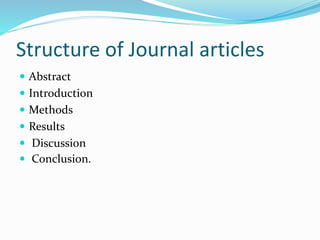
Structure of Journal articles
 Abstract
 Introduction
 Methods
 Results
 Discussion
 Conclusion.
Abstracts
Function Reading Strategies
 Provide a complete overview
of what the research is about,
what it did, how it did it,
what it found and what those
results mean.
 Given the function of the
abstract, you should read it
first to gain a general
understanding about the
whole paper/research
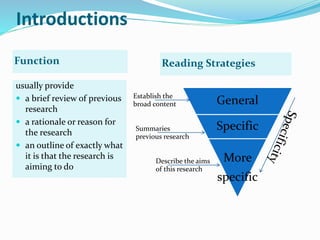
Introductions
Function Reading Strategies
usually provide
 a brief review of previous
research
 a rationale or reason for
the research
 an outline of exactly what
it is that the research is
aiming to do
General
Specific
More
specific
Establish the
broad content
Summaries
previous research
Describe the aims
of this research
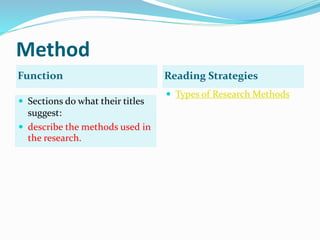
Method
Function Reading Strategies
 Sections do what their titles
suggest:
 describe the methods used in
the research.
 Types of Research Methods
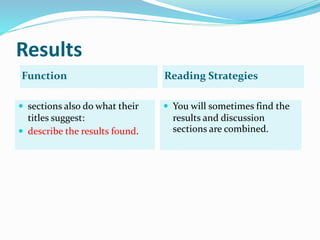
Results
Function Reading Strategies
 sections also do what their
titles suggest:
 describe the results found.
 You will sometimes find the
results and discussion
sections are combined.
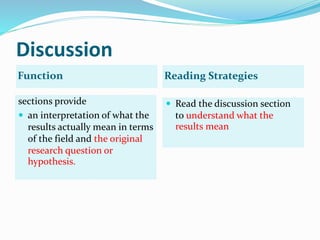
Discussion
Function Reading Strategies
sections provide
 an interpretation of what the
results actually mean in terms
of the field and the original
research question or
hypothesis.
 Read the discussion section
to understand what the
results mean
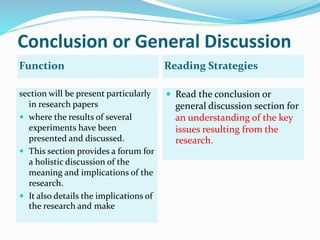
Conclusion or General Discussion
Function Reading Strategies
section will be present particularly
in research papers
 where the results of several
experiments have been
presented and discussed.
 This section provides a forum for
a holistic discussion of the
meaning and implications of the
research.
 It also details the implications of
the research and make
 Read the conclusion or
general discussion section for
an understanding of the key
issues resulting from the
research.
การอ่านงานวิจัยอย่างมีประสิทธิภาพอาจทาได้โดย
 ไม่ควรแปลคำศัพท์ทุกตัว เพื่ออ่ำนทุกตัวอักษร
 พยำยำมใช้พจนำนุกรมให้น้อยที่สุด อ่ำนรูปประโยค โดยกำรเดำ
ศัพท์หำกไม่สำมำรถตีควำมหมำยได้ชัดเจนแล้วจึงพึ่งพจนำนุกรม
รู้จุดมุ่งหมายของการอ่านงานวิจัย
เพื่อ ทรำบควำมเป็นมำคร่ำวๆของงำน
(background) หรือ เพื่อค้นหำข้อมูลที่เป็น
ประเด็นบำงจุดที่ต้องกำร (specific point)
การเริ่มต้นอ่าน
 ไม่จำเป็นต้องอ่ำนทุกสิ่งทุกอย่ำงในงำนวิจัย เพรำะสิ้นเปลืองเวลำ
 จึงควรเริ่มต้นอ่ำนอย่ำงรวดเร็วก่อน โดยให้อ่ำน 1-2 ประโยคแรกใน
แต่ละย่อหน้ำให้ได้ใจควำม
 หำกยังไม่สำมำรถจับประเด็นในงำนวิจัยนั้นๆได้จึงค่อยอ่ำนใน
รำยละเอียด เมื่อสนใจงำนวิจัยเรื่องใดควรเริ่มจำกที่ตีพิมพ์ปีล่ำสุดก่อน
แล้วจึงสืบค้นปีย้อนหลัง
ก่อนตัดสินใจอ่าน
งานวิจัยใดอย่าง
ละเอียด
• ชื่อเรื่องน่ำสนใจ
หรือไม่ และคำดเดำ
ควำมยำกง่ำยของเนื้อ
เรื่อง
• ชื่อวำรสำรมีควำม
น่ำเชื่อถือหรือไม่
ก่อนตัดสินใจอ่านงานวิจัยใดอย่างละเอียด ให้สังเกตว่า
 ผู้อ่ำนควรเป็นกลุ่มใด หรือควรมีควำมรู้เรื่องใดมำก่อนหรือไม่
 ทรีทเมนต์ที่ใช้เป็นเรื่องเข้ำใจยำกหรือไม่
เมื่อต้องการอ่านอย่างละเอียด ให้จับประเด็นโดย
ตอบคาถามดังต่อไปนี้
 บทนำ หรือคำนำ (Introduction)
 ทำอะไร? : What did they do?
 ทำไมต้องทำ? : Why did they do?
 ใครทำมำบ้ำงแล้ว? : Who have been done in before?
เมื่อต้องการอ่านอย่างละเอียด ให้จับประเด็นโดย
ตอบคาถามดังต่อไปนี้
 อุปกรณ์และวิธีกำร (Material and Methods)
 ทำอย่ำงไร? : How did they do?
เมื่อต้องการอ่านอย่างละเอียด ให้จับประเด็นโดย
ตอบคาถามดังต่อไปนี้
 ผลกำรทดลอง (Results)
 ทำแล้วพบอะไร? : What did they find?
เมื่อต้องการอ่านอย่างละเอียด ให้จับประเด็นโดย
ตอบคาถามดังต่อไปนี้
 วิจำรณ์ (Discussion)
 สิ่งที่พบมีควำมหมำยอย่ำงไร? : What does it mean?
 นำไปใช้ได้อย่ำงไร? : How to apply it?
 สุดท้าย สรุปข้อมูลที่ได้จำกคำตอบ จัดทำเป็น mind map สกัดประเด็น
หรือข้อมูลที่ต้องกำร เพื่อนำมำใช้เป็นข้อมูลในกำรเขียนโครงร่ำงงำนวิจัย
 Quick scan  Example Articles

Strategies for reading journal articles 1