Story of Java
By: Ahmed Elbassel
Agenda
● Introduction
● Before Java
● The green project
● Team Gathering
● The problem
● The solution
● First name
● The failure
● Surviving
● The success
● Show time
● Next
● References
Introduction
So, What is a programming language?
A programming language is a formal constructed language
designed to communicate instructions to a machine, particularly
a computer. Programming languages can be used to create
programs to control the behavior of a machine or to express
algorithms.
Before Java
The green project
Sun Microsystems decided to develop special software that
could be used to manipulate consumer electronic devices.
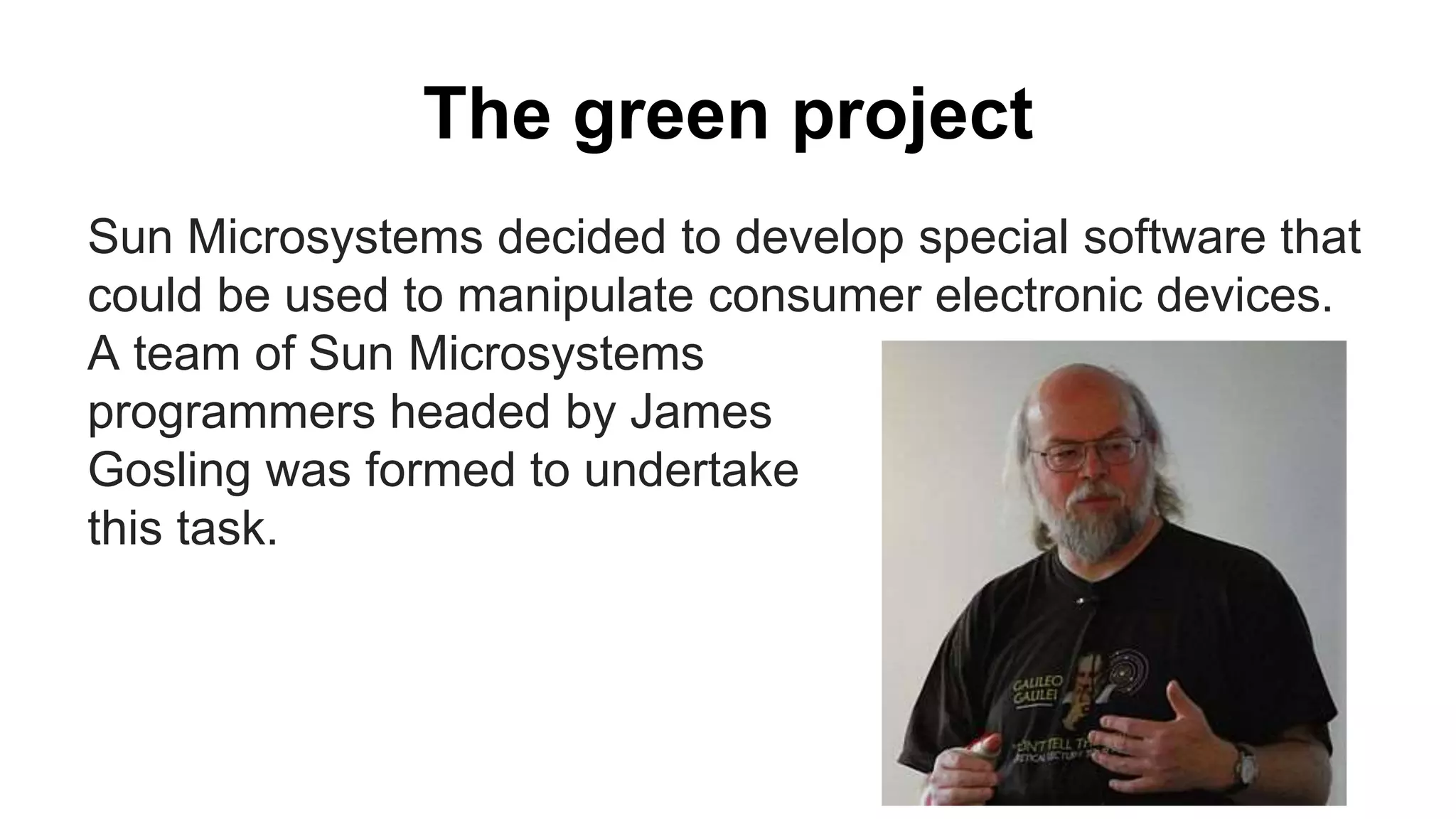
A team of Sun Microsystems
programmers headed by James
Gosling was formed to undertake
this task.
Team Gathering
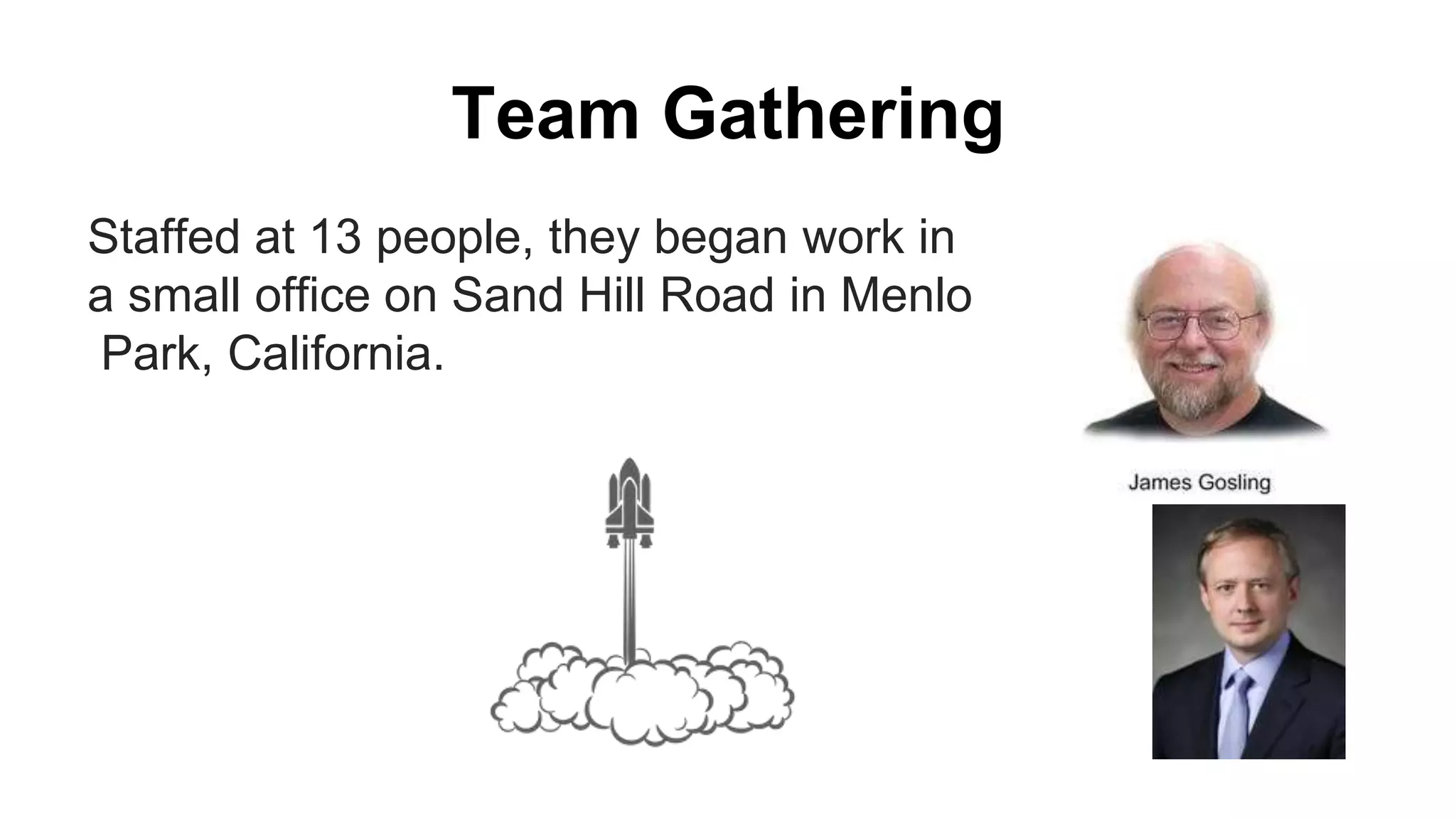
Staffed at 13 people, they began work in
a small office on Sand Hill Road in Menlo
Park, California.
The reason for Java
They take apart many electronic devices, like cable TV set-
top boxes and remote controls to find a way for the
appliances to talk to each other. They discover that the
consumer electronic devices like VCRs and settop boxes
all have different CPUs and limited memory.
The reason for Java
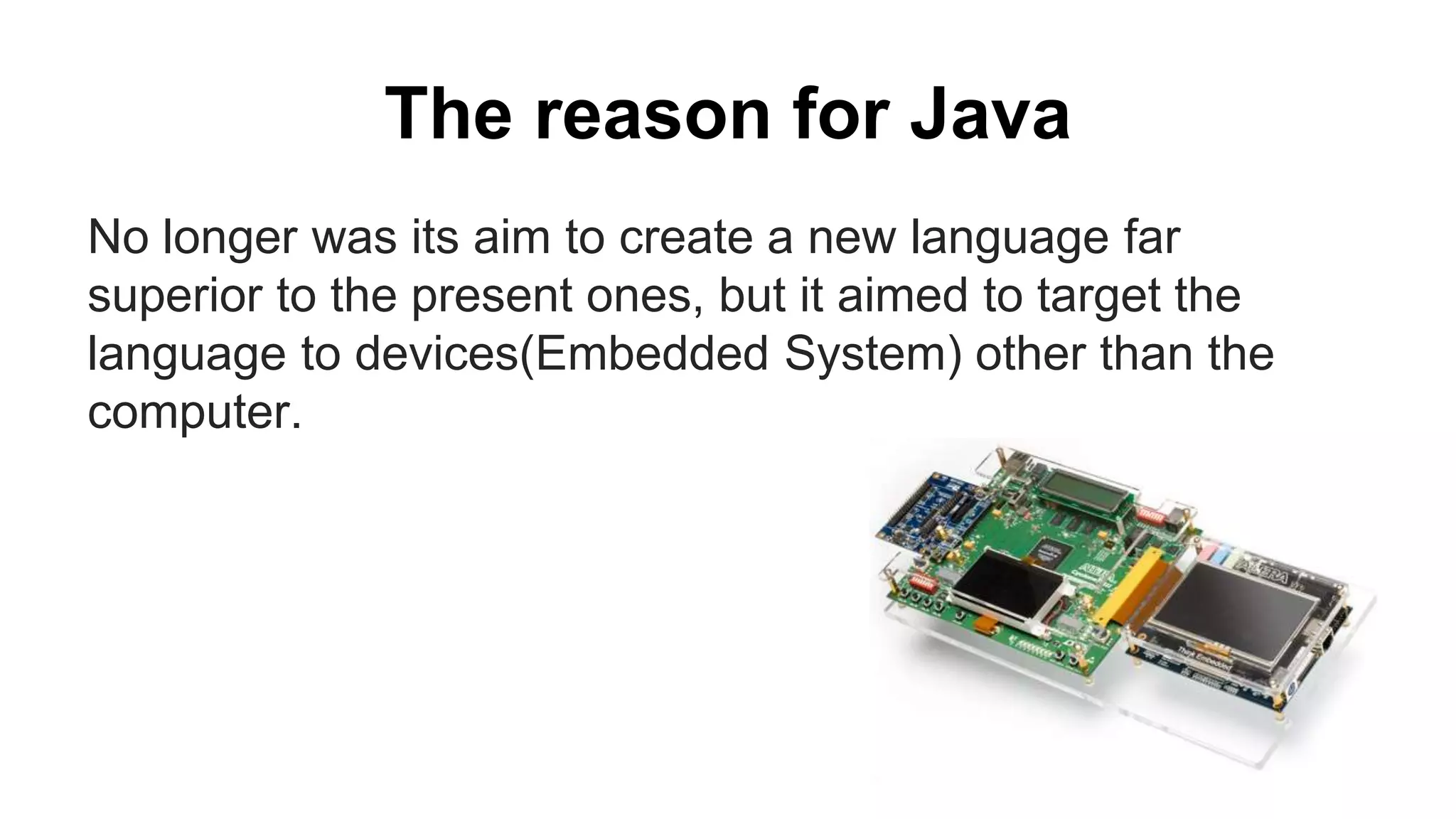
No longer was its aim to create a new language far
superior to the present ones, but it aimed to target the
language to devices(Embedded System) other than the
computer.
The Solution
● Brain storming of the team, all participated.
So the first outcome was (C++ ++ --).
● It renamed to Oak.
● the first demo 1991.
The failure
● Regarding the good solution but this technology did not
take off.
● March 15, 1993, the development team, now
incorporated as FirstPerson.
● FP shifted focus to to the settop box OS market
because of Time Warner.
Surviving
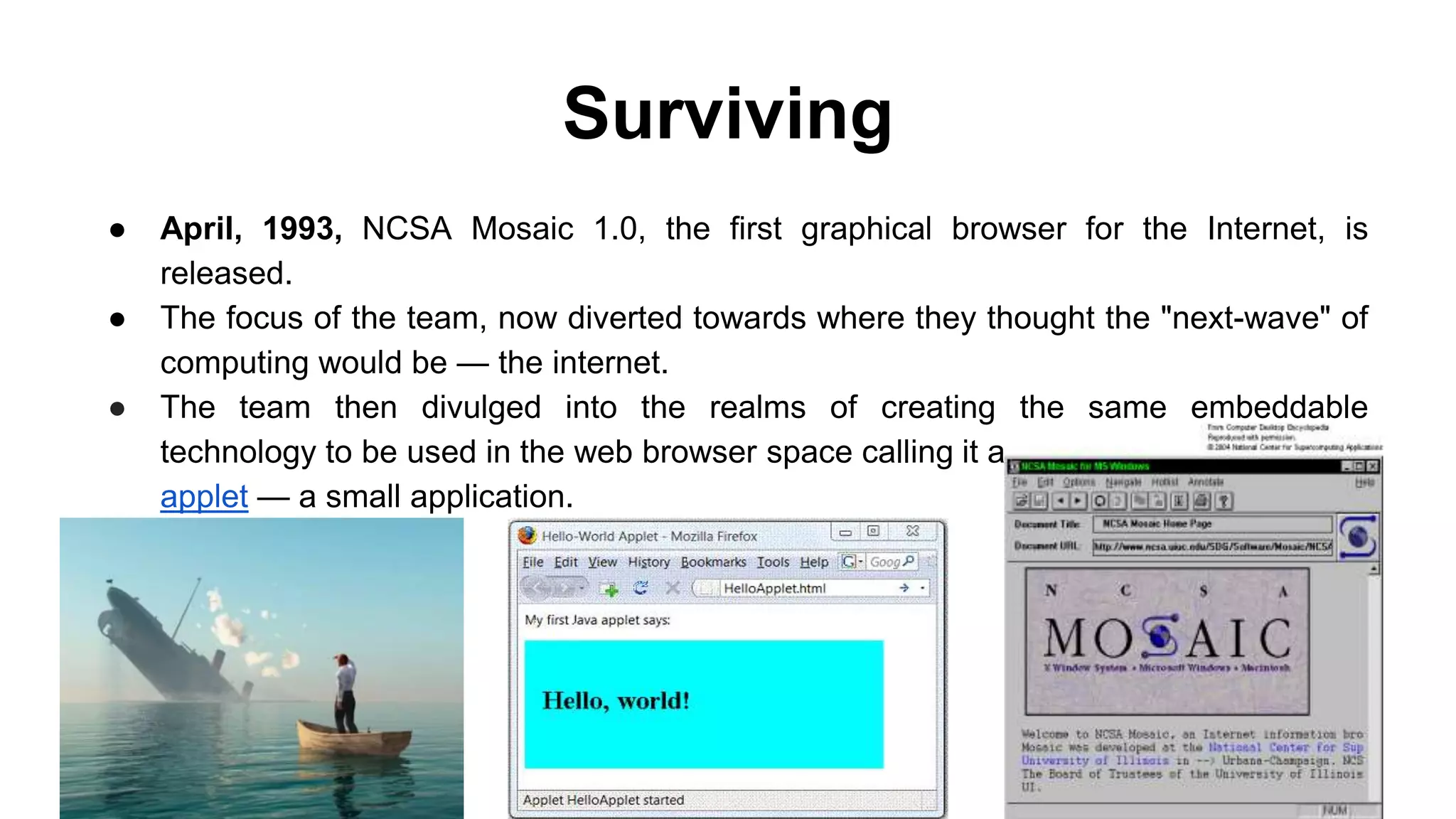
● April, 1993, NCSA Mosaic 1.0, the first graphical browser for the Internet, is
released.
● The focus of the team, now diverted towards where they thought the "next-wave" of
computing would be — the internet.
● The team then divulged into the realms of creating the same embeddable
technology to be used in the web browser space calling it an
applet — a small application.
The success
The team created a list of features tackling the C++ problems. In their opinion,
the project should:
● Be simple and gather tested fundamentals and features from the earlier languages in it.
● Have standard sets of APIs with basic and advanced features bundled with the language,
● Get rid of concepts requiring direct manipulation of hardware (in this case,
● Be platform independent and may written for every platform once (giving birth to the WORA
idiom),
● Be able to manipulate network programming out-of-the-box,
● Be embeddable in web browsers, and ...
● Have the ability for a single program to multi-task and do multiple things at the same time.
Show time
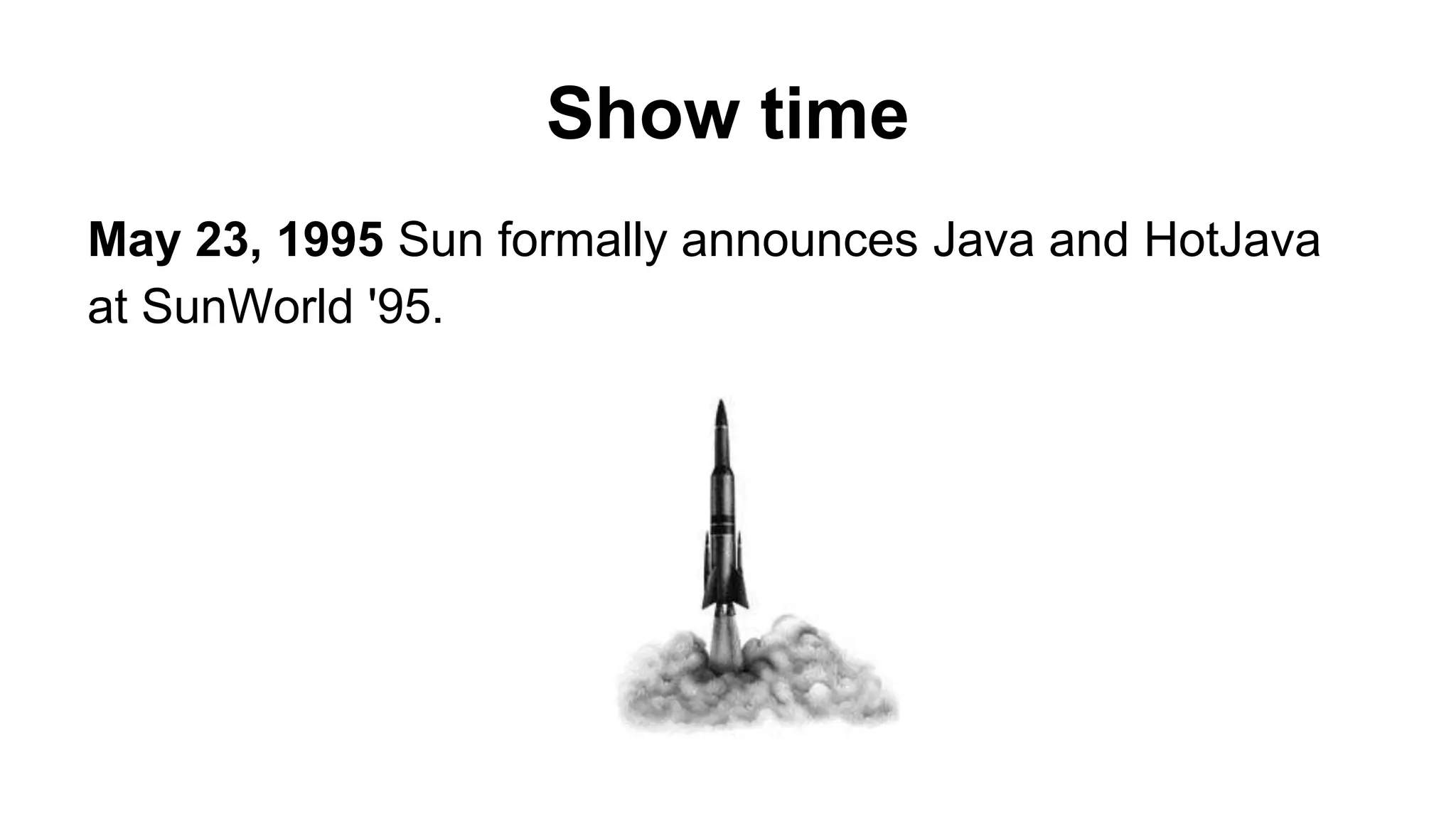
May 23, 1995 Sun formally announces Java and HotJava
at SunWorld '95.
Next
Topic of the next session is Java versions.
References:
http://www.cafeaulait.org/slides/hope/02.html
http://www.java-samples.com/showtutorial.php?tutorialid=109
http://en.wikibooks.org/wiki/Java_Programming/History
http://en.wikipedia.org/wiki/Java_(programming_language)
http://www.oracle.com/technetwork/java/javase/overview/javahistory-index-198355.html
http://papa.det.uvigo.es/~theiere/cursos/Curso_Java/history.html

Story of java

  • 1.
    Story of Java By:Ahmed Elbassel
  • 2.
    Agenda ● Introduction ● BeforeJava ● The green project ● Team Gathering ● The problem ● The solution ● First name ● The failure ● Surviving ● The success ● Show time ● Next ● References
  • 3.
    Introduction So, What isa programming language? A programming language is a formal constructed language designed to communicate instructions to a machine, particularly a computer. Programming languages can be used to create programs to control the behavior of a machine or to express algorithms.
  • 4.
  • 5.
    The green project SunMicrosystems decided to develop special software that could be used to manipulate consumer electronic devices. A team of Sun Microsystems programmers headed by James Gosling was formed to undertake this task.
  • 6.
    Team Gathering Staffed at13 people, they began work in a small office on Sand Hill Road in Menlo Park, California.
  • 7.
    The reason forJava They take apart many electronic devices, like cable TV set- top boxes and remote controls to find a way for the appliances to talk to each other. They discover that the consumer electronic devices like VCRs and settop boxes all have different CPUs and limited memory.
  • 8.
    The reason forJava No longer was its aim to create a new language far superior to the present ones, but it aimed to target the language to devices(Embedded System) other than the computer.
  • 9.
    The Solution ● Brainstorming of the team, all participated. So the first outcome was (C++ ++ --). ● It renamed to Oak. ● the first demo 1991.
  • 10.
    The failure ● Regardingthe good solution but this technology did not take off. ● March 15, 1993, the development team, now incorporated as FirstPerson. ● FP shifted focus to to the settop box OS market because of Time Warner.
  • 11.
    Surviving ● April, 1993,NCSA Mosaic 1.0, the first graphical browser for the Internet, is released. ● The focus of the team, now diverted towards where they thought the "next-wave" of computing would be — the internet. ● The team then divulged into the realms of creating the same embeddable technology to be used in the web browser space calling it an applet — a small application.
  • 12.
    The success The teamcreated a list of features tackling the C++ problems. In their opinion, the project should: ● Be simple and gather tested fundamentals and features from the earlier languages in it. ● Have standard sets of APIs with basic and advanced features bundled with the language, ● Get rid of concepts requiring direct manipulation of hardware (in this case, ● Be platform independent and may written for every platform once (giving birth to the WORA idiom), ● Be able to manipulate network programming out-of-the-box, ● Be embeddable in web browsers, and ... ● Have the ability for a single program to multi-task and do multiple things at the same time.
  • 13.
    Show time May 23,1995 Sun formally announces Java and HotJava at SunWorld '95.
  • 14.
    Next Topic of thenext session is Java versions.
  • 15.