INFO-287-12
STEM in
Libraries:
Collection
Development
February 4, 2016
AGENDA
Collection Development
Pairing Fiction with Nonfiction
Booktalk Assignment
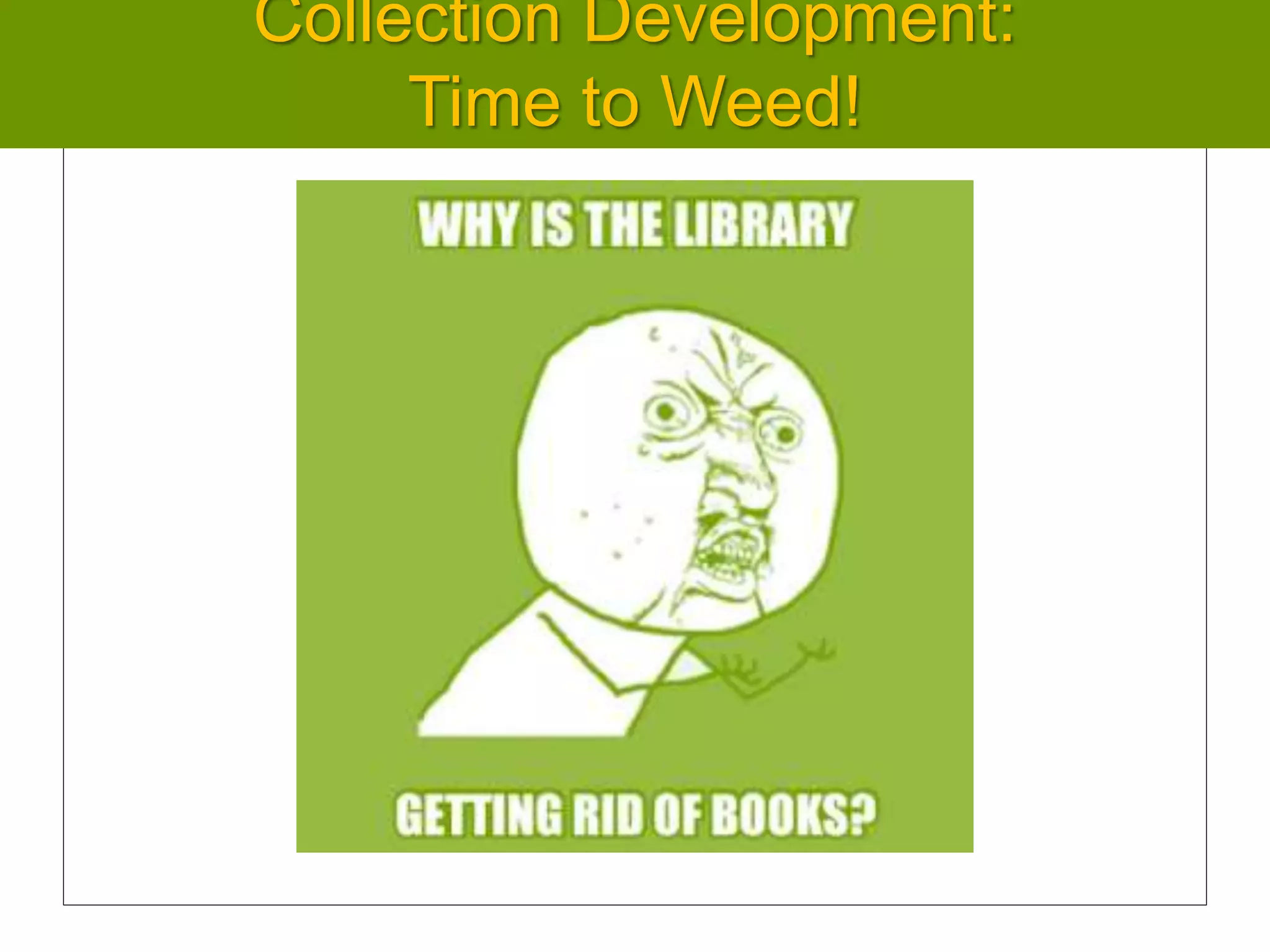
Collection Development:
Time to Weed!
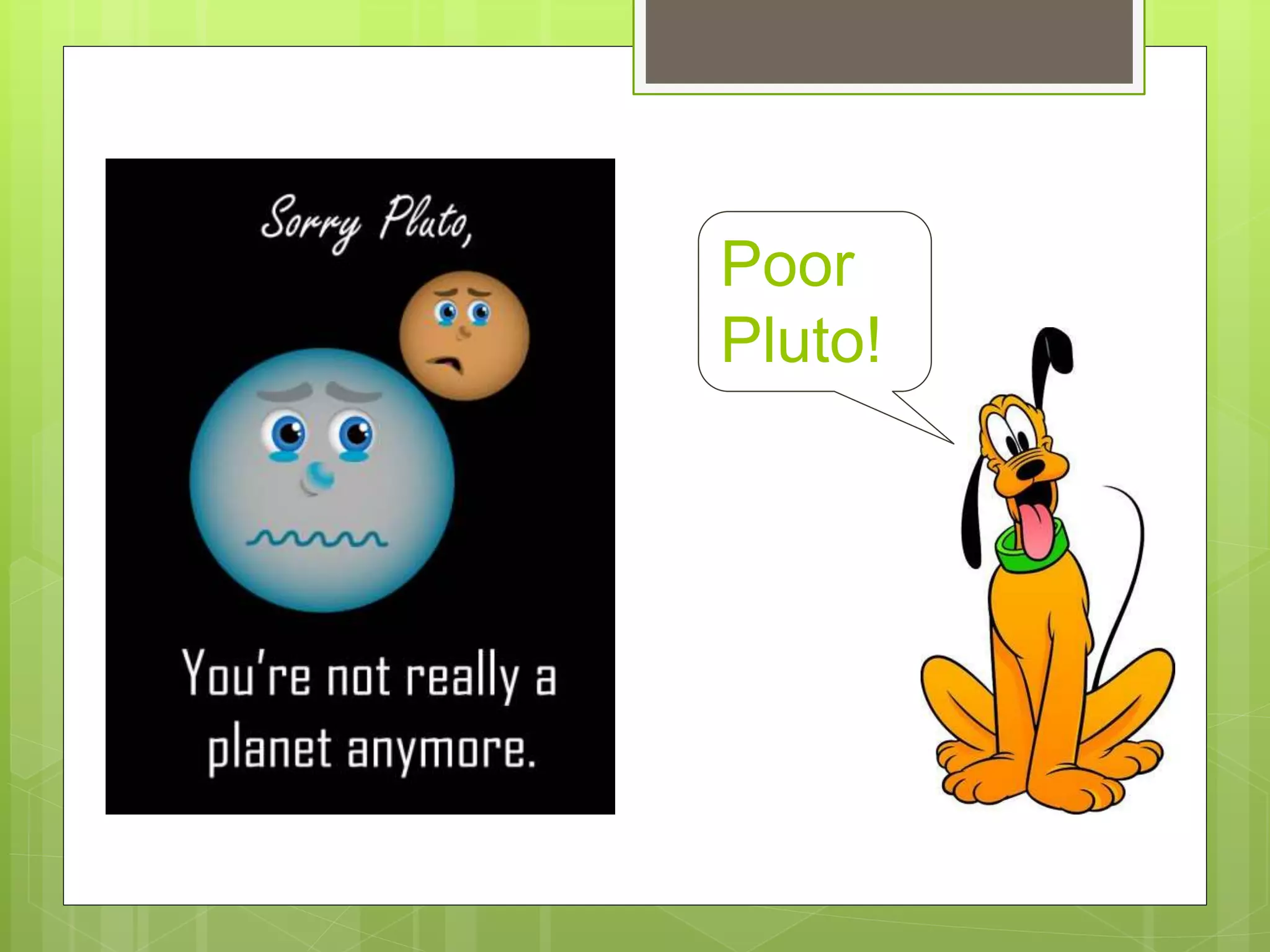
Poor
Pluto!
Collection Development:
Time to Weed!
Publication Date > 5 years
New Discoveries
Outdated Technology
Condition
Relevancy!
What a Great Pair!
Pair Non-Fiction Titles with Fiction
 Connects to Common Core State Standards for
Literacy
 Enforces Concepts through Real-World
Understanding
 Connects Relevancy to Own Lives
 Increases Comprehension
 Access point for readers of both types of
literature.
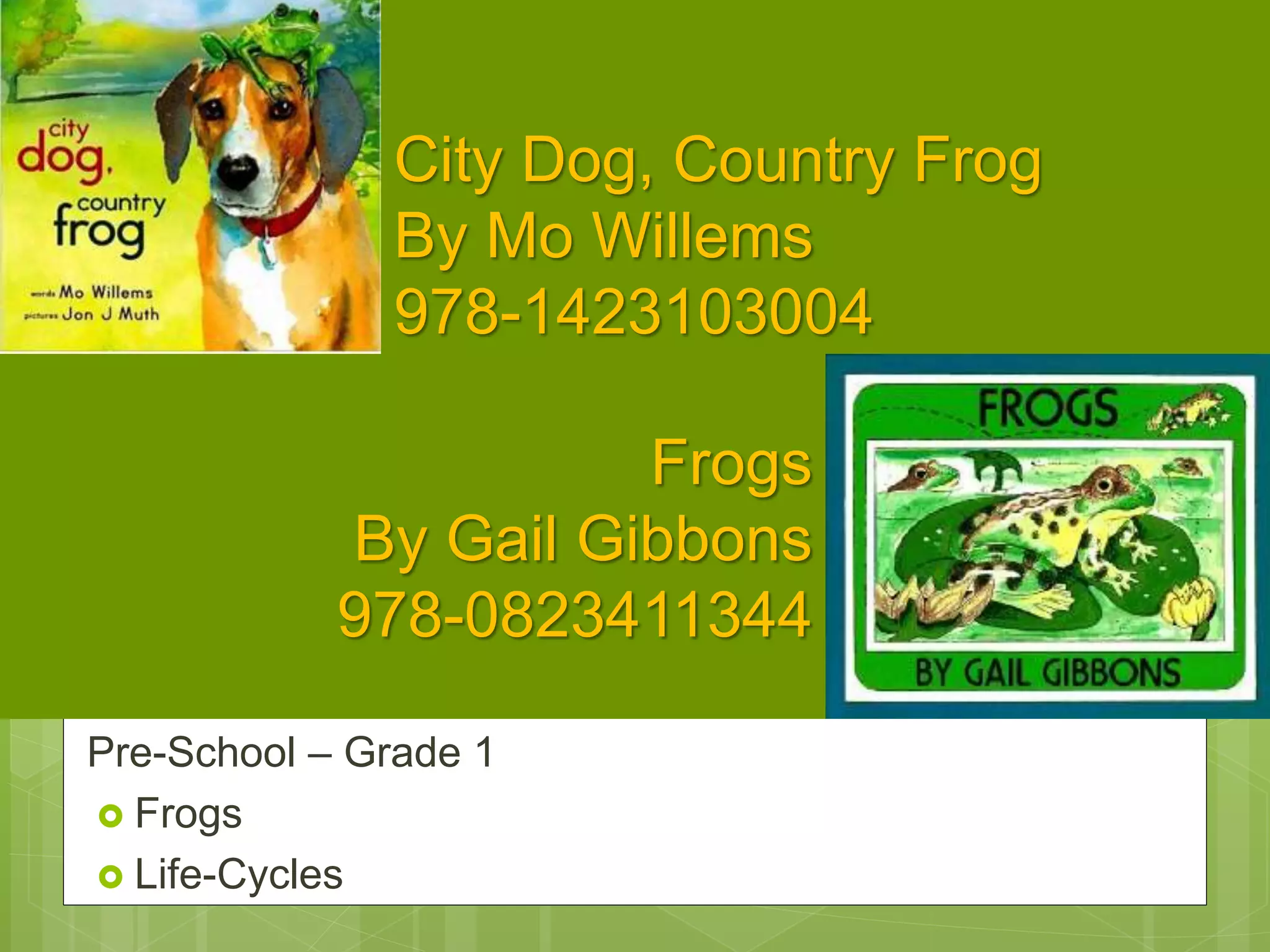
City Dog, Country Frog
By Mo Willems
978-1423103004
Pre-School – Grade 1
 Frogs
 Life-Cycles
Frogs
By Gail Gibbons
978-0823411344
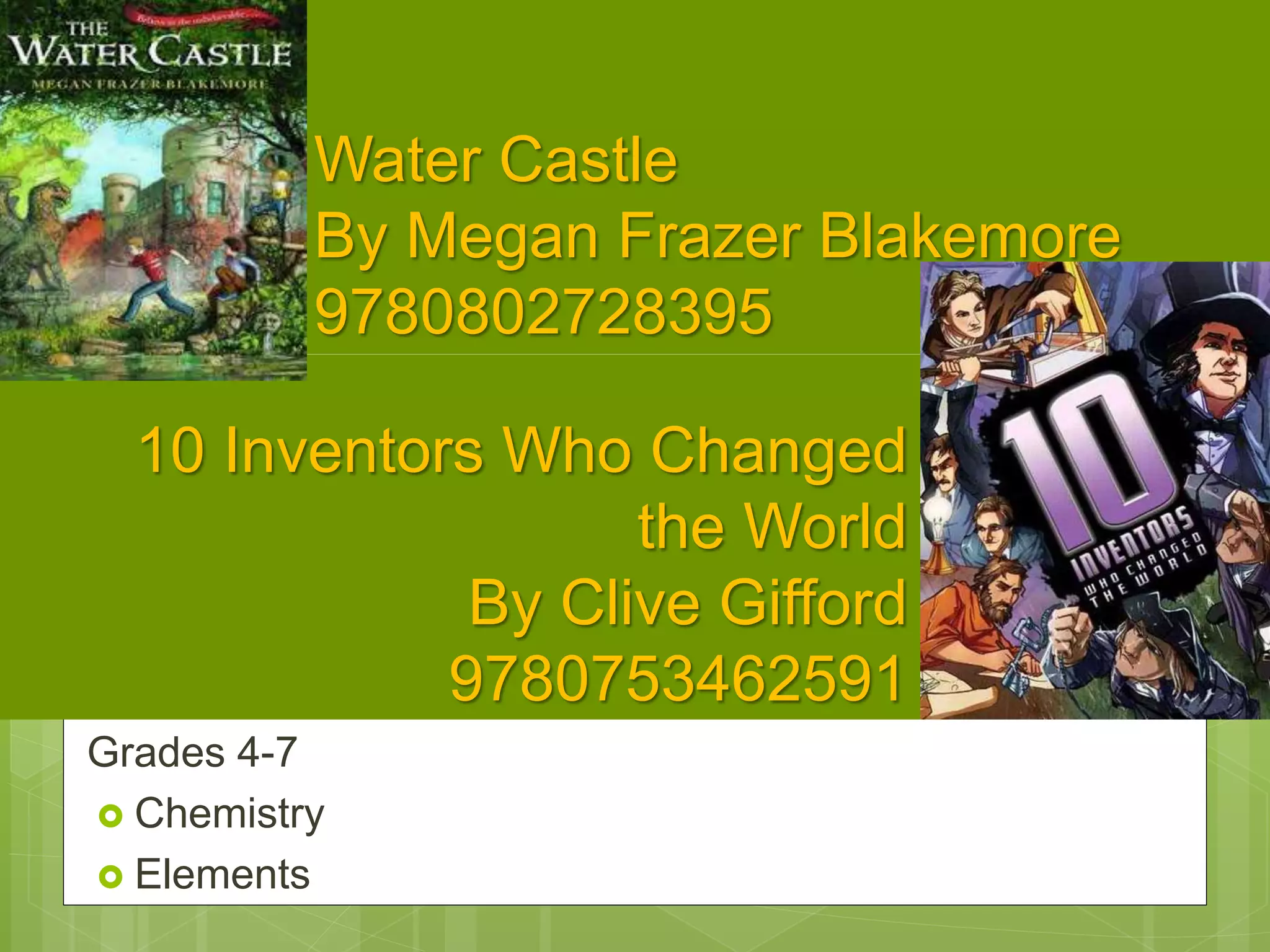
Water Castle
By Megan Frazer Blakemore
9780802728395
Grades 4-7
 Chemistry
 Elements
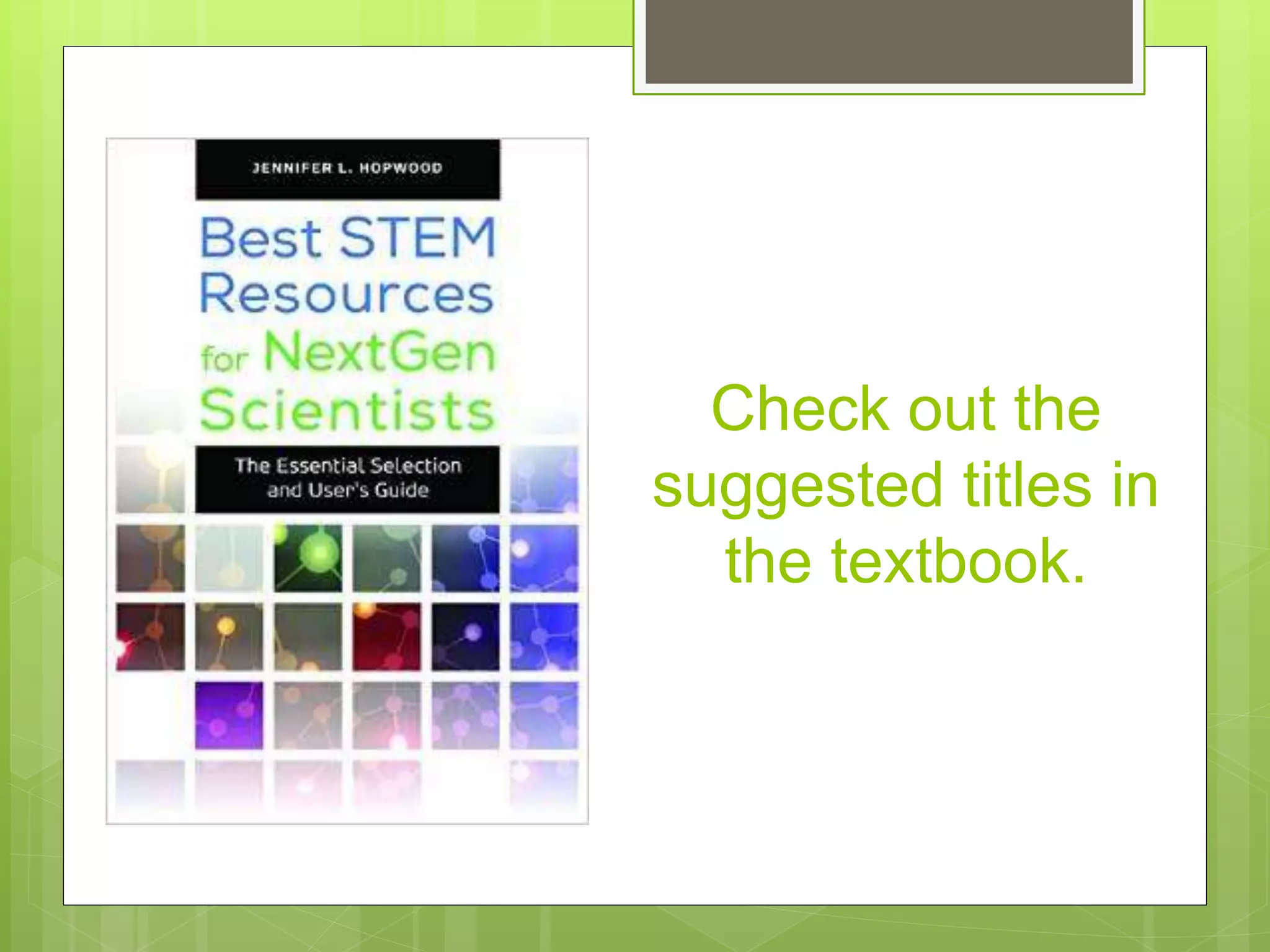
10 Inventors Who Changed
the World
By Clive Gifford
9780753462591
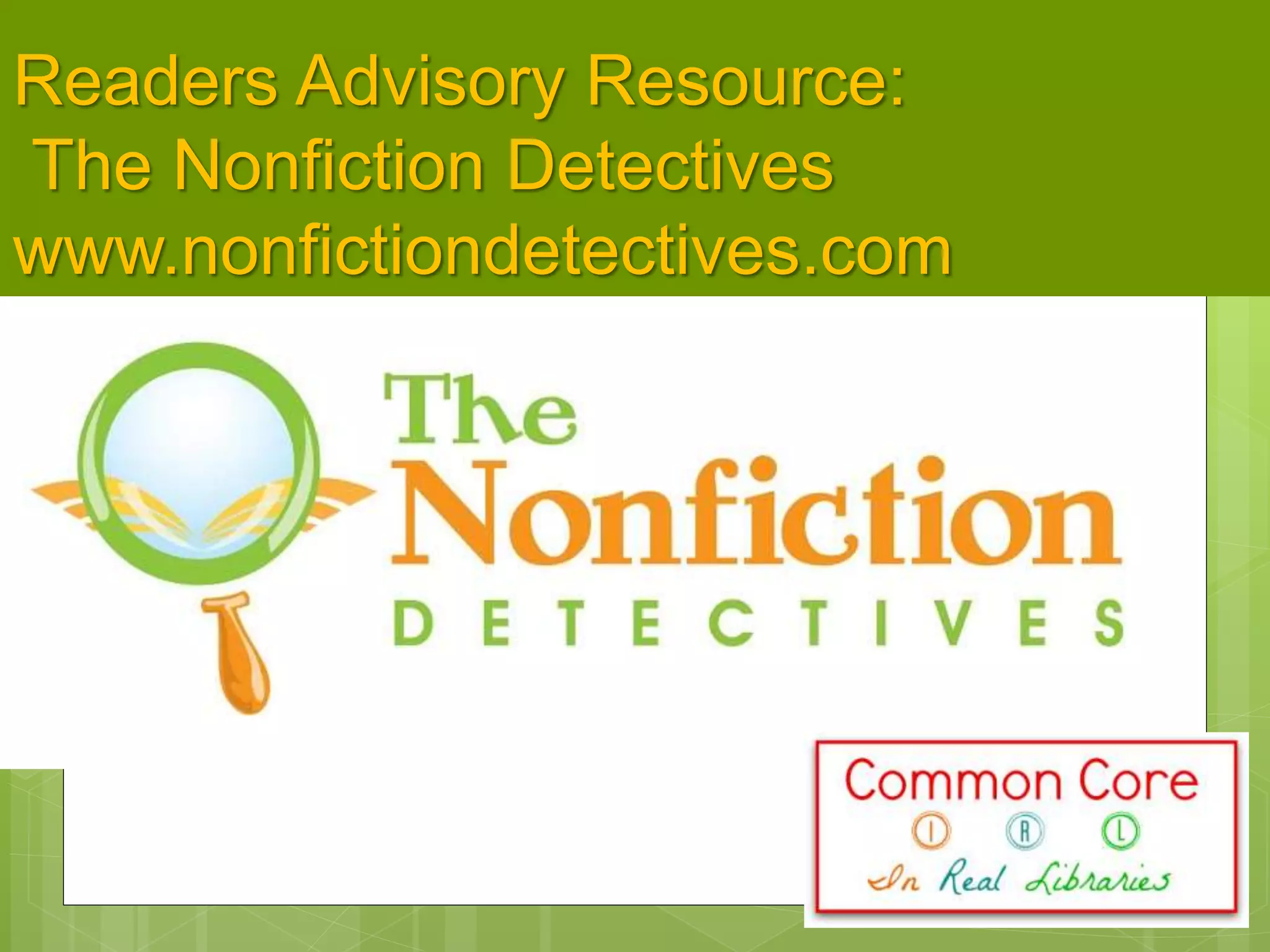
Check out the
suggested titles in
the textbook.
Readers Advisory Resource:
The Nonfiction Detectives
www.nonfictiondetectives.com
Readers Advisory Resource:
Building STEAM with Día
http://dia.ala.org/content/free-program-downloads
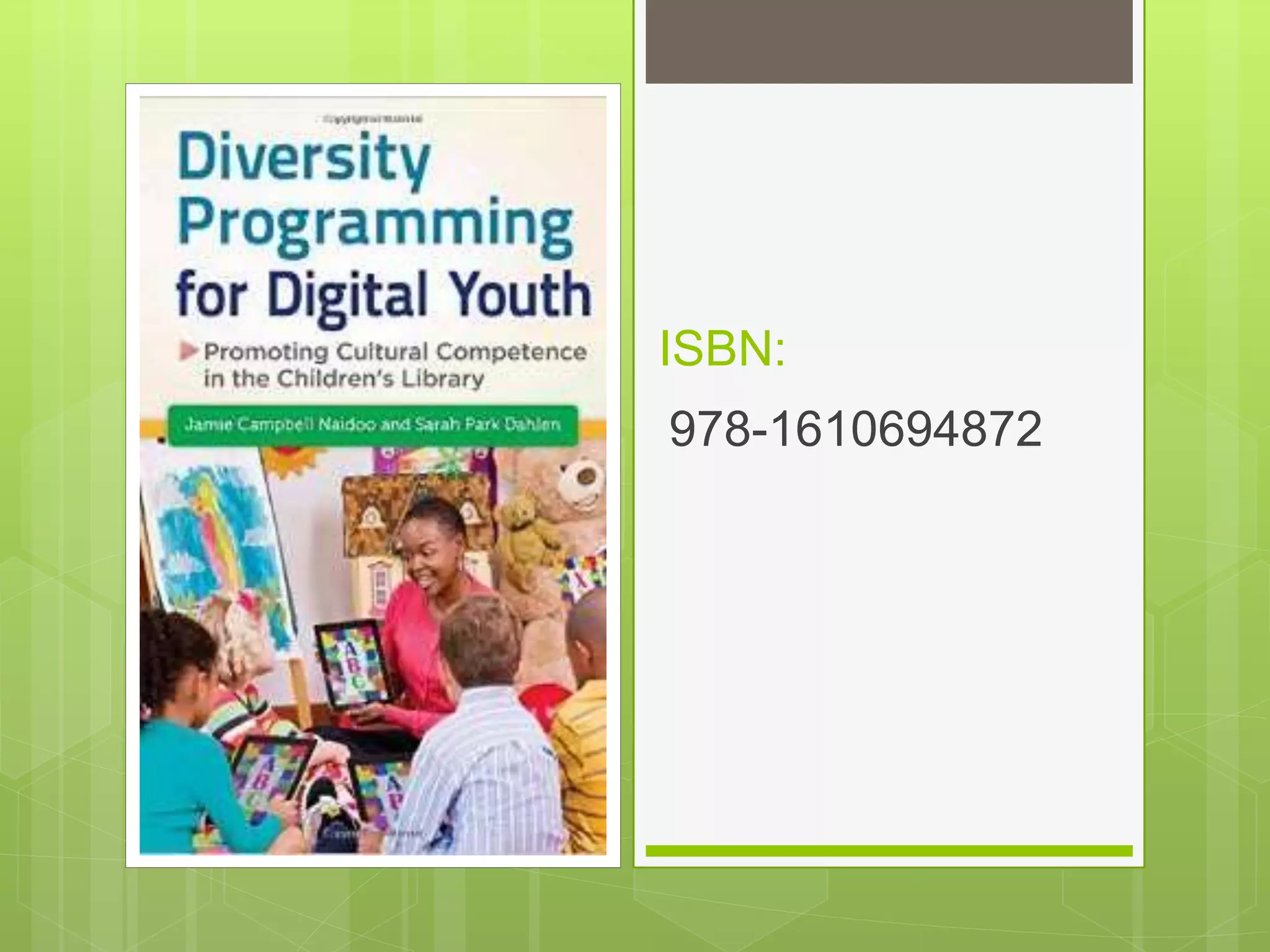
ISBN:
978-1610694872
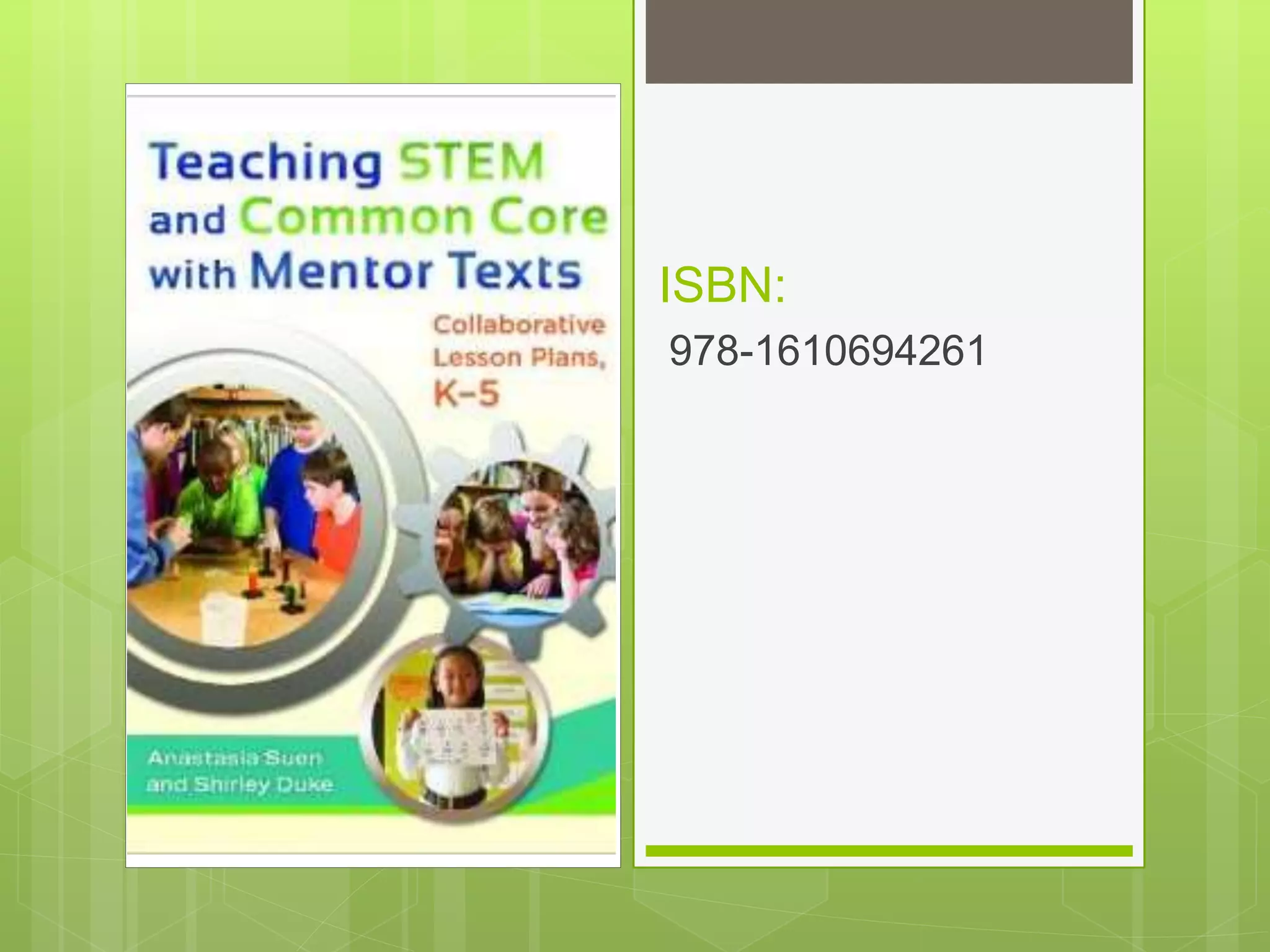
ISBN:
978-1610694261
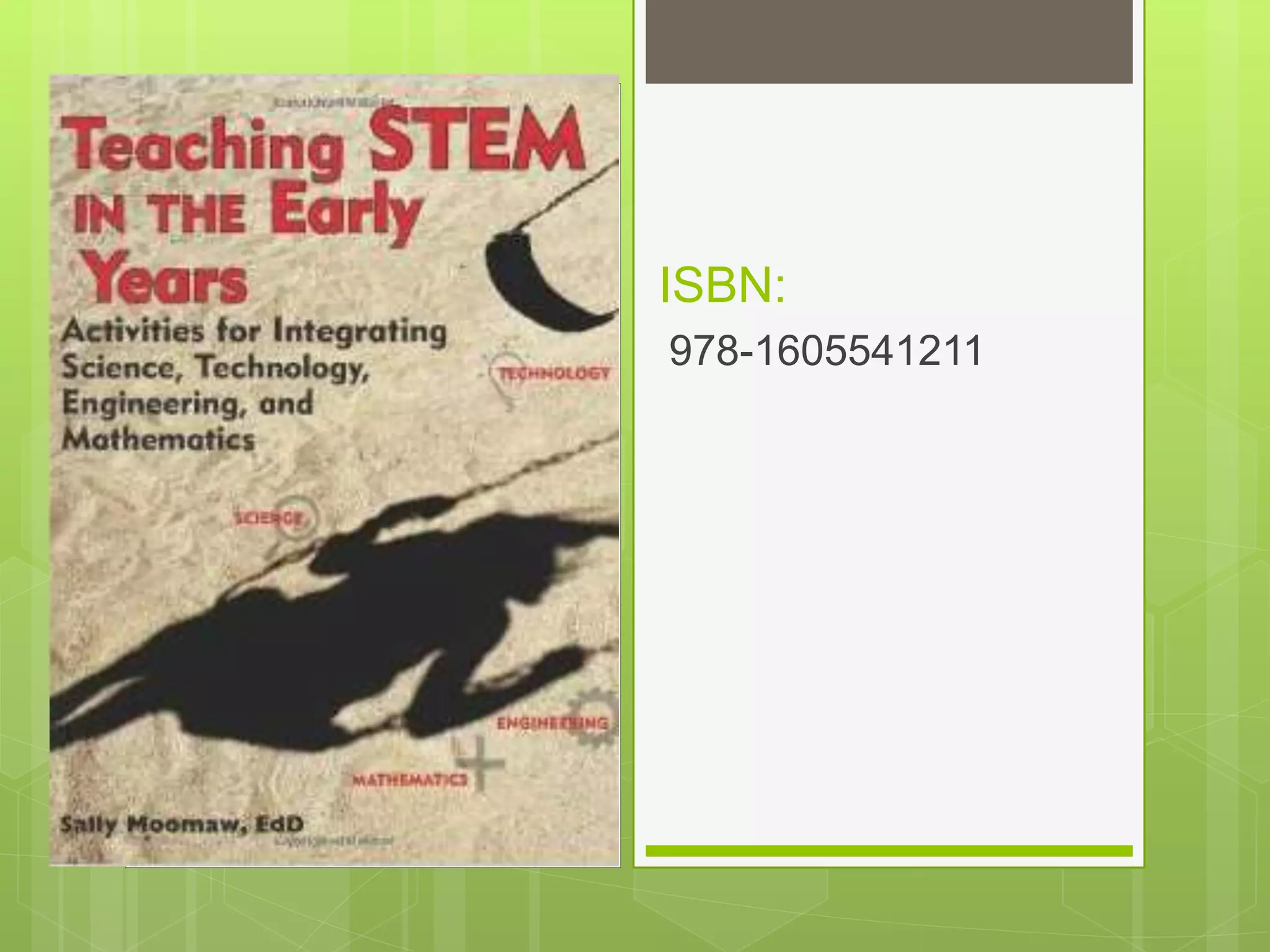
ISBN:
978-1605541211
Lesson Lab: Book Pairing
• Select 1 Non-fiction & 1 Fiction Book
• Submission 1-2 Pages
• Use APA formatting
• Audience your choice
• Entice the reader to read the book.
• Don’t give away the ending!
Questions?

Stem in Libraries: Collection Development

Editor's Notes

  • #2 Welcome to Week 2…
  • #3 This week’s lesson will be discussing collection development.
  • #4 This is probably one of the most important parts about incorporating STEM into your library. You need to make sure that your collection is up to date. Remember that we were talking about constant change. The STEM fields are no different and what we know today might be different tomorrow. Consider this…
  • #5 Pluto is no longer a planet. *this is where we all sigh and say “poor Pluto”.
  • #6 A good rule of thumb would be to limit your collection to nonfiction titles published within the last five years. However, there are always exceptions to this. It is best to look at titles individually based on content. Also consider how relevant your collection is to the children you serve. John Hersey, author of Hiroshima, once worked on a committee for his children’s school to determine why children were struggling at reading. The group’s discovery was that the reason the children were struggling was because they thought the primers they were reading looked boring. They didn’t want to read stories featuring illustrations of perfectly mannered children that just looked dull, insipid, and boring. This concept was what lead to the creation of the Cat in the Hat and Green Eggs and Ham. Using creative illustrations paired with rhyming site words as primers instead.
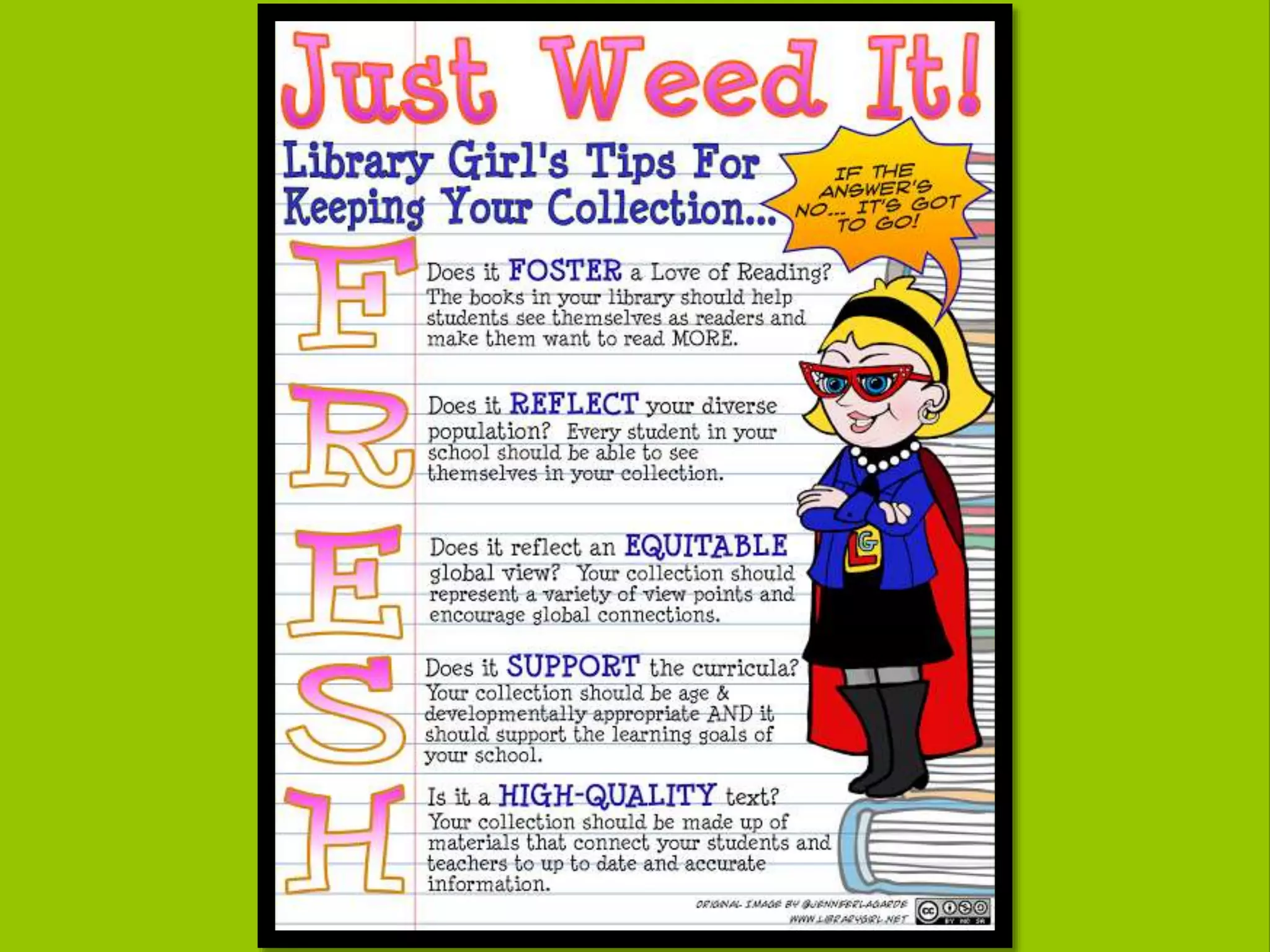
  • #7 Does your collection need an update not just on content, but how about condition? No parent wants to hand their child a smelly dirty book. They will also be hesitant to use a book with pages being held together with book tape and wishful thinking. Keep your collection “FRESH!” as Library Girl says here. I do have one quibble about the S for Support. If you are in a school library, do not assume that all your students will be reading at the same grade level. You may have a third grader reading at the level of a sixth grader which means that when that child is a sixth grader… well, you know what I mean. Also, I know a high school in Florida that has picture books in their collection. Because a lot of their students take care of younger siblings after school. Some were also parents themselves. It goes back to that F for foster. Make sure you are representing and serving all of your students.
  • #8 CCSS.ELA-Literacy.RL.1.5 Explain major differences between books that tell stories and books that give information, drawing on a wide reading of a range of text types.
  • #9 City Dog, Country Frog by Mo Willems is a sad tale about a dog who becomes friends with a frog that is always there until the seasons start to change and then the frog is gone. This is a great fiction title to introduce the concepts of seasons, but also life-cycles and is a great tie in for Gail Gibbons’ Frogs. So when you are paring fiction and non-fiction, the related concepts do not have to take center stage in the fiction title. Use it as an introduction. This is a great way to incorporate nonfiction into your storytimes too.
  • #10 When I would hold a workshop for my teens, I always made sure to have a display table that featured books related to the topic. If we were doing a maker program I would not only have books about inventions and inventors, but also books that featured protagonists who were inventors.
  • #11 The book that I have out at the end of the month is an annotative bibliography on STEM resources. The focus was mainly on fiction books that featured STEM fields, but there are also some nonfiction books listed as well as DVDs, graphic novels, and more. In our lecture readings for this week, you have some excerpts from the book, but here are some additional resources you might want to look at.
  • #12 Non-fiction detectives is a blog that reviews quality nonfiction titles. They also participate in the Common Core in Real Libraries group where they connect some of their reviews to the Common Core Standards.
  • #13 I am very excited about this one! ALSC has created a section of their El Dia website that contains downloadable booklists for STEAM. STEAM is an other acronym associated with STEM that we will talk about later in the course.
  • #14 There is also Dr Jamie Naidoo Campbell’s book. If you ever get a chance to hear him speak, I highly encourage it.
  • #15 Libraries Unlimited also has a new book out that includes in-depth lesson plans for connecting STEM and Common Core with mentor texts.
  • #16 If you purchased the suggested textbook, you will find that it also contains recommended book lists as well as programming ideas.
  • #18 If you have any questions, there are two discussion boards set up in the discussion area. One is a place to ask any course related questions. The other is a student lounge where you may correspond with your classmates. Both of these board will be monitored, but I encourage you to reply to a post if you know the answer to the question being asked.