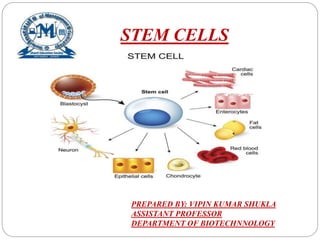
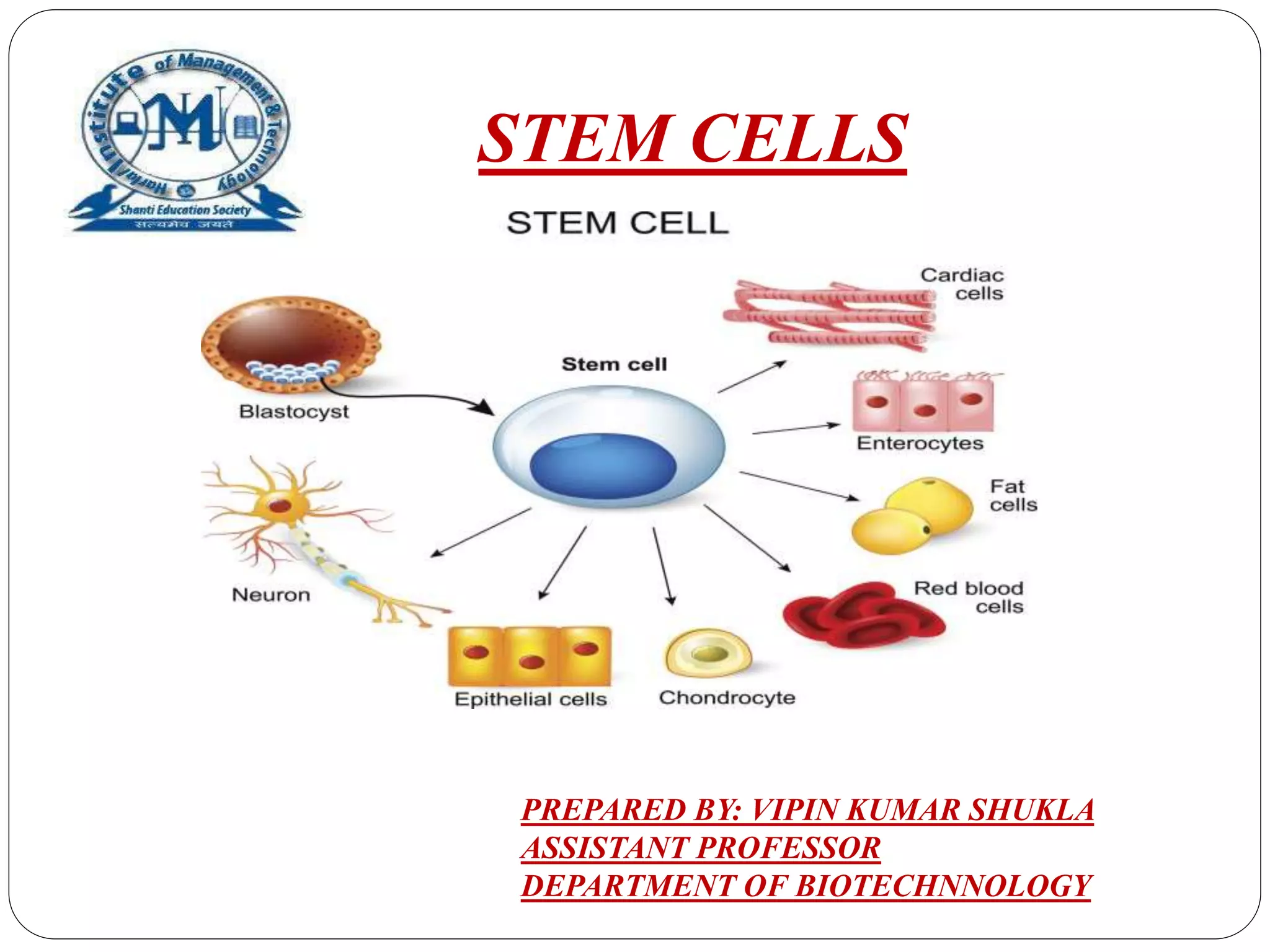
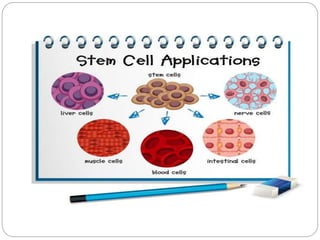
STEM CELLS
PREPARED BY: VIPIN KUMAR SHUKLA
ASSISTANT PROFESSOR
DEPARTMENT OF BIOTECHNNOLOGY
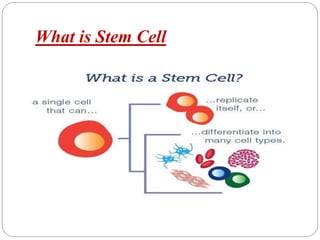
What is Stem Cell
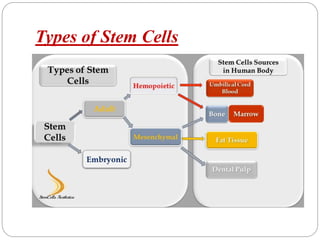
Types of Stem Cells
Stem Cell History
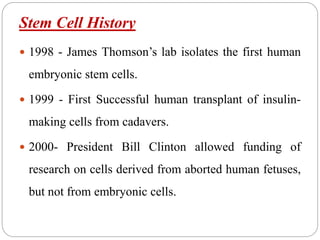
 1998 - James Thomson’s lab isolates the first human
embryonic stem cells.
 1999 - First Successful human transplant of insulin-
making cells from cadavers.
 2000- President Bill Clinton allowed funding of
research on cells derived from aborted human fetuses,
but not from embryonic cells.
Continued…..
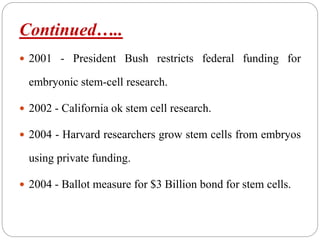
 2001 - President Bush restricts federal funding for
embryonic stem-cell research.
 2002 - California ok stem cell research.
 2004 - Harvard researchers grow stem cells from embryos
using private funding.
 2004 - Ballot measure for $3 Billion bond for stem cells.
Stem Cell – Definition
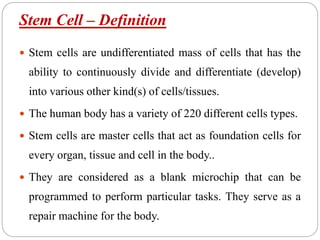
 Stem cells are undifferentiated mass of cells that has the
ability to continuously divide and differentiate (develop)
into various other kind(s) of cells/tissues.
 The human body has a variety of 220 different cells types.
 Stem cells are master cells that act as foundation cells for
every organ, tissue and cell in the body..
 They are considered as a blank microchip that can be
programmed to perform particular tasks. They serve as a
repair machine for the body.
Stem Cell Characteristics
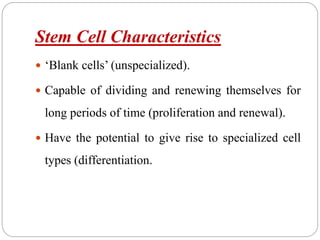
 ‘Blank cells’ (unspecialized).
 Capable of dividing and renewing themselves for
long periods of time (proliferation and renewal).
 Have the potential to give rise to specialized cell
types (differentiation.
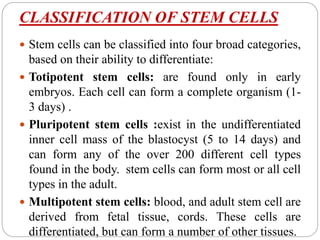
CLASSIFICATION OF STEM CELLS
 Stem cells can be classified into four broad categories,
based on their ability to differentiate:
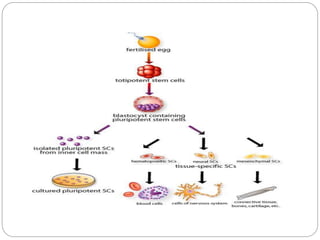
 Totipotent stem cells: are found only in early
embryos. Each cell can form a complete organism (1-
3 days) .
 Pluripotent stem cells :exist in the undifferentiated
inner cell mass of the blastocyst (5 to 14 days) and
can form any of the over 200 different cell types
found in the body. stem cells can form most or all cell
types in the adult.
 Multipotent stem cells: blood, and adult stem cell are
derived from fetal tissue, cords. These cells are
differentiated, but can form a number of other tissues.
Stem cells can form multiple types of
cell and tissue types:
 Unipotent : able to contribute to only one mature
cell type but have the property of self-renewal
which distinguishes them from non-stem cells
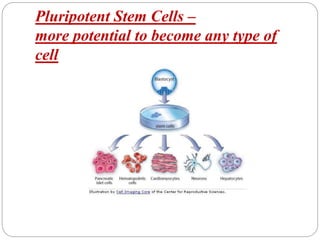
Pluripotent Stem Cells –
more potential to become any type of
cell
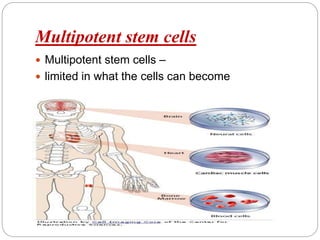
Multipotent stem cells
 Multipotent stem cells –
 limited in what the cells can become
Further classification
 Embryonic stem cells
 Embryonic germ cells
 Adult stem cells
EMBRYONIC STEM CELLS
 Cells found early (less than 2 wks.) in the
development of an Embryo.
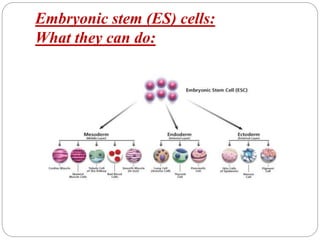
 Embryonic stem cells are the most versatile because
they can become any cell in the body including fetal
stem cells and adult stem cells.
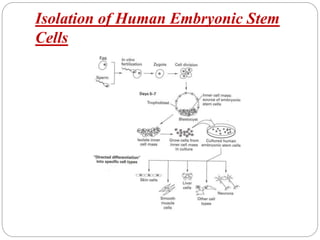
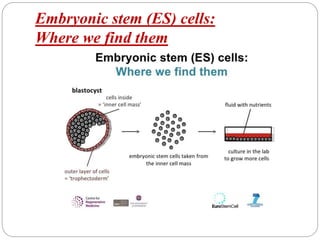
 Embryonic stem (ES) cells are taken from inside the
blastocyst, a very early stage embryo.
Continued…..
 The blastocyst is a ball of about 50-100 cells and it
is not yet implanted in the womb.
 It is made up of an outer layer of cells, a fluid-
filled space and a group of cells called the inner
cell mass. ES cells are found in the inner cell mass.
Isolation of Human Embryonic Stem
Cells
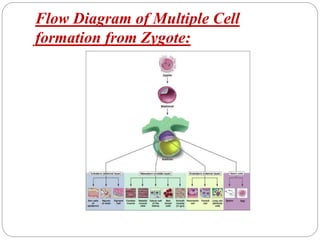
Flow Diagram of Multiple Cell
formation from Zygote:
Embryonic stem (ES) cells:
Where we find them
Embryonic stem (ES) cells:
What they can do:
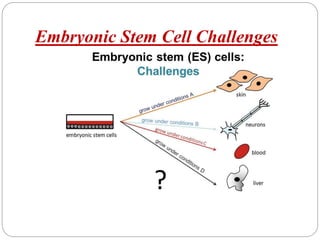
Embryonic Stem Cell Challenges
Embryonic germ cells
 Human embryonic germ cells (EG cells) normally
develop into eggs and sperm. They are derived from a
specific part of the embryo called the gonad ridge, and
are isolated from fetuses older than 8 weeks of
development.
 One advantage of embryonic germ cells cells is that
they do not appear to generate tumors when
transferred into the body, as embryonic stem cells do.
Continued….
 One of the greatest issues facing researchers is
that the derivation of EG cells results from the
destruction of a fetus.
 EG cells are isolated from terminated pregnancies
and no embryos or fetuses are created for research
purposes.
ADULT STEM CELLS
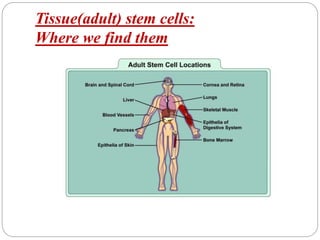
 Adult stem cells are found in the human body and in umbilical
cord blood.
 The most well known source of adult stem cells in the body is
bone marrow but they are also found in many organs and
tissues; even in the blood.
 Adult stem cells are more specialized since they are assigned to
a specific cell family such as blood cells, nerve cells, etc.
 Recently, it was discovered that an adult stem cell from one
tissue may act as a stem cell for another tissue, i.e. blood to
neural.
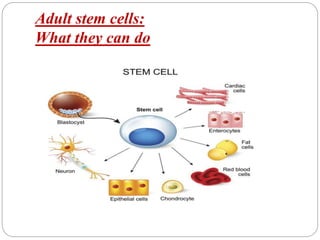
Adult stem cells:
What they can do
Tissue(adult) stem cells:
Where we find them
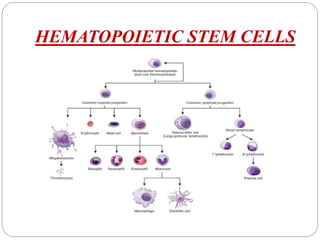
HEMATOPOIETIC STEM CELLS
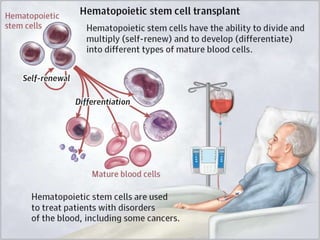
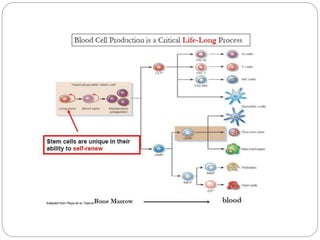
 Hematopoietic stem cells are those cells from where all
blood cells originate.
 Discovery of hematopoietic stem cells in cord blood was
made in the year 1974.
 In the year 1982 Broxmeyer suggested umbilical cord
blood contained significant amount of hematopoietic stem
cells suitable for transplantation.
 Pluripotent :- red cells, white cells and platelets.
 High proliferative capacity : 1 cell in a million.
Sources of hematopoietic stem cells in
human
 Umbilical Cord blood.
 Peripheral blood.
 Bone marrow
Cord Blood
 Umbilical cord blood is also known as placental
blood.
 It is the blood that flows in the circulation of the
developing fetus in the womb.
 After the baby’s birth, the left over blood in the
umbilical cord and placenta is called cord blood.
 This blood is a rich source of stem cells.
Uses for cord blood stem cells
 Today, umbilical cord blood, with its high
concentration of “hematopoietic” stem cells, brings
these types of transplantations into the 21st century.
 Cord blood stem cells have been used to treat more
than 45 malignant and genetic diseases. Leukemia is
the most common.
Continued……
 Stored cord blood stem cells from a child is the perfect
match for that child. This allows for an autologous
transplant if needed, with no risk of Graft-vs- Host
Disease(GVHD).
 GVHD is where the body rejects the donor’s stem cells
and may prevent engraftment from occurring.
 Cord blood stem cells are a close match for siblings or
family members in case of need, with low risk of GVHD.
Uses of stem cells
 Current research shows great promise for the
treatment of heart disease, liver disease, diabetes,
stroke, multiple sclerosis, Alzheimer’s disease,
 Parkinson’s disease, spinal cord injury, and
systemic lupus.
Immuno -Markers for Hematopoietic Stem
Cells (HSC)
 CD 34
 CD 133
 C-kit receptor (CD117)
 Thy-1+ (CD90)
 CD59+
 CD110
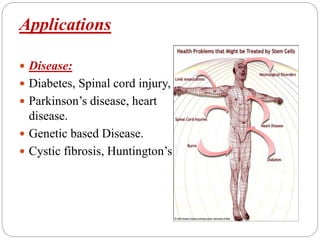
Applications
 Disease:
 Diabetes, Spinal cord injury,
 Parkinson’s disease, heart
disease.
 Genetic based Disease.
 Cystic fibrosis, Huntington’s
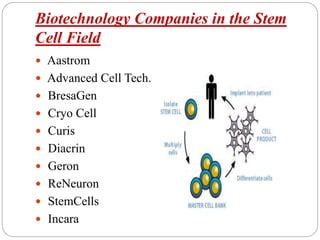
Biotechnology Companies in the Stem
Cell Field
 Aastrom
 Advanced Cell Tech.
 BresaGen
 Cryo Cell
 Curis
 Diacrin
 Geron
 ReNeuron
 StemCells
 Incara
Conclusion
 Stem cell research is complicated and rapidly
changing Today’s medicine generally tries to support
or treat injured tissues and organs, but stem cells may
someday simply replace them. Stem cell therapy is
considered as like a soldier with a weapon.
 Only if the soldier (experienced doctor ),weapon
(technology) and bullets (stem cells) all are in our
hand than the fight will turn in our favor.

Stem cells

  • 1.
    STEM CELLS PREPARED BY:VIPIN KUMAR SHUKLA ASSISTANT PROFESSOR DEPARTMENT OF BIOTECHNNOLOGY
  • 2.
  • 3.
  • 4.
    Stem Cell History 1998 - James Thomson’s lab isolates the first human embryonic stem cells.  1999 - First Successful human transplant of insulin- making cells from cadavers.  2000- President Bill Clinton allowed funding of research on cells derived from aborted human fetuses, but not from embryonic cells.
  • 5.
    Continued…..  2001 -President Bush restricts federal funding for embryonic stem-cell research.  2002 - California ok stem cell research.  2004 - Harvard researchers grow stem cells from embryos using private funding.  2004 - Ballot measure for $3 Billion bond for stem cells.
  • 6.
    Stem Cell –Definition  Stem cells are undifferentiated mass of cells that has the ability to continuously divide and differentiate (develop) into various other kind(s) of cells/tissues.  The human body has a variety of 220 different cells types.  Stem cells are master cells that act as foundation cells for every organ, tissue and cell in the body..  They are considered as a blank microchip that can be programmed to perform particular tasks. They serve as a repair machine for the body.
  • 7.
    Stem Cell Characteristics ‘Blank cells’ (unspecialized).  Capable of dividing and renewing themselves for long periods of time (proliferation and renewal).  Have the potential to give rise to specialized cell types (differentiation.
  • 8.
    CLASSIFICATION OF STEMCELLS  Stem cells can be classified into four broad categories, based on their ability to differentiate:  Totipotent stem cells: are found only in early embryos. Each cell can form a complete organism (1- 3 days) .  Pluripotent stem cells :exist in the undifferentiated inner cell mass of the blastocyst (5 to 14 days) and can form any of the over 200 different cell types found in the body. stem cells can form most or all cell types in the adult.  Multipotent stem cells: blood, and adult stem cell are derived from fetal tissue, cords. These cells are differentiated, but can form a number of other tissues.
  • 9.
    Stem cells canform multiple types of cell and tissue types:  Unipotent : able to contribute to only one mature cell type but have the property of self-renewal which distinguishes them from non-stem cells
  • 11.
    Pluripotent Stem Cells– more potential to become any type of cell
  • 12.
    Multipotent stem cells Multipotent stem cells –  limited in what the cells can become
  • 13.
    Further classification  Embryonicstem cells  Embryonic germ cells  Adult stem cells
  • 14.
    EMBRYONIC STEM CELLS Cells found early (less than 2 wks.) in the development of an Embryo.  Embryonic stem cells are the most versatile because they can become any cell in the body including fetal stem cells and adult stem cells.  Embryonic stem (ES) cells are taken from inside the blastocyst, a very early stage embryo.
  • 15.
    Continued…..  The blastocystis a ball of about 50-100 cells and it is not yet implanted in the womb.  It is made up of an outer layer of cells, a fluid- filled space and a group of cells called the inner cell mass. ES cells are found in the inner cell mass.
  • 16.
    Isolation of HumanEmbryonic Stem Cells
  • 17.
    Flow Diagram ofMultiple Cell formation from Zygote:
  • 18.
    Embryonic stem (ES)cells: Where we find them
  • 19.
    Embryonic stem (ES)cells: What they can do:
  • 20.
  • 21.
    Embryonic germ cells Human embryonic germ cells (EG cells) normally develop into eggs and sperm. They are derived from a specific part of the embryo called the gonad ridge, and are isolated from fetuses older than 8 weeks of development.  One advantage of embryonic germ cells cells is that they do not appear to generate tumors when transferred into the body, as embryonic stem cells do.
  • 22.
    Continued….  One ofthe greatest issues facing researchers is that the derivation of EG cells results from the destruction of a fetus.  EG cells are isolated from terminated pregnancies and no embryos or fetuses are created for research purposes.
  • 23.
    ADULT STEM CELLS Adult stem cells are found in the human body and in umbilical cord blood.  The most well known source of adult stem cells in the body is bone marrow but they are also found in many organs and tissues; even in the blood.  Adult stem cells are more specialized since they are assigned to a specific cell family such as blood cells, nerve cells, etc.  Recently, it was discovered that an adult stem cell from one tissue may act as a stem cell for another tissue, i.e. blood to neural.
  • 24.
  • 25.
  • 26.
  • 27.
    HEMATOPOIETIC STEM CELLS Hematopoietic stem cells are those cells from where all blood cells originate.  Discovery of hematopoietic stem cells in cord blood was made in the year 1974.  In the year 1982 Broxmeyer suggested umbilical cord blood contained significant amount of hematopoietic stem cells suitable for transplantation.  Pluripotent :- red cells, white cells and platelets.  High proliferative capacity : 1 cell in a million.
  • 29.
    Sources of hematopoieticstem cells in human  Umbilical Cord blood.  Peripheral blood.  Bone marrow
  • 31.
    Cord Blood  Umbilicalcord blood is also known as placental blood.  It is the blood that flows in the circulation of the developing fetus in the womb.  After the baby’s birth, the left over blood in the umbilical cord and placenta is called cord blood.  This blood is a rich source of stem cells.
  • 32.
    Uses for cordblood stem cells  Today, umbilical cord blood, with its high concentration of “hematopoietic” stem cells, brings these types of transplantations into the 21st century.  Cord blood stem cells have been used to treat more than 45 malignant and genetic diseases. Leukemia is the most common.
  • 33.
    Continued……  Stored cordblood stem cells from a child is the perfect match for that child. This allows for an autologous transplant if needed, with no risk of Graft-vs- Host Disease(GVHD).  GVHD is where the body rejects the donor’s stem cells and may prevent engraftment from occurring.  Cord blood stem cells are a close match for siblings or family members in case of need, with low risk of GVHD.
  • 34.
    Uses of stemcells  Current research shows great promise for the treatment of heart disease, liver disease, diabetes, stroke, multiple sclerosis, Alzheimer’s disease,  Parkinson’s disease, spinal cord injury, and systemic lupus.
  • 35.
    Immuno -Markers forHematopoietic Stem Cells (HSC)  CD 34  CD 133  C-kit receptor (CD117)  Thy-1+ (CD90)  CD59+  CD110
  • 37.
    Applications  Disease:  Diabetes,Spinal cord injury,  Parkinson’s disease, heart disease.  Genetic based Disease.  Cystic fibrosis, Huntington’s
  • 40.
    Biotechnology Companies inthe Stem Cell Field  Aastrom  Advanced Cell Tech.  BresaGen  Cryo Cell  Curis  Diacrin  Geron  ReNeuron  StemCells  Incara
  • 41.
    Conclusion  Stem cellresearch is complicated and rapidly changing Today’s medicine generally tries to support or treat injured tissues and organs, but stem cells may someday simply replace them. Stem cell therapy is considered as like a soldier with a weapon.  Only if the soldier (experienced doctor ),weapon (technology) and bullets (stem cells) all are in our hand than the fight will turn in our favor.