

STELLA ARTOIS
26 March 2018
Alex Wakeam
Rafay Mirza
Victor Schmidlin
THE PRODUCT.
OR SHOULD WE SAY,
THE ICON?
CURRENT BRAND EQUITY
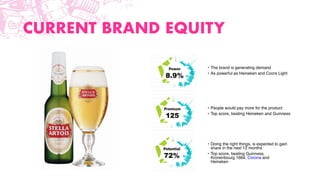
• The brand is generating demand
• As powerful as Heineken and Coors Light
• People would pay more for the product
• Top score, beating Heineken and Guinness
• Doing the right things, is expected to gain
share in the next 12 months
• Top score, beating Guinness,
Kronenbourg 1664, Corona and
Heineken
CURRENT BRAND EQUITY
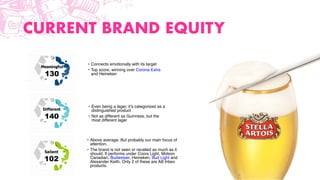
• Connects emotionally with its target
• Top score, winning over Corona Extra
and Heineken
• Even being a lager, it's categorized as a
distinguished product
• Not as different as Guinness, but the
most different lager
• Above average. But probably our main focus of
attention.
• The brand is not seen or recalled as much as it
should. It performs under Coors Light, Molson
Canadian, Budweiser, Heineken, Bud Light and
Alexander Keith. Only 2 of these are AB Inbev
products.
BRAND PROBLEM:
FOCUS ON INCREASE SALIENCE
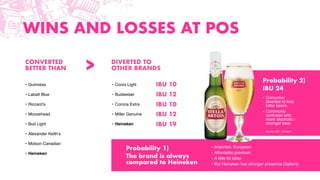
IBU 19
Probability 2)
IBU 24
IBU 12
IBU 10
IBU 12
IBU 10
• Consumer
diverted to less
bitter beers.
• Commonly
confused with
more alcoholic /
stronger beer.
Source: IBU - Untappd
Probability 1)
The brand is always
compared to Heineken
• Imported, European
• Affordable premium
• A little bit bitter
• But Heineken has stronger presence (Salient)
WINS AND LOSSES AT POS
CONVERTED
BETTER THAN
DIVERTED TO
OTHER BRANDS
• Guinness
• Labatt Blue
• Riccard’s
• Moosehead
• Bud Light
• Alexander Keith’s
• Molson Canadian
• Heineken
• Coors Light
• Budweiser
• Corona Extra
• Miller Genuine
• Heineken
>
CONSUMER ISSUE AND
HOW TO DECREASE DIVERSION?
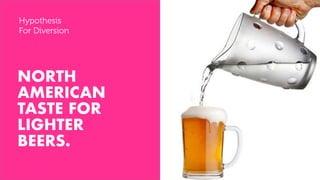
NORTH
AMERICAN
TASTE FOR
LIGHTER
BEERS.
Hypothesis
For Diversion
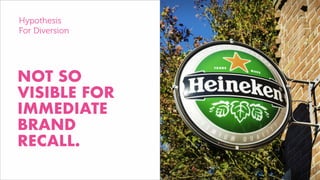
NOT SO
VISIBLE FOR
IMMEDIATE
BRAND
RECALL.
Hypothesis
For Diversion
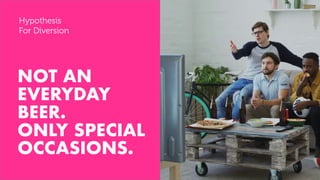
NOT AN
EVERYDAY
BEER.
ONLY SPECIAL
OCCASIONS.
Hypothesis
For Diversion
ELITE IMAGE.
SEEN AS
FANCY, TO
IMPRESS
OTHERS.
Hypothesis
For Diversion
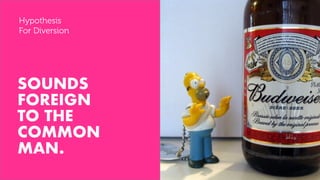
SOUNDS
FOREIGN

TO THE
COMMON
MAN.
Hypothesis
For Diversion
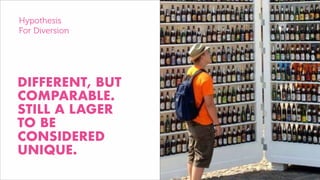
DIFFERENT, BUT
COMPARABLE.
STILL A LAGER
TO BE
CONSIDERED
UNIQUE.
Hypothesis
For Diversion
OUR TARGET.
People who choose a beer that is a
true statement of what they are:
successful and confident.
Consumers who choose quality over
quantity. That will appreciate
instead of drink.
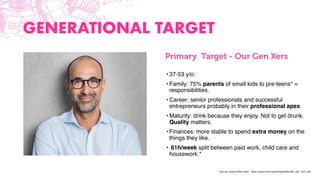
GENERATIONAL TARGET
Primary Target - Our Gen Xers
• 37-53 y/o.
• Family: 75% parents of small kids to pre-teens* =
responsibilities.
• Career: senior professionals and successful
entrepreneurs probably in their professional apex.
• Maturity: drink because they enjoy. Not to get drunk.
Quality matters.
• Finances: more stable to spend extra money on the
things they like.
• 61h/week split between paid work, child care and
housework.*
* Source: Global Web Index - https://www.amic.media/media/les/le_352_1641.pdf
GENERATIONAL TARGET
What do Gen Xers Individually Need or Care About?
•Need more free time: for family, friends and hobbies.
•Details and higher quality: the little things make more sense when you have only 15
minutes between responsibilities.
•Loyalty vs adventure: established tastes but can try something new and are not afraid to
spend extra money.
•Farewell, dear bacon: health, calories, diet, … no excesses anymore.
•Self-image: Am I still cool?
•Nostalgia marketing appeals to Gen X. They will spend more money when feeling
nostalgic and marketers can use that to their advantage.
* Source: PEW Research Center 2015. / Gen X Marketing Strategies: A Demographic “In Bloom” - Eclipse Marketing (https://www.eclipsemarketingservices.com/generation-x-marketing-strategies-a-demographic-in-bloom/)
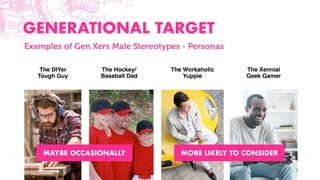
GENERATIONAL TARGET
Examples of Gen Xers Male Stereotypes - Personas
The DIYer
Tough Guy
The Hockey/
Baseball Dad
The Workaholic
Yuppie
The Xennial
Geek Gamer
MAYBE OCCASIONALLY MORE LIKELY TO CONSIDER
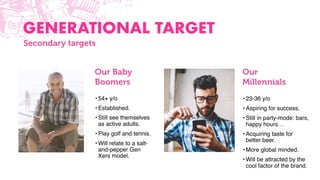
GENERATIONAL TARGET
Our Baby
Boomers
Our
Millennials
• 54+ y/o
• Established.
• Still see themselves
as active adults.
• Play golf and tennis.
• Will relate to a salt-
and-pepper Gen
Xers model.
• 23-36 y/o
• Aspiring for success.
• Still in party-mode: bars,
happy hours…
• Acquiring taste for
better beer.
• More global minded.
• Will be attracted by the
cool factor of the brand.
Secondary targets
HOW TO TARGET
OUR TARGET.
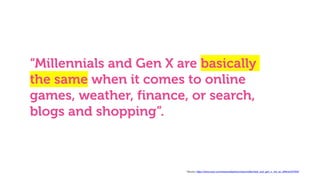
“Millennials and Gen X are basically
the same when it comes to online
games, weather, finance, or search,
blogs and shopping”.
* Source: https://www.warc.com/newsandopinion/news/millennials_and_gen_x_not_so_different/37932
* Sources: Global Web Index - https://www.amic.media/media/les/le_352_1641.pdf, Gen X Marketing Strategies:
A Demographic “In Bloom” - Eclipse Marketing (https://www.eclipsemarketingservices.com/generation-x-marketing-
strategies-a-demographic-in-bloom
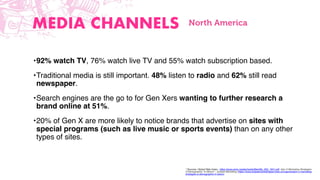
MEDIA CHANNELS
•92% watch TV, 76% watch live TV and 55% watch subscription based.
•Traditional media is still important. 48% listen to radio and 62% still read
newspaper.
•Search engines are the go to for Gen Xers wanting to further research a
brand online at 51%.
•20% of Gen X are more likely to notice brands that advertise on sites with
special programs (such as live music or sports events) than on any other
types of sites.
North America
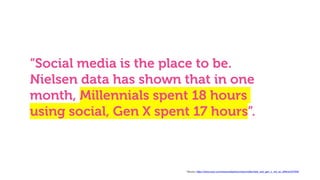
“Social media is the place to be.
Nielsen data has shown that in one
month, Millennials spent 18 hours
using social, Gen X spent 17 hours”.
* Source: https://www.warc.com/newsandopinion/news/millennials_and_gen_x_not_so_different/37932
* Source: Global Web Index - https://www.amic.media/media/les/le_352_1641.pdf
SOCIAL MEDIA
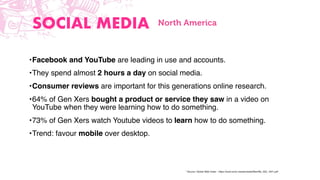
•Facebook and YouTube are leading in use and accounts.
•They spend almost 2 hours a day on social media.
•Consumer reviews are important for this generations online research.
•64% of Gen Xers bought a product or service they saw in a video on
YouTube when they were learning how to do something.
•73% of Gen Xers watch Youtube videos to learn how to do something.
•Trend: favour mobile over desktop.
North America
CONCLUSIONS:
STRATEGY.
STRENGHTS
OPPORTUNITIES
WEAKNESSESS
THREATS
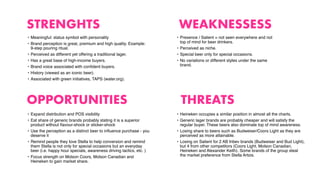
• Meaningful: status symbol with personality
• Brand perception is great, premium and high quality. Example:
9-step pouring ritual.
• Perceived as different yet offering a traditional lager.
• Has a great base of high-income buyers.
• Brand voice associated with confident buyers.
• History (viewed as an iconic beer).
• Associated with green initiatives, TAPS (water.org).
• Presence / Salient = not seen everywhere and not
top of mind for beer drinkers.
• Perceived as niche.
• Special beer only for special occasions.
• No variations or different styles under the same
brand.
• Expand distribution and POS visibility
• Eat share of generic brands probably stating it is a superior
product without flavour-shock or sticker-shock
• Use the perception as a distinct beer to influence purchase - you
deserve it
• Remind people they love Stella to help conversion and remind
them Stella is not only for special occasions but an everyday
beer (i.e. happy hour specials, awareness driving tactics, etc. )
• Focus strength on Molson Coors, Molson Canadian and
Heineken to gain market share.
• Heineken occupies a similar position in almost all the charts.
• Generic lager brands are probably cheaper and will satisfy the
regular buyer. These beers also dominate top of mind awareness.
• Losing share to beers such as Budweiser/Coors Light as they are
perceived as more attainable.
• Losing on Salient for 2 AB Inbev brands (Budweiser and Bud Light),
but 4 from other competitors (Coors Light, Molson Canadian,
Heineken and Alexander Keith). Some brands of the group steal
the market preference from Stella Artois.
MAINTENANCE STRATEGY
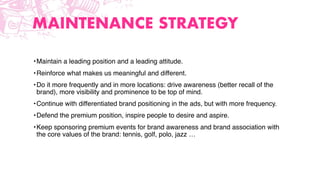
•Maintain a leading position and a leading attitude.
•Reinforce what makes us meaningful and different.
•Do it more frequently and in more locations: drive awareness (better recall of the
brand), more visibility and prominence to be top of mind.
•Continue with differentiated brand positioning in the ads, but with more frequency.
•Defend the premium position, inspire people to desire and aspire.
•Keep sponsoring premium events for brand awareness and brand association with
the core values of the brand: tennis, golf, polo, jazz …
GROWTH STRATEGY
•Present the notion of being one step up. Differentiated because it's superior, not
because it's another type of beer. It's still safe for the average taste but with better
ingredients and brewed flawlessly.
•Increase brand presence and awareness by investing more in advertising, competing
with generic brands.
•To expand consideration with non-buyers, investigate alternatives to engage them with
aspirational messaging (assuming they are ascending in life) that don't relate with elite
sports or elite music, for example.
•Experiential marketing in bars and at events: be top of mind in spaces where
consumers need to be reminded of Stella Artois.
•Brand activation in-LCBO, with sampling.
TACTICAL MEDIA RECOMMENDATIONS
•TV (6-9 pm) - 30s emotional message and 15s reminders.
•Radio (commute time going back home).
•Print, probably segmented premium lifestyle magazines. Opportunity to associate
brand with other premium/luxury brands. Example: Audi Magazine, Cooking Books
like “Mastering BBQ”
•Youtube quick pre-rolls, Facebook ads specifically targeting recipe videos and
upscale brands.
•Discrete product placement in TV series and movies to create a perception that
successful people drink Stella Artois.
IMPLICATIONS

FOR CREATIVE.
CREATIVE THOUGHTSTARTERS.
•Remember: It’s a status symbol. It’s a state of mind and a lifestyle.
•The brand voice is confident in its quality, and in their target's achievements.
•It's a statement of who you are (or aspire to be). Could play with something Epic,
Nostalgic. Can be funny without sarcasm (not snob brand, just superior) or at least
enjoyable.
•Show moments with friends as they become more and more rare.
•Make the regular buyer aspire for more and perceive the difference.
•Make them consider the product as a better daily beer.
•Aftertaste: It’s a reward. Enjoy the moment. You deserve it.
THANK YOU
26 March 2018
Alex Wakeam
Rafay Mirza
Victor Schmidlin

Stella Artois - Research and Implications

  • 1.
    STELLA ARTOIS 26 March2018 Alex Wakeam Rafay Mirza Victor Schmidlin
  • 2.
    THE PRODUCT. OR SHOULDWE SAY, THE ICON?
  • 3.
    CURRENT BRAND EQUITY •The brand is generating demand • As powerful as Heineken and Coors Light • People would pay more for the product • Top score, beating Heineken and Guinness • Doing the right things, is expected to gain share in the next 12 months • Top score, beating Guinness, Kronenbourg 1664, Corona and Heineken
  • 4.
    CURRENT BRAND EQUITY •Connects emotionally with its target • Top score, winning over Corona Extra and Heineken • Even being a lager, it's categorized as a distinguished product • Not as different as Guinness, but the most different lager • Above average. But probably our main focus of attention. • The brand is not seen or recalled as much as it should. It performs under Coors Light, Molson Canadian, Budweiser, Heineken, Bud Light and Alexander Keith. Only 2 of these are AB Inbev products.
  • 5.
    BRAND PROBLEM: FOCUS ONINCREASE SALIENCE
  • 6.
    IBU 19 Probability 2) IBU24 IBU 12 IBU 10 IBU 12 IBU 10 • Consumer diverted to less bitter beers. • Commonly confused with more alcoholic / stronger beer. Source: IBU - Untappd Probability 1) The brand is always compared to Heineken • Imported, European • Affordable premium • A little bit bitter • But Heineken has stronger presence (Salient) WINS AND LOSSES AT POS CONVERTED BETTER THAN DIVERTED TO OTHER BRANDS • Guinness • Labatt Blue • Riccard’s • Moosehead • Bud Light • Alexander Keith’s • Molson Canadian • Heineken • Coors Light • Budweiser • Corona Extra • Miller Genuine • Heineken >
  • 7.
    CONSUMER ISSUE AND HOWTO DECREASE DIVERSION?
  • 8.
  • 9.
  • 10.
  • 11.
    ELITE IMAGE. SEEN AS FANCY,TO IMPRESS OTHERS. Hypothesis For Diversion
  • 12.
  • 13.
    DIFFERENT, BUT COMPARABLE. STILL ALAGER TO BE CONSIDERED UNIQUE. Hypothesis For Diversion
  • 14.
    OUR TARGET. People whochoose a beer that is a true statement of what they are: successful and confident. Consumers who choose quality over quantity. That will appreciate instead of drink.
  • 15.
    GENERATIONAL TARGET Primary Target- Our Gen Xers • 37-53 y/o. • Family: 75% parents of small kids to pre-teens* = responsibilities. • Career: senior professionals and successful entrepreneurs probably in their professional apex. • Maturity: drink because they enjoy. Not to get drunk. Quality matters. • Finances: more stable to spend extra money on the things they like. • 61h/week split between paid work, child care and housework.* * Source: Global Web Index - https://www.amic.media/media/files/file_352_1641.pdf
  • 16.
    GENERATIONAL TARGET What doGen Xers Individually Need or Care About? •Need more free time: for family, friends and hobbies. •Details and higher quality: the little things make more sense when you have only 15 minutes between responsibilities. •Loyalty vs adventure: established tastes but can try something new and are not afraid to spend extra money. •Farewell, dear bacon: health, calories, diet, … no excesses anymore. •Self-image: Am I still cool? •Nostalgia marketing appeals to Gen X. They will spend more money when feeling nostalgic and marketers can use that to their advantage. * Source: PEW Research Center 2015. / Gen X Marketing Strategies: A Demographic “In Bloom” - Eclipse Marketing (https://www.eclipsemarketingservices.com/generation-x-marketing-strategies-a-demographic-in-bloom/)
  • 17.
    GENERATIONAL TARGET Examples ofGen Xers Male Stereotypes - Personas The DIYer Tough Guy The Hockey/ Baseball Dad The Workaholic Yuppie The Xennial Geek Gamer MAYBE OCCASIONALLY MORE LIKELY TO CONSIDER
  • 18.
    GENERATIONAL TARGET Our Baby Boomers Our Millennials •54+ y/o • Established. • Still see themselves as active adults. • Play golf and tennis. • Will relate to a salt- and-pepper Gen Xers model. • 23-36 y/o • Aspiring for success. • Still in party-mode: bars, happy hours… • Acquiring taste for better beer. • More global minded. • Will be attracted by the cool factor of the brand. Secondary targets
  • 19.
  • 20.
    “Millennials and GenX are basically the same when it comes to online games, weather, finance, or search, blogs and shopping”. * Source: https://www.warc.com/newsandopinion/news/millennials_and_gen_x_not_so_different/37932
  • 21.
    * Sources: GlobalWeb Index - https://www.amic.media/media/files/file_352_1641.pdf, Gen X Marketing Strategies: A Demographic “In Bloom” - Eclipse Marketing (https://www.eclipsemarketingservices.com/generation-x-marketing- strategies-a-demographic-in-bloom MEDIA CHANNELS •92% watch TV, 76% watch live TV and 55% watch subscription based. •Traditional media is still important. 48% listen to radio and 62% still read newspaper. •Search engines are the go to for Gen Xers wanting to further research a brand online at 51%. •20% of Gen X are more likely to notice brands that advertise on sites with special programs (such as live music or sports events) than on any other types of sites. North America
  • 22.
    “Social media isthe place to be. Nielsen data has shown that in one month, Millennials spent 18 hours using social, Gen X spent 17 hours”. * Source: https://www.warc.com/newsandopinion/news/millennials_and_gen_x_not_so_different/37932
  • 23.
    * Source: GlobalWeb Index - https://www.amic.media/media/files/file_352_1641.pdf SOCIAL MEDIA •Facebook and YouTube are leading in use and accounts. •They spend almost 2 hours a day on social media. •Consumer reviews are important for this generations online research. •64% of Gen Xers bought a product or service they saw in a video on YouTube when they were learning how to do something. •73% of Gen Xers watch Youtube videos to learn how to do something. •Trend: favour mobile over desktop. North America
  • 24.
  • 25.
    STRENGHTS OPPORTUNITIES WEAKNESSESS THREATS • Meaningful: statussymbol with personality • Brand perception is great, premium and high quality. Example: 9-step pouring ritual. • Perceived as different yet offering a traditional lager. • Has a great base of high-income buyers. • Brand voice associated with confident buyers. • History (viewed as an iconic beer). • Associated with green initiatives, TAPS (water.org). • Presence / Salient = not seen everywhere and not top of mind for beer drinkers. • Perceived as niche. • Special beer only for special occasions. • No variations or different styles under the same brand. • Expand distribution and POS visibility • Eat share of generic brands probably stating it is a superior product without flavour-shock or sticker-shock • Use the perception as a distinct beer to influence purchase - you deserve it • Remind people they love Stella to help conversion and remind them Stella is not only for special occasions but an everyday beer (i.e. happy hour specials, awareness driving tactics, etc. ) • Focus strength on Molson Coors, Molson Canadian and Heineken to gain market share. • Heineken occupies a similar position in almost all the charts. • Generic lager brands are probably cheaper and will satisfy the regular buyer. These beers also dominate top of mind awareness. • Losing share to beers such as Budweiser/Coors Light as they are perceived as more attainable. • Losing on Salient for 2 AB Inbev brands (Budweiser and Bud Light), but 4 from other competitors (Coors Light, Molson Canadian, Heineken and Alexander Keith). Some brands of the group steal the market preference from Stella Artois.
  • 26.
    MAINTENANCE STRATEGY •Maintain aleading position and a leading attitude. •Reinforce what makes us meaningful and different. •Do it more frequently and in more locations: drive awareness (better recall of the brand), more visibility and prominence to be top of mind. •Continue with differentiated brand positioning in the ads, but with more frequency. •Defend the premium position, inspire people to desire and aspire. •Keep sponsoring premium events for brand awareness and brand association with the core values of the brand: tennis, golf, polo, jazz …
  • 27.
    GROWTH STRATEGY •Present thenotion of being one step up. Differentiated because it's superior, not because it's another type of beer. It's still safe for the average taste but with better ingredients and brewed flawlessly. •Increase brand presence and awareness by investing more in advertising, competing with generic brands. •To expand consideration with non-buyers, investigate alternatives to engage them with aspirational messaging (assuming they are ascending in life) that don't relate with elite sports or elite music, for example. •Experiential marketing in bars and at events: be top of mind in spaces where consumers need to be reminded of Stella Artois. •Brand activation in-LCBO, with sampling.
  • 28.
    TACTICAL MEDIA RECOMMENDATIONS •TV(6-9 pm) - 30s emotional message and 15s reminders. •Radio (commute time going back home). •Print, probably segmented premium lifestyle magazines. Opportunity to associate brand with other premium/luxury brands. Example: Audi Magazine, Cooking Books like “Mastering BBQ” •Youtube quick pre-rolls, Facebook ads specifically targeting recipe videos and upscale brands. •Discrete product placement in TV series and movies to create a perception that successful people drink Stella Artois.
  • 29.
  • 30.
    CREATIVE THOUGHTSTARTERS. •Remember: It’sa status symbol. It’s a state of mind and a lifestyle. •The brand voice is confident in its quality, and in their target's achievements. •It's a statement of who you are (or aspire to be). Could play with something Epic, Nostalgic. Can be funny without sarcasm (not snob brand, just superior) or at least enjoyable. •Show moments with friends as they become more and more rare. •Make the regular buyer aspire for more and perceive the difference. •Make them consider the product as a better daily beer. •Aftertaste: It’s a reward. Enjoy the moment. You deserve it.
  • 31.
    THANK YOU 26 March2018 Alex Wakeam Rafay Mirza Victor Schmidlin