What is Steganography?

Greek Words:
STEGANOS – “Covered”
GRAPHIE – “Writing”

 Steganography is the art and
  science of writing hidden messages
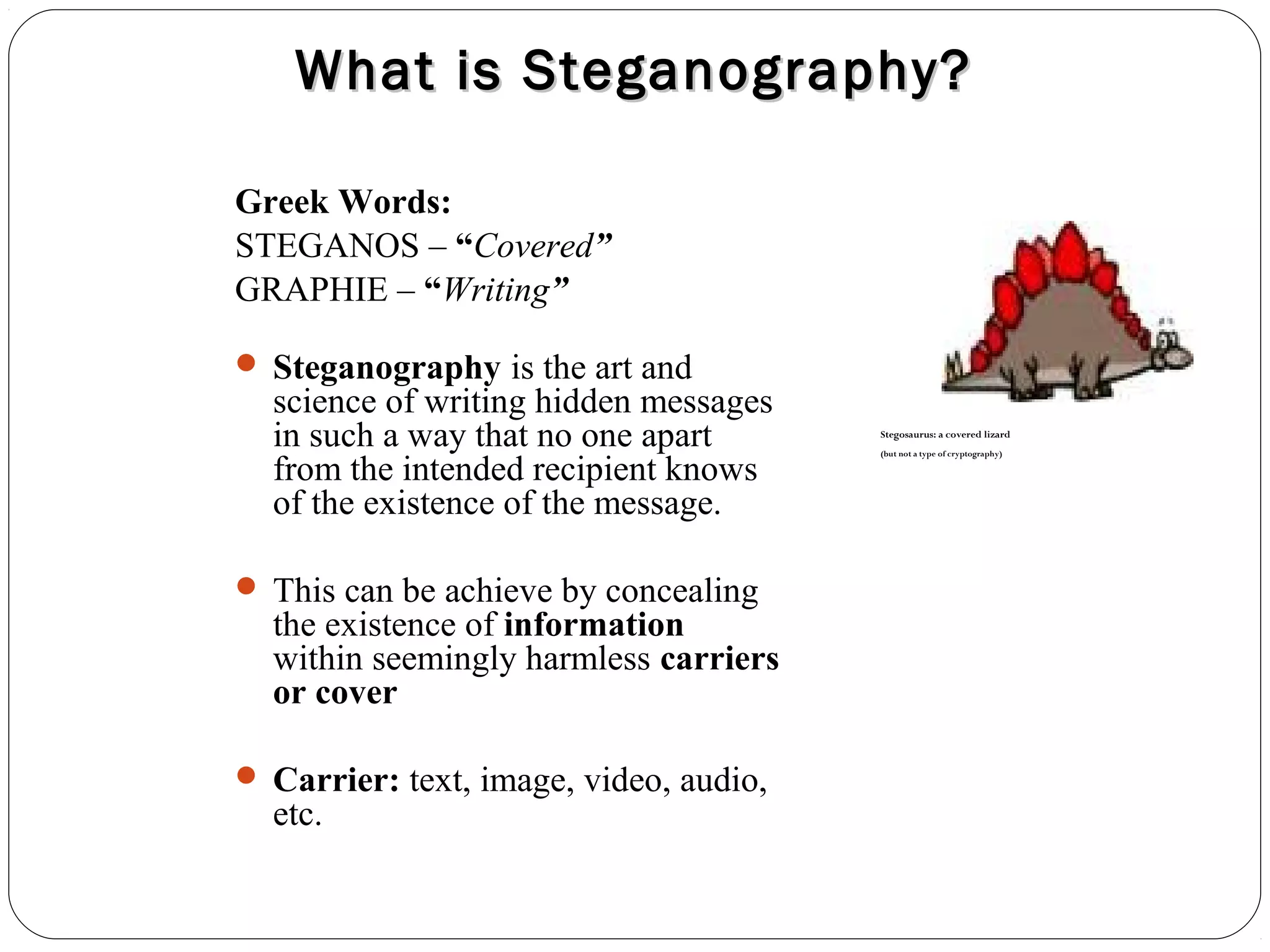
  in such a way that no one apart       Stegosaurus: a covered lizard


  from the intended recipient knows
                                        (but not a type of cryptography)


  of the existence of the message.

 This can be achieve by concealing
  the existence of information
  within seemingly harmless carriers
  or cover

 Carrier: text, image, video, audio,
  etc.
Cryptography
   Cryptography was concerned solely with message
    confidentiality (i.e., encryption)—conversion of message
    from a comprehensible form into an incomprehensible one
    and back again at the other end, rendering it unreadable by
    interceptors or eavesdroppers without secret knowledge
    (namely the key needed for decryption of that message)

Cryptography is secret writing. Anybody can see the message,
  but nobody else can read it. Usually, this is because its letters
  have been re-arranged, or replaced by different letters,
  according to some scheme that only the sender and receiver
  know. Only those who possess a secret key can decrypt the
  message into plain text
DIFFERENCE B/W
CRYPTOGRAPHY AND STEGANOGRAPHY
Steganography deals with composing hidden messages so that
only the sender and the receiver know that the message even
exists. Since, nobody except the sender and the receiver knows
the existence of the message, it does not attract unwanted
attention.
Steganography is hidden writing. The message is there, but
nobody notices it. Once the presence of hidden information is
revealed or even suspected, the purpose of steganography is
defeated.
However, once noticed, it can be read. A common form of
steganography is the use of JPEG files (a computer image) to
hide the message.
The obvious advantage of Steganography over
cryptography is that messages do not attract any
attention
History of Steganography
   Steganography ancient origins can be traced back to 440 BC, from the Histories of
  Herodotus
  Demeratus sent a warning about a forthcoming attack to Greece by writing it on a
  wooden panel and covering it in wax.
    Histiaeus, who shaved the head of his most trusted slave and tattooed a message on it.
  After his hair had grown the message was hidden. The purpose was to instigate a revolt
  against the Persians.
   Hidden messages on messenger's body — also used in ancient Greece. Herodotus tells
  the story of a message tattooed on the shaved head of a slave of Histiaeus, hidden by the
  hair that afterwards grew over it, and exposed by shaving the head again. The message
  allegedly carried a warning to Greece about Persian invasion plans


World War II
the French Resistance sent some messages written on the backs of couriers using invisible
   ink.
Modern Steganography Technique


Least Significant Bit Insertion: The most common and
  popular method of modern day Steganography is to
  make use of the LSB of a picture’s pixel information.
  Thus the overall image distortion is kept to a minimum
  while the message is spaced out over the pixels in the
  images. This technique works best when the image file
  is larger then the message file and if the image is
  grayscale.
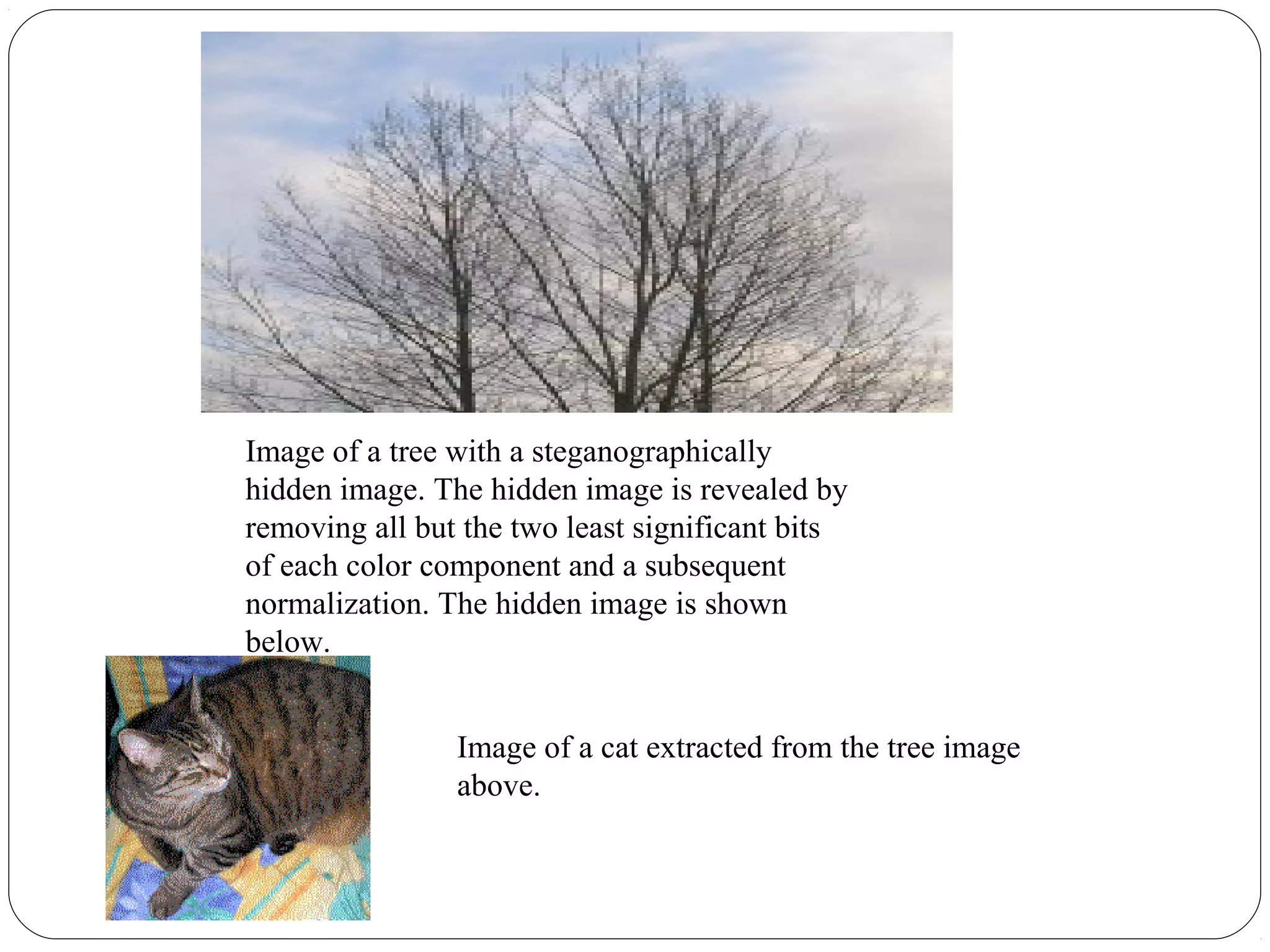
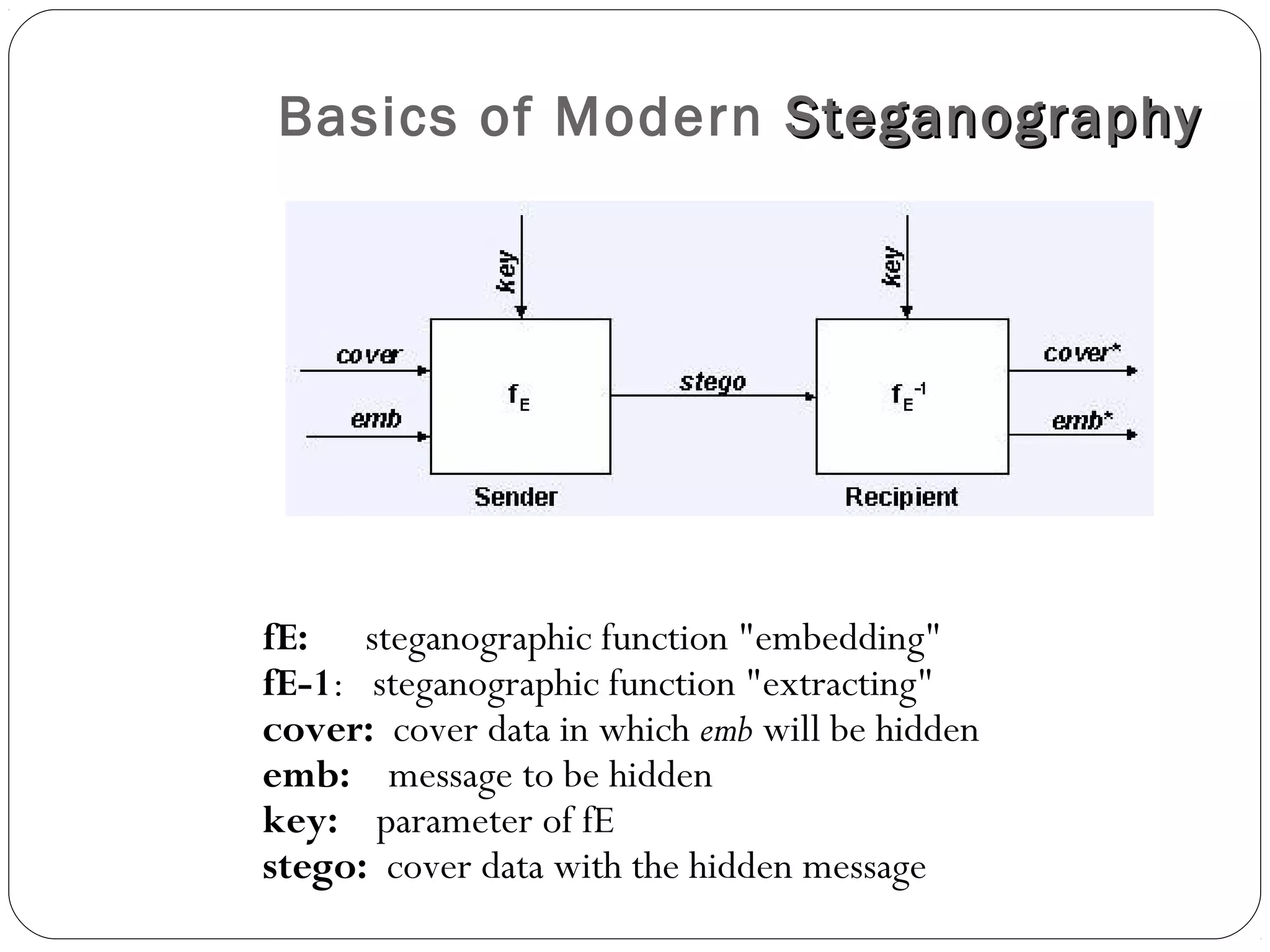
Image of a tree with a steganographically
hidden image. The hidden image is revealed by
removing all but the two least significant bits
of each color component and a subsequent
normalization. The hidden image is shown
below.


                Image of a cat extracted from the tree image
                above.
Basics of Modern Steganography


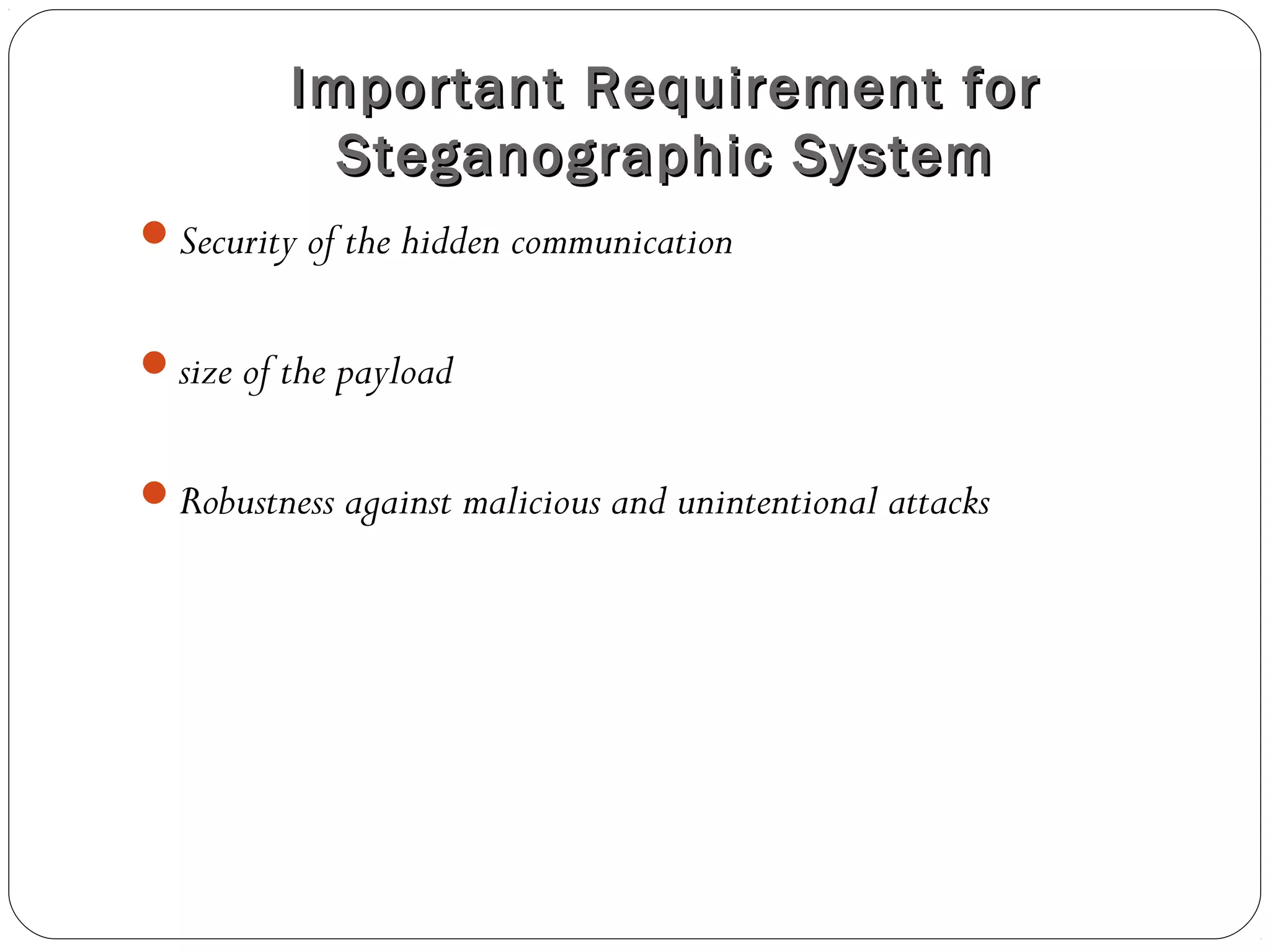
fE:     steganographic function "embedding"
fE-1:   steganographic function "extracting"
cover:  cover data in which emb will be hidden
emb:    message to be hidden
key:    parameter of fE
stego:  cover data with the hidden message
Important Requirement for
           Steganographic System
Security of the hidden communication


size of the payload


Robustness against malicious and unintentional attacks
Detection of Steganographic
        Content/Countermeasures
The detection of steganographically encoded packages is
 called Steganalysis.

  Visual Analysis tries to reveal the presence of secret
    communication through inspection, either with the naked eye
    or with the assistance of a computer.

  Statistical (Algorithmic) Analysis reveals tiny alterations
    in an image's statistical behavior caused by steganographic
    embedding.
     The nominally universal methods developed to detect embedded stego-
      data are generally less effective than the steganalytic methods aimed at
      specific types of embedding.

Steganography ppt

  • 1.
    What is Steganography? GreekWords: STEGANOS – “Covered” GRAPHIE – “Writing”  Steganography is the art and science of writing hidden messages in such a way that no one apart Stegosaurus: a covered lizard from the intended recipient knows (but not a type of cryptography) of the existence of the message.  This can be achieve by concealing the existence of information within seemingly harmless carriers or cover  Carrier: text, image, video, audio, etc.
  • 2.
    Cryptography Cryptography was concerned solely with message confidentiality (i.e., encryption)—conversion of message from a comprehensible form into an incomprehensible one and back again at the other end, rendering it unreadable by interceptors or eavesdroppers without secret knowledge (namely the key needed for decryption of that message) Cryptography is secret writing. Anybody can see the message, but nobody else can read it. Usually, this is because its letters have been re-arranged, or replaced by different letters, according to some scheme that only the sender and receiver know. Only those who possess a secret key can decrypt the message into plain text
  • 3.
    DIFFERENCE B/W CRYPTOGRAPHY ANDSTEGANOGRAPHY Steganography deals with composing hidden messages so that only the sender and the receiver know that the message even exists. Since, nobody except the sender and the receiver knows the existence of the message, it does not attract unwanted attention. Steganography is hidden writing. The message is there, but nobody notices it. Once the presence of hidden information is revealed or even suspected, the purpose of steganography is defeated. However, once noticed, it can be read. A common form of steganography is the use of JPEG files (a computer image) to hide the message. The obvious advantage of Steganography over cryptography is that messages do not attract any attention
  • 4.
    History of Steganography Steganography ancient origins can be traced back to 440 BC, from the Histories of Herodotus Demeratus sent a warning about a forthcoming attack to Greece by writing it on a wooden panel and covering it in wax. Histiaeus, who shaved the head of his most trusted slave and tattooed a message on it. After his hair had grown the message was hidden. The purpose was to instigate a revolt against the Persians. Hidden messages on messenger's body — also used in ancient Greece. Herodotus tells the story of a message tattooed on the shaved head of a slave of Histiaeus, hidden by the hair that afterwards grew over it, and exposed by shaving the head again. The message allegedly carried a warning to Greece about Persian invasion plans World War II the French Resistance sent some messages written on the backs of couriers using invisible ink.
  • 5.
    Modern Steganography Technique LeastSignificant Bit Insertion: The most common and popular method of modern day Steganography is to make use of the LSB of a picture’s pixel information. Thus the overall image distortion is kept to a minimum while the message is spaced out over the pixels in the images. This technique works best when the image file is larger then the message file and if the image is grayscale.
  • 6.
    Image of atree with a steganographically hidden image. The hidden image is revealed by removing all but the two least significant bits of each color component and a subsequent normalization. The hidden image is shown below. Image of a cat extracted from the tree image above.
  • 7.
    Basics of ModernSteganography fE:     steganographic function "embedding" fE-1:   steganographic function "extracting" cover:  cover data in which emb will be hidden emb:    message to be hidden key:    parameter of fE stego:  cover data with the hidden message
  • 8.
    Important Requirement for Steganographic System Security of the hidden communication size of the payload Robustness against malicious and unintentional attacks
  • 9.
    Detection of Steganographic Content/Countermeasures The detection of steganographically encoded packages is called Steganalysis. Visual Analysis tries to reveal the presence of secret communication through inspection, either with the naked eye or with the assistance of a computer. Statistical (Algorithmic) Analysis reveals tiny alterations in an image's statistical behavior caused by steganographic embedding.  The nominally universal methods developed to detect embedded stego- data are generally less effective than the steganalytic methods aimed at specific types of embedding.