Steganography
What is Steganography?
Greek Words:
STEGANOS – “Covered”
GRAPHIE – “Writing”


Steganography is the art and science
of writing hidden messages in such a
way that no one apart from the
intended recipient knows of the
existence of the message.



This can be achieve by concealing the
existence of information within
seemingly harmless carriers or cover
Branches of Information Hiding
There are two major branches of information hiding, Steganography
and Watermarking

Watermarking:





Communication in watermarking is the host signal, with the
embedded data providing copyright protection.
The existence of a watermark is often declared openly.
Any attempt to remove or invalidate the embedded content
renders the host useless.
They are of two types:
Visible watermarking
Invisible watermarking

Once the presence of hidden information is revealed or even
suspected, the purpose of steganography is defeated.
History of Steganography
Demeratus sent a warning about a forthcoming attack to Greece by
writing it on a wooden panel and covering it in wax.
Histiaeus, who shaved the head of his most trusted slave and tattooed
a message on it. After his hair had grown the message was hidden.
The purpose was to instigate a revolt against the Persians.
World War II
Invincible inks
Null ciphers (unencrypted messages):

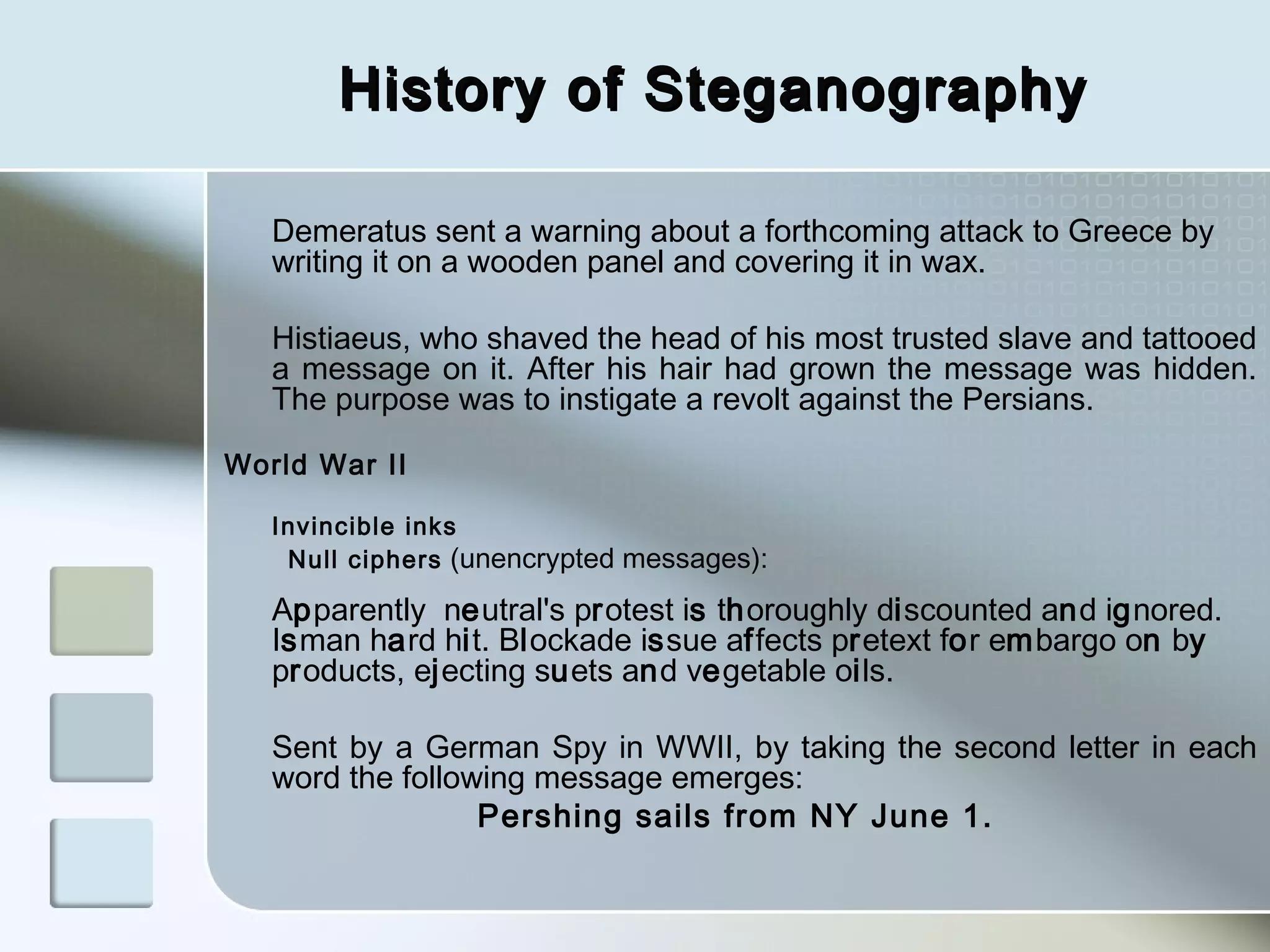
Apparently neutral's protest is thoroughly discounted and ignored.
Isman hard hit. Blockade issue affects pretext for embargo on by
products, ejecting suets and vegetable oils.
Sent by a German Spy in WWII, by taking the second letter in each
word the following message emerges:
Pershing sails from NY June 1.
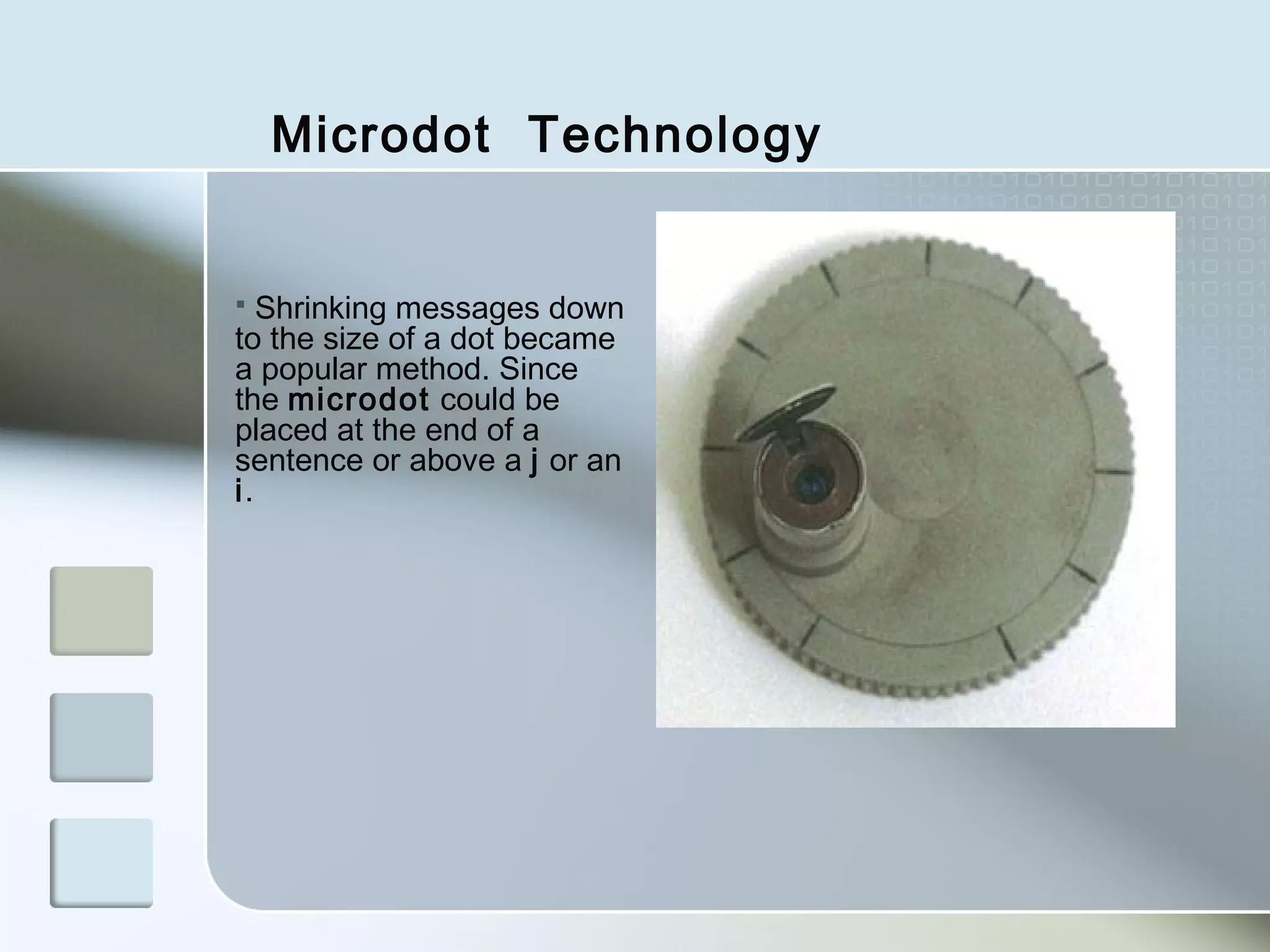
Microdot Technology
Shrinking messages down
to the size of a dot became
a popular method. Since
the microdot could be
placed at the end of a
sentence or above a j or an
i.

Modern Steganography
Techniques
Masking and Filtering : Is where information is hidden inside of a
image using digital watermarks that include information such as
copyright, ownership, or licenses.
Algorithms and Transformations : This technique hides data in
mathematical functions that are often used in compression
algorithms. The idea of this method is to hide the secret message
in the data bits in the least significant coefficients.
Least Significant Bit Insertion : The most common and popular
method of modern day steganography is to make use of the LSB of
a picture’s pixel information.This technique works best when the
image file is larger then the message file and if the image is
grayscale.
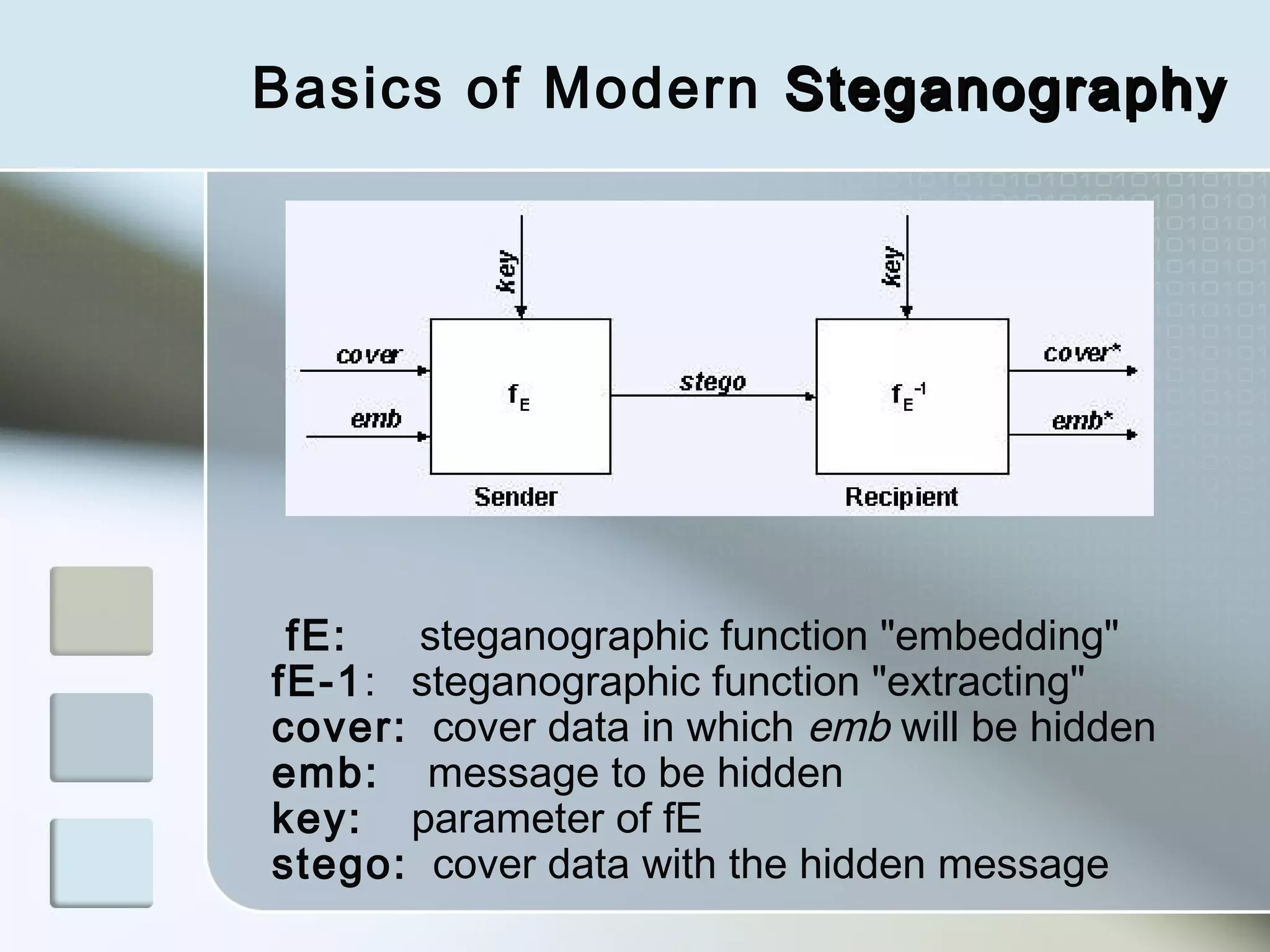
Basics of Modern Steganography

fE:     steganographic function "embedding"
fE-1:   steganographic function "extracting"
cover:  cover data in which emb will be hidden
emb:    message to be hidden
key:    parameter of fE
stego:  cover data with the hidden message
Important Requirement for
Steganographic System

Security of the hidden communication
 Robustness against statistical attacks
 Robustness against image
manipulations

Applications


Usage in modern printers



Alleged use by terrorists



Alleged use by intelligence services
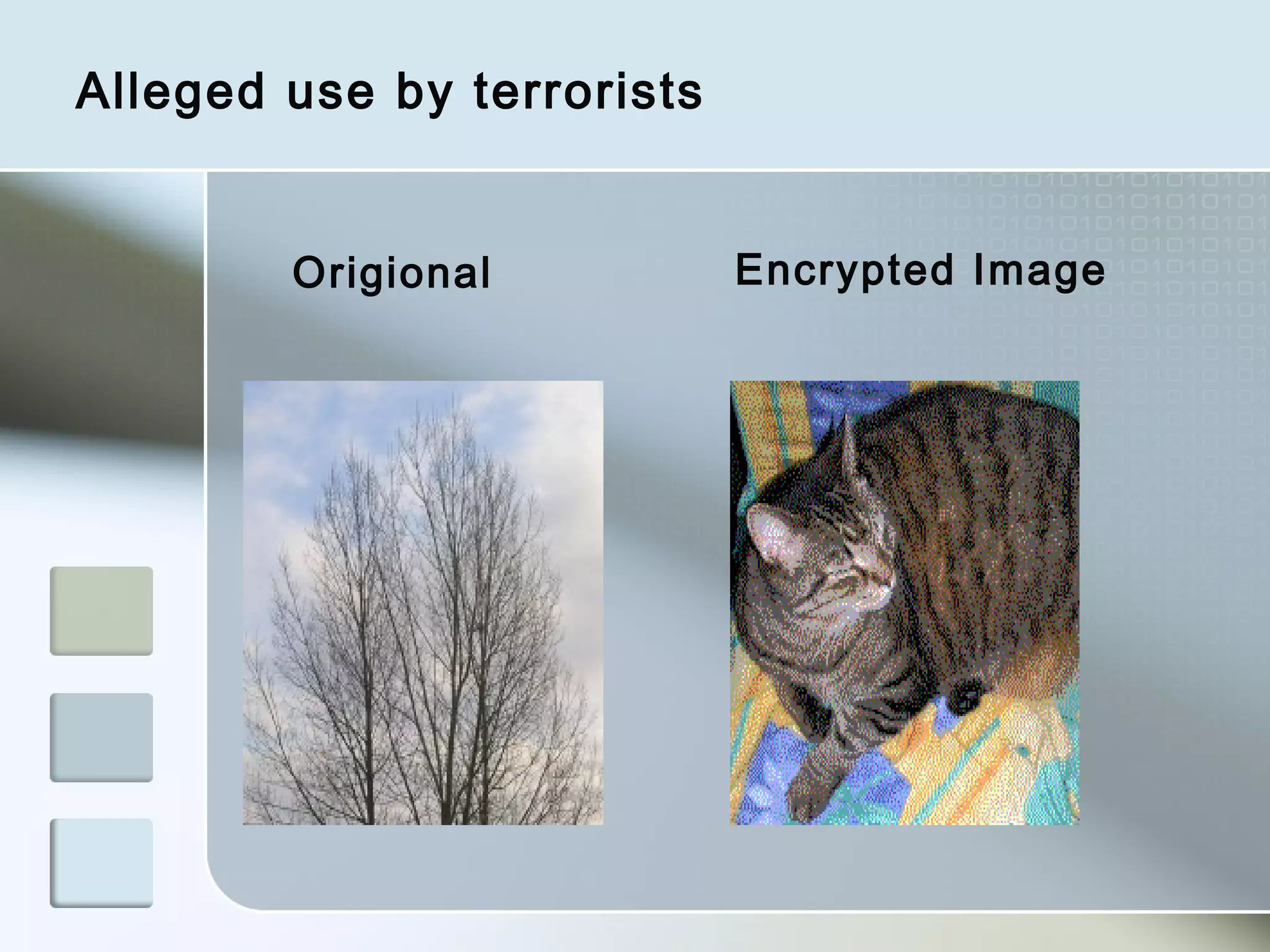
Alleged use by terrorists
Origional

Encrypted Image
Detection of Steganographic
Content/Countermeasures
The detection of steganographically encoded
packages is called Steganalysis.


Visual Analysis tries to reveal the presence
of secret communication through inspection,
either with the naked eye or with the assistance
of a computer.



Statistical (Algorithmic) Analysis reveals
tiny alterations in an image's statistical behavior
caused by steganographic embedding.


The nominally universal methods developed to detect
embedded stego-data are generally less effective
than the steganalytic methods aimed at specific types
of embedding.
Steganography Sample Website


Here is the link for Sample Steganographic
tool Website:

http://mozaiq.org/
Any Querieries ???

Steganography

  • 1.
  • 2.
    What is Steganography? GreekWords: STEGANOS – “Covered” GRAPHIE – “Writing”  Steganography is the art and science of writing hidden messages in such a way that no one apart from the intended recipient knows of the existence of the message.  This can be achieve by concealing the existence of information within seemingly harmless carriers or cover
  • 3.
    Branches of InformationHiding There are two major branches of information hiding, Steganography and Watermarking Watermarking:     Communication in watermarking is the host signal, with the embedded data providing copyright protection. The existence of a watermark is often declared openly. Any attempt to remove or invalidate the embedded content renders the host useless. They are of two types: Visible watermarking Invisible watermarking Once the presence of hidden information is revealed or even suspected, the purpose of steganography is defeated.
  • 4.
    History of Steganography Demeratussent a warning about a forthcoming attack to Greece by writing it on a wooden panel and covering it in wax. Histiaeus, who shaved the head of his most trusted slave and tattooed a message on it. After his hair had grown the message was hidden. The purpose was to instigate a revolt against the Persians. World War II Invincible inks Null ciphers (unencrypted messages): Apparently neutral's protest is thoroughly discounted and ignored. Isman hard hit. Blockade issue affects pretext for embargo on by products, ejecting suets and vegetable oils. Sent by a German Spy in WWII, by taking the second letter in each word the following message emerges: Pershing sails from NY June 1.
  • 5.
    Microdot Technology Shrinking messagesdown to the size of a dot became a popular method. Since the microdot could be placed at the end of a sentence or above a j or an i. 
  • 6.
    Modern Steganography Techniques Masking andFiltering : Is where information is hidden inside of a image using digital watermarks that include information such as copyright, ownership, or licenses. Algorithms and Transformations : This technique hides data in mathematical functions that are often used in compression algorithms. The idea of this method is to hide the secret message in the data bits in the least significant coefficients. Least Significant Bit Insertion : The most common and popular method of modern day steganography is to make use of the LSB of a picture’s pixel information.This technique works best when the image file is larger then the message file and if the image is grayscale.
  • 7.
    Basics of ModernSteganography fE:     steganographic function "embedding" fE-1:   steganographic function "extracting" cover:  cover data in which emb will be hidden emb:    message to be hidden key:    parameter of fE stego:  cover data with the hidden message
  • 8.
    Important Requirement for SteganographicSystem Security of the hidden communication  Robustness against statistical attacks  Robustness against image manipulations 
  • 9.
    Applications  Usage in modernprinters  Alleged use by terrorists  Alleged use by intelligence services
  • 10.
    Alleged use byterrorists Origional Encrypted Image
  • 11.
    Detection of Steganographic Content/Countermeasures Thedetection of steganographically encoded packages is called Steganalysis.  Visual Analysis tries to reveal the presence of secret communication through inspection, either with the naked eye or with the assistance of a computer.  Statistical (Algorithmic) Analysis reveals tiny alterations in an image's statistical behavior caused by steganographic embedding.  The nominally universal methods developed to detect embedded stego-data are generally less effective than the steganalytic methods aimed at specific types of embedding.
  • 12.
    Steganography Sample Website  Hereis the link for Sample Steganographic tool Website: http://mozaiq.org/
  • 13.