
STEALING 
PM 
LESSONS 
FROM 
ARTIFICIAL 
INTELLIGENCE 
Digital 
Project 
Management 
Summit 
Aus>n, 
October 
2014 
Meri 
Williams, 
ChromeRose 
@Geek_Manager
hEp://www.flickr.com/photos/kodomut/3667608102/ 
Meri 
Williams, 
ChromeRose 
@Geek_Manager
Ar>ficial 
Intelligence 
MY 
RESEARCH 
Project 
Management 
Meri 
Williams, 
ChromeRose 
@Geek_Manager
Meri 
Williams, 
ChromeRose 
@Geek_Manager
hEps://www.flickr.com/photos/tbisaacs/4083598572/ 
Meri 
Williams, 
ChromeRose 
@Geek_Manager
TRADITIONAL 
PROJECT 
MANAGEMENT 
OFTEN 
SEEMS 
OF 
THE 
OPINION 
THAT 
THE 
PROCESS 
IS 
SOUND 
AND 
ADHERENCE 
IS 
THE 
PROBLEM 
Meri 
Williams, 
ChromeRose 
@Geek_Manager
hEps://www.flickr.com/photos/imagesbywesVall/3658162161/ 
Meri 
Williams, 
ChromeRose 
@Geek_Manager
ROBOTS/AGENTS 
HAVE 
NO 
PROBLEMS 
BEING 
PATIENT, 
LOGICAL 
OR 
RATIONAL, 
AND 
CAN 
WORK 
24/7/365… 
… 
BUT 
IT 
STILL 
DIDN’T 
WORK 
Meri 
Williams, 
ChromeRose 
@Geek_Manager
Meri 
Williams, 
ChromeRose 
@Geek_Manager
Meri 
Williams, 
ChromeRose 
@Geek_Manager
1) 
AUTONOMY 
(AGENTS) 
2) 
MASTERY 
(MACHINE 
LEARNING) 
3) 
RE-­‐CREATION 
(MACHINE 
INTELLIGENCE) 
Meri 
Williams, 
ChromeRose 
@Geek_Manager
FIRST 
LET’S 
LOOK 
AT 
AUTONOMY 
AND 
AGENTS 
Meri 
Williams, 
ChromeRose 
@Geek_Manager
Meri 
Williams, 
ChromeRose 
@Geek_Manager
Meri 
Williams, 
ChromeRose 
@Geek_Manager
ENABLING 
AGENTS 
TO 
MAKE 
DECISIONS 
AND 
ACT 
INDEPENDENTLY 
BUT 
ALWAYS 
TOWARDS 
A 
COMMON 
GOAL 
LEADS 
TO 
COMPLEX, 
SUCCESSFUL 
ACTION 
Meri 
Williams, 
ChromeRose 
@Geek_Manager
Meri 
Williams, 
ChromeRose 
@Geek_Manager
FOCUS 
ON 
THE 
WHY 
(THE 
GOAL) 
AND 
ENABLE 
THE 
WHAT 
AND 
THE 
HOW 
TO 
BE 
DEFINED 
BY 
THOSE 
DOING 
THE 
WORK, 
AS 
MUCH 
AS 
POSSIBLE 
Meri 
Williams, 
ChromeRose 
@Geek_Manager
THIS 
IS 
WHY 
I 
LOVE 
USER 
STORIES 
As 
a 
<type 
of 
user>, 
I 
want 
to 
<do 
something>, 
So 
that 
<some 
value 
is 
created>. 
(should 
fit 
on 
a 
post-­‐it) 
hEps://www.flickr.com/photos/psd/8591351239/ 
Meri 
Williams, 
ChromeRose 
@Geek_Manager
Meri 
Williams, 
ChromeRose 
@Geek_Manager
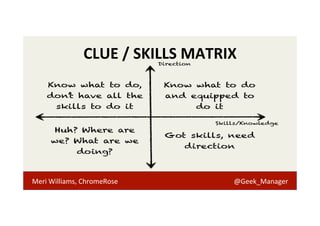
CLUE 
/ 
SKILLS 
MATRIX 
Know what to do 
and equipped to 
do it 
Skills/Knowledge 
Direction 
Know what to do, 
don’t have all the 
skills to do it 
Got skills, need 
direction 
Huh? Where are 
we? What are we 
doing? 
Meri 
Williams, 
ChromeRose 
@Geek_Manager
Meri 
Williams, 
ChromeRose 
@Geek_Manager
hEp://www.flickr.com/photos/8250578@N06/8625641442/ 
Meri 
Williams, 
ChromeRose 
@Geek_Manager
Meri 
Williams, 
ChromeRose 
@Geek_Manager
hEp://www.flickr.com/photos/provoost/2246718091/ 
Meri 
Williams, 
ChromeRose 
@Geek_Manager
hEps://www.flickr.com/photos/wonderlane/37531816/ 
Meri 
Williams, 
ChromeRose 
@Geek_Manager
HUMAN 
SKILL 
DEVELOPMENT 
Unconscious 
Incompetent 
Conscious 
Incompetent 
Conscious 
Competent 
Unconscious 
Competent 
Meri 
Williams, 
ChromeRose 
@Geek_Manager
HOW 
DO 
MACHINES 
LEARN? 
MASTERY 
& 
MACHINE 
INTELLIGENCE 
Meri 
Williams, 
ChromeRose 
@Geek_Manager
Meri 
Williams, 
ChromeRose 
@Geek_Manager
MACHINE 
LEARNING 
IS 
FASCINATING 
• Supervised 
(teacher-­‐student 
model) 
• Unsupervised 
(learn-­‐from-­‐data 
model) 
• Reinforcement 
(learn-­‐by-­‐doing 
model) 
• Developmental 
(learn-­‐enough-­‐to-­‐set-­‐ 
up-­‐more-­‐learning-­‐for-­‐yourself 
model) 
Meri 
Williams, 
ChromeRose 
@Geek_Manager
Meri 
Williams, 
ChromeRose 
@Geek_Manager
Meri 
Williams, 
ChromeRose 
@Geek_Manager
Meri 
Williams, 
ChromeRose 
@Geek_Manager
WE’RE 
GOOD 
AT 
WHAT 
WE 
PRACTISE, 
PROVIDING 
WE 
CAN 
LEARN 
FROM 
IT 
Meri 
Williams, 
ChromeRose 
@Geek_Manager
DELIBERATE 
PRACTICE 
• You 
must 
be 
mo[vated 
to 
aEend 
to 
the 
task 
and 
exert 
effort 
to 
improve 
your 
performance. 
• The 
design 
of 
the 
task 
should 
take 
into 
account 
your 
pre-­‐exis[ng 
knowledge 
so 
that 
the 
task 
can 
be 
correctly 
understood 
a`er 
a 
brief 
period 
of 
instruc>on. 
• You 
should 
receive 
immediate 
informa[ve 
feedback 
and 
knowledge 
of 
results 
of 
your 
performance. 
• You 
should 
repeatedly 
perform 
the 
same 
or 
similar 
tasks. 
Meri 
Williams, 
ChromeRose 
@Geek_Manager
MODELS 
OF 
DELIBERATE 
PRACTICE 
• Sports 
Model 
– 
analogous 
to 
condi>oning 
• Chess 
Model 
– 
what 
did 
the 
grand 
master 
do? 
• Music 
Model 
– 
chunking 
& 
mental 
rehearsal 
Meri 
Williams, 
ChromeRose 
@Geek_Manager
IS 
THE 
WORK 
DESIGNED 
IN 
A 
WAY 
THAT 
MAKES 
IT 
EFFECTIVE 
DELIBERATE 
PRACTICE? 
Meri 
Williams, 
ChromeRose 
@Geek_Manager
hEps://www.flickr.com/photos/psd/8451589322/ 
Meri 
Williams, 
ChromeRose 
@Geek_Manager
hEps://www.flickr.com/photos/psd/8002453131 
Meri 
Williams, 
ChromeRose 
@Geek_Manager
AS 
AN 
ASIDE… 
DO 
RETROSPECTIVES 
DURING 
PROJECTS 
RATHER 
THAN 
POST 
MORTEMS 
AFTER 
FOR 
A 
POST 
MORTEM, 
FIRST 
SOMETHING 
HAS 
TO 
DIE 
Meri 
Williams, 
ChromeRose 
@Geek_Manager
3) 
RE-­‐CREATION 
(MACHINE 
INTELLIGENCE) 
Meri 
Williams, 
ChromeRose 
@Geek_Manager
Meri 
Williams, 
ChromeRose 
@Geek_Manager
Meri 
Williams, 
ChromeRose 
@Geek_Manager
Meri 
Williams, 
ChromeRose 
@Geek_Manager
Meri 
Williams, 
ChromeRose 
@Geek_Manager
Across 
industries, 
across 
countries, 
the 
best 
performing 
teams 
answer 
certain 
ques>ons 
posi>vely 
Meri 
Williams, 
ChromeRose 
@Geek_Manager
Predictors 
of 
High 
Performance 
1. Do 
I 
know 
what 
is 
expected 
of 
me 
at 
work? 
2. Do 
I 
have 
the 
materials 
& 
equipment 
I 
need 
to 
do 
my 
work 
right? 
3. At 
work, 
do 
I 
have 
the 
opportunity 
to 
do 
what 
I 
do 
best 
every 
day? 
4. In 
the 
last 
7 
days, 
have 
I 
received 
recogni>on 
or 
praise 
for 
good 
work? 
5. Does 
my 
supervisor, 
or 
someone 
at 
work, 
seem 
to 
care 
about 
me 
as 
a 
person? 
6. Is 
there 
someone 
at 
work 
who 
cares 
about 
my 
development? 
7. At 
work, 
do 
my 
opinions 
seem 
to 
count? 
8. Does 
the 
mission/purpose 
of 
my 
company 
make 
me 
feel 
like 
my 
work 
is 
important? 
9. Are 
my 
co-­‐workers 
commiEed 
to 
doing 
quality 
work? 
10. Do 
I 
have 
a 
best 
friend 
at 
work? 
11. In 
the 
last 
6 
months, 
have 
I 
talked 
with 
someone 
about 
my 
development? 
12. At 
work, 
have 
I 
had 
opportuni>es 
to 
learn 
and 
grow? 
Meri 
Williams, 
ChromeRose 
@Geek_Manager
Meri 
Williams, 
ChromeRose 
@Geek_Manager
UNDERSTAND 
MOTIVATION 
• Purpose 
• Autonomy 
• Mastery 
Meri 
Williams, 
ChromeRose 
@Geek_Manager
MOTIVATION 
= 
+ 
PURPOSE 
(Do 
I 
believe 
in 
WHY?) 
+ 
AUTONOMY 
(Do 
I 
get 
a 
say 
in 
WHAT?) 
+ 
MASTERY 
(Am 
I 
proud 
of 
HOW?) 
-­‐ 
ANY 
NEGATIVE 
FACTORS 
THAT 
DETRACT 
Meri 
Williams, 
ChromeRose 
@Geek_Manager
Predictors 
of 
High 
Performance 
(remix) 
PURPOSE 
• Does 
the 
mission/purpose 
of 
my 
company 
make 
me 
feel 
like 
my 
work 
is 
important? 
AUTONOMY 
• Do 
I 
know 
what 
is 
expected 
of 
me 
at 
work? 
• At 
work, 
do 
my 
opinions 
seem 
to 
count? 
MASTERY 
• Do 
I 
have 
the 
materials 
& 
equipment 
I 
need 
to 
do 
my 
work 
right? 
• At 
work, 
do 
I 
have 
the 
opportunity 
to 
do 
what 
I 
do 
best 
every 
day? 
• Is 
there 
someone 
at 
work 
who 
cares 
about 
my 
development? 
• Are 
my 
co-­‐workers 
commiEed 
to 
doing 
quality 
work? 
• In 
the 
last 
6 
months, 
have 
I 
talked 
with 
someone 
about 
my 
development? 
• At 
work, 
have 
I 
had 
opportuni>es 
to 
learn 
and 
grow? 
Meri 
Williams, 
ChromeRose 
@Geek_Manager
And 
What 
Else? 
OTHER 
FACTORS: 
• In 
the 
last 
7 
days, 
have 
I 
received 
recogni>on 
or 
praise 
for 
good 
work? 
• Does 
my 
supervisor, 
or 
someone 
at 
work, 
seem 
to 
care 
about 
me 
as 
a 
person? 
• Do 
I 
have 
a 
best 
friend 
at 
work? 
ESSENTIALLY, 
AM 
I 
RESPECTED 
& 
REWARDED 
HERE? 
CAN 
I 
BE 
MYSELF 
AND 
SUCCEED 
HERE? 
I 
CALL 
THIS 
INCLUSION. 
Meri 
Williams, 
ChromeRose 
@Geek_Manager
The 
Most 
Important 
Ques>on 
Best 
predictor 
of 
recruitment 
AND 
reten>on? 
Someone’s 
ability 
to 
agree 
with: 
“Someone 
like 
me 
can 
be 
successful 
here” 
Meri 
Williams, 
ChromeRose 
@Geek_Manager
Your 
job 
as 
a 
project 
manager… 
CREATE 
SPACE 
FOR 
YOUR 
TEAM 
TO 
BE 
THE 
BEST 
THEY 
CAN 
BE 
Meri 
Williams, 
ChromeRose 
@Geek_Manager
As 
a 
PM, 
Ask 
Yourself 
• Do 
my 
team 
know 
WHY 
we 
are 
doing 
this? 
• Do 
my 
team 
get 
a 
say 
in 
the 
WHAT? 
In 
doing 
the 
right 
thing? 
• Do 
my 
team 
get 
opportuni>es 
to 
do 
the 
thing 
right? 
And 
to 
get 
beEer 
at 
the 
HOW? 
• Do 
we 
do 
a 
good 
job 
of 
making 
all 
our 
different 
people 
feel 
included 
& 
like 
they 
BELONG 
HERE? 
(PURPOSE) 
(AUTONOMY) 
(MASTERY) 
(INCLUSION) 
Meri 
Williams, 
ChromeRose 
@Geek_Manager
SPACE 
TO 
BE 
AWESOME 
= 
+ 
PURPOSE 
(Do 
I 
believe 
in 
WHY?) 
+ 
AUTONOMY 
(Do 
I 
get 
a 
say 
in 
WHAT?) 
+ 
MASTERY 
(Am 
I 
proud 
of 
HOW?) 
+ 
INCLUSION 
(Do 
I 
BELONG 
HERE?) 
-­‐ 
ANY 
NEGATIVE 
FACTORS 
THAT 
DETRACT 
Meri 
Williams, 
ChromeRose 
@Geek_Manager
TO 
RECAP: 
KEY 
LESSONS 
WE 
CAN 
STEAL 
FROM 
AI 
AND 
USE 
IN 
PM 
Meri 
Williams, 
ChromeRose 
@Geek_Manager
KEY 
LESSONS 
1. Autonomy 
maEers 
(because 
change 
happens) 
2. Communicate 
purpose 
& 
goals 
(why 
& 
what) 
3. Let 
individuals 
define 
the 
how 
(bonus: 
mo>va>on!) 
4. Help 
design 
work 
as 
deliberate 
prac>ce 
5. Help 
teams 
assess 
& 
improve 
as 
they 
go 
(retros 
> 
post 
mortems) 
6. Awesome 
= 
purpose 
+ 
autonomy 
+ 
mastery 
+ 
inclusion 
Meri 
Williams, 
ChromeRose 
@Geek_Manager
YOU 
CAN’T 
HOLD 
BACK 
THE 
OCEAN, 
BUT 
YOU 
CAN 
LEARN 
TO 
SURF 
hEps://www.flickr.com/photos/colmsurf/144455160/ 
Meri 
Williams, 
ChromeRose 
@Geek_Manager
Meri 
Williams, 
ChromeRose 
@Geek_Manager
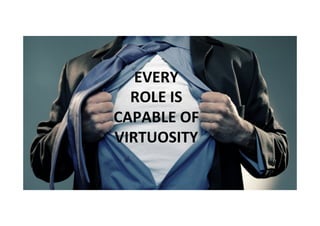
EVERY 
ROLE 
IS 
CAPABLE 
OF 
VIRTUOSITY 
Meri 
Williams, 
ChromeRose 
@Geek_Manager

Stealing Project Management Lessons from Artificial Intelligence

  • 1.
    STEALING PM LESSONS FROM ARTIFICIAL INTELLIGENCE Digital Project Management Summit Aus>n, October 2014 Meri Williams, ChromeRose @Geek_Manager
  • 2.
  • 3.
    Ar>ficial Intelligence MY RESEARCH Project Management Meri Williams, ChromeRose @Geek_Manager
  • 4.
  • 5.
  • 6.
    TRADITIONAL PROJECT MANAGEMENT OFTEN SEEMS OF THE OPINION THAT THE PROCESS IS SOUND AND ADHERENCE IS THE PROBLEM Meri Williams, ChromeRose @Geek_Manager
  • 7.
  • 8.
    ROBOTS/AGENTS HAVE NO PROBLEMS BEING PATIENT, LOGICAL OR RATIONAL, AND CAN WORK 24/7/365… … BUT IT STILL DIDN’T WORK Meri Williams, ChromeRose @Geek_Manager
  • 9.
  • 10.
  • 11.
    1) AUTONOMY (AGENTS) 2) MASTERY (MACHINE LEARNING) 3) RE-­‐CREATION (MACHINE INTELLIGENCE) Meri Williams, ChromeRose @Geek_Manager
  • 12.
    FIRST LET’S LOOK AT AUTONOMY AND AGENTS Meri Williams, ChromeRose @Geek_Manager
  • 13.
  • 14.
  • 15.
    ENABLING AGENTS TO MAKE DECISIONS AND ACT INDEPENDENTLY BUT ALWAYS TOWARDS A COMMON GOAL LEADS TO COMPLEX, SUCCESSFUL ACTION Meri Williams, ChromeRose @Geek_Manager
  • 16.
  • 17.
    FOCUS ON THE WHY (THE GOAL) AND ENABLE THE WHAT AND THE HOW TO BE DEFINED BY THOSE DOING THE WORK, AS MUCH AS POSSIBLE Meri Williams, ChromeRose @Geek_Manager
  • 18.
    THIS IS WHY I LOVE USER STORIES As a <type of user>, I want to <do something>, So that <some value is created>. (should fit on a post-­‐it) hEps://www.flickr.com/photos/psd/8591351239/ Meri Williams, ChromeRose @Geek_Manager
  • 19.
  • 20.
    CLUE / SKILLS MATRIX Know what to do and equipped to do it Skills/Knowledge Direction Know what to do, don’t have all the skills to do it Got skills, need direction Huh? Where are we? What are we doing? Meri Williams, ChromeRose @Geek_Manager
  • 21.
  • 22.
  • 23.
  • 24.
  • 25.
  • 26.
    HUMAN SKILL DEVELOPMENT Unconscious Incompetent Conscious Incompetent Conscious Competent Unconscious Competent Meri Williams, ChromeRose @Geek_Manager
  • 27.
    HOW DO MACHINES LEARN? MASTERY & MACHINE INTELLIGENCE Meri Williams, ChromeRose @Geek_Manager
  • 28.
  • 29.
    MACHINE LEARNING IS FASCINATING • Supervised (teacher-­‐student model) • Unsupervised (learn-­‐from-­‐data model) • Reinforcement (learn-­‐by-­‐doing model) • Developmental (learn-­‐enough-­‐to-­‐set-­‐ up-­‐more-­‐learning-­‐for-­‐yourself model) Meri Williams, ChromeRose @Geek_Manager
  • 30.
  • 31.
  • 32.
  • 33.
    WE’RE GOOD AT WHAT WE PRACTISE, PROVIDING WE CAN LEARN FROM IT Meri Williams, ChromeRose @Geek_Manager
  • 34.
    DELIBERATE PRACTICE •You must be mo[vated to aEend to the task and exert effort to improve your performance. • The design of the task should take into account your pre-­‐exis[ng knowledge so that the task can be correctly understood a`er a brief period of instruc>on. • You should receive immediate informa[ve feedback and knowledge of results of your performance. • You should repeatedly perform the same or similar tasks. Meri Williams, ChromeRose @Geek_Manager
  • 35.
    MODELS OF DELIBERATE PRACTICE • Sports Model – analogous to condi>oning • Chess Model – what did the grand master do? • Music Model – chunking & mental rehearsal Meri Williams, ChromeRose @Geek_Manager
  • 36.
    IS THE WORK DESIGNED IN A WAY THAT MAKES IT EFFECTIVE DELIBERATE PRACTICE? Meri Williams, ChromeRose @Geek_Manager
  • 37.
  • 38.
  • 39.
    AS AN ASIDE… DO RETROSPECTIVES DURING PROJECTS RATHER THAN POST MORTEMS AFTER FOR A POST MORTEM, FIRST SOMETHING HAS TO DIE Meri Williams, ChromeRose @Geek_Manager
  • 40.
    3) RE-­‐CREATION (MACHINE INTELLIGENCE) Meri Williams, ChromeRose @Geek_Manager
  • 41.
  • 42.
  • 43.
  • 44.
  • 45.
    Across industries, across countries, the best performing teams answer certain ques>ons posi>vely Meri Williams, ChromeRose @Geek_Manager
  • 46.
    Predictors of High Performance 1. Do I know what is expected of me at work? 2. Do I have the materials & equipment I need to do my work right? 3. At work, do I have the opportunity to do what I do best every day? 4. In the last 7 days, have I received recogni>on or praise for good work? 5. Does my supervisor, or someone at work, seem to care about me as a person? 6. Is there someone at work who cares about my development? 7. At work, do my opinions seem to count? 8. Does the mission/purpose of my company make me feel like my work is important? 9. Are my co-­‐workers commiEed to doing quality work? 10. Do I have a best friend at work? 11. In the last 6 months, have I talked with someone about my development? 12. At work, have I had opportuni>es to learn and grow? Meri Williams, ChromeRose @Geek_Manager
  • 47.
  • 48.
    UNDERSTAND MOTIVATION •Purpose • Autonomy • Mastery Meri Williams, ChromeRose @Geek_Manager
  • 49.
    MOTIVATION = + PURPOSE (Do I believe in WHY?) + AUTONOMY (Do I get a say in WHAT?) + MASTERY (Am I proud of HOW?) -­‐ ANY NEGATIVE FACTORS THAT DETRACT Meri Williams, ChromeRose @Geek_Manager
  • 50.
    Predictors of High Performance (remix) PURPOSE • Does the mission/purpose of my company make me feel like my work is important? AUTONOMY • Do I know what is expected of me at work? • At work, do my opinions seem to count? MASTERY • Do I have the materials & equipment I need to do my work right? • At work, do I have the opportunity to do what I do best every day? • Is there someone at work who cares about my development? • Are my co-­‐workers commiEed to doing quality work? • In the last 6 months, have I talked with someone about my development? • At work, have I had opportuni>es to learn and grow? Meri Williams, ChromeRose @Geek_Manager
  • 51.
    And What Else? OTHER FACTORS: • In the last 7 days, have I received recogni>on or praise for good work? • Does my supervisor, or someone at work, seem to care about me as a person? • Do I have a best friend at work? ESSENTIALLY, AM I RESPECTED & REWARDED HERE? CAN I BE MYSELF AND SUCCEED HERE? I CALL THIS INCLUSION. Meri Williams, ChromeRose @Geek_Manager
  • 52.
    The Most Important Ques>on Best predictor of recruitment AND reten>on? Someone’s ability to agree with: “Someone like me can be successful here” Meri Williams, ChromeRose @Geek_Manager
  • 53.
    Your job as a project manager… CREATE SPACE FOR YOUR TEAM TO BE THE BEST THEY CAN BE Meri Williams, ChromeRose @Geek_Manager
  • 54.
    As a PM, Ask Yourself • Do my team know WHY we are doing this? • Do my team get a say in the WHAT? In doing the right thing? • Do my team get opportuni>es to do the thing right? And to get beEer at the HOW? • Do we do a good job of making all our different people feel included & like they BELONG HERE? (PURPOSE) (AUTONOMY) (MASTERY) (INCLUSION) Meri Williams, ChromeRose @Geek_Manager
  • 55.
    SPACE TO BE AWESOME = + PURPOSE (Do I believe in WHY?) + AUTONOMY (Do I get a say in WHAT?) + MASTERY (Am I proud of HOW?) + INCLUSION (Do I BELONG HERE?) -­‐ ANY NEGATIVE FACTORS THAT DETRACT Meri Williams, ChromeRose @Geek_Manager
  • 56.
    TO RECAP: KEY LESSONS WE CAN STEAL FROM AI AND USE IN PM Meri Williams, ChromeRose @Geek_Manager
  • 57.
    KEY LESSONS 1.Autonomy maEers (because change happens) 2. Communicate purpose & goals (why & what) 3. Let individuals define the how (bonus: mo>va>on!) 4. Help design work as deliberate prac>ce 5. Help teams assess & improve as they go (retros > post mortems) 6. Awesome = purpose + autonomy + mastery + inclusion Meri Williams, ChromeRose @Geek_Manager
  • 58.
    YOU CAN’T HOLD BACK THE OCEAN, BUT YOU CAN LEARN TO SURF hEps://www.flickr.com/photos/colmsurf/144455160/ Meri Williams, ChromeRose @Geek_Manager
  • 59.
  • 60.
    EVERY ROLE IS CAPABLE OF VIRTUOSITY Meri Williams, ChromeRose @Geek_Manager