l 
Chapter Nine 
Estimation and Confidence IInntteerrvvaallss 
GOALS 
1. Define a what is meant by a point estimate. 
2. Define the term level of confidence. 
3. Construct a confidence interval for the population 
mean when the population standard deviation is 
known. 
4. Construct a confidence interval for the population 
mean when the population standard deviation is 
unknown. 
5. Construct a confidence interval for the population 
proportion. 
6. Determine the sample size for attribute and variable 
sampling.
Point and Interval Estimates 
 A point estimate is a single value (statistic) 
used to estimate a population value 
(parameter). 
 A interval estimate is a range of values within 
which the population parameter is expected to 
occur. 
The interval within which a population 
parameter is expected to occur is called a 
confidence interval. 
The specified probability is called the level of 
confidence. 
The two confidence intervals that are used 
extensively are the 95% and the 99%.
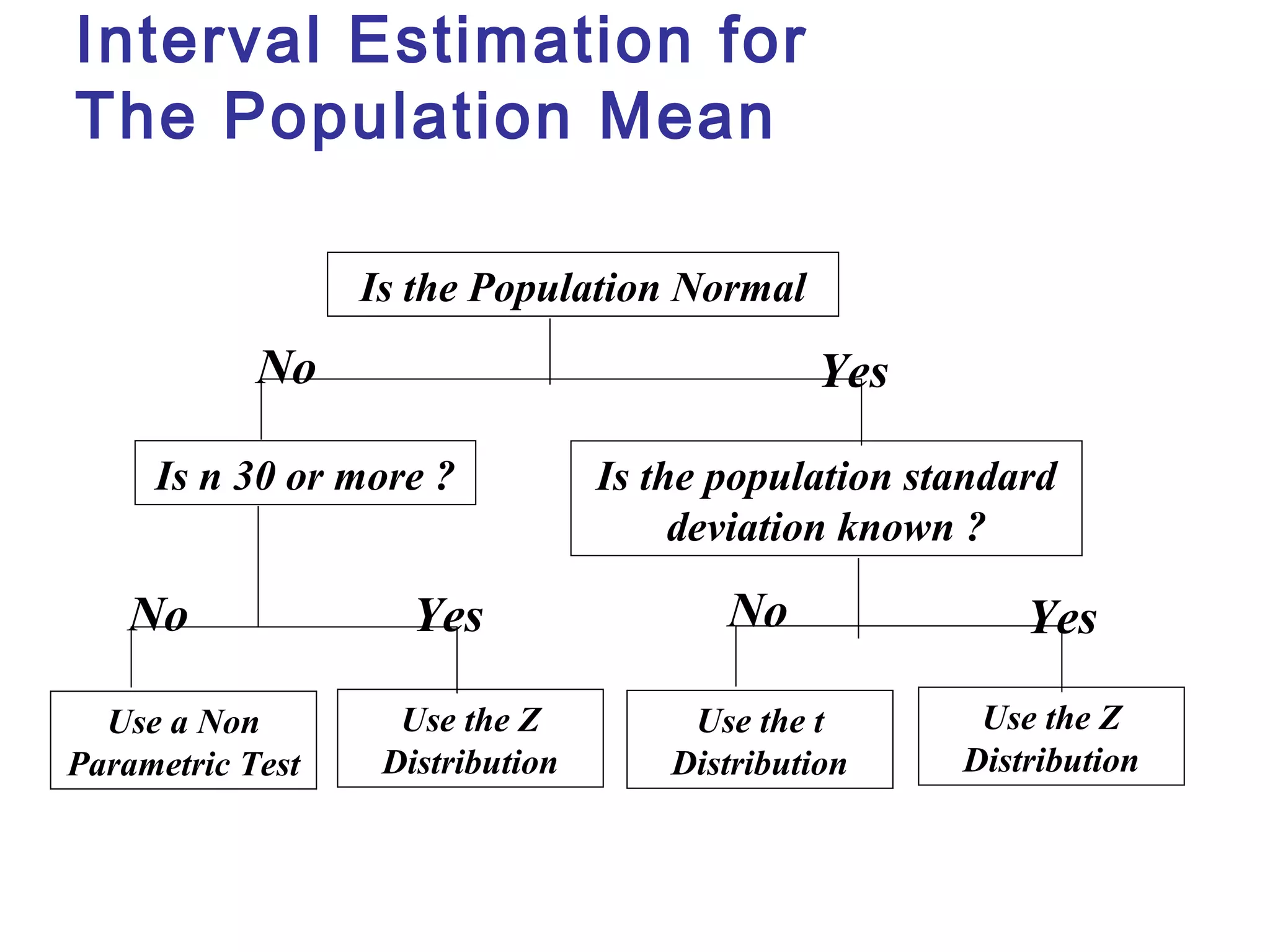
Interval Estimation for 
The Population Mean 
Is the Population Normal 
Is n 30 or more ? Is the population standard 
deviation known ? 
Use a Non 
Parametric Test 
Use the Z 
Distribution 
Use the t 
Distribution 
Use the Z 
Distribution 
No 
No No 
Yes 
Yes Yes
Confidence Intervals 
 The degree to which we can rely on the statistic is as 
important as the initial calculation. Remember, most 
of the time we are working from samples. And 
samples are really estimates. Ultimately, we are 
concerned with the accuracy of the estimate. 
1. Confidence interval provides Range of Values 
 Based on Observations from 1 Sample 
1. Confidence interval gives Information about 
Closeness to Unknown Population Parameter 
 Stated in terms of Probability 
 Knowing Exact Closeness Requires Knowing 
Unknown Population Parameter
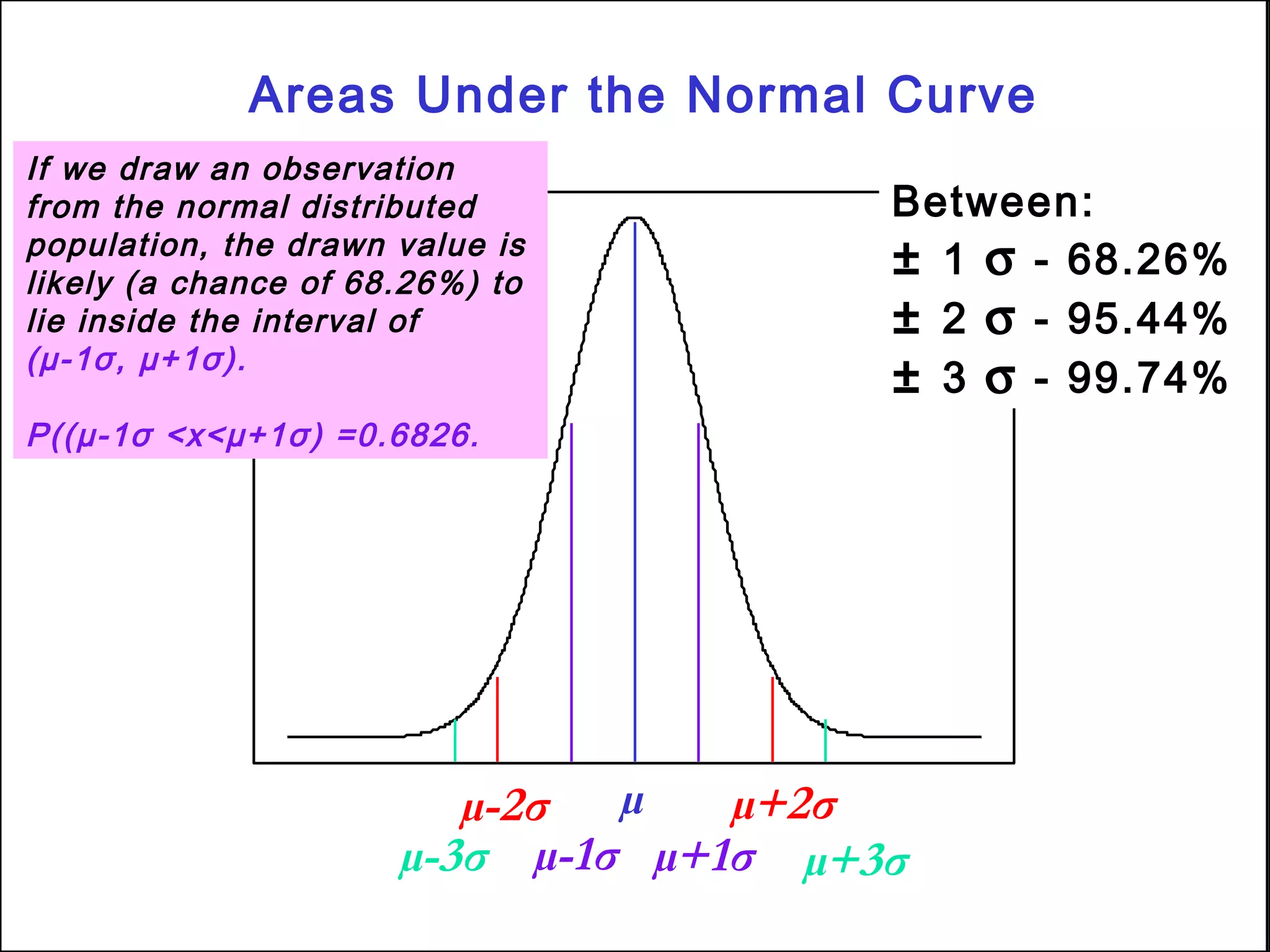
Areas Under the Normal Curve 
Between: 
± 1 s - 68.26% 
± 2 s - 95.44% 
± 3 s - 99.74% 
μ 
If we draw an observation 
from the normal distributed 
population, the drawn value is 
likely (a chance of 68.26%) to 
lie inside the interval of 
(μ-1σ, μ+1σ). 
P((μ-1σ <x<μ+1σ) =0.6826. 
μ-2σ μ+2σ 
μ-3σ μ-1σ μ+1σ 
μ+3σ
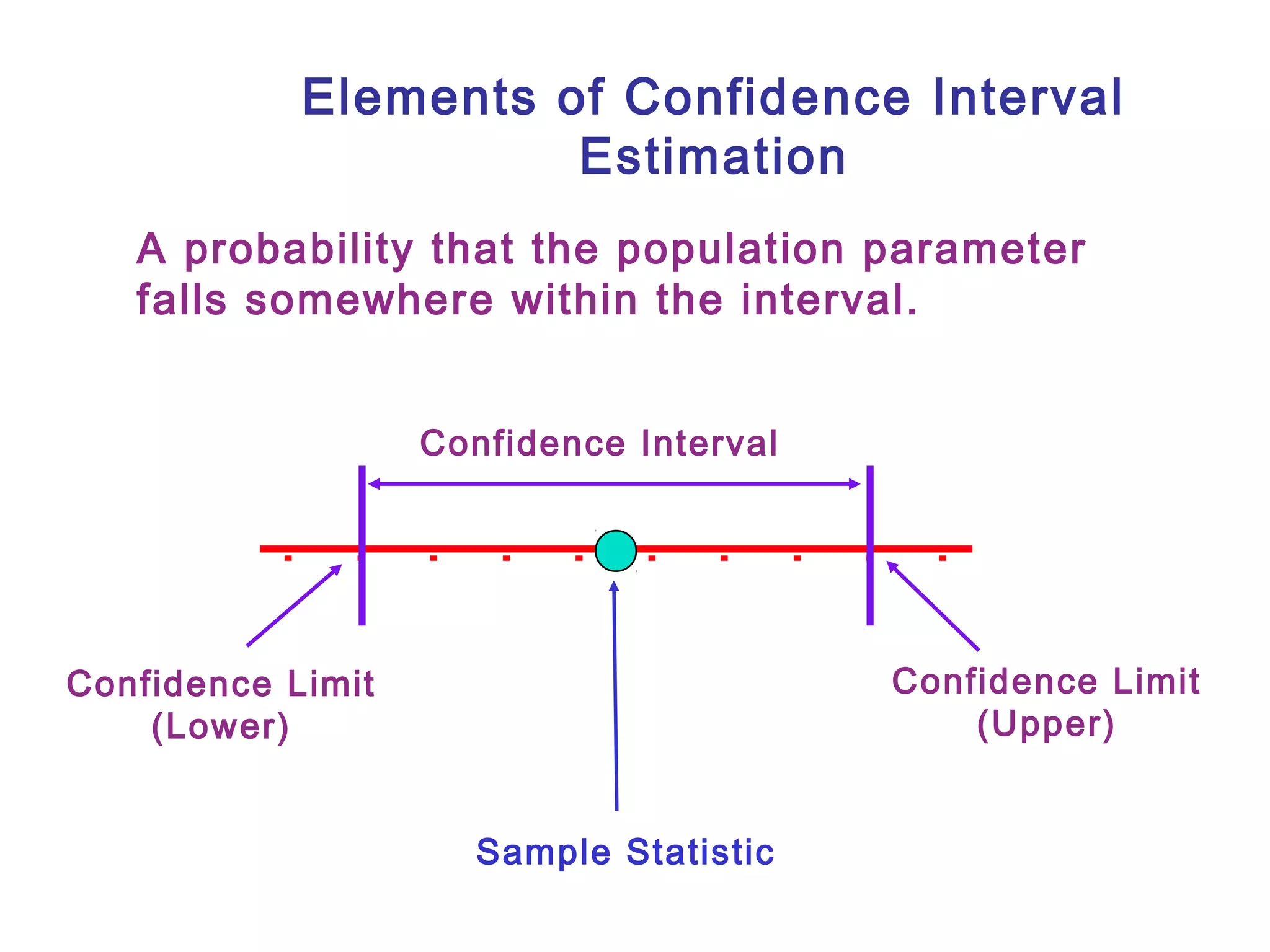
Elements of Confidence Interval 
Estimation 
A probability that the population parameter 
falls somewhere within the interval. 
Confidence Interval 
Sample Statistic 
Confidence Limit 
(Lower) 
Confidence Limit 
(Upper)
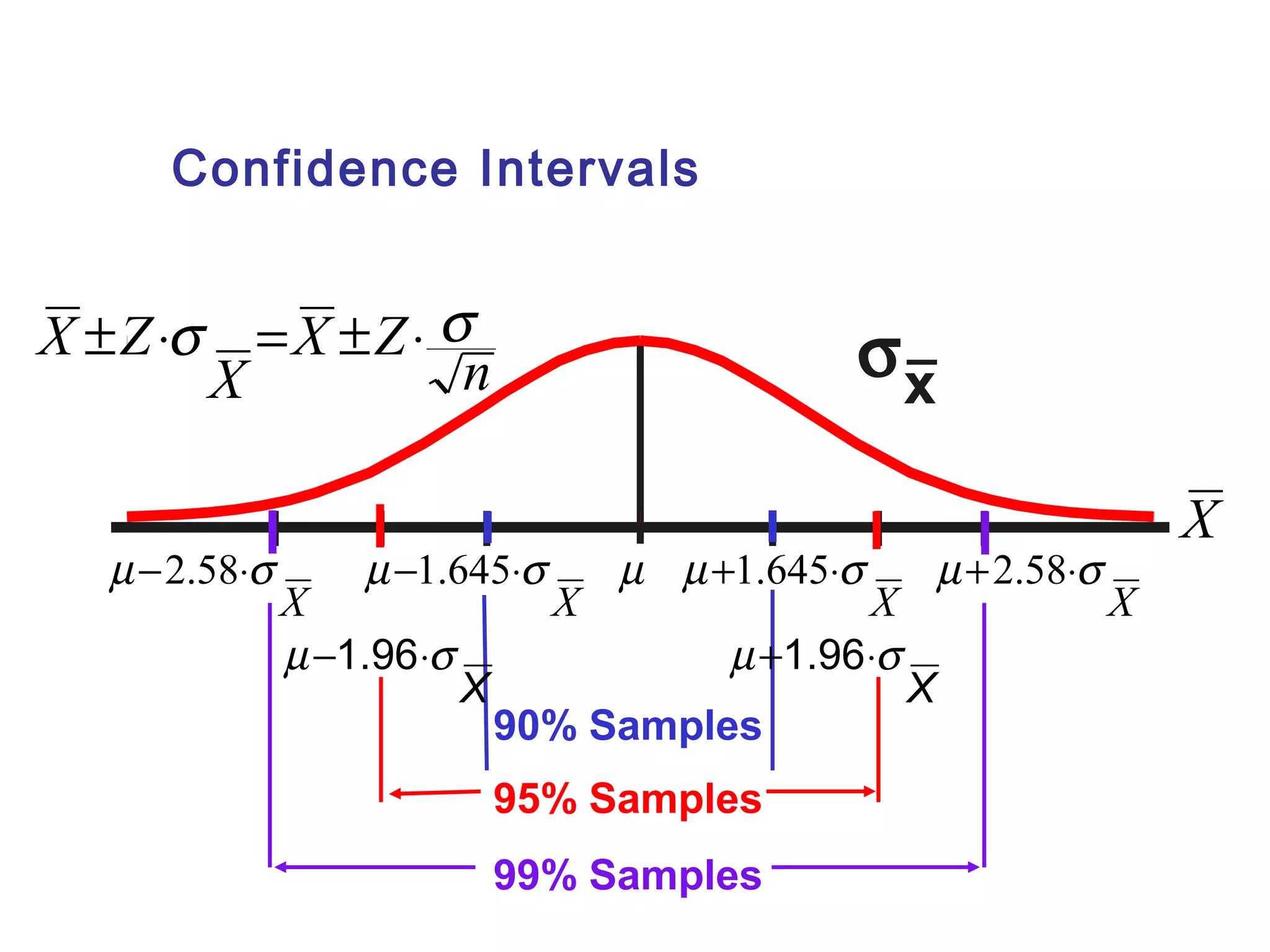
Confidence Intervals 
X ±Z×s = ± ×s 
X Z n _ 
m -2.58×s m -1.645×s m m +1.645×s m +2.58×s 
m -1.96×s m +1.96×s 
90% Samples 
95% Samples 
99% Samples 
sx 
X 
X 
X X X X 
X X
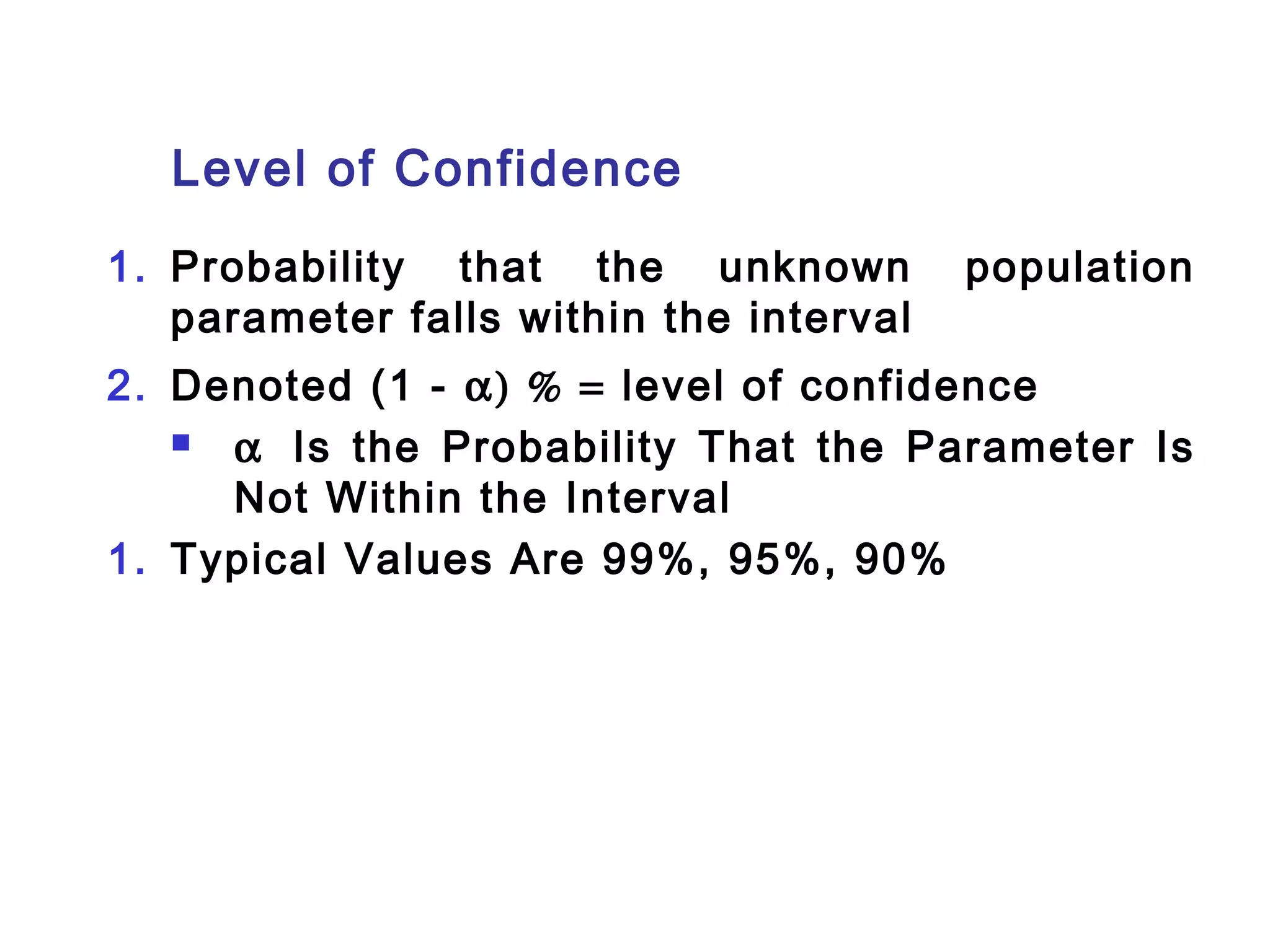
Level of Confidence 
1. Probability that the unknown population 
parameter falls within the interval 
2. Denoted (1 - a) % = level of confidence 
 a  Is the Probability That the Parameter Is 
Not Within the Interval 
1. Typical Values Are 99%, 95%, 90%
Interpreting Confidence Intervals 
 Once a confidence interval has been 
constructed, it will either contain the 
population mean or it will not. 
 For a 95% confidence interval, if you were to 
produce all the possible confidence intervals 
using each possible sample mean from the 
population, 95% of these intervals would 
contain the population mean.
Intervals & Level of Confidence 
Sampling 
Distribution 
of Mean 
_ 
a/2 1 - a a/2 
Large Number of Intervals 
Intervals 
Extend from 
(1 - a) % of 
Intervals 
Contain m . 
a % Do Not. 
m`x = m 
X _ 
sx 
- × s 
to 
X 
X Z 
X 
X Z 
+ × 
s
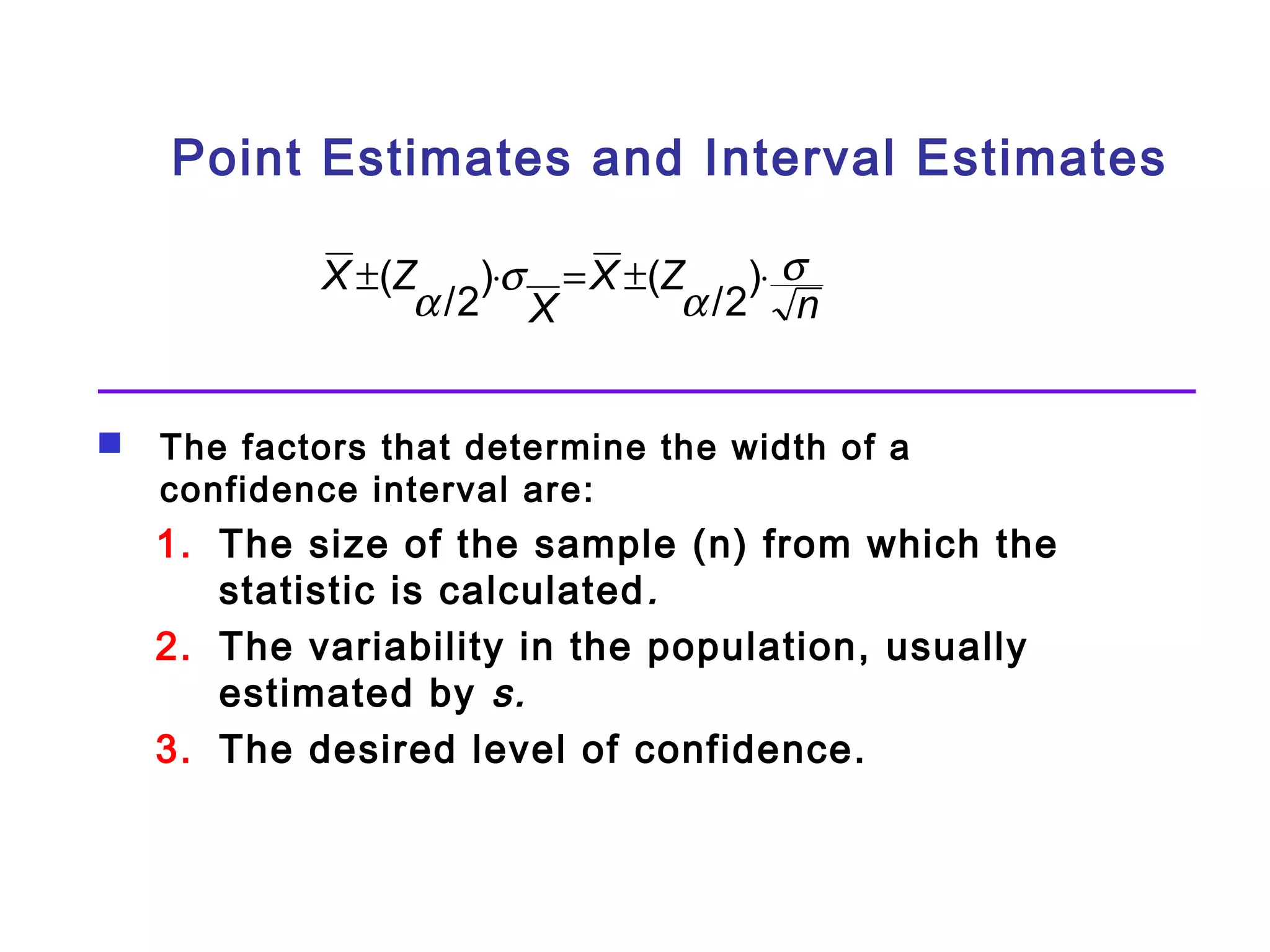
Point Estimates and Interval Estimates 
X Z s 
n 
±( a /2)×s = X ±( Z 
a /2)× 
X 
 The factors that determine the width of a 
confidence interval are: 
1. The size of the sample (n) from which the 
statistic is calculated. 
2. The variability in the population, usually 
estimated by s. 
3. The desired level of confidence.
Point and Interval Estimates 
 If the population standard deviation is known 
or the sample is greater than 30 we use the z 
distribution. 
X ± z s 
n
CONTOH 
 Penelitian dilakukan untuk mengetahui 
pendapatan bersih PKL di Surabaya. Dari 100 
orang sampel random diketahui rata-rata 
pendapatan bersih per hari PKL Rp 50.000 
dengan simpangan baku RP 15.000. 
Berdasarkan data tersebut lakukan estimasi 
pendapatan bersih PKL di Surabaya dengan 
tingkat keyakinan 95%.
Point and Interval Estimates 
 If the population standard deviation is unknown 
and the sample is less than 30 we use the t 
distribution. 
X ±t s 
n
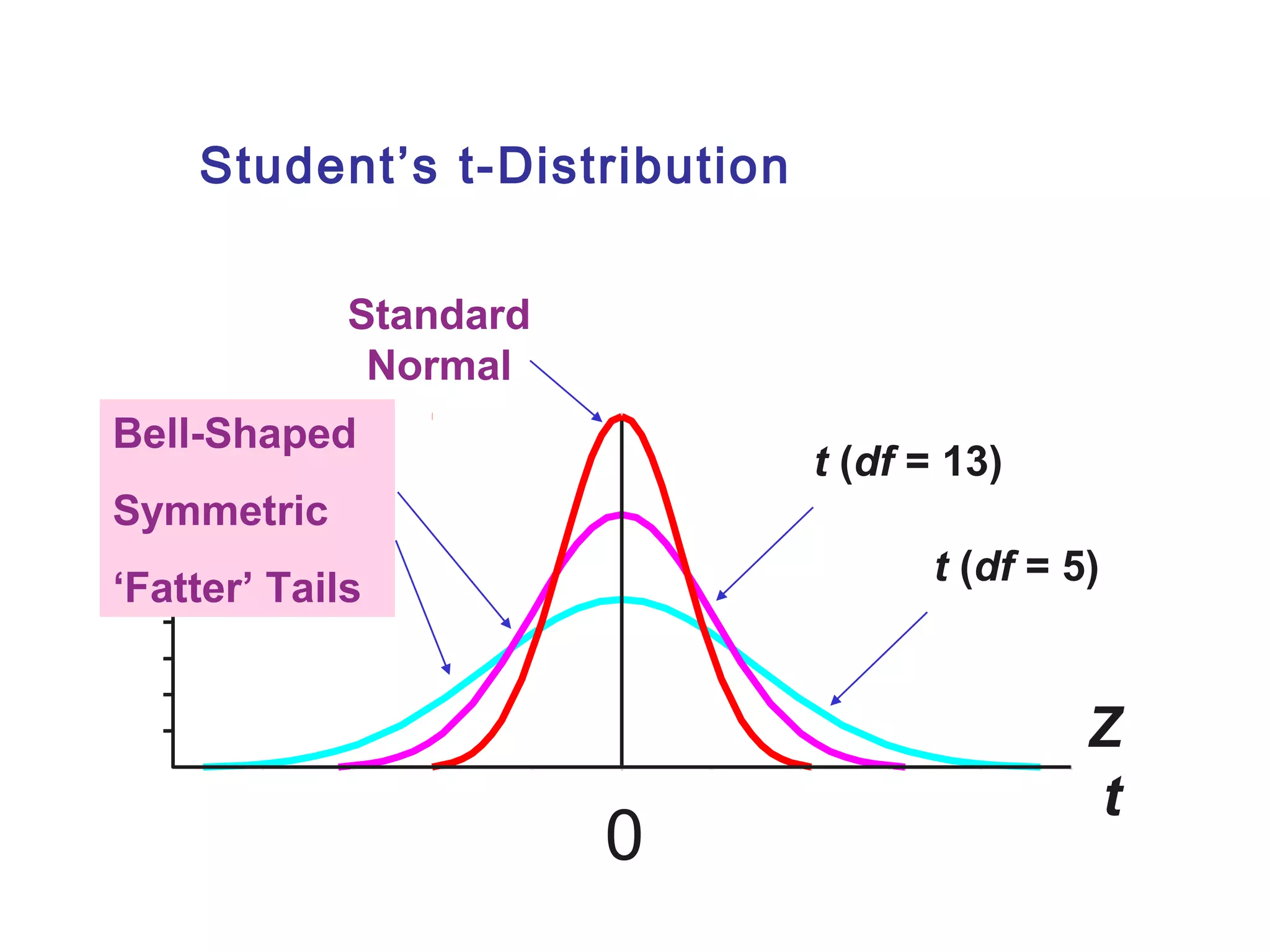
Student’s t-Distribution 
 The t-distribution is a family of distributions 
that is bell-shaped and symmetric like the 
standard normal distribution but with greater 
area in the tails. Each distribution in the t-family 
is defined by its degrees of freedom. 
As the degrees of freedom increase, the t-distribution 
approaches the normal 
distribution.
About Student 
 Student is a pen name for a statistician 
named William S. Gosset who was not 
allowed to publish under his real name. 
Gosset assumed the pseudonym Student for 
this purpose. Student’s t distribution is not 
meant to reference anything regarding 
college students.
Zt 
Student’s t-Distribution 
0 
t (df = 5) 
Standard 
Normal 
Bell-Shaped t (df = 13) 
Symmetric 
‘Fatter’ Tails
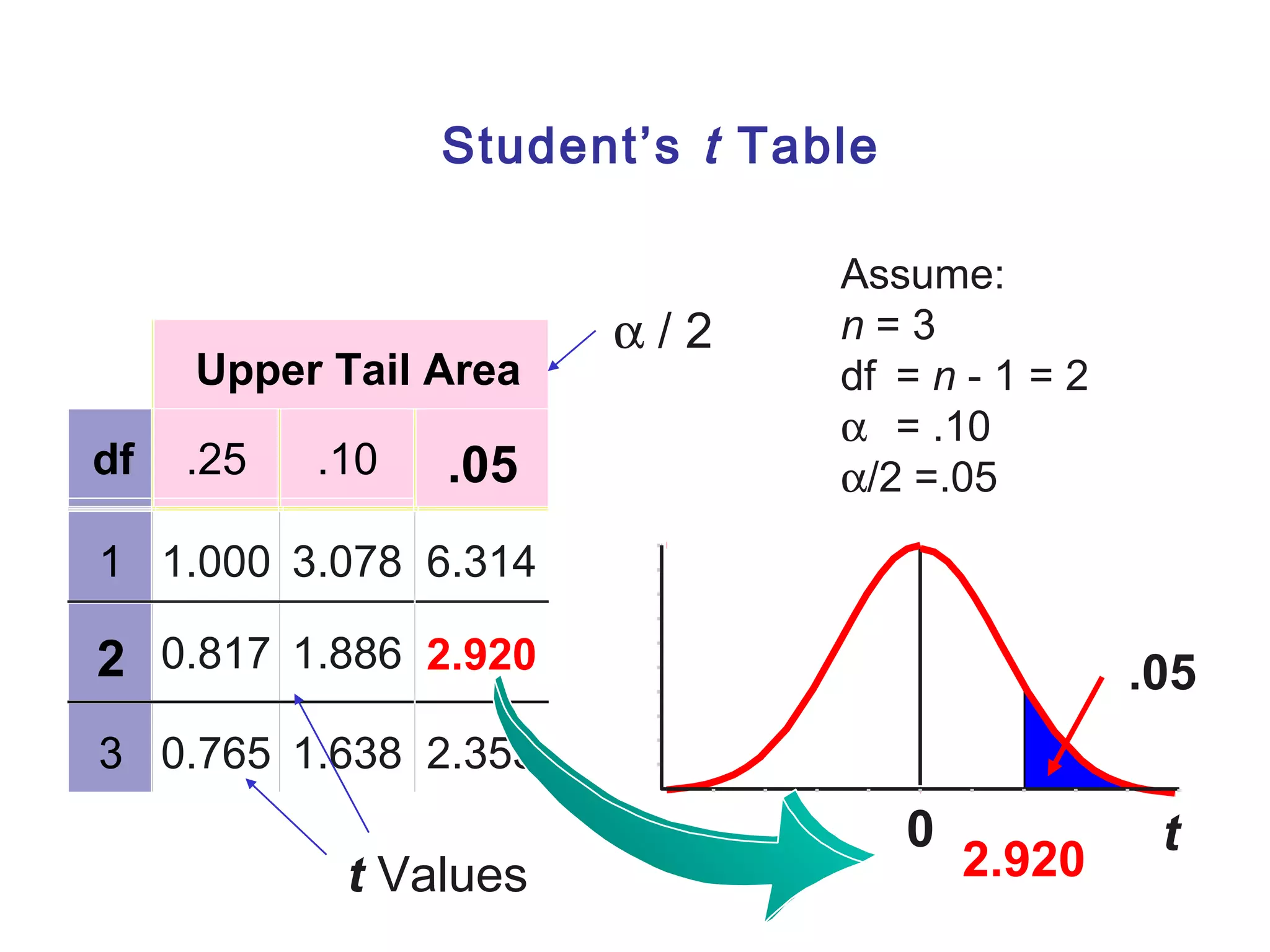
Upper Tail Area 
df .25 .10 .05 
1 1.000 3.078 6.314 
2 0.817 1.886 2.920 
3 0.765 1.638 2.353 
0 t 
Student’s t Table 
Assume: 
n = 3 
df = n - 1 = 2 
a = .10 
a/2 =.05 
a / 2 
t Values 2.920 
.05
Degrees of freedom 
 Degrees of freedom refers to the number of 
independent data values available to estimate 
the population’s standard deviation. If k 
parameters must be estimated before the 
population’s standard deviation can be 
calculated from a sample of size n, the 
degrees of freedom are equal to n - k.
Degrees of Freedom (df ) 
1. Number of Observations that Are Free to Vary After 
Sample Statistic Has Been Calculated 
2. Example 
Sum of 3 Numbers Is 6 
X1 
= 1 (or Any Number) 
X2 
= 2 (or Any Number) 
X3 
= 3 (Cannot Vary) 
Sum = 6 
degrees of freedom 
= n -1 
= 3 -1 
= 2
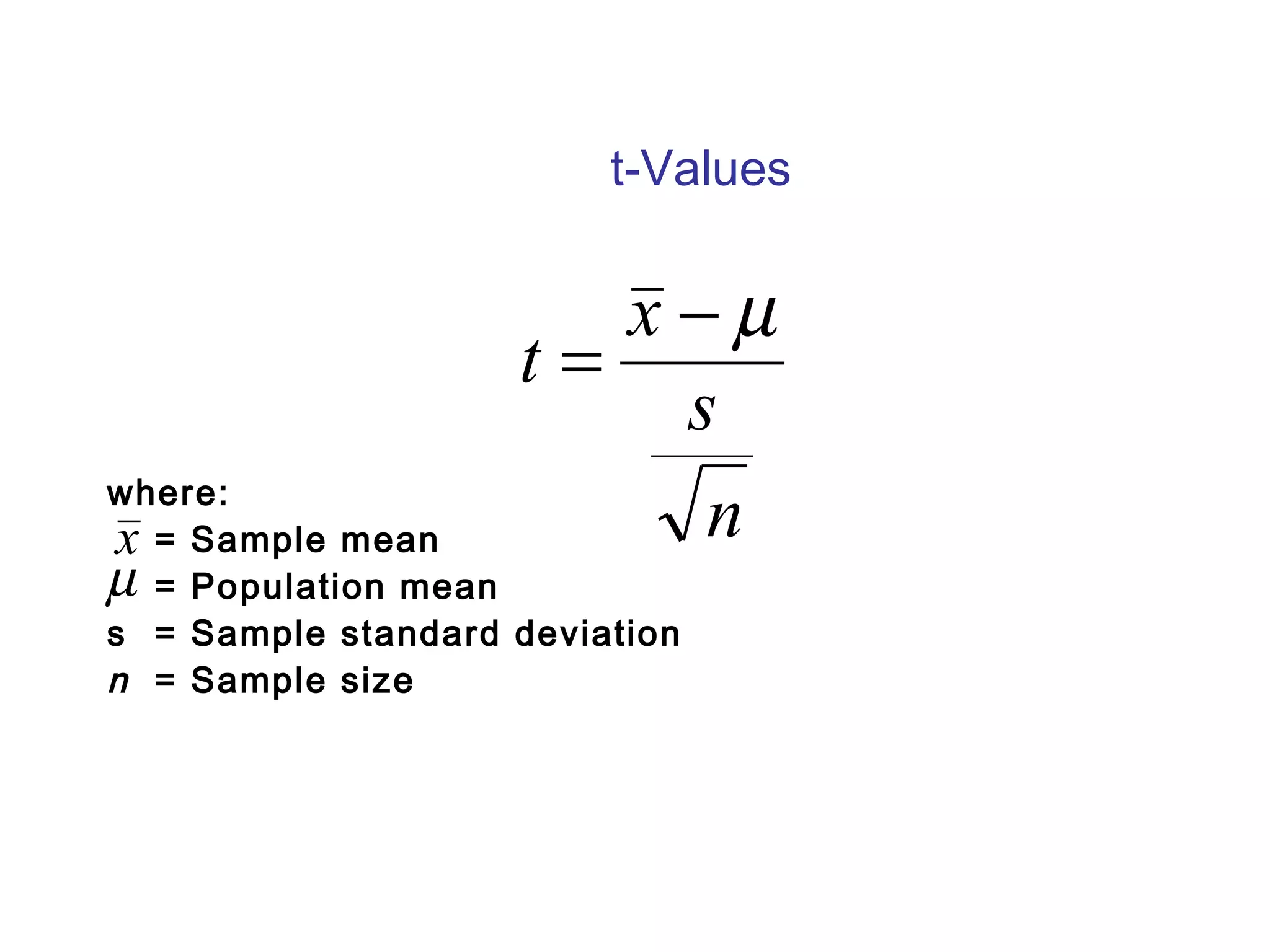
t-Values 
t = x -m 
where: 
= Sample mean 
= Population mean 
s = Sample standard deviation 
n = Sample size 
s 
n 
xm
Estimation Example 
Mean (s Unknown) 
X 
A random sample of n = 25 has = 50 and S = 8. 
Set up a 95% confidence interval estimate for m. 
X t 
S 
n 
X t 
S 
- a n - × £ m £ + a n - 
× 
n - × £ £ + × 
/ , / , 
. . 
2 1 2 1 
m 
m 
. £ £ 
. 
50 2 0639 
8 
25 
50 2 0639 
8 
25 
46 69 53 30
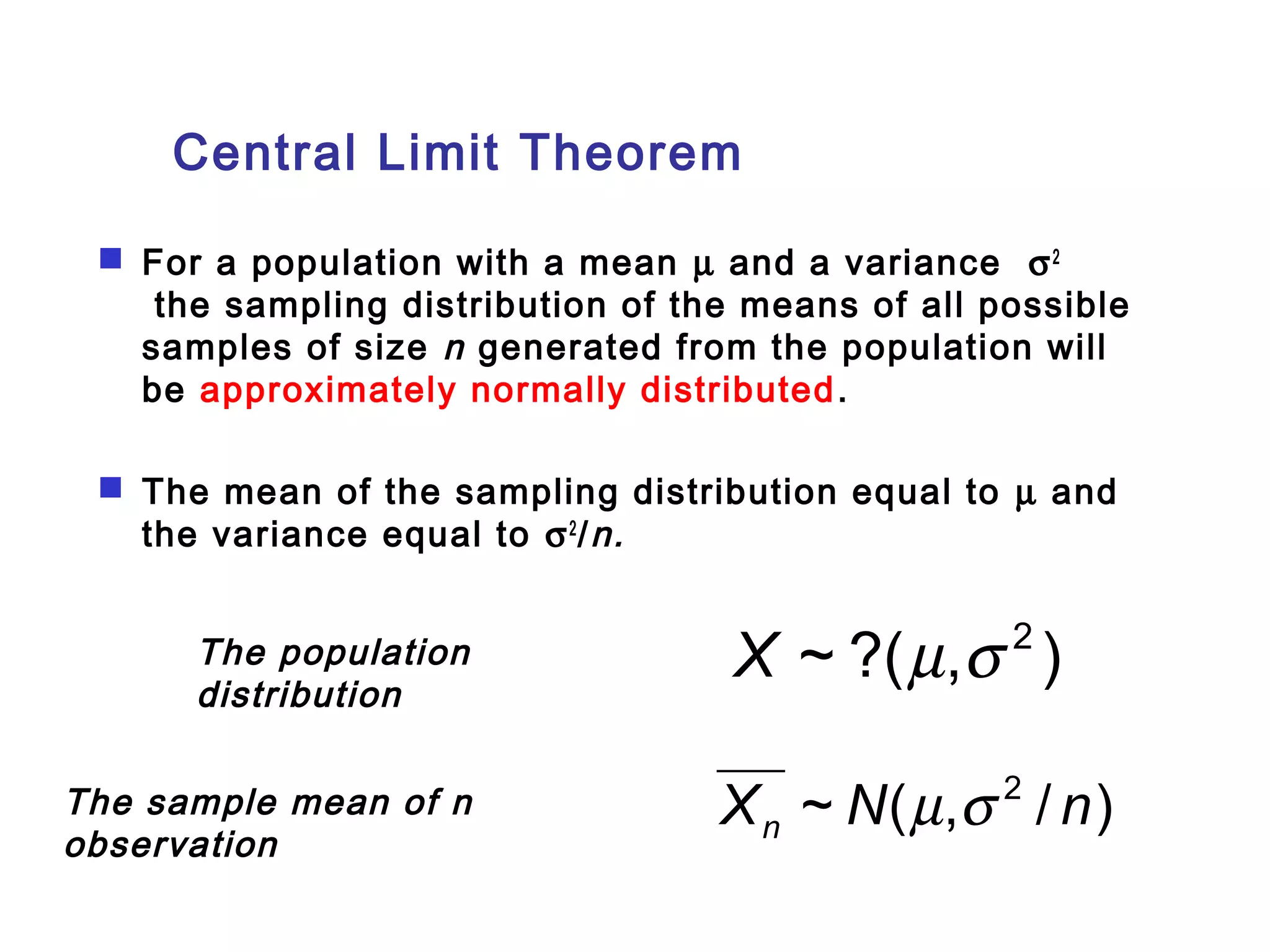
Central Limit Theorem 
 For a population with a mean m and a variance s2 
the sampling distribution of the means of all possible 
samples of size n generated from the population will 
be approximately normally distributed. 
 The mean of the sampling distribution equal to m and 
the variance equal to s2/n. 
The population 
X ~ ?(m,s 2 ) 
distribution 
The sample mean of n X ~ N( m , s 
2 / n) observation 
n
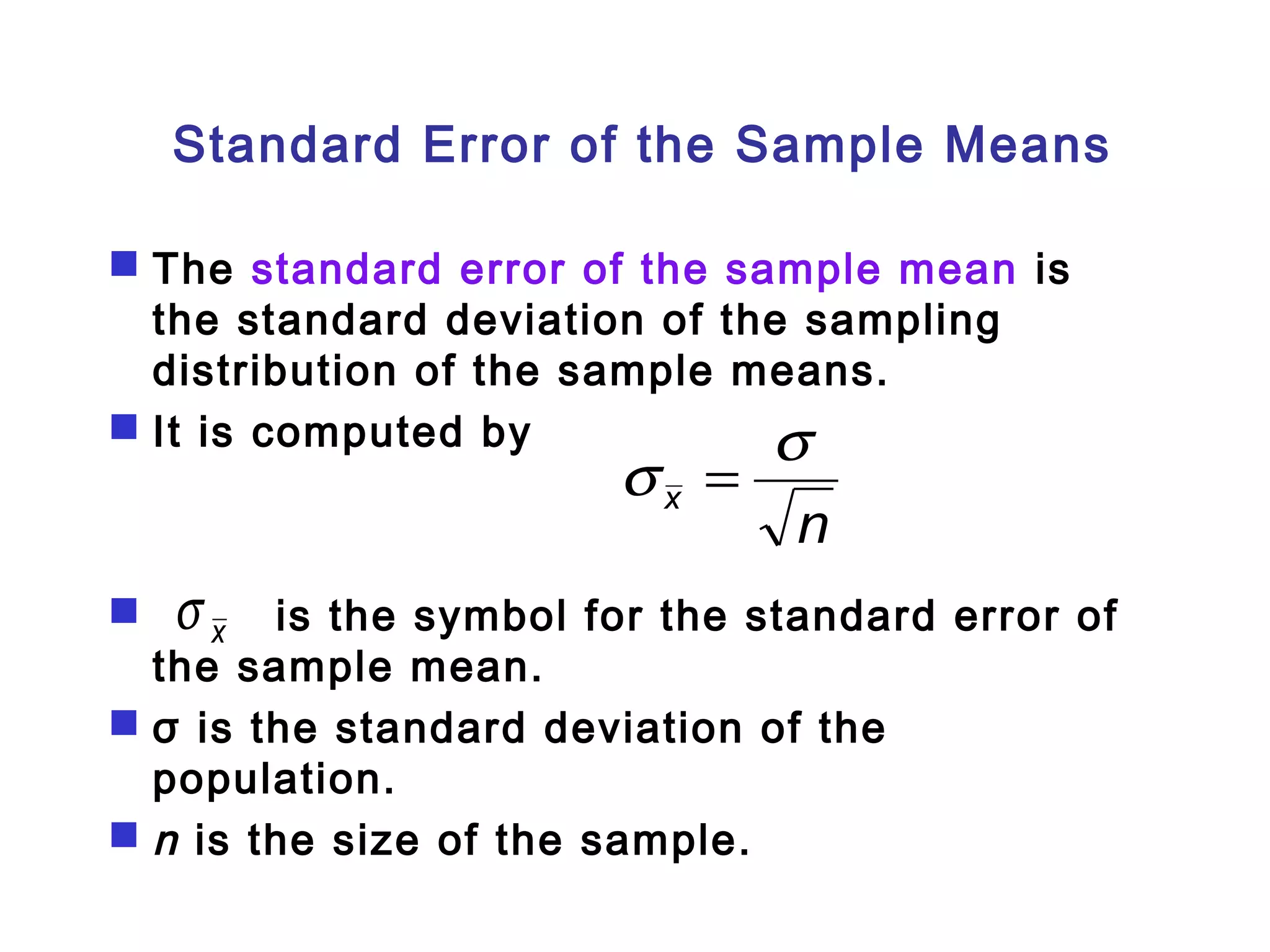
Standard Error of the Sample Means 
 The standard error of the sample mean is 
the standard deviation of the sampling 
distribution of the sample means. 
 It is computed by 
s = s 
n x 
x s 
 is the symbol for the standard error of 
the sample mean. 
 σ is the standard deviation of the 
population. 
 n is the size of the sample.
Standard Error of the Sample Means 
 If s is not known and n ³ 30, the standard 
deviation of the sample, designated s , is used 
to approximate the population standard 
deviation. The formula for the standard error 
is: 
s s x = 
n
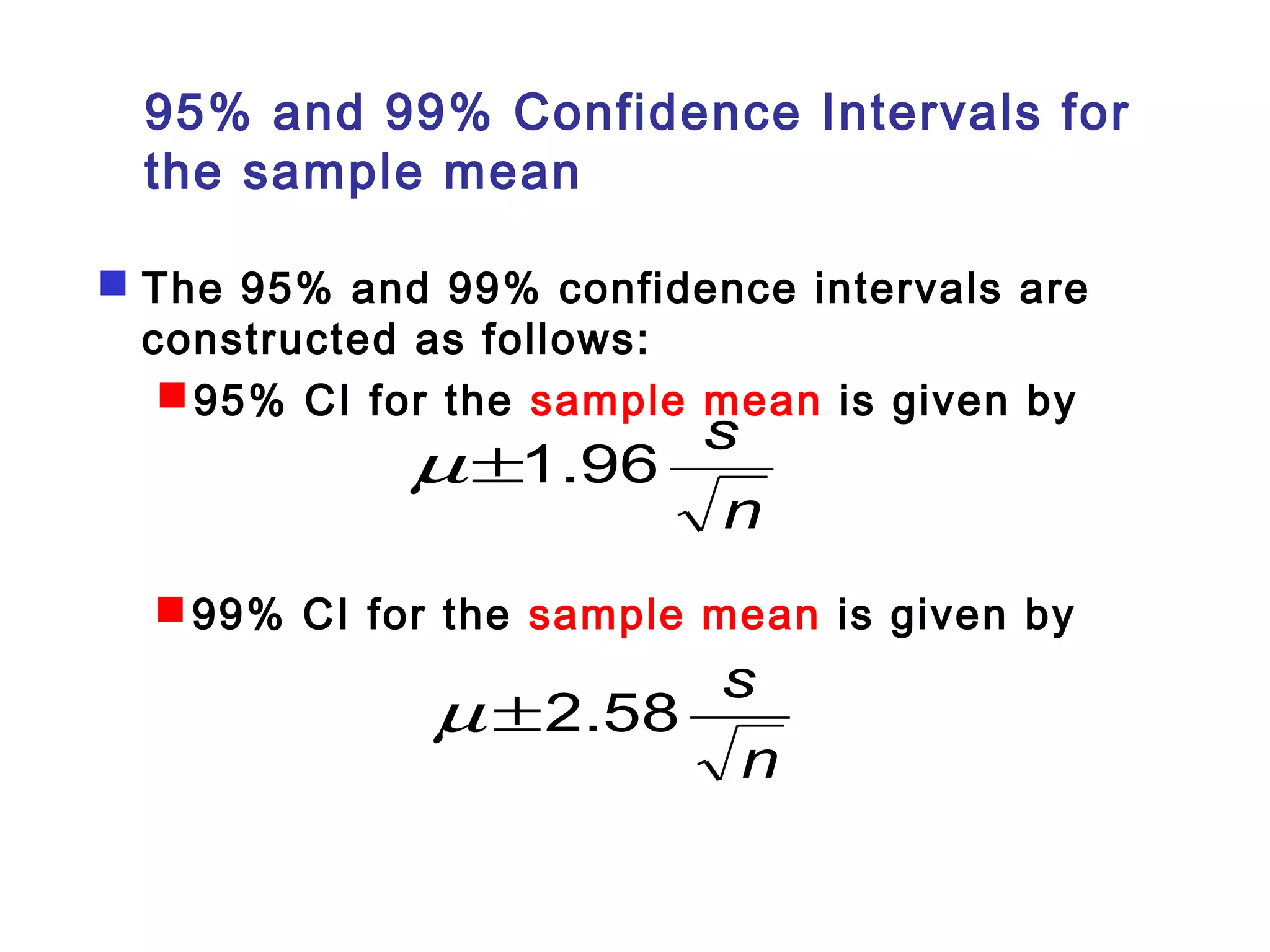
95% and 99% Confidence Intervals for 
the sample mean 
 The 95% and 99% confidence intervals are 
constructed as follows: 
95% CI for the sample mean is given by 
m±1.96 s 
n 
99% CI for the sample mean is given by 
m ±2.58 s 
n
95% and 99% Confidence Intervals for μ 
 The 95% and 99% confidence intervals are 
constructed as follows: 
95% CI for the population mean is given by 
X ±1.96 s 
n 
99% CI for the population mean is given by 
X ±2.58 s 
n
Constructing General Confidence 
Intervals for μ 
 In general, a confidence interval for the mean 
is computed by: 
X ±z s 
n
EXAMPLE 3 
 The Dean of the Business School wants to 
estimate the mean number of hours worked 
per week by students. A sample of 49 
students showed a mean of 24 hours with a 
standard deviation of 4 hours. What is the 
population mean? 
 The value of the population mean is not 
known. Our best estimate of this value is the 
sample mean of 24.0 hours. This value is 
called a point estimate.
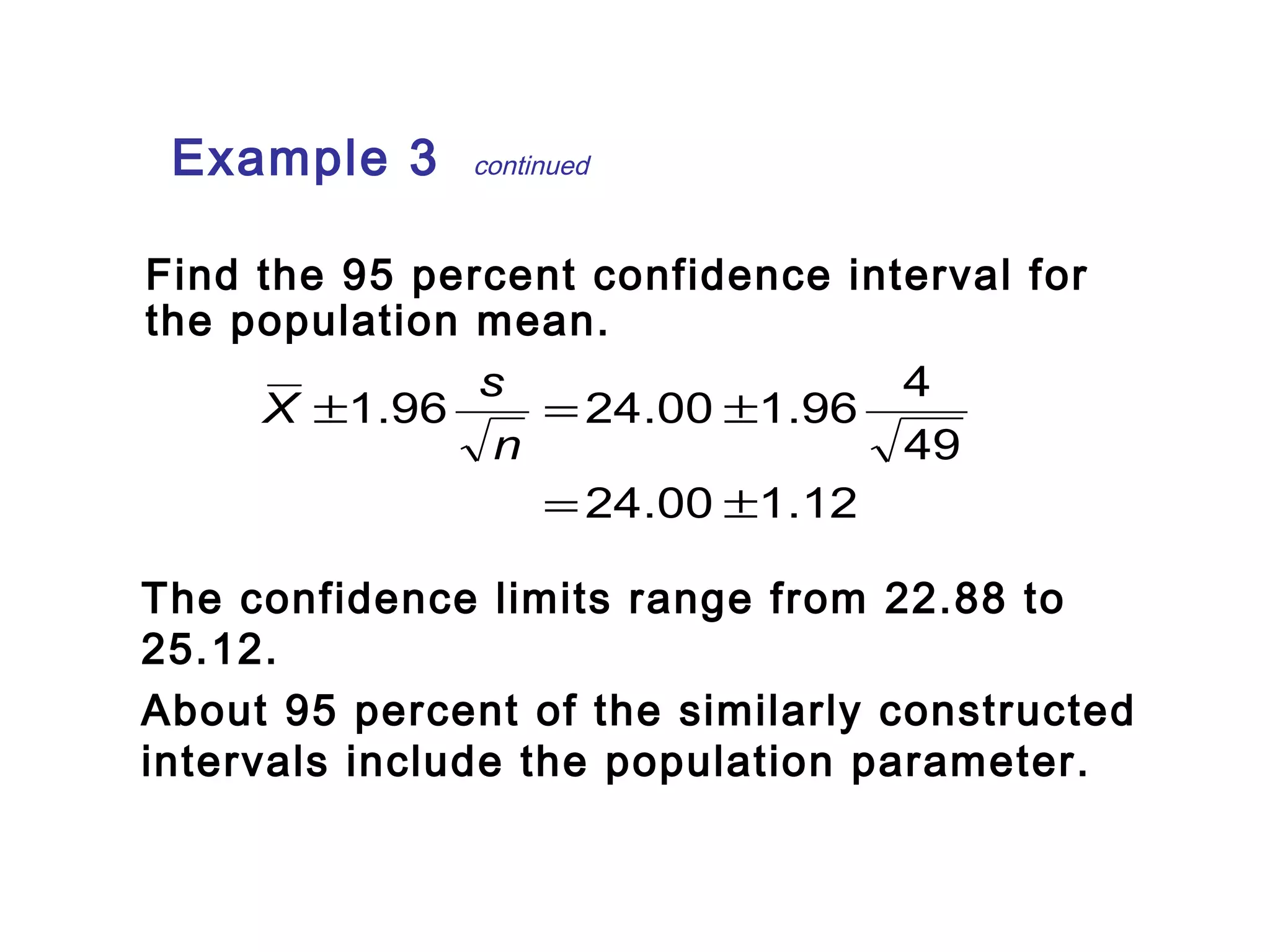
Example 3 continued 
Find the 95 percent confidence interval for 
the population mean. 
1.96 24.00 1.96 4 
X s 
± = ± 
24.00 1.12 
49 
= ± 
n 
The confidence limits range from 22.88 to 
25.12. 
About 95 percent of the similarly constructed 
intervals include the population parameter.
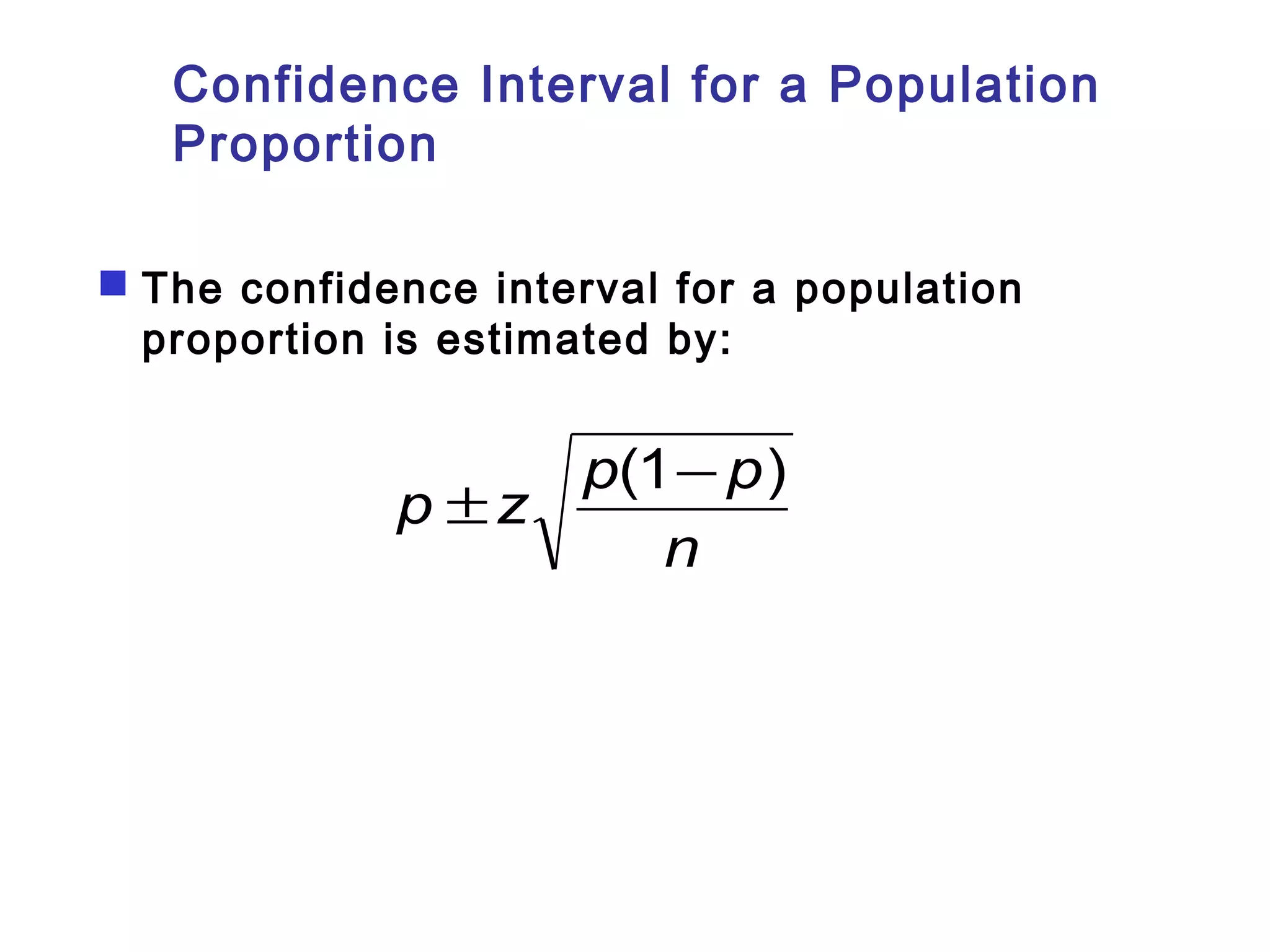
Confidence Interval for a Population 
Proportion 
 The confidence interval for a population 
proportion is estimated by: 
p ±z p(1-p) 
n
EXAMPLE 4 
 A sample of 500 executives who own their 
own home revealed 175 planned to sell their 
homes and retire to Arizona. Develop a 98% 
confidence interval for the proportion of 
executives that plan to sell and move to 
Arizona. 
.35 ±2.33 (.35)(.65) = ± 
.35 .0497 
500
CONTOH 
 Lembaga riset melakukan penelitian tentang 
perusahaan di Jawa Timur yang sudah 
menerapkan UMR. Data menunjukkan dari 50 
sampel perusahaan, 40 diantaranya sudah 
memenuhi UMR. Buatlah confidence interval 
90% untuk menduga persentase perusahaan 
yang sudah menerapkan UMR.
Finite-Population Correction Factor 
 A population that has a fixed upper bound is 
said to be finite. 
 For a finite population, where the total 
number of objects is N and the size of the 
sample is n , the following adjustment is made 
to the standard errors of the sample means 
and the proportion: 
 Standard error of the sample means: 
N n 
s s 
= - 
-1 
N 
n x
Finite-Population Correction Factor 
 Standard error of the sample proportions: 
N n 
p p 
= - - 
1 
(1 ) 
- 
N 
n 
p s 
 This adjustment is called the finite-population 
correction factor. 
 If n /N < .05, the finite-population correction 
factor is ignored.
Finite-Population Correction Factor 
 Standard error of the sample proportions: 
sp 
p p 
- - 
(1 ) 
n 
N n 
N 
= 
- 
1 
 This adjustment is called the finite-population 
correction factor. 
 Note : If n/N < 0.05, the finite-population 
correction factor is ignored. 
 Interval Estimation for proportion with finite-pop 
N n 
1 
ˆ ˆ (1 ˆ ) 
P p Z p p 
= ± - - 
- 
N 
n
EXAMPLE 5 
 Given the information in EXAMPLE 4, 
construct a 95% confidence interval for the 
mean number of hours worked per week by 
the students if there are only 500 students 
on campus. 
 Because n /N = 49/500 = .098 which is 
greater than 05, we use the finite 
population correction factor. 
24 1.96( 4 = ± 
) 24.00 1.0648 
)( 500 49 
± - 
500 1 
49 
-
CONTOH 
 Pimpinan bank ingin mengetahui tentang 
kepuasan nasabah terhadap pelayanan bank. 
Dari jumlah nasabah 1000 orang, diambil 
sampel 100 orang untuk diwawancarai, Hasilnya 
60 orang mengakui puas dengan pelayanan 
bank tersebut. Dengan a = 5%, berapa proporsi 
nasabah yang puas dengan pelayanan bank,
Selecting a Sample Size 
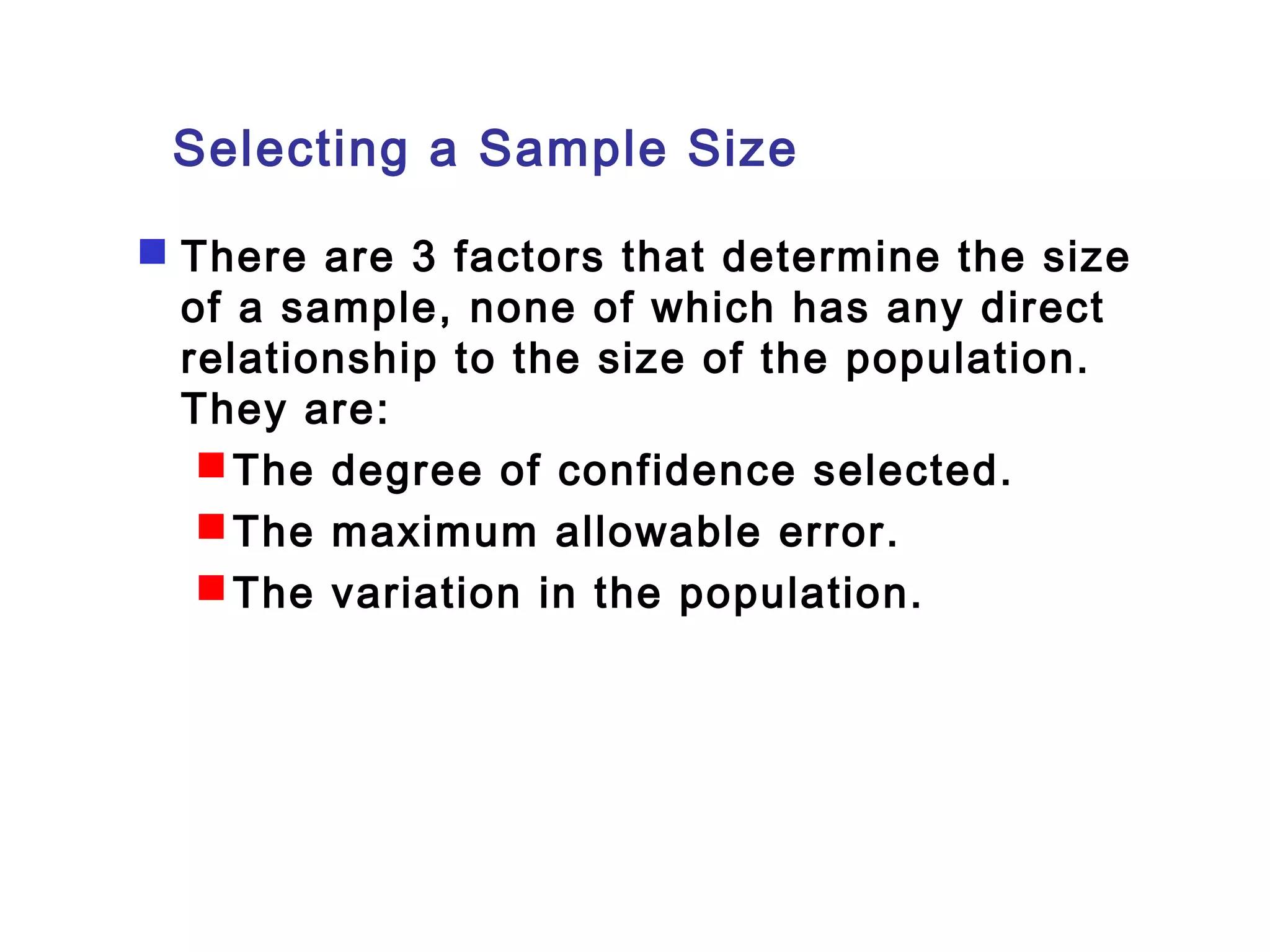
 There are 3 factors that determine the size 
of a sample, none of which has any direct 
relationship to the size of the population. 
They are: 
The degree of confidence selected. 
The maximum allowable error. 
The variation in the population.
Selecting a Sample Size 
X Z s 
n 
±( a /2)×s = X ±( Z 
a /2)× 
X 
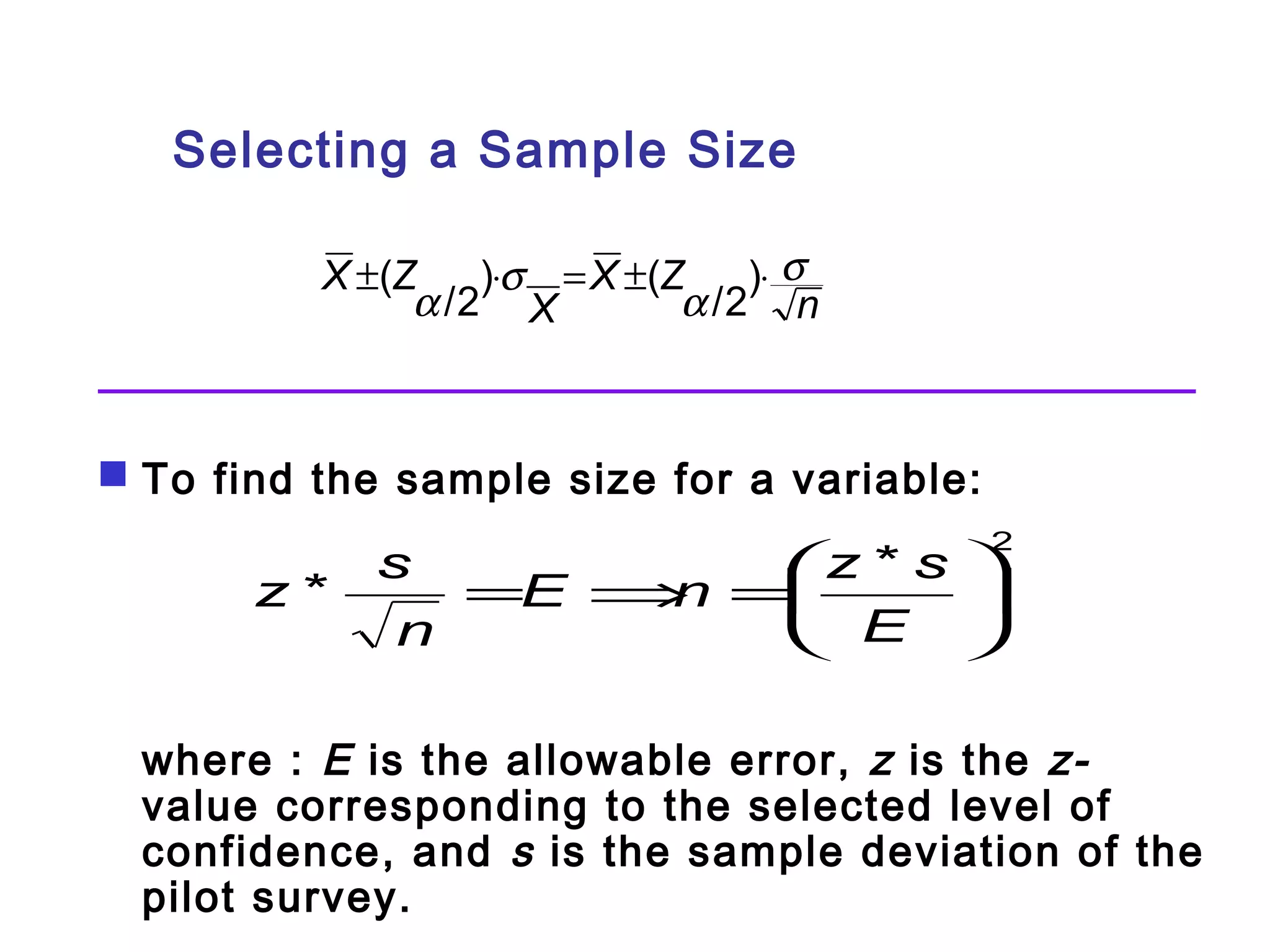
 To find the sample size for a variable: 
=æ 
z * s 
÷ø 
çè 
ö 2 * = E Þ n E 
z s 
n 
where : E is the allowable error, z is the z- 
value corresponding to the selected level of 
confidence, and s is the sample deviation of the 
pilot survey.
EXAMPLE 6 
 A consumer group would like to estimate the 
mean monthly electricity charge for a single 
family house in July within $5 using a 99 
percent level of confidence. Based on 
similar studies the standard deviation is 
estimated to be $20.00. How large a sample 
is required? 
107 
(2.58)(20) 2 
ö 5 
çè 
= ÷ø 
n = æ
Sample Size for Proportions 
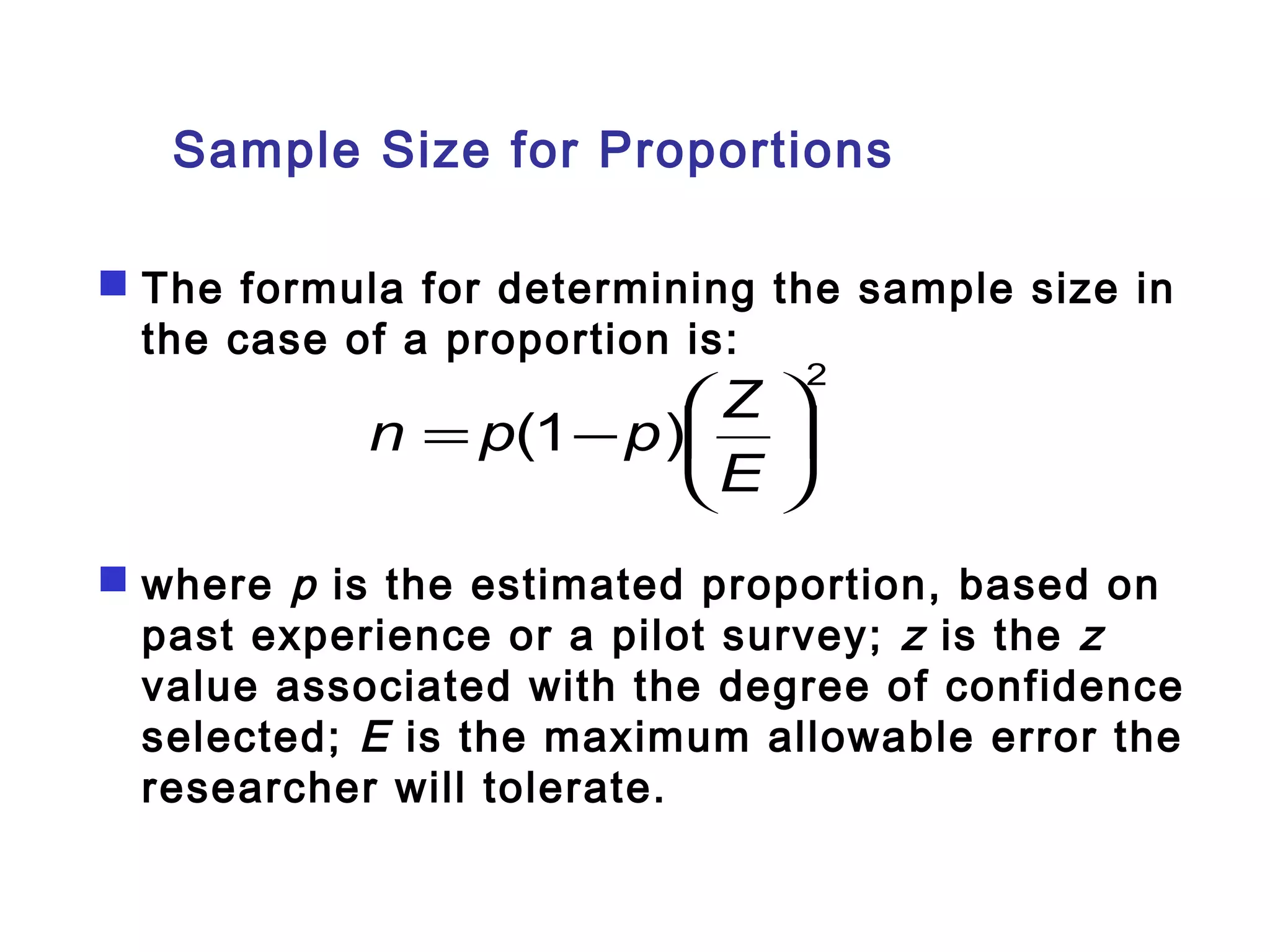
 The formula for determining the sample size in 
the case of a proportion is: 
2 
n = p - p æ 
Z 
ö çè 
÷ø 
( 1 ) E 
 where p is the estimated proportion, based on 
past experience or a pilot survey; z is the z 
value associated with the degree of confidence 
selected; E is the maximum allowable error the 
researcher will tolerate.
EXAMPLE 7 
 The American Kennel Club wanted to 
estimate the proportion of children that 
have a dog as a pet. If the club wanted 
the estimate to be within 3% of the 
population proportion, how many children 
would they need to contact? Assume a 
95% level of confidence and that the club 
estimated that 30% of the children have a 
dog as a pet. 
897 
(.30)(.70) 1.96 
.03 
2 
= ÷ø 
n = æ 
ö çè
Two-sample Estimation 
 Mean : 
 n1, n2 ³ 30 
m m X X Z s 
1 2 1 2 n 
 n1, n2 < 30 
2 
m - m = X - X ± t n - s + n - 
s 
 Proportion : 
ö 
æ 
( ) ÷ ÷ø 
ç çè 
2 
1 
- = - ± + 
2 
2 
2 
1 
s 
n 
æ 
( ) æ 
ö 
÷ø 
÷ + ÷ ÷ø 
ç çè 
ö 
ç çè 
( 1) ( 1) 
2 2 
1 1 
n + n - 
n n 
2 
1 2 1 2 
1 2 1 2 
1 1 
2 
ˆ ˆ ˆ (1 ˆ ) ˆ (1 ˆ ) 
P - P = p - p ± Z p - p + - 
( ) 
p p 
2 2 
2 
1 1 
1 
1 2 1 2 
n 
n
Contoh 
 Perusahaan ban sedang memebandingkan daya 
pakai antara ban merek A dan Merek B. Dari 
sampel random 10 ban A diketahui rata-rata 
daya pakai 1.000 km dengan standar deviasi 
100 km sedangkan dari sampel random 10 ban 
merek B rata-rata daya pakai 900 km dengan 
standar deviasi 90 km. Hitung perbedaan daya 
pakai antara ban merek A dan merek B dengan 
a = 0,05.
Contoh 
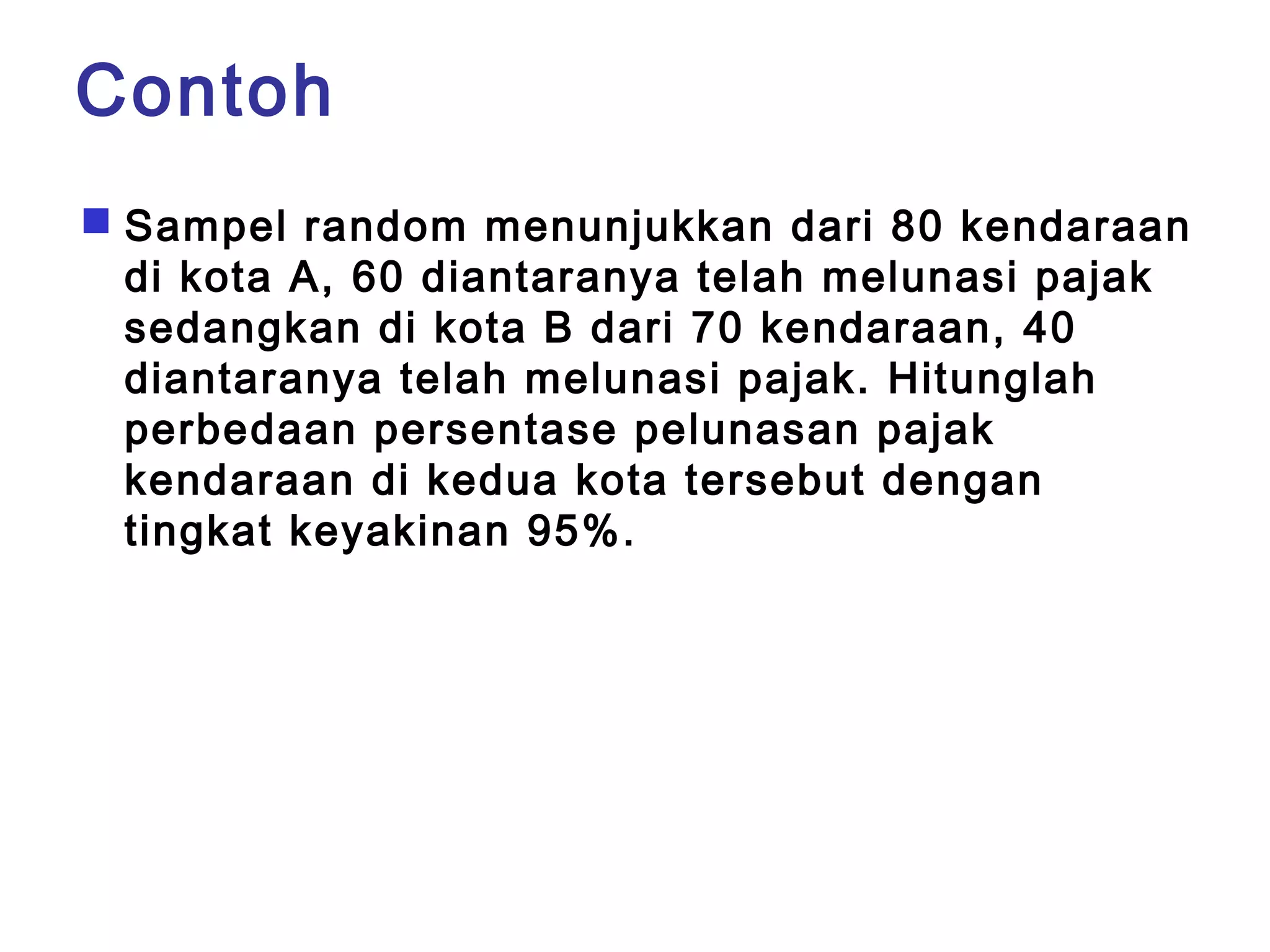
 Sampel random menunjukkan dari 80 kendaraan 
di kota A, 60 diantaranya telah melunasi pajak 
sedangkan di kota B dari 70 kendaraan, 40 
diantaranya telah melunasi pajak. Hitunglah 
perbedaan persentase pelunasan pajak 
kendaraan di kedua kota tersebut dengan 
tingkat keyakinan 95%.
Chapter Nine 
Estimation and Confidence IInntteerrvvaallss 
- END -

Statistik 1 7 estimasi & ci

  • 1.
    l Chapter Nine Estimation and Confidence IInntteerrvvaallss GOALS 1. Define a what is meant by a point estimate. 2. Define the term level of confidence. 3. Construct a confidence interval for the population mean when the population standard deviation is known. 4. Construct a confidence interval for the population mean when the population standard deviation is unknown. 5. Construct a confidence interval for the population proportion. 6. Determine the sample size for attribute and variable sampling.
  • 3.
    Point and IntervalEstimates  A point estimate is a single value (statistic) used to estimate a population value (parameter).  A interval estimate is a range of values within which the population parameter is expected to occur. The interval within which a population parameter is expected to occur is called a confidence interval. The specified probability is called the level of confidence. The two confidence intervals that are used extensively are the 95% and the 99%.
  • 4.
    Interval Estimation for The Population Mean Is the Population Normal Is n 30 or more ? Is the population standard deviation known ? Use a Non Parametric Test Use the Z Distribution Use the t Distribution Use the Z Distribution No No No Yes Yes Yes
  • 5.
    Confidence Intervals The degree to which we can rely on the statistic is as important as the initial calculation. Remember, most of the time we are working from samples. And samples are really estimates. Ultimately, we are concerned with the accuracy of the estimate. 1. Confidence interval provides Range of Values  Based on Observations from 1 Sample 1. Confidence interval gives Information about Closeness to Unknown Population Parameter  Stated in terms of Probability  Knowing Exact Closeness Requires Knowing Unknown Population Parameter
  • 6.
    Areas Under theNormal Curve Between: ± 1 s - 68.26% ± 2 s - 95.44% ± 3 s - 99.74% μ If we draw an observation from the normal distributed population, the drawn value is likely (a chance of 68.26%) to lie inside the interval of (μ-1σ, μ+1σ). P((μ-1σ <x<μ+1σ) =0.6826. μ-2σ μ+2σ μ-3σ μ-1σ μ+1σ μ+3σ
  • 7.
    Elements of ConfidenceInterval Estimation A probability that the population parameter falls somewhere within the interval. Confidence Interval Sample Statistic Confidence Limit (Lower) Confidence Limit (Upper)
  • 8.
    Confidence Intervals X±Z×s = ± ×s X Z n _ m -2.58×s m -1.645×s m m +1.645×s m +2.58×s m -1.96×s m +1.96×s 90% Samples 95% Samples 99% Samples sx X X X X X X X X
  • 9.
    Level of Confidence 1. Probability that the unknown population parameter falls within the interval 2. Denoted (1 - a) % = level of confidence  a Is the Probability That the Parameter Is Not Within the Interval 1. Typical Values Are 99%, 95%, 90%
  • 10.
    Interpreting Confidence Intervals  Once a confidence interval has been constructed, it will either contain the population mean or it will not.  For a 95% confidence interval, if you were to produce all the possible confidence intervals using each possible sample mean from the population, 95% of these intervals would contain the population mean.
  • 11.
    Intervals & Levelof Confidence Sampling Distribution of Mean _ a/2 1 - a a/2 Large Number of Intervals Intervals Extend from (1 - a) % of Intervals Contain m . a % Do Not. m`x = m X _ sx - × s to X X Z X X Z + × s
  • 12.
    Point Estimates andInterval Estimates X Z s n ±( a /2)×s = X ±( Z a /2)× X  The factors that determine the width of a confidence interval are: 1. The size of the sample (n) from which the statistic is calculated. 2. The variability in the population, usually estimated by s. 3. The desired level of confidence.
  • 13.
    Point and IntervalEstimates  If the population standard deviation is known or the sample is greater than 30 we use the z distribution. X ± z s n
  • 14.
    CONTOH  Penelitiandilakukan untuk mengetahui pendapatan bersih PKL di Surabaya. Dari 100 orang sampel random diketahui rata-rata pendapatan bersih per hari PKL Rp 50.000 dengan simpangan baku RP 15.000. Berdasarkan data tersebut lakukan estimasi pendapatan bersih PKL di Surabaya dengan tingkat keyakinan 95%.
  • 15.
    Point and IntervalEstimates  If the population standard deviation is unknown and the sample is less than 30 we use the t distribution. X ±t s n
  • 16.
    Student’s t-Distribution The t-distribution is a family of distributions that is bell-shaped and symmetric like the standard normal distribution but with greater area in the tails. Each distribution in the t-family is defined by its degrees of freedom. As the degrees of freedom increase, the t-distribution approaches the normal distribution.
  • 17.
    About Student Student is a pen name for a statistician named William S. Gosset who was not allowed to publish under his real name. Gosset assumed the pseudonym Student for this purpose. Student’s t distribution is not meant to reference anything regarding college students.
  • 18.
    Zt Student’s t-Distribution 0 t (df = 5) Standard Normal Bell-Shaped t (df = 13) Symmetric ‘Fatter’ Tails
  • 19.
    Upper Tail Area df .25 .10 .05 1 1.000 3.078 6.314 2 0.817 1.886 2.920 3 0.765 1.638 2.353 0 t Student’s t Table Assume: n = 3 df = n - 1 = 2 a = .10 a/2 =.05 a / 2 t Values 2.920 .05
  • 20.
    Degrees of freedom  Degrees of freedom refers to the number of independent data values available to estimate the population’s standard deviation. If k parameters must be estimated before the population’s standard deviation can be calculated from a sample of size n, the degrees of freedom are equal to n - k.
  • 21.
    Degrees of Freedom(df ) 1. Number of Observations that Are Free to Vary After Sample Statistic Has Been Calculated 2. Example Sum of 3 Numbers Is 6 X1 = 1 (or Any Number) X2 = 2 (or Any Number) X3 = 3 (Cannot Vary) Sum = 6 degrees of freedom = n -1 = 3 -1 = 2
  • 22.
    t-Values t =x -m where: = Sample mean = Population mean s = Sample standard deviation n = Sample size s n xm
  • 23.
    Estimation Example Mean(s Unknown) X A random sample of n = 25 has = 50 and S = 8. Set up a 95% confidence interval estimate for m. X t S n X t S - a n - × £ m £ + a n - × n - × £ £ + × / , / , . . 2 1 2 1 m m . £ £ . 50 2 0639 8 25 50 2 0639 8 25 46 69 53 30
  • 24.
    Central Limit Theorem  For a population with a mean m and a variance s2 the sampling distribution of the means of all possible samples of size n generated from the population will be approximately normally distributed.  The mean of the sampling distribution equal to m and the variance equal to s2/n. The population X ~ ?(m,s 2 ) distribution The sample mean of n X ~ N( m , s 2 / n) observation n
  • 25.
    Standard Error ofthe Sample Means  The standard error of the sample mean is the standard deviation of the sampling distribution of the sample means.  It is computed by s = s n x x s  is the symbol for the standard error of the sample mean.  σ is the standard deviation of the population.  n is the size of the sample.
  • 26.
    Standard Error ofthe Sample Means  If s is not known and n ³ 30, the standard deviation of the sample, designated s , is used to approximate the population standard deviation. The formula for the standard error is: s s x = n
  • 27.
    95% and 99%Confidence Intervals for the sample mean  The 95% and 99% confidence intervals are constructed as follows: 95% CI for the sample mean is given by m±1.96 s n 99% CI for the sample mean is given by m ±2.58 s n
  • 28.
    95% and 99%Confidence Intervals for μ  The 95% and 99% confidence intervals are constructed as follows: 95% CI for the population mean is given by X ±1.96 s n 99% CI for the population mean is given by X ±2.58 s n
  • 29.
    Constructing General Confidence Intervals for μ  In general, a confidence interval for the mean is computed by: X ±z s n
  • 30.
    EXAMPLE 3 The Dean of the Business School wants to estimate the mean number of hours worked per week by students. A sample of 49 students showed a mean of 24 hours with a standard deviation of 4 hours. What is the population mean?  The value of the population mean is not known. Our best estimate of this value is the sample mean of 24.0 hours. This value is called a point estimate.
  • 31.
    Example 3 continued Find the 95 percent confidence interval for the population mean. 1.96 24.00 1.96 4 X s ± = ± 24.00 1.12 49 = ± n The confidence limits range from 22.88 to 25.12. About 95 percent of the similarly constructed intervals include the population parameter.
  • 32.
    Confidence Interval fora Population Proportion  The confidence interval for a population proportion is estimated by: p ±z p(1-p) n
  • 33.
    EXAMPLE 4 A sample of 500 executives who own their own home revealed 175 planned to sell their homes and retire to Arizona. Develop a 98% confidence interval for the proportion of executives that plan to sell and move to Arizona. .35 ±2.33 (.35)(.65) = ± .35 .0497 500
  • 34.
    CONTOH  Lembagariset melakukan penelitian tentang perusahaan di Jawa Timur yang sudah menerapkan UMR. Data menunjukkan dari 50 sampel perusahaan, 40 diantaranya sudah memenuhi UMR. Buatlah confidence interval 90% untuk menduga persentase perusahaan yang sudah menerapkan UMR.
  • 35.
    Finite-Population Correction Factor  A population that has a fixed upper bound is said to be finite.  For a finite population, where the total number of objects is N and the size of the sample is n , the following adjustment is made to the standard errors of the sample means and the proportion:  Standard error of the sample means: N n s s = - -1 N n x
  • 36.
    Finite-Population Correction Factor  Standard error of the sample proportions: N n p p = - - 1 (1 ) - N n p s  This adjustment is called the finite-population correction factor.  If n /N < .05, the finite-population correction factor is ignored.
  • 37.
    Finite-Population Correction Factor  Standard error of the sample proportions: sp p p - - (1 ) n N n N = - 1  This adjustment is called the finite-population correction factor.  Note : If n/N < 0.05, the finite-population correction factor is ignored.  Interval Estimation for proportion with finite-pop N n 1 ˆ ˆ (1 ˆ ) P p Z p p = ± - - - N n
  • 38.
    EXAMPLE 5 Given the information in EXAMPLE 4, construct a 95% confidence interval for the mean number of hours worked per week by the students if there are only 500 students on campus.  Because n /N = 49/500 = .098 which is greater than 05, we use the finite population correction factor. 24 1.96( 4 = ± ) 24.00 1.0648 )( 500 49 ± - 500 1 49 -
  • 39.
    CONTOH  Pimpinanbank ingin mengetahui tentang kepuasan nasabah terhadap pelayanan bank. Dari jumlah nasabah 1000 orang, diambil sampel 100 orang untuk diwawancarai, Hasilnya 60 orang mengakui puas dengan pelayanan bank tersebut. Dengan a = 5%, berapa proporsi nasabah yang puas dengan pelayanan bank,
  • 40.
    Selecting a SampleSize  There are 3 factors that determine the size of a sample, none of which has any direct relationship to the size of the population. They are: The degree of confidence selected. The maximum allowable error. The variation in the population.
  • 41.
    Selecting a SampleSize X Z s n ±( a /2)×s = X ±( Z a /2)× X  To find the sample size for a variable: =æ z * s ÷ø çè ö 2 * = E Þ n E z s n where : E is the allowable error, z is the z- value corresponding to the selected level of confidence, and s is the sample deviation of the pilot survey.
  • 42.
    EXAMPLE 6 A consumer group would like to estimate the mean monthly electricity charge for a single family house in July within $5 using a 99 percent level of confidence. Based on similar studies the standard deviation is estimated to be $20.00. How large a sample is required? 107 (2.58)(20) 2 ö 5 çè = ÷ø n = æ
  • 43.
    Sample Size forProportions  The formula for determining the sample size in the case of a proportion is: 2 n = p - p æ Z ö çè ÷ø ( 1 ) E  where p is the estimated proportion, based on past experience or a pilot survey; z is the z value associated with the degree of confidence selected; E is the maximum allowable error the researcher will tolerate.
  • 44.
    EXAMPLE 7 The American Kennel Club wanted to estimate the proportion of children that have a dog as a pet. If the club wanted the estimate to be within 3% of the population proportion, how many children would they need to contact? Assume a 95% level of confidence and that the club estimated that 30% of the children have a dog as a pet. 897 (.30)(.70) 1.96 .03 2 = ÷ø n = æ ö çè
  • 45.
    Two-sample Estimation Mean :  n1, n2 ³ 30 m m X X Z s 1 2 1 2 n  n1, n2 < 30 2 m - m = X - X ± t n - s + n - s  Proportion : ö æ ( ) ÷ ÷ø ç çè 2 1 - = - ± + 2 2 2 1 s n æ ( ) æ ö ÷ø ÷ + ÷ ÷ø ç çè ö ç çè ( 1) ( 1) 2 2 1 1 n + n - n n 2 1 2 1 2 1 2 1 2 1 1 2 ˆ ˆ ˆ (1 ˆ ) ˆ (1 ˆ ) P - P = p - p ± Z p - p + - ( ) p p 2 2 2 1 1 1 1 2 1 2 n n
  • 46.
    Contoh  Perusahaanban sedang memebandingkan daya pakai antara ban merek A dan Merek B. Dari sampel random 10 ban A diketahui rata-rata daya pakai 1.000 km dengan standar deviasi 100 km sedangkan dari sampel random 10 ban merek B rata-rata daya pakai 900 km dengan standar deviasi 90 km. Hitung perbedaan daya pakai antara ban merek A dan merek B dengan a = 0,05.
  • 47.
    Contoh  Sampelrandom menunjukkan dari 80 kendaraan di kota A, 60 diantaranya telah melunasi pajak sedangkan di kota B dari 70 kendaraan, 40 diantaranya telah melunasi pajak. Hitunglah perbedaan persentase pelunasan pajak kendaraan di kedua kota tersebut dengan tingkat keyakinan 95%.
  • 48.
    Chapter Nine Estimationand Confidence IInntteerrvvaallss - END -