Project Report:
Statistical Arbitrage
Shubham Patil • 19-03-2020
Eckovation
Machine Learning
Overview
Deep Learning Strategy
● RNN Overview
● Feature and Label Generation
● Model Formation
● Strategy
● Results
Statistical Arbitrage Strategy
● Statistical Arbitrage Overview
● Finding Correlated Pairs
● Stochastic Control
● Parameter Tuning
● Results
Recurrent Neural Networks (RNN)
What is RNN?
● Family of Neural Network
specialized for sequence
data.
● ‘Many-to-One’ architecture.
● ‘Vanilla’ vs. Long short-term
memory (LSTM)
RNN: Feature and Label Generation
Feature
● Bid/Ask Prices and Spread
(10 levels)
● Volumes (10 levels)
● Mean Prices and Volumes
● Accumulated Price and
Volume Differences
● Price and Volume
Changes
● Order Imbalance Changes
● VWAP
Label Generation
● Mid-Price Movement
● Volume Weighted Average
Price (VWAP) Movement
● Settled on classifying
VWAP movement over the
next time ‘window’
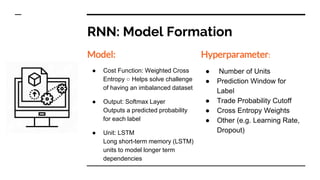
RNN: Model Formation
Model:
● Cost Function: Weighted Cross
Entropy ○ Helps solve challenge
of having an imbalanced dataset
● Output: Softmax Layer
Outputs a predicted probability
for each label
● Unit: LSTM
Long short-term memory (LSTM)
units to model longer term
dependencies
Hyperparameter:
● Number of Units
● Prediction Window for
Label
● Trade Probability Cutoff
● Cross Entropy Weights
● Other (e.g. Learning Rate,
Dropout)
RNN: Strategy
Statistical Arbitrage
Strategy
Baseline model
Linearly regress the mid-price returns of a pair of historically
correlated stocks.
This type of trading strategy assigns stocks a desirability ranking
and then constructs a portfolio to reduce risk as much as
possible.
Statistical arbitrage is heavily reliant on computer models and
analysis and is known as one of the most rigorous approach to
investing.
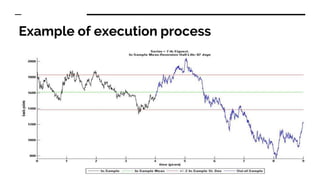
Example of execution process
What's new?
● Identifying most correlated pairs to trade
● Stochastic control to incorporate dynamically optimal
thresholds
● Hyperparameter tuning (frequency, training size,
leverage, etc.)
Parameter Tuning
Two approaches to parameter tuning:
● Grid search
○ Systematic exploration
○ Enables for sensitivity analysis
○ Inefficient
● Random search
○ Black-box method
○ Explore larger subspace
Validation set
● Evaluated 4 models
a. Fixed thresholds, pairs picked by performance
b. Fixed thresholds, pairs picked by correlation
c. Stochastic control thresholds, pairs picked by
performance d. Stochastic control thresholds, pairs picked
by correlation
● Model
a. performed best on validation set
Test Set Result
Future Work
To trade based on factorsfrom PCA eigen portfolio and its
eigenvalues:
○ take a variable number of eigenvectors, truncate to explain
a given percentage of the total variance of the system
Implement a more dynamic strategy
○ Using the correlation from yesterday to decide which pairs
to trade today.
○ Or observe the market for a couple of hours and then start
trading based on earlier correlation
Thank You.
Shubham Balasaheb Patil
Eckovation
Machine Learning

Statistical Arbitrage

  • 1.
    Project Report: Statistical Arbitrage ShubhamPatil • 19-03-2020 Eckovation Machine Learning
  • 2.
    Overview Deep Learning Strategy ●RNN Overview ● Feature and Label Generation ● Model Formation ● Strategy ● Results Statistical Arbitrage Strategy ● Statistical Arbitrage Overview ● Finding Correlated Pairs ● Stochastic Control ● Parameter Tuning ● Results
  • 3.
    Recurrent Neural Networks(RNN) What is RNN? ● Family of Neural Network specialized for sequence data. ● ‘Many-to-One’ architecture. ● ‘Vanilla’ vs. Long short-term memory (LSTM)
  • 4.
    RNN: Feature andLabel Generation Feature ● Bid/Ask Prices and Spread (10 levels) ● Volumes (10 levels) ● Mean Prices and Volumes ● Accumulated Price and Volume Differences ● Price and Volume Changes ● Order Imbalance Changes ● VWAP Label Generation ● Mid-Price Movement ● Volume Weighted Average Price (VWAP) Movement ● Settled on classifying VWAP movement over the next time ‘window’
  • 5.
    RNN: Model Formation Model: ●Cost Function: Weighted Cross Entropy ○ Helps solve challenge of having an imbalanced dataset ● Output: Softmax Layer Outputs a predicted probability for each label ● Unit: LSTM Long short-term memory (LSTM) units to model longer term dependencies Hyperparameter: ● Number of Units ● Prediction Window for Label ● Trade Probability Cutoff ● Cross Entropy Weights ● Other (e.g. Learning Rate, Dropout)
  • 6.
  • 7.
  • 8.
    Baseline model Linearly regressthe mid-price returns of a pair of historically correlated stocks. This type of trading strategy assigns stocks a desirability ranking and then constructs a portfolio to reduce risk as much as possible. Statistical arbitrage is heavily reliant on computer models and analysis and is known as one of the most rigorous approach to investing.
  • 9.
  • 10.
    What's new? ● Identifyingmost correlated pairs to trade ● Stochastic control to incorporate dynamically optimal thresholds ● Hyperparameter tuning (frequency, training size, leverage, etc.)
  • 11.
    Parameter Tuning Two approachesto parameter tuning: ● Grid search ○ Systematic exploration ○ Enables for sensitivity analysis ○ Inefficient ● Random search ○ Black-box method ○ Explore larger subspace
  • 12.
    Validation set ● Evaluated4 models a. Fixed thresholds, pairs picked by performance b. Fixed thresholds, pairs picked by correlation c. Stochastic control thresholds, pairs picked by performance d. Stochastic control thresholds, pairs picked by correlation ● Model a. performed best on validation set
  • 13.
  • 14.
    Future Work To tradebased on factorsfrom PCA eigen portfolio and its eigenvalues: ○ take a variable number of eigenvectors, truncate to explain a given percentage of the total variance of the system Implement a more dynamic strategy ○ Using the correlation from yesterday to decide which pairs to trade today. ○ Or observe the market for a couple of hours and then start trading based on earlier correlation
  • 15.
    Thank You. Shubham BalasahebPatil Eckovation Machine Learning