State and Local Government 9th Edition Bowman Solutions Manual
State and Local Government 9th Edition Bowman Solutions Manual
State and Local Government 9th Edition Bowman Solutions Manual
State and Local Government 9th Edition Bowman Solutions Manual
State and Local Government 9th Edition Bowman Solutions Manual
1.
State and LocalGovernment 9th Edition Bowman
Solutions Manual download
https://testbankfan.com/product/state-and-local-government-9th-
edition-bowman-solutions-manual/
Visit testbankfan.com today to download the complete set of
test bank or solution manual
2.
We have selectedsome products that you may be interested in
Click the link to download now or visit testbankfan.com
for more options!.
State and Local Government 9th Edition Bowman Test Bank
https://testbankfan.com/product/state-and-local-government-9th-
edition-bowman-test-bank/
State and Local Government The Essentials 6th Edition
Bowman Test Bank
https://testbankfan.com/product/state-and-local-government-the-
essentials-6th-edition-bowman-test-bank/
State and Local Government by the People 16th Edition
Magleby Test Bank
https://testbankfan.com/product/state-and-local-government-by-the-
people-16th-edition-magleby-test-bank/
Medical Terminology A Living Language 6th Edition Fremgen
Test Bank
https://testbankfan.com/product/medical-terminology-a-living-
language-6th-edition-fremgen-test-bank/
3.
Financial And ManagerialAccounting
PrinciplesInternational Edition 9th Edition Crosson Test
Bank
https://testbankfan.com/product/financial-and-managerial-accounting-
principlesinternational-edition-9th-edition-crosson-test-bank/
Human Resource Management 9th Edition Stone Solutions
Manual
https://testbankfan.com/product/human-resource-management-9th-edition-
stone-solutions-manual/
Contemporary Project Management 2nd Edition Kloppenborg
Solutions Manual
https://testbankfan.com/product/contemporary-project-management-2nd-
edition-kloppenborg-solutions-manual/
Business Now 1st Edition Shah Test Bank
https://testbankfan.com/product/business-now-1st-edition-shah-test-
bank/
Essentials of Economics 6th Edition Mankiw Test Bank
https://testbankfan.com/product/essentials-of-economics-6th-edition-
mankiw-test-bank/
4.
Engineering Materials 14th Edition Jones Solutions Manual
https://testbankfan.com/product/engineering-materials-1-4th-edition-
jones-solutions-manual/
This ebook isfor the use of anyone anywhere in the United States
and most other parts of the world at no cost and with almost no
restrictions whatsoever. You may copy it, give it away or re-use it
under the terms of the Project Gutenberg License included with this
ebook or online at www.gutenberg.org. If you are not located in the
United States, you will have to check the laws of the country where
you are located before using this eBook.
Title: Gypsy Coppersmiths in Liverpool and Birkenhead
Author: R. A. Scott Macfie
Release date: May 29, 2020 [eBook #62269]
Most recently updated: October 18, 2024
Language: English
Credits: Transcribed from the 1913 Henry Young and Sons edition by
David Price
*** START OF THE PROJECT GUTENBERG EBOOK GYPSY
COPPERSMITHS IN LIVERPOOL AND BIRKENHEAD ***
21.
Transcribed from the1913 Henry Young and Sons edition by David
Price, email ccx074@pglaf.org
GYPSY COPPERSMITHS
IN LIVERPOOL AND
BIRKENHEAD
To E. O.W.,
as amends for his annoyance when the railway-officials refused to
allow the donkey to travel with a dog-ticket, and
24.
To B. G.-S.,
ingratitude for comforting portions of St. Luke and scrambled eggs
administered in hours of depression, these sketches are dedicated.
December, 1913.
25.
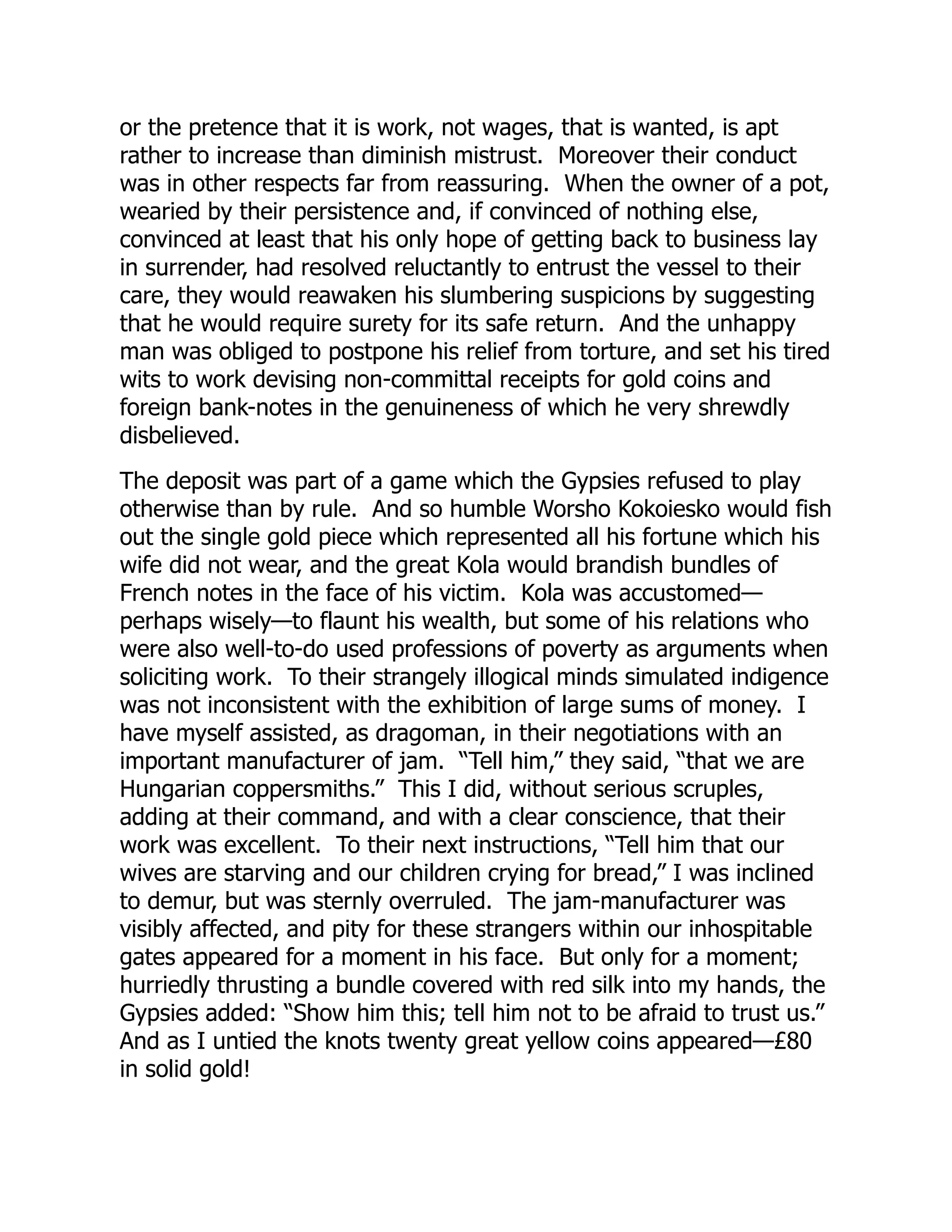
TABLE SHOWING THERELATION OF
THE GYPSIES MENTIONED. [v]
Tomo.
Gunia = Binka (f.) Grantsha (b. 1825) = Lolodzhi (f.).
Descendants of Gunia:
Gunia = Binka (f.)
Kokoi (Fanaz). = Vorzha (f.)
Worsho (Garaz) b. 1881. = Saliska (Anastasi). Luba, a widow.
Descendants of Grantsha:
Grantsha (b. 1825) = Lolodzhi (f.).
Worsho
(Nikola or
Kola
Tshoron) the
chief. =
Tinka (f.).
Fardi
(Andreas) b.
1860. =
Lotka (f.).
Yishwan.
=
Parashiva
(f.).
Yantshi.
= Worsha
(f.).
Vorzha
(f.). =
Yono.
3 other
daughters
Worsho
(Vasili). 4
other
children.
5 children. 6
children.
2
married
sons.
Milanko.
26.
4 other
children.
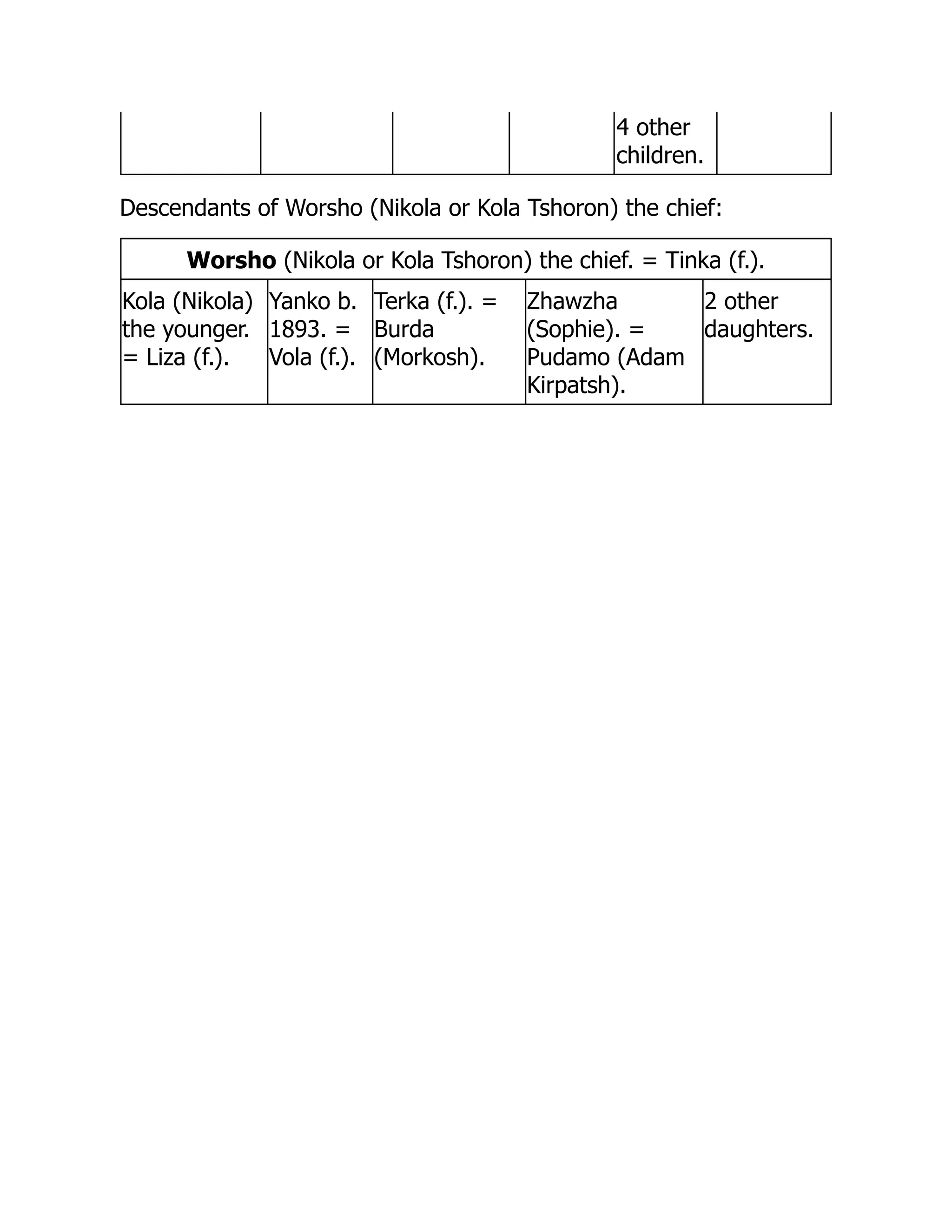
Descendants ofWorsho (Nikola or Kola Tshoron) the chief:
Worsho (Nikola or Kola Tshoron) the chief. = Tinka (f.).
Kola (Nikola)
the younger.
= Liza (f.).
Yanko b.
1893. =
Vola (f.).
Terka (f.). =
Burda
(Morkosh).
Zhawzha
(Sophie). =
Pudamo (Adam
Kirpatsh).
2 other
daughters.
27.
CONTENTS [vi]
PAGE
1. Everywherestrangers: everywhere at home 1
2. Imperium in imperio 7
3. Gypsy bagmen 13
4. The tale of a tub 20
5. Parliaments 26
6. The photograph 32
7. The sick boy 38
8. A good work 44
9. The revelation 50
10.An unwritten tongue 57
28.
1. EVERYWHERE STRANGERS:
EVERYWHEREAT HOME. [1]
When you want to find a Gypsy the police are more likely to be able
to give you his address than directories, bankers, or ministers of
religion; and it was a Liverpool policeman who sent me to the back
of the municipal slaughter-house to seek a horde of “Hungarian”
Roms whose arrival had been announced by the evening papers. In
a squalid street, at a corner where insanitary dwellings had been
demolished, I found a vacant plot of brick-strewn ground surrounded
by high walls. There, evidently, were my Gypsies, for a crowd of
boys had gathered round the one door, struggling for a glance
through its keyhole. Mistaking me for a detective, they made way,
and I knocked loudly and long.
The boys were not mistaken. There was a scene within which was
worth looking at. The strangers had journeyed so rapidly from
Marseilles to Liverpool that they had outstripped their heavy
baggage, and, arriving before their tents, were obliged to bivouac
under tiny extemporized shelters propped against the windowless
house-walls which formed two sides of the square. They were
making the best of circumstances with considerable success, for they
had with them countless beds of eiderdown in brilliantly coloured
covers, and they had their all-important samovars. The men were
out, but the women, protected by a police-serjeant from the
inhospitable attentions of their neighbours, were in the camp, and
into that shabby yard they had brought an unaccustomed glory
which was altogether foreign and oriental.
29.
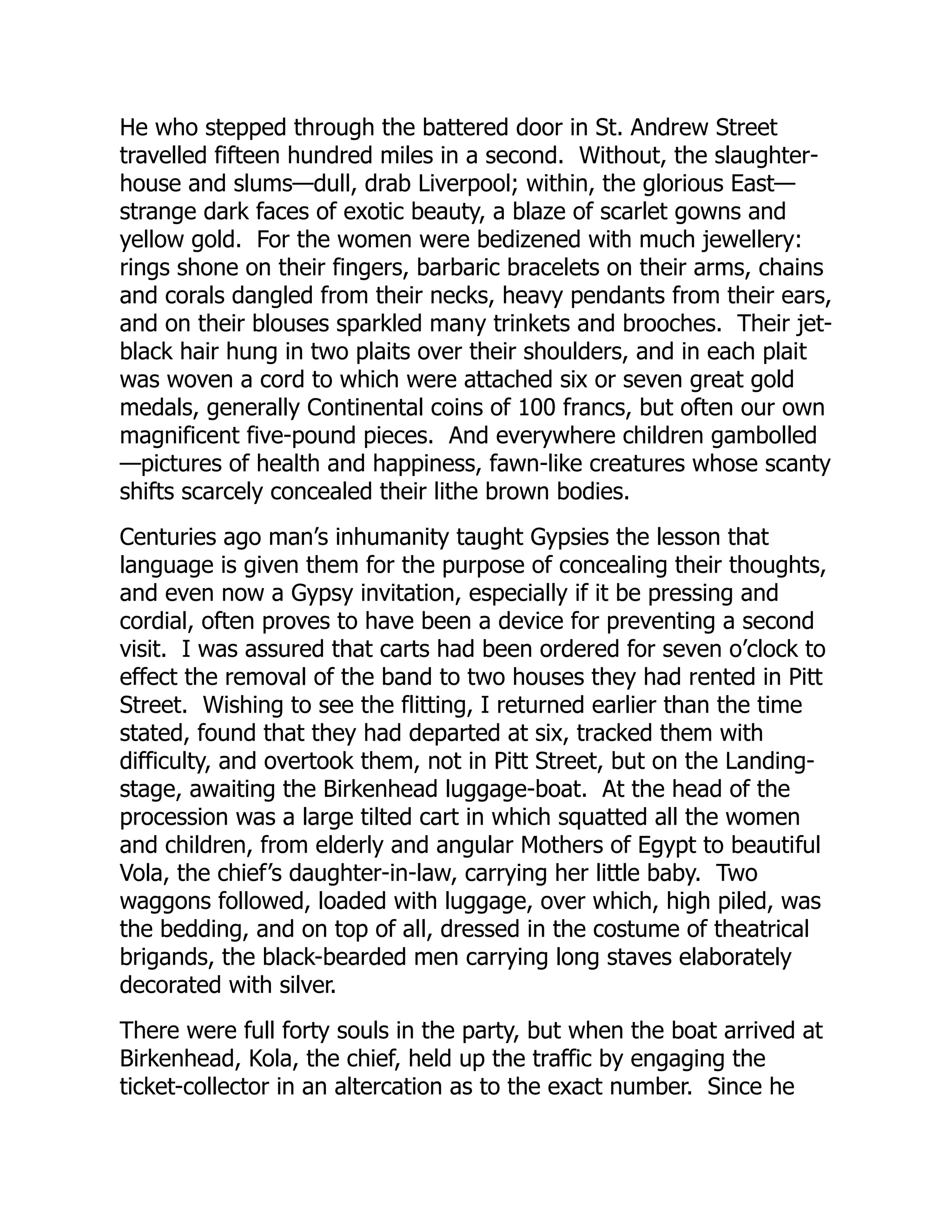
He who steppedthrough the battered door in St. Andrew Street
travelled fifteen hundred miles in a second. Without, the slaughter-
house and slums—dull, drab Liverpool; within, the glorious East—
strange dark faces of exotic beauty, a blaze of scarlet gowns and
yellow gold. For the women were bedizened with much jewellery:
rings shone on their fingers, barbaric bracelets on their arms, chains
and corals dangled from their necks, heavy pendants from their ears,
and on their blouses sparkled many trinkets and brooches. Their jet-
black hair hung in two plaits over their shoulders, and in each plait
was woven a cord to which were attached six or seven great gold
medals, generally Continental coins of 100 francs, but often our own
magnificent five-pound pieces. And everywhere children gambolled
—pictures of health and happiness, fawn-like creatures whose scanty
shifts scarcely concealed their lithe brown bodies.
Centuries ago man’s inhumanity taught Gypsies the lesson that
language is given them for the purpose of concealing their thoughts,
and even now a Gypsy invitation, especially if it be pressing and
cordial, often proves to have been a device for preventing a second
visit. I was assured that carts had been ordered for seven o’clock to
effect the removal of the band to two houses they had rented in Pitt
Street. Wishing to see the flitting, I returned earlier than the time
stated, found that they had departed at six, tracked them with
difficulty, and overtook them, not in Pitt Street, but on the Landing-
stage, awaiting the Birkenhead luggage-boat. At the head of the
procession was a large tilted cart in which squatted all the women
and children, from elderly and angular Mothers of Egypt to beautiful
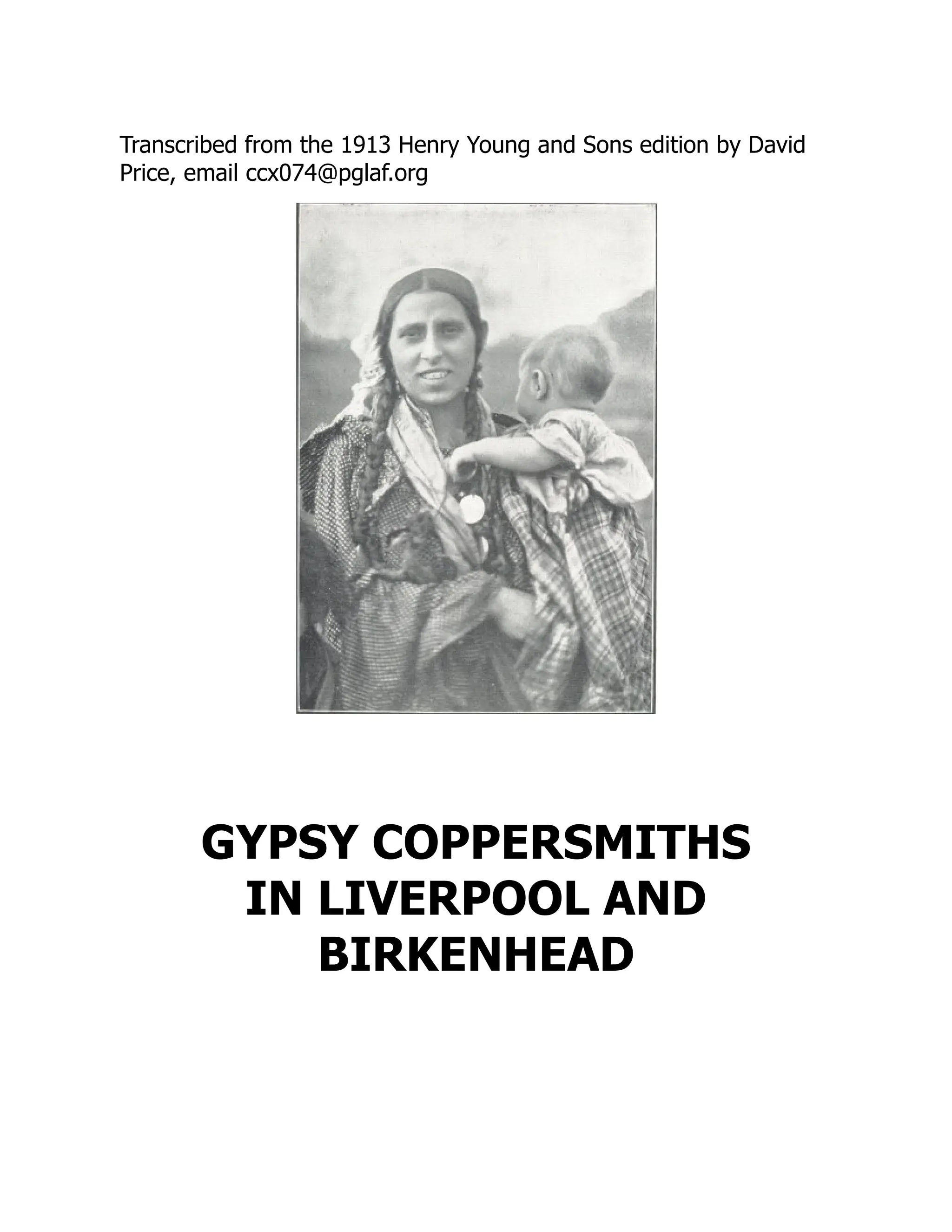
Vola, the chief’s daughter-in-law, carrying her little baby. Two
waggons followed, loaded with luggage, over which, high piled, was
the bedding, and on top of all, dressed in the costume of theatrical
brigands, the black-bearded men carrying long staves elaborately
decorated with silver.
There were full forty souls in the party, but when the boat arrived at
Birkenhead, Kola, the chief, held up the traffic by engaging the
ticket-collector in an altercation as to the exact number. Since he
30.
spoke in Russianand the official in English, neither convinced the
other. The chief maintained that there were only fourteen; the
collector set the figure considerably higher, but as no two of his
repeated attempts at enumeration agreed with one another, while
the chiefs estimate never varied, Kola may be said to have had, on
the whole, the best of the argument. At all events the management
preferred giving way to being detained all night, and Uncle Kola
triumphantly led his procession up the bridge.
Meanwhile a spectator passing along Green Lane, Tranmere, might
have seen a very curious spectacle in the English Gypsies’ camp, for
that was the destination of the aliens. On a bare patch of cindery
earth between the dark brown tents of the Boswells and Robinsons,
a piece of carpet had been spread, and on it, as advanced guard
awaiting the main body, sat portly Tinka, the chief’s wife. Cross-
legged, motionless, aloof, her eyes fixed on a distant infinity, quite
alone yet totally unconcerned, she smoked her cigarette calmly in a
long meerschaum holder. Red-robed as ever, wearing an immense
weight of solid gold, brilliant as a flame, she contrasted strangely
with the dingy colouring of the place: a Chinese idol in a Methodist
chapel would have been less incongruous. But the English Gypsies,
aping her detachment, feigned absence of interest; no one was
visible—nevertheless many an eye was eagerly pressed to a hole in
the tent-blanket.
This invasion by foreign Gypsies was not relished by the old
inhabitants of the pitch, and they threatened to drive the aliens out.
But the aliens neither valued popularity nor feared the Sinte, as they
contemptuously called their British brethren; with scarce a glance
towards, or a thought of, their neighbours, they went diligently to
work to make themselves comfortable. First they removed, without
permission, all the carts from stables near the camp, and set them,
shafts in air, to make shelters for the night, one for each family.
Then, needing coke, and brooms, and water, and other necessaries,
they turned to the despised Sinte and borrowed what they required
from them. And then the English Gypsy women fell in love with
31.
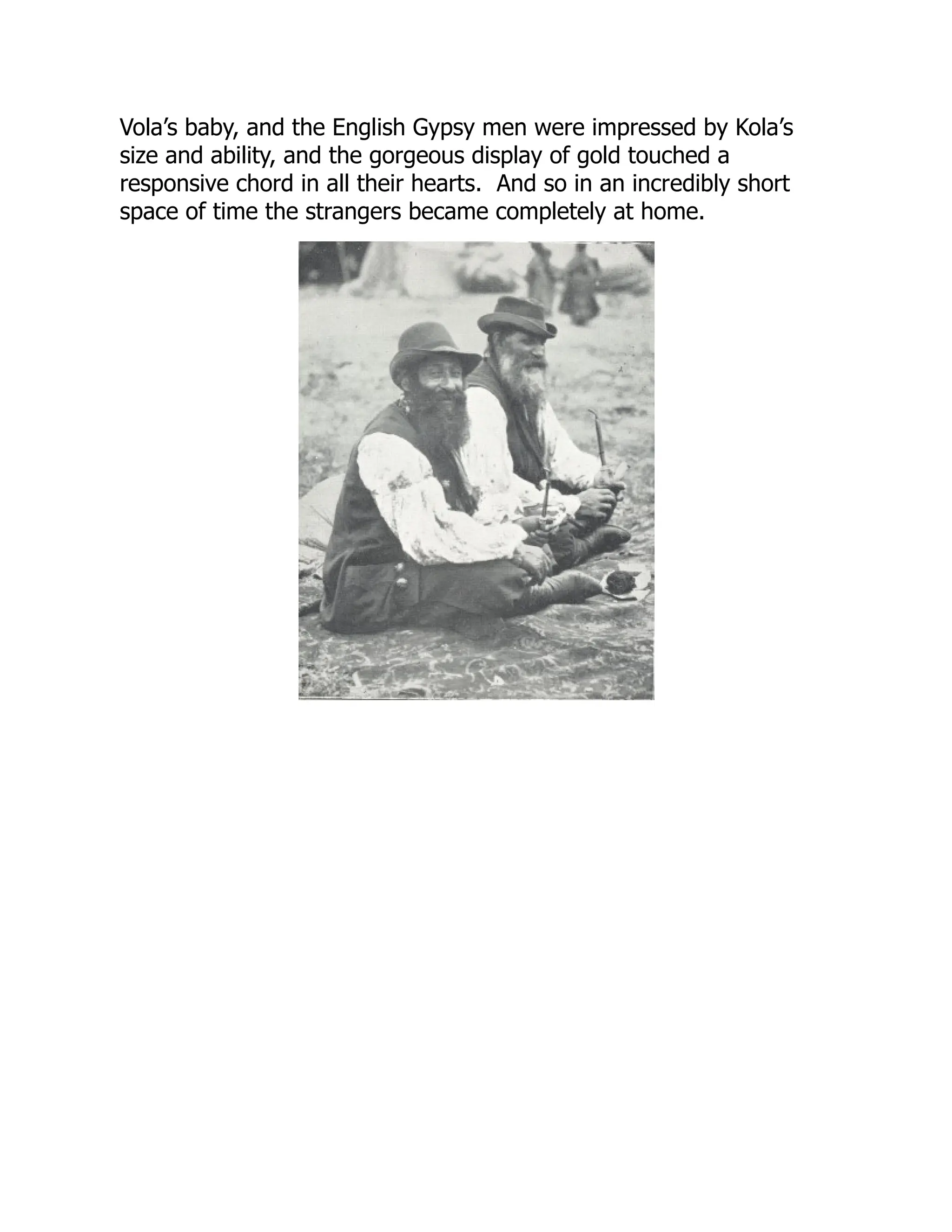
Vola’s baby, andthe English Gypsy men were impressed by Kola’s
size and ability, and the gorgeous display of gold touched a
responsive chord in all their hearts. And so in an incredibly short
space of time the strangers became completely at home.
32.
2. IMPERIUM INIMPERIO. [7]
Many kinds of foreigner tread the streets of Liverpool, and thus,
when Uncle Kola and his tribe appeared on the banks of the Mersey
from nowhere in particular the little boys put him down as a new
species of “Dago,” and did not embarrass him with unwelcome
attention. Yet Kola is an extraordinary man, and even his costume is
conspicuous. His trousers, superfluously baggy and decorated with
wide stripes of bright green and red, are thrust into great top-boots
elaborately stitched. The complicated braiding of his dark blue coat
and waistcoat would be remarkable were it not eclipsed by the glory
of his enormous buttons, splendid examples of the silversmith’s
craft. Kola is tall and powerfully built, and he wears his finery with
effect, supporting himself by a five-foot staff almost covered with
silver, on which shine countless little images of Buddha. His keen
eye, aquiline nose, strong mouth, and venerable beard tinged with
grey make derision impossible; and he walked our thoroughfares
with dignity, slowly, gravely scrutinizing the town as if it owed him
money.
And Kola intended that it should—before he left it. That was why he
had come. He was already rich; his pockets contained bank-notes
which he could have exchanged anywhere for several hundred
golden sovereigns, and his relations believe that he is worth
£30,000. On great occasions he can decorate his table, which
stands only fourteen inches high, with lordly plate; a silver samovar
weighing twenty-three pounds is matched by a huge salver and an
immense bucket of the same precious metal decorated in high relief.
The weight of solid gold which his wife carries in her hair, on her
33.
blouse, and roundher neck and wrists is nothing less than royal.
Kola is, in fact, a ruler; and, if the citizens of Liverpool took but little
interest in him and his subjects, he reciprocated their contempt,
regarding them simply as so many more or less stupid persons who
were destined to provide for him and his tribe what they were then
seeking—copper pots to mend.
Kola is suave and courtly, and if you had asked him what were his
name and nationality he would have replied at once that he was
Nicolas Tshoron, a Caucasian, Russian, Ruthenian, Galitsian, or
Hungarian. He has now removed his kingdom to Brazil, and if you
were to follow him across the Atlantic and repeat the question it is
probable that he would elect to call himself Italian, French, or
English. He may be all of these if a short period of residence is
sufficient qualification; but, though he knows it not, Rumania has
stronger claims to him, and India stronger claims still. Sitting on the
carpeted floor of his great pedimental tent, surrounded by his family
and connexions, you would have found that he is really Worsho, son
of Grantsha, and that he is a Gypsy. Not, of course, exactly the kind
we know; he would call our Gypsies scornfully Sinte, and claim that
he and his tribe alone are the Roma. Intellectually he is a giant. In
the morning his subjects would set out to solicit orders, returning
despondently as night fell with empty hands or single pans on their
shoulders. But Kola would march triumphantly to the camp followed
by a lorry heavily laden with cauldrons he had collected for repair. It
was Kola who directed the work, and when any special difficulty
arose it was he who sat down and overcame it. He was completely
illiterate; yet he used a complicated form of contract which he
dictated and his patrons wrote and signed. It concealed artfully the
extortionate charges he proposed to make, and hoodwinked not only
the authorities of a great political club but even those of a municipal
kitchen. And it was Kola who faced the indignant customer who
came to protest against the charge, and either browbeat him into
submission or put him into court.
34.
The craft ofthe Gypsies was magnificent, and they wielded their
hammers sensitively, as if there were nerve-endings in the heads.
They were admittedly more skilful than British coppersmiths, ready
to undertake and execute successfully work that would elsewhere be
refused as impossible. But their ideas of remuneration were
grandiose, and in a country where bargaining is a neglected science
they retained an oriental habit of demanding ten times as much as
they were prepared to accept. It mattered not if his customers were
offended—Kola never intended to see them again. And so he and
his subjects spent a few weeks in each town collecting work, a few
weeks in doing it, and a few turbulent and glorious weeks in
exacting payment. Then they shook the dust from off the soles of
their feet, and departed for ever from the city they had exhausted.
Kola’s policy is successful; it has made him rich. Other Gypsies have
attached themselves to his family, married his relations, and placed
him at the head of an important tribe, whose activities he regulates,
whose well-being he cares for, whose movements he directs, which
he governs as “king.” When dissatisfaction arises the malcontents
are free to migrate to another monarchy; but so long as Kola is
successful and so long as his subjects share his success, thus long
will his kingdom endure.
Kola’s kingdom should be impossible. It is contrary to reason,
contrary at all events to what we call reason, that a community
should prefer the primitive ways of the Middle Ages to the latest
improvements of modern civilization. His bellows were old-fashioned
even in the fifteenth century and survive now only among savages;
yet in his eyes they are still the best bellows, and if out of curiosity
he were to purchase a mechanical blower he would probably hand it
over to his grandchildren for a toy. With pockets well lined with
money he neglects to buy table cutlery, tears his portion of bread
from the loaf and scrapes it clumsily in the butter-dish. The
luxurious chairs and sofas with which he furnishes his royal tent are
vain ostentation; guests may use them, but Kola himself prefers to
sit, as his ancestors have sat for countless centuries, cross-legged on
35.
the ground. Usand all that we value, with the single exception of
money, he despises even more cordially than we despise him. Like a
drop of oil in a glass of water he and his tribe live in our midst
untouched, strangely aloof and alien, a wonderful spectacle of an
Imperium in Imperio.
36.
3. GYPSY BAGMEN.[13]
The commercial traveller is more truly born to his profession than the
poet, unless an unreasonably exacting definition of poet be
accepted; and to those who are not thus born, it seems inexplicable
that any sane person should willingly adopt so toilsome and
disagreeable, yet thankless and inglorious, an occupation, and even
learn to like it. Paradoxically the Gypsy coppersmiths, in travelling,
combined the methods of a raw apprentice, foredoomed to failure,
with diligence, enthusiasm—and success—which proved them born
bagmen. They evidently enjoyed being “on the road” in this very
un-Gypsylike sense; yet, Gypsylike, retained their independence,
differing from the common “drummer” in that they represented, not
an exacting master, but their own still more exacting selves. The
fact that they travelled was not remarkable—travelling was the
necessary prelude to their industry. What was astonishing was the
versatility which enabled them both to beat our native coppersmiths
in smithcraft and to rival British agents in the energy with which they
canvassed for the orders they were themselves to execute.
With patience anybody can become a fairly good commercial
traveller who has a respectable appearance and good address,
carries a useful article, and asks a reasonable price. The Gypsies
certainly carried a useful article, inasmuch as their repairs were
skilful and thorough, but all the other circumstances were against
them. Their extravagant costume reminded those on whom they
called of brigands rather than of sober business-men, and brigands
are not welcome in offices or factories. In combination with their
black hair and glittering eyes it was apt to betray their nationality. If
37.
it did, somuch the worse, for a commercial transaction with a Gypsy
is several degrees more unpopular than a commercial transaction
with a Jew.
As for address, it mattered not at first whether they possessed it or
not, for they spoke no English. They soon discovered and engaged
threadbare ungrammatical aliens to talk for them, but until they
obtained such assistance they were content to carry tattered scraps
of soiled paper on which their qualifications were set forth in a
handwriting and dialect which were very far from commanding the
respect of possible customers. Here again they reared an
unnecessary obstacle against their own success, for it is an axiom
that the worse the business, the better must be the quality of the
stationery. Even when they had learned a little English—and,
belying Gypsy reputation, they learnt it very slowly—they scorned to
use ingratiating behaviour, delicate compliment, or even funny
stories; their whole persuasive stock-in-trade was a whine, a dogged
and irritating perseverance, inability to recognize the moment when
it is more profitable to go than to stay, and stone-deafness to the
most emphatic “no.” In short, their method was simply the endless
importunity which their wives and children devoted to shameless and
successful begging.
It is easy to give goods away; only an expert bagman can get a high
price. Price is the real criterion of the traveller. In this respect the
Gypsies were nothing if not ambitious, for they set out with the
intention of exacting remuneration so exorbitant that their repairs
often cost more than a pot new from the maker. Thus their only
practicable policy was to conceal carefully the sum they proposed to
ask, and escape at all costs from the danger of giving the estimate
which was always demanded. The form of their contract was
ingeniously designed to serve this purpose, and they also attempted
to disarm natural suspicion by offering to mend—or insisting on
mending, for they were very masterful—the first article for nothing
as a proof of their skill. The latter device was generally
unsuccessful, for in Great Britain the offer of something for nothing,
38.
or the pretencethat it is work, not wages, that is wanted, is apt
rather to increase than diminish mistrust. Moreover their conduct
was in other respects far from reassuring. When the owner of a pot,
wearied by their persistence and, if convinced of nothing else,
convinced at least that his only hope of getting back to business lay
in surrender, had resolved reluctantly to entrust the vessel to their
care, they would reawaken his slumbering suspicions by suggesting
that he would require surety for its safe return. And the unhappy
man was obliged to postpone his relief from torture, and set his tired
wits to work devising non-committal receipts for gold coins and
foreign bank-notes in the genuineness of which he very shrewdly
disbelieved.
The deposit was part of a game which the Gypsies refused to play
otherwise than by rule. And so humble Worsho Kokoiesko would fish
out the single gold piece which represented all his fortune which his
wife did not wear, and the great Kola would brandish bundles of
French notes in the face of his victim. Kola was accustomed—
perhaps wisely—to flaunt his wealth, but some of his relations who
were also well-to-do used professions of poverty as arguments when
soliciting work. To their strangely illogical minds simulated indigence
was not inconsistent with the exhibition of large sums of money. I
have myself assisted, as dragoman, in their negotiations with an
important manufacturer of jam. “Tell him,” they said, “that we are
Hungarian coppersmiths.” This I did, without serious scruples,
adding at their command, and with a clear conscience, that their
work was excellent. To their next instructions, “Tell him that our
wives are starving and our children crying for bread,” I was inclined
to demur, but was sternly overruled. The jam-manufacturer was
visibly affected, and pity for these strangers within our inhospitable
gates appeared for a moment in his face. But only for a moment;
hurriedly thrusting a bundle covered with red silk into my hands, the
Gypsies added: “Show him this; tell him not to be afraid to trust us.”
And as I untied the knots twenty great yellow coins appeared—£80
in solid gold!
39.
No less conspicuousthan their want of finesse was their want of
organization. They neither divided the city into districts to parcel
them out among their members, nor even the users of copper
vessels into classes. Collecting addresses from strangers they met
casually, they visited factories and institutions at random, wasting
much time in long tramps from one extreme end of the town to the
other and then immediately back to the first district. Lucky the man
who discovered a new, unvisited manufactory; a courteous reception
and patient hearing were generally given him. The patience of most
manufacturers had been early exhausted by the repeated and
lengthy invasions of other members of the tribe, and they were in no
mood for further interviews. Some of the more enterprising and
wealthy Gypsies seemed to realize this, for they made expensive
journeys from Birkenhead to Manchester, Leeds, and even the Isle of
Man. The disappointingly small results would have disheartened an
ordinary commercial traveller, but the Gypsies were anything but
ordinary travellers. And gradually their patience was rewarded, and
the camp became littered with cauldrons and pots awaiting repair,
striking evidence of the almost miraculous power of sheer,
unreasoning tenacity.
40.
4. THE TALEOF A TUB.
Milanko, son of Yono, was an impertinent lad, but good-humoured,
rather ugly and always grinning. I had assured him repeatedly that
in the sugar-refinery to which I have the misfortune to be attached
all the “pots” were as big as houses and in perfect repair, so that to
my deep regret I was unable to take advantage of the offer of his
professional services. Milanko, however, with the incredulity of an
habitual liar, made an independent reconnaissance through a
window and caught sight of an ancient copper tub, some six feet in
diameter and about a quarter of a ton in weight. Moreover he
ascertained, by means best known to himself, that it was cracked
and patched; and I was weak enough to admit, under his searching
cross-examination, that it would be an advantage to have its inner
surface coated with tin. It was a huge vessel, but Milanko was
ambitious, and thereafter called regularly at inconvenient hours to
present a series of petitions: first, for the order to mend and tin the
pan; second, for the loan of a pound to purchase solder; third, for
half a sovereign to get boots; fourth, for five shillings to buy a hat;
and fifth, for three pence, the price of a packet of cigarettes. He
accepted the emphatic refusal of his larger requests philosophically
and without resentment. To the last I gave a favourable hearing,
even at our first interview, and we parted with a friendly exchange
of Zha Devlesa (Go with God) and Ash Devlesa (Remain with God),
well understanding that a second rehearsal was ordered for the
morrow and that it would be succeeded by daily performances. The
play had not a long run. One ill-starred afternoon I granted the
main petition, and the cauldron was carted to Birkenhead to be
deposited in the camp.
41.
Knowing that theGypsies’ policy was always to do as much work as
possible, and generally far more than their customer expected or
required, I sent the chief engineer to Green Lane to make plain to
them that the vessel was only to be tinned, and that the cracks and
patches were to be left unmended. No contract was signed, though
there was a distinct verbal agreement that the cost was to be one
pound. I was, however, prepared to pay as much as three, the price
for which a Liverpool firm had offered to do the same work, because
I recognized that the pan was large and heavy and was interested to
see how the coppersmiths would handle it without either blocks and
tackle or large fires. To my great disappointment I was allowed to
see nothing. When I visited the camp the cauldron was always
discreetly covered with a sheet, and the Gypsies found ingenious
means to keep me and it as far apart as possible. But occasionally
they would draw me aside and expatiate alarmingly on the amount
of tin, acid and labour that were needed, and, ignoring their
estimate, talk tentatively of forty pounds as a just and probable
charge.
At last, one morning, a messenger arrived to report that the
cauldron was ready for delivery, and on the afternoon of the same
day the chief engineer, instructed that he might pay three pounds
but not a penny more, took with him a cart and crossed the river to
Birkenhead. He found the pan turned upside down on the cindery
ground of the camp and proposed to remove it to the refinery in
order that the quality of the work might be examined. But the
Gypsies, holding that possession is nine-tenths of the law, refused to
permit the removal before payment was made. The wisdom of their
decision became evident when bargaining began, for the engineer
offered one pound while they, with fierce indignation, demanded
twenty-five, making the sum unmistakably clear by placing a
sovereign on the pan and indicating the numeral by means of their
outstretched fingers. The discrepancy between claim and tender
was too wide for easy or rapid adjustment, and neither side showed
any willingness to compromise. The engineer, accustomed to
dealing with Orientals, stuck to his terms, but finding the Gypsies
42.
equally stubborn andmuch noisier, and convinced as tea-time
approached that no settlement was then possible, he ordered the
cart back to Liverpool and himself withdrew from the conference.
And then the Gypsies made a false step. The engineer had scarcely
settled down to his evening meal when, to his amazement, word
was sent from the refinery that the cauldron and the coppersmiths
were at the gate. They had changed their minds, hastened to
overtake the cart aboard the luggage-boat, and persuaded the carter
to return to the tents and bring the pan away. The office being
closed when they arrived, settlement of their little account was out
of the question, and, obliged to surrender the only security they had
for payment, they could but protest loudly and depart with an
invitation to call again the next day.
Other duties kept me away from business, and I was not a spectator
of their visit. But I heard afterwards long, eloquent and indignant
stories of how Milanko, apparelled like a mountebank, with his father
and the deformed dwarf Burda or Morkosh, his cousin’s husband,
dared to profane the solemnity of the counting-house, a sanctuary
where the cumulative respectability of five generations of sugar-
boilers is devoutly worshipped. Never during the whole course of its
long business experience had that chamber entertained guests so
unwelcome. They arrived at ten in the morning and stayed until
half-past two, demanding payment from the cashier and relenting
gradually from twenty-five to seven pounds, less than which they
long refused to accept. Nobody knew what to do with them—the
situation was unprecedented. When tired of standing and worrying
busy clerks with the question “Master, what you do now?” they
scandalized the whole staff by sitting cross-legged on the floor. It
was a contest of endurance; and, thanks to the definite orders I had
left, we won. Just as the problem of what was to happen at closing
time, if they were still in possession, was becoming insistent, the
Gypsies gave way, accepted three pounds and retired, after
desecrating the office for four hours and a half.
43.
It would havebeen absurd to expect Kola’s disciples to rest content
with a reasonable reward, and indeed they often begged for
supplementary payments. Even the chief’s wife condescended to
interest herself in the matter and complained to me about the
character of the engineer—a bad man, as she said; and I had to
explain that it was partly for this particular fault of character that we
valued him. Yono never forgave me, but Milanko resumed friendly
relationships at once, and I believe that the tribe in general
respected me the more for my victory.
44.
5. PARLIAMENTS.
The professionof the Gypsies, according to a reverend Spanish
professor, whom Borrow quotes, is idleness; and by their proverb
Butin hi dinilenge (Work is for fools) the German Gypsies plead guilty
to the charge. In this respect the coppersmiths were exceptional,
for among them diligence raged almost as an epidemic fever. The
missionary of the eight-hours day would not have found a welcome
in their camp, nor the agent of a Sabbath-observance society any
encouragement. On all days of the week, at all hours of the day, the
rhythmic tap of their hammers and the muffled gust of their bellows
preached eloquent sermons on industry, while knots of busy women,
sewing, washing and cooking, gave an equally striking object-lesson
in the same subject.
Nor did they seek to compensate by recreation for long hours of
labour. The young people showed a certain skill in games like
knuckle-bones or pitch-and-toss, and took a slight interest in boxing
and wrestling but seldom practised them. Only on rare occasions
did they and their elders play cards or visit music-halls, and the
gramophones which several families possessed were little heard. If
they danced it was when there was a prospect of extorting
baksheesh from visitors, and the ill-remembered tales and songs
which they sold to collectors of such curiosities seemed to be rather
what they had heard others tell or sing than what they cherished for
their own amusement. Unlike many of their brethren they were not
entertainers, and they had no strong desire to be themselves
entertained.
45.
Judged from atrade-union point of view, or even from that of a
picture-palace proprietor, this excessive devotion to work would be
regarded as a symptom of savagery; yet, as increasing
productiveness and wealth, it might with equal justice be taken as a
sign of advanced civilization. In one respect, however, the Gypsies
were undoubtedly primitive, and that was in their faith in
parliaments. When day had faded into night and toil had ceased, if
they were not eating their irregular meals or drinking glasses of tea
made in samovars whose hours of work were scarcely less than their
own, the coppersmiths were holding interminable divans. In wet or
cold weather parliament assembled within a tent; but on warm
evenings sessions were held in the open air, the members sitting in a
ring cross-legged on the ground or lolling on beds of eiderdown.
Although the children were kept at a distance these meetings were
not councils of elders, since the young men as well as the old were
present. Their wives and daughters sat apart engaged in womanly
occupations, for there was in the tribe no need to blow a “trumpet
against the monstrous regiment of women.”
Probably Kola, the chief, would not have permitted the constant
presence of inquisitive visitors when important matters were under
discussion, or would have changed the subject on their arrival. In
any case to have sat evening after evening, as it were in the
distinguished strangers’ gallery, listening to debates which were only
half intelligible, was an entertainment drearier than any of his
visitors was prepared to face. Thus it is impossible to decide
whether these parliaments had legislative and judicial functions, or
whether, as Kola’s privy council, they were only deliberative and
advisory. When strangers were present Fardi sometimes improved
the occasion by producing a little ragged map of the world to
question them about the amenities of different countries. It was a
projection after the method of Mercator, in which Greenland
appeared, grossly exaggerated, as an attractive patch of bright
colour equal in size to the whole of Europe and pleasantly unspotted
by the names of icy mountains or any other geographical
complexities. This image of Greenland had for Fardi the same
46.
attraction as thebellman’s chart for the Snark-hunting crew, and he
was convinced only with difficulty that, the climate being intolerable
and the natives poor, he was unlikely to do there a great trade in
mending copper pots. To parliament, too, Kola exhibited his first
large payment in British money, a big bundle of Bank of England
notes. His subjects passed them from grimy hand to grimy hand,
tugged them viciously, held them up to the light, and then delivered
judgment: “Ugly notes, but tough paper.”
The discussions were as solemn as those of the mother of
parliaments at Westminster, and much more sincere, although they
were neither opened with prayer nor encumbered by any decorative
formalities. If the chief was chairman—and he sometimes enthroned
himself upon an upturned cauldron—his services were seldom
required either to keep order, which was amply secured by the
native dignity of the members, or to direct a debate that had no
tendency to stray from the one subject which was uppermost in all
their minds. Generalities that had no concrete application to their
trade did not interest them, and they would have refused to send a
representative to the congress which was held in Hungary in 1879 to
deliberate on the common interests of Gypsies everywhere.
Sometimes when Russians visited the camp the coppersmiths would
listen so eagerly to long accounts of events in the outside world that
it seemed as though the divan was their newspaper or club, and
stood to them in the same relation as the “crack i’ the kirkyard” to
Scottish farm-folk a century ago, or as his favourite public-house to
the British workman. But in truth only those facts really interested
them which affected their work and industry, and most of what they
heard passed in at one ear and out at the other. They were greedy
for knowledge of the wealth of nations, the size of cities, or the
trades by which towns prospered; they collected scraps of paper on
which chance acquaintances had scribbled the addresses of
factories; and in fact all their conversation and all their thoughts
were concerned with the problem of work and where to find it.
47.
Welcome to ourwebsite – the perfect destination for book lovers and
knowledge seekers. We believe that every book holds a new world,
offering opportunities for learning, discovery, and personal growth.
That’s why we are dedicated to bringing you a diverse collection of
books, ranging from classic literature and specialized publications to
self-development guides and children's books.
More than just a book-buying platform, we strive to be a bridge
connecting you with timeless cultural and intellectual values. With an
elegant, user-friendly interface and a smart search system, you can
quickly find the books that best suit your interests. Additionally,
our special promotions and home delivery services help you save time
and fully enjoy the joy of reading.
Join us on a journey of knowledge exploration, passion nurturing, and
personal growth every day!
testbankfan.com








![This ebook is for the use of anyone anywhere in the United States
and most other parts of the world at no cost and with almost no
restrictions whatsoever. You may copy it, give it away or re-use it
under the terms of the Project Gutenberg License included with this
ebook or online at www.gutenberg.org. If you are not located in the
United States, you will have to check the laws of the country where
you are located before using this eBook.
Title: Gypsy Coppersmiths in Liverpool and Birkenhead
Author: R. A. Scott Macfie
Release date: May 29, 2020 [eBook #62269]
Most recently updated: October 18, 2024
Language: English
Credits: Transcribed from the 1913 Henry Young and Sons edition by
David Price
*** START OF THE PROJECT GUTENBERG EBOOK GYPSY
COPPERSMITHS IN LIVERPOOL AND BIRKENHEAD ***](https://image.slidesharecdn.com/19899-250703232631-f5bd25d5/75/State-and-Local-Government-9th-Edition-Bowman-Solutions-Manual-20-2048.jpg)
![TABLE SHOWING THE RELATION OF
THE GYPSIES MENTIONED. [v]
Tomo.
Gunia = Binka (f.) Grantsha (b. 1825) = Lolodzhi (f.).
Descendants of Gunia:
Gunia = Binka (f.)
Kokoi (Fanaz). = Vorzha (f.)
Worsho (Garaz) b. 1881. = Saliska (Anastasi). Luba, a widow.
Descendants of Grantsha:
Grantsha (b. 1825) = Lolodzhi (f.).
Worsho
(Nikola or
Kola
Tshoron) the
chief. =
Tinka (f.).
Fardi
(Andreas) b.
1860. =
Lotka (f.).
Yishwan.
=
Parashiva
(f.).
Yantshi.
= Worsha
(f.).
Vorzha
(f.). =
Yono.
3 other
daughters
Worsho
(Vasili). 4
other
children.
5 children. 6
children.
2
married
sons.
Milanko.](https://image.slidesharecdn.com/19899-250703232631-f5bd25d5/75/State-and-Local-Government-9th-Edition-Bowman-Solutions-Manual-25-2048.jpg)
![CONTENTS [vi]
PAGE
1. Everywhere strangers: everywhere at home 1
2. Imperium in imperio 7
3. Gypsy bagmen 13
4. The tale of a tub 20
5. Parliaments 26
6. The photograph 32
7. The sick boy 38
8. A good work 44
9. The revelation 50
10.An unwritten tongue 57](https://image.slidesharecdn.com/19899-250703232631-f5bd25d5/75/State-and-Local-Government-9th-Edition-Bowman-Solutions-Manual-27-2048.jpg)
![1. EVERYWHERE STRANGERS:
EVERYWHERE AT HOME. [1]
When you want to find a Gypsy the police are more likely to be able
to give you his address than directories, bankers, or ministers of
religion; and it was a Liverpool policeman who sent me to the back
of the municipal slaughter-house to seek a horde of “Hungarian”
Roms whose arrival had been announced by the evening papers. In
a squalid street, at a corner where insanitary dwellings had been
demolished, I found a vacant plot of brick-strewn ground surrounded
by high walls. There, evidently, were my Gypsies, for a crowd of
boys had gathered round the one door, struggling for a glance
through its keyhole. Mistaking me for a detective, they made way,
and I knocked loudly and long.
The boys were not mistaken. There was a scene within which was
worth looking at. The strangers had journeyed so rapidly from
Marseilles to Liverpool that they had outstripped their heavy
baggage, and, arriving before their tents, were obliged to bivouac
under tiny extemporized shelters propped against the windowless
house-walls which formed two sides of the square. They were
making the best of circumstances with considerable success, for they
had with them countless beds of eiderdown in brilliantly coloured
covers, and they had their all-important samovars. The men were
out, but the women, protected by a police-serjeant from the
inhospitable attentions of their neighbours, were in the camp, and
into that shabby yard they had brought an unaccustomed glory
which was altogether foreign and oriental.](https://image.slidesharecdn.com/19899-250703232631-f5bd25d5/75/State-and-Local-Government-9th-Edition-Bowman-Solutions-Manual-28-2048.jpg)
![2. IMPERIUM IN IMPERIO. [7]
Many kinds of foreigner tread the streets of Liverpool, and thus,
when Uncle Kola and his tribe appeared on the banks of the Mersey
from nowhere in particular the little boys put him down as a new
species of “Dago,” and did not embarrass him with unwelcome
attention. Yet Kola is an extraordinary man, and even his costume is
conspicuous. His trousers, superfluously baggy and decorated with
wide stripes of bright green and red, are thrust into great top-boots
elaborately stitched. The complicated braiding of his dark blue coat
and waistcoat would be remarkable were it not eclipsed by the glory
of his enormous buttons, splendid examples of the silversmith’s
craft. Kola is tall and powerfully built, and he wears his finery with
effect, supporting himself by a five-foot staff almost covered with
silver, on which shine countless little images of Buddha. His keen
eye, aquiline nose, strong mouth, and venerable beard tinged with
grey make derision impossible; and he walked our thoroughfares
with dignity, slowly, gravely scrutinizing the town as if it owed him
money.
And Kola intended that it should—before he left it. That was why he
had come. He was already rich; his pockets contained bank-notes
which he could have exchanged anywhere for several hundred
golden sovereigns, and his relations believe that he is worth
£30,000. On great occasions he can decorate his table, which
stands only fourteen inches high, with lordly plate; a silver samovar
weighing twenty-three pounds is matched by a huge salver and an
immense bucket of the same precious metal decorated in high relief.
The weight of solid gold which his wife carries in her hair, on her](https://image.slidesharecdn.com/19899-250703232631-f5bd25d5/75/State-and-Local-Government-9th-Edition-Bowman-Solutions-Manual-32-2048.jpg)

![3. GYPSY BAGMEN. [13]
The commercial traveller is more truly born to his profession than the
poet, unless an unreasonably exacting definition of poet be
accepted; and to those who are not thus born, it seems inexplicable
that any sane person should willingly adopt so toilsome and
disagreeable, yet thankless and inglorious, an occupation, and even
learn to like it. Paradoxically the Gypsy coppersmiths, in travelling,
combined the methods of a raw apprentice, foredoomed to failure,
with diligence, enthusiasm—and success—which proved them born
bagmen. They evidently enjoyed being “on the road” in this very
un-Gypsylike sense; yet, Gypsylike, retained their independence,
differing from the common “drummer” in that they represented, not
an exacting master, but their own still more exacting selves. The
fact that they travelled was not remarkable—travelling was the
necessary prelude to their industry. What was astonishing was the
versatility which enabled them both to beat our native coppersmiths
in smithcraft and to rival British agents in the energy with which they
canvassed for the orders they were themselves to execute.
With patience anybody can become a fairly good commercial
traveller who has a respectable appearance and good address,
carries a useful article, and asks a reasonable price. The Gypsies
certainly carried a useful article, inasmuch as their repairs were
skilful and thorough, but all the other circumstances were against
them. Their extravagant costume reminded those on whom they
called of brigands rather than of sober business-men, and brigands
are not welcome in offices or factories. In combination with their
black hair and glittering eyes it was apt to betray their nationality. If](https://image.slidesharecdn.com/19899-250703232631-f5bd25d5/75/State-and-Local-Government-9th-Edition-Bowman-Solutions-Manual-36-2048.jpg)