
OObbjjeecctt oorriieenntteedd PPrrooggrraammmmiinngg 
wwiitthh CC++++ 
SSttaannddaarrdd TTeemmppllaattee LLiibbrraarryy 
By 
Nilesh Dalvi 
LLeeccttuurreerr,, PPaattkkaarr--VVaarrddee CCoolllleeggee.. 
http://www.slideshare.net/nileshdalvi01
Introduction To STL 
• STL is an advanced application of templates. 
• Introduced by Meng Lee and Alexander Stepanov of 
Hewlwtt-packard in 1994. 
• Contains several built-in functions and operators that 
help the programmer to develop complex programs. 
• All famous compiler provides provide the STL. 
• It consists of vectors, lists, queues and stacks. 
Nilesh Dalvi, Lecturer@Patkar-Varde College, Goregaon(W).
Why should I use STL? 
• STL can save considerable time and effort, and lead 
to high quality programs. 
• These benefits are possible because we are “reusing” 
the well-written and well-tested components 
defined in the STL. 
Nilesh Dalvi, Lecturer@Patkar-Varde College, Goregaon(W).
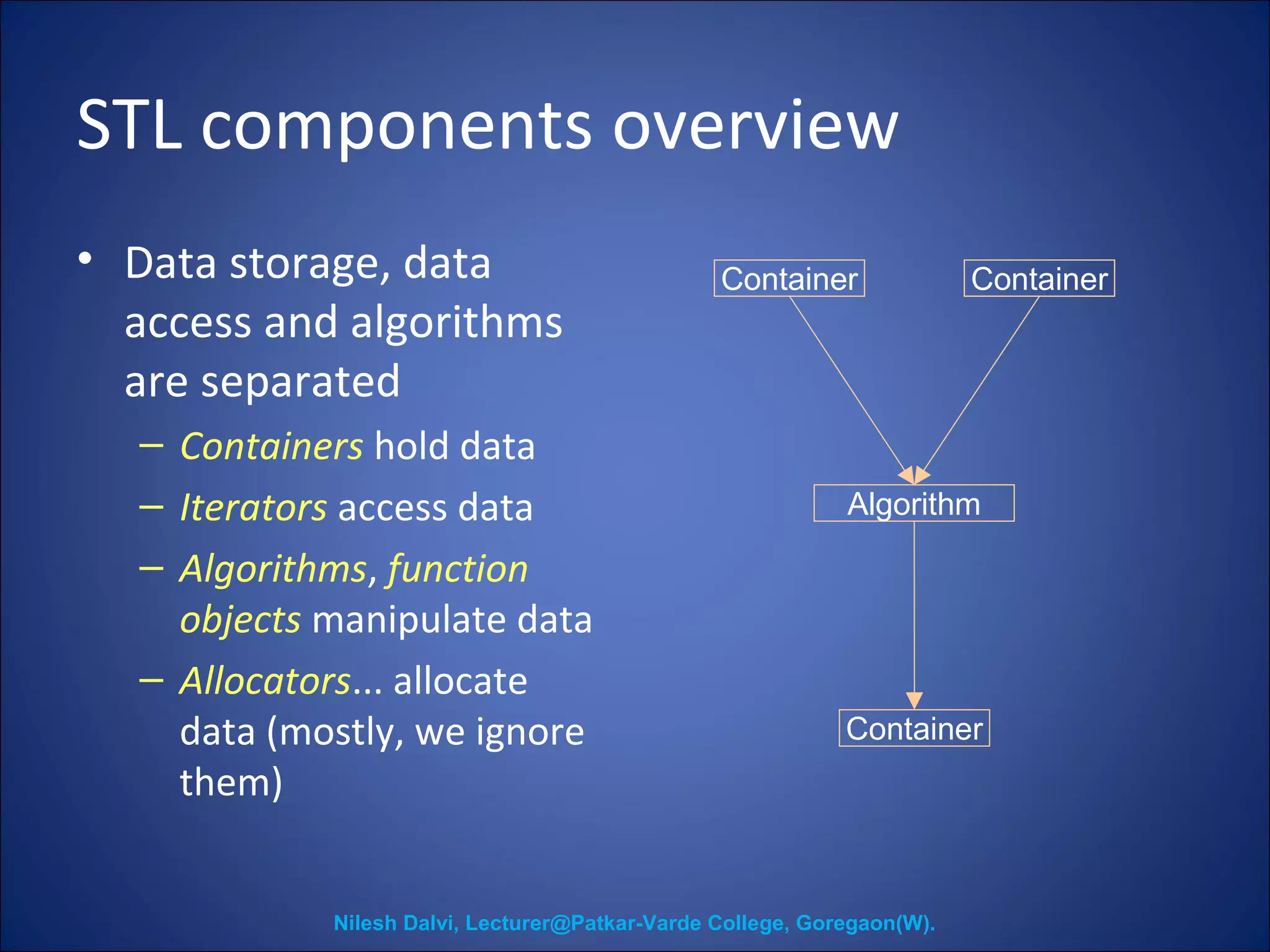
STL components overview 
• Data storage, data 
access and algorithms 
are separated 
– Containers hold data 
– Iterators access data 
– Algorithms, function 
objects manipulate data 
– Allocators... allocate 
data (mostly, we ignore 
them) 
Container Container 
Algorithm 
Container 
Nilesh Dalvi, Lecturer@Patkar-Varde College, Goregaon(W).
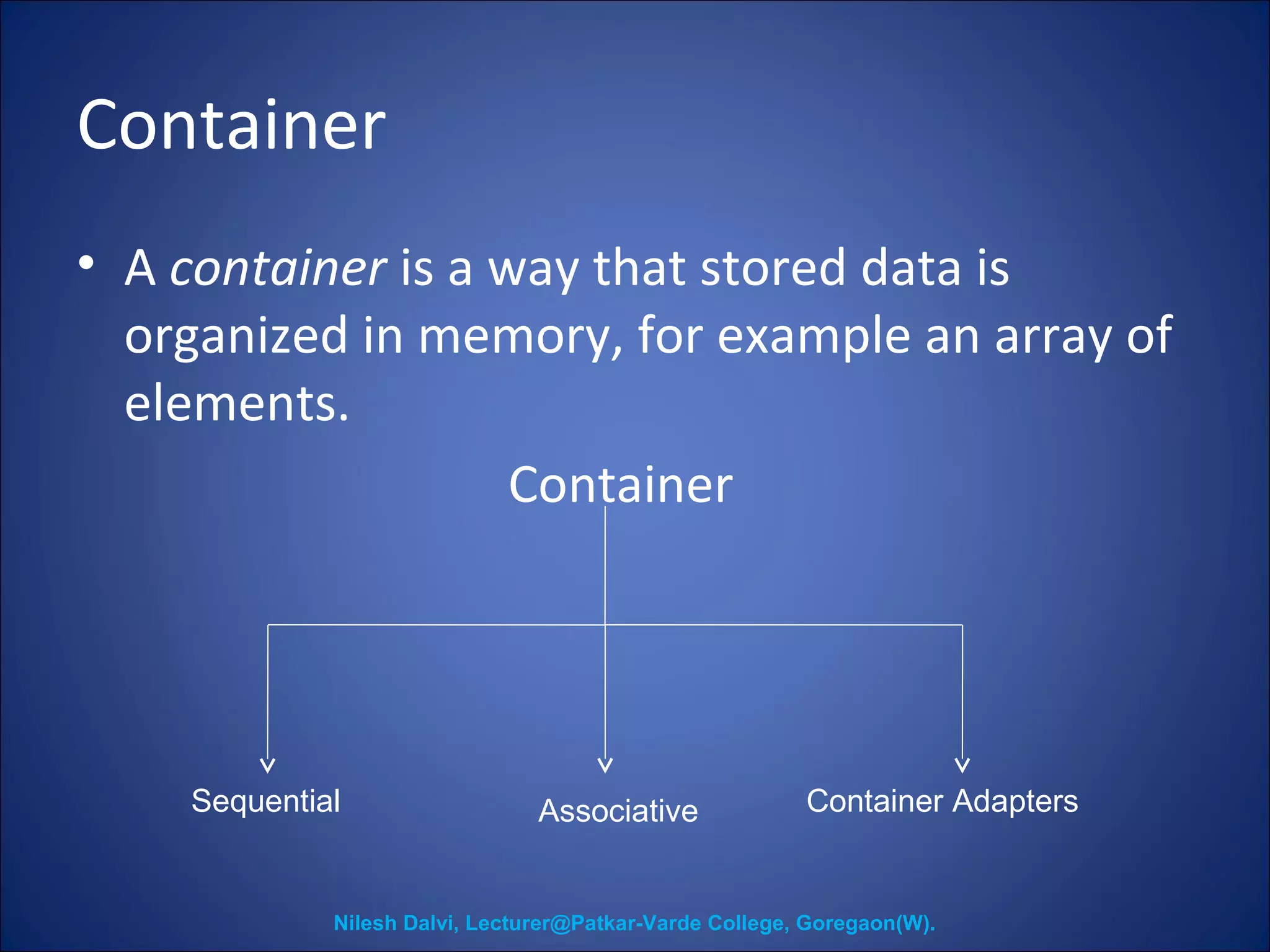
Container 
• A container is a way that stored data is 
organized in memory, for example an array of 
elements. 
Container 
Sequential Associative Container Adapters 
Nilesh Dalvi, Lecturer@Patkar-Varde College, Goregaon(W).
Container 
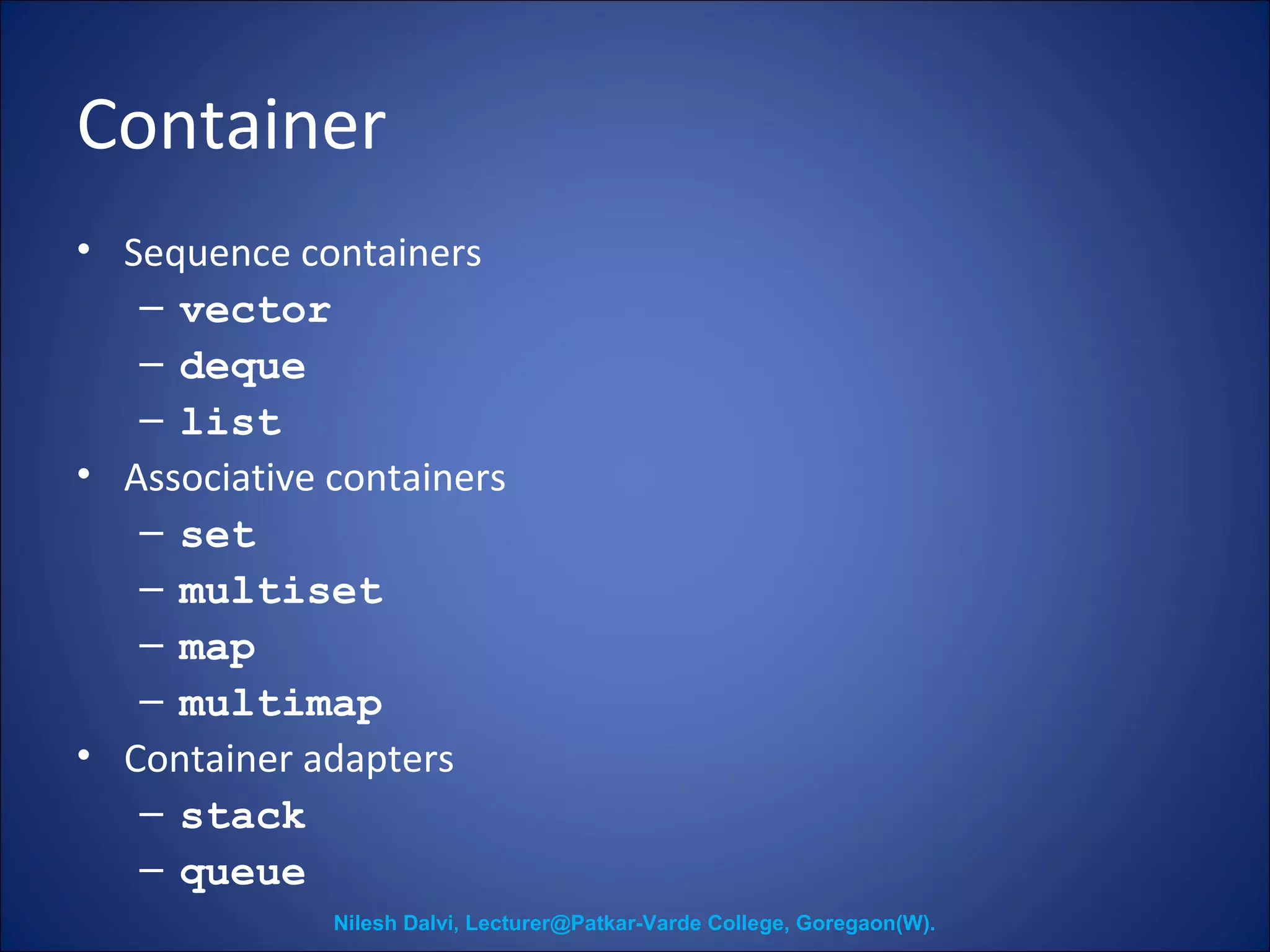
• Sequence containers 
– vector 
– deque 
– list 
• Associative containers 
– set 
– multiset 
– map 
– multimap 
• Container adapters 
– stack 
– queue 
Nilesh Dalvi, Lecturer@Patkar-Varde College, Goregaon(W).
Sequential Container 
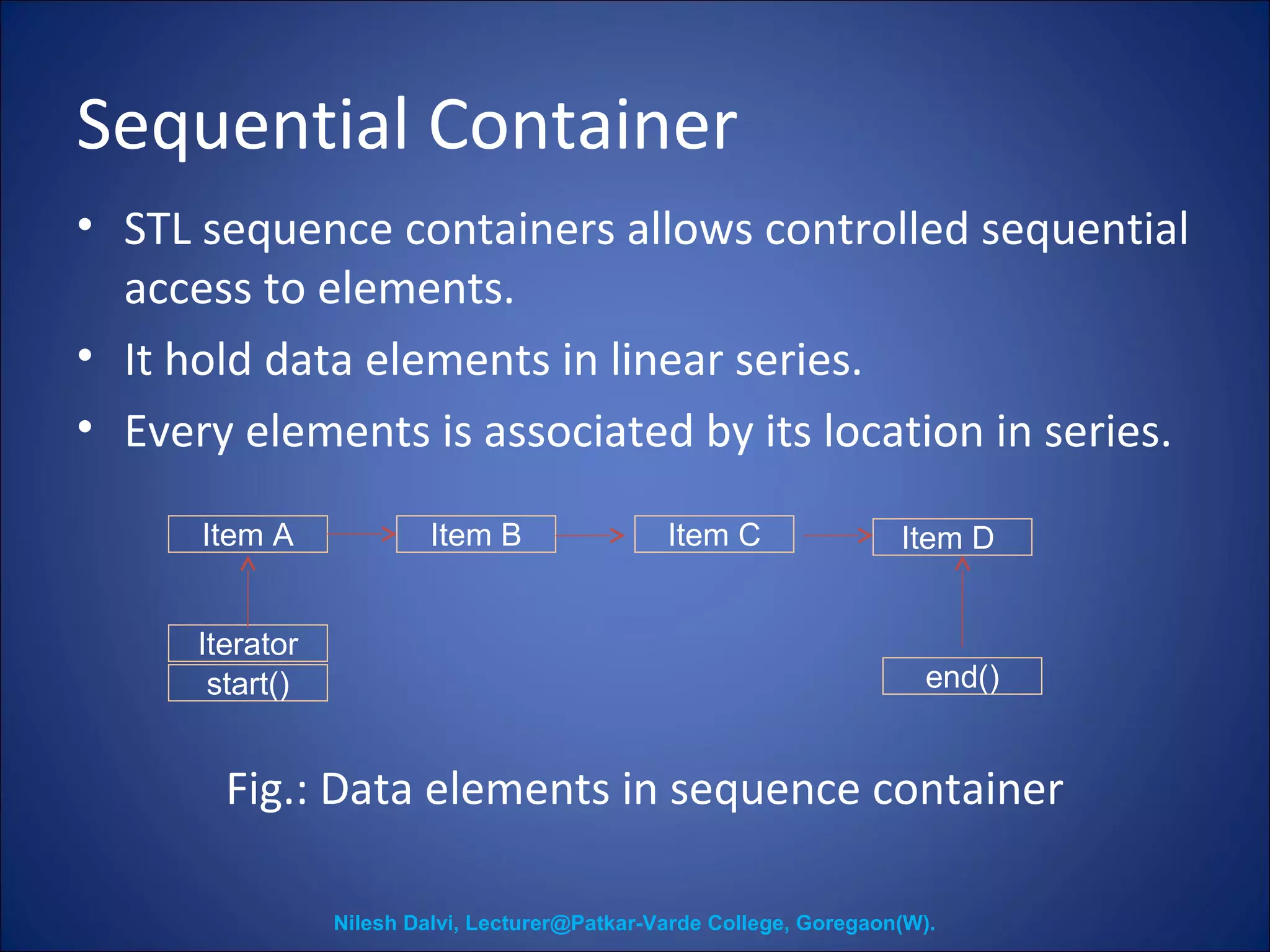
• STL sequence containers allows controlled sequential 
access to elements. 
• It hold data elements in linear series. 
• Every elements is associated by its location in series. 
Item A Item B Item C 
Item D 
Iterator 
start() end() 
Fig.: Data elements in sequence container 
Nilesh Dalvi, Lecturer@Patkar-Varde College, Goregaon(W).
Sequential Container 
– vector<T> – dynamic array 
• Offers random access 
• Allows insertion and deletions at back 
• Backward compatible with C : &v[0] points to the first 
element 
– deque<T> – double-ended queue (usually array of 
arrays) 
• Offers random access, back and front insertion 
• Slower than vectors, no C compatibility 
– list<T> – 'traditional' doubly linked list 
• Don't expect random access, you can insert anywhere 
though 
Nilesh Dalvi, Lecturer@Patkar-Varde College, Goregaon(W).
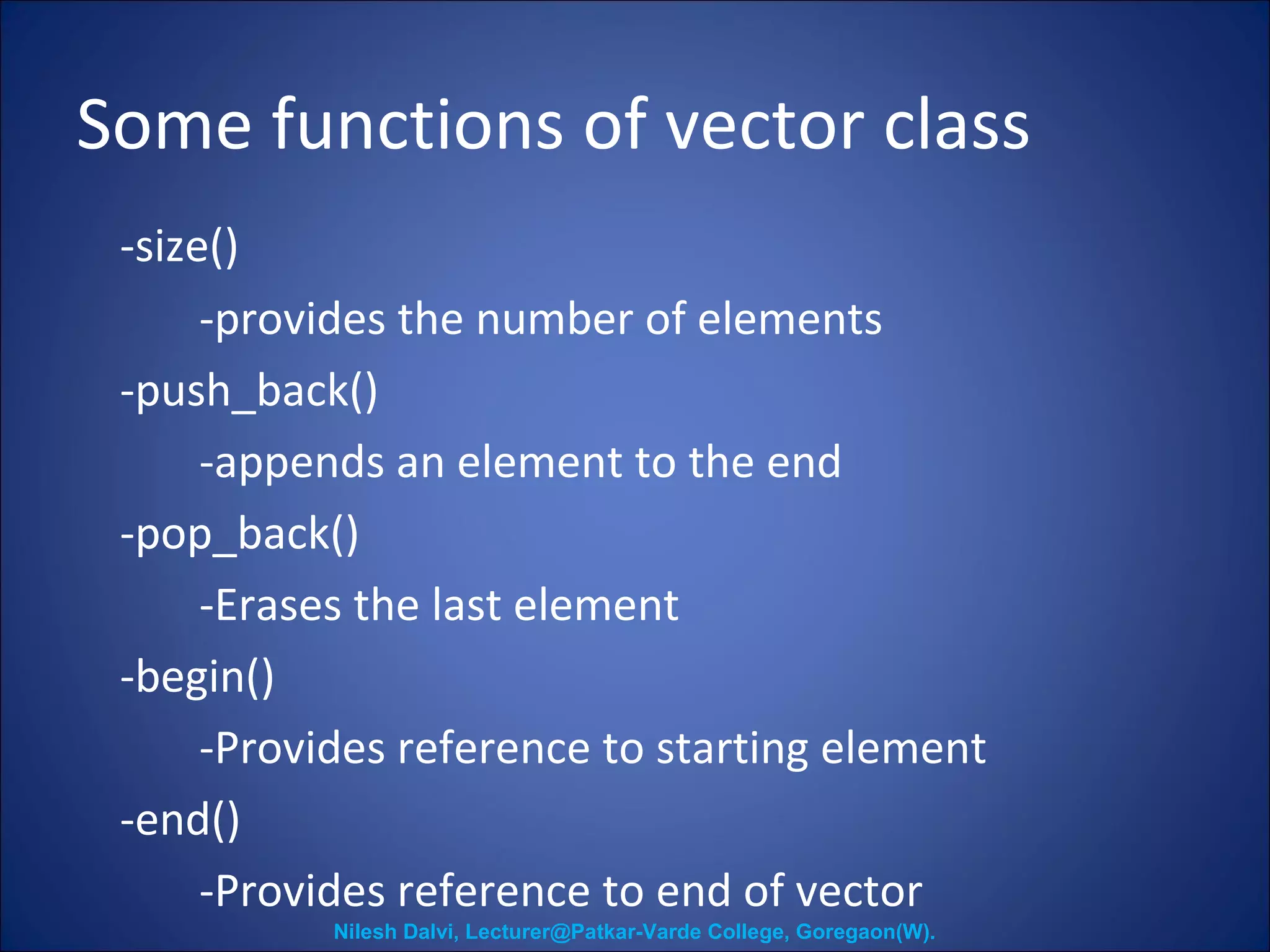
Some functions of vector class 
-size() 
-provides the number of elements 
-push_back() 
-appends an element to the end 
-pop_back() 
-Erases the last element 
-begin() 
-Provides reference to starting element 
-end() 
-Provides reference to end of vector 
Nilesh Dalvi, Lecturer@Patkar-Varde College, Goregaon(W).
Vector container 
int array[5] = {12, 7, 9, 21, 13 }; 
vector<int> v(array,array+5); 
12 7 9 21 13 
0 1 2 3 4 
v.begin(); 
12 7 9 21 
13 
v.push_back(15); 
12 7 9 21 
… 
15 
12 7 9 21 15 
v[3] 
v.pop_back(); 
Nilesh Dalvi, Lecturer@Patkar-Varde College, Goregaon(W).
Vector container 
#include <iostream> 
#include <vector> 
using namespace std; 
void display(vector <int> &v) 
{ 
for (int i=0; i < v.size(); i++) 
{ 
cout << v[i] << " "; 
} 
cout << "n"; 
} 
int main() 
{ 
vector <int> v; 
cout << "initial size = "<< v.size() << "n"; 
int x; 
cout << "Enter the 5 int valuesn"; 
for (int i=0; i < 5; i++) 
{ 
cin >> x; 
v.push_back(x); 
} 
cout << "nsize after adding = "<< v.size() << "n"; 
cout << "Current Vector::n"; 
display(v); 
return 0; 
} 
Nilesh Dalvi, Lecturer@Patkar-Varde College, Goregaon(W).
Vector container 
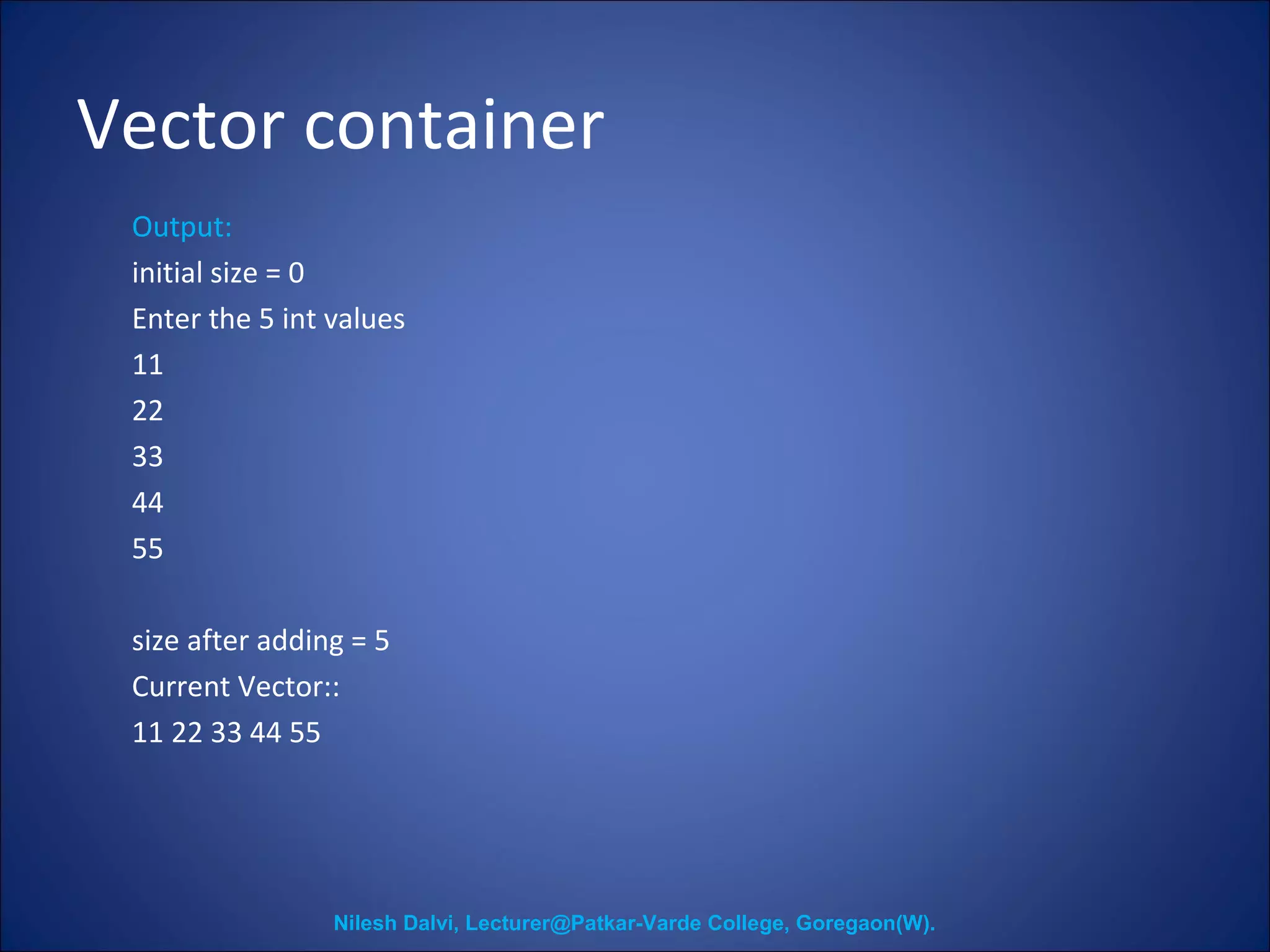
Output: 
initial size = 0 
Enter the 5 int values 
11 
22 
33 
44 
55 
size after adding = 5 
Current Vector:: 
11 22 33 44 55 
Nilesh Dalvi, Lecturer@Patkar-Varde College, Goregaon(W).
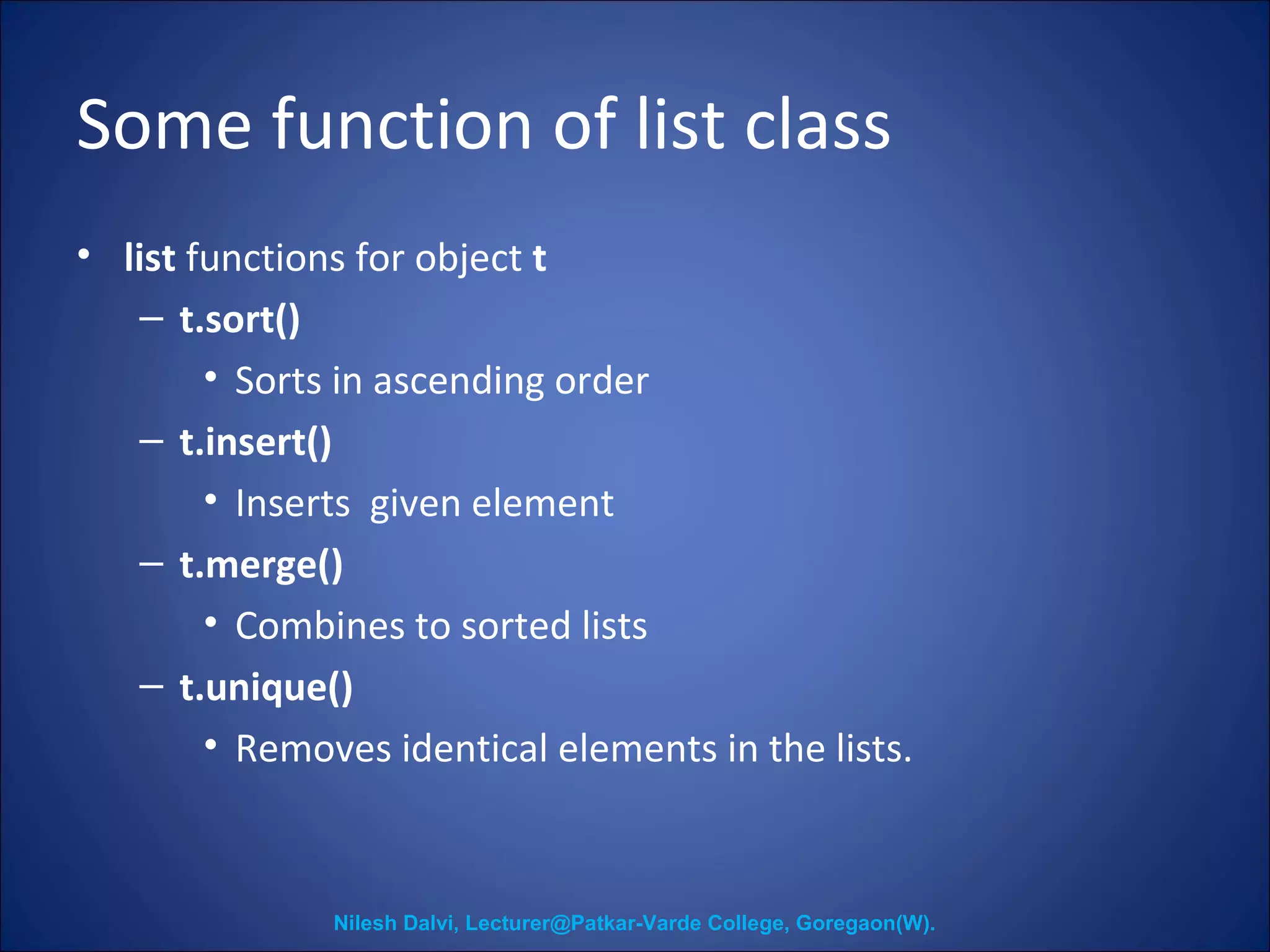
Some function of list class 
• list functions for object t 
– t.sort() 
• Sorts in ascending order 
– t.insert() 
• Inserts given element 
– t.merge() 
• Combines to sorted lists 
– t.unique() 
• Removes identical elements in the lists. 
Nilesh Dalvi, Lecturer@Patkar-Varde College, Goregaon(W).
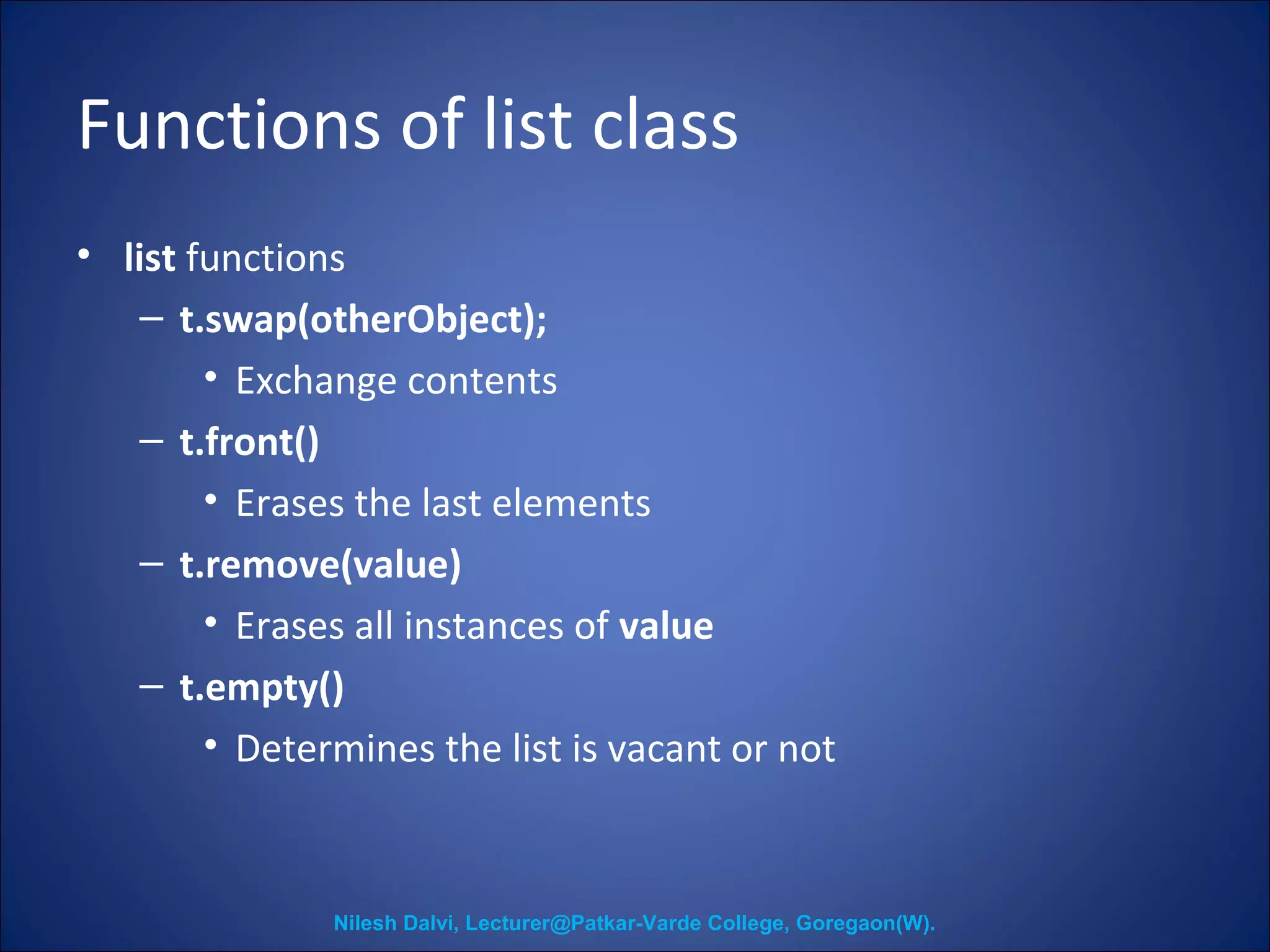
Functions of list class 
• list functions 
– t.swap(otherObject); 
• Exchange contents 
– t.front() 
• Erases the last elements 
– t.remove(value) 
• Erases all instances of value 
– t.empty() 
• Determines the list is vacant or not 
Nilesh Dalvi, Lecturer@Patkar-Varde College, Goregaon(W).
List container 
int array[5] = {12, 7, 9, 21, 13 }; 
list<int> li(array,array+5); 
12 9 21 
7 9 21 
12 
li.push_front(8); 
12 7 9 21 
… 
15 
li.pop_front(); 
13 
li.push_back(15); 
12 7 9 21 
… 
15 
li.pop_back(); 
8 
li.insert() 
19 
7 12 17 21 23 
Nilesh Dalvi, Lecturer@Patkar-Varde College, Goregaon(W).
List container 
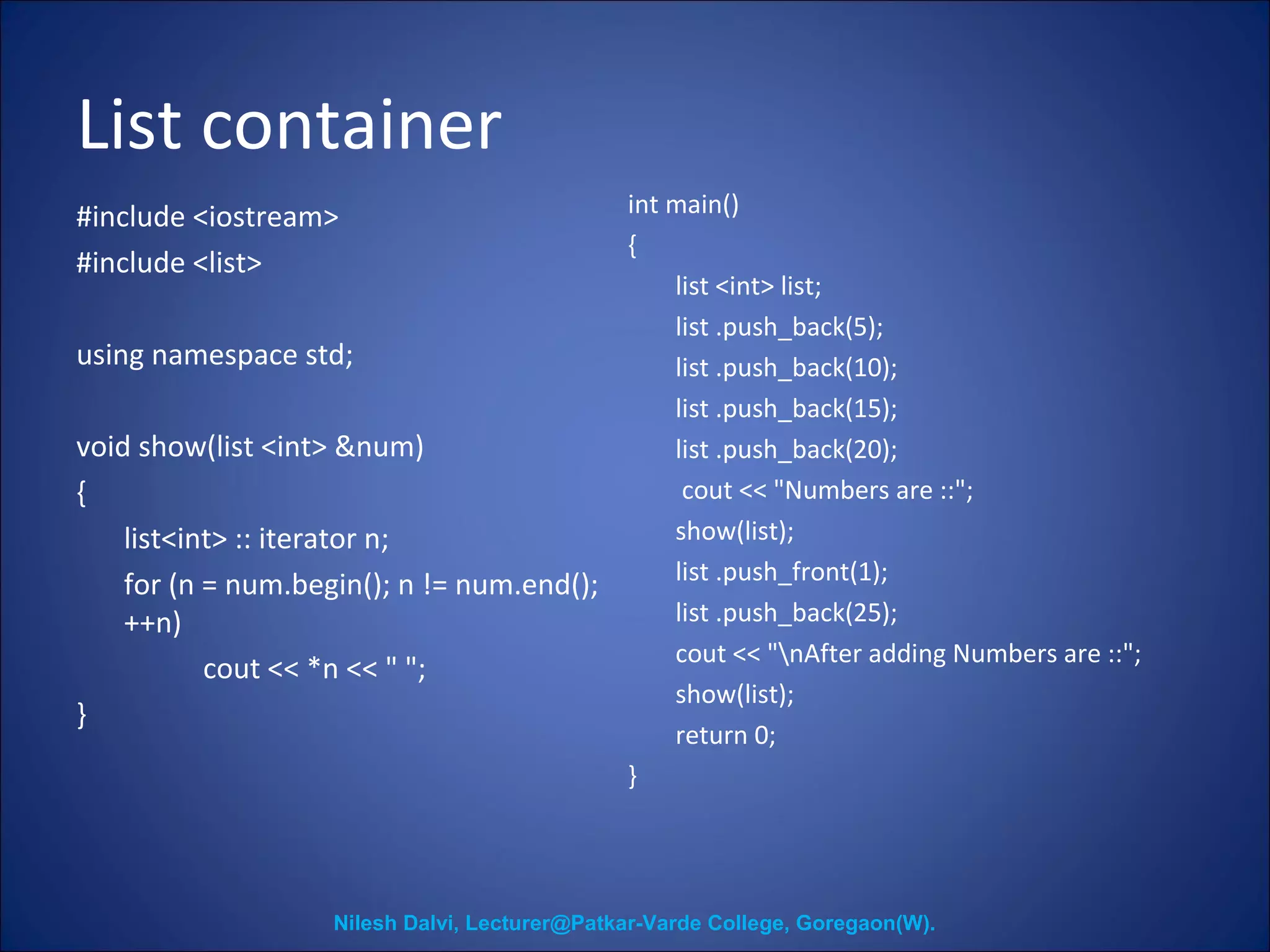
#include <iostream> 
#include <list> 
using namespace std; 
void show(list <int> &num) 
{ 
list<int> :: iterator n; 
for (n = num.begin(); n != num.end(); 
++n) 
cout << *n << " "; 
} 
int main() 
{ 
list <int> list; 
list .push_back(5); 
list .push_back(10); 
list .push_back(15); 
list .push_back(20); 
cout << "Numbers are ::"; 
show(list); 
list .push_front(1); 
list .push_back(25); 
cout << "nAfter adding Numbers are ::"; 
show(list); 
return 0; 
} 
Nilesh Dalvi, Lecturer@Patkar-Varde College, Goregaon(W).
List container 
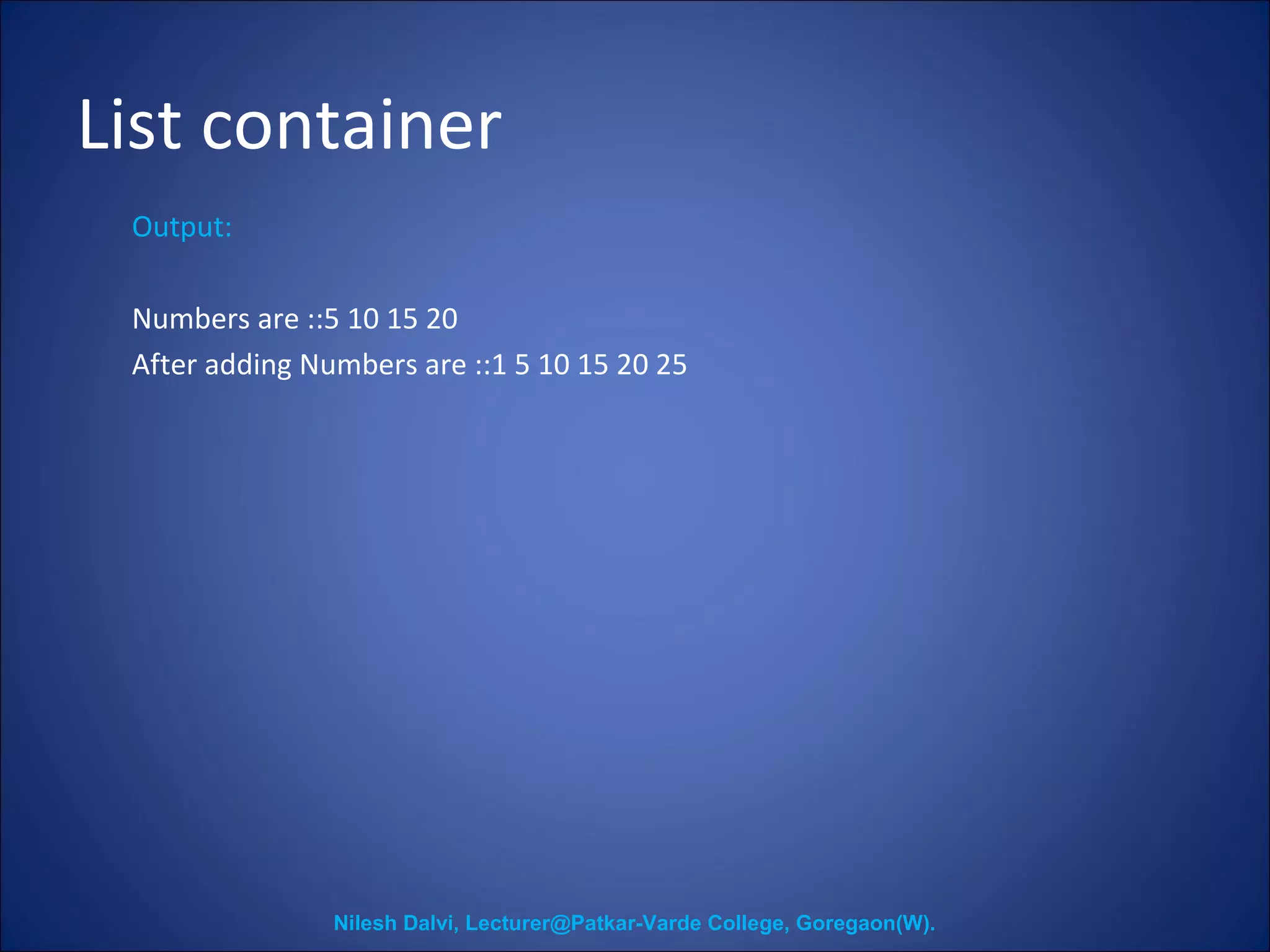
Output: 
Numbers are ::5 10 15 20 
After adding Numbers are ::1 5 10 15 20 25 
Nilesh Dalvi, Lecturer@Patkar-Varde College, Goregaon(W).
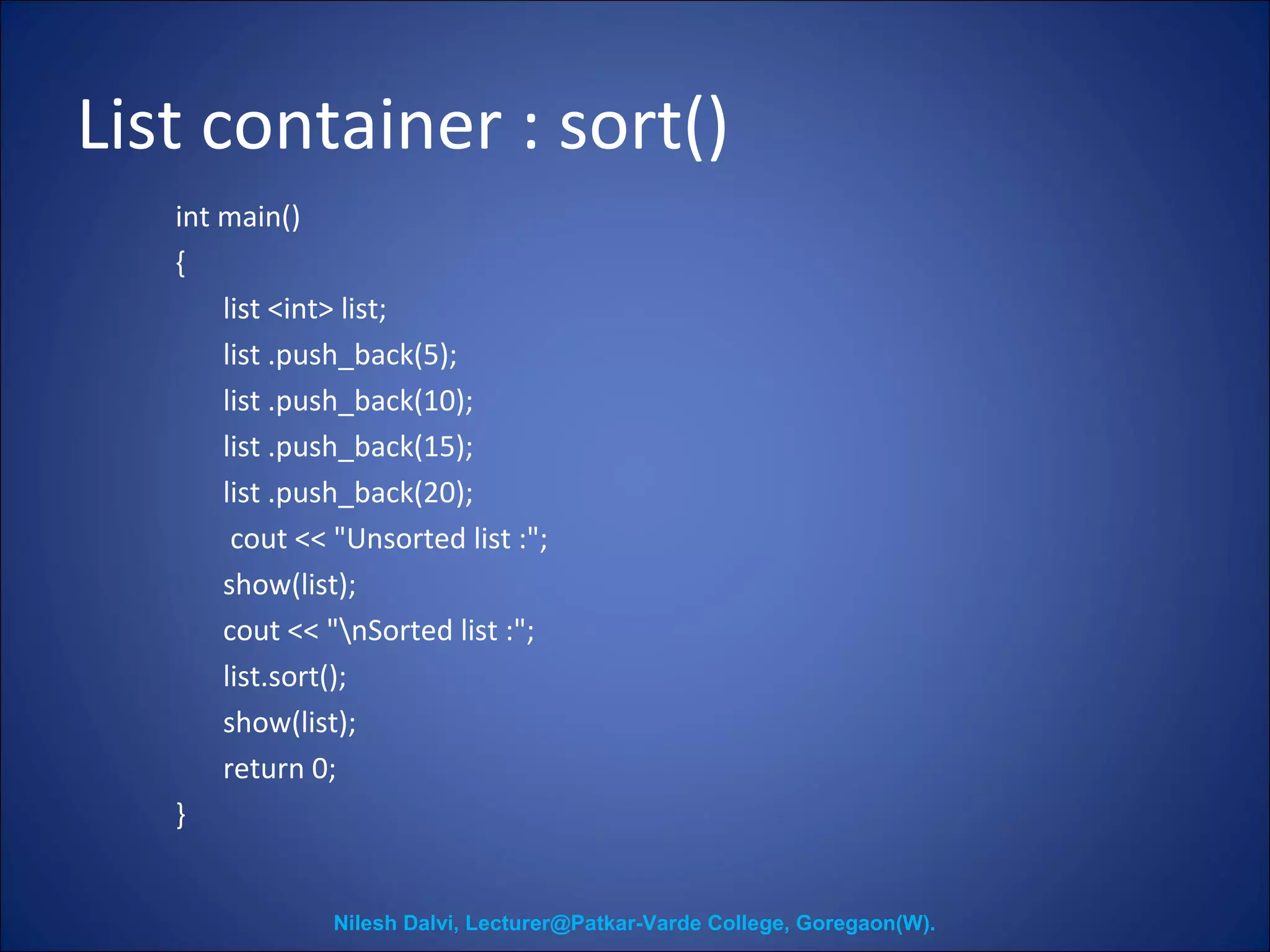
List container : sort() 
int main() 
{ 
list <int> list; 
list .push_back(5); 
list .push_back(10); 
list .push_back(15); 
list .push_back(20); 
cout << "Unsorted list :"; 
show(list); 
cout << "nSorted list :"; 
list.sort(); 
show(list); 
return 0; 
} 
Nilesh Dalvi, Lecturer@Patkar-Varde College, Goregaon(W).
Associative Container 
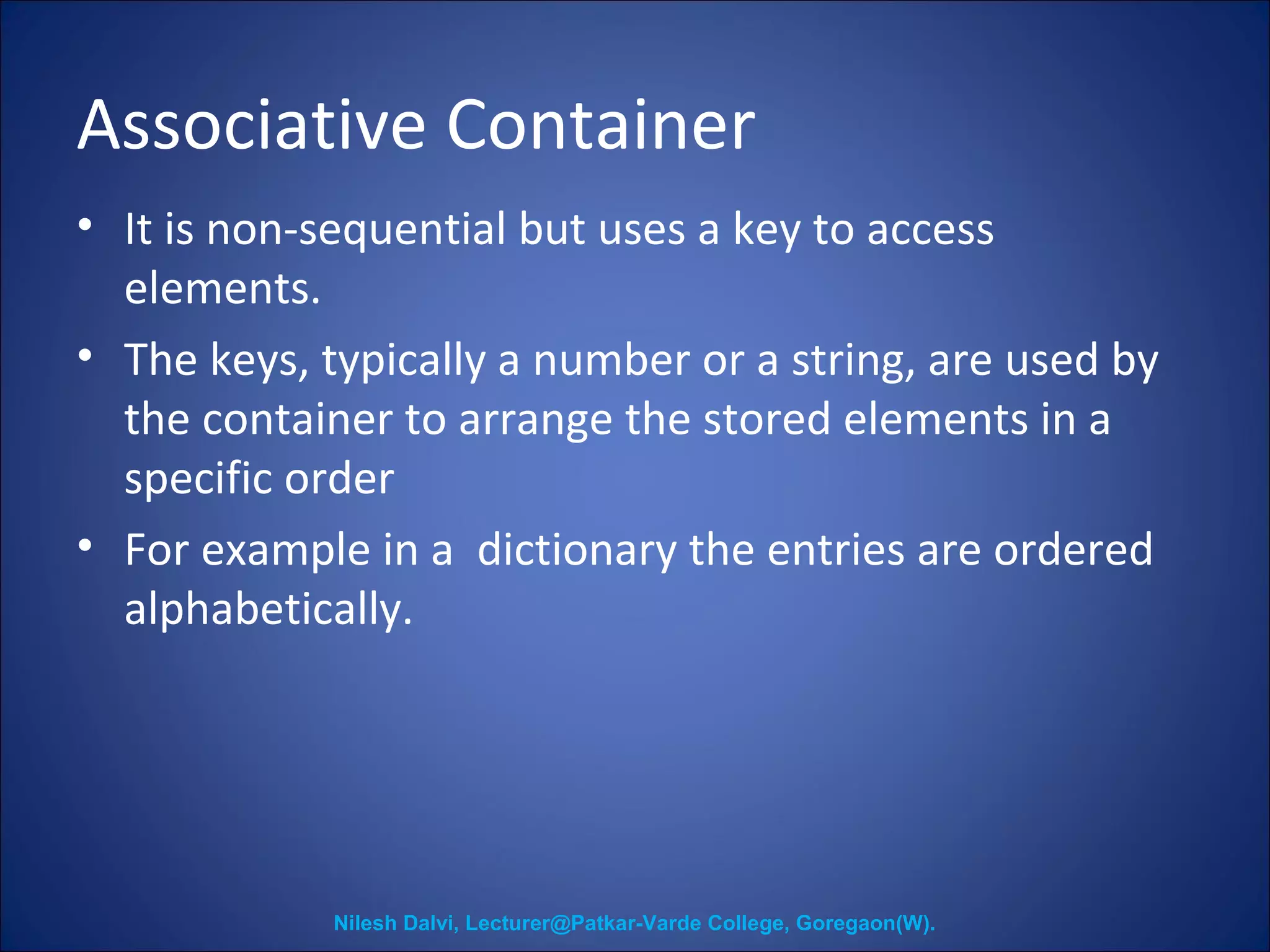
• It is non-sequential but uses a key to access 
elements. 
• The keys, typically a number or a string, are used by 
the container to arrange the stored elements in a 
specific order 
• For example in a dictionary the entries are ordered 
alphabetically. 
Nilesh Dalvi, Lecturer@Patkar-Varde College, Goregaon(W).
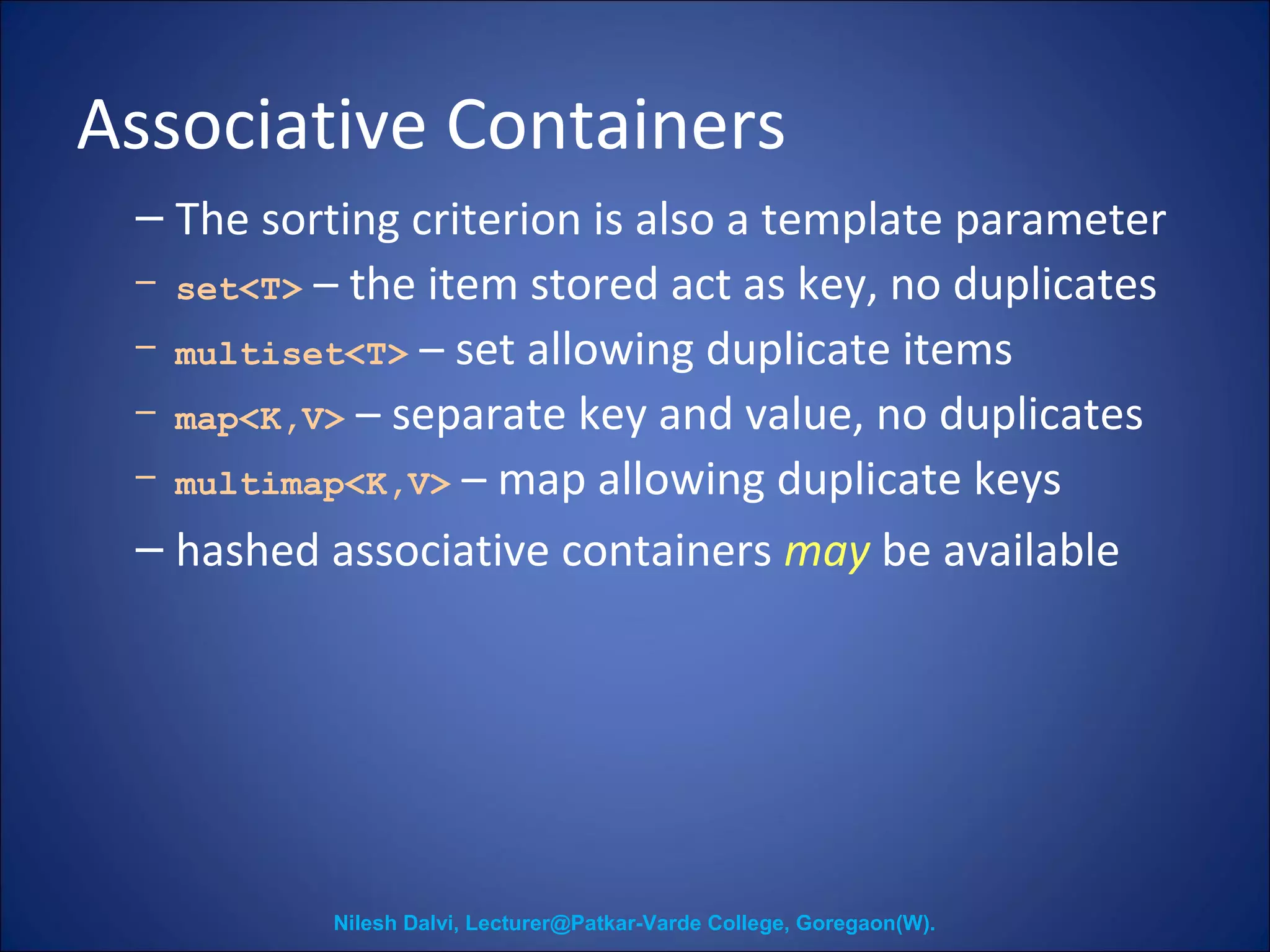
Associative Containers 
– The sorting criterion is also a template parameter 
– set<T> – the item stored act as key, no duplicates 
– multiset<T> – set allowing duplicate items 
– map<K,V> – separate key and value, no duplicates 
– multimap<K,V> – map allowing duplicate keys 
– hashed associative containers may be available 
Nilesh Dalvi, Lecturer@Patkar-Varde College, Goregaon(W).
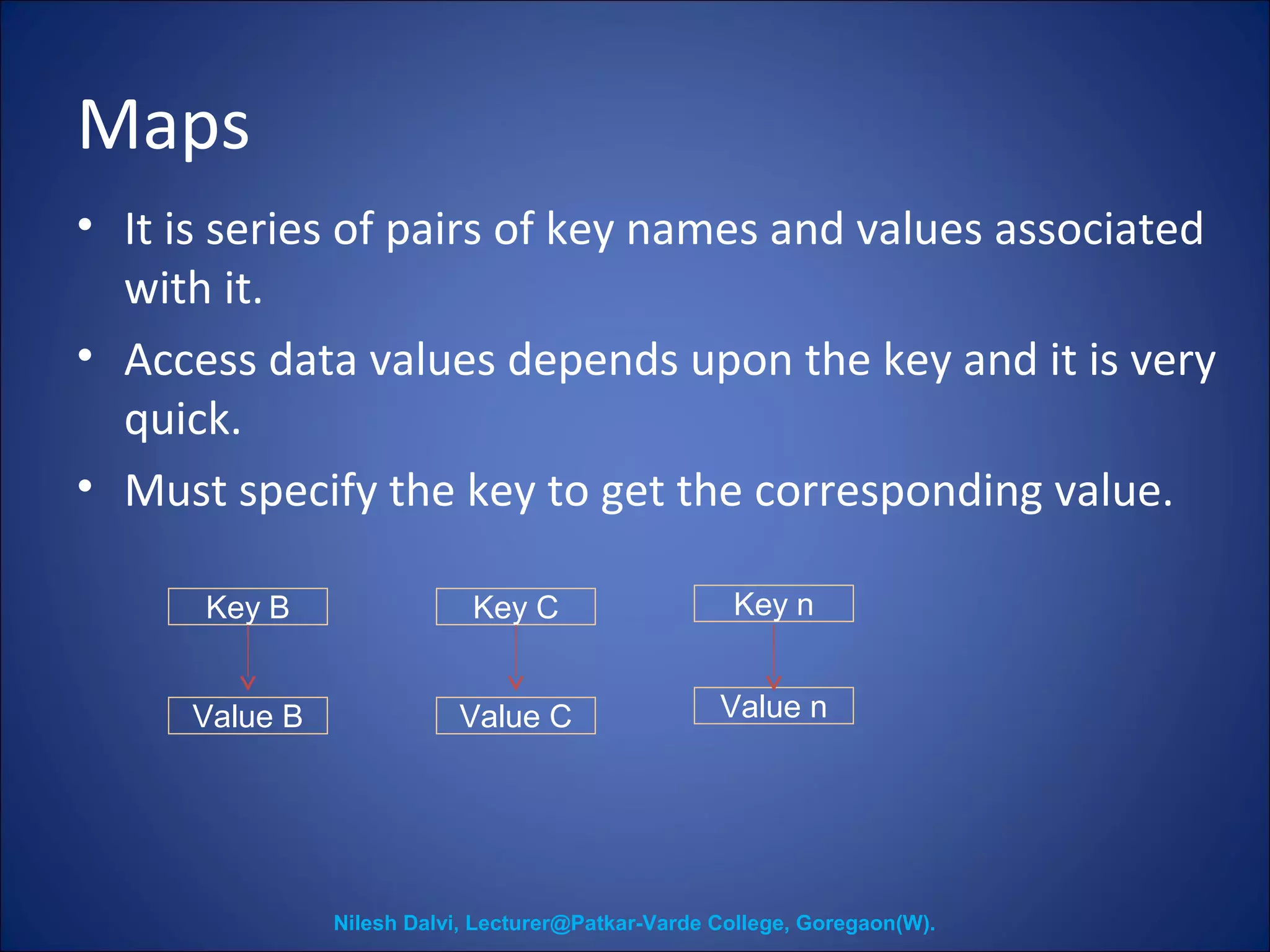
Maps 
• It is series of pairs of key names and values associated 
with it. 
• Access data values depends upon the key and it is very 
quick. 
• Must specify the key to get the corresponding value. 
Key B Key C 
Key n 
Value B Value C Value n 
Nilesh Dalvi, Lecturer@Patkar-Varde College, Goregaon(W).
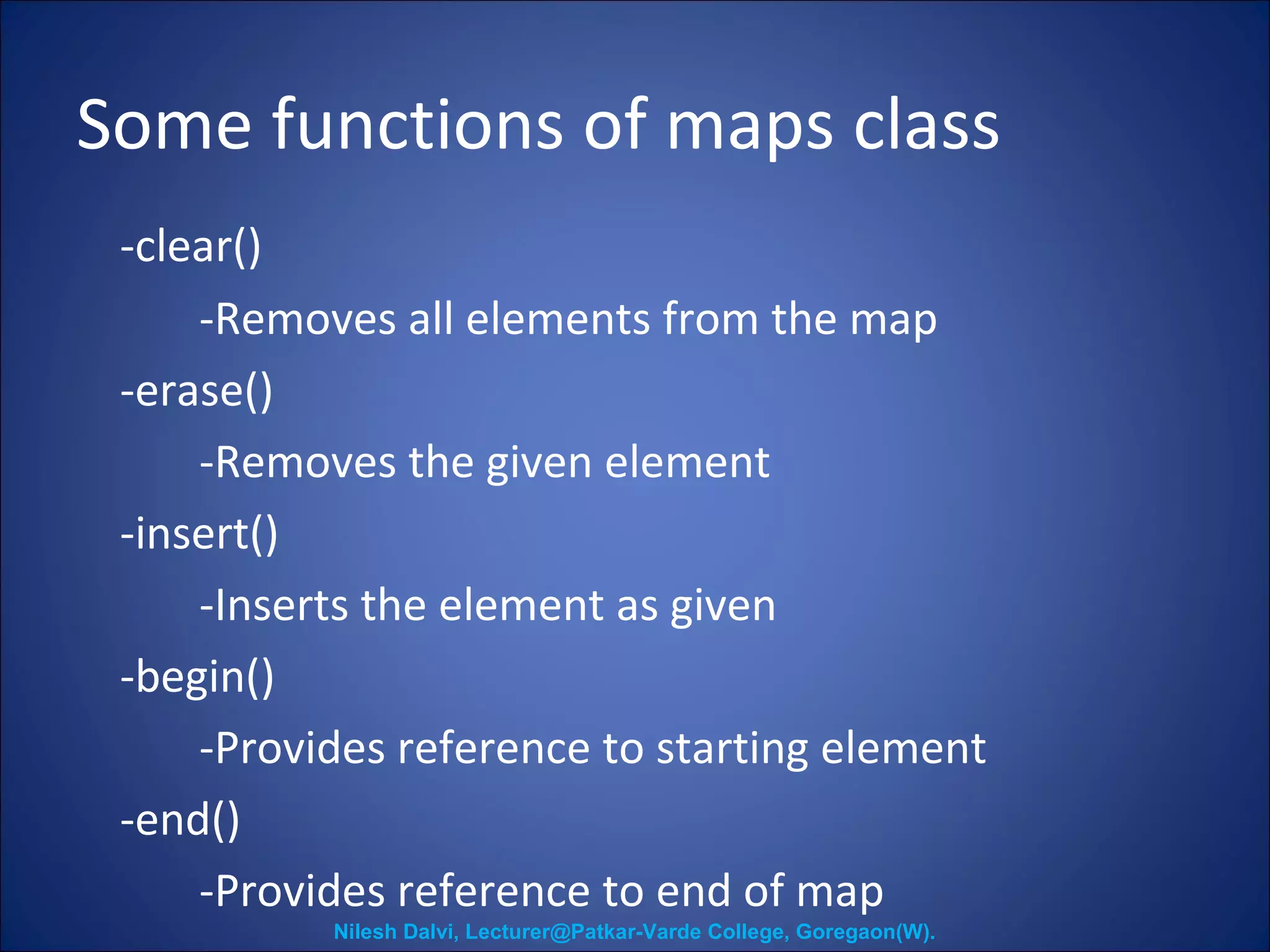
Some functions of maps class 
-clear() 
-Removes all elements from the map 
-erase() 
-Removes the given element 
-insert() 
-Inserts the element as given 
-begin() 
-Provides reference to starting element 
-end() 
-Provides reference to end of map 
Nilesh Dalvi, Lecturer@Patkar-Varde College, Goregaon(W).
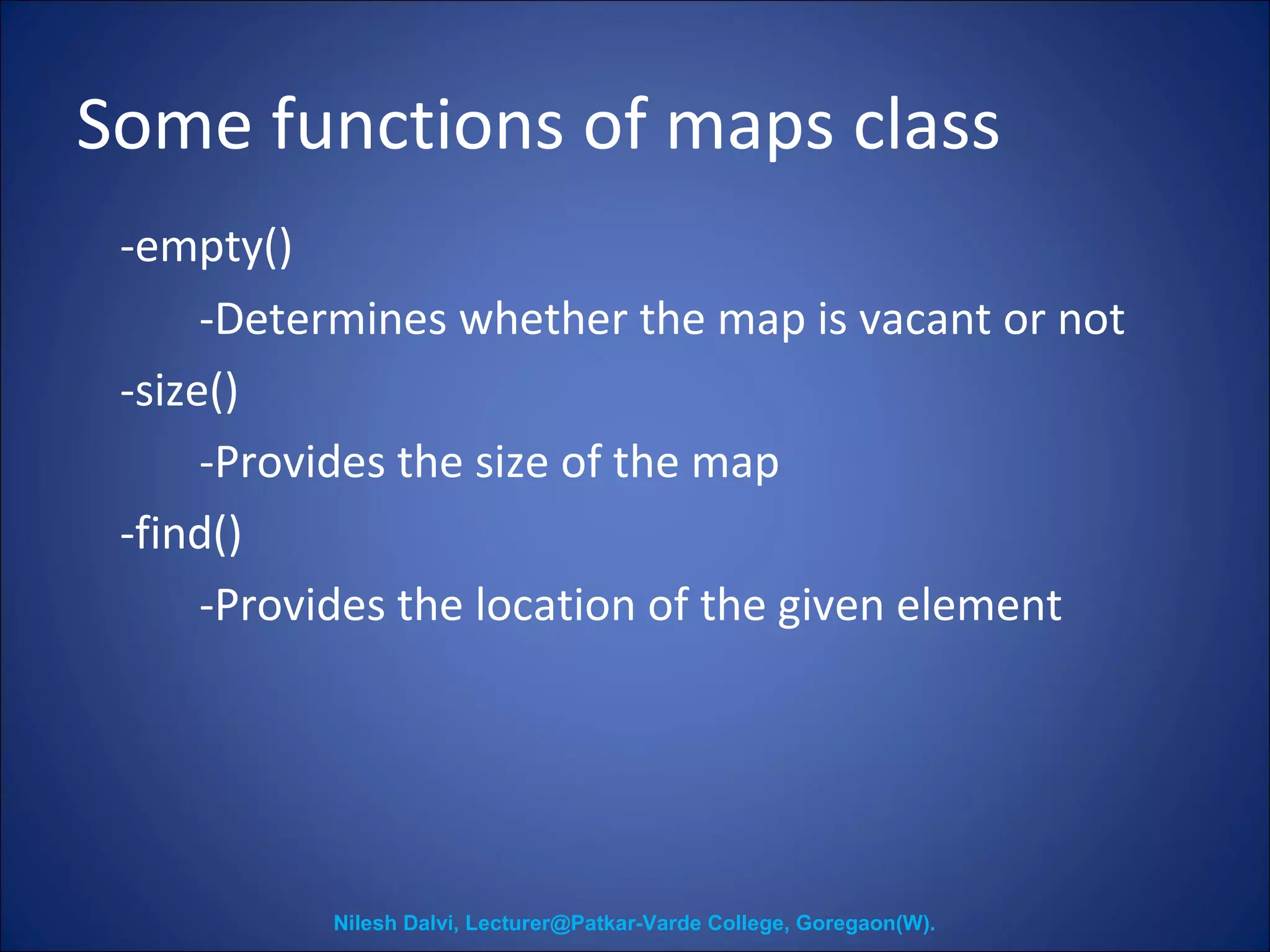
Some functions of maps class 
-empty() 
-Determines whether the map is vacant or not 
-size() 
-Provides the size of the map 
-find() 
-Provides the location of the given element 
Nilesh Dalvi, Lecturer@Patkar-Varde College, Goregaon(W).
Maps container 
#include <iostream> 
#include <map> 
#include <string> 
using namespace std; 
int main() 
{ 
typedef map<string, int> SYIT; 
SYIT stu; 
stu["ABC"] = 111; 
stu["PQR"] = 222; 
stu["XYZ"] = 333; 
stu["MNO"] = 444; 
SYIT::iterator pos; 
for (pos = stu.begin(); pos != stu.end(); ++pos) 
{ 
cout << "key: "" << pos->first << "" " 
<< "value: " << pos->second << endl; 
} 
return 0; 
} 
Output: 
key: "ABC" value: 111 
key: "MNO" value: 444 
key: "PQR" value: 222 
key: "XYZ" value: 333 
Nilesh Dalvi, Lecturer@Patkar-Varde College, Goregaon(W).
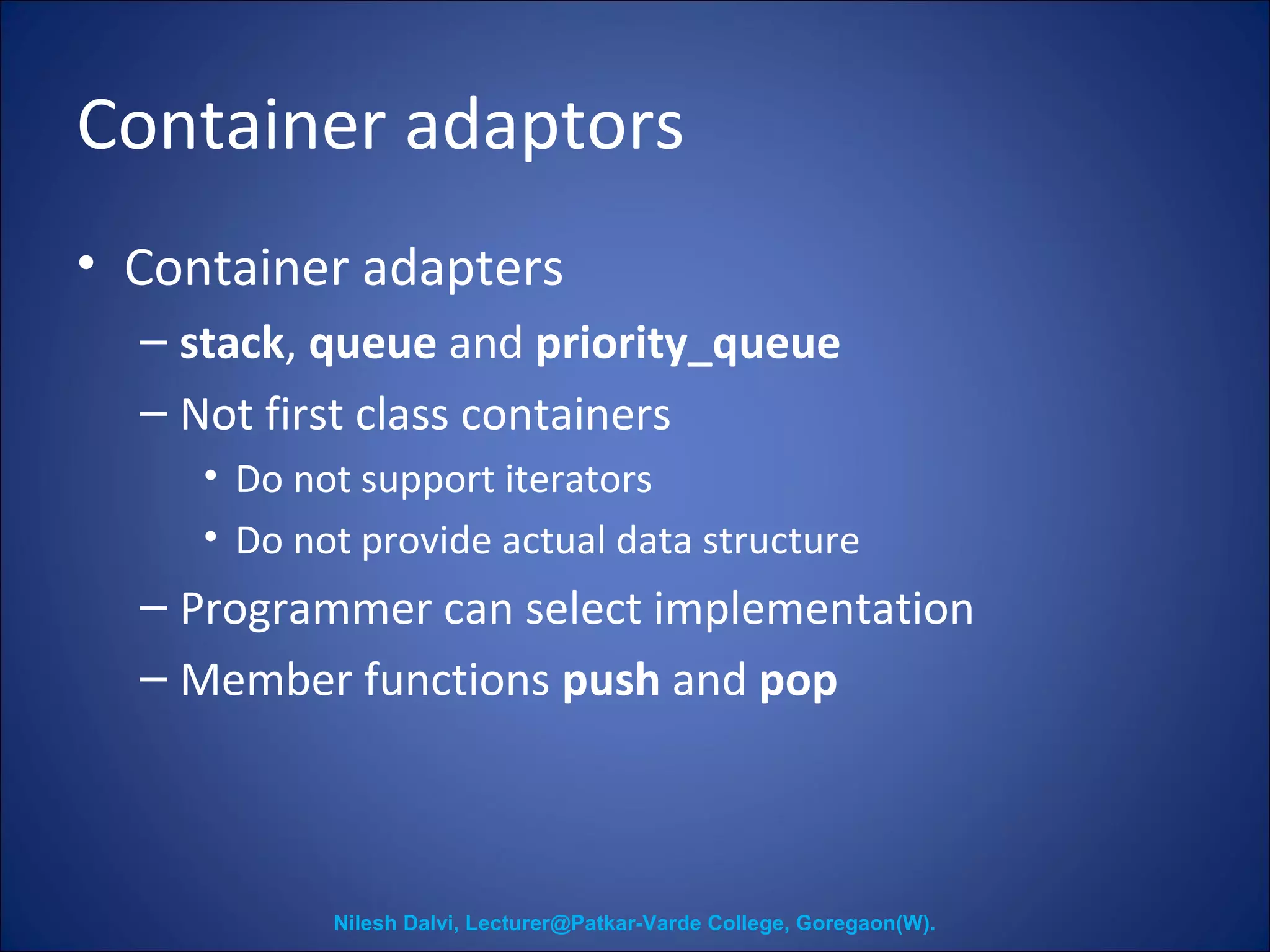
Container adaptors 
• Container adapters 
– stack, queue and priority_queue 
– Not first class containers 
• Do not support iterators 
• Do not provide actual data structure 
– Programmer can select implementation 
– Member functions push and pop 
Nilesh Dalvi, Lecturer@Patkar-Varde College, Goregaon(W).
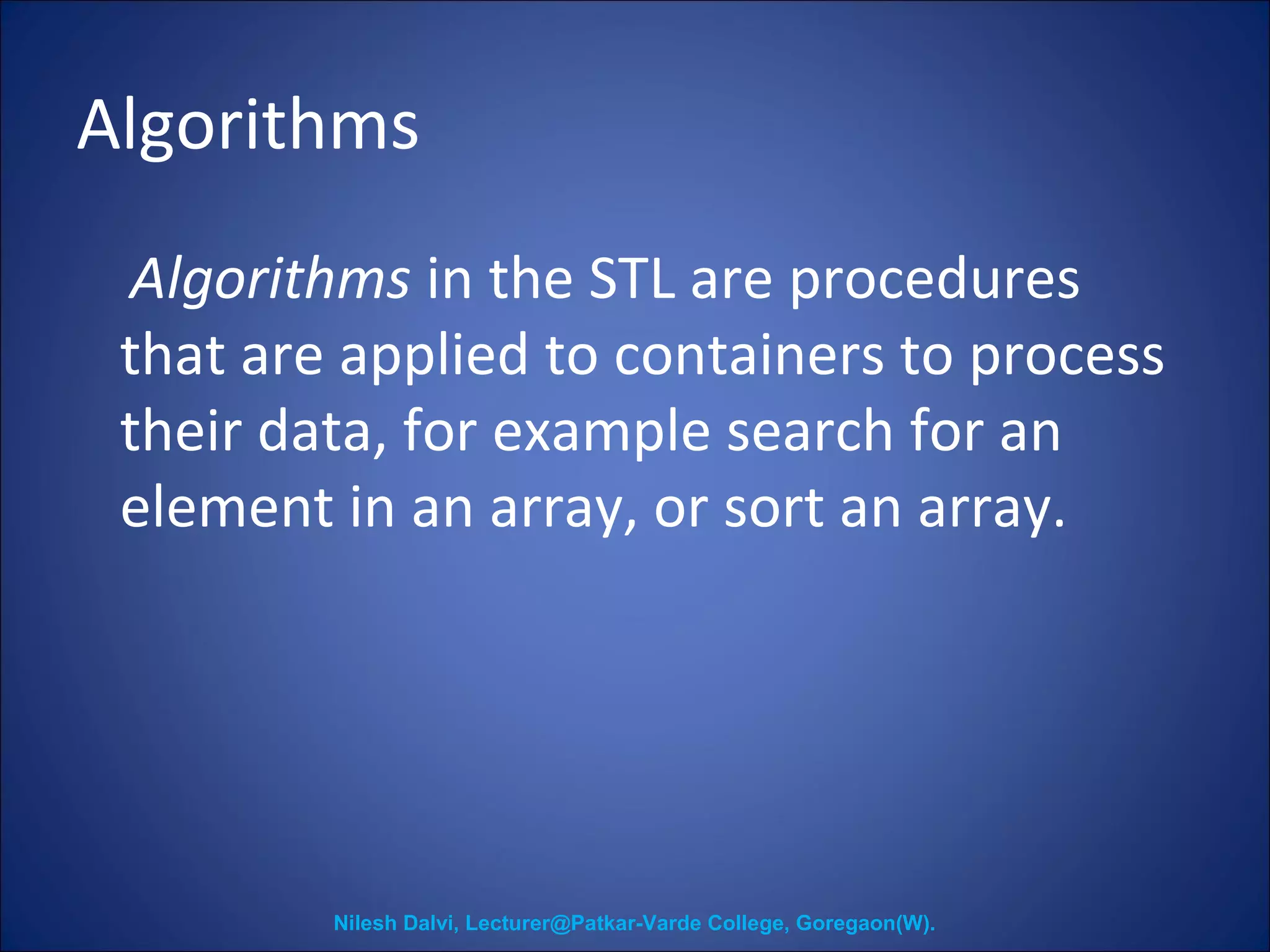
Algorithms 
Algorithms in the STL are procedures 
that are applied to containers to process 
their data, for example search for an 
element in an array, or sort an array. 
Nilesh Dalvi, Lecturer@Patkar-Varde College, Goregaon(W).
For_Each() Algorithm 
#include <vector> 
#include <algorithm> 
#include <iostream> 
void show(int n) 
{ 
cout << n << ” ”; 
} 
int arr[] = { 12, 3, 17, 8 }; // standard C array 
vector<int> v(arr, arr+4); // initialize vector with C array 
for_each (v.begin(), v.end(), show); // apply function show 
// to each element of vector v 
Nilesh Dalvi, Lecturer@Patkar-Varde College, Goregaon(W).
Find() Algorithm 
#include <vector> 
#include <algorithm> 
#include <iostream> 
int key; 
int arr[] = { 12, 3, 17, 8, 34, 56, 9 }; // standard C array 
vector<int> v(arr, arr+7); // initialize vector with C array 
vector<int>::iterator iter; 
cout << ”enter value :”; 
cin >> key; 
iter=find(v.begin(),v.end(),key); // finds integer key in v 
if (iter != v.end()) // found the element 
cout << ”Element ” << key << ” found” << endl; 
else 
cout << ”Element ” << key << ” not in vector v” << endl; 
Nilesh Dalvi, Lecturer@Patkar-Varde College, Goregaon(W).
Sort & Merge 
• Sort and merge allow you to sort and merge 
elements in a container 
#include <list> 
int arr1[]= { 6, 4, 9, 1, 7 }; 
int arr2[]= { 4, 2, 1, 3, 8 }; 
list<int> l1(arr1, arr1+5); // initialize l1 with arr1 
list<int> l2(arr2, arr2+5); // initialize l2 with arr2 
l1.sort(); // l1 = {1, 4, 6, 7, 9} 
l2.sort(); // l2= {1, 2, 3, 4, 8 } 
l1.merge(l2); // merges l2 into l1 
// l1 = { 1, 1, 2, 3, 4, 4, 6, 7, 8, 9}, l2= {} Nilesh Dalvi, Lecturer@Patkar-Varde College, Goregaon(W).
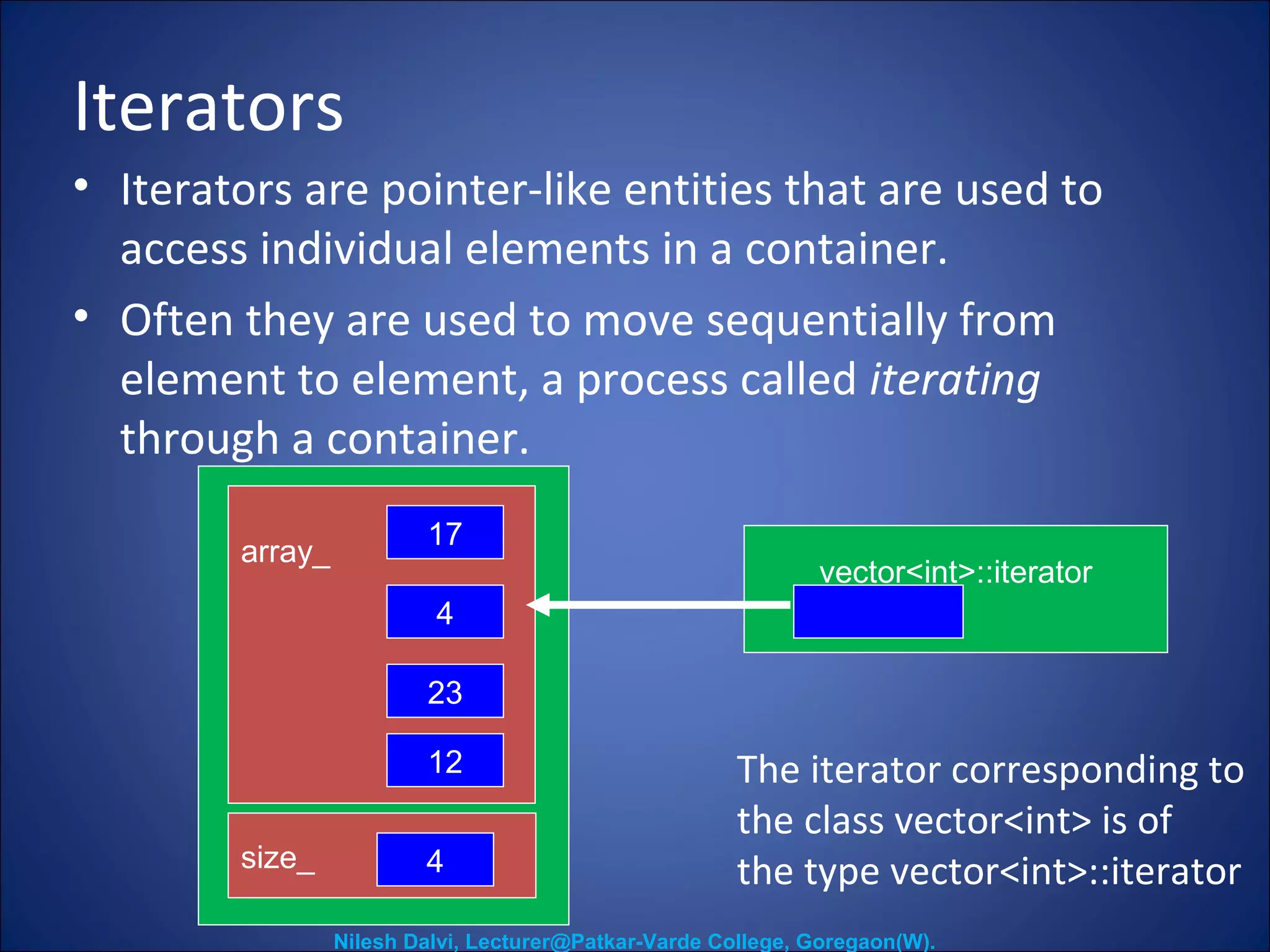
Iterators 
• Iterators are pointer-like entities that are used to 
access individual elements in a container. 
• Often they are used to move sequentially from 
element to element, a process called iterating 
through a container. 
vector<int> 
array_ 17 
4 
23 
12 
size_ 4 
vector<int>::iterator 
The iterator corresponding to 
the class vector<int> is of 
the type vector<int>::iterator 
Nilesh Dalvi, Lecturer@Patkar-Varde College, Goregaon(W).
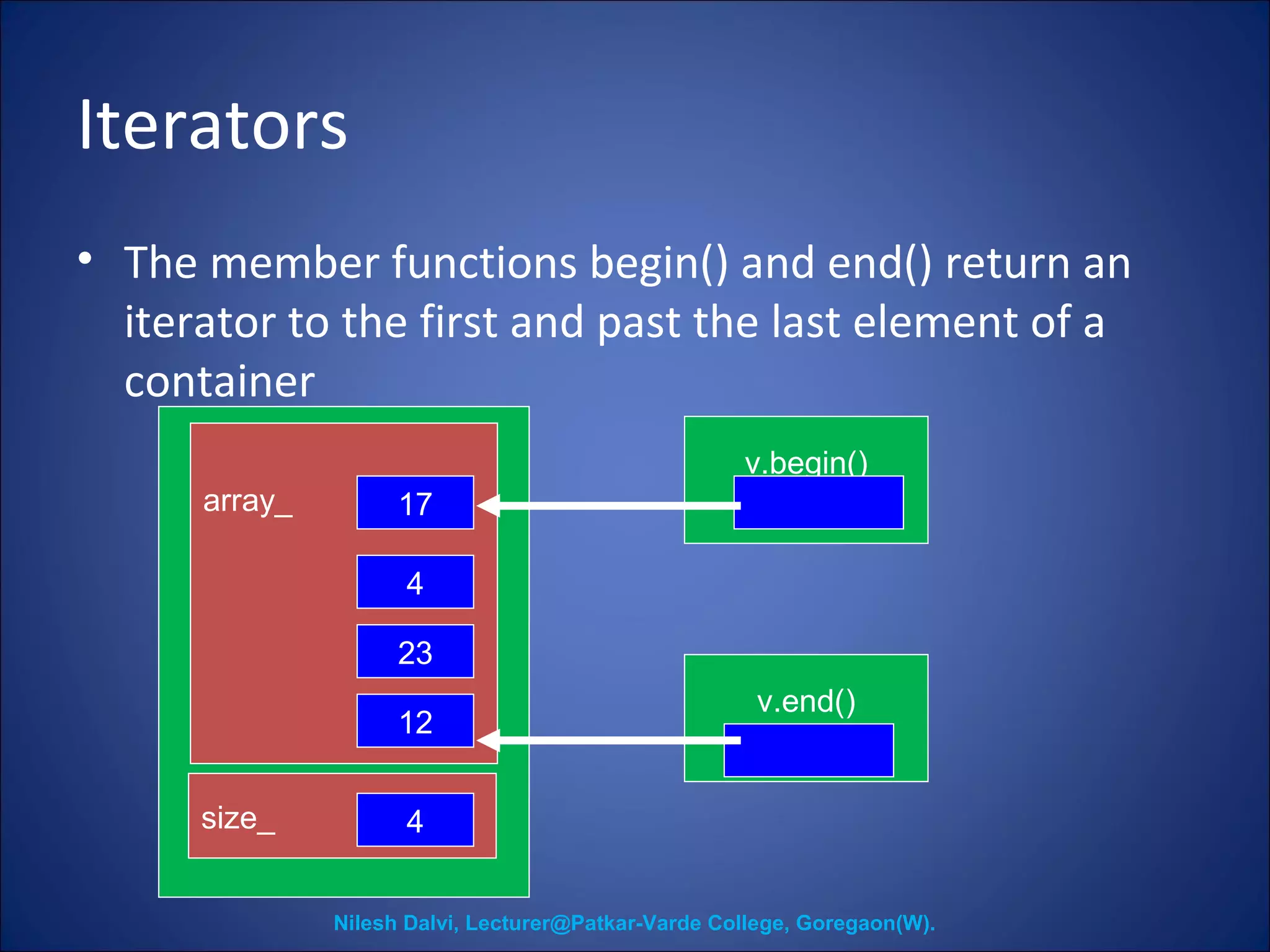
Iterators 
• The member functions begin() and end() return an 
iterator to the first and past the last element of a 
container 
arravye_ctor<int> v 17 
4 
23 
12 
size_ 4 
v.begin() 
v.end() 
Nilesh Dalvi, Lecturer@Patkar-Varde College, Goregaon(W).
So long and thanks for all the attention  
THANK YOU.!!!

Standard Template Library

  • 1.
    OObbjjeecctt oorriieenntteedd PPrrooggrraammmmiinngg wwiitthh CC++++ SSttaannddaarrdd TTeemmppllaattee LLiibbrraarryy By Nilesh Dalvi LLeeccttuurreerr,, PPaattkkaarr--VVaarrddee CCoolllleeggee.. http://www.slideshare.net/nileshdalvi01
  • 2.
    Introduction To STL • STL is an advanced application of templates. • Introduced by Meng Lee and Alexander Stepanov of Hewlwtt-packard in 1994. • Contains several built-in functions and operators that help the programmer to develop complex programs. • All famous compiler provides provide the STL. • It consists of vectors, lists, queues and stacks. Nilesh Dalvi, Lecturer@Patkar-Varde College, Goregaon(W).
  • 3.
    Why should Iuse STL? • STL can save considerable time and effort, and lead to high quality programs. • These benefits are possible because we are “reusing” the well-written and well-tested components defined in the STL. Nilesh Dalvi, Lecturer@Patkar-Varde College, Goregaon(W).
  • 4.
    STL components overview • Data storage, data access and algorithms are separated – Containers hold data – Iterators access data – Algorithms, function objects manipulate data – Allocators... allocate data (mostly, we ignore them) Container Container Algorithm Container Nilesh Dalvi, Lecturer@Patkar-Varde College, Goregaon(W).
  • 5.
    Container • Acontainer is a way that stored data is organized in memory, for example an array of elements. Container Sequential Associative Container Adapters Nilesh Dalvi, Lecturer@Patkar-Varde College, Goregaon(W).
  • 6.
    Container • Sequencecontainers – vector – deque – list • Associative containers – set – multiset – map – multimap • Container adapters – stack – queue Nilesh Dalvi, Lecturer@Patkar-Varde College, Goregaon(W).
  • 7.
    Sequential Container •STL sequence containers allows controlled sequential access to elements. • It hold data elements in linear series. • Every elements is associated by its location in series. Item A Item B Item C Item D Iterator start() end() Fig.: Data elements in sequence container Nilesh Dalvi, Lecturer@Patkar-Varde College, Goregaon(W).
  • 8.
    Sequential Container –vector<T> – dynamic array • Offers random access • Allows insertion and deletions at back • Backward compatible with C : &v[0] points to the first element – deque<T> – double-ended queue (usually array of arrays) • Offers random access, back and front insertion • Slower than vectors, no C compatibility – list<T> – 'traditional' doubly linked list • Don't expect random access, you can insert anywhere though Nilesh Dalvi, Lecturer@Patkar-Varde College, Goregaon(W).
  • 9.
    Some functions ofvector class -size() -provides the number of elements -push_back() -appends an element to the end -pop_back() -Erases the last element -begin() -Provides reference to starting element -end() -Provides reference to end of vector Nilesh Dalvi, Lecturer@Patkar-Varde College, Goregaon(W).
  • 10.
    Vector container intarray[5] = {12, 7, 9, 21, 13 }; vector<int> v(array,array+5); 12 7 9 21 13 0 1 2 3 4 v.begin(); 12 7 9 21 13 v.push_back(15); 12 7 9 21 … 15 12 7 9 21 15 v[3] v.pop_back(); Nilesh Dalvi, Lecturer@Patkar-Varde College, Goregaon(W).
  • 11.
    Vector container #include<iostream> #include <vector> using namespace std; void display(vector <int> &v) { for (int i=0; i < v.size(); i++) { cout << v[i] << " "; } cout << "n"; } int main() { vector <int> v; cout << "initial size = "<< v.size() << "n"; int x; cout << "Enter the 5 int valuesn"; for (int i=0; i < 5; i++) { cin >> x; v.push_back(x); } cout << "nsize after adding = "<< v.size() << "n"; cout << "Current Vector::n"; display(v); return 0; } Nilesh Dalvi, Lecturer@Patkar-Varde College, Goregaon(W).
  • 12.
    Vector container Output: initial size = 0 Enter the 5 int values 11 22 33 44 55 size after adding = 5 Current Vector:: 11 22 33 44 55 Nilesh Dalvi, Lecturer@Patkar-Varde College, Goregaon(W).
  • 13.
    Some function oflist class • list functions for object t – t.sort() • Sorts in ascending order – t.insert() • Inserts given element – t.merge() • Combines to sorted lists – t.unique() • Removes identical elements in the lists. Nilesh Dalvi, Lecturer@Patkar-Varde College, Goregaon(W).
  • 14.
    Functions of listclass • list functions – t.swap(otherObject); • Exchange contents – t.front() • Erases the last elements – t.remove(value) • Erases all instances of value – t.empty() • Determines the list is vacant or not Nilesh Dalvi, Lecturer@Patkar-Varde College, Goregaon(W).
  • 15.
    List container intarray[5] = {12, 7, 9, 21, 13 }; list<int> li(array,array+5); 12 9 21 7 9 21 12 li.push_front(8); 12 7 9 21 … 15 li.pop_front(); 13 li.push_back(15); 12 7 9 21 … 15 li.pop_back(); 8 li.insert() 19 7 12 17 21 23 Nilesh Dalvi, Lecturer@Patkar-Varde College, Goregaon(W).
  • 16.
    List container #include<iostream> #include <list> using namespace std; void show(list <int> &num) { list<int> :: iterator n; for (n = num.begin(); n != num.end(); ++n) cout << *n << " "; } int main() { list <int> list; list .push_back(5); list .push_back(10); list .push_back(15); list .push_back(20); cout << "Numbers are ::"; show(list); list .push_front(1); list .push_back(25); cout << "nAfter adding Numbers are ::"; show(list); return 0; } Nilesh Dalvi, Lecturer@Patkar-Varde College, Goregaon(W).
  • 17.
    List container Output: Numbers are ::5 10 15 20 After adding Numbers are ::1 5 10 15 20 25 Nilesh Dalvi, Lecturer@Patkar-Varde College, Goregaon(W).
  • 18.
    List container :sort() int main() { list <int> list; list .push_back(5); list .push_back(10); list .push_back(15); list .push_back(20); cout << "Unsorted list :"; show(list); cout << "nSorted list :"; list.sort(); show(list); return 0; } Nilesh Dalvi, Lecturer@Patkar-Varde College, Goregaon(W).
  • 19.
    Associative Container •It is non-sequential but uses a key to access elements. • The keys, typically a number or a string, are used by the container to arrange the stored elements in a specific order • For example in a dictionary the entries are ordered alphabetically. Nilesh Dalvi, Lecturer@Patkar-Varde College, Goregaon(W).
  • 20.
    Associative Containers –The sorting criterion is also a template parameter – set<T> – the item stored act as key, no duplicates – multiset<T> – set allowing duplicate items – map<K,V> – separate key and value, no duplicates – multimap<K,V> – map allowing duplicate keys – hashed associative containers may be available Nilesh Dalvi, Lecturer@Patkar-Varde College, Goregaon(W).
  • 21.
    Maps • Itis series of pairs of key names and values associated with it. • Access data values depends upon the key and it is very quick. • Must specify the key to get the corresponding value. Key B Key C Key n Value B Value C Value n Nilesh Dalvi, Lecturer@Patkar-Varde College, Goregaon(W).
  • 22.
    Some functions ofmaps class -clear() -Removes all elements from the map -erase() -Removes the given element -insert() -Inserts the element as given -begin() -Provides reference to starting element -end() -Provides reference to end of map Nilesh Dalvi, Lecturer@Patkar-Varde College, Goregaon(W).
  • 23.
    Some functions ofmaps class -empty() -Determines whether the map is vacant or not -size() -Provides the size of the map -find() -Provides the location of the given element Nilesh Dalvi, Lecturer@Patkar-Varde College, Goregaon(W).
  • 24.
    Maps container #include<iostream> #include <map> #include <string> using namespace std; int main() { typedef map<string, int> SYIT; SYIT stu; stu["ABC"] = 111; stu["PQR"] = 222; stu["XYZ"] = 333; stu["MNO"] = 444; SYIT::iterator pos; for (pos = stu.begin(); pos != stu.end(); ++pos) { cout << "key: "" << pos->first << "" " << "value: " << pos->second << endl; } return 0; } Output: key: "ABC" value: 111 key: "MNO" value: 444 key: "PQR" value: 222 key: "XYZ" value: 333 Nilesh Dalvi, Lecturer@Patkar-Varde College, Goregaon(W).
  • 25.
    Container adaptors •Container adapters – stack, queue and priority_queue – Not first class containers • Do not support iterators • Do not provide actual data structure – Programmer can select implementation – Member functions push and pop Nilesh Dalvi, Lecturer@Patkar-Varde College, Goregaon(W).
  • 26.
    Algorithms Algorithms inthe STL are procedures that are applied to containers to process their data, for example search for an element in an array, or sort an array. Nilesh Dalvi, Lecturer@Patkar-Varde College, Goregaon(W).
  • 27.
    For_Each() Algorithm #include<vector> #include <algorithm> #include <iostream> void show(int n) { cout << n << ” ”; } int arr[] = { 12, 3, 17, 8 }; // standard C array vector<int> v(arr, arr+4); // initialize vector with C array for_each (v.begin(), v.end(), show); // apply function show // to each element of vector v Nilesh Dalvi, Lecturer@Patkar-Varde College, Goregaon(W).
  • 28.
    Find() Algorithm #include<vector> #include <algorithm> #include <iostream> int key; int arr[] = { 12, 3, 17, 8, 34, 56, 9 }; // standard C array vector<int> v(arr, arr+7); // initialize vector with C array vector<int>::iterator iter; cout << ”enter value :”; cin >> key; iter=find(v.begin(),v.end(),key); // finds integer key in v if (iter != v.end()) // found the element cout << ”Element ” << key << ” found” << endl; else cout << ”Element ” << key << ” not in vector v” << endl; Nilesh Dalvi, Lecturer@Patkar-Varde College, Goregaon(W).
  • 29.
    Sort & Merge • Sort and merge allow you to sort and merge elements in a container #include <list> int arr1[]= { 6, 4, 9, 1, 7 }; int arr2[]= { 4, 2, 1, 3, 8 }; list<int> l1(arr1, arr1+5); // initialize l1 with arr1 list<int> l2(arr2, arr2+5); // initialize l2 with arr2 l1.sort(); // l1 = {1, 4, 6, 7, 9} l2.sort(); // l2= {1, 2, 3, 4, 8 } l1.merge(l2); // merges l2 into l1 // l1 = { 1, 1, 2, 3, 4, 4, 6, 7, 8, 9}, l2= {} Nilesh Dalvi, Lecturer@Patkar-Varde College, Goregaon(W).
  • 30.
    Iterators • Iteratorsare pointer-like entities that are used to access individual elements in a container. • Often they are used to move sequentially from element to element, a process called iterating through a container. vector<int> array_ 17 4 23 12 size_ 4 vector<int>::iterator The iterator corresponding to the class vector<int> is of the type vector<int>::iterator Nilesh Dalvi, Lecturer@Patkar-Varde College, Goregaon(W).
  • 31.
    Iterators • Themember functions begin() and end() return an iterator to the first and past the last element of a container arravye_ctor<int> v 17 4 23 12 size_ 4 v.begin() v.end() Nilesh Dalvi, Lecturer@Patkar-Varde College, Goregaon(W).
  • 32.
    So long andthanks for all the attention  THANK YOU.!!!