PREFACE


T  he game of Cricket has been governed by a series of Codes of Law
   for over 250 years. These Codes have been subject to additions
and alterations recommended by the governing authorities of the
time. Since its formation in 1787, the Marylebone Cricket Club
(MCC) has been recognised as the sole authority for drawing up the
Code and for all subsequent amendments. The Club also holds the
World copyright.

    The basic Laws of Cricket have stood remarkably well the test of
well over 250 years of playing the game. It is thought the real reason
for this is that cricketers have traditionally been prepared to play in
the Spirit of the Game as well as in accordance with the Laws.

    In 2000, MCC revised and re-wrote the Laws for the new
Millennium. In this Code, the major innovation was the introduction
of the Spirit of Cricket as a Preamble to the Laws. Whereas in the
past it was assumed that the implicit Spirit of the Game was
understood and accepted by all those involved, MCC felt it right to
put into words some clear guidelines, which help to maintain the
unique character and enjoyment of the game. The other aims were
to dispense with the Notes, to incorporate all the points into the Laws
and to remove, where possible, any ambiguities, so that captains,
players and umpires could continue to enjoy the game at whatever
level they might be playing. MCC consulted widely with all the Full
Member Countries of the International Cricket Council, the Governing
Body of the game. There was close consultation with the Association
of Cricket Umpires and Scorers. The Club also brought in umpires
and players from all round the world.

    This latest version, The Laws of Cricket (2000 Code 2nd Edition –
2003) includes several necessary amendments arising from
experience and practical application of the Code around the world
since October, 2000.
2
Significant dates in the history of the Laws are as follows:

1700 Cricket was recognised as early as this date.
1744 The earliest known Code was drawn up by certain “Noblemen
     and Gentlemen” who used the Artillery Ground in London.
1755 The Laws were revised by “Several Cricket Clubs, particularly
     the Star and Garter in Pall Mall”.
1774 A further revision was produced by “a Committee of
     Noblemen and Gentlemen of Kent, Hampshire, Surrey, Sussex,
     Middlesex and London at the Star and Garter”.
1786 A further revision was undertaken by a similar body of
     Noblemen and Gentlemen of Kent, Hampshire, Surrey, Sussex,
     Middlesex and London.
1788 The first MCC Code of Laws was adopted on 30th May.
1835 A new Code of Laws was approved by the MCC Committee
     on 19th May.
1884 After consultation with cricket clubs worldwide, important
     alterations were incorporated in a new version approved at an
     MCC Special General Meeting on 21st April.
1947 A new Code of Laws was approved at an MCC Special
     General Meeting on 7th May. The main changes were aimed
     at achieving clarification and better arrangement of the Laws
     and their interpretations. This did not, however, exclude
     certain definite alterations which were designed to provide
     greater latitude in the conduct of the game as required by the
     widely differing conditions in which Cricket was played.
1979 After five editions of the 1947 Code, a further revision was
     begun in 1974 with the aim being to remove certain
     anomalies, consolidate various Amendments and Notes, and
     to achieve greater clarity and simplicity. The new Code of
     Laws was approved at an MCC Special General Meeting on
     21st November.

                                                                  3
1992 A second edition of the 1980 Code was produced,
     incorporating all the amendments which were approved
     during the intervening twelve years.
2000 A new Code of Laws, including a Preamble defining the Spirit
     of Cricket was approved on 3rd May, 2000.
    Many queries on the Laws, which apply equally to women’s
cricket as to men’s, are sent to MCC for decision every year. MCC,
as the accepted Guardian of the Laws, which can only be changed
by the vote of two-thirds of the Members at a Special General
Meeting of the Club, has always been prepared to answer the queries
and to give interpretations on certain conditions, which will be readily
understood.
(a) In the case of league or competition cricket, the enquiry must
    come from the committee responsible for organising the league or
    competition. In other cases, enquiries should be initiated by a
    representative officer of a club, or of an umpires’ association on
    behalf of his or her committee, or by a master or mistress in
    charge of school cricket.
(b) The incident on which a ruling is required must not be merely
    invented for disputation but must have actually occurred in play.
(c) The enquiry must not be connected in any way with a bet or
    wager.

Lord’s Cricket Ground                                 R D V KNIGHT
London NW8 8QN                      Secretary & Chief Executive MCC
8 May 2003


4
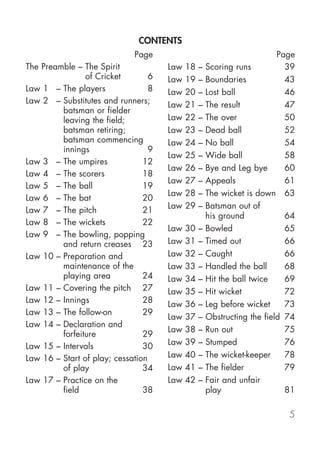
CONTENTS
                             Page                                        Page
The Preamble – The Spirit             Law   18   –   Scoring runs          39
                of Cricket        6   Law   19   –   Boundaries            43
Law 1 – The players               8   Law   20   –   Lost ball             46
Law 2 – Substitutes and runners;      Law   21   –   The result            47
         batsman or fielder
         leaving the field;           Law   22   –   The over              50
         batsman retiring;            Law   23   –   Dead ball             52
         batsman commencing           Law   24   –   No ball               54
         innings                  9
                                      Law   25   –   Wide ball             58
Law 3 – The umpires             12
                                      Law   26   –   Bye and Leg bye       60
Law 4 – The scorers             18
                                      Law   27   –   Appeals               61
Law 5 – The ball                19
                                      Law   28   –   The wicket is down 63
Law 6 – The bat                 20
                                      Law   29   –   Batsman out of
Law 7 – The pitch               21
                                                     his ground            64
Law 8 – The wickets             22
                                      Law   30   –   Bowled                65
Law 9 – The bowling, popping
         and return creases 23        Law   31   –   Timed out             66
Law 10 – Preparation and              Law   32   –   Caught                66
         maintenance of the           Law   33   –   Handled the ball      68
         playing area           24    Law   34   –   Hit the ball twice    69
Law 11 – Covering the pitch 27        Law   35   –   Hit wicket            72
Law 12 – Innings                28    Law   36   –   Leg before wicket     73
Law 13 – The follow-on          29
                                      Law   37   –   Obstructing the field 74
Law 14 – Declaration and
                                      Law   38   –   Run out               75
         forfeiture             29
Law 15 – Intervals              30    Law   39   –   Stumped               76
Law 16 – Start of play; cessation     Law   40   –   The wicket-keeper     78
         of play                34    Law   41   –   The fielder           79
Law 17 – Practice on the              Law   42   –   Fair and unfair
         field                  38                   play                  81

                                                                           5
THE LAWS OF CRICKET
               THE PREAMBLE – THE SPIRIT OF CRICKET
Cricket is a game that owes much of its unique appeal to the fact that
it should be played not only within its Laws but also within the Spirit
of the Game. Any action which is seen to abuse this spirit causes
injury to the game itself. The major responsibility for ensuring the spirit
of fair play rests with the captains.
1. There are two Laws which place the responsibility for the team's
     conduct firmly on the captain.
    Responsibility of captains
    The captains are responsible at all times for ensuring that play is
    conducted within the Spirit of the Game as well as within the
    Laws.
    Player's conduct
    In the event of a player failing to comply with instructions by an
    umpire, or criticising by word or action the decisions of an
    umpire, or showing dissent, or generally behaving in a manner
    which might bring the game into disrepute, the umpire concerned
    shall in the first place report the matter to the other umpire and to
    the player's captain, and instruct the latter to take action.
2. Fair and unfair play
   According to the Laws the umpires are the sole judges of fair and
   unfair play.
   The umpires may intervene at any time and it is the responsibility
   of the captain to take action where required.
3. The umpires are authorised to intervene in cases of:
   ■ Time wasting

   ■ Damaging the pitch

   ■ Dangerous or unfair bowling

   ■ Tampering with the ball

   ■ Any other action that they consider to be unfair

6
4. The Spirit of the Game involves RESPECT for:
   ■ Your opponents
   ■ Your own captain and team
   ■ The role of the umpires
   ■ The game's traditional values

5. It is against the Spirit of the Game:
   ■ To dispute an umpire's decision by word, action or gesture
   ■ To direct abusive language towards an opponent or umpire
   ■ To indulge in cheating or any sharp practice, for instance:
   (a) to appeal knowing that the batsman is not out
   (b) to advance towards an umpire in an aggressive manner when
        appealing
   (c) to seek to distract an opponent either verbally or by
        harassment with persistent clapping or unnecessary noise
        under the guise of enthusiasm and motivation of one's own
        side
6. Violence
   There is no place for any act of violence on the field of play.
7. Players
   Captains and umpires together set the tone for the conduct of a
   cricket match. Every player is expected to make an important
   contribution to this.


                                                                7
The players, umpires and scorers in a game of cricket may be of
either gender and the Laws apply equally to both. The use, throughout
the text, of pronouns indicating the male gender is purely for brevity.
Except where specifically stated otherwise, every provision of the
Laws is to be read as applying to women and girls equally as to men
and boys.

LAW 1 THE PLAYERS
1. Number of players
   A match is played between two sides, each of eleven players, one
   of whom shall be captain.
   By agreement a match may be played between sides of more or
   less than eleven players, but not more than eleven players may
   field at any time.
2. Nomination of players
   Each captain shall nominate his players in writing to one of the
   umpires before the toss. No player may be changed after the
   nomination without the consent of the opposing captain.
3. Captain
   If at any time the captain is not available, a deputy shall act for
   him.
   (a) If a captain is not available during the period in which the toss
        is to take place, then the deputy must be responsible for the
        nomination of the players, if this has not already been done,
        and for the toss. See 2 above and Law 12.4 (The toss).
   (b) At any time after the toss, the deputy must be one of the
        nominated players.
4. Responsibility of captains
   The captains are responsible at all times for ensuring that play is
   conducted within the spirit and traditions of the game as well as
   within the Laws. See The Preamble – The Spirit of Cricket and Law
   42.1 (Fair and unfair play – responsibility of captains).

8
LAW 2       SUBSTITUTES AND RUNNERS;
            BATSMAN OR FIELDER LEAVING THE FIELD;
            BATSMAN RETIRING;
            BATSMAN COMMENCING INNINGS
1.   Substitutes and runners
     (a) If the umpires are satisfied that a player has been injured or
         become ill after the nomination of the players, they shall allow
         that player to have
           (i) a substitute acting instead of him in the field.
          (ii) a runner when batting.
         Any injury or illness that occurs at any time after the
         nomination of the players until the conclusion of the match
         shall be allowable, irrespective of whether play is in progress
         or not.
     (b) The umpires shall have discretion, for other wholly acceptable
         reasons, to allow a substitute for a fielder, or a runner for a
         batsman, at the start of the match or at any subsequent time.
     (c) A player wishing to change his shirt, boots, etc. must leave the
         field to do so. No substitute shall be allowed for him.
2.   Objection to substitutes
     The opposing captain shall have no right of objection to any
     player acting as a substitute on the field, nor as to where the
     substitute shall field. However, no substitute shall act as wicket-
     keeper. See 3 below.
3.   Restrictions on the role of substitutes
     A substitute shall not be allowed to bat or bowl nor to act as
     wicket-keeper or as captain on the field of play.
4.   A player for whom a substitute has acted
     A player is allowed to bat, bowl or field even though a substitute
     has previously acted for him.
5.   Fielder absent or leaving the field
     If a fielder fails to take the field with his side at the start of the

                                                                         9
match or at any later time, or leaves the field during a session of
   play,
   (a) the umpire shall be informed of the reason for his absence.
   (b) he shall not thereafter come on to the field during a session of
         play without the consent of the umpire. See 6 below. The
         umpire shall give such consent as soon as is practicable.
   (c) if he is absent for 15 minutes or longer, he shall not be
         permitted to bowl thereafter, subject to (i), (ii) or (iii) below,
         until he has been on the field for at least that length of playing
         time for which he was absent.
           (i) Absence or penalty for time absent shall not be carried
               over into a new day's play.
          (ii) If, in the case of a follow-on or forfeiture, a side fields for
               two consecutive innings, this restriction shall, subject to (i)
               above, continue as necessary into the second innings but
               shall not otherwise be carried over into a new innings.
         (iii) The time lost for an unscheduled break in play shall be
               counted as time on the field for any fielder who comes on
               to the field at the resumption of play. See Law 15.1 (An
               interval).
6. Player returning without permission
   If a player comes on to the field of play in contravention of 5(b)
   above and comes into contact with the ball while it is in play
     (i) the ball shall immediately become dead and the umpire shall
         award 5 penalty runs to the batting side. See Law 42.17
         (Penalty runs). The ball shall not count as one of the over.
    (ii) the umpire shall inform the other umpire, the captain of the
         fielding side, the batsmen and, as soon as practicable, the
         captain of the batting side of the reason for this action.
   (iii) the umpires together shall report the occurrence as soon as
         possible to the Executive of the fielding side and any
         Governing Body responsible for the match, who shall take
         such action as is considered appropriate against the captain
         and player concerned.

10
7. Runner
   The player acting as a runner for a batsman shall be a member
   of the batting side and shall, if possible, have already batted in
   that innings. The runner shall wear external protective equipment
   equivalent to that worn by the batsman for whom he runs and
   shall carry a bat.
8. Transgression of the Laws by a batsman who has a runner
   (a) A batsman's runner is subject to the Laws. He will be regarded
       as a batsman except where there are specific provisions for
       his role as a runner. See 7 above and Law 29.2 (Which is a
       batsman's ground).
   (b) A batsman with a runner will suffer the penalty for any
       infringement of the Laws by his runner as though he had been
       himself responsible for the infringement. In particular he will
       be out if his runner is out under any of Laws 33 (Handled the
       ball), 37 (Obstructing the field) or 38 (Run out).
   (c) When a batsman with a runner is striker he remains himself
       subject to the Laws and will be liable to the penalties that any
       infringement of them demands.
       Additionally, if he is out of his ground when the wicket is put
       down at the wicket-keeper's end, he will be out in the
       circumstances of Law 38 (Run out) or Law 39 (Stumped)
       irrespective of the position of the non-striker or of the runner. If
       he is thus dismissed, runs completed by the runner and the
       other batsman before the dismissal shall not be scored.
       However, the penalty for a No ball or a Wide shall stand,
       together with any penalties to either side that may be awarded
       when the ball is dead. See Law 42.17 (Penalty runs).
   (d) When a batsman with a runner is not the striker
         (i) he remains subject to Laws 33 (Handled the ball) and 37
             (Obstructing the field) but is otherwise out of the game.
        (ii) he shall stand where directed by the striker's end umpire
             so as not to interfere with play.

                                                                       11
(iii) he will be liable, notwithstanding (i) above, to the penalty
              demanded by the Laws should he commit any act of unfair
              play.
9. Batsman leaving the field or retiring
     A batsman may retire at any time during his innings. The umpires,
     before allowing play to proceed, shall be informed of the reason
     for a batsman retiring.
     (a) If a batsman retires because of illness, injury or any other
         unavoidable cause, he is entitled to resume his innings subject
         to (c) below. If for any reason he does not do so, his innings
         is to be recorded as 'Retired – not out'.
     (b) If a batsman retires for any reason other than as in (a) above,
         he may only resume his innings with the consent of the
         opposing captain. If for any reason he does not resume his
         innings it is to be recorded as 'Retired – out'.
     (c) If after retiring a batsman resumes his innings, it shall be only
         at the fall of a wicket or the retirement of another batsman.
10. Commencement of a batsman's innings
     Except at the start of a side's innings, a batsman shall be
     considered to have commenced his innings when he first steps on
     to the field of play, provided Time has not been called. The
     innings of the opening batsmen, and that of any new batsman at
     the resumption of play after a call of Time, shall commence at the
     call of Play.

LAW 3     THE UMPIRES
1. Appointment and attendance
     Before the match, two umpires shall be appointed, one for each
     end, to control the game as required by the Laws, with absolute
     impartiality. The umpires shall be present on the ground and
     report to the Executive of the ground at least 45 minutes before
     the scheduled start of each day's play.

12
2. Change of umpire
   An umpire shall not be changed during the match, other than in
   exceptional circumstances, unless he is injured or ill. If there has
   to be a change of umpire, the replacement shall act only as the
   striker's end umpire unless the captains agree that he should take
   full responsibility as an umpire.
3. Agreement with captains
   Before the toss the umpires shall
   (a) ascertain the hours of play and agree with the captains
         (i) the balls to be used during the match. See Law 5 (The
             ball).
        (ii) times and durations of intervals for meals and times for
             drinks intervals. See Law 15 (Intervals).
       (iii) the boundary of the field of play and allowances for
             boundaries. See Law 19 (Boundaries).
       (iv) any special conditions of play affecting the conduct of the
             match.
   (b) inform the scorers of the agreements in (ii), (iii) and (iv) above.
4. To inform captains and scorers
   Before the toss the umpires shall agree between themselves and
   inform both captains and both scorers
     (i) which clock or watch and back-up time piece is to be used
         during the match.
    (ii) whether or not any obstacle within the field of play is to be
         regarded as a boundary. See Law 19 (Boundaries).
5. The wickets, creases and boundaries
   Before the toss and during the match, the umpires shall satisfy
   themselves that
     (i) the wickets are properly pitched. See Law 8 (The wickets).
    (ii) the creases are correctly marked. See Law 9 (The bowling,
         popping and return creases).

                                                                      13
(iii) the boundary of the field of play complies with the
           requirements of Law 19.2 (Defining the boundary – boundary
           marking).
6.   Conduct of the game, implements and equipment
     Before the toss and during the match, the umpires shall satisfy
     themselves that
     (a) the conduct of the game is strictly in accordance with the
           Laws.
     (b) the implements of the game conform to the requirements of
           Laws 5 (The ball) and 6 (The bat), together with either Laws
           8.2 (Size of stumps) and 8.3 (The bails) or, if appropriate,
           Law 8.4 (Junior cricket).
     (c) (i) no player uses equipment other than that permitted. See
                 Appendix D.
            (ii) the wicket-keeper's gloves comply with the requirements of
                 Law 40.2 (Gloves).
7.   Fair and unfair play
     The umpires shall be the sole judges of fair and unfair play.
8.   Fitness of ground, weather and light
     The umpires shall be the final judges of the fitness of the ground,
     weather and light for play. See 9 below and Law 7.2 (Fitness of
     the pitch for play).
9.   Suspension of play for adverse conditions of ground, weather or
     light
     (a) (i) All references to ground include the pitch. See Law 7.1
                 (Area of pitch).
            (ii) For the purpose of this Law and Law 15.9(b)(ii) (Intervals
                 for drinks) only, the batsmen at the wicket may deputise for
                 their captain at any appropriate time.
     (b) If at any time the umpires together agree that the condition of
           the ground, weather or light is not suitable for play, they shall
           inform the captains and, unless

14
(i) in unsuitable ground or weather conditions both captains
             agree to continue, or to commence, or to restart play,
    or (ii) in unsuitable light the batting side wishes to continue, or
             to commence, or to restart play,
    they shall suspend play, or not allow play to commence or to
    restart.
(c) (i) After agreeing to play in unsuitable ground or weather
          conditions, either captain may appeal against the
          conditions to the umpires before the next call of Time. The
          umpires shall uphold the appeal only if, in their opinion,
          the factors taken into account when making their previous
          decision are the same or the conditions have further
          deteriorated.
     (ii) After deciding to play in unsuitable light, the captain of
          the batting side may appeal against the light to the
          umpires before the next call of Time. The umpires shall
          uphold the appeal only if, in their opinion, the factors
          taken into account when making their previous decision
          are the same or the condition of the light has further
          deteriorated.
(d) If at any time the umpires together agree that the conditions of
    ground, weather or light are so bad that there is obvious and
    foreseeable risk to the safety of any player or umpire, so that
    it would be unreasonable or dangerous for play to take place,
    then notwithstanding the provisions of (b)(i) and (b)(ii) above,
    they shall immediately suspend play, or not allow play to
    commence or to restart. The decision as to whether conditions
    are so bad as to warrant such action is one for the umpires
    alone to make.
    The fact that the grass and the ball are wet and slippery does
    not warrant the ground conditions being regarded as
    unreasonable or dangerous. If the umpires consider the
    ground is so wet or slippery as to deprive the bowler of a
    reasonable foothold, the fielders of the power of free
    movement, or the batsmen of the ability to play their strokes

                                                                   15
or to run between the wickets, then these conditions shall be
         regarded as so bad that it would be unreasonable for play to
         take place.
    (e) When there is a suspension of play it is the responsibility of
         the umpires to monitor the conditions. They shall make
         inspections as often as appropriate, unaccompanied by any
         of the players or officials. Immediately the umpires together
         agree that conditions are suitable for play they shall call upon
         the players to resume the game.
    (f) If play is in progress up to the start of an agreed interval then
         it will resume after the interval unless the umpires together
         agree that conditions are or have become unsuitable or
         dangerous. If they do so agree, then they shall implement the
         procedure in (b) or (d) above, as appropriate, whether or not
         there had been any decision by the captains to continue, or
         any appeal against the conditions by either captain, prior to
         the commencement of the interval.
10. Exceptional circumstances
    The umpires shall have the discretion to implement the procedures
    of 9 above for reasons other than ground, weather or light if they
    consider that exceptional circumstances warrant it.
11. Position of umpires
    The umpires shall stand where they can best see any act upon
    which their decision may be required.
    Subject to this over-riding consideration the umpire at the bowler's
    end shall stand where he does not interfere with either the
    bowler's run up or the striker's view.
    The umpire at the striker's end may elect to stand on the off side
    instead of the on side of the pitch, provided he informs the captain
    of the fielding side, the striker and the other umpire of his intention
    to do so.
12. Umpires changing ends
    The umpires shall change ends after each side has had one
    completed innings. See Law 14.2 (Forfeiture of an innings).

16
13. Consultation between umpires
    All disputes shall be determined by the umpires. The umpires shall
    consult with each other whenever necessary. See also Law 27.6
    (Consultation by umpires).
14. Signals
    (a) The following code of signals shall be used by umpires.
          (i) Signals made while the ball is in play
              Dead ball         - by crossing and re-crossing the wrists
                                  below the waist.
              No ball           - by extending one arm horizontally.
              Out               - by raising an index finger above the
                                  head. (If not out the umpire shall call
                                  Not out.)
              Wide              - by extending both arms horizontally.
         (ii) When the ball is dead, the signals above, with the
              exception of the signal for Out, shall be repeated to the
              scorers. The signals listed below shall be made to the
              scorers only when the ball is dead.
              Boundary 4        - by waving an arm from side to side
                                  finishing with the arm across the chest.
              Boundary 6        - by raising both arms above the head.
              Bye               - by raising an open hand above the
                                  head.
              Commencement - by pointing to a raised wrist with the
              of last hour        other hand.
              Five penalty      - by repeated tapping of one shoulder
              runs awarded to with the opposite hand.
              the batting side
              Five penalty      - by placing one hand on the opposite
              runs awarded to shoulder.
              the fielding side
              Leg bye           - by touching a raised knee with the
                                  hand.

                                                                      17
New ball          - by holding the ball above the head.
            Revoke            - by touching both shoulders, each with
            last signal         the opposite hand.
            Short run         - by bending one arm upwards and
                                touching the nearer shoulder with the
                                tips of the fingers.
    (b) The umpire shall wait until each signal to the scorers has been
        separately acknowledged by a scorer before allowing play to
        proceed.
15. Correctness of scores
    Consultation between umpires and scorers on doubtful points is
    essential. The umpires shall satisfy themselves as to the correctness
    of the number of runs scored, the wickets that have fallen and,
    where appropriate, the number of overs bowled. They shall agree
    these with the scorers at least at every interval, other than a drinks
    interval, and at the conclusion of the match. See Laws 4.2
    (Correctness of scores), 21.8 (Correctness of result) and 21.10
    (Result not to be changed).

LAW 4 THE SCORERS
1. Appointment of scorers
   Two scorers shall be appointed to record all runs scored, all
   wickets taken and, where appropriate, number of overs bowled.
2. Correctness of scores
   The scorers shall frequently check to ensure that their records
   agree. They shall agree with the umpires, at least at every interval,
   other than a drinks interval, and at the conclusion of the match, the
   runs scored, the wickets that have fallen and, where appropriate,
   the number of overs bowled. See Law 3.15 (Correctness of scores).
3. Acknowledging signals
   The scorers shall accept all instructions and signals given to them
   by the umpires. They shall immediately acknowledge each
   separate signal.

18
LAW 5 THE BALL
1. Weight and size
   The ball, when new, shall weigh not less than 51⁄2 ounces/155.9g,
   nor more than 53⁄4 ounces/163g, and shall measure not less than
   813⁄16 in/22.4cm, nor more than 9 in/22.9cm in circumference.
2. Approval and control of balls
   (a) All balls to be used in the match, having been approved by
       the umpires and captains, shall be in the possession of the
       umpires before the toss and shall remain under their control
       throughout the match.
   (b) The umpire shall take possession of the ball in use at the fall
       of each wicket, at the start of any interval and at any
       interruption of play.
3. New ball
   Unless an agreement to the contrary has been made before the
   match, either captain may demand a new ball at the start of each
   innings.
4. New ball in match of more than one day's duration
   In a match of more than one day's duration, the captain of the
   fielding side may demand a new ball after the prescribed number
   of overs has been bowled with the old one. The Governing Body
   for cricket in the country concerned shall decide the number of
   overs applicable in that country, which shall not be less than 75
   overs.
   The umpires shall indicate to the batsmen and the scorers
   whenever a new ball is taken into play.
5. Ball lost or becoming unfit for play
   If, during play, the ball cannot be found or recovered or the
   umpires agree that it has become unfit for play through normal
   use, the umpires shall replace it with a ball which has had wear
   comparable with that which the previous ball had received before

                                                                   19
the need for its replacement. When the ball is replaced the
   umpires shall inform the batsmen and the fielding captain.
6. Specifications
   The specifications as described in 1 above shall apply to men's
   cricket only. The following specifications will apply to
     (i) Women's cricket
         Weight:          from 415⁄16 ounces/140g to 55⁄16 ounces /151g
         Circumference: from 81⁄4 in/21.0cm to 87⁄8 in/22.5cm
    (ii) Junior cricket – under 13
         Weight:          from 411⁄16 ounces/133g to 51⁄16 ounces/144g
         Circumference: from 81⁄16 in/20.5cm to 811⁄16 in/22.0cm

LAW 6 THE BAT
1. Width and length
   The bat overall shall not be more than 38 inches/96.5cm in
   length. The blade of the bat shall be made solely of wood and
   shall not exceed 41⁄4 in/10.8cm at the widest part.
2. Covering the blade
   The blade may be covered with material for protection,
   strengthening or repair. Such material shall not exceed
   1
    ⁄16 in/1.56mm in thickness, and shall not be likely to cause
   unacceptable damage to the ball.
3. Hand or glove to count as part of bat
   In these Laws,
   (a) reference to the bat shall imply that the bat is held by the
         batsman.
   (b) contact between the ball and
         either (i) the striker's bat itself
         or    (ii) the striker's hand holding the bat
         or (iii) any part of a glove worn on the striker's hand
                    holding the bat

20
shall be regarded as the ball striking or touching the bat, or
       being struck by the bat.

LAW 7 THE PITCH
1. Area of pitch
   The pitch is a rectangular area of the ground 22 yards/20.12m
   in length and 10ft/3.05m in width. It is bounded at either end
   by the bowling creases and on either side by imaginary lines,
   one each side of the imaginary line joining the centres of the
   two middle stumps, each parallel to it and 5ft/1.52m from it.
   See Laws 8.1 (Width and pitching) and 9.2 (The bowling
   crease).
2. Fitness of the pitch for play
   The umpires shall be the final judges of the fitness of the pitch for
   play. See Laws 3.8 (Fitness of ground, weather and light) and 3.9
   (Suspension of play for adverse conditions of ground, weather or
   light).
3. Selection and preparation
   Before the match, the Ground Authority shall be responsible for
   the selection and preparation of the pitch. During the match, the
   umpires shall control its use and maintenance.
4. Changing the pitch
   The pitch shall not be changed during the match unless the
   umpires decide that it is unreasonable or dangerous for play to
   continue on it and then only with the consent of both captains.
5. Non-turf pitches
   In the event of a non-turf pitch being used, the artificial surface
   shall conform to the following measurements:
   Length – a minimum of 58ft/17.68m
   Width – a minimum of 6ft/1.83m
   See Law 10.8 (Non-turf pitches).

                                                                     21
LAW 8     THE WICKETS
1. Width and pitching
   Two sets of wickets shall be pitched opposite and parallel to each
   other at a distance of 22 yards/20.12m between the centres of
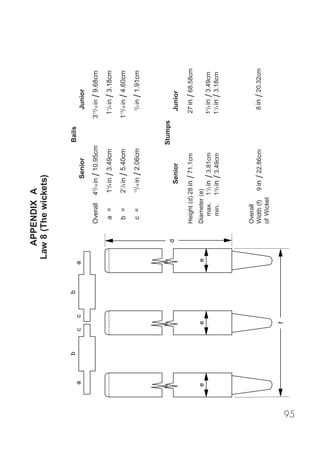
   the two middle stumps. Each set shall be 9 in/22.86cm wide and
   shall consist of three wooden stumps with two wooden bails on
   top. See Appendix A.
2. Size of stumps
   The tops of the stumps shall be 28 in/71.1cm above the playing
   surface and shall be dome shaped except for the bail grooves.
   The portion of a stump above the playing surface shall be
   cylindrical, apart from the domed top, with circular section of
   diameter not less than 13⁄8 in/3.49cm nor more than
   11⁄2 in/3.81cm. See Appendix A.
3. The bails
   (a) The bails, when in position on the top of the stumps,
         (i) shall not project more than 1⁄2 in/1.27cm above them.
        (ii) shall fit between the stumps without forcing them out of the
             vertical.
     (b) Each bail shall conform to the following specifications. See
         Appendix A.
         Overall length:-           45⁄16 in/10.95cm
         Length of barrel:-         21⁄8 in/5.40cm
         Longer spigot:-            13⁄8 in/3.49cm
         Shorter spigot:-           13
                                      ⁄16 in/2.06cm
4. Junior cricket
   In junior cricket, the same definitions of the wickets shall apply
   subject to the following measurements being used.
   Width:-                          8 in/20.32cm
   Pitched for under 13:-           21 yards/19.20m
   Pitched for under 11:-           20 yards/18.29m
   Pitched for under 9:-            18 yards/16.46m
   Height above playing surface:- 27 in/68.58cm

22
Each stump
   Diameter:-                       not less than 11⁄4 in/3.18cm
                                    nor more than 13⁄8 in/3.49cm
   Each bail
   Overall:-                        313⁄16 in/9.68cm
   Barrel:-                         113⁄16 in/4.60cm
   Longer Spigot:-                  11⁄4 in/3.18cm
   Shorter Spigot:-                 3
                                     ⁄4 in/1.91cm
5. Dispensing with bails
   The umpires may agree to dispense with the use of bails, if
   necessary. If they so agree then no bails shall be used at either
   end. The use of bails shall be resumed as soon as conditions
   permit. See Law 28.4 (Dispensing with bails).


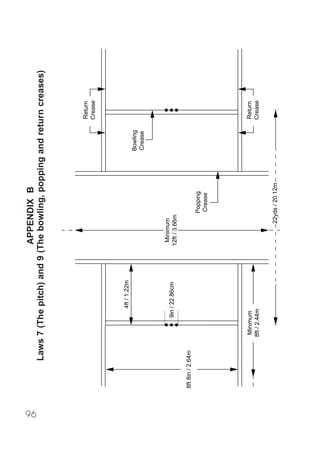
LAW 9    THE BOWLING, POPPING AND RETURN CREASES
1. The creases
   A bowling crease, a popping crease and two return creases shall
   be marked in white, as set out in 2, 3 and 4 below, at each end
   of the pitch. See Appendix B.
2. The bowling crease
   The bowling crease, which is the back edge of the crease
   marking, shall be the line through the centres of the three stumps
   at that end. It shall be 8ft 8 in/2.64m in length, with the stumps
   in the centre.
3. The popping crease
   The popping crease, which is the back edge of the crease
   marking, shall be in front of and parallel to the bowling crease
   and shall be 4ft/1.22m from it. The popping crease shall be
   marked to a minimum of 6ft/1.83m on either side of the
   imaginary line joining the centres of the middle stumps and shall
   be considered to be unlimited in length.

                                                                   23
4. The return creases
   The return creases, which are the inside edges of the crease
   markings, shall be at right angles to the popping crease at a
   distance of 4ft 4 in/1.32m either side of the imaginary line
   joining the centres of the two middle stumps. Each return crease
   shall be marked from the popping crease to a minimum of
   8ft/2.44m behind it and shall be considered to be unlimited in
   length.

LAW 10 PREPARATION AND MAINTENANCE OF THE PLAYING AREA
1. Rolling
   The pitch shall not be rolled during the match except as permitted
   in (a) and (b) below.
   (a) Frequency and duration of rolling
       During the match the pitch may be rolled at the request of the
       captain of the batting side, for a period of not more than 7
       minutes, before the start of each innings, other than the first
       innings of the match, and before the start of each subsequent
       day's play. See (d) below.
   (b) Rolling after a delayed start
       In addition to the rolling permitted above, if, after the toss and
       before the first innings of the match, the start is delayed, the
       captain of the batting side may request to have the pitch rolled
       for not more than 7 minutes. However, if the umpires together
       agree that the delay has had no significant effect on the state
       of the pitch, they shall refuse the request for the rolling of the
       pitch.
   (c) Choice of rollers
       If there is more than one roller available the captain of the
       batting side shall have the choice.
   (d) Timing of permitted rolling
       The rolling permitted (maximum 7 minutes) before play begins
       on any day shall be started not more than 30 minutes before
       the time scheduled or rescheduled for play to begin. The

24
captain of the batting side may, however, delay the start of
       such rolling until not less than 10 minutes before the time
       scheduled or rescheduled for play to begin, should he so
       desire.
   (e) Insufficient time to complete rolling
       If a captain declares an innings closed, or forfeits an innings,
       or enforces the follow-on, and the other captain is prevented
       thereby from exercising his option of the rolling permitted
       (maximum 7 minutes), or if he is so prevented for any other
       reason, the extra time required to complete the rolling shall be
       taken out of the normal playing time.
2. Sweeping
   (a) If rolling is to take place the pitch shall first be swept to avoid
       any possible damage by rolling in debris. This sweeping shall
       be done so that the 7 minutes allowed for rolling is not
       affected.
   (b) The pitch shall be cleared of any debris at all intervals for
       meals, between innings and at the beginning of each day, not
       earlier than 30 minutes nor later than 10 minutes before the
       time scheduled or rescheduled for play to begin. See Law
       15.1 (An interval).
   (c) Notwithstanding the provisions of (a) and (b) above, the
       umpires shall not allow sweeping to take place where they
       consider it may be detrimental to the surface of the pitch.
3. Mowing
   (a) The pitch
       The pitch shall be mown on each day of the match on which
       play is expected to take place, if ground and weather
       conditions allow.
   (b) The outfield
       In order to ensure that conditions are as similar as possible for
       both sides, the outfield shall be mown on each day of the
       match on which play is expected to take place, if ground and
       weather conditions allow.

                                                                      25
If, for reasons other than ground and weather conditions,
           complete mowing of the outfield is not possible, the Ground
           Authority shall notify the captains and umpires of the
           procedure to be adopted for such mowing during the match.
     (c) Responsibility for mowing
           All mowings which are carried out before the match shall be
           the responsibility of the Ground Authority.
           All subsequent mowings shall be carried out under the
           supervision of the umpires.
     (d) Timing of mowing
             (i) Mowing of the pitch on any day of the match shall be
                 completed not later than 30 minutes before the time
                 scheduled or rescheduled for play to begin on that day.
            (ii) Mowing of the outfield on any day of the match shall be
                 completed not later than 15 minutes before the time
                 scheduled or rescheduled for play to begin on that day.
4.   Watering
     The pitch shall not be watered during the match.
5.   Re-marking creases
     The creases shall be re-marked whenever either umpire considers
     it necessary.
6.   Maintenance of footholes
     The umpires shall ensure that the holes made by the bowlers and
     batsmen are cleaned out and dried whenever necessary to
     facilitate play. In matches of more than one day's duration, the
     umpires shall allow, if necessary, the re-turfing of footholes made
     by the bowler in his delivery stride, or the use of quick-setting
     fillings for the same purpose.
7.   Securing of footholds and maintenance of pitch
     During play, the umpires shall allow the players to secure their
     footholds by the use of sawdust provided that no damage to the
     pitch is caused and that Law 42 (Fair and unfair play) is not
     contravened.

26
8. Non-turf pitches
   Wherever appropriate, the provisions set out in 1 to 7 above shall
   apply.

LAW 11 COVERING THE PITCH
1. Before the match
   The use of covers before the match is the responsibility of the
   Ground Authority and may include full covering if required.
   However, the Ground Authority shall grant suitable facility to the
   captains to inspect the pitch before the nomination of their players
   and to the umpires to discharge their duties as laid down in Laws
   3 (The umpires), 7 (The pitch), 8 (The wickets), 9 (The bowling,
   popping and return creases) and 10 (Preparation and
   maintenance of the playing area).
2. During the match
   The pitch shall not be completely covered during the match unless
   provided otherwise by regulations or by agreement before the
   toss.
3. Covering bowlers' run ups
   Whenever possible, the bowlers' run ups shall be covered in
   inclement weather, in order to keep them dry. Unless there is
   agreement for full covering under 2 above the covers so used shall
   not extend further than 5ft/1.52m in front of each popping
   crease.
4. Removal of covers
   (a) If after the toss the pitch is covered overnight, the covers shall
       be removed in the morning at the earliest possible moment on
       each day that play is expected to take place.
   (b) If covers are used during the day as protection from inclement
       weather, or if inclement weather delays the removal of
       overnight covers, they shall be removed promptly as soon as
       conditions allow.

                                                                     27
LAW 12 INNINGS
1. Number of innings
   (a) A match shall be one or two innings of each side according
       to agreement reached before the match.
   (b) It may be agreed to limit any innings to a number of overs or
       by a period of time. If such an agreement is made then
         (i) in a one innings match it shall apply to both innings.
        (ii) in a two innings match it shall apply to
             either the first innings of each side
             or     the second innings of each side
             or     both innings of each side.
2. Alternate innings
   In a two innings match each side shall take their innings
   alternately except in the cases provided for in Law 13 (The follow-
   on) or Law 14.2 (Forfeiture of an innings).
3. Completed innings
   A side's innings is to be considered as completed if
       (a) the side is all out
   or (b) at the fall of a wicket, further balls remain to be bowled,
             but no further batsman is available to come in
   or (c) the captain declares the innings closed
   or (d) the captain forfeits the innings
   or (e) in the case of an agreement under 1(b) above,
             either (i) the prescribed number of overs has been bowled
             or    (ii) the prescribed time has expired.
4. The toss
   The captains shall toss for the choice of innings on the field of play
   not earlier than 30 minutes, nor later than 15 minutes, before the
   scheduled or any rescheduled time for the match to start. Note,
   however, the provisions of Law 1.3 (Captain).
5. Decision to be notified
   The captain of the side winning the toss shall notify the opposing

28
captain of his decision to bat or to field, not later than 10 minutes
   before the scheduled or any rescheduled time for the match to
   start. Once notified the decision may not be altered.

LAW 13 THE FOLLOW-ON
1. Lead on first innings
   (a) In a two innings match of 5 days or more, the side which bats
        first and leads by at least 200 runs shall have the option of
        requiring the other side to follow their innings.
   (b) The same option shall be available in two innings matches of
        shorter duration with the minimum required leads as follows:
          (i) 150 runs in a match of 3 or 4 days;
         (ii) 100 runs in a 2-day match;
        (iii) 75 runs in a 1-day match.
2. Notification
   A captain shall notify the opposing captain and the umpires of his
   intention to take up this option. Law 10.1(e) (Insufficient time to
   complete rolling) shall apply.
3. First day's play lost
   If no play takes place on the first day of a match of more than one
   day's duration, 1 above shall apply in accordance with the
   number of days remaining from the actual start of the match. The
   day on which play first commences shall count as a whole day for
   this purpose, irrespective of the time at which play starts.
   Play will have taken place as soon as, after the call of Play, the
   first over has started. See Law 22.2 (Start of an over).

LAW 14 DECLARATION AND FORFEITURE
1. Time of declaration
   The captain of the batting side may declare an innings closed,
   when the ball is dead, at any time during a match.

                                                                    29
2. Forfeiture of an innings
   A captain may forfeit either of his side's innings. A forfeited
   innings shall be considered as a completed innings.
3. Notification
   A captain shall notify the opposing captain and the umpires of his
   decision to declare or to forfeit an innings. Law 10.1(e)
   (Insufficient time to complete rolling) shall apply.

LAW 15 INTERVALS
1. An interval
   The following shall be classed as intervals.
     (i) The period between close of play on one day and the start of
         the next day's play.
    (ii) Intervals between innings.
   (iii) Intervals for meals.
   (iv) Intervals for drinks.
    (v) Any other agreed interval.
   All these intervals shall be considered as scheduled breaks for the
   purposes of Law 2.5 (Fielder absent or leaving the field).
2. Agreement of intervals
   (a) Before the toss:
           (i) the hours of play shall be established;
          (ii) except as in (b) below, the timing and duration of intervals
               for meals shall be agreed;
         (iii) the timing and duration of any other interval under 1(v)
               above shall be agreed.
   (b) In a one-day match no specific time need be agreed for the
         tea interval. It may be agreed instead to take this interval
         between the innings.
   (c) Intervals for drinks may not be taken during the last hour of

30
the match, as defined in Law 16.6 (Last hour of match –
        number of overs). Subject to this limitation the captains and
        umpires shall agree the times for such intervals, if any, before
        the toss and on each subsequent day not later than 10 minutes
        before play is scheduled to start. See also Law 3.3
        (Agreement with captains).
3. Duration of intervals
   (a) An interval for lunch or for tea shall be of the duration agreed
        under 2(a) above, taken from the call of Time before the
        interval until the call of Play on resumption after the interval.
   (b) An interval between innings shall be 10 minutes from the
        close of an innings to the call of Play for the start of the next
        innings, except as in 4, 6 and 7 below.
4. No allowance for interval between innings
   In addition to the provisions of 6 and 7 below,
   (a) if an innings ends when 10 minutes or less remain before the
        time agreed for close of play on any day, there will be no
        further play on that day. No change will be made to the time
        for the start of play on the following day on account of the 10
        minutes between innings.
   (b) if a captain declares an innings closed during an interruption
        in play of more than 10 minutes duration, no adjustment shall
        be made to the time for resumption of play on account of the
        10 minutes between innings, which shall be considered as
        included in the interruption. Law 10.1(e) (Insufficient time to
        complete rolling) shall apply.
   (c) if a captain declares an innings closed during any interval
        other than an interval for drinks, the interval shall be of the
        agreed duration and shall be considered to include the 10
        minutes between innings. Law 10.1(e) (Insufficient time to
        complete rolling) shall apply.
5. Changing agreed times for intervals
   If for adverse conditions of ground, weather or light, or for any

                                                                     31
other reason, playing time is lost, the umpires and captains
   together may alter the time of the lunch interval or of the tea
   interval. See also 6, 7 and 9(c) below.
6. Changing agreed time for lunch interval
   (a) If an innings ends when 10 minutes or less remain before the
       agreed time for lunch, the interval shall be taken immediately.
       It shall be of the agreed length and shall be considered to
       include the 10 minutes between innings.
   (b) If, because of adverse conditions of ground, weather or light,
       or in exceptional circumstances, a stoppage occurs when 10
       minutes or less remain before the agreed time for lunch then,
       notwithstanding 5 above, the interval shall be taken
       immediately. It shall be of the agreed length. Play shall resume
       at the end of this interval or as soon after as conditions permit.
   (c) If the players have occasion to leave the field for any reason
       when more than 10 minutes remain before the agreed time for
       lunch then, unless the umpires and captains together agree to
       alter it, lunch will be taken at the agreed time.
7. Changing agreed time for tea interval
   (a) (i) If an innings ends when 30 minutes or less remain before
             the agreed time for tea, then the interval shall be taken
             immediately. It shall be of the agreed length and shall be
             considered to include the 10 minutes between innings.
        (ii) If, when 30 minutes remain before the agreed time for tea,
             an interval between innings is already in progress, play
             will resume at the end of the 10 minute interval.
   (b) (i) If, because of adverse conditions of ground, weather or
             light, or in exceptional circumstances, a stoppage occurs
             when 30 minutes or less remain before the agreed time for
             tea, then unless
             either there is an agreement to change the time for tea,
                     as permitted in 5 above
             or      the captains agree to forgo the tea interval, as
                     permitted in 10 below

32
the interval shall be taken immediately. The interval shall
             be of the agreed length. Play shall resume at the end of
             this interval or as soon after as conditions permit.
        (ii) If a stoppage is already in progress when 30 minutes
             remain before the time agreed for tea, 5 above will apply.
8. Tea interval – 9 wickets down
   If either 9 wickets are already down when 2 minutes remain to
                  the agreed time for tea
       or         the 9th wicket falls within these 2 minutes or at any
                  later time up to and including the final ball of the over
                  in progress at the agreed time for tea
   then notwithstanding the provisions of Law 16.5(b) (Completion of
   an over) tea will not be taken until the end of the over in progress
   30 minutes after the originally agreed time for tea, unless the
   players have cause to leave the field of play or the innings is
   completed earlier.
9. Intervals for drinks
   (a) If on any day the captains agree that there shall be intervals
       for drinks, the option to take such intervals shall be available
       to either side. Each interval shall be kept as short as possible
       and in any case shall not exceed 5 minutes.
   (b) (i) Unless both captains agree to forgo any drinks interval, it
             shall be taken at the end of the over in progress when the
             agreed time is reached. If, however, a wicket falls within
             5 minutes of the agreed time then drinks shall be taken
             immediately. No other variation in the timing of drinks
             intervals shall be permitted except as provided for in (c)
             below.
        (ii) For the purpose of (i) above and Law 3.9(a)(ii)
             (Suspension of play for adverse conditions of ground,
             weather or light) only, the batsmen at the wicket may
             deputise for their captain.
   (c) If an innings ends or the players have to leave the field of play

                                                                       33
for any other reason within 30 minutes of the agreed time for
        a drinks interval, the umpires and captains together may
        rearrange the timing of drinks intervals in that session.
10. Agreement to forgo intervals
    At any time during the match, the captains may agree to forgo the
    tea interval or any of the drinks intervals. The umpires shall be
    informed of the decision.
11. Scorers to be informed
    The umpires shall ensure that the scorers are informed of all
    agreements about hours of play and intervals, and of any
    changes made thereto as permitted under this Law.

LAW 16 START OF PLAY; CESSATION OF PLAY
1. Call of Play
   The umpire at the bowler's end shall call Play at the start of the
   match and on the resumption of play after any interval or
   interruption.
2. Call of Time
   The umpire at the bowler's end shall call Time on the cessation of
   play before any interval or interruption of play and at the
   conclusion of the match. See Law 27 (Appeals).
3. Removal of bails
   After the call of Time, the bails shall be removed from both
   wickets.
4. Starting a new over
   Another over shall always be started at any time during the
   match, unless an interval is to be taken in the circumstances set
   out in 5 below, if the umpire, after walking at his normal pace,
   has arrived at his position behind the stumps at the bowler's end
   before the time agreed for the next interval, or for the close of
   play, has been reached.

34
5. Completion of an over
   Other than at the end of the match,
   (a) if the agreed time for an interval is reached during an over,
        the over shall be completed before the interval is taken except
        as provided for in (b) below.
   (b) when less than 2 minutes remain before the time agreed for
        the next interval, the interval will be taken immediately if
        either (i) a batsman is out or retires
        or      (ii) the players have occasion to leave the field
        whether this occurs during an over or at the end of an over.
        Except at the end of an innings, if an over is thus interrupted
        it shall be completed on resumption of play.
6. Last hour of match – number of overs
   When one hour of playing time of the match remains, according
   to the agreed hours of play, the over in progress shall be
   completed. The next over shall be the first of a minimum of 20
   overs which must be bowled, provided that a result is not reached
   earlier and provided that there is no interval or interruption in
   play.
   The umpire at the bowler's end shall indicate the commencement
   of this 20 overs to the players and the scorers. The period of play
   thereafter shall be referred to as the last hour, whatever its actual
   duration.
7. Last hour of match – interruptions of play
   If there is an interruption in play during the last hour of the match,
   the minimum number of overs to be bowled shall be reduced from
   20 as follows.
   (a) The time lost for an interruption is counted from the call of Time
        until the time for resumption of play as decided by the
        umpires.
   (b) One over shall be deducted for every complete 3 minutes of
        time lost.

                                                                     35
(c) In the case of more than one such interruption, the minutes lost
        shall not be aggregated; the calculation shall be made for
        each interruption separately.
   (d) If, when one hour of playing time remains, an interruption is
        already in progress,
          (i) only the time lost after this moment shall be counted in the
              calculation;
         (ii) the over in progress at the start of the interruption shall be
              completed on resumption of play and shall not count as
              one of the minimum number of overs to be bowled.
   (e) If, after the start of the last hour, an interruption occurs during
        an over, the over shall be completed on resumption of play.
        The two part-overs shall between them count as one over of
        the minimum number to be bowled.
8. Last hour of match – intervals between innings
   If an innings ends so that a new innings is to be started during the
   last hour of the match, the interval starts with the end of the
   innings and is to end 10 minutes later.
   (a) If this interval is already in progress at the start of the last hour,
        then to determine the number of overs to be bowled in the new
        innings, calculations are to be made as set out in 7 above.
   (b) If the innings ends after the last hour has started, two
        calculations are to be made, as set out in (c) and (d) below.
        The greater of the numbers yielded by these two calculations
        is to be the minimum number of overs to be bowled in the new
        innings.
   (c) Calculation based on overs remaining.
          (i) At the conclusion of the innings, the number of overs that
              remain to be bowled, of the minimum in the last hour, to
              be noted.
         (ii) If this is not a whole number it is to be rounded up to the
              next whole number.
       (iii) Three overs to be deducted from the result for the interval.

36
(d) Calculation based on time remaining.
           (i) At the conclusion of the innings, the time remaining until
               the agreed time for close of play to be noted.
          (ii) Ten minutes to be deducted from this time, for the interval,
               to determine the playing time remaining.
         (iii) A calculation to be made of one over for every complete
               3 minutes of the playing time remaining, plus one more
               over for any further part of 3 minutes remaining.
9. Conclusion of match
    The match is concluded
    (a) as soon as a result, as defined in sections 1, 2, 3 or 4 of Law
         21 (The result), is reached.
    (b) as soon as both
                  (i) the minimum number of overs for the last hour are
                      completed
         and (ii) the agreed time for close of play is reached
         unless a result has been reached earlier.
    (c) if, without the match being concluded either as in (a) or in (b)
         above, the players leave the field, either for adverse
         conditions of ground, weather or light, or in exceptional
         circumstances, and no further play is possible thereafter.
10. Completion of last over of match
    The over in progress at the close of play on the final day shall be
    completed unless
    either (i) a result has been reached
    or      (ii) the players have occasion to leave the field. In this case
                 there shall be no resumption of play, except in the
                 circumstances of Law 21.9 (Mistakes in scoring), and the
                 match shall be at an end.
11. Bowler unable to complete an over during last hour of match
    If, for any reason, a bowler is unable to complete an over during
    the last hour, Law 22.8 (Bowler incapacitated or suspended
    during an over) shall apply.

                                                                       37
LAW 17 PRACTICE ON THE FIELD
1. Practice on the field
   (a) There shall be no bowling or batting practice on the pitch, or
       on the area parallel and immediately adjacent to the pitch, at
       any time on any day of the match.
   (b) There shall be no bowling or batting practice on any other
       part of the square on any day of the match, except before the
       start of play or after the close of play on that day. Practice
       before the start of play
         (i) must not continue later than 30 minutes before the
             scheduled time or any rescheduled time for play to start on
             that day.
        (ii) shall not be allowed if the umpires consider that, in the
             prevailing conditions of ground and weather, it will be
             detrimental to the surface of the square.
   (c) There shall be no practice on the field of play between the call
       of Play and the call of Time, if the umpire considers that it
       could result in a waste of time. See Law 42.9 (Time wasting
       by the fielding side).
   (d) If a player contravenes (a) or (b) above he shall not be
       allowed to bowl until
       either       at least one hour later than the contravention
       or           there has been at least 30 minutes of playing time
                    since the contravention
       whichever is sooner. If an over is in progress at the
       contravention, he shall not be allowed to complete that
       over.
2. Trial run up
   No bowler shall have a trial run up between the call of Play and
   the call of Time unless the umpire is satisfied that it will not cause
   any waste of time.


38
LAW 18 SCORING RUNS
1. A run
   The score shall be reckoned by runs. A run is scored
   (a) so often as the batsmen, at any time while the ball is in play,
       have crossed and made good their ground from end to end.
   (b) when a boundary is scored. See Law 19 (Boundaries).
   (c) when penalty runs are awarded. See 6 below.
   (d) when Lost ball is called. See Law 20 (Lost ball).
2. Runs disallowed
   Notwithstanding 1 above, or any other provisions elsewhere in
   the Laws, the scoring of runs or awarding of penalties will be
   subject to any disallowance of runs provided for within the Laws
   that may be applicable.
3. Short runs
   (a) A run is short if a batsman fails to make good his ground on
       turning for a further run.
   (b) Although a short run shortens the succeeding one, the latter if
       completed shall not be regarded as short. A striker taking
       stance in front of his popping crease may run from that point
       also without penalty.
4. Unintentional short runs
   Except in the circumstances of 5 below,
   (a) if either batsman runs a short run, unless a boundary is scored
       the umpire concerned shall call and signal Short run as soon
       as the ball becomes dead and that run shall not be scored.
   (b) if, after either or both batsmen run short, a boundary is
       scored, the umpire concerned shall disregard the short
       running and shall not call or signal Short run.
   (c) if both batsmen run short in one and the same run, this shall
       be regarded as only one short run.
   (d) if more than one run is short then, subject to (b) and (c) above,

                                                                     39
all runs so called shall not be scored.
       If there has been more than one short run the umpire shall
       inform the scorers as to the number of runs scored.
5. Deliberate short runs
   (a) Notwithstanding 4 above, if either umpire considers that
       either or both batsmen deliberately run short at his end, the
       following procedure shall be adopted.
         (i) The umpire concerned shall, when the ball is dead, warn
             the batsmen that the practice is unfair, indicate that this is
             a first and final warning and inform the other umpire of
             what has occurred. This warning shall continue to apply
             throughout the innings. The umpire shall so inform each
             incoming batsman.
        (ii) The batsmen shall return to their original ends.
       (iii) Whether a batsman is dismissed or not, the umpire at the
             bowler's end shall disallow all runs to the batting side
             from that delivery other than the penalty for a No ball or
             Wide, or penalties under Laws 42.5 (Deliberate
             distraction or obstruction of batsman) and 42.13 (Fielders
             damaging the pitch), if applicable.
       (iv) The umpire at the bowler's end shall inform the scorers as
             to the number of runs scored.
   (b) If there is any further instance of deliberate short running by
       any batsman in that innings, when the ball is dead the umpire
       concerned shall inform the other umpire of what has occurred
       and the procedure set out in (a)(ii) and (iii) above shall be
       repeated. Additionally, the umpire at the bowler's end shall
         (i) award 5 penalty runs to the fielding side. See Law 42.17
             (Penalty runs).
        (ii) inform the scorers as to the number of runs scored.
       (iii) inform the batsmen, the captain of the fielding side and,
             as soon as practicable, the captain of the batting side of
             the reason for this action.

40
(iv) report the occurrence, with the other umpire, to the
              Executive of the batting side and any Governing Body
              responsible for the match, who shall take such action as is
              considered appropriate against the captain and player or
              players concerned.
6. Runs scored for penalties
    Runs shall be scored for penalties under 5 above and Laws 2.6
    (Player returning without permission), 24 (No ball), 25 (Wide
    ball), 41.2 (Fielding the ball), 41.3 (Protective helmets belonging
    to the fielding side) and 42 (Fair and unfair play).
7. Runs scored for boundaries
    Runs shall be scored for boundary allowances under Law 19
    (Boundaries).
8. Runs scored for Lost ball
    Runs shall be scored when Lost ball is called under Law 20 (Lost
    ball).
9. Batsman dismissed
    When either batsman is dismissed
    (a) any penalties to either side that may be applicable shall stand
         but no other runs shall be scored, except as stated in 10
         below.
    (b) 12(a) below will apply if the method of dismissal is Caught,
         Handled the ball or Obstructing the field. 12(a) will also apply
         if a batsman is Run out, except in the circumstances of Law
         2.8 (Transgression of the Laws by a batsman who has a
         runner) where 12(b) below will apply.
    (c) the not out batsman shall return to his original end except as
         stated in (b) above.
10. Runs scored when a batsman is dismissed
    In addition to any penalties to either side that may be applicable,
    if a batsman is
    (a) dismissed Handled the ball, the batting side shall score the
         runs completed before the offence.

                                                                     41
(b) dismissed Obstructing the field, the batting side shall score the
        runs completed before the offence.
        If, however, the obstruction prevents a catch from being
        made, no runs other than penalties shall be scored.
    (c) dismissed Run out, the batting side shall score the runs
        completed before the dismissal.
        If, however, a striker with a runner is himself dismissed Run
        out, no runs other than penalties shall be scored. See Law 2.8
        (Transgression of the Laws by a batsman who has a runner).
11. Runs scored when ball becomes dead
    (a) When the ball becomes dead on the fall of a wicket, runs shall
        be scored as laid down in 9 and 10 above.
    (b) When the ball becomes dead for any reason other than the
        fall of a wicket, or is called dead by an umpire, unless there
        is specific provision otherwise in the Laws, the batting side
        shall be credited with
                (i) all runs completed by the batsmen before the incident
                    or call
        and (ii) the run in progress if the batsmen have crossed at the
                    instant of the incident or call. Note specifically,
                    however, the provisions of Laws 34.4(c) (Runs
                    permitted from ball lawfully struck more than once)
                    and 42.5(b)(iv) (Deliberate distraction or obstruction
                    of batsman).
        and (iii) any penalties that are applicable.
12. Batsman returning to wicket he has left
    (a) If, while the ball is in play, the batsmen have crossed in
        running, neither shall return to the wicket he has left, except
        as in (b) below.
    (b) The batsmen shall return to the wickets they originally left in
        the cases of, and only in the cases of
          (i) a boundary;

42
(ii) disallowance of runs for any reason;
       (iii) the dismissal of a batsman, except as in 9(b) above.

LAW 19 BOUNDARIES
1. The boundary of the field of play
   (a) Before the toss, the umpires shall agree the boundary of the
       field of play with both captains. The boundary shall if possible
       be marked along its whole length.
   (b) The boundary shall be agreed so that no part of any sight-
       screen is within the field of play.
   (c) An obstacle or person within the field of play shall not be
       regarded as a boundary unless so decided by the umpires
       before the toss. See Law 3.4(ii) (To inform captains and
       scorers).
2. Defining the boundary – boundary marking
   (a) Wherever practicable the boundary shall be marked by
       means of a white line or a rope laid along the ground.
   (b) If the boundary is marked by a white line,
         (i) the inside edge of the line shall be the boundary edge.
        (ii) a flag, post or board used merely to highlight the position
             of a line marked on the ground must be placed outside the
             boundary edge and is not itself to be regarded as
             defining or marking the boundary. Note, however, the
             provisions of (c) below.
   (c) If a solid object is used to mark the boundary, it must have an
       edge or a line to constitute the boundary edge.
         (i) For a rope, which includes any similar object of curved
             cross section lying on the ground, the boundary edge will
             be the line formed by the innermost points of the rope
             along its length.
        (ii) For a fence, which includes any similar object in contact

                                                                    43
with the ground, but with a flat surface projecting above
             the ground, the boundary edge will be the base line of the
             fence.
     (d) If the boundary edge is not defined as in (b) or (c) above, the
         umpires and captains must agree, before the toss, what line
         will be the boundary edge. Where there is no physical marker
         for a section of boundary, the boundary edge shall be the
         imaginary straight line joining the two nearest marked points
         of the boundary edge.
     (e) If a solid object used to mark the boundary is disturbed for
         any reason during play, then if possible it shall be restored to
         its original position as soon as the ball is dead. If this is not
         possible, then
          (i) if some part of the fence or other marker has come within
              the field of play, that portion is to be removed from the
              field of play as soon as the ball is dead.
       (ii) the line where the base of the fence or marker originally
            stood shall define the boundary edge.
3. Scoring a boundary
   (a) A boundary shall be scored and signalled by the umpire at the
       bowler's end whenever, while the ball is in play, in his opinion
        (i) the ball touches the boundary, or is grounded beyond the
            boundary.
       (ii) a fielder, with some part of his person in contact with the
            ball, touches the boundary or has some part of his person
            grounded beyond the boundary.
   (b) The phrases 'touches the boundary' and 'touching the
       boundary' shall mean contact with
       either (i) the boundary edge as defined in 2 above
       or      (ii) any person or obstacle within the field of play which
                    has been designated a boundary by the umpires
                    before the toss.

44
(c) The phrase 'grounded beyond the boundary' shall mean
       contact with
       either (i) any part of a line or a solid object marking the
                     boundary, except its boundary edge
       or       (ii) the ground outside the boundary edge
       or      (iii) any object in contact with the ground outside the
                     boundary edge.
4. Runs allowed for boundaries
   (a) Before the toss, the umpires shall agree with both captains the
       runs to be allowed for boundaries. In deciding the
       allowances, the umpires and captains shall be guided by the
       prevailing custom of the ground.
   (b) Unless agreed differently under (a) above, the allowances for
       boundaries shall be 6 runs if the ball having been struck by
       the bat pitches beyond the boundary, but otherwise 4 runs.
       These allowances shall still apply even though the ball has
       previously touched a fielder. See also (c) below.
   (c) The ball shall be regarded as pitching beyond the boundary
       and 6 runs shall be scored if a fielder
         (i) has any part of his person touching the boundary or
             grounded beyond the boundary when he catches the ball.
        (ii) catches the ball and subsequently touches the boundary or
             grounds some part of his person beyond the boundary
             while carrying the ball but before completing the catch.
             See Law 32 (Caught).
5. Runs scored
   When a boundary is scored,
   (a) the penalty for a No ball or a Wide, if applicable, shall stand,
       together with any penalties under either of Laws 18.5(b)
       (Deliberate short runs) or 42 (Fair and unfair play) that apply
       before the boundary is scored.
   (b) the batting side, except in the circumstances of 6 below, shall

                                                                    45
additionally be awarded whichever is the greater of
          (i) the allowance for the boundary.
         (ii) the runs completed by the batsmen, together with the run
              in progress if they have crossed at the instant the
              boundary is scored.
   (c) When the runs in (b)(ii) above exceed the boundary allowance,
        they shall replace the boundary for the purposes of Law
        18.12 (Batsman returning to wicket he has left).
6. Overthrow or wilful act of fielder
   If the boundary results either from an overthrow or from the wilful
   act of a fielder the runs scored shall be
                (i) the penalty for a No ball or a Wide, if applicable,
                    together with any penalties under either of Laws
                    18.5(b) (Deliberate short runs) or 42 (Fair and unfair
                    play) that are applicable before the boundary is
                    scored
        and (ii) the allowance for the boundary
        and (iii) the runs completed by the batsmen, together with the
                    run in progress if they have crossed at the instant of
                    the throw or act.
   Law 18.12(a) (Batsman returning to wicket he has left) shall apply
   as from the instant of the throw or act.

LAW 20 LOST BALL
1. Fielder to call Lost ball
   If a ball in play cannot be found or recovered, any fielder may
   call Lost ball. The ball shall then become dead. See Law 23.1
   (Ball is dead). Law 18.12(a) (Batsman returning to wicket he has
   left) shall apply as from the instant of the call.
2. Ball to be replaced
   The umpires shall replace the ball with one which has had wear
   comparable with that which the previous ball had received before

46
it was lost or became irrecoverable. See Law 5.5 (Ball lost or
   becoming unfit for play).
3. Runs scored
   (a) The penalty for a No ball or a Wide, if applicable, shall
        stand, together with any penalties under either of Laws
        18.5(b) (Deliberate short runs) or 42 (Fair and unfair play)
        that are applicable before the call of Lost ball.
   (b) The batting side shall additionally be awarded
        either (i) the runs completed by the batsmen, together with the
                    run in progress if they have crossed at the instant of
                    the call,
        or     (ii) 6 runs,
        whichever is the greater.
4. How scored
   If there is a one run penalty for a No ball or for a Wide, it shall
   be scored as a No ball extra or as a Wide as appropriate. See
   Laws 24.13 (Runs resulting from a No ball – how scored) and
   25.6 (Runs resulting from a Wide – how scored). If any other
   penalties have been awarded to either side, they shall be scored
   as penalty extras. See Law 42.17 (Penalty runs).
   Runs to the batting side in 3(b) above shall be credited to the
   striker if the ball has been struck by the bat, but otherwise to
   the total of Byes, Leg byes, No balls or Wides as the case may
   be.

LAW 21 THE RESULT
1. A Win – two innings match
   The side which has scored a total of runs in excess of that scored
   in the two completed innings of the opposing side shall win the
   match. Note also 6 below.
   A forfeited innings is to count as a completed innings. See Law 14
   (Declaration and forfeiture).

                                                                      47
2. A Win – one innings match
   The side which has scored in its one innings a total of runs in
   excess of that scored by the opposing side in its one completed
   innings shall win the match. Note also 6 below.
3. Umpires awarding a match
   (a) A match shall be lost by a side which
       either (i) concedes defeat
       or       (ii) in the opinion of the umpires refuses to play
       and the umpires shall award the match to the other side.
   (b) If an umpire considers that an action by any player or players
       might constitute a refusal by either side to play then the
       umpires together shall ascertain the cause of the action. If they
       then decide together that this action does constitute a refusal
       to play by one side, they shall so inform the captain of that
       side. If the captain persists in the action the umpires shall
       award the match in accordance with (a)(ii) above.
   (c) If action as in (b) above takes place after play has started and
       does not constitute a refusal to play
         (i) playing time lost shall be counted from the start of the
             action until play recommences, subject to Law 15.5
             (Changing agreed times for intervals).
        (ii) the time for close of play on that day shall be extended by
             this length of time, subject to Law 3.9 (Suspension of play
             for adverse conditions of ground, weather or light).
       (iii) if applicable, no overs shall be deducted during the last
             hour of the match solely on account of this time.
4. A Tie
   The result of a match shall be a Tie when the scores are equal at
   the conclusion of play, but only if the side batting last has
   completed its innings.
5. A Draw
   A match which is concluded, as defined in Law 16.9 (Conclusion
   of match), without being determined in any of the ways stated in
   1, 2, 3 or 4 above, shall count as a Draw.

48
6. Winning hit or extras
   (a) As soon as a result is reached, as defined in 1, 2, 3 or 4
        above, the match is at an end. Nothing that happens
        thereafter, except as in Law 42.17(b), shall be regarded as
        part of it. Note also 9 below.
   (b) The side batting last will have scored enough runs to win only
        if its total of runs is sufficient without including any runs
        completed before the dismissal of the striker by the completion
        of a catch or by the obstruction of a catch.
   (c) If a boundary is scored before the batsmen have completed
        sufficient runs to win the match, then the whole of the
        boundary allowance shall be credited to the side's total and,
        in the case of a hit by the bat, to the striker's score.
7. Statement of result
   If the side batting last wins the match without losing all its wickets,
   the result shall be stated as a win by the number of wickets still
   then to fall.
   If the side batting last has lost all its wickets but, as the result of
   an award of 5 penalty runs at the end of the match, has scored a
   total of runs in excess of the total scored by the opposing side, the
   result shall be stated as a win to that side by Penalty runs.
   If the side fielding last wins the match, the result shall be stated as
   a win by runs.
   If the match is decided by one side conceding defeat or refusing
   to play, the result shall be stated as Match Conceded or Match
   Awarded as the case may be.
8. Correctness of result
    Any decision as to the correctness of the scores shall be the
    responsibility of the umpires. See Law 3.15 (Correctness of
    scores).
9. Mistakes in scoring
    If, after the umpires and players have left the field in the belief that

                                                                        49
the match has been concluded, the umpires discover that a
     mistake in scoring has occurred which affects the result, then,
     subject to 10 below, they shall adopt the following procedure.
     (a) If, when the players leave the field, the side batting last has
         not completed its innings, and
        either (i) the number of overs to be bowled in the last hour has
                   not been completed,
        or     (ii) the agreed finishing time has not been reached,
        then unless one side concedes defeat the umpires shall order
        play to resume.
        If conditions permit, play will then continue until the
        prescribed number of overs has been completed and the time
        remaining has elapsed, unless a result is reached earlier. The
        number of overs and/or the time remaining shall be taken as
        they were when the players left the field; no account shall be
        taken of the time between that moment and the resumption of
        play.
    (b) If, when the players leave the field, the overs have been
        completed and time has been reached, or if the side batting
        last has completed its innings, the umpires shall immediately
        inform both captains of the necessary corrections to the scores
        and to the result.
10. Result not to be changed
    Once the umpires have agreed with the scorers the correctness of
    the scores at the conclusion of the match – see Laws 3.15
    (Correctness of scores) and 4.2 (Correctness of scores) – the result
    cannot thereafter be changed.

LAW 22 THE OVER
1. Number of balls
   The ball shall be bowled from each wicket alternately in overs of
   6 balls.

50
2. Start of an over
   An over has started when the bowler starts his run up or, if he has
   no run up, his delivery action for the first delivery of that over.
3. Call of Over
   When 6 balls have been bowled other than those which are not
   to count in the over and as the ball becomes dead – see Law 23
   (Dead ball) – the umpire shall call Over before leaving the wicket.
4. Balls not to count in the over
   (a) A ball shall not count as one of the 6 balls of the over unless
       it is delivered, even though a batsman may be dismissed or
       some other incident occurs before the ball is delivered.
   (b) A ball which is delivered by the bowler shall not count as one
       of the 6 balls of the over
         (i) if it is called dead, or is to be considered dead, before the
             striker has had an opportunity to play it. See Law 23
             (Dead ball).
        (ii) if it is a No ball. See Law 24 (No ball).
       (iii) if it is a Wide. See Law 25 (Wide ball).
       (iv) if it is called dead in the circumstances of Law 23.3(b)(vi)
             (Umpire calling and signalling Dead ball).
        (v) when 5 penalty runs are awarded to the batting side
             under any of Laws 2.6 (Player returning without
             permission), 41.2 (Fielding the ball), 42.4 (Deliberate
             attempt to distract striker) or 42.5 (Deliberate distraction
             or obstruction of batsman).
5. Umpire miscounting
   If an umpire miscounts the number of balls, the over as counted
   by the umpire shall stand.
6. Bowler changing ends
   A bowler shall be allowed to change ends as often as desired,
   provided that he does not bowl two overs, or parts thereof,
   consecutively in the same innings.

                                                                      51
7. Finishing an over
   (a) Other than at the end of an innings, a bowler shall finish an
        over in progress unless he is incapacitated, or he is
        suspended under any of the Laws.
   (b) If for any reason, other than the end of an innings, an over is
        left uncompleted at the start of an interval or interruption of
        play, it shall be completed on resumption of play.
8. Bowler incapacitated or suspended during an over
   If for any reason a bowler is incapacitated while running up to
   bowl the first ball of an over, or is incapacitated or suspended
   during an over, the umpire shall call and signal Dead ball.
   Another bowler shall complete the over from the same end,
   provided that he does not bowl two overs, or parts thereof,
   consecutively in one innings.

LAW 23 DEAD BALL
1. Ball is dead
   (a) The ball becomes dead when
          (i) it is finally settled in the hands of the wicket-keeper or the
              bowler.
         (ii) a boundary is scored. See Law 19.3 (Scoring a boundary).
        (iii) a batsman is dismissed.
        (iv) whether played or not it becomes trapped between the
              bat and person of a batsman or between items of his
              clothing or equipment.
         (v) whether played or not it lodges in the clothing or
              equipment of a batsman or the clothing of an umpire.
        (vi) it lodges in a protective helmet worn by a member of the
              fielding side.
       (vii) there is a contravention of either of Laws 41.2 (Fielding
              the ball) or 41.3 (Protective helmets belonging to the
              fielding side).

52
(viii) there is an award of penalty runs under Law 2.6 (Player
              returning without permission).
        (ix) Lost ball is called. See Law 20 (Lost ball).
         (x) the umpire calls Over or Time.
   (b) The ball shall be considered to be dead when it is clear to the
        umpire at the bowler's end that the fielding side and both
        batsmen at the wicket have ceased to regard it as in play.
2. Ball finally settled
   Whether the ball is finally settled or not is a matter for the umpire
   alone to decide.
3. Umpire calling and signalling Dead ball
   (a) When the ball has become dead under 1 above, the bowler's
        end umpire may call Dead ball, if it is necessary to inform the
        players.
   (b) Either umpire shall call and signal Dead ball when
          (i) he intervenes in a case of unfair play.
         (ii) a serious injury to a player or umpire occurs.
        (iii) he leaves his normal position for consultation.
        (iv) one or both bails fall from the striker's wicket before he
              has the opportunity of playing the ball.
         (v) he is satisfied that for an adequate reason the striker is not
              ready for the delivery of the ball and, if the ball is
              delivered, makes no attempt to play it.
        (vi) the striker is distracted by any noise or movement or in
              any other way while he is preparing to receive or
              receiving a delivery. This shall apply whether the source
              of the distraction is within the game or outside it. Note,
              however, the provisions of Law 42.4 (Deliberate attempt
              to distract the striker).
              The ball shall not count as one of the over.
       (vii) the bowler drops the ball accidentally before delivery.
      (viii) the ball does not leave the bowler's hand for any reason

                                                                       53
other than an attempt to run out the non-striker before
            entering his delivery stride. See Law 42.15 (Bowler
            attempting to run out non-striker before delivery).
       (ix) he is required to do so under any of the Laws.
4. Ball ceases to be dead
   The ball ceases to be dead – that is, it comes into play – when the
   bowler starts his run up or, if he has no run up, his bowling action.
5. Action on call of Dead ball
   (a) A ball is not to count as one of the over if it becomes dead or
       is to be considered dead before the striker has had an
       opportunity to play it.
   (b) If the ball becomes dead or is to be considered dead after the
       striker has had an opportunity to play the ball, except in the
       circumstances of 3(vi) above and Law 42.4 (Deliberate
       attempt to distract striker), no additional delivery shall be
       allowed unless No ball or Wide has been called.

LAW 24 NO BALL
1. Mode of delivery
   (a) The umpire shall ascertain whether the bowler intends to bowl
       right handed or left handed, over or round the wicket, and
       shall so inform the striker.
       It is unfair if the bowler fails to notify the umpire of a change
       in his mode of delivery. In this case the umpire shall call and
       signal No ball.
   (b) Underarm bowling shall not be permitted except by special
       agreement before the match.
2. Fair delivery – the arm
   For a delivery to be fair in respect of the arm the ball must not be
   thrown. See 3 below.
   Although it is the primary responsibility of the striker's end umpire
   to ensure the fairness of a delivery in this respect, there is nothing

54
in this Law to debar the bowler's end umpire from calling and
signalling No ball if he considers that the ball has been thrown.
(a) If, in the opinion of either umpire, the ball has been thrown,
    he shall
      (i) call and signal No ball.
     (ii) caution the bowler, when the ball is dead. This caution
          shall apply throughout the innings.
    (iii) inform the other umpire, the batsmen at the wicket, the
          captain of the fielding side and, as soon as practicable,
          the captain of the batting side of what has occurred.
(b) If either umpire considers that after such caution a further
    delivery by the same bowler in that innings is thrown, the
    umpire concerned shall repeat the procedure set out in (a)
    above, indicating to the bowler that this is a final warning.
    This warning shall also apply throughout the innings.
(c) If either umpire considers that a further delivery by the same
    bowler in that innings is thrown,
      (i) the umpire concerned shall call and signal No ball. When
          the ball is dead he shall inform the other umpire, the
          batsmen at the wicket and, as soon as practicable, the
          captain of the batting side of what has occurred.
     (ii) the umpire at the bowler's end shall direct the captain of
          the fielding side to take the bowler off forthwith. The over
          shall be completed by another bowler, who shall neither
          have bowled the previous over nor be allowed to bowl the
          next over.
          The bowler thus taken off shall not bowl again in that
          innings.
    (iii) the umpires together shall report the occurrence as soon
          as possible to the Executive of the fielding side and any
          Governing Body responsible for the match, who shall take
          such action as is considered appropriate against the
          captain and bowler concerned.

                                                                  55
3. Definition of fair delivery – the arm
   A ball is fairly delivered in respect of the arm if, once the bowler's
   arm has reached the level of the shoulder in the delivery swing,
   the elbow joint is not straightened partially or completely from that
   point until the ball has left the hand. This definition shall not debar
   a bowler from flexing or rotating the wrist in the delivery swing.
4. Bowler throwing towards striker's end before delivery
   If the bowler throws the ball towards the striker's end before
   entering his delivery stride, either umpire shall call and signal No
   ball. See Law 42.16 (Batsmen stealing a run). However, the
   procedure stated in 2 above of caution, informing, final warning,
   action against the bowler and reporting shall not apply.
5. Fair delivery – the feet
     For a delivery to be fair in respect of the feet, in the delivery stride
      (i) the bowler's back foot must land within and not touching the
          return crease.
    (ii) the bowler's front foot must land with some part of the foot,
         whether grounded or raised, behind the popping crease.
   If the umpire at the bowler's end is not satisfied that both these
   conditions have been met, he shall call and signal No ball.
6. Ball bouncing more than twice or rolling along the ground
   The umpire at the bowler's end shall call and signal No ball if a
   ball which he considers to have been delivered, without having
   previously touched the bat or person of the striker,
   either (i) bounces more than twice
   or        (ii) rolls along the ground
   before it reaches the popping crease.
7. Ball coming to rest in front of striker's wicket
   If a ball delivered by the bowler comes to rest in front of the line
   of the striker's wicket, without having touched the bat or person of
   the striker, the umpire shall call and signal No ball and
   immediately call and signal Dead ball.

56
8. Call of No ball for infringement of other Laws
    In addition to the instances above, an umpire shall call and signal
    No ball as required by the following Laws.
    Law 40.3 - Position of wicket-keeper
    Law 41.5 - Limitation of on side fielders
    Law 41.6 - Fielders not to encroach on the pitch
    Law 42.6 - Dangerous and unfair bowling
    Law 42.7 - Dangerous and unfair bowling – action by the umpire
    Law 42.8 - Deliberate bowling of high full pitched balls.
9. Revoking a call of No ball
    An umpire shall revoke the call of No ball if the ball does not
    leave the bowler's hand for any reason.
10. No ball to over-ride Wide
    A call of No ball shall over-ride the call of Wide ball at any time.
    See Law 25.1 (Judging a Wide) and 25.3 (Call and signal of
    Wide ball).
11. Ball not dead
    The ball does not become dead on the call of No ball.
12. Penalty for a No ball
    A penalty of one run shall be awarded instantly on the call of No
    ball. Unless the call is revoked, this penalty shall stand even if a
    batsman is dismissed. It shall be in addition to any other runs
    scored, any boundary allowance and any other penalties
    awarded.
13. Runs resulting from a No ball – how scored
    The one run penalty for a No ball shall be scored as a No ball
    extra. If other penalty runs have been awarded to either side,
    these shall be scored as in Law 42.17 (Penalty runs). Any runs
    completed by the batsmen or a boundary allowance shall be
    credited to the striker if the ball has been struck by the bat;
    otherwise they also shall be scored as No ball extras.

                                                                     57
Apart from any award of a 5 run penalty, all runs resulting from
    a No ball, whether as No ball extras or credited to the striker,
    shall be debited against the bowler.
14. No ball not to count
    A No ball shall not count as one of the over. See Law 22.4 (Balls
    not to count in the over).
15. Out from a No ball
     When No ball has been called, neither batsman shall be out
     under any of the Laws except 33 (Handled the ball), 34 (Hit the
     ball twice), 37 (Obstructing the field) or 38 (Run out).


LAW 25 WIDE BALL
1. Judging a Wide
     (a) If the bowler bowls a ball, not being a No ball, the umpire
         shall adjudge it a Wide if, according to the definition in (b)
         below, in his opinion the ball passes wide of the striker where
         he is standing and would also have passed wide of him
         standing in a normal guard position.
     (b) The ball will be considered as passing wide of the striker
         unless it is sufficiently within his reach for him to be able to hit
         it with his bat by means of a normal cricket stroke.
2. Delivery not a Wide
     The umpire shall not adjudge a delivery as being a Wide
     (a) if the striker, by moving,
         either (i) causes the ball to pass wide of him, as defined in
                    1(b) above
         or    (ii) brings the ball sufficiently within his reach to be able
                    to hit it with his bat by means of a normal cricket
                    stroke.
     (b) if the ball touches the striker's bat or person.

58
3. Call and signal of Wide ball
   (a) If the umpire adjudges a delivery to be a Wide he shall call
       and signal Wide ball as soon as the ball passes the striker's
       wicket. It shall, however, be considered to have been a Wide
       from the instant of delivery, even though it cannot be called
       Wide until it passes the striker's wicket.
   (b) The umpire shall revoke the call of Wide ball if there is then
       any contact between the ball and the striker's bat or person.
   (c) The umpire shall revoke the call of Wide ball if a delivery is
       called a No ball. See Law 24.10 (No ball to over-ride Wide).
4. Ball not dead
   The ball does not become dead on the call of Wide ball.
5. Penalty for a Wide
   A penalty of one run shall be awarded instantly on the call of
   Wide ball. Unless the call is revoked (see 3 above), this penalty
   shall stand even if a batsman is dismissed, and shall be in
   addition to any other runs scored, any boundary allowance and
   any other penalties awarded.
6. Runs resulting from a Wide – how scored
   All runs completed by the batsmen or a boundary allowance,
   together with the penalty for the Wide, shall be scored as Wide
   balls. Apart from any award of a 5 run penalty, all runs resulting
   from a Wide shall be debited against the bowler.
7. Wide not to count
   A Wide shall not count as one of the over. See Law 22.4 (Balls
   not to count in the over).
8. Out from a Wide
   When Wide ball has been called, neither batsman shall be out
   under any of the Laws except 33 (Handled the ball), 35 (Hit
   wicket), 37 (Obstructing the field), 38 (Run out) or 39
   (Stumped).

                                                                  59
LAW 26 BYE AND LEG BYE
1. Byes
   If the ball, not being a No ball or a Wide, passes the striker
   without touching his bat or person, any runs completed by the
   batsmen or a boundary allowance shall be credited as Byes to the
   batting side.
2. Leg byes
   (a) If a ball delivered by the bowler first strikes the person of the
        striker, runs shall be scored only if the umpire is satisfied that
        the striker has
        either (i) attempted to play the ball with his bat,
        or       (ii) tried to avoid being hit by the ball.
        If the umpire is satisfied that either of these conditions has been
        met, and the ball makes no subsequent contact with the bat, runs
        completed by the batsmen or a boundary allowance shall be
        credited to the batting side as in (b). Note, however, the
        provisions of Laws 34.3 (Ball lawfully struck more than once) and
        34.4 (Runs permitted from ball lawfully struck more than once)
   (b) The runs in (a) above shall,
          (i) if the delivery is not a No Ball, be scored as Leg byes.
         (ii) if No ball has been called, be scored together with the
              penalty for the No ball as No ball extras.
3. Leg byes not to be awarded
   If in the circumstances of 2(a) above the umpire considers that
   neither of the conditions (i) and (ii) therein has been met, then Leg
   byes will not be awarded. The batting side shall not be credited
   with any runs from that delivery apart from the one run penalty for
   a No ball if applicable. Moreover, no other penalties shall be
   awarded to the batting side when the ball is dead. See Law
   42.17 (Penalty runs). The following procedure shall be adopted.
   (a) If no run is attempted but the ball reaches the boundary, the
        umpire shall call and signal Dead ball, and disallow the
        boundary.

60
(b) If runs are attempted and if
         (i) neither batsman is dismissed and the ball does not
             become dead for any other reason, the umpire shall call
             and signal Dead ball as soon as one run is completed or
             the ball reaches the boundary. The batsmen shall return to
             their original ends. The run or boundary shall be
             disallowed.
        (ii) before one run is completed or the ball reaches the
             boundary, a batsman is dismissed, or the ball becomes
             dead for any other reason, all the provisions of the Laws
             will apply, except that no runs and no penalties shall be
             credited to the batting side, other than the penalty for a
             No ball if applicable.

LAW 27 APPEALS
1. Umpire not to give batsman out without an appeal
   Neither umpire shall give a batsman out, even though he may be
   out under the Laws, unless appealed to by the fielding side. This
   shall not debar a batsman who is out under any of the Laws from
   leaving his wicket without an appeal having been made. Note,
   however, the provisions of 7 below.
2. Batsman dismissed
   A batsman is dismissed if
   either (a) he is given out by an umpire, on appeal
   or     (b) he is out under any of the Laws and leaves his wicket as
              in 1 above.
3. Timing of appeals
   For an appeal to be valid it must be made before the bowler
   begins his run up or, if he has no run up, his bowling action to
   deliver the next ball, and before Time has been called.
   The call of Over does not invalidate an appeal made prior to the
   start of the following over provided Time has not been called. See
   Laws 16.2 (Call of Time) and 22.2 (Start of an over).

                                                                    61
4. Appeal "How's That?"
   An appeal "How's That?" covers all ways of being out.
5. Answering appeals
   The umpire at the bowler's end shall answer all appeals except
   those arising out of any of Laws 35 (Hit wicket), 39 (Stumped) or
   38 (Run out) when this occurs at the striker's wicket. A decision
   Not out by one umpire shall not prevent the other umpire from
   giving a decision, provided that each is considering only matters
   within his jurisdiction.
   When a batsman has been given Not out, either umpire may,
   within his jurisdiction, answer a further appeal provided that it is
   made in accordance with 3 above.
6. Consultation by umpires
   Each umpire shall answer appeals on matters within his own
   jurisdiction. If an umpire is doubtful about any point that the other
   umpire may have been in a better position to see, he shall consult
   the latter on this point of fact and shall then give his decision. If,
   after consultation, there is still doubt remaining the decision shall
   be Not out.
7. Batsman leaving his wicket under a misapprehension
   An umpire shall intervene if satisfied that a batsman, not having
   been given out, has left his wicket under a misapprehension that
   he is out. The umpire intervening shall call and signal Dead ball
   to prevent any further action by the fielding side and shall recall
   the batsman.
8. Withdrawal of an appeal
   The captain of the fielding side may withdraw an appeal only
   with the consent of the umpire within whose jurisdiction the
   appeal falls and before the outgoing batsman has left the field of
   play. If such consent is given the umpire concerned shall, if
   applicable, revoke his decision and recall the batsman.


62
9. Umpire's decision
   An umpire may alter his decision provided that such alteration is
   made promptly. This apart, an umpire's decision, once made, is
   final.


LAW 28 THE WICKET IS DOWN
1. Wicket put down
    (a) The wicket is put down if a bail is completely removed from
        the top of the stumps, or a stump is struck out of the ground by
          (i) the ball.
         (ii) the striker's bat, whether he is holding it or has let go of
              it.
        (iii) the striker's person or by any part of his clothing or
              equipment becoming detached from his person.
        (iv) a fielder, with his hand or arm, providing that the ball is
              held in the hand or hands so used, or in the hand of the
              arm so used.
              The wicket is also put down if a fielder pulls a stump out
              of the ground in the same manner.
(b) The disturbance of a bail, whether temporary or not, shall not
    constitute its complete removal from the top of the stumps, but if a
    bail in falling lodges between two of the stumps this shall be
    regarded as complete removal.
2. One bail off
   If one bail is off, it shall be sufficient for the purpose of putting the
   wicket down to remove the remaining bail, or to strike or pull any
   of the three stumps out of the ground, in any of the ways stated in
   1 above.
3. Remaking the wicket
   If the wicket is broken or put down while the ball is in play, the
   umpire shall not remake the wicket until the ball is dead. See Law

                                                                        63
23 (Dead ball). Any fielder, however, may
      (i) replace a bail or bails on top of the stumps.
     (ii) put back one or more stumps into the ground where the wicket
          originally stood.
4. Dispensing with bails
    If the umpires have agreed to dispense with bails, in accordance
    with Law 8.5 (Dispensing with bails), the decision as to whether
    the wicket has been put down is one for the umpire concerned to
    decide.
(a) After a decision to play without bails, the wicket has been put
    down if the umpire concerned is satisfied that the wicket has been
    struck by the ball, by the striker's bat, person, or items of his
    clothing or equipment separated from his person as described in
    1(a)(ii) or 1(a)(iii) above, or by a fielder with the hand holding the
    ball or with the arm of the hand holding the ball.
(b) If the wicket has already been broken or put down, (a) above
    shall apply to any stump or stumps still in the ground. Any fielder
    may replace a stump or stumps, in accordance with 3 above, in
    order to have an opportunity of putting the wicket down.

LAW 29 BATSMAN OUT OF HIS GROUND
1. When out of his ground
   A batsman shall be considered to be out of his ground unless his
   bat or some part of his person is grounded behind the popping
   crease at that end.
2. Which is a batsman's ground
   (a) If only one batsman is within a ground
         (i) it is his ground.
        (ii) it remains his ground even if he is later joined there by the
             other batsman.
   (b) If both batsmen are in the same ground and one of them
       subsequently leaves it, (a)(i) above applies.

64
(c) If there is no batsman in either ground, then each ground
       belongs to whichever of the batsmen is nearer to it, or, if the
       batsmen are level, to whichever was nearer to it immediately
       prior to their drawing level.
   (d) If a ground belongs to one batsman then, unless there is a
       striker with a runner, the other ground belongs to the other
       batsman irrespective of his position.
   (e) When a batsman with a runner is striker, his ground is always
       that at the wicket-keeper's end. However, (a), (b), (c) and (d)
       above will still apply, but only to the runner and the non-striker,
       so that that ground will also belong to either the non-striker or
       the runner, as the case may be.
3. Position of non-striker
   The non-striker, when standing at the bowler's end, should be
   positioned on the opposite side of the wicket to that from which
   the ball is being delivered, unless a request to do otherwise is
   granted by the umpire.

LAW 30 BOWLED
1. Out Bowled
    (a) The striker is out Bowled if his wicket is put down by a ball
        delivered by the bowler, not being a No ball, even if it first
        touches his bat or person.
    (b) Notwithstanding (a) above he shall not be out Bowled if
        before striking the wicket the ball has been in contact with any
        other player or with an umpire. He will, however, be subject
        to Laws 33 (Handled the ball), 37 (Obstructing the field), 38
        (Run out) and 39 (Stumped).
2. Bowled to take precedence
    The striker is out Bowled if his wicket is put down as in 1 above,
    even though a decision against him for any other method of
    dismissal would be justified.

                                                                      65
LAW 31 TIMED OUT
1. Out Timed out
     (a) Unless Time has been called, the incoming batsman must be
         in position to take guard or for his partner to be ready to
         receive the next ball within 3 minutes of the fall of the previous
         wicket. If this requirement is not met, the incoming batsman
         will be out, Timed out.
     (b) In the event of protracted delay in which no batsman comes
         to the wicket, the umpires shall adopt the procedure of Law
         21.3 (Umpires awarding a match). For the purposes of that
         Law the start of the action shall be taken as the expiry of the
         3 minutes referred to above.
2. Bowler does not get credit
     The bowler does not get credit for the wicket.

LAW 32 CAUGHT
1. Out Caught
     The striker is out Caught if a ball delivered by the bowler, not
     being a No ball, touches his bat without having previously been
     in contact with any member of the fielding side and is
     subsequently held by a fielder as a fair catch before it touches the
     ground.
2. Caught to take precedence
     If the criteria of 1 above are met and the striker is not out Bowled,
     then he is out Caught, even though a decision against either
     batsman for another method of dismissal would be justified. Runs
     completed by the batsmen before the completion of the catch will
     not be scored. Note also Laws 21.6 (Winning hit or extras) and
     42.17(b) (Penalty runs).
3. A fair catch
     A catch shall be considered to have been fairly made if

66
(a) throughout the act of making the catch
     (i) any fielder in contact with the ball is within the field of
         play. See 4 below.
    (ii) the ball is at no time in contact with any object grounded
         beyond the boundary.
    The act of making the catch shall start from the time when a
    fielder first handles the ball and shall end when a fielder
    obtains complete control both over the ball and over his own
    movement.
(b) the ball is hugged to the body of the catcher or accidentally
    lodges in his clothing or, in the case of the wicket-keeper, in
    his pads. However, it is not a fair catch if the ball lodges in a
    protective helmet worn by a fielder. See Law 23 (Dead ball).
(c) the ball does not touch the ground, even though the hand
    holding it does so in effecting the catch.
(d) a fielder catches the ball after it has been lawfully struck more
    than once by the striker, but only if the ball has not touched
    the ground since first being struck.
(e) a fielder catches the ball after it has touched an umpire,
    another fielder or the other batsman. However, it is not a fair
    catch if the ball has touched a protective helmet worn by a
    fielder, although the ball remains in play.
(f) a fielder catches the ball in the air after it has crossed the
    boundary provided that
      (i) he has no part of his person touching, or grounded
          beyond, the boundary at any time when he is in contact
          with the ball.
     (ii) the ball has not been grounded beyond the boundary.
    See Law 19.3 (Scoring a boundary).
(g) the ball is caught off an obstruction within the boundary,
    provided it has not previously been decided to regard the
    obstruction as a boundary.

                                                                 67
4. Fielder within the field of play
   (a) A fielder is not within the field of play if he touches the
        boundary or has any part of his person grounded beyond the
        boundary. See Law 19.3 (Scoring a boundary).
   (b) 6 runs shall be scored if a fielder
          (i) has any part of his person touching, or grounded beyond,
              the boundary when he catches the ball.
         (ii) catches the ball and subsequently touches the boundary or
              grounds some part of his person over the boundary while
              carrying the ball but before completing the catch.
   See Laws 19.3 (Scoring a boundary) and 19.4 (Runs allowed for
   boundaries).
5. No runs to be scored
   If the striker is dismissed Caught, runs from that delivery completed
   by the batsmen before the completion of the catch shall not be
   scored, but any penalties awarded to either side when the ball is
   dead, if applicable, will stand. Law 18.12(a) (Batsman returning
   to wicket he has left) shall apply from the instant of the catch.

LAW 33 HANDLED THE BALL
1. Out Handled the ball
   Either batsman is out Handled the ball if he wilfully touches the
   ball while in play with a hand or hands not holding the bat unless
   he does so with the consent of the opposing side.
2. Not out Handled the ball
   Notwithstanding 1 above, a batsman will not be out under this
   Law if
     (i) he handles the ball in order to avoid injury.
    (ii) he uses his hand or hands to return the ball to any member of
         the fielding side without the consent of that side. Note,
         however, the provisions of Law 37.4 (Returning the ball to a
         member of the fielding side).

68
3. Runs scored
   If either batsman is dismissed under this Law, any runs completed
   before the offence, together with any penalty extras and the
   penalty for a No ball or Wide, if applicable, shall be scored. See
   Laws 18.10 (Runs scored when a batsman is dismissed) and
   42.17 (Penalty runs).
4. Bowler does not get credit
   The bowler does not get credit for the wicket.

LAW 34 HIT THE BALL TWICE
1. Out Hit the ball twice
   (a) The striker is out Hit the ball twice if, while the ball is in play,
         it strikes any part of his person or is struck by his bat and,
         before the ball has been touched by a fielder, he wilfully
         strikes it again with his bat or person, other than a hand not
         holding the bat, except for the sole purpose of guarding his
         wicket. See 3 below and Laws 33 (Handled the ball) and 37
         (Obstructing the field).
   (b) For the purpose of this Law, 'struck' or 'strike' shall include
         contact with the person of the striker.
2. Not out Hit the ball twice
   Notwithstanding 1(a) above, the striker will not be out under this
   Law if
     (i) he makes a second or subsequent stroke in order to return the
         ball to any member of the fielding side. Note, however, the
         provisions of Law 37.4 (Returning the ball to a member of the
         fielding side).
    (ii) he wilfully strikes the ball after it has touched a fielder. Note,
         however, the provisions of Law 37.1 (Out Obstructing the
         field).
3. Ball lawfully struck more than once
   Solely in order to guard his wicket and before the ball has been

                                                                       69
touched by a fielder, the striker may lawfully strike the ball more
   than once with his bat or with any part of his person other than a
   hand not holding the bat.
   Notwithstanding this provision, the striker may not prevent the ball
   from being caught by making more than one stroke in defence of
   his wicket. See Law 37.3 (Obstructing a ball from being caught).
4. Runs permitted from ball lawfully struck more than once
   When the ball is lawfully struck more than once, as permitted in
   3 above, only the first strike is to be considered in determining
   whether runs are to be allowed and how they are to be scored.
   (a) If on the first strike the umpire is satisfied that
       either (i) the ball first struck the bat
       or      (ii) the striker attempted to play the ball with his bat
       or (iii) the striker tried to avoid being hit by the ball
       then any penalties to the batting side that are applicable shall
       be allowed.
   (b) If the conditions in (a) above are met then, if they result from
       overthrows, and only if they result from overthrows, runs
       completed by the batsmen or a boundary will be allowed in
       addition to any penalties that are applicable. They shall be
       credited to the striker if the first strike was with the bat. If the
       first strike was on the person of the striker they shall be scored
       as Leg byes or No ball extras, as appropriate. See Law 26.2
       (Leg byes).
     (c) If the conditions of (a) above are met and there is no
         overthrow until after the batsmen have started to run, but
         before one run is completed,
         (i) only subsequent completed runs or a boundary shall be
             allowed. The first run shall count as a completed run for
             this purpose only if the batsmen have not crossed at the
             instant of the throw.
         (ii) if in these circumstances the ball goes to the boundary
              from the throw then, notwithstanding the provisions of Law

70
19.6 (Overthrow or wilful act of fielder), only the
           boundary allowance shall be scored.
       (iii) if the ball goes to the boundary as the result of a further
             overthrow, then runs completed by the batsmen after the
             first throw and before this final throw shall be added to the
             boundary allowance. The run in progress at the first throw
             will count only if they have not crossed at that moment; the
             run in progress at the final throw shall count only if they
             have crossed at that moment. Law 18.12 (Batsman
             returning to wicket he has left) shall apply as from the
             moment of the final throw.
   (d) If, in the opinion of the umpire, none of the conditions in (a)
       above have been met then, whether there is an overthrow or
       not, the batting side shall not be credited with any runs from
       that delivery apart from the penalty for a No ball if
       applicable. Moreover, no other penalties shall be awarded to
       the batting side when the ball is dead. See Law 42.17
       (Penalty runs).
5. Ball lawfully struck more than once – action by the umpire
   If no runs are to be allowed, either in the circumstances of 4(d)
   above, or because there has been no overthrow and
   (a) if no run is attempted but the ball reaches the boundary, the
       umpire shall call and signal Dead ball and disallow the
       boundary.
   (b) if the batsmen run and
         (i) neither batsman is dismissed and the ball does not
             become dead for any other reason, the umpire shall call
             and signal Dead ball as soon as one run is completed or
             the ball reaches the boundary. The batsmen shall return to
             their original ends. The run or boundary shall be
             disallowed.
        (ii) a batsman is dismissed, or if for any other reason the ball
             becomes dead before one run is completed or the ball

                                                                      71
reaches the boundary, all the provisions of the Laws will
          apply except that the award of penalties to the batting side
          shall be as laid down in 4(a) or 4(d) above as appropriate.
6. Bowler does not get credit
   The bowler does not get credit for the wicket.

LAW 35 HIT WICKET
1. Out Hit wicket
   (a) The striker is out Hit wicket if, after the bowler has entered his
       delivery stride and while the ball is in play, his wicket is put
       down either by the striker’s bat or by his person as described
       in Law 28.1(a)(ii) and (iii) (Wicket put down)
       either (i) in the course of any action taken by him in preparing
                    to receive or in receiving a delivery,
       or      (ii) in setting off for his first run immediately after
                    playing, or playing at, the ball,
       or (iii) if he makes no attempt to play the ball, in setting off
                    for his first run, providing that in the opinion of the
                    umpire this is immediately after he has had the
                    opportunity of playing the ball,
       or (iv) in lawfully making a second or further stroke for the
                    purpose of guarding his wicket within the provisions
                    of Law 34.3 (Ball lawfully struck more than once).
   (b) If the striker puts his wicket down in any of the ways described
       in Law 28.1(a)(ii) and (iii) (Wicket put down) before the
       bowler has entered his delivery stride, either umpire shall call
       and signal Dead ball.
2. Not out Hit wicket
   Notwithstanding 1 above, the batsman is not out under this Law
   should his wicket be put down in any of the ways referred to in 1
   above if
   (a) it occurs after he has completed any action in receiving the

72
delivery, other than in 1(a)(ii), (iii) or (iv) above.
    (b) it occurs when he is in the act of running, other than in setting
         off immediately for his first run.
    (c) it occurs when he is trying to avoid being run out or stumped.
    (d) it occurs while he is trying to avoid a throw-in at any time.
    (e) the bowler, after entering his delivery stride, does not deliver
         the ball. In this case either umpire shall immediately call and
         signal Dead ball. See Law 23.3 (Umpire calling and
         signalling Dead ball).
    (f ) the delivery is a No ball.

LAW 36 LEG BEFORE WICKET
1. Out LBW
   The striker is out LBW in the circumstances set out below.
        (a) The bowler delivers a ball, not being a No ball
   and (b) the ball, if it is not intercepted full pitch, pitches in line
            between wicket and wicket or on the off side of the
            striker's wicket
   and (c) the ball not having previously touched his bat, the striker
            intercepts the ball, either full pitch or after pitching, with
            any part of his person
    and (d) the point of impact, even if above the level of the bails
             either (i) is between wicket and wicket
             or    (ii) is either between wicket and wicket or outside
                        the line of the off stump, if the striker has made
                        no genuine attempt to play the ball with his bat
    and (e) but for the interception, the ball would have hit the
            wicket.
2. Interception of the ball
    (a) In assessing points (c), (d) and (e) in 1 above, only the first
        interception is to be considered.

                                                                      73
(b) In assessing point (e) in 1 above, it is to be assumed that the
         path of the ball before interception would have continued
         after interception, irrespective of whether the ball might have
         pitched subsequently or not.
3. Off side of wicket
     The off side of the striker's wicket shall be determined by the
     striker's stance at the moment the ball comes into play for that
     delivery.


LAW 37 OBSTRUCTING THE FIELD
1. Out Obstructing the field
     Either batsman is out Obstructing the field if he wilfully obstructs
     or distracts the opposing side by word or action. It shall be
     regarded as obstruction if either batsman wilfully, and without the
     consent of the fielding side, strikes the ball with his bat or person,
     other than a hand not holding the bat, after the ball has touched
     a fielder. See 4 below.
2. Accidental obstruction
   It is for either umpire to decide whether any obstruction or
   distraction is wilful or not. He shall consult the other umpire if he
   has any doubt.
3. Obstructing a ball from being caught
   The striker is out should wilful obstruction or distraction by either
   batsman prevent a catch being made.
   This shall apply even though the striker causes the obstruction in
   lawfully guarding his wicket under the provisions of Law 34.3
   (Ball lawfully struck more than once).
4. Returning the ball to a member of the fielding side
   Either batsman is out under this Law if, without the consent of the
   fielding side and while the ball is in play, he uses his bat or
   person to return the ball to any member of that side.

74
5. Runs scored
   If a batsman is dismissed under this Law, runs completed by the
   batsmen before the offence shall be scored, together with the
   penalty for a No ball or a Wide, if applicable. Other penalties
   that may be awarded to either side when the ball is dead shall
   also stand. See Law 42.17(b) (Penalty runs).
   If, however, the obstruction prevents a catch from being made,
   runs completed by the batsmen before the offence shall not be
   scored, but other penalties that may be awarded to either side
   when the ball is dead shall stand. See Law 42.17(b) (Penalty
   runs).
6. Bowler does not get credit
   The bowler does not get credit for the wicket.

LAW 38 RUN OUT
1. Out Run out
   (a) Either batsman is out Run out, except as in 2 below, if at any
       time while the ball is in play
             (i) he is out of his ground
       and (ii) his wicket is fairly put down by the opposing side.
   (b) (a) above shall apply even though No ball has been called
       and whether or not a run is being attempted, except in the
       circumstances of Law 39.3(b) (Not out Stumped).
2. Batsman not Run out
   Notwithstanding 1 above, a batsman is not out Run out if
   (a) he has been within his ground and has subsequently left it to
       avoid injury, when the wicket is put down.
   (b) the ball has not subsequently been touched again by a fielder,
       after the bowler has entered his delivery stride, before the
       wicket is put down.
   (c) the ball, having been played by the striker, or having come off
       his person, directly strikes a helmet worn by a fielder and

                                                                   75
without further contact with him or any other fielder rebounds
        directly on to the wicket. However, the ball remains in play
        and either batsman may be Run out in the circumstances of 1
        above if a wicket is subsequently put down.
   (d) he is out Stumped. See Law 39.1(b) (Out Stumped).
   (e) he is out of his ground, not attempting a run and his wicket is
        fairly put down by the wicket-keeper without the intervention
        of another member of the fielding side, if No ball has been
        called. See Law 39.3(b) (Not out Stumped).
3. Which batsman is out
   The batsman out in the circumstances of 1 above is the one whose
   ground is at the end where the wicket is put down. See Laws 2.8
   (Transgression of the Laws by a batsman who has a runner) and
   29.2 (Which is a batsman's ground).
4. Runs scored
   If a batsman is dismissed Run out, the batting side shall score the
   runs completed before the dismissal, together with the penalty for
   a No ball or a Wide, if applicable. Other penalties to either side
   that may be awarded when the ball is dead shall also stand. See
   Law 42.17 (Penalty runs).
   If, however, a striker with a runner is himself dismissed Run out,
   runs completed by the runner and the other batsman before the
   dismissal shall not be scored. The penalty for a No ball or a Wide
   and any other penalties to either side that may be awarded when
   the ball is dead shall stand. See Laws 2.8 (Transgression of the
   Laws by a batsman who has a runner) and 42.17(b) (Penalty
   runs).
5. Bowler does not get credit
   The bowler does not get credit for the wicket.

LAW 39 STUMPED
1. Out Stumped
   (a) The striker is out Stumped if

76
(i) he is out of his ground
       and (ii) he is receiving a ball which is not a No ball
       and (iii) he is not attempting a run
       and (iv) his wicket is fairly put down by the wicket-keeper
                without the intervention of another member of the
                fielding side. Note Law 40.3 (Position of wicket-
                keeper).
   (b) The striker is out Stumped if all the conditions of (a) above
       are satisfied, even though a decision of Run out would be
       justified.
2. Ball rebounding from wicket-keeper's person
   (a) If the wicket is put down by the ball, it shall be regarded as
       having been put down by the wicket-keeper if the ball
            (i) rebounds on to the stumps from any part of his person
                or equipment, other than a protective helmet
       or   (ii) has been kicked or thrown on to the stumps by the
                 wicket-keeper.
   (b) If the ball touches a helmet worn by the wicket-keeper, the ball
       is still in play but the striker shall not be out Stumped. He will,
       however, be liable to be Run out in these circumstances if
       there is subsequent contact between the ball and any member
       of the fielding side. Note, however, 3 below.
3. Not out Stumped
   (a) If the striker is not out Stumped, he is liable to be out Run out
       if the conditions of Law 38 (Run out) apply, except as set out
       in (b) below.
   (b) The striker shall not be out Run out if he is out of his ground,
       not attempting a run, and his wicket is fairly put down by the
       wicket-keeper without the intervention of another member of
       the fielding side, if No ball has been called.

                                                                      77
LAW 40 THE WICKET-KEEPER
1. Protective equipment
   The wicket-keeper is the only member of the fielding side
   permitted to wear gloves and external leg guards. If he does so,
   these are to be regarded as part of his person for the purposes of
   Law 41.2 (Fielding the ball). If by his actions and positioning it is
   apparent to the umpires that he will not be able to discharge his
   duties as a wicket-keeper, he shall forfeit this right and also the
   right to be recognised as a wicket-keeper for the purposes of Laws
   32.3 (A fair catch), 39 (Stumped), 41.1 (Protective equipment),
   41.5 (Limitation of on side fielders) and 41.6 (Fielders not to
   encroach on the pitch).
2. Gloves
   If, as permitted under 1 above, the wicket-keeper wears gloves,
   they shall have no webbing between the fingers except joining
   index finger and thumb, where webbing may be inserted as a
   means of support. If used, the webbing shall be
   (a) a single piece of non-stretch material which, although it may
        have facing material attached, shall have no reinforcement or
        tucks.
   (b) such that the top edge of the webbing
          (i) does not protrude beyond the straight line joining the top
              of the index finger to the top of the thumb.
         (ii) is taut when a hand wearing the glove has the thumb fully
              extended.
   See Appendix C.
3. Position of wicket-keeper
   The wicket-keeper shall remain wholly behind the wicket at the
   striker's end from the moment the ball comes into play until
        (a) a ball delivered by the bowler
              either (i) touches the bat or person of the striker
              or     (ii) passes the wicket at the striker's end
   or (b) the striker attempts a run.

78
In the event of the wicket-keeper contravening this Law, the umpire
   at the striker's end shall call and signal No ball as soon as
   possible after the delivery of the ball.
4. Movement by wicket-keeper
   It is unfair if the wicket-keeper standing back makes a significant
   movement towards the wicket after the ball comes into play and
   before it reaches the striker. In the event of such unfair movement
   by the wicket-keeper, either umpire shall call and signal Dead
   ball. It will not be considered a significant movement if the wicket-
   keeper moves a few paces forward for a slower delivery.
5. Restriction on actions of wicket-keeper
   If, in the opinion of either umpire, the wicket-keeper interferes with
   the striker’s right to play the ball and to guard his wicket, Law
   23.3(b)(vi) (Umpire calling and signalling Dead ball) shall apply.
   If, however, the umpire concerned considers that the interference
   by the wicket-keeper was wilful, then Law 42.4 (Deliberate
   attempt to distract striker) shall apply.
6. Interference with wicket-keeper by striker
   If, in playing at the ball or in the legitimate defence of his wicket,
   the striker interferes with the wicket-keeper, he shall not be out,
   except as provided for in Law 37.3 (Obstructing a ball from being
   caught).

LAW 41 THE FIELDER
1. Protective equipment
   No member of the fielding side other than the wicket-keeper shall
   be permitted to wear gloves or external leg guards. In addition,
   protection for the hand or fingers may be worn only with the
   consent of the umpires.
2. Fielding the ball
   A fielder may field the ball with any part of his person but if, while
   the ball is in play he wilfully fields it otherwise,
   (a) the ball shall become dead and 5 penalty runs shall be

                                                                     79
awarded to the batting side. See Law 42.17 (Penalty runs).
       The ball shall not count as one of the over.
   (b) the umpire shall inform the other umpire, the captain of the
       fielding side, the batsmen and, as soon as practicable, the
       captain of the batting side of what has occurred.
   (c) the umpires together shall report the occurrence as soon as
       possible to the Executive of the fielding side and any
       Governing Body responsible for the match who shall take such
       action as is considered appropriate against the captain and
       player concerned.
3. Protective helmets belonging to the fielding side
   Protective helmets, when not in use by fielders, shall only be
   placed, if above the surface, on the ground behind the wicket-
   keeper and in line with both sets of stumps. If a helmet belonging
   to the fielding side is on the ground within the field of play, and
   the ball while in play strikes it, the ball shall become dead. 5
   penalty runs shall then be awarded to the batting side. See Laws
   18.11 (Runs scored when ball becomes dead) and 42.17
   (Penalty runs).
4. Penalty runs not to be awarded
   Notwithstanding 2 and 3 above, if from the delivery by the
   bowler the ball first struck the person of the striker and if, in the
   opinion of the umpire, the striker
   neither (i) attempted to play the ball with his bat,
   nor      (ii) tried to avoid being hit by the ball,
   then no award of 5 penalty runs shall be made and no other runs
   or penalties shall be credited to the batting side except the penalty
   for a No ball if applicable. See Law 26.3 (Leg byes not to be
   awarded).
5. Limitation of on side fielders
   At the instant of the bowler's delivery there shall not be more than
   two fielders, other than the wicket-keeper, behind the popping
   crease on the on side. A fielder will be considered to be behind
   the popping crease unless the whole of his person, whether

80
grounded or in the air, is in front of this line.
   In the event of infringement of this Law by the fielding side, the
   umpire at the striker's end shall call and signal No ball.
6. Fielders not to encroach on the pitch
   While the ball is in play and until the ball has made contact with
   the bat or person of the striker, or has passed the striker's bat, no
   fielder, other than the bowler, may have any part of his person
   grounded on or extended over the pitch.
   In the event of infringement of this Law by any fielder other than
   the wicket-keeper, the umpire at the bowler's end shall call and
   signal No ball as soon as possible after the delivery of the ball.
   Note, however, Law 40.3 (Position of wicket-keeper).
7. Movement by fielders
   Any significant movement by any fielder after the ball comes into
   play and before the ball reaches the striker is unfair. In the event
   of such unfair movement, either umpire shall call and signal Dead
   ball. Note also the provisions of Law 42.4 (Deliberate attempt to
   distract striker).
8. Definition of significant movement
   (a) For close fielders anything other than minor adjustments to
       stance or position in relation to the striker is significant.
   (b) In the outfield, fielders are permitted to move in towards the
       striker or striker's wicket, provided that 5 above is not
       contravened. Anything other than slight movement off line or
       away from the striker is to be considered significant.
   (c) For restrictions on movement by the wicket-keeper see Law
       40.4 (Movement by wicket-keeper).

LAW 42 FAIR AND UNFAIR PLAY
1. Fair and unfair play – responsibility of captains
   The responsibility lies with the captains for ensuring that play is

                                                                     81
conducted within the spirit and traditions of the game, as
     described in The Preamble – The Spirit of Cricket, as well as
     within the Laws.
2. Fair and unfair play – responsibility of umpires
   The umpires shall be the sole judges of fair and unfair play. If
   either umpire considers an action, not covered by the Laws, to be
   unfair, he shall intervene without appeal and, if the ball is in play,
   shall call and signal Dead ball and implement the procedure as
   set out in 18 below. Otherwise the umpires shall not interfere with
   the progress of play, except as required to do so by the Laws.
3. The match ball – changing its condition
   (a) Any fielder may
         (i) polish the ball provided that no artificial substance is used
             and that such polishing wastes no time.
        (ii) remove mud from the ball under the supervision of the
             umpire.
       (iii) dry a wet ball on a towel.
   (b) It is unfair for anyone to rub the ball on the ground for any
       reason, interfere with any of the seams or the surface of the
       ball, use any implement, or take any other action whatsoever
       which is likely to alter the condition of the ball, except as
       permitted in (a) above.
   (c) The umpires shall make frequent and irregular inspections of
       the ball.
   (d) In the event of any fielder changing the condition of the ball
       unfairly, as set out in (b) above, the umpires after consultation
       shall
         (i) change the ball forthwith. It shall be for the umpires to
             decide on the replacement ball, which shall, in their
             opinion, have had wear comparable with that which the
             previous ball had received immediately prior to the
             contravention.
        (ii) inform the batsmen that the ball has been changed.

82
(iii) award 5 penalty runs to the batting side. See 17 below.
        (iv) inform the captain of the fielding side that the reason for
              the action was the unfair interference with the ball.
         (v) inform the captain of the batting side as soon as
              practicable of what has occurred.
        (vi) report the occurrence as soon as possible to the Executive
              of the fielding side and any Governing Body responsible
              for the match, who shall take such action as is considered
              appropriate against the captain and team concerned.
   (e) If there is any further instance of unfairly changing the
        condition of the ball in that innings, the umpires after
        consultation shall
          (i) repeat the procedure in (d)(i), (ii) and (iii) above.
         (ii) inform the captain of the fielding side of the reason for the
              action taken and direct him to take off forthwith the bowler
              who delivered the immediately preceding ball. The bowler
              thus taken off shall not be allowed to bowl again in that
              innings.
        (iii) inform the captain of the batting side as soon as
              practicable of what has occurred.
        (iv) report this further occurrence as soon as possible to the
              Executive of the fielding side and any Governing Body
              responsible for the match, who shall take such action as is
              considered appropriate against the captain and team
              concerned.
4. Deliberate attempt to distract striker
   It is unfair for any member of the fielding side deliberately to
   attempt to distract the striker while he is preparing to receive or
   receiving a delivery.
   (a) If either umpire considers that any action by a member of the
        fielding side is such an attempt, at the first instance he shall
          (i) immediately call and signal Dead ball.

                                                                       83
(ii) warn the captain of the fielding side that the action is
              unfair and indicate that this is a first and final warning.
         (iii) inform the other umpire and the batsmen of what has
               occurred.
         Neither batsman shall be dismissed from that delivery and the
         ball shall not count as one of the over.
     (b) If there is any further such deliberate attempt in that innings,
         by any member of the fielding side, the procedures, other than
         warning, as set out in (a) above shall apply. Additionally, the
         umpire at the bowler's end shall
          (i) award 5 penalty runs to the batting side. See 17 below.
         (ii) inform the captain of the fielding side of the reason for this
              action and, as soon as practicable, inform the captain of
              the batting side.
       (iii) report the occurrence, together with the other umpire, as
             soon as possible to the Executive of the fielding side and
             any Governing Body responsible for the match, who shall
             take such action as is considered appropriate against the
             captain and player or players concerned.
5. Deliberate distraction or obstruction of batsman
     In addition to 4 above, it is unfair for any member of the fielding
     side, by word or action, wilfully to attempt to distract or to obstruct
     either batsman after the striker has received the ball.
     (a) It is for either one of the umpires to decide whether any
         distraction or obstruction is wilful or not.
     (b) If either umpire considers that a member of the fielding side
         has wilfully caused or attempted to cause such a distraction or
         obstruction he shall
          (i) immediately call and signal Dead ball.
         (ii) inform the captain of the fielding side and the other
              umpire of the reason for the call.

84
Additionally,
        (iii) neither batsman shall be dismissed from that delivery.
        (iv) 5 penalty runs shall be awarded to the batting side. See
              17 below. In this instance, the run in progress shall be
              scored, whether or not the batsmen had crossed at the
              instant of the call. See Law 18.11 (Runs scored when ball
              becomes dead).
         (v) the umpire at the bowler's end shall inform the captain of
              the fielding side of the reason for this action and, as soon
              as practicable, inform the captain of the batting side.
        (vi) the ball shall not count as one of the over
       (vii) the batsmen at the wicket shall decide which of them is to
              face the next delivery
      (viii) the umpires shall report the occurrence as soon as
              possible to the Executive of the fielding side and any
              Governing Body responsible for the match, who shall take
              such action as is considered appropriate against the
              captain and player or players concerned.
6. Dangerous and unfair bowling
   (a) Bowling of fast short pitched balls
          (i) The bowling of fast short pitched balls is dangerous and
              unfair if the umpire at the bowler's end considers that by
              their repetition and taking into account their length, height
              and direction they are likely to inflict physical injury on the
              striker, irrespective of the protective equipment he may be
              wearing. The relative skill of the striker shall be taken into
              consideration.
         (ii) Any delivery which, after pitching, passes or would have
              passed over head height of the striker standing upright at
              the crease, although not threatening physical injury, shall
              be included with bowling under (i) both when the umpire
              is considering whether the bowling of fast short pitched
              balls has become dangerous and unfair and after he has

                                                                         85
so decided. The umpire shall call and signal No ball for
              each such delivery.
     (b) Bowling of high full pitched balls
          (i) Any delivery, other than a slow paced one, which passes
              or would have passed on the full above waist height of the
              striker standing upright at the crease is to be deemed
              dangerous and unfair, whether or not it is likely to inflict
              physical injury on the striker.
         (ii) A slow delivery which passes or would have passed on
              the full above shoulder height of the striker standing
              upright at the crease is to be deemed dangerous and
              unfair, whether or not it is likely to inflict physical injury on
              the striker.
7. Dangerous and unfair bowling – action by the umpire
     (a) As soon as the umpire at the bowler’s end decides under 6(a)
         above that the bowling of fast short pitched balls has become
         dangerous and unfair, or, except as in 8 below, there is an
         instance of dangerous and unfair bowling as defined in 6(b)
         above, he shall call and signal No ball and, when the ball is
         dead, caution the bowler, inform the other umpire, the captain
         of the fielding side and the batsman of what has occured. This
         caution shall continue to apply throughout the innings.
     (b) If there is any further instance of dangerous and unfair
         bowling by the same bowler in the same innings, the umpire
         at the bowler’s end shall repeat the above procedure and
         indicate to the bowler that this is a final warning.
     Both the above caution and final warning shall continue to apply
     even though the bowler may later change ends.
     (c) Should there be any further repetition by the same bowler in
         that innings, the umpire shall
          (i) call and signal No ball.
         (ii) direct the captain, when the ball is dead, to take the

86
bowler off forthwith. The over shall be completed by
            another bowler, who shall neither have bowled the
            previous over nor be allowed to bowl the next over.
            The bowler thus taken off shall not be allowed to bowl
            again in that innings.
        (iii) report the occurrence to the other umpire, the batsmen
              and, as soon as practicable, the captain of the batting
              side.
         (iv) report the occurrence, with the other umpire, as soon as
               possible to the Executive of the fielding side and to any
               Governing Body responsible for the match, who shall take
               such action as is considered appropriate against the
               captain and bowler concerned.
8. Deliberate bowling of high full pitched balls
   If the umpire considers that a high full pitch which is deemed to
   be dangerous and unfair, as defined in 6(b) above, was
   deliberately bowled, then the caution and warning prescribed in
   7 above shall be dispensed with. The umpire shall
   (a) call and signal No ball.
   (b) direct the captain, when the ball is dead, to take the bowler
         off forthwith.
   (c) implement the remainder of the procedure as laid down in
         7(c) above.
9. Time wasting by the fielding side
   It is unfair for any member of the fielding side to waste time.
   (a) If the captain of the fielding side wastes time, or allows any
         member of his side to waste time, or if the progress of an over
         is unnecessarily slow, at the first instance the umpire shall call
         and signal Dead ball if necessary and
           (i) warn the captain, and indicate that this is a first and final
               warning.
          (ii) inform the other umpire and the batsmen of what has
               occurred.

                                                                        87
(b) If there is any further waste of time in that innings, by any
         member of the fielding side, the umpire shall
         either (i) if the waste of time is not during the course of an
                      over, award 5 penalty runs to the batting side. See
                      17 below.
         or      (ii) if the waste of time is during the course of an over,
                      when the ball is dead, direct the captain to take the
                      bowler off forthwith. If applicable, the over shall be
                      completed by another bowler, who shall neither
                      have bowled the previous over nor be allowed to
                      bowl the next over.
                      The bowler thus taken off shall not be allowed to
                      bowl again in that innings.
         (iii) inform the other umpire, the batsmen and, as soon as
               practicable, the captain of the batting side of what has
               occurred.
         (iv) report the occurrence, with the other umpire, as soon as
               possible to the Executive of the fielding side and to any
               Governing Body responsible for the match, who shall take
               such action as is considered appropriate against the
               captain and team concerned.
10. Batsman wasting time
    It is unfair for a batsman to waste time. In normal circumstances
    the striker should always be ready to take strike when the bowler
    is ready to start his run up.
    (a) Should either batsman waste time by failing to meet this
         requirement, or in any other way, the following procedure
         shall be adopted. At the first instance, either before the bowler
         starts his run up or when the ball is dead, as appropriate, the
         umpire shall
           (i) warn the batsman and indicate that this is a first and final
               warning. This warning shall continue to apply throughout the
               innings. The umpire shall so inform each incoming batsman.

88
(ii) inform the other umpire, the other batsman and the
              captain of the fielding side of what has occurred.
        (iii) inform the captain of the batting side as soon as practicable.
    (b) if there is any further time wasting by any batsman in that
        innings, the umpire shall, at the appropriate time while the
        ball is dead
          (i) award 5 penalty runs to the fielding side. See 17 below.
         (ii) inform the other umpire, the other batsman, the captain of
              the fielding side and, as soon as practicable, the captain
              of the batting side of what has occurred.
        (iii) report the occurrence, with the other umpire, as soon as
              possible to the Executive of the batting side and to any
              Governing Body responsible for the match, who shall take
              such action as is considered appropriate against the
              captain and player or players and, if appropriate, the
              team concerned.
11. Damaging the pitch – area to be protected
    (a) It is incumbent on all players to avoid unnecessary damage to
        the pitch. It is unfair for any player to cause deliberate
        damage to the pitch.
    (b) An area of the pitch, to be referred to as 'the protected area',
        is defined as that area contained within a rectangle bounded
        at each end by imaginary lines parallel to the popping
        creases and 5ft/1.52m in front of each and on the sides by
        imaginary lines, one each side of the imaginary line joining
        the centres of the two middle stumps, each parallel to it and
        1ft/30.48cm from it.
12. Bowler running on the protected area after delivering the ball
    (a) If the bowler, after delivering the ball, runs on the protected
        area as defined in 11(b) above, the umpire shall at the first
        instance, and when the ball is dead,
          (i) caution the bowler. This caution shall continue to apply
              throughout the innings.

                                                                        89
(ii) inform the other umpire, the captain of the fielding side
               and the batsmen of what has occurred.
     (b) If, in that innings, the same bowler runs on the protected area
         again after delivering the ball, the umpire shall repeat the
         above procedure, indicating that this is a final warning.
     (c) If, in that innings, the same bowler runs on the protected area
         a third time after delivering the ball, when the ball is dead the
         umpire shall
          (i) direct the captain of the fielding side to take the bowler off
              forthwith. If applicable, the over shall be completed by
              another bowler, who shall neither have bowled the
              previous over nor be allowed to bowl the next over. The
              bowler thus taken off shall not be allowed to bowl again
              in that innings.
         (ii) inform the other umpire, the batsmen and, as soon as
              practicable, the captain of the batting side of what has
              occurred.
        (iii) report the occurrence, with the other umpire, as soon as
              possible to the Executive of the fielding side and to any
              Governing Body responsible for the match, who shall take
              such action as is considered appropriate against the
              captain and bowler concerned.
13. Fielder damaging the pitch
    (a) If any fielder causes avoidable damage to the pitch, other
        than as in 12(a) above, at the first instance the umpire shall,
        when the ball is dead,
          (i) caution the captain of the fielding side, indicating that this
              is a first and final warning. This caution shall continue to
              apply throughout the innings.
         (ii) inform the other umpire and the batsmen of what has
              occurred.
    (b) If there is any further avoidable damage to the pitch by any
        fielder in that innings, the umpire shall, when the ball is dead,

90
(i) award 5 penalty runs to the batting side. See 17 below.
         (ii) inform the other umpire, the batsmen, the captain of the
             fielding side and, as soon as practicable, the captain of
             the batting side of what has occurred.
        (iii) report the occurrence, with the other umpire, as soon as
             possible to the Executive of the fielding side and any
             Governing Body responsible for the match, who shall take
             such action as is considered appropriate against the
             captain and player or players concerned.
14. Batsman damaging the pitch
    (a) If either batsman causes avoidable damage to the pitch, at the
        first instance the umpire shall, when the ball is dead,
          (i) caution the batsman. This caution shall continue to apply
              throughout the innings. The umpire shall so inform each
              incoming batsman.
         (ii) inform the other umpire, the other batsman, the captain of
              the fielding side and, as soon as practicable, the captain
              of the batting side.
    (b) If there is a second instance of avoidable damage to the pitch
        by any batsman in that innings
          (i) the umpire shall repeat the above procedure, indicating
              that this is a final warning.
         (ii) additionally he shall disallow all runs to the batting side
              from that delivery other than the penalty for a No ball or
              a Wide, if applicable. The batsmen shall return to their
              original ends.
    (c) If there is any further avoidable damage to the pitch by any
        batsman in that innings, the umpire shall, when the ball is dead,
          (i) disallow all runs to the batting side from that delivery other
              than the penalty for a No ball or a Wide, if applicable.
              The batsmen shall return to their original ends.
         (ii) additionally award 5 penalty runs to the fielding side. See
              17 below.

                                                                        91
(iii) inform the other umpire, the other batsman, the captain of
               the fielding side and, as soon as practicable, the captain
               of the batting side of what has occurred.
         (iv) report the occurrence, with the other umpire, as soon as
               possible to the Executive of the batting side and any
               Governing Body responsible for the match, who shall take
               such action as is considered appropriate against the
               captain and player or players concerned.
15. Bowler attempting to run out non-striker before delivery
    The bowler is permitted, before entering his delivery stride, to
    attempt to run out the non-striker. The ball shall not count in the
    over.
    The umpire shall call and signal Dead ball as soon as possible if
    the bowler fails in the attempt to run out the non-striker.
16. Batsmen stealing a run
    It is unfair for the batsmen to attempt to steal a run during the
    bowler's run up. Unless the bowler attempts to run out either
    batsman – see 15 above and Law 24.4 (Bowler throwing towards
    striker's end before delivery) – the umpire shall
      (i) call and signal Dead ball as soon as the batsmen cross in any
          such attempt.
     (ii) return the batsmen to their original ends.
     (iii) award 5 penalty runs to the fielding side. See 17 below.
     (iv) inform the other umpire, the batsmen, the captain of the
          fielding side and, as soon as practicable, the captain of the
          batting side of the reason for the action taken.
     (v) report the occurrence, with the other umpire, as soon as
         possible to the Executive of the batting side and any
         Governing Body responsible for the match, who shall take
         such action as is considered appropriate against the captain
         and player or players concerned.


92
17. Penalty runs
    (a) When penalty runs are awarded to either side, when the ball
         is dead the umpire shall signal the penalty runs to the scorers
         as laid down in Law 3.14 (Signals).
    (b) Notwithstanding the provisions of Law 21.6 (Winning hit or
         extras), penalty runs shall be awarded in each case where the
         Laws require the award. Note, however, that the restrictions
         on awarding penalty runs in Laws 26.3 (Leg byes not to be
         awarded), 34.4(d) (Runs permitted from ball struck lawfully
         more than once) and Law 41.4 (Penalty runs not to be
         awarded) will apply.
    (c) When 5 penalty runs are awarded to the batting side, under
         either Law 2.6 (Player returning without permission) or Law 41
         (The fielder) or under 3, 4, 5, 9 or 13 above, then
           (i) they shall be scored as penalty extras and shall be in
               addition to any other penalties.
          (ii) they shall not be regarded as runs scored from either the
               immediately preceding delivery or the following delivery,
               and shall be in addition to any runs from those deliveries.
         (iii) the batsmen shall not change ends solely by reason of the
               5 run penalty.
    (d) When 5 penalty runs are awarded to the fielding side, under
         Law 18.5(b) (Deliberate short runs), or under 10, 14 or 16
         above, they shall be added as penalty extras to that side's
         total of runs in its most recently completed innings. If the
         fielding side has not completed an innings, the 5 penalty
         extras shall be added to its next innings.
18. Players' conduct
    If there is any breach of the Spirit of the Game by a player failing
    to comply with the instructions of an umpire, or criticising his
    decisions by word or action, or showing dissent, or generally
    behaving in a manner which might bring the game into disrepute,
    the umpire concerned shall immediately report the matter to the
    other umpire.

                                                                      93
The umpires together shall
       (i) inform the player's captain of the occurrence, instructing the
           latter to take action.
      (ii) warn him of the gravity of the offence, and tell him that it
           will be reported to higher authority.
     (iii) report the occurrence as soon as possible to the Executive
           of the player's team and any Governing Body responsible
           for the match, who shall take such action as is considered
           appropriate against the captain and player or players, and,
           if appropriate, the team concerned.


94
APPENDIX A
                                 Law 8 (The wickets)


         b               b                                                     Bails
     a       c       c       a
                                                                   Senior                     Junior
                                                      5                                  13
                                         Overall     4 /16 in/ 10.95cm                  3 /16 in/ 9.68cm
                                          a =         13/8 in/ 3.49cm                    11/4 in/ 3.18cm
                                                          1                              13
                                          b =                 8
                                                      2 / in / 5.40cm                         16
                                                                                        1 / in / 4.60cm
                                                      13                                      3
                                          c =                 16
                                                     1 / in / 2.06cm                              4
                                                                                         1 / in / 1.91cm


                                                                               Stumps
                                    d
                                                               Senior                      Junior

                                         Height (d) 28 in          / 71.1cm               27 in       / 68.58cm
     e           e           e           Diameter (e)
                                            max. 11/2 in           / 3.81cm              13/8 in      / 3.49cm
                                            min. 13/8 in           / 3.49cm              11/4 in      / 3.18cm


                                         Overall
                                         Width (f)     9 in        / 22.86cm                  8 in    / 20.32cm
                                         of Wicket

                 f


95
APPENDIX B


96
               Laws 7 (The pitch) and 9 (The bowling, popping and return creases)


                                                                                      Return
                                                                                      Crease


                                     4ft / 1.22m
                                                                            Bowling
                                                                            Crease


                                                    Minimum
                              9in / 22.86cm        12ft / 3.66m

     8ft 8in / 2.64m
                                                                  Popping
                                                                  Crease


                        Minimum                                                       Return
                       8ft / 2.44m                                                    Crease


                                                           22yds / 20.12m
APPENDIX C
These diagrams show what is meant by:


● no webbing between the fingers
● single piece of non-stretch material between finger and thumb as
  a means of support
● and, when a hand wearing the glove has the thumb fully
  extended, the top edge being taut and not protruding beyond the
  straight line joining the top of the index finger to the top of the
  thumb.


                                                                  97
APPENDIX D
DEFINITIONS AND EXPLANATIONS OF WORDS OR PHRASES NOT
DEFINED IN THE TEXT
The Toss is the toss for choice of innings.
Before the toss is at any time before the toss on the day the match is
expected to start or, in the case of a one day match, on the day that
match is due to take place.
Before the match is at any time before the toss, not restricted to the
day on which the toss is to take place.
During the match is at any time after the toss until the conclusion of
the match, whether play is in progress or not.
Conduct of the game includes any action relevant to the match at any
time on any day of the match.
Implements of the game are the bat, the ball, the stumps and bails.
The field of play is the area contained within the boundary edge.
The square is a specially prepared area of the field of play within
which the match pitch is situated.
Inside edge is the edge on the same side as the nearer wicket.
Behind in relation to stumps and creases, is on the side further from
the stumps and creases at the other end of the pitch. Conversely, in
front of is on the side nearer to the stumps and creases at the other
end of the pitch.
A batsman's ground – at each end of the pitch, the whole area of the
field of play behind the popping crease is the ground at that end for
a batsman.
In front of the line of the striker's wicket is in the area of the field of
play in front of the imaginary line joining the fronts of the stumps at
one end; this line to be considered extended in both directions to the
boundary.
Behind the wicket is in the area of the field of play behind the
imaginary line joining the backs of the stumps at one end; this line to

98
be considered extended in both directions to the boundary.
Behind the wicket-keeper is behind the wicket at the striker's end, as
defined above, but in line with both sets of stumps, and further from
the stumps than the wicket-keeper.
Off side/on side – see diagram below:


Umpire – where the word 'umpire' is used on its own, it always means
'the umpire at the bowler's end', though this full description is
sometimes used for emphasis or clarity. Otherwise, the phrases the
umpire concerned, the umpire at the striker's end, either umpire
indicate which umpire is intended.
Umpires together agree applies to decisions which the umpires are to
make jointly, independently of the players.
Fielder is any one of those 11 or fewer players currently on the field
of play who together compose the fielding side. This definition
includes not only both the bowler and the wicket-keeper but also any
legitimate substitute fielding instead of a nominated player. It excludes

                                                                     99
any nominated player absent from the field of play, or who has been
absent from the field of play and who has not obtained the umpire's
permission to return.
A player going briefly outside the boundary in the course of
discharging his duties as a fielder is not absent from the field of play
nor, for the purposes of Law 2.5 (Fielder absent or leaving the field),
is he to be regarded as having left the field of play.
Delivery swing is the motion of the bowler's arm during which
normally he releases the ball for a delivery.
Delivery stride is the stride during which the delivery swing is made,
whether the ball is released or not. It starts when the bowler's back
foot lands for that stride and ends when the front foot lands in the
same stride.
The ball is struck/strikes the ball unless specifically defined otherwise,
mean 'the ball is struck by the bat'/'strikes the ball with the bat'.
Rebounds directly/strikes directly and similar phrases mean without
contact with any fielder but do not exclude contact with the ground.
External protective equipment is any visible item of apparel worn for
protection against external blows.
For a batsman, items permitted are a helmet, external leg guards
(batting pads), batting gloves and, if visible, forearm guards.
For a fielder, only a helmet is permitted, except in the case of a wicket-
keeper, for whom wicket-keeping pads and gloves are also permitted.
Clothing – anything that a player is wearing that is not classed as
external protective equipment, including such items as spectacles or
jewellery, is classed as clothing, even though he may be wearing
some items of apparel, which are not visible, for protection. A bat
being carried by a batsman does not come within this definition of
clothing.
The bat       – the following are to be considered as part of the bat
              – the whole of the bat itself.
              – the whole of a glove (or gloves) worn on a hand (or

100
hands) holding the bat.
              – the hand (or hands) holding the bat, if the batsman is
                not wearing a glove on that hand or on those hands.
Equipment – a batsman's equipment is his bat, as defined above,
together with any external protective equipment that he is wearing.
A fielder's equipment is any external protective equipment that he is
wearing.
Person – a player's person is his physical person (flesh and blood)
together with any clothing or legitimate external protective equipment
that he is wearing except, in the case of a batsman, his bat.
A hand, whether gloved or not, that is not holding the bat is part of
the batsman's person.
No item of clothing or equipment is part of the player's person unless
it is attached to him.
For a batsman, a glove being held but not worn is part of his person.
For a fielder, an item of clothing or equipment he is holding in his
hand or hands is not part of his person.


                                                                 101
INDEX TO THE LAWS OF CRICKET
                                  Law       Page                                   Law      Page
Appeals...........................27 61-63            Specifications .................5 19-20
  Answering ...................27       62            Tampering...........Preamble          6
  Batsman leaving his                                 Tampering....................42 82-83
    wicket under a                                    Weight and size .............5 19-20
    misapprehension                27   62            Women’s cricket .............5       20
  Batsman not to be given                          Bat ..................................6 20-21
    out ...........................27   61           Covering the blade .........6            20
  Consultation by umpires.27            62           Hand or glove to count
  "How's That?" ..............27        62             as part of ....................6 20-21
  Timing of .....................27     61           Width and length ...........6            20
  Umpire's decision .........27         63         Batsman
  Withdrawal of..............27         62           Batsman's ground...App. D               98
                                                     Commencement of
Awarding a match ............21              48
                                                       innings........................2       12
Bails..................................8 22-23       Damaging the pitch ......42           91-92
  Diagram................App. A             95       Deliberate distraction of 42          84-85
  Dispensing with ..............8           23       Leaving his wicket
  Dispensing with ............28            64         under a
  Size ..............................8 22-23           misapprehension ........27            62
Ball ..................................5   19-20     Leaving the field .............2        12
                                                     Out of his ground .........29           64
  Approval of ...................5            19
                                                     Permitted external
  Balls to be used ..............3            13
                                                       protective
  Becoming unfit for play ...5             19-20
                                                       equipment...........App. D           100
  Changing condition of ..42               82-83
                                                     Recalling......................27       62
  Drying.........................42           82
                                                     Retiring..........................2     12
  Junior Cricket .................5           20     Returning to wicket he
  Lost ...............................5    19-20       has left......................18    42-43
  Lost .............................20     46-47     Stealing a run ..............42          92
  New .............................3          18     Time wasting by ...........42         88-89
  New .............................5          19     Transgression of the
  Polishing......................42           82       Laws by a batsman
  Size ..............................5     19-20       who has a runner.........2          11-12

102
Law      Page                                    Law     Page
   Wasting time................42 88-89            Trial run up ..................17     38
   Which is his ground......29 64-65               Unable to complete an
                                                     over during last hour
Boundaries.......................19     43-46
                                                     of match ...................16      37
  Agreement of .................3       13-14
                                                Bowling crease ...................9      23
  Agreement of ...............19           43
  Allowances for ...............3          13   Byes................................26   60
  Allowances for .............19           45     Signal ...........................3    17
  Definition of .................19     43-44   Captains
  Marking of...................19       43-44     Agreement with ..............3        13
  Overthrow or wilful act                         Decision to bat or field ..12 28-29
    of fielder ...................19       46     Deputy ..........................1     8
  Runs scored for.............18           41     Fair and unfair play -
  Runs scored for.............19        45-46       responsibility of..........42 81-82
  Signal ...........................3      17     Responsibility
                                                    of ....................Preamble      6
Bowled ............................30     65           ...............................1  8
  To take precedence .......30            65      Substitute not to act as
                                                    captain .......................2     9
Bowler
                                                  Umpires to inform ...........3        13
  Attempting to run out
    non-striker before                          Caught ............................32 66-68
    delivery.....................42     92        Fair catch ....................32 66-67
                                                  No runs to be scored ....32            68
  Changing ends.............22          51
                                                  To take precedence .......32           66
  Covering of run ups ......11          27
  Delivery stride........App. D       100       Cessation of play ..............16 34
  Delivery swing .......App. D        100         Call of Time .................16 34
  Incapacitated or                                Last hour of match ........16 35-37
    suspended during an                           Removal of bails ...........16   34
    over..........................22    52      Conclusion of match ..........16      37
  Mode of delivery ..........24         54        and Result....................21 47-48
  Running on protected                          Covering the pitch.............11        27
    area after delivering                         Before the match ..........11          27
    the ball .....................42 89-90        Bowlers' run ups ...........11         27

                                                                                         103
Law     Page                                    Law        Page
   During the match ..........11        27     Dismissed
   Removal of covers.........11         27        Definition of .................27         61
Creases                                        Distracting striker..............42 83-84
  Bowling .........................9    23     Drawn match ...................21            48
  Diagram ................App. B        96
                                               Drinks intervals ................15 33-34
  Marking ........................9     23
                                                  Agreement of .................3     13
  Popping.........................9     23
                                                  Agreement to forgo.......15         34
  Re-marking...................10       26
                                                  Not to be taken during
  Return............................9   24
                                                   last hour of a match ...15 30-31
  Umpires checking ...........3         13
                                               Drying the ball .................42          82
Damaging the pitch
  Area to be protected.....42            89    Fair and unfair play ..........42 81-93
  Batsman ......................42 91-92                              Preamble        6
  Fielder .........................42 90-91       And captains..................1     8
                                                               ................42 81-82
Dead ball.........................23 52-54
                                                  Umpires sole judges of ....3       14
  Action on call...............23       54
                                                                             ..42 81-82
  Ball ceases to be dead ..23           54
  Ball finally settled..........23      53     Fair delivery
  Calling and signalling ...23 53-54              The arm.......................24 54-56
  Runs scored when ball                           The feet .......................24  56
    becomes dead ...........18          42     Field of play ..............App. D           98
  Signal ...........................3   17        Boundary of .................19           43
  When dead .................23 52-53
                                               Fielder .............................41    79-81
Declarations .....................14 29-30        Absent or leaving the
  Insufficient time to                              field............................2     9-10
    complete rolling .........10        25        Damaging the pitch ......42             90-91
  No allowance for                                Definition of...........App. D         99-100
    interval between                              External protective
    innings......................15     31          equipment...........App. D             100
  Notification..................14      30        Fielding the ball............41         79-80
  Time of ........................14    29        Limitation of on side
                                                    fielders......................41      80-81

104
Law     Page                                   Law     Page
   Movement by ...............41          81       Not out Handled the
   Not to encroach ...........41          81        ball ..........................33   68
   Number of players..........1            8    High Full Pitches
   Person of ...............App. D       101       Bowling of ...................42     86
   Protective equipment .....41           79       Deliberate bowling of....42          87
   Protective helmets .........41         80
   Returning without                            Hit the ball twice...............34 69-72
     permission...................2      10        Ball lawfully struck more
   Wilful act of .................19     46          than once..................34 69-72
   Within the field of play .32          68        Bowler does not get
                                                     credit ........................34 72
Follow-on ........................13     29
                                                   Not out Hit the ball
   Insufficient time to
                                                     twice ........................34  69
     complete rolling .........10        25
                                                   Runs permitted from ball
Footholds
                                                     lawfully struck more
  Securing of ..................10       26
                                                     than once..................34 70-71
Footholes
                                                Hit wicket ........................35 72-73
  Maintenance of ............10          26
                                                   Not out Hit wicket.........35 72-73
Forfeiture .........................14   30
   Insufficient time to                         Implements of the
     complete rolling .........10        25      game ......................App. D      98
Full pitches                                    Innings ............................12 28-29
   Bowling of high ............42        86        Alternate......................12      28
   Deliberate bowling of                           Commencement of
     high..........................42     87         batsman's....................2       12
Ground                                             Completed ...................12  28
  Fitness of .......................3 14           Intervals between..........15    31
  Suspension of play for                           Last hour of match -
    adverse conditions of ...3 14-16                 intervals between .......16 36-37
Handled the ball ...............33 68-69           No allowance for
  Bowler does not get                                interval between ........15    31
   credit ........................33  69           Number of ...................12  28

                                                                                        105
Law       Page                                 Law       Page
   Resumption of batsman's 2                12       Not to be awarded.......26 60-61
   Toss for choice of..........12           28       Signal ...........................3 17
Intervals ..........................15    30-34   Light
   Agreement of .................3           13      Fitness of .......................3 14
   Agreement of ...............15         30-31      Suspension of play for
   Agreement to forgo.......15               34        adverse conditions of ...3 14-16
   Changing agreed times
                                                  Lost Ball.............................5 19-20
     for ............................15   31-33
                                                  Lost Ball ...........................20 46-47
   Definition of .................15         30
                                                     Runs scored for.............18          41
   Drinks..........................15     33-34
   Duration of ..................15          31   Lunch interval
   Last hour of match -                              Agreed time
     intervals between                                (See meals) ...............15        30
     innings......................16        36        Changing..................10         26
   No allowance between                           Mowing...........................10 25-26
     innings......................15        31      Responsibility for ..........10      26
   Scorers to be informed ..15              34      The outfield ..................10 25-26
Junior cricket                                      The pitch......................10    25
   Diagram of wicket ..App. A               95      Timing of .....................10    26
   Measurement of wickets ..8               22    No ball............................24 54-58
   Stumps ..........................8       23      Ball bouncing more than
   Weight and size of ball ...5             20        twice or rolling
Last hour of match                                    along the ground .......24           56
   Bowler unable to                                 Ball coming to rest in
     complete over ............16       37            front of striker's
   Intervals between                                  wicket.......................24      56
     innings......................16 36-37          Ball not dead ...............24        57
   Interruptions of play ......16 35-36             Ball not to count in over 24           58
   Number of overs ..........16         35          Bowler throwing
   Signal for                                         towards striker's end
     commencement of ........3          17            before delivery ..........24         56
Leg before wicket .............36 73-74             Call for infringement of
Leg byes ..........................26 60-61           other Laws.................24        57

106
Law     Page                                   Law     Page
   Fair delivery - the arm ...24 54-55          On side
   Fair delivery - the feet ...24      56         Diagram................App. D      99
   Mode of delivery ..........24       54         Limitation of fielders ......41 80-81
   Not to count.................24     58       Out
   Penalty for ...................24   57         Signal ...........................3   17
   Revoking a call.............24      57
                                                Outfield
   Runs resulting - how
                                                  Mowing of ...................10 25-26
     scored ......................24   57
   Signal ...........................3 17       Over ...............................22 50-52
   To over-ride wide ..........24      57         Balls not to count ..........22         51
                                                  Bowler changing ends...22               51
Non-striker
                                                  Bowler incapacitated or
  Bowler attempting to run
                                                    suspended during an
    out non-striker before
                                                    over..........................22      52
    delivery.....................42      92
                                                  Bowler unable to
  Position of....................29      65
                                                    complete an over
Non-turf pitches..................7      21
                                                    during last hour
Non-turf pitches ................10      27
                                                    of match ...................16        37
Not out                                           Call of.........................22      51
  Batsman retired - not out..2           12       Completion of an over ..16              35
  Call...............................3   17       Completion of last over
Obstructing the field..........37 74-75             of match ...................16        37
  Accidental ...................37    74          Finishing an over ..........22          52
  Bowler does not get                             Last hour of match -
    credit ........................37 75            number of overs .........16           35
  Obstructing a ball from                         No ball not to count......24            58
    being caught .............37      74          Number of balls ...........22           50
  Returning the ball to a                         Start of an over ............22         51
    member of the                                 Starting a new over ......16            34
    fielding side ..............37    74          Timing of appeals .........27           61
Obstruction of batsman                            Umpire miscounting ......22             51
  Deliberate ....................42 84-85         Wide not to count.........25            59
                                                Overthrows......................19      46

                                                                                        107
Law       Page                                  Law      Page
Penalty runs .......................2   10            Number.........................1        8
Penalty runs .....................18 40-41            Returning without
Penalty runs .....................41 79-80              permission...................2      10
Penalty runs .....................42 83-93
                                                   Polishing the ball ..............42      82
  How scored .................42        93
  Signal ...........................3   17         Popping crease...................9       23
Person.......................App. D         101    Practice on the field ..........17       38
Pitch..................................7      21   Protected area
   Area to be protected.....42                89      Damaging the pitch -
   Batsman damaging .......42              91-92        area to be protected...42       89
   Changing ......................7           21      Bowler running on the
   Covering .....................11           27        protected area after
   Definition of ...................7         21        delivering the ball ......42 89-90
   Fielder damaging .........42            90-91
   Fielders not to encroach 41                81   Result ..............................21 47-50
   Fitness for play ...............7          21     Correctness of ..............21          49
   Maintenance ................10             26     Draw...........................21        48
     Use and ......................7          21     Mistakes in scoring .......21 49-50
   Mowing.......................10         25-26     Not to be changed .......21              50
   Non-turf .........................7        21     Refusal to play .............21          48
   Non-turf .......................10         27     Statement of .................21         49
   Practice on the field ......17             38     Tie ..............................21     48
   Rolling.........................10      24-25     Umpires awarding a
   Selection and                                       match .......................21        48
                                                     Win - one innings
     preparation .................7          21
                                                       match .......................21        48
   Sweeping ....................10           25
                                                     Win - two innings
   Watering .....................10          26
                                                       match .......................21        47
Play: Call of .....................16        34
                                                   Return crease .....................9     24
Players ..............................1 8
   Conduct..............Preamble        6          Rolling.............................10 24-25
   Conduct.......................42 93-94            After a delayed start .....10           24
   Nomination....................1      8            Choice of rollers ...........10         24

108
Law      Page                                  Law      Page
   Frequency and duration                           Scored when ball
     of .............................10 24            becomes dead ...........18        42
   Insufficient time to                             Short ...........................18 39
     complete ...................10     25          Unintentional short ........18 39-40
   Timing of permitted .......10 24-25
                                                 Scorers ..............................4 18
Run out............................38 75-76        Acknowledging signals 3,4             18
  Batsman not Run out .....38 75-76                Appointment of...............4        18
  Bowler attempting to                             Correctness of scores ......4         18
    run out non-striker                            Mistakes in scoring .......21 49-50
    before delivery ..........42         92        Umpires to inform ...........3        13
  Bowler does not get                                                       .........15  34
    credit ........................38    76
                                                 Short pitched balls
  Runs scored .................38        76
                                                   Bowling of fast .............42 85-86
  Which batsman is out ...38             76
                                                 Short runs........................18   39
Runners .............................2 9,11
                                                   Deliberate ....................18 40-41
  Conditions to be
                                                   Signal ...........................3  18
    observed.....................2       11
                                                   Unintentional ................18 39-40
  Transgression of Laws by
    a batsman who has a                          Sight-screen
    runner.........................2 11-12          No part to be within the
  When allowed ...............2           9           field of play...............19      43

Runs................................18   39-43   Signals ..............................3 17-18
  Allowed for boundaries .19                45      Acknowledgement by
  Deliberate short ............18        40-41       scorers .....................3,4       18
  Disallowed...................18           39   Spirit of Cricket........Preamble        6-7
  Penalty ........................42     92-93
  Scored for boundaries...18                41   Start of play.....................16     34
  Scored for Lost ball .......18            41      Call of Play ..................16     34
  Scored for penalties ......18             41      Practice before the start
  Scored when a batsman                               of play......................17     38
    is dismissed ...............18       41-42   Stealing a run
                                                    Batsmen stealing a run ..42           92

                                                                                         109
Law     Page                                    Law      Page
Stumped ..........................39 76-77      Time wasting
   Ball rebounding from                            Batsman wasting time....42 88-89
    wicket-keeper's                                By the fielding side .......42 87-88
    person ......................39     77      Timed out ........................31      66
   Not out Stumped ..........39         77         Bowler does not get
Stumps ..............................8 22-23        credit ........................31     66
   Behind ..................App. D        98    Toss ................................12   28
   Diagram................App. A          95    Toss .........................App. D      98
   In front of ..............App. D       98    Trial run up ......................17     38
   Junior cricket ..................8     23
                                                Umpires.............................3 12-18
   Size of ..........................8 22-23
                                                Umpires ....................App. D       99
   Size of ..................App. A       95
                                                  Agreement with captains 3              13
   Width and pitching.........8           22
                                                  and Appeals ................27 61-63
Substitutes .........................2     9      Appointment and
  A player for whom a                               attendance ..................3       12
    substitute has acted ......2           9      and Approval and
  Objection to...................2         9        control of balls.............5       19
  Restrictions on the role of.2            9      Awarding a match ........21            48
  When allowed ...............2            9      Change of .....................3       13
                                                  Changing ends...............3          16
Suspension of play
                                                  Conduct of the game ......3            14
  For adverse conditions of
                                                  Consultation between ......3           17
    ground, weather or
                                                  and Correctness of
    light............................3 14-16
                                                    scores .........................3    18
Sweeping.........................10      25       and Dangerous and
                                                    unfair bowling ...........42 85-87
Tea interval
                                                  and Exceptional
   9 wickets down ............15  33
                                                    circumstances ..............3        16
   Agreeing times .............15 30
                                                  Fair and unfair play ........3         14
   Changing agreed time ..15 32-33
                                                  Fair and unfair play ......42          82
Tied match .......................21     48       and Fitness of ground,
Time: Call of.....................16     34         weather or light ...........3        14

110
Law      Page                                Law       Page
   and Fitness of the pitch                      Bowler running on the
     for play.......................7     21      protected area after
   and Implements and                             delivering the ball ......42 89-90
     equipment ...................3       14     Change in mode of
   Miscounting .................22        51      delivery.....................24   54
   Position of......................3     16     Damaging the pitch -
   Signals ..........................3 17-18      area to be protected...42         89
  Sole judges of fair                            Dangerous and unfair
    and unfair                                    bowling ....................42 85-87
    play.................Preamble           6    Dangerous and unfair
         ............................3     14      bowling - action by
  and Suspension of play
                                                   the umpire.................42       86-87
    for adverse conditions
                                                 Deliberate attempt to
    of ground, weather or
                                                   distract striker ............42     83-84
    light............................3   14-16
                                                 Deliberate bowling of
  To inform captains and
                                                   high full pitched
    scorers ........................3      13
                                                   balls .........................42     87
  To intervene ........Preamble             6
                                                 Deliberate distraction or
  To intervene .................42         82
                                                   obstruction of
  Together agree.......App. D              99
                                                   batsman....................42       84-85
  and Wickets, creases
    and boundaries ...........3          13-14   Fielder damaging the
Unfair play .............Preamble          6-7   pitch............................42   90-91
Unfair play ........................3       14   Movement by fielders ....41              81
Unfair play ......................42     81-94   Movement by wicket-
  Batsman damaging the                             keeper ......................40        79
    pitch .........................42    91-92   Players' conduct ...........42        93-94
  Batsman wasting time....42             88-89   Responsibility of
  Batsmen stealing a run ..42               92     captains ....................42     81-82
  Bowler attempting to run                       Responsibility of
    out non-striker before                         umpires.....................42        82
    delivery.....................42        92    The match ball- changing
                                                   its condition...............42      82-83

                                                                                        111
Law     Page                                Law       Page
   Time wasting by the                           and Stumpings .............39 76-77
     fielding side ..............42 87-88     Wickets .............................8 22-23
Watering .........................10   26       Umpires checking ...........3           13
Weather ............................3 14-16     Width and pitching.........8            22
  Fitness of .......................3    14   Wide ball.........................25 58-59
  Suspension of play for                        Ball not dead ...............25       59
    adverse conditions of ...3 14-16            Call and signal of.........25         59
Wicket down....................28 63-64         Delivery not a Wide .....25           58
                                                Judging a Wide ...........25          58
Wicket-keeper ..................40 78-79
                                                No ball to over-ride ......24         57
  Behind ..................App. D      99
                                                Not to count.................25       59
  Gloves.........................40    78
                                                Out from a Wide..........25           59
  Gloves ..................App. C      97
                                                Penalty for ...................25     59
  Interference with wicket-
                                                Signal ...........................3   17
    keeper by striker ........40       79
  Movement by ...............40        79     Win ................................21 47-48
  Position of....................40 78-79       One innings match .......21             48
  Protective equipment .....40         78       Two innings match ........21            47
  Restriction on actions of 40         79     Women's cricket
  Substitute not to act as                      Weight and size of ball ...5          20
    wicket-keeper...............2       9


112
NOTES


        113
NOTES


114
NOTES


        115
NOTES


116

Standard Smoke

  • 1.
    PREFACE T hegame of Cricket has been governed by a series of Codes of Law for over 250 years. These Codes have been subject to additions and alterations recommended by the governing authorities of the time. Since its formation in 1787, the Marylebone Cricket Club (MCC) has been recognised as the sole authority for drawing up the Code and for all subsequent amendments. The Club also holds the World copyright. The basic Laws of Cricket have stood remarkably well the test of well over 250 years of playing the game. It is thought the real reason for this is that cricketers have traditionally been prepared to play in the Spirit of the Game as well as in accordance with the Laws. In 2000, MCC revised and re-wrote the Laws for the new Millennium. In this Code, the major innovation was the introduction of the Spirit of Cricket as a Preamble to the Laws. Whereas in the past it was assumed that the implicit Spirit of the Game was understood and accepted by all those involved, MCC felt it right to put into words some clear guidelines, which help to maintain the unique character and enjoyment of the game. The other aims were to dispense with the Notes, to incorporate all the points into the Laws and to remove, where possible, any ambiguities, so that captains, players and umpires could continue to enjoy the game at whatever level they might be playing. MCC consulted widely with all the Full Member Countries of the International Cricket Council, the Governing Body of the game. There was close consultation with the Association of Cricket Umpires and Scorers. The Club also brought in umpires and players from all round the world. This latest version, The Laws of Cricket (2000 Code 2nd Edition – 2003) includes several necessary amendments arising from experience and practical application of the Code around the world since October, 2000. 2
  • 2.
    Significant dates inthe history of the Laws are as follows: 1700 Cricket was recognised as early as this date. 1744 The earliest known Code was drawn up by certain “Noblemen and Gentlemen” who used the Artillery Ground in London. 1755 The Laws were revised by “Several Cricket Clubs, particularly the Star and Garter in Pall Mall”. 1774 A further revision was produced by “a Committee of Noblemen and Gentlemen of Kent, Hampshire, Surrey, Sussex, Middlesex and London at the Star and Garter”. 1786 A further revision was undertaken by a similar body of Noblemen and Gentlemen of Kent, Hampshire, Surrey, Sussex, Middlesex and London. 1788 The first MCC Code of Laws was adopted on 30th May. 1835 A new Code of Laws was approved by the MCC Committee on 19th May. 1884 After consultation with cricket clubs worldwide, important alterations were incorporated in a new version approved at an MCC Special General Meeting on 21st April. 1947 A new Code of Laws was approved at an MCC Special General Meeting on 7th May. The main changes were aimed at achieving clarification and better arrangement of the Laws and their interpretations. This did not, however, exclude certain definite alterations which were designed to provide greater latitude in the conduct of the game as required by the widely differing conditions in which Cricket was played. 1979 After five editions of the 1947 Code, a further revision was begun in 1974 with the aim being to remove certain anomalies, consolidate various Amendments and Notes, and to achieve greater clarity and simplicity. The new Code of Laws was approved at an MCC Special General Meeting on 21st November. 3
  • 3.
    1992 A secondedition of the 1980 Code was produced, incorporating all the amendments which were approved during the intervening twelve years. 2000 A new Code of Laws, including a Preamble defining the Spirit of Cricket was approved on 3rd May, 2000. Many queries on the Laws, which apply equally to women’s cricket as to men’s, are sent to MCC for decision every year. MCC, as the accepted Guardian of the Laws, which can only be changed by the vote of two-thirds of the Members at a Special General Meeting of the Club, has always been prepared to answer the queries and to give interpretations on certain conditions, which will be readily understood. (a) In the case of league or competition cricket, the enquiry must come from the committee responsible for organising the league or competition. In other cases, enquiries should be initiated by a representative officer of a club, or of an umpires’ association on behalf of his or her committee, or by a master or mistress in charge of school cricket. (b) The incident on which a ruling is required must not be merely invented for disputation but must have actually occurred in play. (c) The enquiry must not be connected in any way with a bet or wager. Lord’s Cricket Ground R D V KNIGHT London NW8 8QN Secretary & Chief Executive MCC 8 May 2003 4
  • 4.
    CONTENTS Page Page The Preamble – The Spirit Law 18 – Scoring runs 39 of Cricket 6 Law 19 – Boundaries 43 Law 1 – The players 8 Law 20 – Lost ball 46 Law 2 – Substitutes and runners; Law 21 – The result 47 batsman or fielder leaving the field; Law 22 – The over 50 batsman retiring; Law 23 – Dead ball 52 batsman commencing Law 24 – No ball 54 innings 9 Law 25 – Wide ball 58 Law 3 – The umpires 12 Law 26 – Bye and Leg bye 60 Law 4 – The scorers 18 Law 27 – Appeals 61 Law 5 – The ball 19 Law 28 – The wicket is down 63 Law 6 – The bat 20 Law 29 – Batsman out of Law 7 – The pitch 21 his ground 64 Law 8 – The wickets 22 Law 30 – Bowled 65 Law 9 – The bowling, popping and return creases 23 Law 31 – Timed out 66 Law 10 – Preparation and Law 32 – Caught 66 maintenance of the Law 33 – Handled the ball 68 playing area 24 Law 34 – Hit the ball twice 69 Law 11 – Covering the pitch 27 Law 35 – Hit wicket 72 Law 12 – Innings 28 Law 36 – Leg before wicket 73 Law 13 – The follow-on 29 Law 37 – Obstructing the field 74 Law 14 – Declaration and Law 38 – Run out 75 forfeiture 29 Law 15 – Intervals 30 Law 39 – Stumped 76 Law 16 – Start of play; cessation Law 40 – The wicket-keeper 78 of play 34 Law 41 – The fielder 79 Law 17 – Practice on the Law 42 – Fair and unfair field 38 play 81 5
  • 5.
    THE LAWS OFCRICKET THE PREAMBLE – THE SPIRIT OF CRICKET Cricket is a game that owes much of its unique appeal to the fact that it should be played not only within its Laws but also within the Spirit of the Game. Any action which is seen to abuse this spirit causes injury to the game itself. The major responsibility for ensuring the spirit of fair play rests with the captains. 1. There are two Laws which place the responsibility for the team's conduct firmly on the captain. Responsibility of captains The captains are responsible at all times for ensuring that play is conducted within the Spirit of the Game as well as within the Laws. Player's conduct In the event of a player failing to comply with instructions by an umpire, or criticising by word or action the decisions of an umpire, or showing dissent, or generally behaving in a manner which might bring the game into disrepute, the umpire concerned shall in the first place report the matter to the other umpire and to the player's captain, and instruct the latter to take action. 2. Fair and unfair play According to the Laws the umpires are the sole judges of fair and unfair play. The umpires may intervene at any time and it is the responsibility of the captain to take action where required. 3. The umpires are authorised to intervene in cases of: ■ Time wasting ■ Damaging the pitch ■ Dangerous or unfair bowling ■ Tampering with the ball ■ Any other action that they consider to be unfair 6
  • 6.
    4. The Spiritof the Game involves RESPECT for: ■ Your opponents ■ Your own captain and team ■ The role of the umpires ■ The game's traditional values 5. It is against the Spirit of the Game: ■ To dispute an umpire's decision by word, action or gesture ■ To direct abusive language towards an opponent or umpire ■ To indulge in cheating or any sharp practice, for instance: (a) to appeal knowing that the batsman is not out (b) to advance towards an umpire in an aggressive manner when appealing (c) to seek to distract an opponent either verbally or by harassment with persistent clapping or unnecessary noise under the guise of enthusiasm and motivation of one's own side 6. Violence There is no place for any act of violence on the field of play. 7. Players Captains and umpires together set the tone for the conduct of a cricket match. Every player is expected to make an important contribution to this. 7
  • 7.
    The players, umpiresand scorers in a game of cricket may be of either gender and the Laws apply equally to both. The use, throughout the text, of pronouns indicating the male gender is purely for brevity. Except where specifically stated otherwise, every provision of the Laws is to be read as applying to women and girls equally as to men and boys. LAW 1 THE PLAYERS 1. Number of players A match is played between two sides, each of eleven players, one of whom shall be captain. By agreement a match may be played between sides of more or less than eleven players, but not more than eleven players may field at any time. 2. Nomination of players Each captain shall nominate his players in writing to one of the umpires before the toss. No player may be changed after the nomination without the consent of the opposing captain. 3. Captain If at any time the captain is not available, a deputy shall act for him. (a) If a captain is not available during the period in which the toss is to take place, then the deputy must be responsible for the nomination of the players, if this has not already been done, and for the toss. See 2 above and Law 12.4 (The toss). (b) At any time after the toss, the deputy must be one of the nominated players. 4. Responsibility of captains The captains are responsible at all times for ensuring that play is conducted within the spirit and traditions of the game as well as within the Laws. See The Preamble – The Spirit of Cricket and Law 42.1 (Fair and unfair play – responsibility of captains). 8
  • 8.
    LAW 2 SUBSTITUTES AND RUNNERS; BATSMAN OR FIELDER LEAVING THE FIELD; BATSMAN RETIRING; BATSMAN COMMENCING INNINGS 1. Substitutes and runners (a) If the umpires are satisfied that a player has been injured or become ill after the nomination of the players, they shall allow that player to have (i) a substitute acting instead of him in the field. (ii) a runner when batting. Any injury or illness that occurs at any time after the nomination of the players until the conclusion of the match shall be allowable, irrespective of whether play is in progress or not. (b) The umpires shall have discretion, for other wholly acceptable reasons, to allow a substitute for a fielder, or a runner for a batsman, at the start of the match or at any subsequent time. (c) A player wishing to change his shirt, boots, etc. must leave the field to do so. No substitute shall be allowed for him. 2. Objection to substitutes The opposing captain shall have no right of objection to any player acting as a substitute on the field, nor as to where the substitute shall field. However, no substitute shall act as wicket- keeper. See 3 below. 3. Restrictions on the role of substitutes A substitute shall not be allowed to bat or bowl nor to act as wicket-keeper or as captain on the field of play. 4. A player for whom a substitute has acted A player is allowed to bat, bowl or field even though a substitute has previously acted for him. 5. Fielder absent or leaving the field If a fielder fails to take the field with his side at the start of the 9
  • 9.
    match or atany later time, or leaves the field during a session of play, (a) the umpire shall be informed of the reason for his absence. (b) he shall not thereafter come on to the field during a session of play without the consent of the umpire. See 6 below. The umpire shall give such consent as soon as is practicable. (c) if he is absent for 15 minutes or longer, he shall not be permitted to bowl thereafter, subject to (i), (ii) or (iii) below, until he has been on the field for at least that length of playing time for which he was absent. (i) Absence or penalty for time absent shall not be carried over into a new day's play. (ii) If, in the case of a follow-on or forfeiture, a side fields for two consecutive innings, this restriction shall, subject to (i) above, continue as necessary into the second innings but shall not otherwise be carried over into a new innings. (iii) The time lost for an unscheduled break in play shall be counted as time on the field for any fielder who comes on to the field at the resumption of play. See Law 15.1 (An interval). 6. Player returning without permission If a player comes on to the field of play in contravention of 5(b) above and comes into contact with the ball while it is in play (i) the ball shall immediately become dead and the umpire shall award 5 penalty runs to the batting side. See Law 42.17 (Penalty runs). The ball shall not count as one of the over. (ii) the umpire shall inform the other umpire, the captain of the fielding side, the batsmen and, as soon as practicable, the captain of the batting side of the reason for this action. (iii) the umpires together shall report the occurrence as soon as possible to the Executive of the fielding side and any Governing Body responsible for the match, who shall take such action as is considered appropriate against the captain and player concerned. 10
  • 10.
    7. Runner The player acting as a runner for a batsman shall be a member of the batting side and shall, if possible, have already batted in that innings. The runner shall wear external protective equipment equivalent to that worn by the batsman for whom he runs and shall carry a bat. 8. Transgression of the Laws by a batsman who has a runner (a) A batsman's runner is subject to the Laws. He will be regarded as a batsman except where there are specific provisions for his role as a runner. See 7 above and Law 29.2 (Which is a batsman's ground). (b) A batsman with a runner will suffer the penalty for any infringement of the Laws by his runner as though he had been himself responsible for the infringement. In particular he will be out if his runner is out under any of Laws 33 (Handled the ball), 37 (Obstructing the field) or 38 (Run out). (c) When a batsman with a runner is striker he remains himself subject to the Laws and will be liable to the penalties that any infringement of them demands. Additionally, if he is out of his ground when the wicket is put down at the wicket-keeper's end, he will be out in the circumstances of Law 38 (Run out) or Law 39 (Stumped) irrespective of the position of the non-striker or of the runner. If he is thus dismissed, runs completed by the runner and the other batsman before the dismissal shall not be scored. However, the penalty for a No ball or a Wide shall stand, together with any penalties to either side that may be awarded when the ball is dead. See Law 42.17 (Penalty runs). (d) When a batsman with a runner is not the striker (i) he remains subject to Laws 33 (Handled the ball) and 37 (Obstructing the field) but is otherwise out of the game. (ii) he shall stand where directed by the striker's end umpire so as not to interfere with play. 11
  • 11.
    (iii) he willbe liable, notwithstanding (i) above, to the penalty demanded by the Laws should he commit any act of unfair play. 9. Batsman leaving the field or retiring A batsman may retire at any time during his innings. The umpires, before allowing play to proceed, shall be informed of the reason for a batsman retiring. (a) If a batsman retires because of illness, injury or any other unavoidable cause, he is entitled to resume his innings subject to (c) below. If for any reason he does not do so, his innings is to be recorded as 'Retired – not out'. (b) If a batsman retires for any reason other than as in (a) above, he may only resume his innings with the consent of the opposing captain. If for any reason he does not resume his innings it is to be recorded as 'Retired – out'. (c) If after retiring a batsman resumes his innings, it shall be only at the fall of a wicket or the retirement of another batsman. 10. Commencement of a batsman's innings Except at the start of a side's innings, a batsman shall be considered to have commenced his innings when he first steps on to the field of play, provided Time has not been called. The innings of the opening batsmen, and that of any new batsman at the resumption of play after a call of Time, shall commence at the call of Play. LAW 3 THE UMPIRES 1. Appointment and attendance Before the match, two umpires shall be appointed, one for each end, to control the game as required by the Laws, with absolute impartiality. The umpires shall be present on the ground and report to the Executive of the ground at least 45 minutes before the scheduled start of each day's play. 12
  • 12.
    2. Change ofumpire An umpire shall not be changed during the match, other than in exceptional circumstances, unless he is injured or ill. If there has to be a change of umpire, the replacement shall act only as the striker's end umpire unless the captains agree that he should take full responsibility as an umpire. 3. Agreement with captains Before the toss the umpires shall (a) ascertain the hours of play and agree with the captains (i) the balls to be used during the match. See Law 5 (The ball). (ii) times and durations of intervals for meals and times for drinks intervals. See Law 15 (Intervals). (iii) the boundary of the field of play and allowances for boundaries. See Law 19 (Boundaries). (iv) any special conditions of play affecting the conduct of the match. (b) inform the scorers of the agreements in (ii), (iii) and (iv) above. 4. To inform captains and scorers Before the toss the umpires shall agree between themselves and inform both captains and both scorers (i) which clock or watch and back-up time piece is to be used during the match. (ii) whether or not any obstacle within the field of play is to be regarded as a boundary. See Law 19 (Boundaries). 5. The wickets, creases and boundaries Before the toss and during the match, the umpires shall satisfy themselves that (i) the wickets are properly pitched. See Law 8 (The wickets). (ii) the creases are correctly marked. See Law 9 (The bowling, popping and return creases). 13
  • 13.
    (iii) the boundaryof the field of play complies with the requirements of Law 19.2 (Defining the boundary – boundary marking). 6. Conduct of the game, implements and equipment Before the toss and during the match, the umpires shall satisfy themselves that (a) the conduct of the game is strictly in accordance with the Laws. (b) the implements of the game conform to the requirements of Laws 5 (The ball) and 6 (The bat), together with either Laws 8.2 (Size of stumps) and 8.3 (The bails) or, if appropriate, Law 8.4 (Junior cricket). (c) (i) no player uses equipment other than that permitted. See Appendix D. (ii) the wicket-keeper's gloves comply with the requirements of Law 40.2 (Gloves). 7. Fair and unfair play The umpires shall be the sole judges of fair and unfair play. 8. Fitness of ground, weather and light The umpires shall be the final judges of the fitness of the ground, weather and light for play. See 9 below and Law 7.2 (Fitness of the pitch for play). 9. Suspension of play for adverse conditions of ground, weather or light (a) (i) All references to ground include the pitch. See Law 7.1 (Area of pitch). (ii) For the purpose of this Law and Law 15.9(b)(ii) (Intervals for drinks) only, the batsmen at the wicket may deputise for their captain at any appropriate time. (b) If at any time the umpires together agree that the condition of the ground, weather or light is not suitable for play, they shall inform the captains and, unless 14
  • 14.
    (i) in unsuitableground or weather conditions both captains agree to continue, or to commence, or to restart play, or (ii) in unsuitable light the batting side wishes to continue, or to commence, or to restart play, they shall suspend play, or not allow play to commence or to restart. (c) (i) After agreeing to play in unsuitable ground or weather conditions, either captain may appeal against the conditions to the umpires before the next call of Time. The umpires shall uphold the appeal only if, in their opinion, the factors taken into account when making their previous decision are the same or the conditions have further deteriorated. (ii) After deciding to play in unsuitable light, the captain of the batting side may appeal against the light to the umpires before the next call of Time. The umpires shall uphold the appeal only if, in their opinion, the factors taken into account when making their previous decision are the same or the condition of the light has further deteriorated. (d) If at any time the umpires together agree that the conditions of ground, weather or light are so bad that there is obvious and foreseeable risk to the safety of any player or umpire, so that it would be unreasonable or dangerous for play to take place, then notwithstanding the provisions of (b)(i) and (b)(ii) above, they shall immediately suspend play, or not allow play to commence or to restart. The decision as to whether conditions are so bad as to warrant such action is one for the umpires alone to make. The fact that the grass and the ball are wet and slippery does not warrant the ground conditions being regarded as unreasonable or dangerous. If the umpires consider the ground is so wet or slippery as to deprive the bowler of a reasonable foothold, the fielders of the power of free movement, or the batsmen of the ability to play their strokes 15
  • 15.
    or to runbetween the wickets, then these conditions shall be regarded as so bad that it would be unreasonable for play to take place. (e) When there is a suspension of play it is the responsibility of the umpires to monitor the conditions. They shall make inspections as often as appropriate, unaccompanied by any of the players or officials. Immediately the umpires together agree that conditions are suitable for play they shall call upon the players to resume the game. (f) If play is in progress up to the start of an agreed interval then it will resume after the interval unless the umpires together agree that conditions are or have become unsuitable or dangerous. If they do so agree, then they shall implement the procedure in (b) or (d) above, as appropriate, whether or not there had been any decision by the captains to continue, or any appeal against the conditions by either captain, prior to the commencement of the interval. 10. Exceptional circumstances The umpires shall have the discretion to implement the procedures of 9 above for reasons other than ground, weather or light if they consider that exceptional circumstances warrant it. 11. Position of umpires The umpires shall stand where they can best see any act upon which their decision may be required. Subject to this over-riding consideration the umpire at the bowler's end shall stand where he does not interfere with either the bowler's run up or the striker's view. The umpire at the striker's end may elect to stand on the off side instead of the on side of the pitch, provided he informs the captain of the fielding side, the striker and the other umpire of his intention to do so. 12. Umpires changing ends The umpires shall change ends after each side has had one completed innings. See Law 14.2 (Forfeiture of an innings). 16
  • 16.
    13. Consultation betweenumpires All disputes shall be determined by the umpires. The umpires shall consult with each other whenever necessary. See also Law 27.6 (Consultation by umpires). 14. Signals (a) The following code of signals shall be used by umpires. (i) Signals made while the ball is in play Dead ball - by crossing and re-crossing the wrists below the waist. No ball - by extending one arm horizontally. Out - by raising an index finger above the head. (If not out the umpire shall call Not out.) Wide - by extending both arms horizontally. (ii) When the ball is dead, the signals above, with the exception of the signal for Out, shall be repeated to the scorers. The signals listed below shall be made to the scorers only when the ball is dead. Boundary 4 - by waving an arm from side to side finishing with the arm across the chest. Boundary 6 - by raising both arms above the head. Bye - by raising an open hand above the head. Commencement - by pointing to a raised wrist with the of last hour other hand. Five penalty - by repeated tapping of one shoulder runs awarded to with the opposite hand. the batting side Five penalty - by placing one hand on the opposite runs awarded to shoulder. the fielding side Leg bye - by touching a raised knee with the hand. 17
  • 17.
    New ball - by holding the ball above the head. Revoke - by touching both shoulders, each with last signal the opposite hand. Short run - by bending one arm upwards and touching the nearer shoulder with the tips of the fingers. (b) The umpire shall wait until each signal to the scorers has been separately acknowledged by a scorer before allowing play to proceed. 15. Correctness of scores Consultation between umpires and scorers on doubtful points is essential. The umpires shall satisfy themselves as to the correctness of the number of runs scored, the wickets that have fallen and, where appropriate, the number of overs bowled. They shall agree these with the scorers at least at every interval, other than a drinks interval, and at the conclusion of the match. See Laws 4.2 (Correctness of scores), 21.8 (Correctness of result) and 21.10 (Result not to be changed). LAW 4 THE SCORERS 1. Appointment of scorers Two scorers shall be appointed to record all runs scored, all wickets taken and, where appropriate, number of overs bowled. 2. Correctness of scores The scorers shall frequently check to ensure that their records agree. They shall agree with the umpires, at least at every interval, other than a drinks interval, and at the conclusion of the match, the runs scored, the wickets that have fallen and, where appropriate, the number of overs bowled. See Law 3.15 (Correctness of scores). 3. Acknowledging signals The scorers shall accept all instructions and signals given to them by the umpires. They shall immediately acknowledge each separate signal. 18
  • 18.
    LAW 5 THEBALL 1. Weight and size The ball, when new, shall weigh not less than 51⁄2 ounces/155.9g, nor more than 53⁄4 ounces/163g, and shall measure not less than 813⁄16 in/22.4cm, nor more than 9 in/22.9cm in circumference. 2. Approval and control of balls (a) All balls to be used in the match, having been approved by the umpires and captains, shall be in the possession of the umpires before the toss and shall remain under their control throughout the match. (b) The umpire shall take possession of the ball in use at the fall of each wicket, at the start of any interval and at any interruption of play. 3. New ball Unless an agreement to the contrary has been made before the match, either captain may demand a new ball at the start of each innings. 4. New ball in match of more than one day's duration In a match of more than one day's duration, the captain of the fielding side may demand a new ball after the prescribed number of overs has been bowled with the old one. The Governing Body for cricket in the country concerned shall decide the number of overs applicable in that country, which shall not be less than 75 overs. The umpires shall indicate to the batsmen and the scorers whenever a new ball is taken into play. 5. Ball lost or becoming unfit for play If, during play, the ball cannot be found or recovered or the umpires agree that it has become unfit for play through normal use, the umpires shall replace it with a ball which has had wear comparable with that which the previous ball had received before 19
  • 19.
    the need forits replacement. When the ball is replaced the umpires shall inform the batsmen and the fielding captain. 6. Specifications The specifications as described in 1 above shall apply to men's cricket only. The following specifications will apply to (i) Women's cricket Weight: from 415⁄16 ounces/140g to 55⁄16 ounces /151g Circumference: from 81⁄4 in/21.0cm to 87⁄8 in/22.5cm (ii) Junior cricket – under 13 Weight: from 411⁄16 ounces/133g to 51⁄16 ounces/144g Circumference: from 81⁄16 in/20.5cm to 811⁄16 in/22.0cm LAW 6 THE BAT 1. Width and length The bat overall shall not be more than 38 inches/96.5cm in length. The blade of the bat shall be made solely of wood and shall not exceed 41⁄4 in/10.8cm at the widest part. 2. Covering the blade The blade may be covered with material for protection, strengthening or repair. Such material shall not exceed 1 ⁄16 in/1.56mm in thickness, and shall not be likely to cause unacceptable damage to the ball. 3. Hand or glove to count as part of bat In these Laws, (a) reference to the bat shall imply that the bat is held by the batsman. (b) contact between the ball and either (i) the striker's bat itself or (ii) the striker's hand holding the bat or (iii) any part of a glove worn on the striker's hand holding the bat 20
  • 20.
    shall be regardedas the ball striking or touching the bat, or being struck by the bat. LAW 7 THE PITCH 1. Area of pitch The pitch is a rectangular area of the ground 22 yards/20.12m in length and 10ft/3.05m in width. It is bounded at either end by the bowling creases and on either side by imaginary lines, one each side of the imaginary line joining the centres of the two middle stumps, each parallel to it and 5ft/1.52m from it. See Laws 8.1 (Width and pitching) and 9.2 (The bowling crease). 2. Fitness of the pitch for play The umpires shall be the final judges of the fitness of the pitch for play. See Laws 3.8 (Fitness of ground, weather and light) and 3.9 (Suspension of play for adverse conditions of ground, weather or light). 3. Selection and preparation Before the match, the Ground Authority shall be responsible for the selection and preparation of the pitch. During the match, the umpires shall control its use and maintenance. 4. Changing the pitch The pitch shall not be changed during the match unless the umpires decide that it is unreasonable or dangerous for play to continue on it and then only with the consent of both captains. 5. Non-turf pitches In the event of a non-turf pitch being used, the artificial surface shall conform to the following measurements: Length – a minimum of 58ft/17.68m Width – a minimum of 6ft/1.83m See Law 10.8 (Non-turf pitches). 21
  • 21.
    LAW 8 THE WICKETS 1. Width and pitching Two sets of wickets shall be pitched opposite and parallel to each other at a distance of 22 yards/20.12m between the centres of the two middle stumps. Each set shall be 9 in/22.86cm wide and shall consist of three wooden stumps with two wooden bails on top. See Appendix A. 2. Size of stumps The tops of the stumps shall be 28 in/71.1cm above the playing surface and shall be dome shaped except for the bail grooves. The portion of a stump above the playing surface shall be cylindrical, apart from the domed top, with circular section of diameter not less than 13⁄8 in/3.49cm nor more than 11⁄2 in/3.81cm. See Appendix A. 3. The bails (a) The bails, when in position on the top of the stumps, (i) shall not project more than 1⁄2 in/1.27cm above them. (ii) shall fit between the stumps without forcing them out of the vertical. (b) Each bail shall conform to the following specifications. See Appendix A. Overall length:- 45⁄16 in/10.95cm Length of barrel:- 21⁄8 in/5.40cm Longer spigot:- 13⁄8 in/3.49cm Shorter spigot:- 13 ⁄16 in/2.06cm 4. Junior cricket In junior cricket, the same definitions of the wickets shall apply subject to the following measurements being used. Width:- 8 in/20.32cm Pitched for under 13:- 21 yards/19.20m Pitched for under 11:- 20 yards/18.29m Pitched for under 9:- 18 yards/16.46m Height above playing surface:- 27 in/68.58cm 22
  • 22.
    Each stump Diameter:- not less than 11⁄4 in/3.18cm nor more than 13⁄8 in/3.49cm Each bail Overall:- 313⁄16 in/9.68cm Barrel:- 113⁄16 in/4.60cm Longer Spigot:- 11⁄4 in/3.18cm Shorter Spigot:- 3 ⁄4 in/1.91cm 5. Dispensing with bails The umpires may agree to dispense with the use of bails, if necessary. If they so agree then no bails shall be used at either end. The use of bails shall be resumed as soon as conditions permit. See Law 28.4 (Dispensing with bails). LAW 9 THE BOWLING, POPPING AND RETURN CREASES 1. The creases A bowling crease, a popping crease and two return creases shall be marked in white, as set out in 2, 3 and 4 below, at each end of the pitch. See Appendix B. 2. The bowling crease The bowling crease, which is the back edge of the crease marking, shall be the line through the centres of the three stumps at that end. It shall be 8ft 8 in/2.64m in length, with the stumps in the centre. 3. The popping crease The popping crease, which is the back edge of the crease marking, shall be in front of and parallel to the bowling crease and shall be 4ft/1.22m from it. The popping crease shall be marked to a minimum of 6ft/1.83m on either side of the imaginary line joining the centres of the middle stumps and shall be considered to be unlimited in length. 23
  • 23.
    4. The returncreases The return creases, which are the inside edges of the crease markings, shall be at right angles to the popping crease at a distance of 4ft 4 in/1.32m either side of the imaginary line joining the centres of the two middle stumps. Each return crease shall be marked from the popping crease to a minimum of 8ft/2.44m behind it and shall be considered to be unlimited in length. LAW 10 PREPARATION AND MAINTENANCE OF THE PLAYING AREA 1. Rolling The pitch shall not be rolled during the match except as permitted in (a) and (b) below. (a) Frequency and duration of rolling During the match the pitch may be rolled at the request of the captain of the batting side, for a period of not more than 7 minutes, before the start of each innings, other than the first innings of the match, and before the start of each subsequent day's play. See (d) below. (b) Rolling after a delayed start In addition to the rolling permitted above, if, after the toss and before the first innings of the match, the start is delayed, the captain of the batting side may request to have the pitch rolled for not more than 7 minutes. However, if the umpires together agree that the delay has had no significant effect on the state of the pitch, they shall refuse the request for the rolling of the pitch. (c) Choice of rollers If there is more than one roller available the captain of the batting side shall have the choice. (d) Timing of permitted rolling The rolling permitted (maximum 7 minutes) before play begins on any day shall be started not more than 30 minutes before the time scheduled or rescheduled for play to begin. The 24
  • 24.
    captain of thebatting side may, however, delay the start of such rolling until not less than 10 minutes before the time scheduled or rescheduled for play to begin, should he so desire. (e) Insufficient time to complete rolling If a captain declares an innings closed, or forfeits an innings, or enforces the follow-on, and the other captain is prevented thereby from exercising his option of the rolling permitted (maximum 7 minutes), or if he is so prevented for any other reason, the extra time required to complete the rolling shall be taken out of the normal playing time. 2. Sweeping (a) If rolling is to take place the pitch shall first be swept to avoid any possible damage by rolling in debris. This sweeping shall be done so that the 7 minutes allowed for rolling is not affected. (b) The pitch shall be cleared of any debris at all intervals for meals, between innings and at the beginning of each day, not earlier than 30 minutes nor later than 10 minutes before the time scheduled or rescheduled for play to begin. See Law 15.1 (An interval). (c) Notwithstanding the provisions of (a) and (b) above, the umpires shall not allow sweeping to take place where they consider it may be detrimental to the surface of the pitch. 3. Mowing (a) The pitch The pitch shall be mown on each day of the match on which play is expected to take place, if ground and weather conditions allow. (b) The outfield In order to ensure that conditions are as similar as possible for both sides, the outfield shall be mown on each day of the match on which play is expected to take place, if ground and weather conditions allow. 25
  • 25.
    If, for reasonsother than ground and weather conditions, complete mowing of the outfield is not possible, the Ground Authority shall notify the captains and umpires of the procedure to be adopted for such mowing during the match. (c) Responsibility for mowing All mowings which are carried out before the match shall be the responsibility of the Ground Authority. All subsequent mowings shall be carried out under the supervision of the umpires. (d) Timing of mowing (i) Mowing of the pitch on any day of the match shall be completed not later than 30 minutes before the time scheduled or rescheduled for play to begin on that day. (ii) Mowing of the outfield on any day of the match shall be completed not later than 15 minutes before the time scheduled or rescheduled for play to begin on that day. 4. Watering The pitch shall not be watered during the match. 5. Re-marking creases The creases shall be re-marked whenever either umpire considers it necessary. 6. Maintenance of footholes The umpires shall ensure that the holes made by the bowlers and batsmen are cleaned out and dried whenever necessary to facilitate play. In matches of more than one day's duration, the umpires shall allow, if necessary, the re-turfing of footholes made by the bowler in his delivery stride, or the use of quick-setting fillings for the same purpose. 7. Securing of footholds and maintenance of pitch During play, the umpires shall allow the players to secure their footholds by the use of sawdust provided that no damage to the pitch is caused and that Law 42 (Fair and unfair play) is not contravened. 26
  • 26.
    8. Non-turf pitches Wherever appropriate, the provisions set out in 1 to 7 above shall apply. LAW 11 COVERING THE PITCH 1. Before the match The use of covers before the match is the responsibility of the Ground Authority and may include full covering if required. However, the Ground Authority shall grant suitable facility to the captains to inspect the pitch before the nomination of their players and to the umpires to discharge their duties as laid down in Laws 3 (The umpires), 7 (The pitch), 8 (The wickets), 9 (The bowling, popping and return creases) and 10 (Preparation and maintenance of the playing area). 2. During the match The pitch shall not be completely covered during the match unless provided otherwise by regulations or by agreement before the toss. 3. Covering bowlers' run ups Whenever possible, the bowlers' run ups shall be covered in inclement weather, in order to keep them dry. Unless there is agreement for full covering under 2 above the covers so used shall not extend further than 5ft/1.52m in front of each popping crease. 4. Removal of covers (a) If after the toss the pitch is covered overnight, the covers shall be removed in the morning at the earliest possible moment on each day that play is expected to take place. (b) If covers are used during the day as protection from inclement weather, or if inclement weather delays the removal of overnight covers, they shall be removed promptly as soon as conditions allow. 27
  • 27.
    LAW 12 INNINGS 1.Number of innings (a) A match shall be one or two innings of each side according to agreement reached before the match. (b) It may be agreed to limit any innings to a number of overs or by a period of time. If such an agreement is made then (i) in a one innings match it shall apply to both innings. (ii) in a two innings match it shall apply to either the first innings of each side or the second innings of each side or both innings of each side. 2. Alternate innings In a two innings match each side shall take their innings alternately except in the cases provided for in Law 13 (The follow- on) or Law 14.2 (Forfeiture of an innings). 3. Completed innings A side's innings is to be considered as completed if (a) the side is all out or (b) at the fall of a wicket, further balls remain to be bowled, but no further batsman is available to come in or (c) the captain declares the innings closed or (d) the captain forfeits the innings or (e) in the case of an agreement under 1(b) above, either (i) the prescribed number of overs has been bowled or (ii) the prescribed time has expired. 4. The toss The captains shall toss for the choice of innings on the field of play not earlier than 30 minutes, nor later than 15 minutes, before the scheduled or any rescheduled time for the match to start. Note, however, the provisions of Law 1.3 (Captain). 5. Decision to be notified The captain of the side winning the toss shall notify the opposing 28
  • 28.
    captain of hisdecision to bat or to field, not later than 10 minutes before the scheduled or any rescheduled time for the match to start. Once notified the decision may not be altered. LAW 13 THE FOLLOW-ON 1. Lead on first innings (a) In a two innings match of 5 days or more, the side which bats first and leads by at least 200 runs shall have the option of requiring the other side to follow their innings. (b) The same option shall be available in two innings matches of shorter duration with the minimum required leads as follows: (i) 150 runs in a match of 3 or 4 days; (ii) 100 runs in a 2-day match; (iii) 75 runs in a 1-day match. 2. Notification A captain shall notify the opposing captain and the umpires of his intention to take up this option. Law 10.1(e) (Insufficient time to complete rolling) shall apply. 3. First day's play lost If no play takes place on the first day of a match of more than one day's duration, 1 above shall apply in accordance with the number of days remaining from the actual start of the match. The day on which play first commences shall count as a whole day for this purpose, irrespective of the time at which play starts. Play will have taken place as soon as, after the call of Play, the first over has started. See Law 22.2 (Start of an over). LAW 14 DECLARATION AND FORFEITURE 1. Time of declaration The captain of the batting side may declare an innings closed, when the ball is dead, at any time during a match. 29
  • 29.
    2. Forfeiture ofan innings A captain may forfeit either of his side's innings. A forfeited innings shall be considered as a completed innings. 3. Notification A captain shall notify the opposing captain and the umpires of his decision to declare or to forfeit an innings. Law 10.1(e) (Insufficient time to complete rolling) shall apply. LAW 15 INTERVALS 1. An interval The following shall be classed as intervals. (i) The period between close of play on one day and the start of the next day's play. (ii) Intervals between innings. (iii) Intervals for meals. (iv) Intervals for drinks. (v) Any other agreed interval. All these intervals shall be considered as scheduled breaks for the purposes of Law 2.5 (Fielder absent or leaving the field). 2. Agreement of intervals (a) Before the toss: (i) the hours of play shall be established; (ii) except as in (b) below, the timing and duration of intervals for meals shall be agreed; (iii) the timing and duration of any other interval under 1(v) above shall be agreed. (b) In a one-day match no specific time need be agreed for the tea interval. It may be agreed instead to take this interval between the innings. (c) Intervals for drinks may not be taken during the last hour of 30
  • 30.
    the match, asdefined in Law 16.6 (Last hour of match – number of overs). Subject to this limitation the captains and umpires shall agree the times for such intervals, if any, before the toss and on each subsequent day not later than 10 minutes before play is scheduled to start. See also Law 3.3 (Agreement with captains). 3. Duration of intervals (a) An interval for lunch or for tea shall be of the duration agreed under 2(a) above, taken from the call of Time before the interval until the call of Play on resumption after the interval. (b) An interval between innings shall be 10 minutes from the close of an innings to the call of Play for the start of the next innings, except as in 4, 6 and 7 below. 4. No allowance for interval between innings In addition to the provisions of 6 and 7 below, (a) if an innings ends when 10 minutes or less remain before the time agreed for close of play on any day, there will be no further play on that day. No change will be made to the time for the start of play on the following day on account of the 10 minutes between innings. (b) if a captain declares an innings closed during an interruption in play of more than 10 minutes duration, no adjustment shall be made to the time for resumption of play on account of the 10 minutes between innings, which shall be considered as included in the interruption. Law 10.1(e) (Insufficient time to complete rolling) shall apply. (c) if a captain declares an innings closed during any interval other than an interval for drinks, the interval shall be of the agreed duration and shall be considered to include the 10 minutes between innings. Law 10.1(e) (Insufficient time to complete rolling) shall apply. 5. Changing agreed times for intervals If for adverse conditions of ground, weather or light, or for any 31
  • 31.
    other reason, playingtime is lost, the umpires and captains together may alter the time of the lunch interval or of the tea interval. See also 6, 7 and 9(c) below. 6. Changing agreed time for lunch interval (a) If an innings ends when 10 minutes or less remain before the agreed time for lunch, the interval shall be taken immediately. It shall be of the agreed length and shall be considered to include the 10 minutes between innings. (b) If, because of adverse conditions of ground, weather or light, or in exceptional circumstances, a stoppage occurs when 10 minutes or less remain before the agreed time for lunch then, notwithstanding 5 above, the interval shall be taken immediately. It shall be of the agreed length. Play shall resume at the end of this interval or as soon after as conditions permit. (c) If the players have occasion to leave the field for any reason when more than 10 minutes remain before the agreed time for lunch then, unless the umpires and captains together agree to alter it, lunch will be taken at the agreed time. 7. Changing agreed time for tea interval (a) (i) If an innings ends when 30 minutes or less remain before the agreed time for tea, then the interval shall be taken immediately. It shall be of the agreed length and shall be considered to include the 10 minutes between innings. (ii) If, when 30 minutes remain before the agreed time for tea, an interval between innings is already in progress, play will resume at the end of the 10 minute interval. (b) (i) If, because of adverse conditions of ground, weather or light, or in exceptional circumstances, a stoppage occurs when 30 minutes or less remain before the agreed time for tea, then unless either there is an agreement to change the time for tea, as permitted in 5 above or the captains agree to forgo the tea interval, as permitted in 10 below 32
  • 32.
    the interval shallbe taken immediately. The interval shall be of the agreed length. Play shall resume at the end of this interval or as soon after as conditions permit. (ii) If a stoppage is already in progress when 30 minutes remain before the time agreed for tea, 5 above will apply. 8. Tea interval – 9 wickets down If either 9 wickets are already down when 2 minutes remain to the agreed time for tea or the 9th wicket falls within these 2 minutes or at any later time up to and including the final ball of the over in progress at the agreed time for tea then notwithstanding the provisions of Law 16.5(b) (Completion of an over) tea will not be taken until the end of the over in progress 30 minutes after the originally agreed time for tea, unless the players have cause to leave the field of play or the innings is completed earlier. 9. Intervals for drinks (a) If on any day the captains agree that there shall be intervals for drinks, the option to take such intervals shall be available to either side. Each interval shall be kept as short as possible and in any case shall not exceed 5 minutes. (b) (i) Unless both captains agree to forgo any drinks interval, it shall be taken at the end of the over in progress when the agreed time is reached. If, however, a wicket falls within 5 minutes of the agreed time then drinks shall be taken immediately. No other variation in the timing of drinks intervals shall be permitted except as provided for in (c) below. (ii) For the purpose of (i) above and Law 3.9(a)(ii) (Suspension of play for adverse conditions of ground, weather or light) only, the batsmen at the wicket may deputise for their captain. (c) If an innings ends or the players have to leave the field of play 33
  • 33.
    for any otherreason within 30 minutes of the agreed time for a drinks interval, the umpires and captains together may rearrange the timing of drinks intervals in that session. 10. Agreement to forgo intervals At any time during the match, the captains may agree to forgo the tea interval or any of the drinks intervals. The umpires shall be informed of the decision. 11. Scorers to be informed The umpires shall ensure that the scorers are informed of all agreements about hours of play and intervals, and of any changes made thereto as permitted under this Law. LAW 16 START OF PLAY; CESSATION OF PLAY 1. Call of Play The umpire at the bowler's end shall call Play at the start of the match and on the resumption of play after any interval or interruption. 2. Call of Time The umpire at the bowler's end shall call Time on the cessation of play before any interval or interruption of play and at the conclusion of the match. See Law 27 (Appeals). 3. Removal of bails After the call of Time, the bails shall be removed from both wickets. 4. Starting a new over Another over shall always be started at any time during the match, unless an interval is to be taken in the circumstances set out in 5 below, if the umpire, after walking at his normal pace, has arrived at his position behind the stumps at the bowler's end before the time agreed for the next interval, or for the close of play, has been reached. 34
  • 34.
    5. Completion ofan over Other than at the end of the match, (a) if the agreed time for an interval is reached during an over, the over shall be completed before the interval is taken except as provided for in (b) below. (b) when less than 2 minutes remain before the time agreed for the next interval, the interval will be taken immediately if either (i) a batsman is out or retires or (ii) the players have occasion to leave the field whether this occurs during an over or at the end of an over. Except at the end of an innings, if an over is thus interrupted it shall be completed on resumption of play. 6. Last hour of match – number of overs When one hour of playing time of the match remains, according to the agreed hours of play, the over in progress shall be completed. The next over shall be the first of a minimum of 20 overs which must be bowled, provided that a result is not reached earlier and provided that there is no interval or interruption in play. The umpire at the bowler's end shall indicate the commencement of this 20 overs to the players and the scorers. The period of play thereafter shall be referred to as the last hour, whatever its actual duration. 7. Last hour of match – interruptions of play If there is an interruption in play during the last hour of the match, the minimum number of overs to be bowled shall be reduced from 20 as follows. (a) The time lost for an interruption is counted from the call of Time until the time for resumption of play as decided by the umpires. (b) One over shall be deducted for every complete 3 minutes of time lost. 35
  • 35.
    (c) In thecase of more than one such interruption, the minutes lost shall not be aggregated; the calculation shall be made for each interruption separately. (d) If, when one hour of playing time remains, an interruption is already in progress, (i) only the time lost after this moment shall be counted in the calculation; (ii) the over in progress at the start of the interruption shall be completed on resumption of play and shall not count as one of the minimum number of overs to be bowled. (e) If, after the start of the last hour, an interruption occurs during an over, the over shall be completed on resumption of play. The two part-overs shall between them count as one over of the minimum number to be bowled. 8. Last hour of match – intervals between innings If an innings ends so that a new innings is to be started during the last hour of the match, the interval starts with the end of the innings and is to end 10 minutes later. (a) If this interval is already in progress at the start of the last hour, then to determine the number of overs to be bowled in the new innings, calculations are to be made as set out in 7 above. (b) If the innings ends after the last hour has started, two calculations are to be made, as set out in (c) and (d) below. The greater of the numbers yielded by these two calculations is to be the minimum number of overs to be bowled in the new innings. (c) Calculation based on overs remaining. (i) At the conclusion of the innings, the number of overs that remain to be bowled, of the minimum in the last hour, to be noted. (ii) If this is not a whole number it is to be rounded up to the next whole number. (iii) Three overs to be deducted from the result for the interval. 36
  • 36.
    (d) Calculation basedon time remaining. (i) At the conclusion of the innings, the time remaining until the agreed time for close of play to be noted. (ii) Ten minutes to be deducted from this time, for the interval, to determine the playing time remaining. (iii) A calculation to be made of one over for every complete 3 minutes of the playing time remaining, plus one more over for any further part of 3 minutes remaining. 9. Conclusion of match The match is concluded (a) as soon as a result, as defined in sections 1, 2, 3 or 4 of Law 21 (The result), is reached. (b) as soon as both (i) the minimum number of overs for the last hour are completed and (ii) the agreed time for close of play is reached unless a result has been reached earlier. (c) if, without the match being concluded either as in (a) or in (b) above, the players leave the field, either for adverse conditions of ground, weather or light, or in exceptional circumstances, and no further play is possible thereafter. 10. Completion of last over of match The over in progress at the close of play on the final day shall be completed unless either (i) a result has been reached or (ii) the players have occasion to leave the field. In this case there shall be no resumption of play, except in the circumstances of Law 21.9 (Mistakes in scoring), and the match shall be at an end. 11. Bowler unable to complete an over during last hour of match If, for any reason, a bowler is unable to complete an over during the last hour, Law 22.8 (Bowler incapacitated or suspended during an over) shall apply. 37
  • 37.
    LAW 17 PRACTICEON THE FIELD 1. Practice on the field (a) There shall be no bowling or batting practice on the pitch, or on the area parallel and immediately adjacent to the pitch, at any time on any day of the match. (b) There shall be no bowling or batting practice on any other part of the square on any day of the match, except before the start of play or after the close of play on that day. Practice before the start of play (i) must not continue later than 30 minutes before the scheduled time or any rescheduled time for play to start on that day. (ii) shall not be allowed if the umpires consider that, in the prevailing conditions of ground and weather, it will be detrimental to the surface of the square. (c) There shall be no practice on the field of play between the call of Play and the call of Time, if the umpire considers that it could result in a waste of time. See Law 42.9 (Time wasting by the fielding side). (d) If a player contravenes (a) or (b) above he shall not be allowed to bowl until either at least one hour later than the contravention or there has been at least 30 minutes of playing time since the contravention whichever is sooner. If an over is in progress at the contravention, he shall not be allowed to complete that over. 2. Trial run up No bowler shall have a trial run up between the call of Play and the call of Time unless the umpire is satisfied that it will not cause any waste of time. 38
  • 38.
    LAW 18 SCORINGRUNS 1. A run The score shall be reckoned by runs. A run is scored (a) so often as the batsmen, at any time while the ball is in play, have crossed and made good their ground from end to end. (b) when a boundary is scored. See Law 19 (Boundaries). (c) when penalty runs are awarded. See 6 below. (d) when Lost ball is called. See Law 20 (Lost ball). 2. Runs disallowed Notwithstanding 1 above, or any other provisions elsewhere in the Laws, the scoring of runs or awarding of penalties will be subject to any disallowance of runs provided for within the Laws that may be applicable. 3. Short runs (a) A run is short if a batsman fails to make good his ground on turning for a further run. (b) Although a short run shortens the succeeding one, the latter if completed shall not be regarded as short. A striker taking stance in front of his popping crease may run from that point also without penalty. 4. Unintentional short runs Except in the circumstances of 5 below, (a) if either batsman runs a short run, unless a boundary is scored the umpire concerned shall call and signal Short run as soon as the ball becomes dead and that run shall not be scored. (b) if, after either or both batsmen run short, a boundary is scored, the umpire concerned shall disregard the short running and shall not call or signal Short run. (c) if both batsmen run short in one and the same run, this shall be regarded as only one short run. (d) if more than one run is short then, subject to (b) and (c) above, 39
  • 39.
    all runs socalled shall not be scored. If there has been more than one short run the umpire shall inform the scorers as to the number of runs scored. 5. Deliberate short runs (a) Notwithstanding 4 above, if either umpire considers that either or both batsmen deliberately run short at his end, the following procedure shall be adopted. (i) The umpire concerned shall, when the ball is dead, warn the batsmen that the practice is unfair, indicate that this is a first and final warning and inform the other umpire of what has occurred. This warning shall continue to apply throughout the innings. The umpire shall so inform each incoming batsman. (ii) The batsmen shall return to their original ends. (iii) Whether a batsman is dismissed or not, the umpire at the bowler's end shall disallow all runs to the batting side from that delivery other than the penalty for a No ball or Wide, or penalties under Laws 42.5 (Deliberate distraction or obstruction of batsman) and 42.13 (Fielders damaging the pitch), if applicable. (iv) The umpire at the bowler's end shall inform the scorers as to the number of runs scored. (b) If there is any further instance of deliberate short running by any batsman in that innings, when the ball is dead the umpire concerned shall inform the other umpire of what has occurred and the procedure set out in (a)(ii) and (iii) above shall be repeated. Additionally, the umpire at the bowler's end shall (i) award 5 penalty runs to the fielding side. See Law 42.17 (Penalty runs). (ii) inform the scorers as to the number of runs scored. (iii) inform the batsmen, the captain of the fielding side and, as soon as practicable, the captain of the batting side of the reason for this action. 40
  • 40.
    (iv) report theoccurrence, with the other umpire, to the Executive of the batting side and any Governing Body responsible for the match, who shall take such action as is considered appropriate against the captain and player or players concerned. 6. Runs scored for penalties Runs shall be scored for penalties under 5 above and Laws 2.6 (Player returning without permission), 24 (No ball), 25 (Wide ball), 41.2 (Fielding the ball), 41.3 (Protective helmets belonging to the fielding side) and 42 (Fair and unfair play). 7. Runs scored for boundaries Runs shall be scored for boundary allowances under Law 19 (Boundaries). 8. Runs scored for Lost ball Runs shall be scored when Lost ball is called under Law 20 (Lost ball). 9. Batsman dismissed When either batsman is dismissed (a) any penalties to either side that may be applicable shall stand but no other runs shall be scored, except as stated in 10 below. (b) 12(a) below will apply if the method of dismissal is Caught, Handled the ball or Obstructing the field. 12(a) will also apply if a batsman is Run out, except in the circumstances of Law 2.8 (Transgression of the Laws by a batsman who has a runner) where 12(b) below will apply. (c) the not out batsman shall return to his original end except as stated in (b) above. 10. Runs scored when a batsman is dismissed In addition to any penalties to either side that may be applicable, if a batsman is (a) dismissed Handled the ball, the batting side shall score the runs completed before the offence. 41
  • 41.
    (b) dismissed Obstructingthe field, the batting side shall score the runs completed before the offence. If, however, the obstruction prevents a catch from being made, no runs other than penalties shall be scored. (c) dismissed Run out, the batting side shall score the runs completed before the dismissal. If, however, a striker with a runner is himself dismissed Run out, no runs other than penalties shall be scored. See Law 2.8 (Transgression of the Laws by a batsman who has a runner). 11. Runs scored when ball becomes dead (a) When the ball becomes dead on the fall of a wicket, runs shall be scored as laid down in 9 and 10 above. (b) When the ball becomes dead for any reason other than the fall of a wicket, or is called dead by an umpire, unless there is specific provision otherwise in the Laws, the batting side shall be credited with (i) all runs completed by the batsmen before the incident or call and (ii) the run in progress if the batsmen have crossed at the instant of the incident or call. Note specifically, however, the provisions of Laws 34.4(c) (Runs permitted from ball lawfully struck more than once) and 42.5(b)(iv) (Deliberate distraction or obstruction of batsman). and (iii) any penalties that are applicable. 12. Batsman returning to wicket he has left (a) If, while the ball is in play, the batsmen have crossed in running, neither shall return to the wicket he has left, except as in (b) below. (b) The batsmen shall return to the wickets they originally left in the cases of, and only in the cases of (i) a boundary; 42
  • 42.
    (ii) disallowance ofruns for any reason; (iii) the dismissal of a batsman, except as in 9(b) above. LAW 19 BOUNDARIES 1. The boundary of the field of play (a) Before the toss, the umpires shall agree the boundary of the field of play with both captains. The boundary shall if possible be marked along its whole length. (b) The boundary shall be agreed so that no part of any sight- screen is within the field of play. (c) An obstacle or person within the field of play shall not be regarded as a boundary unless so decided by the umpires before the toss. See Law 3.4(ii) (To inform captains and scorers). 2. Defining the boundary – boundary marking (a) Wherever practicable the boundary shall be marked by means of a white line or a rope laid along the ground. (b) If the boundary is marked by a white line, (i) the inside edge of the line shall be the boundary edge. (ii) a flag, post or board used merely to highlight the position of a line marked on the ground must be placed outside the boundary edge and is not itself to be regarded as defining or marking the boundary. Note, however, the provisions of (c) below. (c) If a solid object is used to mark the boundary, it must have an edge or a line to constitute the boundary edge. (i) For a rope, which includes any similar object of curved cross section lying on the ground, the boundary edge will be the line formed by the innermost points of the rope along its length. (ii) For a fence, which includes any similar object in contact 43
  • 43.
    with the ground,but with a flat surface projecting above the ground, the boundary edge will be the base line of the fence. (d) If the boundary edge is not defined as in (b) or (c) above, the umpires and captains must agree, before the toss, what line will be the boundary edge. Where there is no physical marker for a section of boundary, the boundary edge shall be the imaginary straight line joining the two nearest marked points of the boundary edge. (e) If a solid object used to mark the boundary is disturbed for any reason during play, then if possible it shall be restored to its original position as soon as the ball is dead. If this is not possible, then (i) if some part of the fence or other marker has come within the field of play, that portion is to be removed from the field of play as soon as the ball is dead. (ii) the line where the base of the fence or marker originally stood shall define the boundary edge. 3. Scoring a boundary (a) A boundary shall be scored and signalled by the umpire at the bowler's end whenever, while the ball is in play, in his opinion (i) the ball touches the boundary, or is grounded beyond the boundary. (ii) a fielder, with some part of his person in contact with the ball, touches the boundary or has some part of his person grounded beyond the boundary. (b) The phrases 'touches the boundary' and 'touching the boundary' shall mean contact with either (i) the boundary edge as defined in 2 above or (ii) any person or obstacle within the field of play which has been designated a boundary by the umpires before the toss. 44
  • 44.
    (c) The phrase'grounded beyond the boundary' shall mean contact with either (i) any part of a line or a solid object marking the boundary, except its boundary edge or (ii) the ground outside the boundary edge or (iii) any object in contact with the ground outside the boundary edge. 4. Runs allowed for boundaries (a) Before the toss, the umpires shall agree with both captains the runs to be allowed for boundaries. In deciding the allowances, the umpires and captains shall be guided by the prevailing custom of the ground. (b) Unless agreed differently under (a) above, the allowances for boundaries shall be 6 runs if the ball having been struck by the bat pitches beyond the boundary, but otherwise 4 runs. These allowances shall still apply even though the ball has previously touched a fielder. See also (c) below. (c) The ball shall be regarded as pitching beyond the boundary and 6 runs shall be scored if a fielder (i) has any part of his person touching the boundary or grounded beyond the boundary when he catches the ball. (ii) catches the ball and subsequently touches the boundary or grounds some part of his person beyond the boundary while carrying the ball but before completing the catch. See Law 32 (Caught). 5. Runs scored When a boundary is scored, (a) the penalty for a No ball or a Wide, if applicable, shall stand, together with any penalties under either of Laws 18.5(b) (Deliberate short runs) or 42 (Fair and unfair play) that apply before the boundary is scored. (b) the batting side, except in the circumstances of 6 below, shall 45
  • 45.
    additionally be awardedwhichever is the greater of (i) the allowance for the boundary. (ii) the runs completed by the batsmen, together with the run in progress if they have crossed at the instant the boundary is scored. (c) When the runs in (b)(ii) above exceed the boundary allowance, they shall replace the boundary for the purposes of Law 18.12 (Batsman returning to wicket he has left). 6. Overthrow or wilful act of fielder If the boundary results either from an overthrow or from the wilful act of a fielder the runs scored shall be (i) the penalty for a No ball or a Wide, if applicable, together with any penalties under either of Laws 18.5(b) (Deliberate short runs) or 42 (Fair and unfair play) that are applicable before the boundary is scored and (ii) the allowance for the boundary and (iii) the runs completed by the batsmen, together with the run in progress if they have crossed at the instant of the throw or act. Law 18.12(a) (Batsman returning to wicket he has left) shall apply as from the instant of the throw or act. LAW 20 LOST BALL 1. Fielder to call Lost ball If a ball in play cannot be found or recovered, any fielder may call Lost ball. The ball shall then become dead. See Law 23.1 (Ball is dead). Law 18.12(a) (Batsman returning to wicket he has left) shall apply as from the instant of the call. 2. Ball to be replaced The umpires shall replace the ball with one which has had wear comparable with that which the previous ball had received before 46
  • 46.
    it was lostor became irrecoverable. See Law 5.5 (Ball lost or becoming unfit for play). 3. Runs scored (a) The penalty for a No ball or a Wide, if applicable, shall stand, together with any penalties under either of Laws 18.5(b) (Deliberate short runs) or 42 (Fair and unfair play) that are applicable before the call of Lost ball. (b) The batting side shall additionally be awarded either (i) the runs completed by the batsmen, together with the run in progress if they have crossed at the instant of the call, or (ii) 6 runs, whichever is the greater. 4. How scored If there is a one run penalty for a No ball or for a Wide, it shall be scored as a No ball extra or as a Wide as appropriate. See Laws 24.13 (Runs resulting from a No ball – how scored) and 25.6 (Runs resulting from a Wide – how scored). If any other penalties have been awarded to either side, they shall be scored as penalty extras. See Law 42.17 (Penalty runs). Runs to the batting side in 3(b) above shall be credited to the striker if the ball has been struck by the bat, but otherwise to the total of Byes, Leg byes, No balls or Wides as the case may be. LAW 21 THE RESULT 1. A Win – two innings match The side which has scored a total of runs in excess of that scored in the two completed innings of the opposing side shall win the match. Note also 6 below. A forfeited innings is to count as a completed innings. See Law 14 (Declaration and forfeiture). 47
  • 47.
    2. A Win– one innings match The side which has scored in its one innings a total of runs in excess of that scored by the opposing side in its one completed innings shall win the match. Note also 6 below. 3. Umpires awarding a match (a) A match shall be lost by a side which either (i) concedes defeat or (ii) in the opinion of the umpires refuses to play and the umpires shall award the match to the other side. (b) If an umpire considers that an action by any player or players might constitute a refusal by either side to play then the umpires together shall ascertain the cause of the action. If they then decide together that this action does constitute a refusal to play by one side, they shall so inform the captain of that side. If the captain persists in the action the umpires shall award the match in accordance with (a)(ii) above. (c) If action as in (b) above takes place after play has started and does not constitute a refusal to play (i) playing time lost shall be counted from the start of the action until play recommences, subject to Law 15.5 (Changing agreed times for intervals). (ii) the time for close of play on that day shall be extended by this length of time, subject to Law 3.9 (Suspension of play for adverse conditions of ground, weather or light). (iii) if applicable, no overs shall be deducted during the last hour of the match solely on account of this time. 4. A Tie The result of a match shall be a Tie when the scores are equal at the conclusion of play, but only if the side batting last has completed its innings. 5. A Draw A match which is concluded, as defined in Law 16.9 (Conclusion of match), without being determined in any of the ways stated in 1, 2, 3 or 4 above, shall count as a Draw. 48
  • 48.
    6. Winning hitor extras (a) As soon as a result is reached, as defined in 1, 2, 3 or 4 above, the match is at an end. Nothing that happens thereafter, except as in Law 42.17(b), shall be regarded as part of it. Note also 9 below. (b) The side batting last will have scored enough runs to win only if its total of runs is sufficient without including any runs completed before the dismissal of the striker by the completion of a catch or by the obstruction of a catch. (c) If a boundary is scored before the batsmen have completed sufficient runs to win the match, then the whole of the boundary allowance shall be credited to the side's total and, in the case of a hit by the bat, to the striker's score. 7. Statement of result If the side batting last wins the match without losing all its wickets, the result shall be stated as a win by the number of wickets still then to fall. If the side batting last has lost all its wickets but, as the result of an award of 5 penalty runs at the end of the match, has scored a total of runs in excess of the total scored by the opposing side, the result shall be stated as a win to that side by Penalty runs. If the side fielding last wins the match, the result shall be stated as a win by runs. If the match is decided by one side conceding defeat or refusing to play, the result shall be stated as Match Conceded or Match Awarded as the case may be. 8. Correctness of result Any decision as to the correctness of the scores shall be the responsibility of the umpires. See Law 3.15 (Correctness of scores). 9. Mistakes in scoring If, after the umpires and players have left the field in the belief that 49
  • 49.
    the match hasbeen concluded, the umpires discover that a mistake in scoring has occurred which affects the result, then, subject to 10 below, they shall adopt the following procedure. (a) If, when the players leave the field, the side batting last has not completed its innings, and either (i) the number of overs to be bowled in the last hour has not been completed, or (ii) the agreed finishing time has not been reached, then unless one side concedes defeat the umpires shall order play to resume. If conditions permit, play will then continue until the prescribed number of overs has been completed and the time remaining has elapsed, unless a result is reached earlier. The number of overs and/or the time remaining shall be taken as they were when the players left the field; no account shall be taken of the time between that moment and the resumption of play. (b) If, when the players leave the field, the overs have been completed and time has been reached, or if the side batting last has completed its innings, the umpires shall immediately inform both captains of the necessary corrections to the scores and to the result. 10. Result not to be changed Once the umpires have agreed with the scorers the correctness of the scores at the conclusion of the match – see Laws 3.15 (Correctness of scores) and 4.2 (Correctness of scores) – the result cannot thereafter be changed. LAW 22 THE OVER 1. Number of balls The ball shall be bowled from each wicket alternately in overs of 6 balls. 50
  • 50.
    2. Start ofan over An over has started when the bowler starts his run up or, if he has no run up, his delivery action for the first delivery of that over. 3. Call of Over When 6 balls have been bowled other than those which are not to count in the over and as the ball becomes dead – see Law 23 (Dead ball) – the umpire shall call Over before leaving the wicket. 4. Balls not to count in the over (a) A ball shall not count as one of the 6 balls of the over unless it is delivered, even though a batsman may be dismissed or some other incident occurs before the ball is delivered. (b) A ball which is delivered by the bowler shall not count as one of the 6 balls of the over (i) if it is called dead, or is to be considered dead, before the striker has had an opportunity to play it. See Law 23 (Dead ball). (ii) if it is a No ball. See Law 24 (No ball). (iii) if it is a Wide. See Law 25 (Wide ball). (iv) if it is called dead in the circumstances of Law 23.3(b)(vi) (Umpire calling and signalling Dead ball). (v) when 5 penalty runs are awarded to the batting side under any of Laws 2.6 (Player returning without permission), 41.2 (Fielding the ball), 42.4 (Deliberate attempt to distract striker) or 42.5 (Deliberate distraction or obstruction of batsman). 5. Umpire miscounting If an umpire miscounts the number of balls, the over as counted by the umpire shall stand. 6. Bowler changing ends A bowler shall be allowed to change ends as often as desired, provided that he does not bowl two overs, or parts thereof, consecutively in the same innings. 51
  • 51.
    7. Finishing anover (a) Other than at the end of an innings, a bowler shall finish an over in progress unless he is incapacitated, or he is suspended under any of the Laws. (b) If for any reason, other than the end of an innings, an over is left uncompleted at the start of an interval or interruption of play, it shall be completed on resumption of play. 8. Bowler incapacitated or suspended during an over If for any reason a bowler is incapacitated while running up to bowl the first ball of an over, or is incapacitated or suspended during an over, the umpire shall call and signal Dead ball. Another bowler shall complete the over from the same end, provided that he does not bowl two overs, or parts thereof, consecutively in one innings. LAW 23 DEAD BALL 1. Ball is dead (a) The ball becomes dead when (i) it is finally settled in the hands of the wicket-keeper or the bowler. (ii) a boundary is scored. See Law 19.3 (Scoring a boundary). (iii) a batsman is dismissed. (iv) whether played or not it becomes trapped between the bat and person of a batsman or between items of his clothing or equipment. (v) whether played or not it lodges in the clothing or equipment of a batsman or the clothing of an umpire. (vi) it lodges in a protective helmet worn by a member of the fielding side. (vii) there is a contravention of either of Laws 41.2 (Fielding the ball) or 41.3 (Protective helmets belonging to the fielding side). 52
  • 52.
    (viii) there isan award of penalty runs under Law 2.6 (Player returning without permission). (ix) Lost ball is called. See Law 20 (Lost ball). (x) the umpire calls Over or Time. (b) The ball shall be considered to be dead when it is clear to the umpire at the bowler's end that the fielding side and both batsmen at the wicket have ceased to regard it as in play. 2. Ball finally settled Whether the ball is finally settled or not is a matter for the umpire alone to decide. 3. Umpire calling and signalling Dead ball (a) When the ball has become dead under 1 above, the bowler's end umpire may call Dead ball, if it is necessary to inform the players. (b) Either umpire shall call and signal Dead ball when (i) he intervenes in a case of unfair play. (ii) a serious injury to a player or umpire occurs. (iii) he leaves his normal position for consultation. (iv) one or both bails fall from the striker's wicket before he has the opportunity of playing the ball. (v) he is satisfied that for an adequate reason the striker is not ready for the delivery of the ball and, if the ball is delivered, makes no attempt to play it. (vi) the striker is distracted by any noise or movement or in any other way while he is preparing to receive or receiving a delivery. This shall apply whether the source of the distraction is within the game or outside it. Note, however, the provisions of Law 42.4 (Deliberate attempt to distract the striker). The ball shall not count as one of the over. (vii) the bowler drops the ball accidentally before delivery. (viii) the ball does not leave the bowler's hand for any reason 53
  • 53.
    other than anattempt to run out the non-striker before entering his delivery stride. See Law 42.15 (Bowler attempting to run out non-striker before delivery). (ix) he is required to do so under any of the Laws. 4. Ball ceases to be dead The ball ceases to be dead – that is, it comes into play – when the bowler starts his run up or, if he has no run up, his bowling action. 5. Action on call of Dead ball (a) A ball is not to count as one of the over if it becomes dead or is to be considered dead before the striker has had an opportunity to play it. (b) If the ball becomes dead or is to be considered dead after the striker has had an opportunity to play the ball, except in the circumstances of 3(vi) above and Law 42.4 (Deliberate attempt to distract striker), no additional delivery shall be allowed unless No ball or Wide has been called. LAW 24 NO BALL 1. Mode of delivery (a) The umpire shall ascertain whether the bowler intends to bowl right handed or left handed, over or round the wicket, and shall so inform the striker. It is unfair if the bowler fails to notify the umpire of a change in his mode of delivery. In this case the umpire shall call and signal No ball. (b) Underarm bowling shall not be permitted except by special agreement before the match. 2. Fair delivery – the arm For a delivery to be fair in respect of the arm the ball must not be thrown. See 3 below. Although it is the primary responsibility of the striker's end umpire to ensure the fairness of a delivery in this respect, there is nothing 54
  • 54.
    in this Lawto debar the bowler's end umpire from calling and signalling No ball if he considers that the ball has been thrown. (a) If, in the opinion of either umpire, the ball has been thrown, he shall (i) call and signal No ball. (ii) caution the bowler, when the ball is dead. This caution shall apply throughout the innings. (iii) inform the other umpire, the batsmen at the wicket, the captain of the fielding side and, as soon as practicable, the captain of the batting side of what has occurred. (b) If either umpire considers that after such caution a further delivery by the same bowler in that innings is thrown, the umpire concerned shall repeat the procedure set out in (a) above, indicating to the bowler that this is a final warning. This warning shall also apply throughout the innings. (c) If either umpire considers that a further delivery by the same bowler in that innings is thrown, (i) the umpire concerned shall call and signal No ball. When the ball is dead he shall inform the other umpire, the batsmen at the wicket and, as soon as practicable, the captain of the batting side of what has occurred. (ii) the umpire at the bowler's end shall direct the captain of the fielding side to take the bowler off forthwith. The over shall be completed by another bowler, who shall neither have bowled the previous over nor be allowed to bowl the next over. The bowler thus taken off shall not bowl again in that innings. (iii) the umpires together shall report the occurrence as soon as possible to the Executive of the fielding side and any Governing Body responsible for the match, who shall take such action as is considered appropriate against the captain and bowler concerned. 55
  • 55.
    3. Definition offair delivery – the arm A ball is fairly delivered in respect of the arm if, once the bowler's arm has reached the level of the shoulder in the delivery swing, the elbow joint is not straightened partially or completely from that point until the ball has left the hand. This definition shall not debar a bowler from flexing or rotating the wrist in the delivery swing. 4. Bowler throwing towards striker's end before delivery If the bowler throws the ball towards the striker's end before entering his delivery stride, either umpire shall call and signal No ball. See Law 42.16 (Batsmen stealing a run). However, the procedure stated in 2 above of caution, informing, final warning, action against the bowler and reporting shall not apply. 5. Fair delivery – the feet For a delivery to be fair in respect of the feet, in the delivery stride (i) the bowler's back foot must land within and not touching the return crease. (ii) the bowler's front foot must land with some part of the foot, whether grounded or raised, behind the popping crease. If the umpire at the bowler's end is not satisfied that both these conditions have been met, he shall call and signal No ball. 6. Ball bouncing more than twice or rolling along the ground The umpire at the bowler's end shall call and signal No ball if a ball which he considers to have been delivered, without having previously touched the bat or person of the striker, either (i) bounces more than twice or (ii) rolls along the ground before it reaches the popping crease. 7. Ball coming to rest in front of striker's wicket If a ball delivered by the bowler comes to rest in front of the line of the striker's wicket, without having touched the bat or person of the striker, the umpire shall call and signal No ball and immediately call and signal Dead ball. 56
  • 56.
    8. Call ofNo ball for infringement of other Laws In addition to the instances above, an umpire shall call and signal No ball as required by the following Laws. Law 40.3 - Position of wicket-keeper Law 41.5 - Limitation of on side fielders Law 41.6 - Fielders not to encroach on the pitch Law 42.6 - Dangerous and unfair bowling Law 42.7 - Dangerous and unfair bowling – action by the umpire Law 42.8 - Deliberate bowling of high full pitched balls. 9. Revoking a call of No ball An umpire shall revoke the call of No ball if the ball does not leave the bowler's hand for any reason. 10. No ball to over-ride Wide A call of No ball shall over-ride the call of Wide ball at any time. See Law 25.1 (Judging a Wide) and 25.3 (Call and signal of Wide ball). 11. Ball not dead The ball does not become dead on the call of No ball. 12. Penalty for a No ball A penalty of one run shall be awarded instantly on the call of No ball. Unless the call is revoked, this penalty shall stand even if a batsman is dismissed. It shall be in addition to any other runs scored, any boundary allowance and any other penalties awarded. 13. Runs resulting from a No ball – how scored The one run penalty for a No ball shall be scored as a No ball extra. If other penalty runs have been awarded to either side, these shall be scored as in Law 42.17 (Penalty runs). Any runs completed by the batsmen or a boundary allowance shall be credited to the striker if the ball has been struck by the bat; otherwise they also shall be scored as No ball extras. 57
  • 57.
    Apart from anyaward of a 5 run penalty, all runs resulting from a No ball, whether as No ball extras or credited to the striker, shall be debited against the bowler. 14. No ball not to count A No ball shall not count as one of the over. See Law 22.4 (Balls not to count in the over). 15. Out from a No ball When No ball has been called, neither batsman shall be out under any of the Laws except 33 (Handled the ball), 34 (Hit the ball twice), 37 (Obstructing the field) or 38 (Run out). LAW 25 WIDE BALL 1. Judging a Wide (a) If the bowler bowls a ball, not being a No ball, the umpire shall adjudge it a Wide if, according to the definition in (b) below, in his opinion the ball passes wide of the striker where he is standing and would also have passed wide of him standing in a normal guard position. (b) The ball will be considered as passing wide of the striker unless it is sufficiently within his reach for him to be able to hit it with his bat by means of a normal cricket stroke. 2. Delivery not a Wide The umpire shall not adjudge a delivery as being a Wide (a) if the striker, by moving, either (i) causes the ball to pass wide of him, as defined in 1(b) above or (ii) brings the ball sufficiently within his reach to be able to hit it with his bat by means of a normal cricket stroke. (b) if the ball touches the striker's bat or person. 58
  • 58.
    3. Call andsignal of Wide ball (a) If the umpire adjudges a delivery to be a Wide he shall call and signal Wide ball as soon as the ball passes the striker's wicket. It shall, however, be considered to have been a Wide from the instant of delivery, even though it cannot be called Wide until it passes the striker's wicket. (b) The umpire shall revoke the call of Wide ball if there is then any contact between the ball and the striker's bat or person. (c) The umpire shall revoke the call of Wide ball if a delivery is called a No ball. See Law 24.10 (No ball to over-ride Wide). 4. Ball not dead The ball does not become dead on the call of Wide ball. 5. Penalty for a Wide A penalty of one run shall be awarded instantly on the call of Wide ball. Unless the call is revoked (see 3 above), this penalty shall stand even if a batsman is dismissed, and shall be in addition to any other runs scored, any boundary allowance and any other penalties awarded. 6. Runs resulting from a Wide – how scored All runs completed by the batsmen or a boundary allowance, together with the penalty for the Wide, shall be scored as Wide balls. Apart from any award of a 5 run penalty, all runs resulting from a Wide shall be debited against the bowler. 7. Wide not to count A Wide shall not count as one of the over. See Law 22.4 (Balls not to count in the over). 8. Out from a Wide When Wide ball has been called, neither batsman shall be out under any of the Laws except 33 (Handled the ball), 35 (Hit wicket), 37 (Obstructing the field), 38 (Run out) or 39 (Stumped). 59
  • 59.
    LAW 26 BYEAND LEG BYE 1. Byes If the ball, not being a No ball or a Wide, passes the striker without touching his bat or person, any runs completed by the batsmen or a boundary allowance shall be credited as Byes to the batting side. 2. Leg byes (a) If a ball delivered by the bowler first strikes the person of the striker, runs shall be scored only if the umpire is satisfied that the striker has either (i) attempted to play the ball with his bat, or (ii) tried to avoid being hit by the ball. If the umpire is satisfied that either of these conditions has been met, and the ball makes no subsequent contact with the bat, runs completed by the batsmen or a boundary allowance shall be credited to the batting side as in (b). Note, however, the provisions of Laws 34.3 (Ball lawfully struck more than once) and 34.4 (Runs permitted from ball lawfully struck more than once) (b) The runs in (a) above shall, (i) if the delivery is not a No Ball, be scored as Leg byes. (ii) if No ball has been called, be scored together with the penalty for the No ball as No ball extras. 3. Leg byes not to be awarded If in the circumstances of 2(a) above the umpire considers that neither of the conditions (i) and (ii) therein has been met, then Leg byes will not be awarded. The batting side shall not be credited with any runs from that delivery apart from the one run penalty for a No ball if applicable. Moreover, no other penalties shall be awarded to the batting side when the ball is dead. See Law 42.17 (Penalty runs). The following procedure shall be adopted. (a) If no run is attempted but the ball reaches the boundary, the umpire shall call and signal Dead ball, and disallow the boundary. 60
  • 60.
    (b) If runsare attempted and if (i) neither batsman is dismissed and the ball does not become dead for any other reason, the umpire shall call and signal Dead ball as soon as one run is completed or the ball reaches the boundary. The batsmen shall return to their original ends. The run or boundary shall be disallowed. (ii) before one run is completed or the ball reaches the boundary, a batsman is dismissed, or the ball becomes dead for any other reason, all the provisions of the Laws will apply, except that no runs and no penalties shall be credited to the batting side, other than the penalty for a No ball if applicable. LAW 27 APPEALS 1. Umpire not to give batsman out without an appeal Neither umpire shall give a batsman out, even though he may be out under the Laws, unless appealed to by the fielding side. This shall not debar a batsman who is out under any of the Laws from leaving his wicket without an appeal having been made. Note, however, the provisions of 7 below. 2. Batsman dismissed A batsman is dismissed if either (a) he is given out by an umpire, on appeal or (b) he is out under any of the Laws and leaves his wicket as in 1 above. 3. Timing of appeals For an appeal to be valid it must be made before the bowler begins his run up or, if he has no run up, his bowling action to deliver the next ball, and before Time has been called. The call of Over does not invalidate an appeal made prior to the start of the following over provided Time has not been called. See Laws 16.2 (Call of Time) and 22.2 (Start of an over). 61
  • 61.
    4. Appeal "How'sThat?" An appeal "How's That?" covers all ways of being out. 5. Answering appeals The umpire at the bowler's end shall answer all appeals except those arising out of any of Laws 35 (Hit wicket), 39 (Stumped) or 38 (Run out) when this occurs at the striker's wicket. A decision Not out by one umpire shall not prevent the other umpire from giving a decision, provided that each is considering only matters within his jurisdiction. When a batsman has been given Not out, either umpire may, within his jurisdiction, answer a further appeal provided that it is made in accordance with 3 above. 6. Consultation by umpires Each umpire shall answer appeals on matters within his own jurisdiction. If an umpire is doubtful about any point that the other umpire may have been in a better position to see, he shall consult the latter on this point of fact and shall then give his decision. If, after consultation, there is still doubt remaining the decision shall be Not out. 7. Batsman leaving his wicket under a misapprehension An umpire shall intervene if satisfied that a batsman, not having been given out, has left his wicket under a misapprehension that he is out. The umpire intervening shall call and signal Dead ball to prevent any further action by the fielding side and shall recall the batsman. 8. Withdrawal of an appeal The captain of the fielding side may withdraw an appeal only with the consent of the umpire within whose jurisdiction the appeal falls and before the outgoing batsman has left the field of play. If such consent is given the umpire concerned shall, if applicable, revoke his decision and recall the batsman. 62
  • 62.
    9. Umpire's decision An umpire may alter his decision provided that such alteration is made promptly. This apart, an umpire's decision, once made, is final. LAW 28 THE WICKET IS DOWN 1. Wicket put down (a) The wicket is put down if a bail is completely removed from the top of the stumps, or a stump is struck out of the ground by (i) the ball. (ii) the striker's bat, whether he is holding it or has let go of it. (iii) the striker's person or by any part of his clothing or equipment becoming detached from his person. (iv) a fielder, with his hand or arm, providing that the ball is held in the hand or hands so used, or in the hand of the arm so used. The wicket is also put down if a fielder pulls a stump out of the ground in the same manner. (b) The disturbance of a bail, whether temporary or not, shall not constitute its complete removal from the top of the stumps, but if a bail in falling lodges between two of the stumps this shall be regarded as complete removal. 2. One bail off If one bail is off, it shall be sufficient for the purpose of putting the wicket down to remove the remaining bail, or to strike or pull any of the three stumps out of the ground, in any of the ways stated in 1 above. 3. Remaking the wicket If the wicket is broken or put down while the ball is in play, the umpire shall not remake the wicket until the ball is dead. See Law 63
  • 63.
    23 (Dead ball).Any fielder, however, may (i) replace a bail or bails on top of the stumps. (ii) put back one or more stumps into the ground where the wicket originally stood. 4. Dispensing with bails If the umpires have agreed to dispense with bails, in accordance with Law 8.5 (Dispensing with bails), the decision as to whether the wicket has been put down is one for the umpire concerned to decide. (a) After a decision to play without bails, the wicket has been put down if the umpire concerned is satisfied that the wicket has been struck by the ball, by the striker's bat, person, or items of his clothing or equipment separated from his person as described in 1(a)(ii) or 1(a)(iii) above, or by a fielder with the hand holding the ball or with the arm of the hand holding the ball. (b) If the wicket has already been broken or put down, (a) above shall apply to any stump or stumps still in the ground. Any fielder may replace a stump or stumps, in accordance with 3 above, in order to have an opportunity of putting the wicket down. LAW 29 BATSMAN OUT OF HIS GROUND 1. When out of his ground A batsman shall be considered to be out of his ground unless his bat or some part of his person is grounded behind the popping crease at that end. 2. Which is a batsman's ground (a) If only one batsman is within a ground (i) it is his ground. (ii) it remains his ground even if he is later joined there by the other batsman. (b) If both batsmen are in the same ground and one of them subsequently leaves it, (a)(i) above applies. 64
  • 64.
    (c) If thereis no batsman in either ground, then each ground belongs to whichever of the batsmen is nearer to it, or, if the batsmen are level, to whichever was nearer to it immediately prior to their drawing level. (d) If a ground belongs to one batsman then, unless there is a striker with a runner, the other ground belongs to the other batsman irrespective of his position. (e) When a batsman with a runner is striker, his ground is always that at the wicket-keeper's end. However, (a), (b), (c) and (d) above will still apply, but only to the runner and the non-striker, so that that ground will also belong to either the non-striker or the runner, as the case may be. 3. Position of non-striker The non-striker, when standing at the bowler's end, should be positioned on the opposite side of the wicket to that from which the ball is being delivered, unless a request to do otherwise is granted by the umpire. LAW 30 BOWLED 1. Out Bowled (a) The striker is out Bowled if his wicket is put down by a ball delivered by the bowler, not being a No ball, even if it first touches his bat or person. (b) Notwithstanding (a) above he shall not be out Bowled if before striking the wicket the ball has been in contact with any other player or with an umpire. He will, however, be subject to Laws 33 (Handled the ball), 37 (Obstructing the field), 38 (Run out) and 39 (Stumped). 2. Bowled to take precedence The striker is out Bowled if his wicket is put down as in 1 above, even though a decision against him for any other method of dismissal would be justified. 65
  • 65.
    LAW 31 TIMEDOUT 1. Out Timed out (a) Unless Time has been called, the incoming batsman must be in position to take guard or for his partner to be ready to receive the next ball within 3 minutes of the fall of the previous wicket. If this requirement is not met, the incoming batsman will be out, Timed out. (b) In the event of protracted delay in which no batsman comes to the wicket, the umpires shall adopt the procedure of Law 21.3 (Umpires awarding a match). For the purposes of that Law the start of the action shall be taken as the expiry of the 3 minutes referred to above. 2. Bowler does not get credit The bowler does not get credit for the wicket. LAW 32 CAUGHT 1. Out Caught The striker is out Caught if a ball delivered by the bowler, not being a No ball, touches his bat without having previously been in contact with any member of the fielding side and is subsequently held by a fielder as a fair catch before it touches the ground. 2. Caught to take precedence If the criteria of 1 above are met and the striker is not out Bowled, then he is out Caught, even though a decision against either batsman for another method of dismissal would be justified. Runs completed by the batsmen before the completion of the catch will not be scored. Note also Laws 21.6 (Winning hit or extras) and 42.17(b) (Penalty runs). 3. A fair catch A catch shall be considered to have been fairly made if 66
  • 66.
    (a) throughout theact of making the catch (i) any fielder in contact with the ball is within the field of play. See 4 below. (ii) the ball is at no time in contact with any object grounded beyond the boundary. The act of making the catch shall start from the time when a fielder first handles the ball and shall end when a fielder obtains complete control both over the ball and over his own movement. (b) the ball is hugged to the body of the catcher or accidentally lodges in his clothing or, in the case of the wicket-keeper, in his pads. However, it is not a fair catch if the ball lodges in a protective helmet worn by a fielder. See Law 23 (Dead ball). (c) the ball does not touch the ground, even though the hand holding it does so in effecting the catch. (d) a fielder catches the ball after it has been lawfully struck more than once by the striker, but only if the ball has not touched the ground since first being struck. (e) a fielder catches the ball after it has touched an umpire, another fielder or the other batsman. However, it is not a fair catch if the ball has touched a protective helmet worn by a fielder, although the ball remains in play. (f) a fielder catches the ball in the air after it has crossed the boundary provided that (i) he has no part of his person touching, or grounded beyond, the boundary at any time when he is in contact with the ball. (ii) the ball has not been grounded beyond the boundary. See Law 19.3 (Scoring a boundary). (g) the ball is caught off an obstruction within the boundary, provided it has not previously been decided to regard the obstruction as a boundary. 67
  • 67.
    4. Fielder withinthe field of play (a) A fielder is not within the field of play if he touches the boundary or has any part of his person grounded beyond the boundary. See Law 19.3 (Scoring a boundary). (b) 6 runs shall be scored if a fielder (i) has any part of his person touching, or grounded beyond, the boundary when he catches the ball. (ii) catches the ball and subsequently touches the boundary or grounds some part of his person over the boundary while carrying the ball but before completing the catch. See Laws 19.3 (Scoring a boundary) and 19.4 (Runs allowed for boundaries). 5. No runs to be scored If the striker is dismissed Caught, runs from that delivery completed by the batsmen before the completion of the catch shall not be scored, but any penalties awarded to either side when the ball is dead, if applicable, will stand. Law 18.12(a) (Batsman returning to wicket he has left) shall apply from the instant of the catch. LAW 33 HANDLED THE BALL 1. Out Handled the ball Either batsman is out Handled the ball if he wilfully touches the ball while in play with a hand or hands not holding the bat unless he does so with the consent of the opposing side. 2. Not out Handled the ball Notwithstanding 1 above, a batsman will not be out under this Law if (i) he handles the ball in order to avoid injury. (ii) he uses his hand or hands to return the ball to any member of the fielding side without the consent of that side. Note, however, the provisions of Law 37.4 (Returning the ball to a member of the fielding side). 68
  • 68.
    3. Runs scored If either batsman is dismissed under this Law, any runs completed before the offence, together with any penalty extras and the penalty for a No ball or Wide, if applicable, shall be scored. See Laws 18.10 (Runs scored when a batsman is dismissed) and 42.17 (Penalty runs). 4. Bowler does not get credit The bowler does not get credit for the wicket. LAW 34 HIT THE BALL TWICE 1. Out Hit the ball twice (a) The striker is out Hit the ball twice if, while the ball is in play, it strikes any part of his person or is struck by his bat and, before the ball has been touched by a fielder, he wilfully strikes it again with his bat or person, other than a hand not holding the bat, except for the sole purpose of guarding his wicket. See 3 below and Laws 33 (Handled the ball) and 37 (Obstructing the field). (b) For the purpose of this Law, 'struck' or 'strike' shall include contact with the person of the striker. 2. Not out Hit the ball twice Notwithstanding 1(a) above, the striker will not be out under this Law if (i) he makes a second or subsequent stroke in order to return the ball to any member of the fielding side. Note, however, the provisions of Law 37.4 (Returning the ball to a member of the fielding side). (ii) he wilfully strikes the ball after it has touched a fielder. Note, however, the provisions of Law 37.1 (Out Obstructing the field). 3. Ball lawfully struck more than once Solely in order to guard his wicket and before the ball has been 69
  • 69.
    touched by afielder, the striker may lawfully strike the ball more than once with his bat or with any part of his person other than a hand not holding the bat. Notwithstanding this provision, the striker may not prevent the ball from being caught by making more than one stroke in defence of his wicket. See Law 37.3 (Obstructing a ball from being caught). 4. Runs permitted from ball lawfully struck more than once When the ball is lawfully struck more than once, as permitted in 3 above, only the first strike is to be considered in determining whether runs are to be allowed and how they are to be scored. (a) If on the first strike the umpire is satisfied that either (i) the ball first struck the bat or (ii) the striker attempted to play the ball with his bat or (iii) the striker tried to avoid being hit by the ball then any penalties to the batting side that are applicable shall be allowed. (b) If the conditions in (a) above are met then, if they result from overthrows, and only if they result from overthrows, runs completed by the batsmen or a boundary will be allowed in addition to any penalties that are applicable. They shall be credited to the striker if the first strike was with the bat. If the first strike was on the person of the striker they shall be scored as Leg byes or No ball extras, as appropriate. See Law 26.2 (Leg byes). (c) If the conditions of (a) above are met and there is no overthrow until after the batsmen have started to run, but before one run is completed, (i) only subsequent completed runs or a boundary shall be allowed. The first run shall count as a completed run for this purpose only if the batsmen have not crossed at the instant of the throw. (ii) if in these circumstances the ball goes to the boundary from the throw then, notwithstanding the provisions of Law 70
  • 70.
    19.6 (Overthrow orwilful act of fielder), only the boundary allowance shall be scored. (iii) if the ball goes to the boundary as the result of a further overthrow, then runs completed by the batsmen after the first throw and before this final throw shall be added to the boundary allowance. The run in progress at the first throw will count only if they have not crossed at that moment; the run in progress at the final throw shall count only if they have crossed at that moment. Law 18.12 (Batsman returning to wicket he has left) shall apply as from the moment of the final throw. (d) If, in the opinion of the umpire, none of the conditions in (a) above have been met then, whether there is an overthrow or not, the batting side shall not be credited with any runs from that delivery apart from the penalty for a No ball if applicable. Moreover, no other penalties shall be awarded to the batting side when the ball is dead. See Law 42.17 (Penalty runs). 5. Ball lawfully struck more than once – action by the umpire If no runs are to be allowed, either in the circumstances of 4(d) above, or because there has been no overthrow and (a) if no run is attempted but the ball reaches the boundary, the umpire shall call and signal Dead ball and disallow the boundary. (b) if the batsmen run and (i) neither batsman is dismissed and the ball does not become dead for any other reason, the umpire shall call and signal Dead ball as soon as one run is completed or the ball reaches the boundary. The batsmen shall return to their original ends. The run or boundary shall be disallowed. (ii) a batsman is dismissed, or if for any other reason the ball becomes dead before one run is completed or the ball 71
  • 71.
    reaches the boundary,all the provisions of the Laws will apply except that the award of penalties to the batting side shall be as laid down in 4(a) or 4(d) above as appropriate. 6. Bowler does not get credit The bowler does not get credit for the wicket. LAW 35 HIT WICKET 1. Out Hit wicket (a) The striker is out Hit wicket if, after the bowler has entered his delivery stride and while the ball is in play, his wicket is put down either by the striker’s bat or by his person as described in Law 28.1(a)(ii) and (iii) (Wicket put down) either (i) in the course of any action taken by him in preparing to receive or in receiving a delivery, or (ii) in setting off for his first run immediately after playing, or playing at, the ball, or (iii) if he makes no attempt to play the ball, in setting off for his first run, providing that in the opinion of the umpire this is immediately after he has had the opportunity of playing the ball, or (iv) in lawfully making a second or further stroke for the purpose of guarding his wicket within the provisions of Law 34.3 (Ball lawfully struck more than once). (b) If the striker puts his wicket down in any of the ways described in Law 28.1(a)(ii) and (iii) (Wicket put down) before the bowler has entered his delivery stride, either umpire shall call and signal Dead ball. 2. Not out Hit wicket Notwithstanding 1 above, the batsman is not out under this Law should his wicket be put down in any of the ways referred to in 1 above if (a) it occurs after he has completed any action in receiving the 72
  • 72.
    delivery, other thanin 1(a)(ii), (iii) or (iv) above. (b) it occurs when he is in the act of running, other than in setting off immediately for his first run. (c) it occurs when he is trying to avoid being run out or stumped. (d) it occurs while he is trying to avoid a throw-in at any time. (e) the bowler, after entering his delivery stride, does not deliver the ball. In this case either umpire shall immediately call and signal Dead ball. See Law 23.3 (Umpire calling and signalling Dead ball). (f ) the delivery is a No ball. LAW 36 LEG BEFORE WICKET 1. Out LBW The striker is out LBW in the circumstances set out below. (a) The bowler delivers a ball, not being a No ball and (b) the ball, if it is not intercepted full pitch, pitches in line between wicket and wicket or on the off side of the striker's wicket and (c) the ball not having previously touched his bat, the striker intercepts the ball, either full pitch or after pitching, with any part of his person and (d) the point of impact, even if above the level of the bails either (i) is between wicket and wicket or (ii) is either between wicket and wicket or outside the line of the off stump, if the striker has made no genuine attempt to play the ball with his bat and (e) but for the interception, the ball would have hit the wicket. 2. Interception of the ball (a) In assessing points (c), (d) and (e) in 1 above, only the first interception is to be considered. 73
  • 73.
    (b) In assessingpoint (e) in 1 above, it is to be assumed that the path of the ball before interception would have continued after interception, irrespective of whether the ball might have pitched subsequently or not. 3. Off side of wicket The off side of the striker's wicket shall be determined by the striker's stance at the moment the ball comes into play for that delivery. LAW 37 OBSTRUCTING THE FIELD 1. Out Obstructing the field Either batsman is out Obstructing the field if he wilfully obstructs or distracts the opposing side by word or action. It shall be regarded as obstruction if either batsman wilfully, and without the consent of the fielding side, strikes the ball with his bat or person, other than a hand not holding the bat, after the ball has touched a fielder. See 4 below. 2. Accidental obstruction It is for either umpire to decide whether any obstruction or distraction is wilful or not. He shall consult the other umpire if he has any doubt. 3. Obstructing a ball from being caught The striker is out should wilful obstruction or distraction by either batsman prevent a catch being made. This shall apply even though the striker causes the obstruction in lawfully guarding his wicket under the provisions of Law 34.3 (Ball lawfully struck more than once). 4. Returning the ball to a member of the fielding side Either batsman is out under this Law if, without the consent of the fielding side and while the ball is in play, he uses his bat or person to return the ball to any member of that side. 74
  • 74.
    5. Runs scored If a batsman is dismissed under this Law, runs completed by the batsmen before the offence shall be scored, together with the penalty for a No ball or a Wide, if applicable. Other penalties that may be awarded to either side when the ball is dead shall also stand. See Law 42.17(b) (Penalty runs). If, however, the obstruction prevents a catch from being made, runs completed by the batsmen before the offence shall not be scored, but other penalties that may be awarded to either side when the ball is dead shall stand. See Law 42.17(b) (Penalty runs). 6. Bowler does not get credit The bowler does not get credit for the wicket. LAW 38 RUN OUT 1. Out Run out (a) Either batsman is out Run out, except as in 2 below, if at any time while the ball is in play (i) he is out of his ground and (ii) his wicket is fairly put down by the opposing side. (b) (a) above shall apply even though No ball has been called and whether or not a run is being attempted, except in the circumstances of Law 39.3(b) (Not out Stumped). 2. Batsman not Run out Notwithstanding 1 above, a batsman is not out Run out if (a) he has been within his ground and has subsequently left it to avoid injury, when the wicket is put down. (b) the ball has not subsequently been touched again by a fielder, after the bowler has entered his delivery stride, before the wicket is put down. (c) the ball, having been played by the striker, or having come off his person, directly strikes a helmet worn by a fielder and 75
  • 75.
    without further contactwith him or any other fielder rebounds directly on to the wicket. However, the ball remains in play and either batsman may be Run out in the circumstances of 1 above if a wicket is subsequently put down. (d) he is out Stumped. See Law 39.1(b) (Out Stumped). (e) he is out of his ground, not attempting a run and his wicket is fairly put down by the wicket-keeper without the intervention of another member of the fielding side, if No ball has been called. See Law 39.3(b) (Not out Stumped). 3. Which batsman is out The batsman out in the circumstances of 1 above is the one whose ground is at the end where the wicket is put down. See Laws 2.8 (Transgression of the Laws by a batsman who has a runner) and 29.2 (Which is a batsman's ground). 4. Runs scored If a batsman is dismissed Run out, the batting side shall score the runs completed before the dismissal, together with the penalty for a No ball or a Wide, if applicable. Other penalties to either side that may be awarded when the ball is dead shall also stand. See Law 42.17 (Penalty runs). If, however, a striker with a runner is himself dismissed Run out, runs completed by the runner and the other batsman before the dismissal shall not be scored. The penalty for a No ball or a Wide and any other penalties to either side that may be awarded when the ball is dead shall stand. See Laws 2.8 (Transgression of the Laws by a batsman who has a runner) and 42.17(b) (Penalty runs). 5. Bowler does not get credit The bowler does not get credit for the wicket. LAW 39 STUMPED 1. Out Stumped (a) The striker is out Stumped if 76
  • 76.
    (i) he isout of his ground and (ii) he is receiving a ball which is not a No ball and (iii) he is not attempting a run and (iv) his wicket is fairly put down by the wicket-keeper without the intervention of another member of the fielding side. Note Law 40.3 (Position of wicket- keeper). (b) The striker is out Stumped if all the conditions of (a) above are satisfied, even though a decision of Run out would be justified. 2. Ball rebounding from wicket-keeper's person (a) If the wicket is put down by the ball, it shall be regarded as having been put down by the wicket-keeper if the ball (i) rebounds on to the stumps from any part of his person or equipment, other than a protective helmet or (ii) has been kicked or thrown on to the stumps by the wicket-keeper. (b) If the ball touches a helmet worn by the wicket-keeper, the ball is still in play but the striker shall not be out Stumped. He will, however, be liable to be Run out in these circumstances if there is subsequent contact between the ball and any member of the fielding side. Note, however, 3 below. 3. Not out Stumped (a) If the striker is not out Stumped, he is liable to be out Run out if the conditions of Law 38 (Run out) apply, except as set out in (b) below. (b) The striker shall not be out Run out if he is out of his ground, not attempting a run, and his wicket is fairly put down by the wicket-keeper without the intervention of another member of the fielding side, if No ball has been called. 77
  • 77.
    LAW 40 THEWICKET-KEEPER 1. Protective equipment The wicket-keeper is the only member of the fielding side permitted to wear gloves and external leg guards. If he does so, these are to be regarded as part of his person for the purposes of Law 41.2 (Fielding the ball). If by his actions and positioning it is apparent to the umpires that he will not be able to discharge his duties as a wicket-keeper, he shall forfeit this right and also the right to be recognised as a wicket-keeper for the purposes of Laws 32.3 (A fair catch), 39 (Stumped), 41.1 (Protective equipment), 41.5 (Limitation of on side fielders) and 41.6 (Fielders not to encroach on the pitch). 2. Gloves If, as permitted under 1 above, the wicket-keeper wears gloves, they shall have no webbing between the fingers except joining index finger and thumb, where webbing may be inserted as a means of support. If used, the webbing shall be (a) a single piece of non-stretch material which, although it may have facing material attached, shall have no reinforcement or tucks. (b) such that the top edge of the webbing (i) does not protrude beyond the straight line joining the top of the index finger to the top of the thumb. (ii) is taut when a hand wearing the glove has the thumb fully extended. See Appendix C. 3. Position of wicket-keeper The wicket-keeper shall remain wholly behind the wicket at the striker's end from the moment the ball comes into play until (a) a ball delivered by the bowler either (i) touches the bat or person of the striker or (ii) passes the wicket at the striker's end or (b) the striker attempts a run. 78
  • 78.
    In the eventof the wicket-keeper contravening this Law, the umpire at the striker's end shall call and signal No ball as soon as possible after the delivery of the ball. 4. Movement by wicket-keeper It is unfair if the wicket-keeper standing back makes a significant movement towards the wicket after the ball comes into play and before it reaches the striker. In the event of such unfair movement by the wicket-keeper, either umpire shall call and signal Dead ball. It will not be considered a significant movement if the wicket- keeper moves a few paces forward for a slower delivery. 5. Restriction on actions of wicket-keeper If, in the opinion of either umpire, the wicket-keeper interferes with the striker’s right to play the ball and to guard his wicket, Law 23.3(b)(vi) (Umpire calling and signalling Dead ball) shall apply. If, however, the umpire concerned considers that the interference by the wicket-keeper was wilful, then Law 42.4 (Deliberate attempt to distract striker) shall apply. 6. Interference with wicket-keeper by striker If, in playing at the ball or in the legitimate defence of his wicket, the striker interferes with the wicket-keeper, he shall not be out, except as provided for in Law 37.3 (Obstructing a ball from being caught). LAW 41 THE FIELDER 1. Protective equipment No member of the fielding side other than the wicket-keeper shall be permitted to wear gloves or external leg guards. In addition, protection for the hand or fingers may be worn only with the consent of the umpires. 2. Fielding the ball A fielder may field the ball with any part of his person but if, while the ball is in play he wilfully fields it otherwise, (a) the ball shall become dead and 5 penalty runs shall be 79
  • 79.
    awarded to thebatting side. See Law 42.17 (Penalty runs). The ball shall not count as one of the over. (b) the umpire shall inform the other umpire, the captain of the fielding side, the batsmen and, as soon as practicable, the captain of the batting side of what has occurred. (c) the umpires together shall report the occurrence as soon as possible to the Executive of the fielding side and any Governing Body responsible for the match who shall take such action as is considered appropriate against the captain and player concerned. 3. Protective helmets belonging to the fielding side Protective helmets, when not in use by fielders, shall only be placed, if above the surface, on the ground behind the wicket- keeper and in line with both sets of stumps. If a helmet belonging to the fielding side is on the ground within the field of play, and the ball while in play strikes it, the ball shall become dead. 5 penalty runs shall then be awarded to the batting side. See Laws 18.11 (Runs scored when ball becomes dead) and 42.17 (Penalty runs). 4. Penalty runs not to be awarded Notwithstanding 2 and 3 above, if from the delivery by the bowler the ball first struck the person of the striker and if, in the opinion of the umpire, the striker neither (i) attempted to play the ball with his bat, nor (ii) tried to avoid being hit by the ball, then no award of 5 penalty runs shall be made and no other runs or penalties shall be credited to the batting side except the penalty for a No ball if applicable. See Law 26.3 (Leg byes not to be awarded). 5. Limitation of on side fielders At the instant of the bowler's delivery there shall not be more than two fielders, other than the wicket-keeper, behind the popping crease on the on side. A fielder will be considered to be behind the popping crease unless the whole of his person, whether 80
  • 80.
    grounded or inthe air, is in front of this line. In the event of infringement of this Law by the fielding side, the umpire at the striker's end shall call and signal No ball. 6. Fielders not to encroach on the pitch While the ball is in play and until the ball has made contact with the bat or person of the striker, or has passed the striker's bat, no fielder, other than the bowler, may have any part of his person grounded on or extended over the pitch. In the event of infringement of this Law by any fielder other than the wicket-keeper, the umpire at the bowler's end shall call and signal No ball as soon as possible after the delivery of the ball. Note, however, Law 40.3 (Position of wicket-keeper). 7. Movement by fielders Any significant movement by any fielder after the ball comes into play and before the ball reaches the striker is unfair. In the event of such unfair movement, either umpire shall call and signal Dead ball. Note also the provisions of Law 42.4 (Deliberate attempt to distract striker). 8. Definition of significant movement (a) For close fielders anything other than minor adjustments to stance or position in relation to the striker is significant. (b) In the outfield, fielders are permitted to move in towards the striker or striker's wicket, provided that 5 above is not contravened. Anything other than slight movement off line or away from the striker is to be considered significant. (c) For restrictions on movement by the wicket-keeper see Law 40.4 (Movement by wicket-keeper). LAW 42 FAIR AND UNFAIR PLAY 1. Fair and unfair play – responsibility of captains The responsibility lies with the captains for ensuring that play is 81
  • 81.
    conducted within thespirit and traditions of the game, as described in The Preamble – The Spirit of Cricket, as well as within the Laws. 2. Fair and unfair play – responsibility of umpires The umpires shall be the sole judges of fair and unfair play. If either umpire considers an action, not covered by the Laws, to be unfair, he shall intervene without appeal and, if the ball is in play, shall call and signal Dead ball and implement the procedure as set out in 18 below. Otherwise the umpires shall not interfere with the progress of play, except as required to do so by the Laws. 3. The match ball – changing its condition (a) Any fielder may (i) polish the ball provided that no artificial substance is used and that such polishing wastes no time. (ii) remove mud from the ball under the supervision of the umpire. (iii) dry a wet ball on a towel. (b) It is unfair for anyone to rub the ball on the ground for any reason, interfere with any of the seams or the surface of the ball, use any implement, or take any other action whatsoever which is likely to alter the condition of the ball, except as permitted in (a) above. (c) The umpires shall make frequent and irregular inspections of the ball. (d) In the event of any fielder changing the condition of the ball unfairly, as set out in (b) above, the umpires after consultation shall (i) change the ball forthwith. It shall be for the umpires to decide on the replacement ball, which shall, in their opinion, have had wear comparable with that which the previous ball had received immediately prior to the contravention. (ii) inform the batsmen that the ball has been changed. 82
  • 82.
    (iii) award 5penalty runs to the batting side. See 17 below. (iv) inform the captain of the fielding side that the reason for the action was the unfair interference with the ball. (v) inform the captain of the batting side as soon as practicable of what has occurred. (vi) report the occurrence as soon as possible to the Executive of the fielding side and any Governing Body responsible for the match, who shall take such action as is considered appropriate against the captain and team concerned. (e) If there is any further instance of unfairly changing the condition of the ball in that innings, the umpires after consultation shall (i) repeat the procedure in (d)(i), (ii) and (iii) above. (ii) inform the captain of the fielding side of the reason for the action taken and direct him to take off forthwith the bowler who delivered the immediately preceding ball. The bowler thus taken off shall not be allowed to bowl again in that innings. (iii) inform the captain of the batting side as soon as practicable of what has occurred. (iv) report this further occurrence as soon as possible to the Executive of the fielding side and any Governing Body responsible for the match, who shall take such action as is considered appropriate against the captain and team concerned. 4. Deliberate attempt to distract striker It is unfair for any member of the fielding side deliberately to attempt to distract the striker while he is preparing to receive or receiving a delivery. (a) If either umpire considers that any action by a member of the fielding side is such an attempt, at the first instance he shall (i) immediately call and signal Dead ball. 83
  • 83.
    (ii) warn thecaptain of the fielding side that the action is unfair and indicate that this is a first and final warning. (iii) inform the other umpire and the batsmen of what has occurred. Neither batsman shall be dismissed from that delivery and the ball shall not count as one of the over. (b) If there is any further such deliberate attempt in that innings, by any member of the fielding side, the procedures, other than warning, as set out in (a) above shall apply. Additionally, the umpire at the bowler's end shall (i) award 5 penalty runs to the batting side. See 17 below. (ii) inform the captain of the fielding side of the reason for this action and, as soon as practicable, inform the captain of the batting side. (iii) report the occurrence, together with the other umpire, as soon as possible to the Executive of the fielding side and any Governing Body responsible for the match, who shall take such action as is considered appropriate against the captain and player or players concerned. 5. Deliberate distraction or obstruction of batsman In addition to 4 above, it is unfair for any member of the fielding side, by word or action, wilfully to attempt to distract or to obstruct either batsman after the striker has received the ball. (a) It is for either one of the umpires to decide whether any distraction or obstruction is wilful or not. (b) If either umpire considers that a member of the fielding side has wilfully caused or attempted to cause such a distraction or obstruction he shall (i) immediately call and signal Dead ball. (ii) inform the captain of the fielding side and the other umpire of the reason for the call. 84
  • 84.
    Additionally, (iii) neither batsman shall be dismissed from that delivery. (iv) 5 penalty runs shall be awarded to the batting side. See 17 below. In this instance, the run in progress shall be scored, whether or not the batsmen had crossed at the instant of the call. See Law 18.11 (Runs scored when ball becomes dead). (v) the umpire at the bowler's end shall inform the captain of the fielding side of the reason for this action and, as soon as practicable, inform the captain of the batting side. (vi) the ball shall not count as one of the over (vii) the batsmen at the wicket shall decide which of them is to face the next delivery (viii) the umpires shall report the occurrence as soon as possible to the Executive of the fielding side and any Governing Body responsible for the match, who shall take such action as is considered appropriate against the captain and player or players concerned. 6. Dangerous and unfair bowling (a) Bowling of fast short pitched balls (i) The bowling of fast short pitched balls is dangerous and unfair if the umpire at the bowler's end considers that by their repetition and taking into account their length, height and direction they are likely to inflict physical injury on the striker, irrespective of the protective equipment he may be wearing. The relative skill of the striker shall be taken into consideration. (ii) Any delivery which, after pitching, passes or would have passed over head height of the striker standing upright at the crease, although not threatening physical injury, shall be included with bowling under (i) both when the umpire is considering whether the bowling of fast short pitched balls has become dangerous and unfair and after he has 85
  • 85.
    so decided. Theumpire shall call and signal No ball for each such delivery. (b) Bowling of high full pitched balls (i) Any delivery, other than a slow paced one, which passes or would have passed on the full above waist height of the striker standing upright at the crease is to be deemed dangerous and unfair, whether or not it is likely to inflict physical injury on the striker. (ii) A slow delivery which passes or would have passed on the full above shoulder height of the striker standing upright at the crease is to be deemed dangerous and unfair, whether or not it is likely to inflict physical injury on the striker. 7. Dangerous and unfair bowling – action by the umpire (a) As soon as the umpire at the bowler’s end decides under 6(a) above that the bowling of fast short pitched balls has become dangerous and unfair, or, except as in 8 below, there is an instance of dangerous and unfair bowling as defined in 6(b) above, he shall call and signal No ball and, when the ball is dead, caution the bowler, inform the other umpire, the captain of the fielding side and the batsman of what has occured. This caution shall continue to apply throughout the innings. (b) If there is any further instance of dangerous and unfair bowling by the same bowler in the same innings, the umpire at the bowler’s end shall repeat the above procedure and indicate to the bowler that this is a final warning. Both the above caution and final warning shall continue to apply even though the bowler may later change ends. (c) Should there be any further repetition by the same bowler in that innings, the umpire shall (i) call and signal No ball. (ii) direct the captain, when the ball is dead, to take the 86
  • 86.
    bowler off forthwith.The over shall be completed by another bowler, who shall neither have bowled the previous over nor be allowed to bowl the next over. The bowler thus taken off shall not be allowed to bowl again in that innings. (iii) report the occurrence to the other umpire, the batsmen and, as soon as practicable, the captain of the batting side. (iv) report the occurrence, with the other umpire, as soon as possible to the Executive of the fielding side and to any Governing Body responsible for the match, who shall take such action as is considered appropriate against the captain and bowler concerned. 8. Deliberate bowling of high full pitched balls If the umpire considers that a high full pitch which is deemed to be dangerous and unfair, as defined in 6(b) above, was deliberately bowled, then the caution and warning prescribed in 7 above shall be dispensed with. The umpire shall (a) call and signal No ball. (b) direct the captain, when the ball is dead, to take the bowler off forthwith. (c) implement the remainder of the procedure as laid down in 7(c) above. 9. Time wasting by the fielding side It is unfair for any member of the fielding side to waste time. (a) If the captain of the fielding side wastes time, or allows any member of his side to waste time, or if the progress of an over is unnecessarily slow, at the first instance the umpire shall call and signal Dead ball if necessary and (i) warn the captain, and indicate that this is a first and final warning. (ii) inform the other umpire and the batsmen of what has occurred. 87
  • 87.
    (b) If thereis any further waste of time in that innings, by any member of the fielding side, the umpire shall either (i) if the waste of time is not during the course of an over, award 5 penalty runs to the batting side. See 17 below. or (ii) if the waste of time is during the course of an over, when the ball is dead, direct the captain to take the bowler off forthwith. If applicable, the over shall be completed by another bowler, who shall neither have bowled the previous over nor be allowed to bowl the next over. The bowler thus taken off shall not be allowed to bowl again in that innings. (iii) inform the other umpire, the batsmen and, as soon as practicable, the captain of the batting side of what has occurred. (iv) report the occurrence, with the other umpire, as soon as possible to the Executive of the fielding side and to any Governing Body responsible for the match, who shall take such action as is considered appropriate against the captain and team concerned. 10. Batsman wasting time It is unfair for a batsman to waste time. In normal circumstances the striker should always be ready to take strike when the bowler is ready to start his run up. (a) Should either batsman waste time by failing to meet this requirement, or in any other way, the following procedure shall be adopted. At the first instance, either before the bowler starts his run up or when the ball is dead, as appropriate, the umpire shall (i) warn the batsman and indicate that this is a first and final warning. This warning shall continue to apply throughout the innings. The umpire shall so inform each incoming batsman. 88
  • 88.
    (ii) inform theother umpire, the other batsman and the captain of the fielding side of what has occurred. (iii) inform the captain of the batting side as soon as practicable. (b) if there is any further time wasting by any batsman in that innings, the umpire shall, at the appropriate time while the ball is dead (i) award 5 penalty runs to the fielding side. See 17 below. (ii) inform the other umpire, the other batsman, the captain of the fielding side and, as soon as practicable, the captain of the batting side of what has occurred. (iii) report the occurrence, with the other umpire, as soon as possible to the Executive of the batting side and to any Governing Body responsible for the match, who shall take such action as is considered appropriate against the captain and player or players and, if appropriate, the team concerned. 11. Damaging the pitch – area to be protected (a) It is incumbent on all players to avoid unnecessary damage to the pitch. It is unfair for any player to cause deliberate damage to the pitch. (b) An area of the pitch, to be referred to as 'the protected area', is defined as that area contained within a rectangle bounded at each end by imaginary lines parallel to the popping creases and 5ft/1.52m in front of each and on the sides by imaginary lines, one each side of the imaginary line joining the centres of the two middle stumps, each parallel to it and 1ft/30.48cm from it. 12. Bowler running on the protected area after delivering the ball (a) If the bowler, after delivering the ball, runs on the protected area as defined in 11(b) above, the umpire shall at the first instance, and when the ball is dead, (i) caution the bowler. This caution shall continue to apply throughout the innings. 89
  • 89.
    (ii) inform theother umpire, the captain of the fielding side and the batsmen of what has occurred. (b) If, in that innings, the same bowler runs on the protected area again after delivering the ball, the umpire shall repeat the above procedure, indicating that this is a final warning. (c) If, in that innings, the same bowler runs on the protected area a third time after delivering the ball, when the ball is dead the umpire shall (i) direct the captain of the fielding side to take the bowler off forthwith. If applicable, the over shall be completed by another bowler, who shall neither have bowled the previous over nor be allowed to bowl the next over. The bowler thus taken off shall not be allowed to bowl again in that innings. (ii) inform the other umpire, the batsmen and, as soon as practicable, the captain of the batting side of what has occurred. (iii) report the occurrence, with the other umpire, as soon as possible to the Executive of the fielding side and to any Governing Body responsible for the match, who shall take such action as is considered appropriate against the captain and bowler concerned. 13. Fielder damaging the pitch (a) If any fielder causes avoidable damage to the pitch, other than as in 12(a) above, at the first instance the umpire shall, when the ball is dead, (i) caution the captain of the fielding side, indicating that this is a first and final warning. This caution shall continue to apply throughout the innings. (ii) inform the other umpire and the batsmen of what has occurred. (b) If there is any further avoidable damage to the pitch by any fielder in that innings, the umpire shall, when the ball is dead, 90
  • 90.
    (i) award 5penalty runs to the batting side. See 17 below. (ii) inform the other umpire, the batsmen, the captain of the fielding side and, as soon as practicable, the captain of the batting side of what has occurred. (iii) report the occurrence, with the other umpire, as soon as possible to the Executive of the fielding side and any Governing Body responsible for the match, who shall take such action as is considered appropriate against the captain and player or players concerned. 14. Batsman damaging the pitch (a) If either batsman causes avoidable damage to the pitch, at the first instance the umpire shall, when the ball is dead, (i) caution the batsman. This caution shall continue to apply throughout the innings. The umpire shall so inform each incoming batsman. (ii) inform the other umpire, the other batsman, the captain of the fielding side and, as soon as practicable, the captain of the batting side. (b) If there is a second instance of avoidable damage to the pitch by any batsman in that innings (i) the umpire shall repeat the above procedure, indicating that this is a final warning. (ii) additionally he shall disallow all runs to the batting side from that delivery other than the penalty for a No ball or a Wide, if applicable. The batsmen shall return to their original ends. (c) If there is any further avoidable damage to the pitch by any batsman in that innings, the umpire shall, when the ball is dead, (i) disallow all runs to the batting side from that delivery other than the penalty for a No ball or a Wide, if applicable. The batsmen shall return to their original ends. (ii) additionally award 5 penalty runs to the fielding side. See 17 below. 91
  • 91.
    (iii) inform theother umpire, the other batsman, the captain of the fielding side and, as soon as practicable, the captain of the batting side of what has occurred. (iv) report the occurrence, with the other umpire, as soon as possible to the Executive of the batting side and any Governing Body responsible for the match, who shall take such action as is considered appropriate against the captain and player or players concerned. 15. Bowler attempting to run out non-striker before delivery The bowler is permitted, before entering his delivery stride, to attempt to run out the non-striker. The ball shall not count in the over. The umpire shall call and signal Dead ball as soon as possible if the bowler fails in the attempt to run out the non-striker. 16. Batsmen stealing a run It is unfair for the batsmen to attempt to steal a run during the bowler's run up. Unless the bowler attempts to run out either batsman – see 15 above and Law 24.4 (Bowler throwing towards striker's end before delivery) – the umpire shall (i) call and signal Dead ball as soon as the batsmen cross in any such attempt. (ii) return the batsmen to their original ends. (iii) award 5 penalty runs to the fielding side. See 17 below. (iv) inform the other umpire, the batsmen, the captain of the fielding side and, as soon as practicable, the captain of the batting side of the reason for the action taken. (v) report the occurrence, with the other umpire, as soon as possible to the Executive of the batting side and any Governing Body responsible for the match, who shall take such action as is considered appropriate against the captain and player or players concerned. 92
  • 92.
    17. Penalty runs (a) When penalty runs are awarded to either side, when the ball is dead the umpire shall signal the penalty runs to the scorers as laid down in Law 3.14 (Signals). (b) Notwithstanding the provisions of Law 21.6 (Winning hit or extras), penalty runs shall be awarded in each case where the Laws require the award. Note, however, that the restrictions on awarding penalty runs in Laws 26.3 (Leg byes not to be awarded), 34.4(d) (Runs permitted from ball struck lawfully more than once) and Law 41.4 (Penalty runs not to be awarded) will apply. (c) When 5 penalty runs are awarded to the batting side, under either Law 2.6 (Player returning without permission) or Law 41 (The fielder) or under 3, 4, 5, 9 or 13 above, then (i) they shall be scored as penalty extras and shall be in addition to any other penalties. (ii) they shall not be regarded as runs scored from either the immediately preceding delivery or the following delivery, and shall be in addition to any runs from those deliveries. (iii) the batsmen shall not change ends solely by reason of the 5 run penalty. (d) When 5 penalty runs are awarded to the fielding side, under Law 18.5(b) (Deliberate short runs), or under 10, 14 or 16 above, they shall be added as penalty extras to that side's total of runs in its most recently completed innings. If the fielding side has not completed an innings, the 5 penalty extras shall be added to its next innings. 18. Players' conduct If there is any breach of the Spirit of the Game by a player failing to comply with the instructions of an umpire, or criticising his decisions by word or action, or showing dissent, or generally behaving in a manner which might bring the game into disrepute, the umpire concerned shall immediately report the matter to the other umpire. 93
  • 93.
    The umpires togethershall (i) inform the player's captain of the occurrence, instructing the latter to take action. (ii) warn him of the gravity of the offence, and tell him that it will be reported to higher authority. (iii) report the occurrence as soon as possible to the Executive of the player's team and any Governing Body responsible for the match, who shall take such action as is considered appropriate against the captain and player or players, and, if appropriate, the team concerned. 94
  • 94.
    APPENDIX A Law 8 (The wickets) b b Bails a c c a Senior Junior 5 13 Overall 4 /16 in/ 10.95cm 3 /16 in/ 9.68cm a = 13/8 in/ 3.49cm 11/4 in/ 3.18cm 1 13 b = 8 2 / in / 5.40cm 16 1 / in / 4.60cm 13 3 c = 16 1 / in / 2.06cm 4 1 / in / 1.91cm Stumps d Senior Junior Height (d) 28 in / 71.1cm 27 in / 68.58cm e e e Diameter (e) max. 11/2 in / 3.81cm 13/8 in / 3.49cm min. 13/8 in / 3.49cm 11/4 in / 3.18cm Overall Width (f) 9 in / 22.86cm 8 in / 20.32cm of Wicket f 95
  • 95.
    APPENDIX B 96 Laws 7 (The pitch) and 9 (The bowling, popping and return creases) Return Crease 4ft / 1.22m Bowling Crease Minimum 9in / 22.86cm 12ft / 3.66m 8ft 8in / 2.64m Popping Crease Minimum Return 8ft / 2.44m Crease 22yds / 20.12m
  • 96.
    APPENDIX C These diagramsshow what is meant by: ● no webbing between the fingers ● single piece of non-stretch material between finger and thumb as a means of support ● and, when a hand wearing the glove has the thumb fully extended, the top edge being taut and not protruding beyond the straight line joining the top of the index finger to the top of the thumb. 97
  • 97.
    APPENDIX D DEFINITIONS ANDEXPLANATIONS OF WORDS OR PHRASES NOT DEFINED IN THE TEXT The Toss is the toss for choice of innings. Before the toss is at any time before the toss on the day the match is expected to start or, in the case of a one day match, on the day that match is due to take place. Before the match is at any time before the toss, not restricted to the day on which the toss is to take place. During the match is at any time after the toss until the conclusion of the match, whether play is in progress or not. Conduct of the game includes any action relevant to the match at any time on any day of the match. Implements of the game are the bat, the ball, the stumps and bails. The field of play is the area contained within the boundary edge. The square is a specially prepared area of the field of play within which the match pitch is situated. Inside edge is the edge on the same side as the nearer wicket. Behind in relation to stumps and creases, is on the side further from the stumps and creases at the other end of the pitch. Conversely, in front of is on the side nearer to the stumps and creases at the other end of the pitch. A batsman's ground – at each end of the pitch, the whole area of the field of play behind the popping crease is the ground at that end for a batsman. In front of the line of the striker's wicket is in the area of the field of play in front of the imaginary line joining the fronts of the stumps at one end; this line to be considered extended in both directions to the boundary. Behind the wicket is in the area of the field of play behind the imaginary line joining the backs of the stumps at one end; this line to 98
  • 98.
    be considered extendedin both directions to the boundary. Behind the wicket-keeper is behind the wicket at the striker's end, as defined above, but in line with both sets of stumps, and further from the stumps than the wicket-keeper. Off side/on side – see diagram below: Umpire – where the word 'umpire' is used on its own, it always means 'the umpire at the bowler's end', though this full description is sometimes used for emphasis or clarity. Otherwise, the phrases the umpire concerned, the umpire at the striker's end, either umpire indicate which umpire is intended. Umpires together agree applies to decisions which the umpires are to make jointly, independently of the players. Fielder is any one of those 11 or fewer players currently on the field of play who together compose the fielding side. This definition includes not only both the bowler and the wicket-keeper but also any legitimate substitute fielding instead of a nominated player. It excludes 99
  • 99.
    any nominated playerabsent from the field of play, or who has been absent from the field of play and who has not obtained the umpire's permission to return. A player going briefly outside the boundary in the course of discharging his duties as a fielder is not absent from the field of play nor, for the purposes of Law 2.5 (Fielder absent or leaving the field), is he to be regarded as having left the field of play. Delivery swing is the motion of the bowler's arm during which normally he releases the ball for a delivery. Delivery stride is the stride during which the delivery swing is made, whether the ball is released or not. It starts when the bowler's back foot lands for that stride and ends when the front foot lands in the same stride. The ball is struck/strikes the ball unless specifically defined otherwise, mean 'the ball is struck by the bat'/'strikes the ball with the bat'. Rebounds directly/strikes directly and similar phrases mean without contact with any fielder but do not exclude contact with the ground. External protective equipment is any visible item of apparel worn for protection against external blows. For a batsman, items permitted are a helmet, external leg guards (batting pads), batting gloves and, if visible, forearm guards. For a fielder, only a helmet is permitted, except in the case of a wicket- keeper, for whom wicket-keeping pads and gloves are also permitted. Clothing – anything that a player is wearing that is not classed as external protective equipment, including such items as spectacles or jewellery, is classed as clothing, even though he may be wearing some items of apparel, which are not visible, for protection. A bat being carried by a batsman does not come within this definition of clothing. The bat – the following are to be considered as part of the bat – the whole of the bat itself. – the whole of a glove (or gloves) worn on a hand (or 100
  • 100.
    hands) holding thebat. – the hand (or hands) holding the bat, if the batsman is not wearing a glove on that hand or on those hands. Equipment – a batsman's equipment is his bat, as defined above, together with any external protective equipment that he is wearing. A fielder's equipment is any external protective equipment that he is wearing. Person – a player's person is his physical person (flesh and blood) together with any clothing or legitimate external protective equipment that he is wearing except, in the case of a batsman, his bat. A hand, whether gloved or not, that is not holding the bat is part of the batsman's person. No item of clothing or equipment is part of the player's person unless it is attached to him. For a batsman, a glove being held but not worn is part of his person. For a fielder, an item of clothing or equipment he is holding in his hand or hands is not part of his person. 101
  • 101.
    INDEX TO THELAWS OF CRICKET Law Page Law Page Appeals...........................27 61-63 Specifications .................5 19-20 Answering ...................27 62 Tampering...........Preamble 6 Batsman leaving his Tampering....................42 82-83 wicket under a Weight and size .............5 19-20 misapprehension 27 62 Women’s cricket .............5 20 Batsman not to be given Bat ..................................6 20-21 out ...........................27 61 Covering the blade .........6 20 Consultation by umpires.27 62 Hand or glove to count "How's That?" ..............27 62 as part of ....................6 20-21 Timing of .....................27 61 Width and length ...........6 20 Umpire's decision .........27 63 Batsman Withdrawal of..............27 62 Batsman's ground...App. D 98 Commencement of Awarding a match ............21 48 innings........................2 12 Bails..................................8 22-23 Damaging the pitch ......42 91-92 Diagram................App. A 95 Deliberate distraction of 42 84-85 Dispensing with ..............8 23 Leaving his wicket Dispensing with ............28 64 under a Size ..............................8 22-23 misapprehension ........27 62 Ball ..................................5 19-20 Leaving the field .............2 12 Out of his ground .........29 64 Approval of ...................5 19 Permitted external Balls to be used ..............3 13 protective Becoming unfit for play ...5 19-20 equipment...........App. D 100 Changing condition of ..42 82-83 Recalling......................27 62 Drying.........................42 82 Retiring..........................2 12 Junior Cricket .................5 20 Returning to wicket he Lost ...............................5 19-20 has left......................18 42-43 Lost .............................20 46-47 Stealing a run ..............42 92 New .............................3 18 Time wasting by ...........42 88-89 New .............................5 19 Transgression of the Polishing......................42 82 Laws by a batsman Size ..............................5 19-20 who has a runner.........2 11-12 102
  • 102.
    Law Page Law Page Wasting time................42 88-89 Trial run up ..................17 38 Which is his ground......29 64-65 Unable to complete an over during last hour Boundaries.......................19 43-46 of match ...................16 37 Agreement of .................3 13-14 Bowling crease ...................9 23 Agreement of ...............19 43 Allowances for ...............3 13 Byes................................26 60 Allowances for .............19 45 Signal ...........................3 17 Definition of .................19 43-44 Captains Marking of...................19 43-44 Agreement with ..............3 13 Overthrow or wilful act Decision to bat or field ..12 28-29 of fielder ...................19 46 Deputy ..........................1 8 Runs scored for.............18 41 Fair and unfair play - Runs scored for.............19 45-46 responsibility of..........42 81-82 Signal ...........................3 17 Responsibility of ....................Preamble 6 Bowled ............................30 65 ...............................1 8 To take precedence .......30 65 Substitute not to act as captain .......................2 9 Bowler Umpires to inform ...........3 13 Attempting to run out non-striker before Caught ............................32 66-68 delivery.....................42 92 Fair catch ....................32 66-67 No runs to be scored ....32 68 Changing ends.............22 51 To take precedence .......32 66 Covering of run ups ......11 27 Delivery stride........App. D 100 Cessation of play ..............16 34 Delivery swing .......App. D 100 Call of Time .................16 34 Incapacitated or Last hour of match ........16 35-37 suspended during an Removal of bails ...........16 34 over..........................22 52 Conclusion of match ..........16 37 Mode of delivery ..........24 54 and Result....................21 47-48 Running on protected Covering the pitch.............11 27 area after delivering Before the match ..........11 27 the ball .....................42 89-90 Bowlers' run ups ...........11 27 103
  • 103.
    Law Page Law Page During the match ..........11 27 Dismissed Removal of covers.........11 27 Definition of .................27 61 Creases Distracting striker..............42 83-84 Bowling .........................9 23 Drawn match ...................21 48 Diagram ................App. B 96 Drinks intervals ................15 33-34 Marking ........................9 23 Agreement of .................3 13 Popping.........................9 23 Agreement to forgo.......15 34 Re-marking...................10 26 Not to be taken during Return............................9 24 last hour of a match ...15 30-31 Umpires checking ...........3 13 Drying the ball .................42 82 Damaging the pitch Area to be protected.....42 89 Fair and unfair play ..........42 81-93 Batsman ......................42 91-92 Preamble 6 Fielder .........................42 90-91 And captains..................1 8 ................42 81-82 Dead ball.........................23 52-54 Umpires sole judges of ....3 14 Action on call...............23 54 ..42 81-82 Ball ceases to be dead ..23 54 Ball finally settled..........23 53 Fair delivery Calling and signalling ...23 53-54 The arm.......................24 54-56 Runs scored when ball The feet .......................24 56 becomes dead ...........18 42 Field of play ..............App. D 98 Signal ...........................3 17 Boundary of .................19 43 When dead .................23 52-53 Fielder .............................41 79-81 Declarations .....................14 29-30 Absent or leaving the Insufficient time to field............................2 9-10 complete rolling .........10 25 Damaging the pitch ......42 90-91 No allowance for Definition of...........App. D 99-100 interval between External protective innings......................15 31 equipment...........App. D 100 Notification..................14 30 Fielding the ball............41 79-80 Time of ........................14 29 Limitation of on side fielders......................41 80-81 104
  • 104.
    Law Page Law Page Movement by ...............41 81 Not out Handled the Not to encroach ...........41 81 ball ..........................33 68 Number of players..........1 8 High Full Pitches Person of ...............App. D 101 Bowling of ...................42 86 Protective equipment .....41 79 Deliberate bowling of....42 87 Protective helmets .........41 80 Returning without Hit the ball twice...............34 69-72 permission...................2 10 Ball lawfully struck more Wilful act of .................19 46 than once..................34 69-72 Within the field of play .32 68 Bowler does not get credit ........................34 72 Follow-on ........................13 29 Not out Hit the ball Insufficient time to twice ........................34 69 complete rolling .........10 25 Runs permitted from ball Footholds lawfully struck more Securing of ..................10 26 than once..................34 70-71 Footholes Hit wicket ........................35 72-73 Maintenance of ............10 26 Not out Hit wicket.........35 72-73 Forfeiture .........................14 30 Insufficient time to Implements of the complete rolling .........10 25 game ......................App. D 98 Full pitches Innings ............................12 28-29 Bowling of high ............42 86 Alternate......................12 28 Deliberate bowling of Commencement of high..........................42 87 batsman's....................2 12 Ground Completed ...................12 28 Fitness of .......................3 14 Intervals between..........15 31 Suspension of play for Last hour of match - adverse conditions of ...3 14-16 intervals between .......16 36-37 Handled the ball ...............33 68-69 No allowance for Bowler does not get interval between ........15 31 credit ........................33 69 Number of ...................12 28 105
  • 105.
    Law Page Law Page Resumption of batsman's 2 12 Not to be awarded.......26 60-61 Toss for choice of..........12 28 Signal ...........................3 17 Intervals ..........................15 30-34 Light Agreement of .................3 13 Fitness of .......................3 14 Agreement of ...............15 30-31 Suspension of play for Agreement to forgo.......15 34 adverse conditions of ...3 14-16 Changing agreed times Lost Ball.............................5 19-20 for ............................15 31-33 Lost Ball ...........................20 46-47 Definition of .................15 30 Runs scored for.............18 41 Drinks..........................15 33-34 Duration of ..................15 31 Lunch interval Last hour of match - Agreed time intervals between (See meals) ...............15 30 innings......................16 36 Changing..................10 26 No allowance between Mowing...........................10 25-26 innings......................15 31 Responsibility for ..........10 26 Scorers to be informed ..15 34 The outfield ..................10 25-26 Junior cricket The pitch......................10 25 Diagram of wicket ..App. A 95 Timing of .....................10 26 Measurement of wickets ..8 22 No ball............................24 54-58 Stumps ..........................8 23 Ball bouncing more than Weight and size of ball ...5 20 twice or rolling Last hour of match along the ground .......24 56 Bowler unable to Ball coming to rest in complete over ............16 37 front of striker's Intervals between wicket.......................24 56 innings......................16 36-37 Ball not dead ...............24 57 Interruptions of play ......16 35-36 Ball not to count in over 24 58 Number of overs ..........16 35 Bowler throwing Signal for towards striker's end commencement of ........3 17 before delivery ..........24 56 Leg before wicket .............36 73-74 Call for infringement of Leg byes ..........................26 60-61 other Laws.................24 57 106
  • 106.
    Law Page Law Page Fair delivery - the arm ...24 54-55 On side Fair delivery - the feet ...24 56 Diagram................App. D 99 Mode of delivery ..........24 54 Limitation of fielders ......41 80-81 Not to count.................24 58 Out Penalty for ...................24 57 Signal ...........................3 17 Revoking a call.............24 57 Outfield Runs resulting - how Mowing of ...................10 25-26 scored ......................24 57 Signal ...........................3 17 Over ...............................22 50-52 To over-ride wide ..........24 57 Balls not to count ..........22 51 Bowler changing ends...22 51 Non-striker Bowler incapacitated or Bowler attempting to run suspended during an out non-striker before over..........................22 52 delivery.....................42 92 Bowler unable to Position of....................29 65 complete an over Non-turf pitches..................7 21 during last hour Non-turf pitches ................10 27 of match ...................16 37 Not out Call of.........................22 51 Batsman retired - not out..2 12 Completion of an over ..16 35 Call...............................3 17 Completion of last over Obstructing the field..........37 74-75 of match ...................16 37 Accidental ...................37 74 Finishing an over ..........22 52 Bowler does not get Last hour of match - credit ........................37 75 number of overs .........16 35 Obstructing a ball from No ball not to count......24 58 being caught .............37 74 Number of balls ...........22 50 Returning the ball to a Start of an over ............22 51 member of the Starting a new over ......16 34 fielding side ..............37 74 Timing of appeals .........27 61 Obstruction of batsman Umpire miscounting ......22 51 Deliberate ....................42 84-85 Wide not to count.........25 59 Overthrows......................19 46 107
  • 107.
    Law Page Law Page Penalty runs .......................2 10 Number.........................1 8 Penalty runs .....................18 40-41 Returning without Penalty runs .....................41 79-80 permission...................2 10 Penalty runs .....................42 83-93 Polishing the ball ..............42 82 How scored .................42 93 Signal ...........................3 17 Popping crease...................9 23 Person.......................App. D 101 Practice on the field ..........17 38 Pitch..................................7 21 Protected area Area to be protected.....42 89 Damaging the pitch - Batsman damaging .......42 91-92 area to be protected...42 89 Changing ......................7 21 Bowler running on the Covering .....................11 27 protected area after Definition of ...................7 21 delivering the ball ......42 89-90 Fielder damaging .........42 90-91 Fielders not to encroach 41 81 Result ..............................21 47-50 Fitness for play ...............7 21 Correctness of ..............21 49 Maintenance ................10 26 Draw...........................21 48 Use and ......................7 21 Mistakes in scoring .......21 49-50 Mowing.......................10 25-26 Not to be changed .......21 50 Non-turf .........................7 21 Refusal to play .............21 48 Non-turf .......................10 27 Statement of .................21 49 Practice on the field ......17 38 Tie ..............................21 48 Rolling.........................10 24-25 Umpires awarding a Selection and match .......................21 48 Win - one innings preparation .................7 21 match .......................21 48 Sweeping ....................10 25 Win - two innings Watering .....................10 26 match .......................21 47 Play: Call of .....................16 34 Return crease .....................9 24 Players ..............................1 8 Conduct..............Preamble 6 Rolling.............................10 24-25 Conduct.......................42 93-94 After a delayed start .....10 24 Nomination....................1 8 Choice of rollers ...........10 24 108
  • 108.
    Law Page Law Page Frequency and duration Scored when ball of .............................10 24 becomes dead ...........18 42 Insufficient time to Short ...........................18 39 complete ...................10 25 Unintentional short ........18 39-40 Timing of permitted .......10 24-25 Scorers ..............................4 18 Run out............................38 75-76 Acknowledging signals 3,4 18 Batsman not Run out .....38 75-76 Appointment of...............4 18 Bowler attempting to Correctness of scores ......4 18 run out non-striker Mistakes in scoring .......21 49-50 before delivery ..........42 92 Umpires to inform ...........3 13 Bowler does not get .........15 34 credit ........................38 76 Short pitched balls Runs scored .................38 76 Bowling of fast .............42 85-86 Which batsman is out ...38 76 Short runs........................18 39 Runners .............................2 9,11 Deliberate ....................18 40-41 Conditions to be Signal ...........................3 18 observed.....................2 11 Unintentional ................18 39-40 Transgression of Laws by a batsman who has a Sight-screen runner.........................2 11-12 No part to be within the When allowed ...............2 9 field of play...............19 43 Runs................................18 39-43 Signals ..............................3 17-18 Allowed for boundaries .19 45 Acknowledgement by Deliberate short ............18 40-41 scorers .....................3,4 18 Disallowed...................18 39 Spirit of Cricket........Preamble 6-7 Penalty ........................42 92-93 Scored for boundaries...18 41 Start of play.....................16 34 Scored for Lost ball .......18 41 Call of Play ..................16 34 Scored for penalties ......18 41 Practice before the start Scored when a batsman of play......................17 38 is dismissed ...............18 41-42 Stealing a run Batsmen stealing a run ..42 92 109
  • 109.
    Law Page Law Page Stumped ..........................39 76-77 Time wasting Ball rebounding from Batsman wasting time....42 88-89 wicket-keeper's By the fielding side .......42 87-88 person ......................39 77 Timed out ........................31 66 Not out Stumped ..........39 77 Bowler does not get Stumps ..............................8 22-23 credit ........................31 66 Behind ..................App. D 98 Toss ................................12 28 Diagram................App. A 95 Toss .........................App. D 98 In front of ..............App. D 98 Trial run up ......................17 38 Junior cricket ..................8 23 Umpires.............................3 12-18 Size of ..........................8 22-23 Umpires ....................App. D 99 Size of ..................App. A 95 Agreement with captains 3 13 Width and pitching.........8 22 and Appeals ................27 61-63 Substitutes .........................2 9 Appointment and A player for whom a attendance ..................3 12 substitute has acted ......2 9 and Approval and Objection to...................2 9 control of balls.............5 19 Restrictions on the role of.2 9 Awarding a match ........21 48 When allowed ...............2 9 Change of .....................3 13 Changing ends...............3 16 Suspension of play Conduct of the game ......3 14 For adverse conditions of Consultation between ......3 17 ground, weather or and Correctness of light............................3 14-16 scores .........................3 18 Sweeping.........................10 25 and Dangerous and unfair bowling ...........42 85-87 Tea interval and Exceptional 9 wickets down ............15 33 circumstances ..............3 16 Agreeing times .............15 30 Fair and unfair play ........3 14 Changing agreed time ..15 32-33 Fair and unfair play ......42 82 Tied match .......................21 48 and Fitness of ground, Time: Call of.....................16 34 weather or light ...........3 14 110
  • 110.
    Law Page Law Page and Fitness of the pitch Bowler running on the for play.......................7 21 protected area after and Implements and delivering the ball ......42 89-90 equipment ...................3 14 Change in mode of Miscounting .................22 51 delivery.....................24 54 Position of......................3 16 Damaging the pitch - Signals ..........................3 17-18 area to be protected...42 89 Sole judges of fair Dangerous and unfair and unfair bowling ....................42 85-87 play.................Preamble 6 Dangerous and unfair ............................3 14 bowling - action by and Suspension of play the umpire.................42 86-87 for adverse conditions Deliberate attempt to of ground, weather or distract striker ............42 83-84 light............................3 14-16 Deliberate bowling of To inform captains and high full pitched scorers ........................3 13 balls .........................42 87 To intervene ........Preamble 6 Deliberate distraction or To intervene .................42 82 obstruction of Together agree.......App. D 99 batsman....................42 84-85 and Wickets, creases and boundaries ...........3 13-14 Fielder damaging the Unfair play .............Preamble 6-7 pitch............................42 90-91 Unfair play ........................3 14 Movement by fielders ....41 81 Unfair play ......................42 81-94 Movement by wicket- Batsman damaging the keeper ......................40 79 pitch .........................42 91-92 Players' conduct ...........42 93-94 Batsman wasting time....42 88-89 Responsibility of Batsmen stealing a run ..42 92 captains ....................42 81-82 Bowler attempting to run Responsibility of out non-striker before umpires.....................42 82 delivery.....................42 92 The match ball- changing its condition...............42 82-83 111
  • 111.
    Law Page Law Page Time wasting by the and Stumpings .............39 76-77 fielding side ..............42 87-88 Wickets .............................8 22-23 Watering .........................10 26 Umpires checking ...........3 13 Weather ............................3 14-16 Width and pitching.........8 22 Fitness of .......................3 14 Wide ball.........................25 58-59 Suspension of play for Ball not dead ...............25 59 adverse conditions of ...3 14-16 Call and signal of.........25 59 Wicket down....................28 63-64 Delivery not a Wide .....25 58 Judging a Wide ...........25 58 Wicket-keeper ..................40 78-79 No ball to over-ride ......24 57 Behind ..................App. D 99 Not to count.................25 59 Gloves.........................40 78 Out from a Wide..........25 59 Gloves ..................App. C 97 Penalty for ...................25 59 Interference with wicket- Signal ...........................3 17 keeper by striker ........40 79 Movement by ...............40 79 Win ................................21 47-48 Position of....................40 78-79 One innings match .......21 48 Protective equipment .....40 78 Two innings match ........21 47 Restriction on actions of 40 79 Women's cricket Substitute not to act as Weight and size of ball ...5 20 wicket-keeper...............2 9 112
  • 112.
    NOTES 113
  • 113.
  • 114.
    NOTES 115
  • 115.