Moving up the stack with
Stacktician
Amogh Vasekar
Agenda
• Introduction
• History
• Architecture and Implementation
• Current State
• Enhancements
Agenda
• Introduction
• History
• Architecture and Implementation
• Current State
• Enhancements
Introduction
What is Amazon CloudFormation?
•Create and manage collection of related AWS resources
•Typically, the resources will form your whole application
“stack”
In essence, “Infrastructure-as-code”
•JSON file
•Describe resources
•Describe dependencies
•Readable, reusable, reviewable
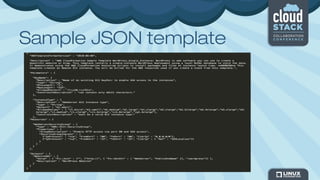
Sample JSON template
Usefulness
• Single click application deployment for multiple users
• Transparent, reusable
• Ease of resource management and dependencies
• Atomic deployments
• Thus, migrate new business applications to “cloud”
Simply put, CloudFormation for CloudStack 
Web interface for template and stack management
Agenda
• Introduction
• History
• Architecture and Implementation
• Current State
• Enhancements
History
• Started by @chiradeep
• Introduced at CCC-13 as a prototype
• Execute AWS CloudFormation templates on CloudStack
*AS IS*
• Problem – low fidelity between AWS and
CloudStack resource types (more on this later)
Agenda
• Introduction
• History
• Architecture and
Implementation
• Current State
• Enhancements
Architecture
Two components
StackMate
•Execution engine for running the templates and interfacing with CloudStack
Stacktician
•Web interface
•Embeds StackMate underneath
StackMate in 2 mins
• Treat template = stack definition as workflow
• Execute workflow by making appropriate CloudStack API
calls
• Core engine for executing templates, does the heavy lifting
• Command line tool
Stacktician in 2 mins
• Web UI for StackMate
• Backed by database for persistence
• Uses Ruby meta-programming to interface with StackMate
Where we were last
time…
• Resolve complex resource dependencies
• Intrinsic functions
• Wait Conditions
• Create simple resources like AWS::Instance and
AWS::SecurityGroup using StackMate
AWS templates on
CloudStack• Simple resources work well
• Too many differences in more complex resources like VPC and networks
 No route tables
• Semantic differences between APIs for same resources
 Different types of values for parameters
• Dependency resolution for CloudStack using AWS templates became too
complex
 Sometimes, two AWS APIs act as a single one in CloudStack
 CloudStack networking renders AWS options like DhcpOptions
unnecessary
 Too many NoOp resources used as work-around for above
CloudStack Namespace
• Instead create CloudStack specific namespace!
• No more mapping of resources from AWS namespace to
CloudStack space
• Adds the ability to validate API parameters
• Every CloudStack resource becomes a “participant” in the
workflow execution
• Essentially need to call create and delete APIs
CloudStack Namespace
• Problems
 New resources added frequently (e.g tags, UCS, Nicira)
 APIs evolve to support new parameters etc.
 Too many CloudStack resources to maintain (~51)
• Solution
 Use API discovery
 Auto generate code
 Use API information to validate all required parameters exist / format
of parameters
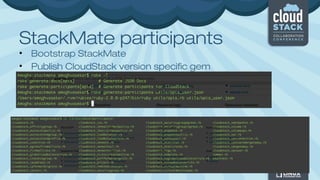
StackMate participants
• Bootstrap StackMate
• Publish CloudStack version specific gem
Errors and rollback
• Want stack creation to be atomic
• But, provide an option to user to disable rollback (e.g. for
debugging)
 Catch resource creation errors, and initiate rollback
 Execute deletion in reverse order of dependencies
 Skip any resources not yet created
 If error while deleting, notify user (log for StackMate, UI status for
Stacktician)
 Stacktician injects additional code in StackMate for DB management
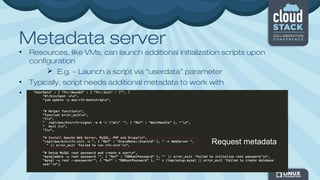
Metadata server
• Resources, like VMs, can launch additional initialization scripts upon
configuration
 E.g. – Launch a script via “userdata” parameter
• Typically, script needs additional metadata to work with
• Metadata is specific to a resource
Request metadata
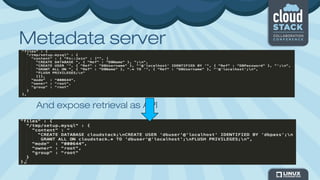
Metadata server
And expose retrieval as API
Metadata Server
• StackMate
In memory metadata, embeds a Sinatra server for
waitcondition and metadata
• Stacktician
Rails serves metadata, persisted in DB
(Special thanks to Simon Waterhouse for integrating cfn-init scripts and creating scripts for
Windows)
Stacktician Scaling
Improvements• Ruby MRI has global interpreter lock. Eventually, allowed for
only one stack execution thread to run at a time
 Use JRuby container, run in JRuby compatible server
• Async wait for stack : one thread per stack launch would
overwhelm server
 GetBack gem for managing thread pool
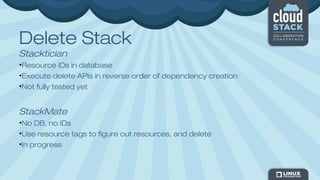
Delete Stack
Stacktician
•Resource IDs in database
•Execute delete APIs in reverse order of dependency creation
•Not fully tested yet
StackMate
•No DB, no IDs
•Use resource tags to figure out resources, and delete
•In progress
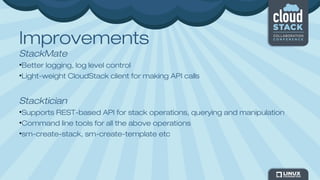
Improvements
StackMate
•Better logging, log level control
•Light-weight CloudStack client for making API calls
Stacktician
•Supports REST-based API for stack operations, querying and manipulation
•Command line tools for all the above operations
•sm-create-stack, sm-create-template etc
Agenda
• Introduction
• History
• Architecture and Implementation
• Current State
• Enhancements
Demo
Agenda
• Introduction
• History
• Architecture and Implementation
• Current State
• Enhancements
Future enhancements
Better plugin architecture
•Allow creation of custom type of resources
•Interface with other types of Clouds – GCE, AWS etc.
•Allow for scenarios like resource A on CloudStack, B on AWS within single
stack
•Currently only in StackMate, and very rudimentary. Enforces some basic
constraints, uses tag “stackmate_participant = true” for discovery
 Bad plugins rejected at run-time
•Needs more work to make robust
Future enhancements
• Nested stacks
 Treat stack as first class object. Template can contain another stack
definition as a resource
 Works in StackMate, disabled for lack of good implementation
• Support conditional functions in template (e.g Fn:And, Fn:Or,
Fn:If)
• Support update stack
 Semantics to be well defined
Q & A
Questions? Thoughts? Comments? Suggestions?
https://github.com/stackmate
Feel free to log issues – more the better!
Big thanks to Chiradeep for all the help

Stacktician - CloudStack Collab Conference 2014

  • 1.
    Moving up thestack with Stacktician Amogh Vasekar
  • 2.
    Agenda • Introduction • History •Architecture and Implementation • Current State • Enhancements
  • 3.
    Agenda • Introduction • History •Architecture and Implementation • Current State • Enhancements
  • 4.
    Introduction What is AmazonCloudFormation? •Create and manage collection of related AWS resources •Typically, the resources will form your whole application “stack” In essence, “Infrastructure-as-code” •JSON file •Describe resources •Describe dependencies •Readable, reusable, reviewable
  • 5.
  • 6.
    Usefulness • Single clickapplication deployment for multiple users • Transparent, reusable • Ease of resource management and dependencies • Atomic deployments • Thus, migrate new business applications to “cloud”
  • 7.
    Simply put, CloudFormationfor CloudStack  Web interface for template and stack management
  • 8.
    Agenda • Introduction • History •Architecture and Implementation • Current State • Enhancements
  • 9.
    History • Started by@chiradeep • Introduced at CCC-13 as a prototype • Execute AWS CloudFormation templates on CloudStack *AS IS* • Problem – low fidelity between AWS and CloudStack resource types (more on this later)
  • 10.
    Agenda • Introduction • History •Architecture and Implementation • Current State • Enhancements
  • 11.
    Architecture Two components StackMate •Execution enginefor running the templates and interfacing with CloudStack Stacktician •Web interface •Embeds StackMate underneath
  • 12.
    StackMate in 2mins • Treat template = stack definition as workflow • Execute workflow by making appropriate CloudStack API calls • Core engine for executing templates, does the heavy lifting • Command line tool
  • 13.
    Stacktician in 2mins • Web UI for StackMate • Backed by database for persistence • Uses Ruby meta-programming to interface with StackMate
  • 14.
    Where we werelast time… • Resolve complex resource dependencies • Intrinsic functions • Wait Conditions • Create simple resources like AWS::Instance and AWS::SecurityGroup using StackMate
  • 15.
    AWS templates on CloudStack•Simple resources work well • Too many differences in more complex resources like VPC and networks  No route tables • Semantic differences between APIs for same resources  Different types of values for parameters • Dependency resolution for CloudStack using AWS templates became too complex  Sometimes, two AWS APIs act as a single one in CloudStack  CloudStack networking renders AWS options like DhcpOptions unnecessary  Too many NoOp resources used as work-around for above
  • 16.
    CloudStack Namespace • Insteadcreate CloudStack specific namespace! • No more mapping of resources from AWS namespace to CloudStack space • Adds the ability to validate API parameters • Every CloudStack resource becomes a “participant” in the workflow execution • Essentially need to call create and delete APIs
  • 17.
    CloudStack Namespace • Problems New resources added frequently (e.g tags, UCS, Nicira)  APIs evolve to support new parameters etc.  Too many CloudStack resources to maintain (~51) • Solution  Use API discovery  Auto generate code  Use API information to validate all required parameters exist / format of parameters
  • 18.
    StackMate participants • BootstrapStackMate • Publish CloudStack version specific gem
  • 19.
    Errors and rollback •Want stack creation to be atomic • But, provide an option to user to disable rollback (e.g. for debugging)  Catch resource creation errors, and initiate rollback  Execute deletion in reverse order of dependencies  Skip any resources not yet created  If error while deleting, notify user (log for StackMate, UI status for Stacktician)  Stacktician injects additional code in StackMate for DB management
  • 20.
    Metadata server • Resources,like VMs, can launch additional initialization scripts upon configuration  E.g. – Launch a script via “userdata” parameter • Typically, script needs additional metadata to work with • Metadata is specific to a resource Request metadata
  • 21.
  • 22.
    Metadata Server • StackMate Inmemory metadata, embeds a Sinatra server for waitcondition and metadata • Stacktician Rails serves metadata, persisted in DB (Special thanks to Simon Waterhouse for integrating cfn-init scripts and creating scripts for Windows)
  • 23.
    Stacktician Scaling Improvements• RubyMRI has global interpreter lock. Eventually, allowed for only one stack execution thread to run at a time  Use JRuby container, run in JRuby compatible server • Async wait for stack : one thread per stack launch would overwhelm server  GetBack gem for managing thread pool
  • 24.
    Delete Stack Stacktician •Resource IDsin database •Execute delete APIs in reverse order of dependency creation •Not fully tested yet StackMate •No DB, no IDs •Use resource tags to figure out resources, and delete •In progress
  • 25.
    Improvements StackMate •Better logging, loglevel control •Light-weight CloudStack client for making API calls Stacktician •Supports REST-based API for stack operations, querying and manipulation •Command line tools for all the above operations •sm-create-stack, sm-create-template etc
  • 26.
    Agenda • Introduction • History •Architecture and Implementation • Current State • Enhancements
  • 27.
  • 28.
    Agenda • Introduction • History •Architecture and Implementation • Current State • Enhancements
  • 29.
    Future enhancements Better pluginarchitecture •Allow creation of custom type of resources •Interface with other types of Clouds – GCE, AWS etc. •Allow for scenarios like resource A on CloudStack, B on AWS within single stack •Currently only in StackMate, and very rudimentary. Enforces some basic constraints, uses tag “stackmate_participant = true” for discovery  Bad plugins rejected at run-time •Needs more work to make robust
  • 30.
    Future enhancements • Nestedstacks  Treat stack as first class object. Template can contain another stack definition as a resource  Works in StackMate, disabled for lack of good implementation • Support conditional functions in template (e.g Fn:And, Fn:Or, Fn:If) • Support update stack  Semantics to be well defined
  • 31.
    Q & A Questions?Thoughts? Comments? Suggestions? https://github.com/stackmate Feel free to log issues – more the better! Big thanks to Chiradeep for all the help