What is astack?
• It is an ordered group of homogeneous items of elements.
• Elements are added to and removed from the top of the
stack (the most recently added items are at the top of the
stack).
• The last element to be added is the first to be removed
(LIFO: Last In, First Out).
3.
Stack Specification
• Definitions:(provided by the user)
– MAX_ITEMS: Max number of items that might be on
the stack
– ItemType: Data type of the items on the stack
• Operations
– MakeEmpty
– Boolean IsEmpty
– Boolean IsFull
– Push (ItemType newItem)
– Pop (ItemType& item) (or pop and top)
4.
Push (ItemType newItem)
•Function:Adds newItem to the top of
the stack.
•Preconditions: Stack has been
initialized and is not full.
•Postconditions: newItem is at the top
of the stack.
5.
Pop (ItemType& item)
•Function: Removes topItem from stack and
returns it in item.
• Preconditions: Stack has been initialized
and is not empty.
• Postconditions: Top element has been
removed from stack and item is a copy of
the removed element.
7.
Stack Implementation
#include "ItemType.h"
//Must be provided by the user of the class
// Contains definitions for MAX_ITEMS and ItemType
class StackType {
public:
StackType();
void MakeEmpty();
bool IsEmpty() const;
bool IsFull() const;
void Push(ItemType);
void Pop(ItemType&);
private:
int top;
ItemType items[MAX_ITEMS];
};
Stack overflow
• Thecondition resulting from trying to push
an element onto a full stack.
if(!stack.IsFull())
stack.Push(item);
Stack underflow
• The condition resulting from trying to pop
an empty stack.
if(!stack.IsEmpty())
stack.Pop(item);
11.
Example: postfix expressions
•Postfix notation is another way of writing arithmetic
expressions.
• In postfix notation, the operator is written after the
two operands.
infix: 2+5 postfix: 2 5 +
• Expressions are evaluated from left to right.
• Precedence rules and parentheses are never needed!!
Postfix expressions:
Algorithm usingstacks
WHILE more input items exist
Get an item
IF item is an operand
stack.Push(item)
ELSE
stack.Pop(operand2)
stack.Pop(operand1)
Compute result
stack.Push(result)
stack.Pop(result)
15.
What is aqueue?
• It is an ordered group of homogeneous items of
elements.
• Queues have two ends:
– Elements are added at one end.
– Elements are removed from the other end.
• The element added first is also removed first
(FIFO: First In, First Out).
queue
elements
enter
no changes of order
elements
exit
2
3
4 1
tail head
16.
Queue Specification
• Definitions:(provided by the user)
– MAX_ITEMS: Max number of items that might be on
the queue
– ItemType: Data type of the items on the queue
• Operations
– MakeEmpty
– Boolean IsEmpty
– Boolean IsFull
– Enqueue (ItemType newItem)
– Dequeue (ItemType& item) (serve and retrieve)
17.
Enqueue (ItemType newItem)
•Function: Adds newItem to the rear of the
queue.
• Preconditions: Queue has been initialized
and is not full.
• Postconditions: newItem is at rear of queue.
18.
Dequeue (ItemType& item)
•Function: Removes front item from queue
and returns it in item.
• Preconditions: Queue has been initialized
and is not empty.
• Postconditions: Front element has been
removed from queue and item is a copy of
removed element.
19.
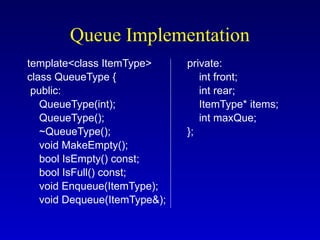
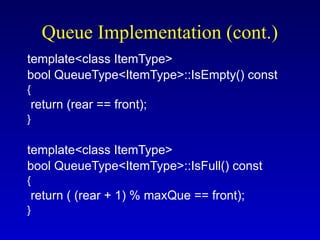
Implementation issues
• Implementthe queue as a circular structure.
• How do we know if a queue is full or
empty?
• Initialization of front and rear.
• Testing for a full or empty queue.
22.
Make front pointto the element preceding the front
element in the queue (one memory location will be
wasted).
Queue overflow
• Thecondition resulting from trying to add
an element onto a full queue.
if(!q.IsFull())
q.Enqueue(item);
33.
Queue underflow
• Thecondition resulting from trying to
remove an element from an empty queue.
if(!q.IsEmpty())
q.Dequeue(item);
34.
Example: recognizing palindromes
•A palindrome is a string that reads the same
forward and backward.
Able was I ere I saw Elba
• We will read the line of text into both a stack and a
queue.
• Compare the contents of the stack and the queue
character-by-character to see if they would
produce the same string of characters.
while( (!q.IsEmpty()) &&(!s.IsEmpty()) ) {
s.Pop(sItem);
q.Dequeue(qItem);
if(sItem != qItem)
++mismatches;
}
if (mismatches == 0)
cout << "That is a palindrome" << endl;
else
cout << That is not a palindrome" << endl;
return 0;
}
Example: recognizing palindromes
38.
Case Study: Simulation
•Queuing System: consists of servers and
queues of objects to be served.
• Simulation: a program that determines how
long items must wait in line before being
served.
39.
Case Study: Simulation(cont.)
• Inputs to the simulation:
(1) the length of the simulation
(2) the average transaction time
(3) the number of servers
(4) the average time between job
arrivals
40.
Case Study: Simulation(cont.)
• Parameters the simulation must vary:
(1) number of servers
(2) time between arrivals of items
• Output of simulation: average wait time.


![Stack Implementation
#include "ItemType.h"
// Must be provided by the user of the class
// Contains definitions for MAX_ITEMS and ItemType
class StackType {
public:
StackType();
void MakeEmpty();
bool IsEmpty() const;
bool IsFull() const;
void Push(ItemType);
void Pop(ItemType&);
private:
int top;
ItemType items[MAX_ITEMS];
};](https://image.slidesharecdn.com/stacksandqueues-250828081244-3586309b/85/StacksandQueuesCLASS-12-COMPUTER-SCIENCE-pptx-7-320.jpg)

![Stack Implementation (cont.)
bool StackType::IsFull() const
{
return (top == MAX_ITEMS-1);
}
void StackType::Push(ItemType newItem)
{
top++;
items[top] = newItem;
}
void StackType::Pop(ItemType& item)
{
item = items[top];
top--;
}](https://image.slidesharecdn.com/stacksandqueues-250828081244-3586309b/85/StacksandQueuesCLASS-12-COMPUTER-SCIENCE-pptx-9-320.jpg)


![Queue Implementation (cont.)
template<class ItemType>
QueueType<ItemType>::QueueType(int
max)
{
maxQue = max + 1;
front = maxQue - 1;
rear = maxQue - 1;
items = new ItemType[maxQue];
}](https://image.slidesharecdn.com/stacksandqueues-250828081244-3586309b/85/StacksandQueuesCLASS-12-COMPUTER-SCIENCE-pptx-26-320.jpg)
![Queue Implementation (cont.)
template<class ItemType>
QueueType<ItemType>::~QueueType()
{
delete [] items;
}](https://image.slidesharecdn.com/stacksandqueues-250828081244-3586309b/85/StacksandQueuesCLASS-12-COMPUTER-SCIENCE-pptx-27-320.jpg)

![Queue Implementation (cont.)
template<class ItemType>
void QueueType<ItemType>::Enqueue
(ItemType newItem)
{
rear = (rear + 1) % maxQue;
items[rear] = newItem;
}](https://image.slidesharecdn.com/stacksandqueues-250828081244-3586309b/85/StacksandQueuesCLASS-12-COMPUTER-SCIENCE-pptx-30-320.jpg)
![Queue Implementation (cont.)
template<class ItemType>
void QueueType<ItemType>::Dequeue
(ItemType& item)
{
front = (front + 1) % maxQue;
item = items[front];
}](https://image.slidesharecdn.com/stacksandqueues-250828081244-3586309b/85/StacksandQueuesCLASS-12-COMPUTER-SCIENCE-pptx-31-320.jpg)


