Stacks
MRS.SOWMYA JYOTHI, SDMCBM, MANGALORE
Reference: Data Structures with C by Seymour Lipschutz, Schaum’s Outlines
Series.
Stacks
INTRODUCTION
• The linear lists and linear arrays are used to insert and delete elements at
any place. There are certain frequent situations when one wants to restrict
insertion and deletion so that they can take place only at the beginning or
end of the list, not in the middle.
• Two of the data structures that are useful in such situations are stacks and
queues.
• A stack is a linear structure in which items may be added or removed only
at one end. It is called last-in first-out (LIFO).
• A queue is a linear list in which items may be added only at one end and
items may be removed only at the other end. It is called first-in first-out
(FIFO) list.
STACKS
• A stack is a list of elements in which an element may
be inserted or deleted only a one end, called TOP of
the stack.
• The elements are removed in reverse order of that in
which they were inserted into the stack.
Basic operations:
a) Push() is the term used to insert/add an
element into a stack.
b) Pop() is the term used to delete/remove an
element from a stack.
•Other names for stacks are piles and push-down
lists.
•There are two ways to represent Stack in
memory.
1. One is using array and
2. Other is using linked list.
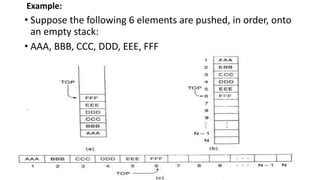
Example:
• Suppose the following 6 elements are pushed, in order, onto
an empty stack:
• AAA, BBB, CCC, DDD, EEE, FFF
ARRAY REPRESENTATION OF STACKS
• Stacks are represented in the computer by a linear array.
• In the following algorithms/procedures of pushing and
popping an item from the stacks,
1. a linear array STACK,
2. a variable TOP which contains the location of the top
element of the stack;
3. and a variable MAXSTAK which gives the maximum
number of elements that can be held by the stack.
OVERFLOW AND UNDERFLOW
1. The condition TOP=0 or TOP=NULL will indicate the
stack is empty and we say UNDERFLOW.
2. The condition TOP=MAXSTK will indicate the stack
is full and we say OVERFLOW.
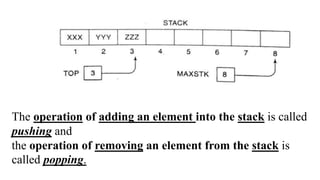
The operation of adding an element into the stack is called
pushing and
the operation of removing an element from the stack is
called popping.
Algorithm 6.1: PUSH(STACK, TOP, MAXSTAK, ITEM):
This procedure pushes an ITEM onto a stack.
1. [STACK already filled?]
If TOP=MAXSTAK, then: Print: OVERFLOW, and Return
2. Set TOP:=TOP+1 [Increase TOP by 1]
3. Set STACK [TOP]:=ITEM [Insert ITEM in new TOP position]
4. Return
Example:
To simulate the operation PUSH(STACK, WWW)
1. Since TOP=3, control is transferred to
Step 2.
2. TOP=3+1=4
3. STACK[TOP]=STACK[4]=WWW
4. Return
Algorithm 6.2: POP(STACK, TOP, ITEM)
This procedure deletes the top element of STACK and assigns
it to the variable ITEM.
1. [STACK has an item to be removed? Check for empty stack]
If TOP=-1, then: Print: UNDERFLOW, and Return
2. Set ITEM:=STACK[TOP] [Assigns TOP element to ITEM]
3. Set TOP=TOP-1 [Decrease TOP by 1.]
4. Return
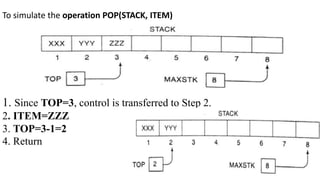
To simulate the operation POP(STACK, ITEM)
1. Since TOP=3, control is transferred to Step 2.
2. ITEM=ZZZ
3. TOP=3-1=2
4. Return
LINKED REPRESENTATION OF STACKS
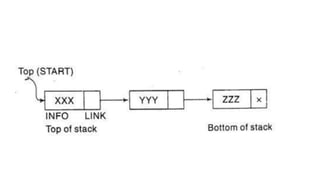
• The linked representation of stack is implemented using singly
linked list.
1. The INFO fields of the nodes hold the elements of the stack and
2. The LINK fields hold the pointers to the neighboring element in
the stack.
3. The START pointer of the linked list behaves as TOP pointer
variable of the stack and
4. The NULL pointer in the last node signals the end of the stack.
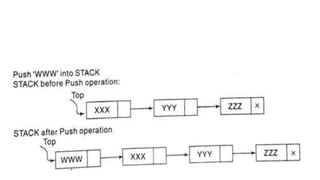
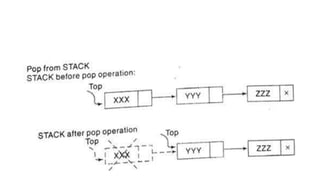
• A PUSH operation is accomplished by inserting a node into the
start of the STACK and a POP operation is undertaken by
deleting the node pointed to by the START pointer.
• The array representation of stack maintains a variable MAXSTK
which gives the maximum number of elements that can be held
by the stack.
• If the number of elements in the stack becomes equal to the
value of variable MAXSTK, it is the condition of OVERFLOW.
• The linked representation of stacks is free from this
requirement.
• There is no limitation on the capacity of the linked stack
hence it can support as many PUSH operations as free
storage list (the AVAIL list) can support.
1. However, the condition TOP=NULL may be retained in the
POP procedure to prevent deletion from an empty stack
and
2. AVAIL=NULL to check for the available space in the free
storage list.
Algorithm 6.3: PUSH_LINKSTACK(INFO, LINK, TOP, AVAIL, ITEM)
This procedure pushes an ITEM onto a stack.
1 IF AVAIL=NULL, then Write: OVERFLOW and Exit [Available Space?]
2. [Remove first node from AVAIL list]
Set NEW:=AVAIL and AVAIL:=LINK[AVAIL]
3. Set INFO[NEW]:=ITEM [ Copies the ITEM into new node]
4. Set LINK[NEW]:=TOP [New node points to the original top node in the stack]
5. Set TOP:=NEW [Reset TOP to point to the new node at the top of the stack]
6. Exit
Algorithm 6.4: POP_LINKSTACK(INFO, LINK, TOP, AVAIL, ITEM)
This procedure deletes the top element of STACK and assigns it to the
variable ITEM.
1. [STACK has an item to be removed? Check for empty stack]
If TOP=NULL , then: Write: UNDERFLOW, and Exit
2. Set ITEM:=INFO[TOP]. [Copies the top element of stack into ITEM]
3. Set TEMP:=TOP and TOP:=LINK[TOP]
[Remember the old value of TOP in TEMP and reset TOP to point to the next
element]
4. [Return deleted node to the AVAIL list]
Set LINK [TEMP]:=AVAIL and AVAIL:=TEMP
5. Exit
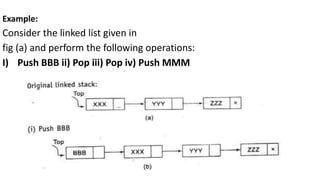
Example:
Consider the linked list given in
fig (a) and perform the following operations:
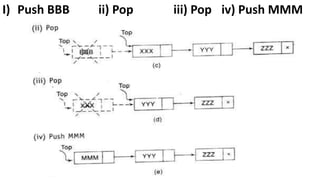
I) Push BBB ii) Pop iii) Pop iv) Push MMM
APPLICATION OF STACKS:
Quick Sort
• Let A be a list of n data items. Quick sort is an algorithm of the divide-and-
conquer type. That is, the problem of sorting a set is reduced to the
problem of sorting two smaller sets.
RECURSION
• Suppose P is a procedure containing either a Call statement to itself or a
Call statement to a second procedure that may eventually result in a call
statement back to the original procedure P. then P is called recursive
procedure. The program contains a recursive procedure should not run
infinitely. Hence, a recursive procedure/function must have the following
properties:
1) There must be certain criteria, called base criteria, for which the
procedure does not call itself.
2) Each time when the procedure is called, it must be closer to that criterion.
RECURSION
• Suppose P is a procedure containing either a Call statement to itself or a
Call statement to a second procedure that may eventually result in a
call statement back to the original procedure P. then P is called
recursive procedure. The program contains a recursive procedure
should not run infinitely.
• Hence, a recursive procedure/function must have the following
properties:
1) There must be certain criteria, called base criteria, for which
the procedure does not call itself.
2) Each time when the procedure is called, it must be closer to
that criterion.
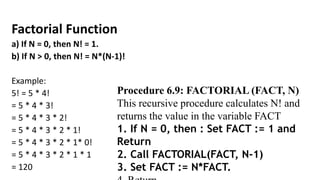
Factorial Function
a) If N = 0, then N! = 1.
b) If N > 0, then N! = N*(N-1)!
Example:
5! = 5 * 4!
= 5 * 4 * 3!
= 5 * 4 * 3 * 2!
= 5 * 4 * 3 * 2 * 1!
= 5 * 4 * 3 * 2 * 1* 0!
= 5 * 4 * 3 * 2 * 1 * 1
= 120
Procedure 6.9: FACTORIAL (FACT, N)
This recursive procedure calculates N! and
returns the value in the variable FACT
1. If N = 0, then : Set FACT := 1 and
Return
2. Call FACTORIAL(FACT, N-1)
3. Set FACT := N*FACT.
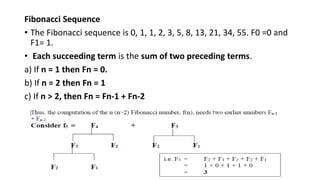
Fibonacci Sequence
• The Fibonacci sequence is 0, 1, 1, 2, 3, 5, 8, 13, 21, 34, 55. F0 =0 and
F1= 1.
• Each succeeding term is the sum of two preceding terms.
a) If n = 1 then Fn = 0.
b) If n = 2 then Fn = 1
c) If n > 2, then Fn = Fn-1 + Fn-2
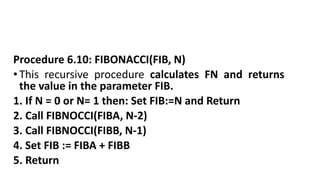
Procedure 6.10: FIBONACCI(FIB, N)
•This recursive procedure calculates FN and returns
the value in the parameter FIB.
1. If N = 0 or N= 1 then: Set FIB:=N and Return
2. Call FIBNOCCI(FIBA, N-2)
3. Call FIBNOCCI(FIBB, N-1)
4. Set FIB := FIBA + FIBB
5. Return
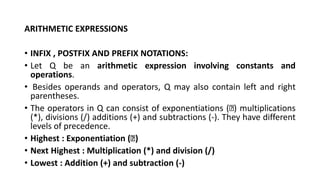
ARITHMETIC EXPRESSIONS
• INFIX , POSTFIX AND PREFIX NOTATIONS:
• Let Q be an arithmetic expression involving constants and
operations.
• Besides operands and operators, Q may also contain left and right
parentheses.
• The operators in Q can consist of exponentiations ( ) multiplications
(*), divisions (/) additions (+) and subtractions (-). They have different
levels of precedence.
• Highest : Exponentiation ( )
• Next Highest : Multiplication (*) and division (/)
• Lowest : Addition (+) and subtraction (-)
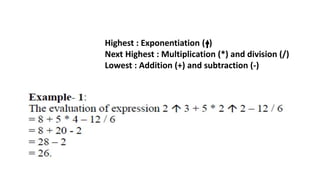
Highest : Exponentiation ( )
Next Highest : Multiplication (*) and division (/)
Lowest : Addition (+) and subtraction (-)
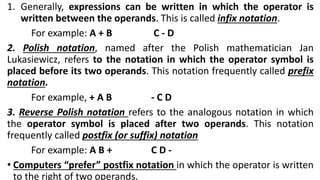
1. Generally, expressions can be written in which the operator is
written between the operands. This is called infix notation.
For example: A + B C - D
2. Polish notation, named after the Polish mathematician Jan
Lukasiewicz, refers to the notation in which the operator symbol is
placed before its two operands. This notation frequently called prefix
notation.
For example, + A B - C D
3. Reverse Polish notation refers to the analogous notation in which
the operator symbol is placed after two operands. This notation
frequently called postfix (or suffix) notation
For example: A B + C D -
• Computers “prefer” postfix notation in which the operator is written
to the right of two operands.
• The computer usually evaluates an arithmetic
expression written in infix notation in two steps.
1. First, it converts the expression to postfix notation
and
2. Then it evaluates the postfix expression.
• In each step stack is used as main tool.
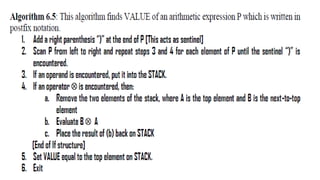
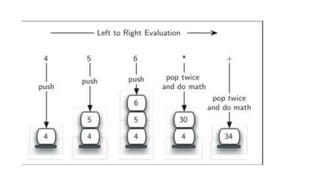
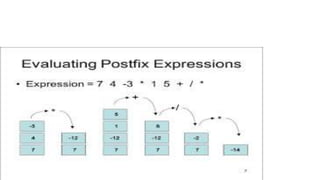
Evaluation of a Postfix Expression:
•Suppose P is an arithmetic expression written in
postfix notation.
•The following algorithm uses STACK to evaluate P.
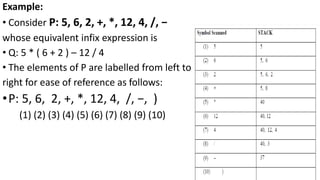
Example:
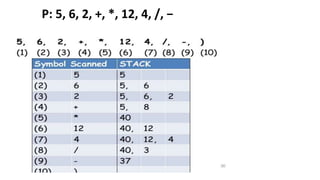
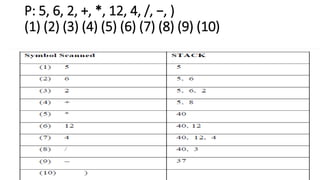
• Consider P: 5, 6, 2, +, *, 12, 4, /, −
whose equivalent infix expression is
• Q: 5 * ( 6 + 2 ) – 12 / 4
• The elements of P are labelled from left to
right for ease of reference as follows:
•P: 5, 6, 2, +, *, 12, 4, /, −, )
(1) (2) (3) (4) (5) (6) (7) (8) (9) (10)
P: 5, 6, 2, +, *, 12, 4, /, −
P: 5, 6, 2, +, *, 12, 4, /, −, )
(1) (2) (3) (4) (5) (6) (7) (8) (9) (10)
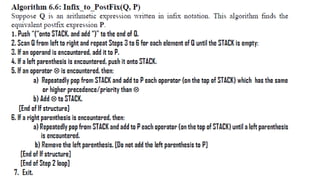
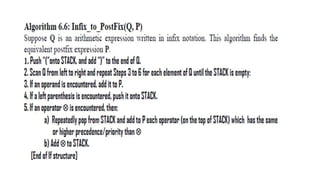
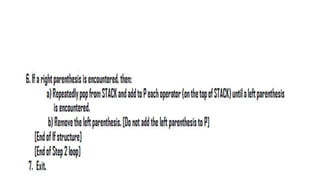
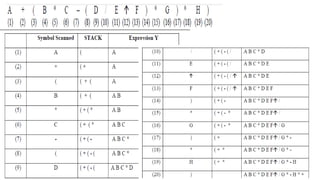
Transforming Infix Expression into Postfix Expression:
• The following algorithm transforms the infix expression Q
into its equivalent postfix expression P.
• It uses a stack to temporary hold the operators and left
parenthesis.
• The postfix expression will be constructed from left to right
using operands from Q and operators popped from STACK.
Stacks IN DATA STRUCTURES

Stacks IN DATA STRUCTURES

  • 1.
    Stacks MRS.SOWMYA JYOTHI, SDMCBM,MANGALORE Reference: Data Structures with C by Seymour Lipschutz, Schaum’s Outlines Series.
  • 2.
    Stacks INTRODUCTION • The linearlists and linear arrays are used to insert and delete elements at any place. There are certain frequent situations when one wants to restrict insertion and deletion so that they can take place only at the beginning or end of the list, not in the middle. • Two of the data structures that are useful in such situations are stacks and queues. • A stack is a linear structure in which items may be added or removed only at one end. It is called last-in first-out (LIFO). • A queue is a linear list in which items may be added only at one end and items may be removed only at the other end. It is called first-in first-out (FIFO) list.
  • 3.
    STACKS • A stackis a list of elements in which an element may be inserted or deleted only a one end, called TOP of the stack. • The elements are removed in reverse order of that in which they were inserted into the stack.
  • 4.
    Basic operations: a) Push()is the term used to insert/add an element into a stack. b) Pop() is the term used to delete/remove an element from a stack. •Other names for stacks are piles and push-down lists.
  • 5.
    •There are twoways to represent Stack in memory. 1. One is using array and 2. Other is using linked list.
  • 6.
    Example: • Suppose thefollowing 6 elements are pushed, in order, onto an empty stack: • AAA, BBB, CCC, DDD, EEE, FFF
  • 7.
    ARRAY REPRESENTATION OFSTACKS • Stacks are represented in the computer by a linear array. • In the following algorithms/procedures of pushing and popping an item from the stacks, 1. a linear array STACK, 2. a variable TOP which contains the location of the top element of the stack; 3. and a variable MAXSTAK which gives the maximum number of elements that can be held by the stack.
  • 8.
    OVERFLOW AND UNDERFLOW 1.The condition TOP=0 or TOP=NULL will indicate the stack is empty and we say UNDERFLOW. 2. The condition TOP=MAXSTK will indicate the stack is full and we say OVERFLOW.
  • 9.
    The operation ofadding an element into the stack is called pushing and the operation of removing an element from the stack is called popping.
  • 10.
    Algorithm 6.1: PUSH(STACK,TOP, MAXSTAK, ITEM): This procedure pushes an ITEM onto a stack. 1. [STACK already filled?] If TOP=MAXSTAK, then: Print: OVERFLOW, and Return 2. Set TOP:=TOP+1 [Increase TOP by 1] 3. Set STACK [TOP]:=ITEM [Insert ITEM in new TOP position] 4. Return
  • 11.
    Example: To simulate theoperation PUSH(STACK, WWW) 1. Since TOP=3, control is transferred to Step 2. 2. TOP=3+1=4 3. STACK[TOP]=STACK[4]=WWW 4. Return
  • 12.
    Algorithm 6.2: POP(STACK,TOP, ITEM) This procedure deletes the top element of STACK and assigns it to the variable ITEM. 1. [STACK has an item to be removed? Check for empty stack] If TOP=-1, then: Print: UNDERFLOW, and Return 2. Set ITEM:=STACK[TOP] [Assigns TOP element to ITEM] 3. Set TOP=TOP-1 [Decrease TOP by 1.] 4. Return
  • 13.
    To simulate theoperation POP(STACK, ITEM) 1. Since TOP=3, control is transferred to Step 2. 2. ITEM=ZZZ 3. TOP=3-1=2 4. Return
  • 14.
    LINKED REPRESENTATION OFSTACKS • The linked representation of stack is implemented using singly linked list. 1. The INFO fields of the nodes hold the elements of the stack and 2. The LINK fields hold the pointers to the neighboring element in the stack. 3. The START pointer of the linked list behaves as TOP pointer variable of the stack and 4. The NULL pointer in the last node signals the end of the stack.
  • 16.
    • A PUSHoperation is accomplished by inserting a node into the start of the STACK and a POP operation is undertaken by deleting the node pointed to by the START pointer. • The array representation of stack maintains a variable MAXSTK which gives the maximum number of elements that can be held by the stack. • If the number of elements in the stack becomes equal to the value of variable MAXSTK, it is the condition of OVERFLOW. • The linked representation of stacks is free from this requirement.
  • 17.
    • There isno limitation on the capacity of the linked stack hence it can support as many PUSH operations as free storage list (the AVAIL list) can support. 1. However, the condition TOP=NULL may be retained in the POP procedure to prevent deletion from an empty stack and 2. AVAIL=NULL to check for the available space in the free storage list.
  • 20.
    Algorithm 6.3: PUSH_LINKSTACK(INFO,LINK, TOP, AVAIL, ITEM) This procedure pushes an ITEM onto a stack. 1 IF AVAIL=NULL, then Write: OVERFLOW and Exit [Available Space?] 2. [Remove first node from AVAIL list] Set NEW:=AVAIL and AVAIL:=LINK[AVAIL] 3. Set INFO[NEW]:=ITEM [ Copies the ITEM into new node] 4. Set LINK[NEW]:=TOP [New node points to the original top node in the stack] 5. Set TOP:=NEW [Reset TOP to point to the new node at the top of the stack] 6. Exit
  • 21.
    Algorithm 6.4: POP_LINKSTACK(INFO,LINK, TOP, AVAIL, ITEM) This procedure deletes the top element of STACK and assigns it to the variable ITEM. 1. [STACK has an item to be removed? Check for empty stack] If TOP=NULL , then: Write: UNDERFLOW, and Exit 2. Set ITEM:=INFO[TOP]. [Copies the top element of stack into ITEM] 3. Set TEMP:=TOP and TOP:=LINK[TOP] [Remember the old value of TOP in TEMP and reset TOP to point to the next element] 4. [Return deleted node to the AVAIL list] Set LINK [TEMP]:=AVAIL and AVAIL:=TEMP 5. Exit
  • 22.
    Example: Consider the linkedlist given in fig (a) and perform the following operations: I) Push BBB ii) Pop iii) Pop iv) Push MMM
  • 23.
    I) Push BBBii) Pop iii) Pop iv) Push MMM
  • 24.
    APPLICATION OF STACKS: QuickSort • Let A be a list of n data items. Quick sort is an algorithm of the divide-and- conquer type. That is, the problem of sorting a set is reduced to the problem of sorting two smaller sets. RECURSION • Suppose P is a procedure containing either a Call statement to itself or a Call statement to a second procedure that may eventually result in a call statement back to the original procedure P. then P is called recursive procedure. The program contains a recursive procedure should not run infinitely. Hence, a recursive procedure/function must have the following properties: 1) There must be certain criteria, called base criteria, for which the procedure does not call itself. 2) Each time when the procedure is called, it must be closer to that criterion.
  • 25.
    RECURSION • Suppose Pis a procedure containing either a Call statement to itself or a Call statement to a second procedure that may eventually result in a call statement back to the original procedure P. then P is called recursive procedure. The program contains a recursive procedure should not run infinitely. • Hence, a recursive procedure/function must have the following properties: 1) There must be certain criteria, called base criteria, for which the procedure does not call itself. 2) Each time when the procedure is called, it must be closer to that criterion.
  • 26.
    Factorial Function a) IfN = 0, then N! = 1. b) If N > 0, then N! = N*(N-1)! Example: 5! = 5 * 4! = 5 * 4 * 3! = 5 * 4 * 3 * 2! = 5 * 4 * 3 * 2 * 1! = 5 * 4 * 3 * 2 * 1* 0! = 5 * 4 * 3 * 2 * 1 * 1 = 120 Procedure 6.9: FACTORIAL (FACT, N) This recursive procedure calculates N! and returns the value in the variable FACT 1. If N = 0, then : Set FACT := 1 and Return 2. Call FACTORIAL(FACT, N-1) 3. Set FACT := N*FACT.
  • 27.
    Fibonacci Sequence • TheFibonacci sequence is 0, 1, 1, 2, 3, 5, 8, 13, 21, 34, 55. F0 =0 and F1= 1. • Each succeeding term is the sum of two preceding terms. a) If n = 1 then Fn = 0. b) If n = 2 then Fn = 1 c) If n > 2, then Fn = Fn-1 + Fn-2
  • 28.
    Procedure 6.10: FIBONACCI(FIB,N) •This recursive procedure calculates FN and returns the value in the parameter FIB. 1. If N = 0 or N= 1 then: Set FIB:=N and Return 2. Call FIBNOCCI(FIBA, N-2) 3. Call FIBNOCCI(FIBB, N-1) 4. Set FIB := FIBA + FIBB 5. Return
  • 29.
    ARITHMETIC EXPRESSIONS • INFIX, POSTFIX AND PREFIX NOTATIONS: • Let Q be an arithmetic expression involving constants and operations. • Besides operands and operators, Q may also contain left and right parentheses. • The operators in Q can consist of exponentiations ( ) multiplications (*), divisions (/) additions (+) and subtractions (-). They have different levels of precedence. • Highest : Exponentiation ( ) • Next Highest : Multiplication (*) and division (/) • Lowest : Addition (+) and subtraction (-)
  • 30.
    Highest : Exponentiation( ) Next Highest : Multiplication (*) and division (/) Lowest : Addition (+) and subtraction (-)
  • 31.
    1. Generally, expressionscan be written in which the operator is written between the operands. This is called infix notation. For example: A + B C - D 2. Polish notation, named after the Polish mathematician Jan Lukasiewicz, refers to the notation in which the operator symbol is placed before its two operands. This notation frequently called prefix notation. For example, + A B - C D 3. Reverse Polish notation refers to the analogous notation in which the operator symbol is placed after two operands. This notation frequently called postfix (or suffix) notation For example: A B + C D - • Computers “prefer” postfix notation in which the operator is written to the right of two operands.
  • 32.
    • The computerusually evaluates an arithmetic expression written in infix notation in two steps. 1. First, it converts the expression to postfix notation and 2. Then it evaluates the postfix expression. • In each step stack is used as main tool.
  • 33.
    Evaluation of aPostfix Expression: •Suppose P is an arithmetic expression written in postfix notation. •The following algorithm uses STACK to evaluate P.
  • 37.
    Example: • Consider P:5, 6, 2, +, *, 12, 4, /, − whose equivalent infix expression is • Q: 5 * ( 6 + 2 ) – 12 / 4 • The elements of P are labelled from left to right for ease of reference as follows: •P: 5, 6, 2, +, *, 12, 4, /, −, ) (1) (2) (3) (4) (5) (6) (7) (8) (9) (10)
  • 38.
    P: 5, 6,2, +, *, 12, 4, /, −
  • 39.
    P: 5, 6,2, +, *, 12, 4, /, −, ) (1) (2) (3) (4) (5) (6) (7) (8) (9) (10)
  • 40.
    Transforming Infix Expressioninto Postfix Expression: • The following algorithm transforms the infix expression Q into its equivalent postfix expression P. • It uses a stack to temporary hold the operators and left parenthesis. • The postfix expression will be constructed from left to right using operands from Q and operators popped from STACK.