ADULT
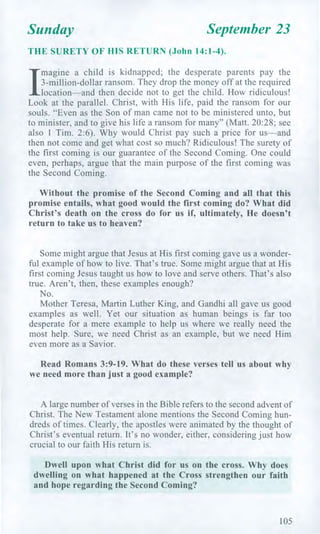
SABBATH SCHOOL
BIBLE STUDY GUIDE
JULY AUG SEP 2001
cfiiiiars of
Our aitb
SEVENTH-DAY
ADVENTIS I CHURCH Aim
Let Ellen G. White
help you study!
E. G. White Notes for the Sabbath
School Lessons is an indispensable
study tool designed to help you gain
new insights and fresh perspectives
from your Sabbath School Bible study.
This attractive booklet contains E. G.
White comments addressing the topics
of the day, week, and quarter in the
Adult Bible Study Guides.
Don't miss out! Start getting more
from your daily Bible study with E. G.
White Notes today.
Available at your Adventist Book Center.
Call 1-800-765-6955 to order.
Pacific Press® Publishing Association. Visit us at www.pacificpress.com
2001 Prices subject to change.
Scripture references other than from the King James Version quoted by permission in this Bible Study Guide for Third Quartet
2001 are as follows:
NASB. From the New American Standard Bible, copyright © the Lockman Foundation 1960, 1962, 1963, 1968, 1971, 1972, 1973
1975, 1977. Used by permission.
NIV. From the Holy Bible, New International Version, copyright © 1978 by International Bible Society. Used by permission.
NKJV. From theHoly Bible, New King James Version, copyright © 1979, 1980, 1982 by Thomas Nelson, Inc. Used by permission
NRSV. From the New Revised Standard Version of the Bible, copyright C1989 by the Division of Christian Education of the Nationa
Council of the Churches of Christ in the USA. Used by permission. All rights reserved.
Adult Sabbath School Bible Study Guide (ISSN 1096-7400) (Standard Edition). Published quarterly by Pacific Press® Publishing Associa.
tion, 1350 N. Kings Road, Nampa, ID 83687-3193, U.S.A. One-year subscription in U.S.A., $8.79; single copy, $3.99. One-year subscrip.
tion to countries outside U.S.A., $11.79; single $3.99. All prices at U.S.A. exchange. Periodicals postage paid at Nampa, Idaho. When 2
change of address is desired, please send both old and new addresses.
POSTMASTER: Send address changes to Adult Sabbath School Bible Study Guide (Standard Edition), P.O. Box 5353, Nampa, ID 83653.
5353. Printed in the United States of America.
Editions in Braille available. Contact Christian Record Services, Box 6097, Lincoln, NE 68506.
Easy Reading Edition available. Contact Pacific Press®, 1350 N. Kings Road, Nampa, ID 83687.
Copyright 2001 by the Office of the Adult Bible Study Guide, General Conference of Seventh-day Adventists, 12501 Old Columbia Pike
Silver Spring, MD 20904-6600, USA.
Adult Sabbath School Bible Study Guide (ISSN 1096-7400)/No. 425/July-September 2001.
Contents
1. The Lord Our Righteousness (June 30—July 6) 6
2. The Sabbath (July 7-13) 14
3. The Sabbath—The Sign of Our Relationship
With God (July 14-20) 22
4. Keeping the Sabbath Holy (July 21-27) 30
5. The First Angel's Message (July 28—August 3) 38
6. Crisis of Loyalty (August 4-10) 46
7. God's Gift of Immortality (August 11-17) 56
8. Light and Shadows:
The Earthly Sanctuary (August 18-24) 64
9. The Heavenly Sanctuary (August 25-31) 72
10. The Hour of God's Judgment (September 1-7) 80
11. The Remnant (September 8-14) 88
12. The Days of the End (September 15-21) 96
13. Behold, He Comes! (September 22-28) 104
Editorial Office: 12501 Old Columbia Pike, Silver Spring, MD 20904
Principal Contributor Editorial Production Manager
Joel Musvosvi Soraya Homayouni Parish
Editor Art and Design
Clifford Goldstein Lars Justinen
Associate Editor Pacific Press® Coordinator
Lyndelle Brower Chiomenti Paul A. Hey
The Adult Sabbath School Bible Study Guide is prepared by the Office of the Adult Bible
Study Guide of the General Conference of Seventh-day Adventists. The preparation of
the guides is under the general direction of a worldwide Sabbath School Manuscript
Evaluation Committee, whose members serve as consulting editors. The published guide
reflects the input of the committee and thus does not solely or necessarily represent the
intent of the author(s).
Check your local Adventist Book Center
for the companion book to the Adult
Sabbath School Bible Study Guide.
DITOR'S OVERVIEW
Identity Crisis
C
zech writer Franz Kafka wrote a short story, called "The
Metamorphosis," about a man who, overnight, was trans-
formed into a huge dung beetle. "As Gregor Samsa awoke
one morning from uneasy dreams," the story begins, "he found him-
self transformed into a gigantic insect." The rest of "The Metamor-
phosis" deals with poor Gregor and the Samsa family as they ad-
justed to this new and unfortunate set of circumstances.
Kafka's tale, however, wasn't meant to be science fiction. It meant,
instead, to deal with the problem commonly known as an "identity
crisis." Here was Gregor, toiling away at some dead-end job for no
other purpose than to support his parents and sister, who had grown
accustomed to the nice lifestyle that he had provided for them.
But who, really, was Gregor Samsa? Why was he there? What
was the purpose of his existence other than to allow his dad to read
the newspaper all morning or to give his sister the money to sleep
late, dress well, and go to parties?
However unique his approach, Kafka touched an issue that faces
not just individuals but entities, as well—and that is the question of
identity. For example, we call ourselves Seventh-day Adventists. But
who are we? Why are we here? What's the purpose of our movement?
How do we justify our existence? With so many other Protestant de-
nominations out there, why the Seventh-day Adventist Church?
The answer is, really, simple. Our identity is intricately tied in, if
not inseparably linked to, our message. What we believe, and what we
do with that belief make us who we are and justify our existence.
Without our message, without our distinctive teachings, we could wake
up one day and suddenly discover we're of no more importance or
significance than a beetle.
This quarter's guide, Pillars of Our Faith, looks at our core
doctrines, the teachings that make us Seventh-day Adventists, the
truths that give us our distinct identity. After all, what we believe
defines who we are, who we are defines why we are here, and why
we are here defines our purpose. We can no more separate our
identity from our mission than we can separate heat from fire. The
message is the mission. Only as we understand what we believe can
we know what we are to do.
Lesson author Dr. Joel Musvosvi, a native of Zimbabwe and (as of
the writing of this Bible Study Guide) ministerial secretary of the
Eastern Africa Division, understands these concepts. Thus he deftly
covers the teachings that give us our identity, purpose, and call. He
covers a lot of ground in the lessons. But that makes sense because, as
Seventh-day Adventists, we have a lot to say. And as long as we keep
believing it, as long as we keep saying it, our identity is sure. On the
other hand, the day we forget, the day these things depart from our
hearts, we might not wake up one day and discover we're a giant
beetle, but Gregor Samsa's problem will, nevertheless, be ours as well.
2
INTRODUCTIOA
Pillars of Our Faith
0
ur church was born amid a fiery, Holy Spirit—inspired con-
viction that Christ was coming soon; our church will end
amid a similar, Spirit-inspired conviction, even more feverish
than the one in which it was born. Until then, we struggle with the
limpid, Laodicean lukewarmness (Rev. 3:14-19) that has sepa-
rated these two prophetic perimeters by 150 years (and counting).
Adventism began with a certainty that God had raised this people to
proclaim the last warning message to the world, a message of the
"everlasting gospel" in the context of the three angels of Revelation
14. Yet as these years have passed, new generations have arisen far
removed from the excitement, passion, and commitment that burned
within the souls of their forebears, those who dedicated their lives in
the belief that God had given this church a unique message for a
dying world.
Today some among us even assert not only that we are not that
different from other churches, but that we shouldn't be. Sadly, there's
a certain logic to that thinking. After all, if we don't have something
unique, something better to offer everyone else, why not be like
everyone else?
Despite those voices, many among us still believe—and rightly
so—that God raised up the Seventh-day Adventist Church not be-
cause He wanted just another denomination but because He has
given us something different, something better, to proclaim to the
world. If He hadn't, what justification do we have for our exist-
ence? It's hard to find one.
And what He has given us are crucial, distinctive truths that
make us Seventh-day Adventists. Not Lutherans, not Episcopalians,
not Baptists, not Methodists, but Adventists, Seventh-day Adventists.
Not that all these truths are uniquely Adventist. Many aren't nor
should they be. But taken together, in the context of what we call
"present truth," these teachings make up a distinct message that no
one else is proclaiming. And because no one else is, we have to.
That's, in fact, why we're here.
This quarter we will examine those distinctive biblical doctrines
that underpin our identity. We will study each doctrine from the
perspective of Christ as the hub from whom all truth radiates. Each
doctrine is to be a window that reveals Christ in all His matchless
beauty. The Cross, the sanctuary, the high-priestly ministry of Christ,
the three angels' messages, the antitypical day of atonement, the
judgment, the Second Coming, and others all form a cluster of interre-
lated lessons that—understood in the light of Christ—define who we
are and what we are supposed be in these last days as we await the
glorious return of our Lord, a return to be preceded by a fiery, Holy
Spirit—inspired conviction burning in the hearts of those who "keep the
commandments of God, and the faith of Jesus" (Rev. 14:12).
3
Pr
Dof
,
For two years, readers of Signs of the Times enjoyed
Randy's monthly column on practical Christian living.
Now, 5 Steps to Christlike Living brings the best of
these articles together in book form to bless and encour-
age a much wider audience.
Each chapter provides con-
cise, hands-on advice for
spiritual growth that you
can use right away. Used
alone or in a small group,
5 Steps to Christlike Living
will provide a wealth of
ideas on restoring your spir-
itual passion, dealing with
guilt, romancing your
spouse, getting along with
your teenager, increasing
your faith, and much, much
more.
0-8163-1816-6. Paperback. US$10.99, Cdn$16.49
Available at your local ABC, 1-800-765-6955.
Or read a sample chapter first and order online:
www.adventistbookcenter.com
From Pacific Press®
© 2001 * Prices subject to change. 300/5590
Help
Ensure
Christian
Workers
Students at Zaoksky Theological Seminary come
from all corners of the Euro-Asia Division, includ-
ing the predominantly Muslim republics. Zaoksky
Theological Seminary needs a multipurpose
building/gymnasium in order to maintain its
government accreditation.
Our Thirteenth Sabbath Offering will ensure that
this miracle school continues to produce dedicated
leaders in the Euro-Asia Division for many years.
Read Mission to learn more.
5
Lesson 1 *June 30—July 6
The Lord Our Righteousness
Sabbath Afternoon
B
IBLICAL TRUTH IS PERSONAL; it connects us to a
Person. "'This is eternal life: that they may know you, the
only true God, and Jesus Christ, whom you have sent' " (John
17:3, NIV). The heart and core of the Adventist faith cannot be an
ideal, a philosophy, even a lifestyle; it is a Person—Jesus Christ. To
have and to maintain a trusting, loving, and obedient relationship
with that Person is the essence of the Christian life.
That's why Jesus is not one of the pillars of our faith; He is,
instead, the foundation of the pillars. Without that foundation, the
pillars—no matter how solid, no matter how firm in and of them-
selves—sit on flimsy sands that ebb and flow with the tides of time,
culture, and trends. As such, these pillars would inevitably fall.
We must, then, view the distinctive beliefs of the Seventh-day
Adventist Church in light of our relationship to Christ. Because the
essence of that relationship exists in Christ as our perfect substitute,
as our righteousness—this quarter begins with "The Lord Our
Righteousness" (Jer. 23:6), because if the Lord Jesus is the foundation
of our faith, His righteousness, which becomes "our righteousness," is
the essence of that foundation and of that faith.
THE WEEK AT A GLANCE: What is grace? How is it related to
faith? How do we attain faith? What does "justification by faith"
mean? Are we really saved by faith, or is faith merely the means
of appropriating something else? What role do works have in the
Christian walk?
MEMORY TEXT: "This is his name whereby he shall be called,
The Lord Our Righteousness" (Jeremiah 23:6).
*(Please study this week's lesson to prepare for Sabbath, July 7).
6
Sunday July 1
GRACE—THE DIVINE INITIATIVE (Rom. 3:24; 4:16).
Define God's grace according to Romans 3:24 and 4:16.
G
race is "unmerited favor." It is the attribute—flowing from
God's love—in which He takes the initiative in the plan of
salvation. Grace isn't something that we seek for; grace is,
instead, freely offered, even though we are so undeserving.
That's a crucial point. Grace is never anything that we deserve. If
we deserved it, it would not be—indeed, could not be—grace, because
by definition "grace" is unmerited. God took the initiative to give us
what we don't deserve.
To get something wonderful that you not only don't deserve but
don't even initiate? No wonder it's called "grace," and no wonder it's
the foundation of the "good news."
Look at the following verses and identify the common theme:
John 3:16; Romans 3:25; Romans 5:6-11.
All these verses, in their own way, teach that God initiated salva-
tion. We didn't seek after Him; He came after us. This truth was
especially foreshadowed in Eden, after Adam's and Eve's fall. (See
Gen. 3:8, 9.) Even after they tried to hide from Him, God sought them
out and extended His grace to them. Even after they tried to blame
anything or anyone other than themselves, God's grace was still of-
fered to them. Human nature, even after thousands of years, hasn't
changed. Fortunately, God's grace hasn't, as well.
"Here was love, and amazing grace that triumphed over justice.
. . . Christ consented to connect himself with the disloyal and
sinful, to partake of the nature of man, to give his own blood, and
to make his soul an offering for sin. In the counsels of heaven, the
guilt of man was measured the wrath for sin was estimated, and
yet Christ announced his decision that he would take upon
himself the responsibility of meeting the conditions whereby hope
should be extended to a fallen race."—Ellen G. White, in Signs
of the Times, March 5, 1896.
Why must grace, "unmerited favor" be the foundation of our
relationship with Jesus? Why would basing that relationship on
our own works be fraught with spiritual danger?
7
Monday July 2
FAITH—THE HUMAN RESPONSE (Rom. 5:1).
0
ne of the greatest truths of all the universe is that we as fallen
beings are "justified by faith." Yet, that phrase can be misun-
derstood, simply because language itself often is not able to
express truth perfectly. To be "justified by faith" does not mean that
faith justifies us. Faith itself, a human response, is not enough. We
need something much greater than anything in and of ourselves in
order to make us right with our God.
Fortunately, we have been given what we need, and that is the
perfect righteousness of Christ credited to our account. Faith is a
human response prompted by what God has already done for us in
Christ by crediting us with that righteousness. As Swedish theolo-
gian Anders Nygren wrote: "It is truer to say that one's faith is
evidence that the gospel has exercised its power on him. It is not
man's faith that gives the gospel its power; quite the contrary, it is
the power of the gospel that makes it possible for one to believe."
—Commentary on Romans (Philadelphia: Fortress Press, 1949),
p. 71.
Dwell on what Anders Nygren wrote, and try to express that
concept in your own words simply enough so that you could
explain it to a child.
Faith isn't something we initiate ourselves as a means of activat-
ing the gospel in our lives. Rather, faith is something that comes to us
from God as a result of His power working upon a heart willing to
receive Him and His promises.
Because faith is the essential link in our relationship with Him,
faith is a gift that God gives to the sinner, allowing that person to
participate in the provisions of salvation. Faith connects us to Christ
in a dynamic relationship that draws us ever closer to God's heart. As
we respond to God in faith, our faith grows; and as our faith grows,
so does our obedience.
"For by grace are ye saved through faith; and that not of your-
selves: it is the gift of God: Not of works, lest any man should
boast" (Eph. 2:8, 9, emphasis supplied). Though faith clearly comes
from God, what things can we do to help strengthen our faith?
On the other hand, what things can we do that will weaken
our faith?
8
Tuesday July 3
SAVED BY GRACE THROUGH FAITH (Eph. 2:8, 9).
"For by grace you have been saved through faith, and this is
not your own doing; it is the gift of God—not the result of works,
so that no one may boast. For we are what he has made us,
created in Christ Jesus for good works, which God prepared
beforehand to be our way of life" (Eph. 2:8, 9, NRSV).
Explain the relationship between grace and faith according to
Ephesians 2:8, 9.
G
race is the hand of God stretching down toward the sinner
with the offer of salvation; faith is the sinner responding to
that offer by allowing that hand to take hold (writer Annie
Dillard once said that we are like beggars holding out a cup before a
waterfall of grace pouring down upon us).
The Protestant Reformers taught that God's grace alone (sola
gratia) is the grounds for salvation. In other words, it's the grace of
God alone that makes the offer of salvation possible. Faith alone
(solafide), they said, is the means of receiving the salvation that God,
through "the riches of his grace" (Eph. 1:7), freely offers us. Through
His grace God offers us salvation; through faith we accept that offer.
It's a gift that is offered to those who are undeserving, and that's
everyone.
Grace "is not merely God's favor toward those who might merit
His approval, it is His unlimited, all-inclusive, transforming love
toward sinful men and women; and the good news of this grace, as
revealed in Jesus Christ, is 'the power of God unto salvation' (Rom.
1:16). It is not merely God's mercy and willingness to forgive, it is
an active, energizing, transforming power to save. Thus it may fill
a person (John 1:14), it may be given (Rom. 12:3, 6), it is all-
sufficient (2 Cor. 12:9; . . .), it reigns (Rom. 5:21), it teaches (Titus
2:11, 12), it establishes the heart (Heb. 13:9)."—The SDA Bible
Commentary, vol. 6, p. 504.
A group of theologians were once vigorously arguing about
the one great distinguishing feature of Christianity, the one
thing that sets it radically apart from all other religions,
when the famed Christian writer C. S. Lewis walked in on
their discussion. When asked what he thought the answer
was to this question, he instantly replied: "That's easy. It's
grace." What do you think of his answer? Explain why you
agree or disagree.
9
Wednesday July 4
THE RICHES OF HIS GRACE: (Eph. 1:7).
0
ne of the most beautiful and clearest texts regarding the
reality of what Christ has done for us, in terms of being "our
righteousness," is found in Ephesians 1:7—"In whom [mean-
ing Jesus] we have redemption through his blood, the forgiveness of
sins, according to the riches of his grace."
This verse is pregnant with meaning. First, it says that we have
redemption. The Greek verb here is used in the present tense; in other
words, redemption isn't just something that happens in the future; it
is something that we have at the present moment. We have redemp-
tion—now!
What do the following verses say about salvation, or redemp-
tion, being a present reality? How many other texts can you find?
Luke 10:20
Col. 1:14
1 John 5:12, 13
Ephesians 1:7 tells not only of our present redemption (the word
for redemption meaning "setting free" or "deliverance" or "the buy-
ing back of a slave from a ransom that has been paid") but how that
redemption has come. We are redeemed, not because of our works, not
because of our obedience, but because of Christ's blood (see 1 Pet.
1:18, 19). This was the ransom paid in our behalf in order to free us, or
to redeem us from the penalty of sin, which is eternal destruction.
Ephesians 1:7 then helps explain what this redemption is all about:
"the forgiveness of sins." Our problem is that we have sinned, and
because of that sin, we have lost the eternal life that God had origi-
nally granted us. Thanks to Jesus, however, who spilled His blood in
our behalf, all those sins have been forgiven. Thus, we are redeemed,
or set free, because the penalty for those sins has already been paid.
Finally, the verse emphasizes the source of this wonderful redemp-
tion, which is "according to the riches of his grace." Again, it's
God's grace acting in our behalf.
Ephesians 1:7 clearly shows that salvation is something that
comes only from what God has done for us. How can you use this
text, and others like it, to give people the assurance of salvation
that many so desperately crave?
10
Thursday July 5
THE OBEDIENCE OF FAITH (Rom. 1:1-5; James 2:14-26).
Based on Romans 1:1-5 and James 2:14-26, which of the fol-
lowing three options best describes the relationship between faith
and obedience?
u Faith alone, no need for obedience
u Obedience that leads to faith
u Obedience that results from faith
Why did you choose the one you did?
J
ames 2:21. James emphasizes "that Abraham's works proved
the genuineness of that faith which God had declared righteous.
Like Paul . . . , James places faith at the core of justification and
illustrates its vitality by citing the worthy deeds of justified men."
—The SDA Bible Commentary, vol. 7, p. 522.
The rallying call of the Protestant Reformation was Romans 1:17,
"For in it [the gospel] the righteousness of God is revealed through
faith for faith; as it is written, 'The one who is righteous will live by
faith' " (NRSV). Here Paul sets forth the essence of the gospel. Faith
is the basis of our experience in Jesus and the basis of our ongoing
response to Jesus, which will always result in works, even if those
works are never the instrument of salvation.
"Yea, a man may say, Thou hast faith, and I have works: shew me
thy faith without thy works, and I will shew thee my faith by my
works. Thou believest that there is one God; thou doest well: the
devils also believe, and tremble. But wilt thou know, 0 vain man,
that faith without works is dead?" (James 2:18-20).
Arnold grew up in an exceedingly legalistic home. For years,
even in his middle age, he always lived with a constant nagging,
an incessant fear that he just wasn't good enough, that his works
weren't good enough for him to be saved. What could you say to
someone like him in order to help him realize that he (along with
everyone else) isn't, in fact, good enough to be saved and that his
works aren't good enough, which is why we have Jesus, who not
only has the goodness to save us but offers to credit to us that
goodness "apart from the works of the law" (or at least apart
from any works of the law that we could do)?
11
Friday July 6
FURTHER STUDY: Read "Faith and Acceptance," Steps to Christ,
pp. 49-56; "Transformed by Grace," The Acts of the Apostles,
pp. 557-567; "Relation of Faith and Works," Selected Messages,
book 1, pp. 377-382.
A
ll the great truths of the Scriptures center in Christ; and
rightly understood, all lead to him. Let Christ be presented as
the Alpha and Omega, the beginning and the end, of the great plan
of redemption."—Ellen G. White, in Review and Herald, Nov. 25, 1890.
One of the great struggles in Christianity has been the relation-
ship between faith and works. Though works are the inevitable
result of faith, works have a different purpose than faith. Works are
the result of being saved, not the means. Faith is the substance;
works are the sign. As E. J. Waggoner wrote in The Glad Tidings:
"People take the sign for the substance, the ends for the means.
They see that righteousness reveals itself in good works. Therefore
they assume that good works bring the righteousness" (Mountain
View, Calif.: Pacific Press Pub. Assn., 1900, 1972), p. 53.
DISCUSSION QUESTIONS:
1. How can we exalt God's grace without promoting cheap
grace (grace that allows anything without regard to God's
will)? How can we present grace and faith in a balanced
way? Describe how a proper balance of faith and grace can
function in our relationships with others.
2. Think of ways we can teach the need for obedience without
encouraging righteousness by works.
3. German theologian Dietrich Bonhoeffer in his famous book
The Cost of Discipleship warned about cheap grace, which
he referred to as the justification of the sin without the
justification of the sinner. How do you understand his words?
SUMMARY: All our doctrines must find their root and origin in Christ,
because through Him all things exist (Col. 1:16, 17). And the greatest
truth that we have in Christ is Him as "the Lord our Righteousness," in
that His perfect righteousness is credited to us by faith, "apart from the
works of the law." By God's grace He has initiated the plan of salvation;
and we, in order to be able to respond to that grace, are given the gift of
faith, which makes that plan of salvation real in our lives. We are justified,
accounted worthy before God as if we have never sinned. This is salva-
tion. And one inevitable result of that salvation, so freely offered, is that
we manifest good works, not as the means of salvation but as the fruit.
12
MI
Twenty Years of Prayers
J. H. Zachary
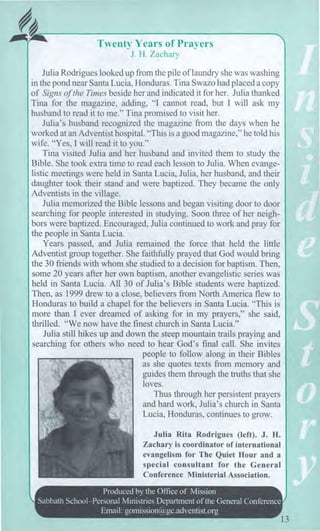
Julia Rodrigues looked up from the pile of laundry she was washing
in the pond near Santa Lucia, Honduras. Tina Swazo had placed a copy
of Signs of the Times beside her and indicated it for her. Julia thanked
Tina for the magazine, adding, "I cannot read, but I will ask my
husband to read it to me." Tina promised to visit her.
Julia's husband recognized the magazine from the days when he
worked at an Adventist hospital. "This is a good magazine," he told his
wife. "Yes, I will read it to you."
Tina visited Julia and her husband and invited them to study the
Bible. She took extra time to read each lesson to Julia. When evange-
listic meetings were held in Santa Lucia, Julia, her husband, and their
daughter took their stand and were baptized. They became the only
Adventists in the village.
Julia memorized the Bible lessons and began visiting door to door
searching for people interested in studying. Soon three of her neigh-
bors were baptized. Encouraged, Julia continued to work and pray for
the people in Santa Lucia.
Years passed, and Julia remained the force that held the little
Adventist group together. She faithfully prayed that God would bring
the 30 friends with whom she studied to a decision for baptism. Then,
some 20 years after her own baptism, another evangelistic series was
held in Santa Lucia. All 30 of Julia's Bible students were baptized.
Then, as 1999 drew to a close, believers from North America flew to
Honduras to build a chapel for the believers in Santa Lucia. "This is
more than I ever dreamed of asking for in my prayers," she said,
thrilled. "We now have the finest church in Santa Lucia."
Julia still hikes up and down the steep mountain trails praying and
searching for others who need to hear God's final call. She invites
people to follow along in their Bibles
as she quotes texts from memory and
guides them through the truths that she
loves.
Thus through her persistent prayers
and hard work, Julia's church in Santa
Lucia, Honduras, continues to grow.
Julia Rita Rodrigues (left). J. H.
Zachary is coordinator of international
evangelism for The Quiet Hour and a
special consultant for the General
Conference Ministerial Association.
Produced by the Office of Mission
Sabbath School—Personal Ministries Department of the General Conference
Email: gomission@gc.adventist.org
13
Lesson 2 *July 7-13
The Sabbath
Sabbath Afternoon
I
n Genesis, the first thing that God declared holy is not a place or a
thing—but a block of time, the seventh day (Gen. 2:3). Though
Creation dealt with earthly things (such as birds, the seas, and
people), it was time, not space, that God first made holy. And that's
because, besides space, time is the dimension in which earthly things
(birds, the seas, and people) exist. Also, because the Sabbath exists in
time, not space, no one has to seek it; Sabbath always comes to them,
every week and without exception. Earthly things, such as shrines or
holy places, can be destroyed; the Sabbath, lodged firmly in time, can't
be. And finally, people can avoid holy things and holy places, but
the Sabbath always finds them. No matter how fast or furiously they
flee—the seventh day (and all that it contains) always catches them.
Skipping over no one, and yet beyond the destructive grasp of all,
the Sabbath stands as an indestructible memorial of God's creative
and redemptive work for the human race. As the prime symbol of our
roots, the Sabbath helps tell us who we are, why we are here, and
where we are ultimately going—all in just a mere twenty-four hours!
THE WEEK AT A GLANCE: Why is the Sabbath so important?
Why does even the Old Testament teach that it's not just for the
Jews? In what ways does Sabbath point to redemption? What
does Jesus teach us about the Sabbath? This week's lesson looks
at these questions—and more.
MEMORY TEXT: "By the seventh day God had finished the
work he had been doing; so on the seventh day he rested from all
his work. And God blessed the seventh day and made it holy,
because on it he rested from all the work of creating that he had
done" (Genesis 2:2, 3, NIV).
*(Please study this week's lesson to prepare for Sabbath, July 14).
14
Sunday July 8
FOUNDATION OF CREATION (Gen. 1:1).
R3
ead the first verse of the Bible and notice what it is not about:
It's not about salvation, it's not about redemption, it's not
bout what did (or did not) happen at the cross, it's not about
the Second Coming, nor is it about life in the earth made new.
Instead, it's about one thing and one thing alone: God as our Creator.
Perhaps the reason the Bible begins with Creation, as opposed to
these other truths, is that all these other truths—salvation, redemp-
tion, the Second Coming—no matter how crucial, make no sense
apart from these words: "In the beginning God created the heaven
and the earth." This is not to say that Creation is more important than
these other beliefs; it is to say, however, that these other beliefs are all
rooted in Creation, and these truths can have no real meaning for us
apart from the fact that God did create us.
Take a few minutes to think about some of the most basic
doctrines we hold, such as salvation, redemption, the Cross, and
try to understand them apart from the reality of God as our
Creator. What meaning can they have in a universe that was not
created by God but by chance alone?
Because Creation is so important, so fundamental to all that we
believe as Christians, no wonder the Sabbath—God's indestructible
memorial to that Creation—is so important as well. The Lord wants
to remind us, every single week, that we are here, not by chance, not
by accident, but because He created us.
The Sabbath is that weekly reminder (Exod. 20:8-11). As long we
keep that day the way He intends us to, we are never in danger of
forgetting our roots. So important is that message that we are
commanded to dedicate one seventh of our lives to remembering it.
The Sabbath isn't about a day; it's about us being reminded—every
week!—of the most fundamental and basic truth about our existence,
which is that we are beings purposely created by God.
Think of other reasons the doctrine of special Creation is so
important that God gave us this weekly reminder of it. Take a
moment to jot down your thoughts.
15
Monday July 9
THE BOOK OF EXODUS AND THE SABBATH (Exod. 16:4, 5,
13-30).
Read the account of the manna in Exodus 16, dwelling on just
how seriously the Lord expected His people to take the Sabbath
commandment.
M
any people believe that God revealed the Sabbath for the
first time at Sinai and that, thus, it's only for the Jews, not
the entire human race. Scripture, however (Exod. 16:4, 5,
13-30) shows just how wrong that teaching is, because here we see
the Hebrews being told to keep the Sabbath even before Sinai.
Also, considering that the Sabbath is a memorial of Creation, and
because all humans, whatever their nationality, exist as a result of
that Creation, why would the Lord limit that memorial to just one
people? If it were possible to find a group whose origins didn't trace
back to Eden, then perhaps that argument would hold, but because no
group of people like that exists, it makes sense that the Sabbath is for
all those whom God created. Jewish philosopher Martin Buber wrote
that because it is "rooted in the very beginning of the world itself,"
the Sabbath "is the common property of all, and all ought to enjoy it
without restriction."
Imagine talking with someone arguing that the Sabbath was
only for the Jews. How would the following verses help you reply?
Gen. 2:2-4; James 2:10, 11; 1 John 5:2; Rev. 14:12. What others
can you find to show the universality of the Sabbath?
Though the Sabbath was created for all humanity, through apos-
tasy it was lost, and when the Lord brought Israel out of Egypt, the
Sabbath became a specific sign (Exod. 31:12-18) between Him and
the Hebrew nation, who were to proclaim the truth about God to the
world. Included in that truth was the Sabbath, a sign of their covenant
relationship with Him. Yet even in this context, that of Israel's special
mission, look at what the Lord wrote about the Sabbath: "It is a sign
between me and the children of Israel for ever: for in six days the Lord
made heaven and earth, and on the seventh day he rested, and was
refreshed" (verse 17, emphasis supplied). Even here the Sabbath is
tied to the Creation week.
Write down the various ways in which the Sabbath strength-
ens your walk with the Lord. Share that list with someone who
doesn't keep the Sabbath. How could you present it to show just
what a blessing it is for all—Jew or Gentile—who keep it?
16
Tuesday July 10
THE SABBATH AND SALVATION (Isa. 56:1-7).
Read the wonderful words of the Lord through the pen of
Isaiah in chapter 56, verses 1-7. In the context of yesterday's
lesson, about the Sabbath not being limited only to the Jews, what
truths are taught here as well?
1
saiah clearly shows that a saving relationship with the Lord
wasn't limited only to the Jews, but to all who would "join
themselves to the Lord." Isaiah reveals that righteousness, salva-
tion, and eternal life were for the Gentiles as well. "And the Gentiles
shall come to thy light, and kings to the brightness of thy rising" (Isa.
60:3). And because salvation is for everyone, the Sabbath is for
everyone, too.
Besides being a sign of Creation, the Sabbath is a sign of redemption,
which ultimately leads to a new creation, a new existence. The same
God who first created the world will, one day, create it again. That's His
promise (see Isa. 65:17; Isa. 66:22; 2 Pet. 3:13; Rev. 21:1).
Find other Old Testament texts stating that the gospel was to
go to all nations, not just the Jews. Examples are Isaiah 62:2,
Zecheriah 8:23, and Isaiah 52:10.
What we see in Isaiah 56:1-7 is the essence of the Adventist
message, only a few thousand years before we started preaching it.
Isaiah shows, not only the need to proclaim the gospel to the world
(such as in the first angel's message of Revelation 14:6), but that the
Sabbath—one of the commandments of God as expressed in the third
angel's message of Revelation 14:12—is tied in with that message of
salvation. Here, again, in the Old Testament, the notion of the
Sabbath being only for the Jews is dispelled. If redemption is for
everyone, the Sabbath is, too.
Besides being a symbol of Creation and even re-creation, in
what other ways does the Sabbath symbolize God's work of
salvation in our behalf? Hint: God rested on the Sabbath day
because His work was complete.
What does it mean to say that Christ's work for us was
complete, and what does that "complete" work mean for us
personally? How do we understand this "complete" work in
relation to His high priestly-ministry?
17
Wednesday July 11
JESUS AND THE SABBATH (Mark 2:27, 28; Luke 4:16; Matt.
12:12, 13).
T
here's great irony in the common argument heard against the
Sabbath, which is that Jesus abolished or changed it. After
looking at how Christ related to the Sabbath, it's hard to see
how anyone can come to that conclusion. On the contrary, nothing
Jesus said or did regarding the Sabbath ever implied that it was
abolished or changed. Christ's battles with the Pharisees were never
over which day was to be kept or whether it was even still to be kept.
The battles, instead, were over how it was to be kept. The logical
question would be: Why would Jesus wrestle with the religious lead-
ers over Sabbath keeping if He planned for the Sabbath to be abol-
ished or changed to another day?
D.A. Carson, a Christian scholar opposed to the Adventist posi-
tion on the Sabbath, nevertheless wrote in a book that: "There is no
hint anywhere in the ministry of Jesus that the first day of the week is
to take on the character of the Sabbath and replace it." (D. A. Carson,
ed. From Sabbath to Lord's Day: A Biblical, Historical, and Theo-
logical Investigation [Grand Rapids, Mich.: 1982] p., 85.)
Go through some of the texts (Matt. 12:1-14; Mark 2:23-28;
Mark 3:2-5; Luke 6:1-6) that show Jesus interacting with the
religious leaders over the Sabbath. Study for yourself what the
issues really were. See if you can find even one hint, anywhere,
that Jesus was changing the Sabbath day.
Why did the Pharisees have such a problem with Jesus
healing others on the Sabbath day? Perhaps the reason is
that the Jews saw the Sabbath as a sign of the Messianic era,
what we as Adventists would call the new earth. The Sab-
bath, the Jews believed, was a small taste of the olam haba,
the world-to-come. Their theology taught that anything that
would not be done in this world-to-come should not be done
on the Sabbath, a foretaste of this future time. And because
there would be no sickness in this new world, there would
be no healing. For this reason, perhaps, they viewed Jesus'
act of Sabbath healing as sinful.
Look at Jesus and how He kept the Sabbath. What principles
can we learn from Him that can help us enrich our experience
with God through obedience to this commandment?
18
Thursday July 12
THE SABBATH AND THE SANCTUARY (Exod. 31:12-18; Rev.
11:19).
What relationship existed between the Sabbath and the earthly
sanctuary? Exod. 31:12-18; 40:20-23.
G
od wrote the Ten Commandments on tables of stone, signify-
ing the permanence and importance of His moral law. He then
directed that they be placed in the ark of the covenant. The
ark was kept in the Most Holy Place of the sanctuary, which repre-
sented God's own dwelling place. The Sabbath, along with all the
other commandments, was enshrined in the sanctuary under the
mercy seat, which symbolized the throne of God.
What relationship exists between the Sabbath and the heav-
enly sanctuary? Rev. 11:19.
Revelation 11:19 talks about the "ark of his testament," another
name for the "ark of the covenant," a reference to the chest in the Most
Holy Place of the earthly sanctuary service. Because the heavenly
sanctuary is the model for the earthly, Revelation 11:19 (by pointing to
the ark of the covenant) directs the Bible student not only to the law of
God, but to the sanctuary, specifically to the Most Holy Place. And
because all the law, including the Sabbath, was in the Most Holy Place of
the earthly model, the vision of the heavenly one also points directly to
the commandments of God and, indirectly, to the Sabbath.
"John's vision of the ark above argues eloquently that in earth's
last hours God's great moral law is to be central in the thinking
and in the lives of all who seek to serve God in spirit and in
truth. "—The SDA Bible Commentary, vol. 7, p. 806.
Atheist Jean-Paul Sartre wrote that if there were no God,
"everything would be permissible." If we existed only by chance,
with no God as Creator, then, Sartre wrote, there is no "possiblity
of finding values" in this world. Following this line of thought,
some have argued that the Sabbath commandment is the one
commandment which shows why we should keep all the others
because it points us back to God, who alone forms the founda-
tion for moral actions. Discuss this idea.
19
Friday July 13
FURTHER STUDY: Read "The Sabbath," The Desire of Ages,
pp. 281-289.
T
he Sabbath was hallowed at the Creation. As ordained for man,
it had its origin when 'the morning stars sang together, and all
the sons of God shouted for joy.' Job 38:7. . . . The Sabbath
was not for Israel merely, but for the world. It had been made known
to man in Eden, and, like the other precepts of the Decalogue, it is of
imperishable obligation. Of that law of which the fourth command-
ment forms a part, Christ declares, 'Till heaven and earth pass, one
jot or one tittle shall in no wise pass from the law.' Matt. 5:18. So
long as the heavens and the earth endure, the Sabbath will continue
as a sign of the Creator's power. And when Eden shall bloom on
earth again, God's holy rest day will be honored by all beneath the
sun. 'From one sabbath to another' the inhabitants of the glorified
new shall . . . 'worship before me, saith the Lord.' "—Ellen G.
White, The Faith I Live By, p. 37.
DISCUSSION QUESTIONS:
1. Why would Sunday rest not be equal to Sabbath rest, even
if one were to keep it just as carefully as the Sabbath?
2. Why is the Sabbath important to the great controversy
theme? Why are many people prejudiced against the Sab-
bath? How can we best share the good news of the Sabbath
with our friends?
SUMMARY: This week's lesson brought out a number of crucial
points: First, the Sabbath points us back to Creation, the starting
point of all that we believe. Without the doctrine of Creation, nothing
we hold as Christians makes sense. Second, because the Sabbath is so
foundational, it belongs to everyone, not just the Jews. Third, Sab-
bath is a sign not only of creation but of redemption, and because
redemption is for all the world, the Sabbath is, too. Fourth, Jesus by
His life and teachings affirmed the importance of the Sabbath. Fi-
nally, the reality of the heavenly sanctuary and Christ's high-priestly
ministry in heaven adds more validity to the Sabbath truth. In short,
by keeping the Sabbath we're on solid biblical ground, as solid and
firm as Creation itself, in fact.
20
Where Lies Truth, part 1
Charlotte Ishkanian
Jin Jiang grew up in China. His family had no religion. But one
day his mother met an old friend and was amazed at how healthy
she looked. She had always been sickly. "What is your secret?"
Jin's mother asked her friend.
"I have found Jesus Christ!" the other woman said. Because of
her friend's influence, Jin's mother decided to try attending church.
Maybe this Jesus could heal her health problems, too.
Jin did not go with his mother to church, but he listened as she
told him what she was learning about Jesus. Perhaps I should seek
after God for my own good, Jin thought.
Jin began to attend church with his mother. As Jin's knowledge
about God grew, so did his faith.
Jin met one of his friends, Zhu, at church. Zhu told him about a
house church he had visited and invited Jin to attend. Jin still had
some questions about religion that no one had answered, so he
accepted Zhu's invitation.
Jin was impressed with the way the house-church believers
studied the Bible in detail. Things that had puzzled him became
clear. When the group studied the Sabbath, Jin wondered why, if
the Sabbath is Saturday, Christians keep Sunday holy. More and
more Jin was drawn to the little group of believers.
Jin and Zhu often talked about the differing beliefs of the two
religious groups. Ironically, Jin leaned more toward the Sabbath
keepers' position, and Zhu leaned toward the Sunday church. The
pastor of the Sunday church had offered to train Zhu for a leader-
ship position, and his friend did not want to lose that privilege.
One day as Jin and his friend were discussing religion, Zhu
surprised him. "You Adventists!" he said. "You have only a hand-
ful of believers. But the Christian (Sunday) church is filled every
week!" Zhu was associating large numbers of believers with cor-
rect doctrine. But Jin's only answer was to point to the command-
ments of God.
"I will bring you some books to read," Zhu offered. "They will
straighten you out!" With that the two went their separate ways.
(continued next week)
Jin Jiang is a Chinese Adventist. Charlotte Ishkanian is editor of
Mission.
Produced by the Office of Mission
Sabbath School—Personal Ministries Department of the General Conference
Email: gomission@gc.adventist.org
21
Lesson 3 *July 14-20
The Sabbath The Sign of
Our Relationship With God
Sabbath Afternoon
S
ACRED HOURS. The Sabbath might be a mere one day per
week, but God has packed a lot of truth into those sacred hours.
The day exudes truth—truth about who we are, who God is,
and, most important, what He has done for us in the person of His
Son, Jesus Christ.
Thus, there's nothing worse we could do to the Sabbath than turn
it into a weekly edifice of dry, legalistic drudgery. How clever of the
devil to take one of the most clear and explicit signs of the gospel and
make it into an expression of humankind's futile attempts to save
themselves. We'd almost be better off not keeping the day than
keeping it as a self-righteous paean to human works. Despite the bad
publicity often linked to the seventh-day Sabbath, this sacred day is,
more than anything, about God's works, not our own. Sabbath is the
one day we're told, specifically, not to work. The symbolism is
profound.
This week we'll see just what's really in the seventh day that's not
in any other.
THE WEEK AT A GLANCE: Why did God choose the seventh
day over any other for the Sabbath? Does it really matter which
day we keep? What spiritual lessons are contained in the Sab-
bath? What does the day signify in regard to what God has done
for us, and even in us?
MEMORY TEXT: " 'And also I gave them My sabbaths to be a
sign between Me and them, that they might know that I am the
Lord who sanctifies them' " (Ezekiel 20:12, NASB).
* (Please study this week's lesson to prepare for Sabbath, July 21).
22
Sunday July 15
THE SABBATH—THE ARBITRARY DAY? (Gen. 2:2, 3; Exod.
20:8-10; Exod. 35:2; Heb. 4:4).
p
erhaps you've heard a pastor or a member from another de-
nomination claim: "Sure, I believe in obeying the fourth com-
mandment. But I take Tuesdays as my Sabbath day, because
that's the most convenient time for me."
Though one can be thankful these people even acknowledge a
Sabbath day, there's a fundamental flaw in that thinking. God didn't
specify the third day of the week or the first day or any other day to be
kept holy. He said, specifically, the seventh day. God chose it, and no
other, as the day of rest.
What reason could people have for thinking that, despite the
clear command of God, the day itself doesn't matter, as long as a
person keeps one day as the Sabbath?
For years Bible students have noticed the apparent arbitrariness of
the seventh day. In other words, there seems to be no logical reason
for the seventh day to be chosen as the Sabbath, as opposed to any
other. Unlike the daily, monthly, or yearly cycle, the seventh day is
entirely independent of celestial motions. Nothing in nature gives the
seventh day any practical significance over the first or third or any
other day. Yet that's the day God specifically chose.
"As the Christian takes heed of the Sabbath day and keeps
it holy, he does so purely in answer to God's command, and
simply because God is his Creator. Thus, the Sabbath com-
mand comes nearer to being a true measure of spirituality
than any other of the commandments, and, as in the days of
Israel of old, it is often more a test of loyalty to God than is
any of the others."—Raoul Dederen, quoted in The Sab-
bath in Scripture and History, edited by Kenneth Strand
(Washington, D.C.: Review and Herald), p. 302.
Unlike the commands against stealing, killing, and adultery,
which have very practical moral results (and which even athe-
ists often follow), the only reason to keep the Sabbath is that
God has told us to. Why do you think, then, that the apparent
arbitrary nature of the Sabbath, far from giving a person lee-
way to choose whatever day he or she wants, instead compels us
to obey it as commanded?
23
Monday July 16
THE SABBATH—THE SIGN OF DELIVERANCE (Deut. 5:12-
15).
Compare the Sabbath commandment as expressed in Exodus
20:8-11 and in Deuteronomy 5:12-15. What major difference do
you see?
H
ow fascinating that in these two incidents the Sabbath com-
mandment is linked to different events. In the Exodus ac-
count the seventh-day Sabbath is tied specifically to God's act
of creating the world; in Deuteronomy the Sabbath is linked not to
Creation but to the Israelites' deliverance from slavery in Egypt. A
close comparison of the texts shows that in both cases their servants
are to rest on the Sabbath. In Deuteronomy, the words about the
servants remind the Hebrews of their bondage in Egypt. Thus, just as
they were given "rest" from their work, they needed to give their
servants rest, as well.
There's even a deeper issue than allowing their servants to rest
on Sabbath. The Hebrews' deliverance from Egypt has been seen
as an example of a greater deliverance. Read 1 Corinthians 10:
1-6. What do these verses teach regarding lessons that God wants
us to learn, using the Exodus from Egypt, about being delivered
from the wages of sin? What do the following texts say that we
have been delivered from?
Rom. 8:21
2 Cor. 1:10
Col. 1:13
1 Thess. 1:10
In Deuteronomy the linking of the Sabbath commandment with
deliverance from slavery simply adds another dimension to Sabbath
keeping, apart from creation alone. Because creation is linked to
redemption, Deuteronomy shows how the Sabbath reminds us that
the same God who created us has redeemed us as well.
If the Sabbath is to remind us of our deliverance, how can
you use the day to reinforce in your own mind what things
Christ has delivered you from personally? Why is it important
to remember these things?
24
Tuesday July 17
THE SABBATH—SIGN OF SALVATION.
"There remaineth therefore a rest to the people of God. For he
that is entered into his rest, he also hath ceased from his own
works, as God did from his. Let us labour therefore to enter into
that rest, lest any man fall after the same example of unbelief"
(Heb. 4:9-11).
I
t took a Creator to bring about creation, and it took the same
Creator to bring about redemption (Col. 1:14-16; Heb. 1:2, 3). As
the Lord celebrated His finished work of Creation by setting
apart the Sabbath and making it holy, so He celebrates His work of
redemption for us by making the same Sabbath a sign of that
redemption.
This is the link between the weekly Sabbath and righteousness by
faith. Just as Creation was a work that was done for us, salvation is the
same. It is what God does for us; it can never be what we do for
ourselves. The Sabbath helps show the source of our righteousness to
be God, nothing else, and certainly not our works. The Sabbath also
reminds us that just as we have not created ourselves, we cannot
redeem ourselves.
What does Hebrews 4 mean when it talks about us ceasing
from our works? Does a person who accepts Christ stop doing
good works? (See Eph. 2:10; Matt. 5:16; 1 Tim. 6:18; 2 Tim. 3:17;
Titus 2:7; Heb. 10:24.) Or does it mean ceasing from seeking
salvation from our works? What does a person saved by faith rest
from, if not good works?
"To all who receive the Sabbath as a sign of Christ's
creative and redeeming power, it will be a delight. Seeing
Christ in it, they delight themselves in Him. The Sabbath
points them to the works of creation as an evidence of His
mighty power in redemption. While it calls to mind the lost
peace of Eden, it tells of peace restored through the Sav-
iour."—The Desire of Ages, p. 289.
How does our rest on Sabbath reflect the peace we have
through salvation in Jesus Christ? See Romans 5:1. Could that
peace really exist if it were dependent upon ourselves? What
practical ways can you express the hope and joy that we have
because of what Christ has done for us?
25
Wednesday July 18
THE SABBATH—THE SIGN OF SANCTIFICATION.
Read Exodus 20:8, along with Leviticus 20:7 and 1 Peter
1:15, 16. What do these verses have in common?
G
od tells us to keep the Sabbath holy (Exod. 20:8). But in order
to do that, we ourselves must be holy. How can people,
themselves unholy, keep a day holy? They can't.
Thus, it's clear: God calls us to holiness. Both the Old and the
New Testament testify to this sacred call. Peter even refers to the New
Testament church as a holy nation: "But ye are a chosen generation, a
royal priesthood, an holy nation, a peculiar people" (1 Pet. 2:9).
That holiness, however, is something that only God can do in us.
We need to learn how to cooperate with the Lord in order that He can
make us into the kind of people who can indeed keep His Sabbath
holy. And the Sabbath is a sign of that holiness.
"Speak thou also unto the children of Israel, saying, Verily my
sabbaths ye shall keep: for it is a sign between me and you
throughout your generations; that ye may know that I am the
Lord that doth sanctify you" (Exod. 31:13; see also Ezek. 20:12).
What do these verses reveal about the link between the Sabbath
and sanctification?
The word in both these texts for "sanctify" comes from the same
Hebrew word as "holy." They could have just as easily been trans-
lated "that you may know that I am the Lord who makes you holy."
The Sabbath, therefore, isn't just a sign of justification, of the work
that God has done for us; it also symbolizes what He wants to do in
us, also known as sanctification. Because the whole plan of redemp-
tion involves restoration, the Sabbath, a symbol of the Creation and
re-creation, symbolizes God's creative power working in us, restor-
ing us to what God wants us to be. Look at 2 Corinthians 5:17 and
Galatians 6:15. That work, of course, will be completed only at the
Second Coming, but the process, that of our sanctification, is going
on even now.
Though we certainly can no more sanctify ourselves on our
own than we can justify ourselves, we can cooperate with the
Lord, who alone can make us holy. In what ways does keeping
the Sabbath help us cooperate in that process? Look at your
own Sabbath-keeping experience, and ask yourself if, in fact,
you are really keeping the day "holy" as commanded.
26
Thursday July 19
THE SABBATH—THE SIGN OF LOYALTY (Rev. 14:1-12).
S
eventh-day Adventists believe that the book of Revelation
teaches that the Sabbath commandment will play a special role
in last day events. It will be, in a sense, a "test" of our loyalty to
God. Yet that won't be the first time the Sabbath has been a test.
Look again at Exodus 16, the story of the manna and the
Sabbath. What verse in particular shows that loyalty to God was
tested by a willingness to obey the Sabbath commandment?
Read carefully the first angel's message (Rev. 14:6, 7). The call to
worship "him that made heaven, and earth, and the sea, and the
fountains of waters" introduces a clear link to the Sabbath command-
ment, even if the language isn't exactly as in Exodus 20 (Revelation
never directly quotes the Old Testament). What makes this link even
more crucial is that the dividing issue in the last days will center on
worship: People will worship either the One " 'who made the heavens,
[and] the earth'" (Rev. 14:7, NIV) or they will worship the "image of
the . . . beast" (Rev. 13:15, KJV). And because we want to worship
only our Creator, and because the Sabbath was instituted to remind us
of that Creator, it's not unreasonable that the Sabbath will play a big
role in the climax of earth's history.
"The Sabbath will be the great test of loyalty, for it is the
point of truth especially controverted. When the final test
shall be brought to bear upon men, then the line of distinc-
tion will be drawn between those who serve God and those
who serve Him not. While the observance of the false
Sabbath in compliance with the law of the state, contrary to
the fourth commandment, will be an avowal of allegiance
to a power that is in opposition to God, the keeping of the
true Sabbath, in obedience to God's law, is an evidence of
loyalty to the Creator."—The Great Controversy, p. 605.
Read carefully through the three angels' messages in Rev-
elation 14:1-12. What verse in particular also adds biblical
proof to our position regarding the Sabbath?
27
Friday July 20
F
URTHER STUDY: Read Psalm 92, which is a song for the
Sabbath day. Why is this an appropriate song for the Sabbath?
Where in the psalm do you find a link between Creation and
God's redemption?
Also read "The Creation," Patriarchs and Prophets, pp. 44-51; "A
Work of Reform," The Great Controversy, pp. 451-460.
"By communing with God, we actually partake of His holiness. Thus
because its hours are filled with intimate fellowship between man and
God, the Sabbath becomes the sign, the epitome, of the entire life of
sanctification.
"God has placed a glorious opportunity and privilege before us. In
a special way on Sabbath we may put aside our daily work and
participate in deep personal communion with the Holy One of Israel,
and in that intimate relationship become changed more and more
into His likeness."—Richard Davidson, A Love Song for the Sabbath
(Hagerstown, Md: Review and Herald Pub. Assoc., 1988), p. 89.
DISCUSSION QUESTIONS:
1. How can keeping the Sabbath be an expression of our trust
in God's promises to provide for our basic needs? In other
words, even though we could earn more money if we worked
on Sabbath, we're commanded not to. Thus, keeping Sab-
bath requires faith. Discuss.
2. How can we guard against a legalistic understanding of the
Sabbath? List ways we can help children and young people
understand the true meaning of the Sabbath and enjoy this
special 24-hour time period.
3. Read carefully Hebrews 4:1-11. What specific issues are
being discussed there? How does the author portray the
Sabbath? What kind of rest is being talked about there?
4. Someone once wrote about a farmer who hoed on the Sab-
bath day. The damage, the author wrote, appeared not in
the farm, but in the farmer himself! What do you think that
means?
SUMMARY: We keep the seventh-day Sabbath, as opposed to any
other day, because God commanded it. The Sabbath is a symbol of
deliverance, of justification, of sanctification, and of our loyalty to
Him. With so much packed into the Sabbath, no wonder we deem it
so crucial. After all, if God thinks it's so important, we should, as
well.
28
At^
Where Lies Truth, part 2
Charlotte Ishkanian
Jin's friend Zhu had introduced Jin to the Adventists, who
worshiped in a house. He was challenged by the careful Bible
study he found there and began attending regularly. However, the
closer Jin drew to the Adventists, the farther Zhu drifted from
them. Finally Zhu cast his lot with the Sunday-keeping church, in
hopes that the pastor would train him for a leadership position.
"I'll bring you some books that will prove the Adventists wrong,"
he told Jin. Jin wondered whether his friend was right and he was
wrong. After all, Christianity was so new to him, and the books
were written by learned scholars.
That night he dreamed that he found some books in an eagle's
nest. He opened one and found it full of lies about God. He picked
up another and found it contained lies as well. When Jin awoke he
wondered what his dream meant. He decided to put his faith in
God rather than in dreams.
When Zhu arrived with the books, Jin could hardly contain his
surprise. The books Zhu carried were the same ones Jin had seen in
his dream. He did not want to take the books, but his friend
insisted. "I've gone to a lot of trouble to get these," Zhu said. "Are
you afraid you will lose confidence in your beliefs?"
Jin told Zhu that God had already shown him the books and told
him he should not read them. Under pressure, Jin finally took the
books, but instead of reading them, he took them to a member of
the house church and asked her how to answer the accusations in
the books. When she answered the accusations with Bible texts,
Jin was satisfied.
Jin returned the books to his friend
and urged him to obey God's laws
rather than man's rationales. But his
friend refused. Jin studied the Bible
with the members of the house church
and was baptized. He rejoices that God
loves him enough to warn him of false
teachings.
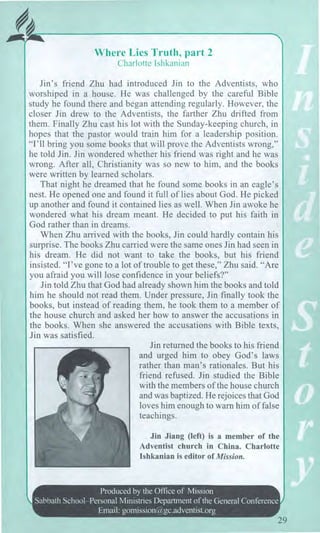
Jin Jiang (left) is a member of the
Adventist church in China. Charlotte
Ishkanian is editor of Mission.
Produced by the Office of Mission
Sabbath School—Personal Ministries Department of the General Conference
Email: gomission@gc.adventist.org
Lesson 4 *July 21-27
Keeping the Sabbath Holy
Sabbath Afternoon
T
HE SABBATH BLESSING. The Jews have a saying: "More
than Israel kept the Sabbath—the Sabbath kept Israel." Though
somewhat exaggerated, the point is well made. There's a
blessing in the Sabbath, not in the day itself but in the blessing that
God has placed in it. By keeping the Sabbath, we partake of that
blessing. Only those who obey the commandment can know just how
rich, deep, and real that blessing is. Those who keep the Sabbath
understand, too, how much, in a sense, it "keeps" them.
Though in the past two weeks we have looked at some theology of
the Sabbath, and the reasons we keep it, this week's study looks at
how to keep it, and the blessings that come from doing so.
THE WEEK AT A GLANCE: What is Sabbath preparation all
about? Is it just doing the cleaning and the cooking, or is there
something deeper? How does the Sabbath help us enhance our
relationships with other people? With God? The Bible tells us to
delight in the Sabbath. What does that mean? Lord willing, by
the end of the week, after you study this lesson, your next Sabbath
will be the best one yet!
MEMORY TEXT: " 'If you keep your feet from breaking the
Sabbath and from doing as you please on my holy day, if you call
the Sabbath a delight and the Lord's holy day honorable, and if
you honor it by not going your own way and not doing as you
please or speaking idle words, then you will find your joy in the
Lord, and I will cause you to ride on the heights of the land and to
feast on the inheritance of your father Jacob.' The mouth of the
Lord has spoken" (Isaiah 58:13, 14, NIV).
*(Please study this week's lesson to prepare for Sabbath, July 28).
30
Sunday July 22
PHYSICAL PREPARATION FOR THE SABBATH (Mark 15:42;
Luke 23:54; John 19:31).
T
hese three verses, though all referring to the day of preparation
prior to the Sabbath, don't give many details regarding the
practical aspects of the day. The Bible really doesn't give us
much information on how to prepare. However, because the Sabbath
is a day of rest, and we are commanded not to work on that day, it
seems logical that the day of preparation should be one that enables
us to keep the Sabbath most effectively as commanded.
List a few things that one can do on the preparation day that
would best help a family obey the commandment to rest on the
seventh day.
"God requires that His holy day be as sacredly observed
now as in the time of Israel. The command given to the
Hebrews should be regarded by all Christians as an injunc-
tion from Jehovah to them. The day before the Sabbath
should be made a day of preparation, that everything may
be in readiness for its sacred hours."—Patriarchs and
Prophets, p. 296.
Following are some ideas on how to prepare for the Sabbath.
What might you add to the list?
1. Each family member should have a specific responsibility in
preparing for the Sabbath. Even younger children may perform work
suitable for their age and ability. Such involvement prevents the work
load from falling on one person.
2. So that there is not so much to do on Friday, it is a good idea to
spread some of the preparation throughout the week.
The Jews, for thousands of years, have viewed the Sabbath,
including the preparation, as a family affair. Think of the
benefits of the family working together to prepare for the Sab-
bath. What can you do in your own home to make the Sabbath
not only a joy but the preparation a joy, as well?
31
Monday July 23
SPIRITUAL PREPARATION FOR THE SABBATH (Isa. 58:12-
14).
0
ur physical preparation for the Sabbath isn't an end in itself;
it should lead us to a deeper spiritual experience with the
Lord. If, on Sabbath, we are freed from the mundane aspects
of daily life, we should, ideally, be in a better situation to commune
with God. That's so much of what Sabbath is about. If obeying the
fourth commandment doesn't strengthen our walk with the Lord,
we're not keeping the Sabbath holy; we're merely taking a day off
from work.
Anyone can "observe" the Sabbath, but it takes the six other
days of the week to help make the seventh holy. List some practi-
cal things that we can do, not just on Friday, but all week, that
can help us prepare spiritually for the Sabbath day.
In Isaiah 58:1-13 the Lord connects works of kindness, mercy, and
sacrifice with the Sabbath. The first verses deal with helping those in
need; the text then immediately jumps into the Sabbath. Could the
Lord be saying that the quality of our daily work and how we treat
people during the week have a direct bearing on the quality of our
spiritual rest on the Sabbath? If our work and relationships during
the week have little or no spiritual foundation, how will we be able to
experience to the fullest the spiritual benefits of the Sabbath?
Jesus was condemned by people who then ran home to keep
the Sabbath. What lesson does this teach us about how little
the Sabbath can mean if our hearts are not right with God?
Sabbath preparation is for welcoming not just a day but the Lord of
the day. This preparation isn't something that is done just on Friday
afternoon alone. It should be done all week. By dwelling on the
Sabbath and the truth that it contains, a person can prepare for a
special wonderful experience with the Lord that he or she can't have
any other day.
Though our weeks are busy with work, what practical things
can you do on Friday, as the Sabbath draws near, that can help
you be better prepared spiritually for the Sabbath day?
32
Tuesday July 24
THE SABBATH—A DAY FOR RELATIONSHIPS (Exod. 20:8-
11).
What relational elements does the fourth commandment sug-
gest? Exod. 20:8-11; Deut. 5:15-21.
T
he first three commandments of the Decalogue encourage a
right relationship with God; the last six encourage a right
relationship with other people. In between the first three and
the last six is the fourth, the Sabbath commandment. Therefore, the
Sabbath links our relationship with God to our relationship with
humanity.
How does this link fit with the words of Jesus regarding what
He called the two greatest commandments? See Mark 12:30, 31.
Because of its double focus, both on the divine and the human, the
Sabbath commandment has been called the "hinge" of the law tables.
It holds together not just the two tablets but the two foci of human
relationships, our relationship to God and to fellow human beings.
How might the Sabbath enrich and deepen the following rela-
tionships? (a) husband-wife relationships; (b) parent-child rela-
tionships; (c) member-to-member relationships; (d) relationships
with nonmembers.
While the Sabbath enriches our relationship with God, it also
gives us practical opportunities to gather with friends and family in
more meaningful ways than one would have without a Sabbath each
week. If we're not working, not fixing the roof, not allowing earthly
world demands to consume our time on this day, we will have
opportunities for revitalizing our relationships with other people if
for no other reason than we will simply have the time to spend with
them.
Good relationships don't just happen. They need to be worked
at. Often time together can do more to strengthen relationships
than anything else, which is one reason, no doubt, why God gave
us the Sabbath. Yet unless we take advantage of this special
opportunity, those twenty-four hours will pass by us as nothing
but another day. Think about how you could use the precious
gift of the Sabbath to strengthen your relationships with others.
33
Wednesday July 25
CALLING THE SABBATH A DELIGHT (Part 1).
"If thou turn away thy foot from the sabbath, from doing thy
pleasure on my holy day; and call the sabbath a delight" (Isa.
58:13).
S
eventh-day Adventists have often struggled with the question
How do we keep the Sabbath? After all, the commands against
stealing, killing, or worshiping idols are pretty clear. The Sab-
bath commandment, however, doesn't come with any built-in in-
structions. We're told to rest from all work, but even on Sabbath
everyone has to do some work, even if just putting a bowl of cereal on
the table for breakfast.
One thing the Bible does teach about the Sabbath is that however
individuals keep the day, it should be a good experience. In Isaiah
58:13 we are told to call the Sabbath a "delight." The word translated
"delight" comes from a Hebrew term oneg, which is rich and deep in
nuance. Oneg means something that is "soft, delicate, exquisite." It
appears in the next verse, Isaiah 58:14, which says to "delight thyself
in the Lord." It's also in Psalm 37:11: "But the meek shall inherit the
earth; and shall delight themselves in the abundance of peace." (Can
you see in this verse how the Sabbath should be a foretaste of the new
earth?)
How do you resolve that apparent contradiction in Isaiah 58:13,
which tells us to refrain from "thy pleasure" on the Sabbath day
and yet tells us to call the Sabbath a "delight"? Or is there even a
contradiction?
However one keeps the Sabbath, besides resting on it we are told to
call it oneg, "a delight." (The Jews often have what they call Oneg
Shabbat, a time of joyous fellowship at the synagogue.) In short, God
wants us to enjoy the Sabbath. It should be the high point of the week.
The best food, the best fellowship, the best of everything, should be
brought out on Sabbath. If we are not enjoying the Sabbath, if we
can't call it "a delight," then there's something wrong with how we
are keeping it.
How do you define your own Sabbath experience? Is the day
something you look forward to?
Is the Sabbath a "delight"? If not, what steps can you take to
change how you are keeping the holy day?
34
Thursday July 26
CALLING THE SABBATH A DELIGHT (Part 2).
"Then shalt thou delight thyself in the Lord; and I will cause
thee to ride upon the high places of the earth, and feed thee with
the heritage of Jacob thy father: for the mouth of the Lord hath
spoken it" (Isa. 58:14).
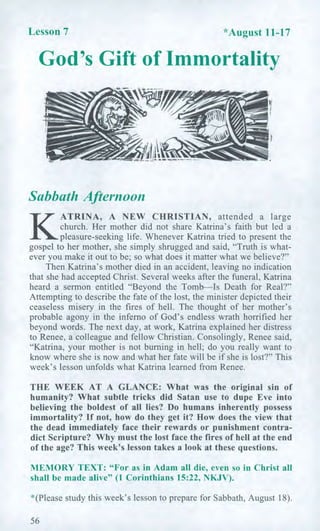
/
n Isaiah 58:13 God tells us to call the Sabbath a "delight," to keep
His holy day holy, and to honor Him. He asks us not to do our own
things, not to speak our own words—and not even do our own
"pleasure."
"If we call the Sabbath a delight, then shall we delight
ourselves in the Lord; he will more and more manifest
himself to us as the delightful subject of our thoughts and
meditations and the delightful object of our best affections.
. . . If we go about duty with cheerfulness, we shall go from
it with satisfaction and shall have reason to say, 'It is good
to be here, good to draw near to God.'—Isaiah 58:13-14" in
Matthew Henry's Commentary on the Whole Bible
(Hendrickson Publishers Inc., 1991), p. 1197.
What do you think it means when the text tells us not to seek
our own "pleasure"? It doesn't tell us not to have pleasure on the
Sabbath; it tells us not to do just our own pleasure. Where, in-
stead, would that pleasure come from?
Isaiah 58:14 lists the promises given to those who keep the
Sabbath. Write them down and think about what each one could
mean for us today.
The bottom line with the Sabbath is that, besides being a
commandment of God, it is also an experience. It's something
that we have to do in order to understand. Trying to explain the
Sabbath to someone who doesn't keep it is like trying to explain
the joy of salvation to an atheist. As Seventh-day Adventists, we
should delight in the Sabbath or, more important, in the Lord of
the Sabbath. What concrete steps could we take, not just as
individuals but as a church family, to help enrich and deepen
our Sabbath experience?
35
Friday July 27
FURTHER STUDY: Read Testimonies for the Church, vol. 6,
pp. 349-368.
A
t the approach of the Sabbath we indeed welcome Royalty.
The great King, the Almighty, comes to be with us—or better,
invites us to be with Him—for 24 hours of celebration and
fellowship. Does not this thought transform preparation for the Sab-
bath from a frenzy to keep a commandment to a joyous expectancy in
awaiting the arrival of a royal Guest? Does not such a concept trans-
form the observance of the Sabbath from a legalistic duty into an
exquisite delight?"—Richard M. Davidson, A Love Song for the Sab-
bath (Hagerstown, Md.: Review and Herald Pub. Assoc., 1988),
pp. 21, 22.
DISCUSSION QUESTIONS:
1. Because the Bible does not give details regarding how to
keep the Sabbath, there's been a lot of discussion, and
dissent, over how to keep it. For instance, any Orthodox
Jew would find even the strictest Adventist Sabbath keep-
ing a joke. Even within the church, some Adventists are
quite appalled at how some other Adventists keep the Sab-
bath. What guidelines, if any, should the church set for
Sabbath keeping? What dangers exist if the church at-
tempts to do that? On the other hand, what dangers exist if
the church doesn't set down guidelines?
2. Because the Sabbath is often a family affair, what can
parents do to help make it a happy time for children?
3. Share with class members some personal benefits that you
yourself derive from keeping the Sabbath.
SUMMARY: God tells us to delight in the Sabbath. But to do that we
first have to keep it. Both physical and spiritual preparation will
better enable us to do just that. Sabbath should be a joyous occasion
because it's there to help us strengthen our relationships, both with
the Lord and with other people. We should take advantage of that
time and use it as God has intended. Then not only will we be able to
call the Sabbath a "delight," but we will enjoy the other blessings that
God promises for those who "turn away thy foot from the sabbath."
36
The Happy Mechanic
J. H. Zachary
As a child Colin Kharkongor attended an Adventist school in
northeastern India. But Colin made no decision for Christ at that time.
During the intervening years God saved his life several times.
Colin recalls how he lost control of his jeep while driving on a lonely
road through a steep canyon. The jeep spun around and headed for the
cliff and certain death. Then Colin felt someone or something pull
him back.
On another occasion a gas cylinder exploded in Colin's auto repair
shop, spewing bits of metal through the air. But miraculously none of
the flying bits struck him or his workers.
When Colin heard that a foreign evangelist was holding meetings
near his home, he decided to attend. While attending the meetings
Colin felt the Holy Spirit touch his life, and he and his wife answered
the call and were baptized.
"I owe my life to Jesus," Colin says. "While I was still a Hindu, He
saved me." In response to God's providence, Colin has given his
energies to evangelism. During the week he works in his auto repair
shop, but his weekends belong solely to God.
On Friday afternoon Colin may travel by jeep as far as he can by
road, then hike an hour just to visit a few isolated Adventists in a remote
village. While there he looks for people in need of help or hope.
He visits people, makes friends, and gains permission from the
village chief to hold Bible meetings. But his greatest evangelistic
weapon is prayer.
Through his efforts as a self-supporting missionary, he has won
150 people to Christ. But he is quick to give the glory to God.
While visiting in one village he met Kong Ti Mai, an elderly
woman who had not walked for ten years. "Do you believe in Jesus?"
Colin asked her.
"Yes, I do," the elderly woman answered. "Can you pray for me?"
Colin prayed for the woman, and the Lord Jesus answered his
prayer. Kong Ti Mai can walk and is able to care for herself; she even
works in the rice fields with her neighbors. But her greatest joy is
working with her new Adventist friends.
During the week Colin Kharkongor is a happy mechanic; but he lives
for the weekends, when he can pursue his true love—evangelism.
J. H. Zachary is coordinator of international evangelism for The
Quiet Hour and a special consultant for the General Conference
Ministerial Association.
Produced by the Office of Mission
Sabbath School—Personal Ministries Department of the General Conference
Email: gomission@gc.adventist.org
37
Lesson 5 *July 28—August 3
The First Angel's Message
Sabbath Afternoon
S
ocial commentator Peter Berger once wrote: "There is really
nothing very funny about finding oneself stranded, alone, in a
remote corner of a universe bereft of human meaning."
Berger's right—there is nothing funny about it. Fortunately, the
universe he talks about doesn't exist. Our universe, the one we find
ourselves in, was created by a loving God who cares immensely about
us and who has given our existence purpose and meaning. And not
only does our God care, He has expressed that care in numerous
ways, including the wonderful three angels' messages of Revelation
14, words of love, promise, and warning.
Particularly revealing is the first angel's message, the topic of this
week's study. In it God speaks to us of the "everlasting gospel," of
worship, of judgment, and of creation—topics that all add meaning,
hope, relevance, and purpose to our lives. In the first angel's message
the Lord shows us His interest in human affairs, as well as the
inseparable link between heaven and earth. He shows us that, far
from being stranded, alone, in some remote corner of the universe,
we are—indeed—at the center of His loving attention.
THE WEEK AT A GLANCE: What does the concept "present truth"
mean? Why does the first angel's message begin with the gospel? How is
judgment related to the gospel? Why is the call to worship the Creator
so relevant? This week's lesson helps answer these important questions.
MEMORY TEXT: "Fear God, and give Him glory, because the
hour of His judgment has come; and worship Him who made the
heaven and the earth and sea and springs of waters' " (Revelation
14:6, 7, NASB).
*(Please study this week's lesson to prepare for Sabbath, August 2).
38
Sunday July 29
THE EVERLASTING GOSPEL.
"And I saw another angel fly in the midst of heaven, having the
everlasting gospel to preach unto them that dwell on the earth, and to
every nation, and kindred, and tongue, and people" (Rev. 14:6).
A
sAdventists, we have been called to preach the three angels'
messages of Revelation 14. We often refer to this as "present
ruth" (see 2 Pet. 1:12), the idea being that this message is
specifically for our time as opposed to some other era. In Genesis
3:15 the Lord gave Adam and Eve a specific message for their time;
in Noah's day, there was a specific message for his; John the Baptist,
Paul, even Martin Luther, each had a message that fit the time they
lived in.
Think about the various "present truth" messages that have
been preached by these different servants of the Lord. However
different the messages might have been in specifics, all had one
crucial core point in common. What was that point? (Hint—you
can find the answer in Revelation 14:6.)
John says that the angel had the "everlasting" gospel. The word
for "everlasting" means "eternal" or "for all time." Perhaps it's
referred to this way because, like all "present truth," the core of the
message is always the same: the good news of salvation in Jesus
Christ. Whatever the specific context of God's message to humanity,
it always centers on Jesus, who died for the sins of the world;
whatever the details, the message is always that our only hope—in
any age, in any circumstance—is found in Him. No wonder then that
the three angels' messages, before talking about anything else, begin
with the "everlasting gospel."
In this context, read Revelation 13:8. Why does it say that
the Lamb had been slain from the foundation of the world
when Jesus was sacrificed many years after the world had
been created?
The three angels' messages begin with the "everlasting gos-
pel" and nothing else. What should that emphasis tell us about
the priority of the gospel in our own lives? In what ways are we
in danger of putting other important doctrines—the Sabbath,
the state of the dead, the Second Coming, and so forth—ahead
of the gospel?
39
Monday July 30
WHAT IS THE EVERLASTING GOSPEL? (1 Cor. 2:2).
/
f "present truth" for our time begins with the "everlasting gos-
pel," we need to understand what that gospel is. How can we
proclaim this message if we, ourselves, don't understand it? The
word gospel itself means "good news," and that good news is centered
on the pivotal event in salvation history, Jesus Christ dying on the
cross for our sins, so that we can have eternal life (see Rom. 5:10, 11,
21).
There are only two options for human beings: eternal life or
eternal death. Anything that doesn't lead to eternal life must, inevita-
bly, lead to eternal death. There's no middle ground. Thus, the "good
news" is that what Jesus Christ has done for us provides eternal life
for all who will claim it by faith.
Why do you think that Paul wrote what he did in 1 Corinthians
2:2? Why, in his thinking, was Christ crucified so pivotal?
After humanity fell, God faced a problem. He could be just and
punish sin, or He could be merciful and forgive sin. But could He be
both just and merciful? Christ, at the Cross, gave the answer. God
showed His justice by punishing sin and His mercy by punishing that
sin in the person of Jesus Christ instead of us. Thus, at the Cross,
God's justice and His mercy climaxed, proving that the Lord could be
both "just, and the justifier of him which believeth in Jesus" (Rom.
3:26).
Here is the essence of the "everlasting gospel." Whatever other
doctrines we preach, including all that follows in the three angels'
messages, "Christ, and him crucified" needs to be the center.
"There is marrow and fatness in the gospel. Jesus is the
living center of everything. Put Christ into every sermon.
Let the preciousness, mercy, and glory of Jesus Christ be
dwelt upon; for Christ formed within is the hope of glory."
—Selected Messages, book 1, p. 158.
Try spending time each day, as much as possible, dwelling on
what Christ did at the Cross and what it means to you person-
ally. Express the hope to anyone who will listen. Talking about
Christ and Him crucified will greatly strengthen your own faith.
40
Tuesday July 31
THE HOUR OF HIS JUDGMENT.
"Saying with a loud voice, Fear God, and give glory to him; for
the hour of his judgment is come: and worship him that made
heaven, and earth, and the sea, and the fountains of waters" (Rev.
14:7).
Af
ter proclaiming the "everlasting gospel," the first angel has a
message of judgment; it says that the hour of judgment is
ome. Linked, then, with the gospel is judgment. They are two
parts of the same message. The concept of judgment is found all
through the Bible, including the New Testament, where the gospel is
presented in its fullest clarity, as well. Thus, the judgment can't be
something that contradicts the gospel. In fact, reading the entire first
angel's message shows that the judgment is part of the everlasting
gospel! See Romans 2:16.
How do the following texts help us to understand judgment in a
positive light for true Christians?
Dan. 7:22
1 John 4:17
1 John 2:1
Rom. 8:1
Heb. 7:25
The Bible does teach that there is going to be a judgment of
everyone. The crucial difference, however, is that those who are in
Christ have a Substitute who stands in their stead in the judgment,
Someone who already paid the penalty for their sins. That's why
there's no condemnation for them, either now or in the judgment.
Talk about good news! What a motive to get us to surrender ourselves
in faith and obedience to the God who has provided for us "so great
salvation" (Heb. 2:3).
Though Benny grew up in a home of loving, faithful Adventist
parents, he had been taught the judgment in a manner that
robbed him of any peace or assurance. He lived always under
the dread of his name coming up and of being eternally lost.
How could you use what you learned from today's lesson to help
someone like Benny?
41
Wednesday August 1
WORSHIP HIM (Rev. 14:7).
Included in the first angel's message is the call to worship the
Creator. How does the Bible define true worship? John 4:23, 24.
W
orship is reverent devotion and allegiance to God. The
Greek word for worship used in John 4:23 can be translated
"to do reverence to" or "to prostrate oneself before." It also
includes the attitude of humility, honor, and adoration. Worship is
the most profound act a Christian can partake in. It is a spiritual
experience that involves a wholesome response to God, the complete
surrendering of one's self to the Lord.
In Jesus' discussion with the woman of Samaria (John 4:4-24), He
highlighted two main aspects of worship. He talked about worshiping
in "truth" and in "spirit." Worship is based on truth about God.
Sincerity is important, but it is not enough. Knowing the truth about
God prepares the way for true worship. Our view of God determines
how we will relate to Him, and how we relate to Him determines how
we will worship Him. The second aspect Jesus highlighted is "spirit."
We need a spiritual relationship with God in order to engage in true
worship of Him. The Holy Spirit guides us into the experience of true
worship.
Worship is an important topic in the book of Revelation. The
heaviest concentration of this word is found in chapters 13 and 14.
As you read through Revelation 13 and 14 (especially verses 7-
11), note the verses in which the word "worship" occurs. Then
compare who is being worshiped. What do you see?
In Revelation 13 these beast powers demand worship; they even
form an economic blockade against those who will not worship the
dragon, the beast, and the image of the beast. Later these powers
issue a death decree against those who refuse to worship the dragon.
The "inhabitants of the earth" (a negative term throughout the book
of Revelation) decide to follow the beast. But there is a faithful
remnant who worship only the living God. The call to worship God is
an invitation to come into a life-giving, life-sustaining relationship
with Him.
How would you rate the quality of your worship? Is your
worship based on the truth about God? What does the quality of
your worship tell you about your relationship with Jesus?
42
Thursday August 2
HE WHO IS THE CREATOR (Rev. 4:11; 10:6; 14:7).
A
dventists began preaching the three angels' messages in the
middle of the nineteenth century, about the same time that
Charles Darwin's book The Origin of Species began influenc-
ing millions with a radically different concept of origins than what
Scripture teaches.
In this context the first angel's message gives a distinct call to worship
the Creator, whose act of creating our world was specifically depicted in
Genesis. The first angel's message is, therefore, a direct rebuke to evolution,
because the first angel points us to an understanding of origins that blatantly
defies common atheistic evolutionary theories.
With evolution so commonly believed today, why is the present
truth message of Revelation 14 especially important? With so
many professed Christians attempting to incorporate evolution-
ary theory into Christianity, why must we preach the first angel's
message undiluted and uncompromised?
Atheist Carl Sagan once described the doctrine of evolution
as the belief that "human beings (and all other species) have
slowly evolved by natural processes from a succession of
more ancient beings with no divine intervention needed along
the way." And yet many claim that this doctrine (yes, even
atheists have doctrines) is compatible with Christianity. Only
those who reject the Creation account as it reads could seek
to incorporate the doctrine of evolution with Christian faith.
"The duty to worship God is based upon the fact that He is the
Creator and that to Him all other beings owe their existence. And
wherever, in the Bible, His claim to reverence and worship, above the
gods of the heathen, is presented, there is cited the evidence of His
creative power. 'All the gods of the nations are idols: but the Lord made
the heavens.' Psalm 96:5."—The Great Controversy, pp. 436, 437.
Carolina has been going to a Christian school in which one
teacher, however well meaning, has been trying to blend the
evolution theory with biblical teaching. What can she do to
protect herself from this threat to her faith? How can a firm
belief in the first angel's message help her?
43
Friday August 3
FURTHER STUDY: Relate the following texts to this week's lesson:
Joshua 24:14, 15; Psalms 5:7; 29:1, 2; 33:6-9; 95:1-8.
Read "The Three Angels' Messages in Their Larger Setting,"
Selected Messages, book 2, pp. 104-107.
T
o give glory to God is to reveal His character in our own, and
thus make Him known. And in whatever way we make known
the Father or the Son, we glorify God."—The SDA Bible
Commentary, Ellen G. White Comments, vol. 7, p. 979.
DISCUSSION QUESTIONS:
1. Notice the universality of the first angel's message. What
does that tell us about the importance of supporting mis-
sionary endeavors the world over?
2. List ways we can teach reverence within a church setting
without destroying the spirit of freedom and joy in wor-
ship.
3. How can we proclaim the first angel's message in relevant
ways to Christians who are not Adventists and to people
who are not Christians? Would both groups require differ-
ent methods or the same? Explain.
4. Why is the first angel's message a message of hope and
assurance?
SUMMARY: The Lord has always had "present truth" in every age.
And whatever the specific message was, it always centered on the
crucial truth of all human history, that of Christ and Him crucified.
The first angel's message also begins with that truth, that of Christ
crucified—because from the Cross other truth flows. Included in that
first angel's message is judgment, good news for those who have
Jesus as their Substitute and Advocate. The first angel's message also
calls us to worship, for our worship reveals whom we truly serve.
Worship is an outward expression of what's going on in our hearts.
And we are called to worship the One " 'who made the heavens' "
(Rev. 14:7, NIV), a particularly important point in a day and age in
which evolutionary theory has seriously weakened Christian faith.
No wonder the first angel's message is part of what is called "present
truth."
44
The Calendar Was Wrong
Fred Webb
Lapangon village in the mountains of southern Philippines was home
to bloodthirsty and warlike people until student missionaries arrived in
1997 to open a school and teach the people a better way of life.
When Mountain View College sent a survey party to investigate the
possibility of opening a school in Lapangon, they stopped to rest and
eat. Suddenly they were surrounded by warriors with spears raised,
ready to strike. One of the students quickly explained who they were,
and eventually the warriors allowed the students to go.
Later, when a team of students and medical personnel visited
Lapangon, they missed the shortcut trail to the village. When they
arrived at the village they learned that warriors had been waiting in
ambush to attack anyone using the shorter trail. If they had not missed
their turn, they might have been killed.
Within months of the missionaries' arrival, 35 people were bap-
tized, and a church was organized in the village.
To help villagers keep track of the days and know when Sabbath
arrived, they made caraws, simple strips of rattan in which they tied a
knot to represent each day. Every morning villagers cut a knot from the
caraw. One Sabbath morning when the church elder did not come to
Sabbath School, some members found him working in his field. "Why
did you not come to Sabbath School today?" they asked.
"Tomorrow is Sabbath," he replied. The villagers showed him their
caraws on which all knots had been cut off except the one representing
the Sabbath. The elder's caraw had two knots remaining. He had
forgotten to cut off a knot one day.
That afternoon the elder went to the youth meeting. With tears he
explained what had happened and begged their forgive-
ness for not keeping better track of the days.
The church members studied with other villagers, and
the student missionaries prepared them for baptism. When
two pastors arrived in the village, they found that virtu-
ally the entire village was ready for baptism. That day
some 60 villagers were baptized. Among them were the
warriors who had threatened the student missionaries
two years earlier. Today nearly every one in Lapangon
Village calls the missionaries brothers and sisters.
A caraw, the Manobo calendar. Fred Webb is financial
consultant and chairperson of the student missionary
program at Mountain View College in the Philippines.
fir`
Produced by the Office of Mission
Sabbath School—Personal Ministries Department of the General Conference
Email: gomission@gc.adventist.org
45
Lesson 6 *August 4-10
Crisis of Loyalty
,
7.0
All
-111!
ttlk
Sabbath AfternoonAfternoon
W
ORSHIPERS. Russian writer Feodor Dostoevski once wrote
that "man cannot live without worshiping something."
The second and third angels' messages of Revelation 14
(this week's lesson) take his point to an extreme that he probably
never dreamed of, for the time is soon coming when each person,
everywhere, will have to decide just whom, or what, they do indeed
worship.
While the first angel's message calls upon us to worship the Cre-
ator, the second and third angels' messages warn about those who
worship something else. Their fate is not, as the third angel so clearly
depicts (Rev. 14:10, 11), one to be envied.
Yet at the same time, these angels clearly depict those who refuse
to succumb to the world's pressure, those who through their faith and
obedience show that they do, indeed, worship the One who made
heaven and earth.
What makes the crucial difference?
THE WEEK AT A GLANCE: When the second angel's message
warns about Babylon, is it talking about this ancient nation that
long ago vanished, or about something else? In the last days the
world is clearly divided into two conflicting classes. What deter-
mines who's in one or the other in this ultimate "class conflict"?
If we are saved by faith and not by the law, why does the law
become prominent in this final conflict? These and other ques-
tions will be looked at during this exciting lesson.
MEMORY TEXT: "Here is the perseverance of the saints who
keep the commandments of God and their faith in Jesus" (Revela-
tion 14:12, NASB).
*(Please study this week's lesson to prepare for Sabbath, August 11).
46
Sunday August 5
"BABYLON ... THAT GREAT CITY" (Rev. 14:8; 18:1-5).
B
ritish author Charles Dickens wrote a book called A Tale of
Two Cities. Some have said that the Bible itself is the real
"tale of two cities"—Jerusalem and Babylon. If Jerusalem is
understood as symbolic of those who worship the true God in "spirit
and in truth" (John 4:23)—who, or what, is Babylon? That question
needs answering, especially when one considers the second angel's
message of Revelation 14, which warns about the fall of "that great
city."
Compare Revelation 14:8 with Revelation 18:1-10. The latter
seems to be repeating what was in the former, only with more
information. Using texts from both chapters, write down some
characteristics of Babylon that could help us understand what
Revelation teaches that this Babylon is.
In Revelation, Babylon "is symbolic of all apostate religious orga-
nizations and their leadership, from antiquity down to the close of
time."—The SDA Bible Commentary, vol. 7, p. 830.
That symbol is also used because in the Old Testament Babylon
was a massive religious and political entity that persecuted God's
people, Jerusalem. Though bigger and more powerful than Jerusa-
lem, ultimately Babylon fell and was destroyed, while God's people
were rescued—thanks to the Lord's miraculous intervention. Com-
pare the Old Testament descriptions of literal Babylon's fate with the
fate of spiritual Babylon to understand why this symbolism is so
fitting (see Isa. 47:1; Jer. 25:12; 50:1; Rev. 16:12-21).
Though some people say that "all religions are just different
paths leading to God," the Bible is clear that there are false
religions that will one day face the judgment of God. At the
same time, we need to be careful how we label individuals who
are part of these false religions. Read Revelation 18:4. What
does this text tell us about the dangers of judging those who are
"still in Babylon"?
47
Monday August 6
CLASS CONFLICT (Rev. 14:9-11).
A
fter the second angel announces that Babylon is fallen, the
third angel proclaims divine judgment against those who
worship the beast and his image. This is the same beast
described in Revelation 13:1-10, and it symbolizes the church-state
union that controlled the Christian world for centuries. Read what
Paul and Daniel said about this beast in 2 Thessalonians 2:2-4 and
Daniel 7:8, 20-25; 8:9-12 (KJV).
What two classes of people does the third angel's message
identify? What religious issue is involved? Rev. 14:9, 12.
"One class will advocate a gospel of human devisings and
will worship the beast and his image. . . . The final issue
involves true and false worship, the true and the false
gospel. When this issue is clearly brought before the world,
those who reject God's memorial of creatorship—the Bible
Sabbath—choosing to worship and honor Sunday in the
full knowledge that it is not God's appointed day of wor-
ship, will receive the 'mark of the beast.' "—Seventh-day
Adventists Believe . . . A Biblical Exposition of 27 Funda-
mental Doctrines, (Hagerstown, Md.: Review and Herald
Pub. Assoc., 1988) p. 167.
In contrast, the other class of people identified in the third angel's
message are characterized as those who "keep the commandments of God,
and the faith of Jesus" (Rev. 14:12). Because of their faith in Christ's
righteousness as their only hope of salvation, they love God and, because
they love Him, they keep His commandments (1 John 5:2, 3).
Miguel left the Adventist Church after his marriage broke
up. He still claims to believe all the teachings but just doesn't
want anything to do with them, at least for now. He has told his
parents that whenever persecution starts, he will rejoin the
church and obey the commandments. What is dangerous about
that kind of thinking? How could you convince someone like
Miguel that if he is not going to obey God now, prior to end-time
persecution, he's probably not going to do it then, under much
more trying circumstances?
48
Tuesday August 7
THE COMMANDMENTS OF GOD AND THE FAITH OF
JESUS: Part 1 (Rev. 14:12).
Read the following verses and write down the two points that
are linked to each other within each verse:
Deut. 11:13
Dent. 11:22
Dent. 19:9
John 14:15
H
ow often we hear people say that the key issue in the new
covenant is "love" and that we don't need to keep the old law
commandments. Instead, they say, we need to just love God.
The above texts show, however, how intimately linked loving God is
to keeping His commandments. Anyone can say they love God;
obedience proves that love.
In this context of the above texts, what do you think the words
"therefore love is the fulfilling of the law" (Rom. 13:10) mean? See
also Romans 13:8.
The third angel's message presents a stark contrast between two
groups of people, one that seems to allow for no middle ground. No
one is neutral in this conflict. There are those who either worship the
beast and his image or those who worship the Creator (Rev. 14:6-12).
The first group faces eternal destruction; the others, eternal life with
Christ. And what helps distinguish the two groups is that one is
described as those who keep "the commandments of God." This must
mean all of them, because as James wrote: "For whosoever shall keep
the whole law, and yet offend in one point, he is guilty of all. For he
that said, Do not commit adultery, said also, Do not kill. Now if thou
commit no adultery, yet if thou kill, thou art become a transgressor of
the law" (James 2:10, 11).
Why, especially in the context of the final crisis, is it so
important that we love God? What does Matthew 22:36-38 add
to this point? Examine your own life and ask yourself, Do I
really love God? If so, how do you express that love? If you don't
love God, what can change you so you will?
49
Wednesday August 8
THE COMMANDMENTS OF GOD AND THE FAITH OF
JESUS: Part 2 (Rev 14:12).
T
he third angel's message, as we saw yesterday, presents a stark
contrast between the saved and the lost at the end of the world.
Two basic characteristics are given specifically in this angel's
message to describe the saved: those who "keep the commandments
of God, and the faith of Jesus." The commandments are clear: it is the
moral law, written by the finger of God on stone in the Old Testament
and perfectly expressed in the person of Christ in the New.
What, however, is the "faith of Jesus"?
The third angel's message makes it clear that besides obedience to
the law, the "faith of Jesus" is also a crucial distinguishing character-
istic of God's saints. The expression appears also in Romans 3:21,
22: "But now the righteousness of God without the law is manifested,
being witnessed by the law and the prophets; even the righteousness
of God which is by faith of Jesus Christ unto all and upon all them
that believe" (emphasis supplied).
In this context the faith of Jesus could mean more like faith in
Jesus. This interpretation is what many prefer also for Revelation
14:12—it is only through our faith in Jesus that we are able to keep the
commandments of God. Some, meanwhile, understand the "faith of
Jesus" as the doctrines or teaching of Jesus. Finally, others see the
"faith of Jesus" as these people reflecting in their lives the faith that
Jesus Himself manifested when here in the flesh.
Read prayerfully and carefully again Revelation 14:12 and see
which explanation seems to fit best. Does the "faith of Jesus" have
to be only one of them? Can the term encompass them all?
Explain your answer.
However one ultimately understands the meaning of the "faith of
Jesus," it's clear that those who stand in the last days will be faithful
followers of Christ, a people who know Jesus, love Jesus, and trust in
Jesus—not only for salvation but for power to "keep the command-
ments of God," even when all the world is arrayed against them.
"Faith of Jesus. Faith in Jesus." However one understands
the terms, this is something that is exceedingly precious. Though
faith is a gift (Eph. 2:8), what can we do, day by day, to
cultivate it so it grows?
50
Thursday August 9
THE LAW, THE GOSPEL, AND THE END.
"Therefore we conclude that a man is justified by faith without
the deeds of the law" (Rom. 3:28).
"Blessed are they that do his commandments, that they may
have right to the tree of life, and may enter in through the gates
into the city" (Rev. 22:14).
T
he first angel's message begins with the "everlasting gospel,"
the great news of Jesus dying for our sins so that we, having
broken God's law, can be saved because Christ, in His flesh,
has fulfilled the demands of the law for us. At the same time, the third
angel's message depicts God's faithful followers as those who are
keeping the law (the commandments)—in stark contrast to those who
receive the mark of the beast. Though the issue is certainly deeper
than this, one can say, simply, that those who are obeying the law in
the last days will be saved, while those who are defying it will be lost.
If we are saved only by the faith of Jesus and not by obedience
to the law (Rom. 3:28), does our understanding of last-day events
teach a form of legalism? If the Sabbath is to be the deciding
factor regarding those who receive the mark of the beast and
those who receive the seal of God, are we teaching salvation by
works?
James 2:18 helps answer this question. Though works can never
save, faith is revealed by works. The final generation is saved through
the same means that saves anyone else: Jesus as their Savior.
Yet Jesus is not just our Savior. He is also our Lord, and we show
His Lordship in our lives by obedience to all His commandments.
Those who refuse the mark of the beast are not saved because they
keep the Sabbath, or any of the other "commandments of God." They
are saved because of what Christ has done for them as their Savior,
and in loving response to that salvation they prove before others
(Eph. 3:10; Matt. 5:16) that Jesus is their Lord as well. And by
obeying Him under extreme persecution, these people will help re-
veal to the universe what Ellen White calls "the final and full display
of the love of God."—The Acts of the Apostles, p. 9.
Work through your own mind the relationship between faith
and works. Why is it so important to keep them in the proper
relationship to each other?
51
Friday August 10
FURTHER STUDY: In Daniel 3 and 6, read what happened to
Daniel and his friends when they faced a crisis of loyalty. How can
their experience help you?
Read chapter 35 of The Great Controversy, "Liberty of Conscience
Threatened," and chapter 38, "The Final Warning."
T
he Sabbath will be the great test of loyalty, for it is the point of
truth especially controverted. When the final test shall be
brought to bear upon men, then the line of distinction will be
drawn between those who serve God and those who serve Him not.
While the observance of the false sabbath in compliance with the law
of the state, contrary to the fourth commandment, will be an avowal
of allegiance to a power that is in opposition to God, the keeping of
the true Sabbath, in obedience to God's law, is an evidence of loyalty
to the Creator. While one class, by accepting the sign of submission
to earthly powers, receive the mark of the beast, the other choosing
the token of allegiance to divine authority, receive the seal of God."
—The Great Controversy, p. 605.
DISCUSSION QUESTIONS:
1. Why are so many people led astray by Babylon when the
Bible is so plain about its teaching? What is our obligation
to those who are in Babylon?
2. Why are God's judgments on Babylon and its followers so
severe? Where do you see the good news in the three an-
gels' messages?
3. The Bible teaches that the law defines sin (Rom. 7:7). Thus
without law, there can be no sin. How can this truth be used
to show people the perpetuity of the law? In other words,
how can sin be a reality if the law isn't, as well? The
continued existence of sin proves the continued existence of
the law. Discuss this idea.
SUMMARY: There are really only two classes of people in the
world: those who live in spiritual Babylon and those who live in
spiritual Jerusalem. In the last days these two classes are going to be
clearly distinguished, for their "citizenship" will be made manifest
by the one whom they worship. God's people, spiritual Jerusalem,
will worship Him as Creator, and they will express that worship
through loving obedience to all His commandments: "For this is the
love of God, that we keep his commandments" (1 John 5:3). In
contrast, those who refuse God's call to worship Him prove, by their
very refusal to heed the call, that they indeed worship someone else.
52
AN
Let the Children Lead
Charlotte Ishkanian
Jokapeci (jaw-ka-PEH-thee) wanted to take her Adventurers Club
wilderness camping in Fiji. The parents were nervous until they heard
why she wanted to go. She planned to take the children to visit a
village that had for years refused to allow an Adventist pastor to come
and hold meetings.
The adults promised to pray all weekend while the children were
gone. The eager group of children set out in a boat for the campsite.
They made their way along the coastline of the island until they
reached the river where they would camp. There they set up camp and
enjoyed a beautiful island sunset vespers.
On Sabbath the children set out for the village. When they arrived
at the village landing place, one of the counselors went to the village to
get permission for the children to enter and visit the homes. The
counselor soon returned with permission for the children to enter the
village and share their faith with the people there.
The children split up into groups and went from house to house to
talk to the children and their parents. Nearly every family allowed the
Adventurers to enter their homes and present the little talks they had
learned for this trip. The children also gave the people brochures
telling who they were and what they believe.
While the children visited in the homes the leader set up a picture
roll on a tree branch near the river and began playing an auto harp. As
the village children heard the music, they streamed down to the river
to see what was happening. The leader began telling them stories and
teaching them songs.
When the Adventurers finished visiting the homes, the villagers
came to the river where they found their own children already sitting at
the riverside listening to stories. The parents sat down and joined
them.When it was time to go, the villagers thanked the children and
invited them back again.
A few months later the church's Pathfinder Club went to the village
to present a concert. They performed dramas and sang for the people.
The people began asking questions about who these children were,
and the local elder who had gone with the children both times an-
swered their questions.
This village that would not allow a pastor to enter now has a Branch
Sabbath School and five families who have been baptized and are
sharing their faith with their neighbors.
Jokapeci Tui lives in Suva, Fiji. Charlotte Ishkanian is editor of
Mission.
Produced by the Office of Mission
Sabbath School—Personal Ministries Department of the General Conference
Email: gomission@gc.adventist.org
HOY/ it1 i
til Yit i';(3
Knowing God in the Real World, by Jon
Paulien, clarifies the basics of the gospel message,
and demonstrates how that message can be
expressed in a way that makes sense in the secu-
lar world.
• What does it mean
to have a relation-
ship with someone
you cannot see, hear
or touch?
• What does it mean to
pray in a computer-
ized world?
• What difference does
it make to know Him?
These are some of
the questions addressed
in this book written for
real people who are
attempting to have a real
faith in an all-too-real world.
0-8163-1812-3. Paperback. US$11.99, Cdn$17.99
Available at your local ABC, 1-800-765-6955.
Or read a sample chapter first and order online:
www.adventistbookcenter.corn
From Pacific Press"
© 2001 * Prices subject to change. 298/5590
Thirteenth Sabbath Offering
Division: Euro-Asia
Project: Multipurpose building/gymnasium
Location: Zaoksky Adventist
44
,tf I,tf I
gg
- .- .
aa ..
- .- .
II
II
.4 /.4 /
,ov f,ov f
lb i *lb i *
. . '. . '
Opportunity: Now it is our
A 1A 1. •. •turn to step out in faith and
IttIttsupport them. Remember
we Takewe Takethe building project at
11Zaoksky Adventist
I1I1
Seminary and give
v. . a Stepv. . a Stepgenerously on
1111uuSeptember 29.
' in Faith' in Faith
55
Seminary near Tula, Russia
Urgency: Without this building
the school may lose its
government accreditation.
Steps of Faith: The need is so
urgent that the leaders of the
work in Euro-Asia have
stepped out in faith and
begun construction.
Lesson 7 *August 11-17
God's Gift of Immortality
Sabbath Afternoon
K
ATRINA, A NEW CHRISTIAN, attended a large
church. Her mother did not share Katrina's faith but led a
pleasure-seeking life. Whenever Katrina tried to present the
gospel to her mother, she simply shrugged and said, "Truth is what-
ever you make it out to be; so what does it matter what we believe?"
Then Katrina's mother died in an accident, leaving no indication
that she had accepted Christ. Several weeks after the funeral, Katrina
heard a sermon entitled "Beyond the Tomb—Is Death for Real?"
Attempting to describe the fate of the lost, the minister depicted their
ceaseless misery in the fires of hell. The thought of her mother's
probable agony in the inferno of God's endless wrath horrified her
beyond words. The next day, at work, Katrina explained her distress
to Renee, a colleague and fellow Christian. Consolingly, Renee said,
"Katrina, your mother is not burning in hell; do you really want to
know where she is now and what her fate will be if she is lost?" This
week's lesson unfolds what Katrina learned from Renee.
THE WEEK AT A GLANCE: What was the original sin of
humanity? What subtle tricks did Satan use to dupe Eve into
believing the boldest of all lies? Do humans inherently possess
immortality? If not, how do they get it? How does the view that
the dead immediately face their rewards or punishment contra-
dict Scripture? Why must the lost face the fires of hell at the end
of the age? This week's lesson takes a look at these questions.
MEMORY TEXT: "For as in Adam all die, even so in Christ all
shall be made alive" (1 Corinthians 15:22, NKJV).
*(Please study this week's lesson to prepare for Sabbath, August 18).
56
Sunday August 12
THE MEN WHO WOULD BE GOD (Gen. 1:26-28; 3:5).
"The sin of man is that he seeks to make himself God."
—Reinhold Niebuhr
T
he Bible says, early on, that God created humans "in his own
image." What a distinct honor and privilege! When philoso-
phers and scientists describe humanity as nothing but "rational
animals," beings whose only essential difference from (for example)
frogs is that they're higher up the evolutionary ladder—they couldn't
be further from the truth.
Yet at the same time, though made in God's image, human beings
are not God. Made in His image, yes, but that's not the same as being
God.
Read Genesis 3:5, the serpent's words to Eve. He said that if she
ate of the tree she would be "like God" (NIV). What was so ironic
about those words is that Eve already was "like God"; that is, made in
His image. Because Eve listened to the serpent, the image was de-
filed, and she became less like God. Nevertheless, Eve listened to
Satan because, apparently, something in her wanted to be "like God."
This was not just Eve's problem. Read these following texts
and note what they all have in common:
Isa. 14:13,14
Ezek. 28:2, 6
2 Thess. 2:3,4
When human beings seek to be "like God," they are reflecting the
characteristics of Satan, whose sin was that "he aspired to the height
of God Himself."—The Spirit of Prophecy, vol. 1, p. 18. Though
most people don't consciously say that they want to be like God,
when they seek to do their own thing, to go their own way, to make
their own rules, to develop their own concepts of good and evil, they
are in a sense seeking to become their own God. How sad, too,
because when connected to God, we can enjoy the promise of possess-
ing one of the essential characteristics of God: eternal life. When,
however, we seek to be our own god, we will lose that promise.
In what subtle ways do we seek to make ourselves God?
57
Monday August 13
E SECOND LIE (Gen. 2:15-17; Gen. 3:1-7).
Read the account of the Fall in Genesis 3:1-7. What is the first
lie ever recorded in the Bible?
/
f you answered that it was " 'You will not surely die' " (Gen. 3:4,
NIV)—you're wrong. That's the second lie. The first lie was in
verse 1, where Satan says to Eve, in the form of a question, "Has
God indeed said, 'You shall not eat of every tree in the garden?' "
(NKJV). God didn't say that; He said, instead, that they could eat of
every tree in the Garden (Gen. 2:16, 17)—except one. Yet Satan used
the first subtle lie to pave the way for the second, his biggest and
dangerous deception, a deception that he promulgates today with the
same trickery and subtlety he used on Eve in the Garden. His first lie
paved the way for his second lie, and his second paved the way for his
third, which is that they would be "like God" by disobeying His
command.
List a few reasons why it is to Satan's advantage to have people
believe that they will live forever, even when they blatantly dis-
obey God.
Of all of Satan's lies, the one about humans not really
dying after death has taken hold almost everywhere, even
among Christians, who should know better, because the
Bible teaches that death is a sleep (see Job 14:12; Eccles.
9:5, 6, 10; Pss. 6:5; 115:17; 146:4). Today an endless
stream of books, movies, tapes, and TV shows all, in one
way or another, reiterate what Satan told Eve in Eden. The
belief is so strong that there are even scientific studies on
what happens after death that "prove" (at least for many
people) that we go on living in another form in another
dimension after death.
With such an almost universal deluge of materials teaching
immediate life after death, what practical steps can Christians
who know the state of the dead take in order to protect them-
selves against this overwhelming deception? What can that same
person do to try to help enlighten someone who believes that the
dead live on?
58
Tuesday August 14
GOD'S GIFT VERSUS SIN'S WAGES (Rom. 6:23).
G
od is the Author and Sustainer of life; no being lives indepen-
dently of Him. Christians are described as seeking immortal-
ity (Rom. 2:7), which indicates that they do not innately
possess it, as many are led to believe by popular, as well as religious,
literature.
What gift do born-again Christians now possess, even in this
mortal life? John 5:24; 1 John 5:11, 12; Rom. 6:23.
Christ as our Savior is eternal life personified. We obtain eternal
life not by something we innately possess by virtue of being humans
but by receiving Christ's substitution and life as a gift. Yet even
those who possess eternal life in Him are still subject to the soul sleep
of death. "'I am the resurrection and the life. He who believes in Me,
though he may die, he shall live"' (John 11:25, NKJV). Note what
Christ did not say in that verse: "Though he may die, he still lives."
He declared, instead, that in the future He will bring forth from the
grave those who die in Him. See John 5:28, 29.
Possessing eternal life in Christ, even now, doesn't mean that
immediately after the body dies one soars off to heaven with Christ. It
means, instead, that even though we must "sleep" in the grave (Luke
8:52; John 11:11-14; Eph. 5:14), we have the promise of the resurrec-
tion when Jesus Christ returns.
Many Christians, if not most, believe that at death the
righteous go off to heaven to be with God, while the
unrighteous immediately go to hell. Though numerous
problems exist with this teaching, one of the biggest deals
with Christ's statement that when He returns in the glory
of His Father and the angels, "then he shall reward every
man according to his works" (Matt. 16:27). Though easy to
understand if the dead are sleeping in the grave, the verse
makes problems for those with the notion that the dead are
already enjoying their rewards. How?
What other verses in the Bible make no sense if the righteous
and wicked dead, rather than sleeping in death until judgment,
get their rewards or punishments immediately after death?
59
Wednesday August 15
CHRIST THE RESURRECTION AND THE LIFE (Col. 3:3, 4;
John 20:31).
C
hrist is the substance of the believer's life. Through the Spirit
He resides in our hearts. John declares, "He who has the Son
has life; he who does not have the Son of God does not have
life" (1 John 5:12, 13, NKJV). We may be biologically, emotionally,
and intellectually alive while still being dead to life's source, value
and purpose—"dead in trespasses and sins," as Paul expresses it
(Eph. 2:1).
What did Christ say eternal life consists of? John 17:2, 3.
"The sum and substance of the whole matter of Christian grace
and experience is contained in believing on Christ, in knowing God
and His Son whom He hath sent. . . .
"The knowledge of God and of Jesus Christ expressed in character
is the very highest education. It is the key that opens the portals of the
heavenly city. This knowledge it is God's purpose that all who put on
Christ shall possess."—That I May Know Him, p. 104. In the born-
again believer God's grace reigns "through righteousness to eternal
life through Jesus Christ our Lord" (Rom. 5:21, NKJV).
Jesus specified that He would resurrect the redeemed at what
time in earth's history? See 1 Cor. 15:22, 23, 51-55; 1 Thess. 4:14-
17; John 6:39, 40, 44.
Immortality is conferred upon the redeemed as a gift at the time of
Christ's second coming. They will then be raised in glorified bodies
immune to sickness, aging, fatigue, or deterioration of any kind. The
redeemed will then be both physically and spiritually glorified. In
this perfect state they will have eternal life (the Christ life within)
and immortality (deathlessness in an incorruptible body like Christ's
body [Phil. 3:20, 21]). Until then, they sleep in a peaceful rest.
Whether a person dies in Christ a thousand years before the
resurrection or two weeks before it, for both of them death itself
will seem the same. They close their eyes, and the next thing
they know (whether a thousand days or a thousands years have
passed) they will be resurrected at Christ's second coming. For
the dead, eternal life seems to come instantly after death, even if
it doesn't. What does this truth tell us about the goodness of our
God?
60
Thursday August 16
THE RESURRECTION OF THE REDEEMED AND THE LOST
(John 5:29).
As we saw yesterday, the righteous dead are resurrected "at
the last day." When does that last day occur? 1 Thess. 4:14-17;
Rev. 20:4-6.
Ah
t His second coming Christ raises and glorifies the righteous
dead and with the glorified living saints takes them to His
eavenly kingdom, where they will live and reign with Him a
thousand years. This begins the millennium, where for a thousand
years the redeemed will have the opportunity to have their questions
answered about so many hard and difficult things here (1 Cor. 4:5;
6:3; Rev. 20:12).
Christ distinguished between two resurrections, that which is
to life and that which is to condemnation (John 5:29). When does
the resurrection of the condemned occur? Rev. 20:5-9.
At the end of the millennium the Lord comes back to earth with
His saints to visit judgment upon the rejecters of His truth and
salvation. (Read The Great Controversy, pp. 662-673.)
The anger and rebellion of the lost at the time of their resurrection
demonstrate that even the unveiled revelation of God's glory does not
move their hearts to repentance or righteousness (Isa. 26:10; Rev.
20:7-9). They are as firmly entrenched in opposition to God as Satan
himself. Therefore it is in mercy to the lost that God expunges them
from their bitter, turbulent existence.
Dwell on this thought: If hell were eternal, then evil would have
won, for it would always exist, and (figuratively speaking) the
angel with theflaming sword (Gen. 3:24) who was to keep sinners
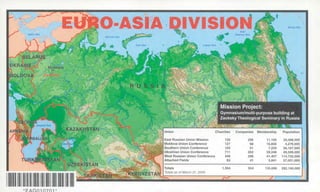
from the tree of life would have failed in his task
Simone Weil once wrote that "vengeance is the desire for
essential equilibrium." Human justice almost always leads to a
false equilibrium. A perfect God, however, will execute perfect
justice. With all the injustice in the world, how does the concept
of "hell" (as eternal destruction, not eternal torment), help Chris-
tians deal with injustice here now?
61
Friday August 17
FURTHER STUDY: Consider Job's understanding of life, death, and
the resurrection: Job 7:6-10; 10:12; 13:15, 16; 14:1, 2, 12-15; 17:13;
19:23-27. Read "The First Great Deception," (pp. 531-550), or
"Spiritualism," (pp. 551-562) in The Great Controversy.
A.
n eternally burning hell preached from the pulpit, and kept
before the people, does injustice to the benevolent character of
God. It presents Him as the veriest tyrant in the universe. This
widespread dogma has turned thousands to universalism, infidelity,
and atheism."—Testimonies for the Church, vol. 1, pp. 344, 345.
"Through the two great errors, the immortality of the soul and Sunday
sacredness, Satan will bring the people under his deceptions. . . .
"As spiritualism [communication with the "dead"] more closely
imitates the nominal Christianity of the day, it has greater power to
deceive and ensnare. Satan himself is converted, after the modern
order of things. He will appear in the character of an angel of light.
Through the agency of spiritualism, miracles will be wrought, the
sick will be healed, and many undeniable wonders will be performed.
And as the spirits will profess faith in the Bible, and manifest respect
for the institutions of the church, their work will be accepted as a
manifestation of divine power."—The Great Controversy, p. 588.
DISCUSSION QUESTIONS:
1. How does it affect your concept of God's character and
justice to know that He does not consign the lost to eternal
torment? At the same time, how would it affect your con-
cept of God's character if there were not a final punish-
ment of the wicked?
2. How do you deal with a person who claims to have con-
tacted the dead? What can you do to show that person that
even if the experience he or she had is real, his or her
understanding of the experience is wrong?
3. Paul says that the deceased righteous are "dead in Christ"
and they "sleep in Jesus" (1 Thess. 4:14, 16). What do these
expressions tell us about Christ's present perception of those
whom He will be resurrecting to His glory and kingdom?
SUMMARY: Eternal life and immortality are gifts that accompany
salvation in Christ; they are not inherent in fallen human beings.
Death is an unconscious sleep in the grave until the resurrection.
Those who reject God's love, salvation, and truth reject life itself;
God honors their decision by terminating their existence at the end of
the judgment.
62
Overwhelming Evidence
J. H. Zachary
Atheism was the only religion in Froll's family as he grew up in the
former Soviet Union. When the boy was 5 years old, he became
paralyzed. Two surgeries on his spine failed to release him from the
paralysis that has left him in a wheelchair.
In spite of his lifelong education in atheism, Froll found his think-
ing challenged. There has to be some sort of intelligent power in the
universe, he reasoned. This conviction grew. "I saw so many evi-
dences that some Power outside myself was guiding in my life," he
said. "But I was not brave enough to dismiss the influence of atheism
and call this power God." As he examined the sophistication and
beauty in nature, the argument for a Creator became stronger.
Froll joined a large and very old Christian denomination and soon
was a zealous believer. He longed to meet the Pope, but he had never
ever seen a Bible.
He became convicted that he was a great sinner and must change his
life. But in spite of his efforts, sin had a strong hold on him. He decided
the only way to overcome sin and enter heaven was to become a monk.
Then a friend gave Froll a New Testament. As he read the Sermon
on the Mount, he was overwhelmed by an even greater sense of his
sinfulness. He became convinced that he would spend eternity in hell.
Froll met some Adventists. These new friends showed him that
Jesus, the sinless One, was the only One who could save him. Froll
began studying the Bible in earnest and realized that what his church
taught differed from what the Bible teaches. There followed a terrible
struggle in his mind, for he did not want to leave his church.
Froll was at a spiritual crossroads. He began praying earnestly.
"Lord, I have so many questions. If You can answer my questions,
then I will follow the Bible as Luther did." He promised God that he
would visit the Adventist church with his friends. If he found answers
to his list of questions, then he would know that this was the church
God wanted him to be a part of. He entered the church and settled in
with his list of questions. He was amazed as the pastor answered each
of his questions from the Bible.
True to his promise, Froll began attending the Adventist church and
preparing for baptism. When he asked God for guidance, God had
given it. Who was he to refuse to follow?
J. H. Zachary is coordinator of international evangelism for The
Quiet Hour anda special consultant for the General Conference Ministerial
Association.
Produced by the Office of Mission
Sabbath School—Personal Ministries Department of the General Conference
Email: gomission@gc.adventist.org
63
Lesson 8 *August 18-24
Light and Shadows: The
Earthly Sanctuary
Sabbath Afternoon
A
SHADOW OF THINGS TO COME. The services of the
Old Testament sanctuary symbolize Christ's redemptive mis-
sion; it reveals the whole plan of redemption, in pictorial
form. These services stood as both a shadow of things to come and a
copy of greater, heavenly realities. Understanding them helps us
understand salvation.
When God told Moses to build a sanctuary patterned after the
heavenly one, He was not thinking of providing only a worship center
for Israel. The sanctuary was to be a teaching model of the sacrifice
and ministry of Jesus, which would begin with His first advent. It
also pointed upward to the greater sanctuary in heaven—the grand
center of Jesus' heavenly ministry from where the final activities of
redemption's drama will be played out. This week we will study how
the role and function of the earthly sanctuary instructs us about how
God deals with the problem of sin. As you study, discover the com-
plete cycle of redemption and the central issues of the cosmic conflict
between Jesus and Satan.
THE WEEK AT A GLANCE: Where did the model and even the
idea of the earthly sanctuary come from? Was salvation to be found
in its rituals? What did the sanctuary service symbolize? What was
the meaning of the daily ritual? The yearly? What was the purpose
of the scapegoat? What lessons were to be taught by the feasts, such
as the Passover, the Day of Atonement, and the Feast of Taber-
nacles? By the end of the week, you might not become an Old
Testament scholar, but you will have a better understanding of
salvation.
MEMORY TEXT: "And let them make me a sanctuary; that I
may dwell among them" (Exodus 25:8).
*(Please study this week's lesson to prepare for Sabbath, August 25).
64
Sunday August 19
A PATTERN OF THE HEAVENLY (Exod. 25:9, 40; Heb. 8:5).
T
he earthly sanctuary, though made with human hands, had,
literally, a heavenly blueprint. It wasn't something Moses and
the Israelites copied from the pagans around them; it was
given to them directly by God Himself.
According to the Bible, God revealed to Moses a "pattern" to
follow in the construction of the tabernacle. The word used for
"pattern" is the Hebrew word tabnith, a word that means "pattern,"
"plan," "a form," "a construction," "a figure," "a structure," and "an
image."
Hebrews 8:5 teaches that God designed the earthly sanctuary to be
a "copy," "shadow," "pattern," or "type" of the heavenly sanctuary.
The Greek word translated as "shadow" refers to a shadow that is cast
by an object and that represents the form of that object. The earthly
sanctuary represents, however faintly, the heavenly sanctuary.
The earthly sanctuary, though only a shadow of the real, was
instituted by God as a means to teach the Israelites, and hence the
world, the truth about salvation. Yet there was no salvation in the
sanctuary ritual itself. The problem with sin was too great for it to be
solved by slicing the throat of a dove or a goat and spilling its blood
before some altar. "For it is not possible that the blood of bulls and of
goats should take away sins" (Heb. 10:4).
Why would God institute such an elaborate and complicated
structure such as the Hebrew sacrificial system if in the end there
was no salvation to be found in it? What was the purpose of the
sanctuary if in fact it was not able to bring about salvation?
Try to understand the work of Christ apart from the Hebrew
sanctuary service. It's difficult. Peter's words that we were "re-
deemed through the precious blood of Christ, as of a lamb without
blemish and without spot" (1 Pet. 1:19, NKJV) are meaningless
unless understood in the context of the Hebrew sanctuary service.
How does one understand Paul's statement, "Christ, our Passover,
was sacrificed for us" (1 Cor. 5:7, NKJV) apart from the Hebrew
sacrificial service? Our whole concept of atonement, redemption, and
salvation is rooted in the earthly sanctuary service and the lessons it
was designed to teach. It is impossible to have a complete understand-
ing of the gospel apart from the sanctuary background.
Considering the truths taught in the earthly sanctuary ser-
vice, why is it important for us to have a personal understand-
ing of the sanctuary?
65
Monday August 20
A TYPE OF THINGS TO COME (John 1:36; 1 Cor. 5:7).
s a type, the earthly sanctuary pointed to Christ's redemptive
ministry. Generally, a type is a person, event, or thing in the
Old Testament that foreshadows something in the New Testa-
ment. Types often meet their fulfillment (or antitype) in the person
and ministry of Jesus, but they sometimes relate to God the Father,
His people, or some other reality.
Give the antitypes, or the realities, to which the following
sanctuary types pointed:
the altar of incense (Rev. 8:3)
the golden lamp stands (John 8:12; Rev. 1:12, 13, 20)
the sacrificial lamb (John 1:36; 1 Cor. 5:7)
the shewbread (John 6:32, 33, 41, 48, 51)
the mercy seat (Exod. 25:22; Lev. 16:2)
the blood of the sacrificial animals (Lev. 17:11, Lev. 5:9; 1 Pet.
1:19)
As one studies the earthly sanctuary service, one point clearly
stands out. However fundamental and crucial the sacrifice of the
animal was, the sanctuary ritual did not end with its death. Often
there was something else that had to be done, not by the sinner but by
the officiating priest. In other words, if we understand the sanctuary
service as a model of the plan of salvation, then the model teaches
that the plan of salvation does not end with the sacrifice. The ministry
of the priest almost always followed. What this should tell us is that
however crucial and fundamental Christ's death on the cross was
(symbolized by the animal sacrifices in the earthly sanctuary), His
work for us did not end at the Cross.
After the sacrifice was brought to the priest, the sinner's
work was essentially done. What lessons can we draw (or not
draw) from that aspect of the sanctuary ritual regarding the
role of the sinner in the plan of salvation?
66
Tuesday August 21
THE DAILY MINISTRY.
What activities were part of the daily service of the sanctuary?
What was their significance for the worshiper? Exod. 29:38-42;
30:1, 6-8.
the time of incense, the daily sacrifice was ready to be offered
pon the altar in the court without. This was a time of intense
interest to the worshipers who assembled at the tabernacle. Before
entering into the presence of God through the ministration of the
priest, they were to engage in earnest searching of heart and confes-
sion of sin. They united in silent prayer, with their faces toward the
holy place. Thus their petitions ascended with the cloud of incense,
while faith laid hold upon the merits of the promised Saviour prefig-
ured by the atoning sacrifice. The hours appointed for the morning
and the evening sacrifice were regarded as sacred, and they came to
be observed as the set time for worship throughout the Jewish na-
tion."—Patriarchs and Prophets, pp. 353, 354.
The sanctuary services were divided into two main parts: (1) the
daily service and (2) the yearly service. The yearly service was
performed both in the Holy Place and the Most Holy Place, while the
daily service was conducted in the Holy Place alone.
What was the fundamental requirement for dealing with the
sin problem? See Lev. 17:11.
Through the ministration of blood in the daily service, sin was
transferred to the sanctuary. First, the person confessed his or her
sins over the lamb, thus symbolically transferring it to the animal
(Lev. 1:4; 4:4, 15, 24, 29; 16:21). Then as the blood of the slain lamb
was sprinkled before the veil or poured out on the altar, sin was
transferred to the sanctuary. Thus at the end of the transaction, the
sinner was clean, and the sin was brought into the sanctuary. In cases
in which blood was not used, the priest eating the flesh of the
sacrificial animal accomplished the same thing, the transfer of sin
(Lev. 10:16-20).
Imagine being an Israelite during the temple ministration
prior to Christ's first advent. How do you think that person
would have understood what the ritual means? What lessons
about salvation should have been drawn from it? What can we
learn as well?
67
Wednesday August 22
THE YEARLY SERVICE (Lev. 16; 23:26-32).
I
n the daily service a person's sins were atoned for by the blood
of the lamb and were transferred to the sanctuary. The yearly
service, the Day of Atonement, demonstrated God's way of re-
moving sin from the camp of His people.
What is the significance of sending away Azazel's goat? (In
Hebrew, the word for scapegoat is "azazel" [Lev. 16:5-10, 20-22.])
This goat indicates God's final removal of sin from the universe.
Not until the goat had been banished to the wilderness could the
people regard themselves as free from the burden of their sins. All
Israelites were to spend the Day of Atonement in prayer, fasting, and
self-examination.
What parallels exist between Azazel's goat and Satan at the
end of time? Rev. 20:1-3, 7-10.
Why doesn't the scapegoat symbolize the sacrifice of Christ
on the cross along with the Lord's goat in Leviticus 16,
especially when it says the scapegoat (Lev. 16:10) will make
"an atonement"? The answers are as follows: (1) No blood
was shed from Azazel's goat; therefore, it was not a sacrifice
for sin (Heb. 9:22). (2) The sins transferred to it had already
been atoned for by other bloody sacrifices (Leviticus 4).
(3) The transfer of sins to it occurred after all of the sins
recorded in the sanctuary had been atoned for by the blood of
the Lord's goat (Lev. 16:16-19). (4) Because one goat was
selected for the Lord (Yahweh), Azazel, for whom the other
goat was chosen, should represent a personal being who
stands in opposition to the Lord. That would be Satan.
Here, then, on the Day of Atonement, the great controversy be-
tween Christ and Satan was represented in miniature—sin and Christ
as its remedy, Satan as the cause of.
What does God's act of removing sin from the camp reveal about
the ultimate fate of sin? Without pushing the type too far, what does it
tell us about our personal need to have sin removed from our lives?
68
Thursday August 23
THE SANCTUARY FEASTS—A CYCLE OF REDEMPTION
(Lev. 23:4, 5, 27-32; Num. 29:12-34).
T
he seven religious feasts celebrated by the Hebrew people
formed a yearly cycle that also taught the Hebrews a great deal
about salvation. Below are snippets of three of these feasts—
the Passover, the Day of Atonement, the Feast of Tabernacles. Notice
their chronological progression.
1. Passover: Read about the Passover (Pesach in Hebrew) in
Exodus 12 and Leviticus 23:4, 5. What event in the plan of salva-
tion did this feast point forward to? 1 Cor. 5:7; 1 Pet. 1:19, 20.
No wonder that in this cycle the Passover comes first. Considering
what it represents, that makes perfect sense, because without the
sacrifice of Christ, the other feasts (or at least what they represent)
would not be able to happen. Passover had to precede them.
2. Day of Atonement: The Day of Atonement cleansing of the
earthly sanctuary (Lev. 16; 23:27-32) was fulfilled in the pre-Advent
judgment, the opening phase of the final judgment (Dan. 7:9, 10;
8:14; Rev. 11:18, 19). This began in October 22, 1844. The Day of
Atonement fell on the tenth day of the seventh month in the Jewish
calendar. The end of the 2300 symbolic evening/mornings or histori-
cal years in Daniel 8:14 came to a close in the autumn of A.D. 1844. In
that year the Day of Atonement fell on October 22, according to the
most accurate reckoning used by the Karaite sect of the Jews. That
was the time for the antitypical cleansing of the sanctuary to begin
with the judgment in heaven.
3. Feast of Tabernacles: The Feast of Tabernacles or Booths is
recorded in Numbers 29:12-34. What event in salvation does this
feast point forward to? Rev. 14:14-16; 19:6-9.
Following the autumn harvest, the Feast of Tabernacles came after
the Day of Atonement and was the last feast of the year. It was a
joyous event, not only because it celebrated the bounties of the season
but because the Israelites had settled all discord and confessed all
their sins on the Day of Atonement.
How could one apply the spiritual lessons taught from these
feasts to one's own spiritual life? What does each feast teach,
and how does that teaching impact how we live today?
69
Friday August 24
FURTHER STUDY: Read about the ceremony of the wave sheaf in
Leviticus 23:10-14 and the event it prefigured in Matthew 28.
Read the chapter entitled "Calvary" in The Desire of the Ages,
pp. 741-757.
C
hrist arose from the dead as the first fruits of those that slept.
He was the antitype of the wave sheaf, and His resurrection
took place on the very day when the wave sheaf was to be
presented before the Lord. For more than a thousand years this
symbolic ceremony had been performed. From the harvest fields the
first heads of ripened grain were gathered, and when the people went
up to Jerusalem to the Passover, the sheaf of first fruits was waved as
a thank offering before the Lord. Not until this was presented could
the sickle be put to the grain, and it be gathered into sheaves. The
sheaf dedicated to God represented the harvest. So Christ the first
fruits represented the great spiritual harvest to be gathered for the
kingdom of God. His resurrection is the type and pledge of the
resurrection of all the righteous dead. 'For if we believe that Jesus
died and rose again, even so them also which sleep in Jesus will God
bring with Him.' 1 Thess. 4:14."—The Desire of the Ages, pp. 785,
786.
DISCUSSION QUESTIONS:
1. Why did God make the Old Testament festivals a repeating
cycle?
2. If the earthly sanctuary does model the whole plan of salva-
tion, what does it teach regarding the atonement? Can we
say that the atonement was completed at the Cross if, in
fact, the priest still had work to do in behalf of the sinner?
Or does the answer depend on how we understand the word
"atonement"? Discuss.
3. The Feast of Tabernacles was celebrated when Israel lived
in tents in the wilderness. Think of three or four reasons it
is good to remember what God has done for us in the past.
How does that strengthen us to trust Him for the future?
SUMMARY: The earthly sanctuary was a model of the one in
heaven. Though salvation was not found in it, the sanctuary pointed
to the Cross and to Christ's high-priestly ministry. The daily service,
the yearly service, and the feasts all symbolized various phases in the
process of redemption. Truly we can say with the psalmist: "Thy way,
0 God, is in the sanctuary" (Ps. 77:13).
70
The Kerosene Failed Not
Rendy Sebilo
Nearly all the members of Lapangon village have been baptized.
They meet together in our front yard to worship each evening, hungry
to learn more about God.
Although the worship starts well before sunset, the villagers are so
intent to study deeper into God's Word that often darkness falls before
we finish. We decided to buy a kerosene lamp to light these evening
worships. The villagers enjoy sitting in the light of the lamp listening
to Bible stories. When the villagers learned that the light from the
lamp can be seen in villages quite a distance away, they compared
their lamp with the light of salvation that has come to their village.
One night we discovered that we were out of kerosene. Villagers
scampered home to bring what kerosene they had to fill the lamp. We
pooled the kerosene and poured it into the lamp. It was not enough to
keep the lamp burning for long, so we decided to shorten the evening
worship. But during the lively worship we all forgot about the limited
supply of kerosene. When worship ended we checked the lamp's fuel
tank and found it was empty. It was too far to walk to the nearest trader
who had kerosene to sell, so we knew that we would have no kerosene
for the next night's worship.
The next evening as we prepared for worship my partner checked
the lamp and found the tank was full! He asked me if I had found some
kerosene, but I had not. We lighted the lamp and began worship. We
told the villagers that our God had worked a miracle and provided
kerosene to light our worship. We told the story of the widow who
borrowed vessels to fill with oil, and the oil failed not until all the
vessels were filled. We explained that this miracle occurred because
of the widow's faith and compared the story with the kerosene in our
lamp. We had a wonderful worship, lighted by faith and kerosene. The
following evening we again inspected the lamp and found the tank
full! This continued for three nights before we could purchase more
kerosene.
The village chief summed up our miracle when, during one of our
worships, he said, "With our own eyes we have seen the miracle given
to us by the God in heaven. We need to be faithful to Him every day!"
"We will be faithful!" the villagers responded.
Rendy Sebilo was a student missionary in Lapangon in southern
Philippines. He is again studying at Mountain View College.
Produced by the General Conference Office of Mission Awareness
Email: gomission@gc.adventist.org
71
Lesson 9 *August 25-31
The Heavenly Sanctuary
Sabbath Afternoon
T
HE PRIEST STANDS IN THE COURT OF THE TEMPLE
in Jerusalem ready to offer a lamb as sacrifice. As he raises the
knife to kill the victim, the earth convulses. Terrified, he
drops the knife, and the lamb escapes. Over the din of the earthquake
he hears a loud ripping noise as an unseen hand rends the veil of the
Temple from top to bottom.
"Across town, black clouds enshroud a cross. When Jesus, the Passover
Lamb of God, calls out, 'It is finished!' He dies for the sins of the world.
"The very event the Temple services have pointed to through the
centuries has taken place. . . .
"But there is more to salvation history. It reaches beyond the cross.
Jesus' resurrection and ascension direct our attention to the heavenly
sanctuary, where, no longer the Lamb, He ministers as priest. The
once-for-all sacrifice has been offered (Heb. 9:28); now He makes
available to all the benefits of this atoning sacrifice."—Seventh-day
Adventists Believe . . . , p. 313.
In the next two weeks we'll see the plan of salvation unfolded as
we study the doctrine of the heavenly sanctuary and what it teaches us
about Christ's ministry in our behalf.
THE WEEK AT A GLANCE: Is the sanctuary in heaven a literal
place or just something spiritual? If real, why? Why would God,
who knows everything, need a sanctuary? What's the purpose of a
heavenly sanctuary and its ministry? What is Christ doing there?
What does the book of Revelation teach about the sanctuary? And
finally, why has the doctrine come under so much attack?
MEMORY TEXT: "The Lord is in his holy temple; the Lord is on
his heavenly throne" (Psalm 11:4, NIV).
*(Please study this week's lesson to prepare for Sabbath, September 1).
72
Sunday August 26
THE REALITY OF THE HEAVENLY SANCTUARY (Heb. 8:2,
5; see also Exod. 25:9; Ps. 102:19; Heb. 9:23, 24).
The Bible calls the earthly sanctuary a "shadow" of the heavenly.
What is greater or more real—a shadow or the reality behind the
shadow? For example, what is more real, your hand, or the shadow it
casts?
The point is this: If the earthly sanctuary and its service were real,
yet these functioned only as shadows of the heavenly, what does this
tell us about the literalness of the heavenly sanctuary?
To discover the major differences between the earthly and
heavenly sanctuaries, complete the chart below.
THE EARTHLY SANCTUARY THE HEAVENLY SANCTUARY
human-made (Exod. 25:8) set up/pitched by
(Heb. 8:1, 2)
a and the true tabernacle (Heb. 8:2)
of what is in
heaven (Heb. 8:5)
the sanctuary sacrifices
and feasts were repeated
year after year (Heb. 10:1)
Christ's sacrifice was
(Heb. 10:10).
In vision Daniel saw the heavenly sanctuary as a real place. He
witnessed the Son of man before the Ancient of Days in the final
judgment (Daniel 7), and he saw that an earthly power would conceal
Christ's ministry in the heavenly sanctuary between the time He
would begin His work there and its cleansing (chapter 8). Then
Daniel chapter 9, the 70-week prophecy—in the context of the anointing
of the "holy of holies"—indicates the start of Christ's ministry in the
sanctuary above.
What is the danger of spiritualizing away the reality of the heav-
enly sanctuary, especially in light of clear biblical evidence that it is
real? At the same time, what's more important, the literalness of the
sanctuary in heaven or the ministry that it represents?
73
Monday August 27
THE PURPOSE OF THE HEAVENLY SANCTUARY.
"Thy way, 0 God, is in the sanctuary: who is so great a God as
our God?" (Ps. 77:13).
0
ne of the important questions regarding the heavenly sanctu-
ary deals with the reason for its existence. The earthly, as we
saw last week, was designed to teach humans about the plan
of redemption. But why a heavenly sanctuary? What's it needed for?
Does God really need some edifice in heaven in order to save human-
ity? Or is there another purpose?
Look up these following verses. What do they all have in
common?
Gen. 22:11, 12
Job 2:1
Dan. 7:10
Eph. 3:10
Rev. 15:5, 6
The problem of sin, salvation, and evil, though being waged on
earth, involves heaven. Sin didn't begin on earth; sin began in
heaven (Isa. 14:12-14), with the rebellion of Lucifer and a third of the
angels. The sin problem has, therefore, heavenly consequences. All
the universe is involved (Rom. 8:22) in the issues dealing with sin
and rebellion.
Could it be, then, that the heavenly sanctuary helps teach the
onlooking universe about salvation just as the earthly one teaches us?
God doesn't need a sanctuary in heaven; it is there, instead, for the
rest of the universe to see how God deals openly and fairly with
rebellion.
Look at the heavenly judgment scene in Daniel 7; this judg-
ment is not taking place in a vacuum. Instead, it is unfolding
before an untold number of heavenly beings (vss. 10, 11). What
does their presence teach us about the involvement and interest
of the onlooking universe regarding the plan of salvation? Why
would it be important that God deal openly with sin before all
His creation? See The Great Controversy, p. 415.
74
Tuesday August 28
INTERCESSORY WORK OF CHRIST (Isa. 53:12; Rom. 8:34;
Heb. 7:25).
T
he Bible is explicit: Christ's work for us did not end after the
Cross. He is now in the heavenly sanctuary, ministering as our
Great High Priest (Heb. 8:1, 2).
"Who is he that condemneth? It [Lev. 4:31] is Christ that died, yea
rather, that is risen again, who is even at the right hand of God, who
also maketh intercession for us" (Rom. 8:34, emphasis supplied).
"The intercession of Christ in man's behalf . . . is as essential to
the plan of salvation as was His death up on the cross. By His death He
began that work which after His resurrection He ascended to complete
in heaven."—The Great Controversy, p. 489.
When Jesus shouted "It is finished," what was finished? At the
same time, what was not finished?
Besides being our sacrifice, Jesus is also our High Priest. In the
earthly "shadow," after an animal was sacrificed, the priest would
take the blood and "make an atonement for" the sinner (Lev. 4:31).
The priest did for sinners what sinners could never do for themselves.
In short, the priest functioned as an intercessor.
The earthly sanctuary, however, only prefigured the life, death,
and high-priestly ministry of Christ. Though the sacrifice was made
once and for all (Heb. 7:27), Christ as our High Priest even now
"maketh intercession" for us. Why do we need an intercessor? For the
same reason the sinner in Israel did—our sin. In the same way that
sinners needed the priest as often as they sinned, we need Jesus as
well, who applies His merits in our behalf. Our continual sin means
we have continual need for an intercessor. That Intercessor, of course,
is Jesus, who presents His blood, His righteousness, in behalf of
repentant sinners (see 1 John 2:1). This is what the Bible means
when it says that "he is able also to save them to the uttermost that
come unto God by him, seeing he ever liveth to make intercession for
them" (Heb. 7:25).
However much emphasis we as a church place on the heav-
enly sanctuary, we must remember that salvation is not found in
the structure itself any more than in the earthly "shadow."
Salvation is found only in Jesus, who through His ministry in
the heavenly sanctuary constantly makes available the merits of
His sacrifice for all who come in true faith and repentance. How
does the knowledge that we have an Intercessor ministering in
our behalf in heaven give us comfort, especially when we fall?
75
Wednesday August 29
THE HEAVENLY SANCTUARY IN REVELATION.
What role does the heavenly sanctuary play in the end-time
visions of Revelation? Rev. 11:19; 14:15, 17; 15:5-8; 16:10.
T
here are sixteen references to the heavenly sanctuary in the
book of Revelation. Some of the words these references use to
name the sanctuary include temple, sanctuary, and tabernacle.
In John's portrayal the major scenes of the drama of redemption are
linked to the heavenly sanctuary. Throughout John's visions there is
an ongoing interplay—sometimes cooperative, at other times an-
tagonistic—between earth and the sanctuary. There's a cooperative
interplay when, for example, the saints receive messages of encour-
agement sent from the sanctuary (Rev. 21:3); in contrast, there's
antagonistic interplay when angels send plagues from the sanctuary
to the powers that oppose God (16:1).
Look up the following verses in Revelation. What sanctuary
imagery do you find in each one? Try to find other examples as well.
Rev. 1:12
Rev. 5:6
Rev. 7:14
Rev. 8:3, 4
Rev. 11:19
Revelation portrays the heavenly sanctuary as the control center of
redemption and always views the Lamb in the sanctuary setting.
Redemption messages originate from God's heavenly throne room.
The security of the saints is based on the sanctuary activities of God
and the Lamb. Judgment comes from the sanctuary, and end-time
events are directed from it.
"One thing will certainly be understood from the study of
Revelation—that the connection between God and His people is
close and decided."—Testimonies to Ministers and Gospel Work-
ers, p. 114. The doctrine of the heavenly sanctuary, as depicted
in Revelation, shows this close connection between heaven and
earth. In what ways is knowledge of this connection assuring? In
what ways, however, could it be discomforting?
76
Thursday August 30
GOD'S WAY IN THE HEAVENLY SANCTUARY (Heb. 7:24-8:2).
What is it about the sanctuary that has made it a special object
of attack by Satan? Dan. 8:11, 12; Rev. 13:6.
T
he sanctuary focuses on Jesus' ministry on behalf of sinners. It
clearly reveals and highlights God's abounding grace to fallen
humanity. The sanctuary teaches us how, with God's help, we
not only have continual forgiveness for sin but can have victory over
sin. In Eden, Adam and Eve experienced face-to-face communion
with God. Sin destroyed that communication. The sanctuary, how-
ever, assures us that God is near, that He is compassionate, and that
He has provided a way for us to approach Him.
No wonder Satan hates the sanctuary truth.
Why is knowledge of Christ as our High Priest so important to
our understanding?
In Daniel 8 the little-horn power targets the sanctuary. He is
portrayed as taking away its "daily sacrifice," or daily ministry. He
also takes away the place of the sanctuary (vss. 11, 12). Later John
also witnessed the same attacks against the sanctuary. The leopard-
like beast, acting on the basis of power given him by the dragon,
"opened his mouth in blasphemies against God, to blaspheme His
name and His tabernacle, that is, those who dwell in heaven" (Rev.
13:6, NASB).
"It becomes apparent at once that Satan's warfare against God
focuses upon God's sanctuary and God's throne, and thereby upon
His sovereignty. . . . The truth from the sanctuary explains the final
end of sin, the final rescue from death and destruction, the judg-
ments of God upon men and nations, and the establishment of God's
everlasting kingdom. That is the goal toward which the whole cre-
ation moves. To understand this, one must take seriously the Bible
truths that issue from the sanctuary."—Edward Heppenstall, Our
High Priest (Washington, D.C.: Review and Herald Publishing Assoc.,
1972), pp. 18, 19.
Jaime has a Christian friend who mocks the Adventist un-
derstanding of the heavenly sanctuary. "Christ finished every-
thing at the Cross!" the friend says. Looking at what we have
studied so far, how could Jamie help expand his friend's knowl-
edge of the plan of salvation?
77
Friday August 31
FURTHER STUDY: Read in 1 Kings 8:56-61 the speech Solomon
gave at the dedication of the temple. Considering the nature of the
heavenly sanctuary, of which the temple services were a shadow, why
are these words so appropriate?
Also read Early Writings, pp. 250-253.
ry, He cried, 'It is finished,' and the veil
This was to show that the services of the earthly sanctuary
were forever finished, and that God would no more meet with the
priests in their earthly temple, to accept their sacrifices. The blood of
Jesus was then shed, which was to be offered by Himself in the
heavenly sanctuary. As the priest entered the most holy once a year to
cleanse the earthly sanctuary, so Jesus entered the most holy of the
heavenly, at the end of the 2300 days of Daniel 8, in 1844, to make a
final atonement for all who could be benefitted by His mediation, and
thus to cleanse the sanctuary."—Early Writings, p. 253.
DISCUSSION QUESTIONS:
1. Many popular books by Christians of other denominations
talk about the reconstruction of the temple in Jerusalem as
a sign of the end. It has even been rumored that somewhere
in the United States a prefabricated earthly temple has
already been built and is just waiting to be shipped at the
right time. Even if this were true, and an earthly sanctuary
were rebuilt in Jerusalem, why would that temple be of no
salvific significance?
2. The whole earthly sanctuary service, the center of ancient
Israel's worship, served only as a shadow of the heavenly
sanctuary service and ministry. Much of the book of He-
brews centers on Christ's high-priestly ministry. The book
of Revelation itself cannot really be understood apart from
Christ's high-priestly ministry. What do these facts tell us
about the importance of Christ's ministry in the sanctuary
in heaven?
SUMMARY: The heavenly sanctuary is where Christ—before the
onlooking universe—ministers the merits of His sacrifice in our be-
half. When we sin, we have an Intercessor who applies His perfect
righteousness in our behalf. The importance of this truth has made the
sanctuary and what it teaches a special target of Satan's wrath.
78
Auk
Unfairly Imprisoned
Francoise Monnier
Beatriz Chavez stood dazed as the prison cell door slammed behind
her. How could she, a Christian, have ended up in prison? Despair
threatened to overwhelm her as she sank onto the narrow cell bed.
Beatriz thought she was doing her friend a favor when she co-
signed for her loan. But when the woman skipped town, the bank told
Beatriz to pay. But Beatriz could not pay off the loan. At first she
thought the bank's lawyers were just trying to frighten her when they
threatened to take her to court, but they weren't, and the judge sen-
tenced Beatriz to a year in prison.
Beatriz had been a Christian most of her life and an Adventist for
three years. But now she wondered if God had forgotten her. Now
what? she asked herself.
As Beatriz got acquainted with the prisoners and heard their stories,
her heart was stirred. She began sharing her faith with the women and
offered to study the Bible with them. But she wanted to do more. With
the prison administration's permission, Beatriz arranged with women
from an Adventist church an hour from the prison to come and teach
them about nutrition, household skills, and money management. The
church women saw other needs, and they arranged for lawyers to
provide free legal advice and for medical personnel to treat the women
and their children's medical needs.
Beatriz heard about the difficulties the prisoners' families faced,
and she urged the church members to visit these families and help
them. The church women began distributing clothes, food, and other
necessities to these families. They held cooking and nutrition classes
and arranged for sponsors to pay the children's school fees so they
would not miss out on their education.
As women's release dates neared, the church women worked to
help prepare the women to find work and reenter society. And they
held evangelistic meetings, inside and outside the prison. Some mem-
bers of this church had already helped build a chapel for the nearest
men's prison; they decided to do the same for the women's prison.
Beatriz was released from prison, but the women from Santa Cruz
continue working with those left behind. Once Beatriz wondered what
good could come from being sent to prison, but today she rejoices over
the 28 women who have been baptized and some 50 more who are
studying the Bible inside the prison. A number of them have requested
baptism.
Beatriz Chavez lives in Santa Cruz, Bolivia. Francoise Monnier is
Women's Ministries Director of the Bolivian Union.
Produced by the Office of Mission
Sabbath School—Personal Ministries Department of the General Conference
Email: gomission@gc.adventist.org
79
Lesson 10 *September 1-7
The Hour of God's
Judgment
Sabbath Afternoon
F
EW DOCTRINES WE HOLD have been subject to more
attack and misunderstanding than the pre-Advent judgment.
No wonder—considering how some people have understood it.
One young woman explained to a Sabbath School class the torment
she had suffered because of how she was taught the judgment.
"From childhood," she said, "I was told that the judgment was
going on in heaven right now and that I'd never know when my name
would come up. And when it did, if I were not absolutely and utterly
perfect, then my name would be blotted out of the book of life, and I
would be eternally lost. But because I would never know the outcome,
I'd continue struggling to be absolutely perfect, even if it were too
late to be saved and my name had already been blotted out."
With such a view of the judgment, it's understandable why people
would have trouble with it. This week's lesson is designed to give a
more Christ-centered, gospel-centered view of the judgment. It will
show, too, that judgment is not only part of the "good news" but is, in
many ways, the best part.
THE WEEK AT A GLANCE: What does "atonement" mean? How
is it accomplished? What does it mean to live in the antitypical day of
atonement? How important is the judgment? What happens when
our names come up in judgment? What role does Jesus play in the
judgment? Does having a substitute mean that our sin is of no
consequence?
MEMORY TEXT: " 'Fear God, and give Him glory, because the hour of
His judgment has come; and worship Him who made the heaven and the
earth and sea and springs of waters' " (Revelation 14:7, NASB).
*(Please study this week's lesson to prepare for Sabbath, September 8).
80
Sunday September 2
THE REAL DAY OF ATONEMENT (Lev. 17:11; Rom. 5:11;
1 Pet. 1:19).
S
ince 1844 we have been living in the great Day of Atonement,
the time of judgment prefigured in the earthly sanctuary system
by the yearly service in which the earthly sanctuary was cleansed
(see Lev. 16:19). The word "atonement," though heavy-laden with
various connotations, means, basically, the act by which a sinner has
been reconciled to God. Thus, however technically understood, "atone-
ment" must be, certainly, good news.
How is atonement achieved? See Lev. 17:11.
Ever since Cain's fruit offering (Gen. 4:3), people have tried
various means to atone for their sins. Mothers have thrown their
fresh-born babies into the mouths of alligators or into the hot breath
of seething volcanoes—all in order to seek atonement. People have
torn the beating hearts out of their sons' chests or have sacrificed
their virgin daughters on stone altars or have beat themselves with
whips and chains or have slept on beds of nails or crawled on paths of
broken glass—again, all in order to have their sins atoned for.
Yet, according to God's Word, there is only one way to receive
atonement, and that is through the blood of Jesus Christ (1 Pet. 1:19).
Take a quick read of Leviticus 16. As you keep in mind that
this is the Day of "Atonement," what is the one crucial element
that appears again and again in the chapter?
What Leviticus 16 should teach us is that atonement comes only
from the blood. Blood, as opposed to the law, is the key element in
the earthly ritual, because it is the Day of Atonement, and only
blood—as opposed to the law—can atone for sin (Heb. 9:22). Any
day dedicated, therefore, only to atonement—which is solely the
work of God for us—has to be good news. Therefore, we should not
be living in dread of the judgment. We should, instead, be focusing
upon what the blood means for us; that focus will change our lives
and through the working of the Holy Spirit bring us into harmony
with God's will.
If you know someone who has lived in fear of the judgment,
how could the understanding that the key element in the earthly
Day of Atonement ritual was blood help that person overcome
his or her fear and, in fact, give him or her reasons to rejoice?
81
Monday September 3
THE PURPOSE OF THE JUDGMENT (Dan. 7:8-27).
T
he great controversy revolves around Satan's accusation that
God is arbitrary and vindictive (Gen. 3:1-6). The devil also
stands as our accuser (Dan. 7:10; Zech. 3:1-5; Rev. 12:10).
Thus the great controversy is fought over the validity of not only
God's character but of His children's character. The purpose of the
judgment, then, is to display God's true character and the character
of the saints before the universe.
Read Daniel 7:8-27 to answer the following questions about the
great controversy and the investigative judgment.
Who are the main characters?
What role does the little-horn power play?
What role does the Ancient of Days play?
What function is the Son of man given?
What is the outcome of the judgment and the great controversy?
Notice the openness of God in this judgment (vss. 9, 10). The
angels are present, and the books are opened. The evidence is avail-
able for all to examine. Such directness is necessary so all may
realize God's true character and the character of the saints.
Ellen White wrote that the two gold cherubim standing over
the ark of the covenant in the Most Holy Place of the earthly
sanctuary (Exod 25:18-20) represented "the interest with
which the heavenly host contemplate the work of redemp-
tion."—The Great Controversy, p. 415. Why would those two
golden angels be placed in the room that symbolizes the judg-
ment, as opposed to the altar of burnt offerings, which symbol-
ized the Cross? Does it show that perhaps it is at the judgment,
not the Cross, that the universe gets all its questions answered
about God? (See The Desire of Ages, p. 761.)
Read Ephesians 3:10 and think about what it says in the
context of today's lesson. What does that verse tell us about our
role in the whole great controversy drama?
82
Tuesday September 4
THE IMPORTANCE OF THE JUDGMENT (Daniel 8).
D
aniel 8 is divided into two parts: the vision (vss. 1-14), then
the explanation of the vision (vss. 15-27). Both Daniel 2 and
Daniel 7 have the same basic structure: a vision (or dream),
then an explanation of the vision (or dream).
The vision of Daniel 8:1-14 centers on four specific elements
that make up the essence of the vision. What are they?
1. 2.
3. 4.
The four crucial factors of Daniel 8 are the ram (vss. 3, 4), the goat
(vss. 5-9), the little horn (vss. 9-12), and the cleansing of the sanctuary
(vs. 14). Most of these elements are explained in the last half of the
chapter. The ram is (vs. 20); the he-goat is
(vs. 21); the little horn is (vss. 23-25); and then the
chapter ends with a reference to the 2,300 days in verse 14.
The ram is identified by name (Media-Persia); the he-goat, too
(Greece). Who is the third power? It is one who comes up after
Greece and is a persecuting power, who stands up against the "Prince
of princes," and who will eventually be destroyed at the end of time
"without hand"—a phrase that means by supernatural action (vs. 25).
Only one power possibly fits, and that is Rome, both pagan and papal
(in the prophecies of Daniel, pagan and papal Rome are often viewed
as one power), especially because that power comes up after Greece
and extends to the end of time.
Historically, Media-Persia played a major role in the history of the
world and of God's people. Greece played a major and important role in
the history of the world and of God's people. And, finally, Rome's
crucial and important role, in both its pagan and papal phases—a role
both in the past and in the future—cannot even begin to be exaggerated.
Only four elements in the chapter: Media-Persia, Greece, Rome,
sanctuary cleansed. The first three are of major importance and
significance in the world's history. The vision then ends, even cli-
maxes, with the fourth element, that of the cleansing of the sanctuary
in Daniel 8:14. Now, if there are only four elements in the vision and
the first three are of major importance, what does that tell us about
the final and climactic element, the cleansing of the sanctuary? Of
course, it must be of major importance, as well! Dwell on this point
until you can see just how important an event this cleansing of the
sanctuary really is.
83
Wednesday September 5
WHEN YOUR NAME COMES UP (Eccles. 12:14; Heb. 10:30;
1 John 2:1).
T
hough people tend to argue of the time, place, and details, one
thing most Bible-believing Christians agree upon is: the Word
does teach that everyone will face judgment.
"For God shall bring every work into judgment, with every secret
thing, whether it be good, or whether it be evil" (Eccles. 12:14).
And in the end there will be only two classes of people in judg-
ment: those who stand before God with every past act laid out
accusingly before them and those who have Jesus, with His perfect
righteousness, standing in their stead.
How do these verses help us understand where our only hope in
judgment lies? Rom. 8:1; Gal. 2:16; 1 John 2:1.
Read Ellen White's depiction of what happens to God's
faithful and penitent followers in the judgment: "While Jesus
is pleading for the subjects of His grace, Satan accuses them
before God as transgressors. The great deceiver has sought
to lead them into skepticism, to cause them to lose confi-
dence in God, to separate themselves from His love, and to
break His law. Now he points to the record of their lives, to
the defects of character, the unlikeness to Christ, which has
dishonored their Redeemer, to all the sins that he has tempted
them to commit, and because of these he claims them as his
subjects.
"Jesus does not excuse their sins, but shows their peni-
tence and faith, and, claiming for them forgiveness, He
lifts His wounded hands before the Father and the holy
angels, saying: I know them by name. I have graven them
on the palms of My hands."—The Great Controversy,
p. 484.
Harry has lived his whole life believing that he would never
make it in the judgment because he just isn't good enough. How
could you show Harry that it is precisely because he isn't good
enough that he needs a Substitute in the judgment? Why must
our hope in the judgment not rest upon ourselves but only upon
Jesus?
84
Thursday September 6
CLEANSED FROM SIN (1 John 1:7-9).
"For on that day shall the priest make an atonement for you, to
cleanse you, that ye may be clean from all your sins before the
Lord" (Lev. 16:30).
T
he earthly Day of Atonement, the model for the heavenly, was
a time of great sacredness and solemnness for Israel. In the
Jewish religion today it is known as the great day of judgment.
Some of the prayers the Jews prayed on this holy day include these
phrases: "Justify us in the judgment"; "0 silence the accuser, and
suffer the advocate to take his place"; "and in consequence of his
pleading, declare, I have pardoned"; "0 blot out the transgressions of
thy people who have been saved."
Look at those phrases in that prayer and see in what ways they
parallel our understanding of what happens in the judgment.
In the typical service of the Day of Atonement, the people were to
search their hearts, while the high priest ministered on their behalf. The
fact that their sins were atoned for by the blood didn't mitigate against
the command that they "afflict" their souls and put away all sin. On the
contrary, they were to be "clean" from all their sins before the Lord.
Jesus died as our Substitute. Our salvation is found only in His
righteousness for us (Rom. 5:8, 9). Why does that not mean, there-
fore, that our sin is of no more consequence? (see Rom. 6:15-18).
Today, while Christ ministers in the heavenly sanctuary, we on
earth are to follow Him by faith into the Most Holy Place, as the
Israelites followed the high priest into the Most Holy Place by faith on
the typical Day of Atonement. We are to search our hearts and ear-
nestly confess our sins, thus cooperating with heavenly agencies in the
process of being transformed into His image. Yet no matter how far
along in the sanctification process we are, in the end our hope—our
only hope—in the judgment is not our good deeds but in Jesus stand-
ing in our stead.
Though it was the Day of Atonement and though atonement
came only by blood, symbolic of Christ's life and death and
perfect righteousness, the children of Israel were to be cleansed
from "all" their sin. What does that earthly model tell us about
how we should deal with "all" sin in our own lives?
85
Friday September 7
FURTHER STUDY: What is the standard of the judgment? James
2:8-12; Eccles. 12:13, 14. In practical life, how do we exhibit obedi-
ence to God's law? Micah 6:8; Matt. 7:12; 25:32-46.
Each of the following provides an in-depth study of the investiga-
tive judgment: The Great Controversy, chapters 18-24, 28; Seventh-
day Adventists Believe, chapters 12, 23. If you wish to study more
about the connections between Leviticus 16 and Daniel 8, see Sympo-
sium on Daniel, Daniel & Revelation Committee Series (Silver Spring,
Md.: Biblical Research Institute, General Conference of Seventh-day
Adventists, 1986), vol. 2, pp. 426-461; 527-549.
I
n the judgment no claims of man to righteousness by works can
possibly stand. For here is revealed the radical evil of the human
heart. 'As it is written, There is none righteous, no, not one'
(Rom. 3:10). Before God there is no way that man can compensate for
his sins or his sinfulness. . . .
"What Christ promises here is not freedom from judgment but
freedom from condemnation. How then shall sinful man be vindi-
cated before God? . . .
"Christ promised the believer freedom from condemnation be-
cause the record will reveal him in a saving relationship to Jesus
Christ. The certainty of a verdict in the believer's favor arises from
the fact that Jesus Christ comes to the Father on the repentant
sinner's behalf. He alone mediates to us our ultimate vindication.
Only as the Christian's life is hid with Christ in God is he able to
stand."—Heppenstall, Our High Priest, pp. 119, 120.
DISCUSSION QUESTIONS:
1. What does it mean to follow our High Priest by faith into
the Most Holy Place of the heavenly sanctuary?
2. How can we follow the work of Christ's judgment today
with interest, confidence, and an appropriate sense of secu-
rity and assurance? Hos. 2:19, 20; Ps. 29:9-11.
3. What is the danger of thinking that because Jesus stands as
our Substitute in judgment our acts have no bearing on our
salvation?
SUMMARY: Though the pre-Advent judgment is a solemn, sacred
process, those who follow Christ in penitence and faith, resting and
trusting in Him, have nothing to fear. Jesus stands as their Substi-
tute; His righteousness alone assures them of salvation, now and in
judgment.
86
;Mk
Angels of Mercy
J. H. Zachary
Bob Roberts, mission pilot for the East Indonesian Union Mission,
guided the little Cessna along the northern coast of Irian Jaya. We
touched down on an airfield and were greeted by the local pastor. We
unloaded food and supplies and were off again for another village.
Bob told me the village we would reach in 15 minutes by plane
would take the pastor a week hiking through the jungle.
The Cessna flew low over the tiny jungle airstrip so Bob could
inspect it before landing. Then he circled over the village to signal the
villagers that we had arrived. The metal roof of the new jungle chapel
glistened in the sunlight.
We were barely on the ground before scores of natives gathered
around the mission plane. Bob unloaded the cargo of mission supplies
for the local pastor and salt for the villagers—their pay for keeping the
airstrip "mowed," a job that required hundreds of hours of backbreak-
ing work.
The villagers have no access to a store; they live off whatever they
can find in the jungle. Bob Roberts is urging them to plant gardens on
the land along the airstrip.
Bob and I hiked down a muddy path and across two fallen-log
bridges to visit the village's newly constructed chapel. After a brief
visit, we hurried toward the airstrip. There were other stops to be made
yet before dark.
Along the trail we met a group of men. One man carried another
man on his back. "He was attacked by a wild pig," the men explained.
"Can you take him to the clinic in Sarmi?" The men had raced against
time to get to the airstrip when they heard the plane land. Bob exam-
ined the man's festered wounds and motioned toward the plane.
Bob placed the man in the back seat. The man's wife climbed into
the front seat, a tiny baby on her back. She would need to feed and care
for him while at the clinic. The couple's two small children were
buckled into seats beside their father. There was no room for another
passenger, so I found shelter under a shade tree to await Bob's return.
Soon the sound of the plane's engine announced Bob's return to
pick me up. As we took off over the thick jungle trees, I thanked God
for mission planes and their pilots who bring hope to otherwise inac-
cessible people, and sometimes bring rescue as well. The plane and its
pilot are truly angels of mercy.
J. H. Zachary is coordinator of international evangelism for The Quiet
Hour and a special consultant for the General Conference Ministerial
Association.
Produced by the Office of Mission
Sabbath School—Personal Ministries Department of the General Conference
Email: gomission@gc.adventist.org
87
Lesson 11 *September 8-14
The Remnant
Sabbath Afternoon
F
ROM THE EARLIEST DAYS as a scattered, fledgling group of
leftover Millerites to the 11-million-member-worldwide-Seventh-
day-Adventist Church today, we have always understood our-
selves to be "the remnant." The twelfth of our twenty-seven fundamen-
tal beliefs states, in fact, that "in the last days, a time of widespread
apostasy, a remnant has been called out to keep the commandments of
God and the faith of Jesus."—Seventh-day Adventists Believe . . .
(Washington, D.C.: Ministerial Association, General Conference of
Seventh-day Adventists, 1988), p. 152. We claim to be that remnant.
Yet merely claiming to be "the remnant" doesn't make one "the
remnant" anymore than claiming to be an eagle makes one able to fly.
Some among us even question our right to use that title, warning that
this notion creates pride, triumphalism, and arrogance; others, seeing
in the church worldliness, compromise, and a lowering of standards,
question this identification; and still others, distraught by legalism,
dogmatism, and a Laodicean coldness among us also ask, How can we
be the remnant? This week's lesson helps answer that question.
THE WEEK AT A GLANCE: Who was the first remnant re-
corded in the Bible? How perfect does someone have to be in
order to be in the remnant? How was the remnant understood
during the day of the Israelite theocracy? How is the remnant
depicted in the last day? Could a church filled with spiritual
problems be the remnant?
MEMORY TEXT: "And the dragon was wroth with the woman,
and went to make war with the remnant of her seed, which keep
the commandments of God, and have the testimony of Jesus Christ"
(Revelation 12:17).
*(Please study this week's lesson to prepare for Sabbath, September 15).
88
Sunday September 9
THE FIRST "REMNANT" (Gen. 7:1, 23; Gen. 9:21, 22).
"And every living substance was destroyed which was upon the
face of the ground, both man, and cattle, and the creeping things,
and the fowl of the heaven; and they were destroyed from the
earth: and Noah only remained alive, and they that were with him
in the ark" (Gen. 7:23, emphasis supplied).
T
he concept of the remnant appears for the first time in Scrip-
ture with Noah. The Hebrew root for the verb "remained" in
Genesis 7:23 is translated in other places in the Old Testament
as the noun "remnant." (See Zeph. 1:4; Jer. 42:2; Isa. 17:3; Neh. 1:3;
Ezra 3:8; 9:8; 2 Chron. 30:6.) In Genesis, this "remnant" is made up
of those who were left over, who remained—in this specific case after
the Flood.
What distinguished Noah and his family from the rest of the
world? What did they do that caused them to "remain" when no
one else did?
Noah and his family, unlike the rest of the world, understood and
believed what could best be called "present truth," which at that time
consisted of the warning about the Flood. And not only did they
believe the truth, they acted upon it. In other words, besides merely
having faith in the message, they acted upon that faith—first by
building the boat and then by getting in it. Their faith was, indeed,
made manifest by their works (see James 2:20).
Yet their works, even as the remnant, were not perfect. Noah, who
in Genesis 7:1 is called "righteous," is depicted in chapter 9, verses
20, 21 as getting so drunk that he fell asleep "uncovered" in his tent.
Ellen White wrote, too, that Ham's reaction to his father "revealed
the impiety and vileness of his character."—Patriarchs and Proph-
ets, p. 117. In short, though they were a remnant who had believed
and acted upon a "present truth" message, these people were not
perfect.
List a few points that we can learn from the Noah story that
help give us an understanding of the remnant, at least as de-
picted in this account:
89
Monday September 10
"THE REMNANT OF THE FLOCK."
"And I will gather the remnant of my flock out of all countries
whither I have driven them, and will bring them again to their
folds; and they shall be fruitful and increase" (Jer. 23:3).
"And it shall come to pass in that day, that the Lord shall set
his hand again the second time to recover the remnant of his
people" (Isa. 11:11).
Through compromise with the world around them, ancient Israel—
the people whom God chose to preserve the knowledge of Him and the
truths about Him (the gospel, the law, the Sabbath, the sanctuary
system, the state of the dead, health, etc.)—went into captivity for 70
years. Yet the Lord was not through with them, for He promised, time
and again, through His prophets, that He would bring them back to
their land and give the Hebrew nation another opportunity to love
and serve Him (see Zech. 8:8). He promised to restore "a remnant."
Though God brought this remnant back, they were hardly a perfect,
holy people. What were some of the problems with this remnant?
Ezra 3:13
Ezra 9
Neh. 5:1-10
Neh. 13:15-19
Hag. 1:9
Despite these problems, God still referred to this people as a remnant
(see Ezra 9:15). And that was because, whatever their failings, these
people still had more light and more truth than any of the pagan nations
around them. They might not have been keeping the Sabbath perfectly,
but they still had the Sabbath truth (Neh. 13:15-19). Here, as in the
example of Noah, the remnant is not distinguished so much by the
holiness of its personal members but by the truth that it possesses.
Klara joined the SDA Church only four years ago, after a powerful
conversion. She loves Jesus, loves the church, loves the "present
truth." Yet she's been terribly discouraged by some of the things
happening, not just among members but among local church leaders.
How can what we've learned about the remnant help those like her?
90
Tuesday September 11
THE REMNANT ACCORDING TO GRACE (Rom. 11:1-6;
1 Pet. 2:9; Gal. 3:29).
fter the failure of the ancient Hebrew nation, the New Testa-
ment church—which began with a faithful remnant of Jews
see Rom. 11:5)—took on the same functions, claimed the
same promises, preached the same truths (now illuminated by knowl-
edge of Christ), and had the same purpose as the Hebrew theocracy.
A theme of the New Testament is that a faithful remnant of Jews and
Gentiles would, by faith, come out of darkness and walk in the light
of Christ. The early Christians understood themselves not as an
exclusive remnant but as an open and universal remnant, not con-
fined to the boundaries of Israel but scattered all over the world.
Unfortunately, even among this new remnant, many problems
quickly arose. What were some of these problems?
Acts 6:1
Acts 15: 1, 2
1 Cor. 5:1
Gal. 3:1
2 Pet. 2:19-22
The problems, eventually, became so bad that it led to what Paul
called the great "falling away" (2 Thess. 2:3) until the Christian
church became the "anti-Christian church." God's faithful ones had
to flee, underground, for centuries (see Rev. 12:6). Eventually God
raised up men like Martin Luther, who started the Protestant Refor-
mation, a movement that helped restore many of the crucial truths
lost during the centuries of darkness. Yet over the years, the Reforma-
tion lost its momentum, and many of the churches fell back into
theological darkness before these important truths could be fully
recovered. Rationalism, evolution, relativism, predestination,
antinomianism (being against the law)—these and other errors were
all making inroads into Christianity. Therefore, as He had done
centuries earlier, when His people were in literal Babylon, God would
call out a people who would restore and promulgate truth. He again
would call out "a remnant."
Why did the early church so quickly fall into such sin? How
do the problems of the early church parallel ours now?
91
Wednesday September 12
THE WOMAN, THE CHILD, THE DRAGON, AND THE
REMNANT (Revelation 12).
R
evelation 12, using flashbacks, sweeps over the history of the
great controversy between Christ and Satan. The first six
verses cover everything from the fall of Satan and the angels
(vs. 4) to the birth of Christ (vss. 1, 2, 5), to Satan's attempt to kill
the infant Christ (vs. 4), to the long centuries when the church
(depicted as a woman) had to flee from persecution (vs. 6).
Verses 7-17 in Revelation 12 cover basically the same ground
as verses 1-6. Reading carefully verses 7-17, write down the texts
that depict the following events:
Satan's rebellion
Satan and His angels cast out of heaven
Satan's attempt to destroy the church
The church fleeing Satan
Though verses 7-17 cover basically the same ground as verses 1-6,
verse 17 goes one step further, for it extends beyond the 1,260-day
period depicted in verse 6 (also depicted as the "time, and times, and
half a time" in verse 14). It describes "the remnant of her seed," a
group of people who face Satan's anger: "And the dragon was wroth
with the woman, and went to make war with the remnant of her seed,
which keep the commandments of God, and have the testimony of
Jesus Christ" (vs. 17).
A crucial component for understanding the identity of this
remnant deals with when it arises. Looking at the whole chap-
ter, this remnant appears after these other events depicted in
the chapter occur. Thus, the remnant appears even after the
time period given twice in the chapter, making it clear that
after the 1,260 days (three and a half times) the dragon will
focus his persecution on the woman's descendents.
Using whatever resources you have, do your best to un-
derstand the time periods depicted in Revelation 12, which will
help you understand the identity of the remnant.
92
Thursday September 13
THE REMNANT OF HER SEED (Rev. 12:17).
R
evelation 12 proves that this remnant of the woman's seed
appears only after the 1,260 years, prophetically expressed in
the chapter. This places it sometime in the late eighteenth or
early nineteenth century (the specific dates we as a church use are A.D.
538-1798; for more information See The SDA Bible Commentary, vol.
7, p. 809). Thus, this remnant must appear some time after that specific
period.
Read Revelation 12:17. What other characteristics are used to
describe this remnant?
The first characteristic says that it will "keep the commandments
of God." What commandments is this talking about? Read these
following texts and see how they help explain what keeping those
commandments must entail: Revelation 14:12; 1 John 2:4; Romans
3:31; Ephesians 6:2; John 14:15; James 2:10, 11; Revelation 22:14.
The other characteristic of this remnant is that it also has "the
testimony of Jesus Christ." Revelation 19:10 says that "testimony of
Jesus is the spirit of prophecy."
We as Adventists have generally associated this with the minis-
try of Ellen G. White, but is it limited to that alone? Explain.
No wonder the Adventist Church has identified itself with this
remnant as depicted in Revelation 12:17. No other organized church
body fits. Consider the following clear identifying marks: (1) it arises
after the 1,260-year period; (2) it keeps all the commandments; (3) it
has the "spirit of prophecy" manifested among it.
Being part oldie remnant, however much a privilege, is no guar-
antee of salvation, as the history of the remnant church proves.
Being among the remnant means only that you're part of a
corporate body that has been given great light and truth, "present
truth." How we, as individuals, respond to that light and truth is
what will determine our ultimate destiny.
How do we explain to a non-Adventist our understanding of the
remnant without seeming arrogant or exclusive?
93
Friday September 14
FURTHER STUDY: This week's lesson looked at the concept of the
remnant from one perspective. The word remnant, however, is used in
numerous different contexts in the Bible. Look at the following verses
to see how the term has been used: Joshua 12:4; 1 Kings 12:23; 14:10;
2 Kings 19:4; Isaiah 1:9; 14:22; Jeremiah 6:9; 31:7; Ezekiel 6:8;
Amos 5:15; Zephaniah 3:13; Romans 9:27.
T
he substitution of the precepts of men for the commandments
of God has not ceased. Even among Christians are found
institutions and usages that have no better foundation than the
traditions of the fathers. Such institutions, resting upon mere human
authority, have supplanted those of divine appointment. Men cling to
their traditions, and revere their customs, and cherish hatred against
those who seek to show them their error. In this day, when we are
bidden to call attention to the commandments of God and the faith of
Jesus, we see the same enmity as was manifested in the days of
Christ. Of the remnant people of God it is written, " 'The dragon was
wroth with the woman, and went to make war with the remnant of
her seed, which keep the commandments of God, and have the
testimony of Jesus Christ.' Rev. 12:17."—The Desire of Ages p. 398.
DISCUSSION QUESTIONS:
1. Imagine being a Hebrew living either during the rampant
liberalism of the first temple period, the time of Jeremiah,
or during the cold, stone legalism of the second temple, the
time of Jesus. Suppose you were discouraged with the spiri-
tuality of the church. Where could you go? To worship
Baal among the nations around Israel? To Rome to worship
Jupiter or one of the Caesars? The point is that, whatever
the spiritual state of the remnant, the truth it possessed
stuck out so clearly in contrast to any other religious op-
tions—that there were no other options. In what ways does
this parallel apply to the Adventist Church today?
2. Does being part of the remnant make us better or holier
than others? If your immediate answer is "Of course not,"
perhaps you should ask yourself, "Why not? Shouldn't we
be 'holier' than others, given the light and privileges we
have? And if we're not, why not?"
SUMMARY: God has always had a remnant, no matter how faulty.
Noah is a prime example of a man who, possessing "present truth,"
acted upon that truth, despite personal faults. Today God has a
corporate remnant church as well, one possessing "present truth,"
yet one, unfortunately, not always living up to the truths it possesses.
94
The Prodigal
Charlotte Ishkanian
Arminda looked up as her husband arrived home about noon one
Saturday. "Where have you been?" she asked.
"I went to the Adventist church," he answered. He told her that he
had been studying the Bible with an Adventist for several weeks and
that day had visited the church. "I liked it," he concluded. "And I will
go back."
Arminda knew nothing about this church her husband was inter-
ested in. The beliefs he mentioned seemed strange to her. She had
never heard of Christians who worship on Saturday! But the next
Sabbath her husband prepared to go to church, and she decided to go
with him. She wanted to at least know what he was getting into.
Arminda's husband was in the baptismal class. If he plans to
become a member, she thought, then maybe I should become a member
also. Arminda joined the baptismal class, and the two were baptized
together.
Soon after their baptism the family moved back to her husband's
hometown. Immediately his family began to pressure them to attend
their own church, and soon her husband stopped going to the Adventist
church. But Arminda had found a faith she could count on, and she
decided to remain in the Adventist church.
Her husband insisted that their children go with him to church to
please his relatives. The eldest daughter wanted to worship with her
mother, but she feared that her father would be angry if he knew, so she
told him she was going to school. When her father found out what she
was doing, he became very angry and sent her away. Her mother
helped her find lodging with an Adventist family.
Arminda told her church elder what had happened, and the elder
suggested that she go to her husband's church and tell his elder what he
had done. She did, and her husband's elder visited him and told him it
would be wise to let his daughter return home. Arminda and her
husband talked about the situation, and finally he agreed that his
daughter could attend church with her mother.
Before long all of his children received his permission to attend the
Adventist church with their mother. Every day they pray for their
father, who had introduced them to the Adventist faith, then wandered
from it. They cling to the hope that one day their beloved prodigal will
return home.
Arminda Muthenba is a homemaker living in Xai Xai, Mozambique.
Charlotte Ishkanian is editor of Mission.
Produced by the Office of Mission
Sabbath School Personal Ministries Department of the General Conference I
Email: gomission@gc.adventist.org
95
Lesson 12 *September 15-21
The Days of the End
Sabbath Afternoon
T
RAVEL PLANS. Believing that end-time events pointed to
Christ's return in 1988, a preacher planned a tour of the Holy
Land to coincide with the Second Advent. The trip could cost
"only $1,975 from Los Angeles or $1,805 from New York (and return if
necessary)." He later explained in a promotional brochure that "we stay
at the Intercontinental Hotel right on the Mount of Olives, where you
can get the beautiful view of the Eastern Gate and the Temple Mount.
And if this is the year of our Lord's return, as we anticipate, you may
even ascend to Glory from within a few feet of His ascension." Needless
to say, those who went on the tour used their return tickets. . . .
It's true, signs do portend the end of the world, the last days that
precede Christ's second advent. As Seventh-day Adventists, our name
itself testifies to our belief in the nearness of His coming. Our identity
is intricately tied to that belief.
Yet we need to be careful. Wild speculations, date-setting, sensa-
tionalism—all these have crept into our ranks. Somehow, as a people,
we need to find the balance between living with our daily routine and
expecting the end of the world to come at any moment—something
not always easy to do. This week's lesson gives some principles that
at least should help.
THE WEEK AT A GLANCE: What are the extremes regarding
last-day events that we must avoid? What principles did Jesus
leave us regarding how to use prophecy? How are we to under-
stand "the signs of the end"? What should we look for as we see
events happening all around us?
MEMORY TEXT: " 'But you, Daniel, shut up the words, and seal
the book until the time of the end; many shall run to and fro, and
knowledge shall increase' " (Daniel 12:4, NKJV).
*(Please study this week's lesson to prepare for Sabbath, September 22).
96
Sunday September 16
THE SURE WORD OF PROPHECY (Isa. 8:20; 2 Pet. 1:18-20).
"And this voice which came from heaven we heard, when we
were with him in the holy mount. We have also a more sure word
of prophecy; whereunto ye do well that ye take heed, as unto a
light that shineth in a dark place, until the day dawn, and the day
star arise in your hearts" (2 Pet. 1:18-20).
C
hrist is coming soon; the prophetic signs of His return abound.
But there is a danger of sensational preaching with regard to
last-day events. Some people—by attributing apocalyptic sig-
nificance to every war, assassination, coup d'etat, and popular craze—
create a false excitement whose eventual effect is to produce uncon-
cern, especially among those who have been lured into ascribing
excessive importance to events that fanatical interpreters have trum-
peted, only to have their hopes dashed again and again. Often tied to
this doom-crying approach to prophetic interpretation is bitterness and
disaffection toward the church when it does not quickly catch the
burden of the message and exalt its bearers. Many who use this news-
flash approach to interpreting prophecy assertively speculate about
coming events not specified in Scripture.
"The itching desire to originate something new results in strange
doctrines, and largely destroys the influence of those who would
be a power for good if they held firm the beginning of their
confidence in the truth the Lord had given them."—Selected
Messages, book 2, p. 38; see also pp. 13-15.
The opposite error is to be unconcerned about the signs of the
times and refuse to recognize the trends and issues that presage the
nearness of Christ's return. As Adventists, we have more reasons
than ever to trust the prophetic message given us to present to the
world. We must close our ears and hearts to those among us who
mock or deny our end-time scenario. In many ways these mockers are
like the Pharisees in John 9, who, despite the overwhelming evidence
regarding Christ, still refused to believe.
David, a faithful Adventist, started reading the literature of an
independent ministry that set various dates for crucial events to
precede Christ's return. When none of the predicted events hap-
pened, David became so disappointed that he all but discarded his
belief in the Second Coming. What can you do to help a person like
him?
97
Monday September 17
PRINCIPLE OF PROPHECY (John 13:19).
"Now I tell you before it come, that, when it is come to pass, ye
may believe that I am he" (John 13:19).
I
t was Danish quantum physicist Neils Bohr who once wrote: "It is
very difficult to make an accurate prediction . . . especially about
the future." That's a lesson that Adventists have been slow to
learn. For example, if you're reading this Bible Study Guide, then
that means you survived the giant asteroid that one independent
Adventist ministry had predicted was going to hit the earth in 1994
and kill a few billion people (interestingly enough, that year some
asteroids did hit Jupiter: right prediction, wrong planet!). The point
is that so often those who speculate about end-time events beyond a
few general truths have one thing in common: They are usually wrong.
Read carefully John 13:19. In this verse Jesus gives a simple
principle regarding prophecy. What does He show us? Is proph-
ecy something given only to enable us to tell the future? Or is it
given so that when the predicted events take place, our faith in
Him can be strengthened? Or is it some of both? Explain your
answer.
In many ways, prophecy becomes more meaningful after it has
been fulfilled, because we can then look back and see how these
predicted events came to pass. That will enhance and strengthen
faith. Anyone, even those who read palms or tea leaves, can make a
prediction about the future; getting that prediction right is another
matter entirely.
Read, as much as possible, Daniel 2. The faith-building aspect of
that chapter isn't so much the promise of Christ's eternal kingdom,
which hasn't come yet; rather, faith is built by looking at the events
that already happened, the sequence of great empires (Babylon,
Media-Persia, Greece, Rome) centuries after Daniel had predicted
they would arise.
Of course, the three angels' messages of Revelation 14 deal with
prophecies, such as the mark of the beast, and we need to understand
what those symbols mean. But speculating much beyond what we
have been told is always risky.
Because we do have a prophetic message, how can we protect
ourselves from making erroneous predictions, while at the same
time remain true to the prophetic Word that we have been
given?
98
Tuesday September 18
SIGNS, SIGNS, EVERYWHERE SIGNS?
What are some signs that point to the nearness of Christ's
return?
Dan. 12:4
Matt. 24:12
Luke 21:9, 10, 11
Luke 21:25, 26
2 Tim. 3:1-5
James 5:1-8
T
hese and many other texts indicate that we are living in the end
of the world. At the same time, however, those who love God
and await His return need to be careful that we don't read too
much into every sign, especially using them as markers in order to set
dates for Christ's return. Ask yourself, Could not someone living a
hundred years ago look at those same texts and apply them to his or
her time? "The coming of the Lord is nearer than when we first
believed. The great controversy is nearing its end. Every report of
calamity by sea or land is a testimony to the fact that the end of all
things is at hand. Wars and rumors of wars declare it. Is there a
Christian whose pulse does not beat with quickened action as he
anticipates the great events opening before us?"—Evangelism, p. 219.
The great struggle for Christians, particularly those who believe in
the literal, personal return of Jesus, who will end this world as we
know it and inaugurate a whole new existence, is How do we live
with the expectation of Christ's second coming while trying to func-
tion with the daily routine of life? It's not always an easy balance to
maintain.
A young couple in a rural church were convinced that Christ
was coming soon. After all, didn't Ellen White say so? Thus, they
sold all of their belongings, took their kids out of school, and fled
to the mountains in order to avoid the mark of the beast. Those
who tried to talk them out of their plans were called "Laodicean"
or "lukewarm" or "scoffers." What can we as a church do to help
prevent that kind of fanaticism yet not appear as if we don't
believe in the nearness of the Second Coming?
99
Wednesday September 19
AS IN THE DAYS OF NOAH.
"But as the days of Noe were, so shall also the coming of the Son
of man be" (Matt. 24:37).
T
he New Testament descriptions of the final days are filled with
drama—and terror. People develop strange diseases; rivers and
seas turn to blood; humanity faces a "global warming" of sear-
ing proportions (Rev.16:8, 9). Nations are angry (11:18) and confused
(Luke 21:25), and the world is divided over faith (Rev. 13:9-12).
Unusual events take place in the sky, and earthquakes, storms, and
disasters become more severe (Luke 21:26; Rev. 6:12-15; 16:18-21).
There is the deceptive confusion caused by competing claims to truth
(Mark 13:19-23; 2 Thess. 2:8-12) and direct demonic intervention (1
Tim. 4:1). Social unrest and contempt for faith increase (2 Tim. 3:1-
5). The people of God suffer greatly from persecution (Rev.13:15-17).
Though last-day events are truly momentous, read carefully
Matthew 24:37-42 and Luke 17:28. What view do they give of the
end time?
As just before the Flood (Matt. 24:37), people will pursue their
normal round of eating and drinking and marrying. As in the days of
Lot, there will be buying and selling. Planting and building contin-
ues. Most people seem to have no premonition that the end is upon
them. Paul announces to the Thessalonians that the terrible destruc-
tions associated with the Second Coming itself (see 2 Thess. 1:5-10)
will come at a time when people are proclaiming "peace and safety"
(1 Thess. 5:2, 3), even amid terrible upheavals.
Thus, to the average person on the street the last days may
seem like a time of peace and prosperity. The troubles, disasters,
social disruptions, and persecutions of the end time will be on the
radar screen but will not seem out of proportion to normal times.
Only those who are connected to Christ and understand the teach-
ings of the Word will be able to understand what the times really
teach.
Despite the "normalcy" of the final days, God's people do not
need to be in ignorance regarding the times that we live in
(1 Thess. 5:4-7). How can we live, even now, without falling into
the complacency that will ensnare most of the world? If we are
complacent now, with so many signs around us, what makes us
think we'll be any different at the very end?
100
Thursday September 20
TRENDS (Matt. 24:6-51).
M
any world events that Christians take as signs of the end are
really "signs of the age" instead. Rather than point to a
specific date for Christ's return, they confirm that His pre-
dicted return is secure. They encourage us to believe that if Jesus
knew the character of the whole age in advance, He will not be
mistaken about the event that closes it.
When the disciples asked Jesus (Matt. 24:3) about the "sign" of
His coming and the end of the age, He replied, "You will hear of wars
and rumors of wars, but see to it that you are not alarmed. Such things
must happen, but the end is still to come" (vs. 6, NIV; emphasis
supplied). Wars and rumors of wars made great signs of the end in
the Jewish understanding of final events, but in Matthew 24 they do
not herald the end; they are part of what life is like before the end.
"Nation will rise against nation, and kingdom against kingdom.
There will be famines and earthquakes in various places. All these
are the beginning of birth pains" (vss. 7, 8, NIV, emphasis sup-
plied). Wars, famines, and earthquakes do not signal the end; they
signal the beginning! The disciples asked for a sign of the end; Jesus
gave them signs of the age. These "signs" were not intended to
stimulate speculation regarding the timing of the end; they were to
remind us of Jesus' words, which encourage us to be watchful for the
end at all times (vs. 42).
The year was 1960, and something amazing, something un-
precedented, had happened: a Roman Catholic had been elected
president of the United States! For many Adventists this was
surely a sign that the end of the world was absolutely imminent.
Of course, that was more than 40 years ago, and we're still here.
What should that tell us about reading too much into specific
events?
Neither the Bible nor Ellen White gives too many details about
last days. Both paint their pictures with quite wide brushes. Thus, we
need to be careful about going beyond the trends that inspiration has
revealed to us. The 1960 American presidential election indicated
only a trend, not a specific sign of the end. To speculate beyond what
we know is to leave ourselves open to disappointment and mistakes.
What can we as a church family do to help those who are
either complacent about last-day events or who are too caught
up in end-time speculations?
101
Friday September 21
FURTHER STUDY: Read Matthew 24:15; Revelation 1:3; Daniel
12:11; Revelation 19:7-9, and the two chapters "What Is the Sanctu-
ary?" and "In the Holy of Holies" in The Great Controversy, pp. 409-
432. Especially note in your reading the manner in which the Holy
Spirit has been guiding reverent seekers into all truth against the
contempt and derision of the nominal Christian world.
W
hen the books of Daniel and Revelation are better under-
stood, believers will have an entirely different religious
experience. They will be given such glimpses of the open
gates of heaven that heart and mind will be impressed with the
character that all must develop in order to realize the blessedness
which is to be the reward of the pure in heart.
"The Lord will bless all who will seek humbly and meekly to
understand that which is revealed in the Revelation. . . .
"One thing will certainly be understood from the study of Revela-
tion—that the connection between God and His people is close and
decided."—Testimonies to Ministers and Gospel Workers, p. 114.
DISCUSSION QUESTIONS:
1. Time and again in her writings, Ellen White made refer-
ence to the nearness of the end. How do we understand her
statements today, living (in some cases) more than a cen-
tury after she wrote them?
2. Though we must be careful about reading too much into
individual events, what are some trends in recent years
that appear to be signs of the age? What, if anything, do the
following events tell us? The collapse of communism. The
status of the United States as "the world's only super-
power." The rampant growth of spiritualism in the guise of
the New Age movement. The attempts by Protestants and
Catholics toward unity. What others can you think of?
3. The author of Revelation considered the coming of Christ to
be near. See Rev. 13:1; 22:10, 12. He wrote those words about
1,900 years ago. How do these texts help us formulate our
understanding of the "nearness" of Christ's return?
SUMMARY: The Bible gives paramount attention to the end times.
The "sure word of prophecy" promises us the end will come and
Christ will return. Until then, Christians need to strike the right
balance between living their daily lives and expecting the end of the
world.
102
Scar Face
Daryl Famisaran
His face bears scars left by stray bullets. As a child he and fellow
villagers fled as his mountain village was caught in the crossfire be-
tween government troops and communist rebels. When he was 14 he
joined the rebel guerrillas.
He quickly mastered the skills to ambush and kill enemy soldiers,
and soon Scar Face became a squad leader. He soon lost count of the
number of enemy soldiers he had killed by gun, land mines, and jungle
traps. Before long Scar Face was on the government's "most wanted"
list. The orders were to shoot to kill.
Unable to wipe out the rebels, the government troops pulled back,
and the fighting stopped. Scar Face and his men cautiously returned to
tending their small farms, always on the alert for a surprise attack.
Scar Face married and started a family. Soon he realized that he
needed to find a better way to provide for his family. He surrendered his
arms to his commander. The commander offered him a higher rank and
better pay, but Scar Face refused. Together with a few others, Scar Face
marched down the mountain and surrendered to the authorities in town.
The government granted them amnesty, though the townspeople still
wanted to see him dead for his murderous past.
Adventists learned that the children of Scar Face's village had no
school to attend. A team from Mountain View College went to the village
to learn if the villagers wanted a school. With promise of protection and a
temporary school building, two student missionaries were appointed to
teach in the village. On the first day of school the children crowded into
their temporary classroom and sat on the floor. They wrote their lessons
on pieces of rough boards. But they are learning.
Scar Face told the villagers, "These teachers have been sent by the
great God to teach us a better way of life. Let us follow."
The villagers love their new teach-
ers. But people in the nearby towns,
especially the soldiers, wonder what
they are doing in that no man's land.
The missionaries know why they are
there. They have come to bring the mes-
sage of salvation and a new life in Christ
to people who have never heard.
Daryl Famisaran directs the student
missionary program at Mountain View
College in southern Philippines.
Produced by the Office of Mission
Sabbath School—Personal Ministries Department of the General Conference
. Email: gomission@gc.adventist.org
103
Lesson 13 *September 22-28
Behold, He Comes!
Sabbath Afternoon
T
HE PROMISE OF ALL PROMISES. When Christ returns
in the clouds of heaven, all that is earthly and human-made,
and thus temporal and meaningless, will be swept away under
the power of God revealed with a might and majesty never before
seen in the human realm. At the Second Advent, in mocking defiance
of all human logic, reason, and science, in an act that exposes all the
world's wisdom in all its parochialness, prejudices, and limits, the
Lord will appear, and the same Voice that first spoke light and life
into existence will do so again. Then, through the power of His Word,
whether in soft-pillowed caskets or in the churning bellies of fish and
squid, the redeemed dead will rise and be reconstructed in bodies far
surpassing anything humankind possessed since the Fall.
This is God's ultimate promise, the promise of the second advent
of Christ. Without it, all His other promises fade away.
No wonder, then, that the Second Coming is so worthy of our
study.
THE WEEK AT A GLANCE: What surety do we have that
Christ will indeed return? Do we have any rational and logical
reasons to believe in such an event that in many ways transcends
logic and reason? How will He return? What is our only protec-
tion against false claims that Christ has returned? What happens
at the Second Advent?
MEMORY TEXT: "And behold, I am coming quickly, and My
reward is with Me, to give to every one according to his work"
(Revelation 22:12, NKJV).
*(Please study this week's lesson to prepare for Sabbath, September 29).
104
Sunday September 23
THE SURETY OF HIS RETURN (John 14:1-4).
/
magine a child is kidnapped; the desperate parents pay the
3-million-dollar ransom. They drop the money off at the required
location—and then decide not to get the child. How ridiculous!
Look at the parallel. Christ, with His life, paid the ransom for our
souls. "Even as the Son of man came not to be ministered unto, but
to minister, and to give his life a ransom for many" (Matt. 20:28; see
also 1 Tim. 2:6). Why would Christ pay such a price for us—and
then not come and get what cost so much? Ridiculous! The surety of
the first coming is our guarantee of the Second Coming. One could
even, perhaps, argue that the main purpose of the first coming was
the Second Coming.
Without the promise of the Second Coming and all that this
promise entails, what good would the first coming do? What did
Christ's death on the cross do for us if, ultimately, He doesn't
return to take us to heaven?
Some might argue that Jesus at His first coming gave us a wonder-
ful example of how to live. That's true. Some might argue that at His
first coming Jesus taught us how to love and serve others. That's also
true. Aren't, then, these examples enough?
No.
Mother Teresa, Martin Luther King, and Gandhi all gave us good
examples as well. Yet our situation as human beings is far too
desperate for a mere example to help us where we really need the
most help. Sure, we need Christ as an example, but we need Him
even more as a Savior.
Read Romans 3:9-19. What do these verses tell us about why
we need more than just a good example?
A large number of verses in the Bible refers to the second advent of
Christ. The New Testament alone mentions the Second Coming hun-
dreds of times. Clearly, the apostles were animated by the thought of
Christ's eventual return. It's no wonder, either, considering just how
crucial to our faith His return is.
Dwell upon what Christ did for us on the cross. Why does
dwelling on what happened at the Cross strengthen our faith
and hope regarding the Second Coming?
105
Monday September 24
THE WORD AND THE PROMISE.
"The wolf also shall dwell with the lamb, and the leopard shall
lie down with the kid; and the calf and the young lion and the
fatling together; and a little child shall lead them" (Isa. 11:6).
F
rom the earliest days of the church the promise of Christ's
return has, perhaps more than anything else, sustained the
hearts of His faithful followers, especially during times of
duress. Whatever their frightful struggles, whatever their inconsol-
able sorrows, they had the hope of Christ's return and all the wonder-
ful promises the Second Advent contains.
How do we know about this promise, that of Christ's return? The
wind in the trees doesn't whisper to us the promise of the Second
Coming. The stars at night don't herald the long-awaited Advent.
The songs of the birds outside our morning windows don't express it
(in fact, without that promise, those birds are really singing our
funeral dirges). We know of the promise of the Second Coming only
because God's Word tells us. Our confidence in that promise is
directly related to our confidence in His Word. How crucial then that
we allow nothing to undermine our trust in the authority and inspira-
tion of the Scriptures. Once that authority is weakened or lost, our
hope in Christ and His return will be weakened or lost, as well. The
Word gives us the promise. Take away the Word and you take away
the promise.
Look at these verses: What do they each promise?
Isa. 25:8
John 14:1-4
1 Cor. 15:50-55
1 Thess. 4:14-18
Without the promises of the Bible regarding the second coming of Christ,
what hope would we have? We live, we suffer, we bleed, we die—all for
what? Nothing . . . that is, unless Christ returns in the clouds, bestows
immortality upon His saints, and they live with Him for eternity.
How do you respond to those who say that all this talk about
heaven and eternity is just human-made inventions, something
to give us a little comfort here? What reasons do we have to
believe that these promises are, in fact, real?
106
Tuesday September 25
REASONS TO TRUST THE PROMISE.
"But sanctify the Lord God in your hearts: and be ready
always to give an answer to every man that asketh you a reason of
the hope that is in you with meekness and fear" (1 Pet. 3:15).
W
e have to take the Second Coming in the same way we have
to take the first coming—on faith. Faith, of course, is "the
evidence of things not seen" (Heb. 11:1); after all, if they
were seen, who'd need faith to believe them?
Yet just because we are asked to believe in things "not seen"
doesn't mean we have to believe blindly; on the contrary, God has
given us reasons, good reasons, to trust in Him and in the promises
that for now are "not seen." And one of those good reasons comes
from Daniel 2.
Review again Daniel 2. What are the six main kingdoms de-
picted in the chapter?
Think about what God has given us in Daniel 2. Babylon came and
went, as predicted. Media-Persia came and went, as predicted. Greece
came and went, as predicted. Pagan Rome came and went, as pre-
dicted. Next there's the divided and unequal nations of modern
Europe, coming out of Rome, as predicted. Finally there's the last
kingdom, the one God establishes after the Second Coming: "And in
the days of these kings shall the God of heaven set up a kingdom,
which shall never be destroyed: and the kingdom shall not be left to
other people, but it shall break in pieces and consume all these
kingdoms, and it shall stand for ever" (Dan. 2:44).
Daniel, writing more than five centuries before Christ, was right
on the first five kingdoms. His perfect record on those gives us plenty
of reasons to trust him on the last kingdom, the only one, from our
vantage point in time, that hasn't come yet. And that's the kingdom
that Christ will establish at His return. Considering what is written in
the text and what has happened in world history, trusting in the
promise of the final kingdom would seem to be the only logical and
reasonable thing to do.
Helene is a new believer, having come out of the secular
world. Her faith sometimes wavers, even to the point of despair.
What other prophecies in the Bible could you share with her
that could help build her faith? What other prophecies that have
been clearly and unmistakably fulfilled could help her trust in
the ones not yet fulfilled, like the Second Coming?
107
Wednesday September 26
THE MANNER OF CHRIST'S RETURN (Matt. 24:23-27).
/
n April 1982 a full-page advertisement in major newspapers
around the world (New York, London, Rome, Jerusalem, Kuwait)
included the headline "The Christ Is Now Here." The ad said not
only that the Christ had returned but that He was living in some great
city and would soon reveal Himself to the world.
Of course, that's not the only time the world has heard that Jesus
has returned. Christian history is filled with those claiming to be the
returned Christ. If that weren't bad enough—in almost all cases,
many people believed them!
In Matthew 24:23 Jesus warned—centuries before the 1982
ad—that there would be false christs. How accurate He was! Read
the next few verses. What do they teach about the manner of
Christ's return?
Matt. 24:24-31
Acts 1:11
1 Thess. 4:16, 17
Rev. 1:7
Rev. 19:20, 21
Given these texts, it's hard to understand how people could allow
themselves to be deceived by the many pretenders who have arisen
claiming in one way or another to be Christ. At Christ's return the
dead will be raised, every eye will see Him, and the wicked will be
destroyed. This is not a subtle event, to say the least.
Our only safety is a firm reliance on what the Bible says. In the Word
we will find the protection we need from the many delusions that will
sweep away millions, including many who claim to be Christians.
Some believe that when Jesus returns He will immediately
set up an earthly millennium (a thousand-year period) in which
He will rule the world from Jerusalem. How can the verses we
looked at, and others, help show just how wrong and dangerous
that perspective is?
108
Thursday September 27
THE RESULTS OF HIS RETURN.
"But the day of the Lord will come as a thief in the night; in
which the heavens shall pass away with a great noise, and the
elements shall melt with fervent heat, the earth also and the
works that are therein shall be burned up" (2 Pet. 3:10).
W
hen Jesus does return, He's not coming back on a repair
mission. He's not going to patch, plug, or paint over what's
here. He isn't coming to revamp, remodel, or renovate. The
earth is far too gone, far too damaged, to be salvaged. Instead, it
needs to be done totally over. It's like a car demolished in a bad
wreck. You don't even try to fix it. It's totaled.
Daniel 2:35, talking about the kingdom that Christ will
establish, says of the earthly kingdoms that precede it: "Then
was the iron, the clay, the brass, the silver, and the gold,
broken to pieces together, and became like the chaff of the
summer threshingfloors; and the wind carried them away,
that no place was found for them: and the stone that smote the
image became a great mountain, and filled the whole earth."
Notice it says that "no place" was left for them. What does
that mean?
What does that tell us about the nature of the kingdom that
God will eventually establish after Christ returns? (See also
Isa. 65:17; 66:22; 2 Pet. 3:13; Rev. 21:1.)
The results of Christ's return, which ultimately lead to a whole
new existence, a whole new world (after the millennium), should tell
us something about the nature of the world we are in now. And what
it says is that the sin that has infected it is so bad, so deadly, there
will be no place for it in Christ's kingdom. There will be no traces of
it, no hints; not the slightest tolerance will be given it. It will be
eradicated. When God saves us, when we are ultimately redeemed
and brought into His eternal kingdom, all bonds to the sinful past, all
links, will be forever gone, demolished, eradicated forever, except
that Jesus will bear the scars of His passion throughout eternity. (See
The Great Controversy, p. 674.)
Given the finality and intensity of what happens when Christ
returns, what does that tell us about how we should view the
world now? In other words, where should our affections, de-
sires, treasures, and hope be ultimately centered?
109
Friday September 28
FURTHER STUDY: Read the chapter "God's People Delivered" in
The Great Controversy, pp. 635-652, or "Christ's Return" in Last Day
Events, pp. 271-282. Contemplate the inexpressible joy of that hour of
deliverance and the wondrous journey to heaven that follows. Read
Revelation 21 and 22 for an inspirational view of the glory that awaits
the redeemed and resolve anew to number among them.
O
h, how glorious it will be to see Him and be welcomed as His
redeemed ones! Long have we waited, but our hope is not to
grow dim. If we can but see the King in His beauty we shall be
forever blessed. I feel as if I must cry aloud, 'Homeward bound!' . . .
"In that day the redeemed will shine forth in the glory of the
Father and the Son. The angels, touching their golden harps, will
welcome the King and His trophies of victory—those who have been
washed and made white in the blood of the Lamb. A song of triumph
will peal forth, filling all heaven. Christ has conquered. He enters the
heavenly courts, accompanied by His redeemed ones, the witnesses
that His mission of suffering and sacrifice has not been in vain."
—Last Day Events, pp. 280, 281.
"Christ's work of redemption in His first advent, His work since in
heaven and in earth, His own claim to kingship, require a return to
earth to complete and establish. His life and teachings would be
meaningless without it. His agony and death on the cross would be in
vain unless He comes again to gather the sinners saved by grace. His
resurrection in glorious power over the grave has gained little unless
it is again exercised on behalf of those who sleep. All this necessi-
tates a return. He will return and finish the work of the restoration of
the lost kingdom. The first advent makes certain the second."
—Fundamentals of Bible Doctrine, Alonzo J. Weamer, (Takoma
Park: Review and Herald, 1935), p. 158.
DISCUSSION QUESTION:
Are you fearful of Christ's second coming, or does the thought
of His return fill you with joyful anticipation? Explain the
reason for your feelings. Could you explain to others how they
can make their "calling and election sure"?
SUMMARY: What Christ did for us at His first coming is our surety
of what He will do for us at His second coming. Though we have to
take the Second Advent on faith, the Lord has given us good—even
logical—reasons to believe it. Nevertheless, several false christs have
arisen and deceived many but only because people are not firmly
grounded in what the Bible says about the manner and results of the
Second Advent.
110
Ask
When God Stayed Behind
J. H. Zachary
Russell and Kanni Dhas fasted and prayed for the people of Keel
Kudi, India. They asked God to help them win 100 persons to Jesus.
They visited village homes, praying with those who were willing
and fasting and praying for the ill. Within a few weeks the couple
was studying the Bible with 200 persons—fully two-thirds of the
village population.
The local religious leader stirred up the villagers against the Dhas.
"Drive them out of town," he told the people. An angry mob sur-
rounded the missionaries' home and demanded that they "Leave this
town, or we will burn your house down! You are not welcome here."
Russell Dhas stepped outside his house and waited for the mob to
quiet down. Then he said, "It is not our purpose to make enemies
here. If you do not want us, we will leave." His quiet manner
disarmed the crowd, and they dispersed. Russell and Kanni, with
help from their new friends, moved to a neighboring village.
But the Lord blessed their work, even after they left the village.
The Adventist pastor in that district visited the 200 people in Keel
Kudi who had studied the Bible with Russell and Kanni. To his
surprise he found them keeping the Sabbath. They had also set aside
their tithe and gave it to him. In fact, 130 of the 200 people were
ready for baptism. Seventy others requested Bible studies.
The mission voted to build a chapel in Keel Kudi. But the
villagers who did not become Adventists resisted the new church
until they learned that the building would also serve as a community
center, where classes in family life, agriculture, and literacy would
be offered.
Even after Russell and Kanni left Keel Kudi, God stayed behind,
and today some 200 persons worship
on Sabbath. Today this dedicated
couple is working in a village of 2,000.
Their goal is to see hundreds more
come to know Jesus Christ as their
personal Savior.
J. H. Zachary is coordinator of
international evangelism for The
Quiet Hour and a special consultant for
the General Conference Ministerial
Association.
Produced by the Office of Mission
Sabbath School—Personal Ministries Department of the General Conference
Email: gomission@gc.adventist.org
Bible Study Guide for Fourth Quarter, 2001
The Bible Study Guide for fourth quarter, 2001, Amos: Seek Me
and Live, covers the life of the prophet Amos and the messages God
gave him to share.
Lesson 1: The Non-Prophet Prophet (Sept. 29—Oct. 5)
THE WEEK AT A GLANCE:
Sunday: The Non-Prophet Prophet (Amos 1:1; 7:14).
Monday: Times Like These.
Tuesday: The Political Setting (1 Kings 12:25-33).
Wednesday: The Imagery of Amos (Amos 8:1).
Thursday: The Lord Reveals "His Secret."
MEMORY TEXT: Amos 7:14, 15.
SABBATH GEM: Amos's name means "burden-bearer." Under-
standing the background of his ministry helps us to understand the
meaning of his name and the nature of the burden God gave him.
Lesson 2: Sins of the Neighbors (Oct. 6-12)
THE WEEK AT A GLANCE:
Sunday: Excitement at Bethel (Amos 1:3, 6, 9, 11, 13; 2:1, 4, 6).
Monday: The Covenant Lawsuit (Amos 1:3-2:16).
Tuesday: Denunciation of Surrounding Nations (Amos 1:3-15).
Wednesday: Denunciation of Israel's Relatives.
Thursday: Appeal to Israel (Amos 2:6-16).
MEMORY TEXT: Revelation 3:19.
SABBATH GEM: Amos travels to Bethel to deliver a message of
warning against the neighboring pagan nations for the sins they
have committed against God. He then shifts the focus of his attack
from the pagans and aims it toward Bethel.
Lessons in Braille
The regular adult Sabbath School Bible Study Guide is available
free each month in Braille and 16 2/3 rpm records to blind and
physically handicapped persons who cannot read normal ink print.
This includes individuals who because of arthritis, multiple sclerosis,
paralysis, accident, old age, and so forth, cannot hold or focus on
normal ink-print publications. Contact the Christian Record Services,
Box 6097, Lincoln, NE 68506.
112
Dig deeper!
Enhance your study of this quarter's Bible Study
Lesson Guide, by reading the companion book Pillars of
Our Faith, by lesson author Brian D. Jones.
This remarkably complete study will provide you with
an excellent refresher course
on Bible prophecy
and our fundamental
doctrines. But it's also
much more. Jones
provides practical
applications of these
"pillars" to help you
grow closer to Jesus.
And you'll be better
prepared to share the
basis for your beliefs,
as you witness to others.
Don't study this quar-
ter's lesson without
Pillars of Our Faith.
0-8163-1833-6. Paperback.
US$9.99, Cdn$14.99
Available at your local ABC, 1-800-765-6955.
Or read a sample chapter first and order online:
www.adventistbookcenter.com
From Pacific Press®
© 2001 * Prices subject to change. 301/5590
Practical applicationl.
vi prophecy
ondamental beliefs
11111 11111111111111111111111111110111111111111 ,4—
wivslujitLz11(,.„,,F1?:zsTArt:1:15 as of March 31. 2000
11111111 Ell 111111110111 1111111111111111111111
Bering Sea
ter" Balt.' Sea
BELARU
UKRAINE
MOLDOVA
Moscow
Mission Project:
Gymnasium/multi-purpose building at
Zaoksky Theological Seminary in Russia
441F6—‘ *$4144e AtEgnr7W
Union Churches Companies Membership Population
East Russian Union Mission 139 206 11,105 30,498,500
Moldova Union Conference 127 98 10,830 4.276.000
Southern Union Conference 105 51 7,259 56,167,000
Ukrainian Union Conference 711 262 59,246 49,509.000
West Russian Union Conference 449 296 41,407 114,732,500
Attached Fields 63 41 5,841 27,001.000
Totals 1.594 954 135,688 282,184.00044 r...;•
GED,
ARuNf
'74
to t r
pEKISTAN' IN
KAZAKHSTAN

Ss20010701 03

  • 1.
    ADULT SABBATH SCHOOL BIBLE STUDYGUIDE JULY AUG SEP 2001 cfiiiiars of Our aitb SEVENTH-DAY ADVENTIS I CHURCH Aim
  • 2.
    Let Ellen G.White help you study! E. G. White Notes for the Sabbath School Lessons is an indispensable study tool designed to help you gain new insights and fresh perspectives from your Sabbath School Bible study. This attractive booklet contains E. G. White comments addressing the topics of the day, week, and quarter in the Adult Bible Study Guides. Don't miss out! Start getting more from your daily Bible study with E. G. White Notes today. Available at your Adventist Book Center. Call 1-800-765-6955 to order. Pacific Press® Publishing Association. Visit us at www.pacificpress.com 2001 Prices subject to change. Scripture references other than from the King James Version quoted by permission in this Bible Study Guide for Third Quartet 2001 are as follows: NASB. From the New American Standard Bible, copyright © the Lockman Foundation 1960, 1962, 1963, 1968, 1971, 1972, 1973 1975, 1977. Used by permission. NIV. From the Holy Bible, New International Version, copyright © 1978 by International Bible Society. Used by permission. NKJV. From theHoly Bible, New King James Version, copyright © 1979, 1980, 1982 by Thomas Nelson, Inc. Used by permission NRSV. From the New Revised Standard Version of the Bible, copyright C1989 by the Division of Christian Education of the Nationa Council of the Churches of Christ in the USA. Used by permission. All rights reserved. Adult Sabbath School Bible Study Guide (ISSN 1096-7400) (Standard Edition). Published quarterly by Pacific Press® Publishing Associa. tion, 1350 N. Kings Road, Nampa, ID 83687-3193, U.S.A. One-year subscription in U.S.A., $8.79; single copy, $3.99. One-year subscrip. tion to countries outside U.S.A., $11.79; single $3.99. All prices at U.S.A. exchange. Periodicals postage paid at Nampa, Idaho. When 2 change of address is desired, please send both old and new addresses. POSTMASTER: Send address changes to Adult Sabbath School Bible Study Guide (Standard Edition), P.O. Box 5353, Nampa, ID 83653. 5353. Printed in the United States of America. Editions in Braille available. Contact Christian Record Services, Box 6097, Lincoln, NE 68506. Easy Reading Edition available. Contact Pacific Press®, 1350 N. Kings Road, Nampa, ID 83687. Copyright 2001 by the Office of the Adult Bible Study Guide, General Conference of Seventh-day Adventists, 12501 Old Columbia Pike Silver Spring, MD 20904-6600, USA. Adult Sabbath School Bible Study Guide (ISSN 1096-7400)/No. 425/July-September 2001.
  • 3.
    Contents 1. The LordOur Righteousness (June 30—July 6) 6 2. The Sabbath (July 7-13) 14 3. The Sabbath—The Sign of Our Relationship With God (July 14-20) 22 4. Keeping the Sabbath Holy (July 21-27) 30 5. The First Angel's Message (July 28—August 3) 38 6. Crisis of Loyalty (August 4-10) 46 7. God's Gift of Immortality (August 11-17) 56 8. Light and Shadows: The Earthly Sanctuary (August 18-24) 64 9. The Heavenly Sanctuary (August 25-31) 72 10. The Hour of God's Judgment (September 1-7) 80 11. The Remnant (September 8-14) 88 12. The Days of the End (September 15-21) 96 13. Behold, He Comes! (September 22-28) 104 Editorial Office: 12501 Old Columbia Pike, Silver Spring, MD 20904 Principal Contributor Editorial Production Manager Joel Musvosvi Soraya Homayouni Parish Editor Art and Design Clifford Goldstein Lars Justinen Associate Editor Pacific Press® Coordinator Lyndelle Brower Chiomenti Paul A. Hey The Adult Sabbath School Bible Study Guide is prepared by the Office of the Adult Bible Study Guide of the General Conference of Seventh-day Adventists. The preparation of the guides is under the general direction of a worldwide Sabbath School Manuscript Evaluation Committee, whose members serve as consulting editors. The published guide reflects the input of the committee and thus does not solely or necessarily represent the intent of the author(s). Check your local Adventist Book Center for the companion book to the Adult Sabbath School Bible Study Guide.
  • 4.
    DITOR'S OVERVIEW Identity Crisis C zechwriter Franz Kafka wrote a short story, called "The Metamorphosis," about a man who, overnight, was trans- formed into a huge dung beetle. "As Gregor Samsa awoke one morning from uneasy dreams," the story begins, "he found him- self transformed into a gigantic insect." The rest of "The Metamor- phosis" deals with poor Gregor and the Samsa family as they ad- justed to this new and unfortunate set of circumstances. Kafka's tale, however, wasn't meant to be science fiction. It meant, instead, to deal with the problem commonly known as an "identity crisis." Here was Gregor, toiling away at some dead-end job for no other purpose than to support his parents and sister, who had grown accustomed to the nice lifestyle that he had provided for them. But who, really, was Gregor Samsa? Why was he there? What was the purpose of his existence other than to allow his dad to read the newspaper all morning or to give his sister the money to sleep late, dress well, and go to parties? However unique his approach, Kafka touched an issue that faces not just individuals but entities, as well—and that is the question of identity. For example, we call ourselves Seventh-day Adventists. But who are we? Why are we here? What's the purpose of our movement? How do we justify our existence? With so many other Protestant de- nominations out there, why the Seventh-day Adventist Church? The answer is, really, simple. Our identity is intricately tied in, if not inseparably linked to, our message. What we believe, and what we do with that belief make us who we are and justify our existence. Without our message, without our distinctive teachings, we could wake up one day and suddenly discover we're of no more importance or significance than a beetle. This quarter's guide, Pillars of Our Faith, looks at our core doctrines, the teachings that make us Seventh-day Adventists, the truths that give us our distinct identity. After all, what we believe defines who we are, who we are defines why we are here, and why we are here defines our purpose. We can no more separate our identity from our mission than we can separate heat from fire. The message is the mission. Only as we understand what we believe can we know what we are to do. Lesson author Dr. Joel Musvosvi, a native of Zimbabwe and (as of the writing of this Bible Study Guide) ministerial secretary of the Eastern Africa Division, understands these concepts. Thus he deftly covers the teachings that give us our identity, purpose, and call. He covers a lot of ground in the lessons. But that makes sense because, as Seventh-day Adventists, we have a lot to say. And as long as we keep believing it, as long as we keep saying it, our identity is sure. On the other hand, the day we forget, the day these things depart from our hearts, we might not wake up one day and discover we're a giant beetle, but Gregor Samsa's problem will, nevertheless, be ours as well. 2
  • 5.
    INTRODUCTIOA Pillars of OurFaith 0 ur church was born amid a fiery, Holy Spirit—inspired con- viction that Christ was coming soon; our church will end amid a similar, Spirit-inspired conviction, even more feverish than the one in which it was born. Until then, we struggle with the limpid, Laodicean lukewarmness (Rev. 3:14-19) that has sepa- rated these two prophetic perimeters by 150 years (and counting). Adventism began with a certainty that God had raised this people to proclaim the last warning message to the world, a message of the "everlasting gospel" in the context of the three angels of Revelation 14. Yet as these years have passed, new generations have arisen far removed from the excitement, passion, and commitment that burned within the souls of their forebears, those who dedicated their lives in the belief that God had given this church a unique message for a dying world. Today some among us even assert not only that we are not that different from other churches, but that we shouldn't be. Sadly, there's a certain logic to that thinking. After all, if we don't have something unique, something better to offer everyone else, why not be like everyone else? Despite those voices, many among us still believe—and rightly so—that God raised up the Seventh-day Adventist Church not be- cause He wanted just another denomination but because He has given us something different, something better, to proclaim to the world. If He hadn't, what justification do we have for our exist- ence? It's hard to find one. And what He has given us are crucial, distinctive truths that make us Seventh-day Adventists. Not Lutherans, not Episcopalians, not Baptists, not Methodists, but Adventists, Seventh-day Adventists. Not that all these truths are uniquely Adventist. Many aren't nor should they be. But taken together, in the context of what we call "present truth," these teachings make up a distinct message that no one else is proclaiming. And because no one else is, we have to. That's, in fact, why we're here. This quarter we will examine those distinctive biblical doctrines that underpin our identity. We will study each doctrine from the perspective of Christ as the hub from whom all truth radiates. Each doctrine is to be a window that reveals Christ in all His matchless beauty. The Cross, the sanctuary, the high-priestly ministry of Christ, the three angels' messages, the antitypical day of atonement, the judgment, the Second Coming, and others all form a cluster of interre- lated lessons that—understood in the light of Christ—define who we are and what we are supposed be in these last days as we await the glorious return of our Lord, a return to be preceded by a fiery, Holy Spirit—inspired conviction burning in the hearts of those who "keep the commandments of God, and the faith of Jesus" (Rev. 14:12). 3
  • 6.
    Pr Dof , For two years,readers of Signs of the Times enjoyed Randy's monthly column on practical Christian living. Now, 5 Steps to Christlike Living brings the best of these articles together in book form to bless and encour- age a much wider audience. Each chapter provides con- cise, hands-on advice for spiritual growth that you can use right away. Used alone or in a small group, 5 Steps to Christlike Living will provide a wealth of ideas on restoring your spir- itual passion, dealing with guilt, romancing your spouse, getting along with your teenager, increasing your faith, and much, much more. 0-8163-1816-6. Paperback. US$10.99, Cdn$16.49 Available at your local ABC, 1-800-765-6955. Or read a sample chapter first and order online: www.adventistbookcenter.com From Pacific Press® © 2001 * Prices subject to change. 300/5590
  • 7.
    Help Ensure Christian Workers Students at ZaokskyTheological Seminary come from all corners of the Euro-Asia Division, includ- ing the predominantly Muslim republics. Zaoksky Theological Seminary needs a multipurpose building/gymnasium in order to maintain its government accreditation. Our Thirteenth Sabbath Offering will ensure that this miracle school continues to produce dedicated leaders in the Euro-Asia Division for many years. Read Mission to learn more. 5
  • 8.
    Lesson 1 *June30—July 6 The Lord Our Righteousness Sabbath Afternoon B IBLICAL TRUTH IS PERSONAL; it connects us to a Person. "'This is eternal life: that they may know you, the only true God, and Jesus Christ, whom you have sent' " (John 17:3, NIV). The heart and core of the Adventist faith cannot be an ideal, a philosophy, even a lifestyle; it is a Person—Jesus Christ. To have and to maintain a trusting, loving, and obedient relationship with that Person is the essence of the Christian life. That's why Jesus is not one of the pillars of our faith; He is, instead, the foundation of the pillars. Without that foundation, the pillars—no matter how solid, no matter how firm in and of them- selves—sit on flimsy sands that ebb and flow with the tides of time, culture, and trends. As such, these pillars would inevitably fall. We must, then, view the distinctive beliefs of the Seventh-day Adventist Church in light of our relationship to Christ. Because the essence of that relationship exists in Christ as our perfect substitute, as our righteousness—this quarter begins with "The Lord Our Righteousness" (Jer. 23:6), because if the Lord Jesus is the foundation of our faith, His righteousness, which becomes "our righteousness," is the essence of that foundation and of that faith. THE WEEK AT A GLANCE: What is grace? How is it related to faith? How do we attain faith? What does "justification by faith" mean? Are we really saved by faith, or is faith merely the means of appropriating something else? What role do works have in the Christian walk? MEMORY TEXT: "This is his name whereby he shall be called, The Lord Our Righteousness" (Jeremiah 23:6). *(Please study this week's lesson to prepare for Sabbath, July 7). 6
  • 9.
    Sunday July 1 GRACE—THEDIVINE INITIATIVE (Rom. 3:24; 4:16). Define God's grace according to Romans 3:24 and 4:16. G race is "unmerited favor." It is the attribute—flowing from God's love—in which He takes the initiative in the plan of salvation. Grace isn't something that we seek for; grace is, instead, freely offered, even though we are so undeserving. That's a crucial point. Grace is never anything that we deserve. If we deserved it, it would not be—indeed, could not be—grace, because by definition "grace" is unmerited. God took the initiative to give us what we don't deserve. To get something wonderful that you not only don't deserve but don't even initiate? No wonder it's called "grace," and no wonder it's the foundation of the "good news." Look at the following verses and identify the common theme: John 3:16; Romans 3:25; Romans 5:6-11. All these verses, in their own way, teach that God initiated salva- tion. We didn't seek after Him; He came after us. This truth was especially foreshadowed in Eden, after Adam's and Eve's fall. (See Gen. 3:8, 9.) Even after they tried to hide from Him, God sought them out and extended His grace to them. Even after they tried to blame anything or anyone other than themselves, God's grace was still of- fered to them. Human nature, even after thousands of years, hasn't changed. Fortunately, God's grace hasn't, as well. "Here was love, and amazing grace that triumphed over justice. . . . Christ consented to connect himself with the disloyal and sinful, to partake of the nature of man, to give his own blood, and to make his soul an offering for sin. In the counsels of heaven, the guilt of man was measured the wrath for sin was estimated, and yet Christ announced his decision that he would take upon himself the responsibility of meeting the conditions whereby hope should be extended to a fallen race."—Ellen G. White, in Signs of the Times, March 5, 1896. Why must grace, "unmerited favor" be the foundation of our relationship with Jesus? Why would basing that relationship on our own works be fraught with spiritual danger? 7
  • 10.
    Monday July 2 FAITH—THEHUMAN RESPONSE (Rom. 5:1). 0 ne of the greatest truths of all the universe is that we as fallen beings are "justified by faith." Yet, that phrase can be misun- derstood, simply because language itself often is not able to express truth perfectly. To be "justified by faith" does not mean that faith justifies us. Faith itself, a human response, is not enough. We need something much greater than anything in and of ourselves in order to make us right with our God. Fortunately, we have been given what we need, and that is the perfect righteousness of Christ credited to our account. Faith is a human response prompted by what God has already done for us in Christ by crediting us with that righteousness. As Swedish theolo- gian Anders Nygren wrote: "It is truer to say that one's faith is evidence that the gospel has exercised its power on him. It is not man's faith that gives the gospel its power; quite the contrary, it is the power of the gospel that makes it possible for one to believe." —Commentary on Romans (Philadelphia: Fortress Press, 1949), p. 71. Dwell on what Anders Nygren wrote, and try to express that concept in your own words simply enough so that you could explain it to a child. Faith isn't something we initiate ourselves as a means of activat- ing the gospel in our lives. Rather, faith is something that comes to us from God as a result of His power working upon a heart willing to receive Him and His promises. Because faith is the essential link in our relationship with Him, faith is a gift that God gives to the sinner, allowing that person to participate in the provisions of salvation. Faith connects us to Christ in a dynamic relationship that draws us ever closer to God's heart. As we respond to God in faith, our faith grows; and as our faith grows, so does our obedience. "For by grace are ye saved through faith; and that not of your- selves: it is the gift of God: Not of works, lest any man should boast" (Eph. 2:8, 9, emphasis supplied). Though faith clearly comes from God, what things can we do to help strengthen our faith? On the other hand, what things can we do that will weaken our faith? 8
  • 11.
    Tuesday July 3 SAVEDBY GRACE THROUGH FAITH (Eph. 2:8, 9). "For by grace you have been saved through faith, and this is not your own doing; it is the gift of God—not the result of works, so that no one may boast. For we are what he has made us, created in Christ Jesus for good works, which God prepared beforehand to be our way of life" (Eph. 2:8, 9, NRSV). Explain the relationship between grace and faith according to Ephesians 2:8, 9. G race is the hand of God stretching down toward the sinner with the offer of salvation; faith is the sinner responding to that offer by allowing that hand to take hold (writer Annie Dillard once said that we are like beggars holding out a cup before a waterfall of grace pouring down upon us). The Protestant Reformers taught that God's grace alone (sola gratia) is the grounds for salvation. In other words, it's the grace of God alone that makes the offer of salvation possible. Faith alone (solafide), they said, is the means of receiving the salvation that God, through "the riches of his grace" (Eph. 1:7), freely offers us. Through His grace God offers us salvation; through faith we accept that offer. It's a gift that is offered to those who are undeserving, and that's everyone. Grace "is not merely God's favor toward those who might merit His approval, it is His unlimited, all-inclusive, transforming love toward sinful men and women; and the good news of this grace, as revealed in Jesus Christ, is 'the power of God unto salvation' (Rom. 1:16). It is not merely God's mercy and willingness to forgive, it is an active, energizing, transforming power to save. Thus it may fill a person (John 1:14), it may be given (Rom. 12:3, 6), it is all- sufficient (2 Cor. 12:9; . . .), it reigns (Rom. 5:21), it teaches (Titus 2:11, 12), it establishes the heart (Heb. 13:9)."—The SDA Bible Commentary, vol. 6, p. 504. A group of theologians were once vigorously arguing about the one great distinguishing feature of Christianity, the one thing that sets it radically apart from all other religions, when the famed Christian writer C. S. Lewis walked in on their discussion. When asked what he thought the answer was to this question, he instantly replied: "That's easy. It's grace." What do you think of his answer? Explain why you agree or disagree. 9
  • 12.
    Wednesday July 4 THERICHES OF HIS GRACE: (Eph. 1:7). 0 ne of the most beautiful and clearest texts regarding the reality of what Christ has done for us, in terms of being "our righteousness," is found in Ephesians 1:7—"In whom [mean- ing Jesus] we have redemption through his blood, the forgiveness of sins, according to the riches of his grace." This verse is pregnant with meaning. First, it says that we have redemption. The Greek verb here is used in the present tense; in other words, redemption isn't just something that happens in the future; it is something that we have at the present moment. We have redemp- tion—now! What do the following verses say about salvation, or redemp- tion, being a present reality? How many other texts can you find? Luke 10:20 Col. 1:14 1 John 5:12, 13 Ephesians 1:7 tells not only of our present redemption (the word for redemption meaning "setting free" or "deliverance" or "the buy- ing back of a slave from a ransom that has been paid") but how that redemption has come. We are redeemed, not because of our works, not because of our obedience, but because of Christ's blood (see 1 Pet. 1:18, 19). This was the ransom paid in our behalf in order to free us, or to redeem us from the penalty of sin, which is eternal destruction. Ephesians 1:7 then helps explain what this redemption is all about: "the forgiveness of sins." Our problem is that we have sinned, and because of that sin, we have lost the eternal life that God had origi- nally granted us. Thanks to Jesus, however, who spilled His blood in our behalf, all those sins have been forgiven. Thus, we are redeemed, or set free, because the penalty for those sins has already been paid. Finally, the verse emphasizes the source of this wonderful redemp- tion, which is "according to the riches of his grace." Again, it's God's grace acting in our behalf. Ephesians 1:7 clearly shows that salvation is something that comes only from what God has done for us. How can you use this text, and others like it, to give people the assurance of salvation that many so desperately crave? 10
  • 13.
    Thursday July 5 THEOBEDIENCE OF FAITH (Rom. 1:1-5; James 2:14-26). Based on Romans 1:1-5 and James 2:14-26, which of the fol- lowing three options best describes the relationship between faith and obedience? u Faith alone, no need for obedience u Obedience that leads to faith u Obedience that results from faith Why did you choose the one you did? J ames 2:21. James emphasizes "that Abraham's works proved the genuineness of that faith which God had declared righteous. Like Paul . . . , James places faith at the core of justification and illustrates its vitality by citing the worthy deeds of justified men." —The SDA Bible Commentary, vol. 7, p. 522. The rallying call of the Protestant Reformation was Romans 1:17, "For in it [the gospel] the righteousness of God is revealed through faith for faith; as it is written, 'The one who is righteous will live by faith' " (NRSV). Here Paul sets forth the essence of the gospel. Faith is the basis of our experience in Jesus and the basis of our ongoing response to Jesus, which will always result in works, even if those works are never the instrument of salvation. "Yea, a man may say, Thou hast faith, and I have works: shew me thy faith without thy works, and I will shew thee my faith by my works. Thou believest that there is one God; thou doest well: the devils also believe, and tremble. But wilt thou know, 0 vain man, that faith without works is dead?" (James 2:18-20). Arnold grew up in an exceedingly legalistic home. For years, even in his middle age, he always lived with a constant nagging, an incessant fear that he just wasn't good enough, that his works weren't good enough for him to be saved. What could you say to someone like him in order to help him realize that he (along with everyone else) isn't, in fact, good enough to be saved and that his works aren't good enough, which is why we have Jesus, who not only has the goodness to save us but offers to credit to us that goodness "apart from the works of the law" (or at least apart from any works of the law that we could do)? 11
  • 14.
    Friday July 6 FURTHERSTUDY: Read "Faith and Acceptance," Steps to Christ, pp. 49-56; "Transformed by Grace," The Acts of the Apostles, pp. 557-567; "Relation of Faith and Works," Selected Messages, book 1, pp. 377-382. A ll the great truths of the Scriptures center in Christ; and rightly understood, all lead to him. Let Christ be presented as the Alpha and Omega, the beginning and the end, of the great plan of redemption."—Ellen G. White, in Review and Herald, Nov. 25, 1890. One of the great struggles in Christianity has been the relation- ship between faith and works. Though works are the inevitable result of faith, works have a different purpose than faith. Works are the result of being saved, not the means. Faith is the substance; works are the sign. As E. J. Waggoner wrote in The Glad Tidings: "People take the sign for the substance, the ends for the means. They see that righteousness reveals itself in good works. Therefore they assume that good works bring the righteousness" (Mountain View, Calif.: Pacific Press Pub. Assn., 1900, 1972), p. 53. DISCUSSION QUESTIONS: 1. How can we exalt God's grace without promoting cheap grace (grace that allows anything without regard to God's will)? How can we present grace and faith in a balanced way? Describe how a proper balance of faith and grace can function in our relationships with others. 2. Think of ways we can teach the need for obedience without encouraging righteousness by works. 3. German theologian Dietrich Bonhoeffer in his famous book The Cost of Discipleship warned about cheap grace, which he referred to as the justification of the sin without the justification of the sinner. How do you understand his words? SUMMARY: All our doctrines must find their root and origin in Christ, because through Him all things exist (Col. 1:16, 17). And the greatest truth that we have in Christ is Him as "the Lord our Righteousness," in that His perfect righteousness is credited to us by faith, "apart from the works of the law." By God's grace He has initiated the plan of salvation; and we, in order to be able to respond to that grace, are given the gift of faith, which makes that plan of salvation real in our lives. We are justified, accounted worthy before God as if we have never sinned. This is salva- tion. And one inevitable result of that salvation, so freely offered, is that we manifest good works, not as the means of salvation but as the fruit. 12
  • 15.
    MI Twenty Years ofPrayers J. H. Zachary Julia Rodrigues looked up from the pile of laundry she was washing in the pond near Santa Lucia, Honduras. Tina Swazo had placed a copy of Signs of the Times beside her and indicated it for her. Julia thanked Tina for the magazine, adding, "I cannot read, but I will ask my husband to read it to me." Tina promised to visit her. Julia's husband recognized the magazine from the days when he worked at an Adventist hospital. "This is a good magazine," he told his wife. "Yes, I will read it to you." Tina visited Julia and her husband and invited them to study the Bible. She took extra time to read each lesson to Julia. When evange- listic meetings were held in Santa Lucia, Julia, her husband, and their daughter took their stand and were baptized. They became the only Adventists in the village. Julia memorized the Bible lessons and began visiting door to door searching for people interested in studying. Soon three of her neigh- bors were baptized. Encouraged, Julia continued to work and pray for the people in Santa Lucia. Years passed, and Julia remained the force that held the little Adventist group together. She faithfully prayed that God would bring the 30 friends with whom she studied to a decision for baptism. Then, some 20 years after her own baptism, another evangelistic series was held in Santa Lucia. All 30 of Julia's Bible students were baptized. Then, as 1999 drew to a close, believers from North America flew to Honduras to build a chapel for the believers in Santa Lucia. "This is more than I ever dreamed of asking for in my prayers," she said, thrilled. "We now have the finest church in Santa Lucia." Julia still hikes up and down the steep mountain trails praying and searching for others who need to hear God's final call. She invites people to follow along in their Bibles as she quotes texts from memory and guides them through the truths that she loves. Thus through her persistent prayers and hard work, Julia's church in Santa Lucia, Honduras, continues to grow. Julia Rita Rodrigues (left). J. H. Zachary is coordinator of international evangelism for The Quiet Hour and a special consultant for the General Conference Ministerial Association. Produced by the Office of Mission Sabbath School—Personal Ministries Department of the General Conference Email: gomission@gc.adventist.org 13
  • 16.
    Lesson 2 *July7-13 The Sabbath Sabbath Afternoon I n Genesis, the first thing that God declared holy is not a place or a thing—but a block of time, the seventh day (Gen. 2:3). Though Creation dealt with earthly things (such as birds, the seas, and people), it was time, not space, that God first made holy. And that's because, besides space, time is the dimension in which earthly things (birds, the seas, and people) exist. Also, because the Sabbath exists in time, not space, no one has to seek it; Sabbath always comes to them, every week and without exception. Earthly things, such as shrines or holy places, can be destroyed; the Sabbath, lodged firmly in time, can't be. And finally, people can avoid holy things and holy places, but the Sabbath always finds them. No matter how fast or furiously they flee—the seventh day (and all that it contains) always catches them. Skipping over no one, and yet beyond the destructive grasp of all, the Sabbath stands as an indestructible memorial of God's creative and redemptive work for the human race. As the prime symbol of our roots, the Sabbath helps tell us who we are, why we are here, and where we are ultimately going—all in just a mere twenty-four hours! THE WEEK AT A GLANCE: Why is the Sabbath so important? Why does even the Old Testament teach that it's not just for the Jews? In what ways does Sabbath point to redemption? What does Jesus teach us about the Sabbath? This week's lesson looks at these questions—and more. MEMORY TEXT: "By the seventh day God had finished the work he had been doing; so on the seventh day he rested from all his work. And God blessed the seventh day and made it holy, because on it he rested from all the work of creating that he had done" (Genesis 2:2, 3, NIV). *(Please study this week's lesson to prepare for Sabbath, July 14). 14
  • 17.
    Sunday July 8 FOUNDATIONOF CREATION (Gen. 1:1). R3 ead the first verse of the Bible and notice what it is not about: It's not about salvation, it's not about redemption, it's not bout what did (or did not) happen at the cross, it's not about the Second Coming, nor is it about life in the earth made new. Instead, it's about one thing and one thing alone: God as our Creator. Perhaps the reason the Bible begins with Creation, as opposed to these other truths, is that all these other truths—salvation, redemp- tion, the Second Coming—no matter how crucial, make no sense apart from these words: "In the beginning God created the heaven and the earth." This is not to say that Creation is more important than these other beliefs; it is to say, however, that these other beliefs are all rooted in Creation, and these truths can have no real meaning for us apart from the fact that God did create us. Take a few minutes to think about some of the most basic doctrines we hold, such as salvation, redemption, the Cross, and try to understand them apart from the reality of God as our Creator. What meaning can they have in a universe that was not created by God but by chance alone? Because Creation is so important, so fundamental to all that we believe as Christians, no wonder the Sabbath—God's indestructible memorial to that Creation—is so important as well. The Lord wants to remind us, every single week, that we are here, not by chance, not by accident, but because He created us. The Sabbath is that weekly reminder (Exod. 20:8-11). As long we keep that day the way He intends us to, we are never in danger of forgetting our roots. So important is that message that we are commanded to dedicate one seventh of our lives to remembering it. The Sabbath isn't about a day; it's about us being reminded—every week!—of the most fundamental and basic truth about our existence, which is that we are beings purposely created by God. Think of other reasons the doctrine of special Creation is so important that God gave us this weekly reminder of it. Take a moment to jot down your thoughts. 15
  • 18.
    Monday July 9 THEBOOK OF EXODUS AND THE SABBATH (Exod. 16:4, 5, 13-30). Read the account of the manna in Exodus 16, dwelling on just how seriously the Lord expected His people to take the Sabbath commandment. M any people believe that God revealed the Sabbath for the first time at Sinai and that, thus, it's only for the Jews, not the entire human race. Scripture, however (Exod. 16:4, 5, 13-30) shows just how wrong that teaching is, because here we see the Hebrews being told to keep the Sabbath even before Sinai. Also, considering that the Sabbath is a memorial of Creation, and because all humans, whatever their nationality, exist as a result of that Creation, why would the Lord limit that memorial to just one people? If it were possible to find a group whose origins didn't trace back to Eden, then perhaps that argument would hold, but because no group of people like that exists, it makes sense that the Sabbath is for all those whom God created. Jewish philosopher Martin Buber wrote that because it is "rooted in the very beginning of the world itself," the Sabbath "is the common property of all, and all ought to enjoy it without restriction." Imagine talking with someone arguing that the Sabbath was only for the Jews. How would the following verses help you reply? Gen. 2:2-4; James 2:10, 11; 1 John 5:2; Rev. 14:12. What others can you find to show the universality of the Sabbath? Though the Sabbath was created for all humanity, through apos- tasy it was lost, and when the Lord brought Israel out of Egypt, the Sabbath became a specific sign (Exod. 31:12-18) between Him and the Hebrew nation, who were to proclaim the truth about God to the world. Included in that truth was the Sabbath, a sign of their covenant relationship with Him. Yet even in this context, that of Israel's special mission, look at what the Lord wrote about the Sabbath: "It is a sign between me and the children of Israel for ever: for in six days the Lord made heaven and earth, and on the seventh day he rested, and was refreshed" (verse 17, emphasis supplied). Even here the Sabbath is tied to the Creation week. Write down the various ways in which the Sabbath strength- ens your walk with the Lord. Share that list with someone who doesn't keep the Sabbath. How could you present it to show just what a blessing it is for all—Jew or Gentile—who keep it? 16
  • 19.
    Tuesday July 10 THESABBATH AND SALVATION (Isa. 56:1-7). Read the wonderful words of the Lord through the pen of Isaiah in chapter 56, verses 1-7. In the context of yesterday's lesson, about the Sabbath not being limited only to the Jews, what truths are taught here as well? 1 saiah clearly shows that a saving relationship with the Lord wasn't limited only to the Jews, but to all who would "join themselves to the Lord." Isaiah reveals that righteousness, salva- tion, and eternal life were for the Gentiles as well. "And the Gentiles shall come to thy light, and kings to the brightness of thy rising" (Isa. 60:3). And because salvation is for everyone, the Sabbath is for everyone, too. Besides being a sign of Creation, the Sabbath is a sign of redemption, which ultimately leads to a new creation, a new existence. The same God who first created the world will, one day, create it again. That's His promise (see Isa. 65:17; Isa. 66:22; 2 Pet. 3:13; Rev. 21:1). Find other Old Testament texts stating that the gospel was to go to all nations, not just the Jews. Examples are Isaiah 62:2, Zecheriah 8:23, and Isaiah 52:10. What we see in Isaiah 56:1-7 is the essence of the Adventist message, only a few thousand years before we started preaching it. Isaiah shows, not only the need to proclaim the gospel to the world (such as in the first angel's message of Revelation 14:6), but that the Sabbath—one of the commandments of God as expressed in the third angel's message of Revelation 14:12—is tied in with that message of salvation. Here, again, in the Old Testament, the notion of the Sabbath being only for the Jews is dispelled. If redemption is for everyone, the Sabbath is, too. Besides being a symbol of Creation and even re-creation, in what other ways does the Sabbath symbolize God's work of salvation in our behalf? Hint: God rested on the Sabbath day because His work was complete. What does it mean to say that Christ's work for us was complete, and what does that "complete" work mean for us personally? How do we understand this "complete" work in relation to His high priestly-ministry? 17
  • 20.
    Wednesday July 11 JESUSAND THE SABBATH (Mark 2:27, 28; Luke 4:16; Matt. 12:12, 13). T here's great irony in the common argument heard against the Sabbath, which is that Jesus abolished or changed it. After looking at how Christ related to the Sabbath, it's hard to see how anyone can come to that conclusion. On the contrary, nothing Jesus said or did regarding the Sabbath ever implied that it was abolished or changed. Christ's battles with the Pharisees were never over which day was to be kept or whether it was even still to be kept. The battles, instead, were over how it was to be kept. The logical question would be: Why would Jesus wrestle with the religious lead- ers over Sabbath keeping if He planned for the Sabbath to be abol- ished or changed to another day? D.A. Carson, a Christian scholar opposed to the Adventist posi- tion on the Sabbath, nevertheless wrote in a book that: "There is no hint anywhere in the ministry of Jesus that the first day of the week is to take on the character of the Sabbath and replace it." (D. A. Carson, ed. From Sabbath to Lord's Day: A Biblical, Historical, and Theo- logical Investigation [Grand Rapids, Mich.: 1982] p., 85.) Go through some of the texts (Matt. 12:1-14; Mark 2:23-28; Mark 3:2-5; Luke 6:1-6) that show Jesus interacting with the religious leaders over the Sabbath. Study for yourself what the issues really were. See if you can find even one hint, anywhere, that Jesus was changing the Sabbath day. Why did the Pharisees have such a problem with Jesus healing others on the Sabbath day? Perhaps the reason is that the Jews saw the Sabbath as a sign of the Messianic era, what we as Adventists would call the new earth. The Sab- bath, the Jews believed, was a small taste of the olam haba, the world-to-come. Their theology taught that anything that would not be done in this world-to-come should not be done on the Sabbath, a foretaste of this future time. And because there would be no sickness in this new world, there would be no healing. For this reason, perhaps, they viewed Jesus' act of Sabbath healing as sinful. Look at Jesus and how He kept the Sabbath. What principles can we learn from Him that can help us enrich our experience with God through obedience to this commandment? 18
  • 21.
    Thursday July 12 THESABBATH AND THE SANCTUARY (Exod. 31:12-18; Rev. 11:19). What relationship existed between the Sabbath and the earthly sanctuary? Exod. 31:12-18; 40:20-23. G od wrote the Ten Commandments on tables of stone, signify- ing the permanence and importance of His moral law. He then directed that they be placed in the ark of the covenant. The ark was kept in the Most Holy Place of the sanctuary, which repre- sented God's own dwelling place. The Sabbath, along with all the other commandments, was enshrined in the sanctuary under the mercy seat, which symbolized the throne of God. What relationship exists between the Sabbath and the heav- enly sanctuary? Rev. 11:19. Revelation 11:19 talks about the "ark of his testament," another name for the "ark of the covenant," a reference to the chest in the Most Holy Place of the earthly sanctuary service. Because the heavenly sanctuary is the model for the earthly, Revelation 11:19 (by pointing to the ark of the covenant) directs the Bible student not only to the law of God, but to the sanctuary, specifically to the Most Holy Place. And because all the law, including the Sabbath, was in the Most Holy Place of the earthly model, the vision of the heavenly one also points directly to the commandments of God and, indirectly, to the Sabbath. "John's vision of the ark above argues eloquently that in earth's last hours God's great moral law is to be central in the thinking and in the lives of all who seek to serve God in spirit and in truth. "—The SDA Bible Commentary, vol. 7, p. 806. Atheist Jean-Paul Sartre wrote that if there were no God, "everything would be permissible." If we existed only by chance, with no God as Creator, then, Sartre wrote, there is no "possiblity of finding values" in this world. Following this line of thought, some have argued that the Sabbath commandment is the one commandment which shows why we should keep all the others because it points us back to God, who alone forms the founda- tion for moral actions. Discuss this idea. 19
  • 22.
    Friday July 13 FURTHERSTUDY: Read "The Sabbath," The Desire of Ages, pp. 281-289. T he Sabbath was hallowed at the Creation. As ordained for man, it had its origin when 'the morning stars sang together, and all the sons of God shouted for joy.' Job 38:7. . . . The Sabbath was not for Israel merely, but for the world. It had been made known to man in Eden, and, like the other precepts of the Decalogue, it is of imperishable obligation. Of that law of which the fourth command- ment forms a part, Christ declares, 'Till heaven and earth pass, one jot or one tittle shall in no wise pass from the law.' Matt. 5:18. So long as the heavens and the earth endure, the Sabbath will continue as a sign of the Creator's power. And when Eden shall bloom on earth again, God's holy rest day will be honored by all beneath the sun. 'From one sabbath to another' the inhabitants of the glorified new shall . . . 'worship before me, saith the Lord.' "—Ellen G. White, The Faith I Live By, p. 37. DISCUSSION QUESTIONS: 1. Why would Sunday rest not be equal to Sabbath rest, even if one were to keep it just as carefully as the Sabbath? 2. Why is the Sabbath important to the great controversy theme? Why are many people prejudiced against the Sab- bath? How can we best share the good news of the Sabbath with our friends? SUMMARY: This week's lesson brought out a number of crucial points: First, the Sabbath points us back to Creation, the starting point of all that we believe. Without the doctrine of Creation, nothing we hold as Christians makes sense. Second, because the Sabbath is so foundational, it belongs to everyone, not just the Jews. Third, Sab- bath is a sign not only of creation but of redemption, and because redemption is for all the world, the Sabbath is, too. Fourth, Jesus by His life and teachings affirmed the importance of the Sabbath. Fi- nally, the reality of the heavenly sanctuary and Christ's high-priestly ministry in heaven adds more validity to the Sabbath truth. In short, by keeping the Sabbath we're on solid biblical ground, as solid and firm as Creation itself, in fact. 20
  • 23.
    Where Lies Truth,part 1 Charlotte Ishkanian Jin Jiang grew up in China. His family had no religion. But one day his mother met an old friend and was amazed at how healthy she looked. She had always been sickly. "What is your secret?" Jin's mother asked her friend. "I have found Jesus Christ!" the other woman said. Because of her friend's influence, Jin's mother decided to try attending church. Maybe this Jesus could heal her health problems, too. Jin did not go with his mother to church, but he listened as she told him what she was learning about Jesus. Perhaps I should seek after God for my own good, Jin thought. Jin began to attend church with his mother. As Jin's knowledge about God grew, so did his faith. Jin met one of his friends, Zhu, at church. Zhu told him about a house church he had visited and invited Jin to attend. Jin still had some questions about religion that no one had answered, so he accepted Zhu's invitation. Jin was impressed with the way the house-church believers studied the Bible in detail. Things that had puzzled him became clear. When the group studied the Sabbath, Jin wondered why, if the Sabbath is Saturday, Christians keep Sunday holy. More and more Jin was drawn to the little group of believers. Jin and Zhu often talked about the differing beliefs of the two religious groups. Ironically, Jin leaned more toward the Sabbath keepers' position, and Zhu leaned toward the Sunday church. The pastor of the Sunday church had offered to train Zhu for a leader- ship position, and his friend did not want to lose that privilege. One day as Jin and his friend were discussing religion, Zhu surprised him. "You Adventists!" he said. "You have only a hand- ful of believers. But the Christian (Sunday) church is filled every week!" Zhu was associating large numbers of believers with cor- rect doctrine. But Jin's only answer was to point to the command- ments of God. "I will bring you some books to read," Zhu offered. "They will straighten you out!" With that the two went their separate ways. (continued next week) Jin Jiang is a Chinese Adventist. Charlotte Ishkanian is editor of Mission. Produced by the Office of Mission Sabbath School—Personal Ministries Department of the General Conference Email: gomission@gc.adventist.org 21
  • 24.
    Lesson 3 *July14-20 The Sabbath The Sign of Our Relationship With God Sabbath Afternoon S ACRED HOURS. The Sabbath might be a mere one day per week, but God has packed a lot of truth into those sacred hours. The day exudes truth—truth about who we are, who God is, and, most important, what He has done for us in the person of His Son, Jesus Christ. Thus, there's nothing worse we could do to the Sabbath than turn it into a weekly edifice of dry, legalistic drudgery. How clever of the devil to take one of the most clear and explicit signs of the gospel and make it into an expression of humankind's futile attempts to save themselves. We'd almost be better off not keeping the day than keeping it as a self-righteous paean to human works. Despite the bad publicity often linked to the seventh-day Sabbath, this sacred day is, more than anything, about God's works, not our own. Sabbath is the one day we're told, specifically, not to work. The symbolism is profound. This week we'll see just what's really in the seventh day that's not in any other. THE WEEK AT A GLANCE: Why did God choose the seventh day over any other for the Sabbath? Does it really matter which day we keep? What spiritual lessons are contained in the Sab- bath? What does the day signify in regard to what God has done for us, and even in us? MEMORY TEXT: " 'And also I gave them My sabbaths to be a sign between Me and them, that they might know that I am the Lord who sanctifies them' " (Ezekiel 20:12, NASB). * (Please study this week's lesson to prepare for Sabbath, July 21). 22
  • 25.
    Sunday July 15 THESABBATH—THE ARBITRARY DAY? (Gen. 2:2, 3; Exod. 20:8-10; Exod. 35:2; Heb. 4:4). p erhaps you've heard a pastor or a member from another de- nomination claim: "Sure, I believe in obeying the fourth com- mandment. But I take Tuesdays as my Sabbath day, because that's the most convenient time for me." Though one can be thankful these people even acknowledge a Sabbath day, there's a fundamental flaw in that thinking. God didn't specify the third day of the week or the first day or any other day to be kept holy. He said, specifically, the seventh day. God chose it, and no other, as the day of rest. What reason could people have for thinking that, despite the clear command of God, the day itself doesn't matter, as long as a person keeps one day as the Sabbath? For years Bible students have noticed the apparent arbitrariness of the seventh day. In other words, there seems to be no logical reason for the seventh day to be chosen as the Sabbath, as opposed to any other. Unlike the daily, monthly, or yearly cycle, the seventh day is entirely independent of celestial motions. Nothing in nature gives the seventh day any practical significance over the first or third or any other day. Yet that's the day God specifically chose. "As the Christian takes heed of the Sabbath day and keeps it holy, he does so purely in answer to God's command, and simply because God is his Creator. Thus, the Sabbath com- mand comes nearer to being a true measure of spirituality than any other of the commandments, and, as in the days of Israel of old, it is often more a test of loyalty to God than is any of the others."—Raoul Dederen, quoted in The Sab- bath in Scripture and History, edited by Kenneth Strand (Washington, D.C.: Review and Herald), p. 302. Unlike the commands against stealing, killing, and adultery, which have very practical moral results (and which even athe- ists often follow), the only reason to keep the Sabbath is that God has told us to. Why do you think, then, that the apparent arbitrary nature of the Sabbath, far from giving a person lee- way to choose whatever day he or she wants, instead compels us to obey it as commanded? 23
  • 26.
    Monday July 16 THESABBATH—THE SIGN OF DELIVERANCE (Deut. 5:12- 15). Compare the Sabbath commandment as expressed in Exodus 20:8-11 and in Deuteronomy 5:12-15. What major difference do you see? H ow fascinating that in these two incidents the Sabbath com- mandment is linked to different events. In the Exodus ac- count the seventh-day Sabbath is tied specifically to God's act of creating the world; in Deuteronomy the Sabbath is linked not to Creation but to the Israelites' deliverance from slavery in Egypt. A close comparison of the texts shows that in both cases their servants are to rest on the Sabbath. In Deuteronomy, the words about the servants remind the Hebrews of their bondage in Egypt. Thus, just as they were given "rest" from their work, they needed to give their servants rest, as well. There's even a deeper issue than allowing their servants to rest on Sabbath. The Hebrews' deliverance from Egypt has been seen as an example of a greater deliverance. Read 1 Corinthians 10: 1-6. What do these verses teach regarding lessons that God wants us to learn, using the Exodus from Egypt, about being delivered from the wages of sin? What do the following texts say that we have been delivered from? Rom. 8:21 2 Cor. 1:10 Col. 1:13 1 Thess. 1:10 In Deuteronomy the linking of the Sabbath commandment with deliverance from slavery simply adds another dimension to Sabbath keeping, apart from creation alone. Because creation is linked to redemption, Deuteronomy shows how the Sabbath reminds us that the same God who created us has redeemed us as well. If the Sabbath is to remind us of our deliverance, how can you use the day to reinforce in your own mind what things Christ has delivered you from personally? Why is it important to remember these things? 24
  • 27.
    Tuesday July 17 THESABBATH—SIGN OF SALVATION. "There remaineth therefore a rest to the people of God. For he that is entered into his rest, he also hath ceased from his own works, as God did from his. Let us labour therefore to enter into that rest, lest any man fall after the same example of unbelief" (Heb. 4:9-11). I t took a Creator to bring about creation, and it took the same Creator to bring about redemption (Col. 1:14-16; Heb. 1:2, 3). As the Lord celebrated His finished work of Creation by setting apart the Sabbath and making it holy, so He celebrates His work of redemption for us by making the same Sabbath a sign of that redemption. This is the link between the weekly Sabbath and righteousness by faith. Just as Creation was a work that was done for us, salvation is the same. It is what God does for us; it can never be what we do for ourselves. The Sabbath helps show the source of our righteousness to be God, nothing else, and certainly not our works. The Sabbath also reminds us that just as we have not created ourselves, we cannot redeem ourselves. What does Hebrews 4 mean when it talks about us ceasing from our works? Does a person who accepts Christ stop doing good works? (See Eph. 2:10; Matt. 5:16; 1 Tim. 6:18; 2 Tim. 3:17; Titus 2:7; Heb. 10:24.) Or does it mean ceasing from seeking salvation from our works? What does a person saved by faith rest from, if not good works? "To all who receive the Sabbath as a sign of Christ's creative and redeeming power, it will be a delight. Seeing Christ in it, they delight themselves in Him. The Sabbath points them to the works of creation as an evidence of His mighty power in redemption. While it calls to mind the lost peace of Eden, it tells of peace restored through the Sav- iour."—The Desire of Ages, p. 289. How does our rest on Sabbath reflect the peace we have through salvation in Jesus Christ? See Romans 5:1. Could that peace really exist if it were dependent upon ourselves? What practical ways can you express the hope and joy that we have because of what Christ has done for us? 25
  • 28.
    Wednesday July 18 THESABBATH—THE SIGN OF SANCTIFICATION. Read Exodus 20:8, along with Leviticus 20:7 and 1 Peter 1:15, 16. What do these verses have in common? G od tells us to keep the Sabbath holy (Exod. 20:8). But in order to do that, we ourselves must be holy. How can people, themselves unholy, keep a day holy? They can't. Thus, it's clear: God calls us to holiness. Both the Old and the New Testament testify to this sacred call. Peter even refers to the New Testament church as a holy nation: "But ye are a chosen generation, a royal priesthood, an holy nation, a peculiar people" (1 Pet. 2:9). That holiness, however, is something that only God can do in us. We need to learn how to cooperate with the Lord in order that He can make us into the kind of people who can indeed keep His Sabbath holy. And the Sabbath is a sign of that holiness. "Speak thou also unto the children of Israel, saying, Verily my sabbaths ye shall keep: for it is a sign between me and you throughout your generations; that ye may know that I am the Lord that doth sanctify you" (Exod. 31:13; see also Ezek. 20:12). What do these verses reveal about the link between the Sabbath and sanctification? The word in both these texts for "sanctify" comes from the same Hebrew word as "holy." They could have just as easily been trans- lated "that you may know that I am the Lord who makes you holy." The Sabbath, therefore, isn't just a sign of justification, of the work that God has done for us; it also symbolizes what He wants to do in us, also known as sanctification. Because the whole plan of redemp- tion involves restoration, the Sabbath, a symbol of the Creation and re-creation, symbolizes God's creative power working in us, restor- ing us to what God wants us to be. Look at 2 Corinthians 5:17 and Galatians 6:15. That work, of course, will be completed only at the Second Coming, but the process, that of our sanctification, is going on even now. Though we certainly can no more sanctify ourselves on our own than we can justify ourselves, we can cooperate with the Lord, who alone can make us holy. In what ways does keeping the Sabbath help us cooperate in that process? Look at your own Sabbath-keeping experience, and ask yourself if, in fact, you are really keeping the day "holy" as commanded. 26
  • 29.
    Thursday July 19 THESABBATH—THE SIGN OF LOYALTY (Rev. 14:1-12). S eventh-day Adventists believe that the book of Revelation teaches that the Sabbath commandment will play a special role in last day events. It will be, in a sense, a "test" of our loyalty to God. Yet that won't be the first time the Sabbath has been a test. Look again at Exodus 16, the story of the manna and the Sabbath. What verse in particular shows that loyalty to God was tested by a willingness to obey the Sabbath commandment? Read carefully the first angel's message (Rev. 14:6, 7). The call to worship "him that made heaven, and earth, and the sea, and the fountains of waters" introduces a clear link to the Sabbath command- ment, even if the language isn't exactly as in Exodus 20 (Revelation never directly quotes the Old Testament). What makes this link even more crucial is that the dividing issue in the last days will center on worship: People will worship either the One " 'who made the heavens, [and] the earth'" (Rev. 14:7, NIV) or they will worship the "image of the . . . beast" (Rev. 13:15, KJV). And because we want to worship only our Creator, and because the Sabbath was instituted to remind us of that Creator, it's not unreasonable that the Sabbath will play a big role in the climax of earth's history. "The Sabbath will be the great test of loyalty, for it is the point of truth especially controverted. When the final test shall be brought to bear upon men, then the line of distinc- tion will be drawn between those who serve God and those who serve Him not. While the observance of the false Sabbath in compliance with the law of the state, contrary to the fourth commandment, will be an avowal of allegiance to a power that is in opposition to God, the keeping of the true Sabbath, in obedience to God's law, is an evidence of loyalty to the Creator."—The Great Controversy, p. 605. Read carefully through the three angels' messages in Rev- elation 14:1-12. What verse in particular also adds biblical proof to our position regarding the Sabbath? 27
  • 30.
    Friday July 20 F URTHERSTUDY: Read Psalm 92, which is a song for the Sabbath day. Why is this an appropriate song for the Sabbath? Where in the psalm do you find a link between Creation and God's redemption? Also read "The Creation," Patriarchs and Prophets, pp. 44-51; "A Work of Reform," The Great Controversy, pp. 451-460. "By communing with God, we actually partake of His holiness. Thus because its hours are filled with intimate fellowship between man and God, the Sabbath becomes the sign, the epitome, of the entire life of sanctification. "God has placed a glorious opportunity and privilege before us. In a special way on Sabbath we may put aside our daily work and participate in deep personal communion with the Holy One of Israel, and in that intimate relationship become changed more and more into His likeness."—Richard Davidson, A Love Song for the Sabbath (Hagerstown, Md: Review and Herald Pub. Assoc., 1988), p. 89. DISCUSSION QUESTIONS: 1. How can keeping the Sabbath be an expression of our trust in God's promises to provide for our basic needs? In other words, even though we could earn more money if we worked on Sabbath, we're commanded not to. Thus, keeping Sab- bath requires faith. Discuss. 2. How can we guard against a legalistic understanding of the Sabbath? List ways we can help children and young people understand the true meaning of the Sabbath and enjoy this special 24-hour time period. 3. Read carefully Hebrews 4:1-11. What specific issues are being discussed there? How does the author portray the Sabbath? What kind of rest is being talked about there? 4. Someone once wrote about a farmer who hoed on the Sab- bath day. The damage, the author wrote, appeared not in the farm, but in the farmer himself! What do you think that means? SUMMARY: We keep the seventh-day Sabbath, as opposed to any other day, because God commanded it. The Sabbath is a symbol of deliverance, of justification, of sanctification, and of our loyalty to Him. With so much packed into the Sabbath, no wonder we deem it so crucial. After all, if God thinks it's so important, we should, as well. 28
  • 31.
    At^ Where Lies Truth,part 2 Charlotte Ishkanian Jin's friend Zhu had introduced Jin to the Adventists, who worshiped in a house. He was challenged by the careful Bible study he found there and began attending regularly. However, the closer Jin drew to the Adventists, the farther Zhu drifted from them. Finally Zhu cast his lot with the Sunday-keeping church, in hopes that the pastor would train him for a leadership position. "I'll bring you some books that will prove the Adventists wrong," he told Jin. Jin wondered whether his friend was right and he was wrong. After all, Christianity was so new to him, and the books were written by learned scholars. That night he dreamed that he found some books in an eagle's nest. He opened one and found it full of lies about God. He picked up another and found it contained lies as well. When Jin awoke he wondered what his dream meant. He decided to put his faith in God rather than in dreams. When Zhu arrived with the books, Jin could hardly contain his surprise. The books Zhu carried were the same ones Jin had seen in his dream. He did not want to take the books, but his friend insisted. "I've gone to a lot of trouble to get these," Zhu said. "Are you afraid you will lose confidence in your beliefs?" Jin told Zhu that God had already shown him the books and told him he should not read them. Under pressure, Jin finally took the books, but instead of reading them, he took them to a member of the house church and asked her how to answer the accusations in the books. When she answered the accusations with Bible texts, Jin was satisfied. Jin returned the books to his friend and urged him to obey God's laws rather than man's rationales. But his friend refused. Jin studied the Bible with the members of the house church and was baptized. He rejoices that God loves him enough to warn him of false teachings. Jin Jiang (left) is a member of the Adventist church in China. Charlotte Ishkanian is editor of Mission. Produced by the Office of Mission Sabbath School—Personal Ministries Department of the General Conference Email: gomission@gc.adventist.org
  • 32.
    Lesson 4 *July21-27 Keeping the Sabbath Holy Sabbath Afternoon T HE SABBATH BLESSING. The Jews have a saying: "More than Israel kept the Sabbath—the Sabbath kept Israel." Though somewhat exaggerated, the point is well made. There's a blessing in the Sabbath, not in the day itself but in the blessing that God has placed in it. By keeping the Sabbath, we partake of that blessing. Only those who obey the commandment can know just how rich, deep, and real that blessing is. Those who keep the Sabbath understand, too, how much, in a sense, it "keeps" them. Though in the past two weeks we have looked at some theology of the Sabbath, and the reasons we keep it, this week's study looks at how to keep it, and the blessings that come from doing so. THE WEEK AT A GLANCE: What is Sabbath preparation all about? Is it just doing the cleaning and the cooking, or is there something deeper? How does the Sabbath help us enhance our relationships with other people? With God? The Bible tells us to delight in the Sabbath. What does that mean? Lord willing, by the end of the week, after you study this lesson, your next Sabbath will be the best one yet! MEMORY TEXT: " 'If you keep your feet from breaking the Sabbath and from doing as you please on my holy day, if you call the Sabbath a delight and the Lord's holy day honorable, and if you honor it by not going your own way and not doing as you please or speaking idle words, then you will find your joy in the Lord, and I will cause you to ride on the heights of the land and to feast on the inheritance of your father Jacob.' The mouth of the Lord has spoken" (Isaiah 58:13, 14, NIV). *(Please study this week's lesson to prepare for Sabbath, July 28). 30
  • 33.
    Sunday July 22 PHYSICALPREPARATION FOR THE SABBATH (Mark 15:42; Luke 23:54; John 19:31). T hese three verses, though all referring to the day of preparation prior to the Sabbath, don't give many details regarding the practical aspects of the day. The Bible really doesn't give us much information on how to prepare. However, because the Sabbath is a day of rest, and we are commanded not to work on that day, it seems logical that the day of preparation should be one that enables us to keep the Sabbath most effectively as commanded. List a few things that one can do on the preparation day that would best help a family obey the commandment to rest on the seventh day. "God requires that His holy day be as sacredly observed now as in the time of Israel. The command given to the Hebrews should be regarded by all Christians as an injunc- tion from Jehovah to them. The day before the Sabbath should be made a day of preparation, that everything may be in readiness for its sacred hours."—Patriarchs and Prophets, p. 296. Following are some ideas on how to prepare for the Sabbath. What might you add to the list? 1. Each family member should have a specific responsibility in preparing for the Sabbath. Even younger children may perform work suitable for their age and ability. Such involvement prevents the work load from falling on one person. 2. So that there is not so much to do on Friday, it is a good idea to spread some of the preparation throughout the week. The Jews, for thousands of years, have viewed the Sabbath, including the preparation, as a family affair. Think of the benefits of the family working together to prepare for the Sab- bath. What can you do in your own home to make the Sabbath not only a joy but the preparation a joy, as well? 31
  • 34.
    Monday July 23 SPIRITUALPREPARATION FOR THE SABBATH (Isa. 58:12- 14). 0 ur physical preparation for the Sabbath isn't an end in itself; it should lead us to a deeper spiritual experience with the Lord. If, on Sabbath, we are freed from the mundane aspects of daily life, we should, ideally, be in a better situation to commune with God. That's so much of what Sabbath is about. If obeying the fourth commandment doesn't strengthen our walk with the Lord, we're not keeping the Sabbath holy; we're merely taking a day off from work. Anyone can "observe" the Sabbath, but it takes the six other days of the week to help make the seventh holy. List some practi- cal things that we can do, not just on Friday, but all week, that can help us prepare spiritually for the Sabbath day. In Isaiah 58:1-13 the Lord connects works of kindness, mercy, and sacrifice with the Sabbath. The first verses deal with helping those in need; the text then immediately jumps into the Sabbath. Could the Lord be saying that the quality of our daily work and how we treat people during the week have a direct bearing on the quality of our spiritual rest on the Sabbath? If our work and relationships during the week have little or no spiritual foundation, how will we be able to experience to the fullest the spiritual benefits of the Sabbath? Jesus was condemned by people who then ran home to keep the Sabbath. What lesson does this teach us about how little the Sabbath can mean if our hearts are not right with God? Sabbath preparation is for welcoming not just a day but the Lord of the day. This preparation isn't something that is done just on Friday afternoon alone. It should be done all week. By dwelling on the Sabbath and the truth that it contains, a person can prepare for a special wonderful experience with the Lord that he or she can't have any other day. Though our weeks are busy with work, what practical things can you do on Friday, as the Sabbath draws near, that can help you be better prepared spiritually for the Sabbath day? 32
  • 35.
    Tuesday July 24 THESABBATH—A DAY FOR RELATIONSHIPS (Exod. 20:8- 11). What relational elements does the fourth commandment sug- gest? Exod. 20:8-11; Deut. 5:15-21. T he first three commandments of the Decalogue encourage a right relationship with God; the last six encourage a right relationship with other people. In between the first three and the last six is the fourth, the Sabbath commandment. Therefore, the Sabbath links our relationship with God to our relationship with humanity. How does this link fit with the words of Jesus regarding what He called the two greatest commandments? See Mark 12:30, 31. Because of its double focus, both on the divine and the human, the Sabbath commandment has been called the "hinge" of the law tables. It holds together not just the two tablets but the two foci of human relationships, our relationship to God and to fellow human beings. How might the Sabbath enrich and deepen the following rela- tionships? (a) husband-wife relationships; (b) parent-child rela- tionships; (c) member-to-member relationships; (d) relationships with nonmembers. While the Sabbath enriches our relationship with God, it also gives us practical opportunities to gather with friends and family in more meaningful ways than one would have without a Sabbath each week. If we're not working, not fixing the roof, not allowing earthly world demands to consume our time on this day, we will have opportunities for revitalizing our relationships with other people if for no other reason than we will simply have the time to spend with them. Good relationships don't just happen. They need to be worked at. Often time together can do more to strengthen relationships than anything else, which is one reason, no doubt, why God gave us the Sabbath. Yet unless we take advantage of this special opportunity, those twenty-four hours will pass by us as nothing but another day. Think about how you could use the precious gift of the Sabbath to strengthen your relationships with others. 33
  • 36.
    Wednesday July 25 CALLINGTHE SABBATH A DELIGHT (Part 1). "If thou turn away thy foot from the sabbath, from doing thy pleasure on my holy day; and call the sabbath a delight" (Isa. 58:13). S eventh-day Adventists have often struggled with the question How do we keep the Sabbath? After all, the commands against stealing, killing, or worshiping idols are pretty clear. The Sab- bath commandment, however, doesn't come with any built-in in- structions. We're told to rest from all work, but even on Sabbath everyone has to do some work, even if just putting a bowl of cereal on the table for breakfast. One thing the Bible does teach about the Sabbath is that however individuals keep the day, it should be a good experience. In Isaiah 58:13 we are told to call the Sabbath a "delight." The word translated "delight" comes from a Hebrew term oneg, which is rich and deep in nuance. Oneg means something that is "soft, delicate, exquisite." It appears in the next verse, Isaiah 58:14, which says to "delight thyself in the Lord." It's also in Psalm 37:11: "But the meek shall inherit the earth; and shall delight themselves in the abundance of peace." (Can you see in this verse how the Sabbath should be a foretaste of the new earth?) How do you resolve that apparent contradiction in Isaiah 58:13, which tells us to refrain from "thy pleasure" on the Sabbath day and yet tells us to call the Sabbath a "delight"? Or is there even a contradiction? However one keeps the Sabbath, besides resting on it we are told to call it oneg, "a delight." (The Jews often have what they call Oneg Shabbat, a time of joyous fellowship at the synagogue.) In short, God wants us to enjoy the Sabbath. It should be the high point of the week. The best food, the best fellowship, the best of everything, should be brought out on Sabbath. If we are not enjoying the Sabbath, if we can't call it "a delight," then there's something wrong with how we are keeping it. How do you define your own Sabbath experience? Is the day something you look forward to? Is the Sabbath a "delight"? If not, what steps can you take to change how you are keeping the holy day? 34
  • 37.
    Thursday July 26 CALLINGTHE SABBATH A DELIGHT (Part 2). "Then shalt thou delight thyself in the Lord; and I will cause thee to ride upon the high places of the earth, and feed thee with the heritage of Jacob thy father: for the mouth of the Lord hath spoken it" (Isa. 58:14). / n Isaiah 58:13 God tells us to call the Sabbath a "delight," to keep His holy day holy, and to honor Him. He asks us not to do our own things, not to speak our own words—and not even do our own "pleasure." "If we call the Sabbath a delight, then shall we delight ourselves in the Lord; he will more and more manifest himself to us as the delightful subject of our thoughts and meditations and the delightful object of our best affections. . . . If we go about duty with cheerfulness, we shall go from it with satisfaction and shall have reason to say, 'It is good to be here, good to draw near to God.'—Isaiah 58:13-14" in Matthew Henry's Commentary on the Whole Bible (Hendrickson Publishers Inc., 1991), p. 1197. What do you think it means when the text tells us not to seek our own "pleasure"? It doesn't tell us not to have pleasure on the Sabbath; it tells us not to do just our own pleasure. Where, in- stead, would that pleasure come from? Isaiah 58:14 lists the promises given to those who keep the Sabbath. Write them down and think about what each one could mean for us today. The bottom line with the Sabbath is that, besides being a commandment of God, it is also an experience. It's something that we have to do in order to understand. Trying to explain the Sabbath to someone who doesn't keep it is like trying to explain the joy of salvation to an atheist. As Seventh-day Adventists, we should delight in the Sabbath or, more important, in the Lord of the Sabbath. What concrete steps could we take, not just as individuals but as a church family, to help enrich and deepen our Sabbath experience? 35
  • 38.
    Friday July 27 FURTHERSTUDY: Read Testimonies for the Church, vol. 6, pp. 349-368. A t the approach of the Sabbath we indeed welcome Royalty. The great King, the Almighty, comes to be with us—or better, invites us to be with Him—for 24 hours of celebration and fellowship. Does not this thought transform preparation for the Sab- bath from a frenzy to keep a commandment to a joyous expectancy in awaiting the arrival of a royal Guest? Does not such a concept trans- form the observance of the Sabbath from a legalistic duty into an exquisite delight?"—Richard M. Davidson, A Love Song for the Sab- bath (Hagerstown, Md.: Review and Herald Pub. Assoc., 1988), pp. 21, 22. DISCUSSION QUESTIONS: 1. Because the Bible does not give details regarding how to keep the Sabbath, there's been a lot of discussion, and dissent, over how to keep it. For instance, any Orthodox Jew would find even the strictest Adventist Sabbath keep- ing a joke. Even within the church, some Adventists are quite appalled at how some other Adventists keep the Sab- bath. What guidelines, if any, should the church set for Sabbath keeping? What dangers exist if the church at- tempts to do that? On the other hand, what dangers exist if the church doesn't set down guidelines? 2. Because the Sabbath is often a family affair, what can parents do to help make it a happy time for children? 3. Share with class members some personal benefits that you yourself derive from keeping the Sabbath. SUMMARY: God tells us to delight in the Sabbath. But to do that we first have to keep it. Both physical and spiritual preparation will better enable us to do just that. Sabbath should be a joyous occasion because it's there to help us strengthen our relationships, both with the Lord and with other people. We should take advantage of that time and use it as God has intended. Then not only will we be able to call the Sabbath a "delight," but we will enjoy the other blessings that God promises for those who "turn away thy foot from the sabbath." 36
  • 39.
    The Happy Mechanic J.H. Zachary As a child Colin Kharkongor attended an Adventist school in northeastern India. But Colin made no decision for Christ at that time. During the intervening years God saved his life several times. Colin recalls how he lost control of his jeep while driving on a lonely road through a steep canyon. The jeep spun around and headed for the cliff and certain death. Then Colin felt someone or something pull him back. On another occasion a gas cylinder exploded in Colin's auto repair shop, spewing bits of metal through the air. But miraculously none of the flying bits struck him or his workers. When Colin heard that a foreign evangelist was holding meetings near his home, he decided to attend. While attending the meetings Colin felt the Holy Spirit touch his life, and he and his wife answered the call and were baptized. "I owe my life to Jesus," Colin says. "While I was still a Hindu, He saved me." In response to God's providence, Colin has given his energies to evangelism. During the week he works in his auto repair shop, but his weekends belong solely to God. On Friday afternoon Colin may travel by jeep as far as he can by road, then hike an hour just to visit a few isolated Adventists in a remote village. While there he looks for people in need of help or hope. He visits people, makes friends, and gains permission from the village chief to hold Bible meetings. But his greatest evangelistic weapon is prayer. Through his efforts as a self-supporting missionary, he has won 150 people to Christ. But he is quick to give the glory to God. While visiting in one village he met Kong Ti Mai, an elderly woman who had not walked for ten years. "Do you believe in Jesus?" Colin asked her. "Yes, I do," the elderly woman answered. "Can you pray for me?" Colin prayed for the woman, and the Lord Jesus answered his prayer. Kong Ti Mai can walk and is able to care for herself; she even works in the rice fields with her neighbors. But her greatest joy is working with her new Adventist friends. During the week Colin Kharkongor is a happy mechanic; but he lives for the weekends, when he can pursue his true love—evangelism. J. H. Zachary is coordinator of international evangelism for The Quiet Hour and a special consultant for the General Conference Ministerial Association. Produced by the Office of Mission Sabbath School—Personal Ministries Department of the General Conference Email: gomission@gc.adventist.org 37
  • 40.
    Lesson 5 *July28—August 3 The First Angel's Message Sabbath Afternoon S ocial commentator Peter Berger once wrote: "There is really nothing very funny about finding oneself stranded, alone, in a remote corner of a universe bereft of human meaning." Berger's right—there is nothing funny about it. Fortunately, the universe he talks about doesn't exist. Our universe, the one we find ourselves in, was created by a loving God who cares immensely about us and who has given our existence purpose and meaning. And not only does our God care, He has expressed that care in numerous ways, including the wonderful three angels' messages of Revelation 14, words of love, promise, and warning. Particularly revealing is the first angel's message, the topic of this week's study. In it God speaks to us of the "everlasting gospel," of worship, of judgment, and of creation—topics that all add meaning, hope, relevance, and purpose to our lives. In the first angel's message the Lord shows us His interest in human affairs, as well as the inseparable link between heaven and earth. He shows us that, far from being stranded, alone, in some remote corner of the universe, we are—indeed—at the center of His loving attention. THE WEEK AT A GLANCE: What does the concept "present truth" mean? Why does the first angel's message begin with the gospel? How is judgment related to the gospel? Why is the call to worship the Creator so relevant? This week's lesson helps answer these important questions. MEMORY TEXT: "Fear God, and give Him glory, because the hour of His judgment has come; and worship Him who made the heaven and the earth and sea and springs of waters' " (Revelation 14:6, 7, NASB). *(Please study this week's lesson to prepare for Sabbath, August 2). 38
  • 41.
    Sunday July 29 THEEVERLASTING GOSPEL. "And I saw another angel fly in the midst of heaven, having the everlasting gospel to preach unto them that dwell on the earth, and to every nation, and kindred, and tongue, and people" (Rev. 14:6). A sAdventists, we have been called to preach the three angels' messages of Revelation 14. We often refer to this as "present ruth" (see 2 Pet. 1:12), the idea being that this message is specifically for our time as opposed to some other era. In Genesis 3:15 the Lord gave Adam and Eve a specific message for their time; in Noah's day, there was a specific message for his; John the Baptist, Paul, even Martin Luther, each had a message that fit the time they lived in. Think about the various "present truth" messages that have been preached by these different servants of the Lord. However different the messages might have been in specifics, all had one crucial core point in common. What was that point? (Hint—you can find the answer in Revelation 14:6.) John says that the angel had the "everlasting" gospel. The word for "everlasting" means "eternal" or "for all time." Perhaps it's referred to this way because, like all "present truth," the core of the message is always the same: the good news of salvation in Jesus Christ. Whatever the specific context of God's message to humanity, it always centers on Jesus, who died for the sins of the world; whatever the details, the message is always that our only hope—in any age, in any circumstance—is found in Him. No wonder then that the three angels' messages, before talking about anything else, begin with the "everlasting gospel." In this context, read Revelation 13:8. Why does it say that the Lamb had been slain from the foundation of the world when Jesus was sacrificed many years after the world had been created? The three angels' messages begin with the "everlasting gos- pel" and nothing else. What should that emphasis tell us about the priority of the gospel in our own lives? In what ways are we in danger of putting other important doctrines—the Sabbath, the state of the dead, the Second Coming, and so forth—ahead of the gospel? 39
  • 42.
    Monday July 30 WHATIS THE EVERLASTING GOSPEL? (1 Cor. 2:2). / f "present truth" for our time begins with the "everlasting gos- pel," we need to understand what that gospel is. How can we proclaim this message if we, ourselves, don't understand it? The word gospel itself means "good news," and that good news is centered on the pivotal event in salvation history, Jesus Christ dying on the cross for our sins, so that we can have eternal life (see Rom. 5:10, 11, 21). There are only two options for human beings: eternal life or eternal death. Anything that doesn't lead to eternal life must, inevita- bly, lead to eternal death. There's no middle ground. Thus, the "good news" is that what Jesus Christ has done for us provides eternal life for all who will claim it by faith. Why do you think that Paul wrote what he did in 1 Corinthians 2:2? Why, in his thinking, was Christ crucified so pivotal? After humanity fell, God faced a problem. He could be just and punish sin, or He could be merciful and forgive sin. But could He be both just and merciful? Christ, at the Cross, gave the answer. God showed His justice by punishing sin and His mercy by punishing that sin in the person of Jesus Christ instead of us. Thus, at the Cross, God's justice and His mercy climaxed, proving that the Lord could be both "just, and the justifier of him which believeth in Jesus" (Rom. 3:26). Here is the essence of the "everlasting gospel." Whatever other doctrines we preach, including all that follows in the three angels' messages, "Christ, and him crucified" needs to be the center. "There is marrow and fatness in the gospel. Jesus is the living center of everything. Put Christ into every sermon. Let the preciousness, mercy, and glory of Jesus Christ be dwelt upon; for Christ formed within is the hope of glory." —Selected Messages, book 1, p. 158. Try spending time each day, as much as possible, dwelling on what Christ did at the Cross and what it means to you person- ally. Express the hope to anyone who will listen. Talking about Christ and Him crucified will greatly strengthen your own faith. 40
  • 43.
    Tuesday July 31 THEHOUR OF HIS JUDGMENT. "Saying with a loud voice, Fear God, and give glory to him; for the hour of his judgment is come: and worship him that made heaven, and earth, and the sea, and the fountains of waters" (Rev. 14:7). Af ter proclaiming the "everlasting gospel," the first angel has a message of judgment; it says that the hour of judgment is ome. Linked, then, with the gospel is judgment. They are two parts of the same message. The concept of judgment is found all through the Bible, including the New Testament, where the gospel is presented in its fullest clarity, as well. Thus, the judgment can't be something that contradicts the gospel. In fact, reading the entire first angel's message shows that the judgment is part of the everlasting gospel! See Romans 2:16. How do the following texts help us to understand judgment in a positive light for true Christians? Dan. 7:22 1 John 4:17 1 John 2:1 Rom. 8:1 Heb. 7:25 The Bible does teach that there is going to be a judgment of everyone. The crucial difference, however, is that those who are in Christ have a Substitute who stands in their stead in the judgment, Someone who already paid the penalty for their sins. That's why there's no condemnation for them, either now or in the judgment. Talk about good news! What a motive to get us to surrender ourselves in faith and obedience to the God who has provided for us "so great salvation" (Heb. 2:3). Though Benny grew up in a home of loving, faithful Adventist parents, he had been taught the judgment in a manner that robbed him of any peace or assurance. He lived always under the dread of his name coming up and of being eternally lost. How could you use what you learned from today's lesson to help someone like Benny? 41
  • 44.
    Wednesday August 1 WORSHIPHIM (Rev. 14:7). Included in the first angel's message is the call to worship the Creator. How does the Bible define true worship? John 4:23, 24. W orship is reverent devotion and allegiance to God. The Greek word for worship used in John 4:23 can be translated "to do reverence to" or "to prostrate oneself before." It also includes the attitude of humility, honor, and adoration. Worship is the most profound act a Christian can partake in. It is a spiritual experience that involves a wholesome response to God, the complete surrendering of one's self to the Lord. In Jesus' discussion with the woman of Samaria (John 4:4-24), He highlighted two main aspects of worship. He talked about worshiping in "truth" and in "spirit." Worship is based on truth about God. Sincerity is important, but it is not enough. Knowing the truth about God prepares the way for true worship. Our view of God determines how we will relate to Him, and how we relate to Him determines how we will worship Him. The second aspect Jesus highlighted is "spirit." We need a spiritual relationship with God in order to engage in true worship of Him. The Holy Spirit guides us into the experience of true worship. Worship is an important topic in the book of Revelation. The heaviest concentration of this word is found in chapters 13 and 14. As you read through Revelation 13 and 14 (especially verses 7- 11), note the verses in which the word "worship" occurs. Then compare who is being worshiped. What do you see? In Revelation 13 these beast powers demand worship; they even form an economic blockade against those who will not worship the dragon, the beast, and the image of the beast. Later these powers issue a death decree against those who refuse to worship the dragon. The "inhabitants of the earth" (a negative term throughout the book of Revelation) decide to follow the beast. But there is a faithful remnant who worship only the living God. The call to worship God is an invitation to come into a life-giving, life-sustaining relationship with Him. How would you rate the quality of your worship? Is your worship based on the truth about God? What does the quality of your worship tell you about your relationship with Jesus? 42
  • 45.
    Thursday August 2 HEWHO IS THE CREATOR (Rev. 4:11; 10:6; 14:7). A dventists began preaching the three angels' messages in the middle of the nineteenth century, about the same time that Charles Darwin's book The Origin of Species began influenc- ing millions with a radically different concept of origins than what Scripture teaches. In this context the first angel's message gives a distinct call to worship the Creator, whose act of creating our world was specifically depicted in Genesis. The first angel's message is, therefore, a direct rebuke to evolution, because the first angel points us to an understanding of origins that blatantly defies common atheistic evolutionary theories. With evolution so commonly believed today, why is the present truth message of Revelation 14 especially important? With so many professed Christians attempting to incorporate evolution- ary theory into Christianity, why must we preach the first angel's message undiluted and uncompromised? Atheist Carl Sagan once described the doctrine of evolution as the belief that "human beings (and all other species) have slowly evolved by natural processes from a succession of more ancient beings with no divine intervention needed along the way." And yet many claim that this doctrine (yes, even atheists have doctrines) is compatible with Christianity. Only those who reject the Creation account as it reads could seek to incorporate the doctrine of evolution with Christian faith. "The duty to worship God is based upon the fact that He is the Creator and that to Him all other beings owe their existence. And wherever, in the Bible, His claim to reverence and worship, above the gods of the heathen, is presented, there is cited the evidence of His creative power. 'All the gods of the nations are idols: but the Lord made the heavens.' Psalm 96:5."—The Great Controversy, pp. 436, 437. Carolina has been going to a Christian school in which one teacher, however well meaning, has been trying to blend the evolution theory with biblical teaching. What can she do to protect herself from this threat to her faith? How can a firm belief in the first angel's message help her? 43
  • 46.
    Friday August 3 FURTHERSTUDY: Relate the following texts to this week's lesson: Joshua 24:14, 15; Psalms 5:7; 29:1, 2; 33:6-9; 95:1-8. Read "The Three Angels' Messages in Their Larger Setting," Selected Messages, book 2, pp. 104-107. T o give glory to God is to reveal His character in our own, and thus make Him known. And in whatever way we make known the Father or the Son, we glorify God."—The SDA Bible Commentary, Ellen G. White Comments, vol. 7, p. 979. DISCUSSION QUESTIONS: 1. Notice the universality of the first angel's message. What does that tell us about the importance of supporting mis- sionary endeavors the world over? 2. List ways we can teach reverence within a church setting without destroying the spirit of freedom and joy in wor- ship. 3. How can we proclaim the first angel's message in relevant ways to Christians who are not Adventists and to people who are not Christians? Would both groups require differ- ent methods or the same? Explain. 4. Why is the first angel's message a message of hope and assurance? SUMMARY: The Lord has always had "present truth" in every age. And whatever the specific message was, it always centered on the crucial truth of all human history, that of Christ and Him crucified. The first angel's message also begins with that truth, that of Christ crucified—because from the Cross other truth flows. Included in that first angel's message is judgment, good news for those who have Jesus as their Substitute and Advocate. The first angel's message also calls us to worship, for our worship reveals whom we truly serve. Worship is an outward expression of what's going on in our hearts. And we are called to worship the One " 'who made the heavens' " (Rev. 14:7, NIV), a particularly important point in a day and age in which evolutionary theory has seriously weakened Christian faith. No wonder the first angel's message is part of what is called "present truth." 44
  • 47.
    The Calendar WasWrong Fred Webb Lapangon village in the mountains of southern Philippines was home to bloodthirsty and warlike people until student missionaries arrived in 1997 to open a school and teach the people a better way of life. When Mountain View College sent a survey party to investigate the possibility of opening a school in Lapangon, they stopped to rest and eat. Suddenly they were surrounded by warriors with spears raised, ready to strike. One of the students quickly explained who they were, and eventually the warriors allowed the students to go. Later, when a team of students and medical personnel visited Lapangon, they missed the shortcut trail to the village. When they arrived at the village they learned that warriors had been waiting in ambush to attack anyone using the shorter trail. If they had not missed their turn, they might have been killed. Within months of the missionaries' arrival, 35 people were bap- tized, and a church was organized in the village. To help villagers keep track of the days and know when Sabbath arrived, they made caraws, simple strips of rattan in which they tied a knot to represent each day. Every morning villagers cut a knot from the caraw. One Sabbath morning when the church elder did not come to Sabbath School, some members found him working in his field. "Why did you not come to Sabbath School today?" they asked. "Tomorrow is Sabbath," he replied. The villagers showed him their caraws on which all knots had been cut off except the one representing the Sabbath. The elder's caraw had two knots remaining. He had forgotten to cut off a knot one day. That afternoon the elder went to the youth meeting. With tears he explained what had happened and begged their forgive- ness for not keeping better track of the days. The church members studied with other villagers, and the student missionaries prepared them for baptism. When two pastors arrived in the village, they found that virtu- ally the entire village was ready for baptism. That day some 60 villagers were baptized. Among them were the warriors who had threatened the student missionaries two years earlier. Today nearly every one in Lapangon Village calls the missionaries brothers and sisters. A caraw, the Manobo calendar. Fred Webb is financial consultant and chairperson of the student missionary program at Mountain View College in the Philippines. fir` Produced by the Office of Mission Sabbath School—Personal Ministries Department of the General Conference Email: gomission@gc.adventist.org 45
  • 48.
    Lesson 6 *August4-10 Crisis of Loyalty , 7.0 All -111! ttlk Sabbath AfternoonAfternoon W ORSHIPERS. Russian writer Feodor Dostoevski once wrote that "man cannot live without worshiping something." The second and third angels' messages of Revelation 14 (this week's lesson) take his point to an extreme that he probably never dreamed of, for the time is soon coming when each person, everywhere, will have to decide just whom, or what, they do indeed worship. While the first angel's message calls upon us to worship the Cre- ator, the second and third angels' messages warn about those who worship something else. Their fate is not, as the third angel so clearly depicts (Rev. 14:10, 11), one to be envied. Yet at the same time, these angels clearly depict those who refuse to succumb to the world's pressure, those who through their faith and obedience show that they do, indeed, worship the One who made heaven and earth. What makes the crucial difference? THE WEEK AT A GLANCE: When the second angel's message warns about Babylon, is it talking about this ancient nation that long ago vanished, or about something else? In the last days the world is clearly divided into two conflicting classes. What deter- mines who's in one or the other in this ultimate "class conflict"? If we are saved by faith and not by the law, why does the law become prominent in this final conflict? These and other ques- tions will be looked at during this exciting lesson. MEMORY TEXT: "Here is the perseverance of the saints who keep the commandments of God and their faith in Jesus" (Revela- tion 14:12, NASB). *(Please study this week's lesson to prepare for Sabbath, August 11). 46
  • 49.
    Sunday August 5 "BABYLON... THAT GREAT CITY" (Rev. 14:8; 18:1-5). B ritish author Charles Dickens wrote a book called A Tale of Two Cities. Some have said that the Bible itself is the real "tale of two cities"—Jerusalem and Babylon. If Jerusalem is understood as symbolic of those who worship the true God in "spirit and in truth" (John 4:23)—who, or what, is Babylon? That question needs answering, especially when one considers the second angel's message of Revelation 14, which warns about the fall of "that great city." Compare Revelation 14:8 with Revelation 18:1-10. The latter seems to be repeating what was in the former, only with more information. Using texts from both chapters, write down some characteristics of Babylon that could help us understand what Revelation teaches that this Babylon is. In Revelation, Babylon "is symbolic of all apostate religious orga- nizations and their leadership, from antiquity down to the close of time."—The SDA Bible Commentary, vol. 7, p. 830. That symbol is also used because in the Old Testament Babylon was a massive religious and political entity that persecuted God's people, Jerusalem. Though bigger and more powerful than Jerusa- lem, ultimately Babylon fell and was destroyed, while God's people were rescued—thanks to the Lord's miraculous intervention. Com- pare the Old Testament descriptions of literal Babylon's fate with the fate of spiritual Babylon to understand why this symbolism is so fitting (see Isa. 47:1; Jer. 25:12; 50:1; Rev. 16:12-21). Though some people say that "all religions are just different paths leading to God," the Bible is clear that there are false religions that will one day face the judgment of God. At the same time, we need to be careful how we label individuals who are part of these false religions. Read Revelation 18:4. What does this text tell us about the dangers of judging those who are "still in Babylon"? 47
  • 50.
    Monday August 6 CLASSCONFLICT (Rev. 14:9-11). A fter the second angel announces that Babylon is fallen, the third angel proclaims divine judgment against those who worship the beast and his image. This is the same beast described in Revelation 13:1-10, and it symbolizes the church-state union that controlled the Christian world for centuries. Read what Paul and Daniel said about this beast in 2 Thessalonians 2:2-4 and Daniel 7:8, 20-25; 8:9-12 (KJV). What two classes of people does the third angel's message identify? What religious issue is involved? Rev. 14:9, 12. "One class will advocate a gospel of human devisings and will worship the beast and his image. . . . The final issue involves true and false worship, the true and the false gospel. When this issue is clearly brought before the world, those who reject God's memorial of creatorship—the Bible Sabbath—choosing to worship and honor Sunday in the full knowledge that it is not God's appointed day of wor- ship, will receive the 'mark of the beast.' "—Seventh-day Adventists Believe . . . A Biblical Exposition of 27 Funda- mental Doctrines, (Hagerstown, Md.: Review and Herald Pub. Assoc., 1988) p. 167. In contrast, the other class of people identified in the third angel's message are characterized as those who "keep the commandments of God, and the faith of Jesus" (Rev. 14:12). Because of their faith in Christ's righteousness as their only hope of salvation, they love God and, because they love Him, they keep His commandments (1 John 5:2, 3). Miguel left the Adventist Church after his marriage broke up. He still claims to believe all the teachings but just doesn't want anything to do with them, at least for now. He has told his parents that whenever persecution starts, he will rejoin the church and obey the commandments. What is dangerous about that kind of thinking? How could you convince someone like Miguel that if he is not going to obey God now, prior to end-time persecution, he's probably not going to do it then, under much more trying circumstances? 48
  • 51.
    Tuesday August 7 THECOMMANDMENTS OF GOD AND THE FAITH OF JESUS: Part 1 (Rev. 14:12). Read the following verses and write down the two points that are linked to each other within each verse: Deut. 11:13 Dent. 11:22 Dent. 19:9 John 14:15 H ow often we hear people say that the key issue in the new covenant is "love" and that we don't need to keep the old law commandments. Instead, they say, we need to just love God. The above texts show, however, how intimately linked loving God is to keeping His commandments. Anyone can say they love God; obedience proves that love. In this context of the above texts, what do you think the words "therefore love is the fulfilling of the law" (Rom. 13:10) mean? See also Romans 13:8. The third angel's message presents a stark contrast between two groups of people, one that seems to allow for no middle ground. No one is neutral in this conflict. There are those who either worship the beast and his image or those who worship the Creator (Rev. 14:6-12). The first group faces eternal destruction; the others, eternal life with Christ. And what helps distinguish the two groups is that one is described as those who keep "the commandments of God." This must mean all of them, because as James wrote: "For whosoever shall keep the whole law, and yet offend in one point, he is guilty of all. For he that said, Do not commit adultery, said also, Do not kill. Now if thou commit no adultery, yet if thou kill, thou art become a transgressor of the law" (James 2:10, 11). Why, especially in the context of the final crisis, is it so important that we love God? What does Matthew 22:36-38 add to this point? Examine your own life and ask yourself, Do I really love God? If so, how do you express that love? If you don't love God, what can change you so you will? 49
  • 52.
    Wednesday August 8 THECOMMANDMENTS OF GOD AND THE FAITH OF JESUS: Part 2 (Rev 14:12). T he third angel's message, as we saw yesterday, presents a stark contrast between the saved and the lost at the end of the world. Two basic characteristics are given specifically in this angel's message to describe the saved: those who "keep the commandments of God, and the faith of Jesus." The commandments are clear: it is the moral law, written by the finger of God on stone in the Old Testament and perfectly expressed in the person of Christ in the New. What, however, is the "faith of Jesus"? The third angel's message makes it clear that besides obedience to the law, the "faith of Jesus" is also a crucial distinguishing character- istic of God's saints. The expression appears also in Romans 3:21, 22: "But now the righteousness of God without the law is manifested, being witnessed by the law and the prophets; even the righteousness of God which is by faith of Jesus Christ unto all and upon all them that believe" (emphasis supplied). In this context the faith of Jesus could mean more like faith in Jesus. This interpretation is what many prefer also for Revelation 14:12—it is only through our faith in Jesus that we are able to keep the commandments of God. Some, meanwhile, understand the "faith of Jesus" as the doctrines or teaching of Jesus. Finally, others see the "faith of Jesus" as these people reflecting in their lives the faith that Jesus Himself manifested when here in the flesh. Read prayerfully and carefully again Revelation 14:12 and see which explanation seems to fit best. Does the "faith of Jesus" have to be only one of them? Can the term encompass them all? Explain your answer. However one ultimately understands the meaning of the "faith of Jesus," it's clear that those who stand in the last days will be faithful followers of Christ, a people who know Jesus, love Jesus, and trust in Jesus—not only for salvation but for power to "keep the command- ments of God," even when all the world is arrayed against them. "Faith of Jesus. Faith in Jesus." However one understands the terms, this is something that is exceedingly precious. Though faith is a gift (Eph. 2:8), what can we do, day by day, to cultivate it so it grows? 50
  • 53.
    Thursday August 9 THELAW, THE GOSPEL, AND THE END. "Therefore we conclude that a man is justified by faith without the deeds of the law" (Rom. 3:28). "Blessed are they that do his commandments, that they may have right to the tree of life, and may enter in through the gates into the city" (Rev. 22:14). T he first angel's message begins with the "everlasting gospel," the great news of Jesus dying for our sins so that we, having broken God's law, can be saved because Christ, in His flesh, has fulfilled the demands of the law for us. At the same time, the third angel's message depicts God's faithful followers as those who are keeping the law (the commandments)—in stark contrast to those who receive the mark of the beast. Though the issue is certainly deeper than this, one can say, simply, that those who are obeying the law in the last days will be saved, while those who are defying it will be lost. If we are saved only by the faith of Jesus and not by obedience to the law (Rom. 3:28), does our understanding of last-day events teach a form of legalism? If the Sabbath is to be the deciding factor regarding those who receive the mark of the beast and those who receive the seal of God, are we teaching salvation by works? James 2:18 helps answer this question. Though works can never save, faith is revealed by works. The final generation is saved through the same means that saves anyone else: Jesus as their Savior. Yet Jesus is not just our Savior. He is also our Lord, and we show His Lordship in our lives by obedience to all His commandments. Those who refuse the mark of the beast are not saved because they keep the Sabbath, or any of the other "commandments of God." They are saved because of what Christ has done for them as their Savior, and in loving response to that salvation they prove before others (Eph. 3:10; Matt. 5:16) that Jesus is their Lord as well. And by obeying Him under extreme persecution, these people will help re- veal to the universe what Ellen White calls "the final and full display of the love of God."—The Acts of the Apostles, p. 9. Work through your own mind the relationship between faith and works. Why is it so important to keep them in the proper relationship to each other? 51
  • 54.
    Friday August 10 FURTHERSTUDY: In Daniel 3 and 6, read what happened to Daniel and his friends when they faced a crisis of loyalty. How can their experience help you? Read chapter 35 of The Great Controversy, "Liberty of Conscience Threatened," and chapter 38, "The Final Warning." T he Sabbath will be the great test of loyalty, for it is the point of truth especially controverted. When the final test shall be brought to bear upon men, then the line of distinction will be drawn between those who serve God and those who serve Him not. While the observance of the false sabbath in compliance with the law of the state, contrary to the fourth commandment, will be an avowal of allegiance to a power that is in opposition to God, the keeping of the true Sabbath, in obedience to God's law, is an evidence of loyalty to the Creator. While one class, by accepting the sign of submission to earthly powers, receive the mark of the beast, the other choosing the token of allegiance to divine authority, receive the seal of God." —The Great Controversy, p. 605. DISCUSSION QUESTIONS: 1. Why are so many people led astray by Babylon when the Bible is so plain about its teaching? What is our obligation to those who are in Babylon? 2. Why are God's judgments on Babylon and its followers so severe? Where do you see the good news in the three an- gels' messages? 3. The Bible teaches that the law defines sin (Rom. 7:7). Thus without law, there can be no sin. How can this truth be used to show people the perpetuity of the law? In other words, how can sin be a reality if the law isn't, as well? The continued existence of sin proves the continued existence of the law. Discuss this idea. SUMMARY: There are really only two classes of people in the world: those who live in spiritual Babylon and those who live in spiritual Jerusalem. In the last days these two classes are going to be clearly distinguished, for their "citizenship" will be made manifest by the one whom they worship. God's people, spiritual Jerusalem, will worship Him as Creator, and they will express that worship through loving obedience to all His commandments: "For this is the love of God, that we keep his commandments" (1 John 5:3). In contrast, those who refuse God's call to worship Him prove, by their very refusal to heed the call, that they indeed worship someone else. 52
  • 55.
    AN Let the ChildrenLead Charlotte Ishkanian Jokapeci (jaw-ka-PEH-thee) wanted to take her Adventurers Club wilderness camping in Fiji. The parents were nervous until they heard why she wanted to go. She planned to take the children to visit a village that had for years refused to allow an Adventist pastor to come and hold meetings. The adults promised to pray all weekend while the children were gone. The eager group of children set out in a boat for the campsite. They made their way along the coastline of the island until they reached the river where they would camp. There they set up camp and enjoyed a beautiful island sunset vespers. On Sabbath the children set out for the village. When they arrived at the village landing place, one of the counselors went to the village to get permission for the children to enter and visit the homes. The counselor soon returned with permission for the children to enter the village and share their faith with the people there. The children split up into groups and went from house to house to talk to the children and their parents. Nearly every family allowed the Adventurers to enter their homes and present the little talks they had learned for this trip. The children also gave the people brochures telling who they were and what they believe. While the children visited in the homes the leader set up a picture roll on a tree branch near the river and began playing an auto harp. As the village children heard the music, they streamed down to the river to see what was happening. The leader began telling them stories and teaching them songs. When the Adventurers finished visiting the homes, the villagers came to the river where they found their own children already sitting at the riverside listening to stories. The parents sat down and joined them.When it was time to go, the villagers thanked the children and invited them back again. A few months later the church's Pathfinder Club went to the village to present a concert. They performed dramas and sang for the people. The people began asking questions about who these children were, and the local elder who had gone with the children both times an- swered their questions. This village that would not allow a pastor to enter now has a Branch Sabbath School and five families who have been baptized and are sharing their faith with their neighbors. Jokapeci Tui lives in Suva, Fiji. Charlotte Ishkanian is editor of Mission. Produced by the Office of Mission Sabbath School—Personal Ministries Department of the General Conference Email: gomission@gc.adventist.org
  • 56.
    HOY/ it1 i tilYit i';(3 Knowing God in the Real World, by Jon Paulien, clarifies the basics of the gospel message, and demonstrates how that message can be expressed in a way that makes sense in the secu- lar world. • What does it mean to have a relation- ship with someone you cannot see, hear or touch? • What does it mean to pray in a computer- ized world? • What difference does it make to know Him? These are some of the questions addressed in this book written for real people who are attempting to have a real faith in an all-too-real world. 0-8163-1812-3. Paperback. US$11.99, Cdn$17.99 Available at your local ABC, 1-800-765-6955. Or read a sample chapter first and order online: www.adventistbookcenter.corn From Pacific Press" © 2001 * Prices subject to change. 298/5590
  • 57.
    Thirteenth Sabbath Offering Division:Euro-Asia Project: Multipurpose building/gymnasium Location: Zaoksky Adventist 44 ,tf I,tf I gg - .- . aa .. - .- . II II .4 /.4 / ,ov f,ov f lb i *lb i * . . '. . ' Opportunity: Now it is our A 1A 1. •. •turn to step out in faith and IttIttsupport them. Remember we Takewe Takethe building project at 11Zaoksky Adventist I1I1 Seminary and give v. . a Stepv. . a Stepgenerously on 1111uuSeptember 29. ' in Faith' in Faith 55 Seminary near Tula, Russia Urgency: Without this building the school may lose its government accreditation. Steps of Faith: The need is so urgent that the leaders of the work in Euro-Asia have stepped out in faith and begun construction.
  • 58.
    Lesson 7 *August11-17 God's Gift of Immortality Sabbath Afternoon K ATRINA, A NEW CHRISTIAN, attended a large church. Her mother did not share Katrina's faith but led a pleasure-seeking life. Whenever Katrina tried to present the gospel to her mother, she simply shrugged and said, "Truth is what- ever you make it out to be; so what does it matter what we believe?" Then Katrina's mother died in an accident, leaving no indication that she had accepted Christ. Several weeks after the funeral, Katrina heard a sermon entitled "Beyond the Tomb—Is Death for Real?" Attempting to describe the fate of the lost, the minister depicted their ceaseless misery in the fires of hell. The thought of her mother's probable agony in the inferno of God's endless wrath horrified her beyond words. The next day, at work, Katrina explained her distress to Renee, a colleague and fellow Christian. Consolingly, Renee said, "Katrina, your mother is not burning in hell; do you really want to know where she is now and what her fate will be if she is lost?" This week's lesson unfolds what Katrina learned from Renee. THE WEEK AT A GLANCE: What was the original sin of humanity? What subtle tricks did Satan use to dupe Eve into believing the boldest of all lies? Do humans inherently possess immortality? If not, how do they get it? How does the view that the dead immediately face their rewards or punishment contra- dict Scripture? Why must the lost face the fires of hell at the end of the age? This week's lesson takes a look at these questions. MEMORY TEXT: "For as in Adam all die, even so in Christ all shall be made alive" (1 Corinthians 15:22, NKJV). *(Please study this week's lesson to prepare for Sabbath, August 18). 56
  • 59.
    Sunday August 12 THEMEN WHO WOULD BE GOD (Gen. 1:26-28; 3:5). "The sin of man is that he seeks to make himself God." —Reinhold Niebuhr T he Bible says, early on, that God created humans "in his own image." What a distinct honor and privilege! When philoso- phers and scientists describe humanity as nothing but "rational animals," beings whose only essential difference from (for example) frogs is that they're higher up the evolutionary ladder—they couldn't be further from the truth. Yet at the same time, though made in God's image, human beings are not God. Made in His image, yes, but that's not the same as being God. Read Genesis 3:5, the serpent's words to Eve. He said that if she ate of the tree she would be "like God" (NIV). What was so ironic about those words is that Eve already was "like God"; that is, made in His image. Because Eve listened to the serpent, the image was de- filed, and she became less like God. Nevertheless, Eve listened to Satan because, apparently, something in her wanted to be "like God." This was not just Eve's problem. Read these following texts and note what they all have in common: Isa. 14:13,14 Ezek. 28:2, 6 2 Thess. 2:3,4 When human beings seek to be "like God," they are reflecting the characteristics of Satan, whose sin was that "he aspired to the height of God Himself."—The Spirit of Prophecy, vol. 1, p. 18. Though most people don't consciously say that they want to be like God, when they seek to do their own thing, to go their own way, to make their own rules, to develop their own concepts of good and evil, they are in a sense seeking to become their own God. How sad, too, because when connected to God, we can enjoy the promise of possess- ing one of the essential characteristics of God: eternal life. When, however, we seek to be our own god, we will lose that promise. In what subtle ways do we seek to make ourselves God? 57
  • 60.
    Monday August 13 ESECOND LIE (Gen. 2:15-17; Gen. 3:1-7). Read the account of the Fall in Genesis 3:1-7. What is the first lie ever recorded in the Bible? / f you answered that it was " 'You will not surely die' " (Gen. 3:4, NIV)—you're wrong. That's the second lie. The first lie was in verse 1, where Satan says to Eve, in the form of a question, "Has God indeed said, 'You shall not eat of every tree in the garden?' " (NKJV). God didn't say that; He said, instead, that they could eat of every tree in the Garden (Gen. 2:16, 17)—except one. Yet Satan used the first subtle lie to pave the way for the second, his biggest and dangerous deception, a deception that he promulgates today with the same trickery and subtlety he used on Eve in the Garden. His first lie paved the way for his second lie, and his second paved the way for his third, which is that they would be "like God" by disobeying His command. List a few reasons why it is to Satan's advantage to have people believe that they will live forever, even when they blatantly dis- obey God. Of all of Satan's lies, the one about humans not really dying after death has taken hold almost everywhere, even among Christians, who should know better, because the Bible teaches that death is a sleep (see Job 14:12; Eccles. 9:5, 6, 10; Pss. 6:5; 115:17; 146:4). Today an endless stream of books, movies, tapes, and TV shows all, in one way or another, reiterate what Satan told Eve in Eden. The belief is so strong that there are even scientific studies on what happens after death that "prove" (at least for many people) that we go on living in another form in another dimension after death. With such an almost universal deluge of materials teaching immediate life after death, what practical steps can Christians who know the state of the dead take in order to protect them- selves against this overwhelming deception? What can that same person do to try to help enlighten someone who believes that the dead live on? 58
  • 61.
    Tuesday August 14 GOD'SGIFT VERSUS SIN'S WAGES (Rom. 6:23). G od is the Author and Sustainer of life; no being lives indepen- dently of Him. Christians are described as seeking immortal- ity (Rom. 2:7), which indicates that they do not innately possess it, as many are led to believe by popular, as well as religious, literature. What gift do born-again Christians now possess, even in this mortal life? John 5:24; 1 John 5:11, 12; Rom. 6:23. Christ as our Savior is eternal life personified. We obtain eternal life not by something we innately possess by virtue of being humans but by receiving Christ's substitution and life as a gift. Yet even those who possess eternal life in Him are still subject to the soul sleep of death. "'I am the resurrection and the life. He who believes in Me, though he may die, he shall live"' (John 11:25, NKJV). Note what Christ did not say in that verse: "Though he may die, he still lives." He declared, instead, that in the future He will bring forth from the grave those who die in Him. See John 5:28, 29. Possessing eternal life in Christ, even now, doesn't mean that immediately after the body dies one soars off to heaven with Christ. It means, instead, that even though we must "sleep" in the grave (Luke 8:52; John 11:11-14; Eph. 5:14), we have the promise of the resurrec- tion when Jesus Christ returns. Many Christians, if not most, believe that at death the righteous go off to heaven to be with God, while the unrighteous immediately go to hell. Though numerous problems exist with this teaching, one of the biggest deals with Christ's statement that when He returns in the glory of His Father and the angels, "then he shall reward every man according to his works" (Matt. 16:27). Though easy to understand if the dead are sleeping in the grave, the verse makes problems for those with the notion that the dead are already enjoying their rewards. How? What other verses in the Bible make no sense if the righteous and wicked dead, rather than sleeping in death until judgment, get their rewards or punishments immediately after death? 59
  • 62.
    Wednesday August 15 CHRISTTHE RESURRECTION AND THE LIFE (Col. 3:3, 4; John 20:31). C hrist is the substance of the believer's life. Through the Spirit He resides in our hearts. John declares, "He who has the Son has life; he who does not have the Son of God does not have life" (1 John 5:12, 13, NKJV). We may be biologically, emotionally, and intellectually alive while still being dead to life's source, value and purpose—"dead in trespasses and sins," as Paul expresses it (Eph. 2:1). What did Christ say eternal life consists of? John 17:2, 3. "The sum and substance of the whole matter of Christian grace and experience is contained in believing on Christ, in knowing God and His Son whom He hath sent. . . . "The knowledge of God and of Jesus Christ expressed in character is the very highest education. It is the key that opens the portals of the heavenly city. This knowledge it is God's purpose that all who put on Christ shall possess."—That I May Know Him, p. 104. In the born- again believer God's grace reigns "through righteousness to eternal life through Jesus Christ our Lord" (Rom. 5:21, NKJV). Jesus specified that He would resurrect the redeemed at what time in earth's history? See 1 Cor. 15:22, 23, 51-55; 1 Thess. 4:14- 17; John 6:39, 40, 44. Immortality is conferred upon the redeemed as a gift at the time of Christ's second coming. They will then be raised in glorified bodies immune to sickness, aging, fatigue, or deterioration of any kind. The redeemed will then be both physically and spiritually glorified. In this perfect state they will have eternal life (the Christ life within) and immortality (deathlessness in an incorruptible body like Christ's body [Phil. 3:20, 21]). Until then, they sleep in a peaceful rest. Whether a person dies in Christ a thousand years before the resurrection or two weeks before it, for both of them death itself will seem the same. They close their eyes, and the next thing they know (whether a thousand days or a thousands years have passed) they will be resurrected at Christ's second coming. For the dead, eternal life seems to come instantly after death, even if it doesn't. What does this truth tell us about the goodness of our God? 60
  • 63.
    Thursday August 16 THERESURRECTION OF THE REDEEMED AND THE LOST (John 5:29). As we saw yesterday, the righteous dead are resurrected "at the last day." When does that last day occur? 1 Thess. 4:14-17; Rev. 20:4-6. Ah t His second coming Christ raises and glorifies the righteous dead and with the glorified living saints takes them to His eavenly kingdom, where they will live and reign with Him a thousand years. This begins the millennium, where for a thousand years the redeemed will have the opportunity to have their questions answered about so many hard and difficult things here (1 Cor. 4:5; 6:3; Rev. 20:12). Christ distinguished between two resurrections, that which is to life and that which is to condemnation (John 5:29). When does the resurrection of the condemned occur? Rev. 20:5-9. At the end of the millennium the Lord comes back to earth with His saints to visit judgment upon the rejecters of His truth and salvation. (Read The Great Controversy, pp. 662-673.) The anger and rebellion of the lost at the time of their resurrection demonstrate that even the unveiled revelation of God's glory does not move their hearts to repentance or righteousness (Isa. 26:10; Rev. 20:7-9). They are as firmly entrenched in opposition to God as Satan himself. Therefore it is in mercy to the lost that God expunges them from their bitter, turbulent existence. Dwell on this thought: If hell were eternal, then evil would have won, for it would always exist, and (figuratively speaking) the angel with theflaming sword (Gen. 3:24) who was to keep sinners from the tree of life would have failed in his task Simone Weil once wrote that "vengeance is the desire for essential equilibrium." Human justice almost always leads to a false equilibrium. A perfect God, however, will execute perfect justice. With all the injustice in the world, how does the concept of "hell" (as eternal destruction, not eternal torment), help Chris- tians deal with injustice here now? 61
  • 64.
    Friday August 17 FURTHERSTUDY: Consider Job's understanding of life, death, and the resurrection: Job 7:6-10; 10:12; 13:15, 16; 14:1, 2, 12-15; 17:13; 19:23-27. Read "The First Great Deception," (pp. 531-550), or "Spiritualism," (pp. 551-562) in The Great Controversy. A. n eternally burning hell preached from the pulpit, and kept before the people, does injustice to the benevolent character of God. It presents Him as the veriest tyrant in the universe. This widespread dogma has turned thousands to universalism, infidelity, and atheism."—Testimonies for the Church, vol. 1, pp. 344, 345. "Through the two great errors, the immortality of the soul and Sunday sacredness, Satan will bring the people under his deceptions. . . . "As spiritualism [communication with the "dead"] more closely imitates the nominal Christianity of the day, it has greater power to deceive and ensnare. Satan himself is converted, after the modern order of things. He will appear in the character of an angel of light. Through the agency of spiritualism, miracles will be wrought, the sick will be healed, and many undeniable wonders will be performed. And as the spirits will profess faith in the Bible, and manifest respect for the institutions of the church, their work will be accepted as a manifestation of divine power."—The Great Controversy, p. 588. DISCUSSION QUESTIONS: 1. How does it affect your concept of God's character and justice to know that He does not consign the lost to eternal torment? At the same time, how would it affect your con- cept of God's character if there were not a final punish- ment of the wicked? 2. How do you deal with a person who claims to have con- tacted the dead? What can you do to show that person that even if the experience he or she had is real, his or her understanding of the experience is wrong? 3. Paul says that the deceased righteous are "dead in Christ" and they "sleep in Jesus" (1 Thess. 4:14, 16). What do these expressions tell us about Christ's present perception of those whom He will be resurrecting to His glory and kingdom? SUMMARY: Eternal life and immortality are gifts that accompany salvation in Christ; they are not inherent in fallen human beings. Death is an unconscious sleep in the grave until the resurrection. Those who reject God's love, salvation, and truth reject life itself; God honors their decision by terminating their existence at the end of the judgment. 62
  • 65.
    Overwhelming Evidence J. H.Zachary Atheism was the only religion in Froll's family as he grew up in the former Soviet Union. When the boy was 5 years old, he became paralyzed. Two surgeries on his spine failed to release him from the paralysis that has left him in a wheelchair. In spite of his lifelong education in atheism, Froll found his think- ing challenged. There has to be some sort of intelligent power in the universe, he reasoned. This conviction grew. "I saw so many evi- dences that some Power outside myself was guiding in my life," he said. "But I was not brave enough to dismiss the influence of atheism and call this power God." As he examined the sophistication and beauty in nature, the argument for a Creator became stronger. Froll joined a large and very old Christian denomination and soon was a zealous believer. He longed to meet the Pope, but he had never ever seen a Bible. He became convicted that he was a great sinner and must change his life. But in spite of his efforts, sin had a strong hold on him. He decided the only way to overcome sin and enter heaven was to become a monk. Then a friend gave Froll a New Testament. As he read the Sermon on the Mount, he was overwhelmed by an even greater sense of his sinfulness. He became convinced that he would spend eternity in hell. Froll met some Adventists. These new friends showed him that Jesus, the sinless One, was the only One who could save him. Froll began studying the Bible in earnest and realized that what his church taught differed from what the Bible teaches. There followed a terrible struggle in his mind, for he did not want to leave his church. Froll was at a spiritual crossroads. He began praying earnestly. "Lord, I have so many questions. If You can answer my questions, then I will follow the Bible as Luther did." He promised God that he would visit the Adventist church with his friends. If he found answers to his list of questions, then he would know that this was the church God wanted him to be a part of. He entered the church and settled in with his list of questions. He was amazed as the pastor answered each of his questions from the Bible. True to his promise, Froll began attending the Adventist church and preparing for baptism. When he asked God for guidance, God had given it. Who was he to refuse to follow? J. H. Zachary is coordinator of international evangelism for The Quiet Hour anda special consultant for the General Conference Ministerial Association. Produced by the Office of Mission Sabbath School—Personal Ministries Department of the General Conference Email: gomission@gc.adventist.org 63
  • 66.
    Lesson 8 *August18-24 Light and Shadows: The Earthly Sanctuary Sabbath Afternoon A SHADOW OF THINGS TO COME. The services of the Old Testament sanctuary symbolize Christ's redemptive mis- sion; it reveals the whole plan of redemption, in pictorial form. These services stood as both a shadow of things to come and a copy of greater, heavenly realities. Understanding them helps us understand salvation. When God told Moses to build a sanctuary patterned after the heavenly one, He was not thinking of providing only a worship center for Israel. The sanctuary was to be a teaching model of the sacrifice and ministry of Jesus, which would begin with His first advent. It also pointed upward to the greater sanctuary in heaven—the grand center of Jesus' heavenly ministry from where the final activities of redemption's drama will be played out. This week we will study how the role and function of the earthly sanctuary instructs us about how God deals with the problem of sin. As you study, discover the com- plete cycle of redemption and the central issues of the cosmic conflict between Jesus and Satan. THE WEEK AT A GLANCE: Where did the model and even the idea of the earthly sanctuary come from? Was salvation to be found in its rituals? What did the sanctuary service symbolize? What was the meaning of the daily ritual? The yearly? What was the purpose of the scapegoat? What lessons were to be taught by the feasts, such as the Passover, the Day of Atonement, and the Feast of Taber- nacles? By the end of the week, you might not become an Old Testament scholar, but you will have a better understanding of salvation. MEMORY TEXT: "And let them make me a sanctuary; that I may dwell among them" (Exodus 25:8). *(Please study this week's lesson to prepare for Sabbath, August 25). 64
  • 67.
    Sunday August 19 APATTERN OF THE HEAVENLY (Exod. 25:9, 40; Heb. 8:5). T he earthly sanctuary, though made with human hands, had, literally, a heavenly blueprint. It wasn't something Moses and the Israelites copied from the pagans around them; it was given to them directly by God Himself. According to the Bible, God revealed to Moses a "pattern" to follow in the construction of the tabernacle. The word used for "pattern" is the Hebrew word tabnith, a word that means "pattern," "plan," "a form," "a construction," "a figure," "a structure," and "an image." Hebrews 8:5 teaches that God designed the earthly sanctuary to be a "copy," "shadow," "pattern," or "type" of the heavenly sanctuary. The Greek word translated as "shadow" refers to a shadow that is cast by an object and that represents the form of that object. The earthly sanctuary represents, however faintly, the heavenly sanctuary. The earthly sanctuary, though only a shadow of the real, was instituted by God as a means to teach the Israelites, and hence the world, the truth about salvation. Yet there was no salvation in the sanctuary ritual itself. The problem with sin was too great for it to be solved by slicing the throat of a dove or a goat and spilling its blood before some altar. "For it is not possible that the blood of bulls and of goats should take away sins" (Heb. 10:4). Why would God institute such an elaborate and complicated structure such as the Hebrew sacrificial system if in the end there was no salvation to be found in it? What was the purpose of the sanctuary if in fact it was not able to bring about salvation? Try to understand the work of Christ apart from the Hebrew sanctuary service. It's difficult. Peter's words that we were "re- deemed through the precious blood of Christ, as of a lamb without blemish and without spot" (1 Pet. 1:19, NKJV) are meaningless unless understood in the context of the Hebrew sanctuary service. How does one understand Paul's statement, "Christ, our Passover, was sacrificed for us" (1 Cor. 5:7, NKJV) apart from the Hebrew sacrificial service? Our whole concept of atonement, redemption, and salvation is rooted in the earthly sanctuary service and the lessons it was designed to teach. It is impossible to have a complete understand- ing of the gospel apart from the sanctuary background. Considering the truths taught in the earthly sanctuary ser- vice, why is it important for us to have a personal understand- ing of the sanctuary? 65
  • 68.
    Monday August 20 ATYPE OF THINGS TO COME (John 1:36; 1 Cor. 5:7). s a type, the earthly sanctuary pointed to Christ's redemptive ministry. Generally, a type is a person, event, or thing in the Old Testament that foreshadows something in the New Testa- ment. Types often meet their fulfillment (or antitype) in the person and ministry of Jesus, but they sometimes relate to God the Father, His people, or some other reality. Give the antitypes, or the realities, to which the following sanctuary types pointed: the altar of incense (Rev. 8:3) the golden lamp stands (John 8:12; Rev. 1:12, 13, 20) the sacrificial lamb (John 1:36; 1 Cor. 5:7) the shewbread (John 6:32, 33, 41, 48, 51) the mercy seat (Exod. 25:22; Lev. 16:2) the blood of the sacrificial animals (Lev. 17:11, Lev. 5:9; 1 Pet. 1:19) As one studies the earthly sanctuary service, one point clearly stands out. However fundamental and crucial the sacrifice of the animal was, the sanctuary ritual did not end with its death. Often there was something else that had to be done, not by the sinner but by the officiating priest. In other words, if we understand the sanctuary service as a model of the plan of salvation, then the model teaches that the plan of salvation does not end with the sacrifice. The ministry of the priest almost always followed. What this should tell us is that however crucial and fundamental Christ's death on the cross was (symbolized by the animal sacrifices in the earthly sanctuary), His work for us did not end at the Cross. After the sacrifice was brought to the priest, the sinner's work was essentially done. What lessons can we draw (or not draw) from that aspect of the sanctuary ritual regarding the role of the sinner in the plan of salvation? 66
  • 69.
    Tuesday August 21 THEDAILY MINISTRY. What activities were part of the daily service of the sanctuary? What was their significance for the worshiper? Exod. 29:38-42; 30:1, 6-8. the time of incense, the daily sacrifice was ready to be offered pon the altar in the court without. This was a time of intense interest to the worshipers who assembled at the tabernacle. Before entering into the presence of God through the ministration of the priest, they were to engage in earnest searching of heart and confes- sion of sin. They united in silent prayer, with their faces toward the holy place. Thus their petitions ascended with the cloud of incense, while faith laid hold upon the merits of the promised Saviour prefig- ured by the atoning sacrifice. The hours appointed for the morning and the evening sacrifice were regarded as sacred, and they came to be observed as the set time for worship throughout the Jewish na- tion."—Patriarchs and Prophets, pp. 353, 354. The sanctuary services were divided into two main parts: (1) the daily service and (2) the yearly service. The yearly service was performed both in the Holy Place and the Most Holy Place, while the daily service was conducted in the Holy Place alone. What was the fundamental requirement for dealing with the sin problem? See Lev. 17:11. Through the ministration of blood in the daily service, sin was transferred to the sanctuary. First, the person confessed his or her sins over the lamb, thus symbolically transferring it to the animal (Lev. 1:4; 4:4, 15, 24, 29; 16:21). Then as the blood of the slain lamb was sprinkled before the veil or poured out on the altar, sin was transferred to the sanctuary. Thus at the end of the transaction, the sinner was clean, and the sin was brought into the sanctuary. In cases in which blood was not used, the priest eating the flesh of the sacrificial animal accomplished the same thing, the transfer of sin (Lev. 10:16-20). Imagine being an Israelite during the temple ministration prior to Christ's first advent. How do you think that person would have understood what the ritual means? What lessons about salvation should have been drawn from it? What can we learn as well? 67
  • 70.
    Wednesday August 22 THEYEARLY SERVICE (Lev. 16; 23:26-32). I n the daily service a person's sins were atoned for by the blood of the lamb and were transferred to the sanctuary. The yearly service, the Day of Atonement, demonstrated God's way of re- moving sin from the camp of His people. What is the significance of sending away Azazel's goat? (In Hebrew, the word for scapegoat is "azazel" [Lev. 16:5-10, 20-22.]) This goat indicates God's final removal of sin from the universe. Not until the goat had been banished to the wilderness could the people regard themselves as free from the burden of their sins. All Israelites were to spend the Day of Atonement in prayer, fasting, and self-examination. What parallels exist between Azazel's goat and Satan at the end of time? Rev. 20:1-3, 7-10. Why doesn't the scapegoat symbolize the sacrifice of Christ on the cross along with the Lord's goat in Leviticus 16, especially when it says the scapegoat (Lev. 16:10) will make "an atonement"? The answers are as follows: (1) No blood was shed from Azazel's goat; therefore, it was not a sacrifice for sin (Heb. 9:22). (2) The sins transferred to it had already been atoned for by other bloody sacrifices (Leviticus 4). (3) The transfer of sins to it occurred after all of the sins recorded in the sanctuary had been atoned for by the blood of the Lord's goat (Lev. 16:16-19). (4) Because one goat was selected for the Lord (Yahweh), Azazel, for whom the other goat was chosen, should represent a personal being who stands in opposition to the Lord. That would be Satan. Here, then, on the Day of Atonement, the great controversy be- tween Christ and Satan was represented in miniature—sin and Christ as its remedy, Satan as the cause of. What does God's act of removing sin from the camp reveal about the ultimate fate of sin? Without pushing the type too far, what does it tell us about our personal need to have sin removed from our lives? 68
  • 71.
    Thursday August 23 THESANCTUARY FEASTS—A CYCLE OF REDEMPTION (Lev. 23:4, 5, 27-32; Num. 29:12-34). T he seven religious feasts celebrated by the Hebrew people formed a yearly cycle that also taught the Hebrews a great deal about salvation. Below are snippets of three of these feasts— the Passover, the Day of Atonement, the Feast of Tabernacles. Notice their chronological progression. 1. Passover: Read about the Passover (Pesach in Hebrew) in Exodus 12 and Leviticus 23:4, 5. What event in the plan of salva- tion did this feast point forward to? 1 Cor. 5:7; 1 Pet. 1:19, 20. No wonder that in this cycle the Passover comes first. Considering what it represents, that makes perfect sense, because without the sacrifice of Christ, the other feasts (or at least what they represent) would not be able to happen. Passover had to precede them. 2. Day of Atonement: The Day of Atonement cleansing of the earthly sanctuary (Lev. 16; 23:27-32) was fulfilled in the pre-Advent judgment, the opening phase of the final judgment (Dan. 7:9, 10; 8:14; Rev. 11:18, 19). This began in October 22, 1844. The Day of Atonement fell on the tenth day of the seventh month in the Jewish calendar. The end of the 2300 symbolic evening/mornings or histori- cal years in Daniel 8:14 came to a close in the autumn of A.D. 1844. In that year the Day of Atonement fell on October 22, according to the most accurate reckoning used by the Karaite sect of the Jews. That was the time for the antitypical cleansing of the sanctuary to begin with the judgment in heaven. 3. Feast of Tabernacles: The Feast of Tabernacles or Booths is recorded in Numbers 29:12-34. What event in salvation does this feast point forward to? Rev. 14:14-16; 19:6-9. Following the autumn harvest, the Feast of Tabernacles came after the Day of Atonement and was the last feast of the year. It was a joyous event, not only because it celebrated the bounties of the season but because the Israelites had settled all discord and confessed all their sins on the Day of Atonement. How could one apply the spiritual lessons taught from these feasts to one's own spiritual life? What does each feast teach, and how does that teaching impact how we live today? 69
  • 72.
    Friday August 24 FURTHERSTUDY: Read about the ceremony of the wave sheaf in Leviticus 23:10-14 and the event it prefigured in Matthew 28. Read the chapter entitled "Calvary" in The Desire of the Ages, pp. 741-757. C hrist arose from the dead as the first fruits of those that slept. He was the antitype of the wave sheaf, and His resurrection took place on the very day when the wave sheaf was to be presented before the Lord. For more than a thousand years this symbolic ceremony had been performed. From the harvest fields the first heads of ripened grain were gathered, and when the people went up to Jerusalem to the Passover, the sheaf of first fruits was waved as a thank offering before the Lord. Not until this was presented could the sickle be put to the grain, and it be gathered into sheaves. The sheaf dedicated to God represented the harvest. So Christ the first fruits represented the great spiritual harvest to be gathered for the kingdom of God. His resurrection is the type and pledge of the resurrection of all the righteous dead. 'For if we believe that Jesus died and rose again, even so them also which sleep in Jesus will God bring with Him.' 1 Thess. 4:14."—The Desire of the Ages, pp. 785, 786. DISCUSSION QUESTIONS: 1. Why did God make the Old Testament festivals a repeating cycle? 2. If the earthly sanctuary does model the whole plan of salva- tion, what does it teach regarding the atonement? Can we say that the atonement was completed at the Cross if, in fact, the priest still had work to do in behalf of the sinner? Or does the answer depend on how we understand the word "atonement"? Discuss. 3. The Feast of Tabernacles was celebrated when Israel lived in tents in the wilderness. Think of three or four reasons it is good to remember what God has done for us in the past. How does that strengthen us to trust Him for the future? SUMMARY: The earthly sanctuary was a model of the one in heaven. Though salvation was not found in it, the sanctuary pointed to the Cross and to Christ's high-priestly ministry. The daily service, the yearly service, and the feasts all symbolized various phases in the process of redemption. Truly we can say with the psalmist: "Thy way, 0 God, is in the sanctuary" (Ps. 77:13). 70
  • 73.
    The Kerosene FailedNot Rendy Sebilo Nearly all the members of Lapangon village have been baptized. They meet together in our front yard to worship each evening, hungry to learn more about God. Although the worship starts well before sunset, the villagers are so intent to study deeper into God's Word that often darkness falls before we finish. We decided to buy a kerosene lamp to light these evening worships. The villagers enjoy sitting in the light of the lamp listening to Bible stories. When the villagers learned that the light from the lamp can be seen in villages quite a distance away, they compared their lamp with the light of salvation that has come to their village. One night we discovered that we were out of kerosene. Villagers scampered home to bring what kerosene they had to fill the lamp. We pooled the kerosene and poured it into the lamp. It was not enough to keep the lamp burning for long, so we decided to shorten the evening worship. But during the lively worship we all forgot about the limited supply of kerosene. When worship ended we checked the lamp's fuel tank and found it was empty. It was too far to walk to the nearest trader who had kerosene to sell, so we knew that we would have no kerosene for the next night's worship. The next evening as we prepared for worship my partner checked the lamp and found the tank was full! He asked me if I had found some kerosene, but I had not. We lighted the lamp and began worship. We told the villagers that our God had worked a miracle and provided kerosene to light our worship. We told the story of the widow who borrowed vessels to fill with oil, and the oil failed not until all the vessels were filled. We explained that this miracle occurred because of the widow's faith and compared the story with the kerosene in our lamp. We had a wonderful worship, lighted by faith and kerosene. The following evening we again inspected the lamp and found the tank full! This continued for three nights before we could purchase more kerosene. The village chief summed up our miracle when, during one of our worships, he said, "With our own eyes we have seen the miracle given to us by the God in heaven. We need to be faithful to Him every day!" "We will be faithful!" the villagers responded. Rendy Sebilo was a student missionary in Lapangon in southern Philippines. He is again studying at Mountain View College. Produced by the General Conference Office of Mission Awareness Email: gomission@gc.adventist.org 71
  • 74.
    Lesson 9 *August25-31 The Heavenly Sanctuary Sabbath Afternoon T HE PRIEST STANDS IN THE COURT OF THE TEMPLE in Jerusalem ready to offer a lamb as sacrifice. As he raises the knife to kill the victim, the earth convulses. Terrified, he drops the knife, and the lamb escapes. Over the din of the earthquake he hears a loud ripping noise as an unseen hand rends the veil of the Temple from top to bottom. "Across town, black clouds enshroud a cross. When Jesus, the Passover Lamb of God, calls out, 'It is finished!' He dies for the sins of the world. "The very event the Temple services have pointed to through the centuries has taken place. . . . "But there is more to salvation history. It reaches beyond the cross. Jesus' resurrection and ascension direct our attention to the heavenly sanctuary, where, no longer the Lamb, He ministers as priest. The once-for-all sacrifice has been offered (Heb. 9:28); now He makes available to all the benefits of this atoning sacrifice."—Seventh-day Adventists Believe . . . , p. 313. In the next two weeks we'll see the plan of salvation unfolded as we study the doctrine of the heavenly sanctuary and what it teaches us about Christ's ministry in our behalf. THE WEEK AT A GLANCE: Is the sanctuary in heaven a literal place or just something spiritual? If real, why? Why would God, who knows everything, need a sanctuary? What's the purpose of a heavenly sanctuary and its ministry? What is Christ doing there? What does the book of Revelation teach about the sanctuary? And finally, why has the doctrine come under so much attack? MEMORY TEXT: "The Lord is in his holy temple; the Lord is on his heavenly throne" (Psalm 11:4, NIV). *(Please study this week's lesson to prepare for Sabbath, September 1). 72
  • 75.
    Sunday August 26 THEREALITY OF THE HEAVENLY SANCTUARY (Heb. 8:2, 5; see also Exod. 25:9; Ps. 102:19; Heb. 9:23, 24). The Bible calls the earthly sanctuary a "shadow" of the heavenly. What is greater or more real—a shadow or the reality behind the shadow? For example, what is more real, your hand, or the shadow it casts? The point is this: If the earthly sanctuary and its service were real, yet these functioned only as shadows of the heavenly, what does this tell us about the literalness of the heavenly sanctuary? To discover the major differences between the earthly and heavenly sanctuaries, complete the chart below. THE EARTHLY SANCTUARY THE HEAVENLY SANCTUARY human-made (Exod. 25:8) set up/pitched by (Heb. 8:1, 2) a and the true tabernacle (Heb. 8:2) of what is in heaven (Heb. 8:5) the sanctuary sacrifices and feasts were repeated year after year (Heb. 10:1) Christ's sacrifice was (Heb. 10:10). In vision Daniel saw the heavenly sanctuary as a real place. He witnessed the Son of man before the Ancient of Days in the final judgment (Daniel 7), and he saw that an earthly power would conceal Christ's ministry in the heavenly sanctuary between the time He would begin His work there and its cleansing (chapter 8). Then Daniel chapter 9, the 70-week prophecy—in the context of the anointing of the "holy of holies"—indicates the start of Christ's ministry in the sanctuary above. What is the danger of spiritualizing away the reality of the heav- enly sanctuary, especially in light of clear biblical evidence that it is real? At the same time, what's more important, the literalness of the sanctuary in heaven or the ministry that it represents? 73
  • 76.
    Monday August 27 THEPURPOSE OF THE HEAVENLY SANCTUARY. "Thy way, 0 God, is in the sanctuary: who is so great a God as our God?" (Ps. 77:13). 0 ne of the important questions regarding the heavenly sanctu- ary deals with the reason for its existence. The earthly, as we saw last week, was designed to teach humans about the plan of redemption. But why a heavenly sanctuary? What's it needed for? Does God really need some edifice in heaven in order to save human- ity? Or is there another purpose? Look up these following verses. What do they all have in common? Gen. 22:11, 12 Job 2:1 Dan. 7:10 Eph. 3:10 Rev. 15:5, 6 The problem of sin, salvation, and evil, though being waged on earth, involves heaven. Sin didn't begin on earth; sin began in heaven (Isa. 14:12-14), with the rebellion of Lucifer and a third of the angels. The sin problem has, therefore, heavenly consequences. All the universe is involved (Rom. 8:22) in the issues dealing with sin and rebellion. Could it be, then, that the heavenly sanctuary helps teach the onlooking universe about salvation just as the earthly one teaches us? God doesn't need a sanctuary in heaven; it is there, instead, for the rest of the universe to see how God deals openly and fairly with rebellion. Look at the heavenly judgment scene in Daniel 7; this judg- ment is not taking place in a vacuum. Instead, it is unfolding before an untold number of heavenly beings (vss. 10, 11). What does their presence teach us about the involvement and interest of the onlooking universe regarding the plan of salvation? Why would it be important that God deal openly with sin before all His creation? See The Great Controversy, p. 415. 74
  • 77.
    Tuesday August 28 INTERCESSORYWORK OF CHRIST (Isa. 53:12; Rom. 8:34; Heb. 7:25). T he Bible is explicit: Christ's work for us did not end after the Cross. He is now in the heavenly sanctuary, ministering as our Great High Priest (Heb. 8:1, 2). "Who is he that condemneth? It [Lev. 4:31] is Christ that died, yea rather, that is risen again, who is even at the right hand of God, who also maketh intercession for us" (Rom. 8:34, emphasis supplied). "The intercession of Christ in man's behalf . . . is as essential to the plan of salvation as was His death up on the cross. By His death He began that work which after His resurrection He ascended to complete in heaven."—The Great Controversy, p. 489. When Jesus shouted "It is finished," what was finished? At the same time, what was not finished? Besides being our sacrifice, Jesus is also our High Priest. In the earthly "shadow," after an animal was sacrificed, the priest would take the blood and "make an atonement for" the sinner (Lev. 4:31). The priest did for sinners what sinners could never do for themselves. In short, the priest functioned as an intercessor. The earthly sanctuary, however, only prefigured the life, death, and high-priestly ministry of Christ. Though the sacrifice was made once and for all (Heb. 7:27), Christ as our High Priest even now "maketh intercession" for us. Why do we need an intercessor? For the same reason the sinner in Israel did—our sin. In the same way that sinners needed the priest as often as they sinned, we need Jesus as well, who applies His merits in our behalf. Our continual sin means we have continual need for an intercessor. That Intercessor, of course, is Jesus, who presents His blood, His righteousness, in behalf of repentant sinners (see 1 John 2:1). This is what the Bible means when it says that "he is able also to save them to the uttermost that come unto God by him, seeing he ever liveth to make intercession for them" (Heb. 7:25). However much emphasis we as a church place on the heav- enly sanctuary, we must remember that salvation is not found in the structure itself any more than in the earthly "shadow." Salvation is found only in Jesus, who through His ministry in the heavenly sanctuary constantly makes available the merits of His sacrifice for all who come in true faith and repentance. How does the knowledge that we have an Intercessor ministering in our behalf in heaven give us comfort, especially when we fall? 75
  • 78.
    Wednesday August 29 THEHEAVENLY SANCTUARY IN REVELATION. What role does the heavenly sanctuary play in the end-time visions of Revelation? Rev. 11:19; 14:15, 17; 15:5-8; 16:10. T here are sixteen references to the heavenly sanctuary in the book of Revelation. Some of the words these references use to name the sanctuary include temple, sanctuary, and tabernacle. In John's portrayal the major scenes of the drama of redemption are linked to the heavenly sanctuary. Throughout John's visions there is an ongoing interplay—sometimes cooperative, at other times an- tagonistic—between earth and the sanctuary. There's a cooperative interplay when, for example, the saints receive messages of encour- agement sent from the sanctuary (Rev. 21:3); in contrast, there's antagonistic interplay when angels send plagues from the sanctuary to the powers that oppose God (16:1). Look up the following verses in Revelation. What sanctuary imagery do you find in each one? Try to find other examples as well. Rev. 1:12 Rev. 5:6 Rev. 7:14 Rev. 8:3, 4 Rev. 11:19 Revelation portrays the heavenly sanctuary as the control center of redemption and always views the Lamb in the sanctuary setting. Redemption messages originate from God's heavenly throne room. The security of the saints is based on the sanctuary activities of God and the Lamb. Judgment comes from the sanctuary, and end-time events are directed from it. "One thing will certainly be understood from the study of Revelation—that the connection between God and His people is close and decided."—Testimonies to Ministers and Gospel Work- ers, p. 114. The doctrine of the heavenly sanctuary, as depicted in Revelation, shows this close connection between heaven and earth. In what ways is knowledge of this connection assuring? In what ways, however, could it be discomforting? 76
  • 79.
    Thursday August 30 GOD'SWAY IN THE HEAVENLY SANCTUARY (Heb. 7:24-8:2). What is it about the sanctuary that has made it a special object of attack by Satan? Dan. 8:11, 12; Rev. 13:6. T he sanctuary focuses on Jesus' ministry on behalf of sinners. It clearly reveals and highlights God's abounding grace to fallen humanity. The sanctuary teaches us how, with God's help, we not only have continual forgiveness for sin but can have victory over sin. In Eden, Adam and Eve experienced face-to-face communion with God. Sin destroyed that communication. The sanctuary, how- ever, assures us that God is near, that He is compassionate, and that He has provided a way for us to approach Him. No wonder Satan hates the sanctuary truth. Why is knowledge of Christ as our High Priest so important to our understanding? In Daniel 8 the little-horn power targets the sanctuary. He is portrayed as taking away its "daily sacrifice," or daily ministry. He also takes away the place of the sanctuary (vss. 11, 12). Later John also witnessed the same attacks against the sanctuary. The leopard- like beast, acting on the basis of power given him by the dragon, "opened his mouth in blasphemies against God, to blaspheme His name and His tabernacle, that is, those who dwell in heaven" (Rev. 13:6, NASB). "It becomes apparent at once that Satan's warfare against God focuses upon God's sanctuary and God's throne, and thereby upon His sovereignty. . . . The truth from the sanctuary explains the final end of sin, the final rescue from death and destruction, the judg- ments of God upon men and nations, and the establishment of God's everlasting kingdom. That is the goal toward which the whole cre- ation moves. To understand this, one must take seriously the Bible truths that issue from the sanctuary."—Edward Heppenstall, Our High Priest (Washington, D.C.: Review and Herald Publishing Assoc., 1972), pp. 18, 19. Jaime has a Christian friend who mocks the Adventist un- derstanding of the heavenly sanctuary. "Christ finished every- thing at the Cross!" the friend says. Looking at what we have studied so far, how could Jamie help expand his friend's knowl- edge of the plan of salvation? 77
  • 80.
    Friday August 31 FURTHERSTUDY: Read in 1 Kings 8:56-61 the speech Solomon gave at the dedication of the temple. Considering the nature of the heavenly sanctuary, of which the temple services were a shadow, why are these words so appropriate? Also read Early Writings, pp. 250-253. ry, He cried, 'It is finished,' and the veil This was to show that the services of the earthly sanctuary were forever finished, and that God would no more meet with the priests in their earthly temple, to accept their sacrifices. The blood of Jesus was then shed, which was to be offered by Himself in the heavenly sanctuary. As the priest entered the most holy once a year to cleanse the earthly sanctuary, so Jesus entered the most holy of the heavenly, at the end of the 2300 days of Daniel 8, in 1844, to make a final atonement for all who could be benefitted by His mediation, and thus to cleanse the sanctuary."—Early Writings, p. 253. DISCUSSION QUESTIONS: 1. Many popular books by Christians of other denominations talk about the reconstruction of the temple in Jerusalem as a sign of the end. It has even been rumored that somewhere in the United States a prefabricated earthly temple has already been built and is just waiting to be shipped at the right time. Even if this were true, and an earthly sanctuary were rebuilt in Jerusalem, why would that temple be of no salvific significance? 2. The whole earthly sanctuary service, the center of ancient Israel's worship, served only as a shadow of the heavenly sanctuary service and ministry. Much of the book of He- brews centers on Christ's high-priestly ministry. The book of Revelation itself cannot really be understood apart from Christ's high-priestly ministry. What do these facts tell us about the importance of Christ's ministry in the sanctuary in heaven? SUMMARY: The heavenly sanctuary is where Christ—before the onlooking universe—ministers the merits of His sacrifice in our be- half. When we sin, we have an Intercessor who applies His perfect righteousness in our behalf. The importance of this truth has made the sanctuary and what it teaches a special target of Satan's wrath. 78
  • 81.
    Auk Unfairly Imprisoned Francoise Monnier BeatrizChavez stood dazed as the prison cell door slammed behind her. How could she, a Christian, have ended up in prison? Despair threatened to overwhelm her as she sank onto the narrow cell bed. Beatriz thought she was doing her friend a favor when she co- signed for her loan. But when the woman skipped town, the bank told Beatriz to pay. But Beatriz could not pay off the loan. At first she thought the bank's lawyers were just trying to frighten her when they threatened to take her to court, but they weren't, and the judge sen- tenced Beatriz to a year in prison. Beatriz had been a Christian most of her life and an Adventist for three years. But now she wondered if God had forgotten her. Now what? she asked herself. As Beatriz got acquainted with the prisoners and heard their stories, her heart was stirred. She began sharing her faith with the women and offered to study the Bible with them. But she wanted to do more. With the prison administration's permission, Beatriz arranged with women from an Adventist church an hour from the prison to come and teach them about nutrition, household skills, and money management. The church women saw other needs, and they arranged for lawyers to provide free legal advice and for medical personnel to treat the women and their children's medical needs. Beatriz heard about the difficulties the prisoners' families faced, and she urged the church members to visit these families and help them. The church women began distributing clothes, food, and other necessities to these families. They held cooking and nutrition classes and arranged for sponsors to pay the children's school fees so they would not miss out on their education. As women's release dates neared, the church women worked to help prepare the women to find work and reenter society. And they held evangelistic meetings, inside and outside the prison. Some mem- bers of this church had already helped build a chapel for the nearest men's prison; they decided to do the same for the women's prison. Beatriz was released from prison, but the women from Santa Cruz continue working with those left behind. Once Beatriz wondered what good could come from being sent to prison, but today she rejoices over the 28 women who have been baptized and some 50 more who are studying the Bible inside the prison. A number of them have requested baptism. Beatriz Chavez lives in Santa Cruz, Bolivia. Francoise Monnier is Women's Ministries Director of the Bolivian Union. Produced by the Office of Mission Sabbath School—Personal Ministries Department of the General Conference Email: gomission@gc.adventist.org 79
  • 82.
    Lesson 10 *September1-7 The Hour of God's Judgment Sabbath Afternoon F EW DOCTRINES WE HOLD have been subject to more attack and misunderstanding than the pre-Advent judgment. No wonder—considering how some people have understood it. One young woman explained to a Sabbath School class the torment she had suffered because of how she was taught the judgment. "From childhood," she said, "I was told that the judgment was going on in heaven right now and that I'd never know when my name would come up. And when it did, if I were not absolutely and utterly perfect, then my name would be blotted out of the book of life, and I would be eternally lost. But because I would never know the outcome, I'd continue struggling to be absolutely perfect, even if it were too late to be saved and my name had already been blotted out." With such a view of the judgment, it's understandable why people would have trouble with it. This week's lesson is designed to give a more Christ-centered, gospel-centered view of the judgment. It will show, too, that judgment is not only part of the "good news" but is, in many ways, the best part. THE WEEK AT A GLANCE: What does "atonement" mean? How is it accomplished? What does it mean to live in the antitypical day of atonement? How important is the judgment? What happens when our names come up in judgment? What role does Jesus play in the judgment? Does having a substitute mean that our sin is of no consequence? MEMORY TEXT: " 'Fear God, and give Him glory, because the hour of His judgment has come; and worship Him who made the heaven and the earth and sea and springs of waters' " (Revelation 14:7, NASB). *(Please study this week's lesson to prepare for Sabbath, September 8). 80
  • 83.
    Sunday September 2 THEREAL DAY OF ATONEMENT (Lev. 17:11; Rom. 5:11; 1 Pet. 1:19). S ince 1844 we have been living in the great Day of Atonement, the time of judgment prefigured in the earthly sanctuary system by the yearly service in which the earthly sanctuary was cleansed (see Lev. 16:19). The word "atonement," though heavy-laden with various connotations, means, basically, the act by which a sinner has been reconciled to God. Thus, however technically understood, "atone- ment" must be, certainly, good news. How is atonement achieved? See Lev. 17:11. Ever since Cain's fruit offering (Gen. 4:3), people have tried various means to atone for their sins. Mothers have thrown their fresh-born babies into the mouths of alligators or into the hot breath of seething volcanoes—all in order to seek atonement. People have torn the beating hearts out of their sons' chests or have sacrificed their virgin daughters on stone altars or have beat themselves with whips and chains or have slept on beds of nails or crawled on paths of broken glass—again, all in order to have their sins atoned for. Yet, according to God's Word, there is only one way to receive atonement, and that is through the blood of Jesus Christ (1 Pet. 1:19). Take a quick read of Leviticus 16. As you keep in mind that this is the Day of "Atonement," what is the one crucial element that appears again and again in the chapter? What Leviticus 16 should teach us is that atonement comes only from the blood. Blood, as opposed to the law, is the key element in the earthly ritual, because it is the Day of Atonement, and only blood—as opposed to the law—can atone for sin (Heb. 9:22). Any day dedicated, therefore, only to atonement—which is solely the work of God for us—has to be good news. Therefore, we should not be living in dread of the judgment. We should, instead, be focusing upon what the blood means for us; that focus will change our lives and through the working of the Holy Spirit bring us into harmony with God's will. If you know someone who has lived in fear of the judgment, how could the understanding that the key element in the earthly Day of Atonement ritual was blood help that person overcome his or her fear and, in fact, give him or her reasons to rejoice? 81
  • 84.
    Monday September 3 THEPURPOSE OF THE JUDGMENT (Dan. 7:8-27). T he great controversy revolves around Satan's accusation that God is arbitrary and vindictive (Gen. 3:1-6). The devil also stands as our accuser (Dan. 7:10; Zech. 3:1-5; Rev. 12:10). Thus the great controversy is fought over the validity of not only God's character but of His children's character. The purpose of the judgment, then, is to display God's true character and the character of the saints before the universe. Read Daniel 7:8-27 to answer the following questions about the great controversy and the investigative judgment. Who are the main characters? What role does the little-horn power play? What role does the Ancient of Days play? What function is the Son of man given? What is the outcome of the judgment and the great controversy? Notice the openness of God in this judgment (vss. 9, 10). The angels are present, and the books are opened. The evidence is avail- able for all to examine. Such directness is necessary so all may realize God's true character and the character of the saints. Ellen White wrote that the two gold cherubim standing over the ark of the covenant in the Most Holy Place of the earthly sanctuary (Exod 25:18-20) represented "the interest with which the heavenly host contemplate the work of redemp- tion."—The Great Controversy, p. 415. Why would those two golden angels be placed in the room that symbolizes the judg- ment, as opposed to the altar of burnt offerings, which symbol- ized the Cross? Does it show that perhaps it is at the judgment, not the Cross, that the universe gets all its questions answered about God? (See The Desire of Ages, p. 761.) Read Ephesians 3:10 and think about what it says in the context of today's lesson. What does that verse tell us about our role in the whole great controversy drama? 82
  • 85.
    Tuesday September 4 THEIMPORTANCE OF THE JUDGMENT (Daniel 8). D aniel 8 is divided into two parts: the vision (vss. 1-14), then the explanation of the vision (vss. 15-27). Both Daniel 2 and Daniel 7 have the same basic structure: a vision (or dream), then an explanation of the vision (or dream). The vision of Daniel 8:1-14 centers on four specific elements that make up the essence of the vision. What are they? 1. 2. 3. 4. The four crucial factors of Daniel 8 are the ram (vss. 3, 4), the goat (vss. 5-9), the little horn (vss. 9-12), and the cleansing of the sanctuary (vs. 14). Most of these elements are explained in the last half of the chapter. The ram is (vs. 20); the he-goat is (vs. 21); the little horn is (vss. 23-25); and then the chapter ends with a reference to the 2,300 days in verse 14. The ram is identified by name (Media-Persia); the he-goat, too (Greece). Who is the third power? It is one who comes up after Greece and is a persecuting power, who stands up against the "Prince of princes," and who will eventually be destroyed at the end of time "without hand"—a phrase that means by supernatural action (vs. 25). Only one power possibly fits, and that is Rome, both pagan and papal (in the prophecies of Daniel, pagan and papal Rome are often viewed as one power), especially because that power comes up after Greece and extends to the end of time. Historically, Media-Persia played a major role in the history of the world and of God's people. Greece played a major and important role in the history of the world and of God's people. And, finally, Rome's crucial and important role, in both its pagan and papal phases—a role both in the past and in the future—cannot even begin to be exaggerated. Only four elements in the chapter: Media-Persia, Greece, Rome, sanctuary cleansed. The first three are of major importance and significance in the world's history. The vision then ends, even cli- maxes, with the fourth element, that of the cleansing of the sanctuary in Daniel 8:14. Now, if there are only four elements in the vision and the first three are of major importance, what does that tell us about the final and climactic element, the cleansing of the sanctuary? Of course, it must be of major importance, as well! Dwell on this point until you can see just how important an event this cleansing of the sanctuary really is. 83
  • 86.
    Wednesday September 5 WHENYOUR NAME COMES UP (Eccles. 12:14; Heb. 10:30; 1 John 2:1). T hough people tend to argue of the time, place, and details, one thing most Bible-believing Christians agree upon is: the Word does teach that everyone will face judgment. "For God shall bring every work into judgment, with every secret thing, whether it be good, or whether it be evil" (Eccles. 12:14). And in the end there will be only two classes of people in judg- ment: those who stand before God with every past act laid out accusingly before them and those who have Jesus, with His perfect righteousness, standing in their stead. How do these verses help us understand where our only hope in judgment lies? Rom. 8:1; Gal. 2:16; 1 John 2:1. Read Ellen White's depiction of what happens to God's faithful and penitent followers in the judgment: "While Jesus is pleading for the subjects of His grace, Satan accuses them before God as transgressors. The great deceiver has sought to lead them into skepticism, to cause them to lose confi- dence in God, to separate themselves from His love, and to break His law. Now he points to the record of their lives, to the defects of character, the unlikeness to Christ, which has dishonored their Redeemer, to all the sins that he has tempted them to commit, and because of these he claims them as his subjects. "Jesus does not excuse their sins, but shows their peni- tence and faith, and, claiming for them forgiveness, He lifts His wounded hands before the Father and the holy angels, saying: I know them by name. I have graven them on the palms of My hands."—The Great Controversy, p. 484. Harry has lived his whole life believing that he would never make it in the judgment because he just isn't good enough. How could you show Harry that it is precisely because he isn't good enough that he needs a Substitute in the judgment? Why must our hope in the judgment not rest upon ourselves but only upon Jesus? 84
  • 87.
    Thursday September 6 CLEANSEDFROM SIN (1 John 1:7-9). "For on that day shall the priest make an atonement for you, to cleanse you, that ye may be clean from all your sins before the Lord" (Lev. 16:30). T he earthly Day of Atonement, the model for the heavenly, was a time of great sacredness and solemnness for Israel. In the Jewish religion today it is known as the great day of judgment. Some of the prayers the Jews prayed on this holy day include these phrases: "Justify us in the judgment"; "0 silence the accuser, and suffer the advocate to take his place"; "and in consequence of his pleading, declare, I have pardoned"; "0 blot out the transgressions of thy people who have been saved." Look at those phrases in that prayer and see in what ways they parallel our understanding of what happens in the judgment. In the typical service of the Day of Atonement, the people were to search their hearts, while the high priest ministered on their behalf. The fact that their sins were atoned for by the blood didn't mitigate against the command that they "afflict" their souls and put away all sin. On the contrary, they were to be "clean" from all their sins before the Lord. Jesus died as our Substitute. Our salvation is found only in His righteousness for us (Rom. 5:8, 9). Why does that not mean, there- fore, that our sin is of no more consequence? (see Rom. 6:15-18). Today, while Christ ministers in the heavenly sanctuary, we on earth are to follow Him by faith into the Most Holy Place, as the Israelites followed the high priest into the Most Holy Place by faith on the typical Day of Atonement. We are to search our hearts and ear- nestly confess our sins, thus cooperating with heavenly agencies in the process of being transformed into His image. Yet no matter how far along in the sanctification process we are, in the end our hope—our only hope—in the judgment is not our good deeds but in Jesus stand- ing in our stead. Though it was the Day of Atonement and though atonement came only by blood, symbolic of Christ's life and death and perfect righteousness, the children of Israel were to be cleansed from "all" their sin. What does that earthly model tell us about how we should deal with "all" sin in our own lives? 85
  • 88.
    Friday September 7 FURTHERSTUDY: What is the standard of the judgment? James 2:8-12; Eccles. 12:13, 14. In practical life, how do we exhibit obedi- ence to God's law? Micah 6:8; Matt. 7:12; 25:32-46. Each of the following provides an in-depth study of the investiga- tive judgment: The Great Controversy, chapters 18-24, 28; Seventh- day Adventists Believe, chapters 12, 23. If you wish to study more about the connections between Leviticus 16 and Daniel 8, see Sympo- sium on Daniel, Daniel & Revelation Committee Series (Silver Spring, Md.: Biblical Research Institute, General Conference of Seventh-day Adventists, 1986), vol. 2, pp. 426-461; 527-549. I n the judgment no claims of man to righteousness by works can possibly stand. For here is revealed the radical evil of the human heart. 'As it is written, There is none righteous, no, not one' (Rom. 3:10). Before God there is no way that man can compensate for his sins or his sinfulness. . . . "What Christ promises here is not freedom from judgment but freedom from condemnation. How then shall sinful man be vindi- cated before God? . . . "Christ promised the believer freedom from condemnation be- cause the record will reveal him in a saving relationship to Jesus Christ. The certainty of a verdict in the believer's favor arises from the fact that Jesus Christ comes to the Father on the repentant sinner's behalf. He alone mediates to us our ultimate vindication. Only as the Christian's life is hid with Christ in God is he able to stand."—Heppenstall, Our High Priest, pp. 119, 120. DISCUSSION QUESTIONS: 1. What does it mean to follow our High Priest by faith into the Most Holy Place of the heavenly sanctuary? 2. How can we follow the work of Christ's judgment today with interest, confidence, and an appropriate sense of secu- rity and assurance? Hos. 2:19, 20; Ps. 29:9-11. 3. What is the danger of thinking that because Jesus stands as our Substitute in judgment our acts have no bearing on our salvation? SUMMARY: Though the pre-Advent judgment is a solemn, sacred process, those who follow Christ in penitence and faith, resting and trusting in Him, have nothing to fear. Jesus stands as their Substi- tute; His righteousness alone assures them of salvation, now and in judgment. 86
  • 89.
    ;Mk Angels of Mercy J.H. Zachary Bob Roberts, mission pilot for the East Indonesian Union Mission, guided the little Cessna along the northern coast of Irian Jaya. We touched down on an airfield and were greeted by the local pastor. We unloaded food and supplies and were off again for another village. Bob told me the village we would reach in 15 minutes by plane would take the pastor a week hiking through the jungle. The Cessna flew low over the tiny jungle airstrip so Bob could inspect it before landing. Then he circled over the village to signal the villagers that we had arrived. The metal roof of the new jungle chapel glistened in the sunlight. We were barely on the ground before scores of natives gathered around the mission plane. Bob unloaded the cargo of mission supplies for the local pastor and salt for the villagers—their pay for keeping the airstrip "mowed," a job that required hundreds of hours of backbreak- ing work. The villagers have no access to a store; they live off whatever they can find in the jungle. Bob Roberts is urging them to plant gardens on the land along the airstrip. Bob and I hiked down a muddy path and across two fallen-log bridges to visit the village's newly constructed chapel. After a brief visit, we hurried toward the airstrip. There were other stops to be made yet before dark. Along the trail we met a group of men. One man carried another man on his back. "He was attacked by a wild pig," the men explained. "Can you take him to the clinic in Sarmi?" The men had raced against time to get to the airstrip when they heard the plane land. Bob exam- ined the man's festered wounds and motioned toward the plane. Bob placed the man in the back seat. The man's wife climbed into the front seat, a tiny baby on her back. She would need to feed and care for him while at the clinic. The couple's two small children were buckled into seats beside their father. There was no room for another passenger, so I found shelter under a shade tree to await Bob's return. Soon the sound of the plane's engine announced Bob's return to pick me up. As we took off over the thick jungle trees, I thanked God for mission planes and their pilots who bring hope to otherwise inac- cessible people, and sometimes bring rescue as well. The plane and its pilot are truly angels of mercy. J. H. Zachary is coordinator of international evangelism for The Quiet Hour and a special consultant for the General Conference Ministerial Association. Produced by the Office of Mission Sabbath School—Personal Ministries Department of the General Conference Email: gomission@gc.adventist.org 87
  • 90.
    Lesson 11 *September8-14 The Remnant Sabbath Afternoon F ROM THE EARLIEST DAYS as a scattered, fledgling group of leftover Millerites to the 11-million-member-worldwide-Seventh- day-Adventist Church today, we have always understood our- selves to be "the remnant." The twelfth of our twenty-seven fundamen- tal beliefs states, in fact, that "in the last days, a time of widespread apostasy, a remnant has been called out to keep the commandments of God and the faith of Jesus."—Seventh-day Adventists Believe . . . (Washington, D.C.: Ministerial Association, General Conference of Seventh-day Adventists, 1988), p. 152. We claim to be that remnant. Yet merely claiming to be "the remnant" doesn't make one "the remnant" anymore than claiming to be an eagle makes one able to fly. Some among us even question our right to use that title, warning that this notion creates pride, triumphalism, and arrogance; others, seeing in the church worldliness, compromise, and a lowering of standards, question this identification; and still others, distraught by legalism, dogmatism, and a Laodicean coldness among us also ask, How can we be the remnant? This week's lesson helps answer that question. THE WEEK AT A GLANCE: Who was the first remnant re- corded in the Bible? How perfect does someone have to be in order to be in the remnant? How was the remnant understood during the day of the Israelite theocracy? How is the remnant depicted in the last day? Could a church filled with spiritual problems be the remnant? MEMORY TEXT: "And the dragon was wroth with the woman, and went to make war with the remnant of her seed, which keep the commandments of God, and have the testimony of Jesus Christ" (Revelation 12:17). *(Please study this week's lesson to prepare for Sabbath, September 15). 88
  • 91.
    Sunday September 9 THEFIRST "REMNANT" (Gen. 7:1, 23; Gen. 9:21, 22). "And every living substance was destroyed which was upon the face of the ground, both man, and cattle, and the creeping things, and the fowl of the heaven; and they were destroyed from the earth: and Noah only remained alive, and they that were with him in the ark" (Gen. 7:23, emphasis supplied). T he concept of the remnant appears for the first time in Scrip- ture with Noah. The Hebrew root for the verb "remained" in Genesis 7:23 is translated in other places in the Old Testament as the noun "remnant." (See Zeph. 1:4; Jer. 42:2; Isa. 17:3; Neh. 1:3; Ezra 3:8; 9:8; 2 Chron. 30:6.) In Genesis, this "remnant" is made up of those who were left over, who remained—in this specific case after the Flood. What distinguished Noah and his family from the rest of the world? What did they do that caused them to "remain" when no one else did? Noah and his family, unlike the rest of the world, understood and believed what could best be called "present truth," which at that time consisted of the warning about the Flood. And not only did they believe the truth, they acted upon it. In other words, besides merely having faith in the message, they acted upon that faith—first by building the boat and then by getting in it. Their faith was, indeed, made manifest by their works (see James 2:20). Yet their works, even as the remnant, were not perfect. Noah, who in Genesis 7:1 is called "righteous," is depicted in chapter 9, verses 20, 21 as getting so drunk that he fell asleep "uncovered" in his tent. Ellen White wrote, too, that Ham's reaction to his father "revealed the impiety and vileness of his character."—Patriarchs and Proph- ets, p. 117. In short, though they were a remnant who had believed and acted upon a "present truth" message, these people were not perfect. List a few points that we can learn from the Noah story that help give us an understanding of the remnant, at least as de- picted in this account: 89
  • 92.
    Monday September 10 "THEREMNANT OF THE FLOCK." "And I will gather the remnant of my flock out of all countries whither I have driven them, and will bring them again to their folds; and they shall be fruitful and increase" (Jer. 23:3). "And it shall come to pass in that day, that the Lord shall set his hand again the second time to recover the remnant of his people" (Isa. 11:11). Through compromise with the world around them, ancient Israel— the people whom God chose to preserve the knowledge of Him and the truths about Him (the gospel, the law, the Sabbath, the sanctuary system, the state of the dead, health, etc.)—went into captivity for 70 years. Yet the Lord was not through with them, for He promised, time and again, through His prophets, that He would bring them back to their land and give the Hebrew nation another opportunity to love and serve Him (see Zech. 8:8). He promised to restore "a remnant." Though God brought this remnant back, they were hardly a perfect, holy people. What were some of the problems with this remnant? Ezra 3:13 Ezra 9 Neh. 5:1-10 Neh. 13:15-19 Hag. 1:9 Despite these problems, God still referred to this people as a remnant (see Ezra 9:15). And that was because, whatever their failings, these people still had more light and more truth than any of the pagan nations around them. They might not have been keeping the Sabbath perfectly, but they still had the Sabbath truth (Neh. 13:15-19). Here, as in the example of Noah, the remnant is not distinguished so much by the holiness of its personal members but by the truth that it possesses. Klara joined the SDA Church only four years ago, after a powerful conversion. She loves Jesus, loves the church, loves the "present truth." Yet she's been terribly discouraged by some of the things happening, not just among members but among local church leaders. How can what we've learned about the remnant help those like her? 90
  • 93.
    Tuesday September 11 THEREMNANT ACCORDING TO GRACE (Rom. 11:1-6; 1 Pet. 2:9; Gal. 3:29). fter the failure of the ancient Hebrew nation, the New Testa- ment church—which began with a faithful remnant of Jews see Rom. 11:5)—took on the same functions, claimed the same promises, preached the same truths (now illuminated by knowl- edge of Christ), and had the same purpose as the Hebrew theocracy. A theme of the New Testament is that a faithful remnant of Jews and Gentiles would, by faith, come out of darkness and walk in the light of Christ. The early Christians understood themselves not as an exclusive remnant but as an open and universal remnant, not con- fined to the boundaries of Israel but scattered all over the world. Unfortunately, even among this new remnant, many problems quickly arose. What were some of these problems? Acts 6:1 Acts 15: 1, 2 1 Cor. 5:1 Gal. 3:1 2 Pet. 2:19-22 The problems, eventually, became so bad that it led to what Paul called the great "falling away" (2 Thess. 2:3) until the Christian church became the "anti-Christian church." God's faithful ones had to flee, underground, for centuries (see Rev. 12:6). Eventually God raised up men like Martin Luther, who started the Protestant Refor- mation, a movement that helped restore many of the crucial truths lost during the centuries of darkness. Yet over the years, the Reforma- tion lost its momentum, and many of the churches fell back into theological darkness before these important truths could be fully recovered. Rationalism, evolution, relativism, predestination, antinomianism (being against the law)—these and other errors were all making inroads into Christianity. Therefore, as He had done centuries earlier, when His people were in literal Babylon, God would call out a people who would restore and promulgate truth. He again would call out "a remnant." Why did the early church so quickly fall into such sin? How do the problems of the early church parallel ours now? 91
  • 94.
    Wednesday September 12 THEWOMAN, THE CHILD, THE DRAGON, AND THE REMNANT (Revelation 12). R evelation 12, using flashbacks, sweeps over the history of the great controversy between Christ and Satan. The first six verses cover everything from the fall of Satan and the angels (vs. 4) to the birth of Christ (vss. 1, 2, 5), to Satan's attempt to kill the infant Christ (vs. 4), to the long centuries when the church (depicted as a woman) had to flee from persecution (vs. 6). Verses 7-17 in Revelation 12 cover basically the same ground as verses 1-6. Reading carefully verses 7-17, write down the texts that depict the following events: Satan's rebellion Satan and His angels cast out of heaven Satan's attempt to destroy the church The church fleeing Satan Though verses 7-17 cover basically the same ground as verses 1-6, verse 17 goes one step further, for it extends beyond the 1,260-day period depicted in verse 6 (also depicted as the "time, and times, and half a time" in verse 14). It describes "the remnant of her seed," a group of people who face Satan's anger: "And the dragon was wroth with the woman, and went to make war with the remnant of her seed, which keep the commandments of God, and have the testimony of Jesus Christ" (vs. 17). A crucial component for understanding the identity of this remnant deals with when it arises. Looking at the whole chap- ter, this remnant appears after these other events depicted in the chapter occur. Thus, the remnant appears even after the time period given twice in the chapter, making it clear that after the 1,260 days (three and a half times) the dragon will focus his persecution on the woman's descendents. Using whatever resources you have, do your best to un- derstand the time periods depicted in Revelation 12, which will help you understand the identity of the remnant. 92
  • 95.
    Thursday September 13 THEREMNANT OF HER SEED (Rev. 12:17). R evelation 12 proves that this remnant of the woman's seed appears only after the 1,260 years, prophetically expressed in the chapter. This places it sometime in the late eighteenth or early nineteenth century (the specific dates we as a church use are A.D. 538-1798; for more information See The SDA Bible Commentary, vol. 7, p. 809). Thus, this remnant must appear some time after that specific period. Read Revelation 12:17. What other characteristics are used to describe this remnant? The first characteristic says that it will "keep the commandments of God." What commandments is this talking about? Read these following texts and see how they help explain what keeping those commandments must entail: Revelation 14:12; 1 John 2:4; Romans 3:31; Ephesians 6:2; John 14:15; James 2:10, 11; Revelation 22:14. The other characteristic of this remnant is that it also has "the testimony of Jesus Christ." Revelation 19:10 says that "testimony of Jesus is the spirit of prophecy." We as Adventists have generally associated this with the minis- try of Ellen G. White, but is it limited to that alone? Explain. No wonder the Adventist Church has identified itself with this remnant as depicted in Revelation 12:17. No other organized church body fits. Consider the following clear identifying marks: (1) it arises after the 1,260-year period; (2) it keeps all the commandments; (3) it has the "spirit of prophecy" manifested among it. Being part oldie remnant, however much a privilege, is no guar- antee of salvation, as the history of the remnant church proves. Being among the remnant means only that you're part of a corporate body that has been given great light and truth, "present truth." How we, as individuals, respond to that light and truth is what will determine our ultimate destiny. How do we explain to a non-Adventist our understanding of the remnant without seeming arrogant or exclusive? 93
  • 96.
    Friday September 14 FURTHERSTUDY: This week's lesson looked at the concept of the remnant from one perspective. The word remnant, however, is used in numerous different contexts in the Bible. Look at the following verses to see how the term has been used: Joshua 12:4; 1 Kings 12:23; 14:10; 2 Kings 19:4; Isaiah 1:9; 14:22; Jeremiah 6:9; 31:7; Ezekiel 6:8; Amos 5:15; Zephaniah 3:13; Romans 9:27. T he substitution of the precepts of men for the commandments of God has not ceased. Even among Christians are found institutions and usages that have no better foundation than the traditions of the fathers. Such institutions, resting upon mere human authority, have supplanted those of divine appointment. Men cling to their traditions, and revere their customs, and cherish hatred against those who seek to show them their error. In this day, when we are bidden to call attention to the commandments of God and the faith of Jesus, we see the same enmity as was manifested in the days of Christ. Of the remnant people of God it is written, " 'The dragon was wroth with the woman, and went to make war with the remnant of her seed, which keep the commandments of God, and have the testimony of Jesus Christ.' Rev. 12:17."—The Desire of Ages p. 398. DISCUSSION QUESTIONS: 1. Imagine being a Hebrew living either during the rampant liberalism of the first temple period, the time of Jeremiah, or during the cold, stone legalism of the second temple, the time of Jesus. Suppose you were discouraged with the spiri- tuality of the church. Where could you go? To worship Baal among the nations around Israel? To Rome to worship Jupiter or one of the Caesars? The point is that, whatever the spiritual state of the remnant, the truth it possessed stuck out so clearly in contrast to any other religious op- tions—that there were no other options. In what ways does this parallel apply to the Adventist Church today? 2. Does being part of the remnant make us better or holier than others? If your immediate answer is "Of course not," perhaps you should ask yourself, "Why not? Shouldn't we be 'holier' than others, given the light and privileges we have? And if we're not, why not?" SUMMARY: God has always had a remnant, no matter how faulty. Noah is a prime example of a man who, possessing "present truth," acted upon that truth, despite personal faults. Today God has a corporate remnant church as well, one possessing "present truth," yet one, unfortunately, not always living up to the truths it possesses. 94
  • 97.
    The Prodigal Charlotte Ishkanian Armindalooked up as her husband arrived home about noon one Saturday. "Where have you been?" she asked. "I went to the Adventist church," he answered. He told her that he had been studying the Bible with an Adventist for several weeks and that day had visited the church. "I liked it," he concluded. "And I will go back." Arminda knew nothing about this church her husband was inter- ested in. The beliefs he mentioned seemed strange to her. She had never heard of Christians who worship on Saturday! But the next Sabbath her husband prepared to go to church, and she decided to go with him. She wanted to at least know what he was getting into. Arminda's husband was in the baptismal class. If he plans to become a member, she thought, then maybe I should become a member also. Arminda joined the baptismal class, and the two were baptized together. Soon after their baptism the family moved back to her husband's hometown. Immediately his family began to pressure them to attend their own church, and soon her husband stopped going to the Adventist church. But Arminda had found a faith she could count on, and she decided to remain in the Adventist church. Her husband insisted that their children go with him to church to please his relatives. The eldest daughter wanted to worship with her mother, but she feared that her father would be angry if he knew, so she told him she was going to school. When her father found out what she was doing, he became very angry and sent her away. Her mother helped her find lodging with an Adventist family. Arminda told her church elder what had happened, and the elder suggested that she go to her husband's church and tell his elder what he had done. She did, and her husband's elder visited him and told him it would be wise to let his daughter return home. Arminda and her husband talked about the situation, and finally he agreed that his daughter could attend church with her mother. Before long all of his children received his permission to attend the Adventist church with their mother. Every day they pray for their father, who had introduced them to the Adventist faith, then wandered from it. They cling to the hope that one day their beloved prodigal will return home. Arminda Muthenba is a homemaker living in Xai Xai, Mozambique. Charlotte Ishkanian is editor of Mission. Produced by the Office of Mission Sabbath School Personal Ministries Department of the General Conference I Email: gomission@gc.adventist.org 95
  • 98.
    Lesson 12 *September15-21 The Days of the End Sabbath Afternoon T RAVEL PLANS. Believing that end-time events pointed to Christ's return in 1988, a preacher planned a tour of the Holy Land to coincide with the Second Advent. The trip could cost "only $1,975 from Los Angeles or $1,805 from New York (and return if necessary)." He later explained in a promotional brochure that "we stay at the Intercontinental Hotel right on the Mount of Olives, where you can get the beautiful view of the Eastern Gate and the Temple Mount. And if this is the year of our Lord's return, as we anticipate, you may even ascend to Glory from within a few feet of His ascension." Needless to say, those who went on the tour used their return tickets. . . . It's true, signs do portend the end of the world, the last days that precede Christ's second advent. As Seventh-day Adventists, our name itself testifies to our belief in the nearness of His coming. Our identity is intricately tied to that belief. Yet we need to be careful. Wild speculations, date-setting, sensa- tionalism—all these have crept into our ranks. Somehow, as a people, we need to find the balance between living with our daily routine and expecting the end of the world to come at any moment—something not always easy to do. This week's lesson gives some principles that at least should help. THE WEEK AT A GLANCE: What are the extremes regarding last-day events that we must avoid? What principles did Jesus leave us regarding how to use prophecy? How are we to under- stand "the signs of the end"? What should we look for as we see events happening all around us? MEMORY TEXT: " 'But you, Daniel, shut up the words, and seal the book until the time of the end; many shall run to and fro, and knowledge shall increase' " (Daniel 12:4, NKJV). *(Please study this week's lesson to prepare for Sabbath, September 22). 96
  • 99.
    Sunday September 16 THESURE WORD OF PROPHECY (Isa. 8:20; 2 Pet. 1:18-20). "And this voice which came from heaven we heard, when we were with him in the holy mount. We have also a more sure word of prophecy; whereunto ye do well that ye take heed, as unto a light that shineth in a dark place, until the day dawn, and the day star arise in your hearts" (2 Pet. 1:18-20). C hrist is coming soon; the prophetic signs of His return abound. But there is a danger of sensational preaching with regard to last-day events. Some people—by attributing apocalyptic sig- nificance to every war, assassination, coup d'etat, and popular craze— create a false excitement whose eventual effect is to produce uncon- cern, especially among those who have been lured into ascribing excessive importance to events that fanatical interpreters have trum- peted, only to have their hopes dashed again and again. Often tied to this doom-crying approach to prophetic interpretation is bitterness and disaffection toward the church when it does not quickly catch the burden of the message and exalt its bearers. Many who use this news- flash approach to interpreting prophecy assertively speculate about coming events not specified in Scripture. "The itching desire to originate something new results in strange doctrines, and largely destroys the influence of those who would be a power for good if they held firm the beginning of their confidence in the truth the Lord had given them."—Selected Messages, book 2, p. 38; see also pp. 13-15. The opposite error is to be unconcerned about the signs of the times and refuse to recognize the trends and issues that presage the nearness of Christ's return. As Adventists, we have more reasons than ever to trust the prophetic message given us to present to the world. We must close our ears and hearts to those among us who mock or deny our end-time scenario. In many ways these mockers are like the Pharisees in John 9, who, despite the overwhelming evidence regarding Christ, still refused to believe. David, a faithful Adventist, started reading the literature of an independent ministry that set various dates for crucial events to precede Christ's return. When none of the predicted events hap- pened, David became so disappointed that he all but discarded his belief in the Second Coming. What can you do to help a person like him? 97
  • 100.
    Monday September 17 PRINCIPLEOF PROPHECY (John 13:19). "Now I tell you before it come, that, when it is come to pass, ye may believe that I am he" (John 13:19). I t was Danish quantum physicist Neils Bohr who once wrote: "It is very difficult to make an accurate prediction . . . especially about the future." That's a lesson that Adventists have been slow to learn. For example, if you're reading this Bible Study Guide, then that means you survived the giant asteroid that one independent Adventist ministry had predicted was going to hit the earth in 1994 and kill a few billion people (interestingly enough, that year some asteroids did hit Jupiter: right prediction, wrong planet!). The point is that so often those who speculate about end-time events beyond a few general truths have one thing in common: They are usually wrong. Read carefully John 13:19. In this verse Jesus gives a simple principle regarding prophecy. What does He show us? Is proph- ecy something given only to enable us to tell the future? Or is it given so that when the predicted events take place, our faith in Him can be strengthened? Or is it some of both? Explain your answer. In many ways, prophecy becomes more meaningful after it has been fulfilled, because we can then look back and see how these predicted events came to pass. That will enhance and strengthen faith. Anyone, even those who read palms or tea leaves, can make a prediction about the future; getting that prediction right is another matter entirely. Read, as much as possible, Daniel 2. The faith-building aspect of that chapter isn't so much the promise of Christ's eternal kingdom, which hasn't come yet; rather, faith is built by looking at the events that already happened, the sequence of great empires (Babylon, Media-Persia, Greece, Rome) centuries after Daniel had predicted they would arise. Of course, the three angels' messages of Revelation 14 deal with prophecies, such as the mark of the beast, and we need to understand what those symbols mean. But speculating much beyond what we have been told is always risky. Because we do have a prophetic message, how can we protect ourselves from making erroneous predictions, while at the same time remain true to the prophetic Word that we have been given? 98
  • 101.
    Tuesday September 18 SIGNS,SIGNS, EVERYWHERE SIGNS? What are some signs that point to the nearness of Christ's return? Dan. 12:4 Matt. 24:12 Luke 21:9, 10, 11 Luke 21:25, 26 2 Tim. 3:1-5 James 5:1-8 T hese and many other texts indicate that we are living in the end of the world. At the same time, however, those who love God and await His return need to be careful that we don't read too much into every sign, especially using them as markers in order to set dates for Christ's return. Ask yourself, Could not someone living a hundred years ago look at those same texts and apply them to his or her time? "The coming of the Lord is nearer than when we first believed. The great controversy is nearing its end. Every report of calamity by sea or land is a testimony to the fact that the end of all things is at hand. Wars and rumors of wars declare it. Is there a Christian whose pulse does not beat with quickened action as he anticipates the great events opening before us?"—Evangelism, p. 219. The great struggle for Christians, particularly those who believe in the literal, personal return of Jesus, who will end this world as we know it and inaugurate a whole new existence, is How do we live with the expectation of Christ's second coming while trying to func- tion with the daily routine of life? It's not always an easy balance to maintain. A young couple in a rural church were convinced that Christ was coming soon. After all, didn't Ellen White say so? Thus, they sold all of their belongings, took their kids out of school, and fled to the mountains in order to avoid the mark of the beast. Those who tried to talk them out of their plans were called "Laodicean" or "lukewarm" or "scoffers." What can we as a church do to help prevent that kind of fanaticism yet not appear as if we don't believe in the nearness of the Second Coming? 99
  • 102.
    Wednesday September 19 ASIN THE DAYS OF NOAH. "But as the days of Noe were, so shall also the coming of the Son of man be" (Matt. 24:37). T he New Testament descriptions of the final days are filled with drama—and terror. People develop strange diseases; rivers and seas turn to blood; humanity faces a "global warming" of sear- ing proportions (Rev.16:8, 9). Nations are angry (11:18) and confused (Luke 21:25), and the world is divided over faith (Rev. 13:9-12). Unusual events take place in the sky, and earthquakes, storms, and disasters become more severe (Luke 21:26; Rev. 6:12-15; 16:18-21). There is the deceptive confusion caused by competing claims to truth (Mark 13:19-23; 2 Thess. 2:8-12) and direct demonic intervention (1 Tim. 4:1). Social unrest and contempt for faith increase (2 Tim. 3:1- 5). The people of God suffer greatly from persecution (Rev.13:15-17). Though last-day events are truly momentous, read carefully Matthew 24:37-42 and Luke 17:28. What view do they give of the end time? As just before the Flood (Matt. 24:37), people will pursue their normal round of eating and drinking and marrying. As in the days of Lot, there will be buying and selling. Planting and building contin- ues. Most people seem to have no premonition that the end is upon them. Paul announces to the Thessalonians that the terrible destruc- tions associated with the Second Coming itself (see 2 Thess. 1:5-10) will come at a time when people are proclaiming "peace and safety" (1 Thess. 5:2, 3), even amid terrible upheavals. Thus, to the average person on the street the last days may seem like a time of peace and prosperity. The troubles, disasters, social disruptions, and persecutions of the end time will be on the radar screen but will not seem out of proportion to normal times. Only those who are connected to Christ and understand the teach- ings of the Word will be able to understand what the times really teach. Despite the "normalcy" of the final days, God's people do not need to be in ignorance regarding the times that we live in (1 Thess. 5:4-7). How can we live, even now, without falling into the complacency that will ensnare most of the world? If we are complacent now, with so many signs around us, what makes us think we'll be any different at the very end? 100
  • 103.
    Thursday September 20 TRENDS(Matt. 24:6-51). M any world events that Christians take as signs of the end are really "signs of the age" instead. Rather than point to a specific date for Christ's return, they confirm that His pre- dicted return is secure. They encourage us to believe that if Jesus knew the character of the whole age in advance, He will not be mistaken about the event that closes it. When the disciples asked Jesus (Matt. 24:3) about the "sign" of His coming and the end of the age, He replied, "You will hear of wars and rumors of wars, but see to it that you are not alarmed. Such things must happen, but the end is still to come" (vs. 6, NIV; emphasis supplied). Wars and rumors of wars made great signs of the end in the Jewish understanding of final events, but in Matthew 24 they do not herald the end; they are part of what life is like before the end. "Nation will rise against nation, and kingdom against kingdom. There will be famines and earthquakes in various places. All these are the beginning of birth pains" (vss. 7, 8, NIV, emphasis sup- plied). Wars, famines, and earthquakes do not signal the end; they signal the beginning! The disciples asked for a sign of the end; Jesus gave them signs of the age. These "signs" were not intended to stimulate speculation regarding the timing of the end; they were to remind us of Jesus' words, which encourage us to be watchful for the end at all times (vs. 42). The year was 1960, and something amazing, something un- precedented, had happened: a Roman Catholic had been elected president of the United States! For many Adventists this was surely a sign that the end of the world was absolutely imminent. Of course, that was more than 40 years ago, and we're still here. What should that tell us about reading too much into specific events? Neither the Bible nor Ellen White gives too many details about last days. Both paint their pictures with quite wide brushes. Thus, we need to be careful about going beyond the trends that inspiration has revealed to us. The 1960 American presidential election indicated only a trend, not a specific sign of the end. To speculate beyond what we know is to leave ourselves open to disappointment and mistakes. What can we as a church family do to help those who are either complacent about last-day events or who are too caught up in end-time speculations? 101
  • 104.
    Friday September 21 FURTHERSTUDY: Read Matthew 24:15; Revelation 1:3; Daniel 12:11; Revelation 19:7-9, and the two chapters "What Is the Sanctu- ary?" and "In the Holy of Holies" in The Great Controversy, pp. 409- 432. Especially note in your reading the manner in which the Holy Spirit has been guiding reverent seekers into all truth against the contempt and derision of the nominal Christian world. W hen the books of Daniel and Revelation are better under- stood, believers will have an entirely different religious experience. They will be given such glimpses of the open gates of heaven that heart and mind will be impressed with the character that all must develop in order to realize the blessedness which is to be the reward of the pure in heart. "The Lord will bless all who will seek humbly and meekly to understand that which is revealed in the Revelation. . . . "One thing will certainly be understood from the study of Revela- tion—that the connection between God and His people is close and decided."—Testimonies to Ministers and Gospel Workers, p. 114. DISCUSSION QUESTIONS: 1. Time and again in her writings, Ellen White made refer- ence to the nearness of the end. How do we understand her statements today, living (in some cases) more than a cen- tury after she wrote them? 2. Though we must be careful about reading too much into individual events, what are some trends in recent years that appear to be signs of the age? What, if anything, do the following events tell us? The collapse of communism. The status of the United States as "the world's only super- power." The rampant growth of spiritualism in the guise of the New Age movement. The attempts by Protestants and Catholics toward unity. What others can you think of? 3. The author of Revelation considered the coming of Christ to be near. See Rev. 13:1; 22:10, 12. He wrote those words about 1,900 years ago. How do these texts help us formulate our understanding of the "nearness" of Christ's return? SUMMARY: The Bible gives paramount attention to the end times. The "sure word of prophecy" promises us the end will come and Christ will return. Until then, Christians need to strike the right balance between living their daily lives and expecting the end of the world. 102
  • 105.
    Scar Face Daryl Famisaran Hisface bears scars left by stray bullets. As a child he and fellow villagers fled as his mountain village was caught in the crossfire be- tween government troops and communist rebels. When he was 14 he joined the rebel guerrillas. He quickly mastered the skills to ambush and kill enemy soldiers, and soon Scar Face became a squad leader. He soon lost count of the number of enemy soldiers he had killed by gun, land mines, and jungle traps. Before long Scar Face was on the government's "most wanted" list. The orders were to shoot to kill. Unable to wipe out the rebels, the government troops pulled back, and the fighting stopped. Scar Face and his men cautiously returned to tending their small farms, always on the alert for a surprise attack. Scar Face married and started a family. Soon he realized that he needed to find a better way to provide for his family. He surrendered his arms to his commander. The commander offered him a higher rank and better pay, but Scar Face refused. Together with a few others, Scar Face marched down the mountain and surrendered to the authorities in town. The government granted them amnesty, though the townspeople still wanted to see him dead for his murderous past. Adventists learned that the children of Scar Face's village had no school to attend. A team from Mountain View College went to the village to learn if the villagers wanted a school. With promise of protection and a temporary school building, two student missionaries were appointed to teach in the village. On the first day of school the children crowded into their temporary classroom and sat on the floor. They wrote their lessons on pieces of rough boards. But they are learning. Scar Face told the villagers, "These teachers have been sent by the great God to teach us a better way of life. Let us follow." The villagers love their new teach- ers. But people in the nearby towns, especially the soldiers, wonder what they are doing in that no man's land. The missionaries know why they are there. They have come to bring the mes- sage of salvation and a new life in Christ to people who have never heard. Daryl Famisaran directs the student missionary program at Mountain View College in southern Philippines. Produced by the Office of Mission Sabbath School—Personal Ministries Department of the General Conference . Email: gomission@gc.adventist.org 103
  • 106.
    Lesson 13 *September22-28 Behold, He Comes! Sabbath Afternoon T HE PROMISE OF ALL PROMISES. When Christ returns in the clouds of heaven, all that is earthly and human-made, and thus temporal and meaningless, will be swept away under the power of God revealed with a might and majesty never before seen in the human realm. At the Second Advent, in mocking defiance of all human logic, reason, and science, in an act that exposes all the world's wisdom in all its parochialness, prejudices, and limits, the Lord will appear, and the same Voice that first spoke light and life into existence will do so again. Then, through the power of His Word, whether in soft-pillowed caskets or in the churning bellies of fish and squid, the redeemed dead will rise and be reconstructed in bodies far surpassing anything humankind possessed since the Fall. This is God's ultimate promise, the promise of the second advent of Christ. Without it, all His other promises fade away. No wonder, then, that the Second Coming is so worthy of our study. THE WEEK AT A GLANCE: What surety do we have that Christ will indeed return? Do we have any rational and logical reasons to believe in such an event that in many ways transcends logic and reason? How will He return? What is our only protec- tion against false claims that Christ has returned? What happens at the Second Advent? MEMORY TEXT: "And behold, I am coming quickly, and My reward is with Me, to give to every one according to his work" (Revelation 22:12, NKJV). *(Please study this week's lesson to prepare for Sabbath, September 29). 104
  • 107.
    Sunday September 23 THESURETY OF HIS RETURN (John 14:1-4). / magine a child is kidnapped; the desperate parents pay the 3-million-dollar ransom. They drop the money off at the required location—and then decide not to get the child. How ridiculous! Look at the parallel. Christ, with His life, paid the ransom for our souls. "Even as the Son of man came not to be ministered unto, but to minister, and to give his life a ransom for many" (Matt. 20:28; see also 1 Tim. 2:6). Why would Christ pay such a price for us—and then not come and get what cost so much? Ridiculous! The surety of the first coming is our guarantee of the Second Coming. One could even, perhaps, argue that the main purpose of the first coming was the Second Coming. Without the promise of the Second Coming and all that this promise entails, what good would the first coming do? What did Christ's death on the cross do for us if, ultimately, He doesn't return to take us to heaven? Some might argue that Jesus at His first coming gave us a wonder- ful example of how to live. That's true. Some might argue that at His first coming Jesus taught us how to love and serve others. That's also true. Aren't, then, these examples enough? No. Mother Teresa, Martin Luther King, and Gandhi all gave us good examples as well. Yet our situation as human beings is far too desperate for a mere example to help us where we really need the most help. Sure, we need Christ as an example, but we need Him even more as a Savior. Read Romans 3:9-19. What do these verses tell us about why we need more than just a good example? A large number of verses in the Bible refers to the second advent of Christ. The New Testament alone mentions the Second Coming hun- dreds of times. Clearly, the apostles were animated by the thought of Christ's eventual return. It's no wonder, either, considering just how crucial to our faith His return is. Dwell upon what Christ did for us on the cross. Why does dwelling on what happened at the Cross strengthen our faith and hope regarding the Second Coming? 105
  • 108.
    Monday September 24 THEWORD AND THE PROMISE. "The wolf also shall dwell with the lamb, and the leopard shall lie down with the kid; and the calf and the young lion and the fatling together; and a little child shall lead them" (Isa. 11:6). F rom the earliest days of the church the promise of Christ's return has, perhaps more than anything else, sustained the hearts of His faithful followers, especially during times of duress. Whatever their frightful struggles, whatever their inconsol- able sorrows, they had the hope of Christ's return and all the wonder- ful promises the Second Advent contains. How do we know about this promise, that of Christ's return? The wind in the trees doesn't whisper to us the promise of the Second Coming. The stars at night don't herald the long-awaited Advent. The songs of the birds outside our morning windows don't express it (in fact, without that promise, those birds are really singing our funeral dirges). We know of the promise of the Second Coming only because God's Word tells us. Our confidence in that promise is directly related to our confidence in His Word. How crucial then that we allow nothing to undermine our trust in the authority and inspira- tion of the Scriptures. Once that authority is weakened or lost, our hope in Christ and His return will be weakened or lost, as well. The Word gives us the promise. Take away the Word and you take away the promise. Look at these verses: What do they each promise? Isa. 25:8 John 14:1-4 1 Cor. 15:50-55 1 Thess. 4:14-18 Without the promises of the Bible regarding the second coming of Christ, what hope would we have? We live, we suffer, we bleed, we die—all for what? Nothing . . . that is, unless Christ returns in the clouds, bestows immortality upon His saints, and they live with Him for eternity. How do you respond to those who say that all this talk about heaven and eternity is just human-made inventions, something to give us a little comfort here? What reasons do we have to believe that these promises are, in fact, real? 106
  • 109.
    Tuesday September 25 REASONSTO TRUST THE PROMISE. "But sanctify the Lord God in your hearts: and be ready always to give an answer to every man that asketh you a reason of the hope that is in you with meekness and fear" (1 Pet. 3:15). W e have to take the Second Coming in the same way we have to take the first coming—on faith. Faith, of course, is "the evidence of things not seen" (Heb. 11:1); after all, if they were seen, who'd need faith to believe them? Yet just because we are asked to believe in things "not seen" doesn't mean we have to believe blindly; on the contrary, God has given us reasons, good reasons, to trust in Him and in the promises that for now are "not seen." And one of those good reasons comes from Daniel 2. Review again Daniel 2. What are the six main kingdoms de- picted in the chapter? Think about what God has given us in Daniel 2. Babylon came and went, as predicted. Media-Persia came and went, as predicted. Greece came and went, as predicted. Pagan Rome came and went, as pre- dicted. Next there's the divided and unequal nations of modern Europe, coming out of Rome, as predicted. Finally there's the last kingdom, the one God establishes after the Second Coming: "And in the days of these kings shall the God of heaven set up a kingdom, which shall never be destroyed: and the kingdom shall not be left to other people, but it shall break in pieces and consume all these kingdoms, and it shall stand for ever" (Dan. 2:44). Daniel, writing more than five centuries before Christ, was right on the first five kingdoms. His perfect record on those gives us plenty of reasons to trust him on the last kingdom, the only one, from our vantage point in time, that hasn't come yet. And that's the kingdom that Christ will establish at His return. Considering what is written in the text and what has happened in world history, trusting in the promise of the final kingdom would seem to be the only logical and reasonable thing to do. Helene is a new believer, having come out of the secular world. Her faith sometimes wavers, even to the point of despair. What other prophecies in the Bible could you share with her that could help build her faith? What other prophecies that have been clearly and unmistakably fulfilled could help her trust in the ones not yet fulfilled, like the Second Coming? 107
  • 110.
    Wednesday September 26 THEMANNER OF CHRIST'S RETURN (Matt. 24:23-27). / n April 1982 a full-page advertisement in major newspapers around the world (New York, London, Rome, Jerusalem, Kuwait) included the headline "The Christ Is Now Here." The ad said not only that the Christ had returned but that He was living in some great city and would soon reveal Himself to the world. Of course, that's not the only time the world has heard that Jesus has returned. Christian history is filled with those claiming to be the returned Christ. If that weren't bad enough—in almost all cases, many people believed them! In Matthew 24:23 Jesus warned—centuries before the 1982 ad—that there would be false christs. How accurate He was! Read the next few verses. What do they teach about the manner of Christ's return? Matt. 24:24-31 Acts 1:11 1 Thess. 4:16, 17 Rev. 1:7 Rev. 19:20, 21 Given these texts, it's hard to understand how people could allow themselves to be deceived by the many pretenders who have arisen claiming in one way or another to be Christ. At Christ's return the dead will be raised, every eye will see Him, and the wicked will be destroyed. This is not a subtle event, to say the least. Our only safety is a firm reliance on what the Bible says. In the Word we will find the protection we need from the many delusions that will sweep away millions, including many who claim to be Christians. Some believe that when Jesus returns He will immediately set up an earthly millennium (a thousand-year period) in which He will rule the world from Jerusalem. How can the verses we looked at, and others, help show just how wrong and dangerous that perspective is? 108
  • 111.
    Thursday September 27 THERESULTS OF HIS RETURN. "But the day of the Lord will come as a thief in the night; in which the heavens shall pass away with a great noise, and the elements shall melt with fervent heat, the earth also and the works that are therein shall be burned up" (2 Pet. 3:10). W hen Jesus does return, He's not coming back on a repair mission. He's not going to patch, plug, or paint over what's here. He isn't coming to revamp, remodel, or renovate. The earth is far too gone, far too damaged, to be salvaged. Instead, it needs to be done totally over. It's like a car demolished in a bad wreck. You don't even try to fix it. It's totaled. Daniel 2:35, talking about the kingdom that Christ will establish, says of the earthly kingdoms that precede it: "Then was the iron, the clay, the brass, the silver, and the gold, broken to pieces together, and became like the chaff of the summer threshingfloors; and the wind carried them away, that no place was found for them: and the stone that smote the image became a great mountain, and filled the whole earth." Notice it says that "no place" was left for them. What does that mean? What does that tell us about the nature of the kingdom that God will eventually establish after Christ returns? (See also Isa. 65:17; 66:22; 2 Pet. 3:13; Rev. 21:1.) The results of Christ's return, which ultimately lead to a whole new existence, a whole new world (after the millennium), should tell us something about the nature of the world we are in now. And what it says is that the sin that has infected it is so bad, so deadly, there will be no place for it in Christ's kingdom. There will be no traces of it, no hints; not the slightest tolerance will be given it. It will be eradicated. When God saves us, when we are ultimately redeemed and brought into His eternal kingdom, all bonds to the sinful past, all links, will be forever gone, demolished, eradicated forever, except that Jesus will bear the scars of His passion throughout eternity. (See The Great Controversy, p. 674.) Given the finality and intensity of what happens when Christ returns, what does that tell us about how we should view the world now? In other words, where should our affections, de- sires, treasures, and hope be ultimately centered? 109
  • 112.
    Friday September 28 FURTHERSTUDY: Read the chapter "God's People Delivered" in The Great Controversy, pp. 635-652, or "Christ's Return" in Last Day Events, pp. 271-282. Contemplate the inexpressible joy of that hour of deliverance and the wondrous journey to heaven that follows. Read Revelation 21 and 22 for an inspirational view of the glory that awaits the redeemed and resolve anew to number among them. O h, how glorious it will be to see Him and be welcomed as His redeemed ones! Long have we waited, but our hope is not to grow dim. If we can but see the King in His beauty we shall be forever blessed. I feel as if I must cry aloud, 'Homeward bound!' . . . "In that day the redeemed will shine forth in the glory of the Father and the Son. The angels, touching their golden harps, will welcome the King and His trophies of victory—those who have been washed and made white in the blood of the Lamb. A song of triumph will peal forth, filling all heaven. Christ has conquered. He enters the heavenly courts, accompanied by His redeemed ones, the witnesses that His mission of suffering and sacrifice has not been in vain." —Last Day Events, pp. 280, 281. "Christ's work of redemption in His first advent, His work since in heaven and in earth, His own claim to kingship, require a return to earth to complete and establish. His life and teachings would be meaningless without it. His agony and death on the cross would be in vain unless He comes again to gather the sinners saved by grace. His resurrection in glorious power over the grave has gained little unless it is again exercised on behalf of those who sleep. All this necessi- tates a return. He will return and finish the work of the restoration of the lost kingdom. The first advent makes certain the second." —Fundamentals of Bible Doctrine, Alonzo J. Weamer, (Takoma Park: Review and Herald, 1935), p. 158. DISCUSSION QUESTION: Are you fearful of Christ's second coming, or does the thought of His return fill you with joyful anticipation? Explain the reason for your feelings. Could you explain to others how they can make their "calling and election sure"? SUMMARY: What Christ did for us at His first coming is our surety of what He will do for us at His second coming. Though we have to take the Second Advent on faith, the Lord has given us good—even logical—reasons to believe it. Nevertheless, several false christs have arisen and deceived many but only because people are not firmly grounded in what the Bible says about the manner and results of the Second Advent. 110
  • 113.
    Ask When God StayedBehind J. H. Zachary Russell and Kanni Dhas fasted and prayed for the people of Keel Kudi, India. They asked God to help them win 100 persons to Jesus. They visited village homes, praying with those who were willing and fasting and praying for the ill. Within a few weeks the couple was studying the Bible with 200 persons—fully two-thirds of the village population. The local religious leader stirred up the villagers against the Dhas. "Drive them out of town," he told the people. An angry mob sur- rounded the missionaries' home and demanded that they "Leave this town, or we will burn your house down! You are not welcome here." Russell Dhas stepped outside his house and waited for the mob to quiet down. Then he said, "It is not our purpose to make enemies here. If you do not want us, we will leave." His quiet manner disarmed the crowd, and they dispersed. Russell and Kanni, with help from their new friends, moved to a neighboring village. But the Lord blessed their work, even after they left the village. The Adventist pastor in that district visited the 200 people in Keel Kudi who had studied the Bible with Russell and Kanni. To his surprise he found them keeping the Sabbath. They had also set aside their tithe and gave it to him. In fact, 130 of the 200 people were ready for baptism. Seventy others requested Bible studies. The mission voted to build a chapel in Keel Kudi. But the villagers who did not become Adventists resisted the new church until they learned that the building would also serve as a community center, where classes in family life, agriculture, and literacy would be offered. Even after Russell and Kanni left Keel Kudi, God stayed behind, and today some 200 persons worship on Sabbath. Today this dedicated couple is working in a village of 2,000. Their goal is to see hundreds more come to know Jesus Christ as their personal Savior. J. H. Zachary is coordinator of international evangelism for The Quiet Hour and a special consultant for the General Conference Ministerial Association. Produced by the Office of Mission Sabbath School—Personal Ministries Department of the General Conference Email: gomission@gc.adventist.org
  • 114.
    Bible Study Guidefor Fourth Quarter, 2001 The Bible Study Guide for fourth quarter, 2001, Amos: Seek Me and Live, covers the life of the prophet Amos and the messages God gave him to share. Lesson 1: The Non-Prophet Prophet (Sept. 29—Oct. 5) THE WEEK AT A GLANCE: Sunday: The Non-Prophet Prophet (Amos 1:1; 7:14). Monday: Times Like These. Tuesday: The Political Setting (1 Kings 12:25-33). Wednesday: The Imagery of Amos (Amos 8:1). Thursday: The Lord Reveals "His Secret." MEMORY TEXT: Amos 7:14, 15. SABBATH GEM: Amos's name means "burden-bearer." Under- standing the background of his ministry helps us to understand the meaning of his name and the nature of the burden God gave him. Lesson 2: Sins of the Neighbors (Oct. 6-12) THE WEEK AT A GLANCE: Sunday: Excitement at Bethel (Amos 1:3, 6, 9, 11, 13; 2:1, 4, 6). Monday: The Covenant Lawsuit (Amos 1:3-2:16). Tuesday: Denunciation of Surrounding Nations (Amos 1:3-15). Wednesday: Denunciation of Israel's Relatives. Thursday: Appeal to Israel (Amos 2:6-16). MEMORY TEXT: Revelation 3:19. SABBATH GEM: Amos travels to Bethel to deliver a message of warning against the neighboring pagan nations for the sins they have committed against God. He then shifts the focus of his attack from the pagans and aims it toward Bethel. Lessons in Braille The regular adult Sabbath School Bible Study Guide is available free each month in Braille and 16 2/3 rpm records to blind and physically handicapped persons who cannot read normal ink print. This includes individuals who because of arthritis, multiple sclerosis, paralysis, accident, old age, and so forth, cannot hold or focus on normal ink-print publications. Contact the Christian Record Services, Box 6097, Lincoln, NE 68506. 112
  • 115.
    Dig deeper! Enhance yourstudy of this quarter's Bible Study Lesson Guide, by reading the companion book Pillars of Our Faith, by lesson author Brian D. Jones. This remarkably complete study will provide you with an excellent refresher course on Bible prophecy and our fundamental doctrines. But it's also much more. Jones provides practical applications of these "pillars" to help you grow closer to Jesus. And you'll be better prepared to share the basis for your beliefs, as you witness to others. Don't study this quar- ter's lesson without Pillars of Our Faith. 0-8163-1833-6. Paperback. US$9.99, Cdn$14.99 Available at your local ABC, 1-800-765-6955. Or read a sample chapter first and order online: www.adventistbookcenter.com From Pacific Press® © 2001 * Prices subject to change. 301/5590 Practical applicationl. vi prophecy ondamental beliefs
  • 116.
    11111 11111111111111111111111111110111111111111 ,4— wivslujitLz11(,.„,,F1?:zsTArt:1:15as of March 31. 2000 11111111 Ell 111111110111 1111111111111111111111 Bering Sea ter" Balt.' Sea BELARU UKRAINE MOLDOVA Moscow Mission Project: Gymnasium/multi-purpose building at Zaoksky Theological Seminary in Russia 441F6—‘ *$4144e AtEgnr7W Union Churches Companies Membership Population East Russian Union Mission 139 206 11,105 30,498,500 Moldova Union Conference 127 98 10,830 4.276.000 Southern Union Conference 105 51 7,259 56,167,000 Ukrainian Union Conference 711 262 59,246 49,509.000 West Russian Union Conference 449 296 41,407 114,732,500 Attached Fields 63 41 5,841 27,001.000 Totals 1.594 954 135,688 282,184.00044 r...;• GED, ARuNf '74 to t r pEKISTAN' IN KAZAKHSTAN