27.07.2016 Analysis: Part 2 ­ GCR ­ Global Competition Review
http://globalcompetitionreview.com/surveys/article/41412/analysis­part­2 1/20
RATING ENFORCEMENT 2016
ANALYSIS: PART 2
Wednesday, 6 July 2016 (2 weeks ago)
Buy PDF
Share via e­mail
Rating Enforcement: Analysis Part 2
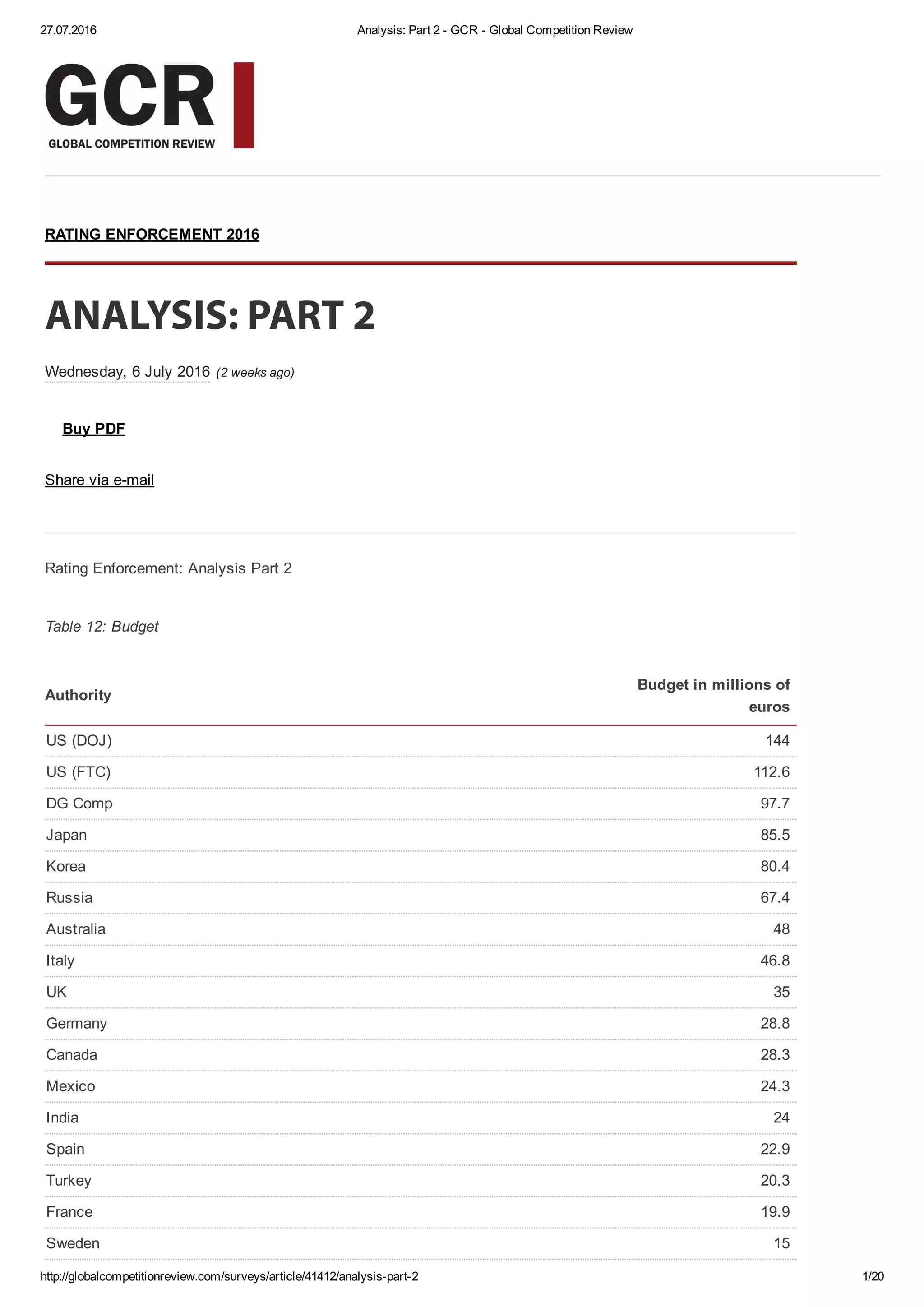
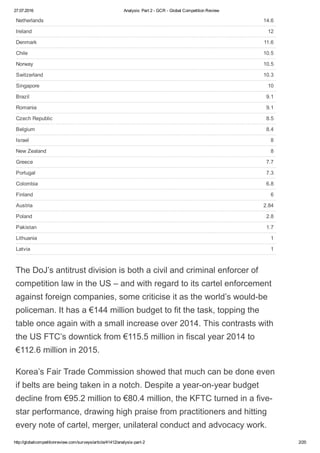
Table 12: Budget
Authority
Budget in millions of
euros
US (DOJ) 144
US (FTC) 112.6
DG Comp 97.7
Japan 85.5
Korea 80.4
Russia 67.4
Australia 48
Italy 46.8
UK 35
Germany 28.8
Canada 28.3
Mexico 24.3
India 24
Spain 22.9
Turkey 20.3
France 19.9
Sweden 15
27.07.2016 Analysis: Part 2 ­ GCR ­ Global Competition Review
http://globalcompetitionreview.com/surveys/article/41412/analysis­part­2 2/20
Netherlands 14.6
Ireland 12
Denmark 11.6
Chile 10.5
Norway 10.5
Switzerland 10.3
Singapore 10
Brazil 9.1
Romania 9.1
Czech Republic 8.5
Belgium 8.4
Israel 8
New Zealand 8
Greece 7.7
Portugal 7.3
Colombia 6.8
Finland 6
Austria 2.84
Poland 2.8
Pakistan 1.7
Lithuania 1
Latvia 1
The DoJ’s antitrust division is both a civil and criminal enforcer of
competition law in the US – and with regard to its cartel enforcement
against foreign companies, some criticise it as the world’s would­be
policeman. It has a €144 million budget to fit the task, topping the
table once again with a small increase over 2014. This contrasts with
the US FTC’s downtick from €115.5 million in fiscal year 2014 to
€112.6 million in 2015.
Korea’s Fair Trade Commission showed that much can be done even
if belts are being taken in a notch. Despite a year­on­year budget
decline from €95.2 million to €80.4 million, the KFTC turned in a five­
star performance, drawing high praise from practitioners and hitting
every note of cartel, merger, unilateral conduct and advocacy work.
27.07.2016 Analysis: Part 2 ­ GCR ­ Global Competition Review
http://globalcompetitionreview.com/surveys/article/41412/analysis­part­2 3/20
Meanwhile, Japan’s Fair Trade Commission barely hung on to the
four­and­a­half stars it has held for several editions of Rating Enforcement,
despite what Baker & McKenzie partner Junya Ae says was an
increase in its competition enforcement budget. He adds that
Japanese practitioners are wondering why the JFTC is less active
when enforcing against international cartels.
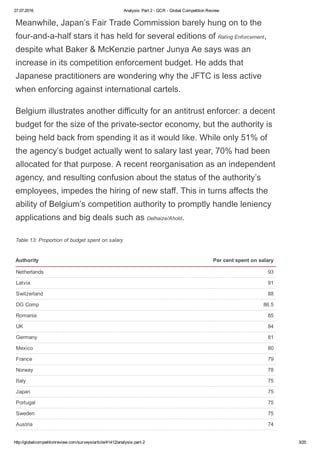
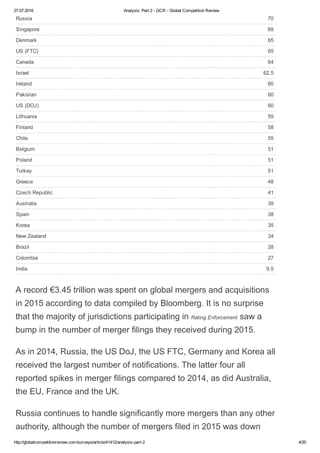
Belgium illustrates another difficulty for an antitrust enforcer: a decent
budget for the size of the private­sector economy, but the authority is
being held back from spending it as it would like. While only 51% of
the agency’s budget actually went to salary last year, 70% had been
allocated for that purpose. A recent reorganisation as an independent
agency, and resulting confusion about the status of the authority’s
employees, impedes the hiring of new staff. This in turns affects the
ability of Belgium’s competition authority to promptly handle leniency
applications and big deals such as Delhaize/Ahold.
Table 13: Proportion of budget spent on salary
Authority Per cent spent on salary
Netherlands 93
Latvia 91
Switzerland 88
DG Comp 86.5
Romania 85
UK 84
Germany 81
Mexico 80
France 79
Norway 78
Italy 75
Japan 75
Portugal 75
Sweden 75
Austria 74
Russia 70
27.07.2016 Analysis: Part 2 ­ GCR ­ Global Competition Review
http://globalcompetitionreview.com/surveys/article/41412/analysis­part­2 4/20
Russia 70
Singapore 69
Denmark 65
US (FTC) 65
Canada 64
Israel 62.5
Ireland 60
Pakistan 60
US (DOJ) 60
Lithuania 59
Finland 58
Chile 55
Belgium 51
Poland 51
Turkey 51
Greece 48
Czech Republic 41
Australia 39
Spain 38
Korea 35
New Zealand 34
Brazil 28
Colombia 27
India 9.5
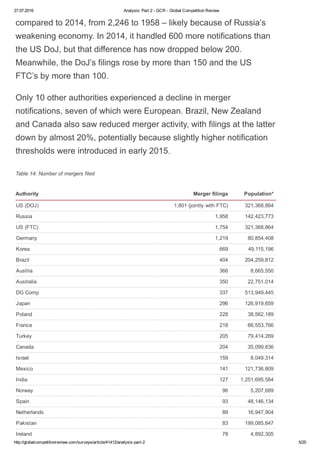
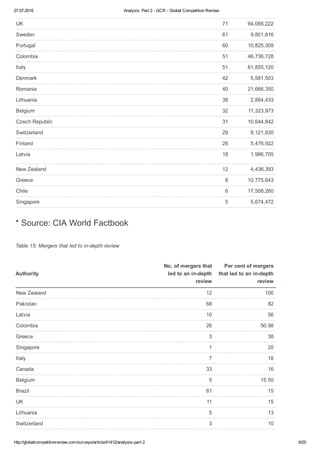
A record €3.45 trillion was spent on global mergers and acquisitions
in 2015 according to data compiled by Bloomberg. It is no surprise
that the majority of jurisdictions participating in Rating Enforcement saw a
bump in the number of merger filings they received during 2015.
As in 2014, Russia, the US DoJ, the US FTC, Germany and Korea all
received the largest number of notifications. The latter four all
reported spikes in merger filings compared to 2014, as did Australia,
the EU, France and the UK.
Russia continues to handle significantly more mergers than any other
authority, although the number of mergers filed in 2015 was down
27.07.2016 Analysis: Part 2 ­ GCR ­ Global Competition Review
http://globalcompetitionreview.com/surveys/article/41412/analysis­part­2 5/20
compared to 2014, from 2,246 to 1958 – likely because of Russia’s
weakening economy. In 2014, it handled 600 more notifications than
the US DoJ, but that difference has now dropped below 200.
Meanwhile, the DoJ’s filings rose by more than 150 and the US
FTC’s by more than 100.
Only 10 other authorities experienced a decline in merger
notifications, seven of which were European. Brazil, New Zealand
and Canada also saw reduced merger activity, with filings at the latter
down by almost 20%, potentially because slightly higher notification
thresholds were introduced in early 2015.
Table 14: Number of mergers filed
Authority Merger filings Population*
US (DOJ) 1,801 (jointly with FTC) 321,368,864
Russia 1,958 142,423,773
US (FTC) 1,754 321,368,864
Germany 1,219 80,854,408
Korea 669 49,115,196
Brazil 404 204,259,812
Austria 366 8,665,550
Australia 350 22,751,014
DG Comp 337 513,949,445
Japan 296 126,919,659
Poland 228 38,562,189
France 218 66,553,766
Turkey 205 79,414,269
Canada 204 35,099,836
Israel 159 8,049,314
Mexico 141 121,736,809
India 127 1,251,695,584
Norway 96 5,207,689
Spain 93 48,146,134
Netherlands 89 16,947,904
Pakistan 83 199,085,847
Ireland 78 4,892,305
27.07.2016 Analysis: Part 2 ­ GCR ­ Global Competition Review
http://globalcompetitionreview.com/surveys/article/41412/analysis­part­2 6/20
UK 71 64,088,222
Sweden 61 9,801,616
Portugal 60 10,825,309
Colombia 51 46,736,728
Italy 51 61,855,120
Denmark 42 5,581,503
Romania 40 21,666,350
Lithuania 38 2,884,433
Belgium 32 11,323,973
Czech Republic 31 10,644,842
Switzerland 29 8,121,830
Finland 26 5,476,922
Latvia 18 1,986,705
New Zealand 12 4,438,393
Greece 8 10,775,643
Chile 6 17,508,260
Singapore 5 5,674,472
* Source: CIA World Factbook
Table 15: Mergers that led to in­depth review
Authority
No. of mergers that
led to an in­depth
review
Per cent of mergers
that led to an in­depth
review
New Zealand 12 100
Pakistan 68 82
Latvia 10 56
Colombia 26 50.98
Greece 3 38
Singapore 1 20
Italy 7 18
Canada 33 16
Belgium 5 15.50
Brazil 61 15
UK 11 15
Lithuania 5 13
Switzerland 3 10
Israel 15 9
27.07.2016 Analysis: Part 2 ­ GCR ­ Global Competition Review
http://globalcompetitionreview.com/surveys/article/41412/analysis­part­2 7/20
Israel 15 9
Norway 9 9
Russia 185 9
Finland 2 8
Denmark 3 7
Mexico 10 7
Sweden 4 7
Netherlands 5 6
Korea 32 5
Australia 13 4
Ireland 3 4
Portugal 2 3.33
DG Comp 11 3
US (DOJ) 32 3
Poland 7 2.50
US (FTC) 20 2.28
Japan 6 2
Austria 5 1.40
Germany 13 1
Spain 1 1
Turkey 2 1
India 1 0.80
Czech Republic 0 0
France 0 0
Romania 0 0
Chile 16 (voluntary MR) Not available
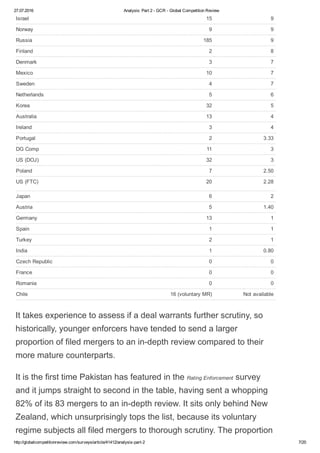
It takes experience to assess if a deal warrants further scrutiny, so
historically, younger enforcers have tended to send a larger
proportion of filed mergers to an in­depth review compared to their
more mature counterparts.
It is the first time Pakistan has featured in the Rating Enforcement survey
and it jumps straight to second in the table, having sent a whopping
82% of its 83 mergers to an in­depth review. It sits only behind New
Zealand, which unsurprisingly tops the list, because its voluntary
regime subjects all filed mergers to thorough scrutiny. The proportion
27.07.2016 Analysis: Part 2 ­ GCR ­ Global Competition Review
http://globalcompetitionreview.com/surveys/article/41412/analysis­part­2 8/20
of Latvia’s Phase II reviews rose from 36% to 56%, the third­highest
in the table, while Colombia and new entrant Singapore scrutinised
51% and 20% of all mergers respectively. Meanwhile, the number of
Phase II’s in Greece dropped from 50% to 38%.
The European Commission and other leading agencies in the US,
Germany, France, Japan and Korea continued to register single
digits, sending 5% or less of all filed mergers to Phase II. Elsewhere,
the Czech Republic slashed the proportion of in­depth probes from
11% to zero, while Poland, which previously subjected all mergers to
further scrutiny, sent only 2.5% of mergers to Phase II, following the
introduction of a new regime at the beginning of the year.
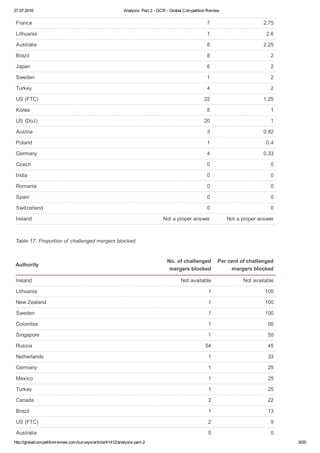
Table 16: Number of mergers challenged
Authority
No. of mergers
challenged
Per cent of mergers
challenged
Chile 3 50
Singapore 2 40
Greece 3 38
UK 11 15
Italy 5 10
New Zealand 1 8.25
Portugal 4 6.66
DG Comp 22 6.5
Belgium 2 6
Latvia 1 6
Russia 119 6
Norway 5 5
Denmark 2 4.75
Canada 9 4.5
Colombia 2 4
Finland 1 4
Pakistan 3 4
Israel 6 3.75
Mexico 4 3
Netherlands 3 3
27.07.2016 Analysis: Part 2 ­ GCR ­ Global Competition Review
http://globalcompetitionreview.com/surveys/article/41412/analysis­part­2 9/20
France 7 2.75
Lithuania 1 2.6
Australia 8 2.25
Brazil 8 2
Japan 6 2
Sweden 1 2
Turkey 4 2
US (FTC) 22 1.25
Korea 8 1
US (DoJ) 20 1
Austria 3 0.82
Poland 1 0.4
Germany 4 0.33
Czech 0 0
India 0 0
Romania 0 0
Spain 0 0
Switzerland 0 0
Ireland Not a proper answer Not a proper answer
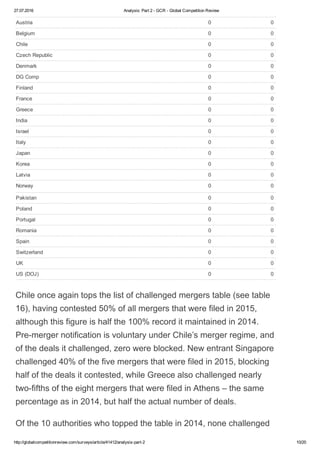
Table 17: Proportion of challenged mergers blocked
Authority
No. of challenged
mergers blocked
Per cent of challenged
mergers blocked
Ireland Not available Not available
Lithuania 1 100
New Zealand 1 100
Sweden 1 100
Colombia 1 50
Singapore 1 50
Russia 54 45
Netherlands 1 33
Germany 1 25
Mexico 1 25
Turkey 1 25
Canada 2 22
Brazil 1 13
US (FTC) 2 9
Australia 0 0
27.07.2016 Analysis: Part 2 ­ GCR ­ Global Competition Review
http://globalcompetitionreview.com/surveys/article/41412/analysis­part­2 10/20
Austria 0 0
Belgium 0 0
Chile 0 0
Czech Republic 0 0
Denmark 0 0
DG Comp 0 0
Finland 0 0
France 0 0
Greece 0 0
India 0 0
Israel 0 0
Italy 0 0
Japan 0 0
Korea 0 0
Latvia 0 0
Norway 0 0
Pakistan 0 0
Poland 0 0
Portugal 0 0
Romania 0 0
Spain 0 0
Switzerland 0 0
UK 0 0
US (DOJ) 0 0
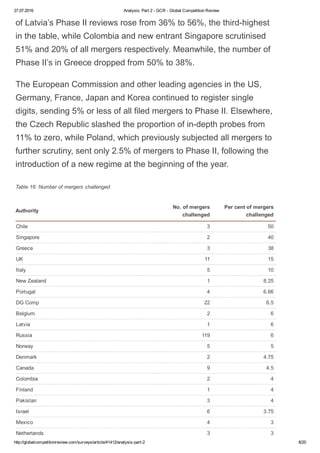
Chile once again tops the list of challenged mergers table (see table
16), having contested 50% of all mergers that were filed in 2015,
although this figure is half the 100% record it maintained in 2014.
Pre­merger notification is voluntary under Chile’s merger regime, and
of the deals it challenged, zero were blocked. New entrant Singapore
challenged 40% of the five mergers that were filed in 2015, blocking
half of the deals it contested, while Greece also challenged nearly
two­fifths of the eight mergers that were filed in Athens – the same
percentage as in 2014, but half the actual number of deals.
Of the 10 authorities who topped the table in 2014, none challenged
27.07.2016 Analysis: Part 2 ­ GCR ­ Global Competition Review
http://globalcompetitionreview.com/surveys/article/41412/analysis­part­2 11/20
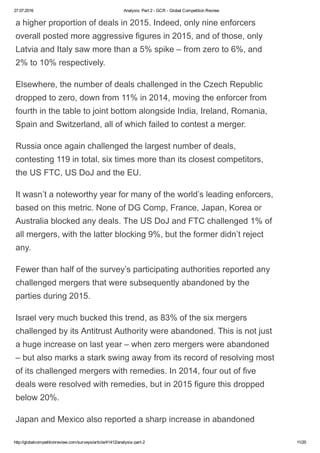
a higher proportion of deals in 2015. Indeed, only nine enforcers
overall posted more aggressive figures in 2015, and of those, only
Latvia and Italy saw more than a 5% spike – from zero to 6%, and
2% to 10% respectively.
Elsewhere, the number of deals challenged in the Czech Republic
dropped to zero, down from 11% in 2014, moving the enforcer from
fourth in the table to joint bottom alongside India, Ireland, Romania,
Spain and Switzerland, all of which failed to contest a merger.
Russia once again challenged the largest number of deals,
contesting 119 in total, six times more than its closest competitors,
the US FTC, US DoJ and the EU.
It wasn’t a noteworthy year for many of the world’s leading enforcers,
based on this metric. None of DG Comp, France, Japan, Korea or
Australia blocked any deals. The US DoJ and FTC challenged 1% of
all mergers, with the latter blocking 9%, but the former didn’t reject
any.
Fewer than half of the survey’s participating authorities reported any
challenged mergers that were subsequently abandoned by the
parties during 2015.
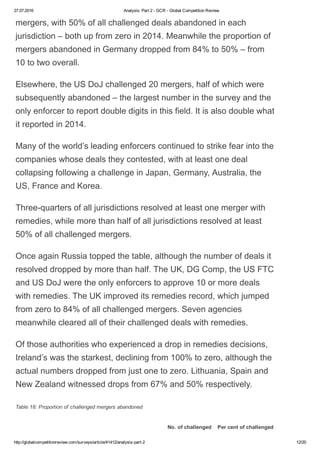
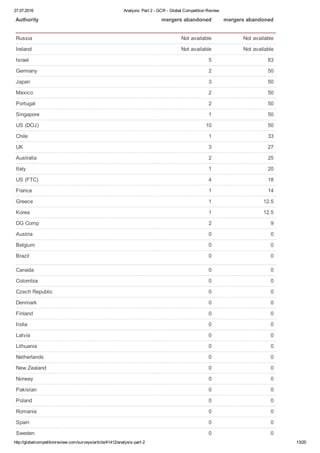
Israel very much bucked this trend, as 83% of the six mergers
challenged by its Antitrust Authority were abandoned. This is not just
a huge increase on last year – when zero mergers were abandoned
– but also marks a stark swing away from its record of resolving most
of its challenged mergers with remedies. In 2014, four out of five
deals were resolved with remedies, but in 2015 figure this dropped
below 20%.
Japan and Mexico also reported a sharp increase in abandoned
27.07.2016 Analysis: Part 2 ­ GCR ­ Global Competition Review
http://globalcompetitionreview.com/surveys/article/41412/analysis­part­2 12/20
mergers, with 50% of all challenged deals abandoned in each
jurisdiction – both up from zero in 2014. Meanwhile the proportion of
mergers abandoned in Germany dropped from 84% to 50% – from
10 to two overall.
Elsewhere, the US DoJ challenged 20 mergers, half of which were
subsequently abandoned – the largest number in the survey and the
only enforcer to report double digits in this field. It is also double what
it reported in 2014.
Many of the world’s leading enforcers continued to strike fear into the
companies whose deals they contested, with at least one deal
collapsing following a challenge in Japan, Germany, Australia, the
US, France and Korea.
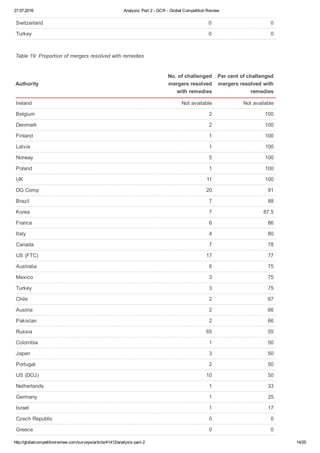
Three­quarters of all jurisdictions resolved at least one merger with
remedies, while more than half of all jurisdictions resolved at least
50% of all challenged mergers.
Once again Russia topped the table, although the number of deals it
resolved dropped by more than half. The UK, DG Comp, the US FTC
and US DoJ were the only enforcers to approve 10 or more deals
with remedies. The UK improved its remedies record, which jumped
from zero to 84% of all challenged mergers. Seven agencies
meanwhile cleared all of their challenged deals with remedies.
Of those authorities who experienced a drop in remedies decisions,
Ireland’s was the starkest, declining from 100% to zero, although the
actual numbers dropped from just one to zero. Lithuania, Spain and
New Zealand witnessed drops from 67% and 50% respectively.
Table 18: Proportion of challenged mergers abandoned
No. of challenged Per cent of challenged
27.07.2016 Analysis: Part 2 ­ GCR ­ Global Competition Review
http://globalcompetitionreview.com/surveys/article/41412/analysis­part­2 13/20
Authority mergers abandoned mergers abandoned
Russia Not available Not available
Ireland Not available Not available
Israel 5 83
Germany 2 50
Japan 3 50
Mexico 2 50
Portugal 2 50
Singapore 1 50
US (DOJ) 10 50
Chile 1 33
UK 3 27
Australia 2 25
Italy 1 20
US (FTC) 4 18
France 1 14
Greece 1 12.5
Korea 1 12.5
DG Comp 2 9
Austria 0 0
Belgium 0 0
Brazil 0 0
Canada 0 0
Colombia 0 0
Czech Republic 0 0
Denmark 0 0
Finland 0 0
India 0 0
Latvia 0 0
Lithuania 0 0
Netherlands 0 0
New Zealand 0 0
Norway 0 0
Pakistan 0 0
Poland 0 0
Romania 0 0
Spain 0 0
Sweden 0 0
27.07.2016 Analysis: Part 2 ­ GCR ­ Global Competition Review
http://globalcompetitionreview.com/surveys/article/41412/analysis­part­2 14/20
Switzerland 0 0
Turkey 0 0
Table 19: Proportion of mergers resolved with remedies
Authority
No. of challenged
mergers resolved
with remedies
Per cent of challenged
mergers resolved with
remedies
Ireland Not available Not available
Belgium 2 100
Denmark 2 100
Finland 1 100
Latvia 1 100
Norway 5 100
Poland 1 100
UK 11 100
DG Comp 20 91
Brazil 7 88
Korea 7 87.5
France 6 86
Italy 4 80
Canada 7 78
US (FTC) 17 77
Australia 6 75
Mexico 3 75
Turkey 3 75
Chile 2 67
Austria 2 66
Pakistan 2 66
Russia 65 55
Colombia 1 50
Japan 3 50
Portugal 2 50
US (DOJ) 10 50
Netherlands 1 33
Germany 1 25
Israel 1 17
Czech Republic 0 0
Greece 0 0
27.07.2016 Analysis: Part 2 ­ GCR ­ Global Competition Review
http://globalcompetitionreview.com/surveys/article/41412/analysis­part­2 15/20
India 0 0
Lithuania 0 0
New Zealand 0 0
Romania 0 0
Singapore 0 0
Spain 0 0
Sweden 0 0
Switzerland 0 0
Table 20: Average length of an in­depth merger review
Authority
Average length of in­
depth merger review (in
days)
Portugal 225
Chile 199
Netherlands 194
Spain 180
UK 180
Poland 162
Turkey 155
Ireland 150
Norway 150
Colombia 144
Denmark 135
Singapore 120
Germany 117
Sweden 115
DG Comp 112.5
Austria 105
Latvia 96
Finland 90
Greece 90
Japan 90
Mexico 87
Switzerland 75­90
Brazil 82
Australia 77
Israel 74.5
New Zealand 64
27.07.2016 Analysis: Part 2 ­ GCR ­ Global Competition Review
http://globalcompetitionreview.com/surveys/article/41412/analysis­part­2 16/20
New Zealand 64
Lithuania 63
Italy 62
Canada 48
Belgium 46
Korea 26.5
Pakistan 14­21
US (FTC) Not available
Czech Republic Not available
France Not available
India Not available
Romania Not available
Russia Not available
US (DOJ) Not available
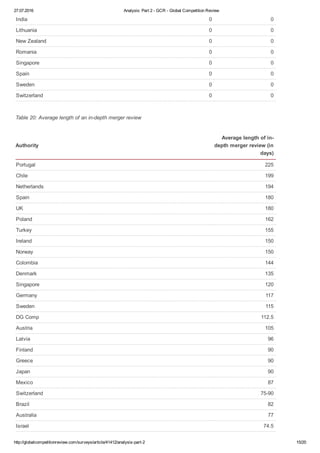
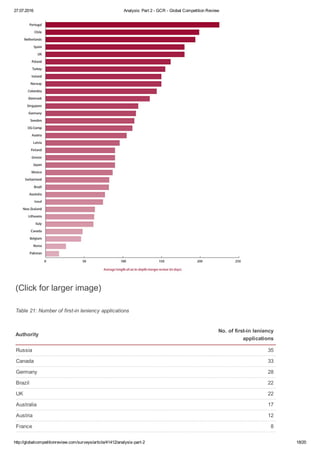
For the third year in a row, we asked competition enforcers how long
it took, on average, to conclude an in­depth merger review. Although
the statistics can be skewed depending on how many in­depth
investigations are opened in one given year and when a merger’s
clock officially begins, the data gives some indication of the general
timing of a Phase II review in these jurisdictions.
The majority of enforcers take between three and five months to
review a complex deal and decide on a course of action. Portugal
and the Netherlands once again appear at the top of the table – this
time alongside Chile – in taking the longest amount of time to
complete a review. The Netherlands, however, dropped from first to
third, after shaving 45 days off of an average review. Portugal now
tops the list: its reviews in 2015 on average took seven­and­a­half
months to conclude, despite launching only two Phase II
investigations last year.
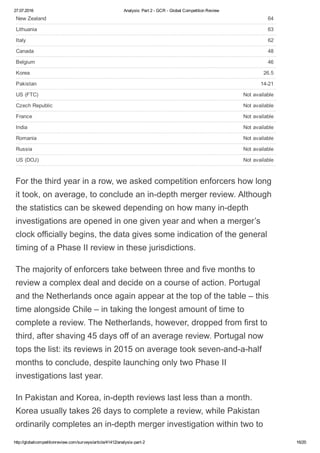
In Pakistan and Korea, in­depth reviews last less than a month.
Korea usually takes 26 days to complete a review, while Pakistan
ordinarily completes an in­depth merger investigation within two to
27.07.2016 Analysis: Part 2 ­ GCR ­ Global Competition Review
http://globalcompetitionreview.com/surveys/article/41412/analysis­part­2 17/20
three weeks – perhaps unsurprising given that the enforcer
scrutinised 82% of the 83 mergers filed in 2015, with only 30
competition enforcement staffers. Enforcers must be efficient when
examining deals to prevent a backlog of cases. Broadly speaking,
those enforcers who initiate the most in­depth reviews tend to take
less time completing their investigations. Elsewhere, Canada and
Belgium continue to keep their Phase II reviews shorter than two
months on average.
A number of authorities trimmed the amount of time it took to review
complex deals in 2015, with Austria, Germany, Belgium and the EU
all taking between 35 and 45 days less on average to conclude their
investigations; the European Commission saw the average duration
of an in­depth review return to 2013 levels after witnessing a steep
climb in 2014.
The average wait time in Poland jumped from two months to 162
days. Poland previously subjected all mergers to in­depth scrutiny,
but in 2015 it sent only 2.5% of mergers to Phase II, following the
introduction of a new regime at the beginning of the year. Turkey
meanwhile extended the average length of an in­depth merger
investigation from just 16 days to five months – nearly a tenfold
increase.
27.07.2016 Analysis: Part 2 ­ GCR ­ Global Competition Review
http://globalcompetitionreview.com/surveys/article/41412/analysis­part­2 18/20
(Click for larger image)
Table 21: Number of first­in leniency applications
Authority
No. of first­in leniency
applications
Russia 35
Canada 33
Germany 28
Brazil 22
UK 22
Australia 17
Austria 12
France 8
Mexico 8
27.07.2016 Analysis: Part 2 ­ GCR ­ Global Competition Review
http://globalcompetitionreview.com/surveys/article/41412/analysis­part­2 19/20
Mexico 8
Singapore 6
Romania 5
New Zealand 3
Norway 3
Chile 1
India 1
Latvia 1
Portugal 1
Turkey 1
Belgium 0
Israel 0
Lithuania 0
Pakistan 0
South Africa was, by some distance, the top enforcer for first­in
leniency applications last year, breaking into triple figures with an
impressive 115 filings. This year, however, the agency declined to
take part in Rating Enforcement, so whether this year saw a repeat of that
spike in applications – caused by the agency’s Construction
Settlements Project – is unknown. We also are unable to report
whether its unusual presence at the top of the leniency applications
table was also repeated this year, but it seems unlikely.
Broadly, things are back to normal on the first­in scene, with the ever­
hyperactive Russia bagging the top spot. Coming right in afterwards
are Canada, which took third place last year, Germany, the UK and
Brazil, and Australia. The top five is more or less business as usual.
The UK and Brazil are new entrants. Otherwise, Canada, Germany
and Australia roughly maintain their positions from last year’s survey,
and while the Federal Cartel Office has dipped from 42 to 33 filings,
the numbers are for the most part steady.
Lower down the table, it’s clear that Belgium had a poor year for
attracting whistleblowers: from six applications in 2014 to zero new
27.07.2016 Analysis: Part 2 ­ GCR ­ Global Competition Review
http://globalcompetitionreview.com/surveys/article/41412/analysis­part­2 20/20
Copyright © 2016 Law Business Research Ltd. All rights reserved. | http://www.lbresearch.com
87 Lancaster Road, London, W11 1QQ, UK | Tel: +44 207 908 1188 / Fax: +44 207 229 6910
http://www.globcompetitionreview.com | editorial@globalcompetitionreview.com
leniency files last year. Israel, Lithuania and Pakistan join the agency
at the bottom, having received no first­in applications. The Pakistani
authority appears in Rating Enforcement for the first time; it’s worth noting
that the authority had a quiet year in 2014 and handed down only
€1.18 million in cartel fines last year.
If the number of first­in applications Germany received sagged in
2015, the broader leniency picture looks much healthier: it received
only four fewer applications last year than in 2014, coming to a total
of 76. And once again, the absence of South Africa has evened
things out a little in the top ranks of the leniency applications table:
usual suspects like Japan, Canada, Russia, DG Comp and Australia
return to the top of our list, with Brazil a new entrant in second place.
Meanwhile, it was an exceptionally good year for Mexico, which saw
a tripling of its number of applications from six to 18 – that’s one
fewer than Australia, and only six fewer than the UK.

Анализ по размерам бюджета