(c) Kow Kuroda:How are inflectional paradigms represented? at NLP22, 2016
屈折パラダイムの(⼼心内)表現はどうなっているの
か?
How are inflectional paradigms represented
(in the mind)?
FCA meets Czech declension
Kow Kuroda/黒 ⽥田 航
Kyorin University/杏林⼤大学
22nd Annual Meeting of the NLP Association, Japan, at Tohoku
University, 2016-03-10 (Thu)
発表後の修正版
(c) Kow Kuroda:How are inflectional paradigms represented? at NLP22, 2016
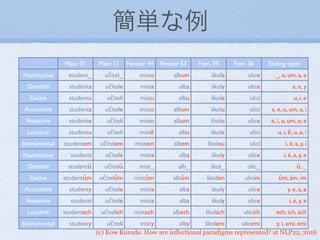
簡単な例
Masc 01 Masc 11 Neuter 44 Neuter 53 Fem. 39 Fem. 36 Ending types
Nominative student_ učitel_ místo album škola ulice _, o, um, a, e
Genitive studenta učitele místa alba školy ulice a, e, y
Dative studentu učiteli místu albu škole ulici u, i, e
Accusative studenta učitele místo album školu ulici a, e, o, um, u, i
Vocactive studente učiteli místo album školo ulice e, i, o, um, o, e
Locative studentu učiteli místě albu škole ulici u, i, ě, u, e, i
Instrumental studentem učitelem místem albem školou ulicí i, é, a, y, í
Nominative studenti učitelé místa alba školy ulice i, é, a, y, e
Genitive studentů učitelů míst_ alb_ škol_ ulic_ ů, _
Dative studentům učitelům místům albům školám ulicím ům, ám, ím
Accusative studenty učitele místa alba školy ulice y, e, a, e
Vocactive studenti učitelé místa alba školy ulice i, é, y, e
Locative studentech učitelích místech albech školách ulicích ech, ích, ách
Instrumental studenty učiteli místy alby školami ulicemi y, i, ami, emi
4.
(c) Kow Kuroda:How are inflectional paradigms represented? at NLP22, 2016
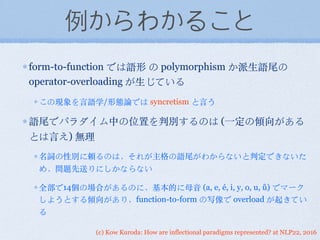
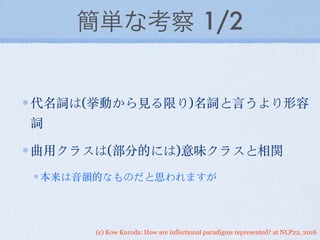
例からわかること
form-to-function では語形 の polymorphism か派⽣生語尾の
operator-overloading が⽣生じている
この現象を⾔言語学/形態論では syncretism と⾔言う
語尾でパラダイム中の位置を判別するのは (⼀一定の傾向がある
とは⾔言え) 無理
名詞の性別に頼るのは,それが主格の語尾がわからないと判定できないた
め,問題先送りにしかならない
全部で14個の場合があるのに,基本的に母⾳音 (a, e, é, i, y, o, u, ů) でマーク
しようとする傾向があり,function-to-form の写像で overload が起きてい
る
5.
(c) Kow Kuroda:How are inflectional paradigms represented? at NLP22, 2016
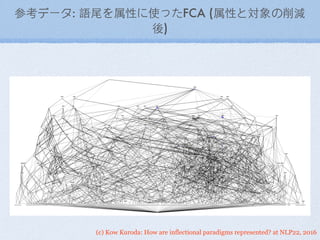
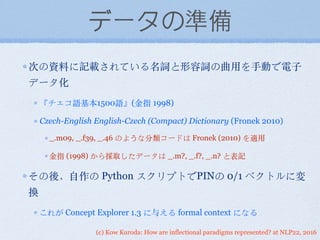
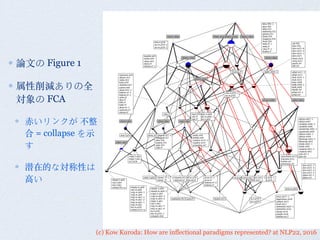
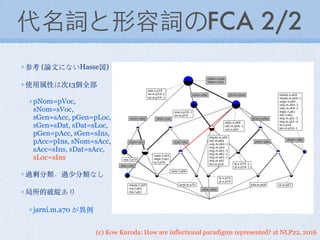
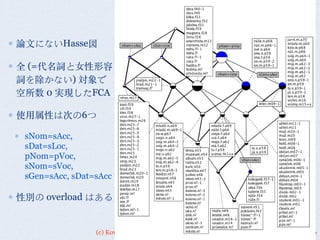
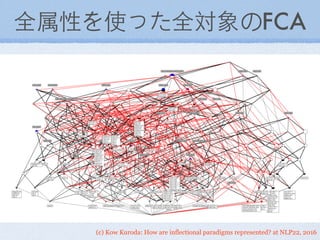
参考データ: 語尾を属性に使ったFCA (属性と対象の削減
後)
6.
(c) Kow Kuroda:How are inflectional paradigms represented? at NLP22, 2016
問題
語尾が曲⽤用クラス識別キーにならないなら,ど
んな情報が識別キーなっているのか?
曲⽤用クラス同⼠士の類似度は測れないのか?
7.
(c) Kow Kuroda:How are inflectional paradigms represented? at NLP22, 2016
検証する仮説 1/2
仮説 H
チェコ語の名詞/形容詞の 14個の語形の(⾮非)同⼀一性の集合
が曲⽤用クラスの識別キーなのでは?
関連研究 (paradigm economy, inflection classes)
[Ackerman, et al., 2009, Ackerman & Malouf, 2013;
Carstairs-McCarthy, 1992, 1994; Blevins, 2004, 2013;
Wurzel, 1987]
8.
(c) Kow Kuroda:How are inflectional paradigms represented? at NLP22, 2016
検証する仮説 2/2
仮説 Hの含意
名詞 N の曲⽤用の個々の語形は,曲⽤用クラス (i.e,. パラダイ
ム) の認識に間接的にしか係わらない
個々の語の終り⽅方は名詞の性別に関係するだけ
パラダイムは表層語形に対して⼆二次の⼀一般化 (2nd order
generalization)
(c) Kow Kuroda:How are inflectional paradigms represented? at NLP22, 2016
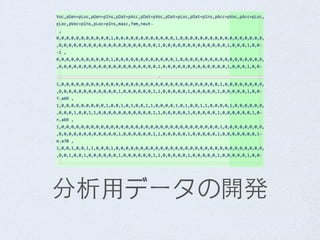
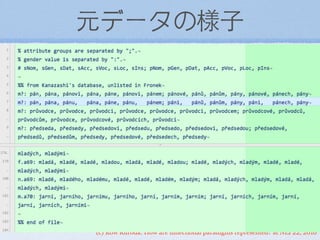
元データの様⼦子
14.
(c) Kow Kuroda:How are inflectional paradigms represented? at NLP22, 2016
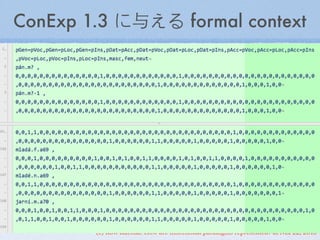
ConExp 1.3 に与える formal context
15.
(c) Kow Kuroda:How are inflectional paradigms represented? at NLP22, 2016
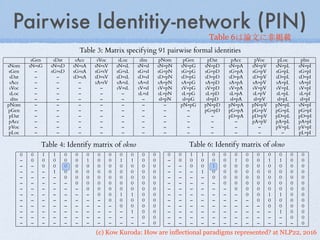
Pairwise Identitiy-network (PIN)
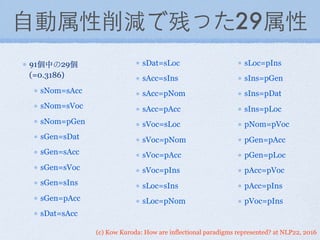
Table 3: Matrix specifying 91 pairwise formal identities
sGen sDat sAcc sVoc sLoc sIns pNom pGen pDat pAcc pVoc pLoc pIns
sNom sN=sG sN=sD sN=sA sN=sV sN=sL sN=sI sN=pN sN=pG sN=pD sN=pA sN=pV sN=pL sN=pI
sGen – sG=sD sG=sA sG=sV sG=sL sG=sI sG=pN sG=pG sG=pD sG=pA sG=pV sG=pL sG=pI
sDat – – sD=sA sD=sV sD=sL sD=sI sD=pN sD=pG sD=pD sD=pA sD=pV sD=pL sD=pI
sAcc – – – sA=sV sA=sL sA=sI sA=pN sA=pG sA=pD sA=pA sA=pV sA=pL sA=pI
sVoc – – – – sV=sL sV=sI sV=pN sV=pG sV=pD sV=pA sV=pV sV=pL sV=pI
sLoc – – – – – sL=sI sL=pN sL=pG sL=pD sL=pA sL=pV sL=pL sL=pI
sIns – – – – – – sI=pN sI=pG sI=pD sI=pA sI=pV sI=pL sI=pI
pNom – – – – – – – pN=pG pN=pD pN=pA pN=pV pN=pL sN=pI
pGen – – – – – – – – pG=pD pG=pA pG=pV pG=pL pG=pI
pDat – – – – – – – – – pD=pA pD=pV pD=pL pD=pI
pAcc – – – – – – – – – – pA=pV pA=pL pA=pI
pVoc – – – – – – – – – – – pV=pL pV=pI
pLoc – – – – – – – – – – – – pL=pI
em formal context given to FCA.4)
For example, okno
Table 1 is encoded as the matrix in Table 4, and this
atrix was then converted into a feature vector by se-
alizing the distribution of values.
Table 4: Identify matrix of okno
0 0 1 1 0 0 0 0 0 0 0 0 0
– 0 0 0 0 0 1 0 0 1 1 0 0
– – 0 0 0 0 0 0 0 0 0 0 0
– – – 1 0 0 0 0 0 0 0 0 0
– – – – 0 0 0 0 0 0 0 0 0
– – – – – 0 0 0 0 0 0 0 0
– – – – – – 0 0 0 0 0 0 0
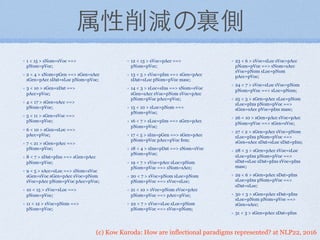
After some investigation, however, it turned out th
inclusion of sVoc=sNom and pVoc=pNom were us
ful and included. Thus, the set of relevant attribu
was reduced to the one in (2) comprising 13 attribut
which is called the set of “legitimate” attributes:
(2) sNom=sAcc, sNom=sVoc, sGen=sDat, sGen=sA
sGen=sIns, sDat=sAcc, sDat=sLoc, sAcc=sI
sLoc=sIns, pNom=pVoc, pGen=pAcc, pGen=pLoc, a
pAcc=pIns.
Table 3: Matrix specifying 91 pairwise formal identities
sGen sDat sAcc sVoc sLoc sIns pNom pGen pDat pAcc pVoc pLoc
sNom sN=sG sN=sD sN=sA sN=sV sN=sL sN=sI sN=pN sN=pG sN=pD sN=pA sN=pV sN=pL
sGen – sG=sD sG=sA sG=sV sG=sL sG=sI sG=pN sG=pG sG=pD sG=pA sG=pV sG=pL
sDat – – sD=sA sD=sV sD=sL sD=sI sD=pN sD=pG sD=pD sD=pA sD=pV sD=pL
sAcc – – – sA=sV sA=sL sA=sI sA=pN sA=pG sA=pD sA=pA sA=pV sA=pL
sVoc – – – – sV=sL sV=sI sV=pN sV=pG sV=pD sV=pA sV=pV sV=pL
sLoc – – – – – sL=sI sL=pN sL=pG sL=pD sL=pA sL=pV sL=pL
sIns – – – – – – sI=pN sI=pG sI=pD sI=pA sI=pV sI=pL
pNom – – – – – – – pN=pG pN=pD pN=pA pN=pV pN=pL
pGen – – – – – – – – pG=pD pG=pA pG=pV pG=pL
pDat – – – – – – – – – pD=pA pD=pV pD=pL
pAcc – – – – – – – – – – pA=pV pA=pL
pVoc – – – – – – – – – – – pV=pL
pLoc – – – – – – – – – – – –
them formal context given to FCA.4)
For example, okno
in Table 1 is encoded as the matrix in Table 4, and this
matrix was then converted into a feature vector by se-
rializing the distribution of values.
Table 4: Identify matrix of okno
0 0 1 1 0 0 0 0 0 0 0 0 0
– 0 0 0 0 0 1 0 0 1 1 0 0
– – 0 0 0 0 0 0 0 0 0 0 0
– – – 1 0 0 0 0 0 0 0 0 0
– – – – 0 0 0 0 0 0 0 0 0
– – – – – 0 0 0 0 0 0 0 0
– – – – – – 0 0 0 0 0 0 0
– – – – – – – 0 0 1 1 0 0
– – – – – – – – 0 0 0 0 0
– – – – – – – – – 0 0 0 0
– – – – – – – – – – 1 0 0
– – – – – – – – – – – 0 0
– – – – – – – – – – – – 0
Some words, mostly frequent ones, show variations
After some investigation, however, it turn
inclusion of sVoc=sNom and pVoc=pNom
ful and included. Thus, the set of relevant
was reduced to the one in (2) comprising 13
which is called the set of “legitimate” attribu
(2) sNom=sAcc, sNom=sVoc, sGen=sDat,
sGen=sIns, sDat=sAcc, sDat=sLoc,
sLoc=sIns, pNom=pVoc, pGen=pAcc, pGen
pAcc=pIns.
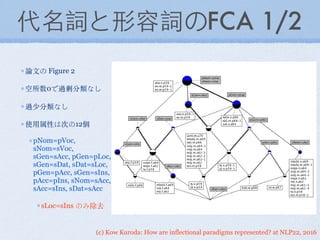
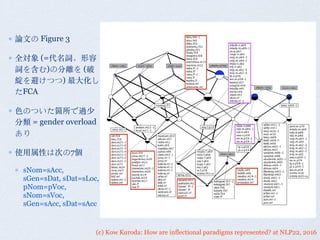
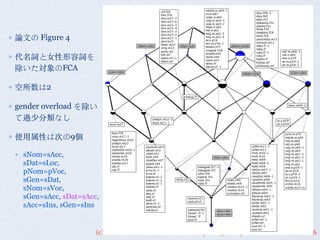
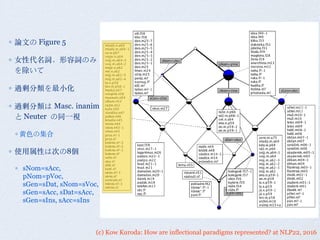
Figure 1 specifies the Hasse diagram wh
gitimate attributes in (2) are used. The
scheme used is the following: m1 m27 ind
line nouns; f28 f42 feminine nouns; n49 n
nouns; p.fm, f, n, xg58 p.fm, f, n, xg68 p
– – – – – – – – 0 0 0 0 0
– – – – – – – – – 0 0 0 0
– – – – – – – – – – 1 0 0
– – – – – – – – – – – 0 0
– – – – – – – – – – – – 0
Some words, mostly frequent ones, show variations
in declension. The noun okno, for example, has an
alternative declension, where sDat and sLoc have the
same form, oknu, as illustrated in Table 5. The identity
matrix based method faces no trouble, however. The
encoding for the alternate declension in Table 5 is given
in Table 6. This flexibility in dealing with variations is
one of the greatest benefits of the encoding used in this
study.
Table 5: Alternative declension of okno
number Nom. Gen. Dat. Accu. Voc. Loc. Inst.
SING. okno okna oknu okno okno oknu oknem
PLUR. okna oken oknům okna okna oknech okny
Table 6: Identify matrix of okno
0 0 1 1 0 0 0 0 0 0 0 0 0
– 0 0 0 0 0 1 0 0 1 1 0 0
– – 0 0 1 0 0 0 0 0 0 0 0
– – – 1 0 0 0 0 0 0 0 0 0
– – – – 0 0 0 0 0 0 0 0 0
– – – – – 0 0 0 0 0 0 0 0
– – – – – – 0 0 0 0 0 0 0
– – – – – – – 0 0 1 1 0 0
– – – – – – – – 0 0 0 0 0
– – – – – – – – – 0 0 0 0
– – – – – – – – – – 1 0 0
– – – – – – – – – – – 0 0
– – – – – – – – – – – – 0
Table 6は論⽂文に⾮非掲載
16.
(c) Kow Kuroda:How are inflectional paradigms represented? at NLP22, 2016
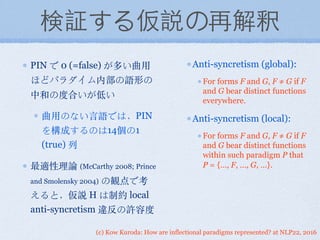
検証する仮説の再解釈
PIN で 0 (=false) が多い曲⽤用
ほどパラダイム内部の語形の
中和の度合いが低い
曲⽤用のない⾔言語では,PIN
を構成するのは14個の1
(true) 列
最適性理論 (McCarthy 2008; Prince
and Smolensky 2004) の観点で考
えると,仮説 H は制約 local
anti-syncretism 違反の許容度
Anti-syncretism (global):
For forms F and G, F ≠ G if F
and G bear distinct functions
everywhere.
Anti-syncretism (local):
For forms F and G, F ≠ G if F
and G bear distinct functions
within such paradigm P that
P = {…, F, …, G, …}.
(c) Kow Kuroda:How are inflectional paradigms represented? at NLP22, 2016
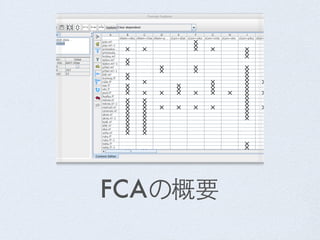
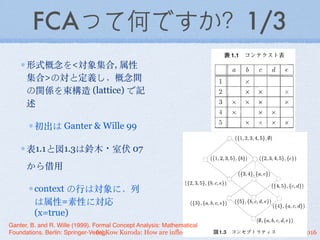
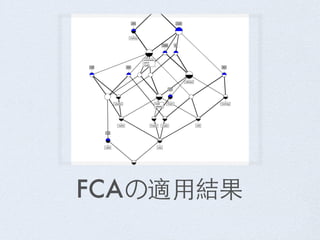
FCAって何ですか?1/3
形式概念を<対象集合, 属性
集合>の対と定義し,概念間
の関係を束構造 (lattice) で記
述
初出は Ganter & Wille 99
表1.1と図1.3は鈴⽊木・室伏 07
から借⽤用
context の⾏行は対象に,列
は属性=素性に対応
(x=true)
Ganter, B. and R. Wille (1999). Formal Concept Analysis: Mathematical
Foundations. Berlin: Springer-Verlag.
19.
(c) Kow Kuroda:How are inflectional paradigms represented? at NLP22, 2016
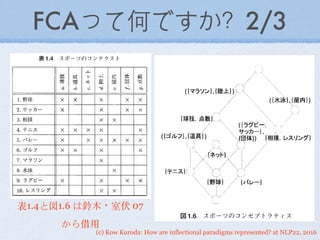
FCAって何ですか?2/3
NII-Electronic Library Service
ety for Fuzzy Theory and intelligent informatics
表1.4と図1.6 は鈴⽊木・室伏 07
から借⽤用
(c) Kow Kuroda:How are inflectional paradigms represented? at NLP22, 2016
今後の課題
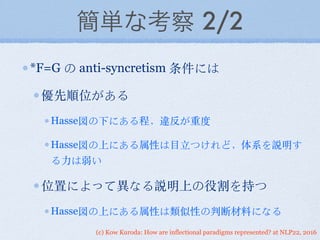
*F=G の優先順位の説明
Static な側⾯面
Paradigm Economy Principle の先⾏行研究 [Ackerman et al. 2009,
2013; Blenvins 2013; Carstairs-McCarthy 1992, 1994] との対照を含む
Dynamic な⾯面
⾔言語進化のシミュレーションの研究成果 [Kirby and Hurford 2002]
や Generative Social Science の研究成果 [Epstein 2006] との対
照
42.
(c) Kow Kuroda:How are inflectional paradigms represented? at NLP22, 2016
References
Ackerman, F., J. Blevins,& R. Malouf. 2009. Parts and
wholes: Patterns of relatedness in complex morphological
systems and why they matter. In J. Blevins & J. Blevins
(eds.), Analogy in Grammar: Form and Acquisition. Oxford:
Oxford University Press.
Ackerman, F., & R. Malouf. 2013. Morphological
organization: The Low Conditional Entropy Conjecture.
Language, 89, 429–464.
Blevins, J. 2004. Inflection classes and economy. In G.
Müller, L. Gunkel and G. Zifonun (eds.), Explorations in
Nominal Inflection. Berlin: Mouton de Gruyter.
Blevins, J. 2013. The information-theoretic turn. Psihologija
46: 355–375.
Carstairs-McCarthy, A. 1992. Current Morphology,
Routledge.
Carstairs-McCarthy, A. 1994. Inflection classes, gender, and
the Principle of Contrast. Language 70: 737–88.
Epstein, J. M. 2006. Generative Social Science: Studies in
Agent-based Computational Modeling. Princeton: Princeton
University Press.
Ganter, B. and R. Wille. 1999. Formal Concept Analysis:
Mathematical Foundations, Spinger Verlag.
Ganter, B., G. Stumme, & R. Wille, eds. 2005. Formal
Concept Analysis: Foundations and Applications, Spinger
Verlag.
Kirby, S., & J. Hurford. 2002. “The emergence of linguistic
structure: An overview of the iterated learning model.” In A.
Cangelosi & D. Parisi (eds.) Simulating the Evolution of
Language. London: Springer Verlag.
McCarthy, J. 2008. Doing Optimality Theory: Applyinig
Theory to Data, Wiley-Blackwell.
Prince, A. and P. Smolensky. 2004. Optimality Theory:
Constraint Interaction in Generative Grammar, John Wiley
& Sons.
Wurzel, W.~Ulrike. 1987. System-dependent morphological
naturalness in inflection. In Dressler, W.~U., Mayerthaler,
W., Panagle, O., & Wurzel, W.~U. (eds.), Leitmotifs in
Natural Morphology, pp .59–96. Berlin: Mouton de Gruyter.
鈴⽊木 治 & 室伏 俊明. 形式概念分析: ⼊入⾨門・⽀支援ソフト・応⽤用.
知能と情報 19 (2): 103--142.

![(c) Kow Kuroda: How are inflectional paradigms represented? at NLP22, 2016
事の始まり
チェコ語を2013年に始めて曲⽤用 (declension) に悩まされている
この複雑性の正体は何なのだ!?
例えば Czech-English English-Dictionary (Fronek 2010) には,名詞について全
部で68種類(男性27種類,中性12種類,⼥女性15種類),形容詞について全部で4
種類の曲⽤用クラスが記載されているが,これらの相互関係はどうなっているの
か?
もっと効率の良い覚え⽅方はないものか!?
という (苛⽴立ち混じりの) 疑問の解消が⽬目的
⾔言語学を学び始めた頃に読んだ形態論の⼊入⾨門書 [Carstairs-McCarthy 1992] に,形
態論で paradigm の研究は不⼗〸十分だと書いてあったし](https://image.slidesharecdn.com/fca-meets-declension-nlp22-slides-160316065320/85/slide-2-320.jpg)
![(c) Kow Kuroda: How are inflectional paradigms represented? at NLP22, 2016
検証する仮説 1/2
仮説 H
チェコ語の名詞/形容詞の 14個の語形の(⾮非)同⼀一性の集合
が曲⽤用クラスの識別キーなのでは?
関連研究 (paradigm economy, inflection classes)
[Ackerman, et al., 2009, Ackerman & Malouf, 2013;
Carstairs-McCarthy, 1992, 1994; Blevins, 2004, 2013;
Wurzel, 1987]](https://image.slidesharecdn.com/fca-meets-declension-nlp22-slides-160316065320/85/slide-7-320.jpg)
![(c) Kow Kuroda: How are inflectional paradigms represented? at NLP22, 2016
課題の定義
⽅方針
H が正しいなら曲⽤用クラスの教師なし分類が可能である
発表後の訂正
最適化の⼿手順が教師信号になっているので,教師なしは誤り
せいぜい半教師あり分類
この分類を Formal Concept Analysis (FCA) [Ganter & Wille, 1999; Ganter, et
al. (eds.), 2005; 鈴⽊木・室伏 2007] を使って検証する
実装
Pairwise identity-network (PIN) (後述) を FCA に与える形式⽂文脈の属性に使う](https://image.slidesharecdn.com/fca-meets-declension-nlp22-slides-160316065320/85/slide-9-320.jpg)
![(c) Kow Kuroda: How are inflectional paradigms represented? at NLP22, 2016
更に sX=pY, pX=sY, s[^(Nom)]=sVoc, p[^(Nom)]=pVoc
を除いた13属性
91個中の13個 (= 1/7 = 0.142)
sNom=sAcc
sNom=sVoc
sGen=sDat
sGen=sAcc
sGen=sVoc
sGen=sIns
sDat=sAcc,
sDat=sLoc
sAcc=sIns
sAcc=pAcc
sVoc=sLoc
sLoc=sIns
pNom=pVoc
pGen=pAcc,
pGen=pLoc
pAcc=pVoc
pAcc=pIns
pVoc=pIns](https://image.slidesharecdn.com/fca-meets-declension-nlp22-slides-160316065320/85/slide-30-320.jpg)
![(c) Kow Kuroda: How are inflectional paradigms represented? at NLP22, 2016
今後の課題
*F=G の優先順位の説明
Static な側⾯面
Paradigm Economy Principle の先⾏行研究 [Ackerman et al. 2009,
2013; Blenvins 2013; Carstairs-McCarthy 1992, 1994] との対照を含む
Dynamic な⾯面
⾔言語進化のシミュレーションの研究成果 [Kirby and Hurford 2002]
や Generative Social Science の研究成果 [Epstein 2006] との対
照](https://image.slidesharecdn.com/fca-meets-declension-nlp22-slides-160316065320/85/slide-41-320.jpg)




![[教育のための] コミュニケーションは双方向的である](https://cdn.slidesharecdn.com/ss_thumbnails/univ-edu-for-next-gen-2010-12-18-slides-160220062328-thumbnail.jpg?width=640&height=640&fit=bounds)


