Journal of Agr.Research & Extension 31(1): 1-12
1
ผลของพาโคลบิวทราโซลต่อพัฒนาการของใบชวนชมพันธุ์ฮอลแลนด์-มิสไทยแลนด์
Effects of Paclobutrazol on Leaf Development of Adenium obesum
cv. Holland-Miss Thailand
นิติพัฒน์ พัฒนฉัตรชัย
Nitipat Pattanachatchai
สาขาวิชาเกษตรและสิ่งแวดล้อม คณะวิทยาศาสตร์และเทคโนโลยี มหาวิทยาลัยราชภัฏสุรินทร์ สุรินทร์ 32000
Department of Agriculture and Environment, Faculty of Science and Technology, Surindra Rajabhat University
Surin, Thailand 32000
Corresponding author: pattanachatchai@gmail.com
Abstract
The effects of paclobutrazol (PBZ) on leaf development of 4-months-old Adenium obesum cv.
Holland-Miss Thailand was carried out during January-May, 2011 at Economic Productive House,
Department of Agriculture and Environment, Surindra Rajabhat University. The experiment was arranged
as factorial in CRD. Different concentration of PBZ; 0, 100, 200, 300 and 400 mg/l and different time of soil
drenching; day of shoot cutting (DSC), 15 days before shoot cutting (15 DBSC) and 15 days after shoot
cutting (15 DASC) were determined as main factor. There were 15 treatment combinations which each was
replicated 5 times. Seven experimental plants were assingned for each replication. The results revealed
that interaction of main factor significantly affected days to full expanding of new leaves, number of new
shoot, number of fallen leaves and leaf area (P<0.05). Soil drenching of distilled water at DSC shortened
the period of full leaf expanding, whereas soil drenching of 300 mg/l at DSC and 15 DASC highly promoted
number of new shoot. Similarly, soil drenching of 200 mg/l PBZ at 15 DASC hastened most of leaf
abscission. Nevertheless, leaf area was remarkably decreased by soil drenching of 100 mg/l PBZ. Time of
PBZ soil drenching at 15 DASC was only a main factor that affected the least days to new leaf presence.
In addition, the greatest number of leaves attached to stem was promoted by the same time of PBZ soil
drenching. Soil drenching of 200 mg/l PBZ decreased number of leaves attached to stem.
Keywords: paclobutrazol, development, Adenium obesum
วารสารวิจัยและส่งเสริมวิชาการเกษตร 31(1): 1-12
4
Table1 Days to new leaf presence as affected by paclobutrazol
Time of drenching
Concentrated level (mg/l)3/
0 100 200 300 400 Mean2/
Day of shoot cutting 7.32a 8.14a 8.63a 9.03a 8.20a 8.27b
15 days before shoot cutting 21.72a 21.20a 21.59a 23.02a 22.80a 22.07a
15 days after shoot cutting 6.24a 5.60a 5.83a 5.00a 6.08a 5.75c
Mean1/
11.76a 11.64a 12.02a 12.35a 12.36a C.V. = 8.88%
Means in rows and columns with different letters are significantly different at P≤0.01 by DMRT.
1/ concentrated level mean, P-value = 0.2389 (ns); 2/ time of drenching mean, P-value = 0.0001 (**)
3/ concentrated level x time of drenching mean, P-value = 0.0501 (ns)
จานวนวันที่ใบใหม่คลี่บานเต็มที่
ระดับความเข้มข้นของสารพาโคลบิวทราโซล
ที่เพิ่มขึ้นมีผลต่อจานวนวันที่ใบใหม่คลี่บานเพิ่มขึ้น
อย่างมีนัยสาคัญตามลาดับเมื่อเปรียบเทียบกับการ
ไม่ได้รับสาร ในขณะที่การราดสารหลังการตัดยอด 15
วัน มีผลต่อจานวนวันคลี่บานของใบใหม่มากที่สุด
อย่างมีนัยสาคัญ นอกจากนี้ พบว่า ระดับความเข้มข้น
และระยะเวลาในการราดสารพาโคลบิวทราโซลที่
แตกต่างกันแสดงอิทธิพลร่วมอย่างมีนัยสาคัญต่อ
จานวนวันเฉลี่ยที่ใช้ในการคลี่บานเต็มที่ของใบใหม่ที่
เกิดขึ้น โดยพบว่า การราดน้ากลั่นพร้อมตัดยอดมีผล
ต่อพัฒนาการดังกล่าวที่ใช้ระยะเวลาสั้นที่สุดเพียง
8.30 วัน ในขณะที่การราดสารความเข้มข้น 400 มก./ล.
หลังการตัดยอด 15 วัน มีผลต่อจานวนวันที่ใช้ในการ
คลี่บานเต็มที่ของใบใหม่ยาวนานที่สุดถึง 17.68 วัน
(Table 2)
Table 2 Days to full expanding of new leaf as affected by paclobutrazol
Time of drenching
Concentrated level (mg/l)3/
0 100 200 300 400 Mean2/
Day of shoot cutting 8.30i 10.83f 12.72e 13.70d 15.59b 12.23b
15 days before shoot cutting 10.48fg 9.64h 10.10gh 12.17e 14.70c 11.42c
15 days after shoot cutting 14.58c 15.00bc 15.17bc 15.49b 17.68a 15.58a
Mean1/
11.12e 11.83d 12.66c 13.79b 15.99a C.V. = 3.87%
Means in rows and columns with different letters are significantly different at P≤0.01 by DMRT.
1/ concentrated level mean, P-value = 0.0001 (**); 2/ time of drenching mean, P-value = 0.0001 (**)
3/ concentrated level x time of drenching mean, P-value = 0.0001 (**)
9.
Journal of Agr.Research & Extension 31(1): 1-12
5
จานวนยอดใหม่
จานวนยอดใหม่เพิ่มขึ้นสูงที่สุดอย่างมี
นัยสาคัญที่ระดับความเข้มข้น 300 มก./ล. และมี
จานวนยอดลดลงเมื่อระดับความเข้มข้นเพิ่มขึ้นถึง
400 มก./ล. ในขณะที่การราดสารหลังการตัดยอด
15 วัน มีผลต่อจานวนยอดใหม่ที่เพิ่มขึ้นมากที่สุดอย่าง
มีนัยสาคัญ อิทธิพลร่วมระหว่างระดับความเข้มข้นและ
ระยะเวลาในการราดสารพาโคลบิวทราโซลที่แตกต่าง
กัน มีผลต่อจานวนยอดใหม่ที่ปรากฏอย่างมีนัยสาคัญ
โดยพบว่า การราดสารที่ระดับความเข้มข้น 300 มก./ล.
พร้อมการตัดยอดและหลังการตัดยอด 15 วัน มีผลทา
ให้พืชทดลองพัฒนายอดใหม่เฉลี่ยได้มากที่สุดเท่ากับ
5.95 และ 5.92 ยอด ตามลาดับ ซึ่งการตอบสนองของ
พัฒนาการด้านจานวนยอดดังกล่าวในทุกระดับความ
เข้มข้นของสารที่ราดหลังการตัดยอด 15 วัน แสดง
แนวโน้มไม่แตกต่างจากการราดด้วยน้ากลั่นหลังการ
ตัดยอด 15 วัน (Table 3)
Table 3 Number of new shoot affected by paclobutrazol
Time of drenching
Concentrated level (mg/l)3/
0 100 200 300 400 Mean2/
Day of shoot cutting 5.41bcd 4.70e 5.39dc 5.95a 5.41bcd 5.38b
15 days before shoot cutting 5.08d 5.72abc 5.49bcd 5.62abc 5.09d 5.40b
15 days after shoot cutting 5.80abc 5.76abc 5.77abc 5.92a 5.83ab 5.81a
Mean1/
5.43b 5.39b 5.55b 5.83a 5.45b C.V. = 5.21%
Means in rows and columns with different letters are significantly different at P≤0.01 by DMRT.
1/ concentrated level mean, P-value = 0.0001 (**); 2/ time of drenching mean, P-value = 0.0001 (**)
3/ concentrated level x time of drenching mean, P-value = 0.0001 (**)
จานวนใบที่ร่วงหล่น
การราดสารพาโคลบิวทราโซลที่ระดับความ
เข้มข้น 100 ถึง 200 มก./ล. มีผลต่อการร่วงหล่นของ
ใบเฉลี่ยมากที่สุดอย่างมีนัยสาคัญ เมื่อเปรียบเทียบกับ
การราดสารที่ระดับความเข้มข้น 400 มก./ล. ที่มีผล
ต่อการร่วงหล่นของใบน้อยที่สุด ในขณะที่การราดสาร
พร้อมการตัดยอดและหลังการตัดยอด 15 วัน มีผลต่อ
การร่วงหล่นของใบมากที่สุดเมื่อเปรียบเทียบกับการราด
สารก่อนการตัดยอด 15 วัน อย่างมีนัยสาคัญ และยัง
พบว่า ระดับความเข้มข้นและระยะเวลาในการราดสาร
พาโคลบิวทราโซลที่แตกต่างกันแสดงอิทธิพลร่วม
อย่างมีนัยสาคัญต่อจานวนใบที่ร่วงหล่น โดยพบว่า
การราดสารที่ระดับความเข้มข้น 200 มก./ล. หลังการ
ตัดยอด 15 วัน มีผลต่อจานวนใบร่วงหล่นเฉลี่ยจากต้น
มากที่สุดถึง 76.40 ใบ ในขณะที่การราดสารระดับ
ความเข้มข้น 400 มก./ล. ในระยะเวลาเดียวกันมีผลต่อ
การร่วงหล่นเฉลี่ยของใบน้อยที่สุดเพียง 52.00 ใบ
(Table 4)
10.
วารสารวิจัยและส่งเสริมวิชาการเกษตร 31(1): 1-12
6
Table4 Number of fallen leaf as affected by paclobutrazol
Time of drenching
Concentrated level (mg/l)3/
0 100 200 300 400 Mean2/
Day of shoot cutting 64.16bcd 65.13bcd 63.99bcd
e
63.23cde 67.76b 64.86a
15 days before shoot cutting 60.18ef 67.17bc 58.84fg 58.88fg 56.12g 60.24b
15 days after shoot cutting 65.20bcd 65.68bcd 76.40a 61.72def 52.00h 64.20a
Mean1/
63.18b 65.99a 66.41a 61.28b 58.63c C.V. = 4.42%
Means in rows and columns with different letters are significantly different at P≤0.01 by DMRT.
1/ concentrated level mean, P-value = 0.0001 (**); 2/ time of drenching mean, P-value = 0.0001 (**)
3/ concentrated level x time of drenching mean, P-value = 0.0001 (**)
จานวนใบที่ติดอยู่กับต้น
การราดสารพาโคลบิวทราโซลทุกระดับความ
เข้มข้นมีผลต่อจานวนใบที่ติดอยู่กับต้นเฉลี่ยต่ากว่า
การไม่ราดสารอย่างมีนัยสาคัญ โดยพบว่า ที่ระดับ
ความเข้มข้น 200 มก./ล. มีผลต่อการคงอยู่ของใบ
กับต้นต่าที่สุดเพียง 17.22 ใบ ในขณะที่การราดสาร
พร้อมการตัดยอดมีผลต่อจานวนใบเฉลี่ยติดอยู่กับต้น
ต่าที่สุดเพียง 22.92 ใบ เมื่อเปรียบเทียบกับการราด
สารก่อนและหลังการตัดยอด 15 วัน ที่มีจานวนใบติด
อยู่กับต้นเฉลี่ยสูงกว่าอย่างมีนัยสาคัญ ตามลาดับ
ระดับความเข้มข้นและระยะเวลาในการราดสารพาโคล
บิวทราโซล ที่แตกต่างกันไม่แสดงอิทธิพลร่วมอย่างมี
นัยสาคัญต่อจานวนใบที่ติดอยู่กับต้น (Table 5)
Table 5 Number of leaves attached to stem as affected by paclobutrazol
Time of drenching
Concentrated level (mg/l)3/
0 100 200 300 400 Mean2/
Day of shoot cutting 28.13a 22.31a 16.64a 25.87a 21.65a 22.92b
15 days before shoot cutting 29.13a 23.42a 16.95a 25.71a 22.06a 23.45ab
15 days after shoot cutting 29.15a 23.27a 18.06a 26.78a 22.85a 24.02a
Mean1/
28.80a 23.00c 17.22d 26.12b 22.19c C.V. = 5.07%
Means in rows and columns with different letters are significantly different at P≤0.01 by DMRT.
1/ concentrated level mean, P-value = 0.0001 (**); 2/ time of drenching mean, P-value = 0.0073 (**)
3/ concentrated level x time of drenching mean, P-value = 0.9180 (ns)
พื้นที่ใบ
การราดสารพาโคลบิวทราโซลทุกระดับความ
เข้มข้นมีผลต่อพื้นที่ใบเฉลี่ยที่ลดลงอย่างมีนัยสาคัญ
เมื่อเปรียบเทียบกับการไม่ราดสาร โดยทุกระดับความ
เข้มข้นมีผลต่อพื้นที่ใบไม่แตกต่างกันอย่างมีนัยสาคัญ
ในขณะที่ระยะเวลาการราดสาร และอิทธิพลร่วมของ
ระดับความเข้มข้นและระยะเวลาการราดสารไม่มีผลต่อ
พื้นที่ใบอย่างมีนัยสาคัญ (Table 6)
11.
Journal of Agr.Research & Extension 31(1): 1-12
7
Table 6 Leaf area as affected by paclobutrazol
Time of drenching
Concentrated level (mg/l)3/
0 100 200 300 400 Mean2/
Day of shoot cutting 15.17a 11.22a 9.22a 9.55a 8.19a 10.67a
15 days before shoot cutting 9.88a 6.02a 12.51a 9.59a 7.65a 9.13a
15 days after shoot cutting 13.73a 10.28a 7.70a 10.53a 8.58a 10.17a
Mean1/
12.93a 9.17b 9.81b 9.89b 8.14ba C.V. = 33.93%
Means in a row with different letters are significantly different at P≤0.01 by DMRT.
1/ concentrated level mean, P-value = 0.0048 (**); 2/ time of drenching mean, P-value = 0.2691 (ns)
3/ concentrated level x time of drenching mean, P-value = 0.0580 (ns)
วิจารณ์ผลการทดลอง
การราดสารพาโคลบิวทราโซลหลังการตัด
ยอด 15 วัน ส่งเสริมให้ตาในบริเวณที่อยู่ถัดจากรอย
ตัดลงมาได้มีการพัฒนาอยู่ตลอดเวลา แม้ว่าจะไม่ได้
รับสารพาโคลบิวทราโซลก็ตาม แต่เมื่อถูกกระตุ้น
โดยสารดังกล่าว อาจส่งผลต่อสัดส่วนระหว่างไซโตไคนิน
และออกซินที่เปลี่ยนแปลงไป เนื่องจากสัดส่วนของ
ไซโตไคนินเพิ่มขึ้นสูงกว่าออกซินจะชักนาให้เกิดการ
สร้างยอดใหม่ (Krikorian et al., 1990) ซึ่งสอดคล้อง
กับผลการศึกษาในพืชหลายชนิด ที่พบว่า สารประกอบ
ในกลุ่มไทรอะโซลแสดงอิทธิพลต่อการเพิ่มขึ้นของ
ปริมาณไซโตไคนินในข้าว (Izumi etal., 1988) คาร์เนชั่น
(Sebastian et al., 2002) แอปเปิ้ล (Zhu et al., 2004)
การเพิ่มขึ้นของไซโตไคนินในพืชยังมีผลต่อการ
ส่งเสริมการแบ่งเซลล์เพิ่มขึ้น ตลอดจนการพัฒนา
ของตา (Arteca, 1996) นอกจากนี้แล้วการตัดยอดของ
พืชทดลองออกไป เปรียบเสมือนการทาลายแหล่ง
สังเคราะห์ออกซินที่ควบคุมการเติบโตของตาข้างที่อยู่
ถัดลงมา ดังนั้นการพัฒนาของตาที่อยู่ถัดลงมาจาก
รอยตัดจึงอาจเป็นผลจากสาเหตุทั้งสองประการ
ดังกล่าวข้างต้น
การคลี่บานเต็มที่ของใบใหม่ที่ปรากฏ ซึ่งเป็น
ลาดับพัฒนาการที่ต่อเนื่องมาจากการปรากฏของใบ
ใหม่ดังกล่าวแล้วนั้น ผลการทดลองแสดงให้เห็นว่า
การราดด้วยน้ากลั่น พร้อมการตัดยอดส่งเสริมให้ใบใหม่
คลี่บานเต็มที่โดยใช้เวลาน้อยที่สุด เนื่องจากการคลี่
บานของใบ มีความสัมพันธ์กับไซโตไคนินภายในต้น
พืชตามธรรมชาติ ซึ่งการเติบโตของใบถูกส่งเสริมโดย
การเพิ่มการเติบโตของเซลล์ เป็นผลให้เกิดการยืด
ขยายของเซลล์ (Salisbury and Ross, 1985; Hamada
et al., 2008) และอาจมีความสัมพันธ์กับระดับและการ
กระจายตัวของไซไคนินภายในต้นพืช ซึ่งตามธรรมชาติ
จะถูกควบคุมโดยออกซินจากปลายยอด (Tamas, 1995)
การราดด้วยน้ากลั่นพร้อมการตัดยอดจึงเป็นผลให้เกิด
การเติบโตของใบใหม่ขึ้น ซึ่งล้วนแล้วแต่เป็นใบที่อยู่ใน
ตาแหน่งของตาข้าง และไม่ได้อยู่ภายใต้อิทธิพลของ
ออกซิเจนจากปลายยอด เนื่องจากยอดพืชทดลองถูก
ตัดออกไป การคลี่บานของใบใหม่จึงเกิดขึ้นอย่าง
รวดเร็ว ทั้งนี้น้ากลั่นซึ่งไม่มีสารพาโคลบิวทราโซลละลาย
อยู่ ย่อมไม่มีผลโดยตรงต่อการเปลี่ยนแปลงสมดุลของ
ไซโตไคนินและออกซิน แต่อาจมีผลโดยอ้อมต่อระดับ
และการกระจายตัวของฮอร์โมนพืชชนิดอื่นๆ ที่มีผล
ต่อการคลี่บานของใบได้
จานวนยอดใหม่ที่ปรากฏมากที่สุด เนื่องจาก
ได้รับสารพาโคลบิวทราโซลที่ระดับความเข้มข้นสูงถึง
300 มก./ล. ทั้งในขณะที่ตัดยอดและหลังตัดยอด 15
วัน อาจเป็นผลมาจากการที่ราดสารพาโคลบิวทราโซล
วารสารวิจัยและส่งเสริมวิชาการเกษตร 31(1): 1-12
8
ภาณุพงศ์ศรีอ่อน. 2548. ผลของสาร
Paclobutrazol และ Trinexapac- ethyl
ต่อการเจริญเติบโตและพัฒนาการของ
ไม้ดอกและไม้ประดับบางชนิด.
วิทยานิพนธ์ปริญญาโท. มหาวิทยาลัย
เกษตรศาสตร์. 113 น.
Antognozzi, E. and P. Preziosi. 1986. Effects of
paclobutrazol (PP333) on nursery trees
of olive. [Online]. Available http://www.
actahort.org/book/179_97.html
(16 January 2012).
Arteca, R. N. 1996. Plant Growth Substances:
Principles and Applications. New York:
Chapman & Hall. 332 p.
Basiouny, F. M. and P. Sass. 1993. Shelf life
and quality of rabbiteye blueberry fruit
in response to preharvest application
of CaEDTA, nutrical and paclobutazol.
[Online]. Available http://www.actahort.
org/books/368/368_107.html
(16 April 2011).
Basra, A. S. 2000. Plant Growth Regulators in
Agriculture and Horticulture: Their Role
and Commercial Uses. New York:
The Haworth. 264 p.
Conover, C. A. and L. N. Satterthwaite. 1996.
Paclobutrazol optimizes leaf size, vine
length and plant grade of golden pothos
(Epipremnum aureum) on totems.
J. Envi. Hortic. 14(1): 44-46.
Cummings, H. D., F. H. Yelverton and
T. W. Rufly. 1999. Rooting of creeping
bentgrass in response to plant growth
regulators and preemergence
herbicides. [Online]. Available
http:www.weedscience.msstate.edu/swss/
Proceedings/1999/section П.pdf
(4 April 2010).
Davis, T. S., G. L. Steffens, and N. Sankhla.
1988. Triazole plant growth regulators.
pp. 63-105. In Janick, J. (ed.).
Horticultural Reviews. Volume 10.
Portland: Timber Press.
de Moraes, P. J., J. A. Saraiva Grossi,
S. de Araújo Tinoco, D.J. Henriques da Silva,
P.R. Cecon and J.G. Barbosa. 2005.
Ornamental tomato growth and fruiting
response to paclobutrazol. [Online].
Available http://www.actahort.rg/books/
683/ 683_40.html (20 April 2012).
Fletcher, R. A. and G. Hofstra. 1985.
Triadimefon-A plant multi-protectant.
Plant Cell Physiol. 26(4): 775-780.
Fletcher, R. A., V. Kallidumbil and P. Steele.
1982. Au improved bioassay for cytokinin
using cucumber cotyledons.
Plant Physiol. 69(3): 675-677.
Hamada, K., K. Hasegawa and T. Ogata. 2008.
Strapping and a synthetic cytokinin
promote cell enlargement in
‘Hiratanenashi’ Japanese persimmon.
Plant Growth Regul. 54(3): 225-230.
10
15.
Journal of Agr.Research & Extension 31(1): 1-12
11
Hunter, D. M. and J. T. A. Proctor. 1992.
Paclobutrazol affects growth and fruit
composition of potted grapevines.
HortSci. 27(4): 319-321.
Izumi, K., S. Nakagawa, M. Kobayashi, H. Oshio,
A. Sakurai and N. Takahashi. 1988.
Levels of IAA, cytokinins, ABA and
ethylene in rice plants as affected by GA
biosynthesis inhibitor, uniconazole-P.
Plant Cell Physiol. 29(1): 97-104.
Krikorian, A.,D. K. Kelly and D. L. Smith. 1990.
Hormones in tissue culture and micro-
propagation. pp. 596-613. In Davies,
P. J. (ed.). Plant Hormones and their
Role in Plant Growth and Development.
Dordrecth: Kluwer Academic.
LeCain, D. R., K. A. Scheke and R. L. Wample.
1986. Growth retarding effects of
paclobutrazol on weeping fig.
HortSci. 21(5): 1150-1152.
Osborne, D. J. 1989. Abscission.
Crit. Rev. Plant Sci. 8(2): 103-129.
Rademacher, E. 2000. Growth retardants:
effects on gibberellin biosynthesis and
other metabolic pathway. Annu. Rev.
Plant Physiol. Plant Mol. Biol.
51: 501-531.
Rademacher, W. 1997. Bioregulation in crop
plants with inhibitors of gibberellin
biosynthesis. pp. 27-31. In Proceedings
of the Plant Growth Regulation Society
of America, 31 March 2000. Atlanta.
Roitsch, T. and R. Ehneβ. 2000. Regulation of
source/sink relations by cytokinins.
Plant Growth Regul. 32(2-3): 359-367.
Salisbury, F.B. and C.W. Ross. 1985. Plant
Physiology. 3rd
ed. Belmont: Wadsworth
540 p.
Sebastian, B., G. Alberto, A. C. Emilio, A. F. Jose
and A. F. Juan. 2002. Growth,
development and colour response of
potted Dianthus caryophyllus cv.
Mondriaan to paclobutrazol treatment.
Sci. Hortic. 9(3): 371-377.
Steffens, G. L., J. T. Lin, A. E. Stafford,
J. D. Metzger and J. P. Hazebroek.
1992. Gibberellin content of immature
apple seeds from paclobutrazol treated
trees over three seasons. J. Plant
Growth Regul. 11(3): 165-170.
Sterrett, J. P. 1985. Paclobutrazol: A promising
growth inhibitor for injection into woody
plants. J. Amer Soc. Hortic. Sci.
110(1): 4-8.
Symons, P. R. R., P. J. Hofman and B. N.
Wolstenholme. 1990. Responses to
paclobutrazol of potted ‘Hass’ avocado
trees. [Online] Available http://www.
actahort.org/books/275/275-21.html
(7 November 2011).
Tamas, I. A. 1995. Hormonal Regulation of
Apical Dominance. pp. 572-597. In
Davies, P. J. (ed.) Plant Hormones:
Physiology, Biochemistry and
Molecular Biology. Dordrecht: Kluwer
Academic.
16.
วารสารวิจัยและส่งเสริมวิชาการเกษตร 31(1): 1-12
8
Tsegaw,T. 2005. Response of Potato to
Paclobutrazol and Manipulation of
Reproductive Growth under Tropical
Conditions. Doctoral dissertation.
University of Pretoria. 203 p.
Weston, G. D. 1994. Crop Physiology.
Butterworth-Heinemann. Oxford: 270 p.
Yeshitela, T., P. J. Robbertse and P.J.C. Stassen.
2004. Paclobutrazol suppressed
vegetative growth and improved yield as
well as fruit quality of ‘Tommy Atkins’
mango (Mangifera indica) in Ethiopia.
New Zea. J. Crop Hortic. Sci.
32(3): 281-293.
Zhu, L-F., A. van de Peppel, X-Y. Li and
M. Welander. 2004. Changes of leaf
water potential and endogenous
cytokinins in young apple trees treated
with or without paclobutrazol under
drought conditions. Sci. Hortic.
99(2): 133-141.
12
17.
Journal of Agr.Research & Extension 31(1): 13-22
13
ผลของกรดแนฟทาลีนอะซีติกและเบนซิลอะดีนีนต่อความเป็นพิษของฟลูออรีน
และฟลูออแรนทีนในข้าวเจ้าพันธุ์ กข 47
Effect of Naphthalene Acetic Acid and Benzyladenine on Fluorene
and Fluoranthene Toxicity in Rice cv. RD 47
วราภรณ์ ฉุยฉาย1*
พรรณี ชาติชัย1
และขนิษฐา สมตระกูล2
Waraporn Chouychai1*
, Pannee Chatchai1
and Khanitta Somtrakoon2
1สาขาวิชาชีววิทยา คณะวิทยาศาสตร์และเทคโนโลยี มหาวิทยาลัยราชภัฏนครสวรรค์ นครสวรรค์ 60000
2ภาควิชาชีววิทยา คณะวิทยาศาสตร์ มหาวิทยาลัยมหาสารคาม มหาสารคาม 44150
1Biology Program, Faculty of Science and Technology, Nakhonsawan Rajabhat University, Nakhonsawan, Thailand 60000
2Department of Biology, Faculty of Science, Mahasarakham University, Mahasarakham, Thailand 44150
*Correspornding author: chouychai@yahoo.com
Abstract
The effect of 2 plant growth regulators, NAA and BA, as concentration 0, 1.0, 10.0 mg/l on growth
of rice cv. RD 47 in 100 mg/kg fluorene or fluoranthene contaminated soil were studied. The results shown
that rice seed immersion in all concentration of NAA and BA did not affect on shoot growth but increased
root fresh weight of seedling growing in fluorene-contaminated soil. Only BA could induce root dried weight
of rice seedlings. For fluoranthene contaminated soil, rice seed immersion in all concentration of NAA and
BA did not affect on shoot and root length but 10 mg/l NAA increased shoot fresh weight and 1.0 mg/l BA
increased root dried weight of rice seedlings significantly when compared with other treatments. Used of
NAA and BA to decrease phytotoxicity of fluorine or fluoranthene contaminated soil is possible.
Keywords: auxin, cytokinin, phytotoxicity, polycyclic aromatic hydrocarbons
บทคัดย่อ
ศึกษาผลของสารควบคุมการเจริญเติบโตของ
พืช 2 ชนิด คือ กรดแนฟทาลีนอะซีติก (Naphthalene
acetic acid; NAA) และเบนซิลอะดีนีน (Benzyladenine;
BA) ที่ความเข้มข้น 0, 1.0และ 10.0มก./กก.ต่อการเจริญ
ของข้าวเจ้าพันธุ์ กข 47 ในดินที่ปนเปื้อนฟลูออรีนหรือ
ฟลูออแรนทีน 100 มก./กก. พบว่า การแช่เมล็ดข้าวใน
สารละลาย NAA และ BA ทุกระดับความเข้มข้น ไม่มี
ผลต่อการเจริญของยอดข้าวที่ปลูกในดินปนเปื้อน
ฟลูออรีน แต่จะทาให้น้าหนักสดของรากข้าวเพิ่มขึ้น
อย่างมีนัยสาคัญทางสถิติ โดยเฉพาะ BA ทุกระดับ
ความเข้มข้นทาให้น้าหนักแห้งของรากข้าวเพิ่มขึ้น
ส่วนในดินที่ปนเปื้อนฟลูออแรนทีน การแช่เมล็ดข้าวใน
สารละลาย NAA และ BA ทุกระดับความเข้มข้น ไม่มี
ผลต่อทั้งความยาวยอดและความยาวราก แต่ NAA 10
มก./ล. ทาให้น้าหนักสดของยอดข้าวมากกว่าต้นกล้า
ข้าวในทรีทเมนต์อื่นๆ และ BA 1.0 มก./ล. ทาให้ต้น
Journal of Agr.Research & Extension 31(1): 13-22
21
วราภรณ์ ฉุยฉาย จตุรพร ดอนรอดไพร
สายสวาท เม่นสุวรรณ์ วณิชชา คงตุ้ม
และนันธพร ศิลป์สมบูรณ์. 2554. ผลของ
ไทเดียซูรอนต่อการเจริญของต้นอ่อน
ข้าวโพดในดินด่างที่ปนเปื้อนฟลูออรีน.
แก่นเกษตร 39(พิเศษ): 316-320.
อนุพันธ์ กงบังเกิด และพันธิตรา กมล. 2549.
ผลของไซโตไคนินและออกซินต่อการพัฒนา
ของเนื้อเยื่อเพาะเลี้ยงกระเจียวขาว.
วารสารวิทยาศาสตร์ มหาวิทยาลัย
นเรศวร. 2: 183-201.
Ahammed, G. J., H. Yuan, J. O. Ogweno, Y. Zhou,
X. Xia, W. Mao, K. Shi and J. Yu. 2012.
Brassinosteroid alleviates phenanthrene
and pyrene phytotoxicity by increasing
detoxification activity and photosynthesis in
tomato. Chemosphere 86: 546-555.
Buban, T. 2000. The use of benzyladenine in
orchardfruit growing: a mini review.
Plant Growth Regulat. 32: 381-390.
Chouychai, W. 2012. Effect of some plant
growth regulators on lindane and alpha-
endosulfan toxicity to Brassica chinensis.
J. Environ. Biol. 33(4): 811-816.
Fässler, E., M. W. Evangelou, B. H. Robinson
and R. Schulin. 2010. Effects of indole-
3-acetic acid (IAA) on sunflower growth
and heavy metal uptake in combination
with ethylenediamine disuccinic acid
(EDDS). Chemosphere 80: 901-907.
Hu, G., X. Luo, F. Li, J. Dai, J. Guo, S. Chen,
C. Hong, B. Mai and M. Xu. 2010.
Organochlorine compounds and polycyclic
aromatic hydrocarbons in surface sediment
from Baiyangdian Lake, north China:
Concentration, sources profiles and
potential risk. J. Environ. Sci.
22: 176-183.
Ioio, R. D., F. S. Linhares and S. Sabatini. 2008.
Emerging role of cytokinin as a regulator
of cellular differentiation. Curr. Opin.
Plant Biol. 11: 23-27.
Jelic, G. and M. Bogdanovic. 1989. Antagonism
between abscisic acid and cytokinin in
chlorophyll synthesis in pine seedlings.
Plant Sci. 61: 197-202.
Nadal, M., M. Schuhmacher and J. L. Domingo.
2004. Levels of PAHs in soil and
vegetation samples from Tarragona County,
Spain. Environ. Pollut. 132: 1-11.
Paraíba, L. C., N. S. C. Queiroz, A. de Holanda
Nunes Maia and V. L. Ferracini. 2010.
Bioconcentration factor estimates of
polycyclic aromatic hydrocarbons in
grains of corn plants cultivated in soils
treated with sewage sludge. Sci. Total
Environ. 408: 3270-3276.
Somtrakoon, K. and W.Chouychai. 2013.
Phytotoxicity of Single and Combine
Polycyclic Aromatic Hydrocarbons toward
Economic Crops. Russian J. Plant
Physiol. 60(1): 139-148.
26.
วารสารวิจัยและส่งเสริมวิชาการเกษตร 31(1): 13-22
22
Vanova,L., M. Kummerova, M. Klems and
S. Zezulka. 2009. Fluoranthene influences
endogenous abscisic acid level and primary
photosynthetic processes in pea (Pisum
sativum L.) plants in vitro.
Plant Growth Regulat. 57: 39-47.
Zhang, H. B, Y. M. Luo, M. H. Wong, Q. G. Zhao
and G. L. Zhang. 2006. Distribution and
concentrations of PAHs in Hong Kong soils.
Environ. Pollut. 141: 107-114 .
27.
Journal of Agr.Research & Extension 31(1): 23-32
23
การเลี้ยงปลาดุกลูกผสมด้วยระบบน้าหมุนเวียน
The Culture of Hybrid Catfish with Recirculation System
กมลวรรณ ศุภวิญญู1*
ยุทธนา สว่างอารมณ์1
ศิลป์ ชัย มณีขัติย์2
และณิชาพล บัวทอง1
Kamonwan Suphawinyoo1*
, Yuttana Savangarrom1
, Sinchai Maneekat2
and Nichapon Baotong1
1
มหาวิทยาลัยแม่โจ้-ชุมพร ชุมพร 86170
2
ภาควิชาชีววิทยาประมง คณะประมง มหาวิทยาลัยเกษตรศาสตร์ กรุงเทพฯ 10900
1
Maejo University at Chumphon Lamae, Chumphon, Thailand 86170
2
Department of Fishery Biology, Faculty of Fisheries, Kasetsart University, Bangkok, Thailand 10900
*Correspornding auther: kamonwans@mju.ac.th
Abstract
The cultivation of hybrid catfish in water recirculating system from water (or pond) morning glory
and lettuce cultivation was experimented at Maejo University at Chumphon during December 2010 to April
2011 for 120 days period. Whereof in the 1st
treatment, it was the hybrid catfish cultivation in water 50%
transferred every 7 days round, the 2nd
treatment was the hybrid catfish cultivation in water circulate through
the treatment system that planted lettuce in recirculation system and the 3rd
treatment was hybrid catfish
cultivation in water circulate through the treatment system that planted water morning glory in water
recirculation system. From the study result, it was found that the catfish survival rates of each treatment
were 41±3.1, 55±2.8 and 65±7.1%, respectively whereas in the 3rd
treatment had the catfish survival rate
higher than the 2nd
treatment and the 1st
treatment, statistically significant level (P<0.05) and in the 3rd
treatment, the catfish growth rate was the highest value approximately at 1.4±0.06 grams/day while in the
1st
and the 2nd
treatments, the growth rate were 0.9±0.23 and 0.9±0.07 grams/day, respectively. In the 3rd
treatment 3, the water morning glory could yield 4 crops, the total harvest production was 9,210 grams and
the 2nd
treatment could produce 2 crops of lettuce that yielded total weight of 1,023 grams. When the total
nitrogen contents in water were measured throughout the experiment period it was found that in the 1st
treatment, there was the lowest total nitrogen content in water is 7.1±5.9 mg/l, followed by the 3rd
and 2nd
treatments that their total nitrogen content in water were 16.7±22.4 and 18.0±32.1 mg/l, respectively. It was
also found that in the 2nd
treatment, there was the highest phosphorus content in water, equally to 4.7±0.09
mg/l, followed by the 3rd
and 1st
that equaled to 3.9±0.61 and 2.6±0.98 mg/l, respectively. Throughout the
experiment, there were measurement of water quality in various factors, including temperature, pH, amount
of alkalinity, ammonia-nitrogen content and nitrite–nitrogen content. These factors were found to be suitable
for cultivation except the dissolved oxygen content in the water was in the lower level than the standard
level for aquaculture cultivation in all treatments. However, because the hybrid catfish is the fish having a
28.
วารสารวิจัยและส่งเสริมวิชาการเกษตร 31(1): 23-32
24
specialrespiratory organs (dendrites) that the fish can live in water with low dissolved oxygen content. The
benefit of hybrid catfish in circulating water of the hydroponic vegetable cultivation could enable the farmer
unnecessary to keep changing water constantly through 120 days period of the hybrid catfish cultivation that
could reduce the water use necessary for the fish cultivation up to 78% when compared with the regular fish
cultivation system that needed the water transference to 50% of water quantity every 7 days. The catfish
cultivation in circulating water system can be solved problem for the farmers when the fresh water is lacked
during the dry season. Farmers can be encouraged to make it as a path of career.
Keywords: hybrid catfish, culture, Chinese cabbage, lettuce and water recirculation system
บทคัดย่อ
การเลี้ยงปลาดุกลูกผสมด้วยระบบน้า
หมุนเวียนที่มีการบาบัดน้าด้วยผักบุ้งจีน และ
ผักกาดหอม ดาเนินการทดลองที่มหาวิทยาลัยแม่โจ้–
ชุมพร ในช่วงเดือนธันวาคม พ.ศ. 2553 ถึงเดือน
เมษายน พ.ศ. 2554 เป็นระยะเวลา 120 วัน โดยในชุด
การทดลองที่ 1เป็นการเลี้ยงปลาดุกลูกผสมที่มีการ
เปลี่ยนถ่ายน้า 50% ทุกๆ 7 วัน ชุดการทดลองที่ 2
เลี้ยงปลาดุกลูกผสมที่มีการบาบัดน้าผ่านระบบการ
ปลูกผักกาดหอม และชุดการทดลองที่ 3 เลี้ยงปลาดุก
ลูกผสมที่มีการบาบัดน้าผ่านระบบการปลูกผักบุ้งจีน
จากการศึกษา พบว่า อัตราการการรอดตายของแต่ละ
ชุดการทดลองมีค่า เท่ากับ 41±3.1, 55±2.8 และ
65±7.1% ตามลาดับ โดยในชุดการทดลองที่ 3 มีอัตรา
การรอดตายสูงกว่าชุดการทดลองที่ 2 และชุดการ
ทดลองที่ 1 อย่างมีนัยสาคัญทางสถิติ (P<0.05) และ
ในชุดการทดลองที่ 3 ปลาดุกมีอัตราการเจริญเติบโต
สูงที่สุด มีค่าเท่ากับ 1.4±0.06 กรัม/วัน ส่วนในชุดการ
ทดลองที่ 1 และ 2 มีอัตราการเจริญเติบโตเท่ากับ
0.9±0.23 และ 0.9±0.07 กรัม/วัน ตามลาดับ ในชุด
การทดลองที่ 3 สามารถผลิตผักบุ้งจีนได้ถึง 4 ครั้ง
โดยสามารถเก็บเกี่ยวผลผลิตได้ทั้งสิ้น 9,210 กรัม
และในชุดการทดลองที่ 2 สามารถผลิตผักกาดหอมได้
2 ครั้ง มีน้าหนักทั้งสิ้น 1,023 กรัม เมื่อทาการตรวจวัด
ปริมาณไนโตรเจนทั้งหมดในน้าเฉลี่ยตลอดการทดลอง
พบว่า ในชุดการทดลองที่ 1 มีปริมาณไนโตรเจน
ทั้งหมดในน้าต่าที่สุดเท่ากับ 7.1±5.9 มก./ล. รองลงมา
คือ ชุดการทดลองที่ 3 และ 2 มีปริมาณไนโตรเจน
ทั้งหมดในน้าเท่ากับ 16.7±22.4 และ 18.0± 32.1 มก./ล.
ตามลาดับ แต่กลับพบว่า ในชุดการทดลองที่ 2 มีปริมาณ
ฟอสฟอรัสทั้งหมดในน้าสูงที่สุด เท่ากับ 4.7±0.09 มก./ล.
รองลงมา คือ ชุดการทดลอง ที่ 3 และ 1 มีปริมาณ
เท่ากับ 3.9±0.61 และ 2.6±0.98 มก./ล. ตามลาดับ
ตลอดการทดลองมีการตรวจวัดค่าคุณภาพน้าในด้าน
ต่างๆ ได้แก่ อุณหภูมิ ความเป็นกรดเป็นด่าง ปริมาณ
ความเป็นด่าง ปริมาณแอมโมเนีย–ไนโตรเจน และ
ปริมาณไนไตรท์–ไนโตรเจน พบว่า มีความเหมาะสม
ต่อการเลี้ยง ยกเว้นปริมาณออกซิเจนที่ละลายในน้า
จะอยู่ในระดับที่ต่ากว่าเกณฑ์มาตรฐานของการ
เพาะเลี้ยงสัตว์น้าในทุกชุดการทดลอง อย่างไรก็ตาม
เนื่องจากปลาดุกลูกผสมเป็นปลาที่มีอวัยวะช่วยหายใจ
(เดนไดรท์) จึงทาให้ปลาดุกสามารถดารงชีวิตในน้าที่มี
ปริมาณออกซิเจนละลายในน้าต่าได้ ประโยชน์ของการ
เลี้ยงปลาดุกลูกผสมในระบบน้าหมุนเวียนด้วยระบบ
ผักไฮโดรโพนิกส์ ทาให้เกษตรกรไม่จาเป็นต้องเปลี่ยน
ถ่ายน้าตลอดการเลี้ยงปลาดุกลูกผสมเป็นระยะเวลา
120 วัน ทาให้ลดการใช้น้าในการเลี้ยงปลาลงได้ถึง 78%
เมื่อเปรียบเทียบกับการเลี้ยงปลาแบบระบบปกติที่มี
การเปลี่ยนถ่ายน้า 50% ทุกๆ 7 วัน การเลี้ยงปลาดุก
วารสารวิจัยและส่งเสริมวิชาการเกษตร 31(1): 23-32
32
สุทินสมบูรณ์ ณรงค์เดช เขียวสะ วีรพงศ์ วุฒิพันธุ์ชัย
และวิชิต เสมาชัย. 2548. อัตราการเจริญ
เติบโตและการเปลี่ยนแปลงคุณภาพน้าในการ
เลี้ยงปลาดุกลูกผสมด้วยอาหารสดจากไส้ไก่
ผสมซี่โครงไก่. น. 428-437. ใน รายงาน
การประชุมวิชาการ ครั้งที่ 43. กรุงเทพฯ:
มหาวิทยาลัยเกษตรศาสตร์.
สุรังษี ทัพพะรังสี. 2548. การอนุบาลกุ้งก้ามกราม
วัยอ่อนในระบบกรองน้าหมุนเวียน.
วิทยานิพนธ์ปริญญาโท. มหาวิทยาลัย
เกษตรศาสตร์. 77 น.
ส่งศรี มหาสวัสดิ์. 2533. สรีรวิทยาสัตว์น้า.
กรุงเทพฯ: ภาควิชาชีววิทยา คณะประมง
มหาวิทยาลัยเกษตรศาสตร์. 185 น.
Andreas, G. and J. Ranka. 2009. Aquaponic
Systems: Nutrient recycling from fish
wastewater by vegetable production.
Desalination 246: 147-156.
APHA, AWWA and WEF. 1995. Standard
Methods for Examination of Water and
Wastewater 19th
ed. Maryland: United
Book Press. 1,220 p.
Boyd C. E. 1985. Chemical budgets for channel
catfish ponds. Transaction of American
Fishery Society 114: 291-298.
Quillert I., D. Marie, L. Roux, F. Gosse and Morot-
J. F. Gaudry. 1993.
An artificial productive ecosystem based
on a fish/bacteria/plant association.
I. design and management. Agriculture
Ecosystems and Environment
47(1): 13-30.
37.
Journal of Agr.Research & Extension 31(1): 33-50
33
การปนเปื้อนในสิ่งแวดล้อมและการย่อยสลายเอนโดซัลแฟนโดยจุลินทรีย์
Environmental Contamination and Degradation of Endosulfan by Microorganisms
ขนิษฐา สมตระกูล
Khanitta Somtrakoon
ภาควิชาชีววิทยา คณะวิทยาศาสตร์ มหาวิทยาลัยมหาสารคาม มหาสารคาม 44150
Department of Biology, Faculty of Science, Mahasarakham University, Mahasarakham, Thailand 44150
Corresponding auther: skhanitta@hotmail.com
Abstract
Endosulfan is chlorinated cyclodiene insecticides currently used throughout the developing country.
Residues of endosulfan and endosulfan sulfate were always detected in agricultural and adjacent area,
including sediment and surface water in Thailand and other countries. These compounds are extremely
toxic to fish and other aquatic invertebrates and it can be bioaccumulate in benthic organisms and
biomagnification along food chain. Microbial degradation of endosulfan and endosulfan sulfate is an
effective way to reduce the accumulation of these compounds in the environment. Endosulfan-degrading
bacteria and fungi were continuously isolated from contaminated sites and the ability to degrade endosulfan
without toxic metabolite formation was intensively studied. The accomplishment of endosulfan bioremediation
at the real contaminated sites should be considered about the decreasing of endosulfan toxicity during
bioremediation.
Keywords: contamination, degradation, endosulfan, endosulfan sulfate
บทคัดย่อ
เอนโดซัลแฟนเป็นสารกาจัดแมลงศัตรูพืช
กลุ่มออร์กาโนคลอรีนที่ยังคงอนุญาตให้มีการใช้งาน
ในประเทศที่กาลังพัฒนา จึงพบการตกค้างของสาร
ดังกล่าวรวมทั้งสารตัวกลางที่ได้จากการย่อยสลาย
เช่น เอนโดซัลแฟน ซัลเฟต ในบริเวณที่มีการทา
เกษตรกรรมและสิ่งแวดล้อมโดยรอบอยู่เสมอทั้งใน
ประเทศไทยและต่างประเทศ งานวิจัยในประเทศไทย
มีการสารวจและพบการตกค้างของทั้งเอนโดซัลแฟน
หรือเอนโดซัลแฟน ซัลเฟตในบริเวณต่างๆ ทั่วประเทศ
ไทย นอกจากนี้ยังพบว่า การปนเปื้อนของสารดังกล่าว
มีความเป็นพิษต่อปลาและสัตว์น้า และสามารถสะสม
ได้ในสิ่งมีชีวิตที่อาศัยอยู่ที่ก้นแหล่งน้า และมีแนวโน้ม
ถ่ายทอดความเป็นพิษผ่านห่วงโซ่อาหารอีกด้วย การใช้
จุลินทรีย์ในการย่อยสลายเอนโดซัลแฟน และเอนโด
ซัลแฟน ซัลเฟตเป็นอีกทางเลือกหนึ่งที่ช่วยลดการ
สะสมของสารดังกล่าวในสิ่งแวดล้อม จุลินทรีย์ทั้ง
แบคทีเรียและเชื้อราหลายชนิดที่ย่อยสลายเอนโด
ซัลแฟนได้ ถูกคัดแยกจากบริเวณที่ปนเปื้อน และ
นามาศึกษาความสามารถในการย่อยสลายเอนโด
ซัลแฟนโดยไม่ผลิตสารตัวกลางที่เป็นพิษ ในการนา
จุลินทรีย์ไปใช้ยังบริเวณที่มีการปนเปื้อนของเอนโด
ซัลแฟนจริง ต้องคานึงถึงชนิดของสารตัวกลางที่
วารสารวิจัยและส่งเสริมวิชาการเกษตร 31(1): 33-50
48
เอกสารอ้างอิง
ปิยะวรรณศรีวิลาศ และกานดา ใจดี. 2549.
สารฆ่าแมลงกลุ่มออร์กาโนคลอรีนในดิน
ตะกอนบริเวณชายฝั่งทะเลภาคตะวันออกของ
ประเทศไทย. วารสารวิทยาศาสตร์บูรพา
11: 26-39.
ศักดา ศรีนิเวศน์. สถาบันบริหารศัตรูพืชโดยชีวภาพ.
[ระบบออนไลน์]. แหล่งที่มา http://www.
doae.go.th/report/sukda/hoy_hit.html
(19 สิงหาคม 2551).
Arbeli, Z. and C. L. Fuentes. 2007. Accelerated
biodegradation of pesticides: An overview
of the phenomenon, its basis and
possible solutions; and a discussion on
the tropical dimension.
Crop Prot. 26: 1733-1746.
Awasthi, N., R. Ahuja and A. Kumar. 2000.
Factors influencing the degradation of
soil-applied endosulfan isomers.
Soil Biol. Biochem. 32: 1697-1705.
Barakat, A. O., A. Mostafa, T. L. Wade,
S. T. Sweet and N. B. El Sayed. 2012.
Spatial distribution and temporal trends
of persistent organochlorine pollutants
in sediments from Lake Maryut,
Alexandria, Egypt. Mar. Pollut. Bull.
64: 395-404.
Becker, L., M. Scheringer, U. Schenker and
K. Hungerbühler. 2011. Assessment of
the environmental persistence and long-
rang transport of endosulfan.
Environ. Pollut. 159: 1737-1743.
Boonyatumanond, R., A. Jaksakul, P. Puncharoen
and M. S. Tabucanon. 2002. Monitoring
of organochlorine pesticides residues
in green mussels (Perna viridis)
from the coastal area of Thailand.
Environ. Pollut. 119: 245-252.
Castillo, J. M., J. Casas and E. Romero. 2011.
Isolation of an endosulfan-degrading
bacterium from a coffee farm soil:
Persistence and inhibitory effect on its
biological functions.
Sci. Total Environ. 412-412: 20-27.
Coimbra, A. M., M. A. Reis-Henriques and
V. M. Darras. 2005. Circulatingthyroid
hormone levels and Iodothyronine
deiodinase activities in Nile tilapia
(Oreochromis niloticus) following dietary
exposure to endosulfan and Aroclor 1254.
Comp. Biochem. Physiol. Toxicol.
Pharmacol. 141:8-14.
Da Cuña, R. H., G. R. Vázquez, M. N. Piol,
N. V. Guerrero, M. C. Maggese and
F. L. Lo Nosto. 2011. Assessment of
the acute toxicity of the organochlorine
pesticide endosulfan in Cichlasoma
dimerus (Teleostei, Perciformes).
Ecotoxicol. Environ. Safe.
74: 1065-1073.
Daly, G. L., Lei, Y. D., C. Teixeira, D. C. G. Muir
and F. Wania. 2007. Pesticides in
western Canadian mountain air and soils.
Environ. Sci. Technol. 41: 6020-6025.
46
51.
Journal of Agr.Research & Extension 31(1): 33-50
47
Doong R. A., C. K. Peng, Y. C. Sun and
P. L. Liao. 2002. Composition and
distribution of organochlorine pesticides
residues in surface sediments from
the Wu-Shi River estuary, Taiwan.
Mar. Pollut. Bull. 45: 246-253.
Dutta, H. M. and D. A. Arends. 2003. Effects of
endosulfan on brain acetylcholinesterase
activity in juvenile bluegill sunfish.
Environ. Res. 91: 157-162.
Golfinopoulos, S. K., A. D. Nikolaou,
M. N. Kostopoulou, N. K. Xilourgidis,
M. C. Vagi and D. T. Lekkas. 2003.
Organochlorine pesticides in the surface
waters of Northern Greece. Chemosphere
50: 507-516.
Goswami, S., K. Vig and D. K. Singh. 2009.
Biodegradation of and endosulfan by
Aspergillus sydoni. Chemosphere
75: 883-888.
Hussain, S., M. Arshad, M. Saleem and
Z. A. Zahir. 2007. Screening of soil fungi
in vitro degradation of endosulfan.
World J. Microbiol. Biotechnol.
23: 939-945.
Jiang, Y. F., X. T. Wang, Y. Jia, F. Wang,
M. H. Wu, G. Y. Sheng and J. M. Fu.
2009. Occurrence, distribution and possible
sources of organochlorine pesticides
in agricultural soil of Shanghai, China.
J. Hazard. Mater. 170: 989-997.
Joseph, R., S. Reed, K. Jayachandran,
C. Clark-Cuadrado and C. Dunn. 2010.
Endosulfan has no adverse effect of soil
respiration. Agr. Ecosys. Environ.
138: 181-188.
Kamei, I., K. Takagi and R. Kondo. 2011.
Degradation of endosulfan and
endosulfan sulfate by white- rot fungus,
Trametes hirsute. J. Wood Sci.
57: 317-322.
Kataoka, R., K. Takagi and F. Sakakibara. 2010.
A new endosulfan-degrading fungus,
Mortieralla species isolated from a soil
contaminated with organochlorine
pesticides. J. Pestic. Sci.
35(3): 326-332.
Kataoka, R., K. Takagi and F. Sakakibara. 2011.
Biodegradation of endosulfan by
Mortieralla sp. strain W8 in soil: Influence
of different substrates on biodegradation.
Chemosphere 85: 548-552.
Kegley, S. E., B. R. Hill, S. Orme and A. H. Choi.
2009. PANPesticideDatabase.Pesticide
Action Network, North America
(San Francisco, CA). [Online]. Available
http://www.pestici deinfo.org
(17 February 2013).
Kim, J. H. and A. Smith. 2001. Distribution of
organochlorine pesticides in soils from
South Korea. Chemosphere 43: 137-140.
Kumar, M. and L. Philip. 2006. Adsorption and
desorption characteristics of hydrophobic
pesticide endosulfan in four Indian soils.
Chemosphere 62: 1064-1077.
Kumar, K., S. S. Devi, K. Krishnamurthi,
G. S. Kanade and T. Chakrabarti. 2007.
Enrichment and isolation of endosulfan
degrading and detoxifying bacteria.
Chemosphere 68: 317-322.
52.
วารสารวิจัยและส่งเสริมวิชาการเกษตร 31(1): 33-50
48
Kumar,M., C. V. Lakshmi and S. Khanna. 2008.
Biodegradation and bioremediation of
endosulfan contaminated soil.
Bioresource Technol. 99: 3116-3122.
Kwon, G. S., J. E. Kim, T. K. Kim, H. Y. Sohn,
S. C. Koh, K. S. Shin and D. G. Kim.
2002. Klebsiella pneumonia KE-1 degrades
endosulfan without formation of the toxic
metabolites, endosulfan sulfate.
FEMS Microbiol. Lett. 215: 255-259.
Kwon, G. S., H. Y. Sohn, K. S. Shin, E. Kim and
B. l. Seo. 2005. Biodegradation of
the organochlorine insecticide, endosulfan,
and the toxic metabolite, endosulfan
sulfate, by Klebsiella oxytoca KE-8.
Appl. Microbiol. Biotechnol.
67: 845-850.
Leong, K. H., L. L. B. Tan and A. M. Mustafa.
2007. Contamination levels of selected
organochlorine and organophosphate
pesticides in the Selangor river, Malaysia
between 2003 and 2003.
Chemosphere 66: 1153-1159.
Li, W., Y. Dai, B. Xue, Y. Li, X. Peng, J. Zhang
and Y. Yan. 2009. Biodegradation and
detoxification of endosulfan in aqueous
medium and soil by Achromobacter
xylosoxidans strain CS5.
J. Hazard. Mater. 167: 209-216.
Li, Q., X. Wang, J. Song, H. Sui, L. Huang and
L. Li. 2012. Seasonal and diurnal
variation in concentrations of gaseous
and particulate phase endosulfan.
Atmos. Environ. 61: 620-626.
Ling, Y. C. and H. C. Teng. 1997. Supercritical
fluind extraction and clean up of
organochlorine pesticides and
polychlorinated biphenyls in mussel.
J. Chromatogr. A. 790: 153-160.
Miglioranza, K .S. B., M. A. González Sagrario,
J. E. Aizpún de Moreno, V. J. Moreno,
A. H. Escalante and M. L. Osterrieth. 2002.
Agricultural soil as a potential source of
organochlorine pesticides into nearby
pond. Environ. Sci. Pollut. Res. Int.
9: 250-256.
Migliolanza, K. S. B., J. E. A. de Moreno and
V. J. Moreno. 2004. Organochlorine
pesticides sequestered in the aquatic
macrophyte Schoenoplectus californicus
(C.A. Mayer) Soják from a shallow lake in
Argentina. Wat. Res. 38: 1765-1772.
Pandit, G. G., A. M. Mohan Rao, S. K. Jha,
T. M. Krishnamoorthy, S. P. Kale,
K. Raghu and N. B. K. Murthy. 2001.
Monitoring of organochlorine pesticide
residues in Indian marine environment.
Chemosphere 44: 301-305.
Paul V. and E. Balasubramanian. 1997. Effect of
single and repeated administration of
endosulfan on behavior and its interaction
with centrally acting drugs in experimental
animals: a mini review. Environ. Toxicol.
Pharmacol. 18: 571-575.
Poolpak, T., P. Pokethitiyook, M. Kruatrachue,
U. Arjarasirikoon and N. Thanwaniwat.
2008. Residue analysis of organochlorine
pesticides in the Maeklong river of central
Thailand. J. Hazard. Mater.
156: 230-239.
53.
Journal of Agr.Research & Extension 31(1): 33-50
47
Rissato, S. R., M. S. Galhiane, V. F. Ximenes,
R. M. B. de Andrade, J. L. B. Talamoni,
M. Libânio, M. V. de Almeida, B. M. Apon
and A. A. Cavalari. 2006. Organochlorine
pesticides and polychlorinated Biphenyls in
soil and water samples in the Northeastern
part of São Paulo State, Brazil.
Chemosphere 65: 1949-1958.
Rivero, A., A. Niell, V. Cesio, M. P. Cerdeiras and
H. Heinzen. 2012. Analytical
methodology for the study of endosulfan
bioremediation under controlled conditions
with white rot fungi. J. Chromatogr. B.
907: 168-172.
Samoh, A. N. H. and M. S. Ibrahim. 2009.
Organochlorine pesticide residues in the
major river of Southern Thailand.
EvironmentAsia. 1: 30-34.
Shukla, G., A. Kumar, M. Bhanti, P. E. Joseph and
A. Taneja. 2006. Organochlorine pesticides
contamination of groundwater in the city
of Hyderabad. Environ. Int. 32: 244-247.
Shivaramaiah, H. M. and I. R. Kennedy. 2006.
Biodegradation of endosulfan by soil
bacterium. J Environ. Sci. Heal. B.
41: 895-905.
Singh, D. K. 2008. Biodegradation and
bioremediation of pesticides in soil:
concept, method and recent
developments. Indian J. Microbiol.
48: 35-40.
Sojinu, O. S., O. O. Sonibare, O. O. Ekundayo
and E. Y. Zeng. 2012. Assessment
organochlorine pesticides residues in
higher plants from oil exploration areas of
Niger Delta, Nigeria. Sci. Total Environ.
433: 169-177.
Sumith, J. A., P. Parkpian and N. Leadprathom.
2009. Dredging influenced sediment
toxicity of endosulfan and lindane on
black tiger shrimp (Penaeus monodon
Fabricius) in Chanthaburi
River estuary in Thailand.
Int. J. Sediment Res. 24: 455-464.
Tan, L., M. He, B. Men and C. Lin. 2009.
Distribution and sources of organochlorine
pesticides in water and sediments from
Daliao River estuary of Liaodong Bay,
Bohai (China). Estuar. Coast. Shelf. S.
89: 119-127.
Thapinta, A. and P. F. Hudak. 2000. Pesticides
use and residues occurrence in Thailand.
Environ. Monit. Assess. 60: 103-114.
Turgut, C. 2003. The contamination with
organochlorine pesticides and heavy
metals in surface water In Küçük
Menderes River in Turkey, 2000-2002.
Environ. Int. 29:29-32.
Verma, K., N. Agrawal, M. Farooq, P. B. Misra
and R. K. Hans. 2006. Endosulfan
degradation by Rhodococcus strain
isolated from earthworm gut. Ecotoxicol.
Environ. Safe. 64: 377-381.
49
54.
วารสารวิจัยและส่งเสริมวิชาการเกษตร 31(1): 33-50
48
Vorkamp,K., F. Riget, M. Glasius, M. Pécselic,
M. Lebeuf and D. Muir. 2004.
Chlorobenzenes, chlorinated pesticides,
coplanar chlorobiphenyls and other
organochlorine compound in
Greenland biota. Sci. Total Environ.
331: 157-175.
Wang, F., X. Jiang, Y. R. Bian, F. X. Yao,
H. J. Gao, G. F. Yu, J. C. Munch and
R. Schroll. 2007. Organochlorine
pesticides in soils under different land
usage in the Taihu Lake
region, China. J. Environ Sci.
19: 584-590.
Weber, J., C. J. Halsall, D. Muir, C. Teixeira,
J. Small, K. Solomon, M. Hermanson,
H. Hung and T. Bidleman. 2010.
Endosulfan, a global pesticide: a review
of its fate in the environment and
occurrence. Sci. Total Environ.
408: 2966-2984.
Xie, H., F. Gao, W. Tan and W. Shu-Guang. 2011.
A short-term study on the interaction of
bacteria, fungi and endosulfan in soil
microcosm. Sci. Total Environ. 412-
413: 375-379.
Yeo, H. G., M. Choi and Y. Sunwoo. 2004.
Seasonal variations in atmospheric
concentrations of organochlorine
pesticides in urban and rural areas of
Korea. Atmos. Environ. 38: 4779-4788.
Zhang, H. B., Y. M. Luo, Q. G. Zhao, M. H. Wong
and G. L. Zhang. Residues of
organochlorine Pesticides in Hong Kong
soils. Chemosphere 63: 633-641.
Zhao, Z., L. Zhang, J. Wu and C. Fan.
Distribution and bioaccumulation of
organochlorine pesticides in surface
sediments and benthic organisms from
Taihu Lake, China. Chemosphere
77: 1191-1198. [Online]. Available
http://chm.pops.int/Convention/Media/Pres
sreleases/Widelyusedpesticideendosulfan
phaseout/tabid/2216/language/en-
US/Default.aspx (9 June 2013).
50
55.
Journal of Agr.Research & Extension 31(1): 51-61
51
กลยุทธ์การจัดการผลิตผักกางมุ้งของกลุ่มเกษตรกรบ้านสะอาดสมศรี
ตาบลภูปอ อาเภอเมือง จังหวัดกาฬสินธุ์
The Strategy of Production Management of Vegetable Production in Nylon-net House
for Ban Sa-at Som Sri Farmers Group in Phupor Sub-district, Mueang District
Kalasin Province
นงนภัส ศิริวรรณ์หอม1*
และสุภาภรณ์ พวงชมภู2
Nongnapat Siriwanhom1*
and Supaporn Poungchompu2
1
สำนักงำนกำรปฏิรูปที่ดินจังหวัดอุดรธำนี อุดรธำนี 41000
2
สำขำธุรกิจกำรเกษตร คณะเกษตรศำสตร์ มหำวิทยำลัยขอนแก่น ขอนแก่น 40000
1
Udonthani Provincial Land Reform Office, Udonthani, Thailand 41000
2
Agricultural Business Program, Department of Agricultural Economics, Faculty of Agriculture, Khon Kean University
Khon Kean, Thailand 40000
*Corresponding auther: snongnapat@yahoo.com
Abstract
This research aims to study management, cost, return, problems and obstacles of the vegetable
nylon-net house production. The main objective is to create strategies for vegetable production in vegettable
nylon-net house for Baan Sa-at Som Sri farmers group in Phupor Sub-district, Mueang district, Kalasin
province. Interview was used as a research tool with village committee and group members as participants.
The study revealed that from 31 members of vegetable growers, 9 members are independent growers. In
this, the main vegetables are Choi Sum, Kale, Coriander, and Dill with 80% of production sold at a self-
reliance community centre and 20% directly to the consumers. It was found that the net profit per 22 square
meters are 708.80 Baht for Choi Sum, 572.80 Baht for Kale, 381.30 Baht for Coriander, and 92.10 Baht
for Dill.
Two main problems were found in this research, one being a lack of knowledge within group
members; and the other being an ineffective organizational management. These problems were found to
be the root causes for vegetables being sold at low prices. Thus, the strategies for organization development
were identified to be 1) organization management competency strategy; 2) production skill development
strategy; 3) capital management strategy; and 4) marketing strategy. These then turned into 3 projects,
namely, 1) organization management and leadership empowerment project; 2) nylon-net house production
plan project, and 3) capital management and book-keeping system.
Keywords: management strategy, negetable production, nylon-net house
วารสารวิจัยและส่งเสริมวิชาการเกษตร 31(1): 62-70
62
การจัดการปัจจัยการผลิตของเกษตรกรภายใต้โครงการบัตรสินเชื่อเกษตรกร
อาเภอบ้านฝางจังหวัดขอนแก่น
Agricultural Input Management of Farmers under the Farmer Credit Card Project
in Ban Fang District, Khonkaen Province
เวชยันต์ อบมาสุ่ย1*
และสุภาภรณ์ พวงชมภู2
Wetchayan Obmasuyand1*
and Supaporn Poungchompu2
1
สาขาวิชาธุรกิจการเกษตร บัณฑิตวิทยาลัย มหาวิทยาลัยขอนแก่น ขอนแก่น 40002
2
ภาควิชาเศรษฐศาสตร์การเกษตร คณะเกษตรศาสตร์ มหาวิทยาลัยขอนแก่น ขอนแก่น 40002
1
An Independent Study Report for the Master of Science Thesis in Agribusiness, Graduate School
Khon Kaen University, Khon Kaen, Thailand 40002
2
Department of Agricultural Economics, Faculty of Agriculture, Khon Kaen University, Khon Kaen, Thailand 40002
*Corresponding auther: wetchayan_obmasuy@hotmail.com
Abstract
The study of agricultural input management of farmers under the farmer credit card project
authorized by the Bank for Agriculture and Agricultural Cooperatives in the Ban Fang district, Khon Kaen
province, aimed to investigate the patterns of input management of farmers by farmer. The study also
investigated farmers’ satisfaction in farmer credit card service. This study used 261 randomized samples
from a total of 810 farmers who purchased agricultural input using a farmer credit card. The study found
that most farmers spent their personal budget on labor management, seeds, and herbicide, but they
purchased the fertilizers by farmer credit card and would repay their debt within 2-5 months although they
understood 47.12% of the details of the project. The satisfaction of the credit limit of the farmer’s credit
card project was the highest since they perceived that the credit limit was adequate for purchasing
necessary agricultural input. The satisfaction of the number of available business taking farmer credit cards
was high. According to the results, it was recommended that the bank acknowledge farmers of all details
and rights provided by the project in order to reach its efficient management.
Keywords: management, agricultural input, farmer credit
Journal of Agr.Research & Extension 31(1): 62-70
65
Table 1 The number and percentage of farmers who used the farmer credit card purchasing inputs
divided by income from agriculture in the past year
Items Frequency (farmers) Percentage
Less than 20,000 Baht
20,001 - 40,000 Baht
40,001 - 60,000 Baht
60,001 - 80,000 Baht
More than 10,000 Baht
34
103
51
31
42
13.03
39.46
19.54
11.88
16.09
Total 261 100.00
Mean (Baht) 55,862.07
Maximum (Baht) 7,000.00
Minimum (Baht) 160,000.00
การใช้บัตรสินเชื่อเกษตรกรซื้อปัจจัยการผลิตและ
ความต้องการปัจจัยการผลิตของเกษตรกร
โครงการบัตรสินเชื่อเกษตรกรมีวัตถุประสงค์
เพื่อลดภาระค่าใช้จ่ายในการจัดหาปัจจัยการผลิต เพิ่ม
ช่องทางการจัดหาปัจจัยการผลิตให้แก่เกษตรกร และ
ให้เกษตรกรเกิดความสะดวก รวดเร็วในการจัดซื้อวัสดุ
อุปกรณ์การเกษตร เกษตรกรสามารถนาบัตรสินเชื่อ
เกษตรกรซื้อปัจจัยการผลิต เช่น เมล็ดพันธุ์ ยาปราบ
ศัตรูพืช ปุ๋ย และน้ามันเชื้อเพลิง จากร้านค้าที่เข้าร่วม
โครงการ ทาให้เกษตรกรสามารถจัดหาปัจจัยการผลิต
ได้รวดเร็วและลดภาระค่าใช้จ่าย ในการจัดหาปัจจัย
การผลิตแทนการชาระด้วยเงินสด จากที่เกษตรกรได้
ใช้บัตรสินเชื่อเกษตรกรซื้อปัจจัยการผลิตแล้ว พบว่า
เกษตรกรใช้บัตรสินเชื่อเกษตรกรซื้อปัจจัยการผลิตปุ๋ย
จากสหกรณ์การเกษตรเพื่อการตลาดทั้งหมด และมี
หนี้สินที่เกิดขึ้นจากการใช้บัตรสินเชื่อเกษตรกรจัดหา
ปัจจัยการผลิตเฉลี่ย 13,892.72 บาท ส่วนใหญ่เกษตรกร
มีหนี้สินจากการจัดหาปัจจัยการผลิตน้อยกว่า 10,000
บาท คิดเป็น ร้อยละ 46.74 รองลงมา มีหนี้สินระหว่าง
10,001-15,000 บาท คิดเป็นร้อยละ 42.54 ดังแสดงใน
Table 2
เกษตรกรคิดว่าจะชาระหนี้หลังจากที่ใช้บัตร
สินเชื่อเกษตรกรซื้อปัจจัยการผลิตแล้วภายใน
ระยะเวลาเฉลี่ย 5.26 เดือน ส่วนใหญ่จะชาระภายใน
ระหว่าง 2-5 เดือน จานวน 203 ราย คิดเป็นร้อยละ
77.70 รองลงมาระยะเวลา 10-12 เดือน จานวน 32 ราย
คิดเป็นร้อยละ 12.30 เพราะเกษตรกรส่วนใหญ่ต้องการ
ลดภาระค่าใช้จ่ายที่เกิดขึ้นจากอัตราดอกเบี้ย และเสีย
ดอกเบี้ยน้อยที่สุด ดังแสดงใน Table 3
70.
วารสารวิจัยและส่งเสริมวิชาการเกษตร 31(1): 62-70
66
Table2 The number and percentage of farmers who used credit cards sorted by debts from purchases
of the factors of production
Items Frequency (farmers) Percentage
Less than 10,000 Baht
10,001 - 15,000 Baht
15,001 - 20,000 Baht
20,001 - 25,000 Baht
More than 25,000 Baht
122
111
7
7
14
46.74
42.54
2.68
2.68
5.36
Total 261 100.00
Mean (Baht) 13,892.72
Maximum (Baht) 50,000.00
Minimum (Baht) 3,000.00
Table 3 The number and percentage of farmers who used credit cards to purchase factors of production
sorted by the repayment duration
Period Frequency (farmers) Percentage
2 - 5 month
6 - 9 month
10 - 12 month
203
26
32
77.70
10.00
12.30
Total 261 100.00
Mean (month) 5.26
Maximum (month) 12
Minimum (month) 2
เกษตรกรที่ใช้บัตรสินเชื่อเกษตรกรซื้อปัจจัย
การผลิต จาแนกตามการใช้บัตรสินเชื่อซื้อปัจจัยการ
ผลิตและความต้องการปัจจัยการผลิต พบว่า เกษตรกร
ทั้งหมดซื้อปัจจัยการผลิตประเภทปุ๋ ยจากสหกรณ์
การเกษตรเพื่อการตลาดลูกค้า (สกต.) ส่วนปัจจัย
การผลิตที่เกษตรกรส่วนใหญ่ต้องการ คือ ปุ๋ย จานวน
124 ราย คิดเป็นร้อยละ 47.50 รองลงมา คือ ยาปราบ
ศัตรูพืช จานวน 98 ราย คิดเป็นร้อยละ 37.50 สาเหตุ
ที่เกษตรกรซื้อปัจจัยการผลิตปุ๋ ยจากสหกรณ์การ
เกษตรเพื่อการตลาดลูกค้า (สกต.) ทั้งหมด เพราะ
เกษตรกรส่วนมากไม่ทราบว่ามีร้านค้าใดบ้าง ที่
สามารถใช้บัตรสินเชื่อการผลิตซื้อปัจจัยการผลิตได้
และที่สหกรณ์การเกษตรเพื่อการตลาดลูกค้า (สกต.)
มีเฉพาะปัจจัยการผลิตปุ๋ยจาหน่ายเท่านั้น ดังแสดงใน
Table 4
Journal of Agr.Research & Extension 31(1):
68
Table 5 Number and percentage of farmers who used credit cards to purchase factors of production
sorted by the level of understanding about benefits, places of credit card acceptance, how to
purchase by credit card and the amount of debt after participated in the project
Items Frequency
(Farmers)
Percentage
Understanding of the advantage of the farmer credit card
- Yes
- No
123
138
47.12
52.88
Knowing the shops participating in the farmers credit card project
- Yes
- No
97
164
37.20
62.80
Know a process for using the farmer credit card
- Yes
- No
249
12
95.40
4.60
The number of debt has decreased after the project
- Yes
- No
75
186
28.70
71.30
ความพึงพอใจของเกษตรกร
การศึกษาด้านความพึงพอใจของเกษตรกรที่
ได้รับจากการบริการของโครงการบัตรสินเชื่อเกษตรกร
ในด้านต่างๆ พบว่า ความพึงพอใจของเกษตรกรที่ใช้
บัตรสินเชื่อเกษตรกร ซื้อปัจจัยการผลิตโดยรวมอยู่ใน
ระดับมาก ด้านวงเงินสินเชื่อที่ได้รับจากโครงการบัตร
สินเชื่อเกษตรกร มีความพึงพอใจอยู่ในระดับมากที่สุด
เนื่องจากเกษตรกรเห็นว่า วงเงินที่ได้รับเพียงพอต่อ
ความต้องการซื้อปัจจัยการผลิต และยังสามารถขอเพิ่ม
วงเงินได้อีก ส่วนระยะเวลาการรับสินค้าจากการใช้
บัตรสินเชื่อเกษตรกรซื้อปัจจัยการผลิต มีความพึง
พอใจอยู่ในระดับมากที่สุดเช่นกัน เพราะเกษตรกร
ได้รับสินค้าทันทีไม่ต้องรอเวลานาน เหมือนการทา
สัญญากู้เงินซื้อปัจจัยการผลิตแบบเดิม และเกษตรกรมี
ความพึงพอใจด้านวงเงินสินเชื่อ ที่ได้รับจากโครงการ
บัตรสินเชื่อเกษตรกร และลักษณะการใช้งานบัตร
สินเชื่อเกษตรกร ง่าย สะดวก รวดเร็ว อยู่ในระดับมาก
รวมถึงความพอใจของเกษตรกรที่มีต่อปัจจัยการผลิต
ปุ๋ย ยาปราบศัตรูพืช เมล็ดพันธุ์ และน้ามันเชื้อเพลิง
มีความพึงพอใจอยู่ในระดับมาก เนื่องจากเป็นปัจจัย
ที่มีความสาคัญและมีความจาเป็นอย่างมากในการผลิต
ดังแสดงใน Table 6
73.
วารสารวิจัยและส่งเสริมวิชาการเกษตร 31(1): 62-70
69
Table6 Level of satisfaction of the farmers who used credit card to purchase the factors of production
Satisfaction of inputs factor
from farmer credit card project
n=261
Percentage S.D Level
Fertilizer 3.94 0.48 high
Pesticide 3.82 0.57 high
Seed 3.88 0.53 high
Gasoline 3.81 0.13 high
Amount of credit under the farmer credit card project 4.52 0.50 highest
Interest rate of bank under the farmer credit card project 4.18 0.70 high
Duration of the credit 4.32 0.47 high
Duration of delivery 4.72 0.45 highest
Period service 4.19 0.39 high
Characteristic of credit card usage: easy, rapid 4.47 0.50 high
Location 3.58 0.64 high
ผลกระทบที่เกิดขึ้นหลังการใช้บัตรสินเชื่อเกษตรกร
จัดการปัจจัยการผลิต
1. ความสะดวกรวดเร็วในการได้รับการ
บริการและได้รับสินค้าเกษตรกรเห็นว่ามีระดับดีขึ้น
(88.89%) เพราะมีความสะดวกและรวดเร็วขึ้น เมื่อ
เปรียบเทียบกับการทาสัญญาตามระบบเดิม ที่ต้องใช้
เวลานานในการทาสัญญาและรับปัจจัยการผลิต
2. ด้านหนี้สิน เกษตรกรเห็นว่ายังมีหนี้สินอยู่
เหมือนเดิม เพราะเปลี่ยนจากหนี้ที่เกิดขึ้นจากการทา
สัญญากู้เงินในระบบเดิมมาเป็นหนี้บัตรเครดิตสินเชื่อ
เกษตรกร แต่มีเกษตรบางส่วน (17.24%) มีหนี้สินที่
ลดลง เนื่องจากอัตราดอกเบี้ยจากโครงการบัตรสินเชื่อ
เกษตรกร น้อยกว่าดอกเบี้ยในการทาสัญญากู้แบบเดิม
และค่าใช้จ่ายที่เกิดขึ้นจากการเดินทางลดลง
3. เกษตรกรมีรายได้เท่าเดิมไม่ได้เพิ่มขึ้น
หรือลดลงมากนัก เมื่อเปรียบเทียบกับที่ยังไม่มีบัตร
สินเชื่อเกษตรกร เพราะสถานที่ทาการเพาะปลูกเท่า
เดิมและผลผลิตไม่ได้เพิ่มขึ้น โดยรายได้ลดลง (4.21%)
และเพิ่มขึ้น (8.05%)
4. ด้านค่าใช้จ่ายดีขึ้นเมื่อเปรียบเทียบกับการ
ทาสัญญาแบบเดิม (44.06%) คือ เกษตรกรมีภาระ
ค่าใช้จ่ายลดลง ส่วนใหญ่จะลดค่าใช้จ่ายในการเดินทาง
เพราะสามารถรับสินค้าได้ทันทีไม่ต้องรอทาสัญญา
ไม่ต้องเสียค่าเดินทาง และไม่ต้องใช้เวลารอนาน
5. ด้านผลผลิตเกษตรกรมีผลผลิตเท่าเดิม
ไม่เพิ่มขึ้นหรือลดลงมากนัก เมื่อเปรียบเทียบกับที่ยัง
ไม่มีบัตรสินเชื่อเกษตรกร โดยผลผลิตลดลง (6.15%)
และเพิ่มขึ้น (21.48%) ดังแสดงใน Table 7
Journal of Agr.Research & Extension 31(1): 71-78
71
ปัจจัยที่มีผลต่อการมีส่วนร่วมในการอนุรักษ์ทรัพยากรป่าไม้
ของชาวไทยภูเขาเผ่ากะเหรี่ยงในโครงการสถานีพัฒนาการเกษตรที่สูง
ตามพระราชดาริดอยแบแล อาเภออมก๋อย จังหวัดเชียงใหม่
Factors Affecting Participation of Karen Villagers in Forest Resource Conservation
at Baelae Highland Agricultural Development Station, Omkoi District, Chiang Mai
พงศ์วิชญ์ กันทะวงศ์* และวรทัศน์ อินทรัคคัมพร
Pongwit Kantawong* and Wallratat Intaruccomporn
ภาควิชาเศรษฐศาสตร์และส่งเสริมการเผยแพร่การเกษตร คณะเกษตรศาสตร์ มหาวิทยาลัยเชียงใหม่ เชียงใหม่ 50200
Department of Agricultural Economics and Agricultural Extension, Faculty of Agriculture, Chiang Mai University
Chiang Mai, Thailand 50200
*Corresponding auther: legip@hotmail.com
Abstract
The objectives of this research aimed to study the Karen's participation on irrigation management
at Baelae Highland Agricultural Development Station, and to analyze the relationship between personal
characteristics, social and economic factors and their participation on irrigation management. Data was
collected by questionnaires from a sample of 219 informant, one per household, and for descriptive statistics
and stepwise multiple regression . The results showed that most of the samples were male (73.1%), age
between 31-40 years old (32.9%). Most of them were uneducated (84.5%) as well as their language skill
was just medium level. However, had received information about forest conservation from television
(48.4%). The main income of the samples was from agriculture (87.7%), and the average income was
approximately 3,001-4,000 Baht per month (72.6%). Aspects of participation in the forest conservation
activities studied included reforestation, forest protection, forest fire prevention and knowledge promotion
of forest conservation aspects. The overall participation were in moderate range, whereas knowledge
promotion aspect was in low range. This might be because of the disadvantage communication, due to
their language skill, The hypothesis test showed that age, social position and understanding of forest
conservation knowledge are significantly associated with the participation in forest conservation at P=0.05.
Keywords: participation, forest resource, conservation
82
การเขียนเอกสารอ้างอิง
1. บทความจากวารสารวิชาการมาตรฐาน
1.1 ผู้เขียนคนเดียวหรือหลายคน
ชื่อผู้เขียนบทความคนที่1,/ผู้เขียนบทความคนที่ 2/และ/ผู้เขียนบทความคนสุดท้าย.//ปีที่พิมพ์.//ชื่อบทความ.//ชื่อวารสาร/
เลขปีที่(เลขฉบับที่):/เลขหน้า.
หทัยพัฒน์ ค่อยประเสริฐ และ ปนัดดา นิรนาทล้าพงศ์. 2547. แนวทางการตรวจประเมินสาหรับการใช้ลวดอาร์กในการพ่น
เคลือบเหล็กกล้าไร้สนิมด้วยวิธีอาร์กไฟฟ้า. ว.สงขลานครินทร์ 27(1): 91-100.
Nadeem, M. Y. and M. Ibrahim. 2002. Phosphorus management in wheat-rice cropping system. Pak. J. Soil Sci.
21(4): 21-23.
Chowdhury, M. A. H., R. Begum, M. R. Kabit and H. M. Zakir. 2002. Plant and animal residue decomposition and
transformation of S and P in soil. Pakistan Journal of Biological Sciences 5(7): 736-739.
2. หนังสือ
2.1 ผู้เขียนคนเดียวหรือหลายคน
ชื่อผู้แต่งคนที่ 1,/ผู้แต่งคนที่ 2/และผู้แต่งคนสุดท้าย.//ปีที่พิมพ์.//ชื่อหนังสือ.//ครั้งที่พิมพ์ (ถ้ามี).//สถานที่พิมพ์:/สานักพิมพ์.//
จานวนหน้า.
สุรินทร์ ปิยะโชคณากุล. 2543. พันธุวิศวกรรมเบื้องต้น. กรุงเทพฯ: สานักพิมพ์มหาวิทยาลัยเกษตรศาสตร์. 256 น.
Aksornkoae, S. 1999. Ecology and Management of Mangroves. Bangkok: Kasetsart University Press. 198 p.
Rajeshwar, K. and J. G. Ibanez. 1997. Environmental Electrochemistry. San Diego: Academic Press. 327 p.
2.2 บทหนึ่งในหนังสือ
ชื่อผู้เขียนบทความ.//ปีที่พิมพ์.//ชื่อบทความ.//น./เลขหน้าที่ปรากฏเรื่อง.//ใน/ชื่อผู้รับผิดชอบ.//ชื่อหนังสือ.//รายละเอียดอื่นๆ
(ถ้ามี).//ครั้งที่พิมพ์ (ถ้ามี).//สถานที่พิมพ์:/สานักพิมพ์.
Hill, S. E. 1996. Emultions. pp. 153-185. In Hall, G. M. (ed.). Methods of Testing Protein Functionality. London:
Chapman & Hall.
Jacober, L. F. and A. G. Rand. 1982. Biochemical of seafood. pp. 347-365. In Martin, R. E., G. J. Flick, C. E. Hebard
and D. R. Ward (eds.). Chemistry and Biochemistry of Marine Food Products. Westport: AVI Inc.
2.3 หนังสือที่มีผู้รับผิดชอบในหน้าที่เป็นผู้รวบรวม ผู้เรียบเรียง หรือบรรณาธิการ
ชื่อผู้รับผิดชอบ.//(หน้าที่รับผิดชอบ).// ปีที่พิมพ์.//ชื่อเรื่อง.//ครั้งที่พิมพ์ (ถ้ามี).//สถานที่พิมพ์:/สานักพิมพ์.//จานวนหน้า.
กอชัย โตศิริโชค. (บรรณาธิการ). 2537. การรักษาด้วยสมุนไพร. พิมพ์ครั้งที่ 1. กรุงเทพฯ: มายิกสานักพิมพ์. 172 น.
Byrappa, K. and M. Yoshimura. (eds.). 2001. Handbook of Hydrothermal Technology. New Jersey: Noyes
Publication. 854 p.
3. เอกสารอื่นๆ
3.1 วิทยานิพนธ์
ชื่อผู้แต่ง.//ปีที่พิมพ์.//ชื่อวิทยานิพนธ์.//ระดับของวิทยานิพนธ์.//ชื่อสถาบันการศึกษา.//จานวนหน้า.
ประเชิญ สร้อยทองคา. 2530. การสกัดแยกสารแทนนินจากเปลือกไม้โกงกางเพื่อใช้ในการฟอกหนังชนิดฟอกทับ.
วิทยานิพนธ์ปริญญาโท. มหาวิทยาลัยเกษตรศาสตร์. 113 น.
Saiklao, W. 2002. Adaptive Bandwidth Allocation Control for Virtual Paths in Broadband Networks. Doctoral
dissertation. Georgia Institute of Technology. 86 p.
80
85.
81
3.2 รายงานการประชุมวิชาการ รายงานการสัมมนาปาฐกถา รายงานประจาปี
ชื่อผู้เขียนบทความ.//ปีที่พิมพ์.//ชื่อบทความ.//น./เลขหน้าที่ปรากฏเรื่อง.//ใน/ชื่อการประชุม.//รายละเอียดอื่นๆ (ถ้ามี).//
ครั้งที่พิมพ์ (ถ้ามี).//สถานที่พิมพ์: สานักพิมพ์.
กมลรัฐ อินทรทัศน์ กษิติธร ภูภราดัย และวันดี กริชอนันต์. 2548. Telecenter: ยุทธศาสตร์แห่งการกระจายโอกาส
การเข้าถึงเทคโนโลยีสารสนเทศและการสื่อสารเพื่อการพัฒนาชนบท. น. 423-432. ใน รายงานการประชุม
ทางวิชาการภาคโปสเตอร์ ครั้งที่ 6 19-20 พฤษภาคม 2548. เชียงใหม่: มหาวิทยาลัยแม่โจ้.
Coates, J. 2013. Clinical Trial for Canine Degenerative Myelopathy. pp. 29-31. In Proceedings of ACVIM
Specialty Symposium (Pre-forum) 12-15 June 2013. Seattle: American College of Veterinary Internal
Medicine (ACVIM).
3.3 รายงานผลการวิจัย
ชื่อผู้เขียนงานวิจัย.//ปีที่พิมพ์.//ชื่องานวิจัย.//จานวนหน้า.//ใน/รายงานผลการวิจัย.//สถานที่พิมพ์:/ชื่อหน่วยงาน.
พรพันธ์ ภู่พร้อมพันธ์ ขนิษฐา ดวงสงค์ และรัฐพล ศรีบัวเผื่อน. 2544. การตรวจหาลายพิมพ์ดีเอ็นเอของกล้วยไม้
ไทยสกุลแวนด้าฟ้ ามุ่ย. 62 น. ใน รายงานผลการวิจัย. เชียงใหม่: มหาวิทยาลัยแม่โจ้.
Theraumpon, N. 2003. Automatic classification of white blood cells in bone marrow images. 74 p. In
Research report. Chiangmai: Chiangmai University.
3.4 บทความจากนิตยสาร
ชื่อผู้เขียนบทความ.//ปีที่ตีพิมพ์.//ชื่อบทความ.// ชื่อนิตยสาร.//ปีที่ของนิตยสาร(เล่มที่): เลขที่หน้าที่อ้างอิง.
นาชัย ทนุผล. 2543. การพัฒนาธุรกิจการท่องเที่ยวเชิงนิเวศในชุมชนป่าบ้านโปง อาเภอสันทราย จังหวัดเชียงใหม่.
นิตยสารการท่องเที่ยว 21(1): 44-54.
3.5 บทความจากหนังสือพิมพ์
ชื่อผู้เขียนบทความ.//ปีที่ตีพิมพ์.//ชื่อบทความ.//ชื่อหนังสือพิมพ์.//(วันที่/เดือน/ปี):/เลขที่หน้าที่อ้างอิง.
สมศักดิ์มานะไพศาล. 2549. เกษตรกรไทยในอนาคต. ไทยรัฐ. (10 มกราคม 2549): 7.
4. แหล่งข้อมูลอิเลคทรอนิกส์
ผู้แต่งหรือผู้รับผิดชอบ.//ปีที่บันทึกข้อมูล.//ชื่อเรื่อง.//[ระบบออนไลน์].//แหล่งที่มา/ระบุแหล่งการติดต่อเครือข่ายหรือการ
ถ่ายโอนแฟ้มข้อมูล ชื่อแฟ้มข้อมูล/(วันที่/เดือน/ปี ที่ค้นข้อมูล).
ฐานิตย์ เมธิยานนท์ นิวัติ พิริยะรุ่งโรจน์ และสมชาติ โสภณรณฤทธิ์. 2547. เตาเผาไหม้วอร์เทค-ฟลูอิไดซ์เบดแบบสอง
ห้องเผาไหม้สาหรับเชื้อเพลิงแกลบ. ว.สงขลานครินทร์ 26(6): 875-893. [ระบบออนไลน์]. แหล่งที่มา
http://www2.psu.ac.th/PresidentOffice/EduService/Journal/Firstpage.htm (22 กันยายน 2548).
National Economic and Social Development Board (NESDB). 2001. Input-output tables of Thailand. [Online].
Available http://www.nesdb.go.th (8 August 2001).
Singh, M. and R. P. Singh. 2001. Siderophore producing bacteria-as potential biocontrol agents of
mushroom disease. [Online]. Available http://www.uio.no/conferences June2000.htm# Samuels
(3 July 2001).
86.
82
Guide for Authors
Manuscriptssubmitted for publication should be of high academic merit and are accepted on
condition that they are contributed solely to the Journal of Agricultural Research and Extension.
Manuscripts, parts of which have been previously published in conference proceedings, may be accepted
if they contain additional material not previously published and not currently under consideration for
publication elsewhere.
Submission of a multi-authored manuscript implies the consent of all the participating authors.
All manuscripts considered for publication will be peer-reviewed by independent referees.
Submission checklist
Manuscript submission must include title page, abstract, key words, text, tables, figures,
acknowledgments, reference list and appendices (if necessary). The title page of this file should include
the title of the article, full names, official name and affiliations of all authors, E-mail address, telephone
and fax numbers and full postal address of the corresponding author.
Preparation and Submission of Manuscripts
Authors submitting manuscripts for consideration for publication should follow the following
guidelines.
1. Manuscript texts must be written using high-quality language. For non-native English
language authors, the article should be proof-read by a language specialist before it is sent to Journal.
2. Manuscript texts should not exceed than 10 pages and the combined number of figures and
tables. The inclusion of more figures and tables will reduce the word allowance, and vice versa.
3. The manuscript text and tables should be created using Microsoft Word.
4. Manuscript texts should be prepared single column, with sufficient margins (1.0 inch) for
editorial and proof-reader’s marks. 12 pt Times New Roman font should be used throughout and all pages
numbered consecutively.
5. Abstracts should not exceed than 200 words. About 5 keywords should also be provided.
6. All measures in the text should be reported in abbreviation
7. Tables and figures should each be numbered consecutively.
8. Acknowledgments should be as brief as possible, in a separate section before the references,
not in the text or as footnotes.
9. Citations of published literature in the text should be given in the form of author and year in
parentheses; (Hoffmann et al., 2001), or, if the name forms part of a sentence, it should be followed by
the year in parenthesis; Hoffmann et al. (2001). All references mentioned in the reference list must be
cited in the text, and vice versa. The references section at the end of the manuscript should list all and
only the references cited in the text in alphabetical order of the first author’s surname. The following are
examples of reference writing.
Reference to a journal article:
Chowdhury, M. A. H., R. Begum, M. R. Kabit and H. M. Zakir. 2002. Plant and animal residue
decomposition and transformation of S and P in soil. Pak. J. Bio. Sci. 5: 736-739.
Reference to article or abstract in a conference proceedings:
Coates, J. 2013. Clinical Trial for Canine Degenerative Myelopathy. pp. 29-31. In Proceedings of
ACVIM Specialty Symposium (Pre-forum) 12-15 June 2013. Seattle: American College of
Veterinary Internal Medicine (ACVIM).
Reference to a book:
Rajeshwar, K. and J. G. Ibanez. 1997. Environmental electrochemistry. San Diego: Academic Press. 327 p.
Reference to an edited book:
Hill, S. E. 1996. Emultions. pp. 153-185. In Hall, G. M. (ed.). Methods of testing protein functionality.
London: Chapman & Hall.
Reference to an electronic data source (used only when unavoidable): Supplier/Database name
(Database identifier or number)/Item or accession number (Access date) should be included
National Economic and Social Development Board (NESDB). 2001. Input-output tables of Thailand.
[Online]. Available http://www.nesdb.go.th (8 August 2001).
10. Submission of manuscript includes 3 copies in which one of them must conform to the format
of the Journal of Agricultural Research and Extension. The other must be submitted without the author’s
name and office with diskette/CD and cover letter to the editor. All should be directed to the editor at the
address given.
JOURNAL OF AGRICULTURALRESEARCH AND EXTENSION
Honorable Consultants: Asst. Prof. Dr. Chamnian Yosraj
Asst. Prof. Dr. Pawin Monochai
Assoc. Prof. Dr. Duang Buddhasukh
Directing Editors: Assoc. Prof. Dr.Yongyut Khamsee Assoc. Prof. Jamnian Bunmark
Asst. Prof. Dr. Jiraporn Inthasan Dr. Sureewan Mekkamol
Editor-in Chief: Dr. Weerasak Prokati
Editorial Board:
Prof. Chalermpol Sampet Prof. Dr. Siriwat Wongsiri
Prof. Dr. Prisarn Sithigorngul Prof. Dr. Tanongkiat Kiatsiriroat
Prof. Dr. Pranom Chantaranothai Prof. Dr. Anurak Panyanuwat
Prof. Dr. Sanchai Jaturasitha Assoc. Prof. Dr. Pramot Seetakoses
Assoc. Prof. Dr. Prasert Janyasupab Assoc. Prof. Dr. Sittisin Bovonsombut
Assoc. Prof. Dr. Nopmanee Topoonyanont Assoc. Prof. Aomtip Mekruksawannich-Kampe
Asst. Prof. Dr. Jatuphong Varith Asst. Prof. Teerapong Sawangpanyangkura
Dr. Sakesan Ussahatanonta
Operation committee: Ms. Varee Rahong Mrs. Thanyarat Thawatmongkonsuk
Ms. Rungsima Ampawan Mrs. Thipsuda Pookmanee
Mr. Somyot Meesuk Ms. Ampar Sansai
Mrs. Chiranan Senanan Ms. Dissawan Sutadsunti
PR and Publishing: Mr. Prinya Painusa Mr. Prasit Chaikum
Mrs. Prapaisri Thongjang Mrs. Suree Apichai
Journal of Agricultural Research and Extension is a publication of the Office of
Agricultural Research and Extension Maejo University and is intended to make available the
results of technical work in the agricultural and related social sciences. Articles are contributed by
MJU faculty members as well as by relevant the general public. Journal of Agricultural Research
and Extension is published three times per year, contact with the Journal should be addressed to:
The Editor, Journal of Agricultural Research and Extension
Innovation and Technology Transfer Section, Office of Agricultural Research and Extension
Maejo University, Chiang Mai 50290, Thailand
Tel: +66-53-87-3935 Fax: +66-53-878-106
E-mail: res_journal@mju.ac.th
Web site: www.rae.mju.ac.th
89.
Effects of Paclobutrazolon Leaf Development of Adenium obesum
cv. Holland-Miss Thailand
Nitipat Pattanachatchai 1-12
Effect of Naphthalene Acetic Acid and Benzyladenine on Fluorene
and Fluoranthene Toxicity in Rice cv. RD 47
Waraporn Chouychai, Pannee Chatchai
and Khanitta Somtrakoon 13-22
The Culture of Hybrid Catfish with Recirculation System
Kamonwan Suphawinyoo, Yuttana Savangarrom, Sinchai Maneekat
and Nichapon Baotong 23-32
Environmental Contamination and Degradation of Endosulfan
by Microorganisms
Khanitta Somtrakoon 33-50
The Strategy of Production Management of Vegetable Production
in Nylon-net House for Ban Sa-at Som Sri Farmers Group
in Phupor Sub-district, Mueang District, Kalasin Province
Nongnapat Siriwanhom and Supaporn Poungchompu 51-61
Agricultural Input Management of Farmers under the Farmer Credit Card
Project in Ban Fang District, Khonkaen Province
Wetchayan Obmasuyand and Supaporn Poungchompu 62-70
Factors Affecting Participation of Karen Villagers in Forest Resource
Conservation at Baelae Highland Agricultural Development Station,
Omkoi District, Chiang Mai
Pongwit Kantawong and Wallratat Intaruccomporn 71-78
JOURNAL OF
Office of Agricultural Research & Extension Maejo University
Vol. 31 No.1 January – April 2014 ISSN 0125-8850
AGRICULTURAL RESEARCH AND EXTENSION


![วารสารวิจัยและส่งเสริมวิชาการเกษตร 31(1): 1-12
8
ภาณุพงศ์ ศรีอ่อน. 2548. ผลของสาร
Paclobutrazol และ Trinexapac- ethyl
ต่อการเจริญเติบโตและพัฒนาการของ
ไม้ดอกและไม้ประดับบางชนิด.
วิทยานิพนธ์ปริญญาโท. มหาวิทยาลัย
เกษตรศาสตร์. 113 น.
Antognozzi, E. and P. Preziosi. 1986. Effects of
paclobutrazol (PP333) on nursery trees
of olive. [Online]. Available http://www.
actahort.org/book/179_97.html
(16 January 2012).
Arteca, R. N. 1996. Plant Growth Substances:
Principles and Applications. New York:
Chapman & Hall. 332 p.
Basiouny, F. M. and P. Sass. 1993. Shelf life
and quality of rabbiteye blueberry fruit
in response to preharvest application
of CaEDTA, nutrical and paclobutazol.
[Online]. Available http://www.actahort.
org/books/368/368_107.html
(16 April 2011).
Basra, A. S. 2000. Plant Growth Regulators in
Agriculture and Horticulture: Their Role
and Commercial Uses. New York:
The Haworth. 264 p.
Conover, C. A. and L. N. Satterthwaite. 1996.
Paclobutrazol optimizes leaf size, vine
length and plant grade of golden pothos
(Epipremnum aureum) on totems.
J. Envi. Hortic. 14(1): 44-46.
Cummings, H. D., F. H. Yelverton and
T. W. Rufly. 1999. Rooting of creeping
bentgrass in response to plant growth
regulators and preemergence
herbicides. [Online]. Available
http:www.weedscience.msstate.edu/swss/
Proceedings/1999/section П.pdf
(4 April 2010).
Davis, T. S., G. L. Steffens, and N. Sankhla.
1988. Triazole plant growth regulators.
pp. 63-105. In Janick, J. (ed.).
Horticultural Reviews. Volume 10.
Portland: Timber Press.
de Moraes, P. J., J. A. Saraiva Grossi,
S. de Araújo Tinoco, D.J. Henriques da Silva,
P.R. Cecon and J.G. Barbosa. 2005.
Ornamental tomato growth and fruiting
response to paclobutrazol. [Online].
Available http://www.actahort.rg/books/
683/ 683_40.html (20 April 2012).
Fletcher, R. A. and G. Hofstra. 1985.
Triadimefon-A plant multi-protectant.
Plant Cell Physiol. 26(4): 775-780.
Fletcher, R. A., V. Kallidumbil and P. Steele.
1982. Au improved bioassay for cytokinin
using cucumber cotyledons.
Plant Physiol. 69(3): 675-677.
Hamada, K., K. Hasegawa and T. Ogata. 2008.
Strapping and a synthetic cytokinin
promote cell enlargement in
‘Hiratanenashi’ Japanese persimmon.
Plant Growth Regul. 54(3): 225-230.
10](https://image.slidesharecdn.com/random-140716045042-phpapp02/85/slide-14-320.jpg)
![Journal of Agr. Research & Extension 31(1): 1-12
11
Hunter, D. M. and J. T. A. Proctor. 1992.
Paclobutrazol affects growth and fruit
composition of potted grapevines.
HortSci. 27(4): 319-321.
Izumi, K., S. Nakagawa, M. Kobayashi, H. Oshio,
A. Sakurai and N. Takahashi. 1988.
Levels of IAA, cytokinins, ABA and
ethylene in rice plants as affected by GA
biosynthesis inhibitor, uniconazole-P.
Plant Cell Physiol. 29(1): 97-104.
Krikorian, A.,D. K. Kelly and D. L. Smith. 1990.
Hormones in tissue culture and micro-
propagation. pp. 596-613. In Davies,
P. J. (ed.). Plant Hormones and their
Role in Plant Growth and Development.
Dordrecth: Kluwer Academic.
LeCain, D. R., K. A. Scheke and R. L. Wample.
1986. Growth retarding effects of
paclobutrazol on weeping fig.
HortSci. 21(5): 1150-1152.
Osborne, D. J. 1989. Abscission.
Crit. Rev. Plant Sci. 8(2): 103-129.
Rademacher, E. 2000. Growth retardants:
effects on gibberellin biosynthesis and
other metabolic pathway. Annu. Rev.
Plant Physiol. Plant Mol. Biol.
51: 501-531.
Rademacher, W. 1997. Bioregulation in crop
plants with inhibitors of gibberellin
biosynthesis. pp. 27-31. In Proceedings
of the Plant Growth Regulation Society
of America, 31 March 2000. Atlanta.
Roitsch, T. and R. Ehneβ. 2000. Regulation of
source/sink relations by cytokinins.
Plant Growth Regul. 32(2-3): 359-367.
Salisbury, F.B. and C.W. Ross. 1985. Plant
Physiology. 3rd
ed. Belmont: Wadsworth
540 p.
Sebastian, B., G. Alberto, A. C. Emilio, A. F. Jose
and A. F. Juan. 2002. Growth,
development and colour response of
potted Dianthus caryophyllus cv.
Mondriaan to paclobutrazol treatment.
Sci. Hortic. 9(3): 371-377.
Steffens, G. L., J. T. Lin, A. E. Stafford,
J. D. Metzger and J. P. Hazebroek.
1992. Gibberellin content of immature
apple seeds from paclobutrazol treated
trees over three seasons. J. Plant
Growth Regul. 11(3): 165-170.
Sterrett, J. P. 1985. Paclobutrazol: A promising
growth inhibitor for injection into woody
plants. J. Amer Soc. Hortic. Sci.
110(1): 4-8.
Symons, P. R. R., P. J. Hofman and B. N.
Wolstenholme. 1990. Responses to
paclobutrazol of potted ‘Hass’ avocado
trees. [Online] Available http://www.
actahort.org/books/275/275-21.html
(7 November 2011).
Tamas, I. A. 1995. Hormonal Regulation of
Apical Dominance. pp. 572-597. In
Davies, P. J. (ed.) Plant Hormones:
Physiology, Biochemistry and
Molecular Biology. Dordrecht: Kluwer
Academic.](https://image.slidesharecdn.com/random-140716045042-phpapp02/85/slide-15-320.jpg)


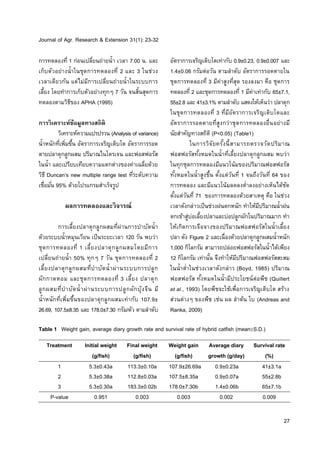


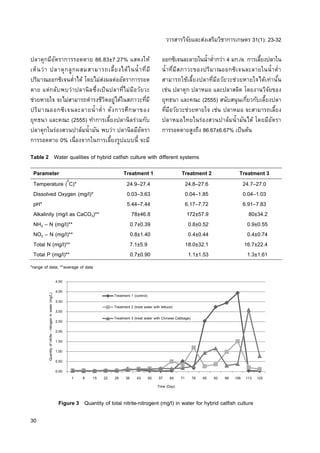
![Journal of Agr. Research & Extension 31(1): 23-32
31
สรุปผลการทดลอง
จากผลการทดลองในครั้งนี้ พบว่า สามารถ
เลี้ยงปลาดุกลูกผสมในระบบน้าหมุนเวียน ที่มีการ
บาบัดด้วยระบบไฮโดรโพนิกส์ได้ โดยไม่จาเป็นต้อง
เปลี่ยนถ่ายน้า โดยการปลูกผักบุ้งหรือผักกาดหอม ซึ่ง
ผักทั้งสองชนิดจะสามารถลดสารประกอบไนโตรเจน
และฟอสฟอรัสในน้า ที่ปลาดุกลูกผสมได้ขับถ่าย
ออกมา ทาให้เกษตรกรลดการใช้น้าในการเลี้ยงปลา
ดุกลูกผสมลงถึง 78% ของระบบการเลี้ยงปลาดุกแบบ
ปกติที่มีการเปลี่ยนถ่ายน้า 50% ทุกๆ 7 วัน โดยไม่
ส่งผลต่ออัตราการเจริญเติบโต อัตราการรอดตายของ
ปลาดุกลูกผสม
กิตติกรรมประกาศ
โครงการวิจัยนี้ได้รับการสนับสนุนทุนวิจัยจาก
สานักวิจัยและส่งเสริมวิชาการการเกษตร มหาวิทยาลัย
แม่โจ้ ประจาปีงบประมาณ 2554 ขอขอบคุณ ผู้บริหาร
ทุกระดับของมหาวิทยาลัยแม่โจ้ มหาวิทยาลัยแม่โจ้-
ชุมพร และมหาวิทยาลัยเกษตรศาสตร์ ที่ให้การ
สนับสนุนให้นักวิจัยได้ทางานร่วมกัน
เอกสารอ้างอิง
กมลวรรณ ศุภวิญญู. 2548. ปริมาณแร่ธาตุบาง
ชนิดในกุ้งก้ามกรามวัยอ่อนที่อนุบาลด้วย
ระบบกรองน้าหมุนเวียน. วิทยานิพนธ์
ปริญญาโท. มหาวิทยาลัยเกษตรศาสตร์.
644 น.
กรมประมง. 2549. สถิติการประมงแห่งประเทศ
ไทย ปี พ.ศ.2547. กรุงเทพฯ: กรมประมง.
91 น.
ชูสินธ์ ชนะสิทธิ์ สมหมาย เชี่ยววารีสัจจะ
และอุดม พืชน์ไพบูลย์. 2550. การเลี้ยง
หอยเป๋ าฮื้อระยะวัยรุ่นโดยใช้ระบบน้า
หมุนเวียน. น. 10-13. ใน บทคัดย่อสัมมนา
วิชาการด้านการเพาะเลี้ยงสัตว์น้าชายฝั่ง.
กรุงเทพฯ: กรมประมง.
มั่นสิน ตัณฑุลเวศม์ และไพพรรรณ พรประภา.
2544. การจัดการคุณภาพน้าและการ
บาบัดน้าเสียในบ่อเลี้ยงปลาและสัตว์น้า
อื่นๆ. กรุงเทพฯ: ภาควิชาวิศวกรรม
สิ่งแวดล้อม คณะวิศวกรรมศาสตร์
จุฬาลงกรณ์มหาวิทยาลัย. 214 น.
ยุทธนา สว่างอารมย์ กมลวรรณ ศุภวิญญู
และณิชาพล แก้วชฎา. 2555. ผลของการ
เลี้ยงปลาดุกลูกผสมร่วมกับปลานิลใน
สวนปาล์มน้ามัน. 79 น. ใน รายงาน
ผลการวิจัยฉบับสมบูรณ์. กรุงเทพฯ:
เครือข่ายการวิจัยและนวัตกรรมเพื่อถ่ายทอด
เทคโนโลยีสู่ชุมชนฐานราก สกอ.
ยงยุทธ ปรีดาลัมพะบุตร, นิคม ละอองศิริวงศ์ และภาสกร
ถมพลกรัง. 2546. การพัฒนาการเลี้ยง
ปลากะรังด้วยระบบน้าหมุนเวียน และ
บาบัดด้วยวิธีทางชีวภาพ. สงขลา: สถาบัน
การเพาะเลี้ยงสัตว์น้าชายฝั่ง. 1 น.
[ระบบออนไลน์]. แหล่งที่มา
http://www.nicaonline.com/index.php?optio
n=com_content&view=article&id=144:2012
-01-06-08-32-46&catid=34:2012-01-05-07-
25-45&Itemid=113. (7 พฤษภาคม 2556).
วิรัช จิ๋วแหยม. 2544. ความรู้เบื้องต้นเกี่ยวกับ
คุณภาพน้าและการวิเคราะห์คุณภาพน้า
ในบ่อเพาะเลี้ยงสัตว์น้า. กรุงเทพฯ:
สานักพิมพ์แห่งจุฬาลงกรณ์มหาวิทยาลัย.
178 น.](https://image.slidesharecdn.com/random-140716045042-phpapp02/85/slide-35-320.jpg)


![วารสารวิจัยและส่งเสริมวิชาการเกษตร 31(1): 33-50
48
เอกสารอ้างอิง
ปิยะวรรณ ศรีวิลาศ และกานดา ใจดี. 2549.
สารฆ่าแมลงกลุ่มออร์กาโนคลอรีนในดิน
ตะกอนบริเวณชายฝั่งทะเลภาคตะวันออกของ
ประเทศไทย. วารสารวิทยาศาสตร์บูรพา
11: 26-39.
ศักดา ศรีนิเวศน์. สถาบันบริหารศัตรูพืชโดยชีวภาพ.
[ระบบออนไลน์]. แหล่งที่มา http://www.
doae.go.th/report/sukda/hoy_hit.html
(19 สิงหาคม 2551).
Arbeli, Z. and C. L. Fuentes. 2007. Accelerated
biodegradation of pesticides: An overview
of the phenomenon, its basis and
possible solutions; and a discussion on
the tropical dimension.
Crop Prot. 26: 1733-1746.
Awasthi, N., R. Ahuja and A. Kumar. 2000.
Factors influencing the degradation of
soil-applied endosulfan isomers.
Soil Biol. Biochem. 32: 1697-1705.
Barakat, A. O., A. Mostafa, T. L. Wade,
S. T. Sweet and N. B. El Sayed. 2012.
Spatial distribution and temporal trends
of persistent organochlorine pollutants
in sediments from Lake Maryut,
Alexandria, Egypt. Mar. Pollut. Bull.
64: 395-404.
Becker, L., M. Scheringer, U. Schenker and
K. Hungerbühler. 2011. Assessment of
the environmental persistence and long-
rang transport of endosulfan.
Environ. Pollut. 159: 1737-1743.
Boonyatumanond, R., A. Jaksakul, P. Puncharoen
and M. S. Tabucanon. 2002. Monitoring
of organochlorine pesticides residues
in green mussels (Perna viridis)
from the coastal area of Thailand.
Environ. Pollut. 119: 245-252.
Castillo, J. M., J. Casas and E. Romero. 2011.
Isolation of an endosulfan-degrading
bacterium from a coffee farm soil:
Persistence and inhibitory effect on its
biological functions.
Sci. Total Environ. 412-412: 20-27.
Coimbra, A. M., M. A. Reis-Henriques and
V. M. Darras. 2005. Circulatingthyroid
hormone levels and Iodothyronine
deiodinase activities in Nile tilapia
(Oreochromis niloticus) following dietary
exposure to endosulfan and Aroclor 1254.
Comp. Biochem. Physiol. Toxicol.
Pharmacol. 141:8-14.
Da Cuña, R. H., G. R. Vázquez, M. N. Piol,
N. V. Guerrero, M. C. Maggese and
F. L. Lo Nosto. 2011. Assessment of
the acute toxicity of the organochlorine
pesticide endosulfan in Cichlasoma
dimerus (Teleostei, Perciformes).
Ecotoxicol. Environ. Safe.
74: 1065-1073.
Daly, G. L., Lei, Y. D., C. Teixeira, D. C. G. Muir
and F. Wania. 2007. Pesticides in
western Canadian mountain air and soils.
Environ. Sci. Technol. 41: 6020-6025.
46](https://image.slidesharecdn.com/random-140716045042-phpapp02/85/slide-50-320.jpg)
![Journal of Agr. Research & Extension 31(1): 33-50
47
Doong R. A., C. K. Peng, Y. C. Sun and
P. L. Liao. 2002. Composition and
distribution of organochlorine pesticides
residues in surface sediments from
the Wu-Shi River estuary, Taiwan.
Mar. Pollut. Bull. 45: 246-253.
Dutta, H. M. and D. A. Arends. 2003. Effects of
endosulfan on brain acetylcholinesterase
activity in juvenile bluegill sunfish.
Environ. Res. 91: 157-162.
Golfinopoulos, S. K., A. D. Nikolaou,
M. N. Kostopoulou, N. K. Xilourgidis,
M. C. Vagi and D. T. Lekkas. 2003.
Organochlorine pesticides in the surface
waters of Northern Greece. Chemosphere
50: 507-516.
Goswami, S., K. Vig and D. K. Singh. 2009.
Biodegradation of and endosulfan by
Aspergillus sydoni. Chemosphere
75: 883-888.
Hussain, S., M. Arshad, M. Saleem and
Z. A. Zahir. 2007. Screening of soil fungi
in vitro degradation of endosulfan.
World J. Microbiol. Biotechnol.
23: 939-945.
Jiang, Y. F., X. T. Wang, Y. Jia, F. Wang,
M. H. Wu, G. Y. Sheng and J. M. Fu.
2009. Occurrence, distribution and possible
sources of organochlorine pesticides
in agricultural soil of Shanghai, China.
J. Hazard. Mater. 170: 989-997.
Joseph, R., S. Reed, K. Jayachandran,
C. Clark-Cuadrado and C. Dunn. 2010.
Endosulfan has no adverse effect of soil
respiration. Agr. Ecosys. Environ.
138: 181-188.
Kamei, I., K. Takagi and R. Kondo. 2011.
Degradation of endosulfan and
endosulfan sulfate by white- rot fungus,
Trametes hirsute. J. Wood Sci.
57: 317-322.
Kataoka, R., K. Takagi and F. Sakakibara. 2010.
A new endosulfan-degrading fungus,
Mortieralla species isolated from a soil
contaminated with organochlorine
pesticides. J. Pestic. Sci.
35(3): 326-332.
Kataoka, R., K. Takagi and F. Sakakibara. 2011.
Biodegradation of endosulfan by
Mortieralla sp. strain W8 in soil: Influence
of different substrates on biodegradation.
Chemosphere 85: 548-552.
Kegley, S. E., B. R. Hill, S. Orme and A. H. Choi.
2009. PANPesticideDatabase.Pesticide
Action Network, North America
(San Francisco, CA). [Online]. Available
http://www.pestici deinfo.org
(17 February 2013).
Kim, J. H. and A. Smith. 2001. Distribution of
organochlorine pesticides in soils from
South Korea. Chemosphere 43: 137-140.
Kumar, M. and L. Philip. 2006. Adsorption and
desorption characteristics of hydrophobic
pesticide endosulfan in four Indian soils.
Chemosphere 62: 1064-1077.
Kumar, K., S. S. Devi, K. Krishnamurthi,
G. S. Kanade and T. Chakrabarti. 2007.
Enrichment and isolation of endosulfan
degrading and detoxifying bacteria.
Chemosphere 68: 317-322.](https://image.slidesharecdn.com/random-140716045042-phpapp02/85/slide-51-320.jpg)


![วารสารวิจัยและส่งเสริมวิชาการเกษตร 31(1): 33-50
48
Vorkamp, K., F. Riget, M. Glasius, M. Pécselic,
M. Lebeuf and D. Muir. 2004.
Chlorobenzenes, chlorinated pesticides,
coplanar chlorobiphenyls and other
organochlorine compound in
Greenland biota. Sci. Total Environ.
331: 157-175.
Wang, F., X. Jiang, Y. R. Bian, F. X. Yao,
H. J. Gao, G. F. Yu, J. C. Munch and
R. Schroll. 2007. Organochlorine
pesticides in soils under different land
usage in the Taihu Lake
region, China. J. Environ Sci.
19: 584-590.
Weber, J., C. J. Halsall, D. Muir, C. Teixeira,
J. Small, K. Solomon, M. Hermanson,
H. Hung and T. Bidleman. 2010.
Endosulfan, a global pesticide: a review
of its fate in the environment and
occurrence. Sci. Total Environ.
408: 2966-2984.
Xie, H., F. Gao, W. Tan and W. Shu-Guang. 2011.
A short-term study on the interaction of
bacteria, fungi and endosulfan in soil
microcosm. Sci. Total Environ. 412-
413: 375-379.
Yeo, H. G., M. Choi and Y. Sunwoo. 2004.
Seasonal variations in atmospheric
concentrations of organochlorine
pesticides in urban and rural areas of
Korea. Atmos. Environ. 38: 4779-4788.
Zhang, H. B., Y. M. Luo, Q. G. Zhao, M. H. Wong
and G. L. Zhang. Residues of
organochlorine Pesticides in Hong Kong
soils. Chemosphere 63: 633-641.
Zhao, Z., L. Zhang, J. Wu and C. Fan.
Distribution and bioaccumulation of
organochlorine pesticides in surface
sediments and benthic organisms from
Taihu Lake, China. Chemosphere
77: 1191-1198. [Online]. Available
http://chm.pops.int/Convention/Media/Pres
sreleases/Widelyusedpesticideendosulfan
phaseout/tabid/2216/language/en-
US/Default.aspx (9 June 2013).
50](https://image.slidesharecdn.com/random-140716045042-phpapp02/85/slide-54-320.jpg)


![Journal of Agr. Research & Extension 31(1): 51-61
59
ศุภกิจ นฤมิตร. 2554. โครงการฝึกอบรมเทคนิค
การจัดทาโรงเรือนกางมุ้งและการ
ถ่ายทอดเทคโนโลยีการผลิตพืชผักเชิง
ระบบ. กำฬสินธุ์: สำนักงำนกำรปฏิรูปที่ดิน
จังหวัดกำฬสินธุ์. 4 น.
สมำคมกำรค้ำเกษตรอินทรีย์ของสหรัฐ. มปป.
SWOT เกษตรอินทรีย์สหรัฐอเมริกา.
[ระบบออนไลน์]. แหล่งที่มำ http://www.
oain.net/index.php/2011-10-19-14-17-
51/106-swot-เกษตรอินทรีย์สหรัฐอเมริกำ
(20 พฤษภำคม 2556).
Fred, D. 1999. Strategic Management. อ้ำงโดย
พักตร์ผจง วัฒนสินธุ์ และพสุ เดชะรินทร์.
2542. การจัดการเชิงกลยุทธ์และนโยบาย
ธุรกิจ. พิมพ์ครั้งที่ 2. กรุงเทพฯ: โรงพิมพ์
แห่งจุฬำลงกรณ์มหำวิทยำลัย. 348 น.
61](https://image.slidesharecdn.com/random-140716045042-phpapp02/85/slide-65-320.jpg)


![วารสารวิจัยและส่งเสริมวิชาการเกษตร 31(1): 62-70
70
Table 7 Impact after using the farmer credit card purchasing inputs
Items Impact level Total
Worse Same Better
Quick 0 0.00 29 11.11 232 88.89 261 100.00
Liabilities 5 1.92 211 80.84 45 17.24 261 100.00
Revenue 11 4.21 229 87.74 21 8.05 261 100.00
Expense 22 8.43 124 47.51 115 44.06 261 100.00
Yield 17 6.51 187 71.65 57 21.84 261 100.00
สรุปผลการวิจัยและข้อเสนอแนะ
เกษตรกรทาการเกษตรเพาะปลูกข้าวเป็น
อาชีพหลัก ใช้บัตรสินเชื่อเกษตรกรซื้อปัจจัยการผลิต
ปุ๋ยน้อยกว่า 10,000 บาท จากสหกรณ์การเกษตรเพื่อ
การตลาดลูกค้า (สกต.) ทั้งหมด ส่วนปัจจัยการผลิต
ที่ต้องการ คือ ปุ๋ยและยาปราบศัตรูพืช ซึ่งเป็นปัจจัย
การผลิตที่มีความสาคัญ และเกษตรกรคิดว่าจะชาระหนี้
หลังจากซื้อปัจจัยการผลิตแล้วภายในระยะเวลา 2-5
เดือน เกษตรกรส่วนมากยังไม่เข้าใจในสิทธิประโยชน์
ที่ได้รับจากโครงการบัตรสินเชื่อเกษตรกร และไม่
ทราบว่ามีร้านค้าใดบ้างที่เข้าร่วมโครงการ เกษตรกร
ส่วนใหญ่มีความพึงพอใจในภาพรวมอยู่ในระดับมาก
แต่ความพึงพอในด้านสถานที่ที่ใช้บัตรสินเชื่อ
เกษตรกร ซื้อปัจจัยการผลิตและรับสินค้าเกษตรกรมี
ความพึงพอใจในลาดับสุดท้าย เนื่องจากสหกรณ์
การเกษตรเพื่อการตลาดลูกค้า (สกต.) มีปัจจัยการ
ผลิตที่ไว้บริการเพียงอย่างเดียว คือ ปุ๋ย และพนักงาน
บริการก็ไม่เพียงพอ ทาให้บางครั้งเกษตรกรที่ซื้อสินค้า
ต้องยกสินค้าขึ้นรถเอง
ดังนั้น จากข้อมูลข้างต้นธนาคารเพื่อการ
เกษตรและสหกรณ์การเกษตร ควรมีการจัดอบรมให้
เกษตรกรได้เข้าใจในรายละเอียดต่างๆ เกี่ยวกับ
โครงการบัตรสินเชื่อเกษตรกร แนะนาให้สหกรณ์
การเกษตรเพื่อการตลาดลูกค้า (สกต.) จัดหาปัจจัย
การผลิตให้ตรงกับความต้องการของลูกค้าและจัดหา
พนักงานไว้คอยบริการให้เพียงพอ
กิตติกรรมประกาศ
ผู้วิจัยขอขอบพระคุณ ผู้ช่วยศาสตราจารย์
ดร.สุภาภรณ์ พวงชมภู ที่ได้กรุณาให้คาแนะนาและ
เป็นที่ปรึกษาเกี่ยวกับการศึกษาวิจัย เกษตรกร และ
พนักงานธนาคารเพื่อการเกษตร และสหกรณ์การ
เกษตร สาขาบ้านฝาง จังหวัดขอนแก่น สาหรับความ
ร่วมมือในการให้สัมภาษณ์เป็นอย่างดี
เอกสารอ้างอิง
ธานินทร์ ศิลป์จารุ. 2550. การวิจัยและวิเคราะห์
ข้อมูลทางสถิติด้วย SPSS.
กรุงเทพฯ: บิสซิเนสอาร์แอนด์ดี. 359 น.
ธนาคารเพื่อการเกษตรและสหกรณ์. 2555.
จุลสาร ธ.ก.ส. ฉบับที่ 431. กรุงเทพฯ:
สหมิตรพริ้นติ้งแอนด์พับลิสซิ่ง. 50 น.
[ระบบออนไลน์]. แหล่งที่มา
http://www.baac.or.th/content-product.php
(10 พฤษภาคม 2555).](https://image.slidesharecdn.com/random-140716045042-phpapp02/85/slide-74-320.jpg)


![81
3.2 รายงานการประชุมวิชาการ รายงานการสัมมนา ปาฐกถา รายงานประจาปี
ชื่อผู้เขียนบทความ.//ปีที่พิมพ์.//ชื่อบทความ.//น./เลขหน้าที่ปรากฏเรื่อง.//ใน/ชื่อการประชุม.//รายละเอียดอื่นๆ (ถ้ามี).//
ครั้งที่พิมพ์ (ถ้ามี).//สถานที่พิมพ์: สานักพิมพ์.
กมลรัฐ อินทรทัศน์ กษิติธร ภูภราดัย และวันดี กริชอนันต์. 2548. Telecenter: ยุทธศาสตร์แห่งการกระจายโอกาส
การเข้าถึงเทคโนโลยีสารสนเทศและการสื่อสารเพื่อการพัฒนาชนบท. น. 423-432. ใน รายงานการประชุม
ทางวิชาการภาคโปสเตอร์ ครั้งที่ 6 19-20 พฤษภาคม 2548. เชียงใหม่: มหาวิทยาลัยแม่โจ้.
Coates, J. 2013. Clinical Trial for Canine Degenerative Myelopathy. pp. 29-31. In Proceedings of ACVIM
Specialty Symposium (Pre-forum) 12-15 June 2013. Seattle: American College of Veterinary Internal
Medicine (ACVIM).
3.3 รายงานผลการวิจัย
ชื่อผู้เขียนงานวิจัย.//ปีที่พิมพ์.//ชื่องานวิจัย.//จานวนหน้า.//ใน/รายงานผลการวิจัย.//สถานที่พิมพ์:/ชื่อหน่วยงาน.
พรพันธ์ ภู่พร้อมพันธ์ ขนิษฐา ดวงสงค์ และรัฐพล ศรีบัวเผื่อน. 2544. การตรวจหาลายพิมพ์ดีเอ็นเอของกล้วยไม้
ไทยสกุลแวนด้าฟ้ ามุ่ย. 62 น. ใน รายงานผลการวิจัย. เชียงใหม่: มหาวิทยาลัยแม่โจ้.
Theraumpon, N. 2003. Automatic classification of white blood cells in bone marrow images. 74 p. In
Research report. Chiangmai: Chiangmai University.
3.4 บทความจากนิตยสาร
ชื่อผู้เขียนบทความ.//ปีที่ตีพิมพ์.//ชื่อบทความ.// ชื่อนิตยสาร.//ปีที่ของนิตยสาร(เล่มที่): เลขที่หน้าที่อ้างอิง.
นาชัย ทนุผล. 2543. การพัฒนาธุรกิจการท่องเที่ยวเชิงนิเวศในชุมชนป่าบ้านโปง อาเภอสันทราย จังหวัดเชียงใหม่.
นิตยสารการท่องเที่ยว 21(1): 44-54.
3.5 บทความจากหนังสือพิมพ์
ชื่อผู้เขียนบทความ.//ปีที่ตีพิมพ์.//ชื่อบทความ.//ชื่อหนังสือพิมพ์.//(วันที่/เดือน/ปี):/เลขที่หน้าที่อ้างอิง.
สมศักดิ์มานะไพศาล. 2549. เกษตรกรไทยในอนาคต. ไทยรัฐ. (10 มกราคม 2549): 7.
4. แหล่งข้อมูลอิเลคทรอนิกส์
ผู้แต่งหรือผู้รับผิดชอบ.//ปีที่บันทึกข้อมูล.//ชื่อเรื่อง.//[ระบบออนไลน์].//แหล่งที่มา/ระบุแหล่งการติดต่อเครือข่ายหรือการ
ถ่ายโอนแฟ้มข้อมูล ชื่อแฟ้มข้อมูล/(วันที่/เดือน/ปี ที่ค้นข้อมูล).
ฐานิตย์ เมธิยานนท์ นิวัติ พิริยะรุ่งโรจน์ และสมชาติ โสภณรณฤทธิ์. 2547. เตาเผาไหม้วอร์เทค-ฟลูอิไดซ์เบดแบบสอง
ห้องเผาไหม้สาหรับเชื้อเพลิงแกลบ. ว.สงขลานครินทร์ 26(6): 875-893. [ระบบออนไลน์]. แหล่งที่มา
http://www2.psu.ac.th/PresidentOffice/EduService/Journal/Firstpage.htm (22 กันยายน 2548).
National Economic and Social Development Board (NESDB). 2001. Input-output tables of Thailand. [Online].
Available http://www.nesdb.go.th (8 August 2001).
Singh, M. and R. P. Singh. 2001. Siderophore producing bacteria-as potential biocontrol agents of
mushroom disease. [Online]. Available http://www.uio.no/conferences June2000.htm# Samuels
(3 July 2001).](https://image.slidesharecdn.com/random-140716045042-phpapp02/85/slide-85-320.jpg)
![82
Guide for Authors
Manuscripts submitted for publication should be of high academic merit and are accepted on
condition that they are contributed solely to the Journal of Agricultural Research and Extension.
Manuscripts, parts of which have been previously published in conference proceedings, may be accepted
if they contain additional material not previously published and not currently under consideration for
publication elsewhere.
Submission of a multi-authored manuscript implies the consent of all the participating authors.
All manuscripts considered for publication will be peer-reviewed by independent referees.
Submission checklist
Manuscript submission must include title page, abstract, key words, text, tables, figures,
acknowledgments, reference list and appendices (if necessary). The title page of this file should include
the title of the article, full names, official name and affiliations of all authors, E-mail address, telephone
and fax numbers and full postal address of the corresponding author.
Preparation and Submission of Manuscripts
Authors submitting manuscripts for consideration for publication should follow the following
guidelines.
1. Manuscript texts must be written using high-quality language. For non-native English
language authors, the article should be proof-read by a language specialist before it is sent to Journal.
2. Manuscript texts should not exceed than 10 pages and the combined number of figures and
tables. The inclusion of more figures and tables will reduce the word allowance, and vice versa.
3. The manuscript text and tables should be created using Microsoft Word.
4. Manuscript texts should be prepared single column, with sufficient margins (1.0 inch) for
editorial and proof-reader’s marks. 12 pt Times New Roman font should be used throughout and all pages
numbered consecutively.
5. Abstracts should not exceed than 200 words. About 5 keywords should also be provided.
6. All measures in the text should be reported in abbreviation
7. Tables and figures should each be numbered consecutively.
8. Acknowledgments should be as brief as possible, in a separate section before the references,
not in the text or as footnotes.
9. Citations of published literature in the text should be given in the form of author and year in
parentheses; (Hoffmann et al., 2001), or, if the name forms part of a sentence, it should be followed by
the year in parenthesis; Hoffmann et al. (2001). All references mentioned in the reference list must be
cited in the text, and vice versa. The references section at the end of the manuscript should list all and
only the references cited in the text in alphabetical order of the first author’s surname. The following are
examples of reference writing.
Reference to a journal article:
Chowdhury, M. A. H., R. Begum, M. R. Kabit and H. M. Zakir. 2002. Plant and animal residue
decomposition and transformation of S and P in soil. Pak. J. Bio. Sci. 5: 736-739.
Reference to article or abstract in a conference proceedings:
Coates, J. 2013. Clinical Trial for Canine Degenerative Myelopathy. pp. 29-31. In Proceedings of
ACVIM Specialty Symposium (Pre-forum) 12-15 June 2013. Seattle: American College of
Veterinary Internal Medicine (ACVIM).
Reference to a book:
Rajeshwar, K. and J. G. Ibanez. 1997. Environmental electrochemistry. San Diego: Academic Press. 327 p.
Reference to an edited book:
Hill, S. E. 1996. Emultions. pp. 153-185. In Hall, G. M. (ed.). Methods of testing protein functionality.
London: Chapman & Hall.
Reference to an electronic data source (used only when unavoidable): Supplier/Database name
(Database identifier or number)/Item or accession number (Access date) should be included
National Economic and Social Development Board (NESDB). 2001. Input-output tables of Thailand.
[Online]. Available http://www.nesdb.go.th (8 August 2001).
10. Submission of manuscript includes 3 copies in which one of them must conform to the format
of the Journal of Agricultural Research and Extension. The other must be submitted without the author’s
name and office with diskette/CD and cover letter to the editor. All should be directed to the editor at the
address given.](https://image.slidesharecdn.com/random-140716045042-phpapp02/85/slide-86-320.jpg)


