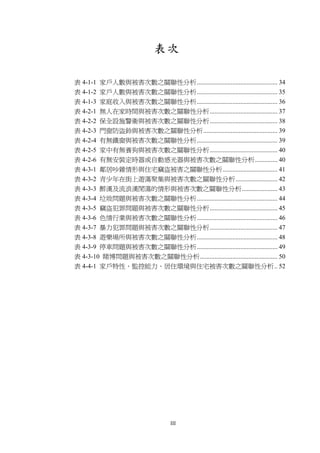
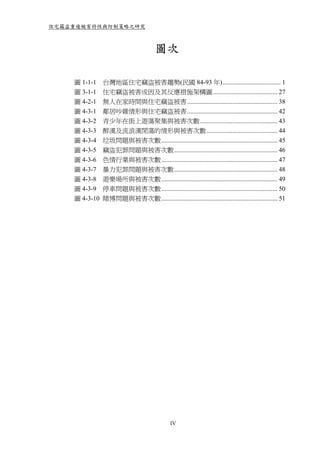
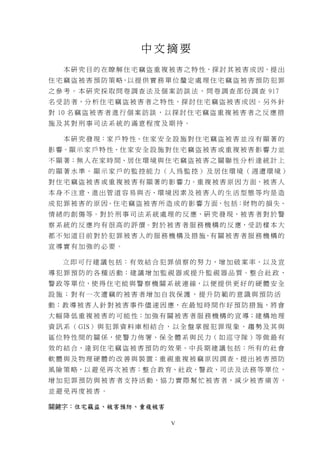
住宅竊盜重複被害特性與防制策略之研究
and Crime Prevention, 3, 269-279.
Bennett, T. & Durie, L.(1999). Preventing residential burglary in
Cambridge: from crime audits to targeted strategies. London: home
Office.
Bogarrd, Joop van den & Wiegman, Oene (1991). Property crime victimization:
the effectiveness of police services for victims of residential burglary.
Journal of Social Behavior and Personality, 6(6), 327-362.
Bottoms, A. (1994). Environmental Criminology. In: M. Magurie, R. Morgan
and R. Reiner(eds.), The Oxford Handbook of Criminology. Oxford, UK:
Clarendon.
Brown, Barbara B. & Harris, Paul B.(1998). Residential Burglary victimization:
reactions to the invasion of a primary territory. Journal of Environmental
Psychology, 9, 119-132.
Clark, R. V., Perkins, E. & Smith Jr., D.J. (2001). Explaining repeat
residential burglaries: an analysis of property stolen. Crime Prevention
Studies, 12, 119-132.
Davis , Robert C., Arthur J. Lurigio and Wesley G. Skogan (1999).
Services for victims: a market research study. International Review of
Victimology. 6(2), 101-115.
Ellingworth, D., Farrell, G. & Pease, K. (1995). A victim is a victim is
a victim? Chronic victimization in four sweeps of the British Crime Survey.
British Journal of Criminology, 35(3), 360-365.
Everson, Steve and Pease, Ken.(2001). Crime against the same person
and place: detection opportunity and offender targeting. Crime
Prevention studies, 12, 199-220.
Farrell, G. (1992). Multiple victimization: its extent and significance.
International Review of Victimology, 2, 85-102.
Farrell, Graham & Sousa, William (2001). Repeat victimization and hot
spots: the overlap and its implications for crime control and
problem-oriented policing. Crime Preventing Studies, 12, 221-240.
Farrell, G. & Bouloukos, A. C. (2001).International overview: a
cross-national comparison of rates of repeat victimization. Crime
Prevention Studies, 12, 5-25.
Farrell, G., Phillips, C. & Pease, K. (1995). Like taking candy: why does
repeat victimization occur? British Journal of Criminology, 35, 384-399.
Farrell, G. & W. Sousa (2001). Repeat victimization and hot spots: the
overlap and its implications for crime control and problem oriented
policing. Crime Prevention Studies, 12, 221-240.
68
69.
參考書目
Ferraro, Kenneth F.(1995). Fear of crime: interpreting victimization risk.
New York: State University of New York Press.
Forrester, D., Chatterton, M. and Pease, K. (1988). The Kirkholt Burglary
Prevention Project, Rochdale. London: HMSO.
Forrester, D., Frenz, S., Connell, M. & Pease, K. (1990). The Kirkholt
burglary prevention project: phase II. London: Home Office.
Genn, H. (1988). Multiple victimization, pp.90-100. in Maguire, M. and
Pointing, J. (eds.) Victims of crime: a new deal? Milton Keynes: Open
University Press.
Greenberg, Martin S. and Ruback R. Barry (1992). After the crime: victim
decision making. New York: Plenum Press.
Hindelang, M., Gottfredson, M. R. & Garafalo, J. (1984). Victims of
personal crime: an empirical foundation for a theory of personal
victimization. Cambridge, MA: Ballinger.
Johnson, J. H. et al., (1973). The recidivist victim: a descriptive study.
Criminal Justice Monograph, v.5.1. Huntsville, TX: Sam Houston State
University.
Jones, T., Maclean, B. & Young, J. (1986). The Islington Crime Survey.
London: Gower.
Kearon, Tony and Leach, Rebecca (2000). Invasion of the body snatchers:
burglary reconsidered. Theoretical Criminology, 4(4), 451-472.
Kidd, Robert F. and Chayet, Ellen F. (1984). Why do victims fail to report? The
psychology of criminal victimization. Journal of Social Issues, 40(1),
39-50.
Kleemans, E. R. (2001). Repeat burglary victimization: results of
empirical research in the Netherlands. Crime Prevention Studies, 12,
53-68.
Lloyd, S., Farrell, G. & Pease, K. (1994). Preventing repeated
domestic violence: a demonstration Project on Merseyside. London, U.K:
Home Office.
Mawby, R. I. (2001). Burglary. London: Willan Publishing.
Mawby, R.I. and Walklate, S.(1996). The impact of burglary: a tale of two
cities. International Review of Victimology. 4(4), p.267-295.
Mirrlees-Black, C. (1998). Rural areas and crime: findings from the
British crime survey. UK.: Home Office Research, Development and
Statistics Directorate.
Morgan, C. (2001). Repeat burglary in a Perth suburb: indicator of
short-term or long-term risk? pp.83-118 in Farrell and Pease,
69
70.
住宅竊盜重複被害特性與防制策略之研究
British crime survey. UK.: Home Office Research, Development and
Statistics Directorate.
Pease, K. and G. Laycock (1996). Revictimisation: reducing the heat on
hot victims. Washington, D.C.: National Institute of Justice.
Polvi, N. et al., (1990). Repeat break and enter victimization: time course
and crime prevention opportunity. Journal of Police Science and
Administration, 17, 8-11.
Polvi, N. et al., (1991). The time course of repeat burglary victimization.
British Journal of Criminology, 31, 411-414.
Porter, M. (1996). Tackling cross border crime. London, UK: Home
Office.
Sparks, R. F. (1981). Mulitiple victimization: evidence, theory, and
future research. The Journal of Criminal Law and Criminology, 72(2),
762-778.
Reppetto, T.(1974). Residential crime. Cambridge, MA: Ballinger.
Ratcliffe, J. H. and McCullagh, M. J. (1999). Burglary, victimization and
social deprivation. Crime Prevention and Community Safety: an
International Journal, 1(2), 37-46.
Robinson, M.B. (1998). Burglary revictimisation: the time period of
heightened risk. British Journal of Criminology, 38, 78-87.
Sampson, A. and C. Philips (1992). Multiple victimization: racial attacks
on an East London estate. London, UK: Home Office.
Smith, D. and Jarjoura, R. (1989). Household characteristics,
neighbourhood composition and victimization risk. Social Forces 68(2):
621-640.
Spark, R. (1981). Multiple revictimisation: evidence, theory and future
research. Journal of Criminal Law and Criminology, 72, 762-778.
Robinson, M. B. (1998). Burglary revictimisation: the time period of
heightened risk. British Journal of Criminology, 38, 78-87.
Trickett, A. et al., (1992). What is different about high crime areas?
British Journal of Criminology, 32, 81-90.
Van Dijk, J. J. M. (2001). Attitudies of victims and repeat victims toward
the police: results of the international crime victims survey. Crime
Prevention Studies, 12, 27-52.
Waller, Irvin & Norman Okihiro (1978). Burglary: the victim and the public.
Toronto: University of Toronto Press.
Wise, Julleah Montecillo (1998). The relationships among perceived social
support, blame and long-term psychological consequences of criminal
70
71.
參考書目
victimization. Doctor disseration, University of Arkansas.
Witterbrood, K. & Nieuwbeerta, P. (2000). Criminal victimization during
one’s life course: the effects of previous victimization and patterns of
routine activities. Journal of Research in Crime and Delinquency, 37(1),
91-122.
71
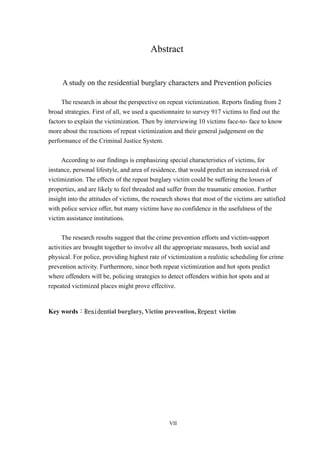
Abstract
A study on the residential burglary characters and Prevention policies
The research in about the perspective on repeat victimization. Reports finding from 2
broad strategies. First of all, we used a questionnaire to survey 917 victims to find out the
factors to explain the victimization. Then by interviewing 10 victims face-to- face to know
more about the reactions of repeat victimization and their general judgement on the
performance of the Criminal Justice System.
According to our findings is emphasizing special characteristics of victims, for
instance, personal lifestyle, and area of residence, that would predict an increased risk of
victimization. The effects of the repeat burglary victim could be suffering the losses of
properties, and are likely to feel threaded and suffer from the traumatic emotion. Further
insight into the attitudes of victims, the research shows that most of the victims are satisfied
with police service offer, but many victims have no confidence in the usefulness of the
victim assistance institutions.
The research results suggest that the crime prevention efforts and victim-support
activities are brought together to involve all the appropriate measures, both social and
physical. For police, providing highest rate of victimization a realistic scheduling for crime
prevention activity. Furthermore, since both repeat victimization and hot spots predict
where offenders will be, policing strategies to detect offenders within hot spots and at
repeated victimized places might prove effective.
Key words:Residential burglary, Victim prevention, Repeat victim
VII