SPRINGnews
JUNE 2016
ENABLING ENTERPRISE
INNOVATIVE TECHNOLOGIES
FOR HIGHER PRODUCTIVITY
SHOWCASE
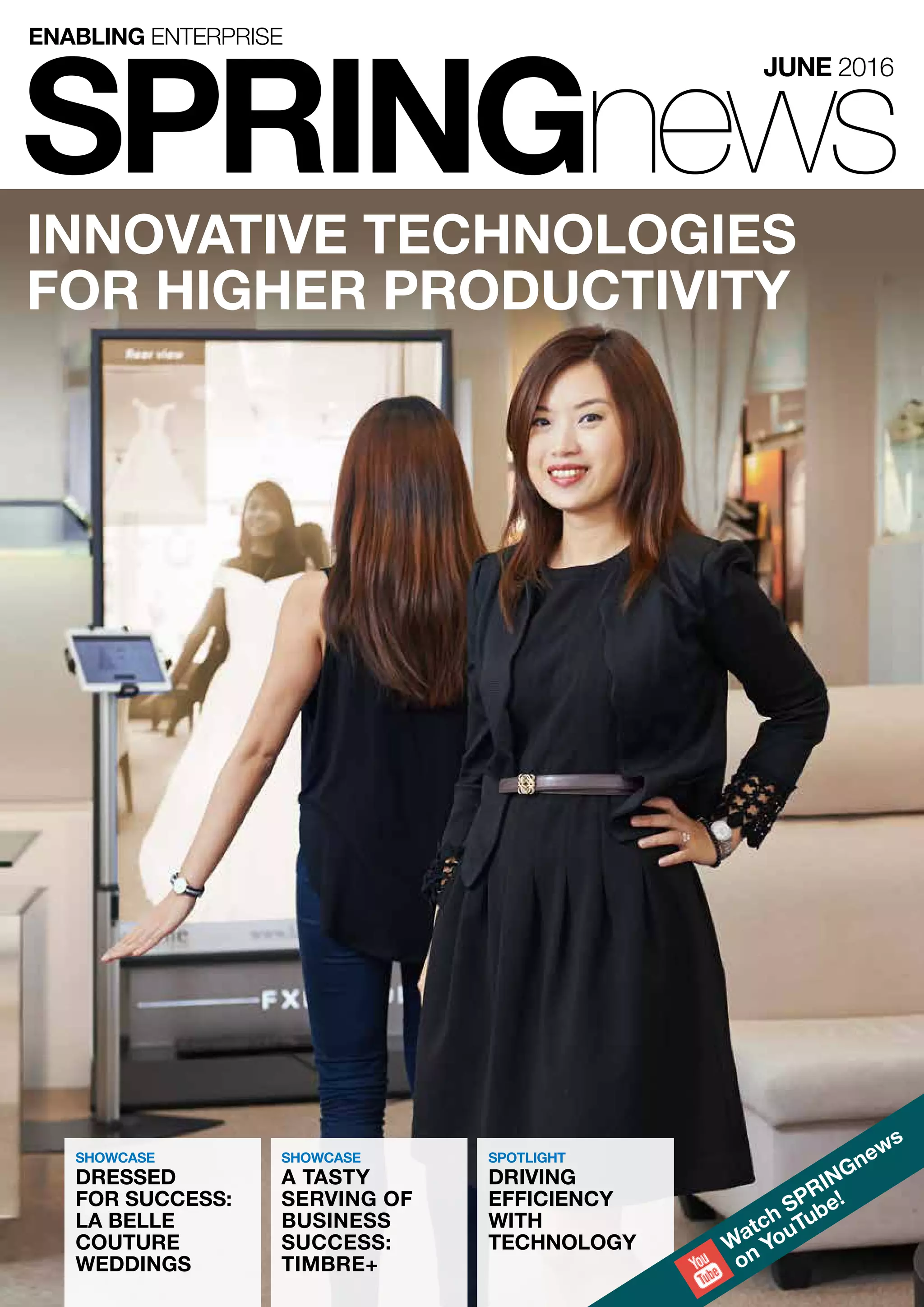
DRESSED
FOR SUCCESS:
LA BELLE
COUTURE
WEDDINGS
SHOWCASE
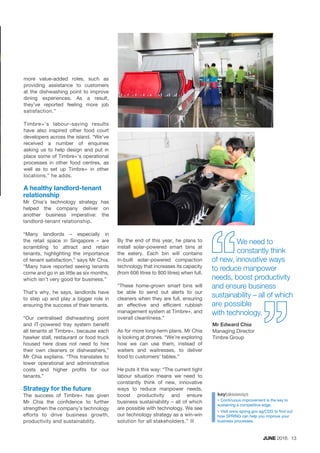
A TASTY
SERVING OF
BUSINESS
SUCCESS:
TIMBRE+
SPOTLIGHT
DRIVING
EFFICIENCY
WITH
TECHNOLOGY Watch SPRINGnews
on YouTube!
CONTENTS
6
EDITORIAL TEAM
Marion ABRAHAM (marion_abraham@spring.gov.sg)
Felicia LEE (felicia_lee@spring.gov.sg)
Kathleen TAN (kathleen_tan@spring.gov.sg)
Mark TAN (mark_tan@spring.gov.sg)
Kathryn ZHANG (kathryn_zhang@spring.gov.sg)
DESIGN & LAYOUT
Kevin LOO (kevin_loo@spring.gov.sg)
PUBLISHING CONSULTANT
Editor Group
SHOWCASE
DRESSED FOR SUCCESS
A TASTY SERVING OF BUSINESS
SUCCESS
AUTOMATING PROCESSES TO
ACCELERATE PERFORMANCE
SPOTLIGHT
DRIVING EFFICIENCY WITH
TECHNOLOGY
PROFILE
A CASE FOR BOOSTING
PRODUCTIVITY WITH
AUTOMATION AND ROBOTICS
10
17
20
12
14AUTOMATION AND ROBOTICS
OFFER A COMPELLING
SOLUTION FOR SMEs
IN TODAY’S HIGHLY
COMPETITIVE, DYNAMIC
BUSINESS ENVIRONMENT
JUNE 2016
To subscribe, visit www.spring.gov.sg/springnews
For comments and feedback, email springnews@spring.gov.sg
Download the SPRINGnews app from the App Store or Google Play
Watch SPRINGnews at www.youtube.com/SPRINGsingapore
FEATURE STORY
THE KEY
TO HIGHER
PRODUCTIVITY AND
PROFITABILITY
BUZZ
JUNE 2016 3
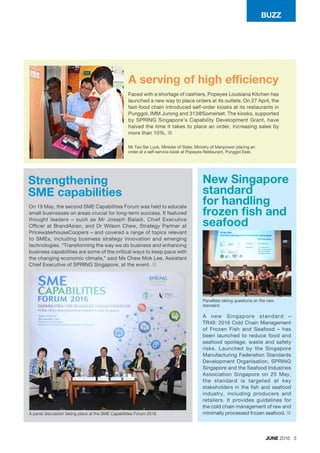
Mr Teo Ser Luck, Minister of State, Ministry of Manpower placing an
order at a self-service kiosk at Popeyes Restaurant, Punggol East.
A serving of high efficiency
Faced with a shortage of cashiers, Popeyes Louisiana Kitchen has
launched a new way to place orders at its outlets. On 27 April, the
fast-food chain introduced self-order kiosks at its restaurants in
Punggol, IMM Jurong and 313@Somerset. The kiosks, supported
by SPRING Singapore’s Capability Development Grant, have
halved the time it takes to place an order, increasing sales by
more than 10%. ¢
Strengthening
SME capabilities 
New Singapore
standard
for handling
frozen fish and
seafood
On 19 May, the second SME Capabilities Forum was held to educate
small businesses on areas crucial for long-term success. It featured
thought leaders – such as Mr Joseph Baladi, Chief Executive
Officer at BrandAsian, and Dr Wilson Chew, Strategy Partner at
PricewaterhouseCoopers – and covered a range of topics relevant
to SMEs, including business strategy innovation and emerging
technologies. “Transforming the way we do business and enhancing
business capabilities are some of the critical ways to keep pace with
the changing economic climate,” said Ms Chew Mok Lee, Assistant
Chief Executive of SPRING Singapore, at the event. ¢
A new Singapore standard –
TR49: 2016 Cold Chain Management
of Frozen Fish and Seafood – has
been launched to reduce food and
seafood spoilage, waste and safety
risks. Launched by the Singapore
Manufacturing Federation Standards
Development Organisation, SPRING
Singapore and the Seafood Industries
Association Singapore on 25 May,
the standard is targeted at key
stakeholders in the fish and seafood
industry, including producers and
retailers. It provides guidelines for
the cold chain management of raw and
minimally processed frozen seafood. ¢
Panellists taking questions on the new
standard.
A panel discussion taking place at the SME Capabilities Forum 2016.
BUZZ
JUNE 2016 5
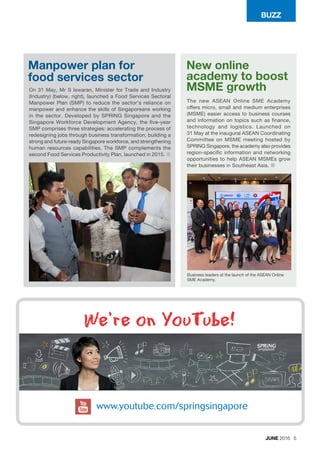
Manpower plan for
food services sector
New online
academy to boost
MSME growthOn 31 May, Mr S Iswaran, Minister for Trade and Industry
(Industry) (below, right), launched a Food Services Sectoral
Manpower Plan (SMP) to reduce the sector’s reliance on
manpower and enhance the skills of Singaporeans working
in the sector. Developed by SPRING Singapore and the
Singapore Workforce Development Agency, the five-year
SMP comprises three strategies: accelerating the process of
redesigning jobs through business transformation, building a
strong and future-ready Singapore workforce, and strengthening
human resources capabilities. The SMP complements the
second Food Services Productivity Plan, launched in 2015. ¢
The new ASEAN Online SME Academy
offers micro, small and medium enterprises
(MSME) easier access to business courses
and information on topics such as finance,
technology and logistics. Launched on
31 May at the inaugural ASEAN Coordinating
Committee on MSME meeting hosted by
SPRING Singapore, the academy also provides
region-specific information and networking
opportunities to help ASEAN MSMEs grow
their businesses in Southeast Asia. ¢
We’re on YouTube!
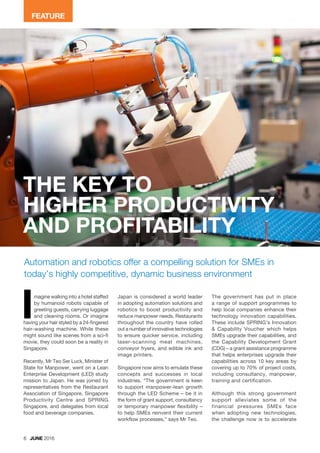
Business leaders at the launch of the ASEAN Online
SME Academy.
6 JUNE 2016
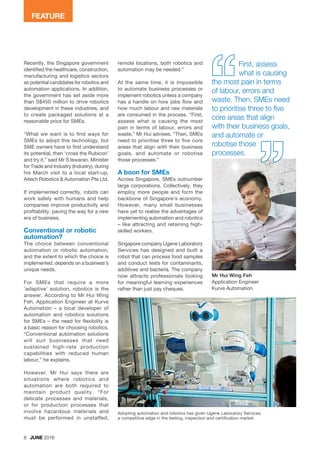
Automation and robotics offer a compelling solution for SMEs in
today’s highly competitive, dynamic business environment
magine walking into a hotel staffed
by humanoid robots capable of
greeting guests, carrying luggage
and cleaning rooms. Or imagine
having your hair styled by a 24-fingered
hair-washing machine. While these
might sound like scenes from a sci-fi
movie, they could soon be a reality in
Singapore.
Recently, Mr Teo Ser Luck, Minister of
State for Manpower, went on a Lean
Enterprise Development (LED) study
mission to Japan. He was joined by
representatives from the Restaurant
Association of Singapore, Singapore
Productivity Centre and SPRING
Singapore, and delegates from local
food and beverage companies.
Japan is considered a world leader
in adopting automation solutions and
robotics to boost productivity and
reduce manpower needs. Restaurants
throughout the country have rolled
out a number of innovative technologies
to ensure quicker service, including
laser-scanning meat machines,
conveyor fryers, and edible ink and
image printers.
Singapore now aims to emulate these
concepts and successes in local
industries. “The government is keen
to support manpower-lean growth
through the LED Scheme – be it in
the form of grant support, consultancy
or temporary manpower flexibility –
to help SMEs reinvent their current
workflow processes,” says Mr Teo.
I The government has put in place
a range of support programmes to
help local companies enhance their
technology innovation capabilities.
These include SPRING’s Innovation
& Capability Voucher which helps
SMEs upgrade their capabilities, and
the Capability Development Grant
(CDG) – a grant assistance programme
that helps enterprises upgrade their
capabilities across 10 key areas by
covering up to 70% of project costs,
including consultancy, manpower,
training and certification.
Although this strong government
support alleviates some of the
financial pressures SMEs face
when adopting new technologies,
the challenge now is to accelerate
THE KEY TO
HIGHER PRODUCTIVITY
AND PROFITABILITY
FEATURE
adoption throughout entire industries.
Doing so will enable automation
solutions to really move the needle
on Singapore’s productivity and
economic performance.
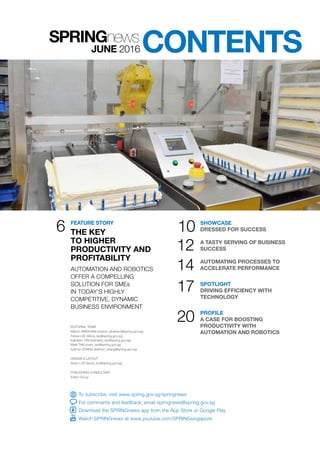
Automation
Automation can be used to perform
dedicated functions, such as inserting
specific components in assemblies,
or multiple tasks like tagging, tracking
and checking items as they come off
the production line.
The biggest benefit of automation is
that it enables businesses to produce
more with less labour, less waste and
less time. In other words, it allows
businesses to increase their capacity
without increasing costs. Other
immediate gains cannot be tangibly
measured. SMEs in the finance sector
that use automated software can
chart asset allocation plans more
efficiently. Small accounting firms can
move away from bookkeeping and
become business consultants.
In 2014, Foodgnostic, a local
supplier of baked goods, decided to
semi-automate its core production
processes to reduce manpower
requirements, improve workflow and
boost productivity.
This strategy has helped Foodgnostic
decrease staffing costs by up to 70%
and reduce production wastage to
nearly zero. In September 2015, it
reported a double-digit net profit
margin – something even large
companies in the food and beverage
industry struggle to achieve.
Such benefits are the reason this year’s
Singapore Budget included a strong
push for automation. It introduced a
new automation support package to
cover up to 50% of project automation
costs, meaning there is no better
time for SMEs to shift away from
manpower-led growth to productivity-
driven growth.
Robotics
Robotics can be a viable path to
profitability for SMEs – especially
those in the food and services
industries – because robots can be
easily reprogrammed to adapt to real-
world variability and imperfections.
Fragrance Foodstuff Pte Ltd, a local
family-owned provider of traditional
Chinese food products such as bak
kwa and mooncakes, is a robotics
champion. In 2014, using SPRING’s
CDG, it installed robotic arms in its
JUNE 2016 7
Process automation is helping Foodgnostic improve productivity, reduce waste and
stay competitive.
The healthcare, construction, manufacturing
and logistics sectors have been identified by the
Singapore government as potential candidates
for robotics and automation applications.
product assembly line. The robot’s
job may be simple – to pick, pack and
label food products – but the company
has since seen a 50% increase in
productivity.
“Previously, it used to take two
staff members to produce only
100 kilograms of packed bak kwa
products,” says Mr CK Tan, the
company’s Senior Manager. “Now,
using the same number of staff
members, we can produce up to three
times the amount of such products.”
Recently, the Singapore government
identified the healthcare, construction,
manufacturing and logistics sectors
as potential candidates for robotics and
automation applications. In addition,
the government has set aside more
than S$450 million to drive robotics
development in these industries, and
to create packaged solutions at a
reasonable price for SMEs.
“What we want is to find ways for
SMEs to adopt this technology, but
SME owners have to first understand
its potential, then ‘cross the Rubicon’
and try it,” said Mr S Iswaran, Minister
for Trade and Industry (Industry), during
his March visit to a local start-up,
Aitech Robotics & Automation Pte Ltd.
If implemented correctly, robots can
work safely with humans and help
companies improve productivity and
profitability, paving the way for a new
era of business.
Conventional or robotic
automation?
The choice between conventional
automation or robotic automation,
and the extent to which the choice is
implemented, depends on a business’s
unique needs.
For SMEs that require a more
‘adaptive’ solution, robotics is the
answer. According to Mr Hui Wing
Feh, Application Engineer at Kurve
Automation – a local developer of
automation and robotics solutions
for SMEs – the need for flexibility is
a basic reason for choosing robotics.
“Conventional automation solutions
will suit businesses that need
sustained high-rate production
capabilities with reduced human
labour,” he explains.
However, Mr Hui says there are
situations where robotics and
automation are both required to
maintain product quality. “For
delicate processes and materials,
or for production processes that
involve hazardous materials and
must be performed in unstaffed,
8 JUNE 2016
FEATURE
remote locations, both robotics and
automation may be needed.”
At the same time, it is impossible
to automate business processes or
implement robotics unless a company
has a handle on how jobs flow and
how much labour and raw materials
are consumed in the process. “First,
assess what is causing the most
pain in terms of labour, errors and
waste,” Mr Hui advises. “Then, SMEs
need to prioritise three to five core
areas that align with their business
goals, and automate or robotise
those processes.”
A boon for SMEs
Across Singapore, SMEs outnumber
large corporations. Collectively, they
employ more people and form the
backbone of Singapore’s economy.
However, many small businesses
have yet to realise the advantages of
implementing automation and robotics
– like attracting and retaining high-
skilled workers.
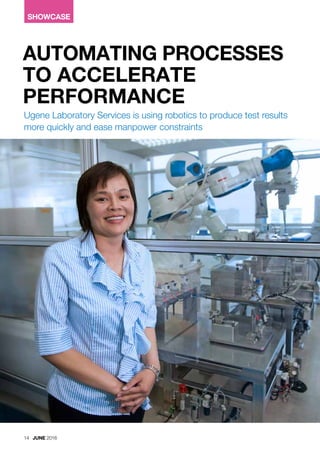
Singapore company Ugene Laboratory
Services has designed and built a
robot that can process food samples
and conduct tests for contaminants,
additives and bacteria. The company
now attracts professionals looking
for meaningful learning experiences
rather than just pay cheques.
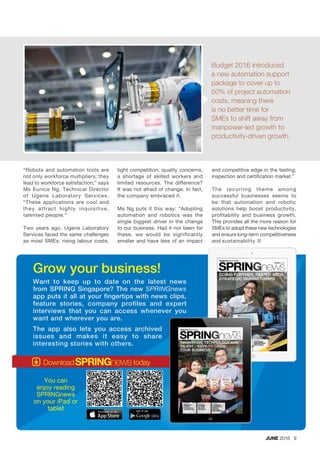
Adopting automation and robotics has given Ugene Laboratory Services
a competitive edge in the testing, inspection and certification market.
Mr Hui Wing Feh
Application Engineer
Kurve Automation
First, assess
what is causing
the most pain in terms
of labour, errors and
waste. Then, SMEs need
to prioritise three to five
core areas that align
with their business goals,
and automate or
robotise those
processes.
Budget 2016 introduced
a new automation support
package to cover up to
50% of project automation
costs, meaning there
is no better time for
SMEs to shift away from
manpower-led growth to
productivity-driven growth.
“Robots and automation tools are
not only workforce multipliers; they
lead to workforce satisfaction,” says
Ms Eunice Ng, Technical Director
of Ugene Laboratory Services.
“These applications are cool and
they attract highly inquisitive,
talented people.”
Two years ago, Ugene Laboratory
Services faced the same challenges
as most SMEs: rising labour costs,
tight competition, quality concerns,
a shortage of skilled workers and
limited resources. The difference?
It was not afraid of change. In fact,
the company embraced it.
Ms Ng puts it this way: “Adopting
automation and robotics was the
single biggest driver in the change
to our business. Had it not been for
these, we would be significantly
smaller and have less of an impact
Want to keep up to date on the latest news
from SPRING Singapore? The new SPRINGnews
app puts it all at your fingertips with news clips,
feature stories, company profiles and expert
interviews that you can access whenever you
want and wherever you are.
Grow your business!
You can
enjoy reading
SPRINGnews
on your iPad or
tablet
The app also lets you access archived
issues and makes it easy to share
interesting stories with others.
JUNE 2016 9
and competitive edge in the testing,
inspection and certification market.”
The recurring theme among
successful businesses seems to
be that automation and robotic
solutions help boost productivity,
profitability and business growth.
This provides all the more reason for
SMEs to adopt these new technologies
and ensure long-term competitiveness
and sustainability.¢
SHOWCASE
10 JUNE 2016
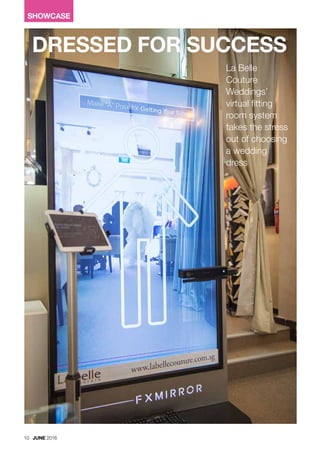
DRESSED FOR SUCCESS
La Belle
Couture
Weddings’
virtual fitting
room system
takes the stress
out of choosing
a wedding
dress
JUNE 2016 11
inding the perfect wedding
dress can be the most
important part of the wedding
planning process for a bride-
to-be. “But it can also be a tiring, over-
whelming and time-consuming affair,”
says Ms Peiru Teo (below), Managing
Director and owner of La Belle Couture
Weddings, a local bridal boutique
that offers more than 700 wedding
gown choices.
According to Ms Teo, brides-to-be
typically spend up to four hours trying
up to 20 dresses. “Each dress weighs
between 7 and 15 kilograms, and
takes about 20 minutes to put on,”
she explains. “It’s often a physically
and mentally exhausting process for
both our customers and staff.”
In 2015, Ms Teo found a way to reduce
thestressinvolvedinchoosingawedding
dress. With the support of SPRING
Singapore’s Capability Development
Grant (CDG), she purchased FX Mirror
– a virtual fitting room system that
allows customers to digitally try on
hundreds of wedding gowns without
the hassle of dressing and undressing.
La Belle Couture Weddings is
the first company in Singapore to
implement the system.
“With the FX Mirror, our customers no
longer have to try on more than a dozen
wedding gowns to pin down the right
size, colour and design,” she says.
Unique shopping experience
Since 2006, La Belle Couture Weddings
has evolved from a company with only
three staff members into one of the
leading bridal boutiques in Singapore.
However, Ms Teo admits that getting
her business off the ground was no
easy feat.
F
keytakeaways
¢	Innovative technologies are the key to
long-term competitiveness and business
sustainability.
¢	Visit www.spring.gov.sg/CDG to find
out how SPRING can help you upgrade
your business capabilities.
“In our first few years, we faced
difficulties in maintaining standard
service levels. Our customers naturally
have high expectations and some-
times it was difficult for our staff
members to meet their needs and
demands,” she explains. “This led to
inconsistencies in terms of service
quality and experiences.”
That pressure on staff members was
greatly alleviated in January 2016, when
Ms Teo installed the FX Mirror at La
Belle Couture Weddings. The South
Korean system uses Microsoft Kinect
cameras and 3D virtual fitting software to
analyse and measure height and body
proportions, such as shoulder width,
waist size and hip circumference, to
accurately fit a virtual garment on
the customer.
“The FX Mirror makes it easy for
customers to choose and eliminate
wedding dresses and suits as it
displays all information about a
particular outfit – from design details to
colour choices – in one central system,”
says Ms Teo. “Additionally, because
it takes only two seconds to put on a
virtual dress, our customers now have
more time to try on as many styles
and designs as they like.”
The system also helps staff members
quickly grasp customers’ preferences.
“Based on what they pick, our
consultants can tell what they like
and dislike, enabling them to provide
higher-quality recommendations,”
Ms Teo adds. “It puts us in a better
position to advise brides- and grooms-
to-be and increases customer trust.”
Now, each fitting appointment takes
less than three hours. “The system
has helped our staff members reduce
time spent per customer by 20%.
This, in turn, has increased our overall
capacity to take in more appointments
by 30%, especially on peak days,”
Ms Teo explains.
Overall, the FX Mirror has enhanced the
customer experience at La Belle Couture
Weddings, providing a personalised,
consistent and convenient service.
In 2015, the company conducted
a customer satisfaction survey and
received a score of 9.2 out of 10 – a
10% increase compared with surveys
conducted in 2013 and 2014.
A forward-looking partner
Today, La Belle Couture Weddings
works with some of the biggest
names in the hospitality industry,
including Mandarin Oriental Singapore,
Regent Singapore and Pan Pacific
Singapore, offering customised
wedding packages and services.
“The FX Mirror has strengthened our
status as a forward-looking bridal
boutique and has led to us becoming
a preferred wedding services partner,”
says Ms Teo.
Within the next year, the company plans
to implement an enterprise resource
planning (ERP) solution to digitise the
customer journey, automate back-
office functions and integrate business
operations, such as sales, inventory
and marketing.
This will empower customers to
‘self-help’ online and get instant
confirmations on, for instance, change
requests, which otherwise may take
up to five days to manually process.
“Then, we plan to link our ERP solution to
our soon-to-be-launched e-commerce
platform to analyse inventory patterns,
identify popular designs and track
every item,” Ms Teo adds.
As for the FX Mirror, the company plans
to incorporate it into its ERP solution
and e-commerce platform. In the
future, customers will be able to try on
gowns at La Belle Couture Weddings
using the FX Mirror, save their selections
to a personal e-wardrobe and make
payments online.
“Essentially, we’re using technology
to enhance the customer experiences
we provide,” says Ms Teo. “With the
FX Mirror, customer experience has
become our competitive advantage.Ӣ
SHOWCASE
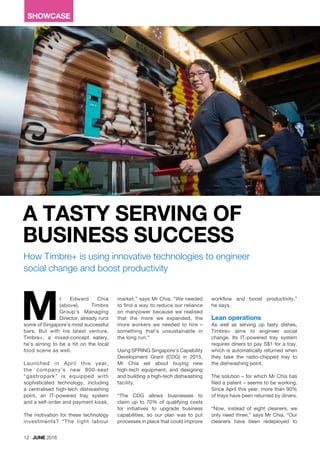
r Edward Chia
(above), Timbre
Group’s Managing
Director, already runs
some of Singapore’s most successful
bars. But with his latest venture,
Timbre+, a mixed-concept eatery,
he’s aiming to be a hit on the local
food scene as well.
Launched in April this year,
the company’s new 800-seat
“gastropark” is equipped with
sophisticated technology, including
a centralised high-tech dishwashing
point, an IT-powered tray system
and a self-order and payment kiosk.
The motivation for these technology
investments? “The tight labour
A TASTY SERVING OF
BUSINESS SUCCESS
How Timbre+ is using innovative technologies to engineer
social change and boost productivity
M
12 JUNE 2016
market,” says Mr Chia. “We needed
to find a way to reduce our reliance
on manpower because we realised
that the more we expanded, the
more workers we needed to hire –
something that’s unsustainable in
the long run.”
Using SPRING Singapore’s Capability
Development Grant (CDG) in 2015,
Mr Chia set about buying new
high-tech equipment, and designing
and building a high-tech dishwashing
facility.
“The CDG allows businesses to
claim up to 70% of qualifying costs
for initiatives to upgrade business
capabilities, so our plan was to put
processes in place that could improve
workflow and boost productivity,”
he says.
Lean operations
As well as serving up tasty dishes,
Timbre+ aims to engineer social
change. Its IT-powered tray system
requires diners to pay S$1 for a tray,
which is automatically returned when
they take the radio-chipped tray to
the dishwashing point.
The solution – for which Mr Chia has
filed a patent – seems to be working.
Since April this year, more than 90%
of trays have been returned by diners.
“Now, instead of eight cleaners, we
only need three,” says Mr Chia. “Our
cleaners have been redeployed to
more value-added roles, such as
providing assistance to customers
at the dishwashing point to improve
dining experiences. As a result,
they’ve reported feeling more job
satisfaction.”
Timbre+’s labour-saving results
have also inspired other food court
developers across the island. “We’ve
received a number of enquiries
asking us to help design and put in
place some of Timbre+’s operational
processes in other food centres, as
well as to set up Timbre+ in other
locations,” he adds.
A healthy landlord-tenant
keytakeaways
¢	Continuous improvement is the key to
sustaining a competitive edge.
¢	Visit www.spring.gov.sg/CDG to find out
how SPRING can help you improve your
business processes.
JUNE 2016 13
We need to
constantly think
of new, innovative ways
to reduce manpower
needs, boost productivity
and ensure business
sustainability – all of which
are possible
with technology.
Mr Edward Chia
Managing Director
Timbre Group
By the end of this year, he plans to
install solar-powered smart bins at
the eatery. Each bin will contains
in-built solar-powered compaction
technology that increases its capacity
(from 606 litres to 800 litres) when full.
“These home-grown smart bins will
be able to send out alerts to our
cleaners when they are full, ensuring
an effective and efficient rubbish
management system at Timbre+, and
overall cleanliness.”
As for more long-term plans, Mr Chia
is looking at drones. “We’re exploring
how we can use them, instead of
waiters and waitresses, to deliver
food to customers’ tables.”
He puts it this way: “The current tight
labour situation means we need to
constantly think of new, innovative
ways to reduce manpower needs,
boost productivity and ensure
business sustainability – all of which
are possible with technology. We see
our technology strategy as a win-win
solution for all stakeholders.” ¢
relationship
Mr Chia’s technology strategy has
helped the company deliver on
another business imperative: the
landlord-tenant relationship.
“Many landlords – especially in
the retail space in Singapore – are
scrambling to attract and retain
tenants, highlighting the importance
of tenant satisfaction,” says Mr Chia.
“Many have reported seeing tenants
come and go in as little as six months,
which isn’t very good for business.”
That’s why, he says, landlords have
to step up and play a bigger role in
ensuring the success of their tenants.
“Our centralised dishwashing point
and IT-powered tray system benefit
all tenants at Timbre+, because each
hawker stall, restaurant or food truck
housed here does not need to hire
their own cleaners or dishwashers,”
Mr Chia explains. “This translates to
lower operational and administrative
costs and higher profits for our
tenants.”
Strategy for the future
The success of Timbre+ has given
Mr Chia the confidence to further
strengthen the company’s technology
efforts to drive business growth,
productivity and sustainability.
14 JUNE 2016
AUTOMATING PROCESSES
TO ACCELERATE
PERFORMANCE
Ugene Laboratory Services is using robotics to produce test results
more quickly and ease manpower constraints
SHOWCASE
JUNE 2016 15
ince 1998, Ugene
Laboratory Services has
provided Singapore’s food
sector with vital quality
checks to ensure products are safe
for consumers. The company’s
microbiologists test food products and
traditional Chinese medicines for a full
range of potentially harmful foodborne
microorganisms, ensuring their clients
comply with food safety regulations.
“Quick and accurate results – that’s
what our clients want,” says Ms Eunice
Ng (left), Technical Director of Ugene
Laboratory Services.
As demand for the company’s services
grew, she realised that it needed to hire
more workers. “The problem was that
hiring the right people turned out to
be unsustainable, given Singapore’s
tight labour situation,” says Ms Ng.
“We needed people willing to under-
take a number of manual, routine and
time-consuming processes, but they
were proving hard to find.”
The company decided to invest in
robotics to address its manpower
challenges. In 2015, using SPRING
Singapore’s Capability Development
Grant, it embarked on a project to
design and build a two-armed robot
that could process food samples
and conduct tests for contaminants,
additives and bacteria.
Quicker, more accurate
results
Putting its robot to work means Ugene
Laboratory Services has been able to
automate a number of repetitive tasks,
such as setting up and weighing test
samples. This enables the company to
generate test results and reports quicker.
It used to take the company five days
to issue a test report. Now it can deliver
one quicker.
“Previously, our laboratory personnel
needed up to 20 minutes to complete
a test. Now, it takes only 10 minutes
and the results are completely
accurate. This means we can now
generate test reports more quickly,
S
keytakeaways
¢	Robotics can help companies improve
business efficiency, and product and service
consistency.
¢	Find out how SPRING can help your
business implement robotics by visiting
www.spring.gov.sg/CDG.
further reducing the time to market
for our clients’ products,” says Ms Ng.
More business
opportunities
Reducing the time spent performing
manual, routine tasks has significantly
improved the company’s productivity
and business opportunities.
“Not only have we been able to do
up to 35% more tests with the same
number of staff members, we’ve also
been able to secure more contracts for
food testing because our clients see us
as a more reliable, trusted partner,”
Ms Ng reports. testing services and reports as a
‘gateway’ to overseas markets.
“Robotics enables us to deliver test
results more quickly and accurately,
which, in turn, allows our clients to
gain quicker access to markets,”
Ms Ng adds.
The company’s success as a result
of implementing robotics has given
it more confidence to expand its
business offerings. “This year, we plan
to implement an automated pathogen
testing system to detect bacteria,
such as salmonella and listeria, in
food samples,” explains Ms Ng.
The system will further ensure the
safety and quality of food products.
“It will complement the testing
services provided by our robot and
help us achieve our target of 20%
growth in the sales of our services,”
Ms Ng adds.
Overall, she believes that the robotics
solution is one of the company’s
biggest assets. “It enables us to
produce higher-quality test results
and reports more quickly, reduce risks
and generate manpower savings – all
of which have put the company on a
path to future growth.” ¢
Robotics enables
us to deliver test
results more quickly and
accurately, which, in turn,
allows our clients to gain
quicker access
to markets.
Ms Eunice Ng
Technical Director
Ugene Laboratory Services
The company has also achieved
manpower savings. “Previously, we
needed three people to set up and
weigh samples, but now we require
only one person to operate the robot,”
says Ms Ng.
With the new robotics solution in
place, Ugene Laboratory Services’
staff members can focus on revenue-
generating activities, such as per-
forming hygiene audits, environmental
testing and water testing for leading
food manufacturers, restaurants and
hotels in Singapore.
“As a result, these new services now
make up almost 20% of the company’s
total revenue,” says Ms Ng.
A solution for success
Today, many local and international
firms use Ugene Laboratory Services’
Develop Your
Human Capital
For more information, visit www.spring.gov.sg/HCD or
email hcd@spring.gov.sg
Make people your most valued asset
Invest in talents and enhance your HR capabilities to
support your business growth.
Implement basic
HR systems and
processes
Attract and
develop young
talents
Embark on
HR capability
upgrading projects
SPOTLIGHT
The Singapore School Transport Association’s integrated technology
solution is set to inject new life into the school transport industry
ingapore school bus
drivers often have to deal
with rowdy children and
anxious calls from parents
– all while operating a 10-tonne
vehicle. This can potentially lead to
distracted driving and accident risks.
“In addition, school bus operators
manually track the daily attendance
of students, which is time-consuming
and prone to errors,” says Mr Wong
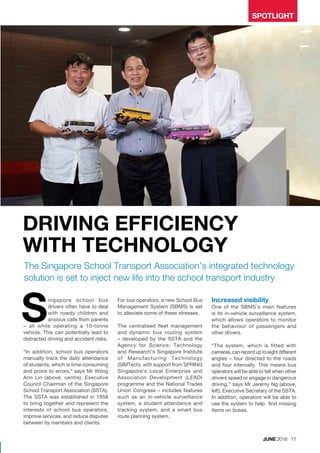
Ann Lin (above, centre), Executive
Council Chairman of the Singapore
School Transport Association (SSTA).
The SSTA was established in 1958
to bring together and represent the
interests of school bus operators,
improve services, and reduce disputes
between its members and clients.
For bus operators, a new School Bus
Management System (SBMS) is set
to alleviate some of these stresses.
The centralised fleet management
and dynamic bus routing system
– developed by the SSTA and the
Agency for Science, Technology
and Research’s Singapore Institute
of Manufacturing Technology
(SIMTech), with support from SPRING
Singapore’s Local Enterprise and
Association Development (LEAD)
programme and the National Trades
Union Congress – includes features
such as an in-vehicle surveillance
system, a student attendance and
tracking system, and a smart bus
route planning system.
S Increased visibility
One of the SBMS’s main features
is its in-vehicle surveillance system,
which allows operators to monitor
the behaviour of passengers and
other drivers.
“The system, which is fitted with
cameras, can record up to eight different
angles – four directed to the roads
and four internally. This means bus
operators will be able to tell when other
drivers speed or engage in dangerous
driving,” says Mr Jeremy Ng (above,
left), Executive Secretary of the SSTA.
In addition, operators will be able to
use the system to help find missing
items on buses.
DRIVING EFFICIENCY
WITH TECHNOLOGY
JUNE 2016 17
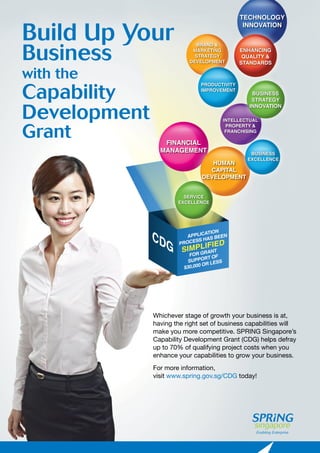
Whichever stage of growth your business is at,
having the right set of business capabilities will
make you more competitive. SPRING Singapore’s
Capability Development Grant (CDG) helps defray
up to 70% of qualifying project costs when you
enhance your capabilities to grow your business.
For more information,
visit www.spring.gov.sg/CDG today!
TECHNOLOGY
INNOVATION
FINANCIAL
MANAGEMENT
HUMAN
CAPITAL
DEVELOPMENT
BRAND &
MARKETING
STRATEGY
DEVELOPMENT
BUSINESS
EXCELLENCE
SERVICE
EXCELLENCE
PRODUCTIVITY
IMPROVEMENT
INTELLECTUAL
PROPERTY &
FRANCHISING
ENHANCING
QUALITY &
STANDARDS
BUSINESS
STRATEGY
INNOVATION
Build Up Your
Business
with the
Capability
Development
Grant
keytakeaways
¢	Technology innovation is the key to
rejuvenating industries and businesses.
¢	To find out how the LEAD programme
can help enhance industry and enterprise
competitiveness, visit www.spring.gov.sg/LEAD.
The SBMS can
be used as a
powerful technology
tool to improve visibility
and services, minimise
disputes, and maximise
productivity and
efficiency.
Dr Liu Wei
Senior Scientist
SIMTech
The automatic attendance-taking and
notification system, which will use radio
frequency identification tags attached
to each child and a mobile app, will
send push notifications to parents about
their child’s location. “For instance, the
app will send a notification to parents
10 minutes before the bus arrives at
their home. When the child boards
the bus, the parents get a message,
and they get another when the child
reaches school,” explains Mr Ng.
Parents are again notified when the
child has boarded the bus after school.
“These notifications will help reduce
the number of calls drivers get from
parents and allow them to concentrate
on driving,” says Mr Ng.
For drivers, the system is also set to
be a productivity boon. “Attendance-
taking is automatic, which will help
eliminate the time it takes to manually
record student attendance,” says
Mr Ng.
A smarter way to plan
Another feature of the SBMS is a
smart bus route planning system
that provides operators with the
fastest route.
“Previously, drivers used to take up
to five days to manually plan their
school bus routing schedules based
on student pick-up locations,” says
Mr Ng. “Now, drivers just have to enter
all the addresses into the system and
it will suggest the best possible route.”
Essentially, with the smart bus
route planning system, drivers will
be able to avoid the fuel wastage
caused by excessive idling and
inefficient routes. “And with proper
driving behaviour, accident repair
and downtime opportunity costs
can be reduced by up to 85%,”
says Mr Wong.
Fit for the future
Following a successful pilot run of
the SBMS with Raffles Girls’ Primary
School in December 2015, the SSTA
now plans to roll out the system
across the school transport sector,
starting with 1,000 buses this year
and reaching 5,000 buses by 2019.
The pilot demonstrated substantial
productivity improvements. “For
instance, the time spent at student
pick-up points – including waiting
for students to board the bus and
taking attendance – was reduced by
a total of 14 minutes per trip,” says
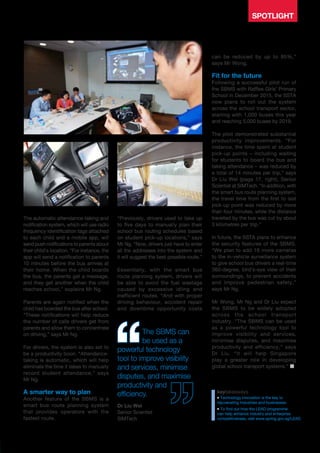
Dr Liu Wei (page 17, right), Senior
Scientist at SIMTech. “In addition, with
the smart bus route planning system,
the travel time from the first to last
pick-up point was reduced by more
than four minutes, while the distance
travelled by the bus was cut by about
3 kilometres per trip.”
In future, the SSTA plans to enhance
the security features of the SBMS.
“We plan to add 16 more cameras
to the in-vehicle surveillance system
to give school bus drivers a real-time
360-degree, bird’s-eye view of their
surroundings, to prevent accidents
and improve pedestrian safety,”
says Mr Ng.
Mr Wong, Mr Ng and Dr Liu expect
the SBMS to be widely adopted
across the school transport
industry. “The SBMS can be used
as a powerful technology tool to
improve visibility and services,
minimise disputes, and maximise
productivity and efficiency,” says
Dr Liu. “It will help Singapore
play a greater role in developing
global school transport systems.” ¢
SPOTLIGHT
JUNE 2016 19
20 JUNE 2016
Tell us more about Kurve
Automation. Why did the
company decide to focus
on providing robotics
for the food and service
sectors?
In 2013, when we set up the company,
we planned to focus on general
automation solutions serving a range
of sectors. However, we noticed that
the market for robotics technology
– especially in the food and service
PROFILE
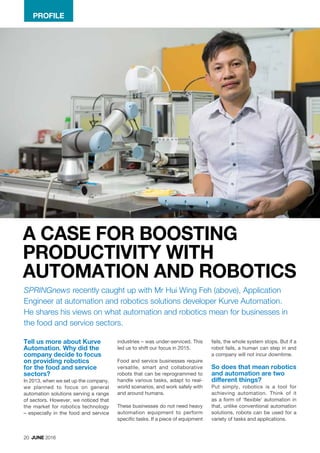
SPRINGnews recently caught up with Mr Hui Wing Feh (above), Application
Engineer at automation and robotics solutions developer Kurve Automation.
He shares his views on what automation and robotics mean for businesses in
the food and service sectors.
industries – was under-serviced. This
led us to shift our focus in 2015.
Food and service businesses require
versatile, smart and collaborative
robots that can be reprogrammed to
handle various tasks, adapt to real-
world scenarios, and work safely with
and around humans.
These businesses do not need heavy
automation equipment to perform
specific tasks. If a piece of equipment
fails, the whole system stops. But if a
robot fails, a human can step in and
a company will not incur downtime.
So does that mean robotics
and automation are two
different things?
Put simply, robotics is a tool for
achieving automation. Think of it
as a form of ‘flexible’ automation in
that, unlike conventional automation
solutions, robots can be used for a
variety of tasks and applications.
A CASE FOR BOOSTING
PRODUCTIVITY WITH
AUTOMATION AND ROBOTICS
JUNE 2016 21
What are some of the
challenges faced by
businesses in the food
and service industries that
Kurve Automation aims to
address?
Two of the biggest challenges facing
these businesses are low productivity
and a shortage of manpower. Both food
manufacturers and service businesses
are under increasing pressure to
improve uptime while reducing costs
in order to remain competitive and
profitable.
That’s where we come in. We want
to help companies in these sectors
build businesses for the future by
revolutionising how automation is
deployed. Smart, collaborative robots
are capable of working alongside
humans and performing a wide range
of tasks faster than people can, freeing
up staff members to use their talents
for more interesting, value-added work.
Could you tell us more
about the company’s
recent solution – the
breakfast egg robot?
With support from SPRING Singapore’s
Capability Development Grant (CDG),
we developed a new robot in January
2016.
The one-armed robot can perform
more than 20 tasks – including beating,
frying and flipping eggs – and operate
up to 10 different pieces of equipment
simultaneously. It’s the first robot in
Singapore with this level of automation
and robotics system integration.
It’s designed specifically to reduce
waiting times at breakfast buffets and
restaurants, so it can work twice as
fast as humans and make all kinds of
eggs – from creamy scrambled eggs
and fluffy omelettes to perfect sunny-
side up eggs. We’ve even programmed
it to make dosai!
It’s developed in such a way that it can
mix different products and make orders
for individual customers. Now we’re
working with Nanyang Polytechnic’s
1
– In December 2015, with SPRING’s support, the COIE launched an Internet of Things Open
Innovation Community to create opportunities for academia, start-ups and larger companies to work
together on diverse innovation projects.
Centre of Innovation for Electronics
(COIE)1
in the area of Internet of
Things to develop an automatic smart
visual 3D sensing system, or ‘eyes’,
to improve the robot’s accuracy,
efficiency and quality control system.
What are some of its other
benefits?
With this robot, jobs will be
transformed. While it serves up food
– quickly and with no risk of error –
human chefs can focus on becoming
customer service champions, building
bonds with customers. It will take
away laborious, low-value tasks and,
inevitably, improve the experiences of
both staff members and customers.
How will this solution
help encourage food and
service businesses to
adopt automation?
We’ve really simplified our solution’s
human-machine interface, so that
anyone can program the robot. This
ease of programming, combined with
the robot’s mobility, will hopefully
encourage businesses to embrace
these advanced automated solutions
– whether they’re micro and small
enterprises or much larger companies.
With this robot, automation can be as
simple as sending an email!
Cost is a significant
concern for most
local SMEs when it
comes to adopting new
technologies. How should
businesses deal with this
challenge?
SMEs can turn to SPRING for help,
and use the CDG and Innovation
& Capability Voucher as stepping
stones to automation and business
success. Those looking to scale up
automation in their businesses can
use the new Automation Support
Package introduced as part of this
year’s Budget to cover up to 50% of
their project automation costs.
How would you advise
Singapore SMEs looking
to adopt automation and
robotics?
There is a clear financial incentive
in moving towards automation and
robotics. It saves money; does the
job more effectively; and, ultimately,
helps improve a company’s overall
productivity, profitability and
competitiveness.
In today’s highly competitive business
landscape, automation is no longer a
question of return on investment – it’s
a necessity for survival! ¢
SMF
At the SME Centre, our Business Advisors partner you on your
growth journey, guiding you to the next level in your business.
Leverage their insights on the SME community, and tap on readily
available business resources, to start growing your business today!
Supported by
Find out more at www.smecentres.sg
More than
Business Advisors,
they are my partners
in business
Ms Shermaine Tay
Business Advisor
SME Centre@SMF
Join these SMEs that have taken
their businesses to the next level
Mr Sia Chye Whatt
Director
Darwin Design &
Development Pte Ltd
Ms Angel Tnee Ching Mei
Founder
Allure Beauty Salon Pte Ltd
Mr Ng Cheng Kai
Business Advisor
SME Centre@SMF
Ms Ashura D/O
Isaahak Piperdy
Business Advisor
SME Centre@SMCCI
Mdm Supiah Abdullah
Director
Foodcrumz Pte Ltd
Ms Ho Qian Yi Fermelle
Director
iConz Pte ltd
Mr Andrew Gam
Business Advisor
SME Centre@ASME
Mr. Ishvinder Singh
Business Advisor
SME Centre@SICCI
Mr P. Gunasegeran
CEO
Just R Enterprise Pte Ltd
Ms Stella Aw Yong
Business Advisor
SME Centre@ASME
Mr Kentigern Tan
Director
Suniwell Trading Pte Ltd
Ms Ong Poh Geok
Founder
Shing Mei Confectionery
Mr Alan Wong Peng How
Business Advisor
SME Centre@SCCCI
Ms Viswanatham Sangari
Business Advisor
SME Centre@SICCI
Mr Mahendran S/O
Navaratna Rajah
Regional Director
Omni-Health Pte Ltd
Mr Tan Guang Lin
Business Advisor
SME Centre@SMF
Ms Ann Yeo
General Manager
Five Star Hainanese
Kampong Chicken Rice
Sales of Standards
Toppan Leefung Pte Ltd
Great World City East Tower
1 Kim Seng Promenade, #18-01
Singapore 237994
Tel: (65) 6826 9691
Fax: (65) 6820 3341
Email: singaporestandardseshop@toppanleefung.com
Website: www.singaporestandardseshop.sg
Standards Collection
National Library Board
Lee Kong Chian Reference Library
100 Victoria Street
Level 7
Singapore 188064
Tel: (65) 6332 3255
Email: ref@library.nlb.gov.sg
Website: eresources.nlb.gov.sg/standards
SME Infoline
Tel: (65) 6898 1800
Email: smeinfoline@spring.gov.sg
Website: www.smeportal.sg
SME Centres
SME Centre@ASME
Association of Small and Medium
Enterprises (ASME)
167 Jalan Bukit Merah
Tower 4, #03-13
Singapore 150167
Tel: (65) 6513 0388
Email: enquiries@smecentre-asme.sg
Website: www.smecentre-asme.sg
SME Centre@SCCCI
Singapore Chinese Chamber of
Commerce and Industry (SCCCI)
47 Hill Street, #09-00
Singapore 179365
Tel: (65) 6337 8381
Fax: (65) 6339 0605
Email: enquiry@smecentre-sccci.sg
Website: www.smecentre-sccci.sg
SME Centre@SICCI
Singapore Indian Chamber of
Commerce and Industry (SICCI)
SICCI Building
31 Stanley Street
Singapore 068740
Tel: (65) 6508 0147
Email: sme@smecentre-sicci.sg
Website: www.smecentre-sicci.sg
Satellite SME Centres are also located at the Community Development Councils (CDCs).
CONTACTS
SME Centre@SMCCI
Singapore Malay Chamber of
Commerce and Industry (SMCCI)
15 Jalan Pinang
Singapore 199147
Tel: (65) 6293 3822
Fax: (65) 6293 3905
Email: gadvisory@smecentre-smcci.sg
Website: www.smecentre-smcci.sg
SME Centre@SMF
Singapore Manufacturing Federation (SMF)
2985 Jalan Bukit Merah
Singapore 159457
Tel: (65) 6826 3020
Fax: (65) 6826 3021
Email: query@smecentre-smf.sg
Website: www.smecentre-smf.sg
For assistance, you can visit
satellite SME Centres located at the
Community Development Councils (CDCs),
Changi Simei Community Club and
Ang Mo Kio Community Centre.
SPRING Singapore is an agency under the Ministry of Trade and Industry, responsible for helping Singapore enterprises grow
and building trust in Singapore products and services. As the enterprise development agency, SPRING works with partners to
help enterprises with financing, capability and management development, technology and innovation, and access to markets.
As the national standards and accreditation body, SPRING develops and promotes an internationally recognised standards and
quality assurance infrastructure. SPRING also oversees the safety of general consumer goods in Singapore.
SPRING Singapore
1 Fusionopolis Walk, #01-02 South Tower, Solaris, Singapore 138628
Tel: +65 6278 6666, Fax: +65 6278 6667
www.spring.gov.sg

SPRINGnews_Jun2016__

  • 1.
    SPRINGnews JUNE 2016 ENABLING ENTERPRISE INNOVATIVETECHNOLOGIES FOR HIGHER PRODUCTIVITY SHOWCASE DRESSED FOR SUCCESS: LA BELLE COUTURE WEDDINGS SHOWCASE A TASTY SERVING OF BUSINESS SUCCESS: TIMBRE+ SPOTLIGHT DRIVING EFFICIENCY WITH TECHNOLOGY Watch SPRINGnews on YouTube!
  • 2.
    CONTENTS 6 EDITORIAL TEAM Marion ABRAHAM(marion_abraham@spring.gov.sg) Felicia LEE (felicia_lee@spring.gov.sg) Kathleen TAN (kathleen_tan@spring.gov.sg) Mark TAN (mark_tan@spring.gov.sg) Kathryn ZHANG (kathryn_zhang@spring.gov.sg) DESIGN & LAYOUT Kevin LOO (kevin_loo@spring.gov.sg) PUBLISHING CONSULTANT Editor Group SHOWCASE DRESSED FOR SUCCESS A TASTY SERVING OF BUSINESS SUCCESS AUTOMATING PROCESSES TO ACCELERATE PERFORMANCE SPOTLIGHT DRIVING EFFICIENCY WITH TECHNOLOGY PROFILE A CASE FOR BOOSTING PRODUCTIVITY WITH AUTOMATION AND ROBOTICS 10 17 20 12 14AUTOMATION AND ROBOTICS OFFER A COMPELLING SOLUTION FOR SMEs IN TODAY’S HIGHLY COMPETITIVE, DYNAMIC BUSINESS ENVIRONMENT JUNE 2016 To subscribe, visit www.spring.gov.sg/springnews For comments and feedback, email springnews@spring.gov.sg Download the SPRINGnews app from the App Store or Google Play Watch SPRINGnews at www.youtube.com/SPRINGsingapore FEATURE STORY THE KEY TO HIGHER PRODUCTIVITY AND PROFITABILITY
  • 3.
    BUZZ JUNE 2016 3 MrTeo Ser Luck, Minister of State, Ministry of Manpower placing an order at a self-service kiosk at Popeyes Restaurant, Punggol East. A serving of high efficiency Faced with a shortage of cashiers, Popeyes Louisiana Kitchen has launched a new way to place orders at its outlets. On 27 April, the fast-food chain introduced self-order kiosks at its restaurants in Punggol, IMM Jurong and 313@Somerset. The kiosks, supported by SPRING Singapore’s Capability Development Grant, have halved the time it takes to place an order, increasing sales by more than 10%. ¢ Strengthening SME capabilities  New Singapore standard for handling frozen fish and seafood On 19 May, the second SME Capabilities Forum was held to educate small businesses on areas crucial for long-term success. It featured thought leaders – such as Mr Joseph Baladi, Chief Executive Officer at BrandAsian, and Dr Wilson Chew, Strategy Partner at PricewaterhouseCoopers – and covered a range of topics relevant to SMEs, including business strategy innovation and emerging technologies. “Transforming the way we do business and enhancing business capabilities are some of the critical ways to keep pace with the changing economic climate,” said Ms Chew Mok Lee, Assistant Chief Executive of SPRING Singapore, at the event. ¢ A new Singapore standard – TR49: 2016 Cold Chain Management of Frozen Fish and Seafood – has been launched to reduce food and seafood spoilage, waste and safety risks. Launched by the Singapore Manufacturing Federation Standards Development Organisation, SPRING Singapore and the Seafood Industries Association Singapore on 25 May, the standard is targeted at key stakeholders in the fish and seafood industry, including producers and retailers. It provides guidelines for the cold chain management of raw and minimally processed frozen seafood. ¢ Panellists taking questions on the new standard. A panel discussion taking place at the SME Capabilities Forum 2016.
  • 5.
    BUZZ JUNE 2016 5 Manpowerplan for food services sector New online academy to boost MSME growthOn 31 May, Mr S Iswaran, Minister for Trade and Industry (Industry) (below, right), launched a Food Services Sectoral Manpower Plan (SMP) to reduce the sector’s reliance on manpower and enhance the skills of Singaporeans working in the sector. Developed by SPRING Singapore and the Singapore Workforce Development Agency, the five-year SMP comprises three strategies: accelerating the process of redesigning jobs through business transformation, building a strong and future-ready Singapore workforce, and strengthening human resources capabilities. The SMP complements the second Food Services Productivity Plan, launched in 2015. ¢ The new ASEAN Online SME Academy offers micro, small and medium enterprises (MSME) easier access to business courses and information on topics such as finance, technology and logistics. Launched on 31 May at the inaugural ASEAN Coordinating Committee on MSME meeting hosted by SPRING Singapore, the academy also provides region-specific information and networking opportunities to help ASEAN MSMEs grow their businesses in Southeast Asia. ¢ We’re on YouTube! Business leaders at the launch of the ASEAN Online SME Academy.
  • 6.
    6 JUNE 2016 Automationand robotics offer a compelling solution for SMEs in today’s highly competitive, dynamic business environment magine walking into a hotel staffed by humanoid robots capable of greeting guests, carrying luggage and cleaning rooms. Or imagine having your hair styled by a 24-fingered hair-washing machine. While these might sound like scenes from a sci-fi movie, they could soon be a reality in Singapore. Recently, Mr Teo Ser Luck, Minister of State for Manpower, went on a Lean Enterprise Development (LED) study mission to Japan. He was joined by representatives from the Restaurant Association of Singapore, Singapore Productivity Centre and SPRING Singapore, and delegates from local food and beverage companies. Japan is considered a world leader in adopting automation solutions and robotics to boost productivity and reduce manpower needs. Restaurants throughout the country have rolled out a number of innovative technologies to ensure quicker service, including laser-scanning meat machines, conveyor fryers, and edible ink and image printers. Singapore now aims to emulate these concepts and successes in local industries. “The government is keen to support manpower-lean growth through the LED Scheme – be it in the form of grant support, consultancy or temporary manpower flexibility – to help SMEs reinvent their current workflow processes,” says Mr Teo. I The government has put in place a range of support programmes to help local companies enhance their technology innovation capabilities. These include SPRING’s Innovation & Capability Voucher which helps SMEs upgrade their capabilities, and the Capability Development Grant (CDG) – a grant assistance programme that helps enterprises upgrade their capabilities across 10 key areas by covering up to 70% of project costs, including consultancy, manpower, training and certification. Although this strong government support alleviates some of the financial pressures SMEs face when adopting new technologies, the challenge now is to accelerate THE KEY TO HIGHER PRODUCTIVITY AND PROFITABILITY FEATURE
  • 7.
    adoption throughout entireindustries. Doing so will enable automation solutions to really move the needle on Singapore’s productivity and economic performance. Automation Automation can be used to perform dedicated functions, such as inserting specific components in assemblies, or multiple tasks like tagging, tracking and checking items as they come off the production line. The biggest benefit of automation is that it enables businesses to produce more with less labour, less waste and less time. In other words, it allows businesses to increase their capacity without increasing costs. Other immediate gains cannot be tangibly measured. SMEs in the finance sector that use automated software can chart asset allocation plans more efficiently. Small accounting firms can move away from bookkeeping and become business consultants. In 2014, Foodgnostic, a local supplier of baked goods, decided to semi-automate its core production processes to reduce manpower requirements, improve workflow and boost productivity. This strategy has helped Foodgnostic decrease staffing costs by up to 70% and reduce production wastage to nearly zero. In September 2015, it reported a double-digit net profit margin – something even large companies in the food and beverage industry struggle to achieve. Such benefits are the reason this year’s Singapore Budget included a strong push for automation. It introduced a new automation support package to cover up to 50% of project automation costs, meaning there is no better time for SMEs to shift away from manpower-led growth to productivity- driven growth. Robotics Robotics can be a viable path to profitability for SMEs – especially those in the food and services industries – because robots can be easily reprogrammed to adapt to real- world variability and imperfections. Fragrance Foodstuff Pte Ltd, a local family-owned provider of traditional Chinese food products such as bak kwa and mooncakes, is a robotics champion. In 2014, using SPRING’s CDG, it installed robotic arms in its JUNE 2016 7 Process automation is helping Foodgnostic improve productivity, reduce waste and stay competitive. The healthcare, construction, manufacturing and logistics sectors have been identified by the Singapore government as potential candidates for robotics and automation applications. product assembly line. The robot’s job may be simple – to pick, pack and label food products – but the company has since seen a 50% increase in productivity. “Previously, it used to take two staff members to produce only 100 kilograms of packed bak kwa products,” says Mr CK Tan, the company’s Senior Manager. “Now, using the same number of staff members, we can produce up to three times the amount of such products.”
  • 8.
    Recently, the Singaporegovernment identified the healthcare, construction, manufacturing and logistics sectors as potential candidates for robotics and automation applications. In addition, the government has set aside more than S$450 million to drive robotics development in these industries, and to create packaged solutions at a reasonable price for SMEs. “What we want is to find ways for SMEs to adopt this technology, but SME owners have to first understand its potential, then ‘cross the Rubicon’ and try it,” said Mr S Iswaran, Minister for Trade and Industry (Industry), during his March visit to a local start-up, Aitech Robotics & Automation Pte Ltd. If implemented correctly, robots can work safely with humans and help companies improve productivity and profitability, paving the way for a new era of business. Conventional or robotic automation? The choice between conventional automation or robotic automation, and the extent to which the choice is implemented, depends on a business’s unique needs. For SMEs that require a more ‘adaptive’ solution, robotics is the answer. According to Mr Hui Wing Feh, Application Engineer at Kurve Automation – a local developer of automation and robotics solutions for SMEs – the need for flexibility is a basic reason for choosing robotics. “Conventional automation solutions will suit businesses that need sustained high-rate production capabilities with reduced human labour,” he explains. However, Mr Hui says there are situations where robotics and automation are both required to maintain product quality. “For delicate processes and materials, or for production processes that involve hazardous materials and must be performed in unstaffed, 8 JUNE 2016 FEATURE remote locations, both robotics and automation may be needed.” At the same time, it is impossible to automate business processes or implement robotics unless a company has a handle on how jobs flow and how much labour and raw materials are consumed in the process. “First, assess what is causing the most pain in terms of labour, errors and waste,” Mr Hui advises. “Then, SMEs need to prioritise three to five core areas that align with their business goals, and automate or robotise those processes.” A boon for SMEs Across Singapore, SMEs outnumber large corporations. Collectively, they employ more people and form the backbone of Singapore’s economy. However, many small businesses have yet to realise the advantages of implementing automation and robotics – like attracting and retaining high- skilled workers. Singapore company Ugene Laboratory Services has designed and built a robot that can process food samples and conduct tests for contaminants, additives and bacteria. The company now attracts professionals looking for meaningful learning experiences rather than just pay cheques. Adopting automation and robotics has given Ugene Laboratory Services a competitive edge in the testing, inspection and certification market. Mr Hui Wing Feh Application Engineer Kurve Automation First, assess what is causing the most pain in terms of labour, errors and waste. Then, SMEs need to prioritise three to five core areas that align with their business goals, and automate or robotise those processes.
  • 9.
    Budget 2016 introduced anew automation support package to cover up to 50% of project automation costs, meaning there is no better time for SMEs to shift away from manpower-led growth to productivity-driven growth. “Robots and automation tools are not only workforce multipliers; they lead to workforce satisfaction,” says Ms Eunice Ng, Technical Director of Ugene Laboratory Services. “These applications are cool and they attract highly inquisitive, talented people.” Two years ago, Ugene Laboratory Services faced the same challenges as most SMEs: rising labour costs, tight competition, quality concerns, a shortage of skilled workers and limited resources. The difference? It was not afraid of change. In fact, the company embraced it. Ms Ng puts it this way: “Adopting automation and robotics was the single biggest driver in the change to our business. Had it not been for these, we would be significantly smaller and have less of an impact Want to keep up to date on the latest news from SPRING Singapore? The new SPRINGnews app puts it all at your fingertips with news clips, feature stories, company profiles and expert interviews that you can access whenever you want and wherever you are. Grow your business! You can enjoy reading SPRINGnews on your iPad or tablet The app also lets you access archived issues and makes it easy to share interesting stories with others. JUNE 2016 9 and competitive edge in the testing, inspection and certification market.” The recurring theme among successful businesses seems to be that automation and robotic solutions help boost productivity, profitability and business growth. This provides all the more reason for SMEs to adopt these new technologies and ensure long-term competitiveness and sustainability.¢
  • 10.
    SHOWCASE 10 JUNE 2016 DRESSEDFOR SUCCESS La Belle Couture Weddings’ virtual fitting room system takes the stress out of choosing a wedding dress
  • 11.
    JUNE 2016 11 indingthe perfect wedding dress can be the most important part of the wedding planning process for a bride- to-be. “But it can also be a tiring, over- whelming and time-consuming affair,” says Ms Peiru Teo (below), Managing Director and owner of La Belle Couture Weddings, a local bridal boutique that offers more than 700 wedding gown choices. According to Ms Teo, brides-to-be typically spend up to four hours trying up to 20 dresses. “Each dress weighs between 7 and 15 kilograms, and takes about 20 minutes to put on,” she explains. “It’s often a physically and mentally exhausting process for both our customers and staff.” In 2015, Ms Teo found a way to reduce thestressinvolvedinchoosingawedding dress. With the support of SPRING Singapore’s Capability Development Grant (CDG), she purchased FX Mirror – a virtual fitting room system that allows customers to digitally try on hundreds of wedding gowns without the hassle of dressing and undressing. La Belle Couture Weddings is the first company in Singapore to implement the system. “With the FX Mirror, our customers no longer have to try on more than a dozen wedding gowns to pin down the right size, colour and design,” she says. Unique shopping experience Since 2006, La Belle Couture Weddings has evolved from a company with only three staff members into one of the leading bridal boutiques in Singapore. However, Ms Teo admits that getting her business off the ground was no easy feat. F keytakeaways ¢ Innovative technologies are the key to long-term competitiveness and business sustainability. ¢ Visit www.spring.gov.sg/CDG to find out how SPRING can help you upgrade your business capabilities. “In our first few years, we faced difficulties in maintaining standard service levels. Our customers naturally have high expectations and some- times it was difficult for our staff members to meet their needs and demands,” she explains. “This led to inconsistencies in terms of service quality and experiences.” That pressure on staff members was greatly alleviated in January 2016, when Ms Teo installed the FX Mirror at La Belle Couture Weddings. The South Korean system uses Microsoft Kinect cameras and 3D virtual fitting software to analyse and measure height and body proportions, such as shoulder width, waist size and hip circumference, to accurately fit a virtual garment on the customer. “The FX Mirror makes it easy for customers to choose and eliminate wedding dresses and suits as it displays all information about a particular outfit – from design details to colour choices – in one central system,” says Ms Teo. “Additionally, because it takes only two seconds to put on a virtual dress, our customers now have more time to try on as many styles and designs as they like.” The system also helps staff members quickly grasp customers’ preferences. “Based on what they pick, our consultants can tell what they like and dislike, enabling them to provide higher-quality recommendations,” Ms Teo adds. “It puts us in a better position to advise brides- and grooms- to-be and increases customer trust.” Now, each fitting appointment takes less than three hours. “The system has helped our staff members reduce time spent per customer by 20%. This, in turn, has increased our overall capacity to take in more appointments by 30%, especially on peak days,” Ms Teo explains. Overall, the FX Mirror has enhanced the customer experience at La Belle Couture Weddings, providing a personalised, consistent and convenient service. In 2015, the company conducted a customer satisfaction survey and received a score of 9.2 out of 10 – a 10% increase compared with surveys conducted in 2013 and 2014. A forward-looking partner Today, La Belle Couture Weddings works with some of the biggest names in the hospitality industry, including Mandarin Oriental Singapore, Regent Singapore and Pan Pacific Singapore, offering customised wedding packages and services. “The FX Mirror has strengthened our status as a forward-looking bridal boutique and has led to us becoming a preferred wedding services partner,” says Ms Teo. Within the next year, the company plans to implement an enterprise resource planning (ERP) solution to digitise the customer journey, automate back- office functions and integrate business operations, such as sales, inventory and marketing. This will empower customers to ‘self-help’ online and get instant confirmations on, for instance, change requests, which otherwise may take up to five days to manually process. “Then, we plan to link our ERP solution to our soon-to-be-launched e-commerce platform to analyse inventory patterns, identify popular designs and track every item,” Ms Teo adds. As for the FX Mirror, the company plans to incorporate it into its ERP solution and e-commerce platform. In the future, customers will be able to try on gowns at La Belle Couture Weddings using the FX Mirror, save their selections to a personal e-wardrobe and make payments online. “Essentially, we’re using technology to enhance the customer experiences we provide,” says Ms Teo. “With the FX Mirror, customer experience has become our competitive advantage.”¢
  • 12.
    SHOWCASE r Edward Chia (above),Timbre Group’s Managing Director, already runs some of Singapore’s most successful bars. But with his latest venture, Timbre+, a mixed-concept eatery, he’s aiming to be a hit on the local food scene as well. Launched in April this year, the company’s new 800-seat “gastropark” is equipped with sophisticated technology, including a centralised high-tech dishwashing point, an IT-powered tray system and a self-order and payment kiosk. The motivation for these technology investments? “The tight labour A TASTY SERVING OF BUSINESS SUCCESS How Timbre+ is using innovative technologies to engineer social change and boost productivity M 12 JUNE 2016 market,” says Mr Chia. “We needed to find a way to reduce our reliance on manpower because we realised that the more we expanded, the more workers we needed to hire – something that’s unsustainable in the long run.” Using SPRING Singapore’s Capability Development Grant (CDG) in 2015, Mr Chia set about buying new high-tech equipment, and designing and building a high-tech dishwashing facility. “The CDG allows businesses to claim up to 70% of qualifying costs for initiatives to upgrade business capabilities, so our plan was to put processes in place that could improve workflow and boost productivity,” he says. Lean operations As well as serving up tasty dishes, Timbre+ aims to engineer social change. Its IT-powered tray system requires diners to pay S$1 for a tray, which is automatically returned when they take the radio-chipped tray to the dishwashing point. The solution – for which Mr Chia has filed a patent – seems to be working. Since April this year, more than 90% of trays have been returned by diners. “Now, instead of eight cleaners, we only need three,” says Mr Chia. “Our cleaners have been redeployed to
  • 13.
    more value-added roles,such as providing assistance to customers at the dishwashing point to improve dining experiences. As a result, they’ve reported feeling more job satisfaction.” Timbre+’s labour-saving results have also inspired other food court developers across the island. “We’ve received a number of enquiries asking us to help design and put in place some of Timbre+’s operational processes in other food centres, as well as to set up Timbre+ in other locations,” he adds. A healthy landlord-tenant keytakeaways ¢ Continuous improvement is the key to sustaining a competitive edge. ¢ Visit www.spring.gov.sg/CDG to find out how SPRING can help you improve your business processes. JUNE 2016 13 We need to constantly think of new, innovative ways to reduce manpower needs, boost productivity and ensure business sustainability – all of which are possible with technology. Mr Edward Chia Managing Director Timbre Group By the end of this year, he plans to install solar-powered smart bins at the eatery. Each bin will contains in-built solar-powered compaction technology that increases its capacity (from 606 litres to 800 litres) when full. “These home-grown smart bins will be able to send out alerts to our cleaners when they are full, ensuring an effective and efficient rubbish management system at Timbre+, and overall cleanliness.” As for more long-term plans, Mr Chia is looking at drones. “We’re exploring how we can use them, instead of waiters and waitresses, to deliver food to customers’ tables.” He puts it this way: “The current tight labour situation means we need to constantly think of new, innovative ways to reduce manpower needs, boost productivity and ensure business sustainability – all of which are possible with technology. We see our technology strategy as a win-win solution for all stakeholders.” ¢ relationship Mr Chia’s technology strategy has helped the company deliver on another business imperative: the landlord-tenant relationship. “Many landlords – especially in the retail space in Singapore – are scrambling to attract and retain tenants, highlighting the importance of tenant satisfaction,” says Mr Chia. “Many have reported seeing tenants come and go in as little as six months, which isn’t very good for business.” That’s why, he says, landlords have to step up and play a bigger role in ensuring the success of their tenants. “Our centralised dishwashing point and IT-powered tray system benefit all tenants at Timbre+, because each hawker stall, restaurant or food truck housed here does not need to hire their own cleaners or dishwashers,” Mr Chia explains. “This translates to lower operational and administrative costs and higher profits for our tenants.” Strategy for the future The success of Timbre+ has given Mr Chia the confidence to further strengthen the company’s technology efforts to drive business growth, productivity and sustainability.
  • 14.
    14 JUNE 2016 AUTOMATINGPROCESSES TO ACCELERATE PERFORMANCE Ugene Laboratory Services is using robotics to produce test results more quickly and ease manpower constraints SHOWCASE
  • 15.
    JUNE 2016 15 ince1998, Ugene Laboratory Services has provided Singapore’s food sector with vital quality checks to ensure products are safe for consumers. The company’s microbiologists test food products and traditional Chinese medicines for a full range of potentially harmful foodborne microorganisms, ensuring their clients comply with food safety regulations. “Quick and accurate results – that’s what our clients want,” says Ms Eunice Ng (left), Technical Director of Ugene Laboratory Services. As demand for the company’s services grew, she realised that it needed to hire more workers. “The problem was that hiring the right people turned out to be unsustainable, given Singapore’s tight labour situation,” says Ms Ng. “We needed people willing to under- take a number of manual, routine and time-consuming processes, but they were proving hard to find.” The company decided to invest in robotics to address its manpower challenges. In 2015, using SPRING Singapore’s Capability Development Grant, it embarked on a project to design and build a two-armed robot that could process food samples and conduct tests for contaminants, additives and bacteria. Quicker, more accurate results Putting its robot to work means Ugene Laboratory Services has been able to automate a number of repetitive tasks, such as setting up and weighing test samples. This enables the company to generate test results and reports quicker. It used to take the company five days to issue a test report. Now it can deliver one quicker. “Previously, our laboratory personnel needed up to 20 minutes to complete a test. Now, it takes only 10 minutes and the results are completely accurate. This means we can now generate test reports more quickly, S keytakeaways ¢ Robotics can help companies improve business efficiency, and product and service consistency. ¢ Find out how SPRING can help your business implement robotics by visiting www.spring.gov.sg/CDG. further reducing the time to market for our clients’ products,” says Ms Ng. More business opportunities Reducing the time spent performing manual, routine tasks has significantly improved the company’s productivity and business opportunities. “Not only have we been able to do up to 35% more tests with the same number of staff members, we’ve also been able to secure more contracts for food testing because our clients see us as a more reliable, trusted partner,” Ms Ng reports. testing services and reports as a ‘gateway’ to overseas markets. “Robotics enables us to deliver test results more quickly and accurately, which, in turn, allows our clients to gain quicker access to markets,” Ms Ng adds. The company’s success as a result of implementing robotics has given it more confidence to expand its business offerings. “This year, we plan to implement an automated pathogen testing system to detect bacteria, such as salmonella and listeria, in food samples,” explains Ms Ng. The system will further ensure the safety and quality of food products. “It will complement the testing services provided by our robot and help us achieve our target of 20% growth in the sales of our services,” Ms Ng adds. Overall, she believes that the robotics solution is one of the company’s biggest assets. “It enables us to produce higher-quality test results and reports more quickly, reduce risks and generate manpower savings – all of which have put the company on a path to future growth.” ¢ Robotics enables us to deliver test results more quickly and accurately, which, in turn, allows our clients to gain quicker access to markets. Ms Eunice Ng Technical Director Ugene Laboratory Services The company has also achieved manpower savings. “Previously, we needed three people to set up and weigh samples, but now we require only one person to operate the robot,” says Ms Ng. With the new robotics solution in place, Ugene Laboratory Services’ staff members can focus on revenue- generating activities, such as per- forming hygiene audits, environmental testing and water testing for leading food manufacturers, restaurants and hotels in Singapore. “As a result, these new services now make up almost 20% of the company’s total revenue,” says Ms Ng. A solution for success Today, many local and international firms use Ugene Laboratory Services’
  • 16.
    Develop Your Human Capital Formore information, visit www.spring.gov.sg/HCD or email hcd@spring.gov.sg Make people your most valued asset Invest in talents and enhance your HR capabilities to support your business growth. Implement basic HR systems and processes Attract and develop young talents Embark on HR capability upgrading projects
  • 17.
    SPOTLIGHT The Singapore SchoolTransport Association’s integrated technology solution is set to inject new life into the school transport industry ingapore school bus drivers often have to deal with rowdy children and anxious calls from parents – all while operating a 10-tonne vehicle. This can potentially lead to distracted driving and accident risks. “In addition, school bus operators manually track the daily attendance of students, which is time-consuming and prone to errors,” says Mr Wong Ann Lin (above, centre), Executive Council Chairman of the Singapore School Transport Association (SSTA). The SSTA was established in 1958 to bring together and represent the interests of school bus operators, improve services, and reduce disputes between its members and clients. For bus operators, a new School Bus Management System (SBMS) is set to alleviate some of these stresses. The centralised fleet management and dynamic bus routing system – developed by the SSTA and the Agency for Science, Technology and Research’s Singapore Institute of Manufacturing Technology (SIMTech), with support from SPRING Singapore’s Local Enterprise and Association Development (LEAD) programme and the National Trades Union Congress – includes features such as an in-vehicle surveillance system, a student attendance and tracking system, and a smart bus route planning system. S Increased visibility One of the SBMS’s main features is its in-vehicle surveillance system, which allows operators to monitor the behaviour of passengers and other drivers. “The system, which is fitted with cameras, can record up to eight different angles – four directed to the roads and four internally. This means bus operators will be able to tell when other drivers speed or engage in dangerous driving,” says Mr Jeremy Ng (above, left), Executive Secretary of the SSTA. In addition, operators will be able to use the system to help find missing items on buses. DRIVING EFFICIENCY WITH TECHNOLOGY JUNE 2016 17
  • 18.
    Whichever stage ofgrowth your business is at, having the right set of business capabilities will make you more competitive. SPRING Singapore’s Capability Development Grant (CDG) helps defray up to 70% of qualifying project costs when you enhance your capabilities to grow your business. For more information, visit www.spring.gov.sg/CDG today! TECHNOLOGY INNOVATION FINANCIAL MANAGEMENT HUMAN CAPITAL DEVELOPMENT BRAND & MARKETING STRATEGY DEVELOPMENT BUSINESS EXCELLENCE SERVICE EXCELLENCE PRODUCTIVITY IMPROVEMENT INTELLECTUAL PROPERTY & FRANCHISING ENHANCING QUALITY & STANDARDS BUSINESS STRATEGY INNOVATION Build Up Your Business with the Capability Development Grant
  • 19.
    keytakeaways ¢ Technology innovation isthe key to rejuvenating industries and businesses. ¢ To find out how the LEAD programme can help enhance industry and enterprise competitiveness, visit www.spring.gov.sg/LEAD. The SBMS can be used as a powerful technology tool to improve visibility and services, minimise disputes, and maximise productivity and efficiency. Dr Liu Wei Senior Scientist SIMTech The automatic attendance-taking and notification system, which will use radio frequency identification tags attached to each child and a mobile app, will send push notifications to parents about their child’s location. “For instance, the app will send a notification to parents 10 minutes before the bus arrives at their home. When the child boards the bus, the parents get a message, and they get another when the child reaches school,” explains Mr Ng. Parents are again notified when the child has boarded the bus after school. “These notifications will help reduce the number of calls drivers get from parents and allow them to concentrate on driving,” says Mr Ng. For drivers, the system is also set to be a productivity boon. “Attendance- taking is automatic, which will help eliminate the time it takes to manually record student attendance,” says Mr Ng. A smarter way to plan Another feature of the SBMS is a smart bus route planning system that provides operators with the fastest route. “Previously, drivers used to take up to five days to manually plan their school bus routing schedules based on student pick-up locations,” says Mr Ng. “Now, drivers just have to enter all the addresses into the system and it will suggest the best possible route.” Essentially, with the smart bus route planning system, drivers will be able to avoid the fuel wastage caused by excessive idling and inefficient routes. “And with proper driving behaviour, accident repair and downtime opportunity costs can be reduced by up to 85%,” says Mr Wong. Fit for the future Following a successful pilot run of the SBMS with Raffles Girls’ Primary School in December 2015, the SSTA now plans to roll out the system across the school transport sector, starting with 1,000 buses this year and reaching 5,000 buses by 2019. The pilot demonstrated substantial productivity improvements. “For instance, the time spent at student pick-up points – including waiting for students to board the bus and taking attendance – was reduced by a total of 14 minutes per trip,” says Dr Liu Wei (page 17, right), Senior Scientist at SIMTech. “In addition, with the smart bus route planning system, the travel time from the first to last pick-up point was reduced by more than four minutes, while the distance travelled by the bus was cut by about 3 kilometres per trip.” In future, the SSTA plans to enhance the security features of the SBMS. “We plan to add 16 more cameras to the in-vehicle surveillance system to give school bus drivers a real-time 360-degree, bird’s-eye view of their surroundings, to prevent accidents and improve pedestrian safety,” says Mr Ng. Mr Wong, Mr Ng and Dr Liu expect the SBMS to be widely adopted across the school transport industry. “The SBMS can be used as a powerful technology tool to improve visibility and services, minimise disputes, and maximise productivity and efficiency,” says Dr Liu. “It will help Singapore play a greater role in developing global school transport systems.” ¢ SPOTLIGHT JUNE 2016 19
  • 20.
    20 JUNE 2016 Tellus more about Kurve Automation. Why did the company decide to focus on providing robotics for the food and service sectors? In 2013, when we set up the company, we planned to focus on general automation solutions serving a range of sectors. However, we noticed that the market for robotics technology – especially in the food and service PROFILE SPRINGnews recently caught up with Mr Hui Wing Feh (above), Application Engineer at automation and robotics solutions developer Kurve Automation. He shares his views on what automation and robotics mean for businesses in the food and service sectors. industries – was under-serviced. This led us to shift our focus in 2015. Food and service businesses require versatile, smart and collaborative robots that can be reprogrammed to handle various tasks, adapt to real- world scenarios, and work safely with and around humans. These businesses do not need heavy automation equipment to perform specific tasks. If a piece of equipment fails, the whole system stops. But if a robot fails, a human can step in and a company will not incur downtime. So does that mean robotics and automation are two different things? Put simply, robotics is a tool for achieving automation. Think of it as a form of ‘flexible’ automation in that, unlike conventional automation solutions, robots can be used for a variety of tasks and applications. A CASE FOR BOOSTING PRODUCTIVITY WITH AUTOMATION AND ROBOTICS
  • 21.
    JUNE 2016 21 Whatare some of the challenges faced by businesses in the food and service industries that Kurve Automation aims to address? Two of the biggest challenges facing these businesses are low productivity and a shortage of manpower. Both food manufacturers and service businesses are under increasing pressure to improve uptime while reducing costs in order to remain competitive and profitable. That’s where we come in. We want to help companies in these sectors build businesses for the future by revolutionising how automation is deployed. Smart, collaborative robots are capable of working alongside humans and performing a wide range of tasks faster than people can, freeing up staff members to use their talents for more interesting, value-added work. Could you tell us more about the company’s recent solution – the breakfast egg robot? With support from SPRING Singapore’s Capability Development Grant (CDG), we developed a new robot in January 2016. The one-armed robot can perform more than 20 tasks – including beating, frying and flipping eggs – and operate up to 10 different pieces of equipment simultaneously. It’s the first robot in Singapore with this level of automation and robotics system integration. It’s designed specifically to reduce waiting times at breakfast buffets and restaurants, so it can work twice as fast as humans and make all kinds of eggs – from creamy scrambled eggs and fluffy omelettes to perfect sunny- side up eggs. We’ve even programmed it to make dosai! It’s developed in such a way that it can mix different products and make orders for individual customers. Now we’re working with Nanyang Polytechnic’s 1 – In December 2015, with SPRING’s support, the COIE launched an Internet of Things Open Innovation Community to create opportunities for academia, start-ups and larger companies to work together on diverse innovation projects. Centre of Innovation for Electronics (COIE)1 in the area of Internet of Things to develop an automatic smart visual 3D sensing system, or ‘eyes’, to improve the robot’s accuracy, efficiency and quality control system. What are some of its other benefits? With this robot, jobs will be transformed. While it serves up food – quickly and with no risk of error – human chefs can focus on becoming customer service champions, building bonds with customers. It will take away laborious, low-value tasks and, inevitably, improve the experiences of both staff members and customers. How will this solution help encourage food and service businesses to adopt automation? We’ve really simplified our solution’s human-machine interface, so that anyone can program the robot. This ease of programming, combined with the robot’s mobility, will hopefully encourage businesses to embrace these advanced automated solutions – whether they’re micro and small enterprises or much larger companies. With this robot, automation can be as simple as sending an email! Cost is a significant concern for most local SMEs when it comes to adopting new technologies. How should businesses deal with this challenge? SMEs can turn to SPRING for help, and use the CDG and Innovation & Capability Voucher as stepping stones to automation and business success. Those looking to scale up automation in their businesses can use the new Automation Support Package introduced as part of this year’s Budget to cover up to 50% of their project automation costs. How would you advise Singapore SMEs looking to adopt automation and robotics? There is a clear financial incentive in moving towards automation and robotics. It saves money; does the job more effectively; and, ultimately, helps improve a company’s overall productivity, profitability and competitiveness. In today’s highly competitive business landscape, automation is no longer a question of return on investment – it’s a necessity for survival! ¢
  • 22.
    SMF At the SMECentre, our Business Advisors partner you on your growth journey, guiding you to the next level in your business. Leverage their insights on the SME community, and tap on readily available business resources, to start growing your business today! Supported by Find out more at www.smecentres.sg More than Business Advisors, they are my partners in business Ms Shermaine Tay Business Advisor SME Centre@SMF Join these SMEs that have taken their businesses to the next level Mr Sia Chye Whatt Director Darwin Design & Development Pte Ltd Ms Angel Tnee Ching Mei Founder Allure Beauty Salon Pte Ltd Mr Ng Cheng Kai Business Advisor SME Centre@SMF Ms Ashura D/O Isaahak Piperdy Business Advisor SME Centre@SMCCI Mdm Supiah Abdullah Director Foodcrumz Pte Ltd Ms Ho Qian Yi Fermelle Director iConz Pte ltd Mr Andrew Gam Business Advisor SME Centre@ASME Mr. Ishvinder Singh Business Advisor SME Centre@SICCI Mr P. Gunasegeran CEO Just R Enterprise Pte Ltd Ms Stella Aw Yong Business Advisor SME Centre@ASME Mr Kentigern Tan Director Suniwell Trading Pte Ltd Ms Ong Poh Geok Founder Shing Mei Confectionery Mr Alan Wong Peng How Business Advisor SME Centre@SCCCI Ms Viswanatham Sangari Business Advisor SME Centre@SICCI Mr Mahendran S/O Navaratna Rajah Regional Director Omni-Health Pte Ltd Mr Tan Guang Lin Business Advisor SME Centre@SMF Ms Ann Yeo General Manager Five Star Hainanese Kampong Chicken Rice
  • 23.
    Sales of Standards ToppanLeefung Pte Ltd Great World City East Tower 1 Kim Seng Promenade, #18-01 Singapore 237994 Tel: (65) 6826 9691 Fax: (65) 6820 3341 Email: singaporestandardseshop@toppanleefung.com Website: www.singaporestandardseshop.sg Standards Collection National Library Board Lee Kong Chian Reference Library 100 Victoria Street Level 7 Singapore 188064 Tel: (65) 6332 3255 Email: ref@library.nlb.gov.sg Website: eresources.nlb.gov.sg/standards SME Infoline Tel: (65) 6898 1800 Email: smeinfoline@spring.gov.sg Website: www.smeportal.sg SME Centres SME Centre@ASME Association of Small and Medium Enterprises (ASME) 167 Jalan Bukit Merah Tower 4, #03-13 Singapore 150167 Tel: (65) 6513 0388 Email: enquiries@smecentre-asme.sg Website: www.smecentre-asme.sg SME Centre@SCCCI Singapore Chinese Chamber of Commerce and Industry (SCCCI) 47 Hill Street, #09-00 Singapore 179365 Tel: (65) 6337 8381 Fax: (65) 6339 0605 Email: enquiry@smecentre-sccci.sg Website: www.smecentre-sccci.sg SME Centre@SICCI Singapore Indian Chamber of Commerce and Industry (SICCI) SICCI Building 31 Stanley Street Singapore 068740 Tel: (65) 6508 0147 Email: sme@smecentre-sicci.sg Website: www.smecentre-sicci.sg Satellite SME Centres are also located at the Community Development Councils (CDCs). CONTACTS SME Centre@SMCCI Singapore Malay Chamber of Commerce and Industry (SMCCI) 15 Jalan Pinang Singapore 199147 Tel: (65) 6293 3822 Fax: (65) 6293 3905 Email: gadvisory@smecentre-smcci.sg Website: www.smecentre-smcci.sg SME Centre@SMF Singapore Manufacturing Federation (SMF) 2985 Jalan Bukit Merah Singapore 159457 Tel: (65) 6826 3020 Fax: (65) 6826 3021 Email: query@smecentre-smf.sg Website: www.smecentre-smf.sg For assistance, you can visit satellite SME Centres located at the Community Development Councils (CDCs), Changi Simei Community Club and Ang Mo Kio Community Centre. SPRING Singapore is an agency under the Ministry of Trade and Industry, responsible for helping Singapore enterprises grow and building trust in Singapore products and services. As the enterprise development agency, SPRING works with partners to help enterprises with financing, capability and management development, technology and innovation, and access to markets. As the national standards and accreditation body, SPRING develops and promotes an internationally recognised standards and quality assurance infrastructure. SPRING also oversees the safety of general consumer goods in Singapore.
  • 24.
    SPRING Singapore 1 FusionopolisWalk, #01-02 South Tower, Solaris, Singapore 138628 Tel: +65 6278 6666, Fax: +65 6278 6667 www.spring.gov.sg