DRYING RATE
Mamta Sahurkar
Drying curve
• Drying curve is the plot of the drying rate Φ or N
versus the remaining water content X. Water content
X is expressed as kg of water per kg of dry matter.
Drying process of a material can be described as a
series of steps in which drying rate plays a key role.
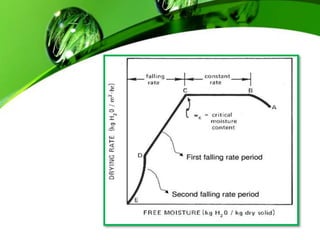
• Following figure shows typical drying rate curve for a
constant drying conditions.
• Point B represents equilibrium temperature conditions of
the product surface.
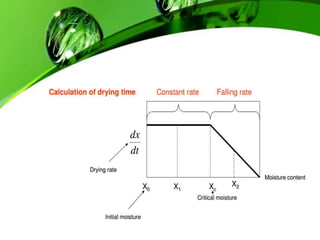
• Section B to C of the curve, known as the constant rate
periods, represents removal of unbound water from the
product.
• The water acts as if the solid is not present.The surface of
the product is very wet and water. And the water activity
is equal to one.
• The constant rate period continues as long as the amount
Constant rate
period
In the constant-rate period, the water is being evaporated from
what is effectively a free water surface.The rate of removal of
water can then be related to the rate of heat transfer, if there is
no change in the temperature of the material and therefore all
heat energy transferred to it must result in evaporation of
water.The rate of removal of the water is also the rate of mass
transfer, from the solid to the ambient air.These two - mass
and heat transfer - must predict the same rate of drying for a
given set of circumstances.
• The falling rate period is reached when the drying rate starts
to decrease, and the surface water activity falls to less than
one.
• The rate of drying is governed by the internal flow of liquid
or vapor.This point is represented by C in the figure.
• At this point there is not enough water on the surface to
maintain a water activity value of one.
Falling rate period
• The falling rate period can be divided
into two steps.
• First falling drying rate
• Second falling drying rate
A first falling drying rate occurs
when wetted spots in the surface
continually diminish until the
surface is dried (Point D).
First falling drying ra
• Second falling rate period begins at point D
when the surface is completely dry.The plane of
evaporation recedes from the surface.
• Heat required for moisture removal is
transferred through
the solid to the vaporization of moisture in the
solid and the vapor moves through the solid into
Second falling drying
rate
• The amount water removed in this period
can be relatively small compared to the
constant rate and first falling rate period.
• However this period may take much
longer than constant rate period because
the drying is slow.
Drying rate experiments can be simply done
by measuring the weight change during
drying.The material to be dried is placed on
the tray.The tray is suspended from a
balance and exposed to air flow in drying
tunnel.
Drying rate experimen
Water removed/time can be easily
determined
Drying time
Drying rates, once determined experimentally or
predicted from theory, can then be used to
calculate drying times so that drying equipment
and operations can be designed. In the most
general cases, the drying rates vary throughout
the dryer with time as drying proceeds, and with
the changing moisture content of the material.
So the situation is complicated.
Calculation of DryingTimes
However, in many cases a simplified approach can provide
useful results. One simplification is to assume that the
temperature and RH of the drying air are constant.
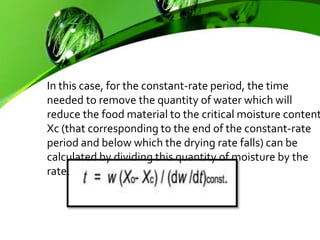
In this case, for the constant-rate period, the time needed to
remove the quantity of water which will reduce the food
material to the critical moisture content Xc (that
corresponding to the end of the constant-rate period and
below which the drying rate falls) can be calculated by
dividing this quantity of moisture by the rate.
In this case, for the constant-rate period, the time
needed to remove the quantity of water which will
reduce the food material to the critical moisture content
Xc (that corresponding to the end of the constant-rate
period and below which the drying rate falls) can be
calculated by dividing this quantity of moisture by the
rate.
and Xo is the initial moisture content and Xc the final
moisture content (the critical moisture content in this
case) both on a dry basis, w is the amount of dry
material in the food and (dw/dt) const is the constant-
drying rate.
Where the drying rate is reduced by a factor f then this can be
incorporated to give:
Dt = w (DX)/ f(dw /dt)const.
and this has to be integrated piecemeal down to X = Xf where
subscript f denotes the final water content, and f expresses the
ratio of the actual drying rate to the maximum drying rate
corresponding to the free surface-moisture situation.
THANK YOU

Drying rate

  • 1.
  • 2.
    Drying curve • Dryingcurve is the plot of the drying rate Φ or N versus the remaining water content X. Water content X is expressed as kg of water per kg of dry matter. Drying process of a material can be described as a series of steps in which drying rate plays a key role. • Following figure shows typical drying rate curve for a constant drying conditions.
  • 4.
    • Point Brepresents equilibrium temperature conditions of the product surface. • Section B to C of the curve, known as the constant rate periods, represents removal of unbound water from the product. • The water acts as if the solid is not present.The surface of the product is very wet and water. And the water activity is equal to one. • The constant rate period continues as long as the amount Constant rate period
  • 5.
    In the constant-rateperiod, the water is being evaporated from what is effectively a free water surface.The rate of removal of water can then be related to the rate of heat transfer, if there is no change in the temperature of the material and therefore all heat energy transferred to it must result in evaporation of water.The rate of removal of the water is also the rate of mass transfer, from the solid to the ambient air.These two - mass and heat transfer - must predict the same rate of drying for a given set of circumstances.
  • 6.
    • The fallingrate period is reached when the drying rate starts to decrease, and the surface water activity falls to less than one. • The rate of drying is governed by the internal flow of liquid or vapor.This point is represented by C in the figure. • At this point there is not enough water on the surface to maintain a water activity value of one. Falling rate period
  • 7.
    • The fallingrate period can be divided into two steps. • First falling drying rate • Second falling drying rate
  • 9.
    A first fallingdrying rate occurs when wetted spots in the surface continually diminish until the surface is dried (Point D). First falling drying ra
  • 10.
    • Second fallingrate period begins at point D when the surface is completely dry.The plane of evaporation recedes from the surface. • Heat required for moisture removal is transferred through the solid to the vaporization of moisture in the solid and the vapor moves through the solid into Second falling drying rate
  • 11.
    • The amountwater removed in this period can be relatively small compared to the constant rate and first falling rate period. • However this period may take much longer than constant rate period because the drying is slow.
  • 12.
    Drying rate experimentscan be simply done by measuring the weight change during drying.The material to be dried is placed on the tray.The tray is suspended from a balance and exposed to air flow in drying tunnel. Drying rate experimen
  • 13.
    Water removed/time canbe easily determined
  • 17.
  • 18.
    Drying rates, oncedetermined experimentally or predicted from theory, can then be used to calculate drying times so that drying equipment and operations can be designed. In the most general cases, the drying rates vary throughout the dryer with time as drying proceeds, and with the changing moisture content of the material. So the situation is complicated. Calculation of DryingTimes
  • 19.
    However, in manycases a simplified approach can provide useful results. One simplification is to assume that the temperature and RH of the drying air are constant. In this case, for the constant-rate period, the time needed to remove the quantity of water which will reduce the food material to the critical moisture content Xc (that corresponding to the end of the constant-rate period and below which the drying rate falls) can be calculated by dividing this quantity of moisture by the rate.
  • 20.
    In this case,for the constant-rate period, the time needed to remove the quantity of water which will reduce the food material to the critical moisture content Xc (that corresponding to the end of the constant-rate period and below which the drying rate falls) can be calculated by dividing this quantity of moisture by the rate.
  • 21.
    and Xo isthe initial moisture content and Xc the final moisture content (the critical moisture content in this case) both on a dry basis, w is the amount of dry material in the food and (dw/dt) const is the constant- drying rate.
  • 22.
    Where the dryingrate is reduced by a factor f then this can be incorporated to give: Dt = w (DX)/ f(dw /dt)const. and this has to be integrated piecemeal down to X = Xf where subscript f denotes the final water content, and f expresses the ratio of the actual drying rate to the maximum drying rate corresponding to the free surface-moisture situation.
  • 23.