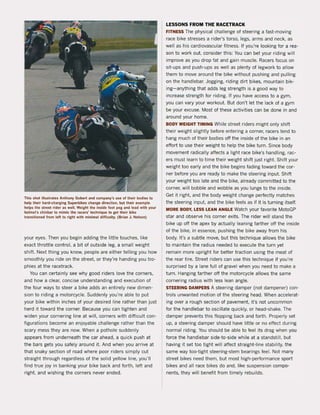
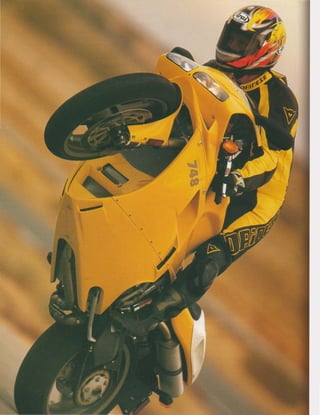
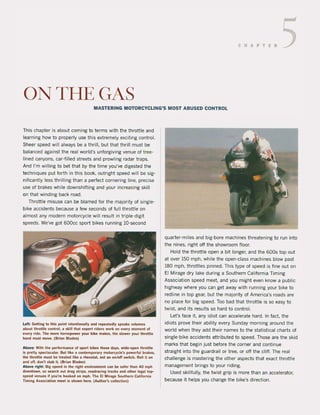
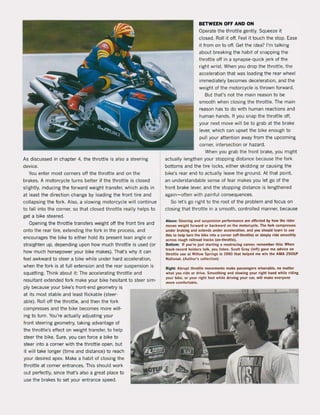
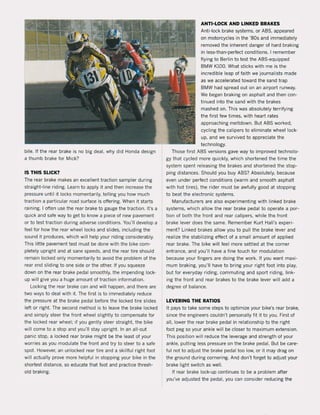
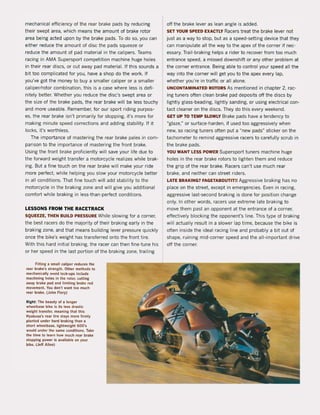
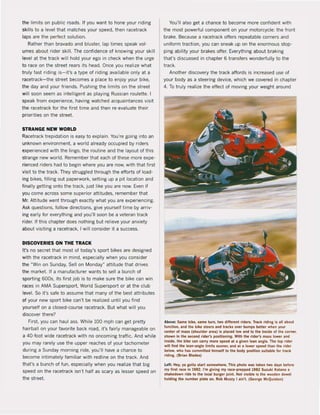
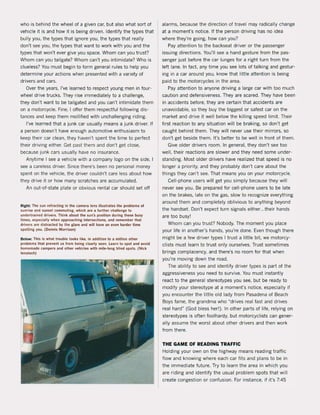
Sport Riding Techniques
Sport Riding
Techniques
HOW TO DEVElOP REAL WORLD SKILLS FOR SPEED.
SAFETY AND CONFIDENCE ON THE STREET AND TRACK
BY NICK IENATSCH
FOREWORD BY KENNY ROBERTS
DESIGN BY TOM MORGAN
111 DAVID BULL PUBLISHING
CONTENTS
Acknowledg,nents .. ..... ... . . .. .. ..... . ... . .......... .. ..... •...... •............ 9
Foreword ........... .. ................... . . ....•. .....•...... .... . . Il
IntroduClion ........ .......... ...................•......•......•......•.... ...... 13
Chapter One: Thc k ..................•......•......•..... ..... ry
Chapter Two: Thc Basics: Bra ing and lccrlng.. ..... . ... ........ ..... ..... .21
Chaple Tbrec: T hc Eyes Have lt ......... .. ....................... 27
Chapter FOUTe"".Steo!rThat TbiD&... . •••••....••.••.
Chapter Five:On the Gas . .. •• .-'; ... .•
Chapter Six: Brakc . . ..••.... . ••. .. .....• ..•.••••...••••..•••• •• ...... .... . .... 57
Chapter Seven: All Ahou EnviroDment ., ........... ................... ... ... 71
Chapter Eight: Gctting on Track ........... ... .. .. . ... . . ..... . .................. 8S
Chapter Nine: Urban Survival .................... . ............. .. ..... .. ...... 103
Chapter Ten: Group Riding and thc Pace ............ . . ..... . ..........•...... . . IIS
Epilogue ................. ... .......... .. ..... . ....... . ................ .. ..... .. 127
I
ACKNOWLEDGMENTS
My first reaction is to thank everyone in the known world,
simply because finishing my first bock was a tremendous
relief. If I acknowledge everyone who has helped me in my
years as a motorcyclist (29 years and counting) the list
would be ridiculously long but meaningful. ..to me. However,
I've been instructed to keep the acknowledgments relative to
the bock. 1'11 try...
David Bull Publishing: Thanks tor the great werk of
designer Tom Morgan and Anna Gilbert. and to Rachel
Bernstein tor her terrific editing. But the biggest thanks go
to my friend, co-rider and publisher David Bull.
Photographers: We have a saying at the magazines. "No
film. no story." Without the insightful work of the following
shooters, there would be no book, A special thanks to ace
photographers Brian J. Nelson, Brian Blades and Dennis
Morrison. Thanks also to Jeff Allen, Dexter Ford, Patrick
Gosling, Fran Kuhn, Gary Lehman, Jay McNally, George
McQuiston, Tom Riles, Dennis Scully, and Marc Urbano.
Great work, gentlemen.
Illustrator: A special thank you to Hector Cademartori, a
motorcycle-riding illustrator who can take any complicated
concept and draw it clearly and persuasively.
Cycle World and Sportbike magazine groups: These folks
have been tremendous help, whether taking photos, riding in
photos or helping in a hundred other ways, Thanks to super
riders Don Canet and Mark Cernicky. Thanks also to David
Edwards, Brian Catterson, Matthew Miles, Mark Hoyer,
Jimmy Lewis, Robyn Davis, Brad Zerbel, Elaine Anderson,
Paul Dean, Jason Colon, Ben Welch, Jason Black, Jim
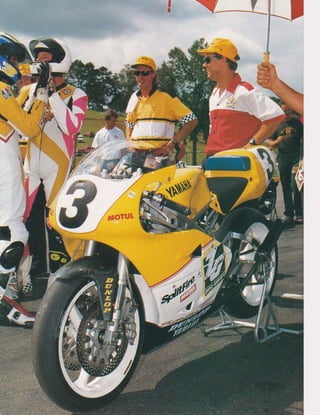
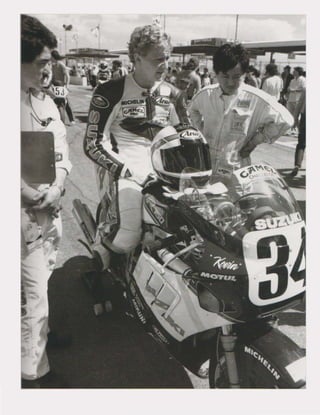
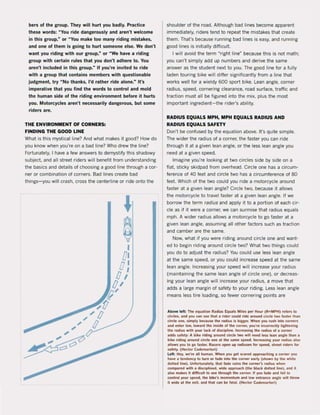
Left: Successful nation/ll-level rating t/lkes an enormous eflort in time and
money, but when things go weil in practice you can have a laugh belore the
m~in event. Jon Cornwell (white helmet) and I (far left) are laughlng at
something Steve Biganskl (standing directly behind the TZ) sald-probably,
"It wu pretty good on Thursday, but I've tuned it to a standstilI:'
(Brian J. Nelson)
Yeardly, Todd Egan and John Casimer. Great people, terrific
publications. And David, 1couldn't have done it without you!
Motorcyclist and Sport Rider magazine groups: 1started
this book while at Sport Rider and must thank the gang
who got it all going in my head: Art Friedman, Mitch
Boehm, Lance Holst. Jason Black, Siobhan Burns and
Angela Barosso,
My racing partners: Racing taught me so much, mainly
because I was free to focus on riding due to the extremely
talented people supporting me. I'd like to thank everyone
who helps me race, but will limit it to the group with whom I
won club and national championships: Steve Biganski, Craig
Erion, Kevin Erion, Steve Johnson, John Cordona, Dan Kyle,
Glenn Cook, Dennis Smith, Jim Allen, Bob Graham, John
Winslett, Tommy Lynch and Larry Pegram,
I have had a great deal of help with my riding/racing and
I'd like to thank those who took the time to teach me so
much: Keith Code, Eddie Lawson, Wayne Rainey, Thomas
Stevens, my dirt-track coach Jeff Haney and, most of all, my
riding-school boss, Freddie Spencer. I mentioned how much I
continue to learn trom Kenny Roberts' book, and I thank
King Kenny tor his words in the foreword.
I must thank my wonderfui, wonderful parents, Ellie and
Bill lenatsch; my terrific wife, Judy, who inspires me, rides
with me and keeps me constantly entertained; and the Lord
Jesus Christ. And lastly, I thank you for reading this book
and being my riding friends since my first day at
Motorcyclist in 1984.
- Nick lenatsch, January, 2003
KENNY ROBERT$
FOREWORD
THE KEY Ta DEVELOPING GOOD SKILLS IS PRACTICE, PRACTICE. PRACTICE
The guy who wrote this baak has seen how hard the best
riders work to get to the top and to stay on top. Team
Roberts started a training camp in Spain to help European
riders learn the basics of dirt track skilIs, whiçh is largely an
omerican sport. The camp in Spain was modeled on my
California ranch, where Nick has trained with guys like
Wayne Rainey, Eddie Lawson, John Kocinski and my kids,
Kenny Jr. and Kurtis. The riding sessions we have are all
playing, but there's a lot of learning taking place on these
dirt bikes.
I first met Nick in 1990, when he came to the Ranch with
Eddie Lawson. and he was just starting to race 2505.
Journalists have always been a pain in the ass, so we beat
him up pretty good on the motocross and dirt track, He did-
n't cry much, Junior was just starting to race 250s in WERA,
so I was paying attention to the national scene, and noticed
Nick finishing in the top three overall in AMA points a few
times, He did OK on some four-stroke Hondas too, Not bad
lor a journalist.
But street riding is the locus of this book, and that
involves more than just lap times, Most people can't even
drive a car weil, much less a bike, so Sport Riding
Techniques should really help, I believe in rider training and
riding technology at all levels, whether you're racing for the
MotoGP world championship or just enjoying a weekend
ride, I know Nick has been writing about riding technique in
the magazines for years, and I wholly endorse this book,
Anything that improves your riding and improves the accept-
ance of motorcycles is great with me,
Nick has mentioned how much my book, Techniques of
Motorcyc/e Roadracing, helped his racing, and I hope this
book helps your riding, This guy has worked hard on his rid-
ing and racing, and his book is the culmination of the
attention he has paid to the techniques for success,
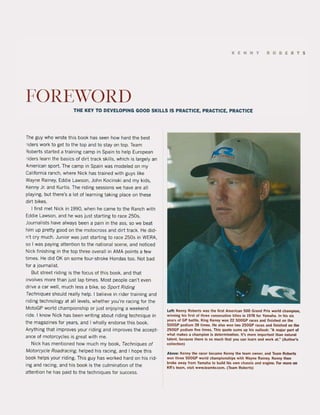
Left: Kenny Roberts was the first AmerK:an SOO Gl'iilnd Prix wortd ehamplon,
winning his lil'St ol three eonseeutive litles in 1978 lor Yamaha, In his sil
years ol GP balIIe, King Kenny won 22 SOOGP l'iiIees and finisl!ed on the
500GP podium 39 times, He also won two 2SOGP races and linished on lhe
250GP podium Flve times, This quote sums up his outlook: WA major part of
what makes a champion is determination. li's mOre important Ihan natur.tl
lalenl. beeause there is 50 much thai you ean leam and work aLM(Author's
collection)
Above: Kenny the racer beeame Kenny the team owner, and Team Roberts
won three 500GP world championships with Wayne Rainey. Kenny thet!
broke away from Yamaha 10 build his own chassis and engine. ror 1'I'IOfe_
KR's team, viS'! www.teamkr.com. (Team Rober!s)
SPORT RIDING TECHNIQUES
A BOOK IS BORN
Welcome to Sport Riding Techniques. a bock devoted to
high-performance motorcycle riding on the street and track.
I add Ihe term track because it's there thai you can safely
find the absolute limit of blke and rider, and several of the
nding elements we'tI discuss in this book are best suited to
the track. However. streel riding is what Sport Riding
Techniques focuses on because streel riding demands its
own set of skilts and issues its Qwn challenges. Anyone who
has ridden a motorcycle down a twisty rcad feels the addic-
ttOn of this thrilting, satisfying and, if carelessly undertaken,
potentially dangerous sport.
This book comes on the heels of a dozen artieles ['ve
written about the human side of the rider-bike equation for
MOforcyclisf, Sport Rider, Sportbike and Cycle World maga-
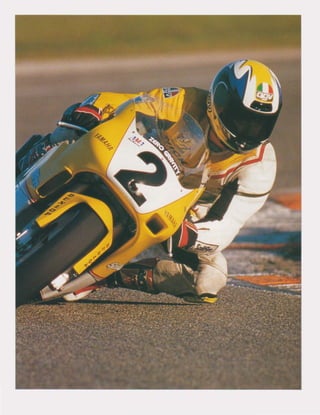
Left: I'~e kad some good 5ueee5S raclna, finishing second in the 1995 AMA
250GP series, I'm shown kere at Oaytona In '96 with my new number plate,
til '91, '93 and '94, I placed Ihird overall In the 250GP championship,
~cked by Zero Gravily, Oei Amo Yamaha, Ounlop, AGV and tuner Steve
Siganski. (Srian J, Nelson)
Above: A cold, wet day at SUluka found me aboard Mick Ooohan's N5R500
tor a look inlo t~ top echelon 0' motorcyellng, As a writer 'or Molorcyc/ls/.
Sport Rldt!r. Cycle World and SpoT/bikt!. ,''Oe ridden ewrything 'rom the
8ritten 10 a 234 mpll turbochal'ge'd GSX·RI340, Jusl sa you know "m
completely Ilooked, I Own more Ihan 2S bik" ... (Fran Kuhn, court"y of
lrIoto"yclist)
RlaM: Teachina at a .iding school involvK mo.e Ihan jusl riding: weil, TIle
concepts 10 master techniques musl be elearly explained and reinforced. I
beaan leachine al riding schOOls In 1989 when 1 re<:ogni~ed Ihat the
inereaslnll'Y sopllisticated bikt! technology (ould best be enjoyed by
Improvlng ,Idlng lechnology. (Oennis Mo.,lson)
zines. Probably the most popular article I've written, "The
Pace," describes and deals with developing the skilIs to
enjoy your sport bike on the street while staying alive and
out of jai!. Several iterations of MThe Pace~ have appeared
since the original in 1987, but I realized a book was needed
not just to update MThe Pace,- but also to explore everything
from urban survival to attending a track day. Sport Riding
Techniques has almost nothing to do with the bike you ride,
Instead. it's all about how you ride that bike.
On top of my magazine writing came work at riding
schools, including former world champion Freddie Spencer's
High Perlormance Riding School in las Vegas, I began work-
ing for Freddie in 1997 as his lead instructor, and his lifelong
racing experience opened my eyes to the techniQues he
mastered on the racetrack not just to win races, but to sur-
vive this difficult sport. As you will discover in this bock,
speed and safety aren't mutually exclusive. In fact. riding
weil is not only a great way to get around a racetrack at the
lap record, but also a terrific way to become an old rider,
Both are excellent goals.
Riding safely and within your limits takes focus, confi-
dence, pradice, patience and self-discipline. The approach I
teach here and the skill exercises I recommend will help all
riders appreciate the fact that there are serious teçhniQues
and guidelines for high-performance street riding. When a
rider like Freddie Spencer tells his students that the skilis he
is teaching them are the same skilis he works on ever; lap,
it becomes clear that proper riding techniques are for begin-
ners and veterans alike. Motorcycles are designed to stop,
tum and accelerate with certain inputs trom the rider, and
this book will refine your inputs while defining good riding.
USING THIS BOOK
Each chapter concludes with a section cal1ed Lessons from
the Racetrack. In these sections. I explain how the informa-
tion contained in the chapter applies to racing on the track,
which is the purest example of our sport. At the track, only
performance- determined by the stopwatch. finishing posi-
tion and, at year's end, championship points-matters. I've
always done weil at the track, and many of the components
of good street riding can be learned from racers. Just as
Kevin Schwantz illustrated to me the importance of the
rider's input, I hope Lessons from the Racetrack helps to
keep you thinking about your street riding.
I also hope you use this book frequently as a reference.
As your riding skilIs grow, rereading the information wil1
spark you to new levels of safety and speed because your
newfound skilIs will allow you to grasp a technique that was
unavailable to you earlier, I hope nobody reads this book
trom cover to cover and then sets it permanentlyon the
bookshelf. because there is simply too much to this
demanding sport to grasp in one sitting. I still pore over
Techniques of Motorcyc/e Roadracing, an old book by
Kenny Roberts and Peter Clifford. and I hope your copy of
this book becomes just as wrinkled and faded from use,
with plenty of notes in the margins.
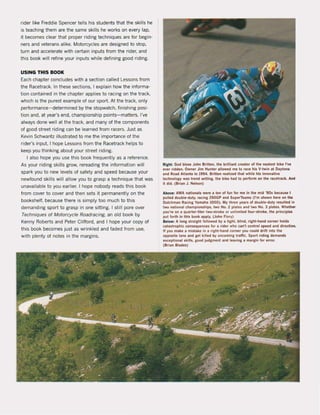
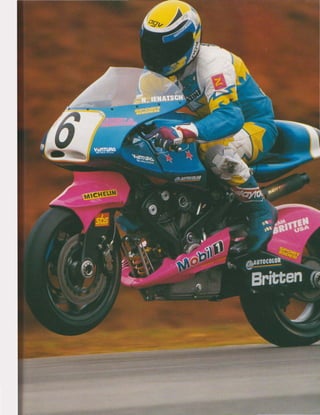
Highl: God bleu John Britten, the brilliant ereator of the neatut bike I've
ever rldden. Dwner Jlm HI/nter IlIowl"d me to race hls V-IWin al Daylo~
and ROld AIlIntI In 1994. Brilten rellli"d thlt whlle hls Innovalive
technoloay Wil trend wlllng, the bik, had to perform on the racetrack, An.
It did. (Brlan J. Nelson)
Above: AMA n.Uonll' Mre 11 tOl! o"un 101 me In the mld '90s HcauH I
pulled double-duty. raclng 250GP Ind SuperTeams (I'm shown he,. on lhoe
Dulchm.n Rltlnl Vamaha 1000). My Ihree yurs ol double-duty ruulted In
two nlUonat champlonshlps. !wo No. 2 platel and two No. 3 platu. Wheth«
you're on a ql/llrter-liter Iwo-stroke or unlimited four-stroke, the principle-
put lorth In thl. book Ipply. (John Ftory)
Below: A lonl strlllht lollowed by I light, blind, right-hand corner holds
catntrophle conuquencn for 11 rlder who can't conlrot speed and directIon.
II yOIl make a ml.take In I rlght-hand torner yell could drilt into the
opposlte line and lel killed by ontomlns traltic_ Sport ridlng demand,
exceptlonll ,klll,. lOod judgment and Inving a marsin for error.
(Brlan Blades)
CHAPTER 1
THE CHAIN'S WEAK LINK
TO FIND THE TRUE TECHNICAL PROBLEM, YOU NEED TO LOOK IN THE MIRROR
Take a look at the performance figures of any modern street
bike, most of which have sub- three-second zero-to-sixty
times that beat the most potent supercars, and it's obvious
that riding skill is being far outpaced by motorcycle technol-
ogy. To find the weakest performance link in the rider-bike
chain, look behind the handlebar to the rider-this is the link
that needs strengthening. By understanding and improving
your rider inputs. not only will you become a betler rider, but
every ride wil! become more enjoyable. When you get on the
latest and greatest trom Japan, Germany, Italy or America. it
wil! behoove yau to have some special skilIs.
My approach deals with more than the fundamentals of
riding a motorcycle, because arider's physical skill means
nothing if his judgment is flawed. In other words, no mat-
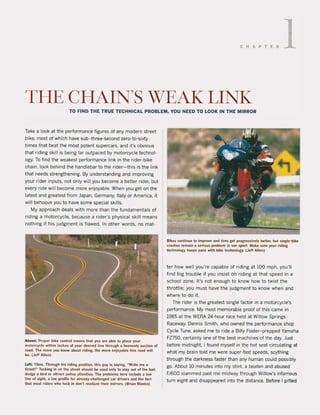
Above; Proper bike control means that you are able 10 place your
motorcycle within inches ol you. desired line through a heavenly section of
road. The more you know about .iding, the more enjoyable this road wilt
beo (Jet! Allen)
Lelt; Yikes. Th.ough his riding position, this guy is saying. ~Wrile me a
licket !~ Tucking in on Ihe street should be used onty to stay out ollhe hail,
dOOge a bird OT atlract potice attention. The problems here inctude a low
line of sight, a low profile 10' already-challenged ca. drivers and the lacl
thai most riders who tuck in don'! readjusi their mirrors. (Brian Blades)
Bikes continue to improve and tires gel progressively bette., but single-bike
crashes remain a serious problem in our sport. Make sure you••iding
technotogy keeps pace with bike technology. (Jeff Allen)
ter how weil you're capable of riding at 100 mph, you'lI
find big trouble if you insist on riding at that speed in a
school zone. It's not enough to know how to twist the
throttle; you must have the judgment to know when and
where to do it.
The rider is the greatest single factor in a motorcycle's
performance. My most memorabie proof of this came in
1985 at the WERA 24-hour race held at Willow Springs
Raceway. Dennis Smith, who owned the performance shop
Cycle Tune, asked me to ride a Billy Foster- prepped Yamaha
FZ750, certainly one of the best machines of the day. Just
before midnight, I found myself in the hot seat circulating at
what my brain told me were super-fast speeds, scything
through the darkness faster than any human could possibly
go. About 10 minutes into my stint. a beaten and abused
FJ600 slammed past me midway through Willow's infamous
turn eight and disappeared into the distance. Before I pitted
to hand off the Cycle Tune machine to our team's next rider,
I was lapped again by the same berserk FJ. a bike clearly
slower than our FZ and certainly more poorly prepared, Until
that race, I thought horsepower and preparation would win
the day. Kevin Schwantz proved me wrong.
The young Texan had been racing the FJ all year and was
cleady at home with its strengths and shortcomings.
Schwantz had adapted to what the FJ offered him as a race
bike. and the bike and rider had melded-a process you'lI
understand when it happens to you, Though it may have
made 30 fewer horsepower than the Cycle Tune FZ750 and
it barely limped through tech inspection, the man behind
the handlebar had that FJ figured out. Lucky for the Cycle
Tune team, none of Schwantz's teammates could match his
pace on the 600, and we went on to win the race. But the
best thing I gat out of the race was an understanding of how
much rider skill adds to a motorcycle. It isn·t the only ingre-
dient. but it's certainly the most important.
ON~BOARD ENGINEER
As you digest this book, bike setup will become much less
important. You will realize how your operation of the controis,
the movement of your body and the use of your eyes affect the
motorcycle. We riders are on-board engineers. able to transfer
weight forward, rearward and to the inside or outside of the
motorcycle. We choose engine rpm. and that affects not just
acceleration and deceleration but lean angle and turn-in rate. A
wiggling bike might not need a steering damper adjustment if
the rider relaxes his grip at the handlebar. A bike that won't
turn might not need more rear ride height once the rider loods
the inside foot peg and closes the throttle. Technically sound
riders can ride anything weil, and if Kevin Schwantz had
decided to whine about setup, he never would have risen to the
rank of World Grand Prix Champion. To be blunt: Quit worrying
about two clicks of rebound or "needing" a pipe and jetting lor
more horsepower. Work on your engineering skilIs to find your
bike's best performance.
IT'S NOT ABOUT GUTS
Testosterone and sheer bravery receive too much emphasis
in the motorcycling world. No rear might work lor bungee
jumping, but not lor riding a motorcycle on the street.
Technique and concentration deserve much more credit. Add
to them intelligence, intuition and desire. and you'lI begin to
describe not just the fastest roadracers but the best street
riders as weil. While I can1 teach intuitiveness, you'lI be sur-
prised at how a bit of knowledge translales into a large gain
in riding ability. Just the fact that you are thinking about
your riding wililead to significant improvement. which, as
you'lI discover, leads to greater enjoyment. After all. if you're
going la do something, why not do it weil?
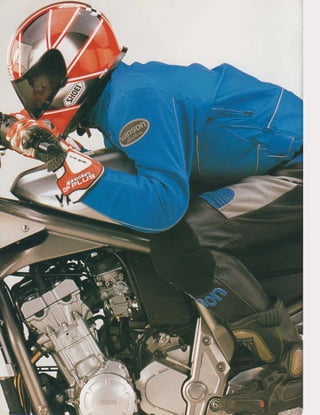
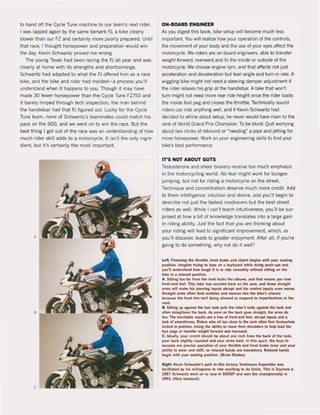
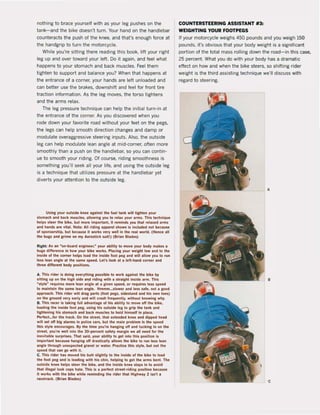
Lelt: Flnessing Ihe Ihrottle. front brake and clutch begins with your .wathilI
po$lllon. fmagine trying 10 type on a keyboard while doing push·up$ and
you'U undersland how tough il is to ride smoothly without sitting on lhe
blke In a retaxed posilion.
A. Silting too far from Ihe tank loch the elbows, and thai means you loM
Iront-end l!'et. This rider has Kooted back on the seat, ilnd those SlraiaM
.rm, wlll ~ke h.s stemnli: Inpuls abn/pt .nd his «IntroI inputs even WOfSe.
Slralahl .rms often fee-d wobbles . nd WUV" lnlo the bike'$ chassis
beul/se lhe front lire Isn'l being aUowed to rnpond to imperfections In lhe
raad,
B. SIttII1I1 up agairm the fuet lank pub the Mder's belly apinst the tank and
often straigtltens the back. As lIOOrI IS the back goos straight, the .rm, do
100, The Inevitabie rl'Sults are a toss of front-end feel, abrupt Inputs .1Id •
I.ek of ,moothnes;s. Riders who slt too close to Ihe tank often IInd themselves
fcx:ked In posltion, 100'ng the abmty to move IMlr shouiders 10 help laad Ihe
foot pep Ol' lransfer welght forward anel rearwarel.
C, fdeally, your eroleh should be aboul one Inch Irom the back ollhe I.nk,
your back slightly rollnded ilM yovr arm, bent. In this $pOft. the keys 10
suceess .re preeise operatIon ol your thraltfe .nd front brake lever anel yovr
.blllly 10 steet anel shifl, $0 rel..ed h.nds .re mandalory. Ael..ed h.nds
beain wilh yollr seatina posilion, (Brian Blad")
Rlght: Ke...in Schwantz's palh to Ihls lactory Yoshimura Superbike was
IltCilitated by his wiliingn"s 10 rlde anythinr to its fimils. This Is D.ytona II
1987, Schwanlz went on to rilte In SOOGP .neI won the ehampionshlp In
1993. (Nick lenalseh)
CHAPT.R2
THEBASICS:
BRAKING AND STEERING
LEARNING TO STOP AND TURN IS A LlFELONG STUDY, BUT THESE BASIes ARE LlFESAVING
The foundation of good riding skilIs is asolid understanding
of the basics of motorcycle handling: You've gat to learn to
brake, and you've gat to tearn to steef. These are basic sur-
vival skilis that you should constantly praetjee. You'U reatize
this when a car unexpectedly turns left in front of you: your
braking and steering ski115 will help you avoid an accident
that would be unavoidable to a less-practiced rider. Now is
the time to step up yaur performance of these two basic
skilis and to work them into yaur favorite recreational ride,
commute or racetrack day.
Whether it's on the back roads of the Rocky Mountains or
the back straight at Mid-Ohio Raceway, those who master
the arts of braking and steering are the best riders. Your
brakes are a controlling device, significantly more powerful
than any other part of the motorcycle: when used correctly,
brakes make the diHerence between riding the motorcyde
and being taken for a ri de. Braking efficiently is your way to
precisely control cornering speed, control the horsepower of
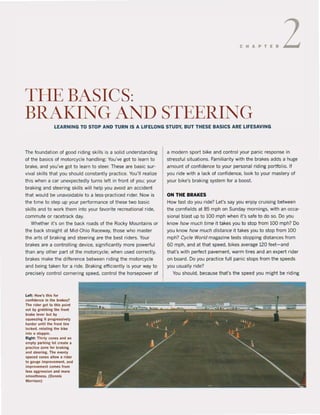
Left; How's thls lor
conlidence In Ihe brakes?
The rider gol to Ihis poinl
nol by grabbinglhe lronl
brake lever but by
squeezinglt progressively
harder unUilhe front lire
locked. rotallng Ihe bike
inlo a stopple.
Righl; Thirly cones and an
emply parking lol create a
practice zone lor brakini
and steerini. The evenly
spaced conn allow a rlder
10 gauie Improvemenl, and
improvement comes Irom
less aggrflslon and more
smoolhness. (Oennis
Mor.ison)
a modern sport bike and control your panic response in
stressful situations. Familiarity with the brakes adds a huge
amount of confidence to your personal riding portfolio. If
you ride with a lack of confidence, look to your mastery of
your bike's braking system for a boost.
ON THE BRAKES
How fast do you ride? Let's say you enjoy cruising between
the cornfields at 85 mph on Sunday mornings, with an occa-
sional blast up to 100 mph when it's safe to do 50. Do you
know how much time it takes you to stop trom 100 mph? Do
you know how much disfance it takes you to stop from 100
mph? CycJe World magazine tests stopping distances from
60 mph, and at that speed, bikes average 120 feet-and
that's with perfect pavement, warm tires and an expert rider
on board. Do you practice full panic stops from the speeds
you usually ride?
You should, because that's the speed you might be riding
when the cow steps over the braken fence and wanders into
your lane. But evidence points to the fact that many riders
are better at twisting the throttle than squeezing the binders
because twisting is easy and stopping hard isn't. Stopping
hard takes practice. Lots of it.
If you ride at 100 mph, practice stopping from 100 mph
and make it part of your riding ritual. Pick a parking lot or
deserted frontage raad and discover what your brakes can
do. Braking practice has been incorporated into my daily
commutes because I'm constantly riding different bikes
from the magazine garage. I wait until there's na traffic
behind me and try the brakes, slowly squeezing them the
first time, then really working them hard from higher
speeds. I'm willing to bet that once you discover how much
distance it takes to stop your bike from high speed, you'lI
be much more careful about where and when you speed.
Practicing your braking will put you in touch with your
bike's ability to shed speed quickly, which is a valuable
point of reference when you begin using your brakes for
more subtie speed changes at corner entrances. You'lI
learn the importance of maximum deceleration in which
the tires are howling and near loek-up, but it's also impor-
tant to master the fine-touch applications of braking, espe-
cially for trail-braking and other more complicated tech-
niques discussed later in this book. You must become com-
fortable with your brakes.
PRACTICE STOPS
Piek a clean, deserted stretch of pavement. wear your best
riding gear and practice stopping. The goal is repeatable
stops at the threshold of front and rear tire loek-up. Notice
the weight transfer forward as the bike begins braking. The
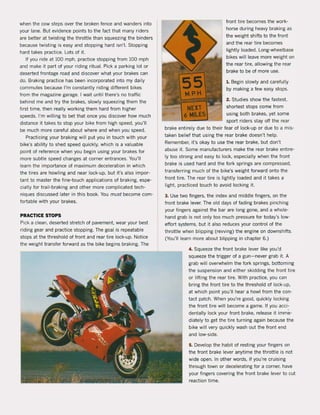
front tire becomes the work-
horse during heavy braking as
the weight shifts to the front
and the rear tire becomes
lightly laaded. Long-wheelbase
bikes will leave more weight on
the rear tire, allowing the rear
brake to be of more use.
1. Begin slowly and caretully
by making a few easy stops.
2. Studies show the fastest,
shortest stops come from
using both brakes, yet same
sport riders stay oft the rear
brake entirely due to their tear of loek-up or due to a mis-
taken belief that using the rear brake doesn't help.
Remember, it's okay to use the rear brake, but don't
abuse it. Same manutacturers make the rear brake entire-
Iy too strong and easy to loek, especially when the front
brake is used hard and the fork springs are compressed,
transferring much of the bike's weight forward onto the
front tire. The rear tire is lightly loaded and it takes a
light. practieed touch to avoid locking i1.
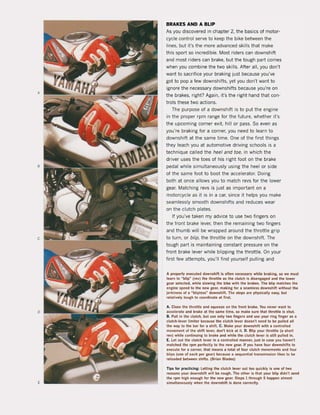
3. Use two fingers, the index and middle fingers, on the
front brake lever. The old days of fading brakes pinching
your fingers against the bar are long gone, and a whoIe-
hand grab is not only too much pressure for today's low-
effort systems, but it also reduces your control of the
throttle when blipping (rewing) the engine on downshifts.
(You'lI learn more about blipping in chapter 6.)
4. Squeeze the front brake lever like you'd
squeeze the trigger of a gun-never grab it. A
grab will overwhelm the fork springs, bottoming
the suspension and either skidding the front tire
or lifting the rear tire. With practice, you can
bring the front tire to the threshold of loek-up,
at which point you'll hear a howl trom the con-
tact pateh. When you're good, quickly locking
the front tire will become a game. If you acci-
dentally loek your front brake, release it imme-
diately to get the tire turning again because the
bike will very quickly wash out the front end
and low-side.
5. Develop the habit of resting your fingers on
the front brake lever anytime the throttle is not
wide open. In other words, if you're cruising
through town or decelerating for a corner, have
your fingers covering the front brake lever to cut
reaction time.
6. Experiment with rear brake pedal pressure. Don't jab
at it; push it down gently until you hear the rear tire howl
just befare lock-up or feel the back end become squirmy.
(Some tires are quiet and you just feel the back end
slew.) Locking the rear brake for a short time isn't a
problem and may be unavoidable, and I hope you have
already experimented with this as part of your braking
practice. A locked-up rear brake can be dealt with in two
ways: leave it locked and steer with the handlebar to
keep the bike upright and straight. or immediately get off
the brake to get the rear tire turning again. In a true
emergency, you might not have the mental capacity to
relieve rear brake pressure, sa practice locking up the
brake and steering. Hmmm ...sounds like a great thing to
try on a dirt bike first!
STEERING CLEAR
Explaining how to steer a motorcycle is often more confus-
ing than simply discovering how to steer on your own.
Anyone who can ride a bicycle is familiar with a single-track
vehicle's peculiar handling characteristics. A few years back,
someone coined the term "countersteering" to describe the
actions involved in turning a moving two-wheeled vehicle:
You push on the left handlebar to deflect the front wheel to
the right. which farces the bicycle or motorcycle to fall to the
left. Confused? Think of it in terms of simply pushing in the
direction you want to go: Ta turn left. push left. or to turn
right. push right. If you can ride a bicycle or motorcycle, you
are countersteering already. A little countersteering aware-
ness goes a long. long way to help a beginning rider steer a
motorcycle eHiciently, and when that rider is ready for more
subtie ways to aHect a motorcycle's direction, she will use
countersteering along with several other techniques exam-
ined in chapter 4.
Once you wrap your mind around the basic countersteering
principle-push the handlebar in the direction you want to
go- you're open to the almost infinite variations possible
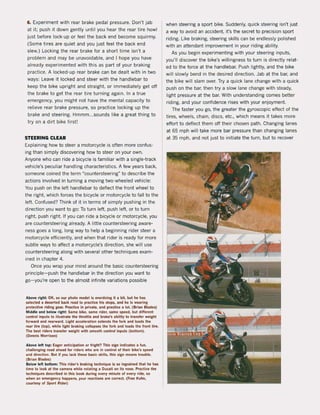
Above righl: OK, so our photo model is overdoing il iI bil, bul he hu
seleeled a deserted back road 10 praetlee hls stoP$, and he Is wearlng
protectlve rlding gear. Practlce In private, and praC"tice a lot. (Brian Blades)
Middle and below right: Same bike, same rlder, same speed, but different
eontrol inputs to iIIustrate the throtUe and brake's ability to transIer weillht
forward and rearward. Llllht aeeeleration extends Ihe lork and laads the
reilr tire (Iop), while light brakinll collapses the lork and 10ilds Ihe fronl lire.
The best riders Iransfer weillhl wilh smoolh conlrol inpuls (bollom).
(Dennis Morrison)
Above lell top: Eager antIcipatIon or Irlght? This sign indicates a lun.
challenllinll roild ahead lor riders who are in eontrol ol Iheir bike's speed
and direction. Bul if you laek Ihese basie skills, this silln means Irouble.
(Brian Blades)
Below lelt bollom: This rider's brakinll lechnique is s.o ingrained thai he has
time to look al the camera while rolaling a DueaU on its nose. Praeltee the
lechniques described in this book during every minule ol every rlde, 50
when an emergeney happens, your ructions are eorreet. (fran Kuhn,
courtesy of Sport Rlder)
when steering a sport bike. Suddenly. quick steering isn't just
a way to avoid an accident, it's the secret to precision sport
riding. Uke braking, steering skilIs can be endlessly polished
with an attendant improvement in your riding ability.
As you begin experimenting with your steering inputs,
you'lI discover the bike's willingness to turn is directly relat-
ed to the force at the handlebar. Push lightly, and the bike
will slowly bend in the desired direction. Jab at the bar, and
the bike wil1slam over. Try a quick lane change with a quick
push on the bar. then try a slow lane change with steady,
light pressure at the bar. With understanding comes better
riding, and your confidence rises with your enjoyment.
The faster you go, the greater the gyroscopic eHect of the
tires, wheels, chain. discs, etc., which means it takes more
effort to deflect them oH their chosen path. Changing lanes
at 65 mph will take more bar pressure than changing lanes
at 35 mph, and not just to initiate the turn, but to recover
as weil. Much of a chassis designer's effort goes toward
developing proper steering feel, balancing stability against
turning ability to give steering characteristics that fit the
bike's intended purpose. But no matter what kind of bike
you ride, perfeding your inputs at the handlebar will braad-
en your bike's range of abilities weil beyond mere descrip-
tions like "stabie" or ~Quick turning." And when you get a
good handle on the basics of countersteering, there are
some advanced steering techniques that wiJl add further
control and confidence to your riding.
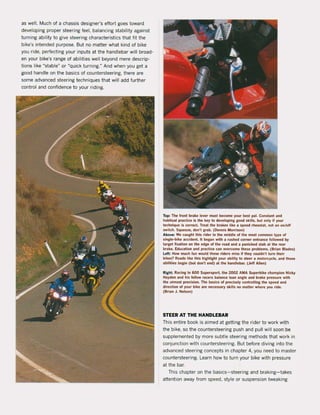
Top: The front brake lever must become your best pal. Constant and
habitual practice is the key to developing good skilis, but only il )'1lur
techniqlle is correct. Treat the brakes like a speed rheostat, not an onloll
switch. Squeeze, don'! grab. (Oenni$ Morrison)
Above: We tallgllt this rider in the middle ol Ihe most common type of
slngle-blke accident. It began wilh a rushed corner entrance followed by
target flxation on the edge of the road and a panicked stab at Ihe ,ear
brake. Educatlon and practlce can overeome these problems. (B,ian Blades)
Left: How mllch tun would these rlders miss If they cOllldn·t turn Iheir
bikes1 Roads like Ihis highlight your abillty to st~r a motorcyele. and those
abililies begin (bul don', end) at Ihe handlebar. (Jeff Allen)
Righ!: Raeing In 600 SupersporI, Ihe 2002 AMA Superbike chllmplon Nicky
Hayden lInd hls fellow racers balance lean angle and brake p'essure wilh
the utmosl precision. The basie5 of pr«isely conlrolling Ihe speed and
direction of your blke afe necessary skins no matter where yOll ride.
(Brian J. Nelson)
STEER AT THE HANDLEBAR
This entire book is aimed at getting the rider to work with
the bike, so the countersteering push and pull will soon be
supplemented by more subtie steering methods that work in
conjundion with countersteering. But before diving into the
advanced steering concepts in chapter 4, you need to master
countersteering. Learn how to turn your bike with pressure
at the bar.
This chapter on the basics-steering and braking-takes
attention away trom speed, style or suspension tweaking
and directs that attention right at the rider, where it belongs.
It's so easy to get carried away by the non-essential extras
and completely forget that a moving motorcycle must be
controlled by the brakes and steering system. If you are a
new rider or know a new rider, make sure these basics are
mastered before worrying about anything else. If you can't
stop and steer, you shouldn't be riding.
LESSONS FROM THE RACETRACK
rEEL THE RHEOSTAT Brake feel is more important than out-
right braking power because racers wiU use their brakes deep
into the corner when necessary. It's called trail-braking (trail-
ing oft the brakes as the bike leans into the corner) and we'lI
be working on that in chapter 6. Quit thinking that the brake
lever is an on/oft switch and treat it like a speed rheostat.
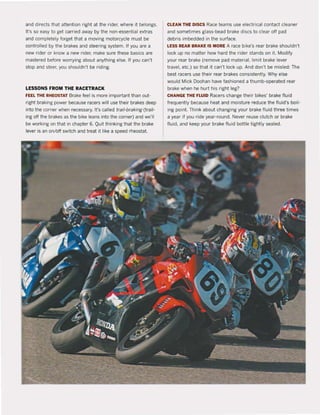
CLEAN THE DISCS Race teams use electrical contact cleaner
and sometimes glass-bead brake discs to clear off pad
debris imbedded in the surface.
LE$S REAR BRAKIE IS MORE A race bike's rear brake shouldn't
loek up no matter how hard the rider stands on it. Modify
your rear brake (remove pad material, limit brake lever
travel, etc.) so that it can't lock up. And don't be misled: The
best racers use their rear brakes consistently. Why else
would Mick Doohan have fashioned a thumb-operated rear
brake when he hurt his right leg?
CHANGE THIE FLUID Racers change their bikes' brake fluid
frequently because heat and moisture reduce the fluid's boi!-
ing point. Think about changing your brake fluid three times
a year if you ride year-round. Never reuse clutch or brake
fluid, and keep your brake fluid boUle tightly sealed.
CHAPTER 3
THE EYES HAVE IT
GET YOUR EYES UP AND SCANNING
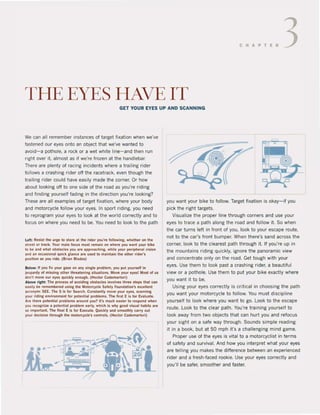
We can all remember instances ol target lixation when we've
fastened our eyes onto an object that we've wanted to
avoid-a pothole, a rock or a wet white line-and then run
flght over it. almost as il we're Irozen at the handlebar.
There are plenty ol racing incidents where a trailing rider
follows a crashing rider off the racetrack, even though the
trailing rider could have easily made the corner. Or how
about looking off to one side of the road as you're riding
and finding yourself fading in the direction you're looking?
These are all examples of target fixation, where your body
and motorcycle follow your eyes. In sport riding, you need
to reprogram your eyes to look at the world correctly and to
focus on where you need to beo You need to look to the path
Left: Rulst the lrae to ,tllre at the rider }'ou·" following, whether on th,
5Ireet or lrack. Vou. mllin locus must rem.ln on where )'Ou want ~our blke
10 be and whal obstll~les }'OU lire approa~hlna, whlle ~our peripherlll vision
and an o~easlonal qul~k Blanee all! used 10 malnlaln Ihe olher rlder's
posilion as l'ou ride. (Brlan Blades)
Below: II }'OU li. ~ou. l"e on Inl' single problem, ~ou pul )'Oursell In
Jeopard}' ol mlsslna other thtutening , iluallons. Move )'Ou. e~esl Most ol us
6on'I mOIle ou. e~es qul~kl~ enough. (He~tor ClIdemIlnor!)
AboYe .ight: The proces' olll'o'Oldinl obstKles Inyolyes thtee steps thllt ~.n
usil ~ be Il!membered using Ihe Motorcycle Slllet~ Foundalion's eicellen!
Kron~m: SEE. The S I1 for Sureh, Consllnll~ move }'our eyes. Kllnnlng
)'Ou. rldlng environment for potenllal problems. The first E is lor EVllluate.
Are Ihell! polentlal p.oblems around you1 11"$ mu~h easler 10 respond when
rou reeognize a polential problem earl}'. whl~h Is wh~ aood vlsual hablts ••e
10 Important. The flna! E Is lor Eneule. Qulckl}' and smoolhl}' earr~ oul
rour decision Ihrough Ihe motorc}'ele's conl.ols. (HeeID. Cademarlo.l)
you want your bike to follow. Target fixation is okay- if you
pick the right targets.
Visualize the proper line through corners and use your
eyes to trace a path along the road and follow i1. So when
the car turns lelt in lront of you, look to your escape route,
not to the car's front bumper. When there's sand across the
corner, look to the clearest path through i1. If you're up in
the mountains riding Quickly, ignore the panoramic view
and concentrate only on the road. Get tough with your
eyes. Use them to look past a crashing rider, a beautiful
view or a pothole. Use them to put your bike exactly where
you want it to be,
Using your eyes correctly is criticaI in choosing the path
you want your motorcycle to lollow. You must discipline
yourself to look where you want to go. Look to the escape
route. Look to the clear path. You're training yourself to
look away Irom two objects that can hurt you and refocus
your sight on a safe way through. Sounds simple reading
it in a baak, but at 50 mph it's achallenging mind game.
Proper use of the eyes is vital to a motorcyclist in terms
of safety and survival. And how you interpret what your eyes
are telling you makes the difference between an experienced
rider and a fresh-faced rookie. Use your eyes correctly and
you'lI be safer, smoother and faster.
CONCENTRATION AND DISCIPLINE
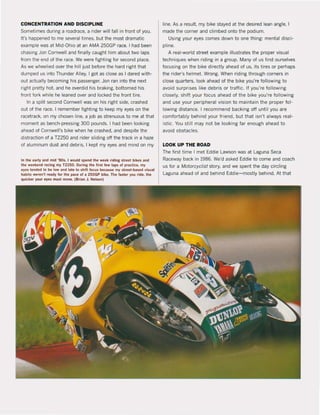
Sometimes dunng a roadrace, a rider will fall in front ol you,
It's happened to me several times, but the most dramatic
example was at Mid-Ohio at an AMA 250GP race, I had been
chasing Jon Cornwell and finally caught him about two laps
from the end ol the race. We were lighting lor second piace.
As we wheelied over the hili just before the hard right that
dumped us into Thunder Alley, I got as close as I dared with-
out actually becoming his passenger. Jon ran into the next
right pretty hot. and he overdid his braking, bottomed his
front fork while he teaned over and locked the front tire.
In a split second Cornwell was on his right side, crashed
out ol the race. I remember fighting to keep my eyes on the
racetrack, on my chosen line, a job as strenuous to me at that
moment as bench-pressing 300 pounds. I had been looking
ahead ol Cornwell's bike when he crashed, and despite the
distraction of a TZ250 and rider sliding oft the track in a haze
of aluminum dust and debris, I kept my eyes and mind on my
In the Utly .nd mld '9Os, I would spend Ihe wuk rldina: streel blkes i!lnd
Ihe wukend raclng my TZ2SO. Ol,ltlna:lhe IIrll lew taps of praclice, my
eyes lend" 10 be low and lale 10 shift locl,ls !>eeaI,lW my street-base<! v;sl,lal
habits weren'l ready lor Ihe pace ol a 2SOGP bike. The laster yOI,l ride, Ihe
quicker your eyes musl move. (Brian J. Nelson)
'ine. As aresuit. my bike stayed at the desired lean angle, I
made the corner and climbed onto the podium.
Using your eyes comes down to one thing: mental disci-
pline.
A real-world street example illustrates the proper visual
techniques when riding in a group. Many ol us lind ourselves
locusing on the bike directly ahead of us, its tires or perhaps
the rider's helmet. Wrong. When riding through corners in
close quarters, look ahead of the bike you're following to
avoid surprises like debris or traflic. II you're following
closely, shift your focus ahead ol the bike you're following
and use your peripheral vision to maintain the proper fol -
lowing distance. I recommelld backing aft until you are
comfortably behind your friend, but that isn't always real -
istic. You still may not be looking lar enough ahead to
avoid obstacles.
LOOK UP THE ROAD
The lirst time I met Eddie Lawson was at Laguna Seca
Raceway back in 1986. We'd asked Eddie to come and coach
us lor a MotorcyC/ist story, and we spent the day circling
Laguna ahead of and behind Eddie-mostly behind. At that
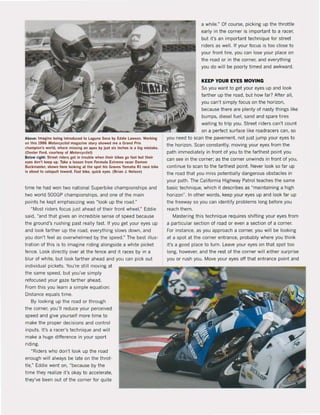
Above: Imagine belnl Inlroduced 10 ugunll Secil by Eddie lawson, Workin.
on thls 1986 MotorcycliJI maga!!ne slory showed me 11 Grand Prb
chllmpion's world, where missing IIn .pex by Ju'l slx Inches I, 11 bil ml,tllke,
(DHIer Ford, courtH~ ol MofofCyc!ist)
Below nght: Streel: riders let in trouble when thelr blkes go Ilist but their
eyes don'! keep up, Take Iiesson lrom Formull E.treme racer Dllmon
Buckmu!er, shown here looklng al the spot hls Graves Yamah. Rl race blke
is .bout 10 cat.puIt toward, Fast bike, qulck e~es, (Brian J. Nelson)
time he had won two national Superbike championships and
two world 500GP championships, and one of the main
points he kepI emphasizing was Mlook up the raad.fl
~Most riders focus jus! ahead of their front wheel," Eddie
said, "and thaI gives an incredible sense of speed because
the ground's rushing past realty tast If you get your eyes up
and look farther up the road, everything slows down, and
you don't feel as overwhelmed by the speed.fl
The best illus·
tration of this is to imagine riding alongside a white picket
fence. Look directly over at the fence and it races by in a
blur of white, but look farther ahead and you can piek out
individual pickels. You're still moving at
the same speed, but you've simply
refocused your gaze farther ahead.
From this you learn a simple equation:
Distance equals time.
By looking up the road or through
the corner, you'lI reduce your perceived
speed and give yourself more time 10
make the proper decisions and control
inputs. It's a racer's technique and will
make a huge difference in your sport
riding,
"Riders who don·t look up the road
enough will always be late on the throt·
tle,ft Eddie went on, "because by the
time they realize it's okay to accelerate,
they've been out ot Ihe corner for quile
a while.fl
Of course, picking up the throttle
early in the corner is important 10 a racer,
but it's an important technique for streel
riders as weil. If your focus is too close 10
your front tire, you can lose your place on
the road or in the corner, and everything
you do wilt be poorly timed and awkward.
KEEP YOUR EYES MOVING
Sc you want to get your eyes up and look
farther up the road, but how far? After all,
you can't simply focus on the horizon,
because there are plenty of nasty things like
bumps, diesel fuel, sand and spare tires
waiting to trip you. Street riders can't coun!
on a perfect surface like roadracers can, so
you need to scan the pavement. not just jump your eyes to
the horizon. Scan constantly. moving your eyes trom the
path immediately in front of you to the farthest point you
can see in the corner: as the corner unwinds in front of you,
continue to scan 10 the farthest point Never look so far up
Ihe road that you miss potentialty dangerous obstacles in
your path. The California Highway Patrol teaches the same
basic technique, which it describes as "maintaining a high
horizonfl
• In other words, keep your eyes up and look far up
the freeway sc you can identify problems long before you
reach them.
Mastering this technique requires shifting your eyes trom
a particular section ot road or even a section of a corner.
Fm instance, as you approach a corner, you will be looking
at a spot at Ihe corner entrance, probably where you think
it's a good place 10 turn. l eave your eyes on thai spot too
long, however, and the rest of the corner will either surprise
you or rush you, Move your eyes off that entrance point and
up into the corner, looking for your apex point, or the point
at which you come closest to the edge of your lane. As you
approach that spot, rip your eyes up again to the exit.
Move them. Jump them oH anything that threatens to grab
your attention, like a crack in the pavement or a rock in
the road.
PERIPHERAL POWER
Peripheral vision- the amount of vision you have away from
your focal point-is one of the most vitaI attributes needed
by every rider, from racer to commuter to Sunday sport bike
rider. Think of peripheral vision as an awareness, one that
can be enlarged and strengthened. What we're talking about
is seeing without fixating, viewing without staring, gathering
information that you may have previously overlooked.
EYE DRILL: VISION REVISION
Try these drilIs to test your peripheral vision awareness, and
continue them to strengthen it.
I, Walk down the sidewalk and while staring straight ahead,
count the cracks as they pass underfoot. This test is espe-
cially important for riders because you must monitor your
current situation (counting the cracks) at the same time as
you are looking ahead.
2. Stare into a crowd and, while maintaining a single focal
point. try to piek up all movement with your peripheral
vision. Developing this ability will help you move through
traffic with your eyes looking ahead while maintaining
enough peripheral strength to detect movement anywhere
in your field of view.
3. When watching TV, look at the corner of the screen and
attempt to watch the show with your peripheral vision. Use
the same technique when following another rider. Look
ahead of the leading rider's bike (when following relatively
closely), yet maintain the leader's position in your periph-
eral vision. What you want to avoid is staring at the lead-
ing ri der or bike.
4. Close this book momentarily, then pop it open to any
page and close it again immediately. How much did you
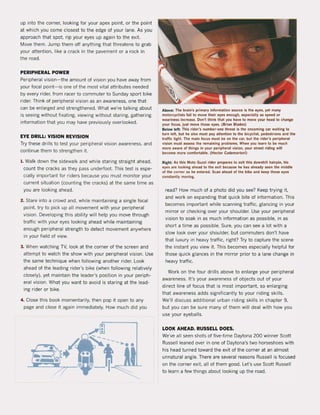
Above: The braln's primary Inlormallon souree Is Ihe eyu. yel m~ny
mOloreyellsls lall to move Ihelr eyes enough. especlally ~s speed or
weariness Increue. Oon'l Ihlnk Ihal you have 10 move your head 10 change
your loeus, jusl move Ihou eyes. (Brlan Blades)
Below lelt Thls rider's number·one Ihreal Is Ihe oncomlng car walling 10
turn lef!, but he al50 musl pay allenllon 10 Ihe bicyellsi, pedesirlans and the
tralfic 11ghl. The main locus musl be on the car, bullhe ride'-s peripheral
vision musl assen Ihe remainlng problems. When you learn 10 be much
more aware of Ihlng' in your perlpheral visIon, yout slreel tldlng wlll
beeome more eomlortable. (Heclor Cademartorl)
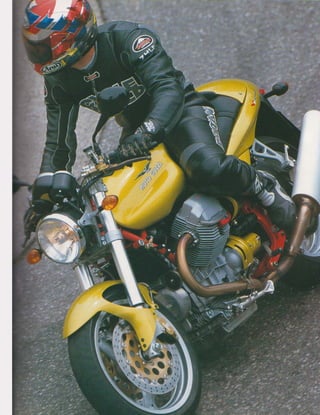
Right; A5 thls Moto Guni rlder ptepares to exit thls downhltl halrpln, hls
eyes are looking ahead to the exit because he has already seen Ihe middie
of the corner as he entered. Scan ahead ol the blke and keep those eyes
constanlly moving.
read? How much of a photo did you see? Keep trying it,
and work on expanding that quick bite of information. This
becomes important while scanning tratfic, glancing in your
mirror or checking over your shoulder. Use your peripheral
vision to soak in as much information as possible, in as
short a time as possible. Sure, you can see a lot with a
slow look over your shoulder, but commuters don't have
that luxury in heavy traffic, right? Try to capture the scene
the instant you view it. This becomes especially helpful for
those quick glances in the minor prior to a lane change in
heavy traffic.
Work on the four drilIs above to enlarge your peripheral
awareness. It's your awareness of objects out of your
direct line of focus that is most important. so enlarging
that awareness adds significantly to your riding skilIs.
We'lI discuss additional urban riding ski lis in chapter 9,
but you can be sure many of them will deal with how you
use your eyeballs.
LOOK AHEAD. RUSSELL DOES.
We've all seen shots of five-time Daytona 200 winner Scott
RusselI leaned over in one of Daytona's two horseshoes with
his head turned toward the exit of the corner at an almost
unnatural angle. There are several reasons RusselI is focused
on the corner exit, all of them good. Let's use Scott RusselI
to learn a few things about looking up the road.
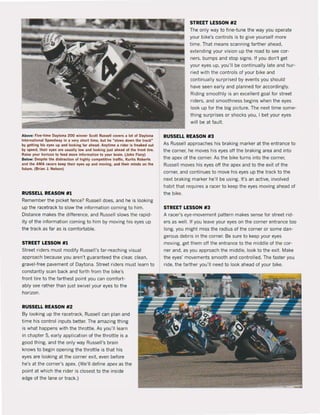
Above: Flve'llme Dayton. 200 winnrr Scolt Russr" co~rs a lot ol D.ytona
InlernaUonal S~w.y In • ~ry short lime, but hl Mslows down Ihl lrackM
by.getllng hls eyfli up . nd looklng flr ahud. Anytlme I rider is frelked 0111
by speed, Ihelr eYH' are usually !ow .nd 100kinK jusl ahead of Ihe Ironl lire.
Raisr your horizon 10 !red more Information 10 your brain. (John Flory)
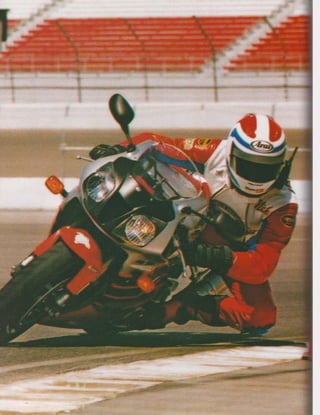
Below: Ouplle Ihe dislratlion of highly compelilive trafIic, Kurtis RObrrts
.r>d Ihe AMA racers ku p Iheir ey" up and moving.•nd Ihelr mlr>ds on Ihl
lulurr. (Brl.n J. Nelson)
RUSSELL REASON #1
Remember the picket fence? RusselI does. and he is looking
up the racetrack to slow the information coming to him.
Distance makes the difference, and Russel1 slows the rapid-
ity of the information coming to him by moving his eyes up
the track as far as is comfortable.
STREET LESSON #1
Street riders must modify Russell's far·reaching visual
approach because you aren'! guaranteed the dear, clean,
gravel·tree pavement of Daytona. Street riders must learn to
constantly scan back and forth from the bike's
tront lire to the farthest point you can comfort·
ably see rather than jus! swivel your eyes to the
horizon.
RUSSELL REASON #2
By looking up the racetrack, Russel1 can plan and
time his control inputs better. The amazing thing
is what happens with the throttle. As you'lI learn
in chapter 5, early application of the throttle is a
good thing, and the only way Russell's brain
knows to begin opening the !hrottle is tha! his
eyes are looking at the corner exit. even belore
he's at the corner's apex. (We'l1 define apex as the
point at which the rider is dosest to the inside
edge ol the lane or track.)
STREET LESSON #2
The only way to fine-tune the way you operate
your bike's contrals is to give yourself more
time. That means scanning farther ahead,
extending yaur vision up the road to see cor-
ners, bumps and stop signs. If you don't get
your eyes up, you'lI be continual1y late and hur·
ried with the contraIs of your bike and
continually surprised byevents yau should
have seen early and planned for accordingly.
Riding smoolhly is an excellent goal for street
riders, and smoothness begins when the eyes
look up for the big picture. The next time some-
thing surprises or shocks you, I bet your eyes
wilI be at lault.
RUSSELL REASON #3
As RusselI approaches his braking marker at the entrance to
the corner, he moves his eyes oH the braking area and into
!he apex of the corner. As the bike turns into the corner,
Russel1 moves his eyes oH the apex and to the exit ol the
corner, and continues to move his eyes up the track to the
next braking marker he'll be using. It's an active, involved
habit that requires a racer to keep the eyes moving ahead of
the bike.
STREET LESSON #3
A racer's eye-movement pattern makes sense for street rid·
ers as weil, 1I you leave your eyes on the corner entrance too
long, you might miss the radius of the corner or same dan·
gerous debris in the corner. Be sure to keep your eyes
moving, get them oH the entrance to the middle ol the cor·
ner and, as you approach the middle, look to the exit. Make
the eyes' movements smooth and contrailed. The laster you
ride, the farther you'lI need to look ahead of your bike.
Tune-up Time
Whcn did you last visi! the optometrist? Iryou'cc like most Amcricall.',
you have your eyes checkcd only when you break youe glasses, lose
your contacts or rail thc drivcr's liccnse eye exam. Theee you are, pos~
sihl}' riding with faulty cquipmcnt, a set ofeyes that arcn', truly seeing
eVl'rythillg t1l(~y ean. As a lIlotoTcydist, your lifc dcpcllds on your
ViSÎOll, ,~o 3n anuual cye eX311l might he one o[the best steps )'ou eall
take 10 extend YOUT riding career.
Many riders wcar glasses or conlacts while riding. Classes ean be a
hassle tn fit insiuc thc hdlllcl and arc an o!Jviols danger during a crash
1X.-ç3USC of tilde proximity 10 the eyes. Thcy present 31l0lhcr surfacc
fOf dirt and rlchris 10 seule Ijxm, aud another laycr 10 rog during mld
or wet wealher.
COnlacts wearers have found varying degrees of success, mostly
de]lCnding on how much wind enters their hdmets. One oflhe most
famous contacts~wearing roadracers is Freddie Spencer. He was
often photographe<:l wilh tape surrounding his face shidd for an extra
larer 10 protelt against wind entering his Arai. He wam't always able
to keep his lenses in place successfuH)', but that diffiCllty l:allle dur~
ing the stress of a soocc Grand Prix. when it's probably difficult to
relllelllbcr 10 blink. Street riders should find il casier.
One trui)' miraeulous solution for riders foreed to wear eorrel:tivc
lenscs has been lascr slIrgery that correcls nearsightcdncss and
astigmatisms. runderwent Ihis surgery at the beginning of1995 after
racing for six years with glasses, and the results continue 10 be ter-
fifie. Two things PUShl-d lIle lowanllascr surgcry.The !lrsl was a very
rain)' 1994 scason, whkh had lIle frequently clIrsing my foggy, wel
glasses. Second. my glasses lefl me with a cut on my cheek after I
crashed a lesl bike in Germany. The gash could have been myeye,
50 after a few Illonths of research, I gol lasered.
This hook isn'l a source for laser surgery information, but this sur-
gery is a tremendous solution for nearsighled mOlOrcycie riders. You
depend heavily on yonr eyes. wcar constraining headgear alld ride
in a wiml)", {lirl)', sOlllelimes wel environmenl. Iencollmgc you 10 look
into it. Who knows what perfeCI vision can do for you?
Again, astreet rider must scan the asphalt to check for
debris and bumps, while a racer can be more certain of
pavement consistency.
SELF-ANALYSIS
Since the eyes are so criticaI to our sport, it's important to
recognize the problems that stem from improper visual
habits. Failing to master this single skill can cause a wide
variety of riding problems. Among them are the following:
1. Running wide in a corner. If you had slow-motion video
of a rider going wide in a corner, you'd probably notice
that her eyes quit looking through the corner. Instead,
her eyes either got caught on something like a pothole or
rock, or failed to scan through the corner as the bike
entered it. Qnce again, keep your eyes moving ahead of
the bike.
Z. Hitting stationary objects. Target fixation is a simple term,
but it brings an ugly result. Arider's eyes get caught on
something like a pothole, car fender, curbing-and the bike
follows the gaze. Tearing your eyes off something that
draws your interest is like ripping Velcro apart-but it's a
skill worth mastering.
3. Being late on the throttle. Applying the throttle (lightly) as
early as possible after turning into a corner is a critical
aspect of riding weil. We will talk all about it in chapter 5, but
the reasen many riders are late on the throttle is their eyes:
They're simply not looking up the road far enough. No matter
how many times you've ridden through a corner, your brain
needs your eyes to reaffirm that the pavement does indeed
still exist and that your right wrist can begin to gently roll on
the throttle.
4. Being overwhelmed and surprised. Riders continuously
overwhelmed with speed are simply focusing too close to
their front tire. Distance slows things down and gives the
brain more time to deal with everything from an encroach-
ing car to an upcoming corner.
5. Entering a corner far toa slowly. While braking for a cor~
ner, it's easy to leave your eyes on whatever you were
using to gauge your speed and braking distance, and your
entrance speed suffers. You stay on the brakes too Jong
because you need your eyes to look into the corner to cor-
rectly gauge the corner's radius, pavement. etc. Isn't it
interesting to find that one of the main secrets to good
entrance speed is the eyes?
LESSONS FROM THE RACETRACK
CLEAN IS CLEAR The top professional racers visit their hel-
met representative between every practice for either a
face-shield cleaning or a completely new face shield. The
tuners take plenty of time making sure the bike's windscreen
is clean and smudge free. Everyone involved knows the
importance of giving the eyes the clearest view possible.
LOOK AHEAD OF THE COMPETITION Beginning racers soon
discover that if they stare at the rider they just caught. their
speed will match that rider's speed exactly. Racers learn to
look ahead of the rider they hope to pass, monitoring that
rider's place on the track with quick glances and use of
peripheral vision.
GET LASERED Getting rid of your glasses or contacts really
helps, especially in dusty venues or the rain. Laser surgery
eliminates the need for glasses and seems tailor-made for
racers.
CHAPTER 4
STEER THAT THING
LET'S MOVE BEYOND COUNTER5TEERING AND TRULY CONTROL THE MOTORCYCLE
Ask 10 riders how to steer a motorcycle and you get 10
different responses. Far the hard-to-find answer to this
simple but important Question, we sent a rider down his
favorite raad lor three experimental passes. On the first
pass, he took his hands oft the handlebar and tried to
steer the bike by pushing his knees against the tank. lean-
ing his weight to the inside of the turn and pushing on the
loot pegs with his feet. Our rider scared himself silly
betore grabbing the bar halfway through the lirst corner
because the bike wasn't responding quickly enough to
match the road's direction. On the next pass, he took his
feet aft the foot pegs and steered by pushing and pulling
on the handgrips but not twisting the thrattle or squeezing
the brakes. He found it better than the lirst approach, but
still not quite right. On the linal run, he left his feet on the
pegs and again pushed and pulled on the hand!ebar to
change the bike's direction, using the throttle and brakes.
The third pass made it obvious that we contral and steer a
road-going motorcycle at the handlebar, but the body and
control action have some significant effects as weil. As
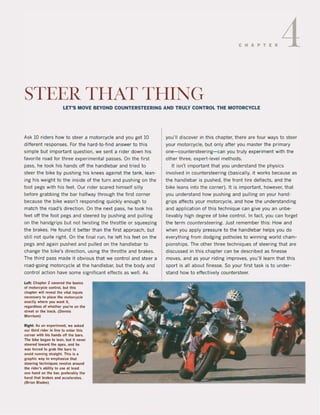
Lefl; Chaple. 2 eovered Ihe bulcs
of molorcycle control. bilt thls
chapte. wlll reveal the vltallnputs
neussary 10 place tha moton:)'(:le
eKactly whe.e you wint It,
reaatdlHs of whethe. you're on lhe
streel or the Iraek. (Oennis
Morrlson)
Rigtll: As an elperlment we IIked
oor Ihitd rider In fine 10 enter thit
corner wlth hls hands of! the I),r$.
TIIe bikt beiM 10 lean, bIIl It never
sleered lowltd Ihe IpeK, Ind he
was forced 10 arab Ihe bars to
lvo;d running straight Th;$ 1$ I
graphic wly to emphaslze thll
steering tllchnlquH 'lIYolve lround
the ,ider', ability to usa It lent
one hand on the bar, p,eferably Ihe
hand that brakes and accelerate$.
(Brlan Bladel)
you'lI discover in this chapter. there are four ways to steer
your motorcycle. but only alter you master the primary
one- countersteering- can you truly experiment with the
other three, expert-level methods.
It isn't important that you understand the physics
involved in countersteering (basically, it works because as
the handlebar is pushed. the front tire deflects, and the
bike leans into Ihe corner). It is important. however, that
you understand how pushing and pulling on your hand-
grips affects your motorcycle, and how the understanding
and application of this technique can give you an unbe-
lievably high degree ol bike contro!. In lact. you can torget
the term countersteering. Just remember this: How and
when you apply pressure to the handlebar helps you do
everything trom dodging potholes to winning world cham-
pionships. The other three techniques of steering that are
discussed in this chapter can be described as finesse
moves, and as your riding improves, you'lI learn that this
sport is all about finesse. So your lirst task is to under-
stand how to elfectively countersteer.
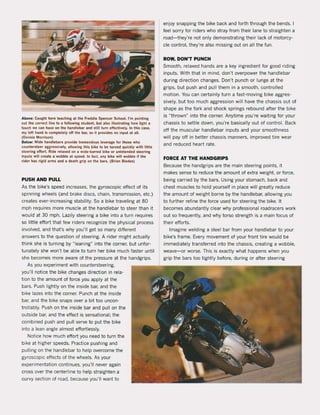
Above: Caught here teaching at the Fteddie Spencer School, I'm polnting
out the correct line to a lollowing sludent, bul also illustrating how light a
touch we can have on the handlebar and 51111 lurn elleclivel~. In this case,
my lelt hand is complelely olf Ihe bar, sa il provides no input at all.
(Dennis Morrison)
Below: Wide handlebars provide Iremendous feverage lor Ihose who
counlersleer aggressively, allowlng thls bike to be turned quickly wilh liUle
sleering ellorl. Ride relaxed on a wide-b<lrred bike or unintended steering
Inpuls wilt create a wobbie al speed. In lact, any bike wlll wobbie il the
rider has rigid arms and a dealh grip on the bars. (Brian Blades)
PUSH AND PULL
As the bike's speed increases, the gyroscopic effect of its
spinning wheels (and brake discs, chain, transmission, etc.)
creates ever-increasing stability. 50 a bike traveling at 80
mph requires more muscIe at the handlebar to steer than it
would at 30 mph. Lazily steering a bike into a turn requires
50 little effort that few riders recognize the physical process
involved, and that's why you'lI get 50 many different
answers to the question of steering. A ri der might actually
think she is turning by "Ieaning" into the corner, but unfor-
tunately she won't be able to turn her bike much faster until
she becomes more aware of the pressure at the handgrips.
As you experiment with countersteering,
you'lI notice the bike changes direction in rela-
tion to the amount of force you apply at the
bars. Push lightlyon the inside bar, and the
bike lazes into the corner. Punch at the inside
bar, and the bike snaps over a bit toa uncon-
trollably. Push on the inside bar and pul! on the
outside bar, and the effect is sensational; the
combined push and pull serve to put the bike
into a lean angle almost effortlessly.
Notice how much effort you need to turn the
bike at higher speeds. Practice pushing and
pulling on the handlebar to help overcome the
gyroscopic effects of the wheels. As your
experimentation continues, you'lI never again
cross over the centerline to help straighten a
curvy section of road, because you'lI want to
enjoy snapping the bike back and forth through the bends. I
feel sorry for riders who stray from their lane to straighten a
road - they're not only demonstrating their lack of motorcy-
cIe control, they're also missing out on all the fun.
ROW, DON'T PUNCH
Smooth, relaxed hands are a key ingredient for good riding
inputs. With that in mind, don't overpower the handlebar
during direction changes. Don't punch or lunge at the
grips, but push and pull them in a smooth, controlled
motion. You can certainly turn a fast-moving bike aggres-
sively, but too much aggression will have the chassis out of
shape as the fork and shock springs rebound after the bike
is "thrown" into the corner. Anytime you're waiting for your
chassis to settle down, you're basically out of control. Back
off the muscular handlebar inputs and your smoothness
will pay off in better chassis manners, improved tire wear
and reduced heart rate.
FORCE AT THE HANDGRIPS
Because the handgrips are the main steering points, it
makes sense to reduce the amount of extra weight. or force,
being carried by the bars. Using your stomach, back and
chest muscles to hold yourself in place will greatly reduce
the amount of weight borne by the handlebar, allowing you
to further refine the force used for steering the bike. It
becomes abundantly clear why professional roadracers work
out 50 frequently, and why torso strength is a main focus of
their efforts.
Imagine welding a steel bar from your handlebar to your
bike's frame. Every movement of your front tire would be
immediately transferred into the chassis, creating a wobbie,
weave- or worse. This is exactly what happens when you
grip the bars too tighUy before, during or after steering
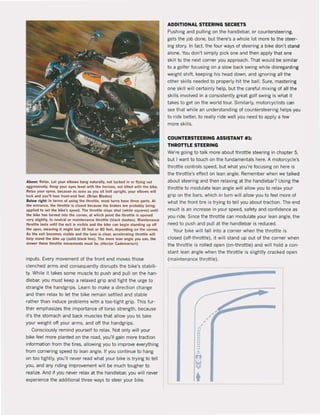
Above: Relax. Let )'Olit ,Ibows hang natllraUy, not tllcked in 0' flyin!! Ollt
'UtHsiVf!ly. Keep YOU' 'YH level witll tlle 1I0.lzon, not tilted witll tlle: blke.
Relax )'011. spine. be(;.Us.l! .s soon .s you sit bolt IIpright, )'011. elbows wlll
loek and you'll los.e front·end f~t. (8.i.n BI.des)
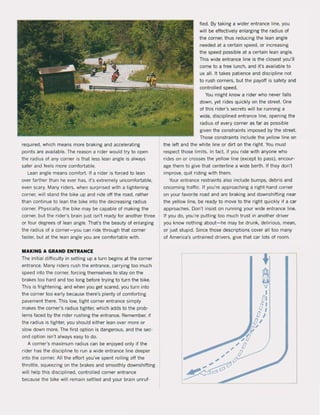
8elow riglll: In lerms ol using IIIe: llirotue, mosl lutns 11.", tIlree p".ts. At
Ilie entrance, tlle tll.ottle Is clostd beclllIW the brakes .re probably belng
.pplied 10 set tlle bike's speed, The Illrottle stays sllul (wllite squ..es) IIntil
tlle bike 11.5 tu.ned Into the corner, al wllicll point tlle tllrottle is opened
very sliglltly, to neul.., Ot m~inlenance Ih.OIlI' (black daslies), Mainten.nce
throltle lasts IIntil tlle exit Is visible and tlle blke can beiin standing lip oft
tlle apex, meaning 11 mlghl IasilO feet 0. 80 feet, depenöing on the corne.,
As the exit bKomes vlslble and Ilie lane Is clea., Kcelel'1llilll tllrottl. wil!
help stand tlle bikt up (solid btack line). The mo.e lean Mgle you uw, Ih,
slowl!f' Illese throttl' movemenls mllst be, (Heclor c.öemartori)
inputs, Every movement of the front end moves those
clenched arms and consequently disrupts the bike's stabili·
ty, While it takes $Ome muscle to push and pull on the han·
diebar, you must keep a relaxed grip and light the urge to
strangle the handgrips, Learn to make a direction change
and then relax to let the bike remain settled and stabie
rather than induce problems with a too·tight grip, This fur·
ther emphasizes the importance of torso strength, because
it's the stomach and back muscles that allow you to take
your weight aft your arms, and aft the handgrips,
Consciously remind yourself to relax, Not only will your
bike feel more planted on the raad, you'lI gain more traction
information trom the tires, allowing you to improve everything
Irom cornering speed to lean angle. If you continue to hang
on too tightly, you'lI never read what your bike is trying to teil
you, and any riding improvement will be much tougher to
realize, And if you never relax at the handlebar, you will never
experience the additional three ways to steer your bike,
ADDITIONAL STEERING SECRETS
Pushing and pulling on the handlebar, or countersteenng,
gets the job done, but there's a whole lot more to the steer'
ing story, In lact. the four ways of steering a bike don't stand
alone, You don't simply piek one and then apply that one
skill to the next corner you approach. That would be similar
to a golfer focusing on a slow back swing while disregarding
weight shift. keeping his head down, and ignoring all the
other ski lis needed to properly hit the balI. Sure, mastering
one skill will certainly help, but the careful mixing of all the
skilis involved in a consistently great golf swing is what it
takes to get on the world tour, Similarly, motorcyclists can
see that while an understanding of countersteering helps you
to ride better, to really ride weil you need to apply a few
more skilis,
COUNTERSTEERING ASSISTANT #1:
THROTTLE STEERING
We're going to talk more about throttle steering in chapter 5,
but I want to touch on the fundamentals here, A motorcycle's
throttle controls speed, but what you're focusing on here is
the throttle's effect on lean angle, Remember when we talked
about steering and then relaxing at the handlebar? Using the
throttle to mocfu1ate lean angle will allow you to relax your
grip on the bars, which in turn will allow you to feel more of
what the front tire is trying to teil you about traction. The end
result is an increase in your speed, safety and conlidence as
you ride, Since the throttle can modulate your lean angle, the
need to push and pull at the handlebar is reduced,
Your bike will fall into a corner when the throttle is
closed (oIHhrottle), it will stand up out of the corner when
the throttle is rolled open (on-throttle) and will hold a con·
stant lean angle when the throttle is slightly cracked open
(maintenance throttle),
,
ao
o
o
o
"-
n
,,,,
,/--
I include the terms in parenthesis to establish a vocabu-
lary to better discuss throttle steering. On-throttle means
accelerating throttle: the bike is actually gaining speed. In
contrast, maintenance throttle is the most minor application
of throttle imaginable, twisting the right grip sc slightly that
the carburetor slides or fuel-injection butterflies barely
move. In fact, the motorcycle's speed might actually be
decreasing with maintenance throttle. There's a huge differ-
ence between maintenance throttle and accelerating throttle.
The difference between on-throttle and maintenance throttle
also has a great deal to do with who wins world champi-
onships and who high-sides themselves into oblivion. So
Iers talk more about the throttle's effect on steering.
You enter the corner off-throttle and initiate the turn.
The bike banks into the corner and continues to fall
because the throttle is closed. As you reach the lean angle
necessary to make the apex of the corner at the speed
you've chosen, you can push on the outside bar to arrest
the increasing lean angle. Or you can crack open the throt-
tie to maintenance to achieve the same effect. Going to
maintenance throttle at this point will be a much smoother
way of arresting the lean angle. and as the corner opens
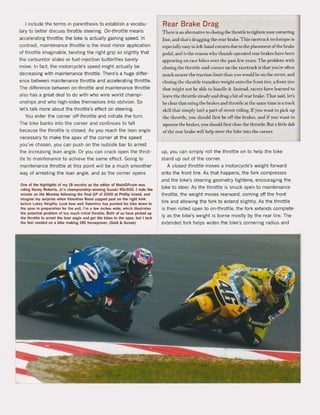
One of the highlights ol my 18 months as the editor of MotoGP.com was
riding Kenny Roberts. Jr.'s championship-winning Su~ukl RGv500.• rode the
missile on the Monday lollowing Ihe fina' GP ol 2000 al Phillip Island. and
imagine my surprise when Valenlino Rossi zapped past on Ihe right kink
before Luke~ Heights. look how weil Valentino hu pointed his bike down to
the apex in preparation for the exit. rm a lew inches wide. which iIIustrates
the potential problem ol too much inilial throttle. 80th of us have picked up
the throttle to arrest the lean angle and get the bikes to the apex. but I lack
the feel needed on a bike making 190 horsepower. (Gold & Goose)
Rear Brake Drag
There is an alternative 10 dosing thc throttlc 10 lightcn your cornering
linc, anti Lhat's dragging the rear brake. This Tacetrack tedlllique is
esped ally easy iuldt-hand corners due to the placement ofthe brake
pedal,and is the reasou why thumh-operated rear brakes have been
appearing on r<lce hikes over thc past rew years. The problem with
closing the throttle mid-corner on the racctrack is that you're ohen
much neareT the traction limit than you would he on Ihe sireet. and
dosiug thc throttle transfers weight onlo Ihe front tire, a front lire
that mighlnot he able 10 handle it.lnstead, racers have learned to
leave the throttle stcady antI drag a bit ofrcar brake. That said, let's
be cleaT that nsing the br.tkes and tluotllc OIt thc same lime is a track
skill that simply isn't a part of streel rining. Ifyou want 10 piek up
the throl ile. you should first he off the brakes, and if yon want to
sqleeze the brakes, you should first dose the throttle. But a little dab
ofthe rcar brake will help sleer the bike into Ihe corner.
up, you can simply roll the throttle on to help the bike
stand up out of the corner.
A c/osed lhrottle moves a motorcycle's weight forward
onto the front tire. As that happens, the fork compresses
and the bike's steering geometry tightens, encouraging the
bike to steer. As the throttle is snuck open to maintenance
throttle, the weight moves rearward. coming oH the front
tire and allowing the fork to extend slightly, As the throttle
is then rolled open to on-throttle, the fork extends complete-
Iy as the bike's weight is borne mostly by the rear tire. The
extended fork helps widen the bike's cornering radius and
helps stand the bike up oft the corner.
Focus your skill on the fine touch needed to sneak open
the throttle after the turn-in. Applying maintenance throttle
to arrest the lean angle is a huge reason why some riders
continue to miss apexes and overshoot corners, running
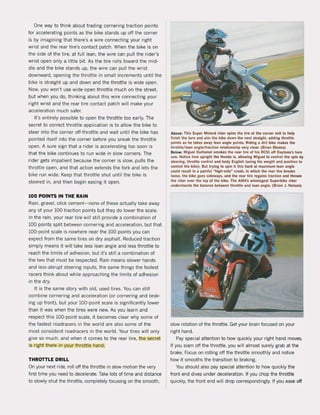
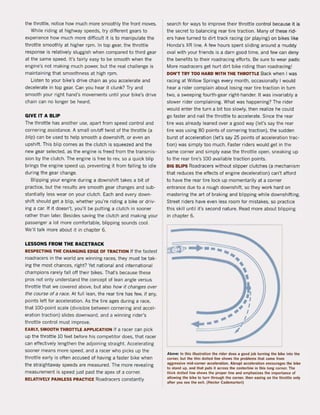
wide at the exits. These riders get greedy and open the
throttle too early while entering the corner, or they open the
throttle too hard, skipping maintenance throttle as they
jump right to on-throttle. Either mistake prevents the bike
from turning down to the apex, but both are also easy to
correct: Leave the throttle shut longer! Don·t go to the throt-
tie until the bike has been turned into the corner, and then
go to it very gently sa the bike continues to carve the radius
you've selected to reach the apex. So when can you open
the throttle? As soon as possible alter the bike has been
turned into the corner. But the earlier you open it, the more
smoothly you must open it.
Smoothness is even more important if you have a power-
ful bike. because a small turn of the right handgrip means a
lot ol horsepower, especially at high rpm. This lesson really
hit home when I guest-rode Kenny Roberts, Jr.'s, world
championship-winning Suzuki 500. Because of the instant
power, I found myself leaving the throttle dosed longer than
I expected simply because once the bike began carbureting.
it wanted to stand up and lunge oft the corner. Roberts and
his ilk use the throttle to steer, and my laps aboard his bike
brought home how smoothly the right hand must move on
high-horsepower machines.
COUNTERSTEERING ASSISTANT #2: LEG PRESSURE
Qne of the biggest drawbacks to pushing and pulling on the
handlebar to turn a motorcycle is the unintended inputs you
make when you either squeeze the grips too tightly or lean
your weight onto the handlebar. One great way to lighten the
handlebar's load is to utilize your outside leg to help steer
the bike into the corner. By placing the inside of your knee
and thigh against the tank, you can apply pressure to help
initiate tipping the bike into a corner.
The truth about this technique is not that you're steering
with your knees, but that you're locusing your steering
eftorts on your legs, not your hands. You are still inpuUing
pressure to the handlebar as you push on the tuel tank with
your leg, but because you're focused on your leg movement.
your hands are relaxed. and the weight on the handlebar is
minima!. The more relaxed you art! at the handlebar, the
better the ride will be, and this leg pressure technique is
exactly what many ol us need to loosen a too-tight grip.
To prove that leg pressure alone doesn·t steer a motorcy-
de very efficiently, try moving your hands from the handle-
bar to the fairing edges, fuel tank or your lap. With your
hands olf the grips, your anchor is gone and you have
Help trom the Front Brake
To take thronle steering a step lilrther, think aoout touehing thc fronl
brakc lever to help steer the bike into thc corner.lfclosed throttle
puts wcighl forward and compresscs thc fork, a small touch on the
front hrake will carry this techniqle a hit further. allowing the bike
lolurn into the corner in less time and distancc. and whh less han-
diebar pressure.
You might be thinking that ij' you lOuch the brake lever to help your
bike steer inlO the corner, your hike will stand up. Yes, it will- iryour
touch is 100 harsh. too grabby, too abrupt. Easc that brake lever on.
Slow those fingers down. Well discuss this tedlllique more in
chapter 6 as we stmly the art and sdence oftrail-hraking. and why
you need 10 master trail-braking 10 slay alive on the stnTt and win
at the track.
Top: Street riders must get in the hablt of leaving their finger(s) on the front
brake lever alter they've completed their braking SO any unexpected debm In
a blind corner CM be dealt with in less time and distance. Remember that
the most Important thing is not atways how long II lakes to stop your bike,
but how far your bike has traveled before you gel on the brakes.
Above: Oon'l just read about it, do it! Steer your bike into a corner wlth let:
pressure aga!nst the fuel tanl< and feel your torso tighten. In this case, It's
leflleg agalnst the tank to tilt the Aprilia lnto a right-hand corner. Hote that
the lelt hand is 011 Ihe bar 10 emphasize the role the leg plays In steeri...
(Brian Blades)
nothing to brace yourself with as your leg pushes on the
tank-and the bike doesn't turn. Your hand on the handlebar
counteracts the push of the knee, and that's enough force at
the handgrip to turn the motorcycle,
While you're sitting there reading this baak, lift your right
leg up and over toward yOUf left. Do it again, and feel what
happens to your stomach and back muscles. Feel them
tighten to support and balance you? When that happens at
the entrance of a corner, your hands are left unloaded and
can better use the brakes, downshift and feel for front tire
traction information. As the leg moves, the torso tightens
and the arms relax.
The leg pressure technique can help the initial turn-in at
the entrance of the corner. As you discovered when you
rode down your favorite road without your feet on the pegs,
the legs can help smooth direction changes and damp or
modulate overaggressive steering inputs. Also, the outside
leg can help modulate lean angle at mid-corner, often more
smoothly than a push on the handlebar, so you can contin-
ue to smooth your riding. Of course, riding smoothness is
something you'lI seek all your life, and using the outside leg
is a technique that utilizes pressure at the handlebar yet
diverts your attention to the outside leg.
Uslng your ol/tslde knee IgllnS! Ihe 'I/el link will lIghten your
slomleh .nd back mI/Kin, .lIowln, you 10 rellX yol/r arm$. Thls I«hnlque
Mlps sleer the bike, bul more Importint, It rtminds you tul rellxe·d arms
Ind hand, are vitai. Note: All rldlnl Ippe,el shown is indLKIed not beteuse
ol ,ponsorshlp, but beçallSl It works Yfl"y weil in the rul world. (Henel 111
Ihe bugs Ind Irlme on mr Aerostleh slIlt!) (Briln Btldes)
Rllht: As In won_bolrd engtneer,W your Ibllity 10 move your bodr mikes I
hUle differente in how rOllr blke works. PI.clnl your welght low .nd to the
In,lde of Ihe corner helpl 10ld Ihe Inslde loot pel and will Illow YOIl 10 run
lesl leln .ngle al the same speed. Lel', look al a lelt-hlnd corner Ind
three di"erent body positIons.
A. This rlder Is dolng e...eryth!n, ponlble 10 work againsl ItHt blke by
slttln, up on the hllh slde .nd rldln, wllh I sll1llghl !nside .rm. Thls
~tyle· l'eqllitH more leln Inlle at a liven speed, or l'equl,es len speed
10 malnlaln Ihe same lun angle. Hmmm...slower and Ins $lle. nol I lOOd
approach. Thls rlder wilt dl1la parts (fooi pegs. sidesland and hls own lDeS)
on the arol/nd ....ry ur1~ .nd wlll crash lrequentl~, withoul knowin, wh~.
B. Thls I1Icer is Ilkhll l1li1 adv.ntlle ol hls abiUty 10 mO'le oft the blke,
10ldlne the inside fooi pel, uslng hls ol/bide lel 10 grip Ihe tink and
tllhtenlng hls stomleh and blek museles 10 hold himsell In plaet.
~rleet...for the track. On Ihe streel, Ihll exlended knee end dlpped hud
wlll set oft big alarms In pollce Clr$, bI/I the maln problem Is Ihe speed
Ihls slyle encourages. By Ihe time yOI/'re hilllging olf end tl/cklng In on Ihe
street, yol/'re weU into the 30-percent safety margin we all need for Iha
Inevitable surprises. ThaI sald, YOI/' .blUty 10 get into this position Is
Import.nl becallse hanglng olf drntlc.lly IIiOWI the bikt 10 run len lun
.nale Ihrol/gh unupecled ataonl or w.ler. PractIce thl, style, but not Ihe
speed thai c.n go with il.
C. Thls rider us moved his butt IlIahll)110 the inside of th. bik. 10 1000d
tha foot pea Ind Is I"dine with hls ehln, heiping to get th••rml benl. The
oulslde knft heipi stee, Iha bike, .1Id the Inslde kn" sl.ys in to lvold
Ihlt lII.gal look cops hate. Thls Is • perleet street-riding pDsition bacil/se
It works with the bikt while remlndlna the rlder th.t Highwa~ 2 Isn·l.
l1Ieetraek. (Brian BIedes)
COUNTERSTEERING ASSISTANT #3:
WEIGHTING YOUR fOOTPEGS
If your motorcycle weighs 450 pounds and you weigh ISO
pounds, i1's obvious that your body weight is a significant
portion of the total mass rolling down the road - in this case,
25 percent. What you do with your body has a dramatic
effect on how and when the bike steers. so shifting rider
weight is the third assisting techniQue we'lI discuss with
regard to steering.
A
•
Above and rlght: Man~ ol us Irrlve on the strut-blke scene Irom the dir!,
and there Ire some si,nlllcant differences In bod~ position dur;ng
cornerinl. Olrl rlders put the blke down benuth them, Inslde 1001 011 the
pel, bults bllinced on the outslde edle ol the sut. weight on the oulslde
1001 pel. Street ,iders put Ihelr "Ipion Ihe Inside 1001 peg. chln and
chesl 10 the Inslde. bulls 10 lhe Inslde edge ol Ihe 111011. When ot ,;der
moves hls bod~ Iround Ihe bik!!. he affects enrythinl lrom steering
quicknHs to lun Inlle to Slabi1lty. On Ihe 'Icelrack, this posilion can be
tlken 10 adremH. (Jeff Atlen)
We've all ridden a bicycle or motorcycle without our
hands on the handlebar and discovered that we can still
turn corners. Or we can, at least, lean into them. The direc-
tion change isn·t sudden or even firm, but the bike can be
guided, however vaguely, by a shift in the rider's weight.
If you coast down the road with your hands oft the han-
dIebar, which way do you lean to initiate a turn to the right?
You lean to the right. or into the corner. You start moving
your shoulders when you want your coasting bike to begin
the turn, and thars the exact habit you want to continue
when you place your hands back onto the handlebar.
Because the weight of your torso and head is relatively high
in comparison to the motorcycle's center of mass (which is
close to the bike's crankshaft), the movement of the head
and shoulders has a significant impact on the handling of
the motorcycle. Discover it for yourself: Stand up and then
lean your head and shoulders to the right. Feel the weight
come onto your right foot? That wilt laad the bike's right
foot peg, helping the bike steer right.
To be sure you're loading that inside foot peg, get in the
habit of reading the bike into the corner with your chin and,
to alesser extent. the center zipper of your jacket. Be sure
the zipper is either centered over the middle of the fuel tank
or slightly to the inside, toward the direction you are turn-
ing. What you're trying to accomplish is simpie: You want to
use your weight to help the bike turn, and as you know from
your hands-free experiment. the bike begins
turning when you move your body weight
toward the inside of the corner, onto the inside
foot peg.
Longtime dirt bike riders have trouble with
this skill be<:ause they're used to sitting up on
top of the bike and putting the machine down
beneath them in the corner. Leaving your
weight way up high like that upsets astreet
bike, masks traction feedback, overworks the
suspension, uses up valuable ground clearance
and just doesn't make sense. On the pave-
ment. use your weight to help the bike faU into
the corner by placing your torso toward the
inside of the corner.
But there's more to i1. The timing of this
weight change is critical, as is the placement
of your weight onto the inside foot peg. Move your body
weight toa early, and the bike will fade into the corner
before you're ready to commit. Move your body weight too
late, and the bike will resist the steering input-and when
it finally comes, it may upset things while you're leaned
over. The difficulty in mastering the body position steering
skilIs lies in the timing of the weight shift onto the inside
foot peg.
For astrong sense of how weil weighting a foot peg
works, cruise down the raad and stand up on your pegs.
While standing, lift a foot oft the peg and notice the bike
turn immediately the other way, in the direction of the
weighted peg.
Through a set of esses, the timing of your body move-
ments can significantly reduce the steering pressure needed
at the handlebar. Think about i1. You've got a quarter of the
total rolling mass moving around on top of the bike. How
and when that mass is moved be<:omes critical to smooth-
ness, and to winning races,
As you begin to experiment with the movement (and the
timing of that movement), focus on how you're moving
your body. Begin by dipping your head and shoulders into
the corner, but start to slide your butt toward the inside of
the corner toa. Keep your knees in-save the radical knee
out, hanging oft, for the racetrack. Take advantage of an
inch or two of butt movement to help the bike steer. Be
careful not to tug on the handlebar during your weight
shifts. Remember, the handlebar makes all significant
direction changes, so any input wilt either alter your course
or cause instability. Instead, use your thighs to help move
your weight across the seat, with the balls of your feet on
the foot pegs. Oon't stand up as you move, but use your
legs to raise up just enough so that your butt slides easily
across the seat. You'lI find the task much more difticult if
you have your heels or arches on the pegs, 50 concentrate
on getting either your toes or the balls of your feet to carry
your weight. Riding with your toes or the balls of your feet
on the foot pegs provides a more dynamic feeion the bike,
Finally, a reminder: Don't confuse bOdy movement with
foot peg weighting, You should be abIe to move your body
all over your bike as you cruise down the road in a straight
line with both pegs equally weighted, but as soon as you
weight a foot peg, the bike will turn.
STEERING PRACTICE MAKES PERFECT
You practice your steering every time you ri de a bike, but a
bit of focused practice will go a long way toward the goal of
bike control. Find yourself a clean parking lot or deserted
road and focus on steering.
1. The first experiment is to simply push on one of the
handgrips at any speed above a walk, Push it slowly, Push
it quickly. Push easy, Push hard, Notice how much more
effort it takes to steer a bike at 60 mph than at 30 mph.
Place the balls ol )'Our feet on the foot pegs to better weight the peg$, durlng
direction changes. Rlden; who place their mid-foot or heel on the pegs wiH
iHl sluggish when movlng thelr welght around the bike, and il the toes
dangle down, il's eas~ 10 calch them on the pavement while leaned over,
When using the rear brake or shifter, U$! your toes to move the lever, rocking
the loot on the loot peg for maximum feel, Don't take your fooi olf the peg to
shift or brake because you'lI be far too rough wilh the input. Once 10u make
tM controI input, place the toes back on the foot peg, (Srian Blades)
2. Add a pull on the opposite bar. Really turns quickly, does-
n't it? As if you had power steering.
3. Tighten up your stomach and chest muscles, and relax
your arms as much as possible. Quit leaning on the bars
and hold yourself in position with your torso. Now use the
same push and pull movements, but notice that the inputs
aren't polluted by the weight of your body.
4. With your torso taut, use your legs to push against the
tank, steering the bike with pressure from your knee and
thigh. To turn right. push your left knee and inside thigh
against the tuel tank, You are still countersteering, but the
leg pressure tightens your stomach to support your body
and this, in turn, relaxes your arms.
5. While changing lanes, see how Quickly your bike will steer
from the upright, straight-ahead position. Change lanes
slowly and easily. Change lanes Quickly and efficiently.
You'lI notice that when you change lanes Quickly, you must
exert pressure to realign the bike in the new lane, but
when you change lanes slowly, the bike realigns itself.
Those gyros want to go straight.
6. Follow your buddy at a safe distance and mirror her
steering inpUlS while riding down a deserted road, If your
buddy flicks the bike right, you flick it right. If she fades
left and then snaps the bike upright. do the same. This is
a good way to pradice your strength and reaction ski115,
7. Steer your bike back and forth in second gear with and
without the throttle open. Notice how nicely the bike
stands up from being leaned over when the throttle is
open, Notice how heavy the bike feels when you steer it
out of any lean angle without opening the throttle.
8. Continue to steer your bike back and forth at various
speeds. and experiment with moving your chest across the
gas tank and your weight onto the foot peg in the direction
you want to go, Use your thigh muscles to move your butt
across the seato while your toes or the bails of your feet
are on the pegs. You'lI find it awkward to shift your weight
unless your feet are corredly placed on the foot pegs.
COMPLICATED COURSE ALTERATIONS
Steering technique is all about smooth combinations. Push
on the handlebar, push on the tank with your outside leg,
lean your weight onto the inside foot peg and don't forget to
use that throttle correctly. The best riders do these things
almost automatically, yet they worked hard on integrating
the skilis. The bottom line is you must understand counter-
steering and how pushing and pUlling on the handlebar
turns the motorcycle. This must become second nature to
you, ingrained and understood, just like the proper use of
This shol iIIuslrales Anlhony Goberl and company's use of thelr bodles 10
help Iheir hard·charging Superbikes change direction. bul their example
help! the streel rider as weil. Weighl the inside fooi peg and lead with your
helmel's chinbar 10 mimic Ihe racer5' lechnique 10 getlheir bike
lransllioned trom lelt 10 righl wilh minimal difficully. (Brian J. Nelson)
your eyes. Then you begin adding the little touches, like
exact throttle control, a bit of outside leg, a small weight
shift. Next thing you know. peopte are either telling you how
smoothly you ride on the streel. or they're handing you tro'
phies at the racetrack.
You can certainly see why good riders love the corners,
and how a clear, concise understanding and execution ol
the four ways to steer a bike adds an entirely new dimen·
sion to riding a motorcycle. Suddenly you're able to put
your bike within inches ol your desired line rather than just
herd it toward the corner. Because you can tighten and
widen your cornering hne at will, corners with difticult con~
figurations become an enjoyable challenge rather than the
scary mess they are now. When a pothole suddenly
appears from underneath the car ahead, a Quick push at
the bars gets you salely around it. And when you arrive at
that snaky section ol road where poor riders simply cut
straight through regardless ol the sotid yellow line, you'lI
find true joy in banking your bike back and forth, left and
right. and wishing the corners never ended.
LESSONS FROM THE RACETRACK
FITNESS The physical challenge of steering a last-moving
race bike stresses a rider's torso, legs, arms and neck, as
weil as his cardiovascular fitness. If you're looking for a rea-
son to work out. consider this: You can bet your riding will
improve as you drop fat and gain muscIe. Racers focus on
sit-ups and push-ups as weil as plenty of legwork to allow
them to move araund the bike without pushing and pulling
on the handlebar. Jogging, riding dirt bikes, mountain bik-
ing- anything that adds leg strength is a good way to
increase strength lor riding. II you have access to a gym,
you can vary your workout. But don't let the lack of a gym
be your excuse. Most ol these activities can be done in and
around your home.
BODY WEIGHT TIMING While street riders might only shift
their weight slightly before entering a corner, racers tend to
hang much of their bodies oft the inside of the bike in an
eftort to use their weight to help the bike turn. Since body
movement radically aHects a light race bike's handling, rac-
ers must learn to time their weight shift just right. Shift your
weight too early and the bike begins fading toward the cor-
ner before you are ready to make the steering input. Shift
your weight toa late and the bike, already committed to the
corner, will bobbie and wobbie as you lunge to the inside.
Get it right, and the bOdy weight change perfectly matches
the steering input. and the bike feels as it it is turning itself.
MORE BODY, LESS LEAN ANGLE Watch your favorite MotoGP
star and observe his corner exits. The rider will stand the
bike up oft the apex by actually leaning larther oH the inside
of the bike, in essence, pushing the bike away trom his
body. It's a subtie move, but this technique allows the bike
to maintain the radius needed to execute the turn yet
remain more upright lor better traction using the meat of
the rear tire. Street riders can use this technique if you're
surprised by a lane tuil of gravel when you need to make a
turn. Hanging farther olf the motorcycle allows the same
cornering radius with less lean angle.
STEERING DAMPERS A steering damper (not dampener) con-
trals unwanted motion ol the steering head. When accelerat-
ing over a rough section of pavement, it's not uncommon
for the handlebar to oscillate Quickly, or head-shake. The
damper prevents this flopping back and torth. Properly set
up, a steering damper should have littte or no elfect during
normal riding. You should be able to feel its drag when )'OU
lorce the handlebar side~to-side while at a standstil!, but
having it set toa tight will affect straight-line stability, the
same way too-tight steering-stem bearings feel. Not many
street bikes need them, but most high-performance sport
bikes and all race bikes do and, like suspension compo-
nents, they will benelit from timely rebuilds.
CHAPTER 5
ONTHEGAS
MASTERING MOTORCYCLlNG'S MOST ABUSED CONTROL
This chapter is about coming to terms with the throttle and
learning how to properly use this extremely exciting contral.
Sheer speed will always be a thrill. but that thrill must be
balanced against the real world's unforgiving venue of tree-
lined canyons, car-filled streets and prowling radar traps.
And I'm willing to bet that by the time you've digested the
techniques put forth in this boak, outright speed will be sig-
nificantly less thrilling than a perfect carnering line, precise
use of brakes while downshifting and your increasing skill
on that winding back raad.
Throttle misuse can be blamed tor the majority of single-
bike accidents because a few seconds of full throttle on
almost any modern motorcycle will result in triple-digit
speeds. We've got 600cc sport bikes running lO·second
Left: Gelling to tllis point intentionally and repeatedly speaks volumes
abouttlirollie control. a skill Illal expert ,iders work on every moment ol
every ride. Tlle more 1I0l'5epower your bike makes, Ihe stower your throtUe
hand musl move. (Brian Blades)
Above: With the performance ol sport bikes Ihese days, wide·open llirollie
is prelly spectacular. Bul like a contemporary motoll:yc!e's powerlul brakes.
Ilie Illrollie musl be Irealed like a rIleostal, nol an on/olf switch. Roll i' on
and 011, don·' slab il. (Brian Blades)
Above rigllt: Big speed in the rigllt environment can be saler Illan 40 mpll
downlown, sa sea.cll oul drag strips, roadracing tracks and other legallop-
speed venues il you're llooked on mpll. Tlle Et Mirage Southern California
Timing Associalion meel is sllown lIere. (Author's eolledion)
quarter·miles and big·bare machines threatening to run into
the nines, right oft the showroom floor.
Hold the throttle open a bit langer, and the 600s top out
at over 150 mph, while the open·class machines blow past
180 mph, throttles pinned. This type of speed is fine out on
EI Mirage dry lake during a Southern California Timing
Association speed meet. and you might even know a pUblic
highway where you can get away with running your bike to
redline in top gear, but the majority of America's roads are
na place tor big speed. Toa bad that throttle is sa easy to
twist. and its results so hard to contro!.
Let's face it, any idiot can accelerate hard. In fact, the
idiots prove their ability every Sunday morning around the
world when they add their names to the statistical charts of
single-bike accidents attributed to speed. Those are the skid
marks that begin just before the corner and continue
straight into the guardrail or tree, or aft the clift. The real
challenge is mastering the other aspects that exact throttle
management brings to your riding.
Used skillfully, the twist grip is more than an accelerator,
because it helps you change the bike's direction.
As discussed in chapter 4, the throttle is also a steering
device.
You enter most corners off the throttle and on the
brakes. A motorcycle turns better if the throttle is closed
slightly, inducing the forward weight transfer, which aids in
at least the direction change by loading the front tire and
collapsing the fork. Also, a slowing motorcycle will continue
to fall into the corner, so that closed throttle really helps to
get a bike steered.
Opening the throttle transfers weight oH the front tire and
onto the rear tire, extending the fork in the process, and
encourages the bike to either hold its present lean angle or
straighten up, depending upon how much throttle is used (or
how much horsepower your bike makes). That's why it can
feel awkward to steer a bike while under hard acceleration,
when the fork is at full extension and the rear suspension is
squatting. Think about it: The accelerating throttle and
resultant extended fork make your bike hesitant to steer sim-
ply because your bike's front-end geometry is
at its most stabie and least flickable (steer-
abie). Roll off the throttle, and then the fork
compresses and the bike becomes more will-
ing to turn. You're actually adjusting your
front steering geometry, taking advantage of
the throttle's effect on weight transfer, to help
steer the bike. Sure, you can force a bike to
steer into a corner with the throttle open, but
it will take longer (time and distance) to reach
your desired apex. Make a habit of closing the
throttle at corner entrances. This should work
out perfectly, since thaÏs also a great place to
use the brakes to set your entrance speed.
BETWEEN OFF AND ON
Operate the throttle gently. Squeeze it
closed. Roll it off. Feel it touch the stop. Ease
it from on to off. Get the idea? I'm talking
about breaking the habit of snapping the
throttle oft in a synapse-quick jerk of the
right wrist. When you drop the throttle, the
acceleration that was loading the rear wheel
immediately becomes deceleration, and the
weight of the motorcycle is thrown forward.
But that's not the main reason to be
smooth when closing the throttle. The main
reason has to do with human reactions and
human hands. If you snap the throttle aft,
your next move will be to grab at the brake
lever, which can upset the bike enough to
pull your attention away from the upcoming
corner, intersection or hazard.
When you grab the front brake, you might
actually lengthen your stopping distance because the fark
bottoms and the tire locks, either skidding or causing the
bike's rear end to actually leave the ground. At that point,
an understandable sense of fear makes you let go of the
front brake lever, and the stopping distance is lengthened
again-often with painful consequences.
50 Iers go right to the root of the problem and focus on
closing that throttle in a smooth, controlled manner, because
Above: Steering ..nd $uspension perfonn..nee are affected by how the rlder
moves welght forward or backward on tlle motoKyde. The lork compresses
under braking and extends under &CCf!leratlon, and you should learn 10 use
Ihls 10 help turn the bike inlo a corner (ofHh,otUe) 0' simply ,ide smoothly
across rough railroad tracks (on-throttle).
Bottom: 1I you',e just startlng a roadracing ca,eer, remember thls: When
track-record holders lalk, you IIslen. Scot! Gray (lelt) gave me advice on
th,ottle use at Willow Springs in 1990 thai helped me win the AMA Z50GP
National. (Author's colleclion)
RIght: Abrupt Ihrottle moyemenls make passengers miserabie. no matter
what you ride or drive. Smoothing and slowlng your righl hand while riding
your bike, or your right loot while driving you, ca" will make everyone
more comlortable.
that's the only way to calm your fingers as they sQueeze the
brake lever. Snap the throttle shut at low rpm and nothing
much happens. Repeat the mistake near redline and you run
the risk of locking the rear tire under engine compression,
especially if you follow with a stab at the frant brake. Begin
training your right hand to always move in a controlled.
smooth manner. Your destiny rides in your right hand.
TRYING TOO HARD
Street riding can be made more diHicult by trying too hard.
An overaggressive rider who uses too much thrattle must wait
tor his bike to settle down. During that period the rider isn't
accelerating, braking or even steering-no inputs are being
made to any ot the bike's controls. Meanwhile, the bike is
moving forward at what could be a high rate of speed. lnd the
rider finds himself a heipiess passenger. At 60 mph, the bike
covers 88 feet every second, so an overaggressive move that
distracts the rider for half a second could take 44 feet to hap-
pen. Do you have 44 feet to wait until your bike settles down?
As your throttle control becomes more adept, with
calmer, gentIer movements. you'lI find your brain is better
able to judge cornering speed and braking distances
because it is no longer dealing with the panic and distrac-
tion of an out-of-contral motorcycle. Because you're no
longer slamming the throttle shut and grabbing at the front
brake. your bike isn't loading up the front tire and suspen-
sion while the rear end wags in the breeze. Your brain
becomes tree to think about fun subjects like cornering
speed, lean angle and bike placement...all because you're
closing your throttle, not snapping it shut.
DRILL TIME: GO SLOW-MO
Rolling the throttle oft smoothly will take practice, and I
don't recommend trying it tor the tirst time while launching
yourself toward a corner at 65 mph. Start slower: first gear.
Take your bike out on a deserted street or parking lot and
accelerate and decelerate in first gear, using various rpm.
Roll the throttle on and oH slowly at first. just easing it open
and easing it closed. Really concentrate on your right hand,
finessing the grip open and closed. As you get smoother,
increase the rpm and try to roll the thrattle on and oft just as
smoothly, but more quickly. Find the point at which you can
Quickly open and close the throttle while maintaining
smoothness. This skill must be practiced constantly to over-
come our inherent instinct to be more aggressive when
trying to excel In sports.
Extend this drill into your cars. trucks. dirt bikes- whatev-
er you drive with a throttle. Start paying attention to how you
lift oH the throttle in your car and how you pick that throttle
back up. Get in the habit of never rushing either movement,
no matter what you ride or drive. It's vital that you master
this and make it part of your vehicle operation because as
you begin to go faster (and use more lean angle). loading
those tires' contact patches is all about smoothness.
CLOSE BUT NOT CLOSED:
REMEMBER MAINTENANCE THROTTLE
A quick review from the previous chapter on steering: You
enter a corner oft the throttle, with much of the weight of the
bike on the front tire as it leans into the corner. If over-
loaded, the front tire will lose traction, so you must learn to
ease the throttle open just enough to transfer some weight
oft the front tire, but not enough to actually accelerate the
bike. We call this mainfenance throttle.
The reason for sneaking on the throttie is two-fold. As we
discussed in chapter 4, throttle will make the bike cease
steering into the corner, so if you turn your bike into the
corner and grab some throttle, it will be tough to make the
apex. Second, if you grab the throttle at lean angle, it's very
possible to overwhelm the rear tire's traction as it deals
with cornering and acceleration forces. The crash that
results is called a high-side: The bike slides sideways, then
the tire abruptly grabs traction, stops sliding, and the rider
is launched over the high side (which is in the opposite
A
B
c
direction of the bike's original lean angle).
This neutral throttle, or maintenance throttle, will arrest
and hold constant the bike's lean angle, unload the front tire
slightly, load the rear tire gently and give the bike an amaz-
ingly balanced feel. Remember, this isn't accelerating throt-
tie- this is just enough throttle to unload the front tire and
maintain the lean angle.
A great bonus of being smooth with the throttle is speed,
pure and simpie. When the bike isn't bobbing and weaving
on its suspension, the rider's brain stays calm and focused
on gear selection. entrance speed, tire traction and cornering
line. A calm right hand affects many things in a very positive
way. It's much easier to judge traction when your bike isn't
violently loading and unloading the front or rear tire. As your
right hand smooths out its control manipulations, you'lI find
yourself riding more quickly with a higher degree of comfort.
THE REAR TIRE AND 100 POINTS OF TRACTION
The question of how much traction a motorcycle tire can
provide doesn't have a hard-and-fast answer. I wish this baak
could teil you to enter a freeway on-ramp at 53 mph and
lean over to 33 degrees to get to the limit of traction.
However, it's this lack of well-defined borders that makes our
sport 50 challenging and enthralling.
Over the years I've come to describe traction levels of
Above: Fast .ider, slow rlght hand. Why? Because thls Rrs rear Ure is bus)'
dealing with lean angle points, s.o the rlder can't afford 10 add additional
acceleration points and risk overwhelming the tire's available traction. Thls
is where maintenance throttle come! in, delivered wlth a slow rlght hand.
(Brlan Blades)
A. and B. The vital importanee of malntenance throttle wil! be clear when
you compare the dlfference In the size ol Ihe contact patch loaded (A) and
unloaded (B). More rubber on the road equals more traction, 50 think about
sneaking open the Ihrottle to load the rear tire belore beginning serious
acceleration. (Dennis Morrison)
C. Thls reat tire can accelerale hard and corner hard, and the secrel to
exiting a corner safely and conslslenUy Is to slowi)' add acceleralion points
while you stand the blke up off the corner, reducing lean angle points. Your
initial throttle applicatIon must be super-slow and smooth because the rear
Ilre's contact patch increases slgnilicanU)' as the bike's weight transfers
rearward. Think about pressillg the rear tire Inlo Ihe pavement before
acceleration. not just snapping on the throtlle. (Brlan Blades)
tires based on a theoretical 100 points of traction. This 100-
point system applies to soft, sticky slicks as weil as harder,
mileage-biased touring tires because each tire has 100
points of traction at whatever maximum traction level it
possesses, As you're riding you can use these 100 traction
points in a variety of ways, but you must respect the fact
that your tires have only 100 points, and you can't use more
than you've got.
For a rear tire, those 100 points are divided between pro-
viding acceleration and providing cornering traction. With
the bike straight up and down, all 100 points are applied to
acceleration traction- in fact, the traction is so good that
the bike can wheelie over backward, But as the bike leans
into a corner, the same tire's acceleration points are traded
lor cornering traction points, As the bike gets to fuJl lean
and the rear tire is steered onto its edge, most of the trac-
tion points are given to cornering traction with very lew lelt
for acceleration, But the cornering traction at full lean is
still so good that the rider can actually drag his inside knee
on the ground, When you stop to think about it. that's pretty
incredible,
If the rider leans the bike into a corner and uses 97
points for cornering traction and then asks for 5 points of
acceleration traction, something's going to give, and that
something can result in a subtie slip or a hard-hitting high-
side, The difference is in how the rider approaches or
exceeds the 100 available traction points. An aggressive
right hand adds acceleration points too quickly, suddenly
overwhelming a tire that's already giving 97 of its available
Above: Top left: A productIon streel blke doesn'! lean over much farther than
this, so it's $afe 10 assume there aren't many traction pOints lelt for
acceteration, Think about reserving the edges ol your tellt lire 10 change 'he
bike's direction at mnimum tean angle, not for acceletation, (Jeff Allison)
Right: The more horsepowet your blke makes, Ihe more closely you musl
monitor your acceleralion poinls, Comlng up from a full lean on Kenny
Robetts Jr.'s 500GP bike, my right hand Is Just sneaking on the Ihrottle,
That light acceleration edends Ihe lork and encourages Ihe bike 105land up
off Ihe apex, allowing me 10 carefully add acçeleratlon points for Ihe
diminishlng lean angle points, 11'5 $afe to add acceleralion points iI you're
giving away tean angle poinls, (Gold & Goose)
points to cornering, A subtie right hand will be able to ease
up to the 100 points with complete conlidence and with
repeatable results, This subtie right hand either wins road-
racing championships or edends a street-riding career, both
excellent goals,
The 100 rear tire traction points can be exceeded through
a variety of approaches, The example in the preceding para-
graph talks about the consequences ol leaning the bike over,
then stabbing at the throttle and overwhelming the rear
tire's ability to maintain traction. But you can also open the
throttle first, then lean the bike into the corner and over-
whelm the rear tire's ability to stay hooked up; in both
cases, the combined points of acceleration and cornering
traction add up to over 100, and the tire slides,
Adding lean angle with the throttle open is a frightening
thing to watch in a beginning rider. That rider wants to go
Above: Even ellremely allted rlde ~, l uch as AMA 600 Supe~port racer
Jak! Zemke, ean aet areedy when bahlnclng lh,oltle and lean anale at a
corner eJit. When you faelor In 5llppery Oaytona pavemenl and hard
compound IIre5, th. n.ed lor a slow throllie hand is even more important.
(Brian J. Nelson)
Below rlght: Nlcky Hayden', Superblke lire I, beginning to Mchunk,~ or
separate, where It'. belna used Ihe hardH !. US! the lar oulside edg" of Ihe
lire lor direction change. not aa:eleralion, TllIly hard aceeleralion should
lake place as the blke stands up trom maximum lean angle, aS )lOl are
giving back cotnerlna points, (Brian J, Nelson)
taster and automatically thinks the throttle is the answer.
Wrong. As you learn more about how a bike works, you real-
ize that this beginning rider is going to have difficulty get·
ting his bike turned. That's because a bike likes to turn with
the throttle shut. or at least reduced, to load the front end.
Also, this beginning rider risks high-siding as he adds lean
angle, which adds cornering points, without reducing accel-
eration points. He simply needs to let the bike turn into the
corner, change direction, with the throttle shut. It doesn't
matter whether you add too many acceleration points while
leaned over or add toa many cornering points while acceler-
ating: Any combination that adds up to over 100 points is
going to cause a slide.
PICKING UP THE THROTTlE
After you've rolled the throttle shut smoathly and turned the
bike into the corner. i1's time to start your drive aft the cor-
ner by going to maintenance throttle to arrest and hold the
bike's lean angle. Imagine the slightest turn of the throttle,
just easing it up aft the idle stop, Imagine the throttle cables
just barely tightening up, Imagine moving the carburetor
slides or fuel-injection throttle bodies just a fraction of a
hair, Imagine just trickling some fuel into the combustion
chamber, because tha1's the type of throttle feel that the
best riders in the world possess, I've tried to say it in many
ways because i1's that important.
How important is it? Let me take you
back to 1990, Willow Springs Raceway,
Rosamond, California. The AMA nationals
had come to town, and I was one of the fast
Willow Springs club racers entered in the
250GP class on my Del Amo Yamaha
TZ250. tuned by Steve Biganski. After two
days of practice, we found ourselves in the
hunt for the win, running lap times compa-
rabie to the national boys. The night befare
the race, I had a chance to talk with Scott
Gray, the Willow Springs track record holder,
and his advice was simpie: ~Try to piek up
the throttle a little bit earlier in every cor-
ner." The next day I won my first AMA
250GP national going away. Thanks, Scott,
Sa the answer to the question of when to
start sneaking the throttle open is: Do it as soan as possible
after the bike changes direction. The earlier you begin
sneaking the throttle open, the smoother and finer you must
be on the twist grip, because your rear tire is using most of
its 100 points for cornering traction. The farther you lean
your bike into the corner. the more gently you must add
acceleration. Believe me, the fastest racers in the world have
the finest feel in their right hands. They're leaning way over,
yet still have enough sensitivity to add the one or two accel·
eration traction points to keep the rear tire at 100 points of
traction. A good way to think about it is this: fast bike, slow
hand,
After reaching full lean angle, you'lI soan begin standing
the bike up to exit the corner. As you stand your bike up aft
the edge of the tire, acceleration traction points become
available as you give back cornering traction points. That
means you can roll the throttle open gently and smoothly as
the bike stands up aft the corner. This answers the question
of when to accelerate in a corner: only when you see the exit
and can begin to take away lean angle.
One way to think about trading cornering traction points
for accelerating points as the bike stands up oH the corner
is by imagining that there's a wire connecting your right
wrist and the rear tire's contact patch. When the bike is on
the side of the tire, at full lean, the wire can pull the rider's
wrist open only a little bit. As the tire rolls toward the mid-
die and the bike stands up, the wire can pull the wrist
downward, opening the throttle in small increments until the
bike is straight up and down and the throttle is wide open.
Now, you won't use wide-open throttle much on the street,
but when you do, thinking about this wire connecting your
right wrist and the rear tire contact patch will make your
acceleration much safer.
l1's entirely possible to open the throttle too early. The
secret to correct throttle application is to allow the bike to
steer into the carner oH-throttle and wait until the bike has
pointed itself into the corner before you sneak the throttle
open. A sure sign that a rider is accelerating too soon is
that the bike continues to run wide in slow corners. The
rider gets impatient because the corner is slow, pulls the
throttle open, and that action extends the fork and lets the
bike run wide. Keep that throttle shut until the bike is
steered in, and then begin easing it open.
100 POINTS IN THE RAIN
Rain, gravel, slick cement-none of these actually take away
any of your 100 traction points but they do lower the scale.
In the rain, your rear tire will still provide a combination of
100 points split between carnering and acceleration. but that
WO-point scale is nowhere near the 100 points you can
expect from the same tires on dry asphalt. Reduced traction
simply means it will take less lean angle and less throttle to
reach the limits of adhesion, but it's still a combination of
the two that must be respected. Rain means slower hands
and less-abrupt steering inputs, the same things the fastest
racers think about while approaching the limits of adhesion
in the dry.
It is the same story with old, used tires. You can still
combine cornering and acceleration (ar carnering and brak-
ing up front), but your 100-point scale is significantly lower
than it was when the tires were new. As you learn and
respect this WO-point scale, it becomes clear why some of
the fastest roadracers in the warld are also some of the
most consistent roadracers in the world. Your tires will only
give so much. and when it comes to the rear tire, the secret
is right there in your throttle hand.
THROTTLE DRILL
On your next ride. rail oH the throttle in slow motion the very
first time you need to decelerate. Take lots of time and distance
to slowly shut the throttle, completely focusing on the smooth,
Above: Thls Super Molard rlder spins Ihe lire allhe corner exil 10 help
finish the turn and Olim the bike down Ihe nexl sirOlIght, addlng throttle
pOints as he takes away lean angle points. Riding a dirt bike makes the
throtUe/lean angle/tr3ction relationship very clear. (Brian Bladel)
Below: Miguel OuHamel $moku Ihe rear Ure of hls RCSt 011 Oaytonl's lurn
one. NOliee how upright Ihe Honda 1$, allowing Miguel to control Ihe spin by
steering, throttle control and body English (using hls welght and pOlitIon 10
control the bike). But trying to spin it thls hard al maximum lean angle
could result in a painful ähigh_sideH
crash, In whlch the rear lire breaks
loose, Ihe bike goes sideways, and Ihe rear lire regains Iraelion and thrOWl
the rider over the top of the bike. The AMA's winningesl Superbike rlder
understands the balance between Ihrotlle and lean angle. (Brian J. Nelson)
slow rotation of the throttle. Get your brain focused on your
right hand.
Pay special attention to how quickly your right hand moves.
11 you slam aft the throttle, you will almost surely grab at the
brake. Focus on rolling oH the throttle smoothly and notice
how it smooths the transition to braking.
You should also pay special attention to how quickly the
front end dives under deceleration. If you chop the throttle
quickly, the front end will drop correspondingly. If you ease oH
the throttle, notice how much more smoothly the front moves.
While riding at highway speeds, try different gears to
experience how much more difficult it is to manipulate the
throttle smoothly at higher rpm. In top gear, the throttle
response is relatively sluggish when compared to third gear
at the same speed. It's fairly easy to be smooth when the
engine's not making much power, but the real challenge is
maintaining that smoothness at high rpm.
Listen to your bike's drive chain as you accelerate and
decelerate in top gear. Can you hear it dunk? Try and
smooth your right hand's movements until your bike's drive
chain can no longer be heard.
GIVE IT A SLIP
The throttle has another use, apart from speed control and
cornering assistance. A small on/oH twist of the throttle (a
bNp) can be used to help smooth a downshitt, or even an
upshift. This blip comes as the clutch is squeezed and the
new gear selected. as the engine is freed trom the transmis-
sion by the clutch. The engine is tree to rev, so a quick blip
brings the engine speed up, preventing it trom falling to idle
during the gear change.
Blipping your engine during a downshift takes a bit of
practice, but the results are smooth gear changes and sub-
stantially less wear on your clutch. Each and every down-
shift should get a blip, whether you're riding a bike or driv-
ing a car. If it doesn't. you'lI be putting a clutch in sooner
rather than later. Besides saving the clutch and making your
passenger a lot more comfortable, blipping sounds cool.
We'lI talk more about it in chapter 6.
LESSONS FROM THE RACETRACK
RESPECTING THE CHANGING EDGE OF TRACTION If the fastest
roadracers in the world are winning races, they must be tak-
ing the most chances, right? Yet national and international
champions rarely fall off their bikes. That's because these
pros not only understand the concept of lean angle versus
throttle that we covered above, but also how it changes over
the course of a race. At full lean. the rear tire has tew, if any,
points left for acceleration. As the tire ages during a race,
that mD-point scale (divisible between cornering and accel-
eration traction) slides downward, and a winning rider's
throttle control must improve.
EARLY, SMOOTH THROTTLE APPLICATION If a racer can pick
up the throttle 10 feet before his competitor does, that racer
can effectively lengthen the adjoining straight. Accelerating
sooner means more speed, and a racer who picks up the
throttle early is often accused of having a faster bike when
the straightaway speeds are measured. The more revealing
measurement is speed just past the apex of a corner.
RELATIVELY PAINLESS PRACTICE Roadracers constantly
search for ways to improve their throttle control because it is
the secret to balancing rear tire traction. Many of these rid-
ers have turned to dirt track racing (or playing) on bikes like
Honda's XR line. A few hours spent sliding around a muddy
oval with your friends is a darn good time, and few can deny
the benefits to their roadracing efforts. Be sure to wear pads:
More roadracers get hurt dirt bike riding than roadracing!
DON'T TRY TOO HARD WITH THE THROTTLE Back when I was
racing at Willow Springs every month, occasionally I would
hear a rider complain about losing rear tire traction in turn
two, a sweeping fourth -gear right-hander. It was invariably a
slower rider complaining. What was happening? The rider
would enter the turn a bit too slowly, then realize he could
go taster and nail the throtlle to accelerate. Since the rear
tire was already leaned over a good way (Iers say the rear
tire was using 80 points of cornering traction), the sudden
burst of acceleration (Iet's say 25 points of acceleration trac-
tion) was simply too much. Faster riders would get in the
same corner and simply ease the throtlle open, sneaking up
to the rear tire's 100 availabJe traction points.
BIG BLiPS Roadracers without slipper clutches (a mechanism
that reduces the effects of engine deceleration) can't afford
to have the rear tire lock up momentarily at a corner
entrance due to a rough downshift, 50 they work hard on
mastering the art ot braking and blipping while downshifting.
Street riders have even less room for mistakes, so practice
this skill until it"s second nature. Read more about blipping
in chapter 6.
~ .........
I
I
.... I
+-~I
~
Above: In thls illust.ation the rider does a Rood job tuming the bike into the
corne•• but the thln dotted IIne shows the problems that come from
aggressive mid-comer acceleration. Abrupt acceleration encourages the bike
to stand up. and that puts it ac.oss the centerline in this long corner. The
thick dotted 'ine shows the proper line and emphasizes the importan~ of
allowing the bike to tllrn th'OURh the corner, then easing on the throUle only
after yOIl sef! Ihe exil. (Heclor Cademarto.i)
C HAP TER 6
BRAI(ES
A MOTORCYCLE"S MOST POWERFUL COMPONENT DOES MUCH MORE THAN JUST STOP
If you're looking for one riding skill to truly master, choose
braking. Using the brakes weil will not only make every ride
more enjoyable, but it may save yaur ass. Once again, your
right hand is the tocal point when it cames to improving
your braking skilis. Your right index and middle fingers con-
trol your destiny, with the right foot contributing as weil.
The training and contralof the right hand and foot ranks
second only to that of the brain when building a good
motorcycle rider.
Compared to the "skjll~ of acceleration. the skill of brak-
ing is significantly more diffjcult. Just ask the thousands of
riders who have accelerated down a straight road only to
find themselves unable to shed their velocity in time for the
upcoming corner. Good brake usage is paramount for every
rider on public roads.
YOUR BUDDY, THE BRAKES
You must find the time not only to study this difficuit skilI,
but also to practice aboard your bike in a controlled setting.
Sure, you say to yourself, I need a bit of practice, and some-
day 1'11 find a clear road or parking lot and do a few stops.
The only problem with this approach is that emergencies
rarely happen according to our schedules. So the sooner
you improve your braking skilis, the more prepared you'lI be
for the next emergency. It might be tomorrow afternoon. Are
you ready?
I've observed many riders try unsuccessfully to stop their
bikes. All of these riders could accelerate weil, but when it
came to curbing their speed, the diHerence in stopping dis-
tances was as varied as the types of motorcycle ridden. The
bikes had almost nothing to do with the varianee. It all
came down to the fingers squeezing the brakes and the
minds operating the fingers. As with all rider inputs, the
name of the game is smoothness. Apply the brakes gradual-
Iy, feel the transfer of weight to the front, and then really
increase the pressure that you apply to the front and rear
brakes. The process needs to happen quickly and in a con-
trolled manner. Squeeze the front brake lever- don't grab it.
Having witnessed these variations in braking skilis, I
understand why many crashes occur within two months of
buying a new bike. Every bike has unique braking character-
istics, and if you haven't taken time to familiarize yourself
with the way your bike stops, ugly things can happen.
BRAKE TESTING
This chapter's observations, hints and tips about braking are
inspired by my experience watching and participating in
braking tests. Like you, I've always realized the importanee
of being able to stop a motorcycle weil, but it wasn't until I
Lelt: A motorc)'(:le's forward weighl transfer during braking makes the lront
lire the workhorse, whelher li's an emergenc)' Ol' you're simply slowlng lor a
red light. A relined touch on Ihe brake lever wil! save you In an emergenc)'
and improve )'our bike's handling during every rlde. (Brlan Blades)
Below: Many ol us have more than one bike. This rider tours on his Triumph
Sprint bul rides a GSX-R600 in Ihe C3nyons. Those two bikes have
decidedl)' different braking characlerislics, so Iheir owner must constantly
reacqualnt himself with both Ihrough braking practice. (Brian Blades)
invited a group of riders to a parking [ot in
Torrance. Ca[ifornia. for a story on braking
for Motorcyc/ist magazine that I appreciated
how much more difficult motorcycles are to
stop than cars. Rider skill at the front brake
lever was signilicantly more important than
the model ol bike. brand ol tire or brake pad
compound when it came to separating those
who could consistently stop a motorcycle in
a short distance Irom those who simply
grabbed and hoped. I saw riders who were
scared of the brakes, ignorant ol the brakes'
strength. overconfident in their braking abil-
ities-yet all of them were able to accelerate
their motorcycle just fine. Dealing with the
speed that lollowed proved to be the
tougher challenge.
We assembied eight riders of various
abilities in a huge, clean parking lot. We asked the riders to
accelerate their motorcycles to 40 mph, and then stop the
bike when they passed an orange cone. The morning began
on a terrible note when the very lirst participant rode
toward the cone at 40 mph and upon passing it, grabbed
the front brake lever like a kid reaching for an ice cream
cone. The front tire locked, skidded sideways and threw the
rider down, breaking his collarbone. It was a harsh demon-
stration of that tremendously important braking tip:
Squeeze the lront brake lever- don't grab it.
As the morning wore on, I saw one rider concentrating
so hard on the brakes that he forgot to shut the throttle.
Another rider continually loeked the rear brake, which then
scared her into releasing both brakes and, of course,
lengthening her stopping distances, All morning long, the
remaining seven riders circled and stopped, circled and
stopped. By noon, the stops were shorter, more controlled
and repeatable, and each showed significant improvement.
The shorter stopping distances also led each rider to
express greater confidence in their braking abilities.
Only one ol these eight licensed riders had been practic-
ing their stops every week, but they all left resolved to
develop the haM of practicing, That's because they had
seen, lirst hand, what a morning ol practice can do. And
they weren't the only ones. Alter getting an eyeful of what
can happen when a ,ider isn't friends with the brakes, I left
that parking lot wanting to practice-a lot.
BUT PRACTICE WHAT?
If you were to speak to a marksman, he would talk about
squeezing the gun's trigger, not pulling the trigger. Let's
take that analogy into our braking practice and get in the
habit of squeezing the front brake lever, not grabbing it.
Above: 11'5 nol surp,ising Ihal Ihe rea, brake is 50 easy 10 .buM given Ihe
diHicully of developing feellhrough • heavy booL Prolective ,iding boolS
are necessary. bul if you, ti,S.1 attempl 10 use the rea, brake is in .In
emefllency. you'1I definitely lock il up, So P-R-A-C-T-I-C-E! (Brian Blades)
That initial squeeze is the equivalent of sneaking the throt·
tie open to begin the corner exit, allowing the bike to settle
back on that rear tire before true acceleration really begins.
By squeezing the front brake lever to begin the braking
process, you allow the motorcycle's weight to transfer
smoothly to the front end, compressing the lork slightly
and loading the tire. Alter this initial smooth squeeze, the
brakes can be applied with vigor. Without the initial
squeeze. the forward weight shift can be too violent. In fact.
grab the brake too aggressively and the front tire can lock
before the bike's weight has a chance to shift forward.
Beating the weight transfer like this will immediately loek
the tire and perhaps lead to a crash. To help remember to
squeeze, you can play with the spelling ol weight ~Wait on
the weight transIer."
Spend time and thought on squeezing the front brake
lever, and make it ahabit every time you go to the brakes.
Stopping a motorcycle isn't always done on periect pave-
ment, and it isn't always done in a straight line. II you grad-
ually squeeze the front brake lever toward the bar, stopping
in rain or mid-corner (or in the middie of a rainy corner) will
be a much less adrenaline·filled affair. If your tendency is to
grab and stab at the front brake lever, a 10w-traction condi·
tion will eventually catch you out. and you will lall.
FINDING THE THRESHOLD OF LoeK-UP
After the initial squeeze, bear down on the brake lever and
get a feel for how weil your bike stops. listen for the tire
to talk to you, because at maximum deceleration the front
tire will howl slightly. The main technique you should mas-
ter is attaining a total focus on the pressure of your right-
hand fingers. As your confidence impraves, you will be
able to either skid the front tire momentarily or allow the
rear end of your bike to lift aft the ground, depending
upon the bike you're riding. Bikes with langer wheelbases
and more relaxed steering geometry will skid the front tire,
while shorter, more aggressive sport bikes will lift the rear
tire as the front approaches loek-up. When either occurs,
immediately but smoothly release pressure on the brake
lever, and train yourself to release only enough pressure to
unlock the wheel or lower the back end. It you get scared
and completely release the brake lever, your braking dis-
tances will be significantly longer.
What you're experimenting with is threshold braking, or
braking to the verge of locking the wheels. This is the outer
limit of straight-line braking, and I suggest you become com-
fortable there.
When applying the rear brake, use the toes of your right
foot on the brake pedal, and use them lightly. with as much
feel as you can muster. The secret to the rear brake is "use
it, don't abuse it." A locked rear brake, especially in a corner,
is distracting at best and contributes to a crash at worst.
Make sure to leave the heel of your foot on the foot peg and
simply flex the ankle forward and down. If you take your foot
oH the peg and place it on the brake pedal, you can easily
lose feel, and the brake can immediately loek. We'lI discuss
the rear brake in more depth later in this chapter.
Setting Speed Precisely: Trail-braking
Trail-braking's bonom line is safety. The ability to trail-brake
al!ows you to set your cornering speed closer 10 the apex, which
is the slowest !)(lint in the !;orner. Those who use their brakes in
a straight line and then let go ofthem 10 sleer their bikes are decid-
ing veryearly in Ihe corner whal speed they need. lfyou always
ride Ihe same wad, Ihis leehnique works okay-as long as Ihere
arc no mid-corneT surprises. But Ihe ability 10 IIse your hrakes
leaned over will al!ow speed adjustments al! Ihe way through the
corner. even past the apex if necessary. Remember: The faster you
riele, the more you will use your hrakes. ThaI means carlier appli-
cation and more pressure over a longer dislance.
Braking Practice Credo
Ir)'ou rine at 120 mph, you had betlef practice braking from 120 mph.
Find a pb<:c to (10 a fcw high-speetl clll(~rgcncy stops; that experiment
will open yom eyes 10 the difficultyo[stopping a hike from high speed.
The distance it takes 10 stop your bikc may have yuu fdhinking your
Snnoay morning speed.
lelt: A. , matter of vehlele dynamiet.• moloreytle . Iowl when you lurn It,
bul ta set you. e"trance speed dflclenlly .nd wllh repeatabl. re. ultl. UH
tht component deslgned lor thai pu.pose: Ihe braku.
(Brtan Btades)
Righl: Tht, front tlre c.n brake hard .nd corner hard. Onu you begin
trnllng your front brake lever at , rheoslal, not an on/olf switch. you wUi
bI! comlortable lqUeUinll on the brakes altean angle. And ....hal .bout
gellini Into a corner 100 hol1 Let', uy thls Ure hu 100 points of lean anale
and is uslna 86 of those points lor cornerlna. A smooth rlaht hand can add
14 braking points In an emergency, while an abrupt hand would ,rab 40
poinlland laU down. (Brlan Blade.)
Below: Every corne. ha. It5 . Iowe.t point. tn thl. 180-de,ree turn, th.
. Iowe.t point comet wellinto the turn, aboul Ihree-quarters ol the way
through. To ensure your ,peed al the slowesi poini, Inrn la use the brak"
while leaned over. Thls diagram shows how brake pr"sur. musl dlmlnlsh as
lean angle is added, and how throttle pren u., can Increase 11 lean angle I.
taken away. Imagine how tough thls would be 11 the .Ider hu an abrupt
right hand. Be smoolh. (Hector Cademartori)
BRAKING
CORNERING POINTS USED: 86 I BRAKING POINTS AVAllABLE: 14
THE FRONT TIRE AND THE 100 POINTS OF TRACTION
Remember the 100 points of tire traction? In a straight line,
with the motorcycle futly upright, the front tire can handle
tremendous braking forces. In fact. the front tire witl stop sa
hard that many sport bikes can actuatly rotate over forward in
a "stoppie." Application of the front brake transfers the bike's
weight forward, and as the fork cotlapses, the tire is loaded
even more. That makes for amazing stopping power, and in
the example of a stoppie, you can see that all 100
points of traction go to braking when traveling in a
straight line.
Now, as the bike leans into a corner, some of
the braking traction points will be traded for cor-
nering traction points. Maybe only a few at first,
but as the bike continues to lean into the turn,
more of the tire's 100 available points are being
used to maintain cornering traction, 50 the rider
must ease off the brake lever to fitl the growing
need for cornering traction points. This tech-
nique is called trail-braking, or trailing the
brakes off as the bike enters the corner. If the
rider continues to brake hard while leaning the
bike into the turn, the 100 avaifable traction
points, split between braking and cornering, witl
be exceeded. And when you run out of traction
points, the tire slides.
It's the way you approach 100 traction points
that makes the difference between a slide and a
complete 1055 of traction, or a crash. If the rider
takes the tire to 100 points in smatl, progressive
steps, the slide is aften quite contratlabie. If the
rider jumps to the limit (or beyond) in an aggres-
sion-fitled instant, traction is suddenly over-
whelmed and used up. Anyone who has tried to
force a bike to turn while at maximum braking is
familiar with the bike's resistance to turning when
the front suspension is botlomed. You need to give away
braking points to allow the front suspension to rebound
slightly, and then the bike can turn more easily. Think of it
as trading braking points for the cornering points you are
adding.
At this point. the rider must not simply let go of the front
brake lever. First. the bike's speed might not yet be set for
the corner. Second, completely letling go of the front brake
lever allows the fork to rebound completely, and the bike
won't be as eager to turn due to the extended geometry.
The rider should esse off the brakes as the bike is turned
into the corner, allowing her fingers to give away braking
points as the bike rails in toward maximum lean angle. A
fine feeion the brake lever is needed because the rider is
balancing braking and cornering points, keeping the front
tire trom exceeding 100 total points. The rider is trading the
braking forces that compressed the front
suspension for cornering farces that cam·
press the front suspension, and when it's
done right. it's the epitome of smoothness.
TRAIL-BRAKING NEEDS SMOOTH HANDS
Qnce you begin trailing your brakes into the
corners, you will be convinced that a tire can
handle the combination of braking and cor-
nering. That's an important concept to
realize, because someday you will be sur-
prised by a mid-corner emergency. If you're
leaned into a corner at 84 points, you still
have 16 points left for braking. And if you're
In the habit of squeezing the front brake
lever and loading the front tire smoothly,
there's a good chance those 16 points of
braking traction wil! be available to you. The
key is applying the brakes gradually so you
avoid exceeding the 100 points and losing
the front end.
As your bike slows, it requires less lean
angle for the given corner radius. and less
lean angle (with fewer cornering traction
points) allows you to add braking traction
points because the bike can stand up. Use
this simpIe equation: Radius Equals Miles
per Hour. Dropping your speed tightens up
the bike's radius, which allows you to take
away lean angle and still stay in your lane.
But the most important step in this sce-
nario is your ability to go to your front and
rear brakes smoothly and controllably. Trail-
braking is the answer to the question: What
if I get in the corner too hot? Keep your
eyes focused on where you want the bike to go. and contin·
ue to trail-brake. As your speed comes down, your radius
will tighten, allowing you to stand the bike up-that means
you can brake even harder. Never give up on the brakes
when your entrance speed is too high.
Abowe: Jimmy rmc. made lew mislakes on a 250, bul lliis dank; low-side
was due 10 one Ihlng: 100 much Ironl brak, pressure lor Ihe blk"s tean
angle. New tires. cold tIres. cold raceirack-IIII mlly liawe conlribuled 10 Ihe
lack of tracllon. bUi Ihe le5son for slreel rlders is this: Err on Ihe slde of
safely by settlnll corner enlrance spei!d early Bnd nol relyinll on heavy lrail-
braking deep inlo 11 turn. Voo have no runoff room on public hiahwlI)'$ II )I0Il
gel il wronll. (Brlan J. Nelson)
Below: Adjuslabilily is I wonderlut Ihing. beuuse no Iwo ride~ ate
idenlical. Be sure )'Our brake and dulch lewers lre posilioned so )'OUr
fingers can teSI on Ihem comfombty, which means weil below Ihe hlndgrip
on mosl spor1 bikes. And since modern bl'lkH rarel~ lade. Ihis lever i,
being adjusted wla Ihe live-posiUon wheetlo a:lve maximum leel whlle Irall-
braking. (Brian Blades)
A
•
c
o
,
BRAKES AND A BLiP
As you discovered in chapter 2. the basics of motor-
eycle control serve to keep the bike between the
lines, but it's the more advanced skills that make
this sport 50 incredible. Most riders can downshift
and most riders can brake. but the tough part comes
when you combine the tWQ skilIs. After all, you don't
want to sacrifice your braking just because you've
gat to pop a few downshifts. yet you don't want to
ignore the necessary downshifts because you're on
the brakes, right? Again, it's the right hand that con-
trols these tWD actions.
The purpose of a downshift is to put the engine
in the proper rpm range for the future, whether it's
the upcoming corner exit, hili or pass. 50 even as
you're braking for a corner, yau need to learn to
downshift at the same time. One of the first things
they teach you at automotive driving schools is a
technique called the heel and toe, in which the
driver uses the toes of his right foot on the brake
pedal while simultaneously using the heel or side
of the same foot to boot the accelerator, Doing
both at once allows you to match revs for the lower
gear, Matching revs is just as important on a
motorcycle as it is in a car, since it helps you make
seamlessly smooth downshifts and reduces wear
on the clutch plates.
If you've taken my advice to use two fingers on
the front brake lever, then the remaining two fingers
and thumb will be wrapped around the throttle grip
to turn, or blip, the throttle on the downshift. The
tough part is maintaining constant pressure on the
front brake lever while blipping the throttle. On your
first few attempts, you'lI find yourself pulling and
A properly executed downshift is often necessary while braking, s.o we must
learn 10 "blip~ (rev) the tllroltl! as tlle dutch is disengaged and tlle lower
gear select!d, wllile slowing tlle bik! willl tlle brakes. The blip matches the
engine speed 10 tlle new gear, making lor a seamless downshift without the
jerklness of a ~ bliptess" downshilt. The steps are physiCillly easy, but
relatively tough 10 coordinate al fl<st.
A, Close the Ihroltle and squeeze on tlle Iront br.llke, You never want to
accelerale and brak! at the same lime, sa make sure that throttle is shut.
B. Pull in tlle clutch, bul use only two lingen and use your ring ling!r as a
elulch-Iever limiler because Ihe clulch lever doesn'! need to be pulled all
Ihe way 10 Ihe bar for a shift. C. Make your downshilI wilh a conlrolled
movemenlof !he shift lever, don'! kick al it. D. Blip )'Our Ihroltle (a short
rev) while continuing to brake and whlle the clutch lever Is still pulled in,
E. Let ou! tlle dutch lever in a conlrolled manner, jus! in case you haven't
malched the rpm perfeclly to Ihe new gear, II you have lour downshifts to
execute for a corner, Ihal means a lolal ol lour cluicli movements and lour
blips (one ol each per geat) because a sequential lransmi$$ion likes to be
reloaded between sllilts. (Brian Blades)
Tips lor pr.llcticing: LeUing tlle clutch lever out 100 quickly is one of two
reasons your downshifI will be rougIl. The otller is Ihal your blip didn't send
tlle rpm higll enough for the new gear. Steps 1 Ihrough 5 lIappen almost
simullaneously when the downshifI is done correctly,
releasing the brake lever. This creates a pogoing front lork
assembly during downshifts, but stick with it. Whatever you
do, don't Quit trying to blip the throttle on the downshifts
while braking, because botching a downshift while slightly
leaned over can momentarily loek the rear tire, and that's
the last thing you want to have happen, Any time you hear
the rear tire chirp as you release the clutch lever after a
downshift. it's a sign that the rpm wasn't correctly matched,
and that the spinning rear tire locked momentarily as ît
dragged the engine up to speed. Rather than depending
upon the rear tire, chain, clutch, crankshaft and connecting
rods to get your engine to the right rpm, give the throttle a
blip while you have the clutch in, ta match the engine rpm
with the newly selected gear. Time your clutch re·engage-
ment ta take best advantage ol the blip, allowing the lower
gear to be selected smoothly and consistently.
Most bikes offer an adjustable front brake lever, so take
advantage of this design by placing the brake lever where it
works best for your hand size. I've noticed that many riders
adjust their brake levers a bit too far away from the throttle,
rabbing them af feel and strength during tricky braking
maneuvers.
Braking and downshifting simultaneously isn't difficult
trom a skilis perspective, but it is difficult from a timing
perspective. The goal is to bring the engine up to speed
using the throttle while the clutch is disengaged and the
downshift is being made. If you grab and release the clutch
abruptly, the downshift will suffer, so remember to use twa
fingers on the clutch. Also, bring the lever in just far enough
to make contact with your ring finger. Remember to release
that clutch smoothly and control the lever all the way out.
because it is your final safety net in the downshift proce-
dure. If you accidentally dawnshift twice, or are unsure of
which gear you are in, the habit of letting the clutch engage
smoothly will be a lilesaver.
COMING TO TERMS WITH THE REAR BRAKE
Ah yes, the rear brake. The obvious problem in using the
rear brake is weight transfer, right? As the front brake is
applied, the bike transfers weight forward anta the front tire
and off the rear tire. With less weight on the rear tire, the
rear brake becomes increasingly touchy and prone to loek-
ing. On the most aggressively designed sport bikes, the rear
tire ean actually leave the ground under hard braking, and
yau ean guess haw much pedaI pressure it then takes ta
loek that rear brake: almost none. It's clear why many riders
never toueh the rear brake.
But studies prove that a eombination of front and rear
braking will stop a bike more Quickly and in less distance
than just using the front brake. Many riders have lound that
applying the rear brake nanoseeonds before the front brake
helps settle the bike because the rear suspension isn't so
eager to rebound, a trait that helps reduce the forward
weight transfer. Because they have longer wheelbases and
can be used to carry passengers, many non ~sport bikes
have extremely usabie rear brake systems. So from a fune-
tional point ol view, it's a good idea to educate your right
foot on the pedal.
TEST IT YOURSELf
Get your motorcycle and a friend together to try this experi-
ment to illustrate the rear brake's stabilizing effect. Set the
Above: A mld-corner lou<n of re.r b...ke helps hold the bike's IiM down to
the 'pe_, Shedd'n, Ih.1 last bit of speed wilhout upsetting the chnlis. !t's
especi.llt en~ In • lelt·h.nd corner but wUI require preparin, )'Our 1001
positIon .1 Ihe corner entnmce. Right-hiind tu,"s are trickier beaU!!! YOll
CotIld ateh )'Our 1001 on Ihe pavemenl. (Dennis Morrison)
Lelt: Thls sltot clearly lIIustrates why rlders crash when Ihey pank mid-
cor~r. Too mLleh rur brake plus lean .nile means Ihe bib goes sideways.
The rur brake can btr used, bul not ilbused, (Jeff Allen)
bike's rebound at the softest damping setting possible, and
then bounce the rear ol the bike while your buddy holds the
handlebar. Do it a few times to get an idea of how quickly
the rear rebounds upward after you shove on it. Now have
your friend apply the rear brake when the rear suspension is
being bottomed with your push. If he applies the rear brake
at the instant the rear suspension is at maximum compres-
sion, you'lI notice the rear rebounds more slowly due to the
brake's torque reaction against the swingarm and chassis.
The application of the rear brake, the caliper clamping the
disc, slows the rear shock's rebound as the weight transfers
forward by compressing the lork. I know plenty of riders who
use the rear brake only for this reaction because it increases
contral under braking and lessens the abruptness of front-
end dive.
USE IT, BUT LlGHTLY
The big trouble comes when riders stomp on the rear brake
as if it's a car brake pedal. This stomp often comes at the
entrance of a corner, when arider's overwhelmed brain
decides the bike is going too fast. The result is a single
black line leading off the pavement. and another story
about ""running her in there too hot.'" Too bad, because a
soft touch on that rear brake is a great way to shed speed
at a corner entrance-and It'S an especially great way to
adlust speed mld-corner.
That's right. correcUy using the rear brake mid-corner is
a great way to scrub speed safely. A touch of rear brake
slows the bike weil without throwing the weight forward,
which would happen il you squeezed the front brake lever.
Weight wiil transfer forward even when using the rear
brake, but the lork compression and tire loading will be
decidedly different. and safer. This light touch on the rear
brake helps drop the bike into the corner-but I emphasize
that finesse is needed from the right foot.
In the years I've tested and raced bikes, there have been
severat times when I couldn't use the rear brake. Once it
was because the builder of the bike had fitted a carbon-
carbon rear brake disc just for looks and hadn·t bothered
to make the rear binder functional. Once a Ilubbed
endurance-race pit stop left me with no rear brake pads,
while another instance involved a misaligned rear ca1iper
hanger that had prematurely worn out the inside brake pad
and forced the caliper into the disco In every instanee, I feit
out ol control under hard braking because the rear end
seemed to wag 1ike a dog's tai1 as the lork compressed. It
was as if the entire motorcycle was balanced on its nose,
and I was hesitant turning the bike into the corner because
of the luzzy traction information coming trom the rear.
When trail-braking into the corner, I found myself missing
the comfort of that rear brake and the extra chassis contral
it afforded. My riding sty1e had adapted to using the rear
brake, and when it was missing. I lelt its loss.
I kept my rear-brake londness to mysell unti1 a conversa-
tion one day with noted roadracing tuner Scatty Beach.
While discussing technology, I admiUed being hooked on
my rear brake. 8each nodded and told me about a little
experiment he did with racer Kurt Hall. Kurt is retired now,
but you will never forget him if you happened to see him
win all three Suzuki Cup races at the WERA Grand National
Final in 1992. Hal l's championships include national
endurance and sprint racing triumphs, and his expertise
makes 8each's experiment that much more interesting.
One day Beach was touting the pluses ol using the rear
brake, and Hall, a racer who never used his right loot lar
anything but balancing on the foot peg, finally gave in and
began experimenting with i1. As his right-Ioot skiil
improved, his lap times tumbled. From that day on, Hall
has used his rear brake. No matter what they say. most of
the lastest roadracers in the world use that rear binder.
Mick Doohan, the five-time 500GP world champion. even
develaped a thumb brake when his right ankle was immo-
Left: Many enlhuslasls can't wail la modifV thelr bikes, and part of Ihal
Guslomizalion Is laHoring the controls 10 fit the rider. Here Ihe rear brake
lever is beina lowered la require more ankle movement belore iock-up,
which .iU help avold lhe risk ol Ioek!na and abusing the rea. brake. Oon't
lorget to adjust )'Ou. rea. brake light actuator, too. (Brian Blam)
Abo'Ie "aht: Brah manufadu~ spend ., much time dewlopina brake
leel as tllet do outrjaht power. and it's the Improvement in leel tllat allows
600 Supersport ""cers to make last, çonlrolled corner entrances IIke Ihis.
(Brian J. NellOn)
biIe. If the rear brake is no big deal, why did Honda design
a thumb brake for Mick?
IS THIS SLICK?
The rear brake makes an excellent traction sampler during
straight-line riding. Learn to apply it and then increase the
pressure unti! it locks momentarily, telling you how much
traction a particular road surface is offering. When it starts
raining, I often use the rear brake to gauge the traction. It's a
quick and safe way to get to know a piece of new pavement
or to test traction during adverse conditions. You'lI develop a
feel for how the rear wheellocks and slides, including the
sound it produces, which will help your riding considerably.
This little pavement test must be done with the bike com-
pletely upright and at sane speeds, and the rear tire should
remain locked only momentarily to avoid the problem of the
rear end sliding to one side or the other. If you squeeze
down on the rear brake pedal smoothly, the impending lock-
up will give you a huge amount of traction information,
Locking the rear brake can and will happen, and there are
two ways to deal with it. The first is to immediately reduce
the pressure at the brake pedal before the locked tire slides
left or right. The second method is to leave the brake locked
and simply steer the front wheel s!ightly to compensate for
the locked rear wheel; if you gently steer straight. the bike
will come to a stop and you'lI stay upright. In an all-out
panic stop, a locked rear brake might be the least of your
worries as you modulate the front and try to steer to a safe
spot. However, an unlocked rear tire and a skillful right foot
will actually prove more helpful in stopping your bike in the
shortest distance, so educate that foot and practice thresh-
old braking.
ANTI-LOCK AND LlNKED BRAKES
Anti-loek brake systems, or ABS, appeared
on motorcycles in the '80s and immediately
removed the inherent danger of hard braking
in less-than-perfect conditions. I remember
flying to Berlin to test the ABS-equipped
BMW KlOO. What sticks with me is the
incredible leap of faith we journalists made
as we accelerated toward the sand trap
BMW had spread out on an airport runway.
We began braking on asphalt and then con-
tinued into the sand with the brakes
mashed on. This was absolutely terrifying
the first tew times, with heart rates
approaehing meltdown. But ABS worked,
cycling the calipers to eliminate wheellock-
up, and we survived to appreciate the
technology.
Those tirst ABS versions gave way to improved technolo·
gy that cycled more quickly, which shortened the time the
system spent releasing the brakes and shortened the stop-
ping distances. Should you buy ABS? Absolutely, because
even under perfect conditions (warm and smooth asphalt
with hot tires), the ri der must be awfully good at stopping
to beat the electronic systems,
Manufacturers are also experimenting with linked brake
systems, which allow the rear brake pedal to operate a por-
tion of both the front and rear calipers, while the front
brake lever does the same. Remember Kurt Hall's experi-
ment? Linked brakes allow you to pull the brake lever and
realize the stabilizing effect of a small amount of applied
rear brake. The bike will feel more settled at the corner
entrance, and you'fI have a fine touch for modulation
because your fingers are doing the work. lf you want maxi-
mum braking, you'lf have to bring your right foot into play,
but for everyday riding, commuting and sport riding, link-
ing the front and rear brakes to the brake lever will add a
degree of balance.
LEVERING THE RATlOS
It pays to take some steps to optimize your bike's rear brake,
since the engineers couldn't personally fit it to you. First of
all, lower the rear brake pedal in relationship to the right
foot peg so your ankle will be closer to maximum extension,
This position wifl reduce the leverage and strength of your
ankie, putting less pressure on the brake peda!. But be care-
ful not to adjust the brake pedal too low, or it may drag on
the ground during cornering. And don't forget to adjust your
brake light switch as weil.
If rear brake loek-up continues to be a problem after
you've adjusted the pedal, you can consider reducing the
mechanica! efficiency ol the rear brake pads by reducing
their swept area, which means the amount of brake rotor
area being acted upon by the brake pads. To do so, you can
either reduce the amount of disc the pads squeeze or
reduce the amount of pad material in the calipers. Teams
racing in AMA Supersport competition machine huge holes
in their rear discs, or cut away pad material. If this sounds a
bit too complicated lor you, have a shop do the work. If
you've got the money to buy a smaller caliper or a smaller
caliper/rotor combination, this is a case where less is deli·
nitely better. Whether you reduce the disc's swept area or
the size of the brake pads, the rear brake will be less touchy
and more useable. Remember, tor our sport riding purpos-
es, the rear brake isn't primarily lor stopping, it's more for
making minute speed corrections and adding stability. If it
locks, it's worthless.
The importance ol mastering the rear brake pales in com-
parison to the importance of mastering the front brake.
Using the lront brake proficiently will save your life due to
the forward weight transfer a motorcycle realizes while brak-
ing. But a fine touch on the rear brake will make your ride
more perfect, while helping you slow your motorcycle better
in all conditions. That fine touch will add stability to the
motorcycle in the braking zone and will give you additional
comfort while braking in less-than' perfect conditions.
LESSONS FROM THE RACETRACK
SQUEEZE, THEN BUILD PRESSURE While slowing lor a corner,
the best racers do the majority of their braking early in the
braking zone. and that means building lever pressure quickly
once the bike's weight has transferred onto the front tire.
With this hard initial braking, the racer can then fine-tune his
or her speed in the last portion of the braking zone, trailing
Fitting a smatl caliper reduces the
rear brake's slrength. Olher melhads 10
mechanically avoid Ia<::k-ups include
machining holes In the rotor, cutting
away brake pad and limiling brake rad
movemen1. You don'l wanl 100 much
rear brake. (John Flory)
Righl: The beauly of a langer
wheelbase bike is ils less drUlic
weight transrer. meaning Ihal Ihis
Hyabusa's rear lire slays more fitmly
planted under hard braking than a
short wheelbase. lighlweighl 600's
would under the same condilions. Take
the time 10 tearn how much rear brake
stopping power is available on your
bike. (Jet! Allen)
oft the brake lever as lean angle is added.
SET YOUR SPEED EXACTLY Racers treat the brake lever not
just as a way to stop, but as a speed-setting device that they
can manipulate all the way to the apex ol the corner if nec·
essary. Trail' braking helps a rider to recover trom too much
entrance speed, a missed downshift or any other problem at
the corner entrance. Being able to control your speed all the
way into the corner will get you to the apex every lap,
whether you're in traftic or all alone.
UNCONTAMINATED ROTORS As mentioned in chapter 2, rac-
ing tuners aften clean brake pad deposits oft the discs by
lightly glass·beading, lightly sanding, or using electrical con-
tact cleaner on the discs. They do this every weekend.
GEl UP TO TEMP SLOWLY 8rake pads have a tendency to
uglaze," or surface-harden, il used too aggressively when
new, so racing tuners often put a "new pads" sticker on the
tachometer to remind aggressive racers to carelully scrub in
the brake pads.
YOU WANT lESS POWER Supersport tuners machine huge
holes in the rear brake rotors to lighten them and reduce
the grip of the rear brake. Racers can't use much rear
brake, and neither can street riders.
LATE BRAKING? FAGETABDUTIT!I Aggressive braking has na
place on the streef. except in emergencies. Even in racing,
aggressive last-second braking is done lor position change
only. In other words, racers use extreme late braking to
move them past an opponent at the entrance ol a corner,
effectively blocking the opponent's line. This type of braking
will actually result in a slower lap time, because the bike is
aften inside the ideal racing line and probably a bit out of
shape, ruining mid-corner speed and the all-important drive
oft the corner.
CHAPTER 7
ALL ABOUT ENVIRONMENT
A RIDEROS ENVIRONMENT IS MORE THAN JUST WEATHER OR TRAFFIC
My whoIe outlook on motorcydes. motorcyde riding and
rider improvement revolves around a bit ol discussion and
plenty ol hands-on experimentation. You've got to get out
there and ride that thing. because seat time helps improve
everything from the daily commute to the hot racetrack lap.
Theorizing is great. but squeezing the front brake lever
smoothly while your bike approaches an unknown corner at
80 mph becomes more than a simple mental exercise.
When the pressure rises. your body must react correctly.
And those correct reactions are much easier to choose
when you knowand understand your environment.
Your riding environment might be a racetrack, a busy
commute, a Sunday-morning canyon blast or a tour through
the Rockies. Il you're lucky, you ride all ol the above, and
I'm planning to show you that my perception ol better riding
actually applies to each ol the riding scenarios listed. You
might tour on a Gold Wing, vintage-race a TZ350 or com-
mute 50 miles a week on an EX500, but understanding and
adapting to your environment will allow you to lully enjoy
whatever aspect ol this sport you love.
BE ENVIRONMENTALLY FRIENDLY
The best rides begin long belore your bike rolls out ol the
garage or exits the motel parking lot. Just like a goller who
makes a putt in his mind a dozen times belore actually
stroking the bali, you should plan and imagine the next ride
weil before sl ipping on a riding jacket and helmet. Street rid-
Right: Riding on the opposite (Iett) side of the road in countries like England.
Austl'illia or Japan pre50ents a speeial ehalletlge 10 U.S.-trained riders, but a
mtle planning and visuali2alion goes a long way toward avolding mistakes.
Take the time 10 skelch interseclions and ~our path through them. mentall~
staying lef! of oneoming tl'ilffie. Finally, dl'ilw an arrow pointing lett on your
tachometer as a constant reminder.
ing will always throw a lew surprises at you. but many ol
those unexpected events can be downplayed when you have
mentally previewed aride and imagined the environment
surrounding it. A rider's environment is often more complex
than mere physical surroundings; it includes trees.
guardrails, cars, other riders and asphalt. When you add up
all the factors that affect a motorcyde ride, the word envi-
ronment looms as large as the state of Montana.
VISUALIZE BEFORE YOU RIDE
In my job as an instructor at the Freddie Spencer High
Performance Riding School. I met the students at the hotel
and shuttled them to the Las Vegas Motor Speedway in a big
Ford van. For 40 minutes each school day. I had direct
responsibility lor the well-being of the students. I began
each morning by listening to the Las Vegas traffic report,
previewing the drive. playing out in my mind the trouble
areas, the places where traffic habitually slows, the spots
where lane dosures conluse out-ol-state drivers. the sec-
tions where idiots dive lrom the lelt lane to the exit ramp
without a signaI. Before I loaded the van. my mind ran
through all the known problems and imagined a few of the
unknowns, And this was just for a van drive!
GeUing your brain started early works for the daily com-
mute. the Sunday race or the Saturday morning canyon
romp. In facto it takes more environmental management to
ri de weil on the street than to ride weil on the track. and 1'11
venture to say that the best street riders have as many deci-
sions to make per second as do the best roadracers.
In this chapter 1'11 do something I've been told can't be
done: teach judgment. Too aften, experienced riders have
gained good judgment only through painful mistakes, but I
hope this chapter will help to make the learning curve
shorter and less diHicult tor novices and experts alike.
CHECK YOUR SPEED
Where are you going and what's the schedule? I made
myself a promise to speed only if I was late tor a significant
event or having a great time. You might want to adopt this
approach, because getting an expensive ticket while cruising
at 80 mph down a boring freeway is pretty stupid. Many of
us simply ride fast all the time, no matter what. That's a bad
habit, not simply because of tickets, but aJso because of
safety. tt doesn't take many tickets to ruin your driving
record, your insurance and, ultimately, your driving privi-
leges, And toa much speed makes it extremely diHicult to
avoid accidents, due to the fact that it takes langer to stop a
bike trom 70 mph than 50 mph. Save speeding lor making
meetings with the company president or for enjoying your
favorite canyon road, river run or back-country twisty.
MOISTURE
Weather is an important factor in every ri de because it
aHects traction and vision. When you are properly prepared,
riding in the (ain is a gas, but it's no time tor heroics. The
only time to ride tast in the rain is if money and points are
on the line. For me, that meant Sunday afternoons at an
AMA national. Period. Rain riding is a traction crapshoot.
and luck and chance play as big a part in high-performance
rain riding as do skill and planning. Yes, it helps to be
extremely smooth in the wet stuH, but street riders don't
have sticky rain tires or acontrolled racetrack environment.
A bo~ right: Your nelghborhood Just mlght be the most dangerous place to
ride, studies show, Olten when drivers and rlder$ get near home, the~ allo.
the familiarit~ of their surroundings to reduee Iheir awareness. As a
moloreyelisl yOIl need to drawan imaginary eircle arollnd any loeallon YOIl
leave on eold lires, whelher lI's Ihe loeal hangout or your garage, and rlde
eonservallvely untll the lires have warmed, (Brian Blades)
Below right: Traetion eonlrol and anti-loek brakes aren'l Incillded on this
Yamaha R7 Sllperblke, leavlng pilot Anthony Goberl In charge of
monitoring traetion front and rear In thls wel race. Successful rain race"
are relaxed and smoolh, Jllst IIke sueeess'lIl dry-weather racers, (Brian J,
Nelson)
Below: Yeah, that's snow, Bul we were all ready for II beeause we che<:k&d
the 'orecast and brollght rain geat and eleeltie vesls. Desplte .Idlng sport
blkes eapable of 170 mph, we jllst safely pIlIled Ihrollgh Ihe eold dampneu.
(Jeff Allen)
"
You should go slow, lean over timidly, work the contrals
smoothly, wear bright clothing, avoid (iding over painted
lines and simply refuse to take chanees. Enjoy the wet
wealher, but don', challenge it.
Farmer Moforcyclist magazine editor Art Friedman ance
Icld me about his iII-fated experiment 10 judge braking !rac·
tion in the wet: MI wanted 10 see how hard I could slop.~ he
said, "sa I jus! kepi stopping harder and harder. I finally
locked the front brake and feil down!" We all know thai dif-
ferent pavement offers different degrees of traction. but in
the wet it's difficult 10 discern the Iraction level of the pave-
ment beneath the water-sc when it changes trom pretty
good 10 pretty slippery, you're down before you can adjust.
Does thai mean you should practice braking in the wet?
No, Practice braking in the dry, and pay special attention to
squeezing the front brake lever initially and concentrating
on your finger pressure at the lever. Remember the wies
about 100 points of traction, and build toward those 100
points slowly when you're riding in the rain: Squeeze the
brakes and roll the throttle on and oH, No grabbing.
Friedman's painful experiment shows us that even an
extremely good street rider has trouble judging wet·weather
traction.
Finally, slow down when ii's raining. Take no chances.
Survive, because the sun wilI shÎne again,
, ~... --~e-'
COLD liRES MEAN LOW GRIP
Cold temperatures make rubber hard, and hard rubber does·
n't offer much traction. ImagÎne leaving your garage at 8
a.m. and accelerating through the gears until you're running
65 mph down your neighborhood street. Suddenly, from
behind a parked van, a station wagon backs into your path.
and an approaching car fills the other side of the street. Too
bad that front tire's cald, because cold tires don't stick weil
and you need to stop now. A warm front tire would haul you
down with na problem. but that hard piece of plastic rotating
around your front brake caliper just isn't ready to grip. You
either fall down and stide into the station wagon or hit it
~ '.  'i
. .
while upright. Either way sucks. The lesson is that if you fail
to account for part of yaur environment (in this instanee. a
eold front tire), yau pay a big price lor that lack of judgment.
(For the purposes of this example. we'lI larget the tact that
you were riding 40 mph over the speed limiL.more bad
judgment.)
lires warm through use. and it isn't just racers who need
warm tires ta survive. On a hot summer day, your tires will
reach working temperature in a very short time due to the
ambient air temperature and hot pavement. But on a chilly
spring morning, it might take several miles of riding to heat
the tires to the point where they werk weil under demand-
ing conditions. Think about tire temperatures every time yau
lire yaur bike, and if they're cold, keep your speed low, As
you refine your feel at the handgrips, you'lI begin to notice
how uncomfortable the bike feels on cold tires, as if some-
thing just isn't right. It isn't. Riding slowlyon cold tires
makes sense for the World Superbike champion or the
everyday commuter,
THE BIKE
Your bike's characteristics are a significant part of your envi-
ronment, and it pays to realize what your machine can and
can't do, If you try to follow a 600cc sport bike into a down-
hili, decreasing radius corner on your lO-year-old cruiser,
you stand a good chance ot dragging foot pegs and other
parts on the ground long before the other bike is near its
Endurance racing will tnch you a great deal about changing environments
In a very short time, lires, brake performance, track temperatures, sun
(and moon) position, traffic..,all constantly change, I'm seen here in the
last hour of the 1993 Wil10w Springs 24-hour race, brlnging a tlred bike
home in first place, I rode on the winning Willow Springs 24-hour team live
times, and no two stints were ever the same. (Author's collection)
cornering limits, Likewise, if your buddy on her 600 tries to
accelerate into heavy traffic at 2500 rpm, her engine may not
be making enough power to accelerate hard. Bath scenarias
are potentially dangerous if the rider fails to realize the weak
points of his motorcycle, yet the danger is easily avoided in
each case, Know your bike and respect its limitations.
Interestingly enough, a motorcycle's realor perceived
shortcomings aften change with time and experience, A per-
fect example comes to mind trom 1992, when 1 spent a
week testing all the open-class sport bikes with
Motorcyclist, After five days of seat time on the latest,
greatest bikes available. on Sunday morning I pulled my
1983 Suzuki Katana 1100 out of the garage, plunked a pas·
senger on the back and headed out with five friends for a
day of fun, My trip almost ended early when I exited the
freeway and turned the bike aggressively into a left-hand
corner leading to our favorite canyon, My brain was accus-
tomed to 1992-style lean angle from riding the new bikes aU
week, but my butt was on a fully loaded 1983 motorcycle, I
ran out of cornering clearance. the centerstand and side-
stand hit the pavement and the bike slid sideways toward
the gutter and curb. For some reason, the tires regained
traction, and the Katana righted itself. The old Kat could be
hustled through corners relatively quickly, but not with two
people aboard, and not with abrupt steering inputs.
Fortunately, I was given a second chance to appraise my
riding environment.
liRE CHANGES
Keep tire details foremost in your mind. As your tires wear,
your riding must be adjusted accordingly, because an old,
wom tire will not only stick poorly but will steer poorly as
weil. Since you ride on new tires only a small percentage of
the time-they don't stay new forever- tire wear is some-
thing you must constantly monitor and respect. I cringe
when I hear street riders blame a crash on worn tires,
because the tires did not wear out during the pre-crash ride.
They were wom before the ride started, and the rider should
have eitt1er changed them or adjusted his riding accordingly.
Let's look at ways you can adjust the way you ri de to
account for worn tires.
THE TIRE ENVIRONMENT:
100 POINTS OF lRACTION ON A SLIDING SCALE
The environmental issues discussed in this chapter have a
huge effect on the 100 points allotted to each tire. Although
environmental factors cannot actually take away points from
either tire, they can adjust the scale on which those 100
points are based. Here's an example: A hot. new, sticky front
racing slick has 100 points of total traction, and the scale is
very high at the start of the race. Forty laps later, that slick
still has 100 points of total traction available, but due to wear
and heat, the scale is now considerably lower. Suddenly the
skies open and rain slashes down. Has the tire lost traction
points? No, there are still 100 points of available traction to
be split between braking, accelerating
and cornering, but the wet pavement
and grooveless tire mean that the
scale of those traction points is very
low. The rider can still use the brakes,
can still corner and can still blend the
two, but a finer touch is needed
because the rain has lowered the over-
all traction scale considerably.
Practically speaking, this means not
braking as hard and not carrying as
much lean angle. Keep in mind that
the tire will stop and steer with the
same characteristics as it did in the
dry, but will reach its finite traction
limits much earlier. Consequently, the
importance of adding braking, accel-
erating and steering points in a smooth and controlled
manner becomes paramount. If your right hand moves
abruptly in a reduced-traction environment, no tire tech-
nology will save you.
You can apply this same thinking to tire compounds. A
touring tire designed to last 20,000 miles has a lower trac-
tion scale than a DOT-Iegal roadracing tire and won't
respond as weil to aggressive control inputs, trail-braking
or accelerating hard while leaned over. All those things are
possible, but they simply can not be done at the same level
as they can on a sticky sport tire.
Tire wear clearly affects traction points. Unfortunately, it
isn't always obvious to riders- even racers- who continue
to use the side of the tire for aggressive braking or acceler-
ating rather than reacting to tire wear by standing the bike
up more before accelerating, and braking more upright dur-
ing the corner entrance. Watch your favorite championship-
winning roadracer on video and see how he takes away
lean angle slightly before truly accelerating off a corner late
in the race. Watch how he slows the bike in a straight line a
bit longer late in the race rather than risk deep trail-brak-
ing on a beat-up tire. Champions realize that a tire's trac-
tion scale slowly slides downward, and they adjust braking,
accelerating and lean angle points accordingly.
Tires wear in several different ways. The first is obvious
upon visual inspection because the tread is thinner. Hard-
core sport bike riders wear out their tires on the sides,
while most others wear out their tires in the center.
Standing above the tire looking down at the profile, you can
The environment ol thieves: Bike shows, races. rally weekends, anywhere
bikes are parked. Protect your bike by taking steps to loek, alarm or disable
it. Oeny thieves ,our bike by being preparelI. (John Flory)
see the changes in the tire's radius. Closer inspection shows
worn rubber and the tread-wear indicators (small rubber
blocks at the boUom of the tread grooves). When the main
tread is worn flush to the tread-wear indicators, it's time to
think about a new tire.
Heat cycles-the number of times a tire has gone trom
cold to hot-have a great deal to do with traction levels, as
much as or more than simple tread depth. How many times
has that tire been heated and cooled? For racers, that ques-
tion is more important than tread depth because every heat
cycle cooks some stickiness out of the lire.
Before every ride, and especially every sport ride, check
your tires and understand that if they're signilicantly worn,
their traction scale is reduced. This means braking and
accelerating must not only be smoother. but more lightly
applied and at less lean angle. Keep that in mind as you
hook up with your friends at the gas station. and know that
if the pace gets turned up. your tires' performance limits are
lower than they were a week ago.
THE HUMAN ENVIRONMENT
The human environment must be addressed, adjusted and
managed just like the weather and tires. The right partners
can make a ride perfect; the wrong ones can ruin i1. If you
ride with idiots, their idiocy will eventually affect you. That's
a promise. This can mean something as mild as a speeding
ticket. but it also can mean helping them out of a ditch or
getting rear-ended as you enter a hairpin corner.
In 1988 I bought a car in Florida and drove it
home to California. My trip involved back roads,
and midway through Texas I came around a cor-
ner and arrived on the scene of what looked like
a bomb blast. Motorcycle parts were scattered
across the road, and two bodies lay motionless
near a BMW sporHouring bike. The accident
had just occurred, and I rushed to render first
aid, helped by several other motorcyclists from
the injured riders' group.
In the li(st five minutes, we had the two
injured riders, a husband and wife 1'11 reler to as
Tom and linda, lying on their backs with their
right legs elevated in an attempt to stop the
bleeding Irom their almost-severed 10wer legs.
With their legs elevated, we took turns squeezilll
the pressure points on the inside ol the thigh to
stem the blood while we waited for the ambu-
lance. Tom and linda remained conscious, and
as we attempted to ease the catastrophe, I
pieced together the cause ol the accident.
The group aften rode in the Texas hili country_
In the past. one ol the members had proven to
be a poor follower, always wanting to lead the group and rid-
ing toa closely to others when he wasn't. Several of the
club's members had spoken to him, but their words had little
effect. He still rode with too much aggression, without
enough following distance and with poor judgment of how a
group works together.
On this particular dav, Tom and linda were leading the
group when Tom spotted a left turn he had been looking
for. He saw it a bit late, and as he thumbed his turn signal
switch, he applied his brakes forcefully while maintaining
his position in the left wheeltrack of the lane. Unfortunately.
Mr. Aggressive was right on Tom's rear tire and not stag-
gered to the right as he should have been. He wasn't pay-
ing attention, and when Tom decelerated, his bike clipped
Tom and linda just above the right ankie. Just after that. I
arrived on the scene.
I spoke with Tom and linda several times over the follow-
ing six months as they grew accustomed to their prosthet-
ics. Bath impressed me with their positive attitudes, and
their recoveries were hastened by their superb physical c:on-
dition. Although Tom had served in Vietnam, Linda had
nothing to prepare her for the violence of that Texas dav.
Her motorcycling experience had been wonderfully fun untll
that summer afternoon.
The lesson here is simpie: Quit riding with the wrong
people-the riders who can't stay to the right of the yeJ.
low line, the riders who run horrendous straightaway
speeds, the riders who can't or won't be cohesive mem-
bers of the group. They will hurt you badly. Practice
these words: " You ride dangerously and aren't welcome
in this group," or "You make too many riding mistakes,
and one of them is going to hurt someone else. We don't
want you riding with our group," or "We have a riding
group with certain rules that you don't adhere t~. You
aren't included in this group." If you're invited to ride
with a group that contains members with questionable
judgment, try " No thanks, I'd rather ride alone." It's
imperalive thai you find the words to control and mold
the human slde of the riding environment before it hurts
you. Motorcycles aren't necessarily dangerous, but some
riders are.
THE ENVIRONMENT OF CORNERS:
FINDING THE GOOD LlNE
Whal is this mystical line? And whal makes it good? How do
you know when you're on a bad line? Who drew the line?
Fortunately, I have a few answers 10 demystify this shadowy
subject. and all street riders wil! benefit from understanding
the basics and details of choosing a good line through a cor-
ner or combination of corners. Bad lines create bad
things-you will crash, cross the centerline or ride onl0 the
shoulder of the road. Although bad lines become apparent
immediately, riders tend to repeat the mistakes that create
them. That's because running bad lines is easy, and running
good lines is initially difficult.
I will avoid the term ~ right line" because this is not math;
you can't simply add up numbers and derive the same
answer as the student next to you. The good line for a fully
laden touring bike will differ significantly from a line that
works weil for a wieldy 600 sport bike. Lean angle, corner
radius, speed, cornering clearance, raad surface, traffic and
traction must all be figured into the mix, plus the most
important ingredient-the rider's ability.
RADIUS EQUALS MPH, MPH EQUALS RADIUS AND
RADIUS EQUALS SAFETY
Don·t be confused by the eQuation above. It's Quite simpIe.
The wider the radius of a corner, the faster you can ri de
through it at a given lean angle, or the less lean angle you
need at a given speed.
Imagine you're looking at two circles side by side on a
flat. sticky skidpad from overhead. eircle one has a circum-
ference of 40 feet and circle two has a circumference of 80
feet. Which of the two could you ride a motorcycle around
taster at a given lean angle? eircle two, because it allows
the motorcycle to travel faster at a given lean angle. lt we
borrow the term radius and apply it to a portion of each cir-
cle as if il were a corner, we can surmise that radius equals
mph. A wider radius allows a motorcycle to go faster at a
given lean angle, assuming all other factors such as traction
and camber are the same.
Now, what if you were riding around circle one and want·
ed to begin riding around circle two? Whal two things could
you do 10 adjust Ihe radius? You could use less lean angle
at the same speed, or you could increase speed at the same
lean angle. Increasing your speed will increase your radius
(maintaining the same lean angle of circle one), or decreas-
ing your lean angle wilI increase your radius, a move thai
adds a large margin of safety 10 your riding. Less lean angle
means less tire loading, so fewer cornering points are
Above !eft: TIle equaUon Radius Equals Mlies per Hour (R:MPH) A'lef$ 10
cireles. 0100 )'Ou can see thaI a ,ieler c:ould ride around c:i.c:1e lwo Iasier Ihan
ci,ele Om!, simply bec.ause Ihe radius is bigger. When you rush inlo corne,s
1100 enter low, lowllrd the Insi. ol lhe COIner, )'Ou're incorrec:1ly tightening
the radius with )'Ou, l.ek of discipline. Increasing the radius of a corner
II<kIS wlely: A bike rldinl around cirde two wilt need less lean angle than 11
bib riding lI.ound circ!e one al lhe same speed. Increasing your radius also
IIlIows )'Ou to go Iasie" Racef$ open up radiuses lor speed. street rider$ lor
safety. (Hec:tor Cademarlo,i)
l elt; Hey, we're 1111 human. When yoo gel stared app,oaching a corner )'Ou
have 11 lendency to lurn or fade Inlo the corner early (5hown by the white
dotted line). Unlortunately, thai lade ,uins lhe corner's radius when
compared wllh 11 disc:iplined, wide approach (the black dotted line), and il
also makes 1I dlfflcull to see througtlthe corner. II rou lade and 1011110
conlrvl )'Our speed, the bike's momenlum and low enlrance angle willlhrow
it wlde at Ihe exit, IInd thai can be lalal. (Hector Cademarlori)
required, which means more braking and accelerating
points are available, The reason a rider would try to open
the radius of any corner is that less lean angle is always
saler and feels more comfortable,
lean angle means comfort. If a rider is forced to lean
over farther than he ever has, it's extremely uncomlortable.
even scary. Many riders, when surprised with a tightening
corner, wlli stand the bike up and ride oft the road, rather
than continue to lean the bike into the decreasing radius
corner. Physically, the bike may be capable of making the
corner, but the rider's brain just isn't ready for another three
or four degrees of lean angle. That's the beauty of enlarging
the radius of a corner-you can ride through that corner
faster, but at the lean angle you are comfortable with.
MAKING A GRAND ENTRANCE
The initial diHiculty in setting up a turn begins at the corner
entrance. Many riders rush the entrance, carrying too much
speed into the corner. torcing themselves to stay on the
brakes too hard and too long before trying to turn the bike.
This is frightening, and when you get scared, you turn into
the corner too early because there's plenty of comforting
pavement there. This low, tight corner entrance simply
makes the corner's radius tighter, which adds to the prob-
lems faced by the rider rushing the entrance. Remember. if
the radius is tighter. you should either lean over more or
slow down more, The first option is dangerous. and the sec-
ond option isn't always easy to do.
A corner's maximum radius can be enjoyed only if the
rider has the discipline to run a wide entrance line deeper
into the corner. All the eftort you've spent rolling oH the
throttle, sQueezing on the brakes and smoothly downshifting
will help this disciplined, con!rolled corner entrance
because the bike will remain settled and your brain unruf-
lied. By taking a wider entrance line, you
will be effectively enlarging the radius of
the corner, thus reducing the lean angle
needed at a certain speed, or increasing
the speed possible at a certain lean angle.
This wide entrance line is the dosest you'lI
come to a free lunch, and it's available to
us all. It takes patience and discipline not
to rush corners, but the payotf is safety and
controlled speed.
You might know a rider who never lalls
down, yet rides quickly on the streel. Qne
of this rider's secrets will be running a
wide, disciplined entrance line, opening the
radius ol every corner as far as possible
given the constraints imposed by the street.
Those constraints include the yellow line on
the lelt and the white line or dirt on the righl. You must
respect those limits. In fact, if you ride with anyone who
rides on or crosses the yellow line (except to pass), encour·
age them to give thai centerline a wide berth. II !hey don'!
improve. quit riding with them,
Your entrance restraints also indude bumps, debris and
oncoming traffic. I' you're approaching a right-hand corner
on your favorite road and are braking and downshifting near
the yellow line, be ready to move to the right quickly if a caf
approaches. Don'l insist on running your wide entrance line,
If you do, you're putting too much trust in another driver
you know nothing about-he may be drunk, delirious, mean,
or just stupid, Since those descriptions cover all 100 many
of America's untrained drivers, give that car lots of room.
WIDE ENTRANCE: GREAT BRAKES, GOOD TURN-IN
The wide entrance line allows the rider to see larther into
the corner belore committing to the corner. Since the bike is
upright longer, any visual surprises can be dealt with by sim-
ply braking harder or larther into the corner. In the canyons
ol Calilornia, you're often peering around a diff, rock, or tree
hiding the exit of the corner, so running a wide entrance line
offers a better view belore the bike has to be leaned over.
Because riders deal with a dynamic environment that
includes police, cars, gravel, kids, animals and myriad other
obstades that appear unannounced, the eyes become the
primary warning device. A wide entrance line gives your pri-
mary warning device a better chance to lunction.
But-and there's almost always a but-this dassic wide
entrance line requires the perlection ol your steering skilIs. II
you plan to run your bike farther into the corner, you'lI be
forced to turn in less time and less distance than you would
had you turned into the corner early. When you turn early,
you can't turn as quickly because you'lI run off the inside of
the corner. On the other hand, if you turn late, you alsa must
turn efficiently or you'lI miss the corner. Your ability to turn
the bike wil! help dictate your corner-entrance point. as will
your bike's tires, steering geomelry, wheelbase and weight.
Notice the word I use to describe a good turn: eHicient.
Not quick, flick, hammer, throw...those words denote
aggression and have been part of riders' vocabularies for
too long. You're going to squeeze the brakes and smoothly
rail on the throttle, so carry those methods to adding lean
angle points as weil. Yes, certain corners reQuire quicker
steering, but keep efficiency in mind and don't simply
throw your bike into a corner-trying to steer your bike
Aboye lelt: Your environment is tlle rlglll lane. Running straight through •
seetlon IIke Ihls is a crime-bolh liIerally .nd metapllor;cally-and it"s a
$LIre sl&n you aren', in control ol your bike's speed and direction. Thai can
be a latal mistake. (Brian Blades)
Below lefl: Plust look at Ihis same eomer (shown on page n) again sa I
Cln .mphnl~e IIow important It is 10 let your bike turned efficiently when
I1Innlng • wlde entl"1lrlU. Practice sleetln& your bike Irom upri&ht 10 tlle
necesuI"Y Jean angle in one smoolh rtIOYement, using the techniques
addressed in ehapte<" 4. And remembet: Look wIlere you want to &0. (HecIOl'"
Cldem.rtotl)
RI&ht: How do you lind a good apex? The whlte dotted line iIIuslrales an
early .pex .nd the te5ulling uit line that could Ihrow the bike inlo the
oneomln& lane. Anytime you're IIpproaehlng the edge Ol your lane or the
edge ol Ihe Irack al an abrupl angle on Ih. uit, you ealler apexed too e.rly
or mlssed the apex (ran wide) by a conslder.ble margin. The thin black line
shows the euet opposite ol the whlte dnh-Iurnin& too tate. The rider on
the thln bl.ek line went Inlo the corner 100 lar .nd lurned 100 late. uiling
the corner on lhe tight side ol lhe lane. The problem here is thai the thin-
bl.ek-Ilne rider Illinks tll.s Is • ver)' sharp corner and must slow way down
to negollale il. On thoe Il"1Ick, lile rider of Ih;s overty l;Ite-ape~ line risks
being centerpunched by anyone on the correct (thiek blaek) line because
the spefll dlfferenli.1 at the apex wilt oe hUle. You know the tllin btaek line
doesn't work because the exit tine doesn't lake .dyanlage of the ayaitable
lane. Flnalty, Ihe Ihick black line works, correctly sptitting the difference .nd
.rriving at the apex with Ihe bike polnted down the nex! stra'gllt. At the
IpeX, tile rider ol tll'$ line can make 8 deelsion about how the bike uils Ihe
corner, based on applying the throttle. nOl on controlling the bike's
momentum. (Heetor Cademartorl)
quickly wil! not work in all corners. For those who Ilick
their bikes into every corner, modern tires will probably
stick 999 out of a 1000 times, but that one slip will be a
doozy. Do not grab the brakes, yank on the throttle or
throw the bike into the corner, because you want to add
and remove traction points in a controlled manner. You can
add traction points quickly, but not suddenly. There's a big
difference.
ENTRANCE TO APEX AND BEYOND
An apex is simply the point where you get dosest to the right
edge of your lane in a right-hand corner, or to the left edge
(yellow line) in a left-hand corner. In a corner, a good line will
almost always leature a -late" apex, meaning that the bike
comes dosest to the edge of the tane farther around the cor-
ner. What happens at or near the apex of the corner becomes
vitally important lor safety and rider longevity, sa Iers discuss
this in more detail.
EARLY APEX
ti you lind yourself adding lean angle after the apex just to
stay in your lane, you have turned too early. A bike should be
at maximum lean angle at or just before the apex of a cor-
ner, and it's at this apex that the drive oH the corner should
be underway. In other words, you should be standing your
bike up off the corner at or just past the apex, putting the
meat of the rear tire to work. At the apex, the tire is giving
the majority ol its 100 rear tire points to cornering traction,
sa the bike must be stood up as the power is rolled on. The
rider who apexes early and adds lean angle after the apex
just to stay in his lane wilI find a world of trouble if he alsa
tries to accelerate oH the apex. Remember that the rear tire
has a linite amount ol traction available, and combining lean
angle and acceleration points at the same time are the lirst
steps to a hospitaI visit.
A nice wide, controlled entrance makes a good apex pos-
sible. II you get the bike out ol shape entering the corner,
n's easy to miss the apex, or run wide ol the apex, by a few
feet or more because your lack of control delayed the turn-
ing ol the bike. Missing the apex by a few leet effectively
makes the raad more narrow, reducing the amount of radius
and pavement you can take advantage of. As you have
learned, that means you must go more slowly or lean over
more just ta make a given corner.
Since the apex ol a corner generally represents the point
of maximum lean angle. it becomes a reference point to
help determine when to begin the drive off the corner. There
might be corners where you brake right past the apex
be<:ause a tighter corner follows immediately, but getting
the apex will give you the abitity to select the necessary
control far the upcoming future. At the apex ol a corner. you
should be able to see the exit ol the corner, and yaur eyes
should find the point of maximum exit radius. That will be
near the white line or raad edge in a left-hander, and near
the yellow line in a right-hand corner (providing there's na
oncoming traffic) or. finally, the best entrance to the next
corner. Missing the apex by a few inches or a lew yards
removes a canfidence-inspiring reference point and wil!
delay acceleration. That's because when a bike runs wide, it
often takes more lean angle to make the corner, meaning
that acceleration is impassible. Nail that apex, however, and
it will become simple to piek the bike up and accelerate
away. I can't stress enough how important it is to get your
bike down to the apex of a corner. It's safer, it's faster...and
what more is there?
OVERLY LATE APEX
Let's go to the other extreme and discuss apexes that are
reached too late. You can define this late apex by looking at
l eft: Get your apex rlght 50 yOll can use all the pllvement al the e.i. Thls
,Ide,'s tighl ape. IIl10ws hlm thf! total widlh ol the .acetrack. He can
Incruse tllrottle points as lIe takf!s away lean anglf! points. Fo, street rlders
In a na'TOW lane. uslng the available pavement (11 it's clean) is even more
Important. (Jf!ff Allen)
Above ,ight: look elosely at Ilie dirt along tlle wllite line and you will He
why these ,ide,s aren't using tlle entire width of tlle lane at th<! entrllriCe.
Welcomf! to tlle ,ui world, wlle.e you can IN! loreed into a ~ Iow~ ent,ance
by gravel. bumP1'. Iloles and dead squirrels. Don"! tnsist on picture-perf&ct
lines when traction is Ihrulened. (Jeff Alten)
Right: Double-apex corners demand tllat }lou not be la~y at the entrance.
Get the bike properly tu,ned inlo Ihe first hall ollhf! corne,. IN!cause Ih<!n
)'Ou have oplions and a chance to deal with unelpected problems. Rlders
who slmply rol1 Into Ihe fitst part ol a double-lpel corner ollen lind
themselves running wide mid-corner wilh I t,emendous amoun! ol Inn
Ingle. Think ol point B (th<! turn-În point lor Ihe JeCond part of Ihf! corner)
n Ihe most importani point in Ihis corner. Ind B Is enier to gel to wh. n
you naillhat first apel. (Heclor Cademartorl)
the angle at which the rider reaches the yellow or white line
at the corner exit, il he reaches it at all. You've seen how an
early apex throws the bike at the yeltow or white line at a
very steep angle, requiring the rider to lean over just to stay
in the lane. In contrast. a rider making a late apex wilt never
reach the yellow or white line at the exit because his turn-in
was sa late that the bike's momentum simply carries it off
the corner on a low exit line. The problem with the overly
late apex is that the rider makes every corner much tighter
than it really is. forcing him to either go more slowly than
necessary or to lean over farther than necessary. And as an
important side note, the rider who makes overly late apexes
is also one of the most dangerous people on a track. His cor-
ner entrances are significantly slower and his turn·in sa
sharp that he blocks passing riders with surprisingly low
speeds at the apex.
DOUBLE~APEX CORNERS
Same corners leature two apexes. These are bends ol approx-
imately 180'degrees-corners that come back upon
themselves. It's easy to get lazy at the entrance to these cor-
ners, but the first apex is vital because it gets the bike
r'
~J
"1
1
1
I
I
I
•
..-~.. B
ft
G
---
pointed Into the corner. 11 you miss thai first apex, it's easy 10
run wlde, which cao be fatal in a right-hand corner with traftic
CQmlng. Make sure you recognize these double-apex corners
as important 10 turn !he bike inta, not simply float inta.
In a double-apex corner, the most important thing is the
bike's positien three-quarters of the way through the turn.
It's at this point thai yau need 10 begin setting up the exit
by moving the bike out wide in the lane and looking for the
second apex and the corner's exit. Remember this: You
can'! accelerate in a double-apex corner, or any corner,
unlil you see the exit. Sure, you can piek up the throttle 10
maintenance throttle, but you can not get greedy halfway
through the corner and begin accelerating. This results in
the bike running wide just when it should be slowing to
turn down to the second apex, If you do it correctly, the
bike will touch the second apex, and you can begin to
stand it up off the corner by gently increasing throttle and
reducing lean angle,
As the bike swooshes past the apex and you begin to
stand it up on the tire to drive out of the corner, go ahead
and use all the space available in your lane to widen your
exit line, There's no reason to leave the bike leaned over of!
the corner if you can safely decrease your lean angle and
take advantage of the available real estate, (Remember that
the available real estate is the right lane, and the right lane
only, Never cross that centerline, except to pass,) It's safer to
put more tire on the ground if you can, so get used to stand-
ing the bike up on the exit if possible, within the constraints
of lane width, road debris, bumps and oncoming traffic,
DANGEROUS DECREASING-RADIUS CORNERS
We've all experienced the fright of entering an unknown cor-
ner only to find it becoming tighter midway through, These
decreasing-radius corners require a wide entrance line,
which allows the rider to see farther into the corner and stay
upright longer before adding lean angle, Decreasing-radius
corners are heli for riders who don't trail-brake (see chapter
6) because of our simple equation: Radius equals mph, A
rider who can trail-brake simply stays on the brakes into the
corner, reducing the bike's speed and thus tightening the
bike's turning radius, Seeing the exit betore you accelerate
really makes sense in a decreasing-radius corner because
early acceleration would begin to widen the bike's radius just
as the corner tightens, If necessary, the brakes can be used
right down to the apex, a helpful technique when hustling
along an unknown road,
GET THAT APEX
Uphill turns, downhilI bends, wide constant sweepers- the
list of potential corner combinations is long, but don't get
confused by elevation changes, lines of sight or debris.
Every corner has an apex, and every corner will be better if
you can somehow increase its radius, Gravel, bumps and
potholes might limit your line choices, but the habit of
reaching your deepest lean angle at or just before the apex
is a safe and smart way to ride, It's also safe and tast, but
that might not matter to you. Speed is a bonus when the
bike is in the right piace.
For sport riders, the environment isn't just a single corner
followed bya straight followed by a single corner. Dur envi-
ronment hooks together sweepers, kinks, hairpins and
everything in between. Picking lines and apexes might
sound straightforward reading it here in black and white, but
as your bike rushes between corners, it becomes tempting
to turn too early and abandon everything we've discussed,
Don't do it. Stick with positioning the bike for a wide
entrance. Look for the apexes and judge whether your cho-
sen apex was too early (if you needed to add more lean
Above left.: Decreasing-radius corners, the kind that lighten up at Ihe uit,
reward trall-braklng and good use of Ihe eyes. II you make a rule of not
accelerating untll you see the exit, unknown roads will become much more
fun. (Hector Cademartori)
Above .ight: Eric Bostrom goes line to line in an effort to open the radius
ol every corner. More radius is more speed or less lean angle, tess lean
angle is important 10 a Superbike rider Irying 10 make a lire last 40
minutes. (Brian J. Nelson)
Right: Thls .Ider has lailed 10 conlrol the bike's entrance speed, and is now
al the mercy of the bike's momentum, Unfortunately, Ihal momen!um is
car.ylng the rider jn!o Ihe other lane and an oncoming car, Th;s rider wilt .,.
loreed 10 add lean angle 10 stay in !he righ! lane, but ideally you wan! to be
decreasing-nol increasing-Iean angle aller Ihe apex. Exit a right-hand
corner al Ihe lell edge ol the lane because you have carefully inc.eased
throttle Irom the apex ol the corner, not because you have been thrown 10
the lelt edge by momen!um. (Hector Cademarto.i)
angle after the apex just to make the corner), or toa late
because you found yourself exiting the corner on the
inside, without the bike wanting to stand up oft the corner.
Get the apex right. and the bike practically rides it5elf.
Hitting your apexes gives you options on the exit. Let's
look at a right-hand corner. At the apex, with your eyes up
to the exit. yau are ready for anything. If a car is approach-
ing with two wheels in yaur lane. leave the throttle shut for
a low exit. If a heap of gravel is next to the white line, piek
up the throttle to take away lean angle. If there's a log in
the road, your bike placement allows you to take away lean
angle immediately as yau brake hard. With the options
gained by a good entrance and nice apex, you aren't taken
along for the ride. You're in control.
Unraveling a serpentine stretch of pavement. unlocking a
combination of corners, remains one of the biggest thrilIs
of riding. It takes discipline, patience and skilI, plus an
awareness of the ever-changing environment you're lucky
enough to ri de in.
LESSONS FROM THE RACETRACK
A RACER'S ENVIRONMENT Racers have a more confined envi-
ronment to worry about. but they spend a huge amount of
time and brain power examining road surface. weather and
competing riders. And that pales in comparison to the time
and thought they put into their bikes and equipment.
CHANGING TIRE CONDITIONS You can't win a race on a new
tire- because by the time a race is over. na tire will still be
considered new. Racers must learn to adapt to the decreas-
ing grip of an abused tire late in the race. That means less
aggressive trail-braking at the entrances to corners and
more subtie acceleration oH the apex of the corner. It also
means using less lean angle by hanging farther off the bike,
a technique that maintains the bike's cornering radius while
running less lean angle.
KNOW WHEN TO GO SLOW Paar jUdgment aften eliminates
racers early in their careers. This aften boils down to over-
enthusiastic use of the throttle and an ensuing high-side, or
rushing corner entrances in the mistaken belief that using
your brakes less is better. Getting the corner entrance right
while racing is just as vitaI as when street riding. Freddie
Spencer says, "Blow the corner entrance and nothing else
matters." Kenny Roberts says, "Slow in, fast out." That's six
world championships talking.
LlNE TO LlNE The best racers use all the track available at
the entrance (far to the right entering a left-hander), then
clip the apex with only millimeters to spare between their
GI ïJ...•
~--- ~~ ....I ~ .,. ...
tires and the edge of the track. Finally, they exit on
the far edge of the track to get the maximum avail-
able radius of the corner. The rest of us can do the
same within the constraints of our lane. Crossing
the yellow line on the street would be equal to a
crash on the racetrack. Treat that yellow line like a
cliH or wall.I ,.",.". ... ....
":~"::~"........"""""I ' .., ,
I "
I'


,
"
'"
"SCRUB IN" NEW liRES It's common for a racer to
start a race on a new tire, using the single warm -
up lap to scrub it in. The warm-up lap on new tires
might involve deep lean angles and significant
brake and throttle pressures, but the racer adds
those inputs in an ultra-smooth manner.
RAIN SUSPENSION Racers want to take advantage
of how a rnotorcycle loads the front and rear tires,
sa when it rains, racers go significantly lighter on
the suspension settings. This makes perfect sense
because brake and throttle pressures won't be as
high in the wet. sa lighter suspension settings
(spring and damping) are dialed in.
CHAPTER 8
GETTING ON TRACK
THINK OF THE RACETRACK AS A CONTROLLED ENVIRONMENT WHERE YOU CAN PRACTICE YOUR SKILLS
This is not a roadracing book, but I hope this chapter con-
vinces you of the rewards the racetrack holds for us all. You
will benefit enormously trom track time even il you have no
interest in adually going racing.
Why do I believe it is so important to introduce more
street riders to the delights ol a closed-course racetrack?
The track is an environment that slresses skill and tech-
niQue without the severe punishment for mistakes that the
street doles out. The racetrack encourages you to locus on
your skilis, and as you have probably realized, skill is the
only lactor that consistently keeps you alive. (You can never
count on luck.) Every veteran rider I know leels that time
spent circling a racetrack adds a huge measure ol skill in a
very short period.
Track riding focuses you on the basics of motorcycle
operation- accelerating, braking and cornering-and on the
skilis needed to perfect those basics. The environment
leaves you Iree to experiment and expand your performance
envelope, leaning over larther, accelerating harder, braking
better. These skilis wilt not only save you in an emergency.
Lelt I know, ~ou love speed.
Weil. so does this guy. and he
reserves Ihis level ol li!an
angle and speed lor a
racelrack. One-way traffic. no
speed 11mlts, reliable lraction.
no eops...heaven'r Yes, and li's
found only al the track. (Brian
Blades)
Rlghl: No. you don'! need
Kurtls Robert,' Honda RC5l
Superblke to parllcipate in a
track day. Almost every
modern street bike makes 8
lantaSllc lrack loot wilh
surptlslngly lew modilications.
(B,i8n J. Nelson)
they will also make your next ride more confident and fun.
When your mind is tree to focus exclusively on riding, your
skill level starts to improve in Quantum teaps.
RACETRACK, NOT RACING
Throwing you into the middle of a 600cc SuperStock club
race would teach you nothing but panic management. This
chapter is not about racing, it is about the racetrack- a closed
course where all the vehicles are going the same direc!ion
and Ihere's no surprise gravel, oncoming cars or cops to
worry about. II you think the track might be too dangerous,
consider that the street offers as many or more challenges.
Since the track rarely changes from lap to lap (barring rain or
crashes), the street rider's need to handle the unexpected is
lessened. There are also flagmen at every corner waiting to
announce any possible changes betore you get to them.
Similarly, the traction level of the track surface remains con-
stant, allowing you to experiment with tire traction on a
known surface rather than the often unknown grip of public
roads. Finally, at the track you'lI be surrounded by motorcycle
riders intent on the same thing you are rather than the myriad
vehicles you encounter on a morning commute or Saturday
afternoon street ride. As unlikely as it sounds, riding on the
track might be the safest mileage possible!
MY FIRST TIME, AND THEN MY FIRST
TIME DOING IT RIGHT
If only I'd known what I know now the first time I took my
bike to the racetrack. In 1982 I lived in Salt Lake City, Utah,
and worked at State Sport Suzuki. Rider Magazine reported
that the roadracing club in Colorado was having street races
at Steamboat Springs. I prepped my Suzuki Katana 1000,
and my pal George McQuiston and I went to the races. I
signed up in the novice class, went out to pradice in the rain
and feil down while braking for a hairpin corner, George fixed
the mangled bits and I did okay in the race. I was then
allowed to race in the expert race, where I once again feil
down in the rain, Was I in over my head? You bet.
In 1984 Art Friedman hired me at MotorcyC/ist, The mag-
azine occasionally tested bikes at Willow Springs Raceway
in California, and I had a chance to run around a racetrack
with no pressure, no competition, no racing, What I learned
during those testing days was invaluable and further high-
lighted all the things I didn't know when 1went racing at
Steamboat. Few riders will be lucky enough to participate
in magazine testing days, but open testing days are avail-
able at most tracks through the local roadracing club or
riding school. Take advantage of them, but don't feel pres-
sured to race.
TRACK TIME
The challenge of the racetrack is simpIe in concept but
enormously difficult in execution. The concept: Lap as
quickly as possible in a repeatable way. The execution:
more complex and tricky than you can possibly imagine.
And the difficulty of execution provides the immeasurable
satisfaction of doing it weil, which explains the addidion to
the racetrack that many of us have developed. Nothing
demands a balance between man and machine as much as
motorcycle roadracing, and at the track, that balance con-
stantly improves and expands, thrilling us at every step of
the journey.
For many street riders, competitive urges often bubble to
the surface during a group ri de, and when two or more
egos collide, the pace can become far too fast for the
street. And when speeds escalate, rider skill often takes a
back seat to pure bravado and careless risk taking, It isn't
the best rider who appears fastest on the street, but the
rider willing to take the most chances- until that rider
crashes, which is almost always catastrophic when pushing
the limils on public roads. If you wanilo hone your riding
skilIs 10 a level that matches your speed, then racetrack
laps are Ihe perfect solution.
Rather than bravado and bluster, lap times speak vol-
umes about rider skilI. The confidence of knowing your skill
level at the track will hold your ego in check when the urge
to race on the street rears its head. Once you realize what
truly tast riding is- it's a type ot riding available only at a
racetrack-the street becomes a place to enjoy your bike.
the day and your friends. Pushing the limits on the street
will soan seem as intelligent as playing Russian roulette. J
speak trom experience, having watched acquaintances visit
the racetrack for the first time and then re·evaluate their
priorities on the streel.
STRANGE NEW WORLD
Racetrack trepidation is easy to explain. You're going into an
unknown environment, a world already occupied by riders
experienced with the lingo, the routine and the layout of this
strange new world. Remember that each of these more expe·
rienced riders had to begin where you are now, with that first
visit to the track. They struggled through the efforts of load·
ing bikes, fiIIing out paperwork, setting up a pit location and
finally getting onto the track, just like you are now. Even il
you come across some superior attitudes, remember that
Mr. Attitude went through exactly what you are experiencing.
Ask questions, follow directions, give yourself time by arriv-
ing early for everything and you'lI soon be a veteran track
rider. If this chapter does nothing but relieve your anxiety
about visiting a racetrack, I will consider it a success.
DISCOVERIES ON THE TRACK
It's na secret that most of today's sport bikes are designed
with the racetrack in mind, especially when yau cansider
the "Win on Sunday, Sell on Monday" attitude that drives
the market. If a manufacturer wants to sell a bunch of
sporting 600s, its first job is to make sure the bike can win
races in AMA Supersport, WorJd Supersport or at the club
level. So it's safe to assume thai many of the best attributes
of your new sport bike can't be realized until you find
yourself on a closed·course racetrack. But what will you
discover there?
First. you can haul ass. While 100 mph can get pretty
hairbal! on your favorite back road, il's fairly manageable on
a 40-fool wide racetrack with no oncoming traffic. And while
you may rarely use the upper reaches of your tachometer
during a Sunday morning ride, you'lI have a chance to
become intimately familiar with redllne on the track. And
that's a bunch of fun, especially when you realize that big
speed on the racetrack isn't half as scary as lesser speed on
the street.
You'l! also get a chance to become more confident with
the most powerful component on your motorcycle: the front
brake. Because a racetrack offers repeatable corners and
uniform traction, you can sneak up on the enormous stop·
ping ability yaur brakes offer. Everything about braking
thars discussed in chapter 6 transfers wonderfully to the
track.
Another discovery the track affords is increased use of
your body as a steering device, which we covered in chapter
4. To truly realize the effect of moving your weight around
Above: Same bike, Rme lurn, Iwo dillerenl rlders, Track riding Is lil lbov!
luncllon, Ind Iile bike sleef!! Ind Inltks over bump5 better when YOUt
cenler of mus (shoulder are.) Is placed low and 10 the In,lde ol the tOfnet,
lliown In Ihe second rlder', posillanini. Wlth the rlder's mus lower .nd
Inslde, Ihe blke can CIIrry more speed 1l • liven lean Ingle. The 10P r'der
wlll fJnd llIe lean·anlle limib s-ooner, .nd .1 a Iower speed Ihn Ihe rlder
below, who hitS commilted hlms.elf 10 lhe body positIon sull.ble kir tnlck
rldlng. (Bri.n Bl.des)
Lef!: Hey, Y' IOlta sl.rt somewhtre. Tht, pliolo was laken Iwo daY" belor.
my fitst nee in 1982. I'm glvlng my rlce·prepped 1982 Suzukl KI lin. I
shkedown .Ide 10 the IOCII burger jolnl. Nol vislble is Ihe wooden dow.1
holding the numbet pli!tte on. Rob Muzzy I Iln'l, (Georle McQulslon)
the molorcycle, you need 10 have Ihe freedom 10 experiment
in a finile environment wilh repeatable corners and no law-
men, It's a great feeling when you begin to time and coordi-
nate your weight changes with the upcoming corners and
discover just how weil your bike can work.
THE DOWNSIDE
Let's talk about the downside of heading out to the track,
Slarting with the expenses. Though il's possible to ride your
bike to most lapping days, you will probably need a truck
andlor trailer to get your bike trackside. The truck and/or
trailer wil! also tote along the gas. ice chests, tools, umbrel-
las and other assorted items that make IIfe nicer, including
lunch and water. You will need 10 spend some cash on a
loading ramp and tie-downs, plus some storage boxes for
extra parts, tools, tape, zip'ties, etc. If your local track isn't
very local, there's the cost of meals and hotels to add, as
weil as maintenance costs or gas money if you borrow your
pal's thirsty truck.
You'lI need speciftc equipment, starting with a DOT·
approved full-face helmet. gloves. boots and a one·piece
leather suit or a two-piece design thai zips together al Ihe
waist. Some clubs will allow nylon street suils from
Aerostich. Motopor!. etc.. and you'lI need a good back pro-
tector. Many track riders, myself included, wear chest pro-
tectors to prevent injury to the heart and lung area. Get Ihe
best protective gear you can afford. Painlul lessons have
taught me to wear quality ri ding gear every time I ride on
the racetrack. whether for magazine photo shoots, racing
or jus! lapping for fun. I recently heard aboul a few riders
who don'! wear their back protectors during practice,
reserving Ihem for the race. How crazy is thaI? Wear it
all-all the time.
You'lI need 10 spend some dough on your bike as weil.
Don't go 10 the track with marginal lires, drive chain or
brake pads. Have your bike freshly tuned. Sring a rear-
wheel stand 10 ease maintenance chores. and an extra 5 to
10 gallons of tuet, which means you'lI need a gas can. If
your local organization requires safety wiring ol all critical
lasteners, you'lI be buying a drilI, drill bits, safety wÎre and
safety-wire piiers, or paying a shop to do the job for you.
Most organizations wil! require replacing your bike's coolant
with straight water to avoid slippery substances on the track
should you crash, so plan on buying a lew gallons ol dis-
tilled water and a water-pump lubricanl and rust inhibitor
Above lelt: Oren to er,uh, because the money spent on lOod elluipment
wil! save you paln and painful medlcal expenses later. Think about addin,
hockey pants and pads under the suit, and add a chl!$t protector to the
mandatory back protector. ProteCtiOfl technology has accelerated Ihe
development ol gloves and boots. so update those important pleces
lrequently. (Courlesy ol Sportbike)
Above: Frame sliders-that black cylindrical part projecting throuah the
lairing in this photo-prolect the bike in a sliding crash. such as a low-sld..
Without these replaeeabte pintic sllders, even a second-geu spil! can tear
up a fully lalred sport bike. Some professional tuners Ihink that 'rame
sliders can cause frame bending in a tumbllnl crash, bul most deelde In
lavor of this chelp lorm ol insurance. (Dennis Morrison)
Aight: C,.uhina your new open-class sporl bikt (this Honda CBA9S4 was
$10.599 in 2002) hurls in many ways. Somt of that pain can be diminlshed
by in~ting In I fen expensive traek-onl~ bikt. The only bright spot In thls
picture is the reallllltion that most cool project bikes begin with I crash!
(Brian Blades)
-..dl as RedIine's Water Wetter, None of this is big bucks,
Witall adds up,
Resist the urge to stretch a tire's usefulness to one more
track day, I can't count the thousands of dollars in wrecked
bodywork produced by worn-out tires that "might have a
lew laps left in them," They didn't. It's important to under-
stand that a tire's life and usability can't be measured by
tread depth alone, As discussed in chapter 7, heat cycles
~Iso have a great deal to do with the level ol traction avail-
1IbIe. Tires that have been through many heat cycles have
lost considerable traction but may not show obvious signs
of wear, I've seen tires worn to the cord in a single cycle
(such as an endurance race) that wil! still outpace a new-
looking tire that has been used for three lapping weekends
over the space of six months, The latter tire looks newer,
but the former tire works better. II you must stretch a tire's
usefulness for one more session, remember how the 100
points of traction work, and respect the fact that the tire is
less than perfect. Sneak up on its limits rather than burst
over them.
Many track enthusiasts find that tires are their biggest
expense because track-compound tires simply don't last as
long as street-compound tires, Improved traction almost
always means accelerated wear, and most riders opt lor
track-compound skins, Yes, street-compound tires will last
longer and possibly cost less, but may not have the traction
you need when the pace gets turned up on the track. I won't
recommend any particular brand because I've ridden every
DOT-approved track-compound tire made since 1984 and
am confident that you can't find a loser in the buneh. Ask
fellow riders about the tires they use and how they like
them, Remember that tires aften differ in their proliles, and
the profile affects steering characteristics, A tire with a
more triangular profile when viewed head on will steef more
quickly than a broader, rounder profile. What works weil on
one bike may not work as weil on another.
As long as we're talking expenses, you might want to
hedge your bets by litting your bike with a set of aftermar-
ket bodywork and some frame sliders (bolt-on plastic pieces
that help keep the bodywork off the pavement) in case you
fall. Even just tipping over your fully faired sport bike while
unloading can cost a lew greenbacks, and that mistake will
be less costly to fix if you have the pristine stock bodywork
at home in the garage. If you want to keep spending, pack
along an extra handlebar, clutch lever and brake lever and a
set of grips in case you have a small spill that requires only
minor surgery. You can bet that any national-Ievel and many
top club-level teams have a significant inventory of extras,
so they are a possible souree for at-track parts.
If you find yourself becoming hooked on track days, you
might consider going one step further in the expense
department. Rather than risking your precious dream bike
on the track. think about buying a track-readY motorcycle as
your track-only bike. You probably have a good idea of what
you like in a motorcycle and which bikes offer those attrib-
utes. A quick scan of the roadracing magazines/newspapers
or Internet sites will overwhelm you with the variety of race
bikes for sale. Think of leaving your MV Augusta F4 in the
garage and picking up a clean. used Japanese 600 for
$2000 to $4000. If you're not particularly mechanicaI, have
an experienced friend or shop check out the bike for you.
Typically ii's cheaper to buy a well-prepped race bike than
to build your own.
MISCELLANEOUS (BUT IMPORTANT) TRACK TIPS
Write big on the entry form because you'lI be nervous and
the small letters will look shaky.
Never miss the riders' meetings.
Learn where the officials want you to enter and exit the
racetrack. Remember to always get a hand up or foot off
the peg when you are preparing to exit the track.
Start drinking lots of water days befare the event and stay
hydrated. even on cold days.
Bring a friend to help with the bike. call him or her your
Tuner and buy him or her dinner.
Go nowhere without checking your tire pressure and tuel
level. That's tire pressure and fuel level every time the
bike moves.
Always say a big friendly hello to those pitted next to you.
You may soon need their help.
Always accept help loading and unloading, or while putting
your bike on the rear-wheel stand.
If your loading ramp sucks. you will pay. Guaranteed. Get a
good. wide ramp.
Hide valuables and lock up your stuff it possible. There's not
much theft. but when something's missing ii's usually
expensive.
Bring as many chairs as possible because yams will always
be in use.
Buya sunshade/tentlcanopy and stake it down the moment
you erect it.
If a racer with a single-digit number speaks about the track.
listen. If anyone else offers advice, thank them politely for
their opinion.
Flags
Since there are na mad signs or speed lîmits. flags are uscd hy the
corner workers or pil steward 10 communicate wilh the riders on thc
track. T hese flags arc almost universally known. bul each club or
gTOUp will have certain mies 10 follow when c('rlain flags are dis-
played. uaTn these tules and understand thaI oheying ,hem is
essential 10 safety on thc track.
Grttn: T hc prael iee scssion, qualifying scssion or race has starleJ.
T iLe track is "hOI"; riders are out aud al speed.
Ye.llow,standing: Caution, control yOIT speed, bUi thc crAsh or prob-
lem is not on the racctraCK. Passing is usually allowed. Often
displayed one or two corner stations berore Ihe incident.
Yellow wîth red stripe: Caulion. dcbris on track. Usually displayed
onc corner station berafe thc illl:idcnt.
Yellow, waving: Extreme caution. Crash or debris is on the pavement.
No pas.~ing. Usually displayc,1onc corner station before Ihe incident.
Watch the corner worker for hand signals Ihat can help direct you
around Ihe problem.
Red: Cessation ofpracticeor rdce due toa problcm that would endan-
ger othcr riders or Ihe rescue workers. Some clubs wanl Ihe rai:ers10
safetycome 10 a complete stop,some dubs want Ihe riders to continue
back 10 the pits at slow speed. Usually displayed al all com"r stations.
Remember 10 raisc )'our hand before }"ou slow your speed. don't sim-
plychopthe throttle. Thal's hand up first, and then slow speed.
Checkered: Race or practice session is over. Complet" Ihe lap and
return 10 the pilS.
BI"ck: Signals toa rider that he or she must pit immediately. due to
a Illotorcyd e prohlclll or rule infractiofl. Usually displaycd at thc
start/ finish Hnc, and often accompanied by a board wi th thc
ofTender's number on it. Safd)' exit the track and go 10 Ihe hOI-pit
lane for instruclions from the offici"ls.
White with red, stationar)': Emergency vellideon course. Will he
displa)'ed one corner station belare the vchicle.
Make a riding-gear list and check it every time, adding
pieces as needed.
It you're late tor the beginning of your session, don't sweat
it or you'lI forget something important, like that you're rid·
ing on cold tires. Take two or three laps to put same heat
in them betore you begin to explore the traction limits.
You'lI probably forget cold tires only once, and then remem·
ber the resulting crash for the rest of your life. Get tire
warmers (and a generator) if you can afford them and use
them for at least 20 minutes before you ride.
Wear earplugs while riding.
Ride your own ride. As soan as you follow another rider for
Abo~ : Euh track's flag usage wlll be covered In Ihe ride~' meellng, bul
don'l mistlke the muning ol the checkered. It means wsesslon over,w not
~510p concenlraUni.w But some riders unplug Iheir brain, and cruh on Ihe
cool-oll lap. Use that lap 10 help your englne cool down and preserve its
valves. Slay locund unlil you ,ome 10 a stop In Ihe p..ddock.
(Dennis Morrison)
left: Thi, dder Is ""iling bec<luse sne can laad her own bike, despite belng
only 5'3-. She ltarned 10 ride the bikt up lhe wide ramp aMd Inlo Ihe truck
by practici"i lirst wilh Ihe ramp on the ground. P~tty cool. so I martled
her. (Nick lenab,h)
more than one lap, you begin to make the same mistakes
and ride the same lines. Either make the pass or slow down
and put some distance between yourself and the (ider.
Wave to the corner workers on the cool-down lap.
Use the first lap to warm up and the last lap to cool down.
Modern sport bikes run tremendous cylinder-head tem-
peratures, and the small valves wil! repay you if each ses-
sion is closed with a nice, low·rpm cool·down lap (not
necessarily slow speed, but low rpm). But sometimes you
may not get this opportunity. If you get the checkered flag
near the end of the lap, I suggest you make a nice long,
slow ride through the pits.
Ask a rider you respect for help with everything from lines
to suspension.
Even if you're in incredible physical condition, it's a Jack of
mental concentration that causes most racetrack crashes.
Don't ride tired.
SPECIAL SKILLS
To get the most out of a day at the track, there are several
areas that require special attention, and several skills that.
once mastered, wiIJ significantly improve your performance.
INTER-RIDER COMMUNICATION
While flags help the safety crew communicate with the rid-
ers, there are also ways for the riders to communicate with
each other on the track. The main reasan tor communication
is to signal to others that you are "off the pace," or simply
not riding at your best speed. Why is that important?
8ecause your brake lights and turn signals will be either
removed or taped over, and your slower speed can create
huge speed difterences that may not be noticeable unless
you are signaling. To show others that you are off the pace,
you must wave your left hand off the bar or dangle your loot
oft the loot peg to teil everyone, "Hey, I'm cruising here so
don't expect me to rage oft into this corner." For instanee. il
you plan to pit belore the checkered Ilag ends the session,
you must wave your arm or dangle a loot to indicate your
intentions to these behind you. If you've been lapping quickly
and want to cruise for a lew corners, wave an arm, dangle a
foot. 1I you're late lor your session and enter the track a lew
laps after the session started. wave an arm and dangle a foot
occasionally during that lirst slower warm-up lap to wam the
riders who are already into their third hard lap.
Your track entrances and exits are supremely important.
Make sure you know where the stewards want you to enter
the track (exiting Irom the pits) and exit the track (entering
the pits). Since you'lI be entering the track on cold tires, do
not dive right onto the racing line: give it plenty ol room
while you wait lor your tires to warm up. In lact. any time
you are oft the pace, try to stay clear ol the racing line to let
other riders past without interrupting their rhythm.
The club I race with most. the Willow Springs Motorcycle
Above , Ighl: Unelpeeled moves al the ,acet'ack have devastating
tonsequenees, IInd improper track enlranees end uits are the most
(ommon mistakes. Riders entering Ihe t,ack on cold li,es must learn 10
stlly aft the lIlsIlIne, as illustrated here. Ugly Ihings happen when bikes
."Ive In Ihe slIme spol al dillerenl speeds. (Heetor Cademarlori)
8elow: Tarllel lixalion isn'l reserved lor SllItlonllry tllrgets. Resisllhe urge
to loek your mllin locus onlo the ,Ider IIhtlld, or you will simply circulale
.1 thai rider·s speed. look where you want to be-in Iront. (Oennis Scully)
... -- -
, ---'" - - :=.
'/i -----"".t
I /
I I
I I
Club, will not tolerate unsafe track entrance and egress
(exit). Do it wrong once and you will be spoken to by the
officials. Continue unsafely and you're done lor the week-
end. Imagine passing a slower rider on the outside of
fourth-gear turn nine, only to have that rider sit up at the
exit and move across the track into pit lane! Safe entrances
and exits are a big enough deal at Willow to receive con-
stant attention lrom the track steward. and they are also a
great habit to take anywhere you ride. Street riders need to
be very aware of communicating in their environment as
weil. The fewer surprises America's cell-phoning drivers
have to deal with. the better your chances ol surviving a
commute. Communication means turn signaIs on the street.
hand signaIs on the track.
PASSING
You will pass and be passed by other riders at the track.
Understand that it is the responsibility ol the rider making
the pass to do so salely. $ince no one can win practice, it
makes sense to pass sensibly and politely- because thars
how you would like to be passed, right? For many beginning
track riders, passing can be a significant chailenge. They
aften lind it's easy to catch up to another rider but then get
stuck behind him lor lap alter lap.
Use your eyes and develop the lollowing technique to
improve your chances ol making asolid, sale
pass. look past the rider you've caught.
using your peripheral vision to keep tabs on
her posltion while laoking forward to find a
spot on the track where you can make your
move. If you and the leading rider are close
in skill and speed, it may take a lap or two ta
discover her weak spot, or your area of
advantage. But remember that you caught
her by riding at your pace and your style, so
don't give up on what has worked to get you
this faro Stick with your lines and limits, and
don't go over your head while making an
unwise pass that will endanger you and the
other rider.
There are two passes that beginning riders often mis-
judge with painful consequences. The first is riding around
the outside of a slower rider. t's easy to misjudge the
length of your motorcyce and puU over into the other rider
too early, clipping his front wheel with your rear wheel. You
need to give the other rider room- just because he's disap-
peared Irom your peripheral vision doesn't mean you can
move over on him. In this case, as in everything related to
our sport, it's better to err on the side of safety.
The second scary pass comes at corner exits, when the
10Uowing rider tries to accelerate out ol the corner under-
neath the leading rider. Think about what the 10Uowing rider
is asking his rear tire to do: corner on a tighter radius than
the leading rider and out-accelerate that leading rider. Talk
about a recipe lor a high'side! The foUowing rider is already
carrying more lean angle points than the leader, and then
tries to add more acceleration points. He's also carrying a
tighter radius, which goes against the equation you learned
in the last chapter: Radius equals mph. Sure, this pass is
Above: Hey, Ihal BMW R-bike ain'l no race bike! Thars OK, becau!;l! Ihis
guy isn'l going racing. Whether race day or lrack day, the pit-support
e5senlials can make or break the e~perience. Many one-lime costs, such as
a bike trailer or a canopy, wil! pro...., uselul lor yeaf5. Yeah, yeaf5. (l'm just
Irying 10 help you ralionalize Ihese c051$. .. ) (Brian Blades)
Right: Sale passing is a must al track days. so Illink about making the pass
(see Ihe circled area al the exit ollurn one) when Ihe rider is parallel 10
you or going away 'rom you. In Ihis case, the rider represenled by Ihe
triangle is being paS!;I!d, and the reetangle rider does it corredly by
increasing the radius ol turn one (remember, R"'MPH) and making Ille pass
as the triangle rider goes 10 the nght to sel up lor turn MO. Meanwhile, the
dotted-line rider is adding tean angle in turn one. plus Irying 10 out-
accelerate the t.iangle rider belore turn two, while the triangle rider is
veering right toward the dotled-line rider. The dotted-line rider is asking his
rear tire to lean over larther and accelerate lIarder than triangle. That's
gonna get scary! (Heetor Cademartori)
Above righl: Experiencing consistent track days or race weekends begins at
home with tllorough preparation. Every unexpected mechanical even! pulls
your atlention away 'rom circulating the racetrack weil. Don', waste time
and mental energy working on you. bike at the track. (Brian J. Nelson)
fine lor overtaking a much-slower rider, but
for someone of equal speed it can get dicey.
It would be much better for the 10Uowing
rider to try to run a wider radius than the
leading rider, carrying more speed through
the corner and accelerating harder (fewer
lean angle points means the use of more
acceleration points). setting up the pass lor
the adjoining straight or next braking zone.
WelJ-done passes begin in the preceding
corner.
So what do you do il you're getting
passed? Nothing. except stick with your
game plan and never look over your shoul-
der. As a laster rider sets you up, or plans
her pass, she takes into account the things
you're doing on the motorcycle. II you sud-
denly change your methods, you become a huge unknown
quantity, and the faster rider's plans have suddenly gone
out the window. Also consider that more than one rider
might be passing you, so a flinch or movement in reaction
to the lirst passing rider may jeopardize the next rider, or
even the one after her. Stay on your line, stay locused on
your shifting, braking or steering, and simply ride as weU as
you can. Every time I've seen a slower rider look over their
shoulder to see a faster rider closing quickly, the slower
rider has bobbied and made the ensuing pass scary to wit-
ness. Keep your eyes and your focus ahead of you.
There's an adjustment you can make to stay out of trou-
bie when riding with laster riders: Leave a bit more room at
the edge ol the racetrack as you exit the corners. By leaving
this outside lane open, you aUow the laster riders to accel-
erate oH the corner on a wider, usually laster line. This is
much better than staying above them as they attempt to
accelerate oH the corner underneath you. It's not only safer
if they misjudge their exit speed or throttle application. but
it will put them past you more quickly. avoiding a drag race
to the next corner.
If you are passed too closely during a practice or open
lapping session. resist the urge to confront the other rider.
Instead. go to the pit steward or club president and ask
them to speak with the rider about his passing distances
and practice-session priorities. Conversely. if you find a
rider limping around the track so slowly he becomes a
safety hazard. ask the steward to put that rider in a slower
practice group, or move up one yoursel'.
GREAT EXPECTATIONS
Let's walk through a typical track day and discuss what you
can expect. Plan on arriving early, around 7:30 a.m., with
the 'irst session beginning at 9 a.m. You may be directed to
a pit spot. but you are usually 'ree to find your own. I like to
pit fairly close to the pit exit/track entrance because there's
lots ol activity and you can stay in your comlortable pits
until your session actually enters the track. You should
think about registering even before unloading your bike.
because there could be a line and you might need to lil! out
several forms. Many clubs and groups allow pre-registration
through the Internet. Take your wallet, checkbook and
heath insurance information to sign-up.
Be Iriendly.
II it's your first time, don't be afraid to ask to speak with
the pit steward. club president or head honcho. That person
is making money 'rom your presence and wilI be glad to
walk you through the procedures. whether you're participat-
ing in a school. entering a race or just lapping the track.
And hopelully while you're mucking about with sign-up.
your ~TunerH will have already unloaded your bike!
Take a page trom my Tuner's notebook and have your
bike ready to run betore it leaves your home. That means
tire pressures have been checked. fuel is in the tank. lights
have been removed or taped. the license plate and side-
stand/centerstand removed and any other items your organ-
ization requires. If you're not sure, call ahead and get a list
of necessary modifications. You then arrive.at the track.
unload your bike and roll it through tech inspection.
Working on your bike at the track seems to increase the
stress level exponentially, and there's already enough stress
at the track. You may need to bring your helmet and
leathers to tech as weil. but get your bike through tech
inspection betore you start worrying about tents. chairs.
carpets or umbrella girls. You want your bike sitting in line
full of gas. ready and waiting.
At this point. listen to the announcements for a riders'
meeting and be sure to attend. The riders' meeting is a
chance for the organization to outline criticaI information.
such as track problems. what to do in case ol a red flag.
how to safely enter and exit the track and any other busi-
ness that needs to be brought to the riders' attention. It
should also address the order of the groups. the school
information and any questions that are asked. If you're
J
unsure of anything, now is the time to ask.
By this time, you should be sipping water, studying a
track map and getting ready 10 ride. Each group should get
a first, second. and third or final cal!, which gives you time
to get your gear on and warm up the bike. It's easy 10 get
ready too early, but that always beats getting ready too late.
If it's hot. leave your helmet otf and leathers unzipped until
the final cal!, and remember that the final cal! can be
delayed for quite a while i1 the group before yOU suffers a
problem. It's easy to get all psyched up on the second call,
put on all your stuff, start your bike and go si! in line only to
find yourself in the same spot 10 minutes later. Youll get
ample time on the track during the day, sa it's silly 10 worr,!
about being one minute late for the start of your session.
Don't accept any offers to be led around the track during
the first session at a new track, unless it's a series of
mandatory sighting or warm-up laps. Why? Following an
experienced rider around an unknown track will only serve
to scare you and lead to a tunnel-vision perspective that
retards your learning curve. Instead, at the beginning of
your lirst session, spend time learning the track layout. and
always take one or two laps to heat your tires, oil, brake
pads and brain at the beginning of every session. If you get
out in the session late, be careful of taster traffic when you
enter the track, and never enter the racing line on cold tires.
Try and use the first few laps of each session to make the
track your own, lamiliarizing yoursell with things other than
the color of the pavement. Look around at the Ilag stands
and take nole of passing zones and allernale lines that are
available. II you enter Ihe Irack and immediately go into
race mode, you may always feel a bit alienated due to the
fact that your surroundings never became lamiliar. Ride the
first two or Ihree laps ol every session as if you've litted
your menlal camera wilh a wide-angle lens rather than the
zoom lens most beginning riders use. Simply put, don"! try
too hard on Ihe first lap. Every racer I know has fallen due
10 cold lires and a hot brain, and it's a lesson with painful
conseQuences that can easily be avoided.
TIRE WARMING
Riding on a cold lire, a new tire or a new, cold tire is exactly
like riding in Ihe rain. There is traction available, but Ihe lim-
ils of traction are relatively low, and these limits can be
easily exceeded with abrupt inpuls. Now more than ever,
smoolhness is criticaI. Vou can rail your bike to its lean
angle, but you can't snap it. Vou can squeeze the brakes pro-
gressively and stop Quite hard, but you can't grab at the
brake lever. Vou can go Quite fast on cold lires, bul never
with the aggression that a hot tire permits.
A dangerous combinalion is a cold tire and a cold day.
Cold pavement prevents the tire from coming up to ils nar-
mal temperature at the usual rale, so warming your bike's
tires will take even more time if the sun's not out and the
air's not hot. As your riding progresses, you'lI be able to feel
your bike's improved comfort level as Ihe tires "come in," or
reach their operating temperatures. Betore the tires warm,
the bike wil! feel top heavy and unwieldy, as if the chassis is
incorrectly set up. Don't ignore this feeling, because it's a
message thai things aren't righ!. Another lap or two, and
the tires will send a message of readiness.
Don't weave 10 warm your tires. Mosi racing organiza·
tions frown on the praclice due 10 Ihe varying skill levels of
!he club racing or track day parlicipants. Tires will heat with
every revolution, so braking and cornering larces will have
the tire ready in a lap or two, depending upon the speed of
the rider and ambient air temperature.
LUNCH BREAK
As the day continues, you should find time belween riding
sessions to draw a track map and jot down some thoughts
on each of the corners. Add your gear changes and draw in
some cornering lines, and pay atlention to the parts of !he
track you are unsure of. Are you downshifting once or twice?
Is Ihere a bump in thai corner? Queslions like these will
highlight the track sections you need 10 focus on in Ihe nexl
session.
I urge you la make a map and notes for the simple rea-
son that riding improvement begins in the mind belore il's
transferred to the Irack. To make significant progress wilh
your riding, you must first make the improvement in your
mind while sitting alone in your pits; writing down your
thoughts helps you 10 focus on the needed improvemenl. II
you want to jump-start your learning curve, do your thinking
on paper and review your notes as aften as possible, espe-
cially just before heading onto Ihe track.
Also find time between sessions 10 wipe down your bike,
especially the parts Ihat wilt kill you if they're faulty: Ihe
brakes, chain, handlebars and levers. When you're cleaning
your bike is the best time to uncover minor flaws thai are
on Iheir way to becoming major problems, such as cracked
brake discs, missing fasteners or a laulty master-link clip.
Make sure there·s a locknut on the brake lever bolt and
also on the chain adjusters, and give all the bodywork a
tug and a tweak. Cleanliness is the first step in safe
machine preparation.
As the afternoon wears on. you'lI notice a significant
loss ol concentratIon 11 you haven't been dnnking water
and eating weil. You'lI also notice fewer riders in your
group due to fatlgue, bike failures and lalls. Keep this in
mind when everyone is rushing about to make the first
mmute ol the flrst practice: you might even want to skip
the first session because you'll probably get plenty of track
time later in the daV.
GOALS
Having a goal lor each riding session will help focus your
time on the track. Those goals might include a different
braking strategy, trying new overall gearing or simply trying
a different body poSlttOn. Broadly speaking, your goal
should be lmprovement with every session. whether that
means going laster, riding better overall or improving a
partlcular skilI. Don't feel that you should push as hard as
possible in every session. Many times your best nding wil!
come when you relax and back off on the aggressiveness,
especially at the corner entrances. I've often seen
students score their fastest times at the end of the daV
when they were simply using thelr final lapping session to
relax and have jun.
Take advantage of your suspension's adjustability by
making changes between practices. Ask an expert rider to
bounce your suspension and then try a lew ol his recom-
mendations. Wnte the changes in a notebook so you'lI
know where you started and how to get back to your basic
settings, just in case you go the wrong way. It's lun, inter-
esting and makes each practice a learning experience.
DONE FOR THE DAV
There's not much to say about packing up, but don't be
too proud to accept help loading your blke. I've seen more
blkes crashed while loading and unloading than while (ld-
RIgllt: Make a hablt of IKh-inspectinK your bike !,equenlly. C"lain Ilems,
wh,n loose or mlsslnl, wlll re.lly hu.t yOIl: brake-caliper bolts, eh.,n-
adjusting bolts Ind nuts, Ihe nut on Ihe brak. leftr bott, front-and-,e..
ades, brake pad rel.lne~...I'ye $!!en crashes .esull 'rom all the$!! 'a.lurft,
and in eyel")' ca$!! Ihe eomponents had slmply ylb.aled tOO$!!. UIIHnatety,
Iha!'s not mechartleal lallure, that's human error. (Brlln Btatles)
Above lelt: l!'s no! surp.lslnl Iha! I found some ol my own radnl nolu
wedged inside Kenny RObe.ts' book, TKh,,/ques or "'olorc)'c~ Ra.drKifll
(co-authored by Plte. Clifford). My copy ol hls baak became dog-ured.
hllhllghtetl ."d a Ireqllen! re!"ellCe, as I hope your cop)' of my book WIM
become 10. you. Mlklng )'Ou. own notes .nd d.1winlS ol corners wilt help
Imp.oye )'Our rlding belween prae!!ces. Don"! wll5te time between senions
(Brian Blades)
ing. so an extra set of hands tS always welcome. It's a goed
idea to wtpe down your bike again before you leave, because
you often arrive home too late to care about a clean bike.
Think about making a list of the needed matntenance or
modilicattons your bike reqUlres as you cruise home, while
everything's fresh in your mind. Buy your Tuner/helper/
friend/wife dinner so you can sucker them into helping you
again next time. And if you dld It nght. there will definitely
be a next ttme.
LESSONS FROM SCHOOL
Since this enttre chapter has been about learntng trom the
racetrack, 1'11 conclude by listing some of the most comman
mistakes instructors see at racetrack schools.
1. Trying too·hard at the corner entrance. To go last. some
students feel the need to push in every section ol the
track. Trouble is, if you goof up the entrance, the corner is
completely shot. ti you get the bike out of shape going in,
you are unable to choose a good line, get the bike turned.
hit the apex and open the throttle early. There's an old
saying: Go slower to go taster. That applies directly to stu·
dents trying too hard at Ihe corner entrance,
2, Early turn-in. This mistake goes hand·in·hand with the
one above. When you scare yourselt on the brakes trying
to rush the entrance, you automatically let the bike drift in
toward the apex because that's where all the comfortabie,
safe pavement is. As you drift in. you reduce the available
radius of the corner, Thai means you must either slow
down to negotiate Ihe corner at your comfortabie, known
lean angle, or lean over more than you have before. That
becomes uncomfortable. and some students get scared,
stand the bike up and ride off the track.
3. All or nothing on the controls. I've said it betore: Be
smoolh, The throttle and brakes aren't on/oH switches,
they're rheostats with an almost infinite number of settings.
The best riders are adding throttle or using the brakes in
minute, almost undelectable amounts, Students might ini-
tially get away with grabbing and jabbing, but as they try to
go taster (and lean over farther). they will quickly over-
whelm their tires' traction limits, 1I won'l be pretty.
4. Tight shoulders and arms, Your bike talks to you in three
places: the handlebars, seal and foot pegs. Of Ihe three,
the bars provide you with the most criticaI information
about steering and traction, but you won't feel any of the
communication if you've got a death grip on the hand·
grips, Relax those arms and shoulders and youll find thai
the bike simply works better because the front end is free
10 respond to bumps and pavement impertections without
you rigidly holding on.
5. An immobile but!. To relax your arms. slide your bult oH
the seat to the inside of the corner. Ideally, the cenler of
your but! will be on the inside edge of the seat. putting
much of your weight on the inside foot peg, Place the
thigh of your outside leg against the tuel tank and tighten
up your stomach muscles to hold yourself in place. relax-
ing your arms. If you don', move oH Ihe seat far enough,
you will have a difficult time relaxing your arms. To prac·
tice this, place your bike on Ihe sidesland and hang oft the
left side in the manner described. See if you can let go of
the handgrips. To do this, you will need 10 lighlen your
Richt: Use thai body! Blatantly IlIepi lIets on public: hichwa~ are pertecll,
.c:ceptable IIt the ...c:et...ek, And necesury. Hanrin, 0"is an important sIIHl
to master to ret the most out of • modern sport bikt! on tlle track. Riders
wIlG don't hang 0" will boe lorc:ed to run more lean angle at tlle Jame speed,
and lun anglf! Is finitf!. (Jay MeNally)
8f!low: Whal bf!lIer plaee 10 flne·tune suspension Ihlln the raeet••ek? The
unehancing repeatabillty ol runnlnl laps .lIows a consistent rider to
experiment with spring preload, damplnl ...tes and ride helghls. Thai sald,
here's a quote lrom an exeeptlonally good 'aelory roadrac:ing meehanle:
MThe most important suspension component to Impro~ Is the rider,"
(Oennis t.1orrl50n)
crotch and stomach muscles. and you'lI understand why
Wayne Rainey used to do 600 sit·ups a day.
6. Eyes down, surprises ahead. Students who are scared by
speed and are late with the control inputs (especially the
throille) simply need 10 raise Iheir horizon and look up the
track. II sounds 100 simpie, bul it's amazing how frequent-
Iy sludents make this one adjustment and open a whole
new door la successful riding. Gel your eyes up and feed
your brain with a picture of a fulure you can survive.
7. Nol enough brakes. As sludents Ihink about riding faster,
they mistakenly believe Ihal less braking is the key. That's
100 percent wrong. The fastest riders will use their brakes
more, which means earlier application. more pressure and
more trail-braking, because they are carrying more speed
on Ihe slraights. A 50 mph corner remains a 50 mph cor-
ner whether you're approaching at 55 mph or 120 mph.
The faster rider will require significanlly more braking to
successfully negotiate the corner's radius because the cor-
ner won't change its radius 10 match your newfound
speed. If you add speed, you must balance it with added
braking. More speed, more brakes.
8. Not working between Ihe corners. let me teil you a little
secret: There's a lol of work 10 be done between corners.
Sludents who don'l get the bike across the track la set up
a wide, radius·increasing corner entrance have la eilher
slow down or lean over farlher just la make the corner. If
the exit of corner two Ihrows the rider out to the lelt side
of the track but corner three's entrance is far 10 Ihe right,
few beginning riders wil! work hard enough la get the bike
over to the righl by using handlebar pressure, knee pres-
sure or weight change to direct the bike.
9. No aft-track improvement. Most major improvements in
riding come fksl from the brain while the body is motion-
less. That means studying in the pits, something thai stu-
dents oflen overlook. It's not enough la try 110 percent on
the track-you must also make that eftort oft the bike.
10. Overemphasizing bike selup. OH the showroom floor, a
modern sport bike works exceedingly weil, but if you jab at
the front brake, every set of fork springs will feel too soft.
Get your bike in the ballpark. and then work on your rid-
ing. Ignore the desire la blame the hardware. and look 10
the software- yourself-for answers.
11. Riding anolher student's pace or racing in practice.
Testosterone is probably Ihe leading cause of crashes.
and I can'! fix it with a few words. But I can remind you la
focus on riding well-riding wilhin your limits-and the
speed/racing thing will take care of itself. Don't get
caughl up in someone else's bad lines. lale entrances and
competitive nature.
CHAPTER 9
URBAN SURVIVAL
RIDING TO WORK AGAIN AND AGAIN
I have lived in the Los Angeles area since 1984. and my daily
commute from the San Fernando Vattey into Hottywood has
forced me to study the art of surviving city traftic on a
motorcycle. City riders must contend with drivers' moods,
stippery intersections. poorty maintained cars and a mult;-
tude of unexpected situations. Stilt, it's too bad only a minor-
ity of the thousands of motorcyctes registered in America are
being used to commute to work or school, because when
properly piloted, motorcyctes are a great way to get through
the city.
Being able to control your motorcycte is an excellent start
to surviving in the city, so basic riding skills such as stop-
ping and steering should be sharp. But there are some criti-
cai survival points that a rider must always keep in mind:
Constantly scan traftic, learn to predict traftic flow, make
sure you can be seen, never ride in motorists' blind spots
and always have an escape route-a plan in case a car
around you does something unexpected.
This chapter is prompted by more than a personal desire
to see bikes replace cars for the daily commute. On a wider
scale, increased usage of motorcyctes to commute would
help curb America's energy consumption, reduce pollution,
increase the availability of parking spaces and even save
wear and tear on the country's highways. Certainly motor-
cyctes are easier to park and they get better mileage than
most cars, and the pollution-reduction argument comes
from the assumption that traffic flow would improve with
more motorcyclists, reducing the amount of air pot!ution
Above riaht: Gre~ .no browns m.ke up the L1rban I.ndscape. s.o yOLi mList
do everything 10 tie seen. Yellow jacket. mLlltlcolored helmet and headlight
on make thls rlder consplcLloLl5. From • visibilily slandpain!. Ihe ubiquitoLis
bl.ck leather Jacket Is the worst commuling choite, secono only 10
c.moullaae military flltlgues. (Brl.n BI.des)
created by cars idling in traffic jams. In my own case, a
typical motorcycle commute lasted between one-half and
two-thirds as long as the same commute in a caf, meaning
the engine getting me to work was polluting for less time,
twice a day. And as catalytic converters become more com-
mon on two-wheelers, the case for motorcycte commuting
gains strength.
FEW ARGUMENTS
There are lew arguments against riding a motorcycle in city
traffic, but those few carry quite a bit of weight. Chief among
them is the danger to life and limb, whether from inattentive
car drivers or the Mmight makes rightft
mentatity that prevails
when there is a thoughtless driver behind the wheel. Bike
riders must be concerned with weather. parking lot crime
and dressing for the conflicting needs of the job and the ride,
but their main concern is simply surviving the commute. the
trip to the store or the ride to the concert. However, my many
years commuting through the heaviest traffic in Los Angeles
taught me that urban riding can be predictabie, manageable
and survivable. This chapter will examine the risks and arm
you with the necessary riding skilIs and mental ingenuity to
survive this highly difficult arena.
You can practice your motorcyde survival techniques as
you drive your car. Pretend you're on two wheels with only
your skilI, wits and riding gear to delend you. Pay attention
to your physical relationship with other cars, and how other
drivers see you, il they even do. Start thinking like a motor-
cyde rider belore you get on that bike.
START WITH SKlll
To begin, study your bike-control skills, especially your abil-
ity to brake. There wilI be a time when your ability to stop
your bike in the shortest possible distance will save your lile
as surely as your ability to spot a drunk driver. Studies have
shown that motorcyclists sometimes make the wrong deci-
sion when conlronted with a surprise in trallic, for example,
they loek the brakes or simply lai! to steer around an object
they could have easily avoided. Throw a novice into an AMA
national race and the results will almost surely be cata-
strophic, and I leel entering heavy traffk without strong
basic riding skilis is equally dangerous.
Get in the habit of practicing your panic braking often. 00
it every ride. The editors I worked with at motorcyde maga-
zines were never on the same bike more than a lew days in
a row, so we had to explore and learn each matarcycle's
braking ability. We would check for traffic behind us and
then make a good, hard stop at the next stop sign ar red
light. We learned ta cover the brake lever with our right
middle and index lingers at all times, reducing the reaction
time when conlronted with a surprise. Our minds would
constantly appraise the traetion situation, and we learned to
avoid the slippery middle ol the lane when possible. Fluid
dripping aut of ears usually finds its way to the middle of
every traffie lane, while car tires keep the edges ol every
lane quite clean. Learn to ride on the outside one-third ol
the lane lor maximum traetion.
DRESS WEll AND WATCH YOUR SPEED
II you see a motoreycle magazine guy riding to work, he will
be dressed weil for the riding environment. He knows his
protective gear ean't be too hot or he'lI quit wearing it, yet it
has to handle a variety of weather conditions during the
weekly eommute. Most of the editors ware full-eoverage,
padded nylon riding suits zipped over their street elothes,
like the Aerastieh. Sa il you want to emulate the editors,
wear your gear.
And we magazine guys did one other thing: We respect-
ed the in-town speed limits. Speed doesn't kill, but it sure
adds distanee to reaetions. Anytime you find yoursell
Ireaked out by city traffie, I bet you're weil over 45 mph.
That's like running down the supermarket aisle looking for
Campbell's Tamata Bisque- your speed doesn't give you
enough time to read the labels. Speeding in town doesn't
give you enough time to read and respond to tratlie, and
reading traffie is the key to survival. One thing's clear: Slow
down in town_
THE SCANNING SKlll
Learning to use your eyes effectively is essential to riding
safely in traffic_ The moment the eyes stop moving and lixate
on a particular car, sign or pedestrian, you've lost your abit-
ity to see the big picture, and a painful surprise can follow.
Abov. left: Riding in lhe I.-IY'$ rlglJlllne plleH you directi,. in the w.,
of drivers tunging across lwo Ianes 10 mike a Iasl-second exit, JU$t 8$ b.d.
you wil! lI;we 10 deal witll all the trafflc ~rginl onto the lreewa,.. USI the
naht line fot your entranc.e .1Id e.it only, not » • trave! lane.
(Nlek lenatsch)
Left: The cleannt line throl.lgh I aravel-strewn cornet wil! be in the tirt
tl1lCU ol I tat, and so wilt the cleillftt pilVement In town. Here'$ I typlCiI
city lane with gravel, car parts. arel5e and coolant colleeted in the middie.
Ayold the center of the ".ne, plrtlcularly at traffic IIgllts and tollbooths.
wIler. flulds colleet Irom the $topped eal"$. (Dennl$ Morrlson)
When you're riding in town, the eyes must keep scanning,
checking, moving, darting- feeding the brain inlormation
about lurking dangers, paths ol escape and upcoming prob·
lems. Sure, you'lI also be listening for horns, sirens and
traffic sounds and using your nose to smell diesel spilIs, but
in most instances, your eyes will serve as your primary
warning system.
II you listen to enough crash stories, you'lI often hear the
words, "I was tired, and.. ,~ Tired eyes gaze at one object
too long. They remain locked on a single possible danger
while the motorcycle continues lorward toward untold oth·
ers, and this narrow locus lails to piek up a problem early
enough to react to it. Since we'lI all occasionally ride when
we're tired, it's important to realize the laziness of tired eyes
and to make the concerted effort to move those eyes. II you
practice scanning when you're Iresh, the habit will become
a permanent part ol your riding, even when commuting
home at midnight.
SHOULD EVERYONE RIDE A BIKE1 NO!
Frankly, same car drivers should never ride a motorcycle in
traffic. I'm Irequently asked by concerned parentslspouses il
their loved one would be safe riding a bike in traffic, and
judging a driver's habits in a car helps to gauge his or her
risk on a bike. Apply this test to any driver who wants to
become a rider:
I , Are you always being encroached upon by other drivers?
If so, you're driving in too many blind spots and are
unaware of how to ~drive in sameone's mirrors."
2. Do you honk your horn daily just to survive? Your hom
should be your last line of defense, If you constantly rely
on it to get through traffic safely, you aren't reading traffic
patterns weil, and you're in the wrong place-probably in
someone else's blind spot.
3, Is every other driver on the road out to get you? It's
okay to think they're out to get you, but drivers who real·
Iy believe it drive in a timid manner. They don't maintain
their place in the flow of traffic, and are constantly taken
advantage of by more aggressive drivers,
4. Does stopped tratfic frequently surprise you, forcing you
to brake hard every time you drive? II so, your eyes are too
low and you aren't looking far enough ahead ol your car.
5, Do you have trouble accelerating onto a Ireeway to merge
smoothly with traffic? You won't survive on a motorcycle
without a good deal ol aggression and an abirity to l it into
tratfic smoothly.
6. Are you honked at often? Drivers who get honked at usual·
Iy aren't paying attention, are daydreaming at traffie lights
or are changing lanes without looking or signaling. If you
can't stay totally locused on your driving, don't try riding.
7. Are you constantly the recipient ol road rage? Drivers get
angry when their safety is threatened, and recipients of
road rage are often doing something that distorts the nor·
mal flow of traffic badly enough to endanger lives.
8. Do you drive below the posted speed limit for safety?
Those who do have no idea ol how traffic really Ilows and
are confusing speed with safety, amistake that will have
tough consequences on a motoreycIe.
9. Do you neglect your turn signal switch? Communicating
with other drivers reduces surprises, and your turn signaI
is a primary souree of communication. II you don't use it
in your car, you aren't truly working with traffic around
you.
10. Do you believe everyone on the road is crazy and that
it's only a matter of time before one of these crazy drivers
hits you? II you leel accidents are inevitable and your turn
is coming, stay in that Volvo station wagon.
If you answered yes to one or two questions, you might be
trainabie, If you answered yes to more than a lew, you may
not enjoy or survive a motorcycle in traffic. It's okay to be
paranoid and believe that everyone on the road is poorly
trained, but if that outlook distracts you from what you're
doing at the handlebar, then you must realign your priorities
to quit worrying about aspects you can't control and totaJly
master those you can.
BE A TRUCK, BE A BICYCLE
Drivers of Mack trucks have a significantly different view of
city traffic than do bicycle riders. The truck driver bulls
through traffic, while the bicycle rider sneaks, The trucker
demands the right of way, but the bicycle rider concedes it
quickly, The truck driver automatically assumes that every·
one sees him, and the bicycle rider assumes she's invisible,
To be a safe and successlul inner·city motorcyclist, you need
to combine elements of both ol these contrasting
approaches to driving.
We've all been told to "ride defensively,~ but in the real
world a purely defensive rider simply gets taken advantage
of. pushed around, ignored and possibly run over. The
aggressive rider is in equal danger but lor different reasons.
The aggressive rider doesn't realize that car drivers con·
stantly make mistakes, and his aggressiveness puts him in
harm's way too often. You must lind the balance between
aggressive and delensive riding, and it's that balance that
the truck driver/bicycle rider analogy speaks to. As you rad
farther. keep this relationship in mind. Occupy your space
like the truck driver, but concede like the bicyclist.
THE TRUCK
Making yourself as visible as a truck is a fascinating objec-
tive, involving mirrors, lane position, vehicle type, driver
type, blind spots, road conditions, following distances, men-
tal outlook and even time of day, The basic objective is to be
conspicuous, while believing that nobody sees you-ever.
Everything trom your riding gear to your headlight to your
lane position to your thumb on the horn button is aimed at
getting you seen, noticed, observed, You can learn to posi-
tion your motorcycle in such a way that it is as obvious as a
truck. You must learn to make yourself seen.
THE BICYCLE
You can pretend you're a truck, but in reality you must real-
ize you are only a bicyclist. Act like a truck by putting your
bike where it should be and working within the confines of
traffic flow. Remember, though, that the right of way may be
yours but you can't insist on it. You must learn to give way
when seriously challenged, avoid confrontation and be con·
stantly aware. You must always expect the worst so you'lI be
prepared when it happens.
MOVING THROUGH TRAFFIC
Part of your aggressiveness must be a con-
scious effort to move through traffic, not
just to flow with it. The California Highway
Patrol teaches its motorcycle officers to ride
slightly faster than traffic because it piaces
them in beUer contral of the situation and
less open to others' mistakes. It also
reduces the risk of errant car drivers
approaching you from the rear and allows
you to concentrate a bit more on the right.
left and forward situations. Now, this means
riding only slightly faster than surrounding
traffic and picking your way through the
mess, not blasting past with 15 mph in
hand, You simply want to be slightly aggres-
sive, not overtly illegal.
Many riders are concerned with speed
and following distances, when their first pri·
ority should be conspicuousness, In fact, 1
would speed or tailgate in order to clear a
car's blind spot and reach a place where the
surraunding cars can actually see me. Many
novice motorcyclists assume they can be
seen, and their assumption is often mistak·
en and can carry a high cast.
Blind spot awareness is paramount. The
same alarm that warns you of cold tires on
the racetrack should also be sounding when
you get into another vehicle's blind spot.
You can teil when you're in a blind spot because you can't
see the driver's head in his rear·view mirrors. And if you
can't see him. guess what-that's right. he can't see you.
Move quickly to a point where you can see the driver's head
in the minor so that he has a fighting chance of seeing you
before changing lanes. Never assume that a driver will actu-
ally use his minors, but be in them at all times.
LEARNING CARS
No two vehicles have similar blind spots due to differences
in vehicle design, driver height, minor adjustment and other
factors, Every vehicle is a new exercise in the art of riding in
the mirrars. One glance at a car carrying four people should
set off an alarm, because the driver's inside mirror may be
blocked by the extra heads in the back seat. One glance at a
gardening truck with a missing right outside mirrar should
scare you away. A car full of balloons is basically minorless.
A custom Chevy truck with cute little mirrars and a boat
behind it should get your attention. As you scan traffic, you
should also notice any badly adjusted minors. Use the throt-
tie to get clear of these rolling blind spots, and if you can't
get ahead of them, make sure that your lane position keeps
you clear of their next mistake. These skilIs wil! become sec-
ond nature i1 you work at them every time you ride or drive.
THE BLIND SPOT AND THE DEATH SPOT
Within every blind spot is a death spot. a place where you
will be in harm's way i1 that vehicle changes lanes or
encroaches on your space. Learn to avoid the death spot na
matter what. As you move through traHic, remember that as
soon as your front wheel draws parallel with a vehicle's rear
bumper you are in the death spot. and you will remain in the
death spot until you are fully past the vehicle. Like the blind
spot, the location and size of the death spot varies, and it
can even depend upon the performance of the vehicle. After
all, a 1974 GMC van probably can't whip a lane change as
quickly as a Lotus Esprit, yet the van's death spot is consid-
erably longer than the Esprit's.
A rider is aften 10rced into blind spots by other cars,
especially in heavy, multilane traHic where the pace of your
lane can stall you in the blind spot of a car in the next lane.
left: The trucker occupies space conlidently. taking lor granted that other
drivers see him. The bicyclisl slips along the edges ol trallic. relying on his
m<lneuverability and constantly evolving escape plan. A motorcyclist must
.ide with the trucker's conlidence and sense of purpose. yel have the
bicyclisl"s agilily 10 slip past problems. (Dennis Morrison)
Below: This Oversize load has no Idea you'te behlnd It betause you. lane
placement puts you out ol his mirrors. Use Ihe widlh ol your lane to keep
yoursell in Ihf' mirrors of the cars surrounding you. Don't be a
passenger/victim. Ride your bike and place it conspicuously and defensively
in tralIic. (Dennis Morrison)
~
-
Do anything to get visible, whether that means slowing
slightly to 1all into the car's minors, or accelerating closer
to the vehicle in front of you to pull next to the driver in the
adjacent lane. It might mean adjusting your lane position a
bit, pulling closer to the car in the next lane to gain a spot
in his mirrors, or moving farther away as you enter the
death spot to gain time and distance should the car lurch
into your lane. Learn to spend as liUle time as possible in
the death spot. An alarm should be going oH in your head
every time you enter the death spot. and this alarm should
not be quelled until you clear the death spot. Riding weil in
traffic is a constant adjustment of speed and lane position,
requiring the same total concentration needed while lap-
ping a racetrack.
THE RIGHT LANE POSITION ISN'T ALWAYS LEFT
Many experts will teil you to ride in the left third of the lane,
and in most instances this is good advice. When you place
yourself in the left side of the lane, the driver in front of you
has a chance of seeing you in her left and inside mirror,
should she bother to look. However, if you loek yourself into
one lane position, you could be cheating yourself out of
being more conspicuous, especially to a car ahead of you on
the right. Sa get in the habit of using the whole lane to your
advantage, moving into mirrors when possible and away
from cars when necessary. On a multilane freeway, it makes
sense to ride wherever a leading car can see you for as long
as it's safe, then move across the lane as you enter that car's
2~
~ntn- .,-
"<I
blind spot to give you a buffer zone in case it makes
a quick lane change. That extra eight feet can make
a huge difference. My final thought on lane position
is do whatever puts you in the mirrors of the cars
around you. and as far away as possible when those
cars make mistakes.
EVERY FIVE SECONDS
Inner-city riders learn to check their mirrors often-
like every five seconds. That's a good habit. and
learning to check your turn-signaI switch at the
same time is a great habit. I believe that uncanceled
turn signals are responsibJe for more accidents than
you can imagine. Most bikes have push-to-cancel
switches, so get in the habit of canceling your turn
signaI every time you check your mirrors. That's
every five seconds. Look and push.
Some riders, afraid of leaving their turn signaJs
flashing inadvertently, decide to quit using them
entirely. Bad decision. Use those signaJs to commu-
nicate your intentions to everyone around you.
whether it's a !ane change or a left turn. Turn sig-
nals help drawattention to your bike, adding con-
spicuousness as weil as helping traNic flow. There
have been many times my flashing turn signaI
caught the attention of the driver ahead. holding
t
SPOT
him in place while ! moved left or right. Without the signaI,
that driver would have assumed that I was staying put
behind him. and we could have ended up fighting for the
same piece of open pavement to our left or right. Guess
who wins?
And while we're talking about control switches. use the
high beam of your headlight to raise your profile in town
during daylight hours. but flip to low beam when you're
going to be behind a certain vehide for any length of time.
Some drivers get quite irritated when a bike's high beam is
burning a hole in their retinas, 50 go to low beam to keep
the irritation level down. Yes. this means thumbing your
switch many times during a morning commute, but remem-
ber, this is an action sport.
YOUR BLIND SPOT AND MIRROR MEMORIZATION
Although most threats will come from the front or sides. you
l elt: Blind spots change depending upon the vehide. but be especi all~
aware (read pafanoid) when you enter the duth spot. the area parallel 10
Ihe car. truck or van. An alarm should sound in your heimeI anytime you
lind yoursell in this position on an urban tide. Use your throttle. lane
position and total alertness to stay dur ol the death spot. (Hector
Cademartori)
Above: This rider is weU placed in the right side of the lane. in position to
see changes in the flow of traltic because trouble 10 hls rlght will have an
immediate elleet on the High Occupancy Vehide lane. Anticipating
problems early and having a plan to avoid these types ol situalions Is just
as important as finel~ honed ph~sical riding skills. (Nick lenatsch)
Abo~ right: Turn signals are great communicators. This rider plans a pass
10 the lef! ol the car in the middle lane. The early uSt! ol the turn signal
helps Ireeze that driver in the center lane. assuming the driver checks his
mirrors. Use your turn signals religiously and cancel them as lrequently as
you check your mirrors-every live seconds. (Hector Cademartori)
Below .igh!: Oanger! This guy's left hand is busy holding his cell phone. sa
don·t expect him to use a turn signal. His mind is elsewhere. sa don't expert
his actions to be remotel~ predictabie. A sec.et to urban riding is spotting
cell-phone users early and staying clear. This is especially important when
splitting lanes, because cell-phone users tend to drift in their lane and not
watch their mirrors. (Gary Lehman)
tI

o
o
, 0.... ...
o
o
o
,
I
I
I
I
t
o
o
o
o
o
o
o
o
still must check your rearview mirrors at least once every
five seconds. Prior to a lane change. a look over yaur shoul-
der is the safest and best method to ensure a clear lane, but
there are times in heavy traffic when a long gaze in the mir-
ror or a look over your shoulder isn't possible. Learn to
glance quickly in your mirror and then return your attention
up front, while mentally recalling what your mirror revealed.
This is called mirror memorization, and yau can learn to do
it with just a Quick movement of your eyes, taking a snap-
shot of your minor and keeping your attention forward as
much as possible as your mind recalls the snapshot. As you
master this technique, these frequent snapshots will blend
into a movie that tells the story behind you without requiring
a large time commitment. Spend some time practicing the
Vision Revision eye drilIs in chapter 3. They will help you
develop the vision and memorization skilIs you need, and
you can practice them anywhere, not just when you're on
your bike and your life is at stake.
A motorcycle's blind spot can be quite large, depending
upon the mirrors and their adjustment. If you find yourself
in a situation where a look over your shoulder isn't possible,
think of your throttle as a blind-spot clearance tooi, because
a bit of acceleration to burst ahead of any car lurking next
to you might save you a peek in the mirror at a criticaI time.
This technique isn't as safe as a glance over your shoulder,
but there are times when taking your eyes off what's ahead
simply isn't possible.
To be sure you have instant acceleration, you should
learn to ride your bike in its powerband in heavy traffic. (A
motorcycle's powerband is the engine rpm range where the
bike makes good, strong power.) Loafing along at 2500 rpm
might be okay in your va pickup, but your bike must be in a
position to respond to throttle input immediately. When you
hear magazine writers talk about dangerously slow, under-
performing motorcycles, they mean bikes that don't have
the power to clear a blind spot or fill a hole in traffic. If
you're in the market for a commuting bike, opt for a
machine with strong mid-range torque to keep you clear of
trouble with just a twist of throttle at any rpm.
Riding your bike in its powerband will require you to add
another skill to your repertoire: flashing your brake light
during deceleration. Because of the high rpm and compres-
sion of a motorcycle engine, off-throttle can result in consid-
erabie slowing, especially compared to a heavy car with an
automatic transmission. Any time you roll oft the throttle
with a car behind you, flash your brake light with your fin-
gers or your foot, even though you're not braking. The flash-
ing light might get the driver's attention and let him know
you are slowing quickly. Then again, it might not. 50 keep
checking those mirrors and be ready to take evasive action,
like pulling up next to the car in front of you.
BEVOND BLIND SPOTS
Mastering blind spots and avoiding death spots requires con-
stant and precise speed adjustments. To be fully prepared to
make these adjustments, one of your city survival ski115 must
be driver identification. This means understanding not only
who is behind the wheel of a given car, but also what sort of
vehicle it is and how it is being driven, Identify the types that
bully you, the types that ignore you, the types that really
don't see you, the types that want to work with you and the
types that won't ever give you space. Whom can you trust?
Whom can you tailgate? Whom can't you intimidate? Who is
clueless? You must begin to form general rules to help you
determine your actions when presented with a variety of
drivers and cars.
Over the years, I've learned to respect young men in tour-
wheel drive trucks, They rise immediately to achallenge,
they don't want to be tailgated and you can't intimidate them
on a motorcycle. Fine, I offer them respectful following dis-
tances and keep them mollified with unchallenging riding.
I've learned that a junk car usually means a junk driver, If
a person doesn't have enough automotive enthusiasm to
keep their car clean, they haven't spent the time to perfect
their driving either. Get past them and don't get close,
because Junk cars usually have no insurance.
Anytime I see a vehicle with a company logo on the side, I
see a careless driver, Since there's been no personal money
spent on the vehicle, the driver couldn't care less about how
they drive it or how many scratches are accumulated,
An out-of-state plate or obvious rental car should set off
Righl: The sun relraclîng in the camera lens iIIustrates the probtems of
sunrise and sunset commuting, which are a lurtller chatfenge 10
underlrained drivers. Tlltnk about tlle un's positton durtng these busy
times, especiatfy when approaclling intersectlons. and remember thai
drivers are dislracted by the gtare and win have an even harder time
spotting you, (Oennis Morrison)
Betow: This is what '.oubte tooks tike. in additlon to a mitfion oHler
probtems that prevent us Irom being ctearly seen. Learn to spot and avoid
homemade campers and other vehtctes wllh mile-Iong blind spots. (Nick
tenatsch)
alarms, because the direction of travel may radically change
at amoment's notice. If the person driving has no idea
where they're going, how can you?
Pay attention to the backseat driver or the passenger
issuing directions. You'lI see a hand gesture from the pas-
senger just betore the car lunges far a right turn from the
left lane. In fact. any time you see lots of talking and gestur-
ing in a car around you, know that little attention is being
paid to the motorcycles in the area.
Pay attention to anyone driving a large car with too much
caution and defensiveness. They are scared. They have been
in accidents before, they are certain that accidents are
unavoidable, so they buy the biggest or safest car on the
market and drive it weil below the killing speed limit. Their
tirst reaction to any situation will be braking, so don't get
caught behind them. They will never use their mirrors, so
don't get beside them. It's better to be weil in front of them.
Give older drivers room. In general, they don't see too
weil, their reactions are s!ower and they need some under-
standing. Most older drivers have realized that speed is no
longer a priority, and they probably don't care about the
things they can't see. That means you on your motorcycle.
Cell-phone users will get you simply because they will
never see you, Be prepared tor cell-phone users to be late
on the brakes, late on the gas, slow to recognize everything
around them and completely oblivious to anything beyond
the handset. Don't expect turn signaIs either. ..their hands
are too busy!
Whom can yau trust? Nobody. The moment yau place
your life in another's hands, you're done. Even though there
might be a few driver types I trust a little bit. we motorcy-
clists must learn to trust only ourselves. Trust sometimes
brings complacency, and there's no room for that when
you're moving down the road.
The ability to see and identify driver types is part of the
aggressiveness you need to survive. You must instantly
react to the general stereotypes you see, but be ready to
mOdify your stereotype at amoment's notice, especially if
you encounter the little old lady from Pasadena of Beach
Boys fame, the grandma who "drives real fast and drives
real hard" (God bless her!). In other parts of life, relying on
stereotypes is often fooihardy, but motorcyclists can gener-
ally assume the worst about other drivers and then work
from there.
THE GAME OF READING TRAFFIC
Holding your own on the highway means reading traffic
flow and knowing where each car fits and plans to be in
the immediate future, Try to learn the area in which you
are riding and identify the usual problem spots that will
create congestion or confusion, For instance, if it's 7:45
a.m. and you're leaving your neighborhood, it's safe to
assume most drivers are commuting to work and will be
headed to the Ireeway. Time of day becomes a huge issue
when you consider the sun's position early in the morning
and late in the afternoon. II you're eastbound at sunset,
assume you are invisible to anyone waiting to pull out in
Iront ol you. Scan and identify anything that ultimately
affects you, whether it's trattic entering a crowded Ireeway
three lanes away or a line of cars waiting to turn left
against the trattic in your lane.
Reading trattic becomes a game you can play any time
you're on the road. whether piloting two wheels or four. The
trick is to guess what cars are going to do betore they do
it. You wiU learn that a car that tailgates is about to pop a
lane change. Out-of-state plates will make mistakes at
every freeway diversion. eertain drivers in certain cars will
always put on their brakes. not accelerate, to change lanes.
An impatient driver waiting to pull out in trattic will soon
get desperate.
Figure out how traffic will mesh together as the right lane
ends. When you see a left hand move toward the turn signa1
switch. a lane change is coming. A hurried glance over the
shoulder signaIs a hurried lane change. and il you study
these moves carefully you'lI soon spot lane changes weil
belore the turn signal flashes, il it's used at all. Older driv-
ers may have trouble looking over their shoulder. so expect
a blind lane change, and don·t be there when it happens.
GETTING OUT
The traffic-reading game will teach you an important aspect
ol urban survival; Always have an out. While you're scanning
and observing. part of your brain must be busy planning
escape routes, places you can lit your motorcycle if the
worst comes. Many times your way out will be an aggressive
braking maneuver. but it can also be hard acceleration or fit-
ting yourself between two lanes of cars. Use your
imagination to create possible problems. like those logs slip-
ping off the back ol that Ilatbed, and then imagine where
you would go to miss the carnage. You wil! soan learn to
place yourself in a position that will allow you to miss the
problems you're imagining.
The game of reading traffic must become second nature.
like all games. you'll learn to keep score. and as you can
guess, the mistakes can have significant consequences. Get
in the habit of scoring your game harshly. II you are sur-
prised by something, examine where your attention was just
prior to the surprise. What type of vehicle and driver was it?
Were there any clues that could have tipped you ofl. clues
that you missed? II the surprise was so unexpected that you
were in danger or had to make emergency avoidance
maneuvers, you must come away with a lesson that wil!
help you notice the next similar instance. Playing this game
keeps you in tune with everything around you and, more
importantly, k.eeps you prepared for whatever your immedi-
ate future holds.
CALIFORNIA LANE SHARING
Many of you either live in California or will ride in California
sometime, so it's important to discuss lane sharing, or lane
splitting, as it's commonly known. The rules behind this
practice are a bit tough 10 pin down. but understand that
the California Highway Palrol (CHP) regards lane sharing as
a '·good thing" because it reduces congestion. Every rider I
know is thankful for lane sharing, so il's important that we
don't abuse it to the point we can no longer enjoy it legally.
The CHP wants lane sharing 10 take place between the
number one and number two freeway lanes (the lane far-
thest to the left is the number one lane). and at speeds no
faster than 10 mph above the speed of traffic, and never
over the posled speed limit. California car drivers have
learned to expect and respect motorcyclists riding between
the one and two lanes, and you wil! be surprised at the
amount ol room almost everyone gives you. An occasional
uptight driver wil! fail to move over. but irs hardly an issue
anymore. The true danger is thai many motorcyclists ride
far 100 last between traffic, and when the unexpected hap'
pens. there's no room or time to react.
The trouble comes when a car lunges toward an open spot
in Ihe adjoining lane, so learn 10 be on double-alert any time
you're approaching an opening in traffic on eilher side of
you. Ride with your high beam on, your thumb covering Ihe
hom button and your fingers and fooi covering
the brakes. Slow down and enjoy the fact thai
you're even moving!
LESSONS FROM THE RACETRACK
TOTAL FOCUS The besl roadracers exhibit an
intense concentration and focus on Iheir rid -
ing. Take that principle and apply il 10 your
in'lown riding. Don't be distraded byany-
thing Ihat pulls your mind from Ihe lask of
traffic survival.
PASS TEeH Roadracers are known lor Iheir
exceptional bike preparation. and we street
riders need 10 be aware of this as weil.
Pretend your bike must pass lechnical
inspection belore irs ridden to work, and if
it's not up 10 snuff, leave it home until the
problem is corrected.
GET GOOD Racers practice a lot. So should
you. When Ihal minivan dodges inlo your
path, your riding skills must be ultra-sharp because the
consequences are adually harsher on the streel than they
are on the racetrack.
RIDE SOBER lI's a shame 10 have to mention it, but don'l
drink and ride. It you have a wild office party planned. make
arrangements to leave your bike at the office and get aride
home. Roadracers train hard. eat right and do nothing 10 add
to the difficulty ol our sport. Do the same for your commute.
NO BRAKE LIGHTS Roadracing bikes don't have brake
lighls...and plenty of cars out there don'l either! Learn 10
judge speed and deceleralion without relying on brake lights.
Aboye: like a roadrllcer. this commuler must live in the luture by getllng
Ihe ..,yes up 10 Kan, predict tralliç movements IInd constllnUy russen IIIe
flnvironment. Oowntown rush-hour commuUng makes roadracing seflm
usy. (Brian Bladfls)
Solving the Problem
Nexttime you'rc in a cooversation wilh somcone who thinks lane
sharing should he Icgislated Olt ofexistcnce. make sure they under-
stand that without lane sharing. things would he even worse. Allthe
motOtl1'c1es currently used for comrnuting wouldjoin thc nmks or
mrs parked on the rrecway. Motorcycle commutcrs are the solution.
not the problem.
CHAPTERIO
GROUP RIDING AND THE PACE
SOME COMMON SENSE THAT ISN'T COMMON ENOUGH
Your phone rings and a guy you faintly remember trom
school invites you on a group sport ride to the café in a
neighboring town. Do you go?
Many of you wouldn't. You've ridden with relative
strangers before. and it's always been a crapshoot of stupid
passes, blind-spot lollawing distances, ill-timed wheelies
and the constant sense that disaster is waiting around the
next corner. Perhaps one of your group rides has ended by
the side of the rood as you haul one of the gang up the
embankment and then head home to get your truck. You
thank your school friend, decline his invitation and end up
riding alone the next day.
Don't get me wrong. riding alone can be hugely reward-
ing, but many agree that Ihe camaraderie ol riding with Ihe
right group beats riding alone any day,
So how do you find the right group? You make it.
COMMUNICATION IS THE KEY
Think about two of the most common types of groups in our
tives: families and co-workers. In both situations, communi-
cation is the key to success. The same ability to talk about
Riahl: Ridilll 111 forfi'll COUllltlfS
puls 1111 emphuis 011 eIItfful mllp
rUdill', but liff gfts USlf' Wh-fll
Ihf group lollows Ollt simpl.
ruif: No matte, wIlai, follow tllf
cUHfn! ludfr untll you Ciln
safely $top IInd discuu 111.
silua!ion. Th. day gets awlully
long wh!1l ,Iders Iry 10 lead t,om
Ihf back! (B,ian Blades)
problems and solutions is exactly what is needed in a riding
group. Communication within a riding group takes two
forms: verbal and physical.
VERBAL COMMUNICATION: SOME SUGGESTIONS
The verbal communication comes lirs!. betore the ride even
starts. ~Where are we going? Do you want to take the 120
cut-oH or jus! run on the Ireeway 10 Hudson Street? Pal. why
don't you lead because most ol us have never been there
belore. Hey, be aware ol the tact that my brake light bulb
just burned out." That's communication in a very simple
form. and it serves to get everyone going in the same direc-
tion and talking about the ride, But ii's not nearly enough.
Keep talking. MWho wants 10 lead going ou! ol Marysville?
Okay, John, after you lead awhile, wave someone else by so
you don'! hog the lead, Whoever is leading when we get on
that long downhilI belore the bridge, look out for radar, Let's
swap the lead every live miles or so, Keep an eye on lodd
because he's brand new. And lodd, be mellow and ride your
own pace."
lhen start talking about the important things.
Offer suggestions and opinions. "I think the best way to do
this is to ride in a staggered formation with the leader on
the left side of the lane. In the twisties, everyone uses the
whole lane, but give the ri der ahead of you some room,
okay? When we get into town, close up the formation so we
can all make the lights. When we get out on Highway 12 we
might come up on slower traffic, so make sure each of us
has a clear pass. Look tor an opening. Don't pass just
because the rider ahead of you passes. Remember what
happened to Chuck."
Get that dialogue started. If you ride with a group or want
to ride with a group, this chapter will provide you with an
excellent blueprint. But it all depends on communication.
PHYSICAL COMMUNICATION: SOME SUGGESTIONS
I grew up riding with my dad in the Salt Lake City Motorcycle Club,
and our president, Larry Chidester, taught the whole club same
great hand signals that I've incorp::lrated with the Motorcycle
Safety Foundation hand signais. The leader initiates most of the
communication and it's passed up or down the line to all riders.
Lelt arm out, forearm straight down, palm baekward:
Stop.
Lelt hand pointing or right foot olf peg: Hazard in road,
eaution.
One finger held up: Single file.
Two fingers held up: Double file, staggered,
Lelt arm out, palm up, moving up and down: Speed up.
Lelt arm out, palm down, moving up and down:
Slow down.
Lelt arm up, palm forward: I'm leading, follow me.
Lelt arm swinging horizontally with index finger out:
Pass me.
Tapping top ol helmet: Your high beam is on.
Lelt arm out, hand opening and closing: Your turn signaI
is on,
Lelt hand up, pointing overhead back and lorth:
We're pulling off.
Left elbow out, index finger pointing to tank: I need tuel.
Lelt elbow out, thumb pointing toward mouth: I need
refreshment.
Left list out: I need a bathroom break.
SET SOME RULES
When everyone is on the same song sheet, the musie is pret·
tier. The song sheet for a group ride depends upon who is
singing, Rules can add safety to the ride, and at the very
least, they help you avoid future hassles.
As the years add up, certain rules have proven to save
lives and hassle. Like staying to the right ol the centerline
except to pass, Like passing only when you see that it's
clear. Like limiting straight-line speed to a preset limit. Like
lollowing the leader. Like never passing a fellow group rider
until you are signaled past on the lelt. Like waving to every·
one who moves over for you on a mountain road. Like wait-
ing tor everyone on the straights, where speed is too easy
and cops too plentiful.
Which brings us to The Pace,
THE PACE
The Pace was invented one day when Motorcyc/ist editor
Mitch Boehm and I were lost in the Santa Monica Mountains
and hit upon a fun style of riding. We were bath on the lat-
est. greatest sport bikes that were equally at home on the
racetrack, but we bath knew weil that racetrack speeds were
deadly on the street. The most comman solo street-bike
crash comes from toa much speed entering a corner, and a
ton of straightaway speed is usually the reason the entrance
gets blown. Many riders learn how to accelerate aggressively,
but their braking and trail-braking techniques aren't up to
par, resulting in a ruined and disastrous corner entrance.
The rhythm that Mitch and 1had fallen into was this:
cool on the straights and fun in the corners. When we ana-
Iyzed our new technique, which I coined "The Pace," we
saw that our straightaway speeds were relatively low com-
pared to what the bikes were capable of doing. Another
reason for these slower speeds was our ticket situation,
which wasn't particularly admirable at the time. Think
about it: Big speed usually happens in a straight line, and
the police have that figured out. Dur new pace took away
that straight-line throttle-happiness and saved the fun for
the corners, with occasional full-throttle blasts up freeway
Lelt: Magazine plioto slioots aren't immune Irom craslies, sa tlie Sportbike
sta" puts the bikes close togetlier in a staggered lormation, allowing each
rider total use ol tlie lane if necessary. This is also a safe way to ride
through the city. When you ride in a staggered lormation, you see more
and you have an ·out" if the rlder ahead of you stops quickly or
unexpectedly. fot example, al a light that turns Irom green 10 yellow. You
don't need to work at a magazine 10 develop a cohesive riding group.
(Brian Blades)
Below: This shot iUustrates tlie use ol the straight to regroup the riders.
Rather than haul ass down the boring straighl part, the leaders slow to
lighten the gang before lipping into the next right-hander. The group
naturally strings out due to riding speeds, bul a race doesn't start because
everyone recognizes the straights are lor regrouping. (Jeff Allen)
on-ramps. After all, straight-line speed is easy and boring
compared to a perfecUy clipped apex.
THE PACE AND THE GROUP
As The Pace permeated our riding, it rubbed aft on the
group we rode with. The straight sections became a chance
to relax and actually look at the scenery a bit, but more
importantly, to reset the ranks of the group. We'd aften use
the straights to trade the lead or simply giggle about the last
set of corners or the ones coming up. This is the exact oppo-
site of racing, avenue where nobody waits for you.
Because the lead changes frequently, the pace of the
group does toa. Remember, if you can't follow the leader, na
one will follow your lead. A slower leader just means you
can relax and work on all the things addressed in the previ-
ous chapters, while a quick leader means the straights will
work perfectly to reform the group.
As you've learned all through this book, rushing the
entrance of corners just doesn't work. It doesn't work on the
track and it doesn't work on the street. If you stick to real-
world speed on the straight parts, the next corner will come
at you at speeds right at your ability. In fact, you will enjoy
street riding sa much more when you eliminate the race-
track speeds. Trust me. I've been at the top of the AMA
SuperTeams and 250GP ranks, and racetrack speed is sim-
ply not manageable on the street.
The Pace allows you to focus on the corners, and that
means line selection, trail-braking, early throttle applica-
tion-all the things discussed in previous chapters. The
Pace allows you to enjoy the best part of your modern
motorcycle without putting yourself in constant danger at
every corner entrance and at every radar trap.
A good way to regulate the speed of your group is to dis·
cuss speed limits and then set a maximum speed. You
might be on a road with some long, fast
sections that can be ridden quickly, but
because a few of the turns are blind, it's
dangerous to traverse that section at 120
mph. (At 120 mph, you're covering 176 feet
every second. Yikes!) You might want to
agree to running no more than 75 mph on
the straight. boring stuft. Setting an agreed-
to speed limit helps keep the group intact
and the pace sane. If you happen to tag
onto the back of the group I ri de with, you'lI
rarely, if ever, ri de over 75 mph on the
straight sections. My survival and love of
street riding comes from an adherence to
this concept of controlled speed.
THIS AIN'T A RACE fast. Big difference.
Riding with friends means keeping an eye on your friends. If Everyone in my favorite riding group raced or had raced.
you haven't seen your buddy in the mirror for two miles or The skill level was high, but our group dynamic kept the
two minutes, slow until you do. If everyone does this, the egos in check. The lead changed all the time, and the
group will naturally stay together. Not only does this keep straights were a chance to cruise one-handed, wave to other
the group together, but it will save valuable time in case one riders and cops and save our licenses. We looked forward to
rider does have a problem and needs help. corners like dogs wait for dinner, setting our bikes on the
If you're riding with a group that makes every ride a race. exact line and working with inches rather than feet when
get away from them right now. Have them read chapter 8 on selecting turn-in points and apexes.
getting on the racetrack, and don't listen to all the excuses
they wil! have for not racing. The smallest street accident is
usual1y significantly more devastating than any racetrack
crash, and riders running a race-pace on the street will
crash. You don't want to be there when it happens.
I can guarantee you that I've heard every excuse for not
racing. If a guy is riding smart on the street and doesn't
want to go racing, that's perfectly fine. But when astreet
rider is pushing all the time- using a lot of motor and
brakes, and riding with a deliberately intense attitude- and
then gives reasons for not racing, it's pure BS.
I really valued the group I rode with as we practiced The
Pace. There were four of us. sometimes five, and we had a
fantastic time. I can remember being the fifth bike in line as
we all flicked back and forth through a set of esses, or look-
ing in my mirror to see my friends heeled over in a third-
gear sweeper. What a gas. Our pace was truly quick, but not
RACERBOY
Our little group was occasionally joined by new riders. Most
of them caught on to our approach, especially after a little
coaching, but once we had a guy who just didn't get it. We
were at the Rock Store and alocal Willow racer asked
where we were going and could he come along. Sure, we
said, and gave him a quick thumbnail of where we were
going and how we rode.
In the first canyon, this guy was in the middle of the
group and slowly worked his way forward, passed the leader
and motored away, hanging off radically and trying pretty
hard...in other words, racing us. We all watched and contin-
ued to have fun until we gat to the top of the canyon and
met the guy. None of us were hanging off. tucking in or
using much motor.
Weil, on the next fun raad the same thing happened. and
we simply stopped, turned around and went the other way
as Racerboy disappeared in the distance. We wanled to ride
together. We wanted to ride with friends. We wanted to go
quickly but not last. And we didn't want 10 be picking some-
one out of the griU ol a truck on a Southern California back
road. I can remember a classic comment Irom one ol our
group: "I onfy race for points and money." None of us need-
ed the hassle on our day oft.
The Racerboy story iUuslrates the need to control the
group you ride with. I'U say it again: II you see someone rid-
ing over their head, taking unsafe chances, riding unsafe
machinery, riding without the right gear, 10Uowing too close-
Iy, etc., mention it and foUow up with some solutions or
stop riding with them. You'U either improve a friend's
Ld l: Tuck&d·in aoo whee.yln....hmmm.Hwhal would Ihe sheriff Ihink?
Fortunalety, 'her. are 'racks Ind track dIp that wekome this level ol
inlensity mOf' warmly than Offic.r ~tersen does. (Brian Blades)
Above: Here's a fundamental concept: Rlde with respect for the other
members of )'Our aroup! Thai munt SoI'e lollowing dislartCH. sane speeds
when )'Ou're leadlng and paille passes. Sounds likt a recipe fot a jun day ol
tiding, and jun " why yOil boughl 11 blke In Ihe fint place. Don't lel Ihe
wrona aroup menlallty ruin YOUt tld•. (Jef! Allen)
Right: Gott. race? Loeal moloerou and desert races are a relatlvety
inexpensive way 10 neJ those competitlve muscles. Getting a liltle crazy
here Is aimosi expl!-Cted, but irs .'50 usually usy to dusl )'Ourself olf IJ )'Ou
crash. and It complemenls sIre! ridlna nlcely. (Jay McNally)
chance of survival or get rid ol the problem altogether.
YOUR SAFETY MARGIN
A big part of The Pace involves leaving yourself a safety
margin and a margin for error- whether your own or same-
one else's. There are too many surprises and unknowns out
there, and a rider who has no margin lor adjustment of lines
or speeds will soon find himsell a victim.
Let's listen in on these victims:
"Yeah, I crashed in that right-hander with the gravel in it."
" I feil because that tree branch surprised me."
"That corner tightened up on me and I couldn't make it."
"This piece of junk dragged the centerstand and made
me crash,"
"I came up on that car so fast, I grabbed the brakes and
crashed,"
And so on. In every one ol these excuses, the rider was
too close to the edge of traction, his bike's limits or his own
riding abilities. The unexpected happened, and the rider
didn't have enough of a margin to deal with it. The result is
a crash and a weak excuse.
II you ride at 100 percent on the track, think about
knocking at least 30 percent oft your aggressiveness when
you street ride. fl you aren't a track rider, review your riding
history and be honest with yourself as you assess the num-
ber ol times you've exceeded your personat comfort levels.
Those are good indications that you have exceeded your
safety margin as weil. Take the time to find out why you're
uncomfortable and then make changes. Discomfort is onty a
tew steps ahead ol a crash. It's the closest you'lI ever come
to someone tapping you on the shoulder and saying, "Hey
Bud, you're going to crash if you keep doing that."
YOUR BODY IN THE BREEZE
Think about your riding position on the street. A tucked·in
racer's crouch sets oH alarm bells in police oHicers and ordi-
nary citizens, sa avoid that track tuck, After all, would you
rather cruise past a highway patrolman in a full tuck at 70
mph or just be sitting up in the breeze? I can teil you from
experience, the sit-up stance looks a lot more innocent.
And don't hang oH radicallyon the street either. You might
want to shift your body slightly to the inside of the corner,
but as soan as that butt comes oH the seat and your inside
knee comes out, 1'1[ bet you're running speeds that are weil
beyond your 70 percent safety margin. On 49 days out of 50
you might get away with those racing speeds, but that one
day when the unexpected happens is a real killer.
And think about what a cop sees. A guy hauling ass
toward him with a knee on the ground, or a guy hauling ass
toward him in a nice, neat riding position? The knee on the
ground on a public road is a ticket to jai1and another black
mark against everyone inv01ved in our sport.
GROUP RULES TO LIVE BY
Pass one at a time. You make the pass only when you con-
firm that the way is clear. Trouble happens when one rider
blindly follows another. If you establish an "okay to pasÇ
sign, make sure everyone respects how important it is to
exercise safe judgment when giving a following rider that
sign. You are holding her life in your hands.
When you make a pass, do it smartly. Oon't waste time
meandering past a car. Pop a downshift or two and move
Lelt: Wllo Is that ,Ider ,ighl on your re.. lender, and how weil does he rlde?
Make sure you know. II hls rlding skitls don', match yours and you are
lon::ed 10 make In emergency slop. thai ,ide, will hit you. I1 you don'lli~
Ille sltuallon Ihrough clear communlcallon, your complacency wil! lIur1 you.
(S,ian Slades)
"DOVe: Ihe teutale siln ollhe ciaH Ic stnlle-bike ..eeident: lil skidlTlilrk lelt
by tilt re•• ti.e at the entrance of • eGrne,. The Pace Is all lboul good
juqment and controlled straightaway spNd 10 give ~ a bette, chance ol
Stowinl ICM" lilt next (potentialI)' trkk)') CCM"nt,. (OennIs Morri50n)
Rlght: RKetracks hilve runoff room, a predlctable environment and an
ambulance. The streel does not. Thls rlder's Intense riding position and
cornerlng speed teave liltle margin lor error and no room fot Ille
unexpected. (Jeff Allen)
past the slower vehicle fairly quickly in order to give your
fellow riders more time to assess their passing chances.
Don't blast past in a full·throttle redline assault; simply
move past eHiciently and then stretch out a bit ahead of the
vehicle to let your friends have room. Nothing is more frus'
trating than a leader who passes slowly and then rides just
ahead of the passed vehicle.
Never touch or cross the centerline, except to pass. Make
this a rule right trom the beginning to avoid the wildly
divergent lines and speeds that can come when riders
ignore the centertine. The challenge is riding weil on the
correct side of the raad.
Control your straightaway speeds. Big speed is too
easy...for you and the cops. Keep it to a low boil on the
straights and live for the turns. The boring straight parts are
a great place to regroup your friends. And here's an idea:
Look at the scenery!
Talk about it. If you see something you don't like, say
something. Communication will either fix the problem or
eliminate it-
Don't ride with idiots. In chapter 7 1told a story about a
married couple I saw crippled by a notoriously inattentive
riding buddy. He always followed too closely, and one day
he hit them. He was an idiot. and now they're crippled.
Ride with your friends, not against them. Are you super-
competitive? Me too...so I go to a racetrack when I need to
race. Do it. or pay big time.
Practice riding techniques, not racing speeds. I have
given you a lifetime of work in this one book. and these
skilis can be honed at sane street speeds. As I've told stu-
dents, when the bike is in the (ight place and you're making
the right control inputs, speed comes easily. Trying to go
fast with poor technique is a recipe for disaster.
Leave a margin lor error. You never know when you'lI
need it. so have it with you all the time.
Get the Racerboys on the racetrack. If you have overly
aggressive riders in your group, insist they go to the race-
track to purge their competitiveness. Notice that the word
race is part of the word racetrack, but not part of the
word street.
LESSONS FROM THE RACETRACK
WATeH rOR WILDNESS Racers quickly learn whom to trust
and whom to be wary of. Their lives depend on it. Know
whom you can ride close to and whom to stay far away from.
NO SUDDEN MOVES Don't make sudden moves in big groups.
On the first lap of a race, when the pack is bunched together,
it's unwise to make radical direction changes or speed
changes. Be smooth and deliberate in a group. On the street
or track, be predictabie.
SPEED ALERT A raised left hand or an outstretched leg sig-
naIs a slow rider on the track because there are no turn
signals or brake lights. This type of communication is vital,
and street riders should use flashing brake lights, turn sig-
nals and even a raised hand to signal a significant lack of
speed.
LOOKING AHEAD Racers soon learn to look ahead of the rider
they're following. If you stare at the back of the lead rider,
you will be constantly surprised. Look ahead of the rider
you're following and use your peripheral vision to maintain
the lead rider's position.
RIDE YOUR RIDE Many beginning racers talk about being
"sucked in" when they try to follow a more experienced,
faster rider into a corner. On the track or on the street. ride
your own ride according to your skilis, motorcycle, tires,
intuition, mood and fitness level.
TOTAL FOCUS Total concentration is a universal trademark of
all the best racers. Develop your mental skilIs as you work
on your physical riding ski lis, and know that a lapse in con-
centration is the primary reason for single-bike accidents on
the street or track.
Above: This shot of Eric Bostrom leading a pack of AMA Superbike racers
iUustrates the uftimate group riding session. These racers depend on
consistent and predictabie actions from everyone in the group, jus! like
street riders. Surprises hurt an)" group ride. (Srian J. Nelson)
Left: Ugly realjty check. These x-rays are of my friend's badly damaged
hands afler he was rammed by an oneoming rider who had erossed into his
lane. Your number-one rule must be to never cross the centerline, except
to pass. The potentially fatal consequenees of this mistake underline the
importance of contro1ling your bike's speed and direction at corner
enl rances.
Right: How ean you get hurt sitting slill? By not pulling far enough olf Ihe
road, espeeially in !I right-hand corner. The riders near the white line are
putting too mueh trust in everyday drivers. Get way right. (Brian Blades)
EPILOGUE
Some writers use bold type or italics to emphasize the
important aspects of their work, grabbing the reader's eye to
make a vital point. If I tried that in this bock, most of the
words would be bold and italicized. because there are so
many criticaI aspects to this sport that should be empha-
sized. If I tried to summarize this boak I'd simply have to
write the whole baak again! Just because words you have
been reading aren't bold or italicized, don't think they
weren't carefully chosen to emphasize my points. All this
stuff is important.
Information in this boak will affect you in different ways,
depending upon yaur twa-wheeled experience. A beginning
rider may be much more concerned with mastering emer-
gency braking than picking up the throttle smoothly to load
the rear tire. A club racer looking to take the next step in
speed may be examining trail-braking and the litlle things he
or she does with the controls. Wherever you are in your rid-
ing career, I guarantee you that the things I work on to win
an AMA road race are the same things I work on to survive
and enjoy the street. Certain techniques work on a motorcy-
cIe. other techniques don't, and they hurt.
Despite my reluctance to summarize the entire book, I will
add a quick review of some items riders need to keep fore-
most in mind. Remember to work with the bike, relaxing and
resisting the desire to force, muscIe or over-control the
motorcycle. Practice correct techniques all the time or you
won't have the muscIe memory in a true emergency. Dress
for the worst-case scenario, because modern riding gear
does an amazing job of protecting you when your body hits
the asphalt.
Remember that the street is for riding with your friends,
the racetrack is for competition. The quicker you ride, the
smoother your control inputs must beo Riding when impaired
by drugs or alcohol continues to be the main reason motor-
cyclists crash. Big speed on the street reduces time and
distance in an emergency. Avoid blind spots. Don't ri de with
idiots. Stay totally focused on your riding.
Develop a no-tolerance policy with yourself in terms of
riding errors, because "good enough" really isn't. We don't
just walk to the net and retrieve the tennis bali in this
sport. but the relatively high physical risk is directly
related to the incredible feeling motorcycling provides. It's
initially addicting and only gets better the farther up the
skilIs ladder you climb.
I feit a social responsibility to write this book because
single-bike accidents continue to plague motorcycling,
despite the improvement in technology and tires. Riding
techniques stuck in the '80s simply don't translate weil to
modern bikes, and my experience on the street, track, and in
schools proved that we are the on-board engineers, and
by using the contrals correctly, we stay in contral. Move your
eyes, keep your brain and hands calm, relax on the bike,
master the brakes.
It's my hope that you pare over this book, revisiting it
often as your experience grows. Any successful person will
teil you the same thing: You never stop learning.
left: A new track and 190 horsepower can be a recipe for disaster without
proper rlding hablts. My guest rlde of KRJR's RGv500 at Phillip Island was
made easier by ingrained riding lechniques thai allowed me 10 deal with
all the unknowns. Smooth control inpuls. proper body poslUon and good
visual habits should remain the same no matter whal the environment.
(Gold &. Goose)
HOW TO DEVELOP REAL WORLD SKILLS FOR SPEED, SAFETY AND
CONFIDENCE ON THE STREET AND TRACK
BY NICK IENATSCH
f believe in nder traming and riding techn%gy at all levels.
whether you're racing for the MotoGP wor/d champlonshlp or
just enjoy/ng a weekend nde. I know Nick has been wntmg
about ndmg technique In the magazmes for years. and I
wholly endorse thls baak.
-Kenny Robert!, three-time Grand Prix champion
and leader of MotoGP's Team Roberts
Contempo,,,y ,po" b,k.s acc.I.,,'. fasl." b'ak. ha,d." and cul Ihmugh com." d••pN Ihan .,., befo'e
These technologlcally advanced motorcycles are exhllaratlng to nde. but to really get the most out of your motor-
cycle's performance capabilltles you need to develop your own personal performance. You need to take your skilIs
to the next level.
Now. In thls boak wntten speclflcally lor sport nders. well-known Journalist. racer. and ridmg school lnstructor Nick
ABOUT THE AUTHOR
lenatsch provides you wlth the tools and technlques to help you ana-
Iyze and develop your personal performance.
II you're an expenenced nder. Nick wlll help you hone and perfect
your skilIs. operate controls wlth even greater finesse. and apply race-
proven techmques on the track-as weil as on the street. II you're a
beginning nder. Nick will show you how to develop proper skilIs and
safety haMs that wlli add to your motorcycllng enjoyment and bUild
your confidence. Whatever your current ndlng ability. Nick Wltl teach
you to safely find the absolute limit of blke and rider.
Nick lenatsch began racing In 1982. and In the mld nlneties won two AMA National Champlonships.
two No. 2 plates. and two No. 3 plates. Nick has been a top motorcycle journalist Slnce 1984. and
among htS most popular arttcles was a senes In Motorcycllst catled -The Pace.~ In whtch he flrst
explained hlS approach to safe. fun sport riding. Now a contnbuting editor to Cycle Wor/do Nick has written a new
series calied "RideCraft." Nick IS also the lead Instructor at Freddie Spencer's High Performance Rlding School.
lil DAVID BULL PUBLISHING
wwwbullpubllshlng.com
$24.95
ISBN 1-893618-07-2
~Ill

Sport Motorcycle Riding Techniques

  • 2.
  • 4.
    Sport Riding Techniques HOW TODEVElOP REAL WORLD SKILLS FOR SPEED. SAFETY AND CONFIDENCE ON THE STREET AND TRACK BY NICK IENATSCH FOREWORD BY KENNY ROBERTS DESIGN BY TOM MORGAN 111 DAVID BULL PUBLISHING
  • 6.
    CONTENTS Acknowledg,nents .. ........ . . .. .. ..... . ... . .......... .. ..... •...... •............ 9 Foreword ........... .. ................... . . ....•. .....•...... .... . . Il IntroduClion ........ .......... ...................•......•......•......•.... ...... 13 Chapter One: Thc k ..................•......•......•..... ..... ry Chapter Two: Thc Basics: Bra ing and lccrlng.. ..... . ... ........ ..... ..... .21 Chaple Tbrec: T hc Eyes Have lt ......... .. ....................... 27 Chapter FOUTe"".Steo!rThat TbiD&... . •••••....••.••. Chapter Five:On the Gas . .. •• .-'; ... .• Chapter Six: Brakc . . ..••.... . ••. .. .....• ..•.••••...••••..•••• •• ...... .... . .... 57 Chapter Seven: All Ahou EnviroDment ., ........... ................... ... ... 71 Chapter Eight: Gctting on Track ........... ... .. .. . ... . . ..... . .................. 8S Chapter Nine: Urban Survival .................... . ............. .. ..... .. ...... 103 Chapter Ten: Group Riding and thc Pace ............ . . ..... . ..........•...... . . IIS Epilogue ................. ... .......... .. ..... . ....... . ................ .. ..... .. 127
  • 7.
  • 8.
    ACKNOWLEDGMENTS My first reactionis to thank everyone in the known world, simply because finishing my first bock was a tremendous relief. If I acknowledge everyone who has helped me in my years as a motorcyclist (29 years and counting) the list would be ridiculously long but meaningful. ..to me. However, I've been instructed to keep the acknowledgments relative to the bock. 1'11 try... David Bull Publishing: Thanks tor the great werk of designer Tom Morgan and Anna Gilbert. and to Rachel Bernstein tor her terrific editing. But the biggest thanks go to my friend, co-rider and publisher David Bull. Photographers: We have a saying at the magazines. "No film. no story." Without the insightful work of the following shooters, there would be no book, A special thanks to ace photographers Brian J. Nelson, Brian Blades and Dennis Morrison. Thanks also to Jeff Allen, Dexter Ford, Patrick Gosling, Fran Kuhn, Gary Lehman, Jay McNally, George McQuiston, Tom Riles, Dennis Scully, and Marc Urbano. Great work, gentlemen. Illustrator: A special thank you to Hector Cademartori, a motorcycle-riding illustrator who can take any complicated concept and draw it clearly and persuasively. Cycle World and Sportbike magazine groups: These folks have been tremendous help, whether taking photos, riding in photos or helping in a hundred other ways, Thanks to super riders Don Canet and Mark Cernicky. Thanks also to David Edwards, Brian Catterson, Matthew Miles, Mark Hoyer, Jimmy Lewis, Robyn Davis, Brad Zerbel, Elaine Anderson, Paul Dean, Jason Colon, Ben Welch, Jason Black, Jim Left: Successful nation/ll-level rating t/lkes an enormous eflort in time and money, but when things go weil in practice you can have a laugh belore the m~in event. Jon Cornwell (white helmet) and I (far left) are laughlng at something Steve Biganskl (standing directly behind the TZ) sald-probably, "It wu pretty good on Thursday, but I've tuned it to a standstilI:' (Brian J. Nelson) Yeardly, Todd Egan and John Casimer. Great people, terrific publications. And David, 1couldn't have done it without you! Motorcyclist and Sport Rider magazine groups: 1started this book while at Sport Rider and must thank the gang who got it all going in my head: Art Friedman, Mitch Boehm, Lance Holst. Jason Black, Siobhan Burns and Angela Barosso, My racing partners: Racing taught me so much, mainly because I was free to focus on riding due to the extremely talented people supporting me. I'd like to thank everyone who helps me race, but will limit it to the group with whom I won club and national championships: Steve Biganski, Craig Erion, Kevin Erion, Steve Johnson, John Cordona, Dan Kyle, Glenn Cook, Dennis Smith, Jim Allen, Bob Graham, John Winslett, Tommy Lynch and Larry Pegram, I have had a great deal of help with my riding/racing and I'd like to thank those who took the time to teach me so much: Keith Code, Eddie Lawson, Wayne Rainey, Thomas Stevens, my dirt-track coach Jeff Haney and, most of all, my riding-school boss, Freddie Spencer. I mentioned how much I continue to learn trom Kenny Roberts' book, and I thank King Kenny tor his words in the foreword. I must thank my wonderfui, wonderful parents, Ellie and Bill lenatsch; my terrific wife, Judy, who inspires me, rides with me and keeps me constantly entertained; and the Lord Jesus Christ. And lastly, I thank you for reading this book and being my riding friends since my first day at Motorcyclist in 1984. - Nick lenatsch, January, 2003
  • 10.
    KENNY ROBERT$ FOREWORD THE KEYTa DEVELOPING GOOD SKILLS IS PRACTICE, PRACTICE. PRACTICE The guy who wrote this baak has seen how hard the best riders work to get to the top and to stay on top. Team Roberts started a training camp in Spain to help European riders learn the basics of dirt track skilIs, whiçh is largely an omerican sport. The camp in Spain was modeled on my California ranch, where Nick has trained with guys like Wayne Rainey, Eddie Lawson, John Kocinski and my kids, Kenny Jr. and Kurtis. The riding sessions we have are all playing, but there's a lot of learning taking place on these dirt bikes. I first met Nick in 1990, when he came to the Ranch with Eddie Lawson. and he was just starting to race 2505. Journalists have always been a pain in the ass, so we beat him up pretty good on the motocross and dirt track, He did- n't cry much, Junior was just starting to race 250s in WERA, so I was paying attention to the national scene, and noticed Nick finishing in the top three overall in AMA points a few times, He did OK on some four-stroke Hondas too, Not bad lor a journalist. But street riding is the locus of this book, and that involves more than just lap times, Most people can't even drive a car weil, much less a bike, so Sport Riding Techniques should really help, I believe in rider training and riding technology at all levels, whether you're racing for the MotoGP world championship or just enjoying a weekend ride, I know Nick has been writing about riding technique in the magazines for years, and I wholly endorse this book, Anything that improves your riding and improves the accept- ance of motorcycles is great with me, Nick has mentioned how much my book, Techniques of Motorcyc/e Roadracing, helped his racing, and I hope this book helps your riding, This guy has worked hard on his rid- ing and racing, and his book is the culmination of the attention he has paid to the techniques for success, Left: Kenny Roberts was the first AmerK:an SOO Gl'iilnd Prix wortd ehamplon, winning his lil'St ol three eonseeutive litles in 1978 lor Yamaha, In his sil years ol GP balIIe, King Kenny won 22 SOOGP l'iiIees and finisl!ed on the 500GP podium 39 times, He also won two 2SOGP races and linished on lhe 250GP podium Flve times, This quote sums up his outlook: WA major part of what makes a champion is determination. li's mOre important Ihan natur.tl lalenl. beeause there is 50 much thai you ean leam and work aLM(Author's collection) Above: Kenny the racer beeame Kenny the team owner, and Team Roberts won three 500GP world championships with Wayne Rainey. Kenny thet! broke away from Yamaha 10 build his own chassis and engine. ror 1'I'IOfe_ KR's team, viS'! www.teamkr.com. (Team Rober!s)
  • 12.
    SPORT RIDING TECHNIQUES ABOOK IS BORN Welcome to Sport Riding Techniques. a bock devoted to high-performance motorcycle riding on the street and track. I add Ihe term track because it's there thai you can safely find the absolute limit of blke and rider, and several of the nding elements we'tI discuss in this book are best suited to the track. However. streel riding is what Sport Riding Techniques focuses on because streel riding demands its own set of skilts and issues its Qwn challenges. Anyone who has ridden a motorcycle down a twisty rcad feels the addic- ttOn of this thrilting, satisfying and, if carelessly undertaken, potentially dangerous sport. This book comes on the heels of a dozen artieles ['ve written about the human side of the rider-bike equation for MOforcyclisf, Sport Rider, Sportbike and Cycle World maga- Left: I'~e kad some good 5ueee5S raclna, finishing second in the 1995 AMA 250GP series, I'm shown kere at Oaytona In '96 with my new number plate, til '91, '93 and '94, I placed Ihird overall In the 250GP championship, ~cked by Zero Gravily, Oei Amo Yamaha, Ounlop, AGV and tuner Steve Siganski. (Srian J, Nelson) Above: A cold, wet day at SUluka found me aboard Mick Ooohan's N5R500 tor a look inlo t~ top echelon 0' motorcyellng, As a writer 'or Molorcyc/ls/. Sport Rldt!r. Cycle World and SpoT/bikt!. ,''Oe ridden ewrything 'rom the 8ritten 10 a 234 mpll turbochal'ge'd GSX·RI340, Jusl sa you know "m completely Ilooked, I Own more Ihan 2S bik" ... (Fran Kuhn, court"y of lrIoto"yclist) RlaM: Teachina at a .iding school involvK mo.e Ihan jusl riding: weil, TIle concepts 10 master techniques musl be elearly explained and reinforced. I beaan leachine al riding schOOls In 1989 when 1 re<:ogni~ed Ihat the inereaslnll'Y sopllisticated bikt! technology (ould best be enjoyed by Improvlng ,Idlng lechnology. (Oennis Mo.,lson) zines. Probably the most popular article I've written, "The Pace," describes and deals with developing the skilIs to enjoy your sport bike on the street while staying alive and out of jai!. Several iterations of MThe Pace~ have appeared since the original in 1987, but I realized a book was needed not just to update MThe Pace,- but also to explore everything from urban survival to attending a track day. Sport Riding Techniques has almost nothing to do with the bike you ride, Instead. it's all about how you ride that bike. On top of my magazine writing came work at riding schools, including former world champion Freddie Spencer's High Perlormance Riding School in las Vegas, I began work- ing for Freddie in 1997 as his lead instructor, and his lifelong racing experience opened my eyes to the techniQues he mastered on the racetrack not just to win races, but to sur- vive this difficult sport. As you will discover in this bock, speed and safety aren't mutually exclusive. In fact. riding weil is not only a great way to get around a racetrack at the lap record, but also a terrific way to become an old rider, Both are excellent goals. Riding safely and within your limits takes focus, confi- dence, pradice, patience and self-discipline. The approach I teach here and the skill exercises I recommend will help all riders appreciate the fact that there are serious teçhniQues and guidelines for high-performance street riding. When a
  • 13.
    rider like FreddieSpencer tells his students that the skilis he is teaching them are the same skilis he works on ever; lap, it becomes clear that proper riding techniques are for begin- ners and veterans alike. Motorcycles are designed to stop, tum and accelerate with certain inputs trom the rider, and this book will refine your inputs while defining good riding. USING THIS BOOK Each chapter concludes with a section cal1ed Lessons from the Racetrack. In these sections. I explain how the informa- tion contained in the chapter applies to racing on the track, which is the purest example of our sport. At the track, only performance- determined by the stopwatch. finishing posi- tion and, at year's end, championship points-matters. I've always done weil at the track, and many of the components of good street riding can be learned from racers. Just as Kevin Schwantz illustrated to me the importance of the rider's input, I hope Lessons from the Racetrack helps to keep you thinking about your street riding. I also hope you use this book frequently as a reference. As your riding skilIs grow, rereading the information wil1 spark you to new levels of safety and speed because your newfound skilIs will allow you to grasp a technique that was unavailable to you earlier, I hope nobody reads this book trom cover to cover and then sets it permanentlyon the bookshelf. because there is simply too much to this demanding sport to grasp in one sitting. I still pore over Techniques of Motorcyc/e Roadracing, an old book by Kenny Roberts and Peter Clifford. and I hope your copy of this book becomes just as wrinkled and faded from use, with plenty of notes in the margins. Highl: God bleu John Britten, the brilliant ereator of the neatut bike I've ever rldden. Dwner Jlm HI/nter IlIowl"d me to race hls V-IWin al Daylo~ and ROld AIlIntI In 1994. Brilten rellli"d thlt whlle hls Innovalive technoloay Wil trend wlllng, the bik, had to perform on the racetrack, An. It did. (Brlan J. Nelson) Above: AMA n.Uonll' Mre 11 tOl! o"un 101 me In the mld '90s HcauH I pulled double-duty. raclng 250GP Ind SuperTeams (I'm shown he,. on lhoe Dulchm.n Rltlnl Vamaha 1000). My Ihree yurs ol double-duty ruulted In two nlUonat champlonshlps. !wo No. 2 platel and two No. 3 platu. Wheth« you're on a ql/llrter-liter Iwo-stroke or unlimited four-stroke, the principle- put lorth In thl. book Ipply. (John Ftory) Below: A lonl strlllht lollowed by I light, blind, right-hand corner holds catntrophle conuquencn for 11 rlder who can't conlrot speed and directIon. II yOIl make a ml.take In I rlght-hand torner yell could drilt into the opposlte line and lel killed by ontomlns traltic_ Sport ridlng demand, exceptlonll ,klll,. lOod judgment and Inving a marsin for error. (Brlan Blades)
  • 16.
    CHAPTER 1 THE CHAIN'SWEAK LINK TO FIND THE TRUE TECHNICAL PROBLEM, YOU NEED TO LOOK IN THE MIRROR Take a look at the performance figures of any modern street bike, most of which have sub- three-second zero-to-sixty times that beat the most potent supercars, and it's obvious that riding skill is being far outpaced by motorcycle technol- ogy. To find the weakest performance link in the rider-bike chain, look behind the handlebar to the rider-this is the link that needs strengthening. By understanding and improving your rider inputs. not only will you become a betler rider, but every ride wil! become more enjoyable. When you get on the latest and greatest trom Japan, Germany, Italy or America. it wil! behoove yau to have some special skilIs. My approach deals with more than the fundamentals of riding a motorcycle, because arider's physical skill means nothing if his judgment is flawed. In other words, no mat- Above; Proper bike control means that you are able 10 place your motorcycle within inches ol you. desired line through a heavenly section of road. The more you know about .iding, the more enjoyable this road wilt beo (Jet! Allen) Lelt; Yikes. Th.ough his riding position, this guy is saying. ~Wrile me a licket !~ Tucking in on Ihe street should be used onty to stay out ollhe hail, dOOge a bird OT atlract potice attention. The problems here inctude a low line of sight, a low profile 10' already-challenged ca. drivers and the lacl thai most riders who tuck in don'! readjusi their mirrors. (Brian Blades) Bikes continue to improve and tires gel progressively bette., but single-bike crashes remain a serious problem in our sport. Make sure you••iding technotogy keeps pace with bike technology. (Jeff Allen) ter how weil you're capable of riding at 100 mph, you'lI find big trouble if you insist on riding at that speed in a school zone. It's not enough to know how to twist the throttle; you must have the judgment to know when and where to do it. The rider is the greatest single factor in a motorcycle's performance. My most memorabie proof of this came in 1985 at the WERA 24-hour race held at Willow Springs Raceway. Dennis Smith, who owned the performance shop Cycle Tune, asked me to ride a Billy Foster- prepped Yamaha FZ750, certainly one of the best machines of the day. Just before midnight, I found myself in the hot seat circulating at what my brain told me were super-fast speeds, scything through the darkness faster than any human could possibly go. About 10 minutes into my stint. a beaten and abused FJ600 slammed past me midway through Willow's infamous turn eight and disappeared into the distance. Before I pitted
  • 17.
    to hand offthe Cycle Tune machine to our team's next rider, I was lapped again by the same berserk FJ. a bike clearly slower than our FZ and certainly more poorly prepared, Until that race, I thought horsepower and preparation would win the day. Kevin Schwantz proved me wrong. The young Texan had been racing the FJ all year and was cleady at home with its strengths and shortcomings. Schwantz had adapted to what the FJ offered him as a race bike. and the bike and rider had melded-a process you'lI understand when it happens to you, Though it may have made 30 fewer horsepower than the Cycle Tune FZ750 and it barely limped through tech inspection, the man behind the handlebar had that FJ figured out. Lucky for the Cycle Tune team, none of Schwantz's teammates could match his pace on the 600, and we went on to win the race. But the best thing I gat out of the race was an understanding of how much rider skill adds to a motorcycle. It isn·t the only ingre- dient. but it's certainly the most important. ON~BOARD ENGINEER As you digest this book, bike setup will become much less important. You will realize how your operation of the controis, the movement of your body and the use of your eyes affect the motorcycle. We riders are on-board engineers. able to transfer weight forward, rearward and to the inside or outside of the motorcycle. We choose engine rpm. and that affects not just acceleration and deceleration but lean angle and turn-in rate. A wiggling bike might not need a steering damper adjustment if the rider relaxes his grip at the handlebar. A bike that won't turn might not need more rear ride height once the rider loods the inside foot peg and closes the throttle. Technically sound riders can ride anything weil, and if Kevin Schwantz had decided to whine about setup, he never would have risen to the rank of World Grand Prix Champion. To be blunt: Quit worrying about two clicks of rebound or "needing" a pipe and jetting lor more horsepower. Work on your engineering skilIs to find your bike's best performance. IT'S NOT ABOUT GUTS Testosterone and sheer bravery receive too much emphasis in the motorcycling world. No rear might work lor bungee jumping, but not lor riding a motorcycle on the street. Technique and concentration deserve much more credit. Add to them intelligence, intuition and desire. and you'lI begin to describe not just the fastest roadracers but the best street riders as weil. While I can1 teach intuitiveness, you'lI be sur- prised at how a bit of knowledge translales into a large gain in riding ability. Just the fact that you are thinking about your riding wililead to significant improvement. which, as you'lI discover, leads to greater enjoyment. After all. if you're going la do something, why not do it weil? Lelt: Flnessing Ihe Ihrottle. front brake and clutch begins with your .wathilI po$lllon. fmagine trying 10 type on a keyboard while doing push·up$ and you'U undersland how tough il is to ride smoothly without sitting on lhe blke In a retaxed posilion. A. Silting too far from Ihe tank loch the elbows, and thai means you loM Iront-end l!'et. This rider has Kooted back on the seat, ilnd those SlraiaM .rm, wlll ~ke h.s stemnli: Inpuls abn/pt .nd his «IntroI inputs even WOfSe. Slralahl .rms often fee-d wobbles . nd WUV" lnlo the bike'$ chassis beul/se lhe front lire Isn'l being aUowed to rnpond to imperfections In lhe raad, B. SIttII1I1 up agairm the fuet lank pub the Mder's belly apinst the tank and often straigtltens the back. As lIOOrI IS the back goos straight, the .rm, do 100, The Inevitabie rl'Sults are a toss of front-end feel, abrupt Inputs .1Id • I.ek of ,moothnes;s. Riders who slt too close to Ihe tank often IInd themselves fcx:ked In posltion, 100'ng the abmty to move IMlr shouiders 10 help laad Ihe foot pep Ol' lransfer welght forward anel rearwarel. C, fdeally, your eroleh should be aboul one Inch Irom the back ollhe I.nk, your back slightly rollnded ilM yovr arm, bent. In this $pOft. the keys 10 suceess .re preeise operatIon ol your thraltfe .nd front brake lever anel yovr .blllly 10 steet anel shifl, $0 rel..ed h.nds .re mandalory. Ael..ed h.nds beain wilh yollr seatina posilion, (Brian Blad") Rlght: Ke...in Schwantz's palh to Ihls lactory Yoshimura Superbike was IltCilitated by his wiliingn"s 10 rlde anythinr to its fimils. This Is D.ytona II 1987, Schwanlz went on to rilte In SOOGP .neI won the ehampionshlp In 1993. (Nick lenalseh)
  • 20.
    CHAPT.R2 THEBASICS: BRAKING AND STEERING LEARNINGTO STOP AND TURN IS A LlFELONG STUDY, BUT THESE BASIes ARE LlFESAVING The foundation of good riding skilIs is asolid understanding of the basics of motorcycle handling: You've gat to learn to brake, and you've gat to tearn to steef. These are basic sur- vival skilis that you should constantly praetjee. You'U reatize this when a car unexpectedly turns left in front of you: your braking and steering ski115 will help you avoid an accident that would be unavoidable to a less-practiced rider. Now is the time to step up yaur performance of these two basic skilis and to work them into yaur favorite recreational ride, commute or racetrack day. Whether it's on the back roads of the Rocky Mountains or the back straight at Mid-Ohio Raceway, those who master the arts of braking and steering are the best riders. Your brakes are a controlling device, significantly more powerful than any other part of the motorcycle: when used correctly, brakes make the diHerence between riding the motorcyde and being taken for a ri de. Braking efficiently is your way to precisely control cornering speed, control the horsepower of Left; How's thls lor conlidence In Ihe brakes? The rider gol to Ihis poinl nol by grabbinglhe lronl brake lever but by squeezinglt progressively harder unUilhe front lire locked. rotallng Ihe bike inlo a stopple. Righl; Thirly cones and an emply parking lol create a practice zone lor brakini and steerini. The evenly spaced conn allow a rlder 10 gauie Improvemenl, and improvement comes Irom less aggrflslon and more smoolhness. (Oennis Mor.ison) a modern sport bike and control your panic response in stressful situations. Familiarity with the brakes adds a huge amount of confidence to your personal riding portfolio. If you ride with a lack of confidence, look to your mastery of your bike's braking system for a boost. ON THE BRAKES How fast do you ride? Let's say you enjoy cruising between the cornfields at 85 mph on Sunday mornings, with an occa- sional blast up to 100 mph when it's safe to do 50. Do you know how much time it takes you to stop trom 100 mph? Do you know how much disfance it takes you to stop from 100 mph? CycJe World magazine tests stopping distances from 60 mph, and at that speed, bikes average 120 feet-and that's with perfect pavement, warm tires and an expert rider on board. Do you practice full panic stops from the speeds you usually ride? You should, because that's the speed you might be riding
  • 21.
    when the cowsteps over the braken fence and wanders into your lane. But evidence points to the fact that many riders are better at twisting the throttle than squeezing the binders because twisting is easy and stopping hard isn't. Stopping hard takes practice. Lots of it. If you ride at 100 mph, practice stopping from 100 mph and make it part of your riding ritual. Pick a parking lot or deserted frontage raad and discover what your brakes can do. Braking practice has been incorporated into my daily commutes because I'm constantly riding different bikes from the magazine garage. I wait until there's na traffic behind me and try the brakes, slowly squeezing them the first time, then really working them hard from higher speeds. I'm willing to bet that once you discover how much distance it takes to stop your bike from high speed, you'lI be much more careful about where and when you speed. Practicing your braking will put you in touch with your bike's ability to shed speed quickly, which is a valuable point of reference when you begin using your brakes for more subtie speed changes at corner entrances. You'lI learn the importance of maximum deceleration in which the tires are howling and near loek-up, but it's also impor- tant to master the fine-touch applications of braking, espe- cially for trail-braking and other more complicated tech- niques discussed later in this book. You must become com- fortable with your brakes. PRACTICE STOPS Piek a clean, deserted stretch of pavement. wear your best riding gear and practice stopping. The goal is repeatable stops at the threshold of front and rear tire loek-up. Notice the weight transfer forward as the bike begins braking. The front tire becomes the work- horse during heavy braking as the weight shifts to the front and the rear tire becomes lightly laaded. Long-wheelbase bikes will leave more weight on the rear tire, allowing the rear brake to be of more use. 1. Begin slowly and caretully by making a few easy stops. 2. Studies show the fastest, shortest stops come from using both brakes, yet same sport riders stay oft the rear brake entirely due to their tear of loek-up or due to a mis- taken belief that using the rear brake doesn't help. Remember, it's okay to use the rear brake, but don't abuse it. Same manutacturers make the rear brake entire- Iy too strong and easy to loek, especially when the front brake is used hard and the fork springs are compressed, transferring much of the bike's weight forward onto the front tire. The rear tire is lightly loaded and it takes a light. practieed touch to avoid locking i1. 3. Use two fingers, the index and middle fingers, on the front brake lever. The old days of fading brakes pinching your fingers against the bar are long gone, and a whoIe- hand grab is not only too much pressure for today's low- effort systems, but it also reduces your control of the throttle when blipping (rewing) the engine on downshifts. (You'lI learn more about blipping in chapter 6.) 4. Squeeze the front brake lever like you'd squeeze the trigger of a gun-never grab it. A grab will overwhelm the fork springs, bottoming the suspension and either skidding the front tire or lifting the rear tire. With practice, you can bring the front tire to the threshold of loek-up, at which point you'll hear a howl trom the con- tact pateh. When you're good, quickly locking the front tire will become a game. If you acci- dentally loek your front brake, release it imme- diately to get the tire turning again because the bike will very quickly wash out the front end and low-side. 5. Develop the habit of resting your fingers on the front brake lever anytime the throttle is not wide open. In other words, if you're cruising through town or decelerating for a corner, have your fingers covering the front brake lever to cut reaction time.
  • 22.
    6. Experiment withrear brake pedal pressure. Don't jab at it; push it down gently until you hear the rear tire howl just befare lock-up or feel the back end become squirmy. (Some tires are quiet and you just feel the back end slew.) Locking the rear brake for a short time isn't a problem and may be unavoidable, and I hope you have already experimented with this as part of your braking practice. A locked-up rear brake can be dealt with in two ways: leave it locked and steer with the handlebar to keep the bike upright and straight. or immediately get off the brake to get the rear tire turning again. In a true emergency, you might not have the mental capacity to relieve rear brake pressure, sa practice locking up the brake and steering. Hmmm ...sounds like a great thing to try on a dirt bike first! STEERING CLEAR Explaining how to steer a motorcycle is often more confus- ing than simply discovering how to steer on your own. Anyone who can ride a bicycle is familiar with a single-track vehicle's peculiar handling characteristics. A few years back, someone coined the term "countersteering" to describe the actions involved in turning a moving two-wheeled vehicle: You push on the left handlebar to deflect the front wheel to the right. which farces the bicycle or motorcycle to fall to the left. Confused? Think of it in terms of simply pushing in the direction you want to go: Ta turn left. push left. or to turn right. push right. If you can ride a bicycle or motorcycle, you are countersteering already. A little countersteering aware- ness goes a long. long way to help a beginning rider steer a motorcycle eHiciently, and when that rider is ready for more subtie ways to aHect a motorcycle's direction, she will use countersteering along with several other techniques exam- ined in chapter 4. Once you wrap your mind around the basic countersteering principle-push the handlebar in the direction you want to go- you're open to the almost infinite variations possible Above righl: OK, so our photo model is overdoing il iI bil, bul he hu seleeled a deserted back road 10 praetlee hls stoP$, and he Is wearlng protectlve rlding gear. Practlce In private, and praC"tice a lot. (Brian Blades) Middle and below right: Same bike, same rlder, same speed, but different eontrol inputs to iIIustrate the throtUe and brake's ability to transIer weillht forward and rearward. Llllht aeeeleration extends Ihe lork and laads the reilr tire (Iop), while light brakinll collapses the lork and 10ilds Ihe fronl lire. The best riders Iransfer weillhl wilh smoolh conlrol inpuls (bollom). (Dennis Morrison) Above lell top: Eager antIcipatIon or Irlght? This sign indicates a lun. challenllinll roild ahead lor riders who are in eontrol ol Iheir bike's speed and direction. Bul if you laek Ihese basie skills, this silln means Irouble. (Brian Blades) Below lelt bollom: This rider's brakinll lechnique is s.o ingrained thai he has time to look al the camera while rolaling a DueaU on its nose. Praeltee the lechniques described in this book during every minule ol every rlde, 50 when an emergeney happens, your ructions are eorreet. (fran Kuhn, courtesy of Sport Rlder) when steering a sport bike. Suddenly. quick steering isn't just a way to avoid an accident, it's the secret to precision sport riding. Uke braking, steering skilIs can be endlessly polished with an attendant improvement in your riding ability. As you begin experimenting with your steering inputs, you'lI discover the bike's willingness to turn is directly relat- ed to the force at the handlebar. Push lightly, and the bike will slowly bend in the desired direction. Jab at the bar, and the bike wil1slam over. Try a quick lane change with a quick push on the bar. then try a slow lane change with steady, light pressure at the bar. With understanding comes better riding, and your confidence rises with your enjoyment. The faster you go, the greater the gyroscopic eHect of the tires, wheels, chain. discs, etc., which means it takes more effort to deflect them oH their chosen path. Changing lanes at 65 mph will take more bar pressure than changing lanes at 35 mph, and not just to initiate the turn, but to recover
  • 23.
    as weil. Muchof a chassis designer's effort goes toward developing proper steering feel, balancing stability against turning ability to give steering characteristics that fit the bike's intended purpose. But no matter what kind of bike you ride, perfeding your inputs at the handlebar will braad- en your bike's range of abilities weil beyond mere descrip- tions like "stabie" or ~Quick turning." And when you get a good handle on the basics of countersteering, there are some advanced steering techniques that wiJl add further control and confidence to your riding. Top: The front brake lever must become your best pal. Constant and habitual practice is the key to developing good skilis, but only il )'1lur techniqlle is correct. Treat the brakes like a speed rheostat, not an onloll switch. Squeeze, don'! grab. (Oenni$ Morrison) Above: We tallgllt this rider in the middle ol Ihe most common type of slngle-blke accident. It began wilh a rushed corner entrance followed by target flxation on the edge of the road and a panicked stab at Ihe ,ear brake. Educatlon and practlce can overeome these problems. (B,ian Blades) Left: How mllch tun would these rlders miss If they cOllldn·t turn Iheir bikes1 Roads like Ihis highlight your abillty to st~r a motorcyele. and those abililies begin (bul don', end) at Ihe handlebar. (Jeff Allen) Righ!: Raeing In 600 SupersporI, Ihe 2002 AMA Superbike chllmplon Nicky Hayden lInd hls fellow racers balance lean angle and brake p'essure wilh the utmosl precision. The basie5 of pr«isely conlrolling Ihe speed and direction of your blke afe necessary skins no matter where yOll ride. (Brian J. Nelson) STEER AT THE HANDLEBAR This entire book is aimed at getting the rider to work with the bike, so the countersteering push and pull will soon be supplemented by more subtie steering methods that work in conjundion with countersteering. But before diving into the advanced steering concepts in chapter 4, you need to master countersteering. Learn how to turn your bike with pressure at the bar. This chapter on the basics-steering and braking-takes attention away trom speed, style or suspension tweaking
  • 24.
    and directs thatattention right at the rider, where it belongs. It's so easy to get carried away by the non-essential extras and completely forget that a moving motorcycle must be controlled by the brakes and steering system. If you are a new rider or know a new rider, make sure these basics are mastered before worrying about anything else. If you can't stop and steer, you shouldn't be riding. LESSONS FROM THE RACETRACK rEEL THE RHEOSTAT Brake feel is more important than out- right braking power because racers wiU use their brakes deep into the corner when necessary. It's called trail-braking (trail- ing oft the brakes as the bike leans into the corner) and we'lI be working on that in chapter 6. Quit thinking that the brake lever is an on/oft switch and treat it like a speed rheostat. CLEAN THE DISCS Race teams use electrical contact cleaner and sometimes glass-bead brake discs to clear off pad debris imbedded in the surface. LE$S REAR BRAKIE IS MORE A race bike's rear brake shouldn't loek up no matter how hard the rider stands on it. Modify your rear brake (remove pad material, limit brake lever travel, etc.) so that it can't lock up. And don't be misled: The best racers use their rear brakes consistently. Why else would Mick Doohan have fashioned a thumb-operated rear brake when he hurt his right leg? CHANGE THIE FLUID Racers change their bikes' brake fluid frequently because heat and moisture reduce the fluid's boi!- ing point. Think about changing your brake fluid three times a year if you ride year-round. Never reuse clutch or brake fluid, and keep your brake fluid boUle tightly sealed.
  • 26.
    CHAPTER 3 THE EYESHAVE IT GET YOUR EYES UP AND SCANNING We can all remember instances ol target lixation when we've fastened our eyes onto an object that we've wanted to avoid-a pothole, a rock or a wet white line-and then run flght over it. almost as il we're Irozen at the handlebar. There are plenty ol racing incidents where a trailing rider follows a crashing rider off the racetrack, even though the trailing rider could have easily made the corner. Or how about looking off to one side of the road as you're riding and finding yourself fading in the direction you're looking? These are all examples of target fixation, where your body and motorcycle follow your eyes. In sport riding, you need to reprogram your eyes to look at the world correctly and to focus on where you need to beo You need to look to the path Left: Rulst the lrae to ,tllre at the rider }'ou·" following, whether on th, 5Ireet or lrack. Vou. mllin locus must rem.ln on where )'Ou want ~our blke 10 be and whal obstll~les }'OU lire approa~hlna, whlle ~our peripherlll vision and an o~easlonal qul~k Blanee all! used 10 malnlaln Ihe olher rlder's posilion as l'ou ride. (Brlan Blades) Below: II }'OU li. ~ou. l"e on Inl' single problem, ~ou pul )'Oursell In Jeopard}' ol mlsslna other thtutening , iluallons. Move )'Ou. e~esl Most ol us 6on'I mOIle ou. e~es qul~kl~ enough. (He~tor ClIdemIlnor!) AboYe .ight: The proces' olll'o'Oldinl obstKles Inyolyes thtee steps thllt ~.n usil ~ be Il!membered using Ihe Motorcycle Slllet~ Foundalion's eicellen! Kron~m: SEE. The S I1 for Sureh, Consllnll~ move }'our eyes. Kllnnlng )'Ou. rldlng environment for potenllal problems. The first E is lor EVllluate. Are Ihell! polentlal p.oblems around you1 11"$ mu~h easler 10 respond when rou reeognize a polential problem earl}'. whl~h Is wh~ aood vlsual hablts ••e 10 Important. The flna! E Is lor Eneule. Qulckl}' and smoolhl}' earr~ oul rour decision Ihrough Ihe motorc}'ele's conl.ols. (HeeID. Cademarlo.l) you want your bike to follow. Target fixation is okay- if you pick the right targets. Visualize the proper line through corners and use your eyes to trace a path along the road and follow i1. So when the car turns lelt in lront of you, look to your escape route, not to the car's front bumper. When there's sand across the corner, look to the clearest path through i1. If you're up in the mountains riding Quickly, ignore the panoramic view and concentrate only on the road. Get tough with your eyes. Use them to look past a crashing rider, a beautiful view or a pothole. Use them to put your bike exactly where you want it to be, Using your eyes correctly is criticaI in choosing the path you want your motorcycle to lollow. You must discipline yourself to look where you want to go. Look to the escape route. Look to the clear path. You're training yourself to look away Irom two objects that can hurt you and refocus your sight on a safe way through. Sounds simple reading it in a baak, but at 50 mph it's achallenging mind game. Proper use of the eyes is vital to a motorcyclist in terms of safety and survival. And how you interpret what your eyes are telling you makes the difference between an experienced rider and a fresh-faced rookie. Use your eyes correctly and you'lI be safer, smoother and faster.
  • 27.
    CONCENTRATION AND DISCIPLINE Sometimesdunng a roadrace, a rider will fall in front ol you, It's happened to me several times, but the most dramatic example was at Mid-Ohio at an AMA 250GP race, I had been chasing Jon Cornwell and finally caught him about two laps from the end ol the race. We were lighting lor second piace. As we wheelied over the hili just before the hard right that dumped us into Thunder Alley, I got as close as I dared with- out actually becoming his passenger. Jon ran into the next right pretty hot. and he overdid his braking, bottomed his front fork while he teaned over and locked the front tire. In a split second Cornwell was on his right side, crashed out ol the race. I remember fighting to keep my eyes on the racetrack, on my chosen line, a job as strenuous to me at that moment as bench-pressing 300 pounds. I had been looking ahead ol Cornwell's bike when he crashed, and despite the distraction of a TZ250 and rider sliding oft the track in a haze of aluminum dust and debris, I kept my eyes and mind on my In the Utly .nd mld '9Os, I would spend Ihe wuk rldina: streel blkes i!lnd Ihe wukend raclng my TZ2SO. Ol,ltlna:lhe IIrll lew taps of praclice, my eyes lend" 10 be low and lale 10 shift locl,ls !>eeaI,lW my street-base<! v;sl,lal habits weren'l ready lor Ihe pace ol a 2SOGP bike. The laster yOI,l ride, Ihe quicker your eyes musl move. (Brian J. Nelson) 'ine. As aresuit. my bike stayed at the desired lean angle, I made the corner and climbed onto the podium. Using your eyes comes down to one thing: mental disci- pline. A real-world street example illustrates the proper visual techniques when riding in a group. Many ol us lind ourselves locusing on the bike directly ahead of us, its tires or perhaps the rider's helmet. Wrong. When riding through corners in close quarters, look ahead of the bike you're following to avoid surprises like debris or traflic. II you're following closely, shift your focus ahead ol the bike you're following and use your peripheral vision to maintain the proper fol - lowing distance. I recommelld backing aft until you are comfortably behind your friend, but that isn't always real - istic. You still may not be looking lar enough ahead to avoid obstacles. LOOK UP THE ROAD The lirst time I met Eddie Lawson was at Laguna Seca Raceway back in 1986. We'd asked Eddie to come and coach us lor a MotorcyC/ist story, and we spent the day circling Laguna ahead of and behind Eddie-mostly behind. At that
  • 28.
    Above: Imagine belnlInlroduced 10 ugunll Secil by Eddie lawson, Workin. on thls 1986 MotorcycliJI maga!!ne slory showed me 11 Grand Prb chllmpion's world, where missing IIn .pex by Ju'l slx Inches I, 11 bil ml,tllke, (DHIer Ford, courtH~ ol MofofCyc!ist) Below nght: Streel: riders let in trouble when thelr blkes go Ilist but their eyes don'! keep up, Take Iiesson lrom Formull E.treme racer Dllmon Buckmu!er, shown here looklng al the spot hls Graves Yamah. Rl race blke is .bout 10 cat.puIt toward, Fast bike, qulck e~es, (Brian J. Nelson) time he had won two national Superbike championships and two world 500GP championships, and one of the main points he kepI emphasizing was Mlook up the raad.fl ~Most riders focus jus! ahead of their front wheel," Eddie said, "and thaI gives an incredible sense of speed because the ground's rushing past realty tast If you get your eyes up and look farther up the road, everything slows down, and you don't feel as overwhelmed by the speed.fl The best illus· tration of this is to imagine riding alongside a white picket fence. Look directly over at the fence and it races by in a blur of white, but look farther ahead and you can piek out individual pickels. You're still moving at the same speed, but you've simply refocused your gaze farther ahead. From this you learn a simple equation: Distance equals time. By looking up the road or through the corner, you'lI reduce your perceived speed and give yourself more time 10 make the proper decisions and control inputs. It's a racer's technique and will make a huge difference in your sport riding, "Riders who don·t look up the road enough will always be late on the throt· tle,ft Eddie went on, "because by the time they realize it's okay to accelerate, they've been out ot Ihe corner for quile a while.fl Of course, picking up the throttle early in the corner is important 10 a racer, but it's an important technique for streel riders as weil. If your focus is too close 10 your front tire, you can lose your place on the road or in the corner, and everything you do wilt be poorly timed and awkward. KEEP YOUR EYES MOVING Sc you want to get your eyes up and look farther up the road, but how far? After all, you can't simply focus on the horizon, because there are plenty of nasty things like bumps, diesel fuel, sand and spare tires waiting to trip you. Street riders can't coun! on a perfect surface like roadracers can, so you need to scan the pavement. not just jump your eyes to the horizon. Scan constantly. moving your eyes trom the path immediately in front of you to the farthest point you can see in the corner: as the corner unwinds in front of you, continue to scan 10 the farthest point Never look so far up Ihe road that you miss potentialty dangerous obstacles in your path. The California Highway Patrol teaches the same basic technique, which it describes as "maintaining a high horizonfl • In other words, keep your eyes up and look far up the freeway sc you can identify problems long before you reach them. Mastering this technique requires shifting your eyes trom a particular section ot road or even a section of a corner. Fm instance, as you approach a corner, you will be looking at a spot at Ihe corner entrance, probably where you think it's a good place 10 turn. l eave your eyes on thai spot too long, however, and the rest of the corner will either surprise you or rush you, Move your eyes off that entrance point and
  • 29.
    up into thecorner, looking for your apex point, or the point at which you come closest to the edge of your lane. As you approach that spot, rip your eyes up again to the exit. Move them. Jump them oH anything that threatens to grab your attention, like a crack in the pavement or a rock in the road. PERIPHERAL POWER Peripheral vision- the amount of vision you have away from your focal point-is one of the most vitaI attributes needed by every rider, from racer to commuter to Sunday sport bike rider. Think of peripheral vision as an awareness, one that can be enlarged and strengthened. What we're talking about is seeing without fixating, viewing without staring, gathering information that you may have previously overlooked. EYE DRILL: VISION REVISION Try these drilIs to test your peripheral vision awareness, and continue them to strengthen it. I, Walk down the sidewalk and while staring straight ahead, count the cracks as they pass underfoot. This test is espe- cially important for riders because you must monitor your current situation (counting the cracks) at the same time as you are looking ahead. 2. Stare into a crowd and, while maintaining a single focal point. try to piek up all movement with your peripheral vision. Developing this ability will help you move through traffic with your eyes looking ahead while maintaining enough peripheral strength to detect movement anywhere in your field of view. 3. When watching TV, look at the corner of the screen and attempt to watch the show with your peripheral vision. Use the same technique when following another rider. Look ahead of the leading rider's bike (when following relatively closely), yet maintain the leader's position in your periph- eral vision. What you want to avoid is staring at the lead- ing ri der or bike. 4. Close this book momentarily, then pop it open to any page and close it again immediately. How much did you Above: The braln's primary Inlormallon souree Is Ihe eyu. yel m~ny mOloreyellsls lall to move Ihelr eyes enough. especlally ~s speed or weariness Increue. Oon'l Ihlnk Ihal you have 10 move your head 10 change your loeus, jusl move Ihou eyes. (Brlan Blades) Below lelt Thls rider's number·one Ihreal Is Ihe oncomlng car walling 10 turn lef!, but he al50 musl pay allenllon 10 Ihe bicyellsi, pedesirlans and the tralfic 11ghl. The main locus musl be on the car, bullhe ride'-s peripheral vision musl assen Ihe remainlng problems. When you learn 10 be much more aware of Ihlng' in your perlpheral visIon, yout slreel tldlng wlll beeome more eomlortable. (Heclor Cademartorl) Right; A5 thls Moto Guni rlder ptepares to exit thls downhltl halrpln, hls eyes are looking ahead to the exit because he has already seen Ihe middie of the corner as he entered. Scan ahead ol the blke and keep those eyes constanlly moving. read? How much of a photo did you see? Keep trying it, and work on expanding that quick bite of information. This becomes important while scanning tratfic, glancing in your mirror or checking over your shoulder. Use your peripheral vision to soak in as much information as possible, in as short a time as possible. Sure, you can see a lot with a slow look over your shoulder, but commuters don't have that luxury in heavy traffic, right? Try to capture the scene the instant you view it. This becomes especially helpful for those quick glances in the minor prior to a lane change in heavy traffic. Work on the four drilIs above to enlarge your peripheral awareness. It's your awareness of objects out of your direct line of focus that is most important. so enlarging that awareness adds significantly to your riding skilIs. We'lI discuss additional urban riding ski lis in chapter 9, but you can be sure many of them will deal with how you use your eyeballs. LOOK AHEAD. RUSSELL DOES. We've all seen shots of five-time Daytona 200 winner Scott RusselI leaned over in one of Daytona's two horseshoes with his head turned toward the exit of the corner at an almost unnatural angle. There are several reasons RusselI is focused on the corner exit, all of them good. Let's use Scott RusselI to learn a few things about looking up the road.
  • 31.
    Above: Flve'llme Dayton.200 winnrr Scolt Russr" co~rs a lot ol D.ytona InlernaUonal S~w.y In • ~ry short lime, but hl Mslows down Ihl lrackM by.getllng hls eyfli up . nd looklng flr ahud. Anytlme I rider is frelked 0111 by speed, Ihelr eYH' are usually !ow .nd 100kinK jusl ahead of Ihe Ironl lire. Raisr your horizon 10 !red more Information 10 your brain. (John Flory) Below: Ouplle Ihe dislratlion of highly compelilive trafIic, Kurtis RObrrts .r>d Ihe AMA racers ku p Iheir ey" up and moving.•nd Ihelr mlr>ds on Ihl lulurr. (Brl.n J. Nelson) RUSSELL REASON #1 Remember the picket fence? RusselI does. and he is looking up the racetrack to slow the information coming to him. Distance makes the difference, and Russel1 slows the rapid- ity of the information coming to him by moving his eyes up the track as far as is comfortable. STREET LESSON #1 Street riders must modify Russell's far·reaching visual approach because you aren'! guaranteed the dear, clean, gravel·tree pavement of Daytona. Street riders must learn to constantly scan back and forth from the bike's tront lire to the farthest point you can comfort· ably see rather than jus! swivel your eyes to the horizon. RUSSELL REASON #2 By looking up the racetrack, Russel1 can plan and time his control inputs better. The amazing thing is what happens with the throttle. As you'lI learn in chapter 5, early application of the throttle is a good thing, and the only way Russell's brain knows to begin opening the !hrottle is tha! his eyes are looking at the corner exit. even belore he's at the corner's apex. (We'l1 define apex as the point at which the rider is dosest to the inside edge ol the lane or track.) STREET LESSON #2 The only way to fine-tune the way you operate your bike's contrals is to give yourself more time. That means scanning farther ahead, extending yaur vision up the road to see cor- ners, bumps and stop signs. If you don't get your eyes up, you'lI be continual1y late and hur· ried with the contraIs of your bike and continually surprised byevents yau should have seen early and planned for accordingly. Riding smoolhly is an excellent goal for street riders, and smoothness begins when the eyes look up for the big picture. The next time some- thing surprises or shocks you, I bet your eyes wilI be at lault. RUSSELL REASON #3 As RusselI approaches his braking marker at the entrance to the corner, he moves his eyes oH the braking area and into !he apex of the corner. As the bike turns into the corner, Russel1 moves his eyes oH the apex and to the exit ol the corner, and continues to move his eyes up the track to the next braking marker he'll be using. It's an active, involved habit that requires a racer to keep the eyes moving ahead of the bike. STREET LESSON #3 A racer's eye-movement pattern makes sense for street rid· ers as weil, 1I you leave your eyes on the corner entrance too long, you might miss the radius of the corner or same dan· gerous debris in the corner. Be sure to keep your eyes moving, get them oH the entrance to the middle ol the cor· ner and, as you approach the middle, look to the exit. Make the eyes' movements smooth and contrailed. The laster you ride, the farther you'lI need to look ahead of your bike.
  • 32.
    Tune-up Time Whcn didyou last visi! the optometrist? Iryou'cc like most Amcricall.', you have your eyes checkcd only when you break youe glasses, lose your contacts or rail thc drivcr's liccnse eye exam. Theee you are, pos~ sihl}' riding with faulty cquipmcnt, a set ofeyes that arcn', truly seeing eVl'rythillg t1l(~y ean. As a lIlotoTcydist, your lifc dcpcllds on your ViSÎOll, ,~o 3n anuual cye eX311l might he one o[the best steps )'ou eall take 10 extend YOUT riding career. Many riders wcar glasses or conlacts while riding. Classes ean be a hassle tn fit insiuc thc hdlllcl and arc an o!Jviols danger during a crash 1X.-ç3USC of tilde proximity 10 the eyes. Thcy present 31l0lhcr surfacc fOf dirt and rlchris 10 seule Ijxm, aud another laycr 10 rog during mld or wet wealher. COnlacts wearers have found varying degrees of success, mostly de]lCnding on how much wind enters their hdmets. One oflhe most famous contacts~wearing roadracers is Freddie Spencer. He was often photographe<:l wilh tape surrounding his face shidd for an extra larer 10 protelt against wind entering his Arai. He wam't always able to keep his lenses in place successfuH)', but that diffiCllty l:allle dur~ ing the stress of a soocc Grand Prix. when it's probably difficult to relllelllbcr 10 blink. Street riders should find il casier. One trui)' miraeulous solution for riders foreed to wear eorrel:tivc lenscs has been lascr slIrgery that correcls nearsightcdncss and astigmatisms. runderwent Ihis surgery at the beginning of1995 after racing for six years with glasses, and the results continue 10 be ter- fifie. Two things PUShl-d lIle lowanllascr surgcry.The !lrsl was a very rain)' 1994 scason, whkh had lIle frequently clIrsing my foggy, wel glasses. Second. my glasses lefl me with a cut on my cheek after I crashed a lesl bike in Germany. The gash could have been myeye, 50 after a few Illonths of research, I gol lasered. This hook isn'l a source for laser surgery information, but this sur- gery is a tremendous solution for nearsighled mOlOrcycie riders. You depend heavily on yonr eyes. wcar constraining headgear alld ride in a wiml)", {lirl)', sOlllelimes wel environmenl. Iencollmgc you 10 look into it. Who knows what perfeCI vision can do for you? Again, astreet rider must scan the asphalt to check for debris and bumps, while a racer can be more certain of pavement consistency. SELF-ANALYSIS Since the eyes are so criticaI to our sport, it's important to recognize the problems that stem from improper visual habits. Failing to master this single skill can cause a wide variety of riding problems. Among them are the following: 1. Running wide in a corner. If you had slow-motion video of a rider going wide in a corner, you'd probably notice that her eyes quit looking through the corner. Instead, her eyes either got caught on something like a pothole or rock, or failed to scan through the corner as the bike entered it. Qnce again, keep your eyes moving ahead of the bike. Z. Hitting stationary objects. Target fixation is a simple term, but it brings an ugly result. Arider's eyes get caught on something like a pothole, car fender, curbing-and the bike follows the gaze. Tearing your eyes off something that draws your interest is like ripping Velcro apart-but it's a skill worth mastering. 3. Being late on the throttle. Applying the throttle (lightly) as early as possible after turning into a corner is a critical aspect of riding weil. We will talk all about it in chapter 5, but the reasen many riders are late on the throttle is their eyes: They're simply not looking up the road far enough. No matter how many times you've ridden through a corner, your brain needs your eyes to reaffirm that the pavement does indeed still exist and that your right wrist can begin to gently roll on the throttle. 4. Being overwhelmed and surprised. Riders continuously overwhelmed with speed are simply focusing too close to their front tire. Distance slows things down and gives the brain more time to deal with everything from an encroach- ing car to an upcoming corner. 5. Entering a corner far toa slowly. While braking for a cor~ ner, it's easy to leave your eyes on whatever you were using to gauge your speed and braking distance, and your entrance speed suffers. You stay on the brakes too Jong because you need your eyes to look into the corner to cor- rectly gauge the corner's radius, pavement. etc. Isn't it interesting to find that one of the main secrets to good entrance speed is the eyes? LESSONS FROM THE RACETRACK CLEAN IS CLEAR The top professional racers visit their hel- met representative between every practice for either a face-shield cleaning or a completely new face shield. The tuners take plenty of time making sure the bike's windscreen is clean and smudge free. Everyone involved knows the importance of giving the eyes the clearest view possible. LOOK AHEAD OF THE COMPETITION Beginning racers soon discover that if they stare at the rider they just caught. their speed will match that rider's speed exactly. Racers learn to look ahead of the rider they hope to pass, monitoring that rider's place on the track with quick glances and use of peripheral vision. GET LASERED Getting rid of your glasses or contacts really helps, especially in dusty venues or the rain. Laser surgery eliminates the need for glasses and seems tailor-made for racers.
  • 34.
    CHAPTER 4 STEER THATTHING LET'S MOVE BEYOND COUNTER5TEERING AND TRULY CONTROL THE MOTORCYCLE Ask 10 riders how to steer a motorcycle and you get 10 different responses. Far the hard-to-find answer to this simple but important Question, we sent a rider down his favorite raad lor three experimental passes. On the first pass, he took his hands oft the handlebar and tried to steer the bike by pushing his knees against the tank. lean- ing his weight to the inside of the turn and pushing on the loot pegs with his feet. Our rider scared himself silly betore grabbing the bar halfway through the lirst corner because the bike wasn't responding quickly enough to match the road's direction. On the next pass, he took his feet aft the foot pegs and steered by pushing and pulling on the handgrips but not twisting the thrattle or squeezing the brakes. He found it better than the lirst approach, but still not quite right. On the linal run, he left his feet on the pegs and again pushed and pulled on the hand!ebar to change the bike's direction, using the throttle and brakes. The third pass made it obvious that we contral and steer a road-going motorcycle at the handlebar, but the body and control action have some significant effects as weil. As Lefl; Chaple. 2 eovered Ihe bulcs of molorcycle control. bilt thls chapte. wlll reveal the vltallnputs neussary 10 place tha moton:)'(:le eKactly whe.e you wint It, reaatdlHs of whethe. you're on lhe streel or the Iraek. (Oennis Morrlson) Rigtll: As an elperlment we IIked oor Ihitd rider In fine 10 enter thit corner wlth hls hands of! the I),r$. TIIe bikt beiM 10 lean, bIIl It never sleered lowltd Ihe IpeK, Ind he was forced 10 arab Ihe bars to lvo;d running straight Th;$ 1$ I graphic wly to emphaslze thll steering tllchnlquH 'lIYolve lround the ,ider', ability to usa It lent one hand on the bar, p,eferably Ihe hand that brakes and accelerate$. (Brlan Bladel) you'lI discover in this chapter. there are four ways to steer your motorcycle. but only alter you master the primary one- countersteering- can you truly experiment with the other three, expert-level methods. It isn't important that you understand the physics involved in countersteering (basically, it works because as the handlebar is pushed. the front tire deflects, and the bike leans into Ihe corner). It is important. however, that you understand how pushing and pulling on your hand- grips affects your motorcycle, and how the understanding and application of this technique can give you an unbe- lievably high degree ol bike contro!. In lact. you can torget the term countersteering. Just remember this: How and when you apply pressure to the handlebar helps you do everything trom dodging potholes to winning world cham- pionships. The other three techniques of steering that are discussed in this chapter can be described as finesse moves, and as your riding improves, you'lI learn that this sport is all about finesse. So your lirst task is to under- stand how to elfectively countersteer.
  • 35.
    Above: Caught hereteaching at the Fteddie Spencer School, I'm polnting out the correct line to a lollowing sludent, bul also illustrating how light a touch we can have on the handlebar and 51111 lurn elleclivel~. In this case, my lelt hand is complelely olf Ihe bar, sa il provides no input at all. (Dennis Morrison) Below: Wide handlebars provide Iremendous feverage lor Ihose who counlersleer aggressively, allowlng thls bike to be turned quickly wilh liUle sleering ellorl. Ride relaxed on a wide-b<lrred bike or unintended steering Inpuls wilt create a wobbie al speed. In lact, any bike wlll wobbie il the rider has rigid arms and a dealh grip on the bars. (Brian Blades) PUSH AND PULL As the bike's speed increases, the gyroscopic effect of its spinning wheels (and brake discs, chain, transmission, etc.) creates ever-increasing stability. 50 a bike traveling at 80 mph requires more muscIe at the handlebar to steer than it would at 30 mph. Lazily steering a bike into a turn requires 50 little effort that few riders recognize the physical process involved, and that's why you'lI get 50 many different answers to the question of steering. A ri der might actually think she is turning by "Ieaning" into the corner, but unfor- tunately she won't be able to turn her bike much faster until she becomes more aware of the pressure at the handgrips. As you experiment with countersteering, you'lI notice the bike changes direction in rela- tion to the amount of force you apply at the bars. Push lightlyon the inside bar, and the bike lazes into the corner. Punch at the inside bar, and the bike snaps over a bit toa uncon- trollably. Push on the inside bar and pul! on the outside bar, and the effect is sensational; the combined push and pull serve to put the bike into a lean angle almost effortlessly. Notice how much effort you need to turn the bike at higher speeds. Practice pushing and pulling on the handlebar to help overcome the gyroscopic effects of the wheels. As your experimentation continues, you'lI never again cross over the centerline to help straighten a curvy section of road, because you'lI want to enjoy snapping the bike back and forth through the bends. I feel sorry for riders who stray from their lane to straighten a road - they're not only demonstrating their lack of motorcy- cIe control, they're also missing out on all the fun. ROW, DON'T PUNCH Smooth, relaxed hands are a key ingredient for good riding inputs. With that in mind, don't overpower the handlebar during direction changes. Don't punch or lunge at the grips, but push and pull them in a smooth, controlled motion. You can certainly turn a fast-moving bike aggres- sively, but too much aggression will have the chassis out of shape as the fork and shock springs rebound after the bike is "thrown" into the corner. Anytime you're waiting for your chassis to settle down, you're basically out of control. Back off the muscular handlebar inputs and your smoothness will pay off in better chassis manners, improved tire wear and reduced heart rate. FORCE AT THE HANDGRIPS Because the handgrips are the main steering points, it makes sense to reduce the amount of extra weight. or force, being carried by the bars. Using your stomach, back and chest muscles to hold yourself in place will greatly reduce the amount of weight borne by the handlebar, allowing you to further refine the force used for steering the bike. It becomes abundantly clear why professional roadracers work out 50 frequently, and why torso strength is a main focus of their efforts. Imagine welding a steel bar from your handlebar to your bike's frame. Every movement of your front tire would be immediately transferred into the chassis, creating a wobbie, weave- or worse. This is exactly what happens when you grip the bars too tighUy before, during or after steering
  • 36.
    Above: Relax. Let)'Olit ,Ibows hang natllraUy, not tllcked in 0' flyin!! Ollt 'UtHsiVf!ly. Keep YOU' 'YH level witll tlle 1I0.lzon, not tilted witll tlle: blke. Relax )'011. spine. be(;.Us.l! .s soon .s you sit bolt IIpright, )'011. elbows wlll loek and you'll los.e front·end f~t. (8.i.n BI.des) 8elow riglll: In lerms ol using IIIe: llirotue, mosl lutns 11.", tIlree p".ts. At Ilie entrance, tlle tll.ottle Is clostd beclllIW the brakes .re probably belng .pplied 10 set tlle bike's speed, The Illrottle stays sllul (wllite squ..es) IIntil tlle bike 11.5 tu.ned Into the corner, al wllicll point tlle tllrottle is opened very sliglltly, to neul.., Ot m~inlenance Ih.OIlI' (black daslies), Mainten.nce throltle lasts IIntil tlle exit Is visible and tlle blke can beiin standing lip oft tlle apex, meaning 11 mlghl IasilO feet 0. 80 feet, depenöing on the corne., As the exit bKomes vlslble and Ilie lane Is clea., Kcelel'1llilll tllrottl. wil! help stand tlle bikt up (solid btack line). The mo.e lean Mgle you uw, Ih, slowl!f' Illese throttl' movemenls mllst be, (Heclor c.öemartori) inputs, Every movement of the front end moves those clenched arms and consequently disrupts the bike's stabili· ty, While it takes $Ome muscle to push and pull on the han· diebar, you must keep a relaxed grip and light the urge to strangle the handgrips, Learn to make a direction change and then relax to let the bike remain settled and stabie rather than induce problems with a too·tight grip, This fur· ther emphasizes the importance of torso strength, because it's the stomach and back muscles that allow you to take your weight aft your arms, and aft the handgrips, Consciously remind yourself to relax, Not only will your bike feel more planted on the raad, you'lI gain more traction information trom the tires, allowing you to improve everything Irom cornering speed to lean angle. If you continue to hang on too tightly, you'lI never read what your bike is trying to teil you, and any riding improvement will be much tougher to realize, And if you never relax at the handlebar, you will never experience the additional three ways to steer your bike, ADDITIONAL STEERING SECRETS Pushing and pulling on the handlebar, or countersteenng, gets the job done, but there's a whole lot more to the steer' ing story, In lact. the four ways of steering a bike don't stand alone, You don't simply piek one and then apply that one skill to the next corner you approach. That would be similar to a golfer focusing on a slow back swing while disregarding weight shift. keeping his head down, and ignoring all the other ski lis needed to properly hit the balI. Sure, mastering one skill will certainly help, but the careful mixing of all the skilis involved in a consistently great golf swing is what it takes to get on the world tour, Similarly, motorcyclists can see that while an understanding of countersteering helps you to ride better, to really ride weil you need to apply a few more skilis, COUNTERSTEERING ASSISTANT #1: THROTTLE STEERING We're going to talk more about throttle steering in chapter 5, but I want to touch on the fundamentals here, A motorcycle's throttle controls speed, but what you're focusing on here is the throttle's effect on lean angle, Remember when we talked about steering and then relaxing at the handlebar? Using the throttle to mocfu1ate lean angle will allow you to relax your grip on the bars, which in turn will allow you to feel more of what the front tire is trying to teil you about traction. The end result is an increase in your speed, safety and conlidence as you ride, Since the throttle can modulate your lean angle, the need to push and pull at the handlebar is reduced, Your bike will fall into a corner when the throttle is closed (oIHhrottle), it will stand up out of the corner when the throttle is rolled open (on-throttle) and will hold a con· stant lean angle when the throttle is slightly cracked open (maintenance throttle), , ao o o o "- n ,,,, ,/--
  • 37.
    I include theterms in parenthesis to establish a vocabu- lary to better discuss throttle steering. On-throttle means accelerating throttle: the bike is actually gaining speed. In contrast, maintenance throttle is the most minor application of throttle imaginable, twisting the right grip sc slightly that the carburetor slides or fuel-injection butterflies barely move. In fact, the motorcycle's speed might actually be decreasing with maintenance throttle. There's a huge differ- ence between maintenance throttle and accelerating throttle. The difference between on-throttle and maintenance throttle also has a great deal to do with who wins world champi- onships and who high-sides themselves into oblivion. So Iers talk more about the throttle's effect on steering. You enter the corner off-throttle and initiate the turn. The bike banks into the corner and continues to fall because the throttle is closed. As you reach the lean angle necessary to make the apex of the corner at the speed you've chosen, you can push on the outside bar to arrest the increasing lean angle. Or you can crack open the throt- tie to maintenance to achieve the same effect. Going to maintenance throttle at this point will be a much smoother way of arresting the lean angle. and as the corner opens One of the highlights ol my 18 months as the editor of MotoGP.com was riding Kenny Roberts. Jr.'s championship-winning Su~ukl RGv500.• rode the missile on the Monday lollowing Ihe fina' GP ol 2000 al Phillip Island. and imagine my surprise when Valenlino Rossi zapped past on Ihe right kink before Luke~ Heights. look how weil Valentino hu pointed his bike down to the apex in preparation for the exit. rm a lew inches wide. which iIIustrates the potential problem ol too much inilial throttle. 80th of us have picked up the throttle to arrest the lean angle and get the bikes to the apex. but I lack the feel needed on a bike making 190 horsepower. (Gold & Goose) Rear Brake Drag There is an alternative 10 dosing thc throttlc 10 lightcn your cornering linc, anti Lhat's dragging the rear brake. This Tacetrack tedlllique is esped ally easy iuldt-hand corners due to the placement ofthe brake pedal,and is the reasou why thumh-operated rear brakes have been appearing on r<lce hikes over thc past rew years. The problem with closing the throttle mid-corner on the racctrack is that you're ohen much neareT the traction limit than you would he on Ihe sireet. and dosiug thc throttle transfers weight onlo Ihe front tire, a front lire that mighlnot he able 10 handle it.lnstead, racers have learned to leave the throttle stcady antI drag a bit ofrcar brake. That said, let's be cleaT that nsing the br.tkes and tluotllc OIt thc same lime is a track skill that simply isn't a part of streel rining. Ifyou want 10 piek up the throl ile. you should first he off the brakes, and if yon want to sqleeze the brakes, you should first dose the throttle. But a little dab ofthe rcar brake will help sleer the bike into Ihe corner. up, you can simply roll the throttle on to help the bike stand up out of the corner. A c/osed lhrottle moves a motorcycle's weight forward onto the front tire. As that happens, the fork compresses and the bike's steering geometry tightens, encouraging the bike to steer. As the throttle is snuck open to maintenance throttle, the weight moves rearward. coming oH the front tire and allowing the fork to extend slightly, As the throttle is then rolled open to on-throttle, the fork extends complete- Iy as the bike's weight is borne mostly by the rear tire. The extended fork helps widen the bike's cornering radius and
  • 38.
    helps stand thebike up oft the corner. Focus your skill on the fine touch needed to sneak open the throttle after the turn-in. Applying maintenance throttle to arrest the lean angle is a huge reason why some riders continue to miss apexes and overshoot corners, running wide at the exits. These riders get greedy and open the throttle too early while entering the corner, or they open the throttle too hard, skipping maintenance throttle as they jump right to on-throttle. Either mistake prevents the bike from turning down to the apex, but both are also easy to correct: Leave the throttle shut longer! Don·t go to the throt- tie until the bike has been turned into the corner, and then go to it very gently sa the bike continues to carve the radius you've selected to reach the apex. So when can you open the throttle? As soon as possible alter the bike has been turned into the corner. But the earlier you open it, the more smoothly you must open it. Smoothness is even more important if you have a power- ful bike. because a small turn of the right handgrip means a lot ol horsepower, especially at high rpm. This lesson really hit home when I guest-rode Kenny Roberts, Jr.'s, world championship-winning Suzuki 500. Because of the instant power, I found myself leaving the throttle dosed longer than I expected simply because once the bike began carbureting. it wanted to stand up and lunge oft the corner. Roberts and his ilk use the throttle to steer, and my laps aboard his bike brought home how smoothly the right hand must move on high-horsepower machines. COUNTERSTEERING ASSISTANT #2: LEG PRESSURE Qne of the biggest drawbacks to pushing and pulling on the handlebar to turn a motorcycle is the unintended inputs you make when you either squeeze the grips too tightly or lean your weight onto the handlebar. One great way to lighten the handlebar's load is to utilize your outside leg to help steer the bike into the corner. By placing the inside of your knee and thigh against the tank, you can apply pressure to help initiate tipping the bike into a corner. The truth about this technique is not that you're steering with your knees, but that you're locusing your steering eftorts on your legs, not your hands. You are still inpuUing pressure to the handlebar as you push on the tuel tank with your leg, but because you're focused on your leg movement. your hands are relaxed. and the weight on the handlebar is minima!. The more relaxed you art! at the handlebar, the better the ride will be, and this leg pressure technique is exactly what many ol us need to loosen a too-tight grip. To prove that leg pressure alone doesn·t steer a motorcy- de very efficiently, try moving your hands from the handle- bar to the fairing edges, fuel tank or your lap. With your hands olf the grips, your anchor is gone and you have Help trom the Front Brake To take thronle steering a step lilrther, think aoout touehing thc fronl brakc lever to help steer the bike into thc corner.lfclosed throttle puts wcighl forward and compresscs thc fork, a small touch on the front hrake will carry this techniqle a hit further. allowing the bike lolurn into the corner in less time and distancc. and whh less han- diebar pressure. You might be thinking that ij' you lOuch the brake lever to help your bike steer inlO the corner, your hike will stand up. Yes, it will- iryour touch is 100 harsh. too grabby, too abrupt. Easc that brake lever on. Slow those fingers down. Well discuss this tedlllique more in chapter 6 as we stmly the art and sdence oftrail-hraking. and why you need 10 master trail-braking 10 slay alive on the stnTt and win at the track. Top: Street riders must get in the hablt of leaving their finger(s) on the front brake lever alter they've completed their braking SO any unexpected debm In a blind corner CM be dealt with in less time and distance. Remember that the most Important thing is not atways how long II lakes to stop your bike, but how far your bike has traveled before you gel on the brakes. Above: Oon'l just read about it, do it! Steer your bike into a corner wlth let: pressure aga!nst the fuel tanl< and feel your torso tighten. In this case, It's leflleg agalnst the tank to tilt the Aprilia lnto a right-hand corner. Hote that the lelt hand is 011 Ihe bar 10 emphasize the role the leg plays In steeri... (Brian Blades)
  • 39.
    nothing to braceyourself with as your leg pushes on the tank-and the bike doesn't turn. Your hand on the handlebar counteracts the push of the knee, and that's enough force at the handgrip to turn the motorcycle, While you're sitting there reading this baak, lift your right leg up and over toward yOUf left. Do it again, and feel what happens to your stomach and back muscles. Feel them tighten to support and balance you? When that happens at the entrance of a corner, your hands are left unloaded and can better use the brakes, downshift and feel for front tire traction information. As the leg moves, the torso tightens and the arms relax. The leg pressure technique can help the initial turn-in at the entrance of the corner. As you discovered when you rode down your favorite road without your feet on the pegs, the legs can help smooth direction changes and damp or modulate overaggressive steering inputs. Also, the outside leg can help modulate lean angle at mid-corner, often more smoothly than a push on the handlebar, so you can contin- ue to smooth your riding. Of course, riding smoothness is something you'lI seek all your life, and using the outside leg is a technique that utilizes pressure at the handlebar yet diverts your attention to the outside leg. Uslng your ol/tslde knee IgllnS! Ihe 'I/el link will lIghten your slomleh .nd back mI/Kin, .lIowln, you 10 rellX yol/r arm$. Thls I«hnlque Mlps sleer the bike, bul more Importint, It rtminds you tul rellxe·d arms Ind hand, are vitai. Note: All rldlnl Ippe,el shown is indLKIed not beteuse ol ,ponsorshlp, but beçallSl It works Yfl"y weil in the rul world. (Henel 111 Ihe bugs Ind Irlme on mr Aerostleh slIlt!) (Briln Btldes) Rllht: As In won_bolrd engtneer,W your Ibllity 10 move your bodr mikes I hUle differente in how rOllr blke works. PI.clnl your welght low .nd to the In,lde of Ihe corner helpl 10ld Ihe Inslde loot pel and will Illow YOIl 10 run lesl leln .ngle al the same speed. Lel', look al a lelt-hlnd corner Ind three di"erent body positIons. A. This rlder Is dolng e...eryth!n, ponlble 10 work againsl ItHt blke by slttln, up on the hllh slde .nd rldln, wllh I sll1llghl !nside .rm. Thls ~tyle· l'eqllitH more leln Inlle at a liven speed, or l'equl,es len speed 10 malnlaln Ihe same lun angle. Hmmm...slower and Ins $lle. nol I lOOd approach. Thls rlder wilt dl1la parts (fooi pegs. sidesland and hls own lDeS) on the arol/nd ....ry ur1~ .nd wlll crash lrequentl~, withoul knowin, wh~. B. Thls I1Icer is Ilkhll l1li1 adv.ntlle ol hls abiUty 10 mO'le oft the blke, 10ldlne the inside fooi pel, uslng hls ol/bide lel 10 grip Ihe tink and tllhtenlng hls stomleh and blek museles 10 hold himsell In plaet. ~rleet...for the track. On Ihe streel, Ihll exlended knee end dlpped hud wlll set oft big alarms In pollce Clr$, bI/I the maln problem Is Ihe speed Ihls slyle encourages. By Ihe time yOI/'re hilllging olf end tl/cklng In on Ihe street, yol/'re weU into the 30-percent safety margin we all need for Iha Inevitable surprises. ThaI sald, YOI/' .blUty 10 get into this position Is Import.nl becallse hanglng olf drntlc.lly IIiOWI the bikt 10 run len lun .nale Ihrol/gh unupecled ataonl or w.ler. PractIce thl, style, but not Ihe speed thai c.n go with il. C. Thls rider us moved his butt IlIahll)110 the inside of th. bik. 10 1000d tha foot pea Ind Is I"dine with hls ehln, heiping to get th••rml benl. The oulslde knft heipi stee, Iha bike, .1Id the Inslde kn" sl.ys in to lvold Ihlt lII.gal look cops hate. Thls Is • perleet street-riding pDsition bacil/se It works with the bikt while remlndlna the rlder th.t Highwa~ 2 Isn·l. l1Ieetraek. (Brian BIedes) COUNTERSTEERING ASSISTANT #3: WEIGHTING YOUR fOOTPEGS If your motorcycle weighs 450 pounds and you weigh ISO pounds, i1's obvious that your body weight is a significant portion of the total mass rolling down the road - in this case, 25 percent. What you do with your body has a dramatic effect on how and when the bike steers. so shifting rider weight is the third assisting techniQue we'lI discuss with regard to steering. A •
  • 40.
    Above and rlght:Man~ ol us Irrlve on the strut-blke scene Irom the dir!, and there Ire some si,nlllcant differences In bod~ position dur;ng cornerinl. Olrl rlders put the blke down benuth them, Inslde 1001 011 the pel, bults bllinced on the outslde edle ol the sut. weight on the oulslde 1001 pel. Street ,iders put Ihelr "Ipion Ihe Inside 1001 peg. chln and chesl 10 the Inslde. bulls 10 lhe Inslde edge ol Ihe 111011. When ot ,;der moves hls bod~ Iround Ihe bik!!. he affects enrythinl lrom steering quicknHs to lun Inlle to Slabi1lty. On Ihe 'Icelrack, this posilion can be tlken 10 adremH. (Jeff Atlen) We've all ridden a bicycle or motorcycle without our hands on the handlebar and discovered that we can still turn corners. Or we can, at least, lean into them. The direc- tion change isn·t sudden or even firm, but the bike can be guided, however vaguely, by a shift in the rider's weight. If you coast down the road with your hands oft the han- dIebar, which way do you lean to initiate a turn to the right? You lean to the right. or into the corner. You start moving your shoulders when you want your coasting bike to begin the turn, and thars the exact habit you want to continue when you place your hands back onto the handlebar. Because the weight of your torso and head is relatively high in comparison to the motorcycle's center of mass (which is close to the bike's crankshaft), the movement of the head and shoulders has a significant impact on the handling of the motorcycle. Discover it for yourself: Stand up and then lean your head and shoulders to the right. Feel the weight come onto your right foot? That wilt laad the bike's right foot peg, helping the bike steer right. To be sure you're loading that inside foot peg, get in the habit of reading the bike into the corner with your chin and, to alesser extent. the center zipper of your jacket. Be sure the zipper is either centered over the middle of the fuel tank or slightly to the inside, toward the direction you are turn- ing. What you're trying to accomplish is simpie: You want to use your weight to help the bike turn, and as you know from your hands-free experiment. the bike begins turning when you move your body weight toward the inside of the corner, onto the inside foot peg. Longtime dirt bike riders have trouble with this skill be<:ause they're used to sitting up on top of the bike and putting the machine down beneath them in the corner. Leaving your weight way up high like that upsets astreet bike, masks traction feedback, overworks the suspension, uses up valuable ground clearance and just doesn't make sense. On the pave- ment. use your weight to help the bike faU into the corner by placing your torso toward the inside of the corner. But there's more to i1. The timing of this weight change is critical, as is the placement of your weight onto the inside foot peg. Move your body weight toa early, and the bike will fade into the corner before you're ready to commit. Move your body weight too late, and the bike will resist the steering input-and when it finally comes, it may upset things while you're leaned over. The difficulty in mastering the body position steering skilIs lies in the timing of the weight shift onto the inside foot peg. For astrong sense of how weil weighting a foot peg works, cruise down the raad and stand up on your pegs. While standing, lift a foot oft the peg and notice the bike turn immediately the other way, in the direction of the weighted peg. Through a set of esses, the timing of your body move- ments can significantly reduce the steering pressure needed at the handlebar. Think about i1. You've got a quarter of the total rolling mass moving around on top of the bike. How and when that mass is moved be<:omes critical to smooth- ness, and to winning races, As you begin to experiment with the movement (and the timing of that movement), focus on how you're moving your body. Begin by dipping your head and shoulders into the corner, but start to slide your butt toward the inside of the corner toa. Keep your knees in-save the radical knee out, hanging oft, for the racetrack. Take advantage of an inch or two of butt movement to help the bike steer. Be careful not to tug on the handlebar during your weight shifts. Remember, the handlebar makes all significant direction changes, so any input wilt either alter your course or cause instability. Instead, use your thighs to help move your weight across the seat, with the balls of your feet on the foot pegs. Oon't stand up as you move, but use your legs to raise up just enough so that your butt slides easily across the seat. You'lI find the task much more difticult if
  • 41.
    you have yourheels or arches on the pegs, 50 concentrate on getting either your toes or the balls of your feet to carry your weight. Riding with your toes or the balls of your feet on the foot pegs provides a more dynamic feeion the bike, Finally, a reminder: Don't confuse bOdy movement with foot peg weighting, You should be abIe to move your body all over your bike as you cruise down the road in a straight line with both pegs equally weighted, but as soon as you weight a foot peg, the bike will turn. STEERING PRACTICE MAKES PERFECT You practice your steering every time you ri de a bike, but a bit of focused practice will go a long way toward the goal of bike control. Find yourself a clean parking lot or deserted road and focus on steering. 1. The first experiment is to simply push on one of the handgrips at any speed above a walk, Push it slowly, Push it quickly. Push easy, Push hard, Notice how much more effort it takes to steer a bike at 60 mph than at 30 mph. Place the balls ol )'Our feet on the foot pegs to better weight the peg$, durlng direction changes. Rlden; who place their mid-foot or heel on the pegs wiH iHl sluggish when movlng thelr welght around the bike, and il the toes dangle down, il's eas~ 10 calch them on the pavement while leaned over, When using the rear brake or shifter, U$! your toes to move the lever, rocking the loot on the loot peg for maximum feel, Don't take your fooi olf the peg to shift or brake because you'lI be far too rough wilh the input. Once 10u make tM controI input, place the toes back on the foot peg, (Srian Blades) 2. Add a pull on the opposite bar. Really turns quickly, does- n't it? As if you had power steering. 3. Tighten up your stomach and chest muscles, and relax your arms as much as possible. Quit leaning on the bars and hold yourself in position with your torso. Now use the same push and pull movements, but notice that the inputs aren't polluted by the weight of your body. 4. With your torso taut, use your legs to push against the tank, steering the bike with pressure from your knee and thigh. To turn right. push your left knee and inside thigh against the tuel tank, You are still countersteering, but the leg pressure tightens your stomach to support your body and this, in turn, relaxes your arms. 5. While changing lanes, see how Quickly your bike will steer from the upright, straight-ahead position. Change lanes slowly and easily. Change lanes Quickly and efficiently. You'lI notice that when you change lanes Quickly, you must exert pressure to realign the bike in the new lane, but when you change lanes slowly, the bike realigns itself. Those gyros want to go straight. 6. Follow your buddy at a safe distance and mirror her steering inpUlS while riding down a deserted road, If your buddy flicks the bike right, you flick it right. If she fades left and then snaps the bike upright. do the same. This is a good way to pradice your strength and reaction ski115, 7. Steer your bike back and forth in second gear with and without the throttle open. Notice how nicely the bike stands up from being leaned over when the throttle is open, Notice how heavy the bike feels when you steer it out of any lean angle without opening the throttle. 8. Continue to steer your bike back and forth at various speeds. and experiment with moving your chest across the gas tank and your weight onto the foot peg in the direction you want to go, Use your thigh muscles to move your butt across the seato while your toes or the bails of your feet are on the pegs. You'lI find it awkward to shift your weight unless your feet are corredly placed on the foot pegs. COMPLICATED COURSE ALTERATIONS Steering technique is all about smooth combinations. Push on the handlebar, push on the tank with your outside leg, lean your weight onto the inside foot peg and don't forget to use that throttle correctly. The best riders do these things almost automatically, yet they worked hard on integrating the skilis. The bottom line is you must understand counter- steering and how pushing and pUlling on the handlebar turns the motorcycle. This must become second nature to you, ingrained and understood, just like the proper use of
  • 42.
    This shol iIIuslralesAnlhony Goberl and company's use of thelr bodles 10 help Iheir hard·charging Superbikes change direction. bul their example help! the streel rider as weil. Weighl the inside fooi peg and lead with your helmel's chinbar 10 mimic Ihe racer5' lechnique 10 getlheir bike lransllioned trom lelt 10 righl wilh minimal difficully. (Brian J. Nelson) your eyes. Then you begin adding the little touches, like exact throttle control, a bit of outside leg, a small weight shift. Next thing you know. peopte are either telling you how smoothly you ride on the streel. or they're handing you tro' phies at the racetrack. You can certainly see why good riders love the corners, and how a clear, concise understanding and execution ol the four ways to steer a bike adds an entirely new dimen· sion to riding a motorcycle. Suddenly you're able to put your bike within inches ol your desired line rather than just herd it toward the corner. Because you can tighten and widen your cornering hne at will, corners with difticult con~ figurations become an enjoyable challenge rather than the scary mess they are now. When a pothole suddenly appears from underneath the car ahead, a Quick push at the bars gets you salely around it. And when you arrive at that snaky section ol road where poor riders simply cut straight through regardless ol the sotid yellow line, you'lI find true joy in banking your bike back and forth, left and right. and wishing the corners never ended. LESSONS FROM THE RACETRACK FITNESS The physical challenge of steering a last-moving race bike stresses a rider's torso, legs, arms and neck, as weil as his cardiovascular fitness. If you're looking for a rea- son to work out. consider this: You can bet your riding will improve as you drop fat and gain muscIe. Racers focus on sit-ups and push-ups as weil as plenty of legwork to allow them to move araund the bike without pushing and pulling on the handlebar. Jogging, riding dirt bikes, mountain bik- ing- anything that adds leg strength is a good way to increase strength lor riding. II you have access to a gym, you can vary your workout. But don't let the lack of a gym be your excuse. Most ol these activities can be done in and around your home. BODY WEIGHT TIMING While street riders might only shift their weight slightly before entering a corner, racers tend to hang much of their bodies oft the inside of the bike in an eftort to use their weight to help the bike turn. Since body movement radically aHects a light race bike's handling, rac- ers must learn to time their weight shift just right. Shift your weight too early and the bike begins fading toward the cor- ner before you are ready to make the steering input. Shift your weight toa late and the bike, already committed to the corner, will bobbie and wobbie as you lunge to the inside. Get it right, and the bOdy weight change perfectly matches the steering input. and the bike feels as it it is turning itself. MORE BODY, LESS LEAN ANGLE Watch your favorite MotoGP star and observe his corner exits. The rider will stand the bike up oft the apex by actually leaning larther oH the inside of the bike, in essence, pushing the bike away trom his body. It's a subtie move, but this technique allows the bike to maintain the radius needed to execute the turn yet remain more upright lor better traction using the meat of the rear tire. Street riders can use this technique if you're surprised by a lane tuil of gravel when you need to make a turn. Hanging farther olf the motorcycle allows the same cornering radius with less lean angle. STEERING DAMPERS A steering damper (not dampener) con- trals unwanted motion ol the steering head. When accelerat- ing over a rough section of pavement, it's not uncommon for the handlebar to oscillate Quickly, or head-shake. The damper prevents this flopping back and torth. Properly set up, a steering damper should have littte or no elfect during normal riding. You should be able to feel its drag when )'OU lorce the handlebar side~to-side while at a standstil!, but having it set toa tight will affect straight-line stability, the same way too-tight steering-stem bearings feel. Not many street bikes need them, but most high-performance sport bikes and all race bikes do and, like suspension compo- nents, they will benelit from timely rebuilds.
  • 44.
    CHAPTER 5 ONTHEGAS MASTERING MOTORCYCLlNG'SMOST ABUSED CONTROL This chapter is about coming to terms with the throttle and learning how to properly use this extremely exciting contral. Sheer speed will always be a thrill. but that thrill must be balanced against the real world's unforgiving venue of tree- lined canyons, car-filled streets and prowling radar traps. And I'm willing to bet that by the time you've digested the techniques put forth in this boak, outright speed will be sig- nificantly less thrilling than a perfect carnering line, precise use of brakes while downshifting and your increasing skill on that winding back raad. Throttle misuse can be blamed tor the majority of single- bike accidents because a few seconds of full throttle on almost any modern motorcycle will result in triple-digit speeds. We've got 600cc sport bikes running lO·second Left: Gelling to tllis point intentionally and repeatedly speaks volumes abouttlirollie control. a skill Illal expert ,iders work on every moment ol every ride. Tlle more 1I0l'5epower your bike makes, Ihe stower your throtUe hand musl move. (Brian Blades) Above: With the performance ol sport bikes Ihese days, wide·open llirollie is prelly spectacular. Bul like a contemporary motoll:yc!e's powerlul brakes. Ilie Illrollie musl be Irealed like a rIleostal, nol an on/olf switch. Roll i' on and 011, don·' slab il. (Brian Blades) Above rigllt: Big speed in the rigllt environment can be saler Illan 40 mpll downlown, sa sea.cll oul drag strips, roadracing tracks and other legallop- speed venues il you're llooked on mpll. Tlle Et Mirage Southern California Timing Associalion meel is sllown lIere. (Author's eolledion) quarter·miles and big·bare machines threatening to run into the nines, right oft the showroom floor. Hold the throttle open a bit langer, and the 600s top out at over 150 mph, while the open·class machines blow past 180 mph, throttles pinned. This type of speed is fine out on EI Mirage dry lake during a Southern California Timing Association speed meet. and you might even know a pUblic highway where you can get away with running your bike to redline in top gear, but the majority of America's roads are na place tor big speed. Toa bad that throttle is sa easy to twist. and its results so hard to contro!. Let's face it, any idiot can accelerate hard. In fact, the idiots prove their ability every Sunday morning around the world when they add their names to the statistical charts of single-bike accidents attributed to speed. Those are the skid marks that begin just before the corner and continue straight into the guardrail or tree, or aft the clift. The real challenge is mastering the other aspects that exact throttle management brings to your riding. Used skillfully, the twist grip is more than an accelerator, because it helps you change the bike's direction.
  • 45.
    As discussed inchapter 4, the throttle is also a steering device. You enter most corners off the throttle and on the brakes. A motorcycle turns better if the throttle is closed slightly, inducing the forward weight transfer, which aids in at least the direction change by loading the front tire and collapsing the fork. Also, a slowing motorcycle will continue to fall into the corner, so that closed throttle really helps to get a bike steered. Opening the throttle transfers weight oH the front tire and onto the rear tire, extending the fork in the process, and encourages the bike to either hold its present lean angle or straighten up, depending upon how much throttle is used (or how much horsepower your bike makes). That's why it can feel awkward to steer a bike while under hard acceleration, when the fork is at full extension and the rear suspension is squatting. Think about it: The accelerating throttle and resultant extended fork make your bike hesitant to steer sim- ply because your bike's front-end geometry is at its most stabie and least flickable (steer- abie). Roll off the throttle, and then the fork compresses and the bike becomes more will- ing to turn. You're actually adjusting your front steering geometry, taking advantage of the throttle's effect on weight transfer, to help steer the bike. Sure, you can force a bike to steer into a corner with the throttle open, but it will take longer (time and distance) to reach your desired apex. Make a habit of closing the throttle at corner entrances. This should work out perfectly, since thaÏs also a great place to use the brakes to set your entrance speed. BETWEEN OFF AND ON Operate the throttle gently. Squeeze it closed. Roll it off. Feel it touch the stop. Ease it from on to off. Get the idea? I'm talking about breaking the habit of snapping the throttle oft in a synapse-quick jerk of the right wrist. When you drop the throttle, the acceleration that was loading the rear wheel immediately becomes deceleration, and the weight of the motorcycle is thrown forward. But that's not the main reason to be smooth when closing the throttle. The main reason has to do with human reactions and human hands. If you snap the throttle aft, your next move will be to grab at the brake lever, which can upset the bike enough to pull your attention away from the upcoming corner, intersection or hazard. When you grab the front brake, you might actually lengthen your stopping distance because the fark bottoms and the tire locks, either skidding or causing the bike's rear end to actually leave the ground. At that point, an understandable sense of fear makes you let go of the front brake lever, and the stopping distance is lengthened again-often with painful consequences. 50 Iers go right to the root of the problem and focus on closing that throttle in a smooth, controlled manner, because Above: Steering ..nd $uspension perfonn..nee are affected by how the rlder moves welght forward or backward on tlle motoKyde. The lork compresses under braking and extends under &CCf!leratlon, and you should learn 10 use Ihls 10 help turn the bike inlo a corner (ofHh,otUe) 0' simply ,ide smoothly across rough railroad tracks (on-throttle). Bottom: 1I you',e just startlng a roadracing ca,eer, remember thls: When track-record holders lalk, you IIslen. Scot! Gray (lelt) gave me advice on th,ottle use at Willow Springs in 1990 thai helped me win the AMA Z50GP National. (Author's colleclion) RIght: Abrupt Ihrottle moyemenls make passengers miserabie. no matter what you ride or drive. Smoothing and slowlng your righl hand while riding your bike, or your right loot while driving you, ca" will make everyone more comlortable.
  • 46.
    that's the onlyway to calm your fingers as they sQueeze the brake lever. Snap the throttle shut at low rpm and nothing much happens. Repeat the mistake near redline and you run the risk of locking the rear tire under engine compression, especially if you follow with a stab at the frant brake. Begin training your right hand to always move in a controlled. smooth manner. Your destiny rides in your right hand. TRYING TOO HARD Street riding can be made more diHicult by trying too hard. An overaggressive rider who uses too much thrattle must wait tor his bike to settle down. During that period the rider isn't accelerating, braking or even steering-no inputs are being made to any ot the bike's controls. Meanwhile, the bike is moving forward at what could be a high rate of speed. lnd the rider finds himself a heipiess passenger. At 60 mph, the bike covers 88 feet every second, so an overaggressive move that distracts the rider for half a second could take 44 feet to hap- pen. Do you have 44 feet to wait until your bike settles down? As your throttle control becomes more adept, with calmer, gentIer movements. you'lI find your brain is better able to judge cornering speed and braking distances because it is no longer dealing with the panic and distrac- tion of an out-of-contral motorcycle. Because you're no longer slamming the throttle shut and grabbing at the front brake. your bike isn't loading up the front tire and suspen- sion while the rear end wags in the breeze. Your brain becomes tree to think about fun subjects like cornering speed, lean angle and bike placement...all because you're closing your throttle, not snapping it shut. DRILL TIME: GO SLOW-MO Rolling the throttle oft smoothly will take practice, and I don't recommend trying it tor the tirst time while launching yourself toward a corner at 65 mph. Start slower: first gear. Take your bike out on a deserted street or parking lot and accelerate and decelerate in first gear, using various rpm. Roll the throttle on and oH slowly at first. just easing it open and easing it closed. Really concentrate on your right hand, finessing the grip open and closed. As you get smoother, increase the rpm and try to roll the thrattle on and oft just as smoothly, but more quickly. Find the point at which you can Quickly open and close the throttle while maintaining smoothness. This skill must be practiced constantly to over- come our inherent instinct to be more aggressive when trying to excel In sports. Extend this drill into your cars. trucks. dirt bikes- whatev- er you drive with a throttle. Start paying attention to how you lift oH the throttle in your car and how you pick that throttle back up. Get in the habit of never rushing either movement, no matter what you ride or drive. It's vital that you master this and make it part of your vehicle operation because as you begin to go faster (and use more lean angle). loading those tires' contact patches is all about smoothness.
  • 47.
    CLOSE BUT NOTCLOSED: REMEMBER MAINTENANCE THROTTLE A quick review from the previous chapter on steering: You enter a corner oft the throttle, with much of the weight of the bike on the front tire as it leans into the corner. If over- loaded, the front tire will lose traction, so you must learn to ease the throttle open just enough to transfer some weight oft the front tire, but not enough to actually accelerate the bike. We call this mainfenance throttle. The reason for sneaking on the throttie is two-fold. As we discussed in chapter 4, throttle will make the bike cease steering into the corner, so if you turn your bike into the corner and grab some throttle, it will be tough to make the apex. Second, if you grab the throttle at lean angle, it's very possible to overwhelm the rear tire's traction as it deals with cornering and acceleration forces. The crash that results is called a high-side: The bike slides sideways, then the tire abruptly grabs traction, stops sliding, and the rider is launched over the high side (which is in the opposite A B c direction of the bike's original lean angle). This neutral throttle, or maintenance throttle, will arrest and hold constant the bike's lean angle, unload the front tire slightly, load the rear tire gently and give the bike an amaz- ingly balanced feel. Remember, this isn't accelerating throt- tie- this is just enough throttle to unload the front tire and maintain the lean angle. A great bonus of being smooth with the throttle is speed, pure and simpie. When the bike isn't bobbing and weaving on its suspension, the rider's brain stays calm and focused on gear selection. entrance speed, tire traction and cornering line. A calm right hand affects many things in a very positive way. It's much easier to judge traction when your bike isn't violently loading and unloading the front or rear tire. As your right hand smooths out its control manipulations, you'lI find yourself riding more quickly with a higher degree of comfort. THE REAR TIRE AND 100 POINTS OF TRACTION The question of how much traction a motorcycle tire can provide doesn't have a hard-and-fast answer. I wish this baak could teil you to enter a freeway on-ramp at 53 mph and lean over to 33 degrees to get to the limit of traction. However, it's this lack of well-defined borders that makes our sport 50 challenging and enthralling. Over the years I've come to describe traction levels of Above: Fast .ider, slow rlght hand. Why? Because thls Rrs rear Ure is bus)' dealing with lean angle points, s.o the rlder can't afford 10 add additional acceleration points and risk overwhelming the tire's available traction. Thls is where maintenance throttle come! in, delivered wlth a slow rlght hand. (Brlan Blades) A. and B. The vital importanee of malntenance throttle wil! be clear when you compare the dlfference In the size ol Ihe contact patch loaded (A) and unloaded (B). More rubber on the road equals more traction, 50 think about sneaking open the Ihrottle to load the rear tire belore beginning serious acceleration. (Dennis Morrison) C. Thls reat tire can accelerale hard and corner hard, and the secrel to exiting a corner safely and conslslenUy Is to slowi)' add acceleralion points while you stand the blke up off the corner, reducing lean angle points. Your initial throttle applicatIon must be super-slow and smooth because the rear Ilre's contact patch increases slgnilicanU)' as the bike's weight transfers rearward. Think about pressillg the rear tire Inlo Ihe pavement before acceleration. not just snapping on the throtlle. (Brlan Blades)
  • 48.
    tires based ona theoretical 100 points of traction. This 100- point system applies to soft, sticky slicks as weil as harder, mileage-biased touring tires because each tire has 100 points of traction at whatever maximum traction level it possesses, As you're riding you can use these 100 traction points in a variety of ways, but you must respect the fact that your tires have only 100 points, and you can't use more than you've got. For a rear tire, those 100 points are divided between pro- viding acceleration and providing cornering traction. With the bike straight up and down, all 100 points are applied to acceleration traction- in fact, the traction is so good that the bike can wheelie over backward, But as the bike leans into a corner, the same tire's acceleration points are traded lor cornering traction points, As the bike gets to fuJl lean and the rear tire is steered onto its edge, most of the trac- tion points are given to cornering traction with very lew lelt for acceleration, But the cornering traction at full lean is still so good that the rider can actually drag his inside knee on the ground, When you stop to think about it. that's pretty incredible, If the rider leans the bike into a corner and uses 97 points for cornering traction and then asks for 5 points of acceleration traction, something's going to give, and that something can result in a subtie slip or a hard-hitting high- side, The difference is in how the rider approaches or exceeds the 100 available traction points. An aggressive right hand adds acceleration points too quickly, suddenly overwhelming a tire that's already giving 97 of its available Above: Top left: A productIon streel blke doesn'! lean over much farther than this, so it's $afe 10 assume there aren't many traction pOints lelt for acceteration, Think about reserving the edges ol your tellt lire 10 change 'he bike's direction at mnimum tean angle, not for acceletation, (Jeff Allison) Right: The more horsepowet your blke makes, Ihe more closely you musl monitor your acceleralion poinls, Comlng up from a full lean on Kenny Robetts Jr.'s 500GP bike, my right hand Is Just sneaking on the Ihrottle, That light acceleration edends Ihe lork and encourages Ihe bike 105land up off Ihe apex, allowing me 10 carefully add acçeleratlon points for Ihe diminishlng lean angle points, 11'5 $afe to add acceleralion points iI you're giving away tean angle poinls, (Gold & Goose) points to cornering, A subtie right hand will be able to ease up to the 100 points with complete conlidence and with repeatable results, This subtie right hand either wins road- racing championships or edends a street-riding career, both excellent goals, The 100 rear tire traction points can be exceeded through a variety of approaches, The example in the preceding para- graph talks about the consequences ol leaning the bike over, then stabbing at the throttle and overwhelming the rear tire's ability to maintain traction. But you can also open the throttle first, then lean the bike into the corner and over- whelm the rear tire's ability to stay hooked up; in both cases, the combined points of acceleration and cornering traction add up to over 100, and the tire slides, Adding lean angle with the throttle open is a frightening thing to watch in a beginning rider. That rider wants to go
  • 49.
    Above: Even ellremelyallted rlde ~, l uch as AMA 600 Supe~port racer Jak! Zemke, ean aet areedy when bahlnclng lh,oltle and lean anale at a corner eJit. When you faelor In 5llppery Oaytona pavemenl and hard compound IIre5, th. n.ed lor a slow throllie hand is even more important. (Brian J. Nelson) Below rlght: Nlcky Hayden', Superblke lire I, beginning to Mchunk,~ or separate, where It'. belna used Ihe hardH !. US! the lar oulside edg" of Ihe lire lor direction change. not aa:eleralion, TllIly hard aceeleralion should lake place as the blke stands up trom maximum lean angle, aS )lOl are giving back cotnerlna points, (Brian J, Nelson) taster and automatically thinks the throttle is the answer. Wrong. As you learn more about how a bike works, you real- ize that this beginning rider is going to have difficulty get· ting his bike turned. That's because a bike likes to turn with the throttle shut. or at least reduced, to load the front end. Also, this beginning rider risks high-siding as he adds lean angle, which adds cornering points, without reducing accel- eration points. He simply needs to let the bike turn into the corner, change direction, with the throttle shut. It doesn't matter whether you add too many acceleration points while leaned over or add toa many cornering points while acceler- ating: Any combination that adds up to over 100 points is going to cause a slide. PICKING UP THE THROTTlE After you've rolled the throttle shut smoathly and turned the bike into the corner. i1's time to start your drive aft the cor- ner by going to maintenance throttle to arrest and hold the bike's lean angle. Imagine the slightest turn of the throttle, just easing it up aft the idle stop, Imagine the throttle cables just barely tightening up, Imagine moving the carburetor slides or fuel-injection throttle bodies just a fraction of a hair, Imagine just trickling some fuel into the combustion chamber, because tha1's the type of throttle feel that the best riders in the world possess, I've tried to say it in many ways because i1's that important. How important is it? Let me take you back to 1990, Willow Springs Raceway, Rosamond, California. The AMA nationals had come to town, and I was one of the fast Willow Springs club racers entered in the 250GP class on my Del Amo Yamaha TZ250. tuned by Steve Biganski. After two days of practice, we found ourselves in the hunt for the win, running lap times compa- rabie to the national boys. The night befare the race, I had a chance to talk with Scott Gray, the Willow Springs track record holder, and his advice was simpie: ~Try to piek up the throttle a little bit earlier in every cor- ner." The next day I won my first AMA 250GP national going away. Thanks, Scott, Sa the answer to the question of when to start sneaking the throttle open is: Do it as soan as possible after the bike changes direction. The earlier you begin sneaking the throttle open, the smoother and finer you must be on the twist grip, because your rear tire is using most of its 100 points for cornering traction. The farther you lean your bike into the corner. the more gently you must add acceleration. Believe me, the fastest racers in the world have the finest feel in their right hands. They're leaning way over, yet still have enough sensitivity to add the one or two accel· eration traction points to keep the rear tire at 100 points of traction. A good way to think about it is this: fast bike, slow hand, After reaching full lean angle, you'lI soan begin standing the bike up to exit the corner. As you stand your bike up aft the edge of the tire, acceleration traction points become available as you give back cornering traction points. That means you can roll the throttle open gently and smoothly as the bike stands up aft the corner. This answers the question of when to accelerate in a corner: only when you see the exit and can begin to take away lean angle.
  • 50.
    One way tothink about trading cornering traction points for accelerating points as the bike stands up oH the corner is by imagining that there's a wire connecting your right wrist and the rear tire's contact patch. When the bike is on the side of the tire, at full lean, the wire can pull the rider's wrist open only a little bit. As the tire rolls toward the mid- die and the bike stands up, the wire can pull the wrist downward, opening the throttle in small increments until the bike is straight up and down and the throttle is wide open. Now, you won't use wide-open throttle much on the street, but when you do, thinking about this wire connecting your right wrist and the rear tire contact patch will make your acceleration much safer. l1's entirely possible to open the throttle too early. The secret to correct throttle application is to allow the bike to steer into the carner oH-throttle and wait until the bike has pointed itself into the corner before you sneak the throttle open. A sure sign that a rider is accelerating too soon is that the bike continues to run wide in slow corners. The rider gets impatient because the corner is slow, pulls the throttle open, and that action extends the fork and lets the bike run wide. Keep that throttle shut until the bike is steered in, and then begin easing it open. 100 POINTS IN THE RAIN Rain, gravel, slick cement-none of these actually take away any of your 100 traction points but they do lower the scale. In the rain, your rear tire will still provide a combination of 100 points split between carnering and acceleration. but that WO-point scale is nowhere near the 100 points you can expect from the same tires on dry asphalt. Reduced traction simply means it will take less lean angle and less throttle to reach the limits of adhesion, but it's still a combination of the two that must be respected. Rain means slower hands and less-abrupt steering inputs, the same things the fastest racers think about while approaching the limits of adhesion in the dry. It is the same story with old, used tires. You can still combine cornering and acceleration (ar carnering and brak- ing up front), but your 100-point scale is significantly lower than it was when the tires were new. As you learn and respect this WO-point scale, it becomes clear why some of the fastest roadracers in the warld are also some of the most consistent roadracers in the world. Your tires will only give so much. and when it comes to the rear tire, the secret is right there in your throttle hand. THROTTLE DRILL On your next ride. rail oH the throttle in slow motion the very first time you need to decelerate. Take lots of time and distance to slowly shut the throttle, completely focusing on the smooth, Above: Thls Super Molard rlder spins Ihe lire allhe corner exil 10 help finish the turn and Olim the bike down Ihe nexl sirOlIght, addlng throttle pOints as he takes away lean angle points. Riding a dirt bike makes the throtUe/lean angle/tr3ction relationship very clear. (Brian Bladel) Below: Miguel OuHamel $moku Ihe rear Ure of hls RCSt 011 Oaytonl's lurn one. NOliee how upright Ihe Honda 1$, allowing Miguel to control Ihe spin by steering, throttle control and body English (using hls welght and pOlitIon 10 control the bike). But trying to spin it thls hard al maximum lean angle could result in a painful ähigh_sideH crash, In whlch the rear lire breaks loose, Ihe bike goes sideways, and Ihe rear lire regains Iraelion and thrOWl the rider over the top of the bike. The AMA's winningesl Superbike rlder understands the balance between Ihrotlle and lean angle. (Brian J. Nelson) slow rotation of the throttle. Get your brain focused on your right hand. Pay special attention to how quickly your right hand moves. 11 you slam aft the throttle, you will almost surely grab at the brake. Focus on rolling oH the throttle smoothly and notice how it smooths the transition to braking. You should also pay special attention to how quickly the front end dives under deceleration. If you chop the throttle quickly, the front end will drop correspondingly. If you ease oH
  • 51.
    the throttle, noticehow much more smoothly the front moves. While riding at highway speeds, try different gears to experience how much more difficult it is to manipulate the throttle smoothly at higher rpm. In top gear, the throttle response is relatively sluggish when compared to third gear at the same speed. It's fairly easy to be smooth when the engine's not making much power, but the real challenge is maintaining that smoothness at high rpm. Listen to your bike's drive chain as you accelerate and decelerate in top gear. Can you hear it dunk? Try and smooth your right hand's movements until your bike's drive chain can no longer be heard. GIVE IT A SLIP The throttle has another use, apart from speed control and cornering assistance. A small on/oH twist of the throttle (a bNp) can be used to help smooth a downshitt, or even an upshift. This blip comes as the clutch is squeezed and the new gear selected. as the engine is freed trom the transmis- sion by the clutch. The engine is tree to rev, so a quick blip brings the engine speed up, preventing it trom falling to idle during the gear change. Blipping your engine during a downshift takes a bit of practice, but the results are smooth gear changes and sub- stantially less wear on your clutch. Each and every down- shift should get a blip, whether you're riding a bike or driv- ing a car. If it doesn't. you'lI be putting a clutch in sooner rather than later. Besides saving the clutch and making your passenger a lot more comfortable, blipping sounds cool. We'lI talk more about it in chapter 6. LESSONS FROM THE RACETRACK RESPECTING THE CHANGING EDGE OF TRACTION If the fastest roadracers in the world are winning races, they must be tak- ing the most chances, right? Yet national and international champions rarely fall off their bikes. That's because these pros not only understand the concept of lean angle versus throttle that we covered above, but also how it changes over the course of a race. At full lean. the rear tire has tew, if any, points left for acceleration. As the tire ages during a race, that mD-point scale (divisible between cornering and accel- eration traction) slides downward, and a winning rider's throttle control must improve. EARLY, SMOOTH THROTTLE APPLICATION If a racer can pick up the throttle 10 feet before his competitor does, that racer can effectively lengthen the adjoining straight. Accelerating sooner means more speed, and a racer who picks up the throttle early is often accused of having a faster bike when the straightaway speeds are measured. The more revealing measurement is speed just past the apex of a corner. RELATIVELY PAINLESS PRACTICE Roadracers constantly search for ways to improve their throttle control because it is the secret to balancing rear tire traction. Many of these rid- ers have turned to dirt track racing (or playing) on bikes like Honda's XR line. A few hours spent sliding around a muddy oval with your friends is a darn good time, and few can deny the benefits to their roadracing efforts. Be sure to wear pads: More roadracers get hurt dirt bike riding than roadracing! DON'T TRY TOO HARD WITH THE THROTTLE Back when I was racing at Willow Springs every month, occasionally I would hear a rider complain about losing rear tire traction in turn two, a sweeping fourth -gear right-hander. It was invariably a slower rider complaining. What was happening? The rider would enter the turn a bit too slowly, then realize he could go taster and nail the throtlle to accelerate. Since the rear tire was already leaned over a good way (Iers say the rear tire was using 80 points of cornering traction), the sudden burst of acceleration (Iet's say 25 points of acceleration trac- tion) was simply too much. Faster riders would get in the same corner and simply ease the throtlle open, sneaking up to the rear tire's 100 availabJe traction points. BIG BLiPS Roadracers without slipper clutches (a mechanism that reduces the effects of engine deceleration) can't afford to have the rear tire lock up momentarily at a corner entrance due to a rough downshift, 50 they work hard on mastering the art ot braking and blipping while downshifting. Street riders have even less room for mistakes, so practice this skill until it"s second nature. Read more about blipping in chapter 6. ~ ......... I I .... I +-~I ~ Above: In thls illust.ation the rider does a Rood job tuming the bike into the corne•• but the thln dotted IIne shows the problems that come from aggressive mid-comer acceleration. Abrupt acceleration encourages the bike to stand up. and that puts it ac.oss the centerline in this long corner. The thick dotted 'ine shows the proper line and emphasizes the importan~ of allowing the bike to tllrn th'OURh the corner, then easing on the throUle only after yOIl sef! Ihe exil. (Heclor Cademarto.i)
  • 53.
    C HAP TER6 BRAI(ES A MOTORCYCLE"S MOST POWERFUL COMPONENT DOES MUCH MORE THAN JUST STOP If you're looking for one riding skill to truly master, choose braking. Using the brakes weil will not only make every ride more enjoyable, but it may save yaur ass. Once again, your right hand is the tocal point when it cames to improving your braking skilis. Your right index and middle fingers con- trol your destiny, with the right foot contributing as weil. The training and contralof the right hand and foot ranks second only to that of the brain when building a good motorcycle rider. Compared to the "skjll~ of acceleration. the skill of brak- ing is significantly more diffjcult. Just ask the thousands of riders who have accelerated down a straight road only to find themselves unable to shed their velocity in time for the upcoming corner. Good brake usage is paramount for every rider on public roads. YOUR BUDDY, THE BRAKES You must find the time not only to study this difficuit skilI, but also to practice aboard your bike in a controlled setting. Sure, you say to yourself, I need a bit of practice, and some- day 1'11 find a clear road or parking lot and do a few stops. The only problem with this approach is that emergencies rarely happen according to our schedules. So the sooner you improve your braking skilis, the more prepared you'lI be for the next emergency. It might be tomorrow afternoon. Are you ready? I've observed many riders try unsuccessfully to stop their bikes. All of these riders could accelerate weil, but when it came to curbing their speed, the diHerence in stopping dis- tances was as varied as the types of motorcycle ridden. The bikes had almost nothing to do with the varianee. It all came down to the fingers squeezing the brakes and the minds operating the fingers. As with all rider inputs, the name of the game is smoothness. Apply the brakes gradual- Iy, feel the transfer of weight to the front, and then really increase the pressure that you apply to the front and rear brakes. The process needs to happen quickly and in a con- trolled manner. Squeeze the front brake lever- don't grab it. Having witnessed these variations in braking skilis, I understand why many crashes occur within two months of buying a new bike. Every bike has unique braking character- istics, and if you haven't taken time to familiarize yourself with the way your bike stops, ugly things can happen. BRAKE TESTING This chapter's observations, hints and tips about braking are inspired by my experience watching and participating in braking tests. Like you, I've always realized the importanee of being able to stop a motorcycle weil, but it wasn't until I Lelt: A motorc)'(:le's forward weighl transfer during braking makes the lront lire the workhorse, whelher li's an emergenc)' Ol' you're simply slowlng lor a red light. A relined touch on Ihe brake lever wil! save you In an emergenc)' and improve )'our bike's handling during every rlde. (Brlan Blades) Below: Many ol us have more than one bike. This rider tours on his Triumph Sprint bul rides a GSX-R600 in Ihe C3nyons. Those two bikes have decidedl)' different braking characlerislics, so Iheir owner must constantly reacqualnt himself with both Ihrough braking practice. (Brian Blades)
  • 54.
    invited a groupof riders to a parking [ot in Torrance. Ca[ifornia. for a story on braking for Motorcyc/ist magazine that I appreciated how much more difficult motorcycles are to stop than cars. Rider skill at the front brake lever was signilicantly more important than the model ol bike. brand ol tire or brake pad compound when it came to separating those who could consistently stop a motorcycle in a short distance Irom those who simply grabbed and hoped. I saw riders who were scared of the brakes, ignorant ol the brakes' strength. overconfident in their braking abil- ities-yet all of them were able to accelerate their motorcycle just fine. Dealing with the speed that lollowed proved to be the tougher challenge. We assembied eight riders of various abilities in a huge, clean parking lot. We asked the riders to accelerate their motorcycles to 40 mph, and then stop the bike when they passed an orange cone. The morning began on a terrible note when the very lirst participant rode toward the cone at 40 mph and upon passing it, grabbed the front brake lever like a kid reaching for an ice cream cone. The front tire locked, skidded sideways and threw the rider down, breaking his collarbone. It was a harsh demon- stration of that tremendously important braking tip: Squeeze the lront brake lever- don't grab it. As the morning wore on, I saw one rider concentrating so hard on the brakes that he forgot to shut the throttle. Another rider continually loeked the rear brake, which then scared her into releasing both brakes and, of course, lengthening her stopping distances, All morning long, the remaining seven riders circled and stopped, circled and stopped. By noon, the stops were shorter, more controlled and repeatable, and each showed significant improvement. The shorter stopping distances also led each rider to express greater confidence in their braking abilities. Only one ol these eight licensed riders had been practic- ing their stops every week, but they all left resolved to develop the haM of practicing, That's because they had seen, lirst hand, what a morning ol practice can do. And they weren't the only ones. Alter getting an eyeful of what can happen when a ,ider isn't friends with the brakes, I left that parking lot wanting to practice-a lot. BUT PRACTICE WHAT? If you were to speak to a marksman, he would talk about squeezing the gun's trigger, not pulling the trigger. Let's take that analogy into our braking practice and get in the habit of squeezing the front brake lever, not grabbing it. Above: 11'5 nol surp,ising Ihal Ihe rea, brake is 50 easy 10 .buM given Ihe diHicully of developing feellhrough • heavy booL Prolective ,iding boolS are necessary. bul if you, ti,S.1 attempl 10 use the rea, brake is in .In emefllency. you'1I definitely lock il up, So P-R-A-C-T-I-C-E! (Brian Blades) That initial squeeze is the equivalent of sneaking the throt· tie open to begin the corner exit, allowing the bike to settle back on that rear tire before true acceleration really begins. By squeezing the front brake lever to begin the braking process, you allow the motorcycle's weight to transfer smoothly to the front end, compressing the lork slightly and loading the tire. Alter this initial smooth squeeze, the brakes can be applied with vigor. Without the initial squeeze. the forward weight shift can be too violent. In fact. grab the brake too aggressively and the front tire can lock before the bike's weight has a chance to shift forward. Beating the weight transfer like this will immediately loek the tire and perhaps lead to a crash. To help remember to squeeze, you can play with the spelling ol weight ~Wait on the weight transIer." Spend time and thought on squeezing the front brake lever, and make it ahabit every time you go to the brakes. Stopping a motorcycle isn't always done on periect pave- ment, and it isn't always done in a straight line. II you grad- ually squeeze the front brake lever toward the bar, stopping in rain or mid-corner (or in the middie of a rainy corner) will be a much less adrenaline·filled affair. If your tendency is to grab and stab at the front brake lever, a 10w-traction condi· tion will eventually catch you out. and you will lall.
  • 55.
    FINDING THE THRESHOLDOF LoeK-UP After the initial squeeze, bear down on the brake lever and get a feel for how weil your bike stops. listen for the tire to talk to you, because at maximum deceleration the front tire will howl slightly. The main technique you should mas- ter is attaining a total focus on the pressure of your right- hand fingers. As your confidence impraves, you will be able to either skid the front tire momentarily or allow the rear end of your bike to lift aft the ground, depending upon the bike you're riding. Bikes with langer wheelbases and more relaxed steering geometry will skid the front tire, while shorter, more aggressive sport bikes will lift the rear tire as the front approaches loek-up. When either occurs, immediately but smoothly release pressure on the brake lever, and train yourself to release only enough pressure to unlock the wheel or lower the back end. It you get scared and completely release the brake lever, your braking dis- tances will be significantly longer. What you're experimenting with is threshold braking, or braking to the verge of locking the wheels. This is the outer limit of straight-line braking, and I suggest you become com- fortable there. When applying the rear brake, use the toes of your right foot on the brake pedal, and use them lightly. with as much feel as you can muster. The secret to the rear brake is "use it, don't abuse it." A locked rear brake, especially in a corner, is distracting at best and contributes to a crash at worst. Make sure to leave the heel of your foot on the foot peg and simply flex the ankle forward and down. If you take your foot oH the peg and place it on the brake pedal, you can easily lose feel, and the brake can immediately loek. We'lI discuss the rear brake in more depth later in this chapter. Setting Speed Precisely: Trail-braking Trail-braking's bonom line is safety. The ability to trail-brake al!ows you to set your cornering speed closer 10 the apex, which is the slowest !)(lint in the !;orner. Those who use their brakes in a straight line and then let go ofthem 10 sleer their bikes are decid- ing veryearly in Ihe corner whal speed they need. lfyou always ride Ihe same wad, Ihis leehnique works okay-as long as Ihere arc no mid-corneT surprises. But Ihe ability 10 IIse your hrakes leaned over will al!ow speed adjustments al! Ihe way through the corner. even past the apex if necessary. Remember: The faster you riele, the more you will use your hrakes. ThaI means carlier appli- cation and more pressure over a longer dislance.
  • 56.
    Braking Practice Credo Ir)'ourine at 120 mph, you had betlef practice braking from 120 mph. Find a pb<:c to (10 a fcw high-speetl clll(~rgcncy stops; that experiment will open yom eyes 10 the difficultyo[stopping a hike from high speed. The distance it takes 10 stop your bikc may have yuu fdhinking your Snnoay morning speed. lelt: A. , matter of vehlele dynamiet.• moloreytle . Iowl when you lurn It, bul ta set you. e"trance speed dflclenlly .nd wllh repeatabl. re. ultl. UH tht component deslgned lor thai pu.pose: Ihe braku. (Brtan Btades) Righl: Tht, front tlre c.n brake hard .nd corner hard. Onu you begin trnllng your front brake lever at , rheoslal, not an on/olf switch. you wUi bI! comlortable lqUeUinll on the brakes altean angle. And ....hal .bout gellini Into a corner 100 hol1 Let', uy thls Ure hu 100 points of lean anale and is uslna 86 of those points lor cornerlna. A smooth rlaht hand can add 14 braking points In an emergency, while an abrupt hand would ,rab 40 poinlland laU down. (Brlan Blade.) Below: Every corne. ha. It5 . Iowe.t point. tn thl. 180-de,ree turn, th. . Iowe.t point comet wellinto the turn, aboul Ihree-quarters ol the way through. To ensure your ,peed al the slowesi poini, Inrn la use the brak" while leaned over. Thls diagram shows how brake pr"sur. musl dlmlnlsh as lean angle is added, and how throttle pren u., can Increase 11 lean angle I. taken away. Imagine how tough thls would be 11 the .Ider hu an abrupt right hand. Be smoolh. (Hector Cademartori) BRAKING CORNERING POINTS USED: 86 I BRAKING POINTS AVAllABLE: 14 THE FRONT TIRE AND THE 100 POINTS OF TRACTION Remember the 100 points of tire traction? In a straight line, with the motorcycle futly upright, the front tire can handle tremendous braking forces. In fact. the front tire witl stop sa hard that many sport bikes can actuatly rotate over forward in a "stoppie." Application of the front brake transfers the bike's weight forward, and as the fork cotlapses, the tire is loaded even more. That makes for amazing stopping power, and in the example of a stoppie, you can see that all 100 points of traction go to braking when traveling in a straight line. Now, as the bike leans into a corner, some of the braking traction points will be traded for cor- nering traction points. Maybe only a few at first, but as the bike continues to lean into the turn, more of the tire's 100 available points are being used to maintain cornering traction, 50 the rider must ease off the brake lever to fitl the growing need for cornering traction points. This tech- nique is called trail-braking, or trailing the brakes off as the bike enters the corner. If the rider continues to brake hard while leaning the bike into the turn, the 100 avaifable traction points, split between braking and cornering, witl be exceeded. And when you run out of traction points, the tire slides. It's the way you approach 100 traction points that makes the difference between a slide and a complete 1055 of traction, or a crash. If the rider takes the tire to 100 points in smatl, progressive steps, the slide is aften quite contratlabie. If the rider jumps to the limit (or beyond) in an aggres- sion-fitled instant, traction is suddenly over- whelmed and used up. Anyone who has tried to force a bike to turn while at maximum braking is familiar with the bike's resistance to turning when
  • 57.
    the front suspensionis botlomed. You need to give away braking points to allow the front suspension to rebound slightly, and then the bike can turn more easily. Think of it as trading braking points for the cornering points you are adding. At this point. the rider must not simply let go of the front brake lever. First. the bike's speed might not yet be set for the corner. Second, completely letling go of the front brake lever allows the fork to rebound completely, and the bike won't be as eager to turn due to the extended geometry. The rider should esse off the brakes as the bike is turned into the corner, allowing her fingers to give away braking points as the bike rails in toward maximum lean angle. A fine feeion the brake lever is needed because the rider is balancing braking and cornering points, keeping the front tire trom exceeding 100 total points. The rider is trading the braking forces that compressed the front suspension for cornering farces that cam· press the front suspension, and when it's done right. it's the epitome of smoothness. TRAIL-BRAKING NEEDS SMOOTH HANDS Qnce you begin trailing your brakes into the corners, you will be convinced that a tire can handle the combination of braking and cor- nering. That's an important concept to realize, because someday you will be sur- prised by a mid-corner emergency. If you're leaned into a corner at 84 points, you still have 16 points left for braking. And if you're In the habit of squeezing the front brake lever and loading the front tire smoothly, there's a good chance those 16 points of braking traction wil! be available to you. The key is applying the brakes gradually so you avoid exceeding the 100 points and losing the front end. As your bike slows, it requires less lean angle for the given corner radius. and less lean angle (with fewer cornering traction points) allows you to add braking traction points because the bike can stand up. Use this simpIe equation: Radius Equals Miles per Hour. Dropping your speed tightens up the bike's radius, which allows you to take away lean angle and still stay in your lane. But the most important step in this sce- nario is your ability to go to your front and rear brakes smoothly and controllably. Trail- braking is the answer to the question: What if I get in the corner too hot? Keep your eyes focused on where you want the bike to go. and contin· ue to trail-brake. As your speed comes down, your radius will tighten, allowing you to stand the bike up-that means you can brake even harder. Never give up on the brakes when your entrance speed is too high. Abowe: Jimmy rmc. made lew mislakes on a 250, bul lliis dank; low-side was due 10 one Ihlng: 100 much Ironl brak, pressure lor Ihe blk"s tean angle. New tires. cold tIres. cold raceirack-IIII mlly liawe conlribuled 10 Ihe lack of tracllon. bUi Ihe le5son for slreel rlders is this: Err on Ihe slde of safely by settlnll corner enlrance spei!d early Bnd nol relyinll on heavy lrail- braking deep inlo 11 turn. Voo have no runoff room on public hiahwlI)'$ II )I0Il gel il wronll. (Brlan J. Nelson) Below: Adjuslabilily is I wonderlut Ihing. beuuse no Iwo ride~ ate idenlical. Be sure )'Our brake and dulch lewers lre posilioned so )'OUr fingers can teSI on Ihem comfombty, which means weil below Ihe hlndgrip on mosl spor1 bikes. And since modern bl'lkH rarel~ lade. Ihis lever i, being adjusted wla Ihe live-posiUon wheetlo a:lve maximum leel whlle Irall- braking. (Brian Blades)
  • 58.
    A • c o , BRAKES AND ABLiP As you discovered in chapter 2. the basics of motor- eycle control serve to keep the bike between the lines, but it's the more advanced skills that make this sport 50 incredible. Most riders can downshift and most riders can brake. but the tough part comes when you combine the tWQ skilIs. After all, you don't want to sacrifice your braking just because you've gat to pop a few downshifts. yet you don't want to ignore the necessary downshifts because you're on the brakes, right? Again, it's the right hand that con- trols these tWD actions. The purpose of a downshift is to put the engine in the proper rpm range for the future, whether it's the upcoming corner exit, hili or pass. 50 even as you're braking for a corner, yau need to learn to downshift at the same time. One of the first things they teach you at automotive driving schools is a technique called the heel and toe, in which the driver uses the toes of his right foot on the brake pedal while simultaneously using the heel or side of the same foot to boot the accelerator, Doing both at once allows you to match revs for the lower gear, Matching revs is just as important on a motorcycle as it is in a car, since it helps you make seamlessly smooth downshifts and reduces wear on the clutch plates. If you've taken my advice to use two fingers on the front brake lever, then the remaining two fingers and thumb will be wrapped around the throttle grip to turn, or blip, the throttle on the downshift. The tough part is maintaining constant pressure on the front brake lever while blipping the throttle. On your first few attempts, you'lI find yourself pulling and A properly executed downshift is often necessary while braking, s.o we must learn 10 "blip~ (rev) the tllroltl! as tlle dutch is disengaged and tlle lower gear select!d, wllile slowing tlle bik! willl tlle brakes. The blip matches the engine speed 10 tlle new gear, making lor a seamless downshift without the jerklness of a ~ bliptess" downshilt. The steps are physiCillly easy, but relatively tough 10 coordinate al fl<st. A, Close the Ihroltle and squeeze on tlle Iront br.llke, You never want to accelerale and brak! at the same lime, sa make sure that throttle is shut. B. Pull in tlle clutch, bul use only two lingen and use your ring ling!r as a elulch-Iever limiler because Ihe clulch lever doesn'! need to be pulled all Ihe way 10 Ihe bar for a shift. C. Make your downshilI wilh a conlrolled movemenlof !he shift lever, don'! kick al it. D. Blip )'Our Ihroltle (a short rev) while continuing to brake and whlle the clutch lever Is still pulled in, E. Let ou! tlle dutch lever in a conlrolled manner, jus! in case you haven't malched the rpm perfeclly to Ihe new gear, II you have lour downshifts to execute for a corner, Ihal means a lolal ol lour cluicli movements and lour blips (one ol each per geat) because a sequential lransmi$$ion likes to be reloaded between sllilts. (Brian Blades) Tips lor pr.llcticing: LeUing tlle clutch lever out 100 quickly is one of two reasons your downshifI will be rougIl. The otller is Ihal your blip didn't send tlle rpm higll enough for the new gear. Steps 1 Ihrough 5 lIappen almost simullaneously when the downshifI is done correctly,
  • 60.
    releasing the brakelever. This creates a pogoing front lork assembly during downshifts, but stick with it. Whatever you do, don't Quit trying to blip the throttle on the downshifts while braking, because botching a downshift while slightly leaned over can momentarily loek the rear tire, and that's the last thing you want to have happen, Any time you hear the rear tire chirp as you release the clutch lever after a downshift. it's a sign that the rpm wasn't correctly matched, and that the spinning rear tire locked momentarily as ît dragged the engine up to speed. Rather than depending upon the rear tire, chain, clutch, crankshaft and connecting rods to get your engine to the right rpm, give the throttle a blip while you have the clutch in, ta match the engine rpm with the newly selected gear. Time your clutch re·engage- ment ta take best advantage ol the blip, allowing the lower gear to be selected smoothly and consistently. Most bikes offer an adjustable front brake lever, so take advantage of this design by placing the brake lever where it works best for your hand size. I've noticed that many riders adjust their brake levers a bit too far away from the throttle, rabbing them af feel and strength during tricky braking maneuvers. Braking and downshifting simultaneously isn't difficult trom a skilis perspective, but it is difficult from a timing perspective. The goal is to bring the engine up to speed using the throttle while the clutch is disengaged and the downshift is being made. If you grab and release the clutch abruptly, the downshift will suffer, so remember to use twa fingers on the clutch. Also, bring the lever in just far enough to make contact with your ring finger. Remember to release that clutch smoothly and control the lever all the way out. because it is your final safety net in the downshift proce- dure. If you accidentally dawnshift twice, or are unsure of which gear you are in, the habit of letting the clutch engage smoothly will be a lilesaver. COMING TO TERMS WITH THE REAR BRAKE Ah yes, the rear brake. The obvious problem in using the rear brake is weight transfer, right? As the front brake is applied, the bike transfers weight forward anta the front tire and off the rear tire. With less weight on the rear tire, the rear brake becomes increasingly touchy and prone to loek- ing. On the most aggressively designed sport bikes, the rear tire ean actually leave the ground under hard braking, and yau ean guess haw much pedaI pressure it then takes ta loek that rear brake: almost none. It's clear why many riders never toueh the rear brake. But studies prove that a eombination of front and rear braking will stop a bike more Quickly and in less distance than just using the front brake. Many riders have lound that applying the rear brake nanoseeonds before the front brake helps settle the bike because the rear suspension isn't so eager to rebound, a trait that helps reduce the forward weight transfer. Because they have longer wheelbases and can be used to carry passengers, many non ~sport bikes have extremely usabie rear brake systems. So from a fune- tional point ol view, it's a good idea to educate your right foot on the pedal. TEST IT YOURSELf Get your motorcycle and a friend together to try this experi- ment to illustrate the rear brake's stabilizing effect. Set the Above: A mld-corner lou<n of re.r b...ke helps hold the bike's IiM down to the 'pe_, Shedd'n, Ih.1 last bit of speed wilhout upsetting the chnlis. !t's especi.llt en~ In • lelt·h.nd corner but wUI require preparin, )'Our 1001 positIon .1 Ihe corner entnmce. Right-hiind tu,"s are trickier beaU!!! YOll CotIld ateh )'Our 1001 on Ihe pavemenl. (Dennis Morrison) Lelt: Thls sltot clearly lIIustrates why rlders crash when Ihey pank mid- cor~r. Too mLleh rur brake plus lean .nile means Ihe bib goes sideways. The rur brake can btr used, bul not ilbused, (Jeff Allen)
  • 61.
    bike's rebound atthe softest damping setting possible, and then bounce the rear ol the bike while your buddy holds the handlebar. Do it a few times to get an idea of how quickly the rear rebounds upward after you shove on it. Now have your friend apply the rear brake when the rear suspension is being bottomed with your push. If he applies the rear brake at the instant the rear suspension is at maximum compres- sion, you'lI notice the rear rebounds more slowly due to the brake's torque reaction against the swingarm and chassis. The application of the rear brake, the caliper clamping the disc, slows the rear shock's rebound as the weight transfers forward by compressing the lork. I know plenty of riders who use the rear brake only for this reaction because it increases contral under braking and lessens the abruptness of front- end dive. USE IT, BUT LlGHTLY The big trouble comes when riders stomp on the rear brake as if it's a car brake pedal. This stomp often comes at the entrance of a corner, when arider's overwhelmed brain decides the bike is going too fast. The result is a single black line leading off the pavement. and another story about ""running her in there too hot.'" Too bad, because a soft touch on that rear brake is a great way to shed speed at a corner entrance-and It'S an especially great way to adlust speed mld-corner. That's right. correcUy using the rear brake mid-corner is a great way to scrub speed safely. A touch of rear brake slows the bike weil without throwing the weight forward, which would happen il you squeezed the front brake lever. Weight wiil transfer forward even when using the rear brake, but the lork compression and tire loading will be decidedly different. and safer. This light touch on the rear brake helps drop the bike into the corner-but I emphasize that finesse is needed from the right foot. In the years I've tested and raced bikes, there have been severat times when I couldn't use the rear brake. Once it was because the builder of the bike had fitted a carbon- carbon rear brake disc just for looks and hadn·t bothered to make the rear binder functional. Once a Ilubbed endurance-race pit stop left me with no rear brake pads, while another instance involved a misaligned rear ca1iper hanger that had prematurely worn out the inside brake pad and forced the caliper into the disco In every instanee, I feit out ol control under hard braking because the rear end seemed to wag 1ike a dog's tai1 as the lork compressed. It was as if the entire motorcycle was balanced on its nose, and I was hesitant turning the bike into the corner because of the luzzy traction information coming trom the rear. When trail-braking into the corner, I found myself missing the comfort of that rear brake and the extra chassis contral it afforded. My riding sty1e had adapted to using the rear brake, and when it was missing. I lelt its loss. I kept my rear-brake londness to mysell unti1 a conversa- tion one day with noted roadracing tuner Scatty Beach. While discussing technology, I admiUed being hooked on my rear brake. 8each nodded and told me about a little experiment he did with racer Kurt Hall. Kurt is retired now, but you will never forget him if you happened to see him win all three Suzuki Cup races at the WERA Grand National Final in 1992. Hal l's championships include national endurance and sprint racing triumphs, and his expertise makes 8each's experiment that much more interesting. One day Beach was touting the pluses ol using the rear brake, and Hall, a racer who never used his right loot lar anything but balancing on the foot peg, finally gave in and began experimenting with i1. As his right-Ioot skiil improved, his lap times tumbled. From that day on, Hall has used his rear brake. No matter what they say. most of the lastest roadracers in the world use that rear binder. Mick Doohan, the five-time 500GP world champion. even develaped a thumb brake when his right ankle was immo- Left: Many enlhuslasls can't wail la modifV thelr bikes, and part of Ihal Guslomizalion Is laHoring the controls 10 fit the rider. Here Ihe rear brake lever is beina lowered la require more ankle movement belore iock-up, which .iU help avold lhe risk ol Ioek!na and abusing the rea. brake. Oon't lorget to adjust )'Ou. rea. brake light actuator, too. (Brian Blam) Abo'Ie "aht: Brah manufadu~ spend ., much time dewlopina brake leel as tllet do outrjaht power. and it's the Improvement in leel tllat allows 600 Supersport ""cers to make last, çonlrolled corner entrances IIke Ihis. (Brian J. NellOn)
  • 62.
    biIe. If therear brake is no big deal, why did Honda design a thumb brake for Mick? IS THIS SLICK? The rear brake makes an excellent traction sampler during straight-line riding. Learn to apply it and then increase the pressure unti! it locks momentarily, telling you how much traction a particular road surface is offering. When it starts raining, I often use the rear brake to gauge the traction. It's a quick and safe way to get to know a piece of new pavement or to test traction during adverse conditions. You'lI develop a feel for how the rear wheellocks and slides, including the sound it produces, which will help your riding considerably. This little pavement test must be done with the bike com- pletely upright and at sane speeds, and the rear tire should remain locked only momentarily to avoid the problem of the rear end sliding to one side or the other. If you squeeze down on the rear brake pedal smoothly, the impending lock- up will give you a huge amount of traction information, Locking the rear brake can and will happen, and there are two ways to deal with it. The first is to immediately reduce the pressure at the brake pedal before the locked tire slides left or right. The second method is to leave the brake locked and simply steer the front wheel s!ightly to compensate for the locked rear wheel; if you gently steer straight. the bike will come to a stop and you'lI stay upright. In an all-out panic stop, a locked rear brake might be the least of your worries as you modulate the front and try to steer to a safe spot. However, an unlocked rear tire and a skillful right foot will actually prove more helpful in stopping your bike in the shortest distance, so educate that foot and practice thresh- old braking. ANTI-LOCK AND LlNKED BRAKES Anti-loek brake systems, or ABS, appeared on motorcycles in the '80s and immediately removed the inherent danger of hard braking in less-than-perfect conditions. I remember flying to Berlin to test the ABS-equipped BMW KlOO. What sticks with me is the incredible leap of faith we journalists made as we accelerated toward the sand trap BMW had spread out on an airport runway. We began braking on asphalt and then con- tinued into the sand with the brakes mashed on. This was absolutely terrifying the first tew times, with heart rates approaehing meltdown. But ABS worked, cycling the calipers to eliminate wheellock- up, and we survived to appreciate the technology. Those tirst ABS versions gave way to improved technolo· gy that cycled more quickly, which shortened the time the system spent releasing the brakes and shortened the stop- ping distances. Should you buy ABS? Absolutely, because even under perfect conditions (warm and smooth asphalt with hot tires), the ri der must be awfully good at stopping to beat the electronic systems, Manufacturers are also experimenting with linked brake systems, which allow the rear brake pedal to operate a por- tion of both the front and rear calipers, while the front brake lever does the same. Remember Kurt Hall's experi- ment? Linked brakes allow you to pull the brake lever and realize the stabilizing effect of a small amount of applied rear brake. The bike will feel more settled at the corner entrance, and you'fI have a fine touch for modulation because your fingers are doing the work. lf you want maxi- mum braking, you'lf have to bring your right foot into play, but for everyday riding, commuting and sport riding, link- ing the front and rear brakes to the brake lever will add a degree of balance. LEVERING THE RATlOS It pays to take some steps to optimize your bike's rear brake, since the engineers couldn't personally fit it to you. First of all, lower the rear brake pedal in relationship to the right foot peg so your ankle will be closer to maximum extension, This position wifl reduce the leverage and strength of your ankie, putting less pressure on the brake peda!. But be care- ful not to adjust the brake pedal too low, or it may drag on the ground during cornering. And don't forget to adjust your brake light switch as weil. If rear brake loek-up continues to be a problem after you've adjusted the pedal, you can consider reducing the
  • 63.
    mechanica! efficiency olthe rear brake pads by reducing their swept area, which means the amount of brake rotor area being acted upon by the brake pads. To do so, you can either reduce the amount of disc the pads squeeze or reduce the amount of pad material in the calipers. Teams racing in AMA Supersport competition machine huge holes in their rear discs, or cut away pad material. If this sounds a bit too complicated lor you, have a shop do the work. If you've got the money to buy a smaller caliper or a smaller caliper/rotor combination, this is a case where less is deli· nitely better. Whether you reduce the disc's swept area or the size of the brake pads, the rear brake will be less touchy and more useable. Remember, tor our sport riding purpos- es, the rear brake isn't primarily lor stopping, it's more for making minute speed corrections and adding stability. If it locks, it's worthless. The importance ol mastering the rear brake pales in com- parison to the importance of mastering the front brake. Using the lront brake proficiently will save your life due to the forward weight transfer a motorcycle realizes while brak- ing. But a fine touch on the rear brake will make your ride more perfect, while helping you slow your motorcycle better in all conditions. That fine touch will add stability to the motorcycle in the braking zone and will give you additional comfort while braking in less-than' perfect conditions. LESSONS FROM THE RACETRACK SQUEEZE, THEN BUILD PRESSURE While slowing lor a corner, the best racers do the majority of their braking early in the braking zone. and that means building lever pressure quickly once the bike's weight has transferred onto the front tire. With this hard initial braking, the racer can then fine-tune his or her speed in the last portion of the braking zone, trailing Fitting a smatl caliper reduces the rear brake's slrength. Olher melhads 10 mechanically avoid Ia<::k-ups include machining holes In the rotor, cutting away brake pad and limiling brake rad movemen1. You don'l wanl 100 much rear brake. (John Flory) Righl: The beauly of a langer wheelbase bike is ils less drUlic weight transrer. meaning Ihal Ihis Hyabusa's rear lire slays more fitmly planted under hard braking than a short wheelbase. lighlweighl 600's would under the same condilions. Take the time 10 tearn how much rear brake stopping power is available on your bike. (Jet! Allen) oft the brake lever as lean angle is added. SET YOUR SPEED EXACTLY Racers treat the brake lever not just as a way to stop, but as a speed-setting device that they can manipulate all the way to the apex ol the corner if nec· essary. Trail' braking helps a rider to recover trom too much entrance speed, a missed downshift or any other problem at the corner entrance. Being able to control your speed all the way into the corner will get you to the apex every lap, whether you're in traftic or all alone. UNCONTAMINATED ROTORS As mentioned in chapter 2, rac- ing tuners aften clean brake pad deposits oft the discs by lightly glass·beading, lightly sanding, or using electrical con- tact cleaner on the discs. They do this every weekend. GEl UP TO TEMP SLOWLY 8rake pads have a tendency to uglaze," or surface-harden, il used too aggressively when new, so racing tuners often put a "new pads" sticker on the tachometer to remind aggressive racers to carelully scrub in the brake pads. YOU WANT lESS POWER Supersport tuners machine huge holes in the rear brake rotors to lighten them and reduce the grip of the rear brake. Racers can't use much rear brake, and neither can street riders. LATE BRAKING? FAGETABDUTIT!I Aggressive braking has na place on the streef. except in emergencies. Even in racing, aggressive last-second braking is done lor position change only. In other words, racers use extreme late braking to move them past an opponent at the entrance ol a corner, effectively blocking the opponent's line. This type of braking will actually result in a slower lap time, because the bike is aften inside the ideal racing line and probably a bit out of shape, ruining mid-corner speed and the all-important drive oft the corner.
  • 64.
    CHAPTER 7 ALL ABOUTENVIRONMENT A RIDEROS ENVIRONMENT IS MORE THAN JUST WEATHER OR TRAFFIC My whoIe outlook on motorcydes. motorcyde riding and rider improvement revolves around a bit ol discussion and plenty ol hands-on experimentation. You've got to get out there and ride that thing. because seat time helps improve everything from the daily commute to the hot racetrack lap. Theorizing is great. but squeezing the front brake lever smoothly while your bike approaches an unknown corner at 80 mph becomes more than a simple mental exercise. When the pressure rises. your body must react correctly. And those correct reactions are much easier to choose when you knowand understand your environment. Your riding environment might be a racetrack, a busy commute, a Sunday-morning canyon blast or a tour through the Rockies. Il you're lucky, you ride all ol the above, and I'm planning to show you that my perception ol better riding actually applies to each ol the riding scenarios listed. You might tour on a Gold Wing, vintage-race a TZ350 or com- mute 50 miles a week on an EX500, but understanding and adapting to your environment will allow you to lully enjoy whatever aspect ol this sport you love. BE ENVIRONMENTALLY FRIENDLY The best rides begin long belore your bike rolls out ol the garage or exits the motel parking lot. Just like a goller who makes a putt in his mind a dozen times belore actually stroking the bali, you should plan and imagine the next ride weil before sl ipping on a riding jacket and helmet. Street rid- Right: Riding on the opposite (Iett) side of the road in countries like England. Austl'illia or Japan pre50ents a speeial ehalletlge 10 U.S.-trained riders, but a mtle planning and visuali2alion goes a long way toward avolding mistakes. Take the time 10 skelch interseclions and ~our path through them. mentall~ staying lef! of oneoming tl'ilffie. Finally, dl'ilw an arrow pointing lett on your tachometer as a constant reminder. ing will always throw a lew surprises at you. but many ol those unexpected events can be downplayed when you have mentally previewed aride and imagined the environment surrounding it. A rider's environment is often more complex than mere physical surroundings; it includes trees. guardrails, cars, other riders and asphalt. When you add up all the factors that affect a motorcyde ride, the word envi- ronment looms as large as the state of Montana. VISUALIZE BEFORE YOU RIDE In my job as an instructor at the Freddie Spencer High Performance Riding School. I met the students at the hotel and shuttled them to the Las Vegas Motor Speedway in a big Ford van. For 40 minutes each school day. I had direct responsibility lor the well-being of the students. I began each morning by listening to the Las Vegas traffic report, previewing the drive. playing out in my mind the trouble areas, the places where traffic habitually slows, the spots where lane dosures conluse out-ol-state drivers. the sec- tions where idiots dive lrom the lelt lane to the exit ramp
  • 65.
    without a signaI.Before I loaded the van. my mind ran through all the known problems and imagined a few of the unknowns, And this was just for a van drive! GeUing your brain started early works for the daily com- mute. the Sunday race or the Saturday morning canyon romp. In facto it takes more environmental management to ri de weil on the street than to ride weil on the track. and 1'11 venture to say that the best street riders have as many deci- sions to make per second as do the best roadracers. In this chapter 1'11 do something I've been told can't be done: teach judgment. Too aften, experienced riders have gained good judgment only through painful mistakes, but I hope this chapter will help to make the learning curve shorter and less diHicult tor novices and experts alike. CHECK YOUR SPEED Where are you going and what's the schedule? I made myself a promise to speed only if I was late tor a significant event or having a great time. You might want to adopt this approach, because getting an expensive ticket while cruising at 80 mph down a boring freeway is pretty stupid. Many of us simply ride fast all the time, no matter what. That's a bad habit, not simply because of tickets, but aJso because of safety. tt doesn't take many tickets to ruin your driving record, your insurance and, ultimately, your driving privi- leges, And toa much speed makes it extremely diHicult to avoid accidents, due to the fact that it takes langer to stop a bike trom 70 mph than 50 mph. Save speeding lor making meetings with the company president or for enjoying your favorite canyon road, river run or back-country twisty. MOISTURE Weather is an important factor in every ri de because it aHects traction and vision. When you are properly prepared, riding in the (ain is a gas, but it's no time tor heroics. The only time to ride tast in the rain is if money and points are on the line. For me, that meant Sunday afternoons at an AMA national. Period. Rain riding is a traction crapshoot. and luck and chance play as big a part in high-performance rain riding as do skill and planning. Yes, it helps to be extremely smooth in the wet stuH, but street riders don't have sticky rain tires or acontrolled racetrack environment. A bo~ right: Your nelghborhood Just mlght be the most dangerous place to ride, studies show, Olten when drivers and rlder$ get near home, the~ allo. the familiarit~ of their surroundings to reduee Iheir awareness. As a moloreyelisl yOIl need to drawan imaginary eircle arollnd any loeallon YOIl leave on eold lires, whelher lI's Ihe loeal hangout or your garage, and rlde eonservallvely untll the lires have warmed, (Brian Blades) Below right: Traetion eonlrol and anti-loek brakes aren'l Incillded on this Yamaha R7 Sllperblke, leavlng pilot Anthony Goberl In charge of monitoring traetion front and rear In thls wel race. Successful rain race" are relaxed and smoolh, Jllst IIke sueeess'lIl dry-weather racers, (Brian J, Nelson) Below: Yeah, that's snow, Bul we were all ready for II beeause we che<:k&d the 'orecast and brollght rain geat and eleeltie vesls. Desplte .Idlng sport blkes eapable of 170 mph, we jllst safely pIlIled Ihrollgh Ihe eold dampneu. (Jeff Allen)
  • 66.
    " You should goslow, lean over timidly, work the contrals smoothly, wear bright clothing, avoid (iding over painted lines and simply refuse to take chanees. Enjoy the wet wealher, but don', challenge it. Farmer Moforcyclist magazine editor Art Friedman ance Icld me about his iII-fated experiment 10 judge braking !rac· tion in the wet: MI wanted 10 see how hard I could slop.~ he said, "sa I jus! kepi stopping harder and harder. I finally locked the front brake and feil down!" We all know thai dif- ferent pavement offers different degrees of traction. but in the wet it's difficult 10 discern the Iraction level of the pave- ment beneath the water-sc when it changes trom pretty good 10 pretty slippery, you're down before you can adjust. Does thai mean you should practice braking in the wet? No, Practice braking in the dry, and pay special attention to squeezing the front brake lever initially and concentrating on your finger pressure at the lever. Remember the wies about 100 points of traction, and build toward those 100 points slowly when you're riding in the rain: Squeeze the brakes and roll the throttle on and oH, No grabbing. Friedman's painful experiment shows us that even an extremely good street rider has trouble judging wet·weather traction. Finally, slow down when ii's raining. Take no chances. Survive, because the sun wilI shÎne again, , ~... --~e-' COLD liRES MEAN LOW GRIP Cold temperatures make rubber hard, and hard rubber does· n't offer much traction. ImagÎne leaving your garage at 8 a.m. and accelerating through the gears until you're running 65 mph down your neighborhood street. Suddenly, from behind a parked van, a station wagon backs into your path. and an approaching car fills the other side of the street. Too bad that front tire's cald, because cold tires don't stick weil and you need to stop now. A warm front tire would haul you down with na problem. but that hard piece of plastic rotating around your front brake caliper just isn't ready to grip. You either fall down and stide into the station wagon or hit it
  • 67.
    ~ '. 'i . . while upright. Either way sucks. The lesson is that if you fail to account for part of yaur environment (in this instanee. a eold front tire), yau pay a big price lor that lack of judgment. (For the purposes of this example. we'lI larget the tact that you were riding 40 mph over the speed limiL.more bad judgment.) lires warm through use. and it isn't just racers who need warm tires ta survive. On a hot summer day, your tires will reach working temperature in a very short time due to the ambient air temperature and hot pavement. But on a chilly spring morning, it might take several miles of riding to heat the tires to the point where they werk weil under demand- ing conditions. Think about tire temperatures every time yau lire yaur bike, and if they're cold, keep your speed low, As you refine your feel at the handgrips, you'lI begin to notice how uncomfortable the bike feels on cold tires, as if some- thing just isn't right. It isn't. Riding slowlyon cold tires makes sense for the World Superbike champion or the everyday commuter, THE BIKE Your bike's characteristics are a significant part of your envi- ronment, and it pays to realize what your machine can and can't do, If you try to follow a 600cc sport bike into a down- hili, decreasing radius corner on your lO-year-old cruiser, you stand a good chance ot dragging foot pegs and other parts on the ground long before the other bike is near its Endurance racing will tnch you a great deal about changing environments In a very short time, lires, brake performance, track temperatures, sun (and moon) position, traffic..,all constantly change, I'm seen here in the last hour of the 1993 Wil10w Springs 24-hour race, brlnging a tlred bike home in first place, I rode on the winning Willow Springs 24-hour team live times, and no two stints were ever the same. (Author's collection) cornering limits, Likewise, if your buddy on her 600 tries to accelerate into heavy traffic at 2500 rpm, her engine may not be making enough power to accelerate hard. Bath scenarias are potentially dangerous if the rider fails to realize the weak points of his motorcycle, yet the danger is easily avoided in each case, Know your bike and respect its limitations. Interestingly enough, a motorcycle's realor perceived shortcomings aften change with time and experience, A per- fect example comes to mind trom 1992, when 1 spent a week testing all the open-class sport bikes with Motorcyclist, After five days of seat time on the latest, greatest bikes available. on Sunday morning I pulled my 1983 Suzuki Katana 1100 out of the garage, plunked a pas· senger on the back and headed out with five friends for a day of fun, My trip almost ended early when I exited the freeway and turned the bike aggressively into a left-hand corner leading to our favorite canyon, My brain was accus- tomed to 1992-style lean angle from riding the new bikes aU week, but my butt was on a fully loaded 1983 motorcycle, I ran out of cornering clearance. the centerstand and side- stand hit the pavement and the bike slid sideways toward
  • 68.
    the gutter andcurb. For some reason, the tires regained traction, and the Katana righted itself. The old Kat could be hustled through corners relatively quickly, but not with two people aboard, and not with abrupt steering inputs. Fortunately, I was given a second chance to appraise my riding environment. liRE CHANGES Keep tire details foremost in your mind. As your tires wear, your riding must be adjusted accordingly, because an old, wom tire will not only stick poorly but will steer poorly as weil. Since you ride on new tires only a small percentage of the time-they don't stay new forever- tire wear is some- thing you must constantly monitor and respect. I cringe when I hear street riders blame a crash on worn tires, because the tires did not wear out during the pre-crash ride. They were wom before the ride started, and the rider should have eitt1er changed them or adjusted his riding accordingly. Let's look at ways you can adjust the way you ri de to account for worn tires. THE TIRE ENVIRONMENT: 100 POINTS OF lRACTION ON A SLIDING SCALE The environmental issues discussed in this chapter have a huge effect on the 100 points allotted to each tire. Although environmental factors cannot actually take away points from either tire, they can adjust the scale on which those 100 points are based. Here's an example: A hot. new, sticky front racing slick has 100 points of total traction, and the scale is very high at the start of the race. Forty laps later, that slick still has 100 points of total traction available, but due to wear and heat, the scale is now considerably lower. Suddenly the skies open and rain slashes down. Has the tire lost traction points? No, there are still 100 points of available traction to be split between braking, accelerating and cornering, but the wet pavement and grooveless tire mean that the scale of those traction points is very low. The rider can still use the brakes, can still corner and can still blend the two, but a finer touch is needed because the rain has lowered the over- all traction scale considerably. Practically speaking, this means not braking as hard and not carrying as much lean angle. Keep in mind that the tire will stop and steer with the same characteristics as it did in the dry, but will reach its finite traction limits much earlier. Consequently, the importance of adding braking, accel- erating and steering points in a smooth and controlled manner becomes paramount. If your right hand moves abruptly in a reduced-traction environment, no tire tech- nology will save you. You can apply this same thinking to tire compounds. A touring tire designed to last 20,000 miles has a lower trac- tion scale than a DOT-Iegal roadracing tire and won't respond as weil to aggressive control inputs, trail-braking or accelerating hard while leaned over. All those things are possible, but they simply can not be done at the same level as they can on a sticky sport tire. Tire wear clearly affects traction points. Unfortunately, it isn't always obvious to riders- even racers- who continue to use the side of the tire for aggressive braking or acceler- ating rather than reacting to tire wear by standing the bike up more before accelerating, and braking more upright dur- ing the corner entrance. Watch your favorite championship- winning roadracer on video and see how he takes away lean angle slightly before truly accelerating off a corner late in the race. Watch how he slows the bike in a straight line a bit longer late in the race rather than risk deep trail-brak- ing on a beat-up tire. Champions realize that a tire's trac- tion scale slowly slides downward, and they adjust braking, accelerating and lean angle points accordingly. Tires wear in several different ways. The first is obvious upon visual inspection because the tread is thinner. Hard- core sport bike riders wear out their tires on the sides, while most others wear out their tires in the center. Standing above the tire looking down at the profile, you can The environment ol thieves: Bike shows, races. rally weekends, anywhere bikes are parked. Protect your bike by taking steps to loek, alarm or disable it. Oeny thieves ,our bike by being preparelI. (John Flory)
  • 69.
    see the changesin the tire's radius. Closer inspection shows worn rubber and the tread-wear indicators (small rubber blocks at the boUom of the tread grooves). When the main tread is worn flush to the tread-wear indicators, it's time to think about a new tire. Heat cycles-the number of times a tire has gone trom cold to hot-have a great deal to do with traction levels, as much as or more than simple tread depth. How many times has that tire been heated and cooled? For racers, that ques- tion is more important than tread depth because every heat cycle cooks some stickiness out of the lire. Before every ride, and especially every sport ride, check your tires and understand that if they're signilicantly worn, their traction scale is reduced. This means braking and accelerating must not only be smoother. but more lightly applied and at less lean angle. Keep that in mind as you hook up with your friends at the gas station. and know that if the pace gets turned up. your tires' performance limits are lower than they were a week ago. THE HUMAN ENVIRONMENT The human environment must be addressed, adjusted and managed just like the weather and tires. The right partners can make a ride perfect; the wrong ones can ruin i1. If you ride with idiots, their idiocy will eventually affect you. That's a promise. This can mean something as mild as a speeding ticket. but it also can mean helping them out of a ditch or getting rear-ended as you enter a hairpin corner. In 1988 I bought a car in Florida and drove it home to California. My trip involved back roads, and midway through Texas I came around a cor- ner and arrived on the scene of what looked like a bomb blast. Motorcycle parts were scattered across the road, and two bodies lay motionless near a BMW sporHouring bike. The accident had just occurred, and I rushed to render first aid, helped by several other motorcyclists from the injured riders' group. In the li(st five minutes, we had the two injured riders, a husband and wife 1'11 reler to as Tom and linda, lying on their backs with their right legs elevated in an attempt to stop the bleeding Irom their almost-severed 10wer legs. With their legs elevated, we took turns squeezilll the pressure points on the inside ol the thigh to stem the blood while we waited for the ambu- lance. Tom and linda remained conscious, and as we attempted to ease the catastrophe, I pieced together the cause ol the accident. The group aften rode in the Texas hili country_ In the past. one ol the members had proven to be a poor follower, always wanting to lead the group and rid- ing toa closely to others when he wasn't. Several of the club's members had spoken to him, but their words had little effect. He still rode with too much aggression, without enough following distance and with poor judgment of how a group works together. On this particular dav, Tom and linda were leading the group when Tom spotted a left turn he had been looking for. He saw it a bit late, and as he thumbed his turn signal switch, he applied his brakes forcefully while maintaining his position in the left wheeltrack of the lane. Unfortunately. Mr. Aggressive was right on Tom's rear tire and not stag- gered to the right as he should have been. He wasn't pay- ing attention, and when Tom decelerated, his bike clipped Tom and linda just above the right ankie. Just after that. I arrived on the scene. I spoke with Tom and linda several times over the follow- ing six months as they grew accustomed to their prosthet- ics. Bath impressed me with their positive attitudes, and their recoveries were hastened by their superb physical c:on- dition. Although Tom had served in Vietnam, Linda had nothing to prepare her for the violence of that Texas dav. Her motorcycling experience had been wonderfully fun untll that summer afternoon. The lesson here is simpie: Quit riding with the wrong people-the riders who can't stay to the right of the yeJ. low line, the riders who run horrendous straightaway speeds, the riders who can't or won't be cohesive mem-
  • 70.
    bers of thegroup. They will hurt you badly. Practice these words: " You ride dangerously and aren't welcome in this group," or "You make too many riding mistakes, and one of them is going to hurt someone else. We don't want you riding with our group," or "We have a riding group with certain rules that you don't adhere t~. You aren't included in this group." If you're invited to ride with a group that contains members with questionable judgment, try " No thanks, I'd rather ride alone." It's imperalive thai you find the words to control and mold the human slde of the riding environment before it hurts you. Motorcycles aren't necessarily dangerous, but some riders are. THE ENVIRONMENT OF CORNERS: FINDING THE GOOD LlNE Whal is this mystical line? And whal makes it good? How do you know when you're on a bad line? Who drew the line? Fortunately, I have a few answers 10 demystify this shadowy subject. and all street riders wil! benefit from understanding the basics and details of choosing a good line through a cor- ner or combination of corners. Bad lines create bad things-you will crash, cross the centerline or ride onl0 the shoulder of the road. Although bad lines become apparent immediately, riders tend to repeat the mistakes that create them. That's because running bad lines is easy, and running good lines is initially difficult. I will avoid the term ~ right line" because this is not math; you can't simply add up numbers and derive the same answer as the student next to you. The good line for a fully laden touring bike will differ significantly from a line that works weil for a wieldy 600 sport bike. Lean angle, corner radius, speed, cornering clearance, raad surface, traffic and traction must all be figured into the mix, plus the most important ingredient-the rider's ability. RADIUS EQUALS MPH, MPH EQUALS RADIUS AND RADIUS EQUALS SAFETY Don·t be confused by the eQuation above. It's Quite simpIe. The wider the radius of a corner, the faster you can ri de through it at a given lean angle, or the less lean angle you need at a given speed. Imagine you're looking at two circles side by side on a flat. sticky skidpad from overhead. eircle one has a circum- ference of 40 feet and circle two has a circumference of 80 feet. Which of the two could you ride a motorcycle around taster at a given lean angle? eircle two, because it allows the motorcycle to travel faster at a given lean angle. lt we borrow the term radius and apply it to a portion of each cir- cle as if il were a corner, we can surmise that radius equals mph. A wider radius allows a motorcycle to go faster at a given lean angle, assuming all other factors such as traction and camber are the same. Now, what if you were riding around circle one and want· ed to begin riding around circle two? Whal two things could you do 10 adjust Ihe radius? You could use less lean angle at the same speed, or you could increase speed at the same lean angle. Increasing your speed will increase your radius (maintaining the same lean angle of circle one), or decreas- ing your lean angle wilI increase your radius, a move thai adds a large margin of safety 10 your riding. Less lean angle means less tire loading, so fewer cornering points are Above !eft: TIle equaUon Radius Equals Mlies per Hour (R:MPH) A'lef$ 10 cireles. 0100 )'Ou can see thaI a ,ieler c:ould ride around c:i.c:1e lwo Iasier Ihan ci,ele Om!, simply bec.ause Ihe radius is bigger. When you rush inlo corne,s 1100 enter low, lowllrd the Insi. ol lhe COIner, )'Ou're incorrec:1ly tightening the radius with )'Ou, l.ek of discipline. Increasing the radius of a corner II<kIS wlely: A bike rldinl around cirde two wilt need less lean angle than 11 bib riding lI.ound circ!e one al lhe same speed. Increasing your radius also IIlIows )'Ou to go Iasie" Racef$ open up radiuses lor speed. street rider$ lor safety. (Hec:tor Cademarlo,i) l elt; Hey, we're 1111 human. When yoo gel stared app,oaching a corner )'Ou have 11 lendency to lurn or fade Inlo the corner early (5hown by the white dotted line). Unlortunately, thai lade ,uins lhe corner's radius when compared wllh 11 disc:iplined, wide approach (the black dotted line), and il also makes 1I dlfflcull to see througtlthe corner. II rou lade and 1011110 conlrvl )'Our speed, the bike's momenlum and low enlrance angle willlhrow it wlde at Ihe exit, IInd thai can be lalal. (Hector Cademarlori)
  • 71.
    required, which meansmore braking and accelerating points are available, The reason a rider would try to open the radius of any corner is that less lean angle is always saler and feels more comfortable, lean angle means comfort. If a rider is forced to lean over farther than he ever has, it's extremely uncomlortable. even scary. Many riders, when surprised with a tightening corner, wlli stand the bike up and ride oft the road, rather than continue to lean the bike into the decreasing radius corner. Physically, the bike may be capable of making the corner, but the rider's brain just isn't ready for another three or four degrees of lean angle. That's the beauty of enlarging the radius of a corner-you can ride through that corner faster, but at the lean angle you are comfortable with. MAKING A GRAND ENTRANCE The initial diHiculty in setting up a turn begins at the corner entrance. Many riders rush the entrance, carrying too much speed into the corner. torcing themselves to stay on the brakes too hard and too long before trying to turn the bike. This is frightening, and when you get scared, you turn into the corner too early because there's plenty of comforting pavement there. This low, tight corner entrance simply makes the corner's radius tighter, which adds to the prob- lems faced by the rider rushing the entrance. Remember. if the radius is tighter. you should either lean over more or slow down more, The first option is dangerous. and the sec- ond option isn't always easy to do. A corner's maximum radius can be enjoyed only if the rider has the discipline to run a wide entrance line deeper into the corner. All the eftort you've spent rolling oH the throttle, sQueezing on the brakes and smoothly downshifting will help this disciplined, con!rolled corner entrance because the bike will remain settled and your brain unruf- lied. By taking a wider entrance line, you will be effectively enlarging the radius of the corner, thus reducing the lean angle needed at a certain speed, or increasing the speed possible at a certain lean angle. This wide entrance line is the dosest you'lI come to a free lunch, and it's available to us all. It takes patience and discipline not to rush corners, but the payotf is safety and controlled speed. You might know a rider who never lalls down, yet rides quickly on the streel. Qne of this rider's secrets will be running a wide, disciplined entrance line, opening the radius ol every corner as far as possible given the constraints imposed by the street. Those constraints include the yellow line on the lelt and the white line or dirt on the righl. You must respect those limits. In fact, if you ride with anyone who rides on or crosses the yellow line (except to pass), encour· age them to give thai centerline a wide berth. II !hey don'! improve. quit riding with them, Your entrance restraints also indude bumps, debris and oncoming traffic. I' you're approaching a right-hand corner on your favorite road and are braking and downshifting near the yellow line, be ready to move to the right quickly if a caf approaches. Don'l insist on running your wide entrance line, If you do, you're putting too much trust in another driver you know nothing about-he may be drunk, delirious, mean, or just stupid, Since those descriptions cover all 100 many of America's untrained drivers, give that car lots of room.
  • 72.
    WIDE ENTRANCE: GREATBRAKES, GOOD TURN-IN The wide entrance line allows the rider to see larther into the corner belore committing to the corner. Since the bike is upright longer, any visual surprises can be dealt with by sim- ply braking harder or larther into the corner. In the canyons ol Calilornia, you're often peering around a diff, rock, or tree hiding the exit of the corner, so running a wide entrance line offers a better view belore the bike has to be leaned over. Because riders deal with a dynamic environment that includes police, cars, gravel, kids, animals and myriad other obstades that appear unannounced, the eyes become the primary warning device. A wide entrance line gives your pri- mary warning device a better chance to lunction. But-and there's almost always a but-this dassic wide entrance line requires the perlection ol your steering skilIs. II you plan to run your bike farther into the corner, you'lI be forced to turn in less time and less distance than you would had you turned into the corner early. When you turn early, you can't turn as quickly because you'lI run off the inside of the corner. On the other hand, if you turn late, you alsa must turn efficiently or you'lI miss the corner. Your ability to turn the bike wil! help dictate your corner-entrance point. as will your bike's tires, steering geomelry, wheelbase and weight. Notice the word I use to describe a good turn: eHicient. Not quick, flick, hammer, throw...those words denote aggression and have been part of riders' vocabularies for too long. You're going to squeeze the brakes and smoothly rail on the throttle, so carry those methods to adding lean angle points as weil. Yes, certain corners reQuire quicker steering, but keep efficiency in mind and don't simply throw your bike into a corner-trying to steer your bike Aboye lelt: Your environment is tlle rlglll lane. Running straight through • seetlon IIke Ihls is a crime-bolh liIerally .nd metapllor;cally-and it"s a $LIre sl&n you aren', in control ol your bike's speed and direction. Thai can be a latal mistake. (Brian Blades) Below lefl: Plust look at Ihis same eomer (shown on page n) again sa I Cln .mphnl~e IIow important It is 10 let your bike turned efficiently when I1Innlng • wlde entl"1lrlU. Practice sleetln& your bike Irom upri&ht 10 tlle necesuI"Y Jean angle in one smoolh rtIOYement, using the techniques addressed in ehapte<" 4. And remembet: Look wIlere you want to &0. (HecIOl'" Cldem.rtotl) RI&ht: How do you lind a good apex? The whlte dotted line iIIuslrales an early .pex .nd the te5ulling uit line that could Ihrow the bike inlo the oneomln& lane. Anytime you're IIpproaehlng the edge Ol your lane or the edge ol Ihe Irack al an abrupl angle on Ih. uit, you ealler apexed too e.rly or mlssed the apex (ran wide) by a conslder.ble margin. The thin black line shows the euet opposite ol the whlte dnh-Iurnin& too tate. The rider on the thln bl.ek line went Inlo the corner 100 lar .nd lurned 100 late. uiling the corner on lhe tight side ol lhe lane. The problem here is thai the thin- bl.ek-Ilne rider Illinks tll.s Is • ver)' sharp corner and must slow way down to negollale il. On thoe Il"1Ick, lile rider of Ih;s overty l;Ite-ape~ line risks being centerpunched by anyone on the correct (thiek blaek) line because the spefll dlfferenli.1 at the apex wilt oe hUle. You know the tllin btaek line doesn't work because the exit tine doesn't lake .dyanlage of the ayaitable lane. Flnalty, Ihe Ihick black line works, correctly sptitting the difference .nd .rriving at the apex with Ihe bike polnted down the nex! stra'gllt. At the IpeX, tile rider ol tll'$ line can make 8 deelsion about how the bike uils Ihe corner, based on applying the throttle. nOl on controlling the bike's momentum. (Heetor Cademartorl) quickly wil! not work in all corners. For those who Ilick their bikes into every corner, modern tires will probably stick 999 out of a 1000 times, but that one slip will be a doozy. Do not grab the brakes, yank on the throttle or throw the bike into the corner, because you want to add and remove traction points in a controlled manner. You can add traction points quickly, but not suddenly. There's a big difference. ENTRANCE TO APEX AND BEYOND An apex is simply the point where you get dosest to the right edge of your lane in a right-hand corner, or to the left edge (yellow line) in a left-hand corner. In a corner, a good line will almost always leature a -late" apex, meaning that the bike comes dosest to the edge of the tane farther around the cor- ner. What happens at or near the apex of the corner becomes vitally important lor safety and rider longevity, sa Iers discuss this in more detail. EARLY APEX ti you lind yourself adding lean angle after the apex just to stay in your lane, you have turned too early. A bike should be at maximum lean angle at or just before the apex of a cor- ner, and it's at this apex that the drive oH the corner should be underway. In other words, you should be standing your bike up off the corner at or just past the apex, putting the meat of the rear tire to work. At the apex, the tire is giving the majority ol its 100 rear tire points to cornering traction, sa the bike must be stood up as the power is rolled on. The rider who apexes early and adds lean angle after the apex just to stay in his lane wilI find a world of trouble if he alsa tries to accelerate oH the apex. Remember that the rear tire
  • 74.
    has a liniteamount ol traction available, and combining lean angle and acceleration points at the same time are the lirst steps to a hospitaI visit. A nice wide, controlled entrance makes a good apex pos- sible. II you get the bike out ol shape entering the corner, n's easy to miss the apex, or run wide ol the apex, by a few feet or more because your lack of control delayed the turn- ing ol the bike. Missing the apex by a few leet effectively makes the raad more narrow, reducing the amount of radius and pavement you can take advantage of. As you have learned, that means you must go more slowly or lean over more just ta make a given corner. Since the apex ol a corner generally represents the point of maximum lean angle. it becomes a reference point to help determine when to begin the drive off the corner. There might be corners where you brake right past the apex be<:ause a tighter corner follows immediately, but getting the apex will give you the abitity to select the necessary control far the upcoming future. At the apex ol a corner. you should be able to see the exit ol the corner, and yaur eyes should find the point of maximum exit radius. That will be near the white line or raad edge in a left-hander, and near the yellow line in a right-hand corner (providing there's na oncoming traffic) or. finally, the best entrance to the next corner. Missing the apex by a few inches or a lew yards removes a canfidence-inspiring reference point and wil! delay acceleration. That's because when a bike runs wide, it often takes more lean angle to make the corner, meaning that acceleration is impassible. Nail that apex, however, and it will become simple to piek the bike up and accelerate away. I can't stress enough how important it is to get your bike down to the apex of a corner. It's safer, it's faster...and what more is there? OVERLY LATE APEX Let's go to the other extreme and discuss apexes that are reached too late. You can define this late apex by looking at l eft: Get your apex rlght 50 yOll can use all the pllvement al the e.i. Thls ,Ide,'s tighl ape. IIl10ws hlm thf! total widlh ol the .acetrack. He can Incruse tllrottle points as lIe takf!s away lean anglf! points. Fo, street rlders In a na'TOW lane. uslng the available pavement (11 it's clean) is even more Important. (Jf!ff Allen) Above ,ight: look elosely at Ilie dirt along tlle wllite line and you will He why these ,ide,s aren't using tlle entire width of tlle lane at th<! entrllriCe. Welcomf! to tlle ,ui world, wlle.e you can IN! loreed into a ~ Iow~ ent,ance by gravel. bumP1'. Iloles and dead squirrels. Don"! tnsist on picture-perf&ct lines when traction is Ihrulened. (Jeff Alten) Right: Double-apex corners demand tllat }lou not be la~y at the entrance. Get the bike properly tu,ned inlo Ihe first hall ollhf! corne,. IN!cause Ih<!n )'Ou have oplions and a chance to deal with unelpected problems. Rlders who slmply rol1 Into Ihe fitst part ol a double-lpel corner ollen lind themselves running wide mid-corner wilh I t,emendous amoun! ol Inn Ingle. Think ol point B (th<! turn-În point lor Ihe JeCond part of Ihf! corner) n Ihe most importani point in Ihis corner. Ind B Is enier to gel to wh. n you naillhat first apel. (Heclor Cademartorl) the angle at which the rider reaches the yellow or white line at the corner exit, il he reaches it at all. You've seen how an early apex throws the bike at the yeltow or white line at a very steep angle, requiring the rider to lean over just to stay in the lane. In contrast. a rider making a late apex wilt never reach the yellow or white line at the exit because his turn-in was sa late that the bike's momentum simply carries it off the corner on a low exit line. The problem with the overly late apex is that the rider makes every corner much tighter than it really is. forcing him to either go more slowly than necessary or to lean over farther than necessary. And as an important side note, the rider who makes overly late apexes is also one of the most dangerous people on a track. His cor- ner entrances are significantly slower and his turn·in sa sharp that he blocks passing riders with surprisingly low speeds at the apex. DOUBLE~APEX CORNERS Same corners leature two apexes. These are bends ol approx- imately 180'degrees-corners that come back upon themselves. It's easy to get lazy at the entrance to these cor- ners, but the first apex is vital because it gets the bike r' ~J "1 1 1 I I I • ..-~.. B ft G
  • 75.
    --- pointed Into thecorner. 11 you miss thai first apex, it's easy 10 run wlde, which cao be fatal in a right-hand corner with traftic CQmlng. Make sure you recognize these double-apex corners as important 10 turn !he bike inta, not simply float inta. In a double-apex corner, the most important thing is the bike's positien three-quarters of the way through the turn. It's at this point thai yau need 10 begin setting up the exit by moving the bike out wide in the lane and looking for the second apex and the corner's exit. Remember this: You can'! accelerate in a double-apex corner, or any corner, unlil you see the exit. Sure, you can piek up the throttle 10 maintenance throttle, but you can not get greedy halfway through the corner and begin accelerating. This results in the bike running wide just when it should be slowing to turn down to the second apex, If you do it correctly, the bike will touch the second apex, and you can begin to stand it up off the corner by gently increasing throttle and reducing lean angle, As the bike swooshes past the apex and you begin to stand it up on the tire to drive out of the corner, go ahead and use all the space available in your lane to widen your exit line, There's no reason to leave the bike leaned over of! the corner if you can safely decrease your lean angle and take advantage of the available real estate, (Remember that the available real estate is the right lane, and the right lane only, Never cross that centerline, except to pass,) It's safer to put more tire on the ground if you can, so get used to stand- ing the bike up on the exit if possible, within the constraints of lane width, road debris, bumps and oncoming traffic, DANGEROUS DECREASING-RADIUS CORNERS We've all experienced the fright of entering an unknown cor- ner only to find it becoming tighter midway through, These decreasing-radius corners require a wide entrance line, which allows the rider to see farther into the corner and stay upright longer before adding lean angle, Decreasing-radius corners are heli for riders who don't trail-brake (see chapter 6) because of our simple equation: Radius equals mph, A rider who can trail-brake simply stays on the brakes into the corner, reducing the bike's speed and thus tightening the bike's turning radius, Seeing the exit betore you accelerate really makes sense in a decreasing-radius corner because early acceleration would begin to widen the bike's radius just as the corner tightens, If necessary, the brakes can be used right down to the apex, a helpful technique when hustling along an unknown road, GET THAT APEX Uphill turns, downhilI bends, wide constant sweepers- the list of potential corner combinations is long, but don't get confused by elevation changes, lines of sight or debris. Every corner has an apex, and every corner will be better if you can somehow increase its radius, Gravel, bumps and potholes might limit your line choices, but the habit of reaching your deepest lean angle at or just before the apex is a safe and smart way to ride, It's also safe and tast, but that might not matter to you. Speed is a bonus when the bike is in the right piace. For sport riders, the environment isn't just a single corner followed bya straight followed by a single corner. Dur envi- ronment hooks together sweepers, kinks, hairpins and everything in between. Picking lines and apexes might sound straightforward reading it here in black and white, but as your bike rushes between corners, it becomes tempting to turn too early and abandon everything we've discussed, Don't do it. Stick with positioning the bike for a wide entrance. Look for the apexes and judge whether your cho- sen apex was too early (if you needed to add more lean Above left.: Decreasing-radius corners, the kind that lighten up at Ihe uit, reward trall-braklng and good use of Ihe eyes. II you make a rule of not accelerating untll you see the exit, unknown roads will become much more fun. (Hector Cademartori) Above .ight: Eric Bostrom goes line to line in an effort to open the radius ol every corner. More radius is more speed or less lean angle, tess lean angle is important 10 a Superbike rider Irying 10 make a lire last 40 minutes. (Brian J. Nelson) Right: Thls .Ider has lailed 10 conlrol the bike's entrance speed, and is now al the mercy of the bike's momentum, Unfortunately, Ihal momen!um is car.ylng the rider jn!o Ihe other lane and an oncoming car, Th;s rider wilt .,. loreed 10 add lean angle 10 stay in !he righ! lane, but ideally you wan! to be decreasing-nol increasing-Iean angle aller Ihe apex. Exit a right-hand corner al Ihe lell edge ol the lane because you have carefully inc.eased throttle Irom the apex ol the corner, not because you have been thrown 10 the lelt edge by momen!um. (Hector Cademarto.i)
  • 76.
    angle after theapex just to make the corner), or toa late because you found yourself exiting the corner on the inside, without the bike wanting to stand up oft the corner. Get the apex right. and the bike practically rides it5elf. Hitting your apexes gives you options on the exit. Let's look at a right-hand corner. At the apex, with your eyes up to the exit. yau are ready for anything. If a car is approach- ing with two wheels in yaur lane. leave the throttle shut for a low exit. If a heap of gravel is next to the white line, piek up the throttle to take away lean angle. If there's a log in the road, your bike placement allows you to take away lean angle immediately as yau brake hard. With the options gained by a good entrance and nice apex, you aren't taken along for the ride. You're in control. Unraveling a serpentine stretch of pavement. unlocking a combination of corners, remains one of the biggest thrilIs of riding. It takes discipline, patience and skilI, plus an awareness of the ever-changing environment you're lucky enough to ri de in. LESSONS FROM THE RACETRACK A RACER'S ENVIRONMENT Racers have a more confined envi- ronment to worry about. but they spend a huge amount of time and brain power examining road surface. weather and competing riders. And that pales in comparison to the time and thought they put into their bikes and equipment. CHANGING TIRE CONDITIONS You can't win a race on a new tire- because by the time a race is over. na tire will still be considered new. Racers must learn to adapt to the decreas- ing grip of an abused tire late in the race. That means less aggressive trail-braking at the entrances to corners and more subtie acceleration oH the apex of the corner. It also means using less lean angle by hanging farther off the bike, a technique that maintains the bike's cornering radius while running less lean angle. KNOW WHEN TO GO SLOW Paar jUdgment aften eliminates racers early in their careers. This aften boils down to over- enthusiastic use of the throttle and an ensuing high-side, or rushing corner entrances in the mistaken belief that using your brakes less is better. Getting the corner entrance right while racing is just as vitaI as when street riding. Freddie Spencer says, "Blow the corner entrance and nothing else matters." Kenny Roberts says, "Slow in, fast out." That's six world championships talking. LlNE TO LlNE The best racers use all the track available at the entrance (far to the right entering a left-hander), then clip the apex with only millimeters to spare between their GI ïJ...• ~--- ~~ ....I ~ .,. ... tires and the edge of the track. Finally, they exit on the far edge of the track to get the maximum avail- able radius of the corner. The rest of us can do the same within the constraints of our lane. Crossing the yellow line on the street would be equal to a crash on the racetrack. Treat that yellow line like a cliH or wall.I ,.",.". ... .... ":~"::~"........"""""I ' .., , I " I' , " '" "SCRUB IN" NEW liRES It's common for a racer to start a race on a new tire, using the single warm - up lap to scrub it in. The warm-up lap on new tires might involve deep lean angles and significant brake and throttle pressures, but the racer adds those inputs in an ultra-smooth manner. RAIN SUSPENSION Racers want to take advantage of how a rnotorcycle loads the front and rear tires, sa when it rains, racers go significantly lighter on the suspension settings. This makes perfect sense because brake and throttle pressures won't be as high in the wet. sa lighter suspension settings (spring and damping) are dialed in.
  • 78.
    CHAPTER 8 GETTING ONTRACK THINK OF THE RACETRACK AS A CONTROLLED ENVIRONMENT WHERE YOU CAN PRACTICE YOUR SKILLS This is not a roadracing book, but I hope this chapter con- vinces you of the rewards the racetrack holds for us all. You will benefit enormously trom track time even il you have no interest in adually going racing. Why do I believe it is so important to introduce more street riders to the delights ol a closed-course racetrack? The track is an environment that slresses skill and tech- niQue without the severe punishment for mistakes that the street doles out. The racetrack encourages you to locus on your skilis, and as you have probably realized, skill is the only lactor that consistently keeps you alive. (You can never count on luck.) Every veteran rider I know leels that time spent circling a racetrack adds a huge measure ol skill in a very short period. Track riding focuses you on the basics of motorcycle operation- accelerating, braking and cornering-and on the skilis needed to perfect those basics. The environment leaves you Iree to experiment and expand your performance envelope, leaning over larther, accelerating harder, braking better. These skilis wilt not only save you in an emergency. Lelt I know, ~ou love speed. Weil. so does this guy. and he reserves Ihis level ol li!an angle and speed lor a racelrack. One-way traffic. no speed 11mlts, reliable lraction. no eops...heaven'r Yes, and li's found only al the track. (Brian Blades) Rlghl: No. you don'! need Kurtls Robert,' Honda RC5l Superblke to parllcipate in a track day. Almost every modern street bike makes 8 lantaSllc lrack loot wilh surptlslngly lew modilications. (B,i8n J. Nelson) they will also make your next ride more confident and fun. When your mind is tree to focus exclusively on riding, your skill level starts to improve in Quantum teaps. RACETRACK, NOT RACING Throwing you into the middle of a 600cc SuperStock club race would teach you nothing but panic management. This chapter is not about racing, it is about the racetrack- a closed course where all the vehicles are going the same direc!ion and Ihere's no surprise gravel, oncoming cars or cops to worry about. II you think the track might be too dangerous, consider that the street offers as many or more challenges. Since the track rarely changes from lap to lap (barring rain or crashes), the street rider's need to handle the unexpected is lessened. There are also flagmen at every corner waiting to announce any possible changes betore you get to them. Similarly, the traction level of the track surface remains con- stant, allowing you to experiment with tire traction on a known surface rather than the often unknown grip of public roads. Finally, at the track you'lI be surrounded by motorcycle
  • 79.
    riders intent onthe same thing you are rather than the myriad vehicles you encounter on a morning commute or Saturday afternoon street ride. As unlikely as it sounds, riding on the track might be the safest mileage possible! MY FIRST TIME, AND THEN MY FIRST TIME DOING IT RIGHT If only I'd known what I know now the first time I took my bike to the racetrack. In 1982 I lived in Salt Lake City, Utah, and worked at State Sport Suzuki. Rider Magazine reported that the roadracing club in Colorado was having street races at Steamboat Springs. I prepped my Suzuki Katana 1000, and my pal George McQuiston and I went to the races. I signed up in the novice class, went out to pradice in the rain and feil down while braking for a hairpin corner, George fixed the mangled bits and I did okay in the race. I was then allowed to race in the expert race, where I once again feil down in the rain, Was I in over my head? You bet. In 1984 Art Friedman hired me at MotorcyC/ist, The mag- azine occasionally tested bikes at Willow Springs Raceway in California, and I had a chance to run around a racetrack with no pressure, no competition, no racing, What I learned during those testing days was invaluable and further high- lighted all the things I didn't know when 1went racing at Steamboat. Few riders will be lucky enough to participate in magazine testing days, but open testing days are avail- able at most tracks through the local roadracing club or riding school. Take advantage of them, but don't feel pres- sured to race. TRACK TIME The challenge of the racetrack is simpIe in concept but enormously difficult in execution. The concept: Lap as quickly as possible in a repeatable way. The execution: more complex and tricky than you can possibly imagine. And the difficulty of execution provides the immeasurable satisfaction of doing it weil, which explains the addidion to the racetrack that many of us have developed. Nothing demands a balance between man and machine as much as motorcycle roadracing, and at the track, that balance con- stantly improves and expands, thrilling us at every step of the journey. For many street riders, competitive urges often bubble to the surface during a group ri de, and when two or more egos collide, the pace can become far too fast for the street. And when speeds escalate, rider skill often takes a back seat to pure bravado and careless risk taking, It isn't the best rider who appears fastest on the street, but the rider willing to take the most chances- until that rider crashes, which is almost always catastrophic when pushing
  • 80.
    the limils onpublic roads. If you wanilo hone your riding skilIs 10 a level that matches your speed, then racetrack laps are Ihe perfect solution. Rather than bravado and bluster, lap times speak vol- umes about rider skilI. The confidence of knowing your skill level at the track will hold your ego in check when the urge to race on the street rears its head. Once you realize what truly tast riding is- it's a type ot riding available only at a racetrack-the street becomes a place to enjoy your bike. the day and your friends. Pushing the limits on the street will soan seem as intelligent as playing Russian roulette. J speak trom experience, having watched acquaintances visit the racetrack for the first time and then re·evaluate their priorities on the streel. STRANGE NEW WORLD Racetrack trepidation is easy to explain. You're going into an unknown environment, a world already occupied by riders experienced with the lingo, the routine and the layout of this strange new world. Remember that each of these more expe· rienced riders had to begin where you are now, with that first visit to the track. They struggled through the efforts of load· ing bikes, fiIIing out paperwork, setting up a pit location and finally getting onto the track, just like you are now. Even il you come across some superior attitudes, remember that Mr. Attitude went through exactly what you are experiencing. Ask questions, follow directions, give yourself time by arriv- ing early for everything and you'lI soon be a veteran track rider. If this chapter does nothing but relieve your anxiety about visiting a racetrack, I will consider it a success. DISCOVERIES ON THE TRACK It's na secret that most of today's sport bikes are designed with the racetrack in mind, especially when yau cansider the "Win on Sunday, Sell on Monday" attitude that drives the market. If a manufacturer wants to sell a bunch of sporting 600s, its first job is to make sure the bike can win races in AMA Supersport, WorJd Supersport or at the club level. So it's safe to assume thai many of the best attributes of your new sport bike can't be realized until you find yourself on a closed·course racetrack. But what will you discover there? First. you can haul ass. While 100 mph can get pretty hairbal! on your favorite back road, il's fairly manageable on a 40-fool wide racetrack with no oncoming traffic. And while you may rarely use the upper reaches of your tachometer during a Sunday morning ride, you'lI have a chance to become intimately familiar with redllne on the track. And that's a bunch of fun, especially when you realize that big speed on the racetrack isn't half as scary as lesser speed on the street. You'l! also get a chance to become more confident with the most powerful component on your motorcycle: the front brake. Because a racetrack offers repeatable corners and uniform traction, you can sneak up on the enormous stop· ping ability yaur brakes offer. Everything about braking thars discussed in chapter 6 transfers wonderfully to the track. Another discovery the track affords is increased use of your body as a steering device, which we covered in chapter 4. To truly realize the effect of moving your weight around Above: Same bike, Rme lurn, Iwo dillerenl rlders, Track riding Is lil lbov! luncllon, Ind Iile bike sleef!! Ind Inltks over bump5 better when YOUt cenler of mus (shoulder are.) Is placed low and 10 the In,lde ol the tOfnet, lliown In Ihe second rlder', posillanini. Wlth the rlder's mus lower .nd Inslde, Ihe blke can CIIrry more speed 1l • liven lean Ingle. The 10P r'der wlll fJnd llIe lean·anlle limib s-ooner, .nd .1 a Iower speed Ihn Ihe rlder below, who hitS commilted hlms.elf 10 lhe body positIon sull.ble kir tnlck rldlng. (Bri.n Bl.des) Lef!: Hey, Y' IOlta sl.rt somewhtre. Tht, pliolo was laken Iwo daY" belor. my fitst nee in 1982. I'm glvlng my rlce·prepped 1982 Suzukl KI lin. I shkedown .Ide 10 the IOCII burger jolnl. Nol vislble is Ihe wooden dow.1 holding the numbet pli!tte on. Rob Muzzy I Iln'l, (Georle McQulslon)
  • 81.
    the molorcycle, youneed 10 have Ihe freedom 10 experiment in a finile environment wilh repeatable corners and no law- men, It's a great feeling when you begin to time and coordi- nate your weight changes with the upcoming corners and discover just how weil your bike can work. THE DOWNSIDE Let's talk about the downside of heading out to the track, Slarting with the expenses. Though il's possible to ride your bike to most lapping days, you will probably need a truck andlor trailer to get your bike trackside. The truck and/or trailer wil! also tote along the gas. ice chests, tools, umbrel- las and other assorted items that make IIfe nicer, including lunch and water. You will need 10 spend some cash on a loading ramp and tie-downs, plus some storage boxes for extra parts, tools, tape, zip'ties, etc. If your local track isn't very local, there's the cost of meals and hotels to add, as weil as maintenance costs or gas money if you borrow your pal's thirsty truck. You'lI need speciftc equipment, starting with a DOT· approved full-face helmet. gloves. boots and a one·piece leather suit or a two-piece design thai zips together al Ihe waist. Some clubs will allow nylon street suils from Aerostich. Motopor!. etc.. and you'lI need a good back pro- tector. Many track riders, myself included, wear chest pro- tectors to prevent injury to the heart and lung area. Get Ihe best protective gear you can afford. Painlul lessons have taught me to wear quality ri ding gear every time I ride on the racetrack. whether for magazine photo shoots, racing or jus! lapping for fun. I recently heard aboul a few riders who don'! wear their back protectors during practice, reserving Ihem for the race. How crazy is thaI? Wear it all-all the time. You'lI need 10 spend some dough on your bike as weil. Don't go 10 the track with marginal lires, drive chain or brake pads. Have your bike freshly tuned. Sring a rear- wheel stand 10 ease maintenance chores. and an extra 5 to 10 gallons of tuet, which means you'lI need a gas can. If your local organization requires safety wiring ol all critical lasteners, you'lI be buying a drilI, drill bits, safety wÎre and safety-wire piiers, or paying a shop to do the job for you. Most organizations wil! require replacing your bike's coolant with straight water to avoid slippery substances on the track should you crash, so plan on buying a lew gallons ol dis- tilled water and a water-pump lubricanl and rust inhibitor Above lelt: Oren to er,uh, because the money spent on lOod elluipment wil! save you paln and painful medlcal expenses later. Think about addin, hockey pants and pads under the suit, and add a chl!$t protector to the mandatory back protector. ProteCtiOfl technology has accelerated Ihe development ol gloves and boots. so update those important pleces lrequently. (Courlesy ol Sportbike) Above: Frame sliders-that black cylindrical part projecting throuah the lairing in this photo-prolect the bike in a sliding crash. such as a low-sld.. Without these replaeeabte pintic sllders, even a second-geu spil! can tear up a fully lalred sport bike. Some professional tuners Ihink that 'rame sliders can cause frame bending in a tumbllnl crash, bul most deelde In lavor of this chelp lorm ol insurance. (Dennis Morrison) Aight: C,.uhina your new open-class sporl bikt (this Honda CBA9S4 was $10.599 in 2002) hurls in many ways. Somt of that pain can be diminlshed by in~ting In I fen expensive traek-onl~ bikt. The only bright spot In thls picture is the reallllltion that most cool project bikes begin with I crash! (Brian Blades)
  • 82.
    -..dl as RedIine'sWater Wetter, None of this is big bucks, Witall adds up, Resist the urge to stretch a tire's usefulness to one more track day, I can't count the thousands of dollars in wrecked bodywork produced by worn-out tires that "might have a lew laps left in them," They didn't. It's important to under- stand that a tire's life and usability can't be measured by tread depth alone, As discussed in chapter 7, heat cycles ~Iso have a great deal to do with the level ol traction avail- 1IbIe. Tires that have been through many heat cycles have lost considerable traction but may not show obvious signs of wear, I've seen tires worn to the cord in a single cycle (such as an endurance race) that wil! still outpace a new- looking tire that has been used for three lapping weekends over the space of six months, The latter tire looks newer, but the former tire works better. II you must stretch a tire's usefulness for one more session, remember how the 100 points of traction work, and respect the fact that the tire is less than perfect. Sneak up on its limits rather than burst over them. Many track enthusiasts find that tires are their biggest expense because track-compound tires simply don't last as long as street-compound tires, Improved traction almost always means accelerated wear, and most riders opt lor track-compound skins, Yes, street-compound tires will last longer and possibly cost less, but may not have the traction you need when the pace gets turned up on the track. I won't recommend any particular brand because I've ridden every DOT-approved track-compound tire made since 1984 and am confident that you can't find a loser in the buneh. Ask fellow riders about the tires they use and how they like them, Remember that tires aften differ in their proliles, and the profile affects steering characteristics, A tire with a more triangular profile when viewed head on will steef more quickly than a broader, rounder profile. What works weil on one bike may not work as weil on another. As long as we're talking expenses, you might want to hedge your bets by litting your bike with a set of aftermar- ket bodywork and some frame sliders (bolt-on plastic pieces that help keep the bodywork off the pavement) in case you fall. Even just tipping over your fully faired sport bike while unloading can cost a lew greenbacks, and that mistake will be less costly to fix if you have the pristine stock bodywork at home in the garage. If you want to keep spending, pack along an extra handlebar, clutch lever and brake lever and a set of grips in case you have a small spill that requires only minor surgery. You can bet that any national-Ievel and many top club-level teams have a significant inventory of extras, so they are a possible souree for at-track parts. If you find yourself becoming hooked on track days, you
  • 83.
    might consider goingone step further in the expense department. Rather than risking your precious dream bike on the track. think about buying a track-readY motorcycle as your track-only bike. You probably have a good idea of what you like in a motorcycle and which bikes offer those attrib- utes. A quick scan of the roadracing magazines/newspapers or Internet sites will overwhelm you with the variety of race bikes for sale. Think of leaving your MV Augusta F4 in the garage and picking up a clean. used Japanese 600 for $2000 to $4000. If you're not particularly mechanicaI, have an experienced friend or shop check out the bike for you. Typically ii's cheaper to buy a well-prepped race bike than to build your own. MISCELLANEOUS (BUT IMPORTANT) TRACK TIPS Write big on the entry form because you'lI be nervous and the small letters will look shaky. Never miss the riders' meetings. Learn where the officials want you to enter and exit the racetrack. Remember to always get a hand up or foot off the peg when you are preparing to exit the track. Start drinking lots of water days befare the event and stay hydrated. even on cold days. Bring a friend to help with the bike. call him or her your Tuner and buy him or her dinner. Go nowhere without checking your tire pressure and tuel level. That's tire pressure and fuel level every time the bike moves. Always say a big friendly hello to those pitted next to you. You may soon need their help. Always accept help loading and unloading, or while putting your bike on the rear-wheel stand. If your loading ramp sucks. you will pay. Guaranteed. Get a good. wide ramp. Hide valuables and lock up your stuff it possible. There's not much theft. but when something's missing ii's usually expensive. Bring as many chairs as possible because yams will always be in use. Buya sunshade/tentlcanopy and stake it down the moment you erect it. If a racer with a single-digit number speaks about the track. listen. If anyone else offers advice, thank them politely for their opinion.
  • 84.
    Flags Since there arena mad signs or speed lîmits. flags are uscd hy the corner workers or pil steward 10 communicate wilh the riders on thc track. T hese flags arc almost universally known. bul each club or gTOUp will have certain mies 10 follow when c('rlain flags are dis- played. uaTn these tules and understand thaI oheying ,hem is essential 10 safety on thc track. Grttn: T hc prael iee scssion, qualifying scssion or race has starleJ. T iLe track is "hOI"; riders are out aud al speed. Ye.llow,standing: Caution, control yOIT speed, bUi thc crAsh or prob- lem is not on the racctraCK. Passing is usually allowed. Often displayed one or two corner stations berore Ihe incident. Yellow wîth red stripe: Caulion. dcbris on track. Usually displayed onc corner station berafe thc illl:idcnt. Yellow, waving: Extreme caution. Crash or debris is on the pavement. No pas.~ing. Usually displayc,1onc corner station before Ihe incident. Watch the corner worker for hand signals Ihat can help direct you around Ihe problem. Red: Cessation ofpracticeor rdce due toa problcm that would endan- ger othcr riders or Ihe rescue workers. Some clubs wanl Ihe rai:ers10 safetycome 10 a complete stop,some dubs want Ihe riders to continue back 10 the pits at slow speed. Usually displayed al all com"r stations. Remember 10 raisc )'our hand before }"ou slow your speed. don't sim- plychopthe throttle. Thal's hand up first, and then slow speed. Checkered: Race or practice session is over. Complet" Ihe lap and return 10 the pilS. BI"ck: Signals toa rider that he or she must pit immediately. due to a Illotorcyd e prohlclll or rule infractiofl. Usually displaycd at thc start/ finish Hnc, and often accompanied by a board wi th thc ofTender's number on it. Safd)' exit the track and go 10 Ihe hOI-pit lane for instruclions from the offici"ls. White with red, stationar)': Emergency vellideon course. Will he displa)'ed one corner station belare the vchicle. Make a riding-gear list and check it every time, adding pieces as needed. It you're late tor the beginning of your session, don't sweat it or you'lI forget something important, like that you're rid· ing on cold tires. Take two or three laps to put same heat in them betore you begin to explore the traction limits. You'lI probably forget cold tires only once, and then remem· ber the resulting crash for the rest of your life. Get tire warmers (and a generator) if you can afford them and use them for at least 20 minutes before you ride. Wear earplugs while riding. Ride your own ride. As soan as you follow another rider for Abo~ : Euh track's flag usage wlll be covered In Ihe ride~' meellng, bul don'l mistlke the muning ol the checkered. It means wsesslon over,w not ~510p concenlraUni.w But some riders unplug Iheir brain, and cruh on Ihe cool-oll lap. Use that lap 10 help your englne cool down and preserve its valves. Slay locund unlil you ,ome 10 a stop In Ihe p..ddock. (Dennis Morrison) left: Thi, dder Is ""iling bec<luse sne can laad her own bike, despite belng only 5'3-. She ltarned 10 ride the bikt up lhe wide ramp aMd Inlo Ihe truck by practici"i lirst wilh Ihe ramp on the ground. P~tty cool. so I martled her. (Nick lenab,h) more than one lap, you begin to make the same mistakes and ride the same lines. Either make the pass or slow down and put some distance between yourself and the (ider. Wave to the corner workers on the cool-down lap. Use the first lap to warm up and the last lap to cool down. Modern sport bikes run tremendous cylinder-head tem- peratures, and the small valves wil! repay you if each ses- sion is closed with a nice, low·rpm cool·down lap (not necessarily slow speed, but low rpm). But sometimes you may not get this opportunity. If you get the checkered flag near the end of the lap, I suggest you make a nice long, slow ride through the pits. Ask a rider you respect for help with everything from lines to suspension. Even if you're in incredible physical condition, it's a Jack of mental concentration that causes most racetrack crashes. Don't ride tired. SPECIAL SKILLS To get the most out of a day at the track, there are several areas that require special attention, and several skills that. once mastered, wiIJ significantly improve your performance. INTER-RIDER COMMUNICATION While flags help the safety crew communicate with the rid- ers, there are also ways for the riders to communicate with each other on the track. The main reasan tor communication is to signal to others that you are "off the pace," or simply
  • 85.
    not riding atyour best speed. Why is that important? 8ecause your brake lights and turn signals will be either removed or taped over, and your slower speed can create huge speed difterences that may not be noticeable unless you are signaling. To show others that you are off the pace, you must wave your left hand off the bar or dangle your loot oft the loot peg to teil everyone, "Hey, I'm cruising here so don't expect me to rage oft into this corner." For instanee. il you plan to pit belore the checkered Ilag ends the session, you must wave your arm or dangle a loot to indicate your intentions to these behind you. If you've been lapping quickly and want to cruise for a lew corners, wave an arm, dangle a foot. 1I you're late lor your session and enter the track a lew laps after the session started. wave an arm and dangle a foot occasionally during that lirst slower warm-up lap to wam the riders who are already into their third hard lap. Your track entrances and exits are supremely important. Make sure you know where the stewards want you to enter the track (exiting Irom the pits) and exit the track (entering the pits). Since you'lI be entering the track on cold tires, do not dive right onto the racing line: give it plenty ol room while you wait lor your tires to warm up. In lact. any time you are oft the pace, try to stay clear ol the racing line to let other riders past without interrupting their rhythm. The club I race with most. the Willow Springs Motorcycle Above , Ighl: Unelpeeled moves al the ,acet'ack have devastating tonsequenees, IInd improper track enlranees end uits are the most (ommon mistakes. Riders entering Ihe t,ack on cold li,es must learn 10 stlly aft the lIlsIlIne, as illustrated here. Ugly Ihings happen when bikes ."Ive In Ihe slIme spol al dillerenl speeds. (Heetor Cademarlori) 8elow: Tarllel lixalion isn'l reserved lor SllItlonllry tllrgets. Resisllhe urge to loek your mllin locus onlo the ,Ider IIhtlld, or you will simply circulale .1 thai rider·s speed. look where you want to be-in Iront. (Oennis Scully) ... -- - , ---'" - - :=. '/i -----"".t I / I I I I Club, will not tolerate unsafe track entrance and egress (exit). Do it wrong once and you will be spoken to by the officials. Continue unsafely and you're done lor the week- end. Imagine passing a slower rider on the outside of fourth-gear turn nine, only to have that rider sit up at the exit and move across the track into pit lane! Safe entrances and exits are a big enough deal at Willow to receive con- stant attention lrom the track steward. and they are also a great habit to take anywhere you ride. Street riders need to be very aware of communicating in their environment as weil. The fewer surprises America's cell-phoning drivers have to deal with. the better your chances ol surviving a commute. Communication means turn signaIs on the street. hand signaIs on the track. PASSING You will pass and be passed by other riders at the track. Understand that it is the responsibility ol the rider making the pass to do so salely. $ince no one can win practice, it makes sense to pass sensibly and politely- because thars how you would like to be passed, right? For many beginning track riders, passing can be a significant chailenge. They aften lind it's easy to catch up to another rider but then get stuck behind him lor lap alter lap. Use your eyes and develop the lollowing technique to improve your chances ol making asolid, sale pass. look past the rider you've caught. using your peripheral vision to keep tabs on her posltion while laoking forward to find a spot on the track where you can make your move. If you and the leading rider are close in skill and speed, it may take a lap or two ta discover her weak spot, or your area of advantage. But remember that you caught her by riding at your pace and your style, so don't give up on what has worked to get you this faro Stick with your lines and limits, and don't go over your head while making an unwise pass that will endanger you and the other rider.
  • 86.
    There are twopasses that beginning riders often mis- judge with painful consequences. The first is riding around the outside of a slower rider. t's easy to misjudge the length of your motorcyce and puU over into the other rider too early, clipping his front wheel with your rear wheel. You need to give the other rider room- just because he's disap- peared Irom your peripheral vision doesn't mean you can move over on him. In this case, as in everything related to our sport, it's better to err on the side of safety. The second scary pass comes at corner exits, when the 10Uowing rider tries to accelerate out ol the corner under- neath the leading rider. Think about what the 10Uowing rider is asking his rear tire to do: corner on a tighter radius than the leading rider and out-accelerate that leading rider. Talk about a recipe lor a high'side! The foUowing rider is already carrying more lean angle points than the leader, and then tries to add more acceleration points. He's also carrying a tighter radius, which goes against the equation you learned in the last chapter: Radius equals mph. Sure, this pass is Above: Hey, Ihal BMW R-bike ain'l no race bike! Thars OK, becau!;l! Ihis guy isn'l going racing. Whether race day or lrack day, the pit-support e5senlials can make or break the e~perience. Many one-lime costs, such as a bike trailer or a canopy, wil! pro...., uselul lor yeaf5. Yeah, yeaf5. (l'm just Irying 10 help you ralionalize Ihese c051$. .. ) (Brian Blades) Right: Sale passing is a must al track days. so Illink about making the pass (see Ihe circled area al the exit ollurn one) when Ihe rider is parallel 10 you or going away 'rom you. In Ihis case, the rider represenled by Ihe triangle is being paS!;I!d, and the reetangle rider does it corredly by increasing the radius ol turn one (remember, R"'MPH) and making Ille pass as the triangle rider goes 10 the nght to sel up lor turn MO. Meanwhile, the dotted-line rider is adding tean angle in turn one. plus Irying 10 out- accelerate the t.iangle rider belore turn two, while the triangle rider is veering right toward the dotled-line rider. The dotted-line rider is asking his rear tire to lean over larther and accelerate lIarder than triangle. That's gonna get scary! (Heetor Cademartori) Above righl: Experiencing consistent track days or race weekends begins at home with tllorough preparation. Every unexpected mechanical even! pulls your atlention away 'rom circulating the racetrack weil. Don', waste time and mental energy working on you. bike at the track. (Brian J. Nelson) fine lor overtaking a much-slower rider, but for someone of equal speed it can get dicey. It would be much better for the 10Uowing rider to try to run a wider radius than the leading rider, carrying more speed through the corner and accelerating harder (fewer lean angle points means the use of more acceleration points). setting up the pass lor the adjoining straight or next braking zone. WelJ-done passes begin in the preceding corner. So what do you do il you're getting passed? Nothing. except stick with your game plan and never look over your shoul- der. As a laster rider sets you up, or plans her pass, she takes into account the things you're doing on the motorcycle. II you sud- denly change your methods, you become a huge unknown quantity, and the faster rider's plans have suddenly gone out the window. Also consider that more than one rider might be passing you, so a flinch or movement in reaction to the lirst passing rider may jeopardize the next rider, or even the one after her. Stay on your line, stay locused on your shifting, braking or steering, and simply ride as weU as you can. Every time I've seen a slower rider look over their shoulder to see a faster rider closing quickly, the slower rider has bobbied and made the ensuing pass scary to wit- ness. Keep your eyes and your focus ahead of you. There's an adjustment you can make to stay out of trou- bie when riding with laster riders: Leave a bit more room at the edge ol the racetrack as you exit the corners. By leaving this outside lane open, you aUow the laster riders to accel- erate oH the corner on a wider, usually laster line. This is
  • 87.
    much better thanstaying above them as they attempt to accelerate oH the corner underneath you. It's not only safer if they misjudge their exit speed or throttle application. but it will put them past you more quickly. avoiding a drag race to the next corner. If you are passed too closely during a practice or open lapping session. resist the urge to confront the other rider. Instead. go to the pit steward or club president and ask them to speak with the rider about his passing distances and practice-session priorities. Conversely. if you find a rider limping around the track so slowly he becomes a safety hazard. ask the steward to put that rider in a slower practice group, or move up one yoursel'. GREAT EXPECTATIONS Let's walk through a typical track day and discuss what you can expect. Plan on arriving early, around 7:30 a.m., with the 'irst session beginning at 9 a.m. You may be directed to a pit spot. but you are usually 'ree to find your own. I like to pit fairly close to the pit exit/track entrance because there's lots ol activity and you can stay in your comlortable pits until your session actually enters the track. You should think about registering even before unloading your bike. because there could be a line and you might need to lil! out several forms. Many clubs and groups allow pre-registration through the Internet. Take your wallet, checkbook and heath insurance information to sign-up. Be Iriendly. II it's your first time, don't be afraid to ask to speak with the pit steward. club president or head honcho. That person is making money 'rom your presence and wilI be glad to walk you through the procedures. whether you're participat- ing in a school. entering a race or just lapping the track. And hopelully while you're mucking about with sign-up. your ~TunerH will have already unloaded your bike! Take a page trom my Tuner's notebook and have your bike ready to run betore it leaves your home. That means tire pressures have been checked. fuel is in the tank. lights have been removed or taped. the license plate and side- stand/centerstand removed and any other items your organ- ization requires. If you're not sure, call ahead and get a list of necessary modifications. You then arrive.at the track. unload your bike and roll it through tech inspection. Working on your bike at the track seems to increase the stress level exponentially, and there's already enough stress at the track. You may need to bring your helmet and leathers to tech as weil. but get your bike through tech inspection betore you start worrying about tents. chairs. carpets or umbrella girls. You want your bike sitting in line full of gas. ready and waiting. At this point. listen to the announcements for a riders' meeting and be sure to attend. The riders' meeting is a chance for the organization to outline criticaI information. such as track problems. what to do in case ol a red flag. how to safely enter and exit the track and any other busi- ness that needs to be brought to the riders' attention. It should also address the order of the groups. the school information and any questions that are asked. If you're
  • 88.
    J unsure of anything,now is the time to ask. By this time, you should be sipping water, studying a track map and getting ready 10 ride. Each group should get a first, second. and third or final cal!, which gives you time to get your gear on and warm up the bike. It's easy 10 get ready too early, but that always beats getting ready too late. If it's hot. leave your helmet otf and leathers unzipped until the final cal!, and remember that the final cal! can be delayed for quite a while i1 the group before yOU suffers a problem. It's easy to get all psyched up on the second call, put on all your stuff, start your bike and go si! in line only to find yourself in the same spot 10 minutes later. Youll get ample time on the track during the day, sa it's silly 10 worr,! about being one minute late for the start of your session. Don't accept any offers to be led around the track during the first session at a new track, unless it's a series of mandatory sighting or warm-up laps. Why? Following an experienced rider around an unknown track will only serve to scare you and lead to a tunnel-vision perspective that retards your learning curve. Instead, at the beginning of your lirst session, spend time learning the track layout. and always take one or two laps to heat your tires, oil, brake pads and brain at the beginning of every session. If you get out in the session late, be careful of taster traffic when you enter the track, and never enter the racing line on cold tires. Try and use the first few laps of each session to make the track your own, lamiliarizing yoursell with things other than the color of the pavement. Look around at the Ilag stands and take nole of passing zones and allernale lines that are available. II you enter Ihe Irack and immediately go into race mode, you may always feel a bit alienated due to the fact that your surroundings never became lamiliar. Ride the first two or Ihree laps ol every session as if you've litted your menlal camera wilh a wide-angle lens rather than the zoom lens most beginning riders use. Simply put, don"! try too hard on Ihe first lap. Every racer I know has fallen due 10 cold lires and a hot brain, and it's a lesson with painful conseQuences that can easily be avoided. TIRE WARMING Riding on a cold lire, a new tire or a new, cold tire is exactly like riding in Ihe rain. There is traction available, but Ihe lim- ils of traction are relatively low, and these limits can be easily exceeded with abrupt inpuls. Now more than ever, smoolhness is criticaI. Vou can rail your bike to its lean angle, but you can't snap it. Vou can squeeze the brakes pro- gressively and stop Quite hard, but you can't grab at the brake lever. Vou can go Quite fast on cold lires, bul never with the aggression that a hot tire permits. A dangerous combinalion is a cold tire and a cold day. Cold pavement prevents the tire from coming up to ils nar- mal temperature at the usual rale, so warming your bike's tires will take even more time if the sun's not out and the air's not hot. As your riding progresses, you'lI be able to feel your bike's improved comfort level as Ihe tires "come in," or reach their operating temperatures. Betore the tires warm, the bike wil! feel top heavy and unwieldy, as if the chassis is incorrectly set up. Don't ignore this feeling, because it's a message thai things aren't righ!. Another lap or two, and the tires will send a message of readiness. Don't weave 10 warm your tires. Mosi racing organiza· tions frown on the praclice due 10 Ihe varying skill levels of !he club racing or track day parlicipants. Tires will heat with every revolution, so braking and cornering larces will have the tire ready in a lap or two, depending upon the speed of the rider and ambient air temperature. LUNCH BREAK As the day continues, you should find time belween riding sessions to draw a track map and jot down some thoughts on each of the corners. Add your gear changes and draw in some cornering lines, and pay atlention to the parts of !he track you are unsure of. Are you downshifting once or twice? Is Ihere a bump in thai corner? Queslions like these will highlight the track sections you need 10 focus on in Ihe nexl session. I urge you la make a map and notes for the simple rea- son that riding improvement begins in the mind belore il's transferred to the Irack. To make significant progress wilh your riding, you must first make the improvement in your mind while sitting alone in your pits; writing down your thoughts helps you 10 focus on the needed improvemenl. II you want to jump-start your learning curve, do your thinking on paper and review your notes as aften as possible, espe- cially just before heading onto Ihe track. Also find time between sessions 10 wipe down your bike, especially the parts Ihat wilt kill you if they're faulty: Ihe brakes, chain, handlebars and levers. When you're cleaning your bike is the best time to uncover minor flaws thai are on Iheir way to becoming major problems, such as cracked
  • 89.
    brake discs, missingfasteners or a laulty master-link clip. Make sure there·s a locknut on the brake lever bolt and also on the chain adjusters, and give all the bodywork a tug and a tweak. Cleanliness is the first step in safe machine preparation. As the afternoon wears on. you'lI notice a significant loss ol concentratIon 11 you haven't been dnnking water and eating weil. You'lI also notice fewer riders in your group due to fatlgue, bike failures and lalls. Keep this in mind when everyone is rushing about to make the first mmute ol the flrst practice: you might even want to skip the first session because you'll probably get plenty of track time later in the daV. GOALS Having a goal lor each riding session will help focus your time on the track. Those goals might include a different braking strategy, trying new overall gearing or simply trying a different body poSlttOn. Broadly speaking, your goal should be lmprovement with every session. whether that means going laster, riding better overall or improving a partlcular skilI. Don't feel that you should push as hard as possible in every session. Many times your best nding wil! come when you relax and back off on the aggressiveness, especially at the corner entrances. I've often seen students score their fastest times at the end of the daV when they were simply using thelr final lapping session to relax and have jun. Take advantage of your suspension's adjustability by making changes between practices. Ask an expert rider to bounce your suspension and then try a lew ol his recom- mendations. Wnte the changes in a notebook so you'lI know where you started and how to get back to your basic settings, just in case you go the wrong way. It's lun, inter- esting and makes each practice a learning experience. DONE FOR THE DAV There's not much to say about packing up, but don't be too proud to accept help loading your blke. I've seen more blkes crashed while loading and unloading than while (ld- RIgllt: Make a hablt of IKh-inspectinK your bike !,equenlly. C"lain Ilems, wh,n loose or mlsslnl, wlll re.lly hu.t yOIl: brake-caliper bolts, eh.,n- adjusting bolts Ind nuts, Ihe nut on Ihe brak. leftr bott, front-and-,e.. ades, brake pad rel.lne~...I'ye $!!en crashes .esull 'rom all the$!! 'a.lurft, and in eyel")' ca$!! Ihe eomponents had slmply ylb.aled tOO$!!. UIIHnatety, Iha!'s not mechartleal lallure, that's human error. (Brlln Btatles) Above lelt: l!'s no! surp.lslnl Iha! I found some ol my own radnl nolu wedged inside Kenny RObe.ts' book, TKh,,/ques or "'olorc)'c~ Ra.drKifll (co-authored by Plte. Clifford). My copy ol hls baak became dog-ured. hllhllghtetl ."d a Ireqllen! re!"ellCe, as I hope your cop)' of my book WIM become 10. you. Mlklng )'Ou. own notes .nd d.1winlS ol corners wilt help Imp.oye )'Our rlding belween prae!!ces. Don"! wll5te time between senions (Brian Blades) ing. so an extra set of hands tS always welcome. It's a goed idea to wtpe down your bike again before you leave, because you often arrive home too late to care about a clean bike. Think about making a list of the needed matntenance or modilicattons your bike reqUlres as you cruise home, while everything's fresh in your mind. Buy your Tuner/helper/ friend/wife dinner so you can sucker them into helping you again next time. And if you dld It nght. there will definitely be a next ttme. LESSONS FROM SCHOOL Since this enttre chapter has been about learntng trom the racetrack, 1'11 conclude by listing some of the most comman mistakes instructors see at racetrack schools. 1. Trying too·hard at the corner entrance. To go last. some students feel the need to push in every section ol the track. Trouble is, if you goof up the entrance, the corner is completely shot. ti you get the bike out of shape going in, you are unable to choose a good line, get the bike turned.
  • 90.
    hit the apexand open the throttle early. There's an old saying: Go slower to go taster. That applies directly to stu· dents trying too hard at Ihe corner entrance, 2, Early turn-in. This mistake goes hand·in·hand with the one above. When you scare yourselt on the brakes trying to rush the entrance, you automatically let the bike drift in toward the apex because that's where all the comfortabie, safe pavement is. As you drift in. you reduce the available radius of the corner, Thai means you must either slow down to negotiate Ihe corner at your comfortabie, known lean angle, or lean over more than you have before. That becomes uncomfortable. and some students get scared, stand the bike up and ride off the track. 3. All or nothing on the controls. I've said it betore: Be smoolh, The throttle and brakes aren't on/oH switches, they're rheostats with an almost infinite number of settings. The best riders are adding throttle or using the brakes in minute, almost undelectable amounts, Students might ini- tially get away with grabbing and jabbing, but as they try to go taster (and lean over farther). they will quickly over- whelm their tires' traction limits, 1I won'l be pretty. 4. Tight shoulders and arms, Your bike talks to you in three places: the handlebars, seal and foot pegs. Of Ihe three, the bars provide you with the most criticaI information about steering and traction, but you won't feel any of the communication if you've got a death grip on the hand· grips, Relax those arms and shoulders and youll find thai the bike simply works better because the front end is free 10 respond to bumps and pavement impertections without you rigidly holding on. 5. An immobile but!. To relax your arms. slide your bult oH the seat to the inside of the corner. Ideally, the cenler of your but! will be on the inside edge of the seat. putting much of your weight on the inside foot peg, Place the thigh of your outside leg against the tuel tank and tighten up your stomach muscles to hold yourself in place. relax- ing your arms. If you don', move oH Ihe seat far enough, you will have a difficult time relaxing your arms. To prac· tice this, place your bike on Ihe sidesland and hang oft the left side in the manner described. See if you can let go of the handgrips. To do this, you will need 10 lighlen your Richt: Use thai body! Blatantly IlIepi lIets on public: hichwa~ are pertecll, .c:ceptable IIt the ...c:et...ek, And necesury. Hanrin, 0"is an important sIIHl to master to ret the most out of • modern sport bikt! on tlle track. Riders wIlG don't hang 0" will boe lorc:ed to run more lean angle at tlle Jame speed, and lun anglf! Is finitf!. (Jay MeNally) 8f!low: Whal bf!lIer plaee 10 flne·tune suspension Ihlln the raeet••ek? The unehancing repeatabillty ol runnlnl laps .lIows a consistent rider to experiment with spring preload, damplnl ...tes and ride helghls. Thai sald, here's a quote lrom an exeeptlonally good 'aelory roadrac:ing meehanle: MThe most important suspension component to Impro~ Is the rider," (Oennis t.1orrl50n)
  • 91.
    crotch and stomachmuscles. and you'lI understand why Wayne Rainey used to do 600 sit·ups a day. 6. Eyes down, surprises ahead. Students who are scared by speed and are late with the control inputs (especially the throille) simply need 10 raise Iheir horizon and look up the track. II sounds 100 simpie, bul it's amazing how frequent- Iy sludents make this one adjustment and open a whole new door la successful riding. Gel your eyes up and feed your brain with a picture of a fulure you can survive. 7. Nol enough brakes. As sludents Ihink about riding faster, they mistakenly believe Ihal less braking is the key. That's 100 percent wrong. The fastest riders will use their brakes more, which means earlier application. more pressure and more trail-braking, because they are carrying more speed on Ihe slraights. A 50 mph corner remains a 50 mph cor- ner whether you're approaching at 55 mph or 120 mph. The faster rider will require significanlly more braking to successfully negotiate the corner's radius because the cor- ner won't change its radius 10 match your newfound speed. If you add speed, you must balance it with added braking. More speed, more brakes. 8. Not working between Ihe corners. let me teil you a little secret: There's a lol of work 10 be done between corners. Sludents who don'l get the bike across the track la set up a wide, radius·increasing corner entrance have la eilher slow down or lean over farlher just la make the corner. If the exit of corner two Ihrows the rider out to the lelt side of the track but corner three's entrance is far 10 Ihe right, few beginning riders wil! work hard enough la get the bike over to the righl by using handlebar pressure, knee pres- sure or weight change to direct the bike. 9. No aft-track improvement. Most major improvements in riding come fksl from the brain while the body is motion- less. That means studying in the pits, something thai stu- dents oflen overlook. It's not enough la try 110 percent on the track-you must also make that eftort oft the bike. 10. Overemphasizing bike selup. OH the showroom floor, a modern sport bike works exceedingly weil, but if you jab at the front brake, every set of fork springs will feel too soft. Get your bike in the ballpark. and then work on your rid- ing. Ignore the desire la blame the hardware. and look 10 the software- yourself-for answers. 11. Riding anolher student's pace or racing in practice. Testosterone is probably Ihe leading cause of crashes. and I can'! fix it with a few words. But I can remind you la focus on riding well-riding wilhin your limits-and the speed/racing thing will take care of itself. Don't get caughl up in someone else's bad lines. lale entrances and competitive nature.
  • 93.
    CHAPTER 9 URBAN SURVIVAL RIDINGTO WORK AGAIN AND AGAIN I have lived in the Los Angeles area since 1984. and my daily commute from the San Fernando Vattey into Hottywood has forced me to study the art of surviving city traftic on a motorcycle. City riders must contend with drivers' moods, stippery intersections. poorty maintained cars and a mult;- tude of unexpected situations. Stilt, it's too bad only a minor- ity of the thousands of motorcyctes registered in America are being used to commute to work or school, because when properly piloted, motorcyctes are a great way to get through the city. Being able to control your motorcycte is an excellent start to surviving in the city, so basic riding skills such as stop- ping and steering should be sharp. But there are some criti- cai survival points that a rider must always keep in mind: Constantly scan traftic, learn to predict traftic flow, make sure you can be seen, never ride in motorists' blind spots and always have an escape route-a plan in case a car around you does something unexpected. This chapter is prompted by more than a personal desire to see bikes replace cars for the daily commute. On a wider scale, increased usage of motorcyctes to commute would help curb America's energy consumption, reduce pollution, increase the availability of parking spaces and even save wear and tear on the country's highways. Certainly motor- cyctes are easier to park and they get better mileage than most cars, and the pollution-reduction argument comes from the assumption that traffic flow would improve with more motorcyclists, reducing the amount of air pot!ution Above riaht: Gre~ .no browns m.ke up the L1rban I.ndscape. s.o yOLi mList do everything 10 tie seen. Yellow jacket. mLlltlcolored helmet and headlight on make thls rlder consplcLloLl5. From • visibilily slandpain!. Ihe ubiquitoLis bl.ck leather Jacket Is the worst commuling choite, secono only 10 c.moullaae military flltlgues. (Brl.n BI.des) created by cars idling in traffic jams. In my own case, a typical motorcycle commute lasted between one-half and two-thirds as long as the same commute in a caf, meaning the engine getting me to work was polluting for less time, twice a day. And as catalytic converters become more com- mon on two-wheelers, the case for motorcycte commuting gains strength. FEW ARGUMENTS There are lew arguments against riding a motorcycle in city traffic, but those few carry quite a bit of weight. Chief among them is the danger to life and limb, whether from inattentive car drivers or the Mmight makes rightft mentatity that prevails when there is a thoughtless driver behind the wheel. Bike riders must be concerned with weather. parking lot crime and dressing for the conflicting needs of the job and the ride, but their main concern is simply surviving the commute. the trip to the store or the ride to the concert. However, my many years commuting through the heaviest traffic in Los Angeles taught me that urban riding can be predictabie, manageable
  • 94.
    and survivable. Thischapter will examine the risks and arm you with the necessary riding skilIs and mental ingenuity to survive this highly difficult arena. You can practice your motorcyde survival techniques as you drive your car. Pretend you're on two wheels with only your skilI, wits and riding gear to delend you. Pay attention to your physical relationship with other cars, and how other drivers see you, il they even do. Start thinking like a motor- cyde rider belore you get on that bike. START WITH SKlll To begin, study your bike-control skills, especially your abil- ity to brake. There wilI be a time when your ability to stop your bike in the shortest possible distance will save your lile as surely as your ability to spot a drunk driver. Studies have shown that motorcyclists sometimes make the wrong deci- sion when conlronted with a surprise in trallic, for example, they loek the brakes or simply lai! to steer around an object they could have easily avoided. Throw a novice into an AMA national race and the results will almost surely be cata- strophic, and I leel entering heavy traffk without strong basic riding skilis is equally dangerous. Get in the habit of practicing your panic braking often. 00 it every ride. The editors I worked with at motorcyde maga- zines were never on the same bike more than a lew days in a row, so we had to explore and learn each matarcycle's braking ability. We would check for traffic behind us and then make a good, hard stop at the next stop sign ar red light. We learned ta cover the brake lever with our right middle and index lingers at all times, reducing the reaction time when conlronted with a surprise. Our minds would constantly appraise the traetion situation, and we learned to avoid the slippery middle ol the lane when possible. Fluid dripping aut of ears usually finds its way to the middle of every traffie lane, while car tires keep the edges ol every lane quite clean. Learn to ride on the outside one-third ol the lane lor maximum traetion. DRESS WEll AND WATCH YOUR SPEED II you see a motoreycle magazine guy riding to work, he will be dressed weil for the riding environment. He knows his protective gear ean't be too hot or he'lI quit wearing it, yet it has to handle a variety of weather conditions during the weekly eommute. Most of the editors ware full-eoverage, padded nylon riding suits zipped over their street elothes, like the Aerastieh. Sa il you want to emulate the editors, wear your gear. And we magazine guys did one other thing: We respect- ed the in-town speed limits. Speed doesn't kill, but it sure adds distanee to reaetions. Anytime you find yoursell Ireaked out by city traffie, I bet you're weil over 45 mph. That's like running down the supermarket aisle looking for Campbell's Tamata Bisque- your speed doesn't give you enough time to read the labels. Speeding in town doesn't give you enough time to read and respond to tratlie, and reading traffie is the key to survival. One thing's clear: Slow down in town_ THE SCANNING SKlll Learning to use your eyes effectively is essential to riding safely in traffic_ The moment the eyes stop moving and lixate on a particular car, sign or pedestrian, you've lost your abit- ity to see the big picture, and a painful surprise can follow. Abov. left: Riding in lhe I.-IY'$ rlglJlllne plleH you directi,. in the w., of drivers tunging across lwo Ianes 10 mike a Iasl-second exit, JU$t 8$ b.d. you wil! lI;we 10 deal witll all the trafflc ~rginl onto the lreewa,.. USI the naht line fot your entranc.e .1Id e.it only, not » • trave! lane. (Nlek lenatsch) Left: The cleannt line throl.lgh I aravel-strewn cornet wil! be in the tirt tl1lCU ol I tat, and so wilt the cleillftt pilVement In town. Here'$ I typlCiI city lane with gravel, car parts. arel5e and coolant colleeted in the middie. Ayold the center of the ".ne, plrtlcularly at traffic IIgllts and tollbooths. wIler. flulds colleet Irom the $topped eal"$. (Dennl$ Morrlson)
  • 95.
    When you're ridingin town, the eyes must keep scanning, checking, moving, darting- feeding the brain inlormation about lurking dangers, paths ol escape and upcoming prob· lems. Sure, you'lI also be listening for horns, sirens and traffic sounds and using your nose to smell diesel spilIs, but in most instances, your eyes will serve as your primary warning system. II you listen to enough crash stories, you'lI often hear the words, "I was tired, and.. ,~ Tired eyes gaze at one object too long. They remain locked on a single possible danger while the motorcycle continues lorward toward untold oth· ers, and this narrow locus lails to piek up a problem early enough to react to it. Since we'lI all occasionally ride when we're tired, it's important to realize the laziness of tired eyes and to make the concerted effort to move those eyes. II you practice scanning when you're Iresh, the habit will become a permanent part ol your riding, even when commuting home at midnight. SHOULD EVERYONE RIDE A BIKE1 NO! Frankly, same car drivers should never ride a motorcycle in traffic. I'm Irequently asked by concerned parentslspouses il their loved one would be safe riding a bike in traffic, and judging a driver's habits in a car helps to gauge his or her risk on a bike. Apply this test to any driver who wants to become a rider: I , Are you always being encroached upon by other drivers? If so, you're driving in too many blind spots and are unaware of how to ~drive in sameone's mirrors." 2. Do you honk your horn daily just to survive? Your hom should be your last line of defense, If you constantly rely on it to get through traffic safely, you aren't reading traffic patterns weil, and you're in the wrong place-probably in someone else's blind spot. 3, Is every other driver on the road out to get you? It's okay to think they're out to get you, but drivers who real· Iy believe it drive in a timid manner. They don't maintain their place in the flow of traffic, and are constantly taken advantage of by more aggressive drivers, 4. Does stopped tratfic frequently surprise you, forcing you to brake hard every time you drive? II so, your eyes are too low and you aren't looking far enough ahead ol your car. 5, Do you have trouble accelerating onto a Ireeway to merge smoothly with traffic? You won't survive on a motorcycle without a good deal ol aggression and an abirity to l it into tratfic smoothly. 6. Are you honked at often? Drivers who get honked at usual· Iy aren't paying attention, are daydreaming at traffie lights or are changing lanes without looking or signaling. If you can't stay totally locused on your driving, don't try riding. 7. Are you constantly the recipient ol road rage? Drivers get angry when their safety is threatened, and recipients of road rage are often doing something that distorts the nor· mal flow of traffic badly enough to endanger lives. 8. Do you drive below the posted speed limit for safety? Those who do have no idea ol how traffic really Ilows and are confusing speed with safety, amistake that will have tough consequences on a motoreycIe. 9. Do you neglect your turn signal switch? Communicating with other drivers reduces surprises, and your turn signaI is a primary souree of communication. II you don't use it in your car, you aren't truly working with traffic around you. 10. Do you believe everyone on the road is crazy and that it's only a matter of time before one of these crazy drivers hits you? II you leel accidents are inevitable and your turn is coming, stay in that Volvo station wagon. If you answered yes to one or two questions, you might be trainabie, If you answered yes to more than a lew, you may not enjoy or survive a motorcycle in traffic. It's okay to be paranoid and believe that everyone on the road is poorly trained, but if that outlook distracts you from what you're doing at the handlebar, then you must realign your priorities to quit worrying about aspects you can't control and totaJly master those you can. BE A TRUCK, BE A BICYCLE Drivers of Mack trucks have a significantly different view of city traffic than do bicycle riders. The truck driver bulls through traffic, while the bicycle rider sneaks, The trucker demands the right of way, but the bicycle rider concedes it quickly, The truck driver automatically assumes that every· one sees him, and the bicycle rider assumes she's invisible, To be a safe and successlul inner·city motorcyclist, you need to combine elements of both ol these contrasting approaches to driving. We've all been told to "ride defensively,~ but in the real world a purely defensive rider simply gets taken advantage of. pushed around, ignored and possibly run over. The aggressive rider is in equal danger but lor different reasons. The aggressive rider doesn't realize that car drivers con· stantly make mistakes, and his aggressiveness puts him in harm's way too often. You must lind the balance between aggressive and delensive riding, and it's that balance that the truck driver/bicycle rider analogy speaks to. As you rad farther. keep this relationship in mind. Occupy your space like the truck driver, but concede like the bicyclist.
  • 96.
    THE TRUCK Making yourselfas visible as a truck is a fascinating objec- tive, involving mirrors, lane position, vehicle type, driver type, blind spots, road conditions, following distances, men- tal outlook and even time of day, The basic objective is to be conspicuous, while believing that nobody sees you-ever. Everything trom your riding gear to your headlight to your lane position to your thumb on the horn button is aimed at getting you seen, noticed, observed, You can learn to posi- tion your motorcycle in such a way that it is as obvious as a truck. You must learn to make yourself seen. THE BICYCLE You can pretend you're a truck, but in reality you must real- ize you are only a bicyclist. Act like a truck by putting your bike where it should be and working within the confines of traffic flow. Remember, though, that the right of way may be yours but you can't insist on it. You must learn to give way when seriously challenged, avoid confrontation and be con· stantly aware. You must always expect the worst so you'lI be prepared when it happens. MOVING THROUGH TRAFFIC Part of your aggressiveness must be a con- scious effort to move through traffic, not just to flow with it. The California Highway Patrol teaches its motorcycle officers to ride slightly faster than traffic because it piaces them in beUer contral of the situation and less open to others' mistakes. It also reduces the risk of errant car drivers approaching you from the rear and allows you to concentrate a bit more on the right. left and forward situations. Now, this means riding only slightly faster than surrounding traffic and picking your way through the mess, not blasting past with 15 mph in hand, You simply want to be slightly aggres- sive, not overtly illegal. Many riders are concerned with speed and following distances, when their first pri· ority should be conspicuousness, In fact, 1 would speed or tailgate in order to clear a car's blind spot and reach a place where the surraunding cars can actually see me. Many novice motorcyclists assume they can be seen, and their assumption is often mistak· en and can carry a high cast. Blind spot awareness is paramount. The same alarm that warns you of cold tires on the racetrack should also be sounding when you get into another vehicle's blind spot. You can teil when you're in a blind spot because you can't see the driver's head in his rear·view mirrors. And if you can't see him. guess what-that's right. he can't see you. Move quickly to a point where you can see the driver's head in the minor so that he has a fighting chance of seeing you before changing lanes. Never assume that a driver will actu- ally use his minors, but be in them at all times. LEARNING CARS No two vehicles have similar blind spots due to differences in vehicle design, driver height, minor adjustment and other factors, Every vehicle is a new exercise in the art of riding in the mirrars. One glance at a car carrying four people should set off an alarm, because the driver's inside mirror may be blocked by the extra heads in the back seat. One glance at a gardening truck with a missing right outside mirrar should scare you away. A car full of balloons is basically minorless. A custom Chevy truck with cute little mirrars and a boat behind it should get your attention. As you scan traffic, you should also notice any badly adjusted minors. Use the throt- tie to get clear of these rolling blind spots, and if you can't
  • 97.
    get ahead ofthem, make sure that your lane position keeps you clear of their next mistake. These skilIs wil! become sec- ond nature i1 you work at them every time you ride or drive. THE BLIND SPOT AND THE DEATH SPOT Within every blind spot is a death spot. a place where you will be in harm's way i1 that vehicle changes lanes or encroaches on your space. Learn to avoid the death spot na matter what. As you move through traHic, remember that as soon as your front wheel draws parallel with a vehicle's rear bumper you are in the death spot. and you will remain in the death spot until you are fully past the vehicle. Like the blind spot, the location and size of the death spot varies, and it can even depend upon the performance of the vehicle. After all, a 1974 GMC van probably can't whip a lane change as quickly as a Lotus Esprit, yet the van's death spot is consid- erably longer than the Esprit's. A rider is aften 10rced into blind spots by other cars, especially in heavy, multilane traHic where the pace of your lane can stall you in the blind spot of a car in the next lane. left: The trucker occupies space conlidently. taking lor granted that other drivers see him. The bicyclisl slips along the edges ol trallic. relying on his m<lneuverability and constantly evolving escape plan. A motorcyclist must .ide with the trucker's conlidence and sense of purpose. yel have the bicyclisl"s agilily 10 slip past problems. (Dennis Morrison) Below: This Oversize load has no Idea you'te behlnd It betause you. lane placement puts you out ol his mirrors. Use Ihe widlh ol your lane to keep yoursell in Ihf' mirrors of the cars surrounding you. Don't be a passenger/victim. Ride your bike and place it conspicuously and defensively in tralIic. (Dennis Morrison) ~ - Do anything to get visible, whether that means slowing slightly to 1all into the car's minors, or accelerating closer to the vehicle in front of you to pull next to the driver in the adjacent lane. It might mean adjusting your lane position a bit, pulling closer to the car in the next lane to gain a spot in his mirrors, or moving farther away as you enter the death spot to gain time and distance should the car lurch into your lane. Learn to spend as liUle time as possible in the death spot. An alarm should be going oH in your head every time you enter the death spot. and this alarm should not be quelled until you clear the death spot. Riding weil in traffic is a constant adjustment of speed and lane position, requiring the same total concentration needed while lap- ping a racetrack. THE RIGHT LANE POSITION ISN'T ALWAYS LEFT Many experts will teil you to ride in the left third of the lane, and in most instances this is good advice. When you place yourself in the left side of the lane, the driver in front of you has a chance of seeing you in her left and inside mirror, should she bother to look. However, if you loek yourself into one lane position, you could be cheating yourself out of being more conspicuous, especially to a car ahead of you on the right. Sa get in the habit of using the whole lane to your advantage, moving into mirrors when possible and away from cars when necessary. On a multilane freeway, it makes sense to ride wherever a leading car can see you for as long as it's safe, then move across the lane as you enter that car's 2~ ~ntn- .,- "<I
  • 98.
    blind spot togive you a buffer zone in case it makes a quick lane change. That extra eight feet can make a huge difference. My final thought on lane position is do whatever puts you in the mirrors of the cars around you. and as far away as possible when those cars make mistakes. EVERY FIVE SECONDS Inner-city riders learn to check their mirrors often- like every five seconds. That's a good habit. and learning to check your turn-signaI switch at the same time is a great habit. I believe that uncanceled turn signals are responsibJe for more accidents than you can imagine. Most bikes have push-to-cancel switches, so get in the habit of canceling your turn signaI every time you check your mirrors. That's every five seconds. Look and push. Some riders, afraid of leaving their turn signaJs flashing inadvertently, decide to quit using them entirely. Bad decision. Use those signaJs to commu- nicate your intentions to everyone around you. whether it's a !ane change or a left turn. Turn sig- nals help drawattention to your bike, adding con- spicuousness as weil as helping traNic flow. There have been many times my flashing turn signaI caught the attention of the driver ahead. holding t SPOT him in place while ! moved left or right. Without the signaI, that driver would have assumed that I was staying put behind him. and we could have ended up fighting for the same piece of open pavement to our left or right. Guess who wins? And while we're talking about control switches. use the high beam of your headlight to raise your profile in town during daylight hours. but flip to low beam when you're going to be behind a certain vehide for any length of time. Some drivers get quite irritated when a bike's high beam is burning a hole in their retinas, 50 go to low beam to keep the irritation level down. Yes. this means thumbing your switch many times during a morning commute, but remem- ber, this is an action sport. YOUR BLIND SPOT AND MIRROR MEMORIZATION Although most threats will come from the front or sides. you l elt: Blind spots change depending upon the vehide. but be especi all~ aware (read pafanoid) when you enter the duth spot. the area parallel 10 Ihe car. truck or van. An alarm should sound in your heimeI anytime you lind yoursell in this position on an urban tide. Use your throttle. lane position and total alertness to stay dur ol the death spot. (Hector Cademartori) Above: This rider is weU placed in the right side of the lane. in position to see changes in the flow of traltic because trouble 10 hls rlght will have an immediate elleet on the High Occupancy Vehide lane. Anticipating problems early and having a plan to avoid these types ol situalions Is just as important as finel~ honed ph~sical riding skills. (Nick lenatsch) Abo~ right: Turn signals are great communicators. This rider plans a pass 10 the lef! ol the car in the middle lane. The early uSt! ol the turn signal helps Ireeze that driver in the center lane. assuming the driver checks his mirrors. Use your turn signals religiously and cancel them as lrequently as you check your mirrors-every live seconds. (Hector Cademartori) Below .igh!: Oanger! This guy's left hand is busy holding his cell phone. sa don·t expect him to use a turn signal. His mind is elsewhere. sa don't expert his actions to be remotel~ predictabie. A sec.et to urban riding is spotting cell-phone users early and staying clear. This is especially important when splitting lanes, because cell-phone users tend to drift in their lane and not watch their mirrors. (Gary Lehman)
  • 99.
    tI o o , 0.... ... o o o , I I I I t o o o o o o o o stillmust check your rearview mirrors at least once every five seconds. Prior to a lane change. a look over yaur shoul- der is the safest and best method to ensure a clear lane, but there are times in heavy traffic when a long gaze in the mir- ror or a look over your shoulder isn't possible. Learn to glance quickly in your mirror and then return your attention up front, while mentally recalling what your mirror revealed. This is called mirror memorization, and yau can learn to do it with just a Quick movement of your eyes, taking a snap- shot of your minor and keeping your attention forward as much as possible as your mind recalls the snapshot. As you master this technique, these frequent snapshots will blend into a movie that tells the story behind you without requiring a large time commitment. Spend some time practicing the Vision Revision eye drilIs in chapter 3. They will help you develop the vision and memorization skilIs you need, and you can practice them anywhere, not just when you're on your bike and your life is at stake. A motorcycle's blind spot can be quite large, depending upon the mirrors and their adjustment. If you find yourself in a situation where a look over your shoulder isn't possible, think of your throttle as a blind-spot clearance tooi, because a bit of acceleration to burst ahead of any car lurking next to you might save you a peek in the mirror at a criticaI time. This technique isn't as safe as a glance over your shoulder, but there are times when taking your eyes off what's ahead simply isn't possible. To be sure you have instant acceleration, you should learn to ride your bike in its powerband in heavy traffic. (A motorcycle's powerband is the engine rpm range where the bike makes good, strong power.) Loafing along at 2500 rpm might be okay in your va pickup, but your bike must be in a position to respond to throttle input immediately. When you hear magazine writers talk about dangerously slow, under- performing motorcycles, they mean bikes that don't have the power to clear a blind spot or fill a hole in traffic. If you're in the market for a commuting bike, opt for a machine with strong mid-range torque to keep you clear of trouble with just a twist of throttle at any rpm. Riding your bike in its powerband will require you to add another skill to your repertoire: flashing your brake light during deceleration. Because of the high rpm and compres- sion of a motorcycle engine, off-throttle can result in consid- erabie slowing, especially compared to a heavy car with an automatic transmission. Any time you roll oft the throttle with a car behind you, flash your brake light with your fin- gers or your foot, even though you're not braking. The flash- ing light might get the driver's attention and let him know you are slowing quickly. Then again, it might not. 50 keep checking those mirrors and be ready to take evasive action, like pulling up next to the car in front of you. BEVOND BLIND SPOTS Mastering blind spots and avoiding death spots requires con- stant and precise speed adjustments. To be fully prepared to make these adjustments, one of your city survival ski115 must be driver identification. This means understanding not only
  • 100.
    who is behindthe wheel of a given car, but also what sort of vehicle it is and how it is being driven, Identify the types that bully you, the types that ignore you, the types that really don't see you, the types that want to work with you and the types that won't ever give you space. Whom can you trust? Whom can you tailgate? Whom can't you intimidate? Who is clueless? You must begin to form general rules to help you determine your actions when presented with a variety of drivers and cars. Over the years, I've learned to respect young men in tour- wheel drive trucks, They rise immediately to achallenge, they don't want to be tailgated and you can't intimidate them on a motorcycle. Fine, I offer them respectful following dis- tances and keep them mollified with unchallenging riding. I've learned that a junk car usually means a junk driver, If a person doesn't have enough automotive enthusiasm to keep their car clean, they haven't spent the time to perfect their driving either. Get past them and don't get close, because Junk cars usually have no insurance. Anytime I see a vehicle with a company logo on the side, I see a careless driver, Since there's been no personal money spent on the vehicle, the driver couldn't care less about how they drive it or how many scratches are accumulated, An out-of-state plate or obvious rental car should set off Righl: The sun relraclîng in the camera lens iIIustrates the probtems of sunrise and sunset commuting, which are a lurtller chatfenge 10 underlrained drivers. Tlltnk about tlle un's positton durtng these busy times, especiatfy when approaclling intersectlons. and remember thai drivers are dislracted by the gtare and win have an even harder time spotting you, (Oennis Morrison) Betow: This is what '.oubte tooks tike. in additlon to a mitfion oHler probtems that prevent us Irom being ctearly seen. Learn to spot and avoid homemade campers and other vehtctes wllh mile-Iong blind spots. (Nick tenatsch) alarms, because the direction of travel may radically change at amoment's notice. If the person driving has no idea where they're going, how can you? Pay attention to the backseat driver or the passenger issuing directions. You'lI see a hand gesture from the pas- senger just betore the car lunges far a right turn from the left lane. In fact. any time you see lots of talking and gestur- ing in a car around you, know that little attention is being paid to the motorcycles in the area. Pay attention to anyone driving a large car with too much caution and defensiveness. They are scared. They have been in accidents before, they are certain that accidents are unavoidable, so they buy the biggest or safest car on the market and drive it weil below the killing speed limit. Their tirst reaction to any situation will be braking, so don't get caught behind them. They will never use their mirrors, so don't get beside them. It's better to be weil in front of them. Give older drivers room. In general, they don't see too weil, their reactions are s!ower and they need some under- standing. Most older drivers have realized that speed is no longer a priority, and they probably don't care about the things they can't see. That means you on your motorcycle. Cell-phone users will get you simply because they will never see you, Be prepared tor cell-phone users to be late on the brakes, late on the gas, slow to recognize everything around them and completely oblivious to anything beyond the handset. Don't expect turn signaIs either. ..their hands are too busy! Whom can yau trust? Nobody. The moment yau place your life in another's hands, you're done. Even though there might be a few driver types I trust a little bit. we motorcy- clists must learn to trust only ourselves. Trust sometimes brings complacency, and there's no room for that when you're moving down the road. The ability to see and identify driver types is part of the aggressiveness you need to survive. You must instantly react to the general stereotypes you see, but be ready to mOdify your stereotype at amoment's notice, especially if you encounter the little old lady from Pasadena of Beach Boys fame, the grandma who "drives real fast and drives real hard" (God bless her!). In other parts of life, relying on stereotypes is often fooihardy, but motorcyclists can gener- ally assume the worst about other drivers and then work from there. THE GAME OF READING TRAFFIC Holding your own on the highway means reading traffic flow and knowing where each car fits and plans to be in the immediate future, Try to learn the area in which you are riding and identify the usual problem spots that will create congestion or confusion, For instance, if it's 7:45
  • 101.
    a.m. and you'releaving your neighborhood, it's safe to assume most drivers are commuting to work and will be headed to the Ireeway. Time of day becomes a huge issue when you consider the sun's position early in the morning and late in the afternoon. II you're eastbound at sunset, assume you are invisible to anyone waiting to pull out in Iront ol you. Scan and identify anything that ultimately affects you, whether it's trattic entering a crowded Ireeway three lanes away or a line of cars waiting to turn left against the trattic in your lane. Reading trattic becomes a game you can play any time you're on the road. whether piloting two wheels or four. The trick is to guess what cars are going to do betore they do it. You wiU learn that a car that tailgates is about to pop a lane change. Out-of-state plates will make mistakes at every freeway diversion. eertain drivers in certain cars will always put on their brakes. not accelerate, to change lanes. An impatient driver waiting to pull out in trattic will soon get desperate. Figure out how traffic will mesh together as the right lane ends. When you see a left hand move toward the turn signa1 switch. a lane change is coming. A hurried glance over the shoulder signaIs a hurried lane change. and il you study these moves carefully you'lI soon spot lane changes weil belore the turn signal flashes, il it's used at all. Older driv- ers may have trouble looking over their shoulder. so expect a blind lane change, and don·t be there when it happens. GETTING OUT The traffic-reading game will teach you an important aspect ol urban survival; Always have an out. While you're scanning and observing. part of your brain must be busy planning escape routes, places you can lit your motorcycle if the worst comes. Many times your way out will be an aggressive braking maneuver. but it can also be hard acceleration or fit- ting yourself between two lanes of cars. Use your imagination to create possible problems. like those logs slip- ping off the back ol that Ilatbed, and then imagine where you would go to miss the carnage. You wil! soan learn to place yourself in a position that will allow you to miss the problems you're imagining. The game of reading traffic must become second nature. like all games. you'll learn to keep score. and as you can guess, the mistakes can have significant consequences. Get in the habit of scoring your game harshly. II you are sur- prised by something, examine where your attention was just prior to the surprise. What type of vehicle and driver was it? Were there any clues that could have tipped you ofl. clues that you missed? II the surprise was so unexpected that you were in danger or had to make emergency avoidance
  • 102.
    maneuvers, you mustcome away with a lesson that wil! help you notice the next similar instance. Playing this game keeps you in tune with everything around you and, more importantly, k.eeps you prepared for whatever your immedi- ate future holds. CALIFORNIA LANE SHARING Many of you either live in California or will ride in California sometime, so it's important to discuss lane sharing, or lane splitting, as it's commonly known. The rules behind this practice are a bit tough 10 pin down. but understand that the California Highway Palrol (CHP) regards lane sharing as a '·good thing" because it reduces congestion. Every rider I know is thankful for lane sharing, so il's important that we don't abuse it to the point we can no longer enjoy it legally. The CHP wants lane sharing 10 take place between the number one and number two freeway lanes (the lane far- thest to the left is the number one lane). and at speeds no faster than 10 mph above the speed of traffic, and never over the posled speed limit. California car drivers have learned to expect and respect motorcyclists riding between the one and two lanes, and you wil! be surprised at the amount ol room almost everyone gives you. An occasional uptight driver wil! fail to move over. but irs hardly an issue anymore. The true danger is thai many motorcyclists ride far 100 last between traffic, and when the unexpected hap' pens. there's no room or time to react. The trouble comes when a car lunges toward an open spot in Ihe adjoining lane, so learn 10 be on double-alert any time you're approaching an opening in traffic on eilher side of you. Ride with your high beam on, your thumb covering Ihe hom button and your fingers and fooi covering the brakes. Slow down and enjoy the fact thai you're even moving! LESSONS FROM THE RACETRACK TOTAL FOCUS The besl roadracers exhibit an intense concentration and focus on Iheir rid - ing. Take that principle and apply il 10 your in'lown riding. Don't be distraded byany- thing Ihat pulls your mind from Ihe lask of traffic survival. PASS TEeH Roadracers are known lor Iheir exceptional bike preparation. and we street riders need 10 be aware of this as weil. Pretend your bike must pass lechnical inspection belore irs ridden to work, and if it's not up 10 snuff, leave it home until the problem is corrected. GET GOOD Racers practice a lot. So should you. When Ihal minivan dodges inlo your path, your riding skills must be ultra-sharp because the consequences are adually harsher on the streel than they are on the racetrack. RIDE SOBER lI's a shame 10 have to mention it, but don'l drink and ride. It you have a wild office party planned. make arrangements to leave your bike at the office and get aride home. Roadracers train hard. eat right and do nothing 10 add to the difficulty ol our sport. Do the same for your commute. NO BRAKE LIGHTS Roadracing bikes don't have brake lighls...and plenty of cars out there don'l either! Learn 10 judge speed and deceleralion without relying on brake lights. Aboye: like a roadrllcer. this commuler must live in the luture by getllng Ihe ..,yes up 10 Kan, predict tralliç movements IInd constllnUy russen IIIe flnvironment. Oowntown rush-hour commuUng makes roadracing seflm usy. (Brian Bladfls) Solving the Problem Nexttime you'rc in a cooversation wilh somcone who thinks lane sharing should he Icgislated Olt ofexistcnce. make sure they under- stand that without lane sharing. things would he even worse. Allthe motOtl1'c1es currently used for comrnuting wouldjoin thc nmks or mrs parked on the rrecway. Motorcycle commutcrs are the solution. not the problem.
  • 104.
    CHAPTERIO GROUP RIDING ANDTHE PACE SOME COMMON SENSE THAT ISN'T COMMON ENOUGH Your phone rings and a guy you faintly remember trom school invites you on a group sport ride to the café in a neighboring town. Do you go? Many of you wouldn't. You've ridden with relative strangers before. and it's always been a crapshoot of stupid passes, blind-spot lollawing distances, ill-timed wheelies and the constant sense that disaster is waiting around the next corner. Perhaps one of your group rides has ended by the side of the rood as you haul one of the gang up the embankment and then head home to get your truck. You thank your school friend, decline his invitation and end up riding alone the next day. Don't get me wrong. riding alone can be hugely reward- ing, but many agree that Ihe camaraderie ol riding with Ihe right group beats riding alone any day, So how do you find the right group? You make it. COMMUNICATION IS THE KEY Think about two of the most common types of groups in our tives: families and co-workers. In both situations, communi- cation is the key to success. The same ability to talk about Riahl: Ridilll 111 forfi'll COUllltlfS puls 1111 emphuis 011 eIItfful mllp rUdill', but liff gfts USlf' Wh-fll Ihf group lollows Ollt simpl. ruif: No matte, wIlai, follow tllf cUHfn! ludfr untll you Ciln safely $top IInd discuu 111. silua!ion. Th. day gets awlully long wh!1l ,Iders Iry 10 lead t,om Ihf back! (B,ian Blades) problems and solutions is exactly what is needed in a riding group. Communication within a riding group takes two forms: verbal and physical. VERBAL COMMUNICATION: SOME SUGGESTIONS The verbal communication comes lirs!. betore the ride even starts. ~Where are we going? Do you want to take the 120 cut-oH or jus! run on the Ireeway 10 Hudson Street? Pal. why don't you lead because most ol us have never been there belore. Hey, be aware ol the tact that my brake light bulb just burned out." That's communication in a very simple form. and it serves to get everyone going in the same direc- tion and talking about the ride, But ii's not nearly enough. Keep talking. MWho wants 10 lead going ou! ol Marysville? Okay, John, after you lead awhile, wave someone else by so you don'! hog the lead, Whoever is leading when we get on that long downhilI belore the bridge, look out for radar, Let's swap the lead every live miles or so, Keep an eye on lodd because he's brand new. And lodd, be mellow and ride your own pace." lhen start talking about the important things.
  • 105.
    Offer suggestions andopinions. "I think the best way to do this is to ride in a staggered formation with the leader on the left side of the lane. In the twisties, everyone uses the whole lane, but give the ri der ahead of you some room, okay? When we get into town, close up the formation so we can all make the lights. When we get out on Highway 12 we might come up on slower traffic, so make sure each of us has a clear pass. Look tor an opening. Don't pass just because the rider ahead of you passes. Remember what happened to Chuck." Get that dialogue started. If you ride with a group or want to ride with a group, this chapter will provide you with an excellent blueprint. But it all depends on communication. PHYSICAL COMMUNICATION: SOME SUGGESTIONS I grew up riding with my dad in the Salt Lake City Motorcycle Club, and our president, Larry Chidester, taught the whole club same great hand signals that I've incorp::lrated with the Motorcycle Safety Foundation hand signais. The leader initiates most of the communication and it's passed up or down the line to all riders. Lelt arm out, forearm straight down, palm baekward: Stop. Lelt hand pointing or right foot olf peg: Hazard in road, eaution. One finger held up: Single file. Two fingers held up: Double file, staggered, Lelt arm out, palm up, moving up and down: Speed up. Lelt arm out, palm down, moving up and down: Slow down. Lelt arm up, palm forward: I'm leading, follow me. Lelt arm swinging horizontally with index finger out: Pass me. Tapping top ol helmet: Your high beam is on. Lelt arm out, hand opening and closing: Your turn signaI is on, Lelt hand up, pointing overhead back and lorth: We're pulling off. Left elbow out, index finger pointing to tank: I need tuel. Lelt elbow out, thumb pointing toward mouth: I need refreshment. Left list out: I need a bathroom break. SET SOME RULES When everyone is on the same song sheet, the musie is pret· tier. The song sheet for a group ride depends upon who is singing, Rules can add safety to the ride, and at the very least, they help you avoid future hassles. As the years add up, certain rules have proven to save lives and hassle. Like staying to the right ol the centerline except to pass, Like passing only when you see that it's clear. Like limiting straight-line speed to a preset limit. Like lollowing the leader. Like never passing a fellow group rider until you are signaled past on the lelt. Like waving to every· one who moves over for you on a mountain road. Like wait- ing tor everyone on the straights, where speed is too easy and cops too plentiful. Which brings us to The Pace,
  • 106.
    THE PACE The Pacewas invented one day when Motorcyc/ist editor Mitch Boehm and I were lost in the Santa Monica Mountains and hit upon a fun style of riding. We were bath on the lat- est. greatest sport bikes that were equally at home on the racetrack, but we bath knew weil that racetrack speeds were deadly on the street. The most comman solo street-bike crash comes from toa much speed entering a corner, and a ton of straightaway speed is usually the reason the entrance gets blown. Many riders learn how to accelerate aggressively, but their braking and trail-braking techniques aren't up to par, resulting in a ruined and disastrous corner entrance. The rhythm that Mitch and 1had fallen into was this: cool on the straights and fun in the corners. When we ana- Iyzed our new technique, which I coined "The Pace," we saw that our straightaway speeds were relatively low com- pared to what the bikes were capable of doing. Another reason for these slower speeds was our ticket situation, which wasn't particularly admirable at the time. Think about it: Big speed usually happens in a straight line, and the police have that figured out. Dur new pace took away that straight-line throttle-happiness and saved the fun for the corners, with occasional full-throttle blasts up freeway Lelt: Magazine plioto slioots aren't immune Irom craslies, sa tlie Sportbike sta" puts the bikes close togetlier in a staggered lormation, allowing each rider total use ol tlie lane if necessary. This is also a safe way to ride through the city. When you ride in a staggered lormation, you see more and you have an ·out" if the rlder ahead of you stops quickly or unexpectedly. fot example, al a light that turns Irom green 10 yellow. You don't need to work at a magazine 10 develop a cohesive riding group. (Brian Blades) Below: This shot iUustrates tlie use ol the straight to regroup the riders. Rather than haul ass down the boring straighl part, the leaders slow to lighten the gang before lipping into the next right-hander. The group naturally strings out due to riding speeds, bul a race doesn't start because everyone recognizes the straights are lor regrouping. (Jeff Allen) on-ramps. After all, straight-line speed is easy and boring compared to a perfecUy clipped apex. THE PACE AND THE GROUP As The Pace permeated our riding, it rubbed aft on the group we rode with. The straight sections became a chance to relax and actually look at the scenery a bit, but more importantly, to reset the ranks of the group. We'd aften use the straights to trade the lead or simply giggle about the last set of corners or the ones coming up. This is the exact oppo- site of racing, avenue where nobody waits for you. Because the lead changes frequently, the pace of the group does toa. Remember, if you can't follow the leader, na one will follow your lead. A slower leader just means you can relax and work on all the things addressed in the previ- ous chapters, while a quick leader means the straights will work perfectly to reform the group. As you've learned all through this book, rushing the entrance of corners just doesn't work. It doesn't work on the track and it doesn't work on the street. If you stick to real- world speed on the straight parts, the next corner will come at you at speeds right at your ability. In fact, you will enjoy street riding sa much more when you eliminate the race- track speeds. Trust me. I've been at the top of the AMA SuperTeams and 250GP ranks, and racetrack speed is sim- ply not manageable on the street. The Pace allows you to focus on the corners, and that means line selection, trail-braking, early throttle applica- tion-all the things discussed in previous chapters. The Pace allows you to enjoy the best part of your modern motorcycle without putting yourself in constant danger at every corner entrance and at every radar trap. A good way to regulate the speed of your group is to dis· cuss speed limits and then set a maximum speed. You might be on a road with some long, fast sections that can be ridden quickly, but because a few of the turns are blind, it's dangerous to traverse that section at 120 mph. (At 120 mph, you're covering 176 feet every second. Yikes!) You might want to agree to running no more than 75 mph on the straight. boring stuft. Setting an agreed- to speed limit helps keep the group intact and the pace sane. If you happen to tag onto the back of the group I ri de with, you'lI rarely, if ever, ri de over 75 mph on the straight sections. My survival and love of street riding comes from an adherence to this concept of controlled speed.
  • 107.
    THIS AIN'T ARACE fast. Big difference. Riding with friends means keeping an eye on your friends. If Everyone in my favorite riding group raced or had raced. you haven't seen your buddy in the mirror for two miles or The skill level was high, but our group dynamic kept the two minutes, slow until you do. If everyone does this, the egos in check. The lead changed all the time, and the group will naturally stay together. Not only does this keep straights were a chance to cruise one-handed, wave to other the group together, but it will save valuable time in case one riders and cops and save our licenses. We looked forward to rider does have a problem and needs help. corners like dogs wait for dinner, setting our bikes on the If you're riding with a group that makes every ride a race. exact line and working with inches rather than feet when get away from them right now. Have them read chapter 8 on selecting turn-in points and apexes. getting on the racetrack, and don't listen to all the excuses they wil! have for not racing. The smallest street accident is usual1y significantly more devastating than any racetrack crash, and riders running a race-pace on the street will crash. You don't want to be there when it happens. I can guarantee you that I've heard every excuse for not racing. If a guy is riding smart on the street and doesn't want to go racing, that's perfectly fine. But when astreet rider is pushing all the time- using a lot of motor and brakes, and riding with a deliberately intense attitude- and then gives reasons for not racing, it's pure BS. I really valued the group I rode with as we practiced The Pace. There were four of us. sometimes five, and we had a fantastic time. I can remember being the fifth bike in line as we all flicked back and forth through a set of esses, or look- ing in my mirror to see my friends heeled over in a third- gear sweeper. What a gas. Our pace was truly quick, but not RACERBOY Our little group was occasionally joined by new riders. Most of them caught on to our approach, especially after a little coaching, but once we had a guy who just didn't get it. We were at the Rock Store and alocal Willow racer asked where we were going and could he come along. Sure, we said, and gave him a quick thumbnail of where we were going and how we rode. In the first canyon, this guy was in the middle of the group and slowly worked his way forward, passed the leader and motored away, hanging off radically and trying pretty hard...in other words, racing us. We all watched and contin- ued to have fun until we gat to the top of the canyon and met the guy. None of us were hanging off. tucking in or using much motor. Weil, on the next fun raad the same thing happened. and
  • 108.
    we simply stopped,turned around and went the other way as Racerboy disappeared in the distance. We wanled to ride together. We wanted to ride with friends. We wanted to go quickly but not last. And we didn't want 10 be picking some- one out of the griU ol a truck on a Southern California back road. I can remember a classic comment Irom one ol our group: "I onfy race for points and money." None of us need- ed the hassle on our day oft. The Racerboy story iUuslrates the need to control the group you ride with. I'U say it again: II you see someone rid- ing over their head, taking unsafe chances, riding unsafe machinery, riding without the right gear, 10Uowing too close- Iy, etc., mention it and foUow up with some solutions or stop riding with them. You'U either improve a friend's Ld l: Tuck&d·in aoo whee.yln....hmmm.Hwhal would Ihe sheriff Ihink? Fortunalety, 'her. are 'racks Ind track dIp that wekome this level ol inlensity mOf' warmly than Offic.r ~tersen does. (Brian Blades) Above: Here's a fundamental concept: Rlde with respect for the other members of )'Our aroup! Thai munt SoI'e lollowing dislartCH. sane speeds when )'Ou're leadlng and paille passes. Sounds likt a recipe fot a jun day ol tiding, and jun " why yOil boughl 11 blke In Ihe fint place. Don't lel Ihe wrona aroup menlallty ruin YOUt tld•. (Jef! Allen) Right: Gott. race? Loeal moloerou and desert races are a relatlvety inexpensive way 10 neJ those competitlve muscles. Getting a liltle crazy here Is aimosi expl!-Cted, but irs .'50 usually usy to dusl )'Ourself olf IJ )'Ou crash. and It complemenls sIre! ridlna nlcely. (Jay McNally) chance of survival or get rid ol the problem altogether. YOUR SAFETY MARGIN A big part of The Pace involves leaving yourself a safety margin and a margin for error- whether your own or same- one else's. There are too many surprises and unknowns out there, and a rider who has no margin lor adjustment of lines or speeds will soon find himsell a victim. Let's listen in on these victims: "Yeah, I crashed in that right-hander with the gravel in it." " I feil because that tree branch surprised me." "That corner tightened up on me and I couldn't make it." "This piece of junk dragged the centerstand and made me crash," "I came up on that car so fast, I grabbed the brakes and crashed," And so on. In every one ol these excuses, the rider was too close to the edge of traction, his bike's limits or his own riding abilities. The unexpected happened, and the rider didn't have enough of a margin to deal with it. The result is a crash and a weak excuse. II you ride at 100 percent on the track, think about knocking at least 30 percent oft your aggressiveness when you street ride. fl you aren't a track rider, review your riding history and be honest with yourself as you assess the num- ber ol times you've exceeded your personat comfort levels. Those are good indications that you have exceeded your safety margin as weil. Take the time to find out why you're uncomfortable and then make changes. Discomfort is onty a tew steps ahead ol a crash. It's the closest you'lI ever come to someone tapping you on the shoulder and saying, "Hey Bud, you're going to crash if you keep doing that."
  • 110.
    YOUR BODY INTHE BREEZE Think about your riding position on the street. A tucked·in racer's crouch sets oH alarm bells in police oHicers and ordi- nary citizens, sa avoid that track tuck, After all, would you rather cruise past a highway patrolman in a full tuck at 70 mph or just be sitting up in the breeze? I can teil you from experience, the sit-up stance looks a lot more innocent. And don't hang oH radicallyon the street either. You might want to shift your body slightly to the inside of the corner, but as soan as that butt comes oH the seat and your inside knee comes out, 1'1[ bet you're running speeds that are weil beyond your 70 percent safety margin. On 49 days out of 50 you might get away with those racing speeds, but that one day when the unexpected happens is a real killer. And think about what a cop sees. A guy hauling ass toward him with a knee on the ground, or a guy hauling ass toward him in a nice, neat riding position? The knee on the ground on a public road is a ticket to jai1and another black mark against everyone inv01ved in our sport. GROUP RULES TO LIVE BY Pass one at a time. You make the pass only when you con- firm that the way is clear. Trouble happens when one rider blindly follows another. If you establish an "okay to pasÇ sign, make sure everyone respects how important it is to exercise safe judgment when giving a following rider that sign. You are holding her life in your hands. When you make a pass, do it smartly. Oon't waste time meandering past a car. Pop a downshift or two and move Lelt: Wllo Is that ,Ider ,ighl on your re.. lender, and how weil does he rlde? Make sure you know. II hls rlding skitls don', match yours and you are lon::ed 10 make In emergency slop. thai ,ide, will hit you. I1 you don'lli~ Ille sltuallon Ihrough clear communlcallon, your complacency wil! lIur1 you. (S,ian Slades) "DOVe: Ihe teutale siln ollhe ciaH Ic stnlle-bike ..eeident: lil skidlTlilrk lelt by tilt re•• ti.e at the entrance of • eGrne,. The Pace Is all lboul good juqment and controlled straightaway spNd 10 give ~ a bette, chance ol Stowinl ICM" lilt next (potentialI)' trkk)') CCM"nt,. (OennIs Morri50n) Rlght: RKetracks hilve runoff room, a predlctable environment and an ambulance. The streel does not. Thls rlder's Intense riding position and cornerlng speed teave liltle margin lor error and no room fot Ille unexpected. (Jeff Allen) past the slower vehicle fairly quickly in order to give your fellow riders more time to assess their passing chances. Don't blast past in a full·throttle redline assault; simply move past eHiciently and then stretch out a bit ahead of the vehicle to let your friends have room. Nothing is more frus' trating than a leader who passes slowly and then rides just ahead of the passed vehicle. Never touch or cross the centerline, except to pass. Make this a rule right trom the beginning to avoid the wildly divergent lines and speeds that can come when riders ignore the centertine. The challenge is riding weil on the correct side of the raad. Control your straightaway speeds. Big speed is too easy...for you and the cops. Keep it to a low boil on the straights and live for the turns. The boring straight parts are a great place to regroup your friends. And here's an idea: Look at the scenery! Talk about it. If you see something you don't like, say something. Communication will either fix the problem or eliminate it- Don't ride with idiots. In chapter 7 1told a story about a married couple I saw crippled by a notoriously inattentive riding buddy. He always followed too closely, and one day he hit them. He was an idiot. and now they're crippled. Ride with your friends, not against them. Are you super- competitive? Me too...so I go to a racetrack when I need to race. Do it. or pay big time. Practice riding techniques, not racing speeds. I have given you a lifetime of work in this one book. and these skilis can be honed at sane street speeds. As I've told stu- dents, when the bike is in the (ight place and you're making the right control inputs, speed comes easily. Trying to go fast with poor technique is a recipe for disaster. Leave a margin lor error. You never know when you'lI need it. so have it with you all the time.
  • 111.
    Get the Racerboyson the racetrack. If you have overly aggressive riders in your group, insist they go to the race- track to purge their competitiveness. Notice that the word race is part of the word racetrack, but not part of the word street. LESSONS FROM THE RACETRACK WATeH rOR WILDNESS Racers quickly learn whom to trust and whom to be wary of. Their lives depend on it. Know whom you can ride close to and whom to stay far away from. NO SUDDEN MOVES Don't make sudden moves in big groups. On the first lap of a race, when the pack is bunched together, it's unwise to make radical direction changes or speed changes. Be smooth and deliberate in a group. On the street or track, be predictabie. SPEED ALERT A raised left hand or an outstretched leg sig- naIs a slow rider on the track because there are no turn signals or brake lights. This type of communication is vital, and street riders should use flashing brake lights, turn sig- nals and even a raised hand to signal a significant lack of speed. LOOKING AHEAD Racers soon learn to look ahead of the rider they're following. If you stare at the back of the lead rider, you will be constantly surprised. Look ahead of the rider you're following and use your peripheral vision to maintain the lead rider's position. RIDE YOUR RIDE Many beginning racers talk about being "sucked in" when they try to follow a more experienced, faster rider into a corner. On the track or on the street. ride your own ride according to your skilis, motorcycle, tires, intuition, mood and fitness level. TOTAL FOCUS Total concentration is a universal trademark of all the best racers. Develop your mental skilIs as you work on your physical riding ski lis, and know that a lapse in con- centration is the primary reason for single-bike accidents on the street or track. Above: This shot of Eric Bostrom leading a pack of AMA Superbike racers iUustrates the uftimate group riding session. These racers depend on consistent and predictabie actions from everyone in the group, jus! like street riders. Surprises hurt an)" group ride. (Srian J. Nelson) Left: Ugly realjty check. These x-rays are of my friend's badly damaged hands afler he was rammed by an oneoming rider who had erossed into his lane. Your number-one rule must be to never cross the centerline, except to pass. The potentially fatal consequenees of this mistake underline the importance of contro1ling your bike's speed and direction at corner enl rances. Right: How ean you get hurt sitting slill? By not pulling far enough olf Ihe road, espeeially in !I right-hand corner. The riders near the white line are putting too mueh trust in everyday drivers. Get way right. (Brian Blades)
  • 114.
    EPILOGUE Some writers usebold type or italics to emphasize the important aspects of their work, grabbing the reader's eye to make a vital point. If I tried that in this bock, most of the words would be bold and italicized. because there are so many criticaI aspects to this sport that should be empha- sized. If I tried to summarize this boak I'd simply have to write the whole baak again! Just because words you have been reading aren't bold or italicized, don't think they weren't carefully chosen to emphasize my points. All this stuff is important. Information in this boak will affect you in different ways, depending upon yaur twa-wheeled experience. A beginning rider may be much more concerned with mastering emer- gency braking than picking up the throttle smoothly to load the rear tire. A club racer looking to take the next step in speed may be examining trail-braking and the litlle things he or she does with the controls. Wherever you are in your rid- ing career, I guarantee you that the things I work on to win an AMA road race are the same things I work on to survive and enjoy the street. Certain techniques work on a motorcy- cIe. other techniques don't, and they hurt. Despite my reluctance to summarize the entire book, I will add a quick review of some items riders need to keep fore- most in mind. Remember to work with the bike, relaxing and resisting the desire to force, muscIe or over-control the motorcycle. Practice correct techniques all the time or you won't have the muscIe memory in a true emergency. Dress for the worst-case scenario, because modern riding gear does an amazing job of protecting you when your body hits the asphalt. Remember that the street is for riding with your friends, the racetrack is for competition. The quicker you ride, the smoother your control inputs must beo Riding when impaired by drugs or alcohol continues to be the main reason motor- cyclists crash. Big speed on the street reduces time and distance in an emergency. Avoid blind spots. Don't ri de with idiots. Stay totally focused on your riding. Develop a no-tolerance policy with yourself in terms of riding errors, because "good enough" really isn't. We don't just walk to the net and retrieve the tennis bali in this sport. but the relatively high physical risk is directly related to the incredible feeling motorcycling provides. It's initially addicting and only gets better the farther up the skilIs ladder you climb. I feit a social responsibility to write this book because single-bike accidents continue to plague motorcycling, despite the improvement in technology and tires. Riding techniques stuck in the '80s simply don't translate weil to modern bikes, and my experience on the street, track, and in schools proved that we are the on-board engineers, and by using the contrals correctly, we stay in contral. Move your eyes, keep your brain and hands calm, relax on the bike, master the brakes. It's my hope that you pare over this book, revisiting it often as your experience grows. Any successful person will teil you the same thing: You never stop learning. left: A new track and 190 horsepower can be a recipe for disaster without proper rlding hablts. My guest rlde of KRJR's RGv500 at Phillip Island was made easier by ingrained riding lechniques thai allowed me 10 deal with all the unknowns. Smooth control inpuls. proper body poslUon and good visual habits should remain the same no matter whal the environment. (Gold &. Goose)
  • 115.
    HOW TO DEVELOPREAL WORLD SKILLS FOR SPEED, SAFETY AND CONFIDENCE ON THE STREET AND TRACK BY NICK IENATSCH f believe in nder traming and riding techn%gy at all levels. whether you're racing for the MotoGP wor/d champlonshlp or just enjoy/ng a weekend nde. I know Nick has been wntmg about ndmg technique In the magazmes for years. and I wholly endorse thls baak. -Kenny Robert!, three-time Grand Prix champion and leader of MotoGP's Team Roberts Contempo,,,y ,po" b,k.s acc.I.,,'. fasl." b'ak. ha,d." and cul Ihmugh com." d••pN Ihan .,., befo'e These technologlcally advanced motorcycles are exhllaratlng to nde. but to really get the most out of your motor- cycle's performance capabilltles you need to develop your own personal performance. You need to take your skilIs to the next level. Now. In thls boak wntten speclflcally lor sport nders. well-known Journalist. racer. and ridmg school lnstructor Nick ABOUT THE AUTHOR lenatsch provides you wlth the tools and technlques to help you ana- Iyze and develop your personal performance. II you're an expenenced nder. Nick wlll help you hone and perfect your skilIs. operate controls wlth even greater finesse. and apply race- proven techmques on the track-as weil as on the street. II you're a beginning nder. Nick will show you how to develop proper skilIs and safety haMs that wlli add to your motorcycllng enjoyment and bUild your confidence. Whatever your current ndlng ability. Nick Wltl teach you to safely find the absolute limit of blke and rider. Nick lenatsch began racing In 1982. and In the mld nlneties won two AMA National Champlonships. two No. 2 plates. and two No. 3 plates. Nick has been a top motorcycle journalist Slnce 1984. and among htS most popular arttcles was a senes In Motorcycllst catled -The Pace.~ In whtch he flrst explained hlS approach to safe. fun sport riding. Now a contnbuting editor to Cycle Wor/do Nick has written a new series calied "RideCraft." Nick IS also the lead Instructor at Freddie Spencer's High Performance Rlding School. lil DAVID BULL PUBLISHING wwwbullpubllshlng.com $24.95 ISBN 1-893618-07-2 ~Ill