B.Sc. (H) 3rd Year (Animal Behaviour)
INTRODUCTION
A part of the Central Nervous
System
A long pipe-like structure arising
from the medulla oblongata
Running through the vertebral
column of the backbone
consisting of nerve fibres joining
to form the spinal nerves
ANATOMY
 40cm long and 2cm wide
 The spinal cord is divided into
five different parts
i. Cervical cord  Neck
ii. Thoracic cord  Chest
iii. Lumbar cord  Lower back
iv. Sacral cord  Sacrum
v. Coccygeal  Tailbone
STRUCTURE
Cross-section displays grey matter
surrounded by white matter
Grey matter is filled with a fluid
called CSF (Cerebrospinal fluid)
The white matter consists of a
collection of axons permitting
communication between different
layers of CNS
STRUCTURE
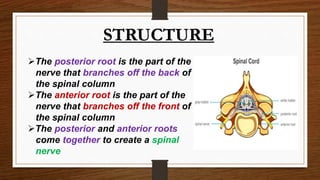
The posterior root is the part of the
nerve that branches off the back of
the spinal column
The anterior root is the part of the
nerve that branches off the front of
the spinal column
The posterior and anterior roots
come together to create a spinal
nerve
SPINAL CORD INJURIES
The spinal cord is a delicate part of the body. It is
therefore susceptible to injury
Vehicle accidents, gunshot wounds, and damage while
playing sports are all potential causes of spinal cord
injury
One has a complete injury when he loses the ability to
move or sense below the injury
The incomplete injury allows the injured to perform
some sensory and motor functions
SPINAL CORD INJURIES
Paralysis from an injury can be of two types:
1) Tetraplegic 2) Paraplegic
Tetraplegia is a paralysis that results in total or partial
loss of use of all four limbs and torso
Paraplegia is similar to tetraplegic except it doesn’t
affect the arms.
These injuries result in the inability to voluntarily move
limbs, lose sensation, delayed reflexes etc
FUNCTIONS
Forms a connecting link between the brain and the PNS
Provides structural support and builds a body posture
Facilitates flexible movements
Communicates messages from the brain to different
parts of the body
Coordinates reflexes
Receives sensory information from receptors and
approaches towards the brain for processing
GROUP MEMBERS
HASSAN RAZA WASEEM AHMED
MUHAMMAD UZAIR MUHAMMAD NAJAM
MUHAMMAD FAHAD

SPINAL CORD(1ii).pptx

  • 1.
    B.Sc. (H) 3rdYear (Animal Behaviour)
  • 2.
    INTRODUCTION A part ofthe Central Nervous System A long pipe-like structure arising from the medulla oblongata Running through the vertebral column of the backbone consisting of nerve fibres joining to form the spinal nerves
  • 3.
    ANATOMY  40cm longand 2cm wide  The spinal cord is divided into five different parts i. Cervical cord  Neck ii. Thoracic cord  Chest iii. Lumbar cord  Lower back iv. Sacral cord  Sacrum v. Coccygeal  Tailbone
  • 4.
    STRUCTURE Cross-section displays greymatter surrounded by white matter Grey matter is filled with a fluid called CSF (Cerebrospinal fluid) The white matter consists of a collection of axons permitting communication between different layers of CNS
  • 5.
    STRUCTURE The posterior rootis the part of the nerve that branches off the back of the spinal column The anterior root is the part of the nerve that branches off the front of the spinal column The posterior and anterior roots come together to create a spinal nerve
  • 6.
    SPINAL CORD INJURIES Thespinal cord is a delicate part of the body. It is therefore susceptible to injury Vehicle accidents, gunshot wounds, and damage while playing sports are all potential causes of spinal cord injury One has a complete injury when he loses the ability to move or sense below the injury The incomplete injury allows the injured to perform some sensory and motor functions
  • 7.
    SPINAL CORD INJURIES Paralysisfrom an injury can be of two types: 1) Tetraplegic 2) Paraplegic Tetraplegia is a paralysis that results in total or partial loss of use of all four limbs and torso Paraplegia is similar to tetraplegic except it doesn’t affect the arms. These injuries result in the inability to voluntarily move limbs, lose sensation, delayed reflexes etc
  • 8.
    FUNCTIONS Forms a connectinglink between the brain and the PNS Provides structural support and builds a body posture Facilitates flexible movements Communicates messages from the brain to different parts of the body Coordinates reflexes Receives sensory information from receptors and approaches towards the brain for processing
  • 9.
    GROUP MEMBERS HASSAN RAZAWASEEM AHMED MUHAMMAD UZAIR MUHAMMAD NAJAM MUHAMMAD FAHAD