OUTCOMES
Students learn to:
1. Classify living things according to structural features and
identify that they have patterns of similarities and
differences
2. Identify a range of plants and animals using simple keys
3. Identify that living things can be divided into a number of
major kingdoms
4. Discuss the concept of a species
5. Design simple keys to identify a range of living things
6. Classify organisms as being autotrophic or heterotrophic
FOCUS OUTCOME
Classify living things according to
structural features and identify that
they have patterns of similarities and
differences
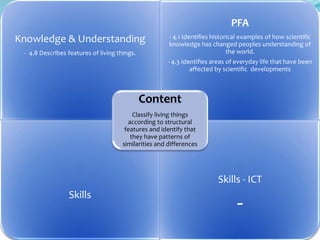
Knowledge & Understanding
- 4.8 Describes features of living things.
PFA
- 4.1 Identifies historical examples of how scientific
knowledge has changed peoples understanding of
the world.
- 4.3 Identifies areas of everyday life that have been
affected by scientific developments
Skills
Skills - ICT
-
Content
Classify living things
according to structural
features and identify that
they have patterns of
similarities and differences
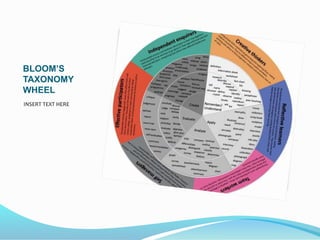
BLOOM’S
TAXONOMY
WHEEL
INSERT TEXT HERE
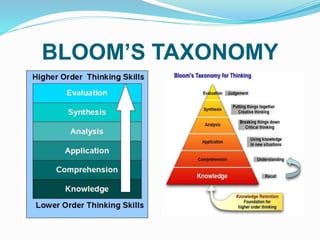
BLOOM’S TAXONOMY
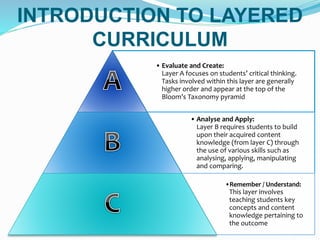
INTRODUCTION TO LAYERED
CURRICULUM
• Evaluate and Create:
Layer A focuses on students’ critical thinking.
Tasks involved within this layer are generally
higher order and appear at the top of the
Bloom’s Taxonomy pyramid
• Analyse and Apply:
Layer B requires students to build
upon their acquired content
knowledge (from layer C) through
the use of various skills such as
analysing, applying, manipulating
and comparing.
•Remember / Understand:
This layer involves
teaching students key
concepts and content
knowledge pertaining to
the outcome
LAYER C
 INSERT TEXT HERE
LAYER B
 INSERT TEXT HERE
LAYER A
 INSERT TEXT HERE
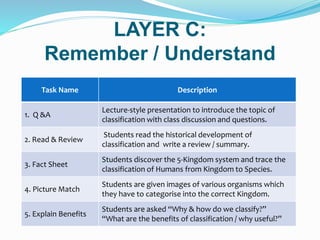
LAYER C:
Remember / Understand
Task Name Description
1. Q &A
Lecture-style presentation to introduce the topic of
classification with class discussion and questions.
2. Read & Review
Students read the historical development of
classification and write a review / summary.
3. Fact Sheet
Students discover the 5-Kingdom system and trace the
classification of Humans from Kingdom to Species.
4. Picture Match
Students are given images of various organisms which
they have to categorise into the correct Kingdom.
5. Explain Benefits
Students are asked “Why & how do we classify?”
“What are the benefits of classification / why useful?”
LAYER C - Example
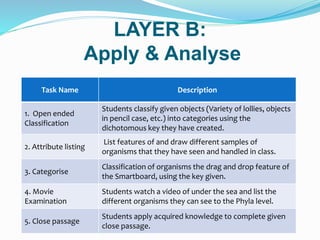
LAYER B:
Apply & Analyse
Task Name Description
1. Open ended
Classification
Students classify given objects (Variety of lollies, objects
in pencil case, etc.) into categories using the
dichotomous key they have created.
2. Attribute listing
List features of and draw different samples of
organisms that they have seen and handled in class.
3. Categorise
Classification of organisms the drag and drop feature of
the Smartboard, using the key given.
4. Movie
Examination
Students watch a video of under the sea and list the
different organisms they can see to the Phyla level.
5. Close passage
Students apply acquired knowledge to complete given
close passage.
LAYER B - Example
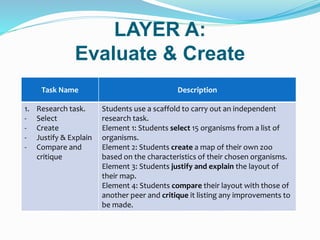
LAYER A:
Evaluate & Create
Task Name Description
1. Research task.
- Select
- Create
- Justify & Explain
- Compare and
critique
Students use a scaffold to carry out an independent
research task.
Element 1: Students select 15 organisms from a list of
organisms.
Element 2: Students create a map of their own zoo
based on the characteristics of their chosen organisms.
Element 3: Students justify and explain the layout of
their map.
Element 4: Students compare their layout with those of
another peer and critique it listing any improvements to
be made.

Special ed

  • 3.
    OUTCOMES Students learn to: 1.Classify living things according to structural features and identify that they have patterns of similarities and differences 2. Identify a range of plants and animals using simple keys 3. Identify that living things can be divided into a number of major kingdoms 4. Discuss the concept of a species 5. Design simple keys to identify a range of living things 6. Classify organisms as being autotrophic or heterotrophic
  • 4.
    FOCUS OUTCOME Classify livingthings according to structural features and identify that they have patterns of similarities and differences
  • 5.
    Knowledge & Understanding -4.8 Describes features of living things. PFA - 4.1 Identifies historical examples of how scientific knowledge has changed peoples understanding of the world. - 4.3 Identifies areas of everyday life that have been affected by scientific developments Skills Skills - ICT - Content Classify living things according to structural features and identify that they have patterns of similarities and differences
  • 6.
  • 7.
  • 8.
    INTRODUCTION TO LAYERED CURRICULUM •Evaluate and Create: Layer A focuses on students’ critical thinking. Tasks involved within this layer are generally higher order and appear at the top of the Bloom’s Taxonomy pyramid • Analyse and Apply: Layer B requires students to build upon their acquired content knowledge (from layer C) through the use of various skills such as analysing, applying, manipulating and comparing. •Remember / Understand: This layer involves teaching students key concepts and content knowledge pertaining to the outcome
  • 9.
  • 10.
  • 11.
  • 12.
    LAYER C: Remember /Understand Task Name Description 1. Q &A Lecture-style presentation to introduce the topic of classification with class discussion and questions. 2. Read & Review Students read the historical development of classification and write a review / summary. 3. Fact Sheet Students discover the 5-Kingdom system and trace the classification of Humans from Kingdom to Species. 4. Picture Match Students are given images of various organisms which they have to categorise into the correct Kingdom. 5. Explain Benefits Students are asked “Why & how do we classify?” “What are the benefits of classification / why useful?”
  • 13.
    LAYER C -Example
  • 14.
    LAYER B: Apply &Analyse Task Name Description 1. Open ended Classification Students classify given objects (Variety of lollies, objects in pencil case, etc.) into categories using the dichotomous key they have created. 2. Attribute listing List features of and draw different samples of organisms that they have seen and handled in class. 3. Categorise Classification of organisms the drag and drop feature of the Smartboard, using the key given. 4. Movie Examination Students watch a video of under the sea and list the different organisms they can see to the Phyla level. 5. Close passage Students apply acquired knowledge to complete given close passage.
  • 15.
    LAYER B -Example
  • 16.
    LAYER A: Evaluate &Create Task Name Description 1. Research task. - Select - Create - Justify & Explain - Compare and critique Students use a scaffold to carry out an independent research task. Element 1: Students select 15 organisms from a list of organisms. Element 2: Students create a map of their own zoo based on the characteristics of their chosen organisms. Element 3: Students justify and explain the layout of their map. Element 4: Students compare their layout with those of another peer and critique it listing any improvements to be made.