Lake Como 2016
Spatial network
Theory and applications
Marc Barthelemy
CEA, Institut de Physique Théorique, Saclay, France
EHESS, Centre d’Analyse et de Mathématiques sociales, Paris, France
marc.barthelemy@cea.fr
http://www.quanturb.com
Lake Como 2016
Outline
n  I. Introduction: space and networks
n  II. Tools
q  Irrelevant tools
q  Interesting tools
n  Typology (street patterns)
n  Simplicity
n  Time evolution (Streets, subway)
n  Mobility networks: Extracting mesoscale information
n  III. Some models
q  “Standard” models
n  Random geometric graph, tessellations
n  Optimal networks
q  “Non-standard” 
n  Road networks
q  Scaling theory 
n  Subway and railways
Lake Como 2016
(Short) Bibliography
n  Review article and books
q  Spatial Networks, MB, Physics Reports 499:1-101 (2011) (and arXiv)
q  Morphogenesis of spatial networks, MB, Springer, to appear (2017)
n  Books and articles (more mathematical)
q  Spatial tessellations, A Okabe (2009) 
q  Papers by D. Aldous
n  Older (but excellent) material:
q  Models in geography, Chorley and Haggett
q  Network analysis in geography, Haggett and Chorley
n  More specialized (urban systems and transportation)
q  The geography of transport systems, Rodrigue, Comtois, Slack
q  Geography of transportation, Taaffe and Gauthier
q  Planning for place and plexus, Levinson and Krizek
q  A new science of cities, M Batty (2013)
q  The Structure and dynamics of cities, MB, Cambridge Univ Press, to appear
(2016)
Lake Como 2016
Space and networks
n  Network science: space is not important

n  But for many networks, space does matter !
q  Biological (neural networks, veins)
q  Technological (power grids, Internet)
q  Transportation (roads, railways, airline network)
⇒  Nodes in space
Questions: 

- Effect of space on the traffic and on the shape of
(transportation) networks

- Principles of formation/evolution of spatial networks
Lake Como 2016
Spatial networks
n  A network is ‘spatial’ if
q  The nodes are located in space
q  The network is embedded in a space: There is a ‘cost’
associated to the length of links: a long link must be
compensated by something else (large degree, traffic, etc.)
n  Adjacency matrix (NxN) + the position of nodes
q  Very rich object
q  Time evolution: difficult problem
n  Many examples
q  Transportation systems
q  Power grids
q  Social networks
q  …
Lake Como 2016
Transportation networks
Transporting energy, goods or individuals

- formation and evolution

- congestion, optimization, robustness

- disease spread, urban evolution
Lake Como 2016
Transporting water
Nodes: intersections, auxins
sources"
Links: veins !
!
Example of a "
planar network"
Lake Como 2016
Transporting goods
State of Indiana (Bureau of Transportation
statistics)
Lake Como 2016
Nodes: power
plants, transformers,
etc,…)"
Links: cables"
Transporting electricity
New York state power grid"
Lake Como 2016
Transporting electricity
 US power grid"
Lake Como 2016
Transporting gas
 European pipelines"
Lake Como 2016
Transporting individuals: urban scale
Lake Como 2016
Intra urban movements: streets and roads
Lake Como 2016
TRANSIMS project"
Nodes: locations
(homes, shops,
offices, …)"
Links: flow of
individuals"
Chowell et al Phys. Rev. E (2003) Nature (2004)
Transporting individuals: intra city"
Mobility networks
Nodes: airports
Links: direct flight"
Transporting individuals: global scale "
(air travel)
Neural Network
 Nodes: neurons "
Links: axons !
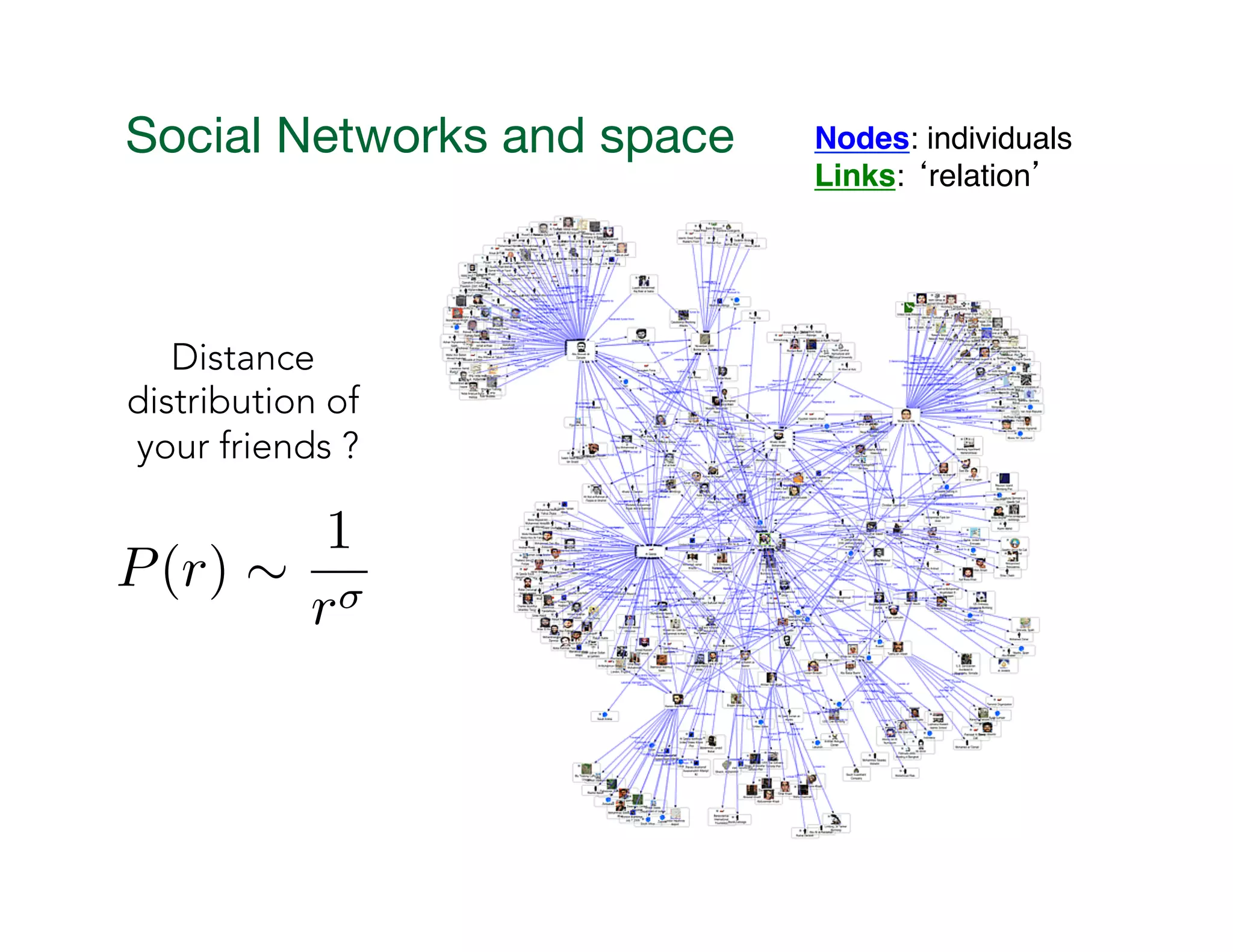
Social Networks and space
 Nodes: individuals "
Links: ‘relation’!
Distance
distribution of
your friends ?
P(r) ⇠
1
r
Lake Como 2016
Planar networks
Most of the interesting spatial networks 
are planar
Lake Como 2016
Planar networks
Graph G=(V,E) and can be represented in the plane
without intersections

n  Does not contain K5 or K3,3
n  Euler’s formula:
n  Any face has at least 3 edges and every edge touches
at most two faces (2E≥3F): Exact bound
Lake Como 2016
Planar networks
n  Other consequence:
n  Important for null models ! Don’t compare to
Emax=N(N-1)/2
Lake Como 2016
n  A graph has many representations (in 2d) 
n  But it can be drawn in 2d in such a way that no edges
cross each other: planar embedding, plane graph,
planar map

n  The planar map is the well-defined object for
mathematicians -used for the four color theorem for
example and in combinatorics (Tutte, Schaeffer, …)

Planar maps
Lake Como 2016
Irrelevant measures
Lake Como 2016
Uninteresting measures
n  Average degree
n  Degree distribution
n  Clustering and assortativity properties 
n  Edge length distribution
Lake Como 2016
Degree distribution P(k)
n  Physical constraints limit the degree (planar networks: <k> <6)
n  Road network and commuters in sardinia
Lammer et al, Physica A (2006)
 De Montis et al, Env Plan B (2007)
Power grids
Sole et al (2008)
Map
 Topological
network
Degree distribution
Europe, Italy, UK &Ireland
Power grids
Albert et al (2004)
North America
Lake Como 2016
Airline network
n  For spatial non-planar networks, we can have large
degrees (worldwide airline network, inter-urban)

Barrat, MB, Pastor-Satorras, Vespignani (2005)
Airline network
Lake Como 2016
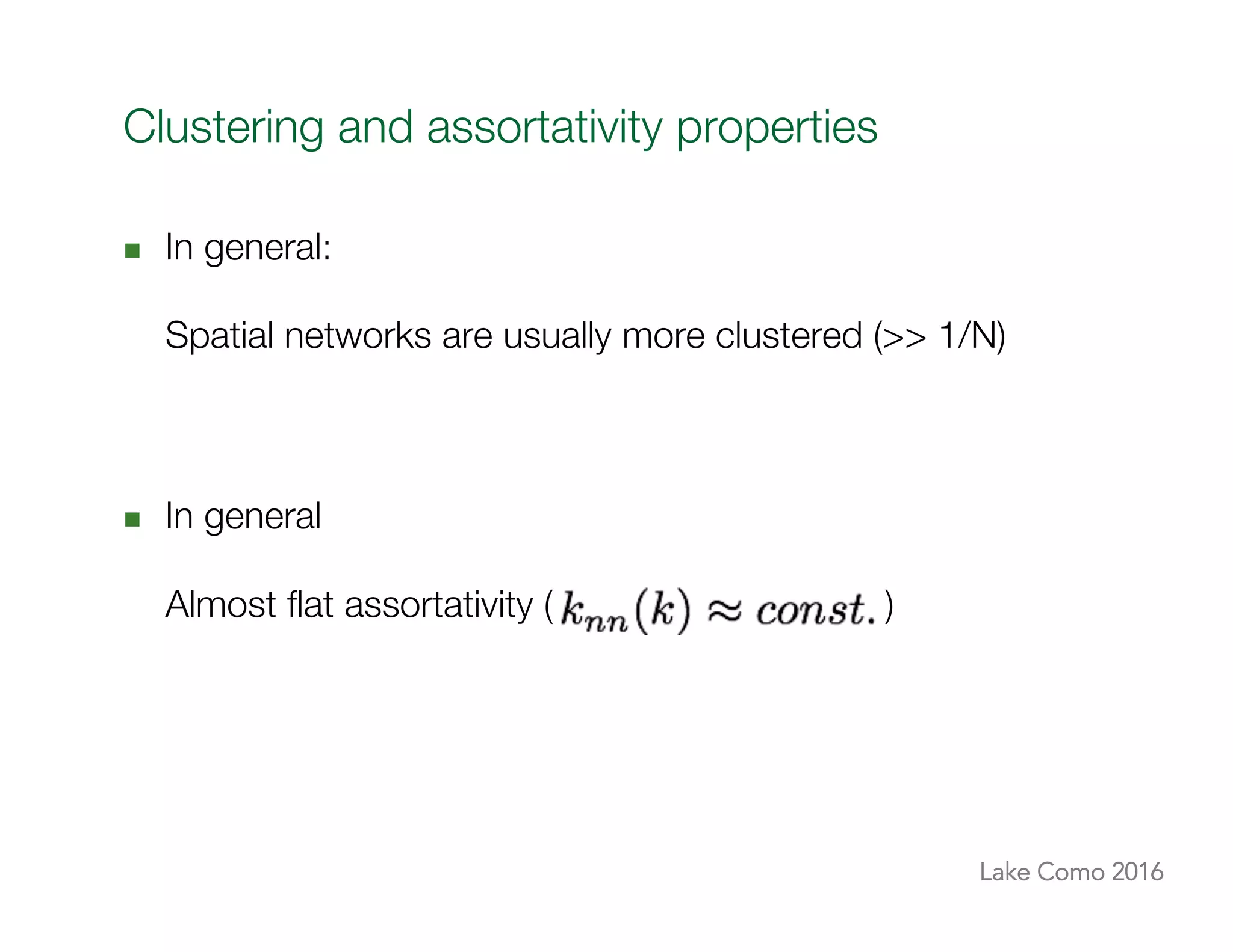
n  In general:

Spatial networks are usually more clustered (>> 1/N)
n  In general

Almost flat assortativity ( )
Clustering and assortativity properties "
Lake Como 2016
North American
Airline network

Clustering and assortativity properties "

Barrat et al, 2005
Lake Como 2016
Power grid
(Western US)

Clustering"

Ravasz et al, 2003
Lake Como 2016
Internet
(router level)

Clustering"

Ravasz et al, 2003
C(k)=const. 
(BA: C(k)=1/k)]
Lake Como 2016
Empirical fact: Length of links
n  Edge link limited

by cost
Gastner et Newman EPJ (2006)
Barrat, MB, Vespignani, JSTAT (2005)
Lake Como 2016
Empirical fact: Length of links
n  London street length
Masucci et al., 2009
Lake Como 2016
Road networks: Total length
Data from: Cardillo et al, PRE 2006
Total length vs. N
Argument for the total length
n  At this point, a perturbed lattice is a good model:

q  Scaling of length with N:
q  Peaked distribution of degrees:

n  Cell area and shape ?
Lake Como 2016
Interesting tools 
- Various indicators
- Typology of street patterns
- Simplicity
- Time evolution of networks
Lake Como 2016
Space has an important impact on the structure

Low information content measures:
n  Generally planar (nodes, edges, faces or cells)
n  Degree distribution: peaked (if planar)
n  Clustering: large
n  Assortativity spectrum: flat 
n  Edge length distribution: peaked
n  Total length: N1/2

More interesting:
n  Geometry statistics of cells (for planar graphs)
n  Betweenness centrality properties
n  Communities
n  Traffic, correlations: degree-distance, degree-traffic
n  …
Specific tools for spatial networks
§ Indices alpha, gamma, etc…
Specific tools for spatial networks
§ Indice for street networks
§ If r close to 1: ‘organic’ city
§ Small r<<1: organized city (N(4) dominant)
Specific tools for spatial networks
§ Indice for transportation networks
§ Q=1: straight line
§ Q>>1: large detour
(see D. Aldous)
Specific tools for spatial networks
§ Indice for transportation networks
Specific tools for spatial networks
§ Indice for transportation networks
Specific tools for spatial networks
§ An interesting null model: the minimum spanning
tree (MST)
§ Cost and efficiency
Lake Como 2016
Typology:
“classification” of
planar graphs
Lake Como 2016
Typology of planar graphs
Many applications:
n  Botanics (classification of leaves)
n  Urban morphology: street network (“Space syntax”)
Lake Como 2016
Typology of
street networks
S. Marshall (2005)
Lake Como 2016
Typology of
street networks
Classification 
Attempt
S. Marshall (2005)
Lake Como 2016
“Census of planar graphs”
n  BDG bijection between a rooted map and a tree
(Bouttier, Di Francesco, Guitter, Electron J Combin, 2009)

n  Approximate tree 
representation of a 
weighted planar map 
(Mileyko et al, PLoS One, 2012
Katifori et al, PLoS One 2012)
Lake Como 2016
Typology of planar graphs
From the graph to the statistics of blocks
Lake Como 2016
Lammer et al, Physica A (2006)
Shape of blocks
Lammer et al, Physica A (2006)
Lake Como 2016
- Lammer et al, Physica A (2006)
- MB, Physics Reports (2011)
Area of blocks
⌧ ' 2.0
Lake Como 2016
Broad block area distribution
n  Area of blocks
n  Simple argument: density fluctuations
n  Assumption: density random
Lake Como 2016
Shape versus area
n  But even with the same P(Φ) the networks can be very
different ! Importance of P(A)
n  The visual impression of a map is given by both the
distribution of shapes and areas
n  We thus use P(Φ|A) and bin the area (small, medium,
large)
Lake Como 2016
Combining shape and area of blocks: a
“fingerprint” of planar graphs:
Louf & MB, RS Interface (2014)
P( |A)
Lake Como 2016
A “fingerprint” of planar graphs
Tokyo
NYC
Lake Como 2016
Typology of street patterns
Louf & MB, RS Interface (2014)
n  Distance constructed on 
n  Clustering -> classes of planar graphs (131 cities)
P( |A)
Lake Como 2016
Not the end of the story
n  Attempt to classify planar maps
n  Taking into account both topological and geometrical
features
n  Correlations ? (existence of neighborhoods)
Lake Como 2016
Time evolution:
Characterization ?
Too many things to measure…
Lake Como 2016
An old problem in quantitative geography
n  Kansky (63-69)
Evolution 
of the Sicilian 
railroad network

n  Morrill (1965)
Railway network
Growth

n  New data sources:
Digitization of 
old maps
Lake Como 2016
Road network evolution
Groane region, Italy 1833-2007
Strano, Nicosia, Latora, Porta, MB, Nature Scientific Reports (2012)
Lake Como 2016
Road network evolution:
Importance of central planning
n  Evolution of the Paris street network 1789-2010
(1789, 1826, 1836, 1888, 1999, 2010-soon 1591, 1652, 1728)
n  Haussmann period (~1853-1870)
Lake Como 2016
Road network evolution
Central Paris, France 1789-2010
MB, Bordin, Berestycki, Gribaudi (2013)
1789
Lake Como 2016
Road network evolution
Central Paris, France 1789-2010
MB, Bordin, Berestycki, Gribaudi (2013)
1826
Lake Como 2016
Road network evolution
Central Paris, France 1789-2010
MB, Bordin, Berestycki, Gribaudi (2013)
1836
Lake Como 2016
Road network evolution
Central Paris, France 1789-2010
MB, Bordin, Berestycki, Gribaudi (2013)
1888
Lake Como 2016
Road network evolution
Central Paris, France 1789-2010
MB, Bordin, Berestycki, Gribaudi (2013)
1999
Lake Como 2016
Road network
China
1600(BC)- 1900 (AC)
Wang, Ducruet,
Wang (2015)
Lake Como 2016
1. Simple measures
Lake Como 2016
Road network evolution (Groane region, Italy)
Lake Como 2016
Importance of central planning
n  N follows the population evolution
n  The “good” clock here is the number of nodes
Lake Como 2016
Time evolution (Paris 1789-2010)
n  Standard indicators versus time or N
Lake Como 2016
Lammer et al, Physica A (2006)
Faces (blocks): shape and area
P(A) ⇠?
Lake Como 2016
Haussmann effect: shape factor
Lake Como 2016
Haussmann effect: angle distribution
Lake Como 2016
Road network evolution
Lake Como 2016
2. The betweenness
centrality
Lake Como 2016
More interesting: Betweenness Centrality
(Freeman ‘77)
σst = # of shortest paths from s to t
σst(ij)= # of shortest paths from s to t via (ij)
i
j
k
ij: large centrality
jk: small centrality
Measures the importance of a segment in the shortest
paths flow
Betweenness centrality and space
Large BC: distance 
to barycenter
Large BC: large degree
Lake Como 2016
Betweenness centrality and space
Lammer et al, 2006
Lake Como 2016
Betweenness centrality
n  Backbone of stable central roads
Lake Como 2016
Haussmann effect
n  Spatial distribution of centrality (most central nodes)
Lake Como 2016
Characterization of new links: BC impact
n  Average BC of the graph at time t:
n  BC impact of new edge e*:
Lake Como 2016
Evolution: two processes
n  Two different categories of new links: ‘densification’ and
‘exploration’ clearly identified by the BC impact
Lake Como 2016
3. The simplicity
Lake Como 2016
!
Statistical comparison of the length of shortest and
simplest paths (with the minimal number of turns)
Another measure: Simplicity of planar networks
MP. Viana, E. Strano, P. Bordin, MB (Sci. Rep. 2013)
Lake Como 2016
Perspective: the Simplicity of planar netwoks
!
n  Statistical comparison of the length of shortest and
simplest paths
MP. Viana, E. Strano, P. Bordin, MB (2014)
Lake Como 2016
Simplicity of paths
Viana, Strano, Bordin, MB Scientific reports (2013)
S(d) =
1
N(d)
X
i,j/d(i,j)=d
`⇤
(i, j)
`(i, j)
`(i, j)
`⇤
(i, j)
Length of shortest path
Length of simplest path
For small d: and increases 
For large d: 
⇒ There is a (at least one) maximum at d=d*
Meaning of d*: typical size of ‘domains’ not
crossed by long straight lines

S(d ! 0) ⇡ 1
S(d ! dmax) ⇡ 1
Lake Como 2016
Lammer et al, Physica A (2006)
Simplicity
Spectrum
Viana, Strano,
Bordin, MB
Scientific reports
(2013)
Length of simplest path
Lake Como 2016
10 Km
0 0.2 0.4 0.6 0.8 1
1
1.1
1.2
1.3
1.4
1833
1914
1913
1955
1980
1994
2007
S(d)
0 0.2 0.4 0.6 0.8 1
1
1.1
1.2
1.3
1.4
1.5
1789
1826
1836
1888
1999
d/dmax
S(d)
1955 1980 2007
¯Groane evolving street network
4 KmParis evolving street network
2 CmPhysarum evolving vascular network
a
b
c
d/dmax
1789
h 4 h 8 h 10 h 15 h 20
19991836
0 0.2 0.4 0.6 0.8 1
1
1.1
1.2
1.3
1.4
h04
h08
h10
h15
h20
d/dmax
S(d)
Viana, Strano, Bordin, MB Scientific reports (2013)
Lake Como 2016
4. Template:
the subway case
Too many things to measure: a template as 
a guide
Lake Como 2016
The subway evolution: not a new problem 
n  Cope (1967): Stages of the London underground rail
Lake Como 2016
All large cities have a subway system
Lake Como 2016
World subway networks
We focus on large networks (N>100 stations)
Time evolving spatial networks: too many things to measure !
Most large cities have a subway network (50% for P>106)
Lake Como 2016
Lake Como 2016
“Universal” template
Algorithm to
identify the 
core and 
the branches
(non-ambiguous)
Lake Como 2016
Measures on this universal structure
n  Characterizing the core

NC: number of nodes in the core
EC: number of links in the core
Lake Como 2016
Measures on this universal structure
n  Characterizing the branches
NB: number of stations in branches
NC: number of stations in the core


DB: average distance from barycenter to branches stations
DC: average distance from barycenter to core stations
Lake Como 2016
Evolution
fraction of
branches
stations
Lake Como 2016
Average degree
Percentage f2
Lake Como 2016
Spatial extension of branches
Lake Como 2016
“Universal” template
n  Quantitative convergence
q  Fraction of branches 

stations of order 50%
q  Extension of branches/core 

extension of order 2
q  Average degree 

of core of order 2.5 

and f2>60%
Lake Como 2016
Spatial organization of the core and branches
n  Old result for Paris (Benguigui, Daoud 1991)


N(r): number of stations at distance less than r from
barycenter
First regime: homogeneous distribution with df=2
Second regime ?
Lake Como 2016
Spatial organization of the core and branches
n  Natural explanation with the universal template


: core density
Nb : number of branches
: Interstation spacing at distance r
Lake Como 2016
Spatial organization of the core and branches
n  Interstation spacing at distance r
n  Natural explanation of the Benguigui-Daoud
result
Lake Como 2016
Number of branches
n  If the spacing between two branches is constant:
n  For a lattice of size N
Lake Como 2016
Number of branches
Lake Como 2016
“Universal” template
n  Quantitative convergence!
q  Fraction of branches !
"stations of order 50%!
q  Extension of branches/core !
"extension of order 2!
q  Average degree !
"of core of order 2.5 !
"and f2>60%!
!
q  Number of branches!
"!
!
!
=> Existence of a minimal model (?)!
!
Lake Como 2016
5. Extracting mesoscale
information from mobile
phone data
How can we get meaningful information from
large dasets ?
Typology of mobility patterns
(journey to work trips)
Motivation:
Compare the spatial 
structure of mobility patterns
in many cities

Question:
How to build a quantitative
typology of cities based on the
spatial structure of the mobility
patterns ?
(Bertaud & Malpezzi 2003)
Lake Como 2016
How to compare OD commuting
matrices of different cities?
§  The OD matrix is a large and complicated object
§  Difficult to compare different cities ! 
- Different sizes
- Potentially different spatial resolutions
§  We need a simpler, clearer picture:
coarse-grained information 

Fij
i j
Hotspots: local maxima of density
City structure (mono- vs. polycentric)
Aire urbaine de Zaragoza Aire urbaine de Bilbao
ENPC-2016
Hotspot identification
n  State of the art
q  No clear method
q  Density larger than a given 

threshold is a hotspot
q  Problem of the 

threshold choice
n  A simple approach
q  Discussion on the 

Lorentz curve
q  Identify a lower 

and upper threshold
Louail, et al, Sci. Rep. 2014
⇢1 < ⇢2 < · · · < ⇢N
Lake Como 2016
How to compare OD commuting
matrices of different cities?

1. Determine 
Residential and 
work hotspots
(Louail et al, 2014)

2. Separate 4 categories 
of flows: I, C, D, R

Integrated: Hotspot->Hotspot
Convergent: Non hotspot->hotspot
Divergent: Hotspot->non hotspot
Random: non hotspot->non hotspot
Louail, et al, Nature Comms 2015
0.1
0.2
0.3
0.4
0.5
106
P
Flows I C D RThe importance of 
Integrated flows
decreases when population 
size increases,
in favor of an increase 
of “Random” flows

Weights of Divergent and 
Convergent flows 
are constant 
I and R alone seem 
enough to characterize cities


Structure of flows versus population
(30 largest urban areas in Spain)
Louail, et al, Nature Comms 2015
Lake Como 2016
Structure des flots (Espagne)
Vient des possibilité plus grandes dans les
grandes villes de se deplacer (?)

Structure spatiale “délocalisée” des grandes
villes
Cordoba
Gijon
Vitoria
Zaragosa
Malaga

Valencia
Sevilla

Madrid
Barcelona
R 27% 36% 41% 46%
I 43% 37% 31% 25%
Population
Lake Como 2016
Numbers of hotspots vs. population size of the city
Exponent value is
remarkably smaller for
work/school/daily
activity hotspots

à in Spanish urban
areas, the number of
activity places grows
slower than
the number of
major residential
places.

Sublinear in both
cases !!!
Lake Como 2016
Discussion
n  New results on new datasets usually imply to have new
tools !
n  Typology
q  Attempt to classify planar maps
q  Taking into account both topological and geometrical features
q  Correlations ?
n  Evolution of planar graphs
q  Simple measures usually not very helpful
q  Important structural changes: betweenness centrality distribution
q  Use of templates
q  Better characterization ?
q  Models ?
Lake Como 2016
Thank you for your attention.

Students and Postdocs:

Giulia Carra (PhD student)

Riccardo Gallotti (Postdoc)

Thomas Louail (Postdoc)

Remi Louf (PhD student)
Emanuele Strano (PhD student)

Collaborators:

M. Batty 

 H. Berestycki 
P. Bordin


S. Dobson 

 M. Gribaudi 
P. Jensen

JP. Nadal 
 V. Nicosia 
V. Latora

J. Perret 
 S. Porta 
C. Roth


S. Shay MP. Viana

Funding:

EUNOIA (FP7-DG.Connect-318367 European Commission)

PLEXMATH (FP7-ICT-2011-8 European Commission)
www.quanturb.com
marc.barthelemy@cea.fr

Spatial network, Theory and applications - Marc Barthelemy

  • 1.
    Lake Como 2016 Spatialnetwork Theory and applications Marc Barthelemy CEA, Institut de Physique Théorique, Saclay, France EHESS, Centre d’Analyse et de Mathématiques sociales, Paris, France marc.barthelemy@cea.fr http://www.quanturb.com
  • 2.
    Lake Como 2016 Outline n I. Introduction: space and networks n  II. Tools q  Irrelevant tools q  Interesting tools n  Typology (street patterns) n  Simplicity n  Time evolution (Streets, subway) n  Mobility networks: Extracting mesoscale information n  III. Some models q  “Standard” models n  Random geometric graph, tessellations n  Optimal networks q  “Non-standard” n  Road networks q  Scaling theory n  Subway and railways
  • 3.
    Lake Como 2016 (Short)Bibliography n  Review article and books q  Spatial Networks, MB, Physics Reports 499:1-101 (2011) (and arXiv) q  Morphogenesis of spatial networks, MB, Springer, to appear (2017) n  Books and articles (more mathematical) q  Spatial tessellations, A Okabe (2009) q  Papers by D. Aldous n  Older (but excellent) material: q  Models in geography, Chorley and Haggett q  Network analysis in geography, Haggett and Chorley n  More specialized (urban systems and transportation) q  The geography of transport systems, Rodrigue, Comtois, Slack q  Geography of transportation, Taaffe and Gauthier q  Planning for place and plexus, Levinson and Krizek q  A new science of cities, M Batty (2013) q  The Structure and dynamics of cities, MB, Cambridge Univ Press, to appear (2016)
  • 4.
    Lake Como 2016 Spaceand networks n  Network science: space is not important n  But for many networks, space does matter ! q  Biological (neural networks, veins) q  Technological (power grids, Internet) q  Transportation (roads, railways, airline network) ⇒  Nodes in space Questions: - Effect of space on the traffic and on the shape of (transportation) networks - Principles of formation/evolution of spatial networks
  • 5.
    Lake Como 2016 Spatialnetworks n  A network is ‘spatial’ if q  The nodes are located in space q  The network is embedded in a space: There is a ‘cost’ associated to the length of links: a long link must be compensated by something else (large degree, traffic, etc.) n  Adjacency matrix (NxN) + the position of nodes q  Very rich object q  Time evolution: difficult problem n  Many examples q  Transportation systems q  Power grids q  Social networks q  …
  • 6.
    Lake Como 2016 Transportationnetworks Transporting energy, goods or individuals - formation and evolution - congestion, optimization, robustness - disease spread, urban evolution
  • 7.
    Lake Como 2016 Transportingwater Nodes: intersections, auxins sources" Links: veins ! ! Example of a " planar network"
  • 8.
    Lake Como 2016 Transportinggoods State of Indiana (Bureau of Transportation statistics)
  • 9.
    Lake Como 2016 Nodes:power plants, transformers, etc,…)" Links: cables" Transporting electricity New York state power grid"
  • 10.
    Lake Como 2016 Transportingelectricity US power grid"
  • 11.
    Lake Como 2016 Transportinggas European pipelines"
  • 12.
    Lake Como 2016 Transportingindividuals: urban scale
  • 13.
    Lake Como 2016 Intraurban movements: streets and roads
  • 14.
    Lake Como 2016 TRANSIMSproject" Nodes: locations (homes, shops, offices, …)" Links: flow of individuals" Chowell et al Phys. Rev. E (2003) Nature (2004) Transporting individuals: intra city" Mobility networks
  • 15.
    Nodes: airports Links: directflight" Transporting individuals: global scale " (air travel)
  • 16.
    Neural Network Nodes:neurons " Links: axons !
  • 17.
    Social Networks andspace Nodes: individuals " Links: ‘relation’! Distance distribution of your friends ? P(r) ⇠ 1 r
  • 18.
    Lake Como 2016 Planarnetworks Most of the interesting spatial networks are planar
  • 19.
    Lake Como 2016 Planarnetworks Graph G=(V,E) and can be represented in the plane without intersections n  Does not contain K5 or K3,3 n  Euler’s formula: n  Any face has at least 3 edges and every edge touches at most two faces (2E≥3F): Exact bound
  • 20.
    Lake Como 2016 Planarnetworks n  Other consequence: n  Important for null models ! Don’t compare to Emax=N(N-1)/2
  • 21.
    Lake Como 2016 n A graph has many representations (in 2d) n  But it can be drawn in 2d in such a way that no edges cross each other: planar embedding, plane graph, planar map n  The planar map is the well-defined object for mathematicians -used for the four color theorem for example and in combinatorics (Tutte, Schaeffer, …) Planar maps
  • 22.
  • 23.
    Lake Como 2016 Uninterestingmeasures n  Average degree n  Degree distribution n  Clustering and assortativity properties n  Edge length distribution
  • 24.
    Lake Como 2016 Degreedistribution P(k) n  Physical constraints limit the degree (planar networks: <k> <6) n  Road network and commuters in sardinia Lammer et al, Physica A (2006) De Montis et al, Env Plan B (2007)
  • 25.
    Power grids Sole etal (2008) Map Topological network Degree distribution Europe, Italy, UK &Ireland
  • 26.
    Power grids Albert etal (2004) North America
  • 27.
    Lake Como 2016 Airlinenetwork n  For spatial non-planar networks, we can have large degrees (worldwide airline network, inter-urban) Barrat, MB, Pastor-Satorras, Vespignani (2005) Airline network
  • 28.
    Lake Como 2016 n In general: Spatial networks are usually more clustered (>> 1/N) n  In general Almost flat assortativity ( ) Clustering and assortativity properties "
  • 29.
    Lake Como 2016 NorthAmerican Airline network Clustering and assortativity properties " Barrat et al, 2005
  • 30.
    Lake Como 2016 Powergrid (Western US) Clustering" Ravasz et al, 2003
  • 31.
    Lake Como 2016 Internet (routerlevel) Clustering" Ravasz et al, 2003 C(k)=const. (BA: C(k)=1/k)]
  • 32.
    Lake Como 2016 Empiricalfact: Length of links n  Edge link limited by cost Gastner et Newman EPJ (2006) Barrat, MB, Vespignani, JSTAT (2005)
  • 33.
    Lake Como 2016 Empiricalfact: Length of links n  London street length Masucci et al., 2009
  • 34.
    Lake Como 2016 Roadnetworks: Total length Data from: Cardillo et al, PRE 2006 Total length vs. N
  • 35.
    Argument for thetotal length n  At this point, a perturbed lattice is a good model: q  Scaling of length with N: q  Peaked distribution of degrees: n  Cell area and shape ?
  • 36.
    Lake Como 2016 Interestingtools - Various indicators - Typology of street patterns - Simplicity - Time evolution of networks
  • 37.
    Lake Como 2016 Spacehas an important impact on the structure Low information content measures: n  Generally planar (nodes, edges, faces or cells) n  Degree distribution: peaked (if planar) n  Clustering: large n  Assortativity spectrum: flat n  Edge length distribution: peaked n  Total length: N1/2 More interesting: n  Geometry statistics of cells (for planar graphs) n  Betweenness centrality properties n  Communities n  Traffic, correlations: degree-distance, degree-traffic n  …
  • 38.
    Specific tools forspatial networks § Indices alpha, gamma, etc…
  • 39.
    Specific tools forspatial networks § Indice for street networks § If r close to 1: ‘organic’ city § Small r<<1: organized city (N(4) dominant)
  • 40.
    Specific tools forspatial networks § Indice for transportation networks § Q=1: straight line § Q>>1: large detour (see D. Aldous)
  • 41.
    Specific tools forspatial networks § Indice for transportation networks
  • 42.
    Specific tools forspatial networks § Indice for transportation networks
  • 43.
    Specific tools forspatial networks § An interesting null model: the minimum spanning tree (MST) § Cost and efficiency
  • 44.
  • 45.
    Lake Como 2016 Typologyof planar graphs Many applications: n  Botanics (classification of leaves) n  Urban morphology: street network (“Space syntax”)
  • 46.
    Lake Como 2016 Typologyof street networks S. Marshall (2005)
  • 47.
    Lake Como 2016 Typologyof street networks Classification Attempt S. Marshall (2005)
  • 48.
    Lake Como 2016 “Censusof planar graphs” n  BDG bijection between a rooted map and a tree (Bouttier, Di Francesco, Guitter, Electron J Combin, 2009) n  Approximate tree representation of a weighted planar map (Mileyko et al, PLoS One, 2012 Katifori et al, PLoS One 2012)
  • 49.
    Lake Como 2016 Typologyof planar graphs From the graph to the statistics of blocks
  • 50.
    Lake Como 2016 Lammeret al, Physica A (2006) Shape of blocks Lammer et al, Physica A (2006)
  • 51.
    Lake Como 2016 -Lammer et al, Physica A (2006) - MB, Physics Reports (2011) Area of blocks ⌧ ' 2.0
  • 52.
    Lake Como 2016 Broadblock area distribution n  Area of blocks n  Simple argument: density fluctuations n  Assumption: density random
  • 53.
    Lake Como 2016 Shapeversus area n  But even with the same P(Φ) the networks can be very different ! Importance of P(A) n  The visual impression of a map is given by both the distribution of shapes and areas n  We thus use P(Φ|A) and bin the area (small, medium, large)
  • 54.
    Lake Como 2016 Combiningshape and area of blocks: a “fingerprint” of planar graphs: Louf & MB, RS Interface (2014) P( |A)
  • 55.
    Lake Como 2016 A“fingerprint” of planar graphs Tokyo NYC
  • 56.
    Lake Como 2016 Typologyof street patterns Louf & MB, RS Interface (2014) n  Distance constructed on n  Clustering -> classes of planar graphs (131 cities) P( |A)
  • 57.
    Lake Como 2016 Notthe end of the story n  Attempt to classify planar maps n  Taking into account both topological and geometrical features n  Correlations ? (existence of neighborhoods)
  • 58.
    Lake Como 2016 Timeevolution: Characterization ? Too many things to measure…
  • 59.
    Lake Como 2016 Anold problem in quantitative geography n  Kansky (63-69) Evolution of the Sicilian railroad network n  Morrill (1965) Railway network Growth n  New data sources: Digitization of old maps
  • 60.
    Lake Como 2016 Roadnetwork evolution Groane region, Italy 1833-2007 Strano, Nicosia, Latora, Porta, MB, Nature Scientific Reports (2012)
  • 61.
    Lake Como 2016 Roadnetwork evolution: Importance of central planning n  Evolution of the Paris street network 1789-2010 (1789, 1826, 1836, 1888, 1999, 2010-soon 1591, 1652, 1728) n  Haussmann period (~1853-1870)
  • 62.
    Lake Como 2016 Roadnetwork evolution Central Paris, France 1789-2010 MB, Bordin, Berestycki, Gribaudi (2013) 1789
  • 63.
    Lake Como 2016 Roadnetwork evolution Central Paris, France 1789-2010 MB, Bordin, Berestycki, Gribaudi (2013) 1826
  • 64.
    Lake Como 2016 Roadnetwork evolution Central Paris, France 1789-2010 MB, Bordin, Berestycki, Gribaudi (2013) 1836
  • 65.
    Lake Como 2016 Roadnetwork evolution Central Paris, France 1789-2010 MB, Bordin, Berestycki, Gribaudi (2013) 1888
  • 66.
    Lake Como 2016 Roadnetwork evolution Central Paris, France 1789-2010 MB, Bordin, Berestycki, Gribaudi (2013) 1999
  • 67.
    Lake Como 2016 Roadnetwork China 1600(BC)- 1900 (AC) Wang, Ducruet, Wang (2015)
  • 68.
    Lake Como 2016 1.Simple measures
  • 69.
    Lake Como 2016 Roadnetwork evolution (Groane region, Italy)
  • 70.
    Lake Como 2016 Importanceof central planning n  N follows the population evolution n  The “good” clock here is the number of nodes
  • 71.
    Lake Como 2016 Timeevolution (Paris 1789-2010) n  Standard indicators versus time or N
  • 72.
    Lake Como 2016 Lammeret al, Physica A (2006) Faces (blocks): shape and area P(A) ⇠?
  • 73.
    Lake Como 2016 Haussmanneffect: shape factor
  • 74.
    Lake Como 2016 Haussmanneffect: angle distribution
  • 75.
    Lake Como 2016 Roadnetwork evolution
  • 76.
    Lake Como 2016 2.The betweenness centrality
  • 77.
    Lake Como 2016 Moreinteresting: Betweenness Centrality (Freeman ‘77) σst = # of shortest paths from s to t σst(ij)= # of shortest paths from s to t via (ij) i j k ij: large centrality jk: small centrality Measures the importance of a segment in the shortest paths flow
  • 78.
    Betweenness centrality andspace Large BC: distance to barycenter Large BC: large degree
  • 79.
    Lake Como 2016 Betweennesscentrality and space Lammer et al, 2006
  • 80.
    Lake Como 2016 Betweennesscentrality n  Backbone of stable central roads
  • 81.
    Lake Como 2016 Haussmanneffect n  Spatial distribution of centrality (most central nodes)
  • 82.
    Lake Como 2016 Characterizationof new links: BC impact n  Average BC of the graph at time t: n  BC impact of new edge e*:
  • 83.
    Lake Como 2016 Evolution:two processes n  Two different categories of new links: ‘densification’ and ‘exploration’ clearly identified by the BC impact
  • 84.
    Lake Como 2016 3.The simplicity
  • 85.
    Lake Como 2016 ! Statisticalcomparison of the length of shortest and simplest paths (with the minimal number of turns) Another measure: Simplicity of planar networks MP. Viana, E. Strano, P. Bordin, MB (Sci. Rep. 2013)
  • 86.
    Lake Como 2016 Perspective:the Simplicity of planar netwoks ! n  Statistical comparison of the length of shortest and simplest paths MP. Viana, E. Strano, P. Bordin, MB (2014)
  • 87.
    Lake Como 2016 Simplicityof paths Viana, Strano, Bordin, MB Scientific reports (2013) S(d) = 1 N(d) X i,j/d(i,j)=d `⇤ (i, j) `(i, j) `(i, j) `⇤ (i, j) Length of shortest path Length of simplest path For small d: and increases For large d: ⇒ There is a (at least one) maximum at d=d* Meaning of d*: typical size of ‘domains’ not crossed by long straight lines S(d ! 0) ⇡ 1 S(d ! dmax) ⇡ 1
  • 88.
    Lake Como 2016 Lammeret al, Physica A (2006) Simplicity Spectrum Viana, Strano, Bordin, MB Scientific reports (2013) Length of simplest path
  • 89.
    Lake Como 2016 10Km 0 0.2 0.4 0.6 0.8 1 1 1.1 1.2 1.3 1.4 1833 1914 1913 1955 1980 1994 2007 S(d) 0 0.2 0.4 0.6 0.8 1 1 1.1 1.2 1.3 1.4 1.5 1789 1826 1836 1888 1999 d/dmax S(d) 1955 1980 2007 ¯Groane evolving street network 4 KmParis evolving street network 2 CmPhysarum evolving vascular network a b c d/dmax 1789 h 4 h 8 h 10 h 15 h 20 19991836 0 0.2 0.4 0.6 0.8 1 1 1.1 1.2 1.3 1.4 h04 h08 h10 h15 h20 d/dmax S(d) Viana, Strano, Bordin, MB Scientific reports (2013)
  • 90.
    Lake Como 2016 4.Template: the subway case Too many things to measure: a template as a guide
  • 91.
    Lake Como 2016 Thesubway evolution: not a new problem n  Cope (1967): Stages of the London underground rail
  • 92.
    Lake Como 2016 Alllarge cities have a subway system
  • 93.
    Lake Como 2016 Worldsubway networks We focus on large networks (N>100 stations) Time evolving spatial networks: too many things to measure ! Most large cities have a subway network (50% for P>106)
  • 94.
  • 95.
    Lake Como 2016 “Universal”template Algorithm to identify the core and the branches (non-ambiguous)
  • 96.
    Lake Como 2016 Measureson this universal structure n  Characterizing the core NC: number of nodes in the core EC: number of links in the core
  • 97.
    Lake Como 2016 Measureson this universal structure n  Characterizing the branches NB: number of stations in branches NC: number of stations in the core DB: average distance from barycenter to branches stations DC: average distance from barycenter to core stations
  • 98.
  • 99.
    Lake Como 2016 Averagedegree Percentage f2
  • 100.
    Lake Como 2016 Spatialextension of branches
  • 101.
    Lake Como 2016 “Universal”template n  Quantitative convergence q  Fraction of branches stations of order 50% q  Extension of branches/core extension of order 2 q  Average degree of core of order 2.5 and f2>60%
  • 102.
    Lake Como 2016 Spatialorganization of the core and branches n  Old result for Paris (Benguigui, Daoud 1991) N(r): number of stations at distance less than r from barycenter First regime: homogeneous distribution with df=2 Second regime ?
  • 103.
    Lake Como 2016 Spatialorganization of the core and branches n  Natural explanation with the universal template : core density Nb : number of branches : Interstation spacing at distance r
  • 104.
    Lake Como 2016 Spatialorganization of the core and branches n  Interstation spacing at distance r n  Natural explanation of the Benguigui-Daoud result
  • 105.
    Lake Como 2016 Numberof branches n  If the spacing between two branches is constant: n  For a lattice of size N
  • 106.
  • 107.
    Lake Como 2016 “Universal”template n  Quantitative convergence! q  Fraction of branches ! "stations of order 50%! q  Extension of branches/core ! "extension of order 2! q  Average degree ! "of core of order 2.5 ! "and f2>60%! ! q  Number of branches! "! ! ! => Existence of a minimal model (?)! !
  • 108.
    Lake Como 2016 5.Extracting mesoscale information from mobile phone data How can we get meaningful information from large dasets ?
  • 109.
    Typology of mobilitypatterns (journey to work trips) Motivation: Compare the spatial structure of mobility patterns in many cities Question: How to build a quantitative typology of cities based on the spatial structure of the mobility patterns ? (Bertaud & Malpezzi 2003)
  • 110.
    Lake Como 2016 Howto compare OD commuting matrices of different cities? §  The OD matrix is a large and complicated object §  Difficult to compare different cities ! - Different sizes - Potentially different spatial resolutions §  We need a simpler, clearer picture: coarse-grained information Fij i j
  • 111.
    Hotspots: local maximaof density City structure (mono- vs. polycentric) Aire urbaine de Zaragoza Aire urbaine de Bilbao
  • 112.
    ENPC-2016 Hotspot identification n  Stateof the art q  No clear method q  Density larger than a given threshold is a hotspot q  Problem of the threshold choice n  A simple approach q  Discussion on the Lorentz curve q  Identify a lower and upper threshold Louail, et al, Sci. Rep. 2014 ⇢1 < ⇢2 < · · · < ⇢N
  • 113.
    Lake Como 2016 Howto compare OD commuting matrices of different cities? 1. Determine Residential and work hotspots (Louail et al, 2014) 2. Separate 4 categories of flows: I, C, D, R Integrated: Hotspot->Hotspot Convergent: Non hotspot->hotspot Divergent: Hotspot->non hotspot Random: non hotspot->non hotspot Louail, et al, Nature Comms 2015
  • 114.
    0.1 0.2 0.3 0.4 0.5 106 P Flows I CD RThe importance of Integrated flows decreases when population size increases, in favor of an increase of “Random” flows Weights of Divergent and Convergent flows are constant I and R alone seem enough to characterize cities Structure of flows versus population (30 largest urban areas in Spain) Louail, et al, Nature Comms 2015
  • 115.
    Lake Como 2016 Structuredes flots (Espagne) Vient des possibilité plus grandes dans les grandes villes de se deplacer (?) Structure spatiale “délocalisée” des grandes villes Cordoba Gijon Vitoria Zaragosa Malaga Valencia Sevilla Madrid Barcelona R 27% 36% 41% 46% I 43% 37% 31% 25% Population
  • 116.
    Lake Como 2016 Numbersof hotspots vs. population size of the city Exponent value is remarkably smaller for work/school/daily activity hotspots à in Spanish urban areas, the number of activity places grows slower than the number of major residential places. Sublinear in both cases !!!
  • 117.
    Lake Como 2016 Discussion n New results on new datasets usually imply to have new tools ! n  Typology q  Attempt to classify planar maps q  Taking into account both topological and geometrical features q  Correlations ? n  Evolution of planar graphs q  Simple measures usually not very helpful q  Important structural changes: betweenness centrality distribution q  Use of templates q  Better characterization ? q  Models ?
  • 118.
    Lake Como 2016 Thankyou for your attention. Students and Postdocs: Giulia Carra (PhD student) Riccardo Gallotti (Postdoc) Thomas Louail (Postdoc) Remi Louf (PhD student) Emanuele Strano (PhD student) Collaborators: M. Batty H. Berestycki P. Bordin S. Dobson M. Gribaudi P. Jensen JP. Nadal V. Nicosia V. Latora J. Perret S. Porta C. Roth S. Shay MP. Viana Funding: EUNOIA (FP7-DG.Connect-318367 European Commission) PLEXMATH (FP7-ICT-2011-8 European Commission) www.quanturb.com marc.barthelemy@cea.fr