http://www.dynamic-connectome.org
http://neuroinformatics.ncl.ac.uk/
@ConnectomeLab
Dr Marcus Kaiser
A Tutorial in Connectome Analysis (I):
Topological and Spatial Features of Brain Networks
Professor of Neuroinformatics
School of Computing Science /
Institute of Neuroscience
Newcastle University
United Kingdom
2
Outline
• What are neural networks?
• Introduction to network analysis
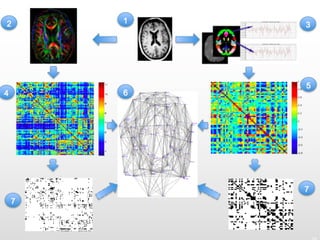
• How can the fibre tract network
structure be examined?
• Topological network organisation
3
What are neural networks?
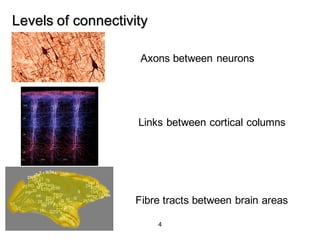
4
Axons between neurons
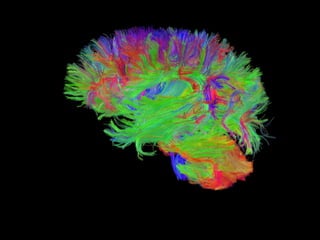
Fibre tracts between brain areas
Links between cortical columns
Levels of connectivity
5
Types of connectivity
• Structural / Anatomical (connection):
two regions are connected by a fibre tract
• Functional (correlation):
two regions are active at the same time
• Effective (causation):
region A modulates activity in region B
Sporns, Chialvo, Kaiser, Hilgetag.Trends in Cognitive Sciences, 2004
A B
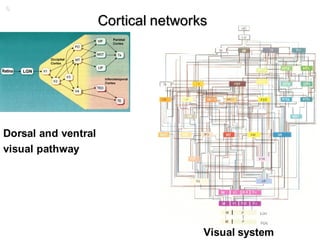
Dorsal and ventral
visual pathway
Visual system
Cortical networks
6
8
Introduction to network analysis
9
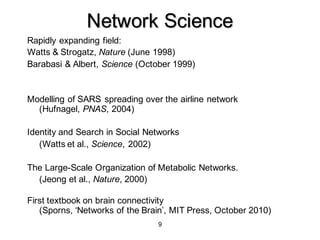
Network Science
Rapidly expanding field:
Watts & Strogatz, Nature (June 1998)
Barabasi & Albert, Science (October 1999)
Modelling of SARS spreading over the airline network
(Hufnagel, PNAS, 2004)
Identity and Search in Social Networks
(Watts et al., Science, 2002)
The Large-Scale Organization of Metabolic Networks.
(Jeong et al., Nature, 2000)
First textbook on brain connectivity
(Sporns, ‘Networks of the Brain’, MIT Press, October 2010)
10
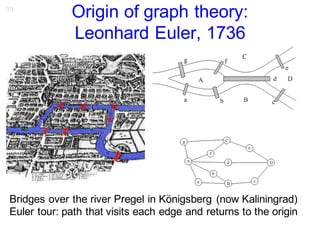
Origin of graph theory:
Leonhard Euler, 1736
Bridges over the river Pregel in Königsberg (now Kaliningrad)
Euler tour: path that visits each edge and returns to the origin
11
Nodes in graphs
• Isolated nodes
• Degree of a node
• Connected graph
• Average degree of a graph
• Edge density: probability that
any two nodes are connected
d= E___
(N*N-1) /2)
v1
v3
v2
v4 v5
Ø Isolated node: v5
Ø Degree of a node:
d(v1)=2, d(v4)=1
Ø Average degree of a graph:
D = (2+2+2+1+0)/5 = 1.4
Ø Edge density
d=4/(5*4/2) = 0.4
12
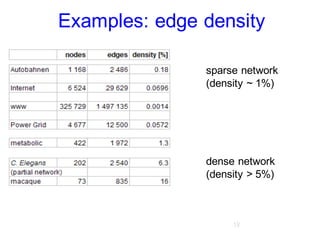
Examples: edge density
sparse network
(density ~ 1%)
dense network
(density > 5%)
13
How can the fibre tract network structure
be examined?
14
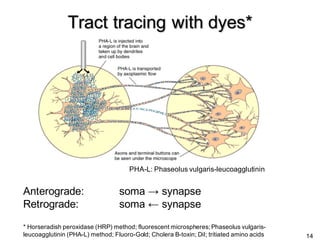
Tract tracing with dyes*
Anterograde: soma → synapse
Retrograde: soma ← synapse
* Horseradish peroxidase (HRP) method; fluorescent microspheres; Phaseolus vulgaris-
leucoagglutinin (PHA-L) method; Fluoro-Gold; Cholera B-toxin; DiI; tritiated amino acids
PHA-L: Phaseolus vulgaris-leucoagglutinin
15
Diffusion Tensor Imaging (DTI)
17
Topological network organisation
18
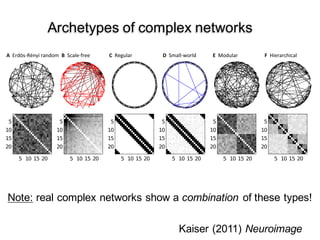
Archetypes of complex networks
Kaiser (2011) Neuroimage
Note: real complex networks show a combination of these types!
!!A!!Erdös'Rényi!random!!B!!Scale'free!!!!!!!!!!!!!!!C!!Regular!!!!!!!!!!!!!!!!!!!!!!!!D!!Small'world!!!!!!!!!!!!!E!!Modular!!!!!!!!!!!!!!!!!!!!!F!!Hierarchical!
19
Nodes: individuals
Links: social relationship
S. Milgram. Psychology Today (1967)
It’s a small world
20
A Few
Good Man
Robert Wagner
Austin Powers
Wild Things
Let’s make
it legal
Barry Norton
What Price Glory
Monsieur
Verdoux
Kevin Bacon
21
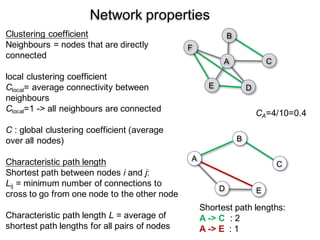
Network properties
Clustering coefficient
Neighbours = nodes that are directly
connected
local clustering coefficient
Clocal= average connectivity between
neighbours
Clocal=1 -> all neighbours are connected
C : global clustering coefficient (average
over all nodes)
Characteristic path length
Shortest path between nodes i and j:
Lij = minimum number of connections to
cross to go from one node to the other node
Characteristic path length L = average of
shortest path lengths for all pairs of nodes
A
B
C
D E
Shortest path lengths:
A -> C : 2
A -> E : 1
A
B
C
E D
F
CA=4/10=0.4
22
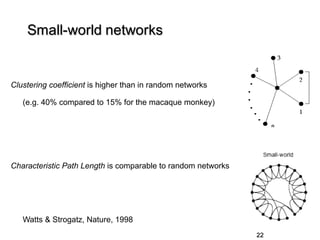
Small-world networks
Clustering coefficient is higher than in random networks
(e.g. 40% compared to 15% for the macaque monkey)
Characteristic Path Length is comparable to random networks
Watts & Strogatz, Nature, 1998
23
Modular small-world connectivity
Hilgetag & Kaiser (2004) Neuroinformatics 2: 353
Small-world
Neighbours are well
connected; short
characteristic path
length (~2)
Modular
Clusters: relatively
more connections
within the cluster
than between
clusters
18
Sequential
Kaiser et al. (2010) Frontiers in Neuroinformatics
Hilgetag & Kaiser PLoS Comput. Biol. (in preparation)
Hierarchy
getag and others Hierarchical organization of macaque and cat cortex
V3
V2
PIP
VOT
AITv STPa
TH
AITd
V4
CITv
V11
2
4
3
5
8
7
6
11
10
9
46
CITd FEF
FSTPITd
V3A
VP
V4t
LIP
PO
MSTl
DP
7aPITv
VIPMSTd
TF
STPp
MT
mal hierarchical enumeration of primate visual areas, in which each area is placed at the lowest level possible
straint suggested by Van Essen & Felleman (1996) and Crick & Koch (1998)). In this optimal 11-level scheme,
aced on the lowest level of the area's distribution in all optimal 11-level hierarchies, see ¢gure 16. To verify that
me with lower positions for the areas existed, we attempted to compute optimal hierarchies with ten levels, but
xtensive computations. Most connections between the areas are omitted for simplicity's sake; however,
h lateral contributions in their connectivity patterns are shown. This points out a network that may implement a
ystem within the primate visual system, see ½ 4(e). The constraint violations for this optimal arrangement are
T4MSTd, FST5TF, and their respective counterparts. Dashed lines denote these violations in the scheme.
with identical hatching have ¢xed relative, or absolute, positions in all optimal 11-level hierarchies computed, see
cheme is arranged so as to represent the functional subdivisions of the primate visual system, with the left side
ventral and the right side the dorsal stream.
area
5
10
level
V1
V2
VP
V3
PIP
V3A
V4
PO
MT
V4t
VOT
DP
VIP
MSTd
LIP
MSTl
PITv
PITd
FST
7a
STPp
CITv
CITd
FEF
STPa
AITv
46
TF
TH
AITd
ribution of primate visual areas in 108 optimal hierarchies with 11 levels. Constraint violations are: FST4MSTd
ncy in all solutions: 12%), FST5TF (9%), FST STPp (8%), LIP ˆ PITv (7%), LIP4MSTd (5%),
Particularly striking were the very stable clusters of
somatosensory-motor areas.
The binary classi¢cation of these connectivity data,
and their subsequent OSA, led to very similar cluster
structures as the categorization of existing connections in
three classes. The main subdivisions detailed above for
the balanced OSA condition were also recognizable for
balanced OSA arrangements of the binary data, even
though the ¢rst two groups of somatosensory-motor and
`limbic'areas were more strongly subdivided in the binary
data. The correlation between the cluster-count summa-
ries for the quaternary and binary data (655 optimal
arrangements) under balanced OSA was R ˆ 0.61. The
cluster arrangements of the binary data were reduced to
building-block structures at a repulsion weight of ten, and
248 optimal arrangements obtained under this condition.
All areas came together in one cluster for an attraction
weight of 21.
There are two principal ways of interpreting the
graded strengths of existing connections for this set of cat
connectivity data. In the `optimistic' interpretation, which
we followed in the above analysis of the quaternary data,
the numerical values assigned to the di¡erent strengths
directly re£ect the absolute anatomical strengths or densi-
ties of the connections. On this assumption, it is possible
to evaluate the di¡erent connections as if, for instance,
any intermediate-strength connection (with a value of
two) is indeed about twice as strong as two weak connec-
tions (with a strength value of one). In this view, the
connection strength classes approximate interval data. In
a more conservative interpretation, on the other hand,
the strength values are solely numerical labels for ranks of
di¡erent connection densities, which are considered
ordinal or nominal. In this case, a direct numerical
comparison of di¡erent connection categories would not
be possible. We considered this possibility by modifying
our OSA algorithm in such a way that di¡erent connec-
tion categories would be considered independently from
each other during the optimizations. This was achieved
by giving all connections of a particular category such
high weights that the arrangement of areas possessing this
connection could not be a¡ected, even if all connections
of lower ranks together exerted a contrary in£uence. In
this way, the overall arrangement was ¢rst shaped by the
optimization of the highest ranks, then by next highest and
so on, while the di¡erent ranks did not directly interfere
with each other. The weights of the absent and unknown
connections were determined as means of the weights for
the existing connections, weighted by the frequency of
connections in a particular strength category. Applying
such a modi¢ed OSA to the ¢nely graded cat connectivity
data yielded a unique cluster arrangement, which
resembled the main subdivisions obtained for the balanced
OSA of the quaternary data. Di¡erences between the
Connectivity clusters in macaque and cat cortex C.-C. Hilgetag and others 103
Phil.Trans. R. Soc. Lond. B (2000)
areas
V1
V2
V3
MT
V3A
V4t
VP
PIP
V4
VIP
MSTl
PO
LIP
MSTd
FST
DP
FEF
7a
STPp
46
CITd
TH
AITd
CITv
PITv
AITv
TF
PITd
MIP
MDP
STPa
VOT
V1
V2
V3
MT
V3A
V4t
VP
PIP
V4
VIP
MSTl
PO
LIP
MSTd
FST
DP
FEF
7a
STPp
46
CITd
TH
AITd
CITv
PITv
AITv
TF
PITd
MIP
MDP
STPa
VOT
Figure 8. Cluster-count summary of all clusters identi¢ed by ¢xed-radii NPCA in 2D-NMDS representations of primate visual
connectivity.
Topological
SpatialTemporal
Period concatenation in neocortical rhythms
Author's personal copy
0.1 1
102
103
<v(τ)>
REM
0.1 1
102
103
Wake
0.1 1
102
103
N1
0.1 1
102
103
<v(τ)>
N2
0.1 1
102
103
N3
v ∼ τ1.15 v ∼ τ1.38
v ∼ τ1.14
v ∼ τ1.51
v ∼ τ1.22
τ (s) τ (s)
Fig. 5. Typical DFA scaling behaviors of each sleep stage of N01. The scaling exponents were determined in the interval ð0:1 srtr1 sÞ.
N3
10−3
10−2
P(f)
N2
1 10
10−3
10−2
N1
1 10
10−3
10−2
Wake
1 10
10−3
10−2
P(f)
REM
β = 1.35 β = 1.45 β = 1.33
β = 1.47
10−2
10−3
β = 1.96
J.W. Kim et al. / Computers in Biology and Medicine 40 (2010) 831–838 835
f [Hz]
Author's personal copy
0.1 1
102
103
<v(τ)>
REM
0.1 1
102
103
Wake
0.1 1
102
103
N1
0.1 1
102
103
<v(τ)>
N2
0.1 1
102
103
N3
v ∼ τ1.15 v ∼ τ1.38
v ∼ τ1.14
v ∼ τ1.51
v ∼ τ1.22
τ (s) τ (s)
g. 5. Typical DFA scaling behaviors of each sleep stage of N01. The scaling exponents were determined in the interval ð0:1 srtr1 sÞ.
1 10
N3
1 10
10−3
10−2
P(f)
N2
1 10
10−3
10−2
N1
1 10
10−3
10−2
Wake
1 10
10−3
10−2
P(f)
REM
β = 1.35 β = 1.45 β = 1.33
β = 1.47
10−2
10−3
β = 1.96
J.W. Kim et al. / Computers in Biology and Medicine 40 (2010) 831–838 835
f [Hz]
25
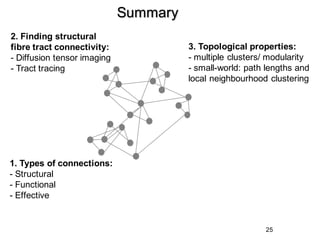
Summary
1. Types of connections:
- Structural
- Functional
- Effective
2. Finding structural
fibre tract connectivity:
- Diffusion tensor imaging
- Tract tracing
3. Topological properties:
- multiple clusters/ modularity
- small-world: path lengths and
local neighbourhood clustering
26
Further readings
Jeff Hawkins with Sandra Blakeslee.
On Intelligence. Henry Holt and Company, 2004
Olaf Sporns. Networks of the Brain. MIT Press, 2010
Duncan J. Watts. Six Degrees: The Science of a Connected
Age. Norton & Company, 2004
Sporns, Chialvo, Kaiser, Hilgetag. Trends in Cognitive Sciences
(September 2004) www.dynamic-connectome.org
27
Practical
use Matlab or Octave
• Measures for brain connectivity structure and development
(including data for the macaque and cat):
http://www.dynamic-connectome.org
http://www.dynamic-connectome.org/t/tutorial/honey.mat
• Brain Connectivity Toolbox: http://www.brain-connectivity-toolbox.net/
• Connectome Viewer: http://www.connectomeviewer.org/
28
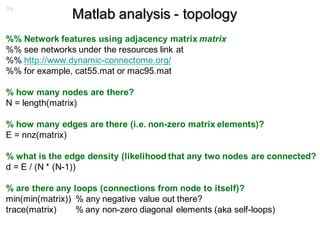
Matlab analysis - topology
%% Network features using adjacency matrix matrix
%% see networks under the resources link at
%% http://www.dynamic-connectome.org/
%% for example, cat55.mat or mac95.mat
% how many nodes are there?
N = length(matrix)
% how many edges are there (i.e. non-zero matrix elements)?
E = nnz(matrix)
% what is the edge density (likelihood that any two nodes are connected?
d = E / (N * (N-1))
% are there any loops (connections from node to itself)?
min(min(matrix)) % any negative value out there?
trace(matrix) % any non-zero diagonal elements (aka self-loops)
29
Matlab analysis – spatial organisation
% network with 3D coordinates in variable pos e.g. using
% http://www.dynamic-connectome.org/t/tutorial/honey.mat
%% visualize network
spy(matrix) % binary view
pcolor(matrix) % view of values for weighted networks
hist(nonzeros(matrix))
unique(nonzeros(matrix))
%% Spatial Network visualisation
% view from top
subplot(1,3,1); gplot(pos(:, [1,2])); axis equal
% view from side
subplot(1,3,2); gplot(pos(:, [1,3])); axis equal
% view from back
subplot(1,3,3); gplot(pos(:, [2,3])); axis equal

A tutorial in Connectome Analysis (1) - Marcus Kaiser

  • 1.
    http://www.dynamic-connectome.org http://neuroinformatics.ncl.ac.uk/ @ConnectomeLab Dr Marcus Kaiser ATutorial in Connectome Analysis (I): Topological and Spatial Features of Brain Networks Professor of Neuroinformatics School of Computing Science / Institute of Neuroscience Newcastle University United Kingdom
  • 2.
    2 Outline • What areneural networks? • Introduction to network analysis • How can the fibre tract network structure be examined? • Topological network organisation
  • 3.
  • 4.
    4 Axons between neurons Fibretracts between brain areas Links between cortical columns Levels of connectivity
  • 5.
    5 Types of connectivity •Structural / Anatomical (connection): two regions are connected by a fibre tract • Functional (correlation): two regions are active at the same time • Effective (causation): region A modulates activity in region B Sporns, Chialvo, Kaiser, Hilgetag.Trends in Cognitive Sciences, 2004 A B
  • 6.
    Dorsal and ventral visualpathway Visual system Cortical networks 6
  • 8.
  • 9.
    9 Network Science Rapidly expandingfield: Watts & Strogatz, Nature (June 1998) Barabasi & Albert, Science (October 1999) Modelling of SARS spreading over the airline network (Hufnagel, PNAS, 2004) Identity and Search in Social Networks (Watts et al., Science, 2002) The Large-Scale Organization of Metabolic Networks. (Jeong et al., Nature, 2000) First textbook on brain connectivity (Sporns, ‘Networks of the Brain’, MIT Press, October 2010)
  • 10.
    10 Origin of graphtheory: Leonhard Euler, 1736 Bridges over the river Pregel in Königsberg (now Kaliningrad) Euler tour: path that visits each edge and returns to the origin
  • 11.
    11 Nodes in graphs •Isolated nodes • Degree of a node • Connected graph • Average degree of a graph • Edge density: probability that any two nodes are connected d= E___ (N*N-1) /2) v1 v3 v2 v4 v5 Ø Isolated node: v5 Ø Degree of a node: d(v1)=2, d(v4)=1 Ø Average degree of a graph: D = (2+2+2+1+0)/5 = 1.4 Ø Edge density d=4/(5*4/2) = 0.4
  • 12.
    12 Examples: edge density sparsenetwork (density ~ 1%) dense network (density > 5%)
  • 13.
    13 How can thefibre tract network structure be examined?
  • 14.
    14 Tract tracing withdyes* Anterograde: soma → synapse Retrograde: soma ← synapse * Horseradish peroxidase (HRP) method; fluorescent microspheres; Phaseolus vulgaris- leucoagglutinin (PHA-L) method; Fluoro-Gold; Cholera B-toxin; DiI; tritiated amino acids PHA-L: Phaseolus vulgaris-leucoagglutinin
  • 15.
  • 17.
  • 18.
    18 Archetypes of complexnetworks Kaiser (2011) Neuroimage Note: real complex networks show a combination of these types! !!A!!Erdös'Rényi!random!!B!!Scale'free!!!!!!!!!!!!!!!C!!Regular!!!!!!!!!!!!!!!!!!!!!!!!D!!Small'world!!!!!!!!!!!!!E!!Modular!!!!!!!!!!!!!!!!!!!!!F!!Hierarchical!
  • 19.
    19 Nodes: individuals Links: socialrelationship S. Milgram. Psychology Today (1967) It’s a small world
  • 20.
    20 A Few Good Man RobertWagner Austin Powers Wild Things Let’s make it legal Barry Norton What Price Glory Monsieur Verdoux Kevin Bacon
  • 21.
    21 Network properties Clustering coefficient Neighbours= nodes that are directly connected local clustering coefficient Clocal= average connectivity between neighbours Clocal=1 -> all neighbours are connected C : global clustering coefficient (average over all nodes) Characteristic path length Shortest path between nodes i and j: Lij = minimum number of connections to cross to go from one node to the other node Characteristic path length L = average of shortest path lengths for all pairs of nodes A B C D E Shortest path lengths: A -> C : 2 A -> E : 1 A B C E D F CA=4/10=0.4
  • 22.
    22 Small-world networks Clustering coefficientis higher than in random networks (e.g. 40% compared to 15% for the macaque monkey) Characteristic Path Length is comparable to random networks Watts & Strogatz, Nature, 1998
  • 23.
    23 Modular small-world connectivity Hilgetag& Kaiser (2004) Neuroinformatics 2: 353 Small-world Neighbours are well connected; short characteristic path length (~2) Modular Clusters: relatively more connections within the cluster than between clusters
  • 24.
    18 Sequential Kaiser et al.(2010) Frontiers in Neuroinformatics Hilgetag & Kaiser PLoS Comput. Biol. (in preparation) Hierarchy getag and others Hierarchical organization of macaque and cat cortex V3 V2 PIP VOT AITv STPa TH AITd V4 CITv V11 2 4 3 5 8 7 6 11 10 9 46 CITd FEF FSTPITd V3A VP V4t LIP PO MSTl DP 7aPITv VIPMSTd TF STPp MT mal hierarchical enumeration of primate visual areas, in which each area is placed at the lowest level possible straint suggested by Van Essen & Felleman (1996) and Crick & Koch (1998)). In this optimal 11-level scheme, aced on the lowest level of the area's distribution in all optimal 11-level hierarchies, see ¢gure 16. To verify that me with lower positions for the areas existed, we attempted to compute optimal hierarchies with ten levels, but xtensive computations. Most connections between the areas are omitted for simplicity's sake; however, h lateral contributions in their connectivity patterns are shown. This points out a network that may implement a ystem within the primate visual system, see ½ 4(e). The constraint violations for this optimal arrangement are T4MSTd, FST5TF, and their respective counterparts. Dashed lines denote these violations in the scheme. with identical hatching have ¢xed relative, or absolute, positions in all optimal 11-level hierarchies computed, see cheme is arranged so as to represent the functional subdivisions of the primate visual system, with the left side ventral and the right side the dorsal stream. area 5 10 level V1 V2 VP V3 PIP V3A V4 PO MT V4t VOT DP VIP MSTd LIP MSTl PITv PITd FST 7a STPp CITv CITd FEF STPa AITv 46 TF TH AITd ribution of primate visual areas in 108 optimal hierarchies with 11 levels. Constraint violations are: FST4MSTd ncy in all solutions: 12%), FST5TF (9%), FST STPp (8%), LIP ˆ PITv (7%), LIP4MSTd (5%), Particularly striking were the very stable clusters of somatosensory-motor areas. The binary classi¢cation of these connectivity data, and their subsequent OSA, led to very similar cluster structures as the categorization of existing connections in three classes. The main subdivisions detailed above for the balanced OSA condition were also recognizable for balanced OSA arrangements of the binary data, even though the ¢rst two groups of somatosensory-motor and `limbic'areas were more strongly subdivided in the binary data. The correlation between the cluster-count summa- ries for the quaternary and binary data (655 optimal arrangements) under balanced OSA was R ˆ 0.61. The cluster arrangements of the binary data were reduced to building-block structures at a repulsion weight of ten, and 248 optimal arrangements obtained under this condition. All areas came together in one cluster for an attraction weight of 21. There are two principal ways of interpreting the graded strengths of existing connections for this set of cat connectivity data. In the `optimistic' interpretation, which we followed in the above analysis of the quaternary data, the numerical values assigned to the di¡erent strengths directly re£ect the absolute anatomical strengths or densi- ties of the connections. On this assumption, it is possible to evaluate the di¡erent connections as if, for instance, any intermediate-strength connection (with a value of two) is indeed about twice as strong as two weak connec- tions (with a strength value of one). In this view, the connection strength classes approximate interval data. In a more conservative interpretation, on the other hand, the strength values are solely numerical labels for ranks of di¡erent connection densities, which are considered ordinal or nominal. In this case, a direct numerical comparison of di¡erent connection categories would not be possible. We considered this possibility by modifying our OSA algorithm in such a way that di¡erent connec- tion categories would be considered independently from each other during the optimizations. This was achieved by giving all connections of a particular category such high weights that the arrangement of areas possessing this connection could not be a¡ected, even if all connections of lower ranks together exerted a contrary in£uence. In this way, the overall arrangement was ¢rst shaped by the optimization of the highest ranks, then by next highest and so on, while the di¡erent ranks did not directly interfere with each other. The weights of the absent and unknown connections were determined as means of the weights for the existing connections, weighted by the frequency of connections in a particular strength category. Applying such a modi¢ed OSA to the ¢nely graded cat connectivity data yielded a unique cluster arrangement, which resembled the main subdivisions obtained for the balanced OSA of the quaternary data. Di¡erences between the Connectivity clusters in macaque and cat cortex C.-C. Hilgetag and others 103 Phil.Trans. R. Soc. Lond. B (2000) areas V1 V2 V3 MT V3A V4t VP PIP V4 VIP MSTl PO LIP MSTd FST DP FEF 7a STPp 46 CITd TH AITd CITv PITv AITv TF PITd MIP MDP STPa VOT V1 V2 V3 MT V3A V4t VP PIP V4 VIP MSTl PO LIP MSTd FST DP FEF 7a STPp 46 CITd TH AITd CITv PITv AITv TF PITd MIP MDP STPa VOT Figure 8. Cluster-count summary of all clusters identi¢ed by ¢xed-radii NPCA in 2D-NMDS representations of primate visual connectivity. Topological SpatialTemporal Period concatenation in neocortical rhythms Author's personal copy 0.1 1 102 103 <v(τ)> REM 0.1 1 102 103 Wake 0.1 1 102 103 N1 0.1 1 102 103 <v(τ)> N2 0.1 1 102 103 N3 v ∼ τ1.15 v ∼ τ1.38 v ∼ τ1.14 v ∼ τ1.51 v ∼ τ1.22 τ (s) τ (s) Fig. 5. Typical DFA scaling behaviors of each sleep stage of N01. The scaling exponents were determined in the interval ð0:1 srtr1 sÞ. N3 10−3 10−2 P(f) N2 1 10 10−3 10−2 N1 1 10 10−3 10−2 Wake 1 10 10−3 10−2 P(f) REM β = 1.35 β = 1.45 β = 1.33 β = 1.47 10−2 10−3 β = 1.96 J.W. Kim et al. / Computers in Biology and Medicine 40 (2010) 831–838 835 f [Hz] Author's personal copy 0.1 1 102 103 <v(τ)> REM 0.1 1 102 103 Wake 0.1 1 102 103 N1 0.1 1 102 103 <v(τ)> N2 0.1 1 102 103 N3 v ∼ τ1.15 v ∼ τ1.38 v ∼ τ1.14 v ∼ τ1.51 v ∼ τ1.22 τ (s) τ (s) g. 5. Typical DFA scaling behaviors of each sleep stage of N01. The scaling exponents were determined in the interval ð0:1 srtr1 sÞ. 1 10 N3 1 10 10−3 10−2 P(f) N2 1 10 10−3 10−2 N1 1 10 10−3 10−2 Wake 1 10 10−3 10−2 P(f) REM β = 1.35 β = 1.45 β = 1.33 β = 1.47 10−2 10−3 β = 1.96 J.W. Kim et al. / Computers in Biology and Medicine 40 (2010) 831–838 835 f [Hz]
  • 25.
    25 Summary 1. Types ofconnections: - Structural - Functional - Effective 2. Finding structural fibre tract connectivity: - Diffusion tensor imaging - Tract tracing 3. Topological properties: - multiple clusters/ modularity - small-world: path lengths and local neighbourhood clustering
  • 26.
    26 Further readings Jeff Hawkinswith Sandra Blakeslee. On Intelligence. Henry Holt and Company, 2004 Olaf Sporns. Networks of the Brain. MIT Press, 2010 Duncan J. Watts. Six Degrees: The Science of a Connected Age. Norton & Company, 2004 Sporns, Chialvo, Kaiser, Hilgetag. Trends in Cognitive Sciences (September 2004) www.dynamic-connectome.org
  • 27.
    27 Practical use Matlab orOctave • Measures for brain connectivity structure and development (including data for the macaque and cat): http://www.dynamic-connectome.org http://www.dynamic-connectome.org/t/tutorial/honey.mat • Brain Connectivity Toolbox: http://www.brain-connectivity-toolbox.net/ • Connectome Viewer: http://www.connectomeviewer.org/
  • 28.
    28 Matlab analysis -topology %% Network features using adjacency matrix matrix %% see networks under the resources link at %% http://www.dynamic-connectome.org/ %% for example, cat55.mat or mac95.mat % how many nodes are there? N = length(matrix) % how many edges are there (i.e. non-zero matrix elements)? E = nnz(matrix) % what is the edge density (likelihood that any two nodes are connected? d = E / (N * (N-1)) % are there any loops (connections from node to itself)? min(min(matrix)) % any negative value out there? trace(matrix) % any non-zero diagonal elements (aka self-loops)
  • 29.
    29 Matlab analysis –spatial organisation % network with 3D coordinates in variable pos e.g. using % http://www.dynamic-connectome.org/t/tutorial/honey.mat %% visualize network spy(matrix) % binary view pcolor(matrix) % view of values for weighted networks hist(nonzeros(matrix)) unique(nonzeros(matrix)) %% Spatial Network visualisation % view from top subplot(1,3,1); gplot(pos(:, [1,2])); axis equal % view from side subplot(1,3,2); gplot(pos(:, [1,3])); axis equal % view from back subplot(1,3,3); gplot(pos(:, [2,3])); axis equal