How Health Reform Can
Help Child Welfare Families

    An Early Look at Opportunities and
    Options for Action
SPARC Webinar
February 19, 2013

    Olivia Golden, Institute Fellow
    Dina Emam, Research Assistant
    The Urban Institute
Trying to Understand How the ACA
Applies to You….
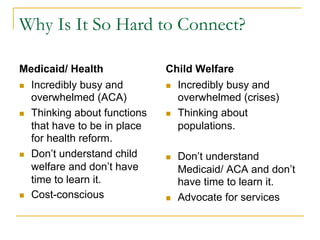
Why Is It So Hard to Connect?

Medicaid/ Health               Child Welfare
n  Incredibly busy and        n  Incredibly busy and
    overwhelmed (ACA)              overwhelmed (crises)
n  Thinking about functions   n  Thinking about
    that have to be in place       populations.
    for health reform.
n  Don’t understand child     n    Don’t understand
    welfare and don’t have           Medicaid/ ACA and don’t
    time to learn it.                have time to learn it.
n  Cost-conscious             n    Advocate for services
Our Paper

n    Goal: to bridge the gaps.
n    Reviewed available resources
n    Interviewed health and child welfare experts.
n    Intensive help from colleagues in Health
      Policy Center (but remaining mistakes are
      ours).
n    Final review and update going on now.
n    Paper will be available in March.
Plan for Today

n    Why Does the ACA Matter So Much?

n    Three Major Opportunities: Parents,
      Children, and Youth

n    Today’s Focus: Foster Youth Aging Out

n    What Should You Do Right Away?
It takes a lot of effort to connect the child welfare and health worlds.
Why is it worth it?

WHY DOES THE ACA MATTER
SO MUCH?
What Does the ACA Do?

n    Increases the number of people with health
      insurance.
n    Streamlines enrollment and renewal
n    Requires behavioral health as well as
      medical benefits.
n    Promotes innovation to integrate health care.
n    Provides coverage till age 26 for aging-out
      foster youth.
Why Do the Links Matter to Child
Welfare?
n    Parents, children, youth have major health and mental
      health needs.
n    Good treatment serves child welfare goals.
n    BUT today, they often don’t get help.
      q    Parents/ youth lack insurance.
      q    Children’s coverage is interrupted.
      q    Health/ mental health care is hard to navigate


n    “Biggest social services change in decades”
Why Do the Links Matter to Health/
Medicaid?
n    Child welfare agencies can find and bring in people who
      might otherwise not enroll.
n    Systems for enrollment are being redesigned right now,
      at mostly federal cost.
n    States may want to enroll high-need individuals promptly,
      to avert costs.
n    Helping maltreated children and preventing abuse and
      neglect may have wide appeal.
Parents, Children, Youth

THREE MAJOR
OPPORTUNITIES
Parents
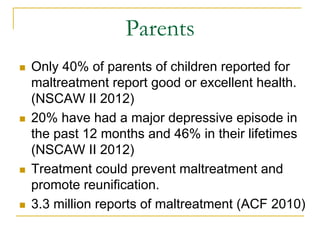
n    Only 40% of parents of children reported for
      maltreatment report good or excellent health.
      (NSCAW II 2012)
n    20% have had a major depressive episode in
      the past 12 months and 46% in their lifetimes
      (NSCAW II 2012)
n    Treatment could prevent maltreatment and
      promote reunification.
n    3.3 million reports of maltreatment (ACF 2010)
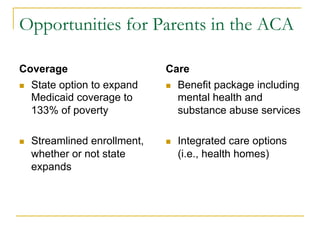
Opportunities for Parents in the ACA

Coverage                        Care
n  State option to expand      n  Benefit package including
    Medicaid coverage to            mental health and
    133% of poverty                 substance abuse services

n    Streamlined enrollment,   n    Integrated care options
      whether or not state            (i.e., health homes)
      expands
Forthcoming sources…..

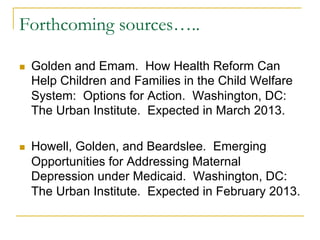
n    Golden and Emam. How Health Reform Can
      Help Children and Families in the Child Welfare
      System: Options for Action. Washington, DC:
      The Urban Institute. Expected in March 2013.

n    Howell, Golden, and Beardslee. Emerging
      Opportunities for Addressing Maternal
      Depression under Medicaid. Washington, DC:
      The Urban Institute. Expected in February 2013.
Children
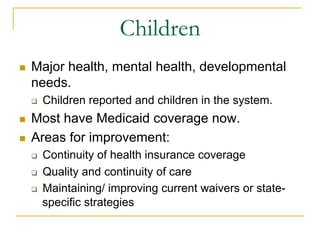
n    Major health, mental health, developmental
      needs.
      q    Children reported and children in the system.
n    Most have Medicaid coverage now.
n    Areas for improvement:
      q    Continuity of health insurance coverage
      q    Quality and continuity of care
      q    Maintaining/ improving current waivers or state-
            specific strategies
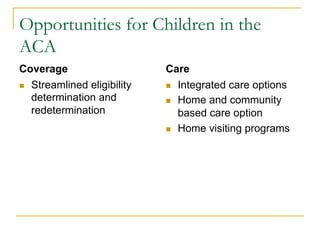
Opportunities for Children in the
ACA
Coverage                      Care
n  Streamlined eligibility   n  Integrated care options
    determination and         n  Home and community
    redetermination               based care option
                              n  Home visiting programs
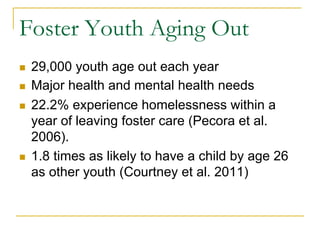
Foster Youth Aging Out
n    29,000 youth age out each year
n    Major health and mental health needs
n    22.2% experience homelessness within a
      year of leaving foster care (Pecora et al.
      2006).
n    1.8 times as likely to have a child by age 26
      as other youth (Courtney et al. 2011)
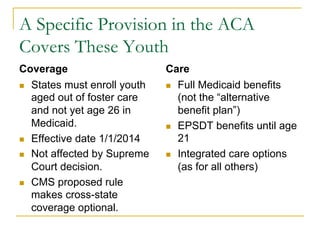
A Specific Provision in the ACA
Covers These Youth
Coverage                       Care
n  States must enroll youth   n  Full Medicaid benefits
    aged out of foster care        (not the “alternative
    and not yet age 26 in          benefit plan”)
    Medicaid.                  n  EPSDT benefits until age
n  Effective date 1/1/2014        21
n  Not affected by Supreme    n  Integrated care options
    Court decision.                (as for all others)
n  CMS proposed rule
    makes cross-state
    coverage optional.
FOSTER YOUTH AGING OUT
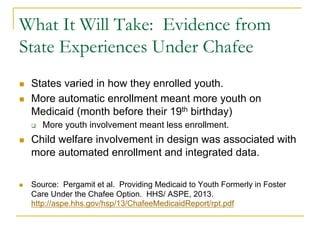
What It Will Take: Evidence from
State Experiences Under Chafee
n    States varied in how they enrolled youth.
n    More automatic enrollment meant more youth on
      Medicaid (month before their 19th birthday)
      q    More youth involvement meant less enrollment.
n    Child welfare involvement in design was associated with
      more automated enrollment and integrated data.

n    Source: Pergamit et al. Providing Medicaid to Youth Formerly in Foster
      Care Under the Chafee Option. HHS/ ASPE, 2013.
      http://aspe.hhs.gov/hsp/13/ChafeeMedicaidReport/rpt.pdf
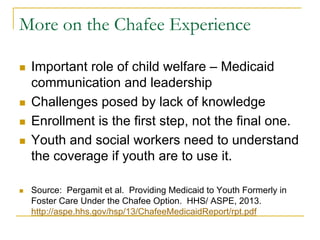
More on the Chafee Experience

n    Important role of child welfare – Medicaid
      communication and leadership
n    Challenges posed by lack of knowledge
n    Enrollment is the first step, not the final one.
n    Youth and social workers need to understand
      the coverage if youth are to use it.

n    Source: Pergamit et al. Providing Medicaid to Youth Formerly in
      Foster Care Under the Chafee Option. HHS/ ASPE, 2013.
      http://aspe.hhs.gov/hsp/13/ChafeeMedicaidReport/rpt.pdf
The Headline:


Get ready now.
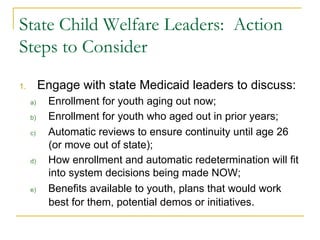
State Child Welfare Leaders: Action
Steps to Consider
1.          Engage with state Medicaid leaders to discuss:
      a)     Enrollment for youth aging out now;
      b)     Enrollment for youth who aged out in prior years;
      c)     Automatic reviews to ensure continuity until age 26
             (or move out of state);
      d)     How enrollment and automatic redetermination will fit
             into system decisions being made NOW;
      e)     Benefits available to youth, plans that would work
             best for them, potential demos or initiatives.
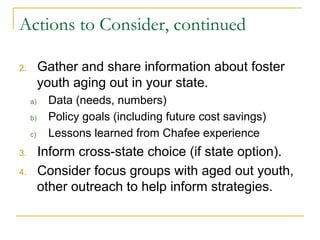
Actions to Consider, continued

2.      Gather and share information about foster
        youth aging out in your state.
      a)    Data (needs, numbers)
      b)    Policy goals (including future cost savings)
      c)    Lessons learned from Chafee experience
3.      Inform cross-state choice (if state option).
4.      Consider focus groups with aged out youth,
        other outreach to help inform strategies.
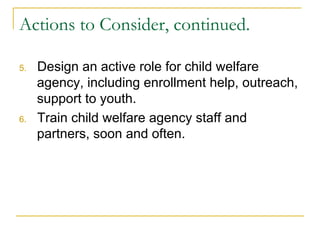
Actions to Consider, continued.

5.    Design an active role for child welfare
      agency, including enrollment help, outreach,
      support to youth.
6.    Train child welfare agency staff and
      partners, soon and often.
Federal Child Welfare and Health
Leaders: Action Steps to Consider
1.    Joint technical assistance to states from ACF,
      CMS, and SAMHSA.
2.    Identify and disseminate best practices.
3.    Promote an effective cross-state framework.
4.    Track coverage for youth; support state data
      collection and tracking.
5.    Address specific challenging issues in ongoing
      policy and guidance.
Examples of Challenging Issues


n    Youth moving from child welfare to juvenile
      justice
n    Youth in guardianship settings
n    State arrangements that may not be foster
      care
n    Don’t let these slow you down!!
Philanthropy: Action Steps To Consider
1.    Amplify federal and state technical assistance and
      outreach to reach larger audiences.
       a)    Advocates, community organizations
       b)    Youth and families, broader public
       c)    Direct service staff
2.    Create collaborative network of stakeholders – multiple
      states, multiple perspectives.
3.    Identify and disseminate best practices.
4.    Support advocates/ experts to track and report results,
      recommend improvements.
5.    Stay the course!
It’s a Marathon AND
a Sprint.

Those we interviewed said that
gaining the benefits of the ACA for
children, youth, and families involved
with child welfare requires BOTH
starting now AND staying the course.
Questions?

SPARC Webinar: Child Welfare and the Affordable Care Act

  • 1.
    How Health ReformCan Help Child Welfare Families An Early Look at Opportunities and Options for Action
  • 2.
    SPARC Webinar February 19,2013 Olivia Golden, Institute Fellow Dina Emam, Research Assistant The Urban Institute
  • 3.
    Trying to UnderstandHow the ACA Applies to You….
  • 4.
    Why Is ItSo Hard to Connect? Medicaid/ Health Child Welfare n  Incredibly busy and n  Incredibly busy and overwhelmed (ACA) overwhelmed (crises) n  Thinking about functions n  Thinking about that have to be in place populations. for health reform. n  Don’t understand child n  Don’t understand welfare and don’t have Medicaid/ ACA and don’t time to learn it. have time to learn it. n  Cost-conscious n  Advocate for services
  • 5.
    Our Paper n  Goal: to bridge the gaps. n  Reviewed available resources n  Interviewed health and child welfare experts. n  Intensive help from colleagues in Health Policy Center (but remaining mistakes are ours). n  Final review and update going on now. n  Paper will be available in March.
  • 6.
    Plan for Today n  Why Does the ACA Matter So Much? n  Three Major Opportunities: Parents, Children, and Youth n  Today’s Focus: Foster Youth Aging Out n  What Should You Do Right Away?
  • 7.
    It takes alot of effort to connect the child welfare and health worlds. Why is it worth it? WHY DOES THE ACA MATTER SO MUCH?
  • 8.
    What Does theACA Do? n  Increases the number of people with health insurance. n  Streamlines enrollment and renewal n  Requires behavioral health as well as medical benefits. n  Promotes innovation to integrate health care. n  Provides coverage till age 26 for aging-out foster youth.
  • 9.
    Why Do theLinks Matter to Child Welfare? n  Parents, children, youth have major health and mental health needs. n  Good treatment serves child welfare goals. n  BUT today, they often don’t get help. q  Parents/ youth lack insurance. q  Children’s coverage is interrupted. q  Health/ mental health care is hard to navigate n  “Biggest social services change in decades”
  • 10.
    Why Do theLinks Matter to Health/ Medicaid? n  Child welfare agencies can find and bring in people who might otherwise not enroll. n  Systems for enrollment are being redesigned right now, at mostly federal cost. n  States may want to enroll high-need individuals promptly, to avert costs. n  Helping maltreated children and preventing abuse and neglect may have wide appeal.
  • 11.
    Parents, Children, Youth THREEMAJOR OPPORTUNITIES
  • 12.
    Parents n  Only 40% of parents of children reported for maltreatment report good or excellent health. (NSCAW II 2012) n  20% have had a major depressive episode in the past 12 months and 46% in their lifetimes (NSCAW II 2012) n  Treatment could prevent maltreatment and promote reunification. n  3.3 million reports of maltreatment (ACF 2010)
  • 13.
    Opportunities for Parentsin the ACA Coverage Care n  State option to expand n  Benefit package including Medicaid coverage to mental health and 133% of poverty substance abuse services n  Streamlined enrollment, n  Integrated care options whether or not state (i.e., health homes) expands
  • 14.
    Forthcoming sources….. n  Golden and Emam. How Health Reform Can Help Children and Families in the Child Welfare System: Options for Action. Washington, DC: The Urban Institute. Expected in March 2013. n  Howell, Golden, and Beardslee. Emerging Opportunities for Addressing Maternal Depression under Medicaid. Washington, DC: The Urban Institute. Expected in February 2013.
  • 15.
    Children n  Major health, mental health, developmental needs. q  Children reported and children in the system. n  Most have Medicaid coverage now. n  Areas for improvement: q  Continuity of health insurance coverage q  Quality and continuity of care q  Maintaining/ improving current waivers or state- specific strategies
  • 16.
    Opportunities for Childrenin the ACA Coverage Care n  Streamlined eligibility n  Integrated care options determination and n  Home and community redetermination based care option n  Home visiting programs
  • 17.
    Foster Youth AgingOut n  29,000 youth age out each year n  Major health and mental health needs n  22.2% experience homelessness within a year of leaving foster care (Pecora et al. 2006). n  1.8 times as likely to have a child by age 26 as other youth (Courtney et al. 2011)
  • 18.
    A Specific Provisionin the ACA Covers These Youth Coverage Care n  States must enroll youth n  Full Medicaid benefits aged out of foster care (not the “alternative and not yet age 26 in benefit plan”) Medicaid. n  EPSDT benefits until age n  Effective date 1/1/2014 21 n  Not affected by Supreme n  Integrated care options Court decision. (as for all others) n  CMS proposed rule makes cross-state coverage optional.
  • 19.
  • 20.
    What It WillTake: Evidence from State Experiences Under Chafee n  States varied in how they enrolled youth. n  More automatic enrollment meant more youth on Medicaid (month before their 19th birthday) q  More youth involvement meant less enrollment. n  Child welfare involvement in design was associated with more automated enrollment and integrated data. n  Source: Pergamit et al. Providing Medicaid to Youth Formerly in Foster Care Under the Chafee Option. HHS/ ASPE, 2013. http://aspe.hhs.gov/hsp/13/ChafeeMedicaidReport/rpt.pdf
  • 21.
    More on theChafee Experience n  Important role of child welfare – Medicaid communication and leadership n  Challenges posed by lack of knowledge n  Enrollment is the first step, not the final one. n  Youth and social workers need to understand the coverage if youth are to use it. n  Source: Pergamit et al. Providing Medicaid to Youth Formerly in Foster Care Under the Chafee Option. HHS/ ASPE, 2013. http://aspe.hhs.gov/hsp/13/ChafeeMedicaidReport/rpt.pdf
  • 22.
  • 23.
    State Child WelfareLeaders: Action Steps to Consider 1.  Engage with state Medicaid leaders to discuss: a)  Enrollment for youth aging out now; b)  Enrollment for youth who aged out in prior years; c)  Automatic reviews to ensure continuity until age 26 (or move out of state); d)  How enrollment and automatic redetermination will fit into system decisions being made NOW; e)  Benefits available to youth, plans that would work best for them, potential demos or initiatives.
  • 24.
    Actions to Consider,continued 2.  Gather and share information about foster youth aging out in your state. a)  Data (needs, numbers) b)  Policy goals (including future cost savings) c)  Lessons learned from Chafee experience 3.  Inform cross-state choice (if state option). 4.  Consider focus groups with aged out youth, other outreach to help inform strategies.
  • 25.
    Actions to Consider,continued. 5.  Design an active role for child welfare agency, including enrollment help, outreach, support to youth. 6.  Train child welfare agency staff and partners, soon and often.
  • 26.
    Federal Child Welfareand Health Leaders: Action Steps to Consider 1.  Joint technical assistance to states from ACF, CMS, and SAMHSA. 2.  Identify and disseminate best practices. 3.  Promote an effective cross-state framework. 4.  Track coverage for youth; support state data collection and tracking. 5.  Address specific challenging issues in ongoing policy and guidance.
  • 27.
    Examples of ChallengingIssues n  Youth moving from child welfare to juvenile justice n  Youth in guardianship settings n  State arrangements that may not be foster care n  Don’t let these slow you down!!
  • 28.
    Philanthropy: Action StepsTo Consider 1.  Amplify federal and state technical assistance and outreach to reach larger audiences. a)  Advocates, community organizations b)  Youth and families, broader public c)  Direct service staff 2.  Create collaborative network of stakeholders – multiple states, multiple perspectives. 3.  Identify and disseminate best practices. 4.  Support advocates/ experts to track and report results, recommend improvements. 5.  Stay the course!
  • 29.
    It’s a MarathonAND a Sprint. Those we interviewed said that gaining the benefits of the ACA for children, youth, and families involved with child welfare requires BOTH starting now AND staying the course.
  • 30.