CONTENTS
 Tree
 Minimum spanning tree
       Definition
       Properties
       Example
       Applications
Tree
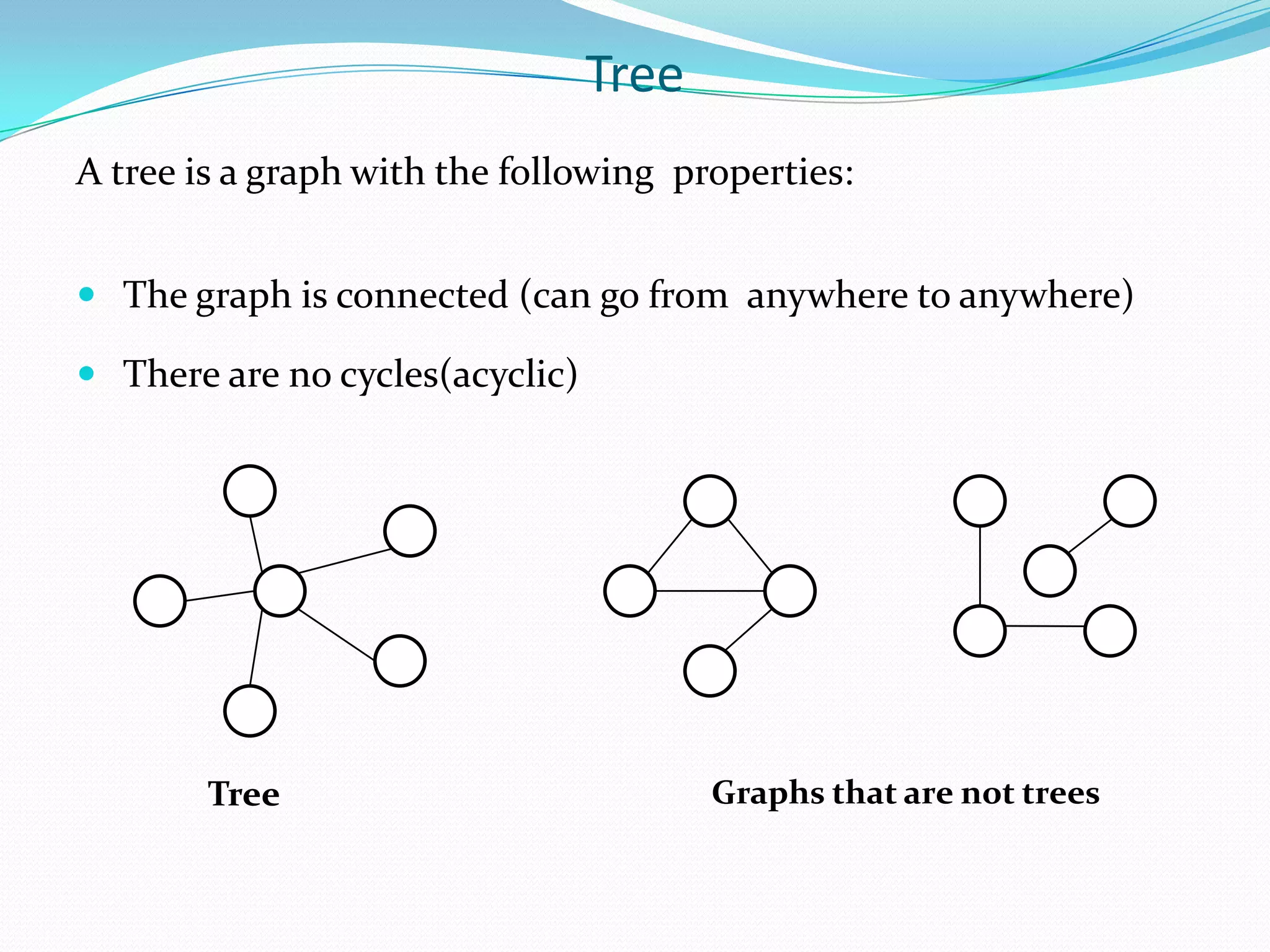
A tree is a graph with the following properties:


 The graph is connected (can go from anywhere to anywhere)

 There are no cycles(acyclic)


        Tree                            Graphs that are not trees
Minimum Spanning Tree (MST)

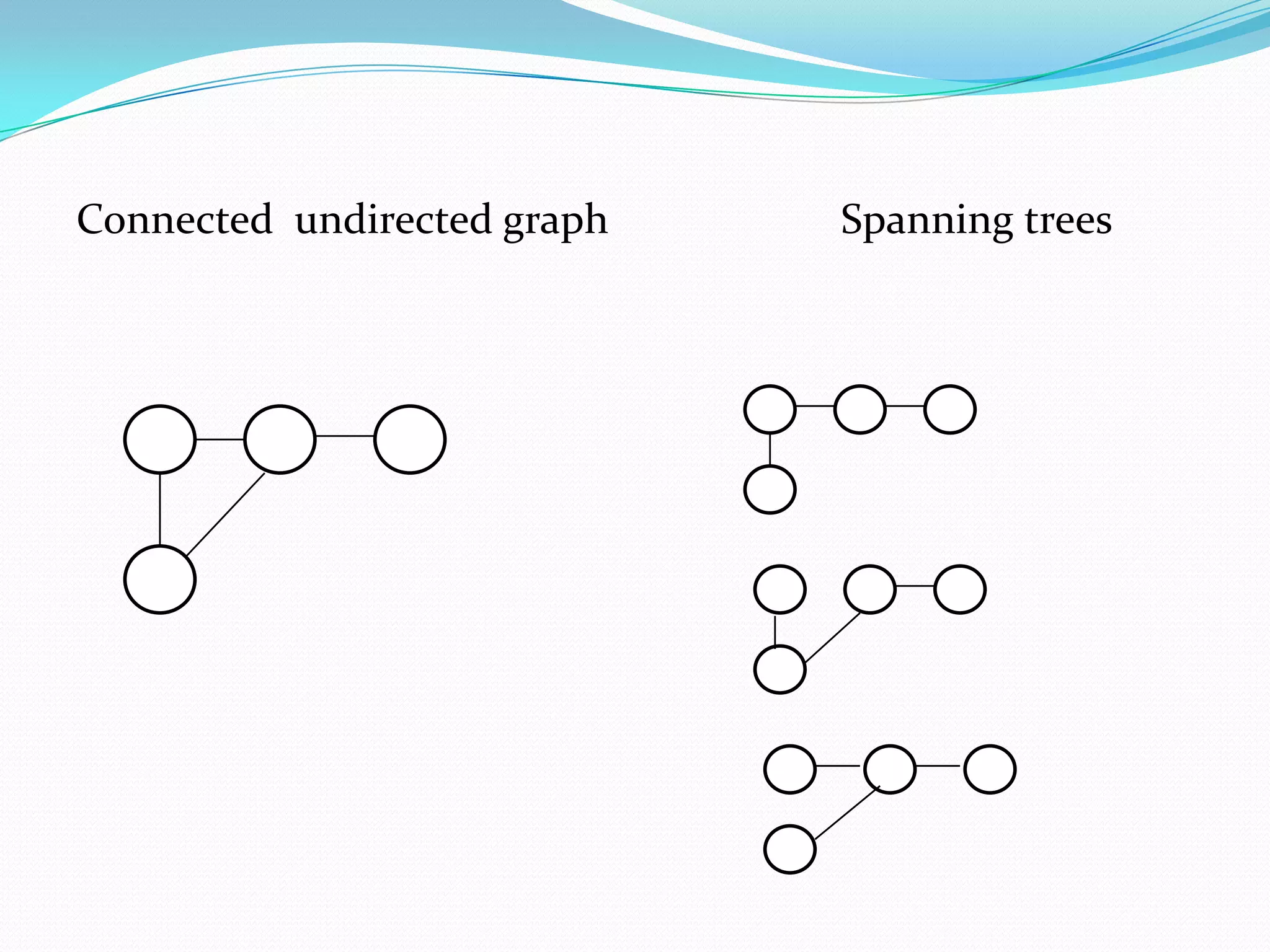
Let G=(V,E) be an undirected connected graph.
A sub graph T=(V,E’) of G is a spanning tree of G iff T is
a tree.

• It is a tree (i.e., it is acyclic)

• It covers all the vertices V

    • contains |V| - 1 edges

• A single graph can have many different spanning
   trees.
               4
Connected undirected graph   Spanning trees
 A minimum cost spanning tree is a spanning tree which has a
  minimum total cost.
 A minimum spanning tree (MST) or minimum weight spanning
  tree is then a spanning tree with weight less than or equal to the
  weight of every other spanning tree.
 Addition of even one single edge results in the spanning tree losing its
  property of acyclicity and removal of one single edge results in its
  losing the property of connectivity.
 It is the shortest spanning tree .

 The length of a tree is equal to the sum of the length of the arcs on the
  tree.
Properties

Possible multiplicity

 There may be several minimum spanning trees of the same weight
  having a minimum number of edges

 if all the edge weights of a given graph are the same, then every
  spanning tree of that graph is minimum.

 If there are n vertices in the graph, then each tree has n-1 edges.


Uniqueness

 If each edge has a distinct weight then there will be only one, unique
  minimum spanning tree.
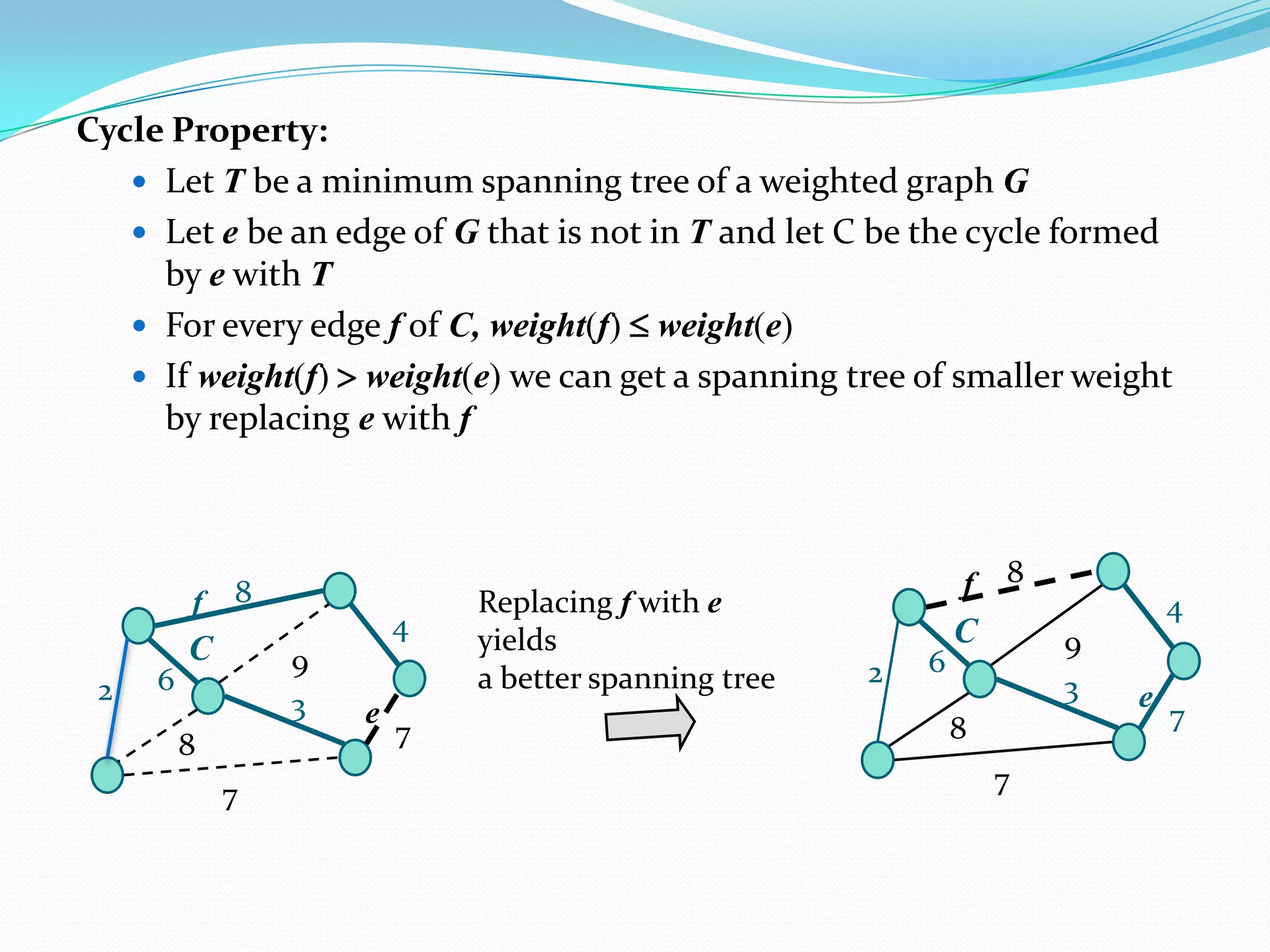
Cycle Property:
    Let T be a minimum spanning tree of a weighted graph G
    Let e be an edge of G that is not in T and let C be the cycle formed
     by e with T
    For every edge f of C, weight(f)  weight(e)
    If weight(f) > weight(e) we can get a spanning tree of smaller weight
     by replacing e with f


                                                              f   8
         f   8               Replacing f with e                               4
                         4   yields                           C
         C                                                            9
                 9                                    2   6
 2   6                       a better spanning tree                   3
                 3                                                        e
                     e                                        8               7
         8               7
             7                                                    7
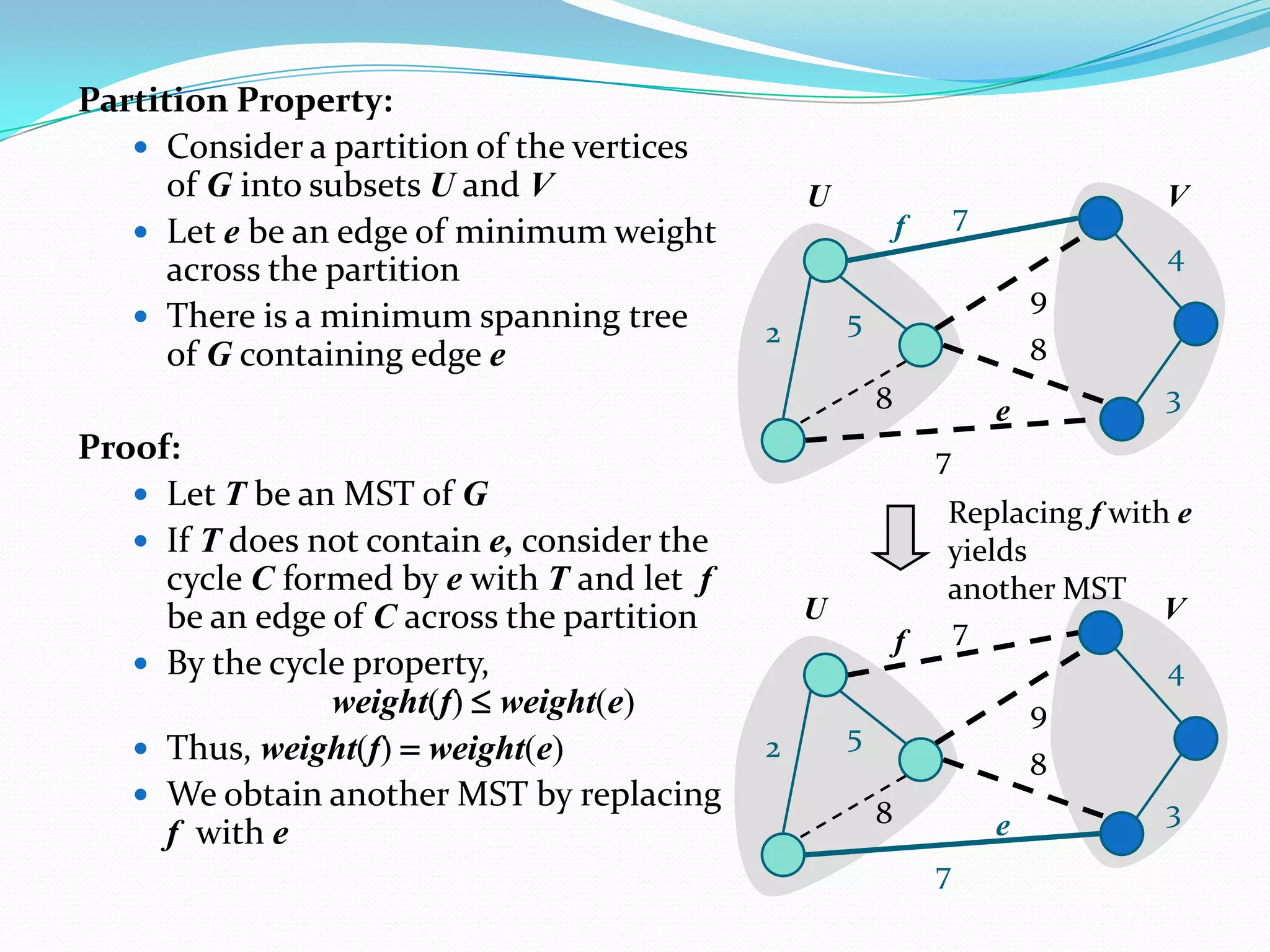
Partition Property:
    Consider a partition of the vertices
      of G into subsets U and V                  U                               V
                                                             f       7
    Let e be an edge of minimum weight
      across the partition                                                       4
                                                                             9
    There is a minimum spanning tree                5
                                             2
      of G containing edge e                                                 8
                                                         8               e       3
Proof:                                                           7
    Let T be an MST of G
                                                                 Replacing f with e
    If T does not contain e, consider the                       yields
     cycle C formed by e with T and let f                        another MST
     be an edge of C across the partition        U                               V
                                                             f   7
    By the cycle property,                                                      4
                weight(f)  weight(e)                                   9
    Thus, weight(f) = weight(e)             2       5
                                                                             8
    We obtain another MST by replacing
                                                         8               e       3
     f with e
                                                                 7
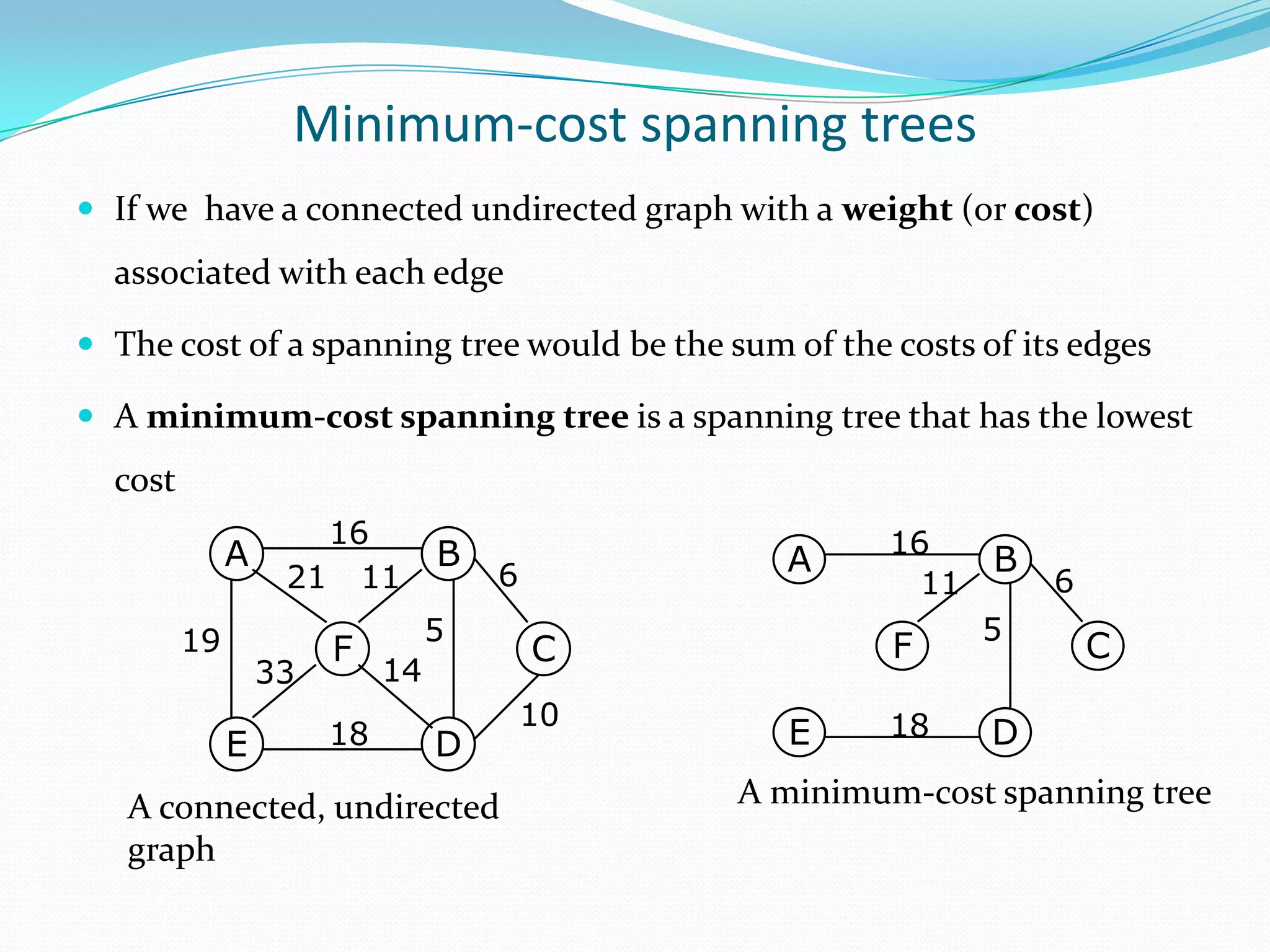
Minimum-cost spanning trees
 If we have a connected undirected graph with a weight (or cost)
  associated with each edge

 The cost of a spanning tree would be the sum of the costs of its edges

 A minimum-cost spanning tree is a spanning tree that has the lowest
  cost
                     16                               16
              A                  B              A            B
                   21 11             6                  11       6
         19                      5                           5
                       F                 C             F             C
                  33        14
                                         10           18
              E        18        D              E            D

   A connected, undirected                    A minimum-cost spanning tree
   graph
Applications of minimum spanning trees
 Consider an application where n stations are to be linked using a
  communication network.

 The laying of communication links between any two stations involves a
  cost.

 The problem is to obtain a network of communication links which
  while preserving the connectivity between stations does it with
  minimum cost.

 The ideal solution to the problem would be to extract a sub graph
  termed minimum cost spanning tree.

 It preserves the connectedness of the graph yields minimum cost.
Applications cont’d
• Suppose you want to supply a set of houses with:
    electric power
    water
    sewage lines
    telephone lines

• To keep costs down, you could connect these houses with
a spanning tree ( for example, power lines)
   •However, the houses are not all equal distances apart

• To reduce costs even further, you could connect the
houses with a minimum-cost spanning tree
Applications cont’d


•   Constructing highways or railroads spanning several
    cities
•   Designing local access network
•   Making electric wire connections on a control panel
•   Laying pipelines connecting offshore drilling sites,
    refineries, and consumer markets
Applications cont’d
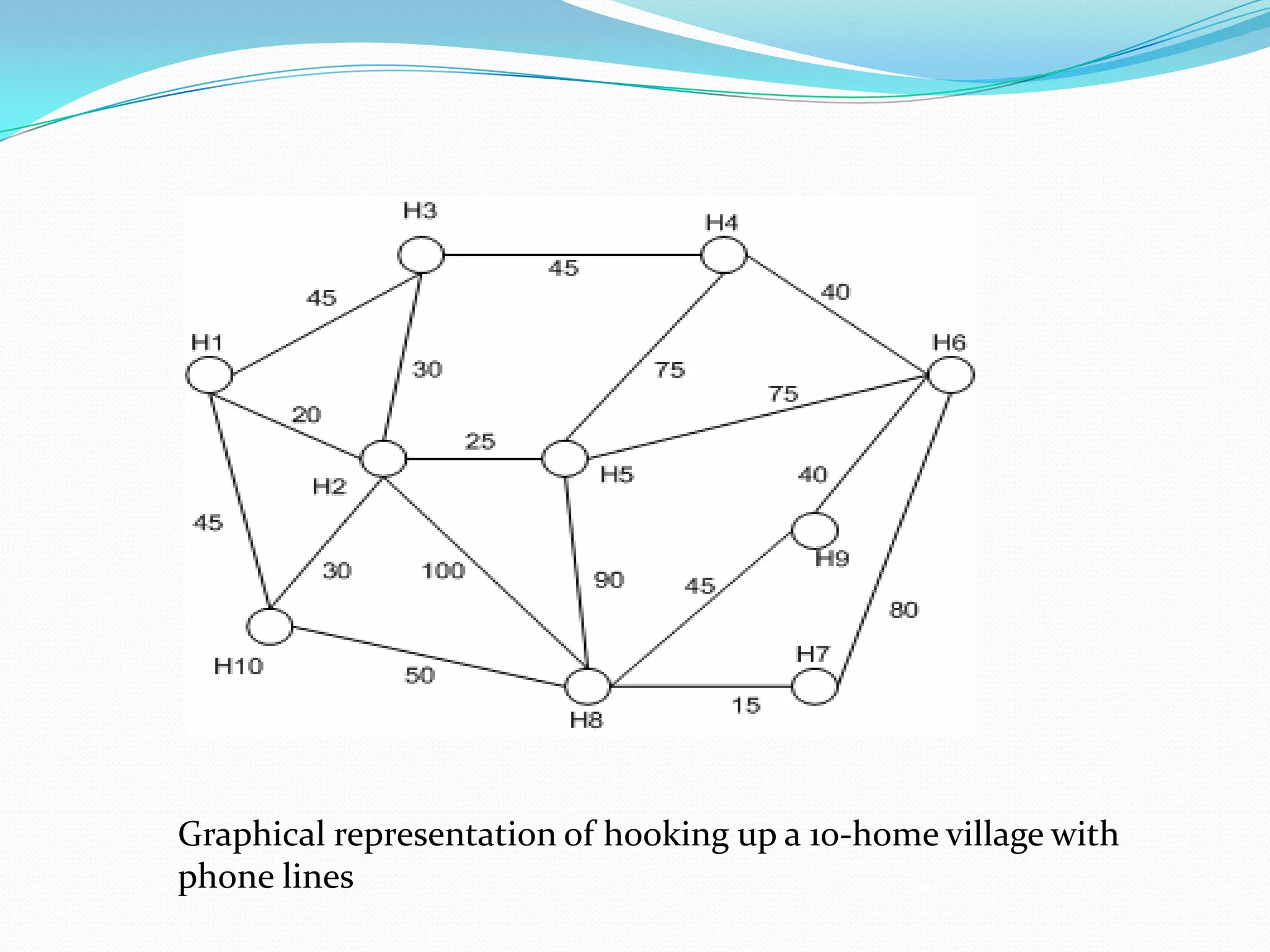
 The phone company task is to provide phone lines to a village with 10
  houses, each labeled H1 through H10.

 A single cable must connects each home. The cable must run through
  houses H1, H2, and so forth, up through H10.

 Each node is a house, and the edges are the means by which one house
  can be wired up to another.

 The weights of the edges dictate the distance between the homes.

 Their task is to wire up all ten houses using the least amount of
  telephone wiring possible.
Graphical representation of hooking up a 10-home village with
phone lines
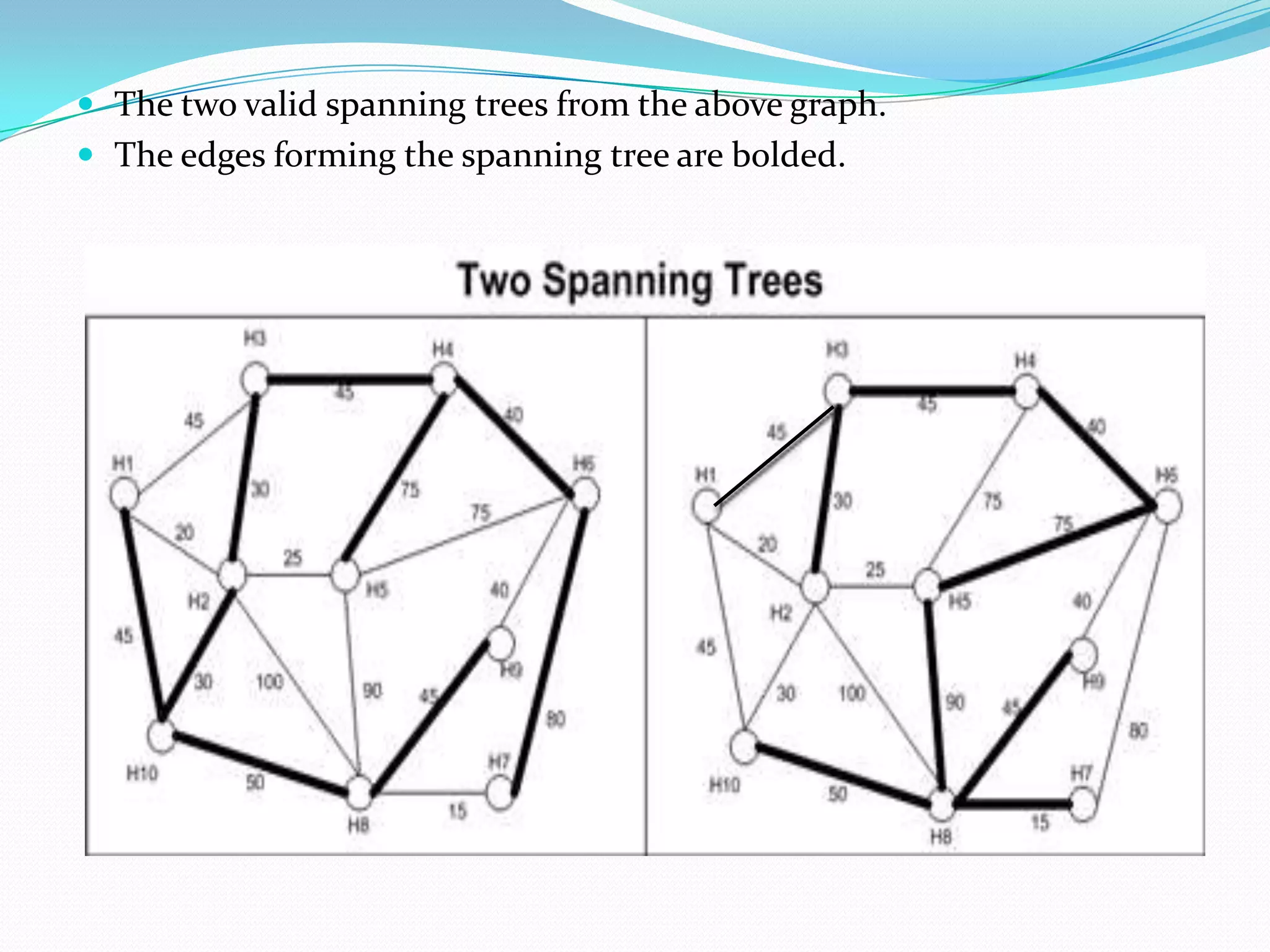
 The two valid spanning trees from the above graph.
 The edges forming the spanning tree are bolded.
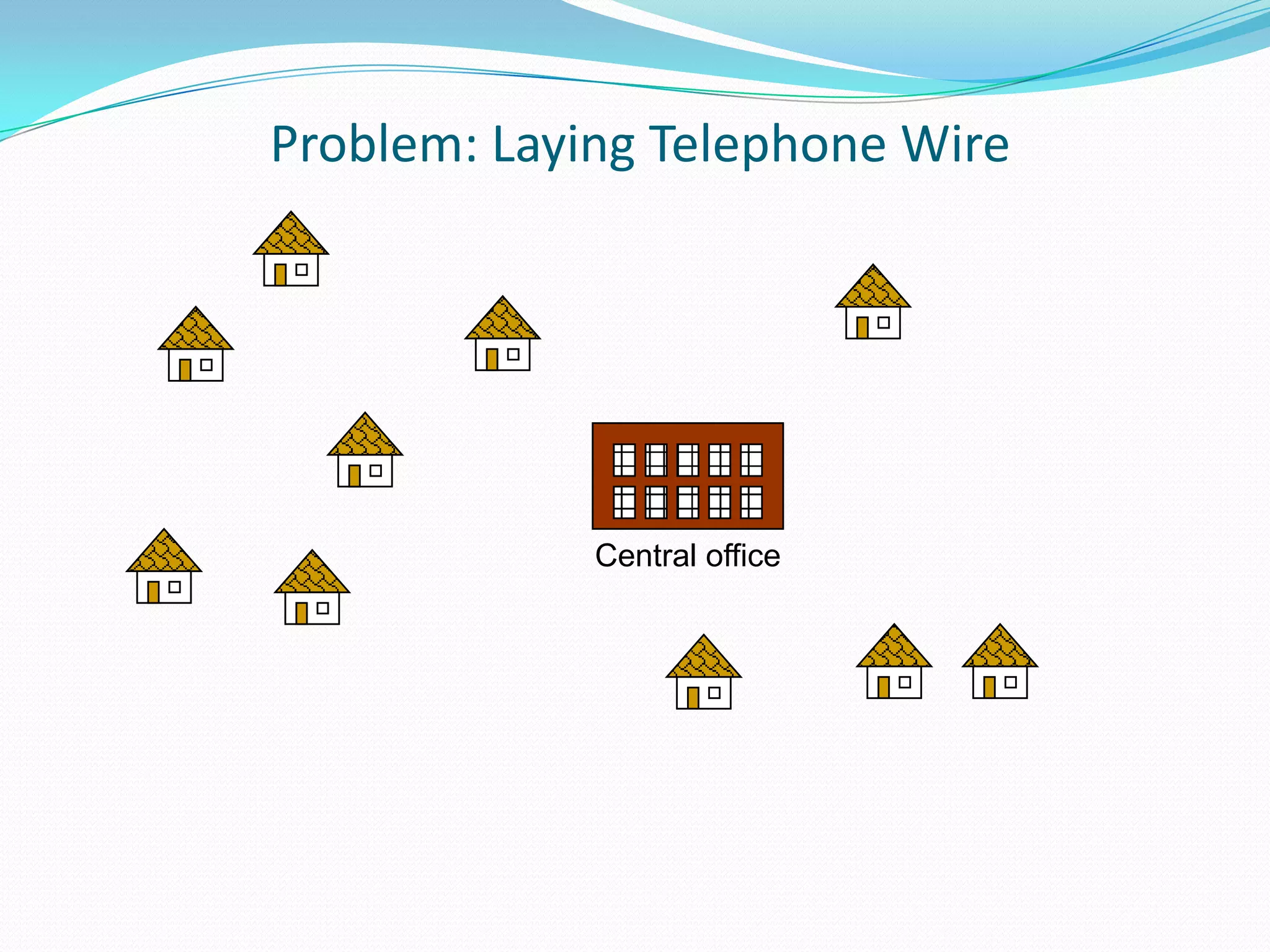
Problem: Laying Telephone Wire


             Central office
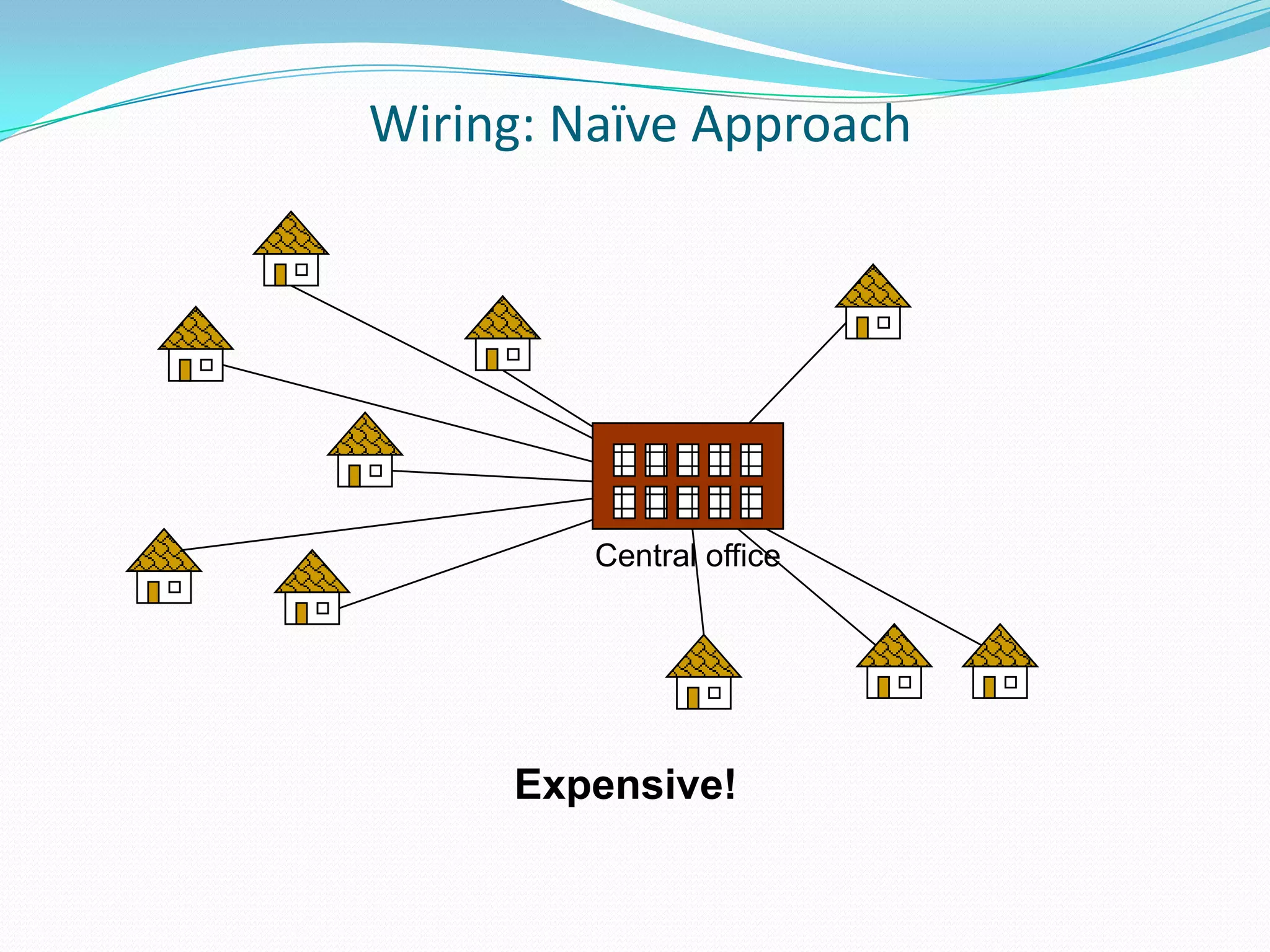
Wiring: Naïve Approach


         Central office


     Expensive!
Wiring: Better Approach


                           Central office


Minimize the total length of wire connecting the customers
Thank you

Spanning trees & applications

  • 2.
    CONTENTS  Tree  Minimumspanning tree  Definition  Properties  Example  Applications
  • 3.
    Tree A tree isa graph with the following properties:  The graph is connected (can go from anywhere to anywhere)  There are no cycles(acyclic) Tree Graphs that are not trees
  • 4.
    Minimum Spanning Tree(MST) Let G=(V,E) be an undirected connected graph. A sub graph T=(V,E’) of G is a spanning tree of G iff T is a tree. • It is a tree (i.e., it is acyclic) • It covers all the vertices V • contains |V| - 1 edges • A single graph can have many different spanning trees. 4
  • 5.
  • 6.
     A minimumcost spanning tree is a spanning tree which has a minimum total cost.  A minimum spanning tree (MST) or minimum weight spanning tree is then a spanning tree with weight less than or equal to the weight of every other spanning tree.  Addition of even one single edge results in the spanning tree losing its property of acyclicity and removal of one single edge results in its losing the property of connectivity.  It is the shortest spanning tree .  The length of a tree is equal to the sum of the length of the arcs on the tree.
  • 7.
    Properties Possible multiplicity  Theremay be several minimum spanning trees of the same weight having a minimum number of edges  if all the edge weights of a given graph are the same, then every spanning tree of that graph is minimum.  If there are n vertices in the graph, then each tree has n-1 edges. Uniqueness  If each edge has a distinct weight then there will be only one, unique minimum spanning tree.
  • 8.
    Cycle Property:  Let T be a minimum spanning tree of a weighted graph G  Let e be an edge of G that is not in T and let C be the cycle formed by e with T  For every edge f of C, weight(f)  weight(e)  If weight(f) > weight(e) we can get a spanning tree of smaller weight by replacing e with f f 8 f 8 Replacing f with e 4 4 yields C C 9 9 2 6 2 6 a better spanning tree 3 3 e e 8 7 8 7 7 7
  • 9.
    Partition Property:  Consider a partition of the vertices of G into subsets U and V U V f 7  Let e be an edge of minimum weight across the partition 4 9  There is a minimum spanning tree 5 2 of G containing edge e 8 8 e 3 Proof: 7  Let T be an MST of G Replacing f with e  If T does not contain e, consider the yields cycle C formed by e with T and let f another MST be an edge of C across the partition U V f 7  By the cycle property, 4 weight(f)  weight(e) 9  Thus, weight(f) = weight(e) 2 5 8  We obtain another MST by replacing 8 e 3 f with e 7
  • 10.
    Minimum-cost spanning trees If we have a connected undirected graph with a weight (or cost) associated with each edge  The cost of a spanning tree would be the sum of the costs of its edges  A minimum-cost spanning tree is a spanning tree that has the lowest cost 16 16 A B A B 21 11 6 11 6 19 5 5 F C F C 33 14 10 18 E 18 D E D A connected, undirected A minimum-cost spanning tree graph
  • 11.
    Applications of minimumspanning trees  Consider an application where n stations are to be linked using a communication network.  The laying of communication links between any two stations involves a cost.  The problem is to obtain a network of communication links which while preserving the connectivity between stations does it with minimum cost.  The ideal solution to the problem would be to extract a sub graph termed minimum cost spanning tree.  It preserves the connectedness of the graph yields minimum cost.
  • 12.
    Applications cont’d • Supposeyou want to supply a set of houses with:  electric power  water  sewage lines  telephone lines • To keep costs down, you could connect these houses with a spanning tree ( for example, power lines) •However, the houses are not all equal distances apart • To reduce costs even further, you could connect the houses with a minimum-cost spanning tree
  • 13.
    Applications cont’d • Constructing highways or railroads spanning several cities • Designing local access network • Making electric wire connections on a control panel • Laying pipelines connecting offshore drilling sites, refineries, and consumer markets
  • 14.
    Applications cont’d  Thephone company task is to provide phone lines to a village with 10 houses, each labeled H1 through H10.  A single cable must connects each home. The cable must run through houses H1, H2, and so forth, up through H10.  Each node is a house, and the edges are the means by which one house can be wired up to another.  The weights of the edges dictate the distance between the homes.  Their task is to wire up all ten houses using the least amount of telephone wiring possible.
  • 15.
    Graphical representation ofhooking up a 10-home village with phone lines
  • 16.
     The twovalid spanning trees from the above graph.  The edges forming the spanning tree are bolded.
  • 17.
    Problem: Laying TelephoneWire Central office
  • 18.
    Wiring: Naïve Approach Central office Expensive!
  • 19.
    Wiring: Better Approach Central office Minimize the total length of wire connecting the customers
  • 20.