SPAIN
                                                                        Economic Freedom Score
                                                                                                50
                                                                                      25                  75
                                                                          Least                                    Most
                                                                           free 0                            100 free
 World Rank:    36	                             Regional Rank:   17                 69.1
                                                                          This economy is not graded

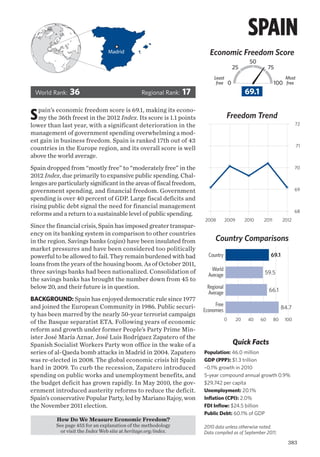
S pain’s economic freedom2012 Index. Itsmakingisits econo-
   my the 36th freest in the
                              score is 69.1,
                                             score 1.1 points
lower than last year, with a significant deterioration in the
                                                                                  Freedom Trend
                                                                                                                         72
management of government spending overwhelming a mod-
est gain in business freedom. Spain is ranked 17th out of 43
                                                                                                                          71
countries in the Europe region, and its overall score is well
above the world average.
Spain dropped from “mostly free” to “moderately free” in the                                                             70
2012 Index, due primarily to expansive public spending. Chal-
lenges are particularly significant in the areas of fiscal freedom,
government spending, and financial freedom. Government                                                                   69
spending is over 40 percent of GDP. Large fiscal deficits and
rising public debt signal the need for financial management
                                                                                                                         68
reforms and a return to a sustainable level of public spending.
                                                                      2008        2009        2010    2011        2012
Since the financial crisis, Spain has imposed greater transpar-
ency on its banking system in comparison to other countries
in the region. Savings banks (cajas) have been insulated from              Country Comparisons
market pressures and have been considered too politically
powerful to be allowed to fail. They remain burdened with bad           Country                            69.1
loans from the years of the housing boom. As of October 2011,
three savings banks had been nationalized. Consolidation of               World
                                                                        Average                       59.5
the savings banks has brought the number down from 45 to
below 20, and their future is in question.                             Regional
                                                                                                          66.1
                                                                       Average
Background: Spain has enjoyed democratic rule since 1977
and joined the European Community in 1986. Public securi­                  Free
                                                                      Economies                                   84.7
ty has been marred by the nearly 50-year terrorist campaign
                                                                                  0      20    40    60      80    100
of the Basque separatist ETA. Following years of economic
reform and growth under former People’s Party Prime Min-
ister José María Aznar, José Luis Rodríguez Zapatero of the
Spanish Socialist Workers Party won office in the wake of a                           Quick Facts
series of al-Qaeda bomb attacks in Madrid in 2004. Zapatero           Population: 46.0 million
was re-elected in 2008. The global economic crisis hit Spain          GDP (PPP): $1.3 trillion
hard in 2009. To curb the recession, Zapatero introduced              –0.1% growth in 2010
spending on public works and unemployment benefits, and               5-year compound annual growth 0.9%
the budget deficit has grown rapidly. In May 2010, the gov-           $29,742 per capita
ernment introduced austerity reforms to reduce the deficit.           Unemployment: 20.1%
Spain’s conservative Popular Party, led by Mariano Rajoy, won         Inflation (CPI): 2.0%
the November 2011 election.                                           FDI Inflow: $24.5 billion
                                                                      Public Debt: 60.1% of GDP
          How Do We Measure Economic Freedom?
          See page 455 for an explanation of the methodology          2010 data unless otherwise noted.
            or visit the Index Web site at heritage.org/index.        Data compiled as of September 2011.
                                                                                                                    383
SPAIN (continued)
                               THE TEN ECONOMIC FREEDOMS
                                                          Country   World Average                       Rank

   RULE OF LAW                Property Rights 70.0                                                     25th
                     Freedom from Corruption 61.0                                                      32nd
                                                     0       20       40        60       80      100
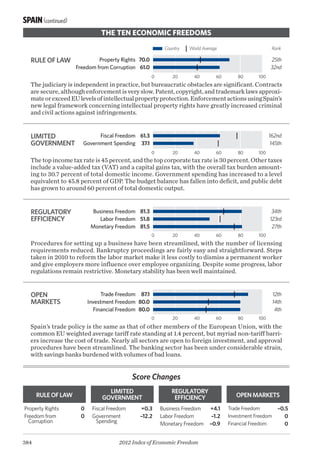
   The judiciary is independent in practice, but bureaucratic obstacles are significant. Contracts
   are secure, although enforcement is very slow. Patent, copyright, and trademark laws approxi-
   mate or exceed EU levels of intellectual property protection. Enforcement actions using Spain’s
   new legal framework concerning intellectual property rights have greatly increased criminal
   and civil actions against infringements.


   LIMITED                   Fiscal Freedom 61.3                                                       162nd
   GOVERNMENT          Government Spending 37.1                                                         145th
                                                     0       20       40        60       80      100
   The top income tax rate is 45 percent, and the top corporate tax rate is 30 percent. Other taxes
   include a value-added tax (VAT) and a capital gains tax, with the overall tax burden amount-
   ing to 30.7 percent of total domestic income. Government spending has increased to a level
   equivalent to 45.8 percent of GDP. The budget balance has fallen into deficit, and public debt
   has grown to around 60 percent of total domestic output.


   REGULATORY               Business Freedom 81.3                                                       34th
   EFFICIENCY                 Labor Freedom 51.8                                                       123rd
                           Monetary Freedom 81.5                                                        27th
                                                     0       20       40        60       80      100
   Procedures for setting up a business have been streamlined, with the number of licensing
   requirements reduced. Bankruptcy proceedings are fairly easy and straightforward. Steps
   taken in 2010 to reform the labor market make it less costly to dismiss a permanent worker
   and give employers more influence over employee organizing. Despite some progress, labor
   regulations remain restrictive. Monetary stability has been well maintained.


   OPEN                        Trade Freedom 87.1                                                         12th
   MARKETS                Investment Freedom 80.0                                                         14th
                            Financial Freedom 80.0                                                         4th
                                                     0       20       40        60       80      100
   Spain’s trade policy is the same as that of other members of the European Union, with the
   common EU weighted average tariff rate standing at 1.4 percent, but myriad non-tariff barri-
   ers increase the cost of trade. Nearly all sectors are open to foreign investment, and approval
   procedures have been streamlined. The banking sector has been under considerable strain,
   with savings banks burdened with volumes of bad loans.


                                            Score Changes
                                 LIMITED                     REGULATORY
       RULE OF LAW             GOVERNMENT                     EFFICIENCY                OPEN MARKETS

Property Rights       0    Fiscal Freedom     +0.3       Business Freedom    +4.1    Trade Freedom          –0.5
Freedom from          0    Government         –12.2      Labor Freedom        –1.2   Investment Freedom        0
  Corruption                 Spending                    Monetary Freedom    –0.9    Financial Freedom         0


384	                                  2012 Index of Economic Freedom

Spain’s economic freedom score

  • 1.
    SPAIN Economic Freedom Score 50 25 75 Least Most free 0 100 free World Rank: 36 Regional Rank: 17 69.1 This economy is not graded S pain’s economic freedom2012 Index. Itsmakingisits econo- my the 36th freest in the score is 69.1, score 1.1 points lower than last year, with a significant deterioration in the Freedom Trend 72 management of government spending overwhelming a mod- est gain in business freedom. Spain is ranked 17th out of 43 71 countries in the Europe region, and its overall score is well above the world average. Spain dropped from “mostly free” to “moderately free” in the 70 2012 Index, due primarily to expansive public spending. Chal- lenges are particularly significant in the areas of fiscal freedom, government spending, and financial freedom. Government 69 spending is over 40 percent of GDP. Large fiscal deficits and rising public debt signal the need for financial management 68 reforms and a return to a sustainable level of public spending. 2008 2009 2010 2011 2012 Since the financial crisis, Spain has imposed greater transpar- ency on its banking system in comparison to other countries in the region. Savings banks (cajas) have been insulated from Country Comparisons market pressures and have been considered too politically powerful to be allowed to fail. They remain burdened with bad Country 69.1 loans from the years of the housing boom. As of October 2011, three savings banks had been nationalized. Consolidation of World Average 59.5 the savings banks has brought the number down from 45 to below 20, and their future is in question. Regional 66.1 Average Background: Spain has enjoyed democratic rule since 1977 and joined the European Community in 1986. Public securi­ Free Economies 84.7 ty has been marred by the nearly 50-year terrorist campaign 0 20 40 60 80 100 of the Basque separatist ETA. Following years of economic reform and growth under former People’s Party Prime Min- ister José María Aznar, José Luis Rodríguez Zapatero of the Spanish Socialist Workers Party won office in the wake of a Quick Facts series of al-Qaeda bomb attacks in Madrid in 2004. Zapatero Population: 46.0 million was re-elected in 2008. The global economic crisis hit Spain GDP (PPP): $1.3 trillion hard in 2009. To curb the recession, Zapatero introduced –0.1% growth in 2010 spending on public works and unemployment benefits, and 5-year compound annual growth 0.9% the budget deficit has grown rapidly. In May 2010, the gov- $29,742 per capita ernment introduced austerity reforms to reduce the deficit. Unemployment: 20.1% Spain’s conservative Popular Party, led by Mariano Rajoy, won Inflation (CPI): 2.0% the November 2011 election. FDI Inflow: $24.5 billion Public Debt: 60.1% of GDP How Do We Measure Economic Freedom? See page 455 for an explanation of the methodology 2010 data unless otherwise noted. or visit the Index Web site at heritage.org/index. Data compiled as of September 2011. 383
  • 2.
    SPAIN (continued) THE TEN ECONOMIC FREEDOMS Country World Average Rank RULE OF LAW Property Rights 70.0 25th Freedom from Corruption 61.0 32nd 0 20 40 60 80 100 The judiciary is independent in practice, but bureaucratic obstacles are significant. Contracts are secure, although enforcement is very slow. Patent, copyright, and trademark laws approxi- mate or exceed EU levels of intellectual property protection. Enforcement actions using Spain’s new legal framework concerning intellectual property rights have greatly increased criminal and civil actions against infringements. LIMITED Fiscal Freedom 61.3 162nd GOVERNMENT Government Spending 37.1 145th 0 20 40 60 80 100 The top income tax rate is 45 percent, and the top corporate tax rate is 30 percent. Other taxes include a value-added tax (VAT) and a capital gains tax, with the overall tax burden amount- ing to 30.7 percent of total domestic income. Government spending has increased to a level equivalent to 45.8 percent of GDP. The budget balance has fallen into deficit, and public debt has grown to around 60 percent of total domestic output. REGULATORY Business Freedom 81.3 34th EFFICIENCY Labor Freedom 51.8 123rd Monetary Freedom 81.5 27th 0 20 40 60 80 100 Procedures for setting up a business have been streamlined, with the number of licensing requirements reduced. Bankruptcy proceedings are fairly easy and straightforward. Steps taken in 2010 to reform the labor market make it less costly to dismiss a permanent worker and give employers more influence over employee organizing. Despite some progress, labor regulations remain restrictive. Monetary stability has been well maintained. OPEN Trade Freedom 87.1 12th MARKETS Investment Freedom 80.0 14th Financial Freedom 80.0 4th 0 20 40 60 80 100 Spain’s trade policy is the same as that of other members of the European Union, with the common EU weighted average tariff rate standing at 1.4 percent, but myriad non-tariff barri- ers increase the cost of trade. Nearly all sectors are open to foreign investment, and approval procedures have been streamlined. The banking sector has been under considerable strain, with savings banks burdened with volumes of bad loans. Score Changes LIMITED REGULATORY RULE OF LAW GOVERNMENT EFFICIENCY OPEN MARKETS Property Rights 0 Fiscal Freedom +0.3 Business Freedom +4.1 Trade Freedom –0.5 Freedom from 0 Government –12.2 Labor Freedom –1.2 Investment Freedom 0 Corruption Spending Monetary Freedom –0.9 Financial Freedom 0 384 2012 Index of Economic Freedom