NATIONAL
BRANDING
PROMOTION
OF COUNTRY-
SPAIN MARKS
TABLE OF CONTENTS
About Turespana
About Spain Marks Campaign
Visuals
Conclusion
References
About TURESPAÑA
• Turespana is the national
tourism agency responsible
for the marketing of Spain
in the world.
• Economic, social and
environmental
sustainability, creating value
for the tourism sector.
• The mission is to be the
pioneer of the tourism
strategy in Spain, to
coordinate and manage
public and private actors.
About Spain
Marks
• In 2002-2003, campaign is
created: “Spain marks”,
designed by “Publicis España”.
• The objective of this campaign is
to present Spain as a
competitive and differentiated
tourist destination,
• Unlike other campaigns, it also
wanted to show Spain not only
as a country of beaches,
monuments and gastronomy,
but as a country for every sense,
a unique experience which
change the tourist.
• With this message, TURESPAÑA
pretended to show Spain as a
different destination, mainly
comparing to the rest of
Mediterranean countries, thanks to
a top quality offer of culture,
gastronomy and nature tourism.
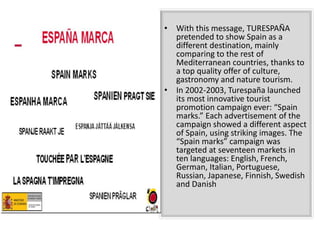
• In 2002-2003, Turespaña launched
its most innovative tourist
promotion campaign ever: “Spain
marks.” Each advertisement of the
campaign showed a different aspect
of Spain, using striking images. The
“Spain marks” campaign was
targeted at seventeen markets in
ten languages: English, French,
German, Italian, Portuguese,
Russian, Japanese, Finnish, Swedish
and Danish
The advertising agency Publicis groupe was selected
according to the following criteria, which met
Turespaña requirements:
• Provide an overall image of Spain (not only sun
and beach but also monuments, museums, sport,
wellness, conferences, etc.)
• Distinguish quality as a singular element of Spain
(cultural events, innovative infrastructures, etc.)
• Leave an unforgettable impression.
• Promote the "Spanish attitude" that means
hospitality, friendliness, the Spanish way of life.
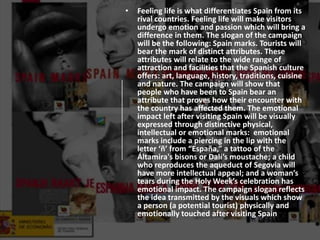
• Feeling life is what differentiates Spain from its
rival countries. Feeling life will make visitors
undergo emotion and passion which will bring a
difference in them. The slogan of the campaign
will be the following: Spain marks. Tourists will
bear the mark of distinct attributes. These
attributes will relate to the wide range of
attraction and facilities that the Spanish culture
offers: art, language, history, traditions, cuisine
and nature. The campaign will show that
people who have been to Spain bear an
attribute that proves how their encounter with
the country has affected them. The emotional
impact left after visiting Spain will be visually
expressed through distinctive physical,
intellectual or emotional marks: emotional
marks include a piercing in the lip with the
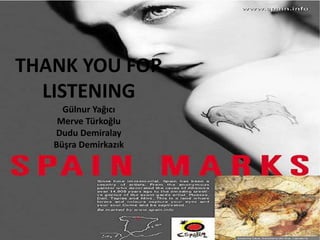
letter ‘ñ’ from “España,” a tattoo of the
Áltamira's bisons or Dalí’s moustache; a child
who reproduces the aqueduct of Segovia will
have more intellectual appeal; and a woman’s
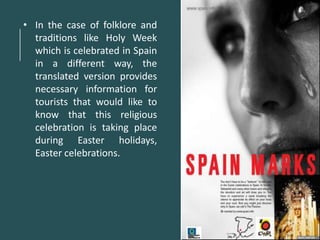
tears during the Holy Week’s celebration has
emotional impact. The campaign slogan reflects
the idea transmitted by the visuals which show
a person (a potential tourist) physically and
emotionally touched after visiting Spain
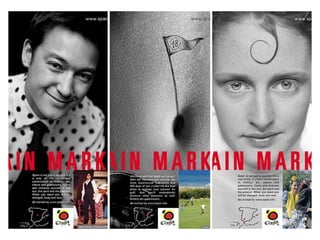
• In the place of traditional postcards, 24 portraits of a
black and white elegant, often dark, made by the
Barcelona fashion photographer Jose Manuel Ferrater.
• Pictures a little provocative: close-ups of a lip
adorned with a "piercing", bruised toes, a man's butt
that suggests ripped jeans ... Each illustrates a theme
(gastronomy, green tourism , golf, linguistic stay, Dali
year, etc.) by the imprint left on the body of the
model / tourist. The sun and the beach have not been
forgotten, but are only suggested by a tan mark left
by a string, at the bottom of the back of an elegant
evening dress
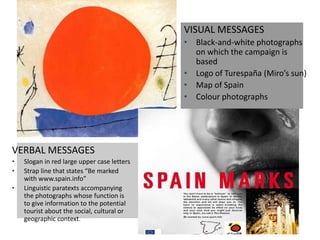
VISUAL MESSAGES
• Black-and-white photographs
on which the campaign is
based
• Logo of Turespaña (Miro’s sun)
• Map of Spain
• Colour photographs
VERBAL MESSAGES
• Slogan in red large upper case letters
• Strap line that states “Be marked
with www.spain.info”
• Linguistic paratexts accompanying
the photographs whose function is
to give information to the potential
tourist about the social, cultural or
geographic context.
Pure
Exoticisation
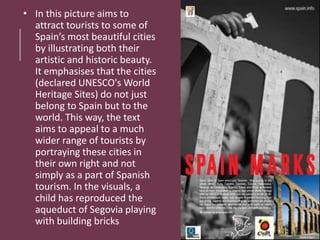
• In this picture aims to
attract tourists to some of
Spain’s most beautiful cities
by illustrating both their
artistic and historic beauty.
It emphasises that the cities
(declared UNESCO's World
Heritage Sites) do not just
belong to Spain but to the
world. This way, the text
aims to appeal to a much
wider range of tourists by
portraying these cities in
their own right and not
simply as a part of Spanish
tourism. In the visuals, a
child has reproduced the
aqueduct of Segovia playing
with building bricks
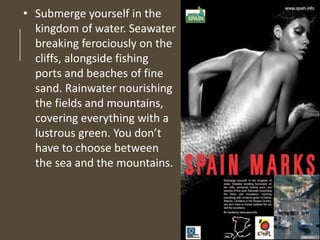
• Submerge yourself in the
kingdom of water. Seawater
breaking ferociously on the
cliffs, alongside fishing
ports and beaches of fine
sand. Rainwater nourishing
the fields and mountains,
covering everything with a
lustrous green. You don’t
have to choose between
the sea and the mountains.
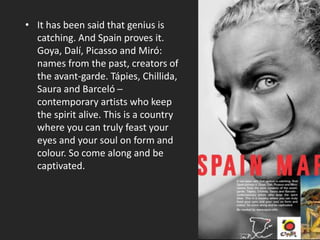
• It has been said that genius is
catching. And Spain proves it.
Goya, Dalí, Picasso and Miró:
names from the past, creators of
the avant-garde. Tápies, Chillida,
Saura and Barceló ─
contemporary artists who keep
the spirit alive. This is a country
where you can truly feast your
eyes and your soul on form and
colour. So come along and be
captivated.
Italicised
Exoticisation
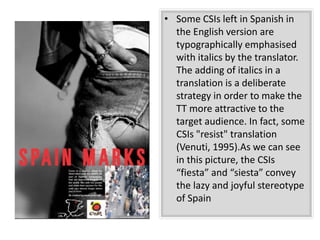
• Some CSIs left in Spanish in
the English version are
typographically emphasised
with italics by the translator.
The adding of italics in a
translation is a deliberate
strategy in order to make the
TT more attractive to the
target audience. In fact, some
CSIs "resist" translation
(Venuti, 1995).As we can see
in this picture, the CSIs
“fiesta” and “siesta” convey
the lazy and joyful stereotype
of Spain
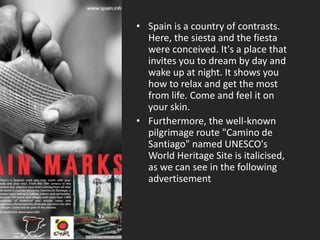
• Spain is a country of contrasts.
Here, the siesta and the fiesta
were conceived. It's a place that
invites you to dream by day and
wake up at night. It shows you
how to relax and get the most
from life. Come and feel it on
your skin.
• Furthermore, the well-known
pilgrimage route "Camino de
Santiago" named UNESCO's
World Heritage Site is italicised,
as we can see in the following
advertisement
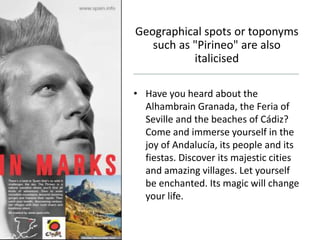
Geographical spots or toponyms
such as "Pirineo" are also
italicised
• Have you heard about the
Alhambrain Granada, the Feria of
Seville and the beaches of Cádiz?
Come and immerse yourself in the
joy of Andalucía, its people and its
fiestas. Discover its majestic cities
and amazing villages. Let yourself
be enchanted. Its magic will change
your life.
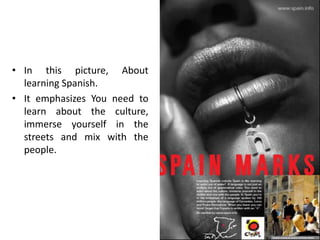
• In this picture, About
learning Spanish.
• It emphasizes You need to
learn about the culture,
immerse yourself in the
streets and mix with the
people.
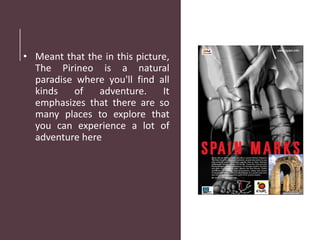
• Meant that the in this picture,
The Pirineo is a natural
paradise where you'll find all
kinds of adventure. It
emphasizes that there are so
many places to explore that
you can experience a lot of
adventure here
Exoticisation
combined with
deletion
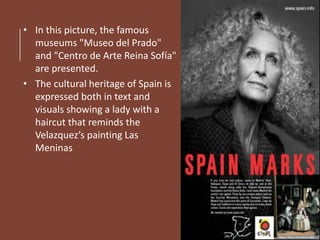
• In this picture, the famous
museums "Museo del Prado"
and "Centro de Arte Reina Sofía"
are presented.
• The cultural heritage of Spain is
expressed both in text and
visuals showing a lady with a
haircut that reminds the
Velazquez’s painting Las
Meninas
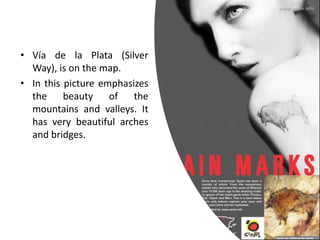
• Vía de la Plata (Silver
Way), is on the map.
• In this picture emphasizes
the beauty of the
mountains and valleys. It
has very beautiful arches
and bridges.
Adjectivised
Explanation
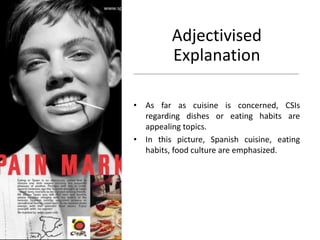
• As far as cuisine is concerned, CSIs
regarding dishes or eating habits are
appealing topics.
• In this picture, Spanish cuisine, eating
habits, food culture are emphasized.
Pure Assimilation
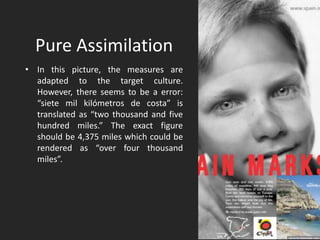
• In this picture, the measures are
adapted to the target culture.
However, there seems to be a error:
“siete mil kilómetros de costa” is
translated as “two thousand and five
hundred miles.” The exact figure
should be 4,375 miles which could be
rendered as “over four thousand
miles”.
• In the case of folklore and
traditions like Holy Week
which is celebrated in Spain
in a different way, the
translated version provides
necessary information for
tourists that would like to
know that this religious
celebration is taking place
during Easter holidays,
Easter celebrations.
CONCLUSION
• It makes a modern connotation from the
visual point of view.
• But ıt is difficult to establish a connection
between the images used in the
campaign and the images on the side.
• In the criticism of the campaign, Spanish
campaign did not persuade sufficient
readers to visit Spain.
• Also It has also been found to be
insufficient in translation.
REFERENCES
• http://www.jostrans.org/issue21/art_comitre.
php
• http://langues.ac-dijon.fr/spip.php?article2501
• http://phantasma.lett.ubbcluj.ro/?page_id=540
3
• https://books.google.pl/books?id=ZsYsBgAAQB
AJ&pg=PA213&lpg=PA213&dq=spain+marks+tu
respaña&source=bl&ots=xP0ZD5taKJ&sig=8kL7
1bXiUEO3G_lrurMFET57eaQ&hl=tr&sa=X&ved=
0ahUKEwjYsqPHwcjYAhXRalAKHbfK
• https://it.wikipedia.org/wiki/Turespa%C3%B1a
• http://langues.ac-dijon.fr/spip.php?article2501
THANK YOU FOR
LISTENING
Gülnur Yağıcı
Merve Türkoğlu
Dudu Demiralay
Büşra Demirkazık

Spai̇n marks-campaign

  • 1.
  • 2.
    TABLE OF CONTENTS AboutTurespana About Spain Marks Campaign Visuals Conclusion References
  • 3.
    About TURESPAÑA • Turespanais the national tourism agency responsible for the marketing of Spain in the world. • Economic, social and environmental sustainability, creating value for the tourism sector. • The mission is to be the pioneer of the tourism strategy in Spain, to coordinate and manage public and private actors.
  • 4.
    About Spain Marks • In2002-2003, campaign is created: “Spain marks”, designed by “Publicis España”. • The objective of this campaign is to present Spain as a competitive and differentiated tourist destination, • Unlike other campaigns, it also wanted to show Spain not only as a country of beaches, monuments and gastronomy, but as a country for every sense, a unique experience which change the tourist.
  • 6.
    • With thismessage, TURESPAÑA pretended to show Spain as a different destination, mainly comparing to the rest of Mediterranean countries, thanks to a top quality offer of culture, gastronomy and nature tourism. • In 2002-2003, Turespaña launched its most innovative tourist promotion campaign ever: “Spain marks.” Each advertisement of the campaign showed a different aspect of Spain, using striking images. The “Spain marks” campaign was targeted at seventeen markets in ten languages: English, French, German, Italian, Portuguese, Russian, Japanese, Finnish, Swedish and Danish
  • 7.
    The advertising agencyPublicis groupe was selected according to the following criteria, which met Turespaña requirements: • Provide an overall image of Spain (not only sun and beach but also monuments, museums, sport, wellness, conferences, etc.) • Distinguish quality as a singular element of Spain (cultural events, innovative infrastructures, etc.) • Leave an unforgettable impression. • Promote the "Spanish attitude" that means hospitality, friendliness, the Spanish way of life.
  • 8.
    • Feeling lifeis what differentiates Spain from its rival countries. Feeling life will make visitors undergo emotion and passion which will bring a difference in them. The slogan of the campaign will be the following: Spain marks. Tourists will bear the mark of distinct attributes. These attributes will relate to the wide range of attraction and facilities that the Spanish culture offers: art, language, history, traditions, cuisine and nature. The campaign will show that people who have been to Spain bear an attribute that proves how their encounter with the country has affected them. The emotional impact left after visiting Spain will be visually expressed through distinctive physical, intellectual or emotional marks: emotional marks include a piercing in the lip with the letter ‘ñ’ from “España,” a tattoo of the Áltamira's bisons or Dalí’s moustache; a child who reproduces the aqueduct of Segovia will have more intellectual appeal; and a woman’s tears during the Holy Week’s celebration has emotional impact. The campaign slogan reflects the idea transmitted by the visuals which show a person (a potential tourist) physically and emotionally touched after visiting Spain
  • 9.
    • In theplace of traditional postcards, 24 portraits of a black and white elegant, often dark, made by the Barcelona fashion photographer Jose Manuel Ferrater. • Pictures a little provocative: close-ups of a lip adorned with a "piercing", bruised toes, a man's butt that suggests ripped jeans ... Each illustrates a theme (gastronomy, green tourism , golf, linguistic stay, Dali year, etc.) by the imprint left on the body of the model / tourist. The sun and the beach have not been forgotten, but are only suggested by a tan mark left by a string, at the bottom of the back of an elegant evening dress
  • 10.
    VISUAL MESSAGES • Black-and-whitephotographs on which the campaign is based • Logo of Turespaña (Miro’s sun) • Map of Spain • Colour photographs VERBAL MESSAGES • Slogan in red large upper case letters • Strap line that states “Be marked with www.spain.info” • Linguistic paratexts accompanying the photographs whose function is to give information to the potential tourist about the social, cultural or geographic context.
  • 11.
  • 12.
    • In thispicture aims to attract tourists to some of Spain’s most beautiful cities by illustrating both their artistic and historic beauty. It emphasises that the cities (declared UNESCO's World Heritage Sites) do not just belong to Spain but to the world. This way, the text aims to appeal to a much wider range of tourists by portraying these cities in their own right and not simply as a part of Spanish tourism. In the visuals, a child has reproduced the aqueduct of Segovia playing with building bricks
  • 13.
    • Submerge yourselfin the kingdom of water. Seawater breaking ferociously on the cliffs, alongside fishing ports and beaches of fine sand. Rainwater nourishing the fields and mountains, covering everything with a lustrous green. You don’t have to choose between the sea and the mountains.
  • 14.
    • It hasbeen said that genius is catching. And Spain proves it. Goya, Dalí, Picasso and Miró: names from the past, creators of the avant-garde. Tápies, Chillida, Saura and Barceló ─ contemporary artists who keep the spirit alive. This is a country where you can truly feast your eyes and your soul on form and colour. So come along and be captivated.
  • 15.
  • 16.
    • Some CSIsleft in Spanish in the English version are typographically emphasised with italics by the translator. The adding of italics in a translation is a deliberate strategy in order to make the TT more attractive to the target audience. In fact, some CSIs "resist" translation (Venuti, 1995).As we can see in this picture, the CSIs “fiesta” and “siesta” convey the lazy and joyful stereotype of Spain
  • 17.
    • Spain isa country of contrasts. Here, the siesta and the fiesta were conceived. It's a place that invites you to dream by day and wake up at night. It shows you how to relax and get the most from life. Come and feel it on your skin. • Furthermore, the well-known pilgrimage route "Camino de Santiago" named UNESCO's World Heritage Site is italicised, as we can see in the following advertisement
  • 18.
    Geographical spots ortoponyms such as "Pirineo" are also italicised • Have you heard about the Alhambrain Granada, the Feria of Seville and the beaches of Cádiz? Come and immerse yourself in the joy of Andalucía, its people and its fiestas. Discover its majestic cities and amazing villages. Let yourself be enchanted. Its magic will change your life.
  • 19.
    • In thispicture, About learning Spanish. • It emphasizes You need to learn about the culture, immerse yourself in the streets and mix with the people.
  • 20.
    • Meant thatthe in this picture, The Pirineo is a natural paradise where you'll find all kinds of adventure. It emphasizes that there are so many places to explore that you can experience a lot of adventure here
  • 21.
  • 22.
    • In thispicture, the famous museums "Museo del Prado" and "Centro de Arte Reina Sofía" are presented. • The cultural heritage of Spain is expressed both in text and visuals showing a lady with a haircut that reminds the Velazquez’s painting Las Meninas
  • 23.
    • Vía dela Plata (Silver Way), is on the map. • In this picture emphasizes the beauty of the mountains and valleys. It has very beautiful arches and bridges.
  • 24.
    Adjectivised Explanation • As faras cuisine is concerned, CSIs regarding dishes or eating habits are appealing topics. • In this picture, Spanish cuisine, eating habits, food culture are emphasized.
  • 25.
    Pure Assimilation • Inthis picture, the measures are adapted to the target culture. However, there seems to be a error: “siete mil kilómetros de costa” is translated as “two thousand and five hundred miles.” The exact figure should be 4,375 miles which could be rendered as “over four thousand miles”.
  • 26.
    • In thecase of folklore and traditions like Holy Week which is celebrated in Spain in a different way, the translated version provides necessary information for tourists that would like to know that this religious celebration is taking place during Easter holidays, Easter celebrations.
  • 27.
    CONCLUSION • It makesa modern connotation from the visual point of view. • But ıt is difficult to establish a connection between the images used in the campaign and the images on the side. • In the criticism of the campaign, Spanish campaign did not persuade sufficient readers to visit Spain. • Also It has also been found to be insufficient in translation.
  • 28.
    REFERENCES • http://www.jostrans.org/issue21/art_comitre. php • http://langues.ac-dijon.fr/spip.php?article2501 •http://phantasma.lett.ubbcluj.ro/?page_id=540 3 • https://books.google.pl/books?id=ZsYsBgAAQB AJ&pg=PA213&lpg=PA213&dq=spain+marks+tu respaña&source=bl&ots=xP0ZD5taKJ&sig=8kL7 1bXiUEO3G_lrurMFET57eaQ&hl=tr&sa=X&ved= 0ahUKEwjYsqPHwcjYAhXRalAKHbfK • https://it.wikipedia.org/wiki/Turespa%C3%B1a • http://langues.ac-dijon.fr/spip.php?article2501
  • 29.
    THANK YOU FOR LISTENING GülnurYağıcı Merve Türkoğlu Dudu Demiralay Büşra Demirkazık