Sorting & Searching
Sorting & Searching
● Bubble Sort
● Insertion Sort
● Selection Sort
● Quick Sort
● Sequential Search
● Binary Search
Bubble Sort
● In bubble sort repeatedly move the largest
element to the highest index position of the array
and on each iteration to reduce the effective size
of the array.
● In Bubble sort we compare the adjacent item and
swap if required.
● In a bubble sorting algorithm, the elements of the
list "gradually 'bubble' (or rise) to their proper
location in the array, like bubbles rising in a glass
of soda"
Algorithm of Bubble Sort
● Declare array on n items
items[n]={4,5,1,8,54,32...32}
● Compare each pair of item and swap if required.
for(int pass=0; pass<n-1; pass ++)
for(int i=0; i<n-pass-1; i++)
If (item[ i ] > item [i+1]) {
tempvar = item[i]
Item[ i ] = item [i+1]
Item[ i+1]=tempvar
}
}
}
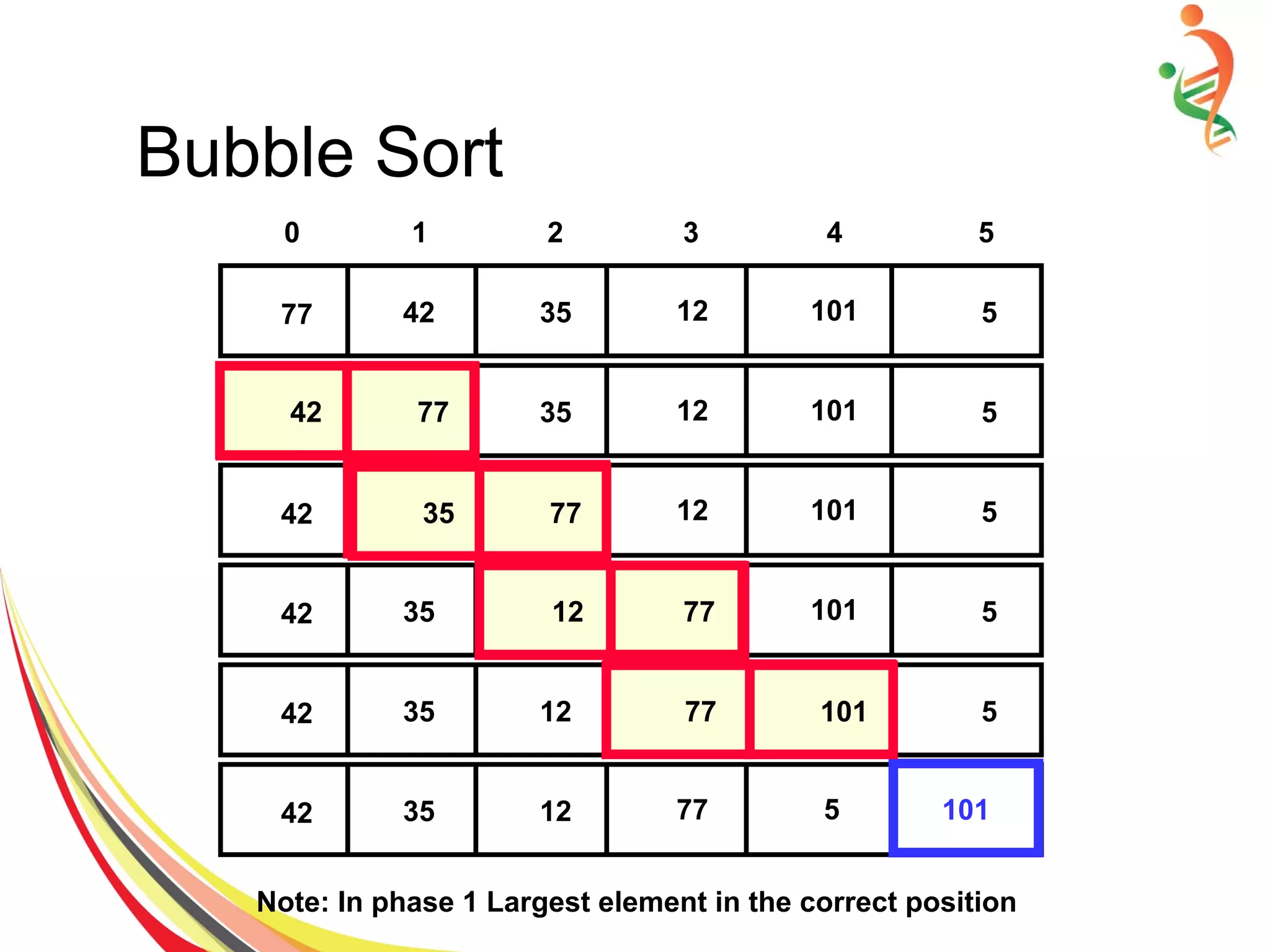
Bubble Sort
512354277 101
0 1 2 3 4 5
512354277 10142 77
512357742 10135 77
512773542 10112 77
577123542 101
77123542 5 101
Note: In phase 1 Largest element in the correct position
77 101
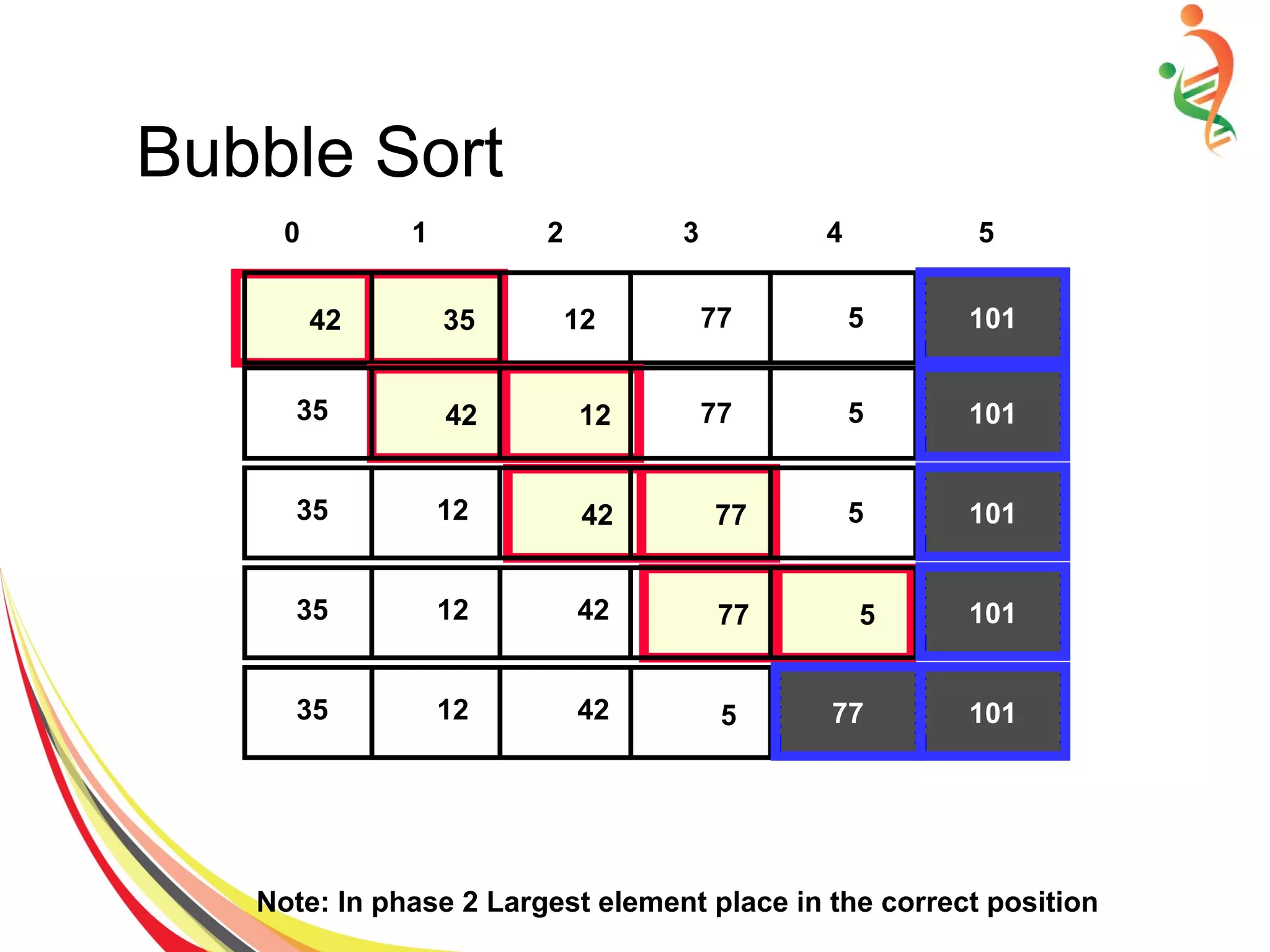
Bubble Sort
0 1 2 3 4 5
Note: In phase 2 Largest element place in the correct position
42 35 7712 5 101
42 12 77 5 10135
42 77 5 10135 12
77 5 10135 12 42
10135 12 42 5 77
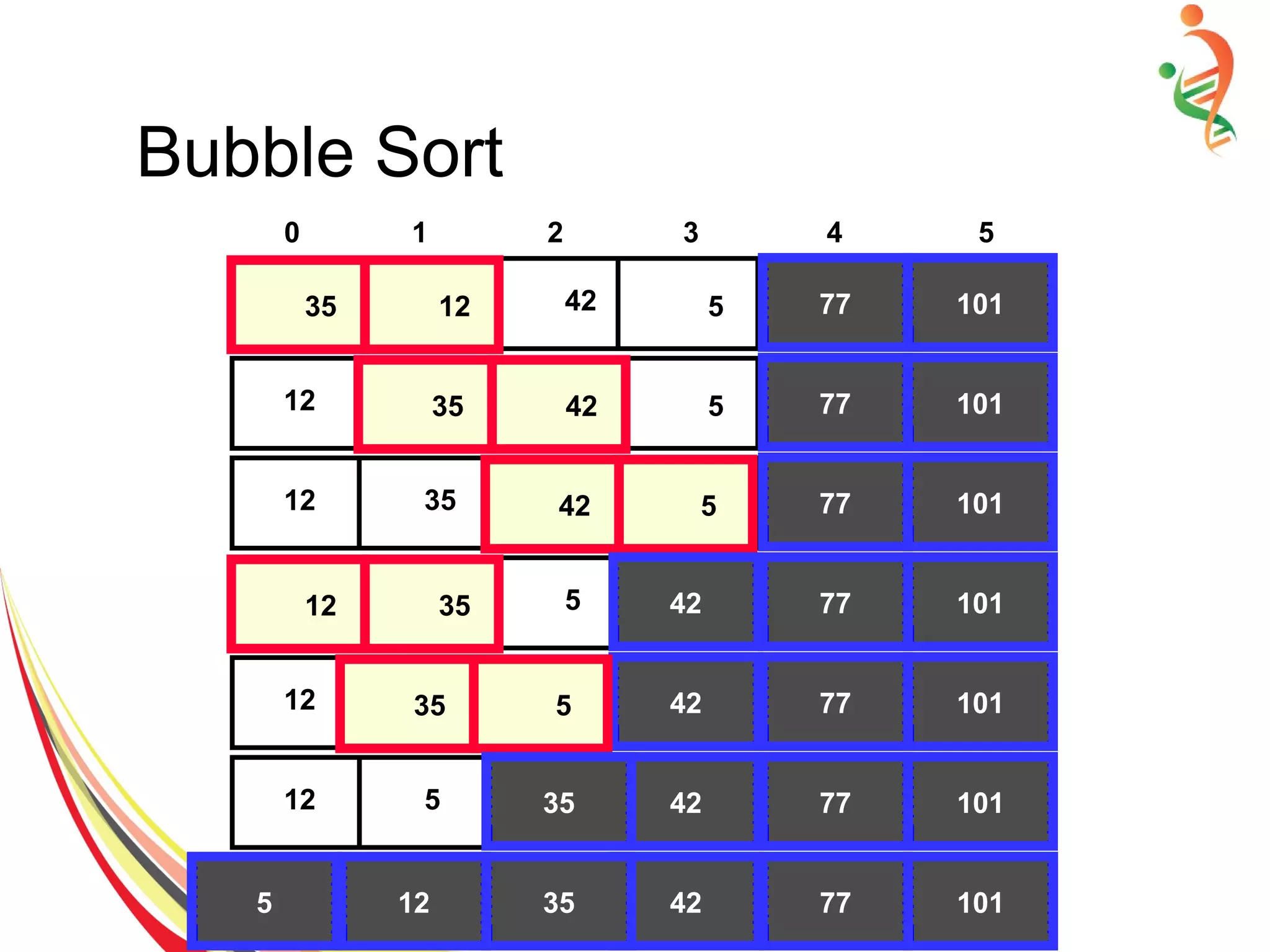
Bubble Sort
0 1 2 3 4 5
10135 12 42 5 7735 12
10112 12 42 5 7735 42
10112 35 42 5 7742 5
10112 35 5 774212 35
10112 35 5 774235 5
10112 5 5 774235
1015 ●
12 5 774235125
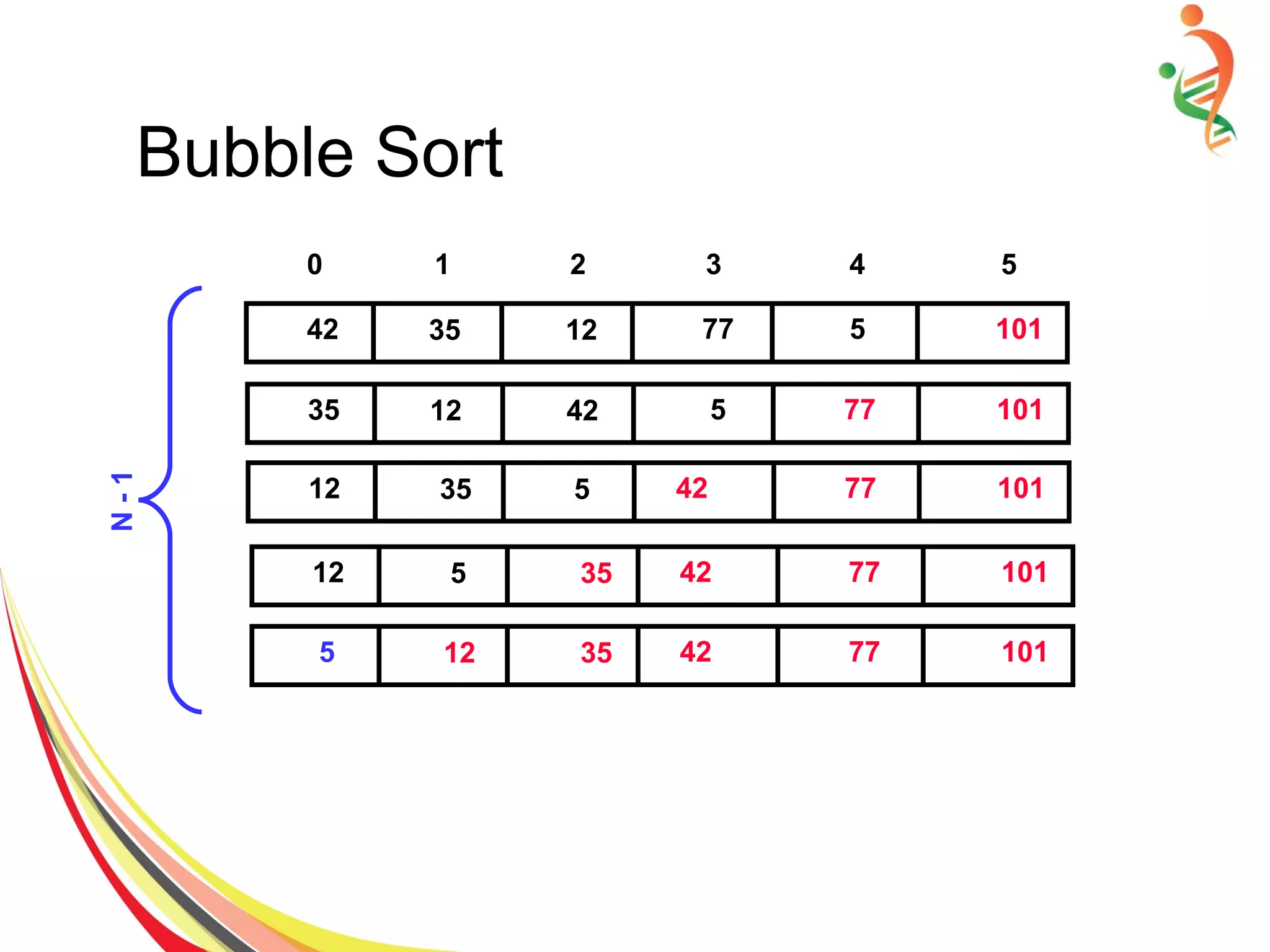
Bubble Sort
77123542 5 101
5421235 77 101
4253512 77 101
4235512 77 101
4235125 77 101
N-1
0 1 2 3 4 5
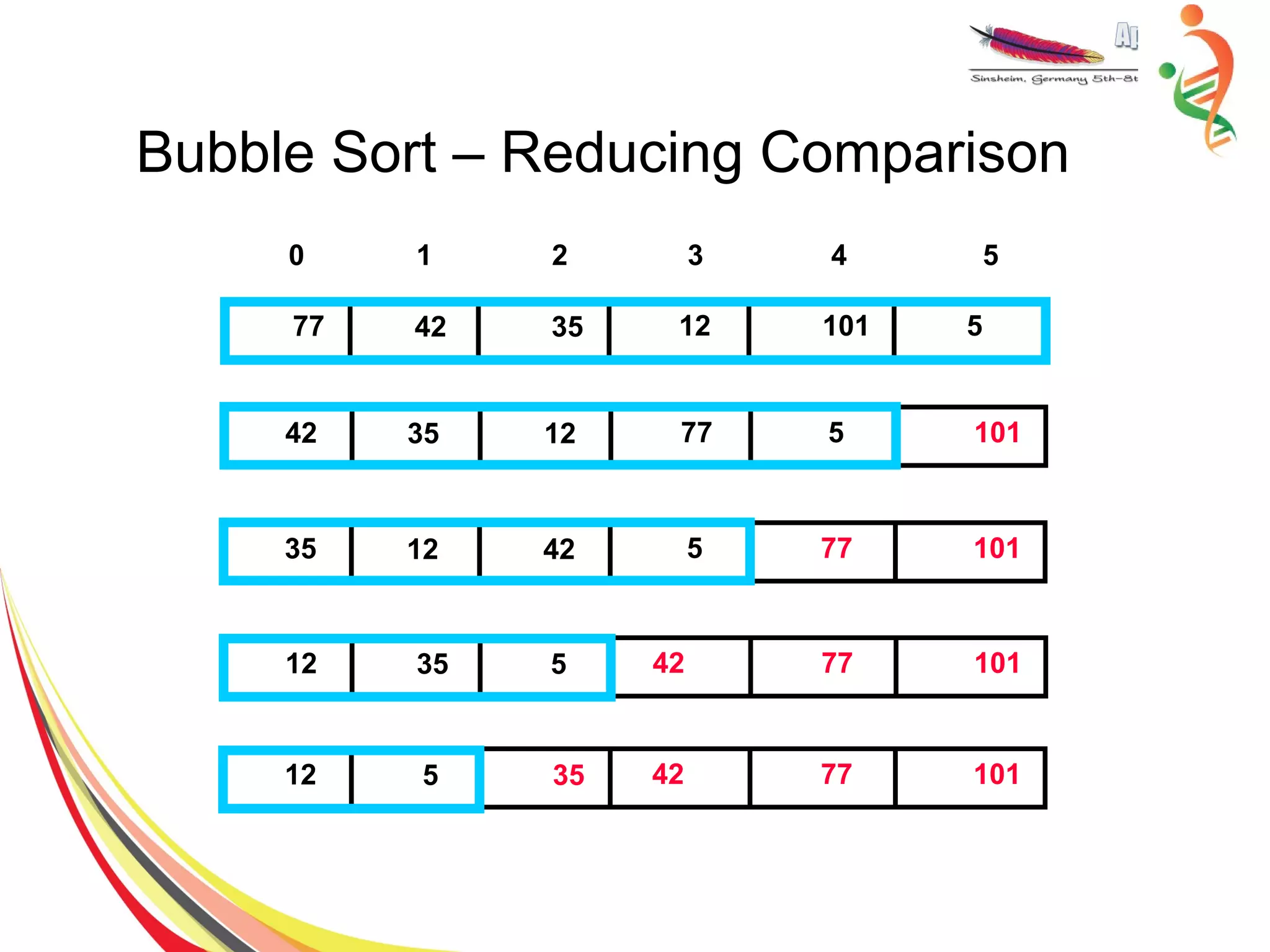
Bubble Sort – Reducing Comparison
12354277 101 5
77123542 5 101
5421235 77 101
4253512 77 101
4235512 77 101
0 1 2 3 4 5
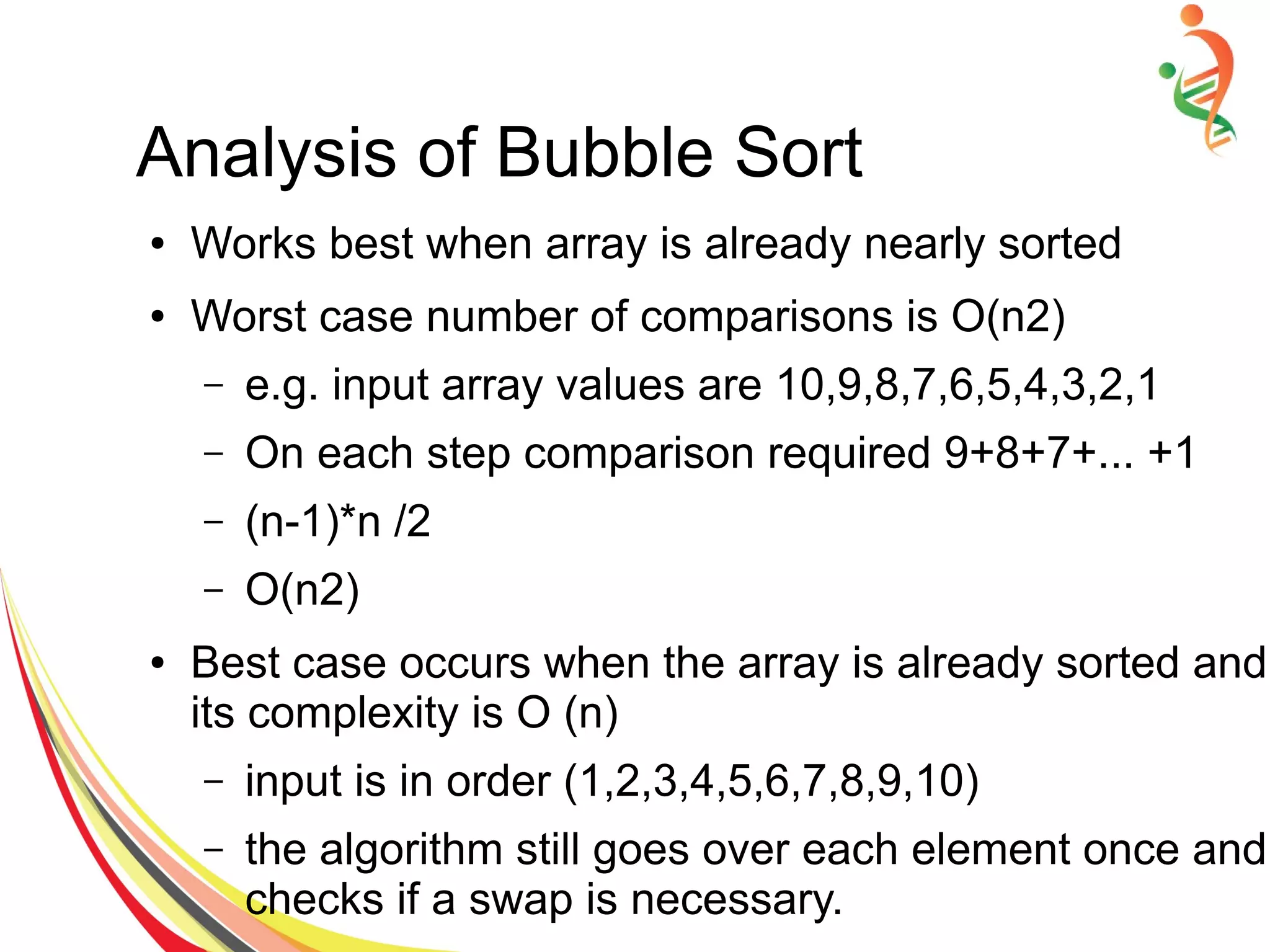
Analysis of Bubble Sort
● Works best when array is already nearly sorted
● Worst case number of comparisons is O(n2)
– e.g. input array values are 10,9,8,7,6,5,4,3,2,1
– On each step comparison required 9+8+7+... +1
– (n-1)*n /2
– O(n2)
● Best case occurs when the array is already sorted and
its complexity is O (n)
– input is in order (1,2,3,4,5,6,7,8,9,10)
– the algorithm still goes over each element once and
checks if a swap is necessary.
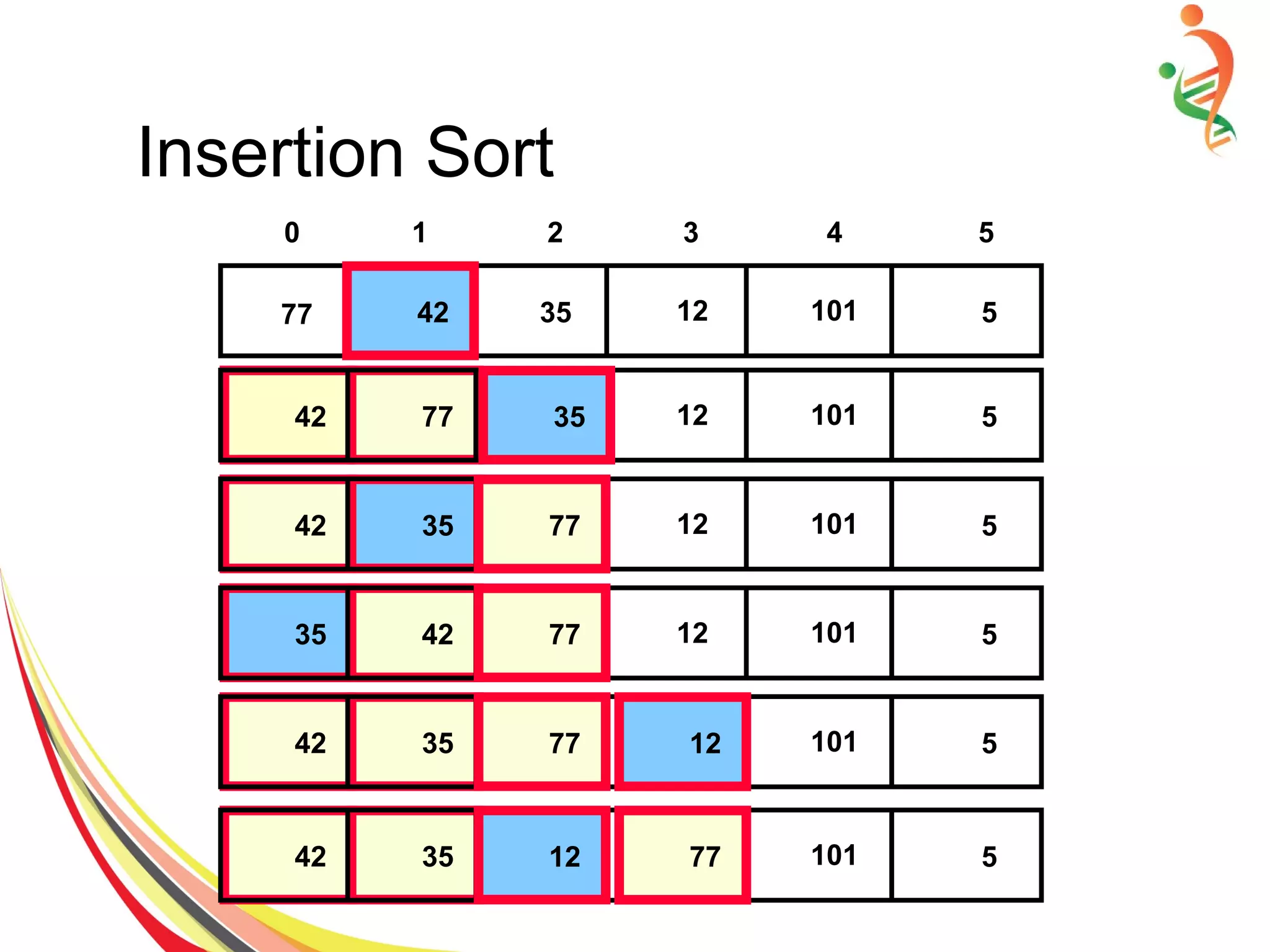
Insertion Sort
● Sort the elements in range[0,m] form = 0,...,n−1
● No action need form=0
● When going from m to m+1, insert the element
in index m+1, to its appropriate location
Algorithm of Insertion Sort
● This algorithm sorts the array a with n elements.
Set a[n] ={ 2,7,5,8,43,23..99}
● for (int i = 1; i < n; i++) //Array start from 0
{
Item tmp = a[i];
for (int j=i; j>0 && tmp < a[j-1]; j--)
a[j] = a[j-1];
a[j] = tmp;
}
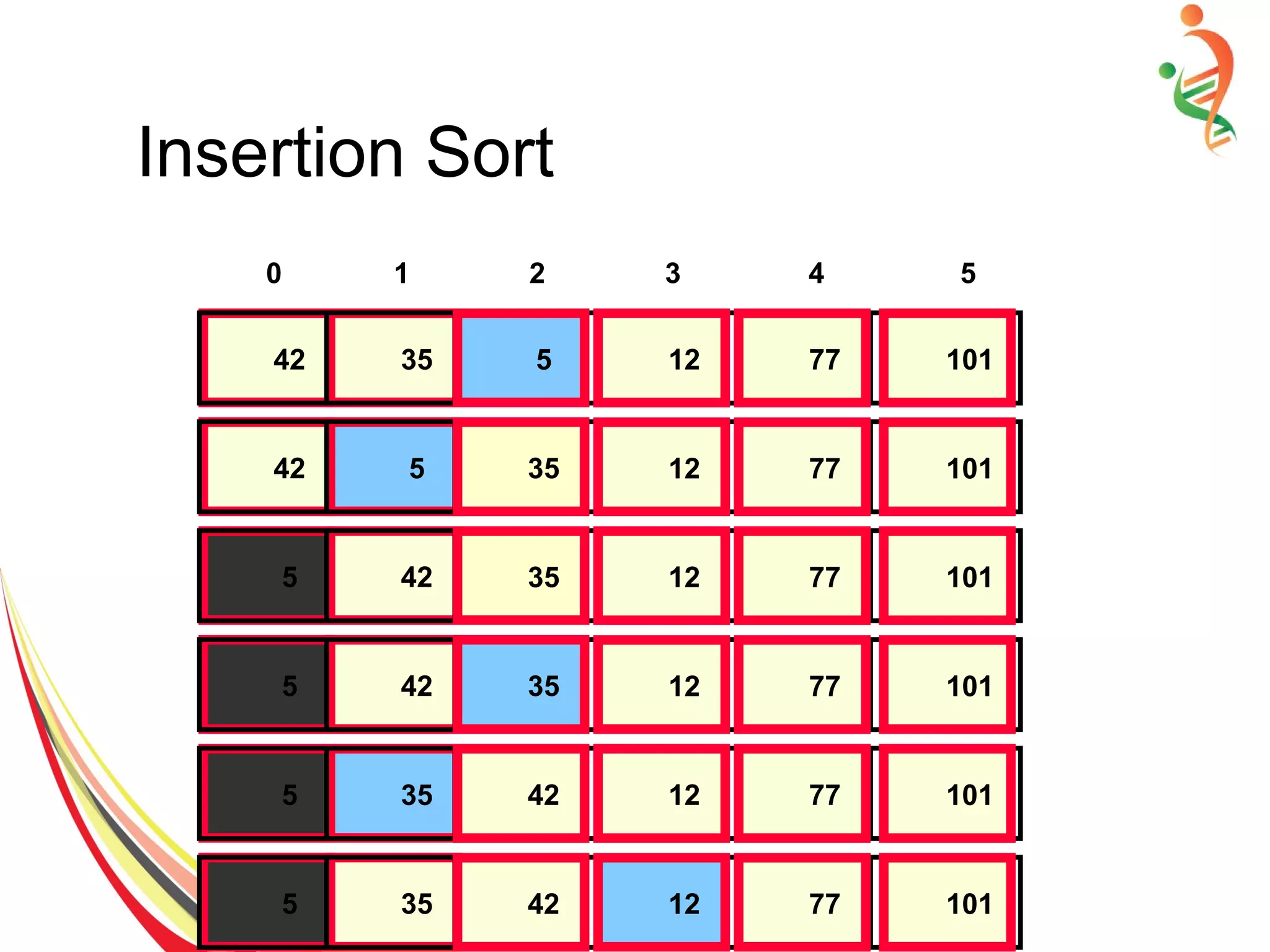
Insertion Sort
512354277 101
42 77 51235 101
42 35 51235 10177
35 42 51235 10177
42 35 51235 10177 12
42 35 51235 10112 77
42
35
0 1 2 3 4 5
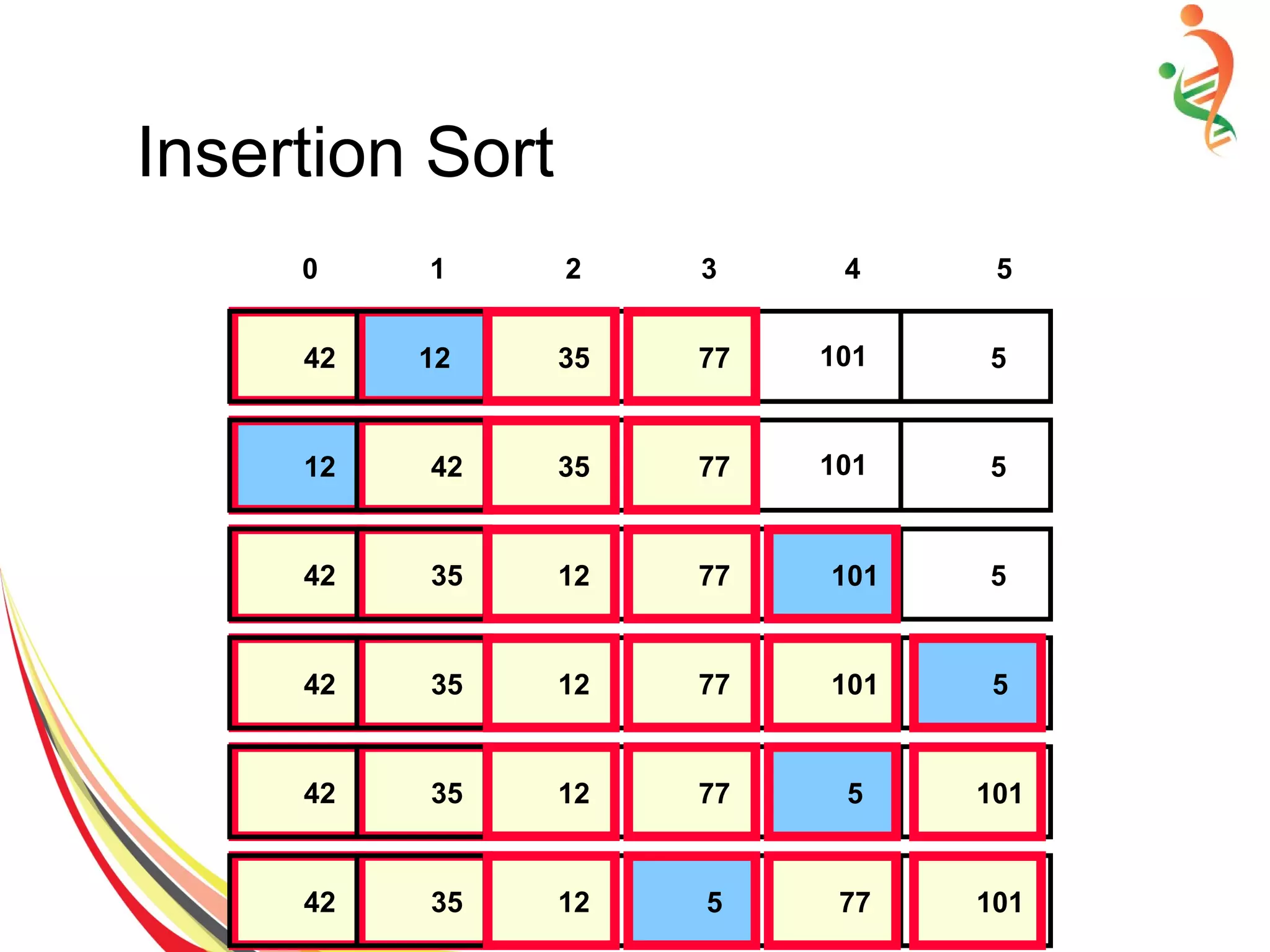
Insertion Sort
42 12 51235 10135 77
12 42 51235 10135 77
42 35 51235 10112 77 101
42 35 51235 10112 77 101 5
42 35 51235 10112 77 5 101
42 35 51235 10112 5 77 101
0 1 2 3 4 5
Insertion Sort
42 35 51235 1015 12 77 101
42 5 51235 10135 12 77 101
5 42 51235 10135 12 77 101
5 42 51235 10135 12 77 101
5 35 51235 10142 12 77 101
5 35 51235 10142 12 77 101
0 1 2 3 4 5
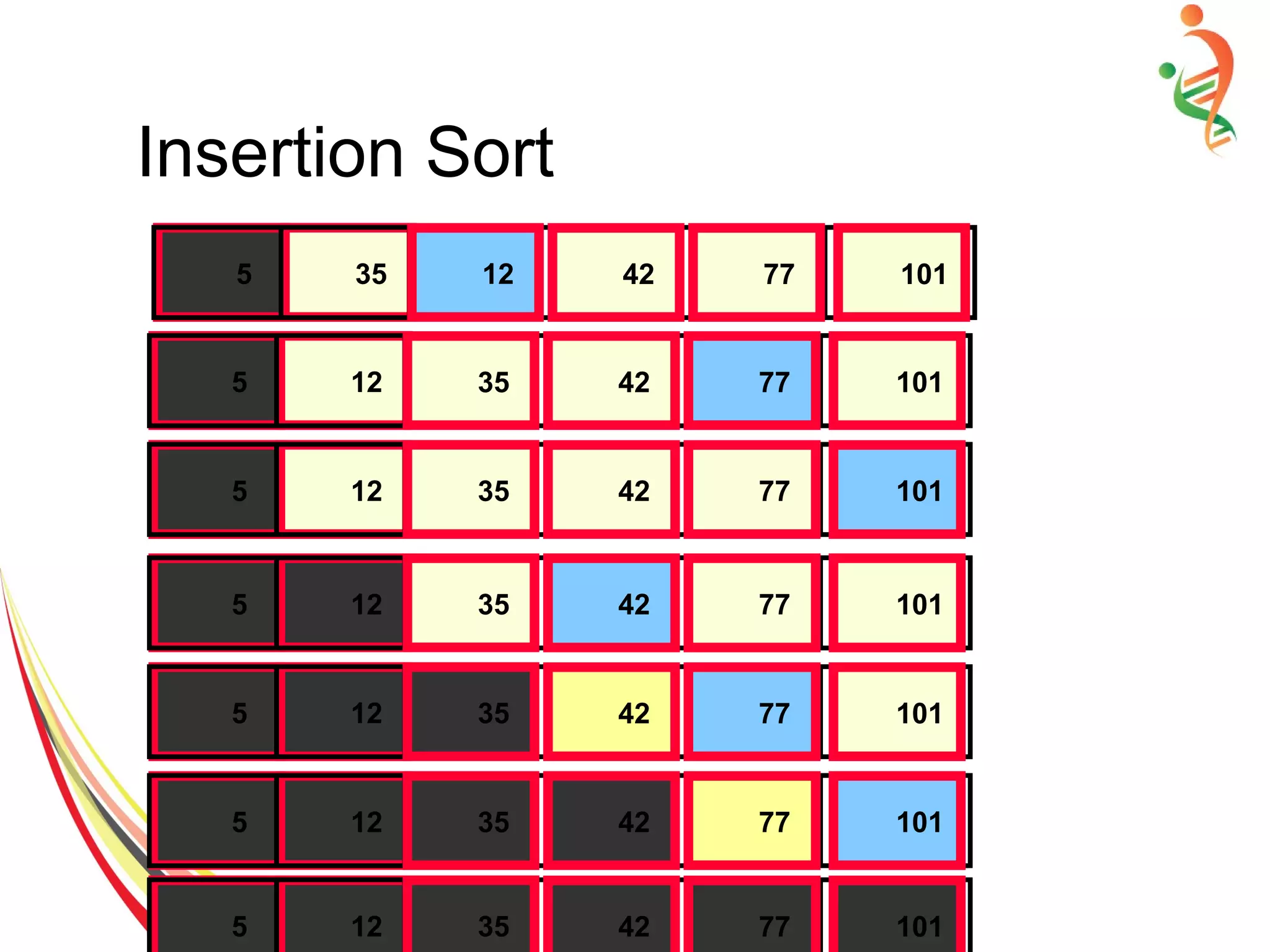
Insertion Sort
5 35 51235 10112 42 77 101
5 12 51235 10135 42 77 101
5 12 51235 10135 42 77 101
5 12 51235 10135 42 77 101
5 12 51235 10135 42 77 101
5 12 51235 10135 42 77 101
5 12 51235 10135 42 77 101
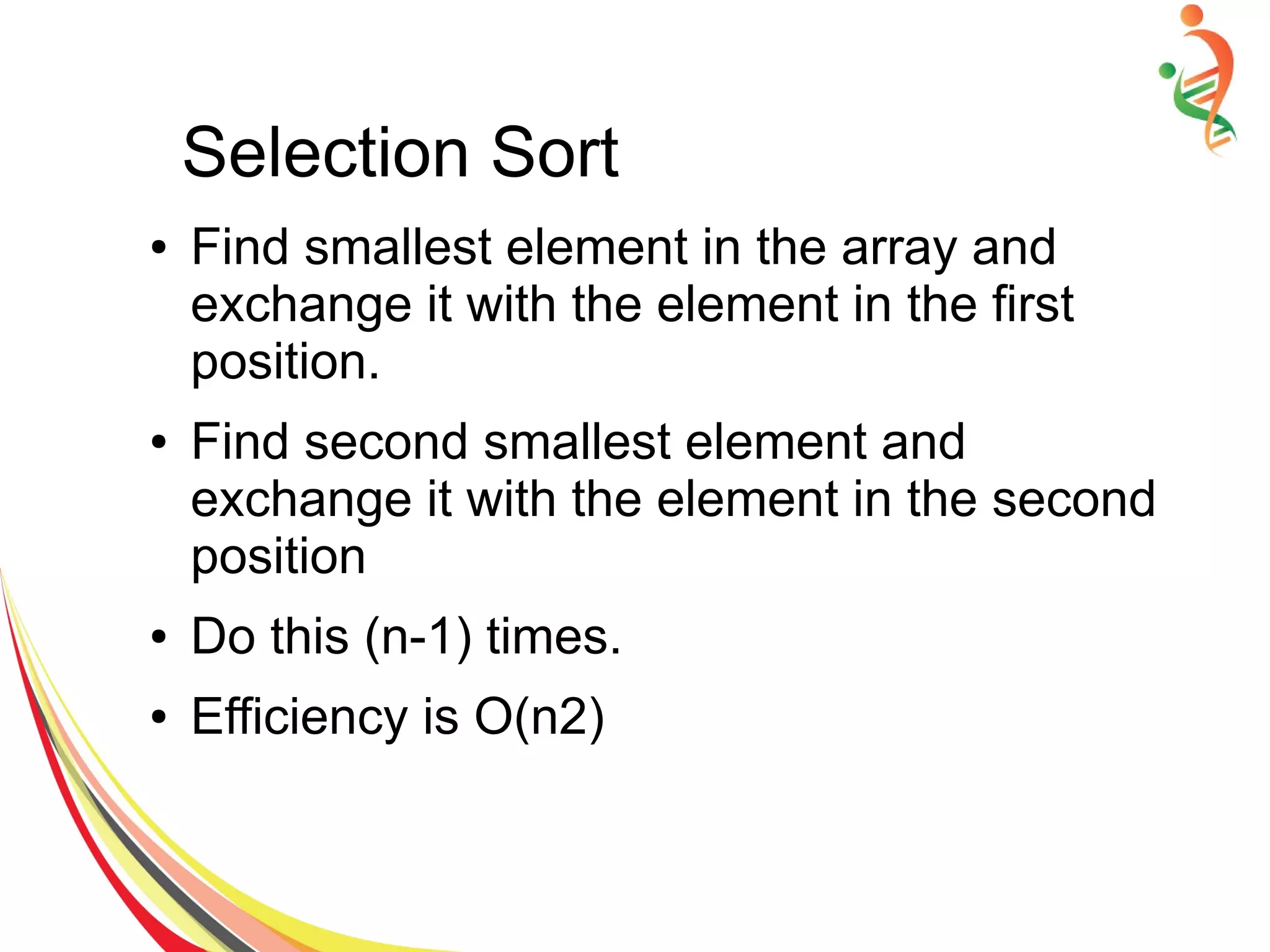
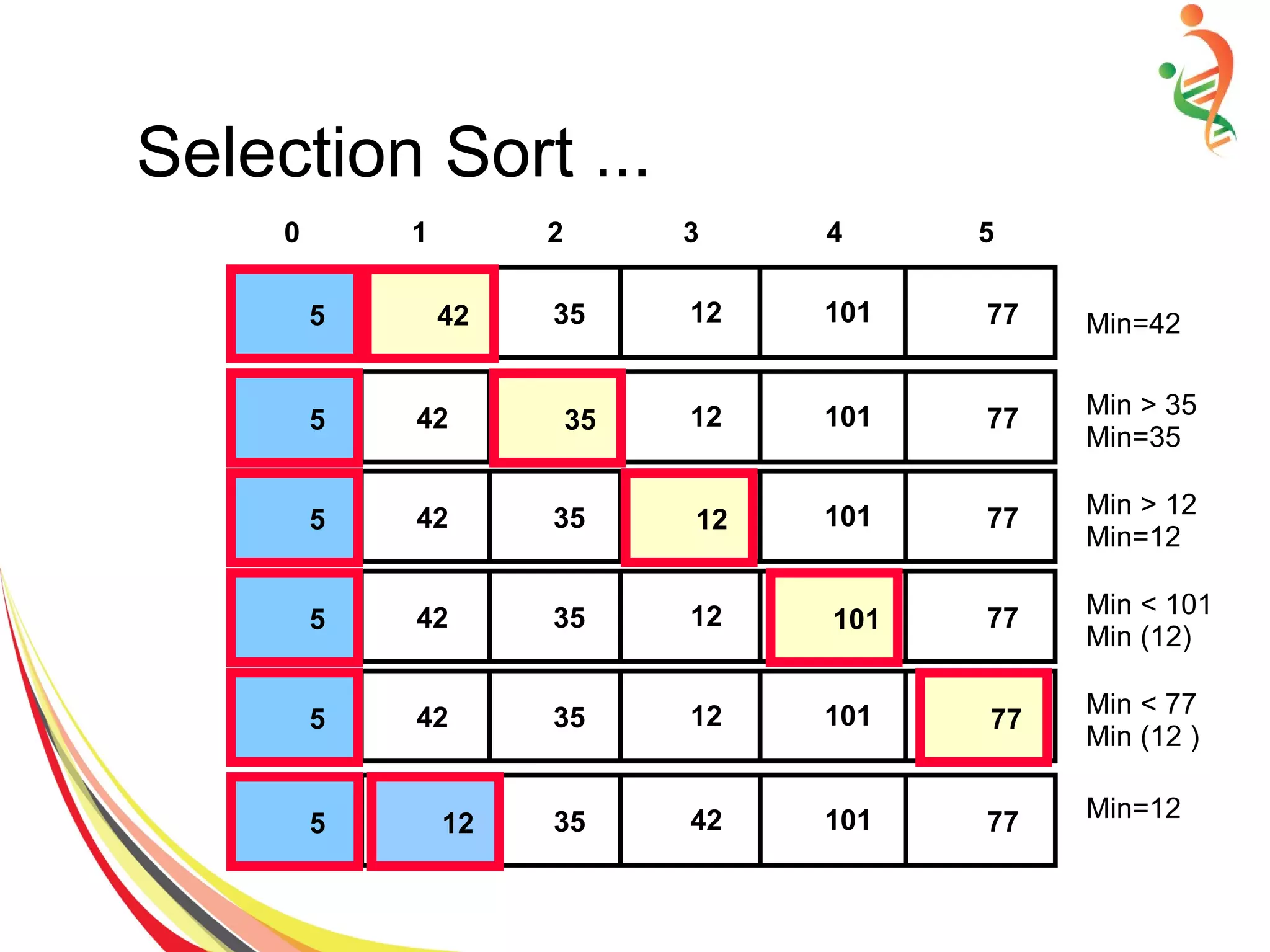
Selection Sort
● Find smallest element in the array and
exchange it with the element in the first
position.
● Find second smallest element and
exchange it with the element in the second
position
● Do this (n-1) times.
● Efficiency is O(n2)
Selection Sort Algorithm
● Declare array on n items
Set items[n] = { 2,7,5,8,43,23..99}
● Find the min item and and iteratively swap with
first item if required.
for (int i = 0; i < n-1; i++) {
int min = i;
for (int j = i+1; j < n; j++)
if (a[j] < a[min]) min = j;
swap(a[i], a[min]);
}
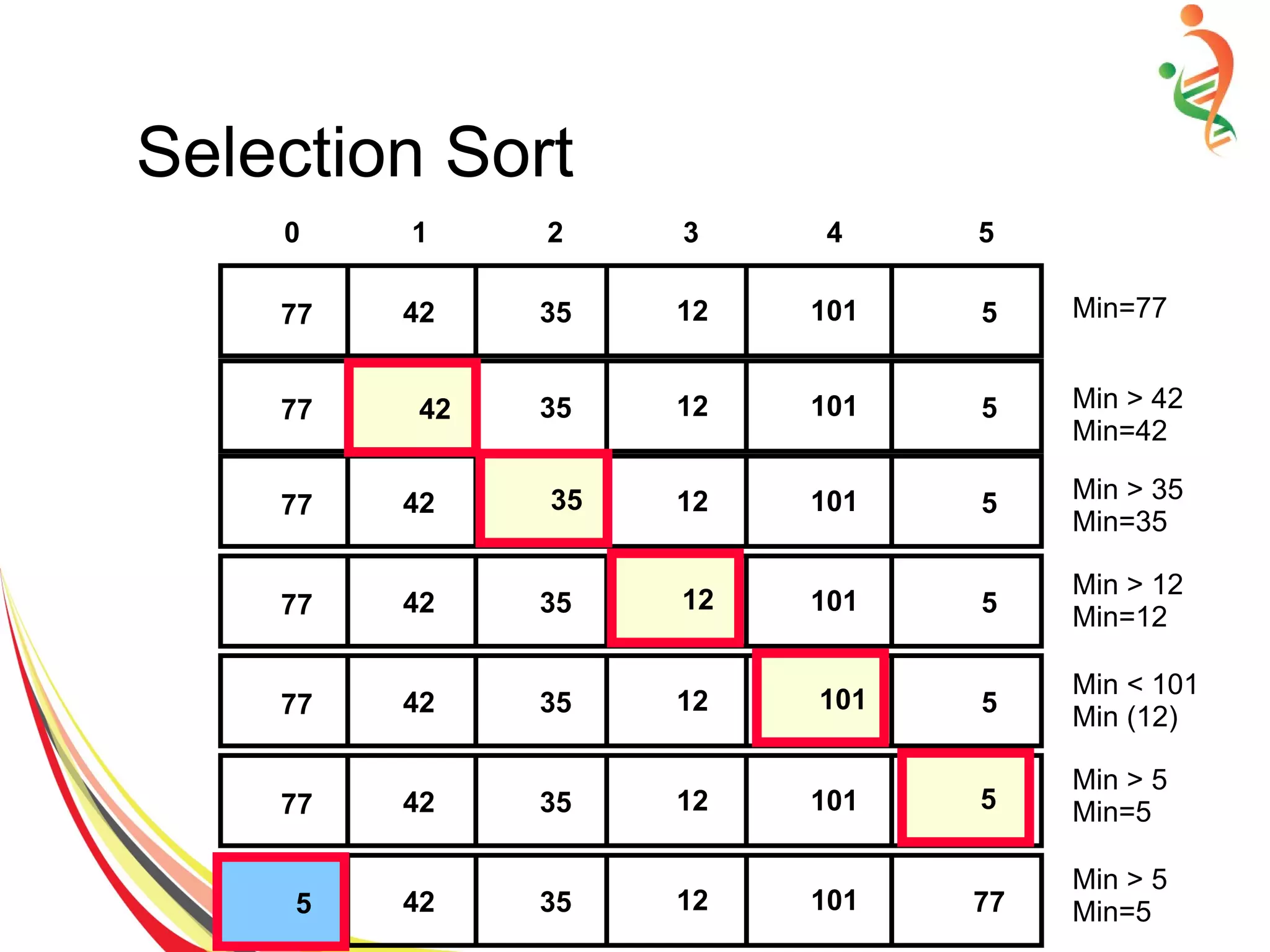
Selection Sort
512354277 101 Min=77
512354277 101
512354277 101
42 Min > 42
Min=42
Min > 35
Min=35
35
512354277 10112
512354277 101101
512354277 101 5
Min > 12
Min=12
Min < 101
Min (12)
Min > 5
Min=5
771235425 1015
Min > 5
Min=5
0 1 2 3 4 5
Selection Sort ...
771235425 1015 Min=4242
771235425 1015 35
Min > 35
Min=35
771235425 1015 12
Min > 12
Min=12
771235425 1015 101
Min < 101
Min (12)
771235425 1015 77
Min < 77
Min (12 )
774235425 1015 12
Min=12
0 1 2 3 4 5
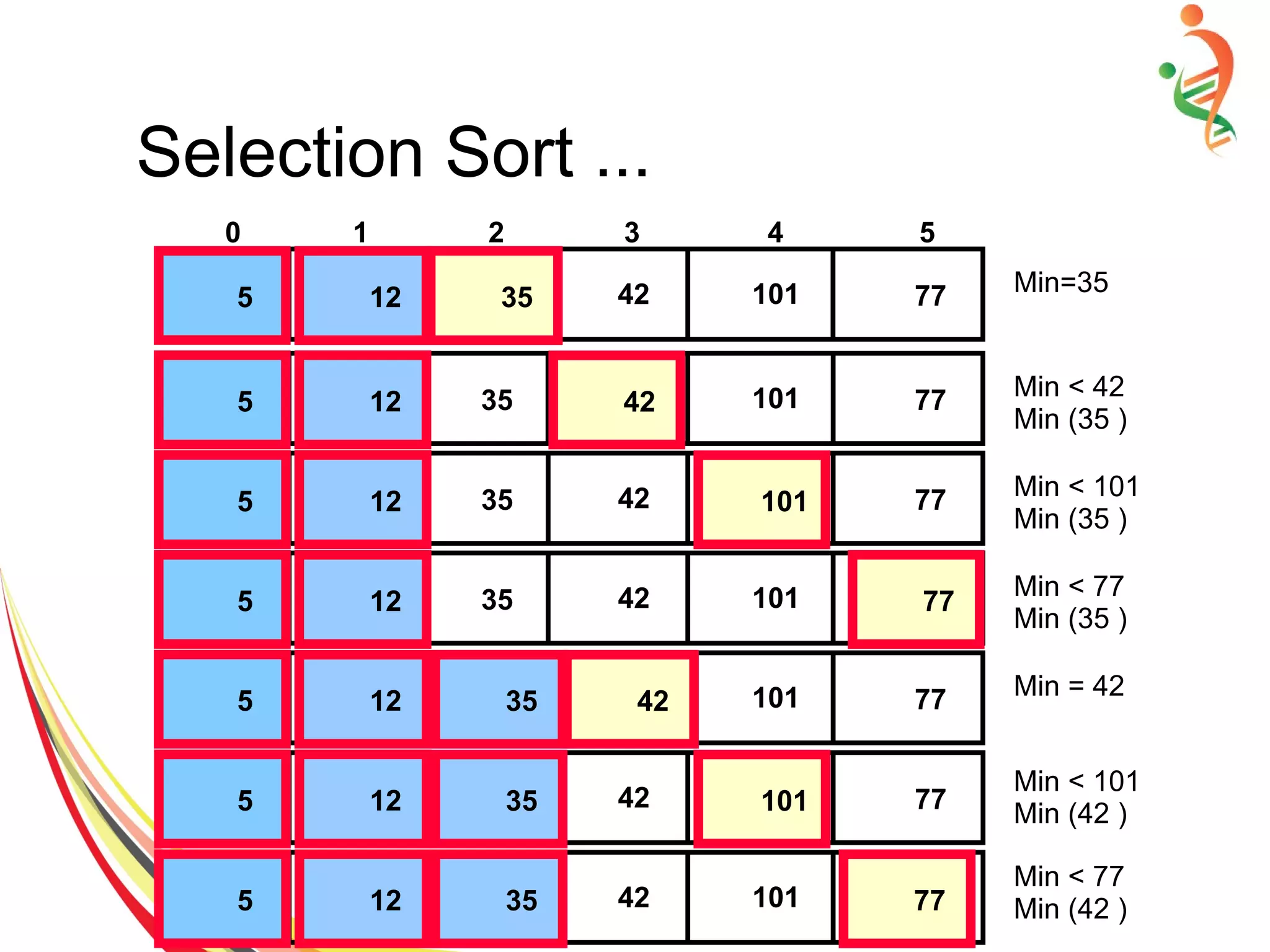
Selection Sort ...
774235425 1015 12
Min=35
35
774235425 1015 12
Min < 42
Min (35 )
42
774235425 1015 12
Min < 101
Min (35 )
101
774235425 1015 12
Min < 77
Min (35 )
77
774235425 1015 12
Min = 42
4235
774235425 1015 12 10135
774235425 1015 12 7735
Min < 101
Min (42 )
Min < 77
Min (42 )
0 1 2 3 4 5
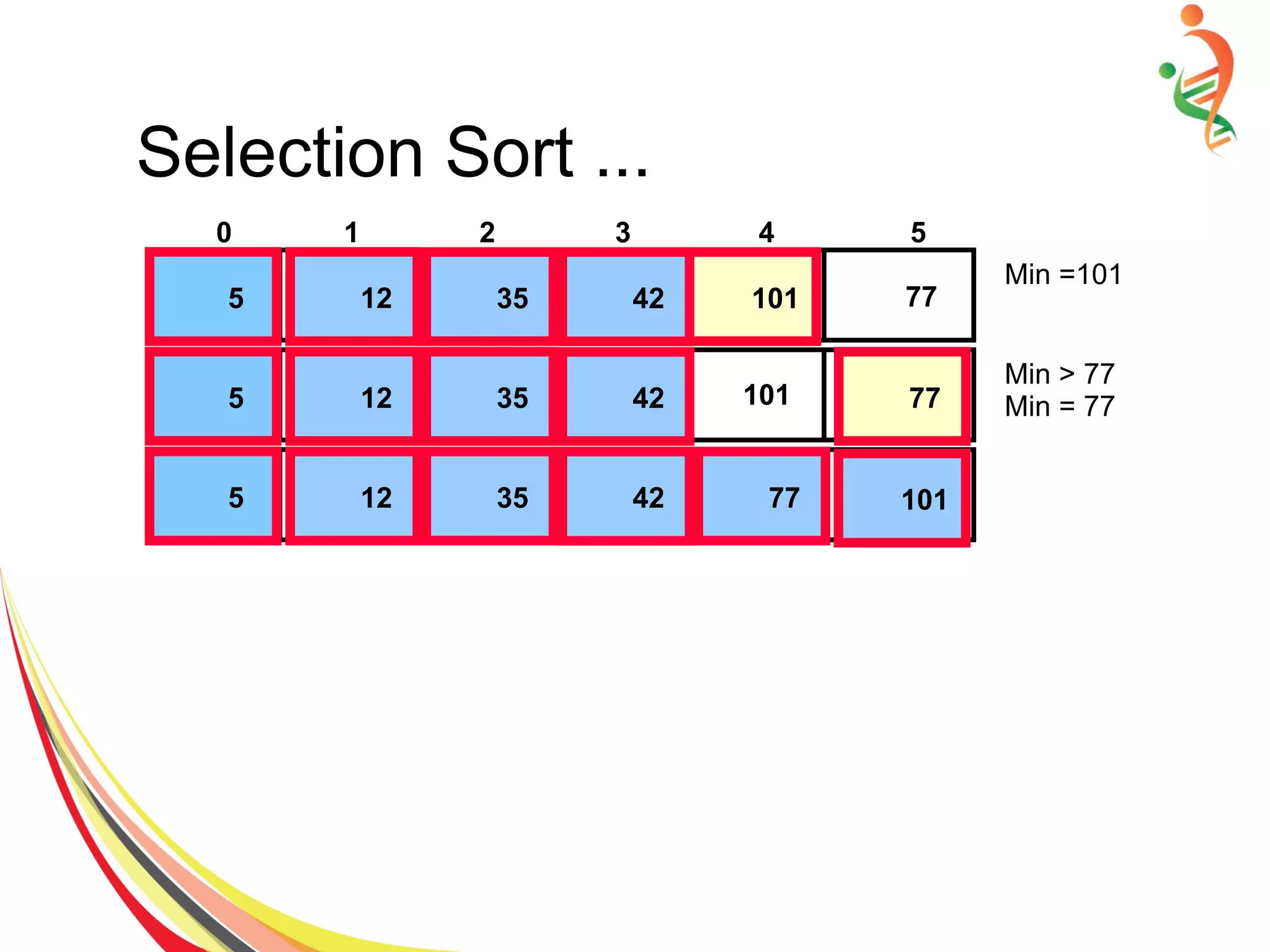
Selection Sort ...
774235425 1015 12 10135
Min =101
42
774235425 1015 12 7735
Min > 77
Min = 7742
1014235425 1015 12 7735 42 101
0 1 2 3 4 5
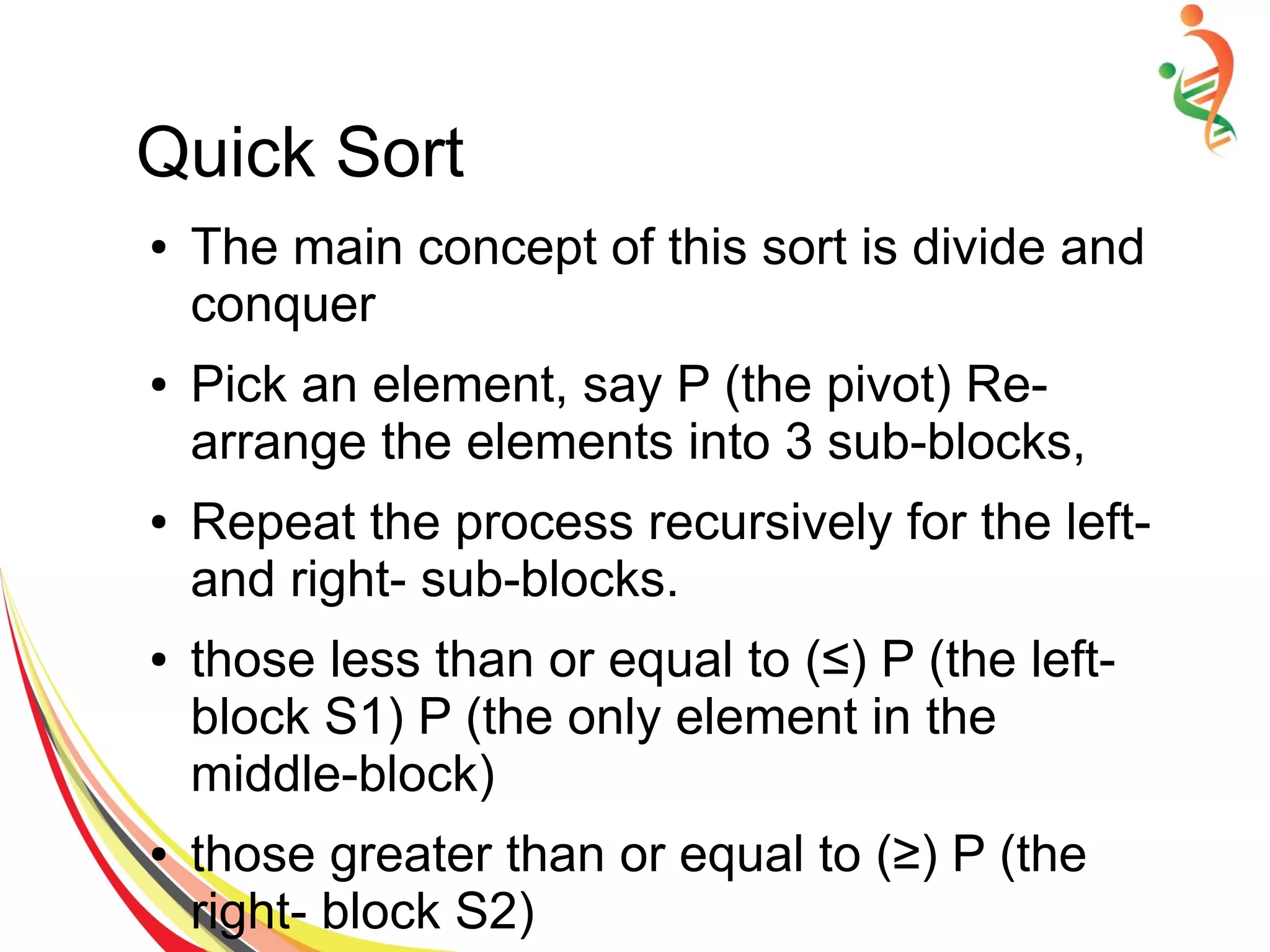
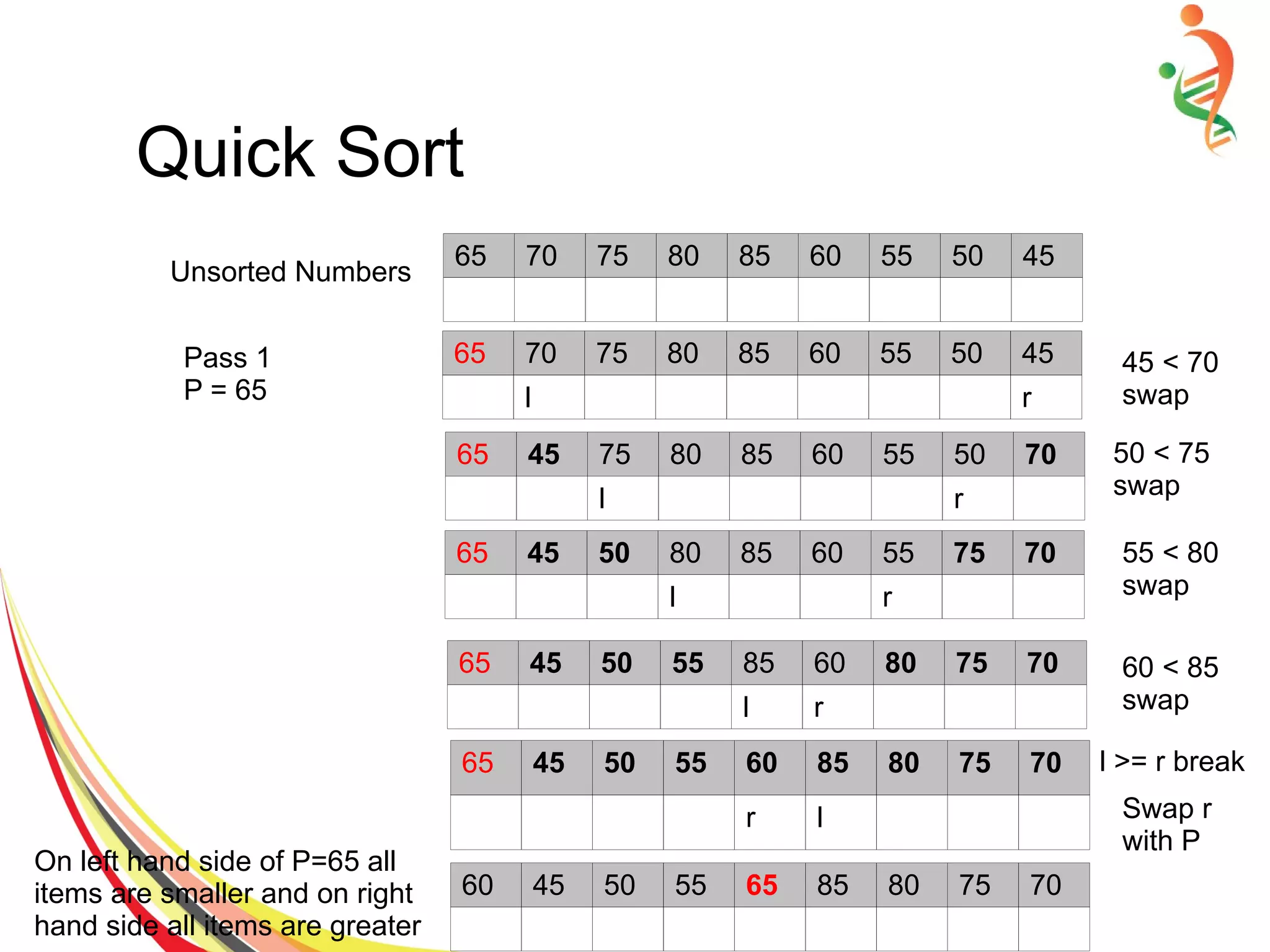
Quick Sort
● The main concept of this sort is divide and
conquer
● Pick an element, say P (the pivot) Re-
arrange the elements into 3 sub-blocks,
● Repeat the process recursively for the left-
and right- sub-blocks.
● those less than or equal to (≤) P (the left-
block S1) P (the only element in the
middle-block)
● those greater than or equal to (≥) P (the
right- block S2)
Quick Sort Algorithm
● Set pivot = a[left], l = left + 1, r = right;
● while l < r, do
– while l < right & a[l] < pivot , set l = l + 1
– while r > left & a[r] >= pivot , set r = r – 1
– if a[l] < a[r], swap a[l] and a[r]
● Set a[left] = a[r], a[r] = pivot
● Terminate
Quick Sort
65 70 75 80 85 60 55 50 45
Pass 1
P = 65
65 45 75 80 85 60 55 50 70
l r
65 45 50 80 85 60 55 75 70
l r
65 45 50 55 85 60 80 75 70
l r
65 45 50 55 60 85 80 75 70
r l
65 70 75 80 85 60 55 50 45
l r
Unsorted Numbers
45 < 70
swap
50 < 75
swap
55 < 80
swap
60 < 85
swap
l >= r break
Swap r
with P
60 45 50 55 65 85 80 75 70
On left hand side of P=65 all
items are smaller and on right
hand side all items are greater
Quick Sort
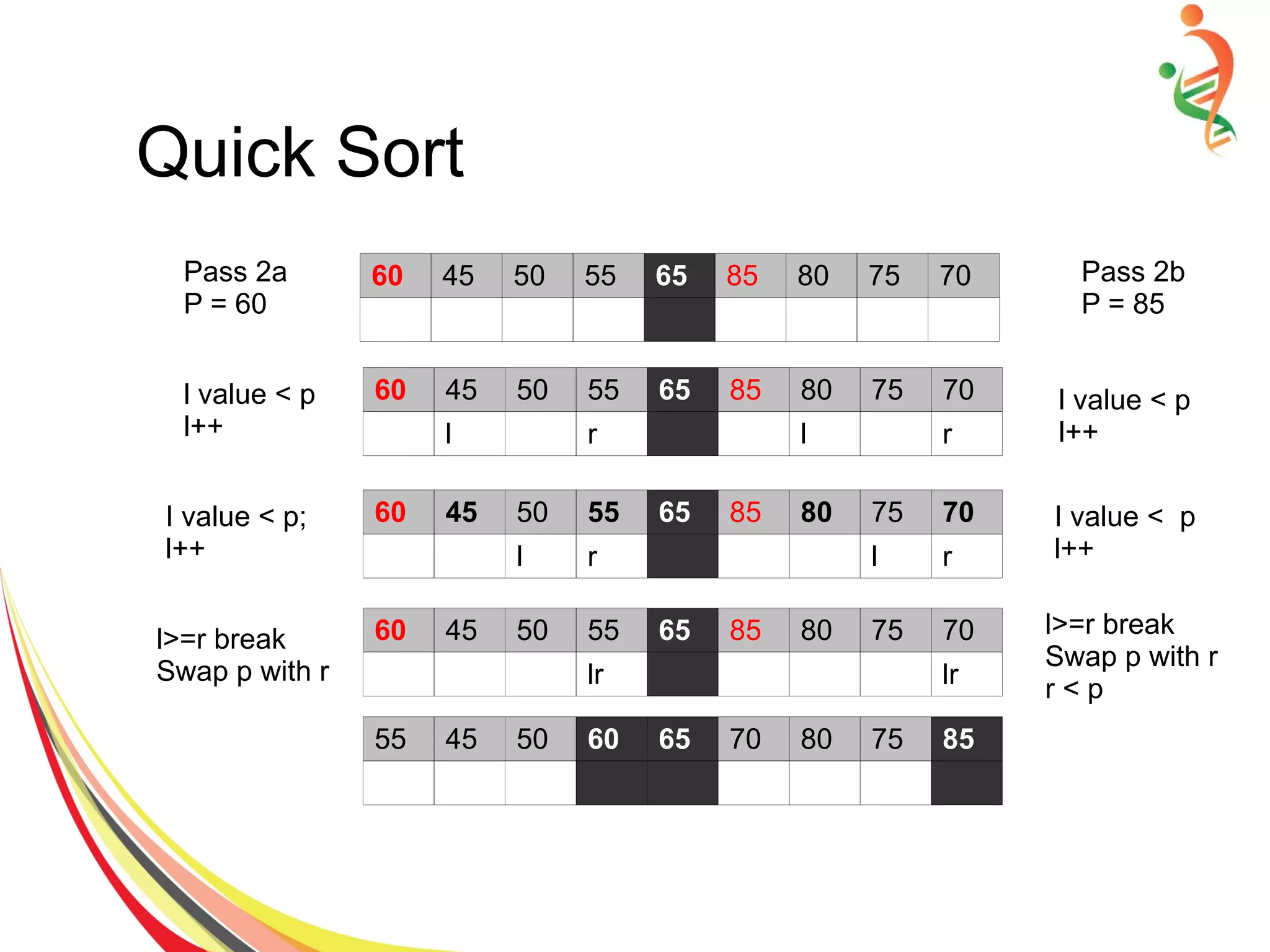
Pass 2a
P = 60
60 45 50 55 65 85 80 75 70 Pass 2b
P = 85
60 45 50 55 65 85 80 75 70
l r l r
l value < p
l++
l value < p
l++
60 45 50 55 65 85 80 75 70
l r l r
I value < p
l++
I value < p;
l++
l>=r break
Swap p with r
l>=r break
Swap p with r
r < p
60 45 50 55 65 85 80 75 70
lr lr
55 45 50 60 65 70 80 75 85
Quick Sort
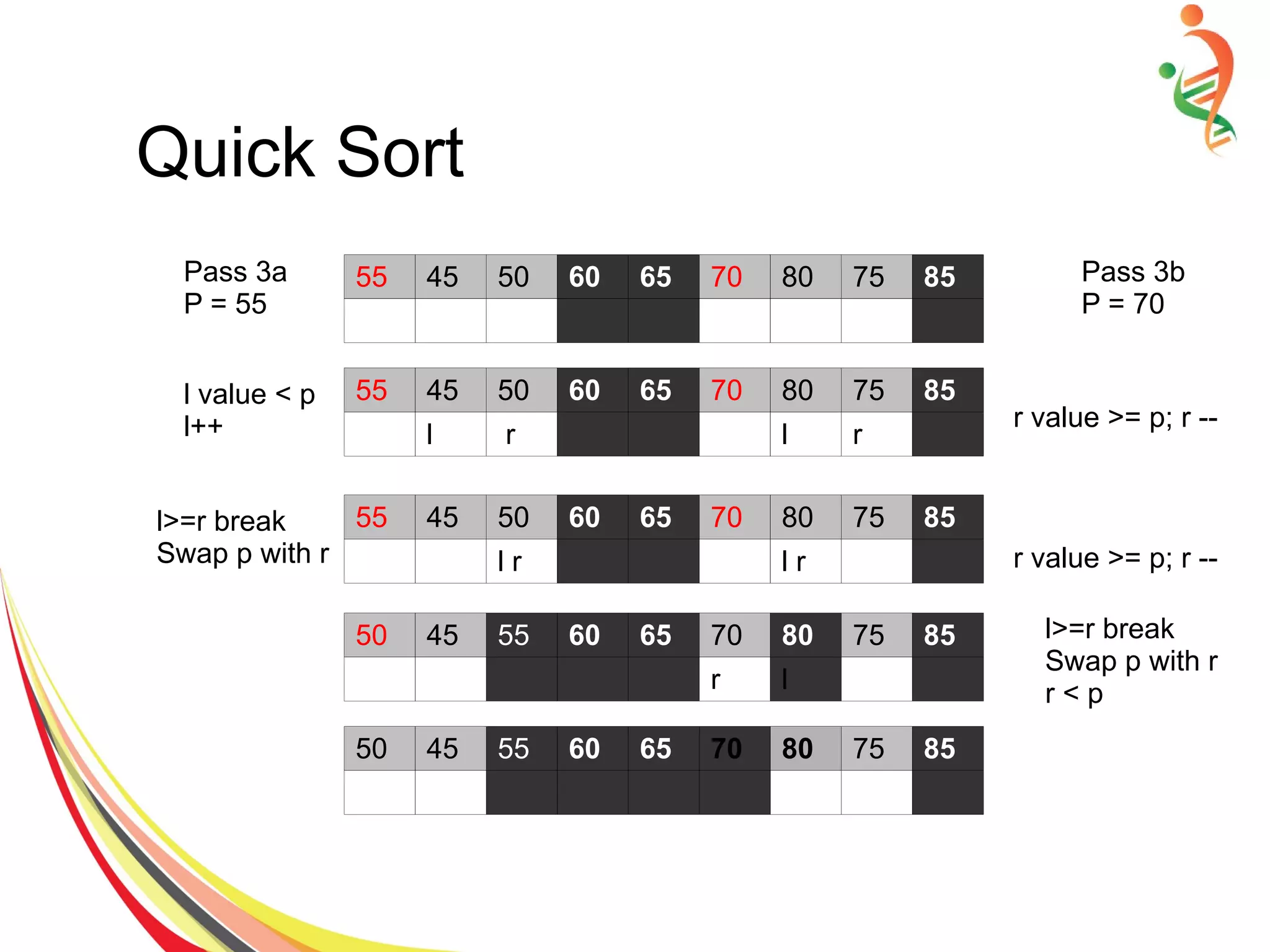
Pass 3a
P = 55
Pass 3b
P = 70
l value < p
l++ r value >= p; r --
l>=r break
Swap p with r
l>=r break
Swap p with r
r < p
55 45 50 60 65 70 80 75 85
55 45 50 60 65 70 80 75 85
l r l r
55 45 50 60 65 70 80 75 85
l r l r
50 45 55 60 65 70 80 75 85
r l
50 45 55 60 65 70 80 75 85
r value >= p; r --
Quick Sort
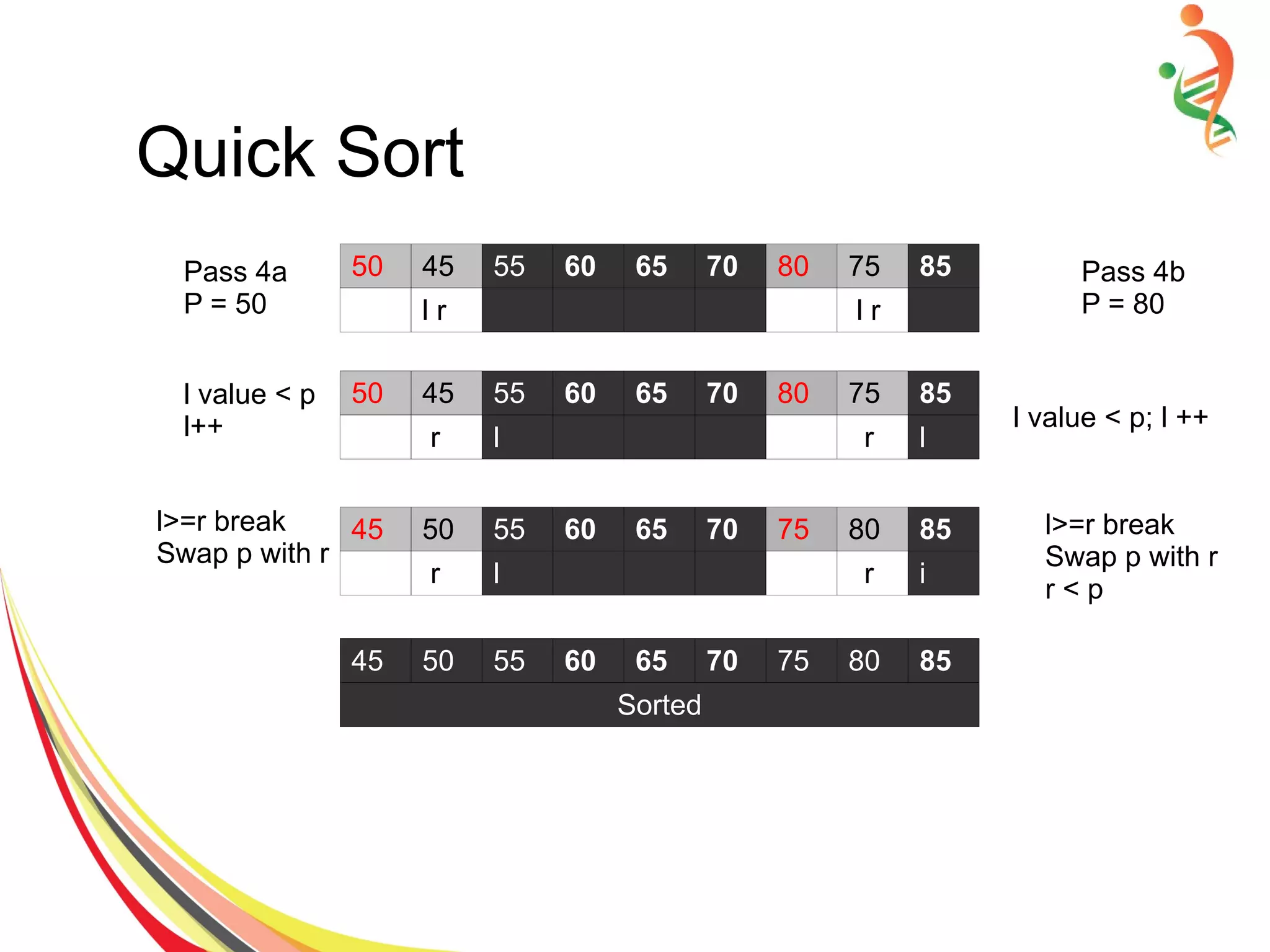
Pass 4a
P = 50
Pass 4b
P = 80
l value < p
l++ l value < p; l ++
l>=r break
Swap p with r
l>=r break
Swap p with r
r < p
50 45 55 60 65 70 80 75 85
l r l r
50 45 55 60 65 70 80 75 85
r l r l
45 50 55 60 65 70 75 80 85
r l r i
45 50 55 60 65 70 75 80 85
Sorted
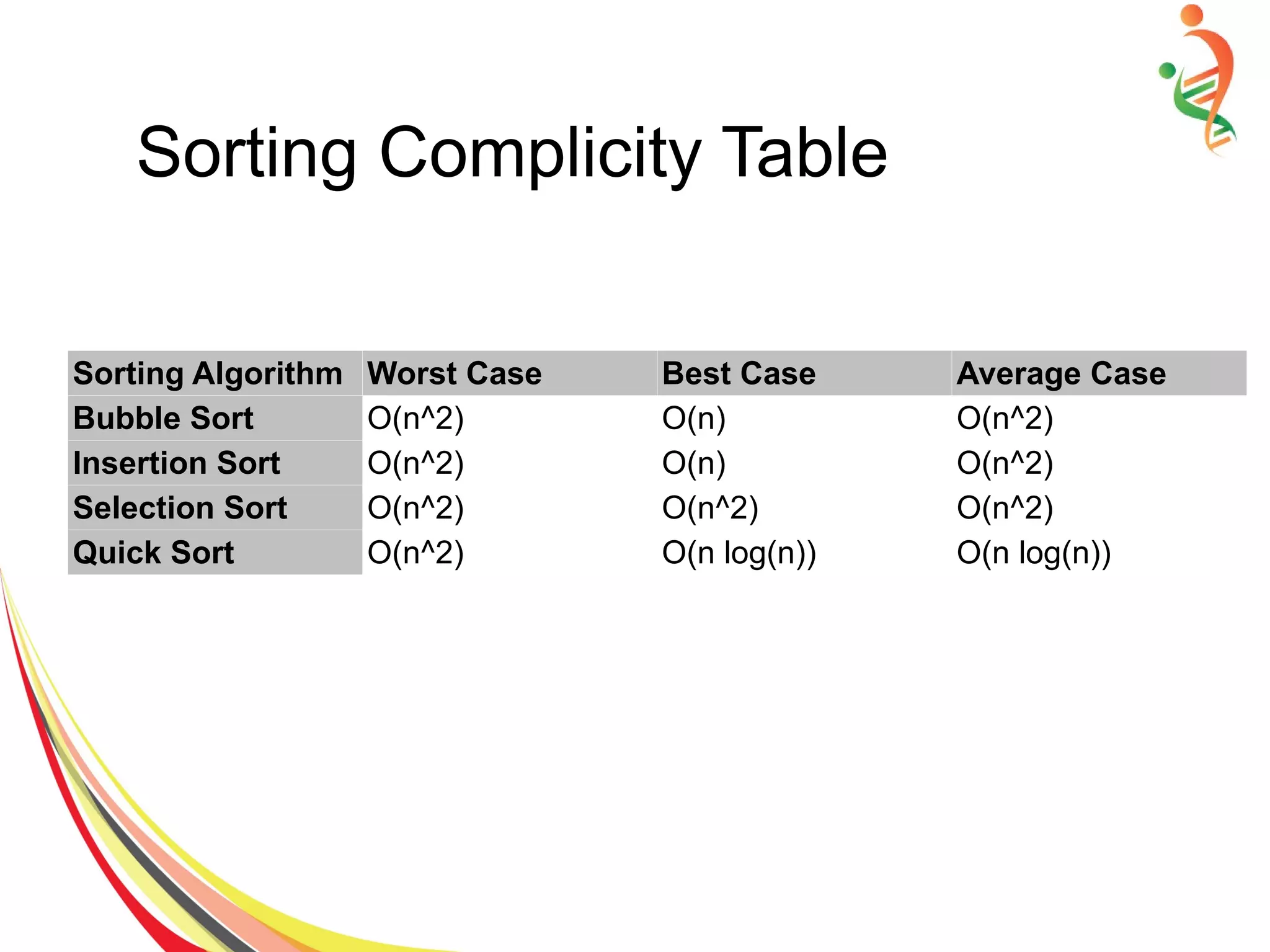
Sorting Complicity Table
Sorting Algorithm Worst Case Best Case Average Case
Bubble Sort O(n^2) O(n) O(n^2)
Insertion Sort O(n^2) O(n) O(n^2)
Selection Sort O(n^2) O(n^2) O(n^2)
Quick Sort O(n^2) O(n log(n)) O(n log(n))
Sorting Algorithm Animations
● http://www.ee.ryerson.ca/~courses/coe428/
sorting/insertionsort.html
Sequential Search
● Search key is compared with all elements
in the list,
● O(n) time consuming for large datasets
● Time can reduced if data is sorted.
Sequential Search Algorithm
● Declare array on n items
Set items[n] = { 2,7,5,8,43,23..99}
● Find a number into provided items array.
bool found = false;
for(int loc = 0; loc < n; loc++)
if(items[loc] == item) {
found = true;
break; }
if(found)
return loc;
else
return -1;
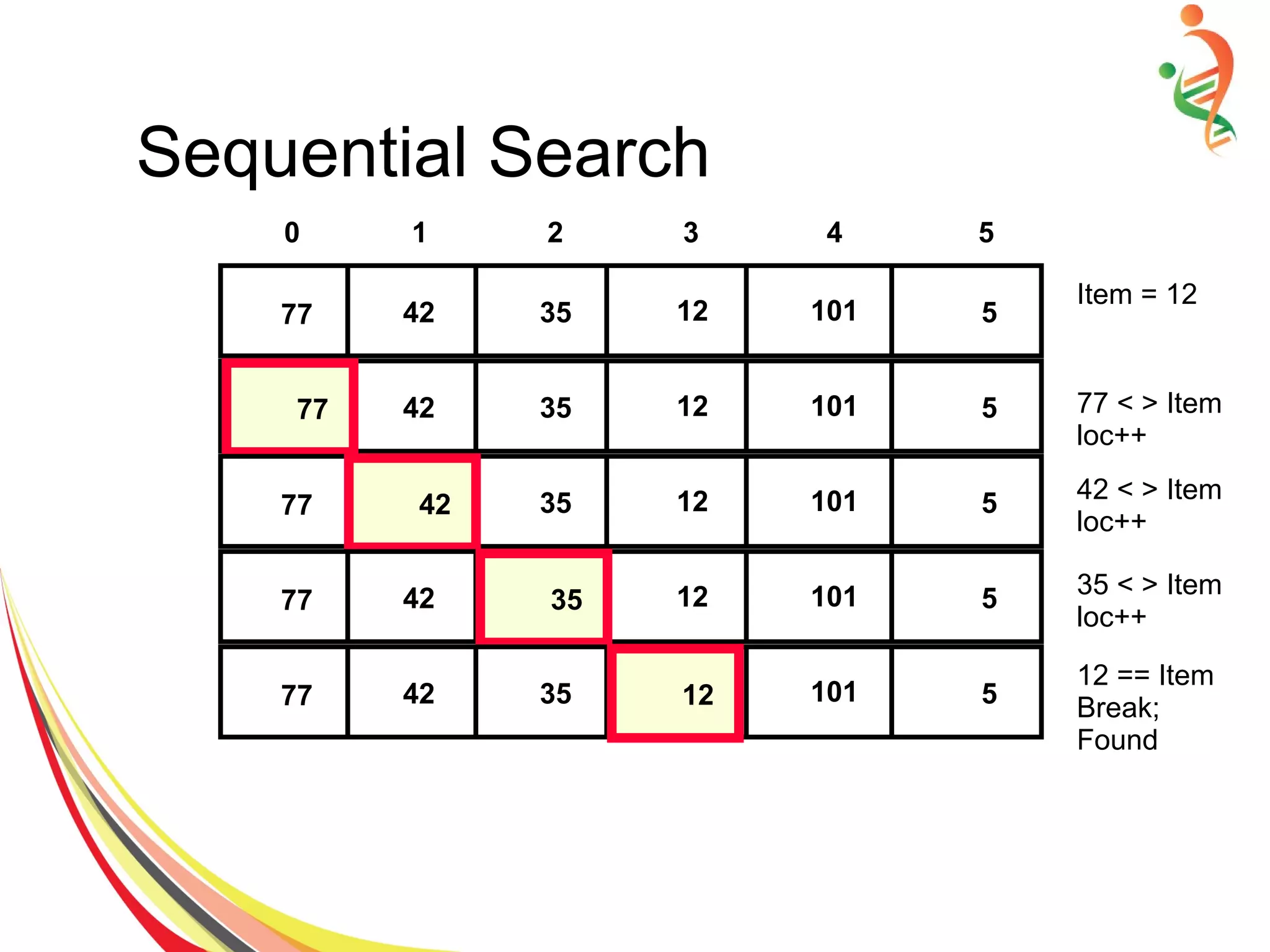
Sequential Search
512354277 101
0 1 2 3 4 5
Item = 12
512354277 10177 77 < > Item
loc++
512354277 10142
42 < > Item
loc++
512354277 10135
35 < > Item
loc++
512354277 10112
12 == Item
Break;
Found
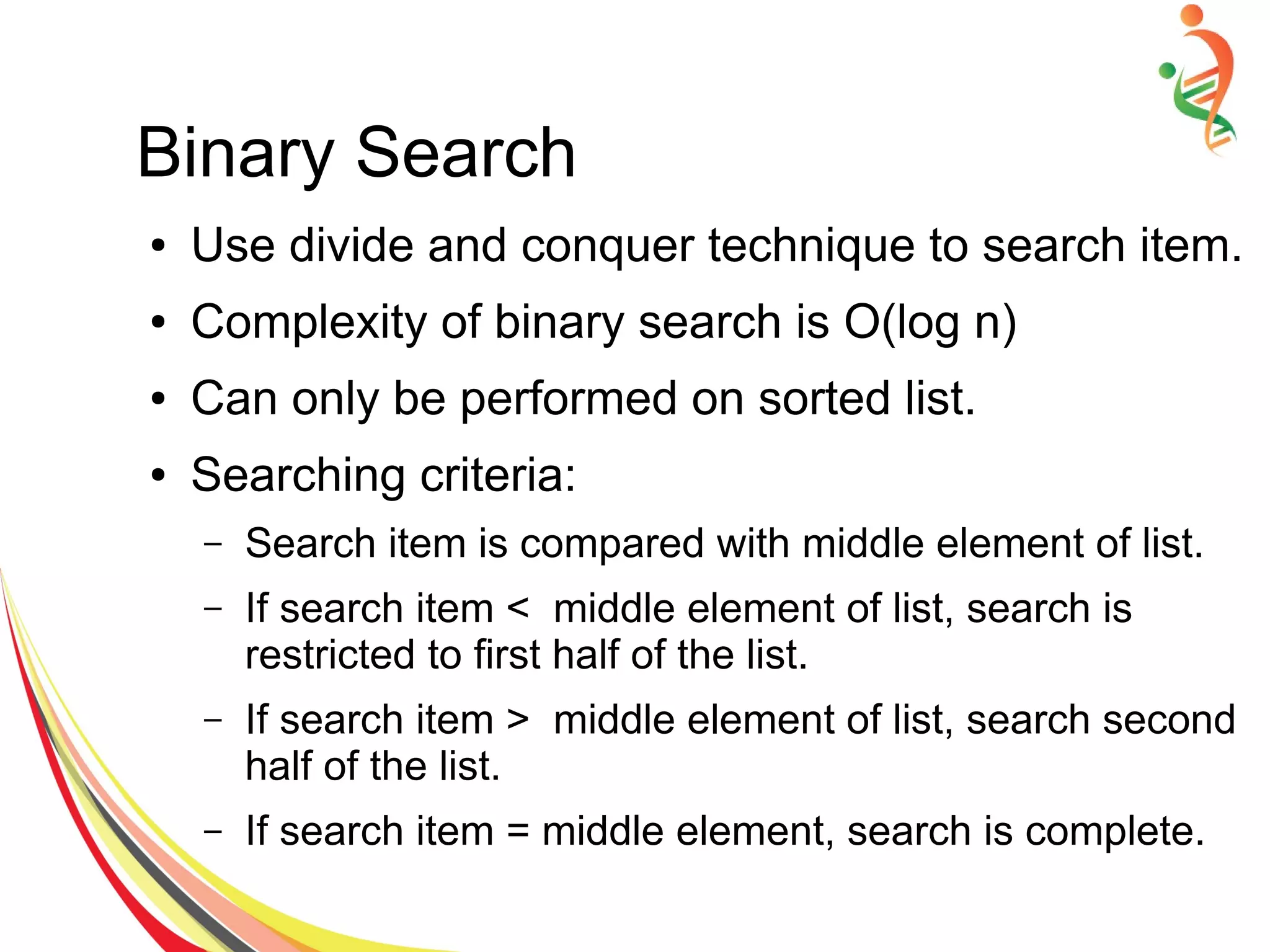
Binary Search
● Use divide and conquer technique to search item.
● Complexity of binary search is O(log n)
● Can only be performed on sorted list.
● Searching criteria:
– Search item is compared with middle element of list.
– If search item < middle element of list, search is
restricted to first half of the list.
– If search item > middle element of list, search second
half of the list.
– If search item = middle element, search is complete.
Binary Search Algorithm
● Declare array of n items
Set items[n] = { 2,7,5,8,43,23..99}
● Find a number into provided items
array.
● int first = 0; int mid; int last=n -1
● bool found = false;
● while(first <= last && !found) {
– mid = (first + last) / 2 ;
– if(items[mid] ==item)
found=true;
else
if(items[mid] > item)
last=mid-1;
else
first= mid+1;
}
if(found)
return mid;
else
return -1;
Binary Search
1021225102 101
0 1 2 3 4 5 6
110
First =0; Last = 6; Mid=(0+6)/2=3
Item= 101
Items[3]<>10145
1024525102 101 110102
items[mid]< 101; First=4; Last=6; Mid=(4+6)/2=5
Items[5]<>101
1024525102 101 110101
items[mid]> 101; First=4; Last=4; Mid=(4+4)/2=4
Items[4]==101
Found

Sorting

  • 1.
  • 2.
    Sorting & Searching ●Bubble Sort ● Insertion Sort ● Selection Sort ● Quick Sort ● Sequential Search ● Binary Search
  • 3.
    Bubble Sort ● Inbubble sort repeatedly move the largest element to the highest index position of the array and on each iteration to reduce the effective size of the array. ● In Bubble sort we compare the adjacent item and swap if required. ● In a bubble sorting algorithm, the elements of the list "gradually 'bubble' (or rise) to their proper location in the array, like bubbles rising in a glass of soda"
  • 4.
    Algorithm of BubbleSort ● Declare array on n items items[n]={4,5,1,8,54,32...32} ● Compare each pair of item and swap if required. for(int pass=0; pass<n-1; pass ++) for(int i=0; i<n-pass-1; i++) If (item[ i ] > item [i+1]) { tempvar = item[i] Item[ i ] = item [i+1] Item[ i+1]=tempvar } } }
  • 5.
    Bubble Sort 512354277 101 01 2 3 4 5 512354277 10142 77 512357742 10135 77 512773542 10112 77 577123542 101 77123542 5 101 Note: In phase 1 Largest element in the correct position 77 101
  • 6.
    Bubble Sort 0 12 3 4 5 Note: In phase 2 Largest element place in the correct position 42 35 7712 5 101 42 12 77 5 10135 42 77 5 10135 12 77 5 10135 12 42 10135 12 42 5 77
  • 7.
    Bubble Sort 0 12 3 4 5 10135 12 42 5 7735 12 10112 12 42 5 7735 42 10112 35 42 5 7742 5 10112 35 5 774212 35 10112 35 5 774235 5 10112 5 5 774235 1015 ● 12 5 774235125
  • 8.
    Bubble Sort 77123542 5101 5421235 77 101 4253512 77 101 4235512 77 101 4235125 77 101 N-1 0 1 2 3 4 5
  • 9.
    Bubble Sort –Reducing Comparison 12354277 101 5 77123542 5 101 5421235 77 101 4253512 77 101 4235512 77 101 0 1 2 3 4 5
  • 10.
    Analysis of BubbleSort ● Works best when array is already nearly sorted ● Worst case number of comparisons is O(n2) – e.g. input array values are 10,9,8,7,6,5,4,3,2,1 – On each step comparison required 9+8+7+... +1 – (n-1)*n /2 – O(n2) ● Best case occurs when the array is already sorted and its complexity is O (n) – input is in order (1,2,3,4,5,6,7,8,9,10) – the algorithm still goes over each element once and checks if a swap is necessary.
  • 11.
    Insertion Sort ● Sortthe elements in range[0,m] form = 0,...,n−1 ● No action need form=0 ● When going from m to m+1, insert the element in index m+1, to its appropriate location
  • 12.
    Algorithm of InsertionSort ● This algorithm sorts the array a with n elements. Set a[n] ={ 2,7,5,8,43,23..99} ● for (int i = 1; i < n; i++) //Array start from 0 { Item tmp = a[i]; for (int j=i; j>0 && tmp < a[j-1]; j--) a[j] = a[j-1]; a[j] = tmp; }
  • 13.
    Insertion Sort 512354277 101 4277 51235 101 42 35 51235 10177 35 42 51235 10177 42 35 51235 10177 12 42 35 51235 10112 77 42 35 0 1 2 3 4 5
  • 14.
    Insertion Sort 42 1251235 10135 77 12 42 51235 10135 77 42 35 51235 10112 77 101 42 35 51235 10112 77 101 5 42 35 51235 10112 77 5 101 42 35 51235 10112 5 77 101 0 1 2 3 4 5
  • 15.
    Insertion Sort 42 3551235 1015 12 77 101 42 5 51235 10135 12 77 101 5 42 51235 10135 12 77 101 5 42 51235 10135 12 77 101 5 35 51235 10142 12 77 101 5 35 51235 10142 12 77 101 0 1 2 3 4 5
  • 16.
    Insertion Sort 5 3551235 10112 42 77 101 5 12 51235 10135 42 77 101 5 12 51235 10135 42 77 101 5 12 51235 10135 42 77 101 5 12 51235 10135 42 77 101 5 12 51235 10135 42 77 101 5 12 51235 10135 42 77 101
  • 17.
    Selection Sort ● Findsmallest element in the array and exchange it with the element in the first position. ● Find second smallest element and exchange it with the element in the second position ● Do this (n-1) times. ● Efficiency is O(n2)
  • 18.
    Selection Sort Algorithm ●Declare array on n items Set items[n] = { 2,7,5,8,43,23..99} ● Find the min item and and iteratively swap with first item if required. for (int i = 0; i < n-1; i++) { int min = i; for (int j = i+1; j < n; j++) if (a[j] < a[min]) min = j; swap(a[i], a[min]); }
  • 19.
    Selection Sort 512354277 101Min=77 512354277 101 512354277 101 42 Min > 42 Min=42 Min > 35 Min=35 35 512354277 10112 512354277 101101 512354277 101 5 Min > 12 Min=12 Min < 101 Min (12) Min > 5 Min=5 771235425 1015 Min > 5 Min=5 0 1 2 3 4 5
  • 20.
    Selection Sort ... 7712354251015 Min=4242 771235425 1015 35 Min > 35 Min=35 771235425 1015 12 Min > 12 Min=12 771235425 1015 101 Min < 101 Min (12) 771235425 1015 77 Min < 77 Min (12 ) 774235425 1015 12 Min=12 0 1 2 3 4 5
  • 21.
    Selection Sort ... 7742354251015 12 Min=35 35 774235425 1015 12 Min < 42 Min (35 ) 42 774235425 1015 12 Min < 101 Min (35 ) 101 774235425 1015 12 Min < 77 Min (35 ) 77 774235425 1015 12 Min = 42 4235 774235425 1015 12 10135 774235425 1015 12 7735 Min < 101 Min (42 ) Min < 77 Min (42 ) 0 1 2 3 4 5
  • 22.
    Selection Sort ... 7742354251015 12 10135 Min =101 42 774235425 1015 12 7735 Min > 77 Min = 7742 1014235425 1015 12 7735 42 101 0 1 2 3 4 5
  • 23.
    Quick Sort ● Themain concept of this sort is divide and conquer ● Pick an element, say P (the pivot) Re- arrange the elements into 3 sub-blocks, ● Repeat the process recursively for the left- and right- sub-blocks. ● those less than or equal to (≤) P (the left- block S1) P (the only element in the middle-block) ● those greater than or equal to (≥) P (the right- block S2)
  • 24.
    Quick Sort Algorithm ●Set pivot = a[left], l = left + 1, r = right; ● while l < r, do – while l < right & a[l] < pivot , set l = l + 1 – while r > left & a[r] >= pivot , set r = r – 1 – if a[l] < a[r], swap a[l] and a[r] ● Set a[left] = a[r], a[r] = pivot ● Terminate
  • 25.
    Quick Sort 65 7075 80 85 60 55 50 45 Pass 1 P = 65 65 45 75 80 85 60 55 50 70 l r 65 45 50 80 85 60 55 75 70 l r 65 45 50 55 85 60 80 75 70 l r 65 45 50 55 60 85 80 75 70 r l 65 70 75 80 85 60 55 50 45 l r Unsorted Numbers 45 < 70 swap 50 < 75 swap 55 < 80 swap 60 < 85 swap l >= r break Swap r with P 60 45 50 55 65 85 80 75 70 On left hand side of P=65 all items are smaller and on right hand side all items are greater
  • 26.
    Quick Sort Pass 2a P= 60 60 45 50 55 65 85 80 75 70 Pass 2b P = 85 60 45 50 55 65 85 80 75 70 l r l r l value < p l++ l value < p l++ 60 45 50 55 65 85 80 75 70 l r l r I value < p l++ I value < p; l++ l>=r break Swap p with r l>=r break Swap p with r r < p 60 45 50 55 65 85 80 75 70 lr lr 55 45 50 60 65 70 80 75 85
  • 27.
    Quick Sort Pass 3a P= 55 Pass 3b P = 70 l value < p l++ r value >= p; r -- l>=r break Swap p with r l>=r break Swap p with r r < p 55 45 50 60 65 70 80 75 85 55 45 50 60 65 70 80 75 85 l r l r 55 45 50 60 65 70 80 75 85 l r l r 50 45 55 60 65 70 80 75 85 r l 50 45 55 60 65 70 80 75 85 r value >= p; r --
  • 28.
    Quick Sort Pass 4a P= 50 Pass 4b P = 80 l value < p l++ l value < p; l ++ l>=r break Swap p with r l>=r break Swap p with r r < p 50 45 55 60 65 70 80 75 85 l r l r 50 45 55 60 65 70 80 75 85 r l r l 45 50 55 60 65 70 75 80 85 r l r i 45 50 55 60 65 70 75 80 85 Sorted
  • 29.
    Sorting Complicity Table SortingAlgorithm Worst Case Best Case Average Case Bubble Sort O(n^2) O(n) O(n^2) Insertion Sort O(n^2) O(n) O(n^2) Selection Sort O(n^2) O(n^2) O(n^2) Quick Sort O(n^2) O(n log(n)) O(n log(n))
  • 30.
    Sorting Algorithm Animations ●http://www.ee.ryerson.ca/~courses/coe428/ sorting/insertionsort.html
  • 31.
    Sequential Search ● Searchkey is compared with all elements in the list, ● O(n) time consuming for large datasets ● Time can reduced if data is sorted.
  • 32.
    Sequential Search Algorithm ●Declare array on n items Set items[n] = { 2,7,5,8,43,23..99} ● Find a number into provided items array. bool found = false; for(int loc = 0; loc < n; loc++) if(items[loc] == item) { found = true; break; } if(found) return loc; else return -1;
  • 33.
    Sequential Search 512354277 101 01 2 3 4 5 Item = 12 512354277 10177 77 < > Item loc++ 512354277 10142 42 < > Item loc++ 512354277 10135 35 < > Item loc++ 512354277 10112 12 == Item Break; Found
  • 34.
    Binary Search ● Usedivide and conquer technique to search item. ● Complexity of binary search is O(log n) ● Can only be performed on sorted list. ● Searching criteria: – Search item is compared with middle element of list. – If search item < middle element of list, search is restricted to first half of the list. – If search item > middle element of list, search second half of the list. – If search item = middle element, search is complete.
  • 35.
    Binary Search Algorithm ●Declare array of n items Set items[n] = { 2,7,5,8,43,23..99} ● Find a number into provided items array. ● int first = 0; int mid; int last=n -1 ● bool found = false; ● while(first <= last && !found) { – mid = (first + last) / 2 ; – if(items[mid] ==item) found=true; else if(items[mid] > item) last=mid-1; else first= mid+1; } if(found) return mid; else return -1;
  • 36.
    Binary Search 1021225102 101 01 2 3 4 5 6 110 First =0; Last = 6; Mid=(0+6)/2=3 Item= 101 Items[3]<>10145 1024525102 101 110102 items[mid]< 101; First=4; Last=6; Mid=(4+6)/2=5 Items[5]<>101 1024525102 101 110101 items[mid]> 101; First=4; Last=4; Mid=(4+4)/2=4 Items[4]==101 Found