Bubble sort
Insertion sort
Selection sort
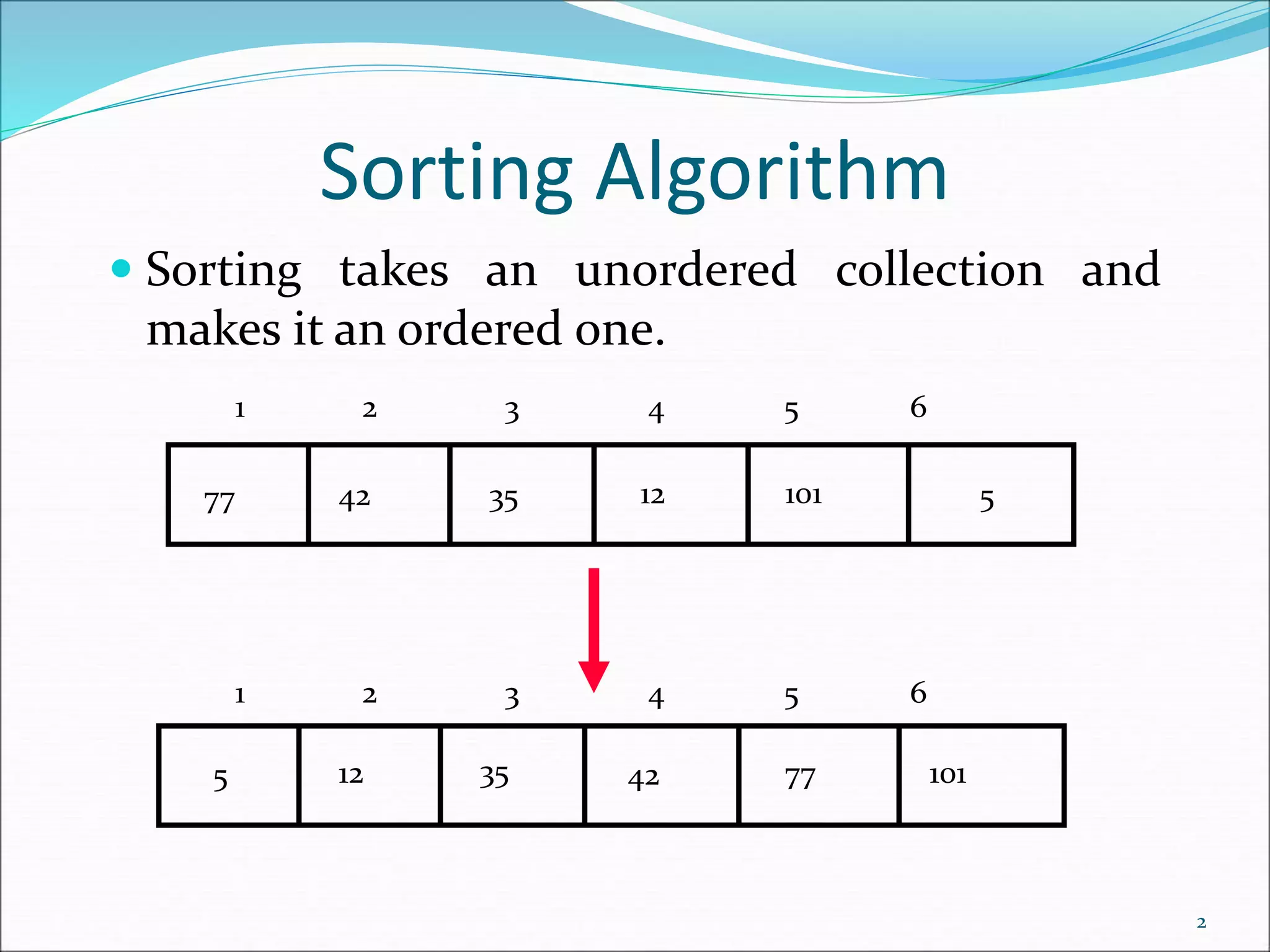
Sorting Algorithm
 Sorting takes an unordered collection and
makes it an ordered one.
2
5
12
35
42
77 101
5 12 35 42 77 101
1 2 3 4 5 6
1 2 3 4 5 6
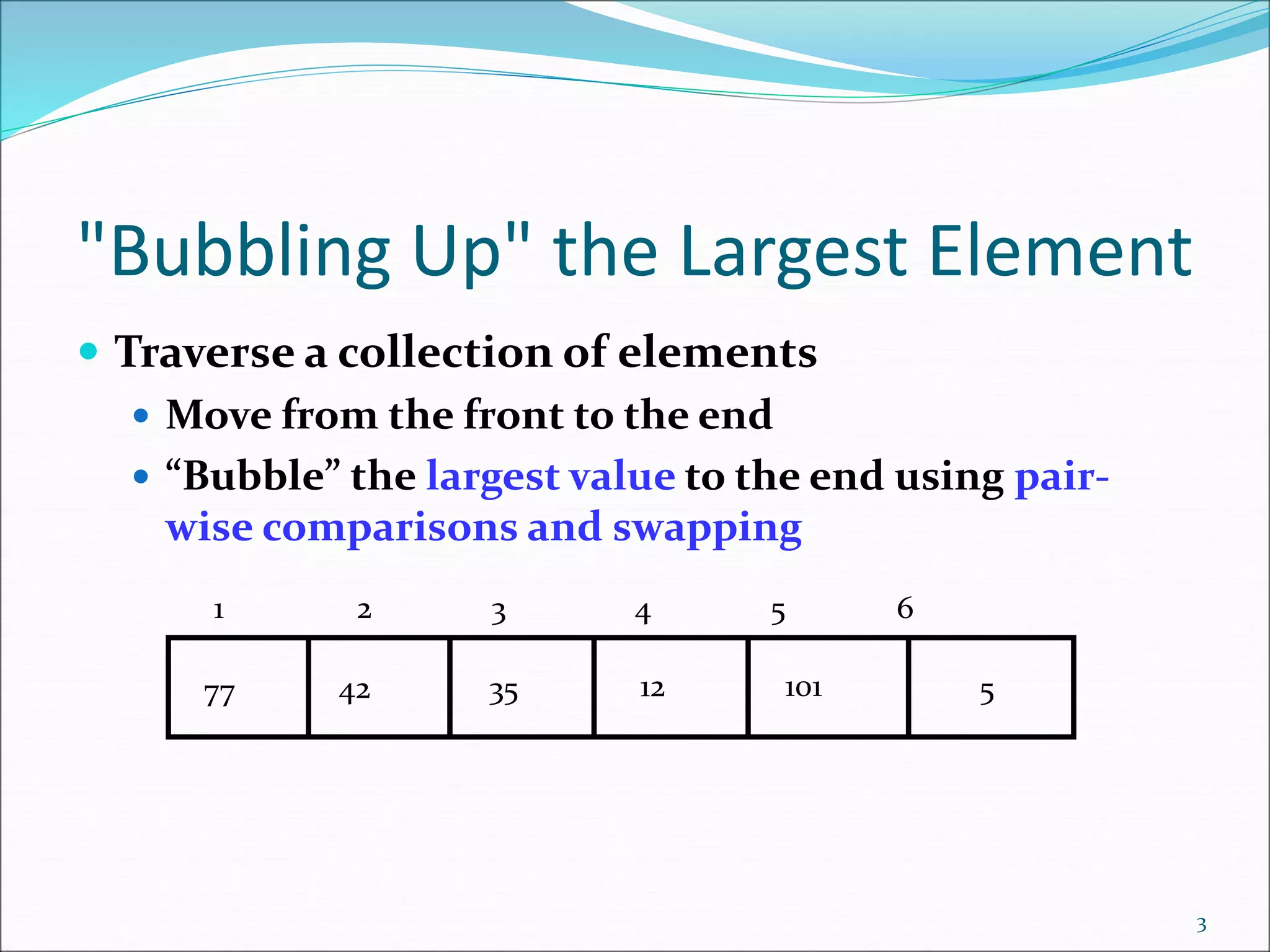
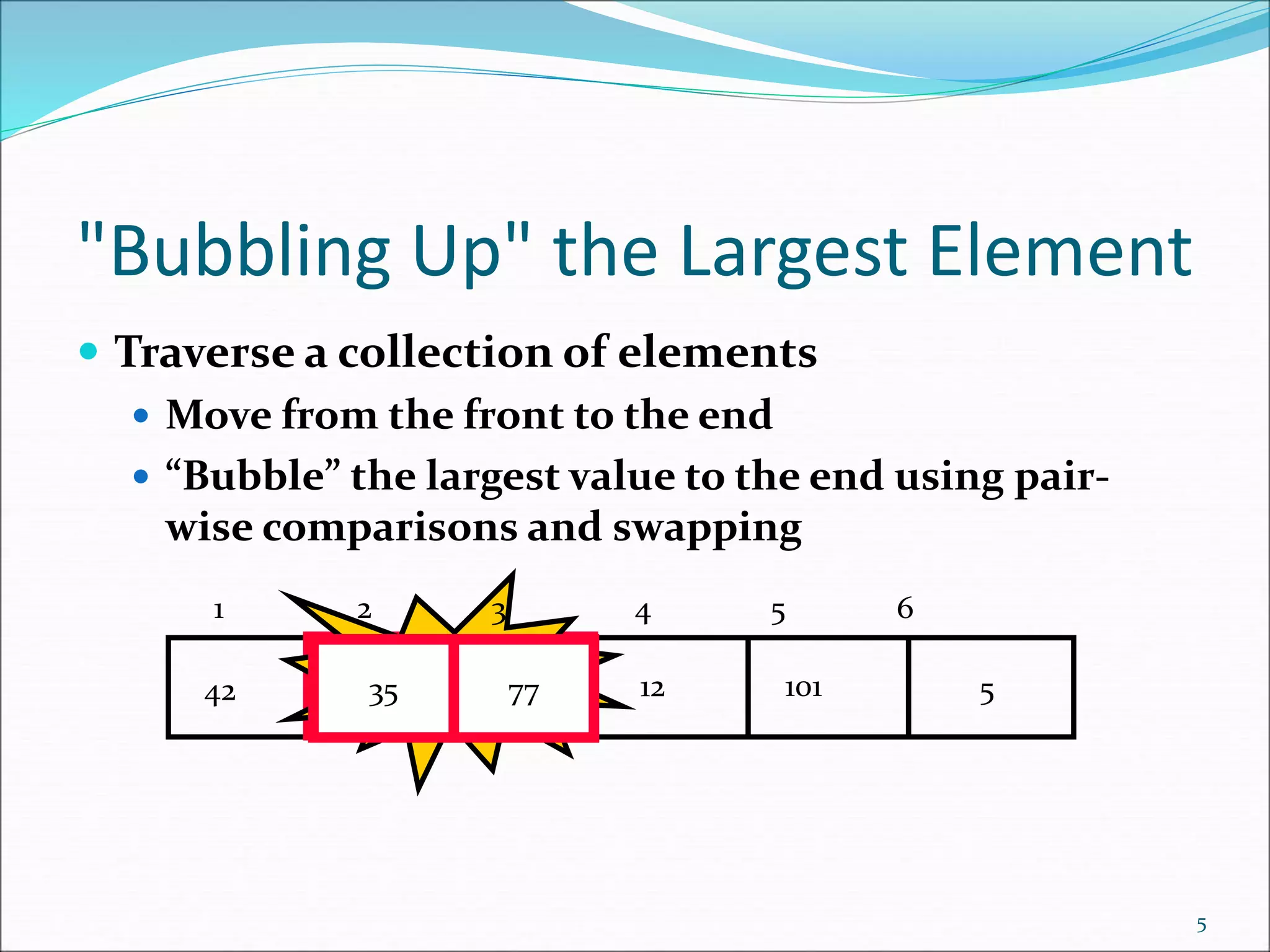
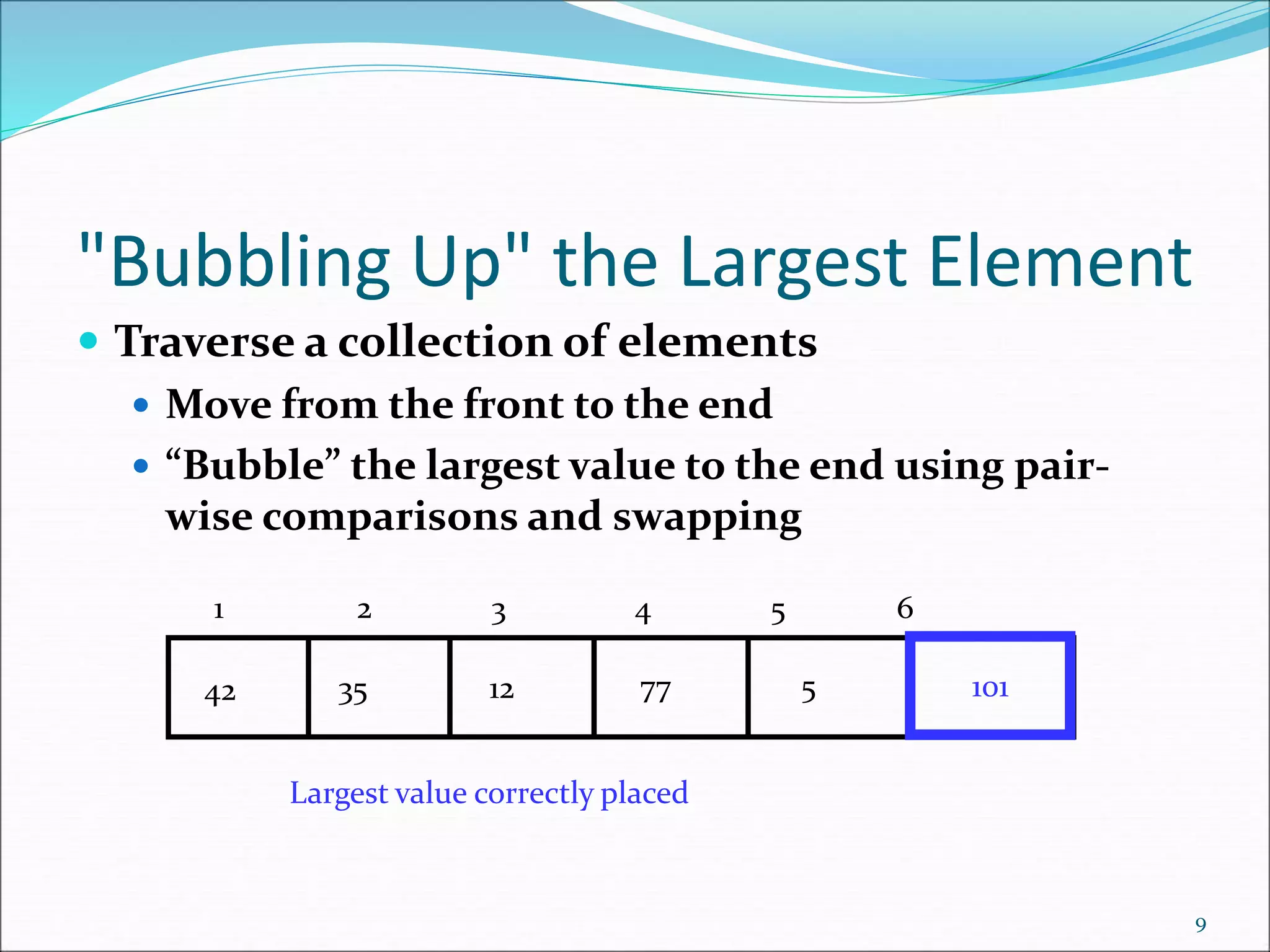
"Bubbling Up" the Largest Element
 Traverse a collection of elements
 Move from the front to the end
 “Bubble” the largest value to the end using pair-
wise comparisons and swapping
3
5
12
35
42
77 101
1 2 3 4 5 6
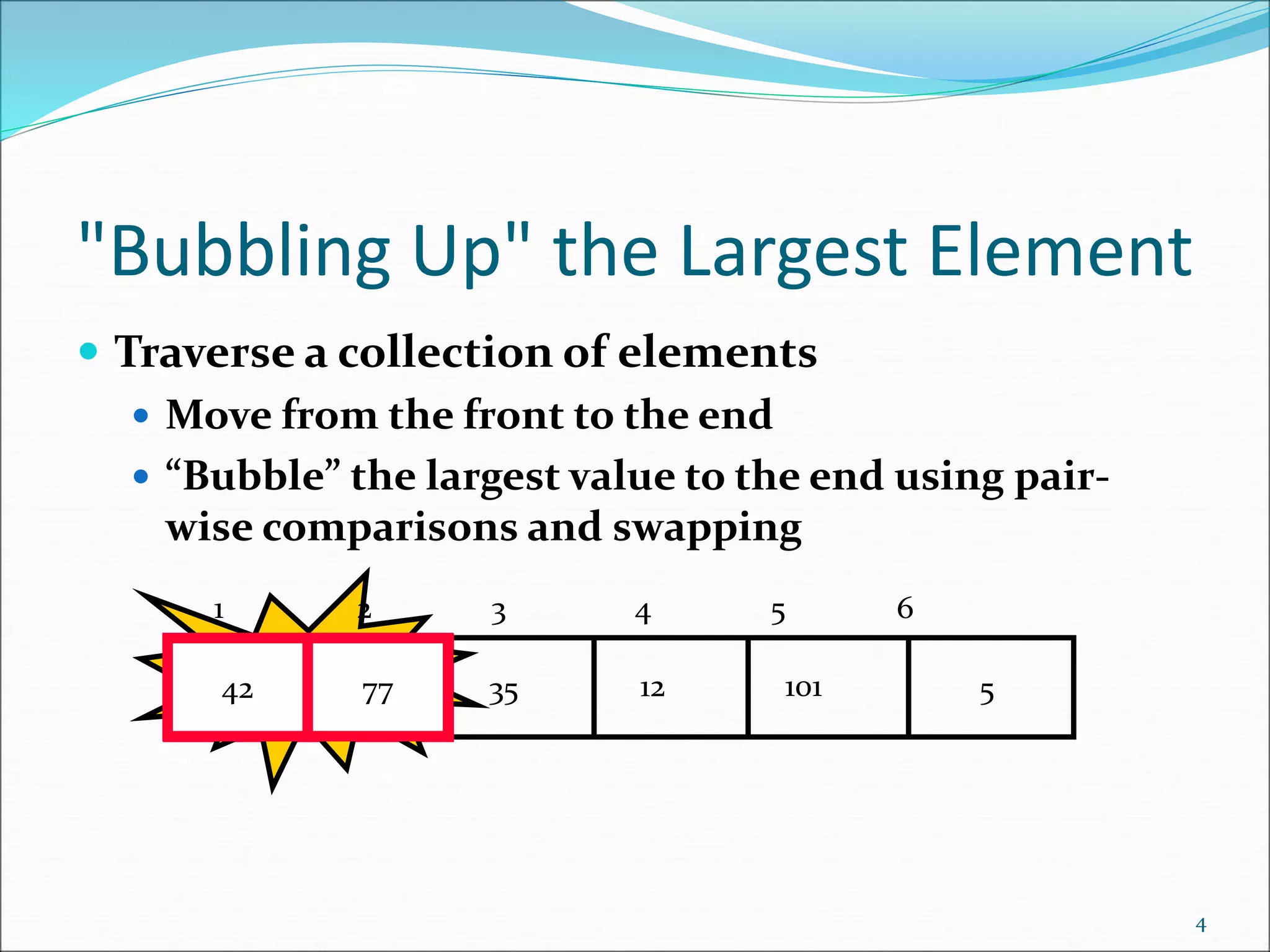
"Bubbling Up" the Largest Element
 Traverse a collection of elements
 Move from the front to the end
 “Bubble” the largest value to the end using pair-
wise comparisons and swapping
4
5
12
35
42
77 101
Swap
42 77
1 2 3 4 5 6
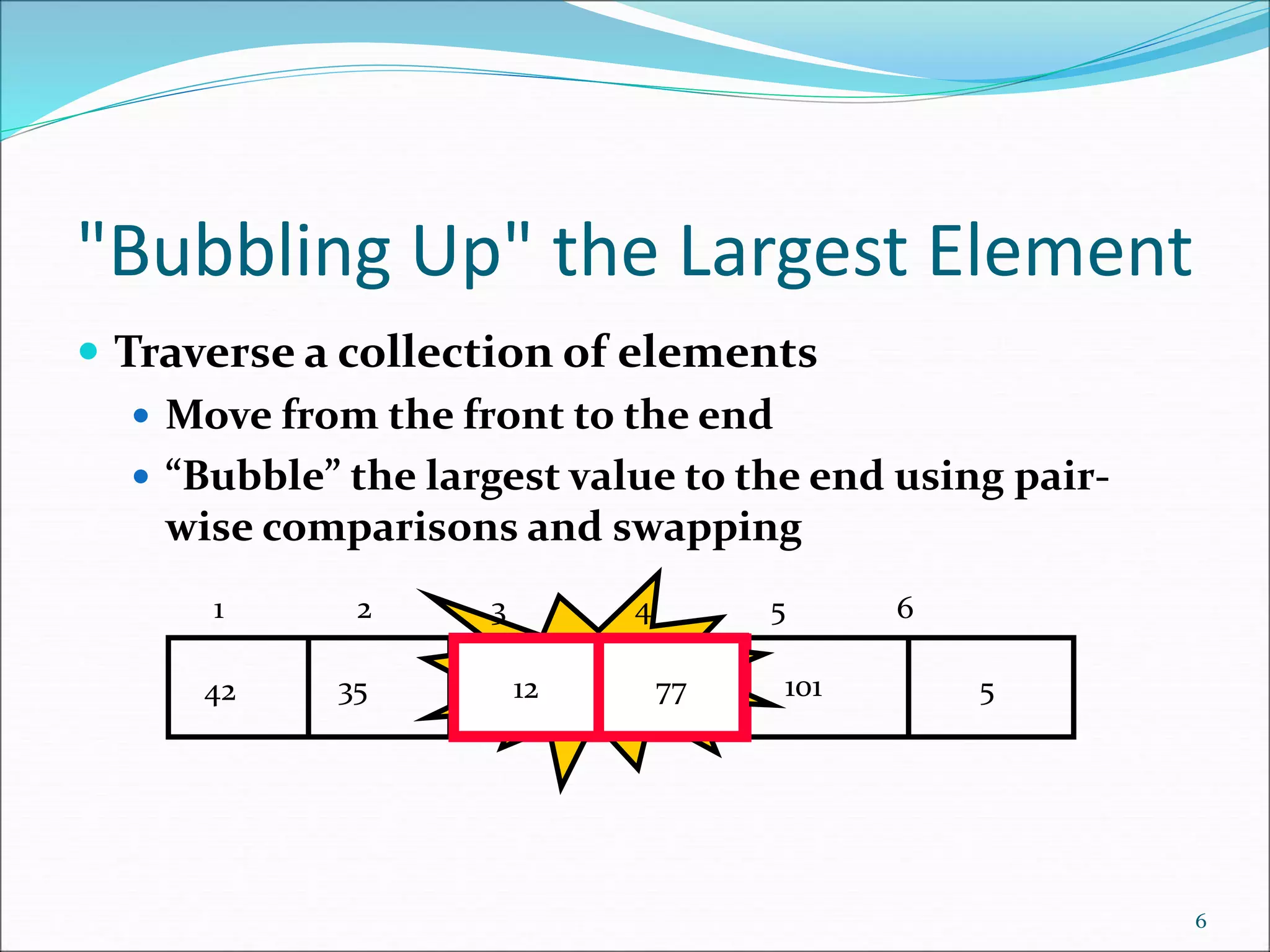
"Bubbling Up" the Largest Element
 Traverse a collection of elements
 Move from the front to the end
 “Bubble” the largest value to the end using pair-
wise comparisons and swapping
5
5
12
35
77
42 101
Swap
35 77
1 2 3 4 5 6
"Bubbling Up" the Largest Element
 Traverse a collection of elements
 Move from the front to the end
 “Bubble” the largest value to the end using pair-
wise comparisons and swapping
6
5
12
77
35
42 101
Swap
12 77
1 2 3 4 5 6
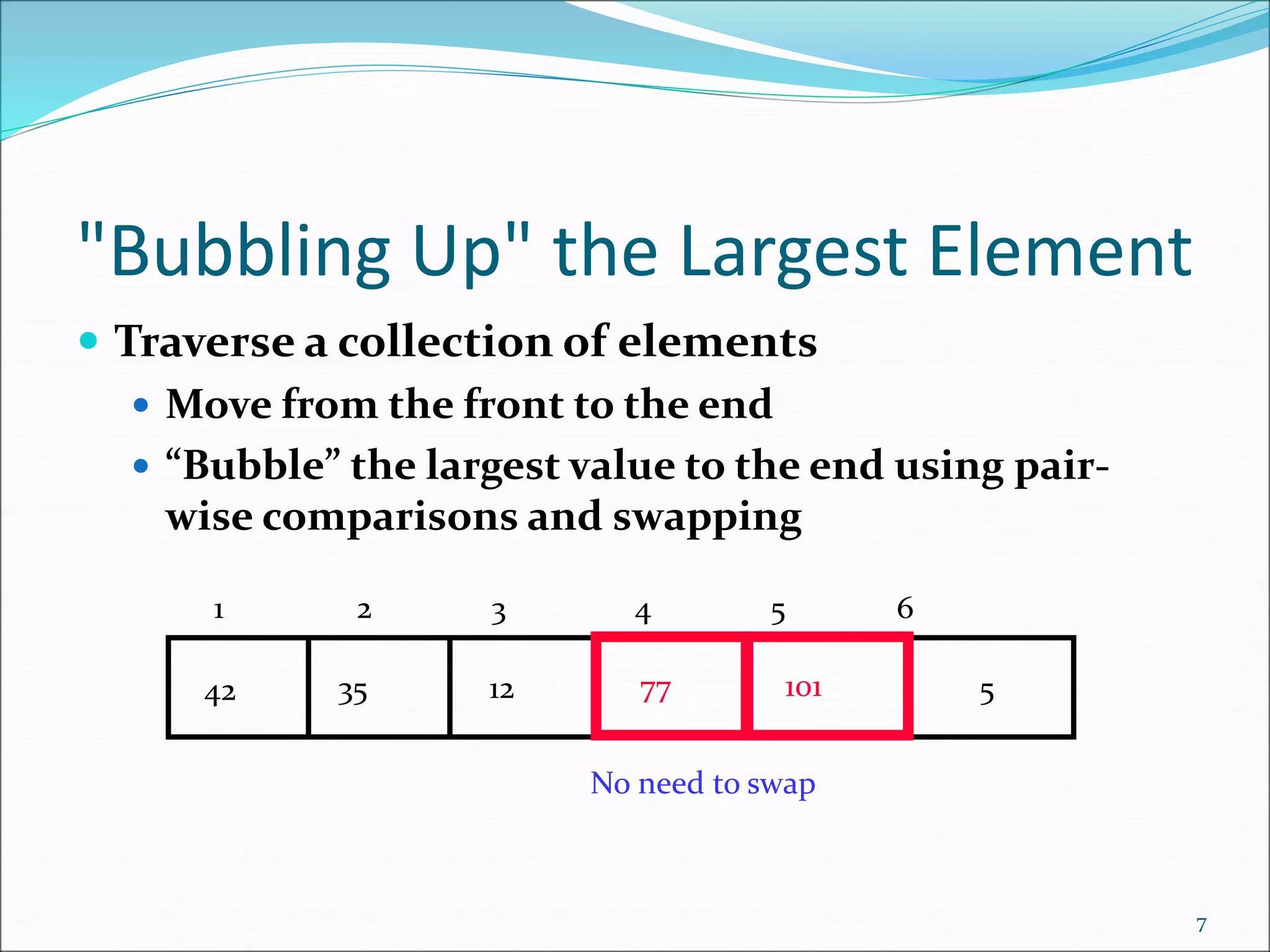
"Bubbling Up" the Largest Element
 Traverse a collection of elements
 Move from the front to the end
 “Bubble” the largest value to the end using pair-
wise comparisons and swapping
7
5
77
12
35
42 101
No need to swap
1 2 3 4 5 6
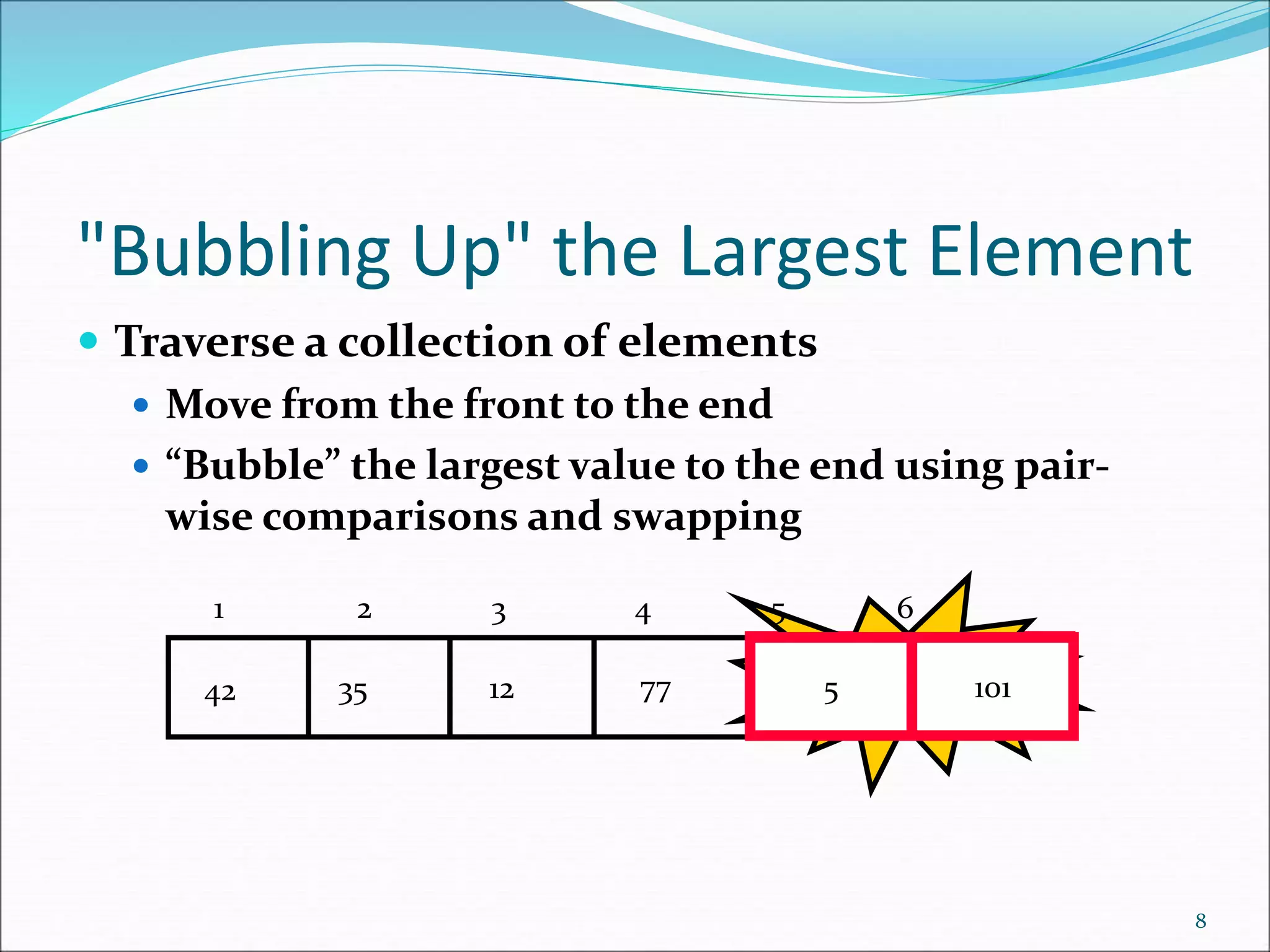
"Bubbling Up" the Largest Element
 Traverse a collection of elements
 Move from the front to the end
 “Bubble” the largest value to the end using pair-
wise comparisons and swapping
8
5
77
12
35
42 101 Swap
5 101
1 2 3 4 5 6
"Bubbling Up" the Largest Element
 Traverse a collection of elements
 Move from the front to the end
 “Bubble” the largest value to the end using pair-
wise comparisons and swapping
9
77
12
35
42 5 101
Largest value correctly placed
1 2 3 4 5 6
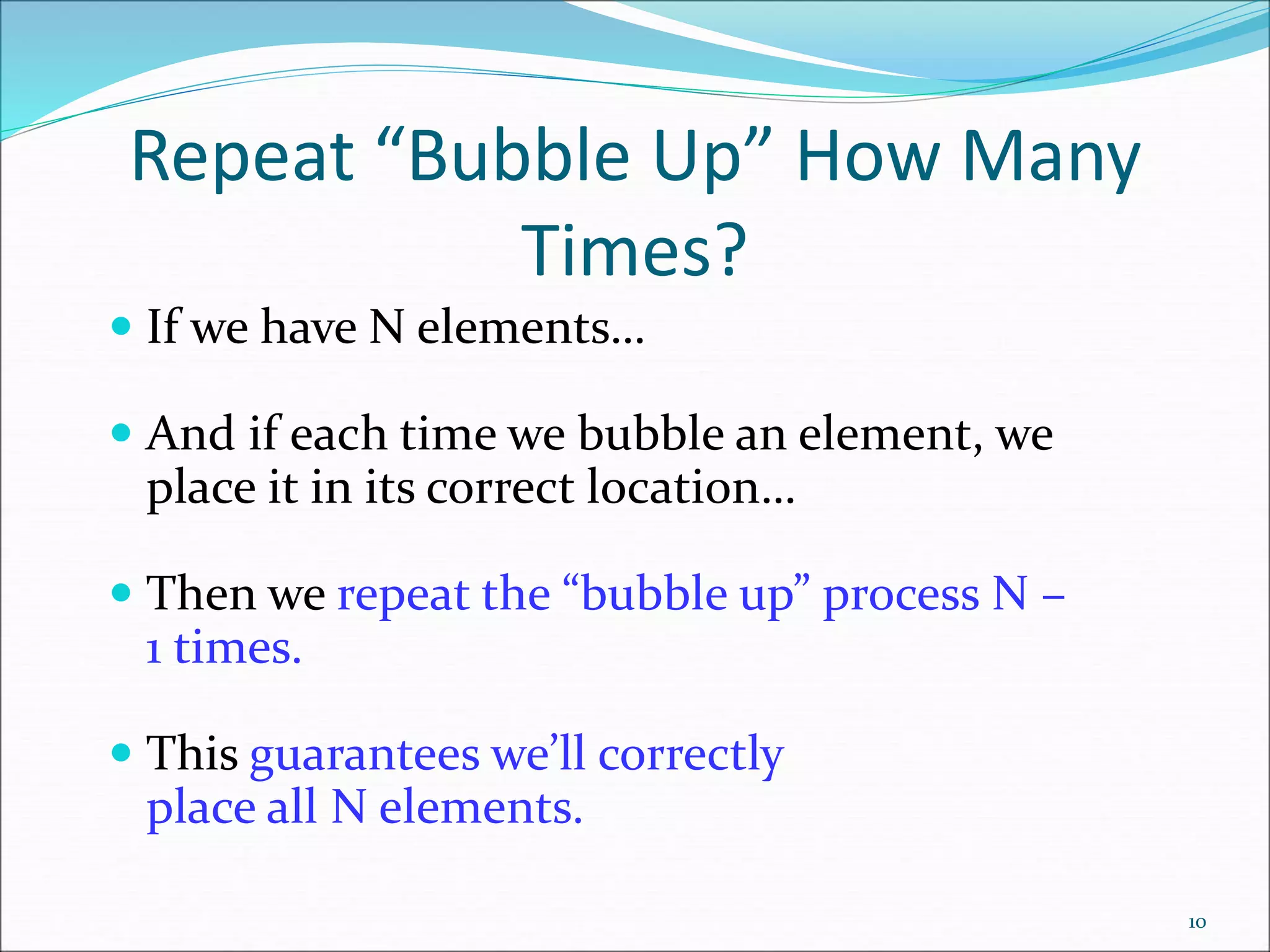
Repeat “Bubble Up” How Many
Times?
 If we have N elements…
 And if each time we bubble an element, we
place it in its correct location…
 Then we repeat the “bubble up” process N –
1 times.
 This guarantees we’ll correctly
place all N elements.
10
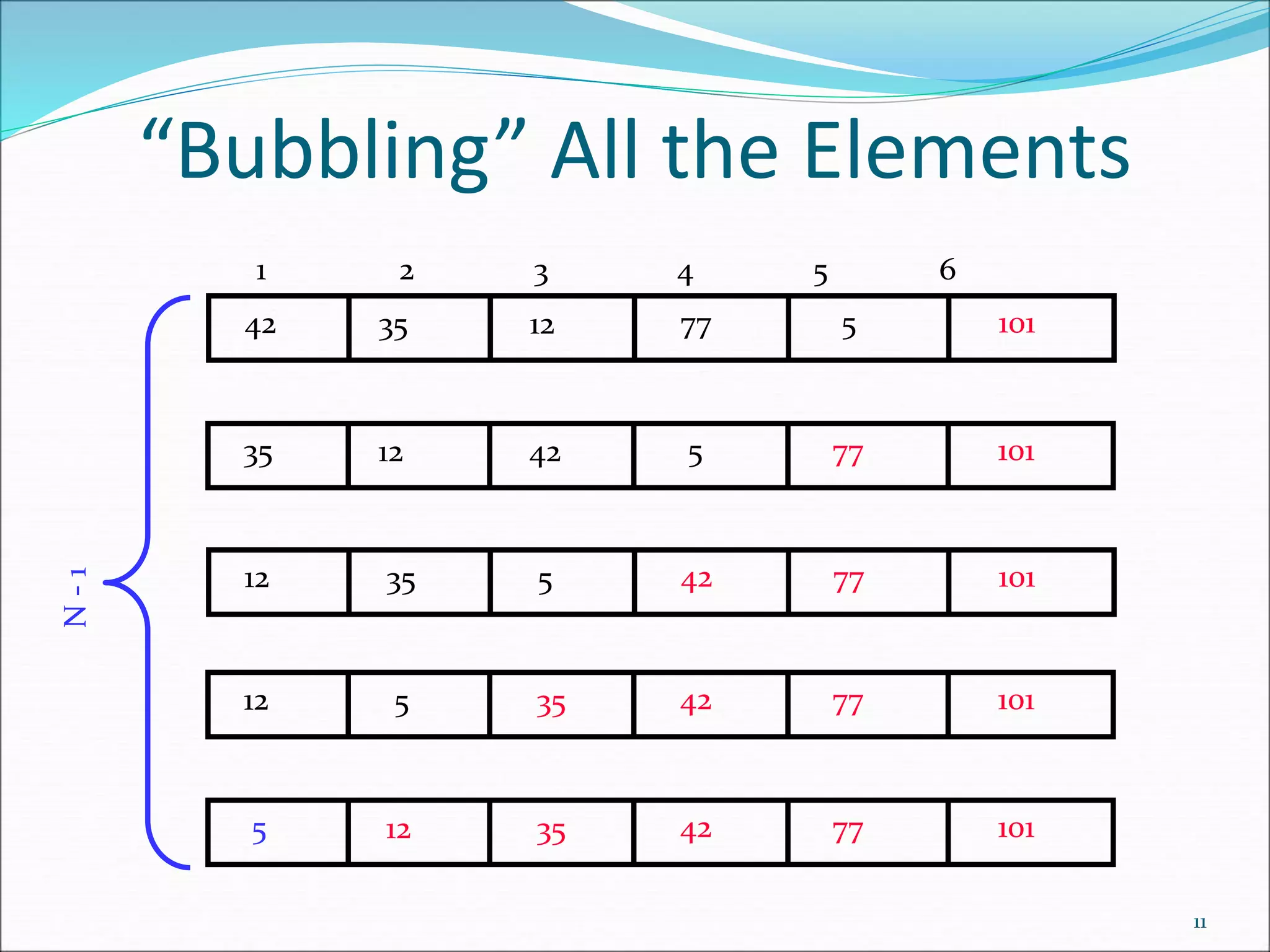
“Bubbling” All the Elements
11
77
12
35
42 5 101
5
42
12
35 77 101
42
5
35
12 77 101
42
35
5
12 77 101
42
35
12
5 77 101
N
-
1
1 2 3 4 5 6
Bubble Sort
Algorithm
for i  1 to n-1 do
for j  1 to n-i do
if (A[j+1] < A[j]) swap A[j] and A[j+1] ;
}
}
Analysis:
In general, if the list has n elements, we will have to do
(n-1) + (n-2) …. + 2 +1 = (n-1) n / 2 comparisons.
=O(n^2)
12
Insertion Sort
INSERTION_SORT (A, N)
1. Set A[0] = -∞.
2. Repeat Step 3 to 5 for K = 2, 3, …, N:
3. Set TEMP = A[K] and PTR = K – 1.
4. Repeat while TEMP < A[PTR]:
(a) Set A[PTR+1] = A[PTR]
(b) Set PTR = PTR – 1.
[End of Loop.]
5. Set A[PTR+1] = TEMP.
[End of Loop 2.]
6. Return.
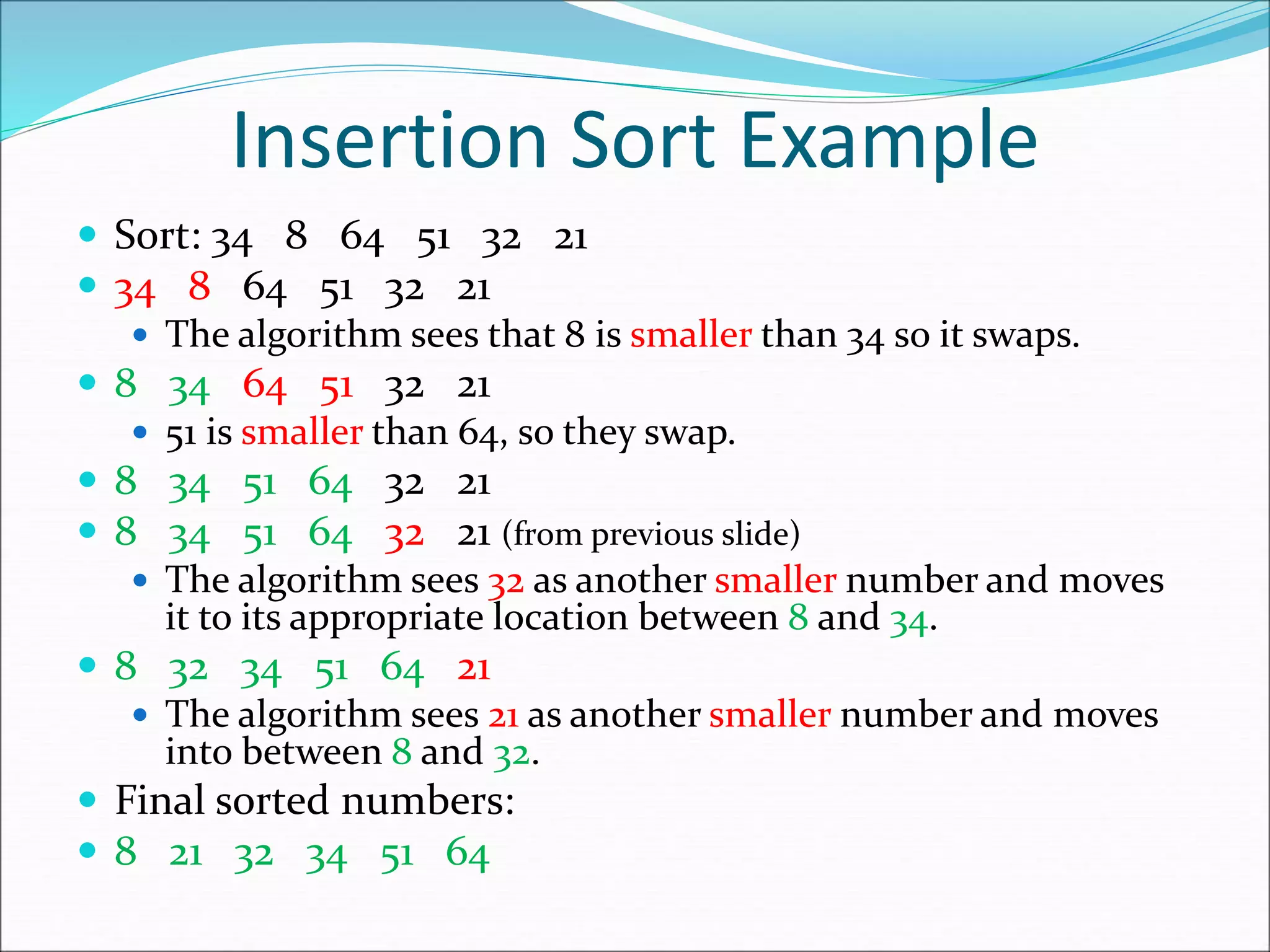
Insertion Sort Example
 Sort: 34 8 64 51 32 21
 34 8 64 51 32 21
 The algorithm sees that 8 is smaller than 34 so it swaps.
 8 34 64 51 32 21
 51 is smaller than 64, so they swap.
 8 34 51 64 32 21
 8 34 51 64 32 21 (from previous slide)
 The algorithm sees 32 as another smaller number and moves
it to its appropriate location between 8 and 34.
 8 32 34 51 64 21
 The algorithm sees 21 as another smaller number and moves
into between 8 and 32.
 Final sorted numbers:
 8 21 32 34 51 64
Insertion Sort Complexity
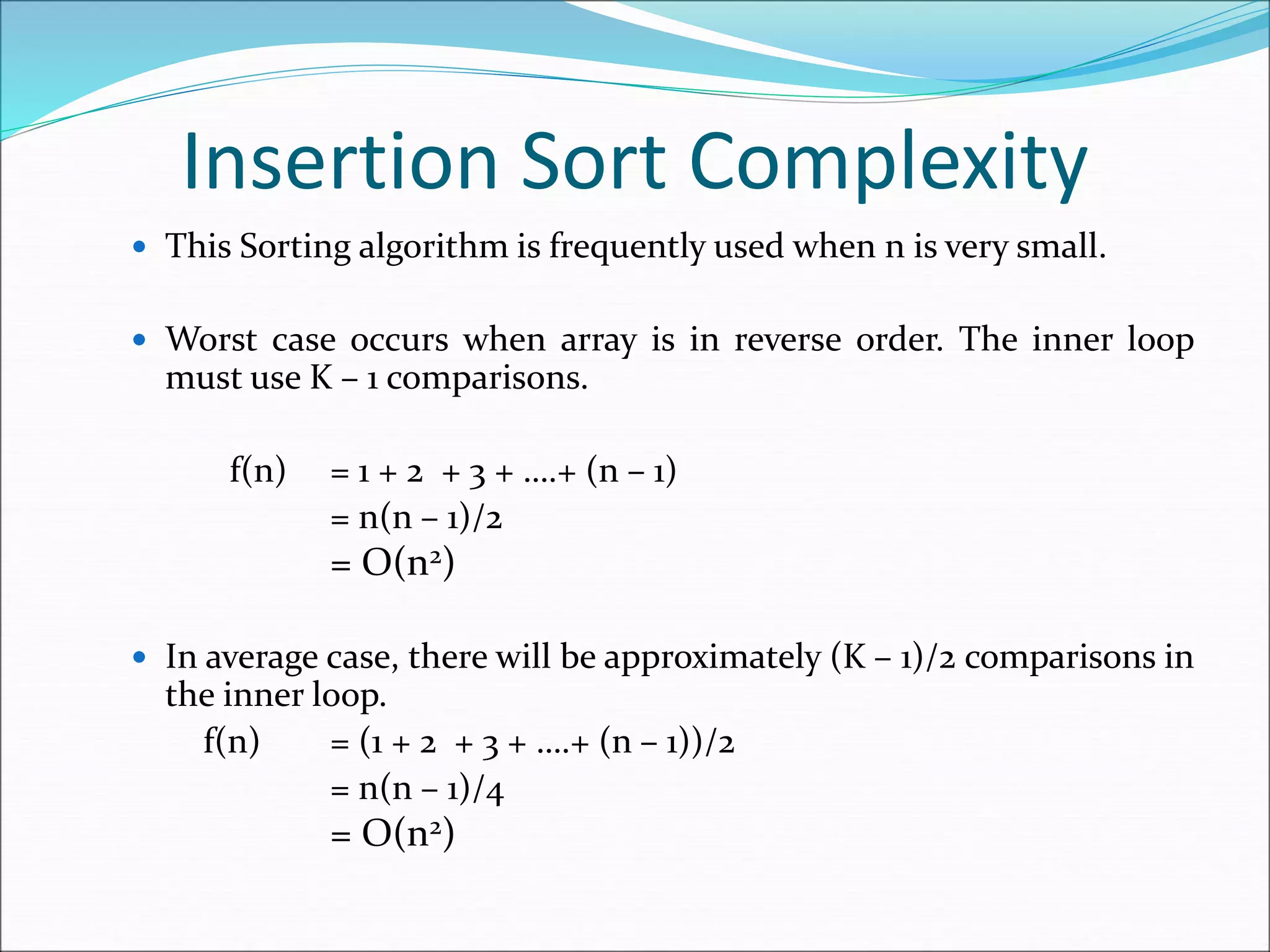
 This Sorting algorithm is frequently used when n is very small.
 Worst case occurs when array is in reverse order. The inner loop
must use K – 1 comparisons.
f(n) = 1 + 2 + 3 + ….+ (n – 1)
= n(n – 1)/2
= O(n2)
 In average case, there will be approximately (K – 1)/2 comparisons in
the inner loop.
f(n) = (1 + 2 + 3 + ….+ (n – 1))/2
= n(n – 1)/4
= O(n2)
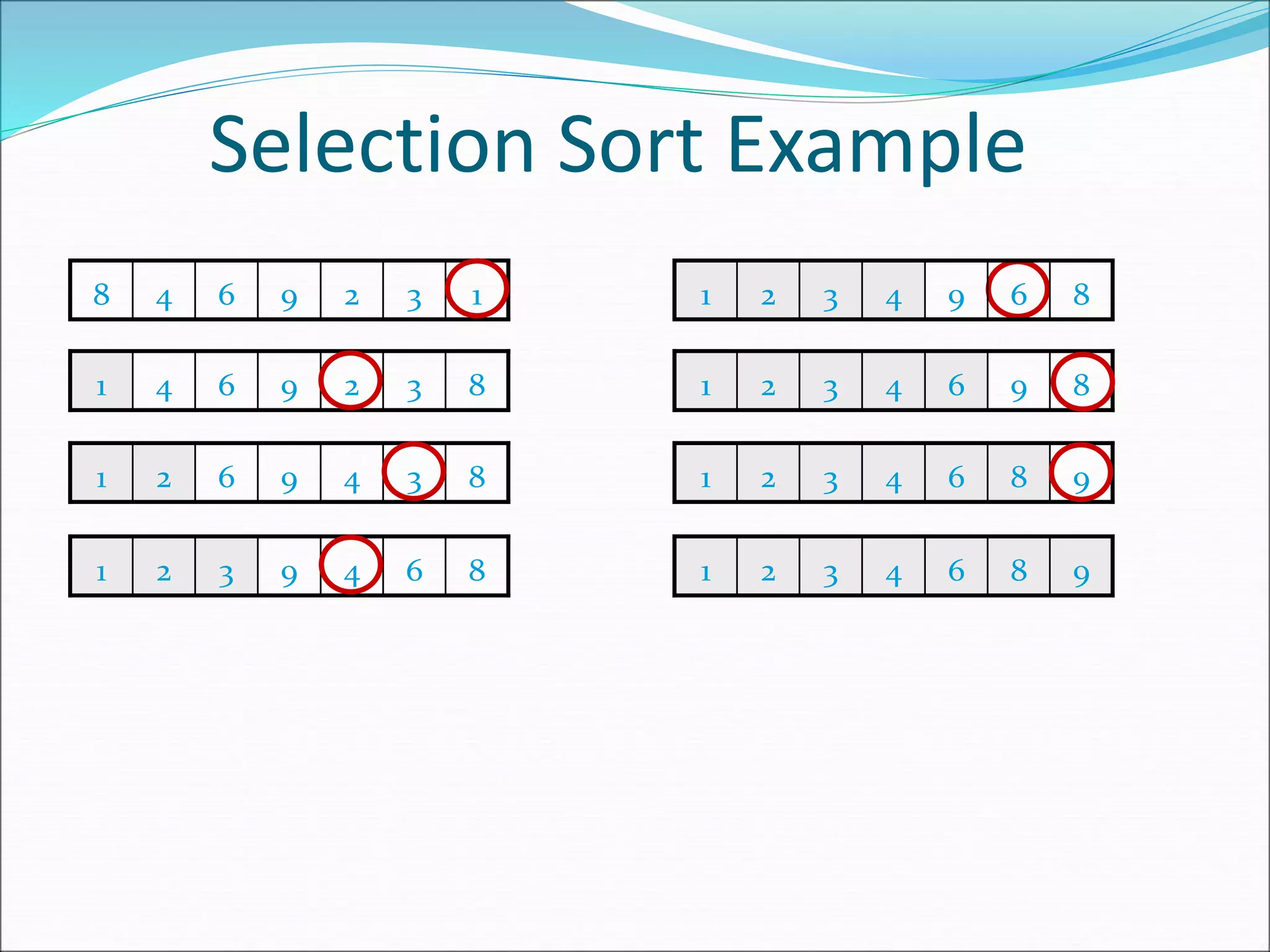
Selection Sort
This algorithm sorts an array A with N elements.
SELECTION(A, N)
1. Repeat steps 2 and 3 for k=1 to N-1:
2. Call MIN(A, K, N, LOC).
3. [Interchange A[k] and A[LOC]]
Set Temp:= A[k], A[k]:= A[LOC] and A[LOC]:=Temp.
[End of step 1 Loop.]
4. Exit.
MIN(A, K, N, LOC).
1. Set MIN := A[K] and LOC:= K.
2. Repeat for j=k+1 to N:
If Min>A[j], then: Set Min:= A[j] and LOC:=J.
[End of if structure]
3. Return.
Selection Sort Example
1
3
2
9
6
4
8
8
3
2
9
6
4
1
8
3
4
9
6
2
1
8
6
4
9
3
2
1
8
9
6
4
3
2
1
8
6
9
4
3
2
1
9
8
6
4
3
2
1
9
8
6
4
3
2
1
Selection Sort Complexity
The number f(n) of comparisons in selection sort
algorithm is independent of original order of elements.
There are n-1 comparisons during pass 1 to find the
smallest element, n-2 comparisons during pass 2 to find
the second smallest element, and so on.
Accordingly,
f (n) = (n-1)+(n-2)+-----+2+1
= n(n-1)/2
= O(n2)
The f (n) holds the same value O(n2) both for worst case
and average case.
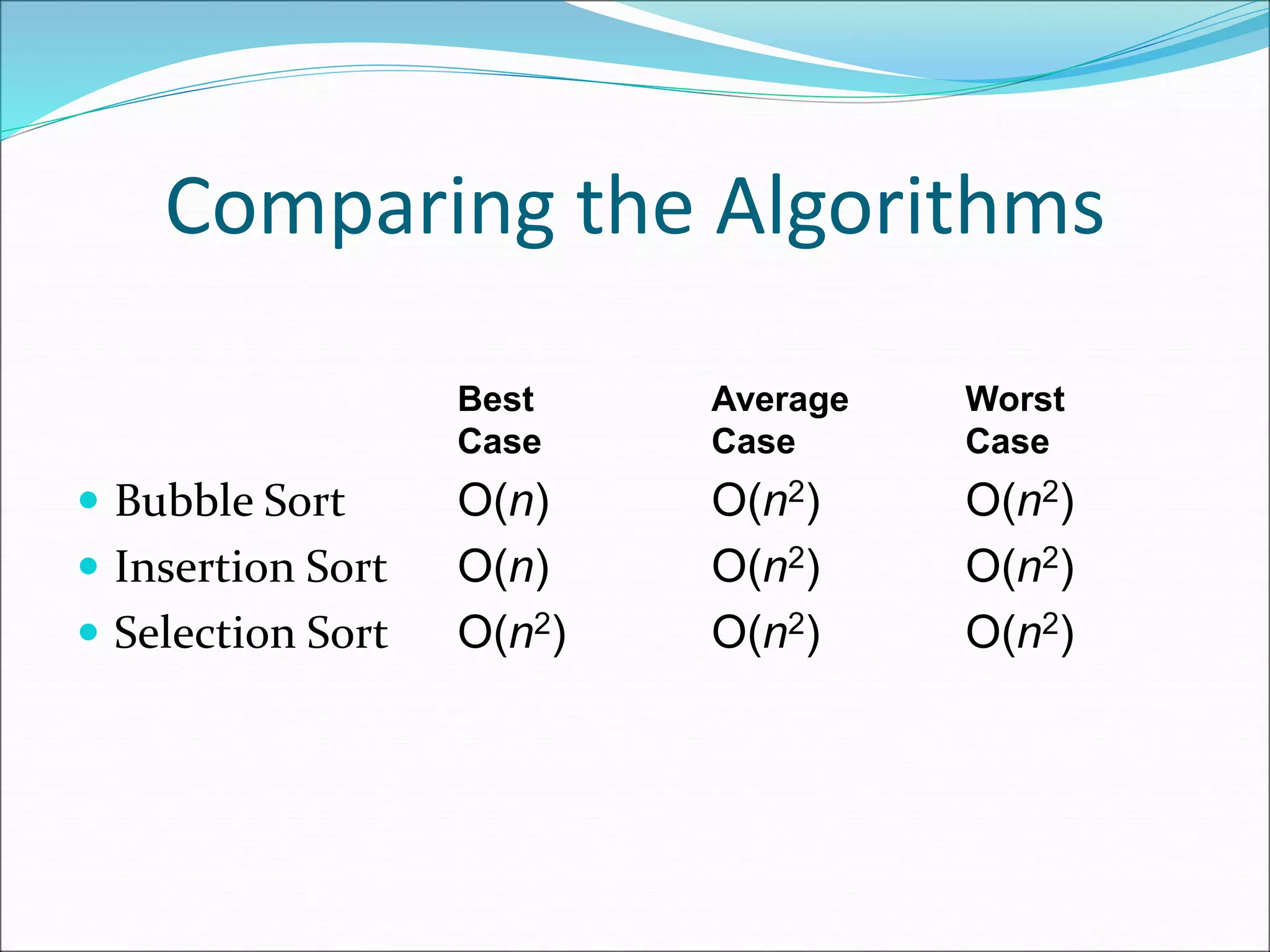
Comparing the Algorithms
Best Average Worst
Case Case Case
 Bubble Sort O(n) O(n2) O(n2)
 Insertion Sort O(n) O(n2) O(n2)
 Selection Sort O(n2) O(n2) O(n2)
Thank You

ds 3Sorting.ppt

  • 1.
  • 2.
    Sorting Algorithm  Sortingtakes an unordered collection and makes it an ordered one. 2 5 12 35 42 77 101 5 12 35 42 77 101 1 2 3 4 5 6 1 2 3 4 5 6
  • 3.
    "Bubbling Up" theLargest Element  Traverse a collection of elements  Move from the front to the end  “Bubble” the largest value to the end using pair- wise comparisons and swapping 3 5 12 35 42 77 101 1 2 3 4 5 6
  • 4.
    "Bubbling Up" theLargest Element  Traverse a collection of elements  Move from the front to the end  “Bubble” the largest value to the end using pair- wise comparisons and swapping 4 5 12 35 42 77 101 Swap 42 77 1 2 3 4 5 6
  • 5.
    "Bubbling Up" theLargest Element  Traverse a collection of elements  Move from the front to the end  “Bubble” the largest value to the end using pair- wise comparisons and swapping 5 5 12 35 77 42 101 Swap 35 77 1 2 3 4 5 6
  • 6.
    "Bubbling Up" theLargest Element  Traverse a collection of elements  Move from the front to the end  “Bubble” the largest value to the end using pair- wise comparisons and swapping 6 5 12 77 35 42 101 Swap 12 77 1 2 3 4 5 6
  • 7.
    "Bubbling Up" theLargest Element  Traverse a collection of elements  Move from the front to the end  “Bubble” the largest value to the end using pair- wise comparisons and swapping 7 5 77 12 35 42 101 No need to swap 1 2 3 4 5 6
  • 8.
    "Bubbling Up" theLargest Element  Traverse a collection of elements  Move from the front to the end  “Bubble” the largest value to the end using pair- wise comparisons and swapping 8 5 77 12 35 42 101 Swap 5 101 1 2 3 4 5 6
  • 9.
    "Bubbling Up" theLargest Element  Traverse a collection of elements  Move from the front to the end  “Bubble” the largest value to the end using pair- wise comparisons and swapping 9 77 12 35 42 5 101 Largest value correctly placed 1 2 3 4 5 6
  • 10.
    Repeat “Bubble Up”How Many Times?  If we have N elements…  And if each time we bubble an element, we place it in its correct location…  Then we repeat the “bubble up” process N – 1 times.  This guarantees we’ll correctly place all N elements. 10
  • 11.
    “Bubbling” All theElements 11 77 12 35 42 5 101 5 42 12 35 77 101 42 5 35 12 77 101 42 35 5 12 77 101 42 35 12 5 77 101 N - 1 1 2 3 4 5 6
  • 12.
    Bubble Sort Algorithm for i 1 to n-1 do for j  1 to n-i do if (A[j+1] < A[j]) swap A[j] and A[j+1] ; } } Analysis: In general, if the list has n elements, we will have to do (n-1) + (n-2) …. + 2 +1 = (n-1) n / 2 comparisons. =O(n^2) 12
  • 13.
    Insertion Sort INSERTION_SORT (A,N) 1. Set A[0] = -∞. 2. Repeat Step 3 to 5 for K = 2, 3, …, N: 3. Set TEMP = A[K] and PTR = K – 1. 4. Repeat while TEMP < A[PTR]: (a) Set A[PTR+1] = A[PTR] (b) Set PTR = PTR – 1. [End of Loop.] 5. Set A[PTR+1] = TEMP. [End of Loop 2.] 6. Return.
  • 14.
    Insertion Sort Example Sort: 34 8 64 51 32 21  34 8 64 51 32 21  The algorithm sees that 8 is smaller than 34 so it swaps.  8 34 64 51 32 21  51 is smaller than 64, so they swap.  8 34 51 64 32 21  8 34 51 64 32 21 (from previous slide)  The algorithm sees 32 as another smaller number and moves it to its appropriate location between 8 and 34.  8 32 34 51 64 21  The algorithm sees 21 as another smaller number and moves into between 8 and 32.  Final sorted numbers:  8 21 32 34 51 64
  • 15.
    Insertion Sort Complexity This Sorting algorithm is frequently used when n is very small.  Worst case occurs when array is in reverse order. The inner loop must use K – 1 comparisons. f(n) = 1 + 2 + 3 + ….+ (n – 1) = n(n – 1)/2 = O(n2)  In average case, there will be approximately (K – 1)/2 comparisons in the inner loop. f(n) = (1 + 2 + 3 + ….+ (n – 1))/2 = n(n – 1)/4 = O(n2)
  • 16.
    Selection Sort This algorithmsorts an array A with N elements. SELECTION(A, N) 1. Repeat steps 2 and 3 for k=1 to N-1: 2. Call MIN(A, K, N, LOC). 3. [Interchange A[k] and A[LOC]] Set Temp:= A[k], A[k]:= A[LOC] and A[LOC]:=Temp. [End of step 1 Loop.] 4. Exit. MIN(A, K, N, LOC). 1. Set MIN := A[K] and LOC:= K. 2. Repeat for j=k+1 to N: If Min>A[j], then: Set Min:= A[j] and LOC:=J. [End of if structure] 3. Return.
  • 17.
  • 18.
    Selection Sort Complexity Thenumber f(n) of comparisons in selection sort algorithm is independent of original order of elements. There are n-1 comparisons during pass 1 to find the smallest element, n-2 comparisons during pass 2 to find the second smallest element, and so on. Accordingly, f (n) = (n-1)+(n-2)+-----+2+1 = n(n-1)/2 = O(n2) The f (n) holds the same value O(n2) both for worst case and average case.
  • 19.
    Comparing the Algorithms BestAverage Worst Case Case Case  Bubble Sort O(n) O(n2) O(n2)  Insertion Sort O(n) O(n2) O(n2)  Selection Sort O(n2) O(n2) O(n2)
  • 20.