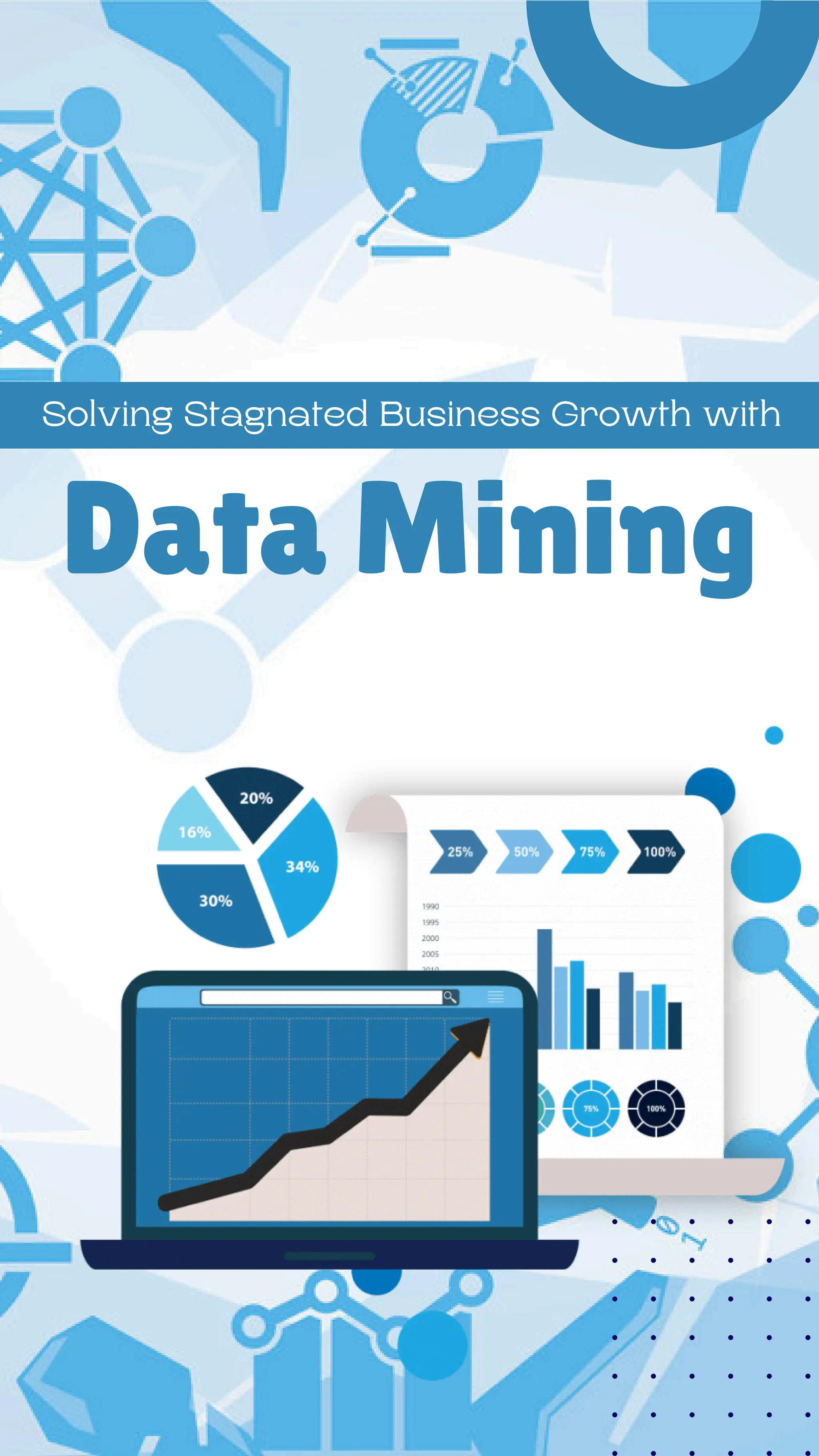
Solving Stagnated Business Growth with
Data Mining
For businesses to thrive in this data-rich landscape, they must
extract meaningful insights from their data. This is where data
mining becomes indispensable. Data mining involves analyzing vast
datasets to uncover useful intelligence that can solve problems,
predict trends, mitigate risks, and discover new opportunities.
However, leveraging this technology effectively requires a strategic
approach.
The Rising Tide of Data
In today’s world, data is ubiquitous, permeating every industry and
organization. The sheer volume of data generated is staggering
and continues to grow at an exponential rate. A recent report by
Techjury highlights that the global production of data has reached
5 exabytes, equivalent to 2.5 quintillion bytes or 2.5 billion
gigabytes. This massive influx of data is increasingly valuable,
particularly for businesses aiming to harness it for growth.
Companies like Amazon, Meta, Apple, and Microsoft rely heavily on
data-driven insights to navigate customer expectations and
dynamic market environments.
Unleashing the Power of Data Mining
Adopting a data-driven strategy allows companies to anticipate
changes and address challenges with greater accuracy. Data mining
provides management with a forward-looking perspective, enabling
them to set long-term, measurable goals instead of relying solely on
short-term snapshots. The key benefits include:
Personalized Customer Experiences: By analyzing customer
data, businesses can tailor their communication, products, and
services to meet specific needs, enhancing customer
satisfaction.
Improved Decision-Making: Access to comprehensive data
allows for quicker and more informed decision-making
processes.
New Business Models: Data mining insights help stakeholders
reassess and refine existing workflows, potentially leading to
innovative business models.
Enhanced Efficiency: Outsourcing data mining tasks can free up
internal resources, boosting overall productivity and efficiency.
Stronger Cybersecurity: Data-driven insights help identify and
address vulnerabilities, bolstering an organization’s cybersecurity
measures
Achieving Social Goals: Beyond financial benefits, data mining
can also support sustainable practices and diverse initiatives.
Real-Life Applications Across Industries
Data mining serves as a versatile tool across various business
functions:
1. Optimizing Sales Strategies
Data mining enables more efficient resource utilization to drive
revenue growth. For instance, a coffee shop can analyze point-of-
sale data to identify peak sales times and popular product
combinations, allowing for strategic adjustments to its offerings.
2. Enhancing Marketing Campaigns
Marketing greatly benefits from data mining, which helps in
understanding customer demographics, preferences, and behaviors.
This information is crucial for creating targeted marketing strategies,
personalized promotions, and effective loyalty programs.
3. Improving Healthcare Services
In the healthcare sector, data mining aggregates patient information,
aiding in accurate diagnoses and efficient resource management,
ultimately leading to better patient care and cost-effective
operations.
4. Elevating Customer Service
By analyzing data on customer interactions, companies can pinpoint
strengths and weaknesses in their service delivery, leading to
improved customer satisfaction through targeted improvements.
Practical Applications of Data Mining
5. Strategic Human Resource Management
Data mining helps HR departments analyze data related to salaries,
promotions, employee retention, and benefits. This enables better
understanding and improvement of employee engagement and
retention strategies.
6. Detecting and Reducing Fraud
Identifying patterns and anomalies in financial transactions can help
organizations detect and investigate fraudulent activities, protecting
their assets and reputation.
7. Streamlining Manufacturing Processes
For manufacturing companies, data mining provides insights into
material usage, production costs, and process inefficiencies. This
information is vital for optimizing production workflows and reducing
costs.
Conclusion
Data mining is transforming how businesses operate, providing
critical insights that drive growth and innovation. As organizations
continue to explore the potential of data, the benefits of effective
data mining are becoming increasingly clear. By leveraging this
powerful tool, businesses can unlock new opportunities and stay
ahead in a competitive market.
GET IN TOUCH
CONTACT US
CONTACT US TODAY TO START YOUR DATA-DRIVEN
JOURNEY TOWARD SUSTAINED GROWTH AND SUCCESS.
To harness the full potential of data mining for your
business, partner with experts who can help you
uncover valuable insights and apply them effectively.

Solving Stagnated Business Growth with Data Mining

  • 1.
    Solving Stagnated BusinessGrowth with Data Mining
  • 2.
    For businesses tothrive in this data-rich landscape, they must extract meaningful insights from their data. This is where data mining becomes indispensable. Data mining involves analyzing vast datasets to uncover useful intelligence that can solve problems, predict trends, mitigate risks, and discover new opportunities. However, leveraging this technology effectively requires a strategic approach. The Rising Tide of Data In today’s world, data is ubiquitous, permeating every industry and organization. The sheer volume of data generated is staggering and continues to grow at an exponential rate. A recent report by Techjury highlights that the global production of data has reached 5 exabytes, equivalent to 2.5 quintillion bytes or 2.5 billion gigabytes. This massive influx of data is increasingly valuable, particularly for businesses aiming to harness it for growth. Companies like Amazon, Meta, Apple, and Microsoft rely heavily on data-driven insights to navigate customer expectations and dynamic market environments. Unleashing the Power of Data Mining
  • 3.
    Adopting a data-drivenstrategy allows companies to anticipate changes and address challenges with greater accuracy. Data mining provides management with a forward-looking perspective, enabling them to set long-term, measurable goals instead of relying solely on short-term snapshots. The key benefits include: Personalized Customer Experiences: By analyzing customer data, businesses can tailor their communication, products, and services to meet specific needs, enhancing customer satisfaction. Improved Decision-Making: Access to comprehensive data allows for quicker and more informed decision-making processes. New Business Models: Data mining insights help stakeholders reassess and refine existing workflows, potentially leading to innovative business models. Enhanced Efficiency: Outsourcing data mining tasks can free up internal resources, boosting overall productivity and efficiency. Stronger Cybersecurity: Data-driven insights help identify and address vulnerabilities, bolstering an organization’s cybersecurity measures Achieving Social Goals: Beyond financial benefits, data mining can also support sustainable practices and diverse initiatives. Real-Life Applications Across Industries
  • 4.
    Data mining servesas a versatile tool across various business functions: 1. Optimizing Sales Strategies Data mining enables more efficient resource utilization to drive revenue growth. For instance, a coffee shop can analyze point-of- sale data to identify peak sales times and popular product combinations, allowing for strategic adjustments to its offerings. 2. Enhancing Marketing Campaigns Marketing greatly benefits from data mining, which helps in understanding customer demographics, preferences, and behaviors. This information is crucial for creating targeted marketing strategies, personalized promotions, and effective loyalty programs. 3. Improving Healthcare Services In the healthcare sector, data mining aggregates patient information, aiding in accurate diagnoses and efficient resource management, ultimately leading to better patient care and cost-effective operations. 4. Elevating Customer Service By analyzing data on customer interactions, companies can pinpoint strengths and weaknesses in their service delivery, leading to improved customer satisfaction through targeted improvements. Practical Applications of Data Mining
  • 5.
    5. Strategic HumanResource Management Data mining helps HR departments analyze data related to salaries, promotions, employee retention, and benefits. This enables better understanding and improvement of employee engagement and retention strategies. 6. Detecting and Reducing Fraud Identifying patterns and anomalies in financial transactions can help organizations detect and investigate fraudulent activities, protecting their assets and reputation. 7. Streamlining Manufacturing Processes For manufacturing companies, data mining provides insights into material usage, production costs, and process inefficiencies. This information is vital for optimizing production workflows and reducing costs. Conclusion Data mining is transforming how businesses operate, providing critical insights that drive growth and innovation. As organizations continue to explore the potential of data, the benefits of effective data mining are becoming increasingly clear. By leveraging this powerful tool, businesses can unlock new opportunities and stay ahead in a competitive market.
  • 6.
    GET IN TOUCH CONTACTUS CONTACT US TODAY TO START YOUR DATA-DRIVEN JOURNEY TOWARD SUSTAINED GROWTH AND SUCCESS. To harness the full potential of data mining for your business, partner with experts who can help you uncover valuable insights and apply them effectively.