Solution Manual for Service Management 9th by Bordoloi
Solution Manual for Service Management 9th by Bordoloi
Solution Manual for Service Management 9th by Bordoloi
Solution Manual for Service Management 9th by Bordoloi
Solution Manual for Service Management 9th by Bordoloi
1.
Visit https://testbankmall.com todownload the full version and
explore more testbank or solutions manual
Solution Manual for Service Management 9th by
Bordoloi
_____ Click the link below to download _____
https://testbankmall.com/product/solution-manual-for-
service-management-9th-by-bordoloi/
Explore and download more testbank or solutions manual at testbankmall.com
2.
Here are somerecommended products that we believe you will be
interested in. You can click the link to download.
Solution Manual for Management 9th by Kinicki
https://testbankmall.com/product/solution-manual-for-management-9th-
by-kinicki/
Test Bank for MP Service Management 8th Edition
https://testbankmall.com/product/test-bank-for-mp-service-
management-8th-edition/
Solution manual for Griffin’s Fundamentals of Management
9th Edition by Griffin
https://testbankmall.com/product/solution-manual-for-griffins-
fundamentals-of-management-9th-edition-by-griffin/
Solution Manual for Understanding Management, 9th Edition
https://testbankmall.com/product/solution-manual-for-understanding-
management-9th-edition/
3.
Solution Manual forRecords Management, 9th Edition
https://testbankmall.com/product/solution-manual-for-records-
management-9th-edition/
Test Bank for Service Management, 7th Edition: James A.
Fitzsimmons
https://testbankmall.com/product/test-bank-for-service-management-7th-
edition-james-a-fitzsimmons/
Solution Manual for Cases in Strategic Management An
Integrated Approach 9th Edition by Hill
https://testbankmall.com/product/solution-manual-for-cases-in-
strategic-management-an-integrated-approach-9th-edition-by-hill/
Solution Manual for Customer Service: A Practical
Approach, 6/E 6th Edition : 013274239X
https://testbankmall.com/product/solution-manual-for-customer-service-
a-practical-approach-6-e-6th-edition-013274239x/
Solution Manual for Developing Management Skills 9th
Edition Whetten •
https://testbankmall.com/product/solution-manual-for-developing-
management-skills-9th-edition-whetten/
5.
Chapter 1
The ServiceEconomy
2
2. Facilitating Role of Services in an Economy (Figure 1.1)
3. Economic Evolution (Table 1.1, Figure 1.2, and Figure 1.3)
4. Stages of Economic Development (Table 1.2)
5. Nature of the Service Sector (Figure 1.4)
6. The Experience Economy (Table 1.3, Table 1.4, and Figure 1.5)
7. Service –Dominant Logic (Table 1.5)
8. Distinctive Characteristics of Service Operations
9. The Service Package (Figure 1.6 and Table 1.7)
10. Grouping Services by Delivery Process (Figure 1.7 and Figure 1.8)
11. Open-Systems View of Service Operations Management (Figure 1.9)
TOPICS FOR DISCUSSION
1. Illustrate how the type of work that he or she does influences a person's lifestyle. For example, contrast a farmer,
a factory worker, and a schoolteacher.
A farmer's lifestyle is, to a certain extent, still influenced and conditioned by the elements, the weather, the quality
of the soil, and the availability of water. Life is partly a game, but mostly it is a struggle against nature. The rhythm
of life is shaped by nature and the pace of work varies with the season.
In the case of the factory worker, the struggle is against a fabricated nature: a world of cities, factories and tenements.
Life is machine-paced (or at least appears to be). Efficiency is the watchword and productivity is its measure. The
standard of living is measured by the quantity of goods a person has. The worker becomes just a part, a person in
the bureaucratic and faceless organizations that spring up to achieve the task of production and distribution of these
goods. The individual is the unit of social life, with society considered as the sum of all the individual decisions
being made in the marketplace. Protection from the organization is often sought through labor unions.
A schoolteacher interacts on a face-to-face basis with his/her students in an intellectual environment. A career in
teaching involves continual reading in the subjects taught and searching for innovative ways to motivate students.
Life is reflective, ordinarily not physically demanding, and work is conducted in a pleasant campus environment.
2. Is it possible for an economy to be based entirely on services?
Economies based on services only are exceptions and rare ones at that, e.g., Andorra and Liechtenstein, resort
islands in the South Pacific and the Caribbean, and Monte Carlo (gambling). Such countries must import their food,
consumer goods, and durables. But as a rule, this cannot be done for larger economies where production of food
and/or goods is essential.
3. What is the value of self-service in an economy?
Measuring self-service is a problem in its own right and currently is not included in the GNP. A creative discussion
of methods to measure self-service indirectly would include accounting for customer labor in transactions such as
buying a meal at a fast-food restaurant where you are expected to bus your own table or the savings in pumping
6.
Chapter 1
The ServiceEconomy
3
your own gas at a filling station. Self-service has additional value because the labor is present only when it is
needed. In Chapter 5 “Technology in Services” the topic of self-service technology (SST) will be explored.
4. Determine if the U.S. service sector currently is expanding or contracting based upon the Non-Manufacturing
Index (NMI) found at ISM Report on Business on the Institute of Supply Management website:
http://www.ism.ws/pubs/ismmag/.
The ISM Report of Business has a wealth of survey data from industry respondents on the current level of business
activity for the month. The first table presents the ISM series index for the current and previous month for several
measures (e.g., new orders, employment, inventories, etc.). An index value above 50 indicates an expanding service
sector economy, below 50 a declining economy. The table also contains a measure of the index direction and rate
of change.
5. What are challenges of the sharing economy with respect to regulation, insurance, and trust issues?
Push back from established service providers has occurred with many cities requiring for example Uber drivers to
abide by the same arrest back ground checks required of regular taxi drivers. Airbnb renters have run afoul of
zoning restrictions and other rules governing temporary rentals and need for inspections. For Uber whether a car-
owner’s insurance is liable in the event of an accident remains a question. Airbnb has a $50,000 guarantee for hosts
against property and furniture damage from a tenant. The Airbnb site allows hosts and guests to find out more
about each other in advance of a commitment.
6. Critique the “Distinctive Characteristics of Service Operations” by arguing that the characteristics of, customer
participation, simultaneity, perishablity, intangibility, and heterogeneity, may apply to goods as well.
The following analysis is based upon the article “The Four Service Marketing Myths: Remnants of a Goods-Based,
Manufacturing Model,” Journal of Service Research, 6, no. 4, (May 2004), pp. 324-335 by Stephen L. Largo and
Robert F. Lushc. Note how the arguments are a precursor of Service-Dominant Logic.
Customer participation in the service process This characteristic was not one of the original four unique
characteristics of services offered by our colleagues in marketing. In taking a process perspective customer
participation should be expanded beyond a physical presence in the process, for example, providing health history
to a physician, investing savings in a bank, or entrusting one’s automobile to a repair shop. Customer participation
in the service delivery process is the hallmark of all services but could be found in collaborative product design in
manufacturing. Interestingly the attempt to reduce customer-employee interaction through the promotion of self-
service just reinforces the customer role as co-producer.
Simultaneity In an attempt to achieve manufacturing efficiencies, some services decouple part of the delivery
process from the customer. The typical example is auto repair that involves processing a customer’s tangible
possession in a factory setting that does not require the simultaneous presence of the customer. Most services such
as restaurants, banks, and hotels have a front and back office operation with part of the service produced in the back
office where customer demand can be batched and processed with manufacturing efficiency.
Perishability The concept that services cannot be produced at one point in time, inventoried, and later sold upon
demand led to the concept of service perishability. However, service capability can be stored in systems, databases,
knowledge, and people to be used when called upon. In fact, service capacity as measured, for example, in hotel
rooms or airline seats is routinely referred to as inventory to be sold at a later date. Unlike manufacturing, service
capacity is inventoried prior to production rather than after. Finally, when customers form a queue waiting for
service, one might consider this to be an inventory of raw material.
Intangibility With few exceptions, essentially all goods have a service component, whereas all services have some
facilitating goods in the service package. Thus, goods and services can be placed on a continuum according to the
7.
Chapter 1
The ServiceEconomy
4
relative degree of tangibility. For example, in the purchase of a home entertainment center the financing offered
by the store is a service. On a domestic airline flight, passengers in coach are offered a drink and peanuts.
Heterogeneity Process variability destroys efficiency and consistency in quality both in manufacturing and services.
Standardization in services, such as limited menus at fast-food restaurants, is an attempt to reduce input variability.
In the medical field, standardization of procedures has a major impact on reducing infection and recurrence.
INTERACTIVE CLASS EXERCISE
The class breaks into small groups. Each group identifies service firms that should be listed in the Fortune 100
and places them in rank order of estimated annual revenue.
Post on the backboard the combined results of the student groups. Bring to class an PowerPoint slide or overhead
of the most recent listing of the Fortune 100 to compare with the students’ lists (see http://www.fortune.com).
8.
Chapter 1
The ServiceEconomy
5
CASE 1.1: VILLAGE VOLVO
1. Describe Village Volvo's service package.
The following descriptions address the four elements of Village Volvo's service package: supporting facility,
facilitating goods, explicit services, and implicit service.
Supporting facility The new Butler building with ample service bays (two bays per mechanic) and comfortable
waiting room promotes the customer's positive perception of the organization. The suburban location could mean
difficult access and the possible need for a shuttle.
Facilitating goods Specialized tools and an inventory of select auto parts are obvious items in this element.
Information The unique and possibly differentiating feature is the Custom Care Vehicle Dossier (CCVD), which
serves as a powerful information tool for both mechanic and customer. The CCVD acts as a prompt to the customer
to seek continuing service in a pattern (based upon mileage or time). Analysis of customer patterns can assist
Village Volvo in predicting demand and scheduling its operations to make full use of capacity.
Explicit services The two owners of Village Volvo are former authorized Volvo dealer mechanics and have 22
years of combined experience between them. They have earned a respected reputation and satisfied customer
following. Service availability is enhanced by the use of "express times" when customers can come in and get
quick, routine jobs done while they wait.
Implicit services The owners' attitudes and emphasis on customer satisfaction is illustrated by encouraging
inspection of replaced parts. The policy of confirming work prior to commencement is essential to the customer's
perception of reliability and participation in the service process.
2. How are the distinctive characteristics of a service firm illustrated by Village Volvo?
Village Volvo exemplifies many characteristics of a service firm, one of which is that the inputs are the customers
themselves. Listed below are the distinguishing characteristics of a service firm and the specific attributes of Village
Volvo, which exemplify those characteristics.
Customer participation in the service process
The client brings his or her car to Village Volvo for specific needs or routine services during scheduled
times. There is continuous interaction between the client and the service manager and the assigned mechanic as
evidenced by the discussion of problems and the test drive of the vehicle prior to the time when the repair work is
done. Once the repair is complete, the client does the quality control inspection and is furnished with the worn
parts.
Simultaneity
For routine repairs, customers can wait in the attractively furnished waiting area. In most cases the
customers drop off their vehicles early in the morning and return for pickup at the end of the day. This allows
Village Volvo some latitude in scheduling the daily work. For repair services, production and consumption of the
service need not occur simultaneously, because the service is performed on the customer's property, which can be
inventoried.
Perishability
Village Volvo is aware of this problem and has taken action to smooth demand, first by encouraging clients to make
appointments for diagnosis and repair of specific problems and then by scheduling "drop in" times for Wednesday
9.
Chapter 1
The ServiceEconomy
6
afternoon and Thursday morning. During peak hours, all mechanics are asked to deal with customers to reduce
customer-waiting time.
Intangibility
Most customers are unable to judge the quality of an automobile repair service and thus, reputation becomes very
important. If Village Volvo did not have such a good reputation, it would be difficult to persuade customers to use
the private garage rather than the dealership. Village Volvo tries to reduce this intangibility by providing customers
with their worn out parts.
Heterogeneity
Village Volvo is a service shop with the capability to handle a variety of auto repair problems. The mechanics treat
each customer's problem individually by explaining to the customer exactly what has occurred and what will
happen.
3. How could Village Volvo manage its back office (i.e., repair operations) like a factory?
After receiving the cars for repair at the beginning of the day, the scheduling of repairs can be planned in accordance
with the availability of the mechanics and the promised delivery times. Thus, the back office can be run much like
a manufacturing job shop. Routine work like brake pad replacement and minor tune-ups can be delegated to
apprentice mechanics in order to achieve cost savings.
4. How can Village Volvo differentiate itself from Volvo dealers?
Dealers have traditionally neglected their service departments because more money was made in the sale of vehicles.
The turnover of dealer mechanics also has been high because good mechanics leave to open their own shops such
as Village Volvo. The appeal of the independent mechanic is the personal relationship and trust that develops
between vehicle owner and mechanic. The Custom Care Vehicle Dossier is a method that Village Volvo uses to
establish the customer's loyalty.
CASE 1.2: XPRESSO LUBE
[Students Robert Ferrell, Greg Miller, Neil Orman, and Trent Reynolds prepared this analysis.]
1. Describe Xpresso Lube’s service package?
• Supporting facility: Xpresso Lube has a fixed amount of operational capacity because it has a limited
number of service lifts – two to be exact. Other components of its supporting facility are tools and
equipment, an equipment storage area, a spacious waiting room, chairs, a service counter, street access and
parking.
• Facilitating goods: oil, filters, auto parts, coffee, snacks, cups, napkins, sugar, and milk.
• Information: for regular customers a reminder card could be sent for routine maintenance.
• Explicit services: a car with new oil and filter, maintenance checks of the car, and a cup of coffee.
10.
Chapter 1
The ServiceEconomy
7
• Implicit services: trust, a feeling of not “getting screwed,” a feeling of keeping the car maintained, the
satisfaction that comes from taking care of one’s car, the good feeling that comes from recycling the old
oil, a caffeine lift, and the satisfaction of drinking good coffee while you wait.
2. How are the distinctive characteristics of a service operation illustrated by Xpresso Lube?
• Customer Participation in the Service Process: Customers bring their cars to Xpresso Lube and wait for
the oil change. Customers are invited to inspect the car while on the lift to observe other needed repairs.
• Simultaneity: Using the coffee shop as a pleasant diversion allows Xpresso Lube to reduce partially the
need for working on arriving cars immediately. Providing a shuttle service to the nearby University and
State Capital would allow scheduling of oil changes.
• Perishability: The number of car lifts at the shop limits Xpresso Lube’s capacity. This oil change business
also owns an auto repair facility next door so the two businesses can deploy mechanics between them to
utilize labor capacity in the most efficient way.
• Intangibility: When an oil change is done in a typical pit, the customer cannot actually see the process and,
after the service, the car’s performance probably will not be noticeably different. In this situation,
customers rely on the word of the oil change service person. Xpresso Lube’s car lift design allows customers
to watch its service, which gives customers more assurance that their needs are being met.
• Heterogeneity: Different cars provide some variability in the oil change routine. Some customers even
come only for the coffee.
3. What elements of Xpresso Lube’s location contribute to its success?
Xpresso Lube is located on the main thoroughfare leading to the University of Texas and, thus, provides excellent
visibility. The immediate business area is bustling and diverse, and attracts a broad spectrum of visitors. It’s also
an area where customers don’t mind waiting because they can walk to a variety of popular shops (e.g., Wheatville
Co-Op and Half-Priced Books).
4. Given the example of Xpresso Lube, what other services could be combined to “add value” for the customer?
Many examples exist in today’s business environment. One common service combination is selling concessions –
candy, popcorn, or beer, for example – with showing movies, sports events, or concerts. Others include the
combination of bookstores and coffeehouses, gaming activities such as pool or bowling with alcohol sales and
prepared food (e.g., Dave & Busters), fast food and gasoline (e.g., Exxon and McDonald’s).
All of these combinations support one another and marry related customer needs. In the case of gas and
hamburgers, for example, customers are in a hurry and the service combination provides them additional reasons to
stop. Other examples take advantage of unfilled waiting time. By locating in a shopping mall, a one-hour eyeglass
store provides its customers something to do while they wait for their glasses (i.e., shop at other mall stores).
CHAPTER QUIZ QUESTIONS
True/False
1. Services are deeds, processes, and performances. (T)
2. The Clark-Fisher hypothesis notes the shift of employment from one sector of the economy to another. (T)
3. The fall in employment in the agricultural sector is the primary reason for the increase in service sector
employment. (F)
4. The consumer participates in the service process, which is not the case in manufacturing. (T)
11.
Chapter 1
The ServiceEconomy
8
5. The classification of service systems using the "service process matrix" is based on two considerations:
degree of labor intensity, and the degree of service customization. (T)
6. From an open-systems view, the output of a service system consists of satisfied customers. (T)
7. The service experience defined as escapism requires the most commitment from the customer. (T)
8. A study of service systems must begin with the fundamental idea that the basic inputs are supporting facility,
facilitating goods, labor, and capital. The output is the service offered. (F)
9. In contrast to manufacturing, the aesthetics of the environment play a major role in the customer's perception
of the service. (T)
10. The fact that services can be inventoried is an important characteristic, which distinguishes them from
manufacturing. (F)
11. Reduction of the role played by the consumer is an effective way of improving productivity and decreasing
the cost of the service. (F)
12. Services are time-perishable. An opportunity to provide a service, if forgone, is lost forever. (T)
13. Both manufacturing and services can suffer from technological obsolescence. (T)
14. Retail and wholesale trade had the greatest percentage of U.S. employment by industry in 2014. (T)
15. From a marketing perspective, services, unlike goods, involve transfer of ownership. (F)
16. It is convenient and often necessary to combine the operations and marketing functions for service
organizations. (T)
17. Sharing service resources among customers presents a challenge for mangers. (T)
18. Little or no interaction between customer and service provider is required when the service is customized (F)
19. Personnel training is a criterion for evaluating the explicit services feature of the service package. (T)
20. The decrease in the proportion of income spent on the basic necessities of life has encouraged the demand for
more services and accelerated the transition to post-industrial society. (T)
21. Marketing helps smooth demand to match capacity in service operations. (T)
22. Service-dominant logic is the foundation of “service science.” (T)
23. Value for the “business service experience” is derived from co-creation. (T)
24. A standardized experience is a feature of the new experience economy. (F)
25. A business service experience (B2B) has three dimensions: co-creation of value, relationships, and
sustainability. (F)
Multiple Choice
1. The service package consists of five features. Which one of the features listed below is not included in the
package?
a. Explicit services
b. Supporting facility
c. Information
d. Cost of service*
2. The major input into a large public hospital from a service point of view would be:
12.
Chapter 1
The ServiceEconomy
9
a. physicians' services.
b. patients.*
c. nursing services.
d. federal reimbursement (Medicare/Medicaid).
3. Which of the following is not true of services?
a. The customer is the input.
b. The customer takes an active part in the service.
c. A service can be inventoried.*
d. Production and consumption occur simultaneously.
4. Which of the following is not a type of service in the non-ownership classification?
a. Goods rental
b. Information*
c. Labor and expertise
d. Network usage
5. The service process matrix classification consists of four categories of services. Which one of the four features
listed below is not included in this classification?
a. Service factory
b. Service shop
c. Public service*
d. Professional service
6. Which service offering is best described by the following service mix: a high degree of customer interaction and
a high degree of labor intensity?
a. Public university
b. Cruise ship
c. Plumbing repair
d. Chiropractor*
7. Division of labor is the central concept of:
a. Industrial societies*
b. Preindustrial societies
c. Agrarian societies
d. Postindustrial societies
8. An empty airline seat or hotel room not occupied best illustrates the characteristic of a service's
a. time perishability.*
b. labor intensity.
13.
Chapter 1
The ServiceEconomy
10
c. intangibility.
d. simultaneous production and consumption.
9. Which type of service falls under the category of "high labor intensity/low interaction and customization?"
a. Service factory
b. Service shop
c. Mass service*
d. Professional service
10. Which one of the following is not a value-added service provided by a manufacturer to increase profits?
a. Financing or leasing
b. Customer-support call center*
c. After-sales maintenance
d. Network and communication services
11. Which of the following is not a feature of the new experience economy?
a. The experience is memorable.
b. The experience is customized.*
c. The customer is treated as a guest.
d. The experience is staged.
12. The key technology of a postindustrial society is ________.
a. machines
b. energy
c. information*
d. intellectual capital of the workers
13. Capital decisions, technological advances, and managing demand are some managerial challenges for a
a. service factory. *
b. service shop.
c. mass service.
d. professional service.
14. Which among the following strategies is used by fast-food restaurants to reduce costs?
a. Increase advertising via the Internet.
b. Allowing the customer to play an active part in the service process. *
c. Increase prices.
d. Increasing menu items to cater to varying tastes.
14.
Chapter 1
The ServiceEconomy
11
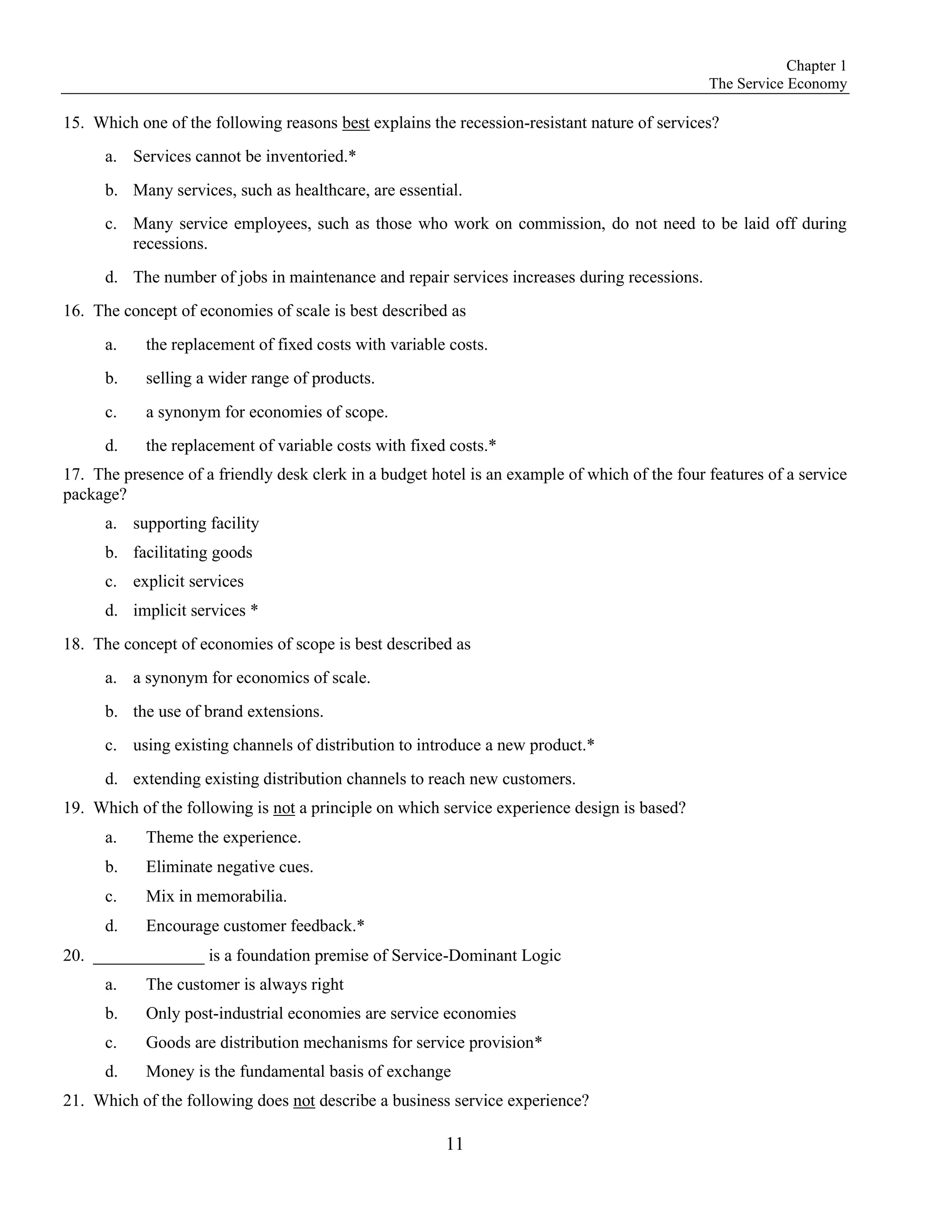
15. Which one of the following reasons best explains the recession-resistant nature of services?
a. Services cannot be inventoried.*
b. Many services, such as healthcare, are essential.
c. Many service employees, such as those who work on commission, do not need to be laid off during
recessions.
d. The number of jobs in maintenance and repair services increases during recessions.
16. The concept of economies of scale is best described as
a. the replacement of fixed costs with variable costs.
b. selling a wider range of products.
c. a synonym for economies of scope.
d. the replacement of variable costs with fixed costs.*
17. The presence of a friendly desk clerk in a budget hotel is an example of which of the four features of a service
package?
a. supporting facility
b. facilitating goods
c. explicit services
d. implicit services *
18. The concept of economies of scope is best described as
a. a synonym for economics of scale.
b. the use of brand extensions.
c. using existing channels of distribution to introduce a new product.*
d. extending existing distribution channels to reach new customers.
19. Which of the following is not a principle on which service experience design is based?
a. Theme the experience.
b. Eliminate negative cues.
c. Mix in memorabilia.
d. Encourage customer feedback.*
20. _____________ is a foundation premise of Service-Dominant Logic
a. The customer is always right
b. Only post-industrial economies are service economies
c. Goods are distribution mechanisms for service provision*
d. Money is the fundamental basis of exchange
21. Which of the following does not describe a business service experience?
15.
Chapter 1
The ServiceEconomy
12
a. themed*
b. co-creation
c. collaboration
d. problem solving
21. The realms of an experience include all but one of the following:
a. Entertainment
b. Education
c. Estheticism
d. Elation*
22. Which one of the following is not a dimension of a business service experience?
a. Co-creation of value
b. Problem solving*
c. Relationships
d. Service capability
23. Which of the following is an example of a business service (B2B)?
a. Communications
b. Auditing*
c. Retailing
d. Leasing
25. In an experience economy the method of supply is
a. revealed over time.*
b. stored in bulk.
c. delivered on demand.
d. inventoried.
Gutenberg” appears, orwith which the phrase “Project
Gutenberg” is associated) is accessed, displayed, performed,
viewed, copied or distributed:
This eBook is for the use of anyone anywhere in
the United States and most other parts of the
world at no cost and with almost no restrictions
whatsoever. You may copy it, give it away or re-
use it under the terms of the Project Gutenberg
License included with this eBook or online at
www.gutenberg.org. If you are not located in the
United States, you will have to check the laws of
the country where you are located before using
this eBook.
1.E.2. If an individual Project Gutenberg™ electronic work is
derived from texts not protected by U.S. copyright law (does not
contain a notice indicating that it is posted with permission of
the copyright holder), the work can be copied and distributed to
anyone in the United States without paying any fees or charges.
If you are redistributing or providing access to a work with the
phrase “Project Gutenberg” associated with or appearing on the
work, you must comply either with the requirements of
paragraphs 1.E.1 through 1.E.7 or obtain permission for the use
of the work and the Project Gutenberg™ trademark as set forth
in paragraphs 1.E.8 or 1.E.9.
1.E.3. If an individual Project Gutenberg™ electronic work is
posted with the permission of the copyright holder, your use and
distribution must comply with both paragraphs 1.E.1 through
1.E.7 and any additional terms imposed by the copyright holder.
Additional terms will be linked to the Project Gutenberg™
License for all works posted with the permission of the copyright
holder found at the beginning of this work.
18.
1.E.4. Do notunlink or detach or remove the full Project
Gutenberg™ License terms from this work, or any files
containing a part of this work or any other work associated with
Project Gutenberg™.
1.E.5. Do not copy, display, perform, distribute or redistribute
this electronic work, or any part of this electronic work, without
prominently displaying the sentence set forth in paragraph 1.E.1
with active links or immediate access to the full terms of the
Project Gutenberg™ License.
1.E.6. You may convert to and distribute this work in any binary,
compressed, marked up, nonproprietary or proprietary form,
including any word processing or hypertext form. However, if
you provide access to or distribute copies of a Project
Gutenberg™ work in a format other than “Plain Vanilla ASCII” or
other format used in the official version posted on the official
Project Gutenberg™ website (www.gutenberg.org), you must,
at no additional cost, fee or expense to the user, provide a copy,
a means of exporting a copy, or a means of obtaining a copy
upon request, of the work in its original “Plain Vanilla ASCII” or
other form. Any alternate format must include the full Project
Gutenberg™ License as specified in paragraph 1.E.1.
1.E.7. Do not charge a fee for access to, viewing, displaying,
performing, copying or distributing any Project Gutenberg™
works unless you comply with paragraph 1.E.8 or 1.E.9.
1.E.8. You may charge a reasonable fee for copies of or
providing access to or distributing Project Gutenberg™
electronic works provided that:
• You pay a royalty fee of 20% of the gross profits you derive
from the use of Project Gutenberg™ works calculated using the
method you already use to calculate your applicable taxes. The
fee is owed to the owner of the Project Gutenberg™ trademark,
19.
but he hasagreed to donate royalties under this paragraph to
the Project Gutenberg Literary Archive Foundation. Royalty
payments must be paid within 60 days following each date on
which you prepare (or are legally required to prepare) your
periodic tax returns. Royalty payments should be clearly marked
as such and sent to the Project Gutenberg Literary Archive
Foundation at the address specified in Section 4, “Information
about donations to the Project Gutenberg Literary Archive
Foundation.”
• You provide a full refund of any money paid by a user who
notifies you in writing (or by e-mail) within 30 days of receipt
that s/he does not agree to the terms of the full Project
Gutenberg™ License. You must require such a user to return or
destroy all copies of the works possessed in a physical medium
and discontinue all use of and all access to other copies of
Project Gutenberg™ works.
• You provide, in accordance with paragraph 1.F.3, a full refund of
any money paid for a work or a replacement copy, if a defect in
the electronic work is discovered and reported to you within 90
days of receipt of the work.
• You comply with all other terms of this agreement for free
distribution of Project Gutenberg™ works.
1.E.9. If you wish to charge a fee or distribute a Project
Gutenberg™ electronic work or group of works on different
terms than are set forth in this agreement, you must obtain
permission in writing from the Project Gutenberg Literary
Archive Foundation, the manager of the Project Gutenberg™
trademark. Contact the Foundation as set forth in Section 3
below.
1.F.
20.
1.F.1. Project Gutenbergvolunteers and employees expend
considerable effort to identify, do copyright research on,
transcribe and proofread works not protected by U.S. copyright
law in creating the Project Gutenberg™ collection. Despite these
efforts, Project Gutenberg™ electronic works, and the medium
on which they may be stored, may contain “Defects,” such as,
but not limited to, incomplete, inaccurate or corrupt data,
transcription errors, a copyright or other intellectual property
infringement, a defective or damaged disk or other medium, a
computer virus, or computer codes that damage or cannot be
read by your equipment.
1.F.2. LIMITED WARRANTY, DISCLAIMER OF DAMAGES - Except
for the “Right of Replacement or Refund” described in
paragraph 1.F.3, the Project Gutenberg Literary Archive
Foundation, the owner of the Project Gutenberg™ trademark,
and any other party distributing a Project Gutenberg™ electronic
work under this agreement, disclaim all liability to you for
damages, costs and expenses, including legal fees. YOU AGREE
THAT YOU HAVE NO REMEDIES FOR NEGLIGENCE, STRICT
LIABILITY, BREACH OF WARRANTY OR BREACH OF CONTRACT
EXCEPT THOSE PROVIDED IN PARAGRAPH 1.F.3. YOU AGREE
THAT THE FOUNDATION, THE TRADEMARK OWNER, AND ANY
DISTRIBUTOR UNDER THIS AGREEMENT WILL NOT BE LIABLE
TO YOU FOR ACTUAL, DIRECT, INDIRECT, CONSEQUENTIAL,
PUNITIVE OR INCIDENTAL DAMAGES EVEN IF YOU GIVE
NOTICE OF THE POSSIBILITY OF SUCH DAMAGE.
1.F.3. LIMITED RIGHT OF REPLACEMENT OR REFUND - If you
discover a defect in this electronic work within 90 days of
receiving it, you can receive a refund of the money (if any) you
paid for it by sending a written explanation to the person you
received the work from. If you received the work on a physical
medium, you must return the medium with your written
explanation. The person or entity that provided you with the
defective work may elect to provide a replacement copy in lieu
21.
of a refund.If you received the work electronically, the person
or entity providing it to you may choose to give you a second
opportunity to receive the work electronically in lieu of a refund.
If the second copy is also defective, you may demand a refund
in writing without further opportunities to fix the problem.
1.F.4. Except for the limited right of replacement or refund set
forth in paragraph 1.F.3, this work is provided to you ‘AS-IS’,
WITH NO OTHER WARRANTIES OF ANY KIND, EXPRESS OR
IMPLIED, INCLUDING BUT NOT LIMITED TO WARRANTIES OF
MERCHANTABILITY OR FITNESS FOR ANY PURPOSE.
1.F.5. Some states do not allow disclaimers of certain implied
warranties or the exclusion or limitation of certain types of
damages. If any disclaimer or limitation set forth in this
agreement violates the law of the state applicable to this
agreement, the agreement shall be interpreted to make the
maximum disclaimer or limitation permitted by the applicable
state law. The invalidity or unenforceability of any provision of
this agreement shall not void the remaining provisions.
1.F.6. INDEMNITY - You agree to indemnify and hold the
Foundation, the trademark owner, any agent or employee of the
Foundation, anyone providing copies of Project Gutenberg™
electronic works in accordance with this agreement, and any
volunteers associated with the production, promotion and
distribution of Project Gutenberg™ electronic works, harmless
from all liability, costs and expenses, including legal fees, that
arise directly or indirectly from any of the following which you
do or cause to occur: (a) distribution of this or any Project
Gutenberg™ work, (b) alteration, modification, or additions or
deletions to any Project Gutenberg™ work, and (c) any Defect
you cause.
22.
Section 2. Informationabout the Mission
of Project Gutenberg™
Project Gutenberg™ is synonymous with the free distribution of
electronic works in formats readable by the widest variety of
computers including obsolete, old, middle-aged and new
computers. It exists because of the efforts of hundreds of
volunteers and donations from people in all walks of life.
Volunteers and financial support to provide volunteers with the
assistance they need are critical to reaching Project
Gutenberg™’s goals and ensuring that the Project Gutenberg™
collection will remain freely available for generations to come. In
2001, the Project Gutenberg Literary Archive Foundation was
created to provide a secure and permanent future for Project
Gutenberg™ and future generations. To learn more about the
Project Gutenberg Literary Archive Foundation and how your
efforts and donations can help, see Sections 3 and 4 and the
Foundation information page at www.gutenberg.org.
Section 3. Information about the Project
Gutenberg Literary Archive Foundation
The Project Gutenberg Literary Archive Foundation is a non-
profit 501(c)(3) educational corporation organized under the
laws of the state of Mississippi and granted tax exempt status
by the Internal Revenue Service. The Foundation’s EIN or
federal tax identification number is 64-6221541. Contributions
to the Project Gutenberg Literary Archive Foundation are tax
deductible to the full extent permitted by U.S. federal laws and
your state’s laws.
The Foundation’s business office is located at 809 North 1500
West, Salt Lake City, UT 84116, (801) 596-1887. Email contact
23.
links and upto date contact information can be found at the
Foundation’s website and official page at
www.gutenberg.org/contact
Section 4. Information about Donations to
the Project Gutenberg Literary Archive
Foundation
Project Gutenberg™ depends upon and cannot survive without
widespread public support and donations to carry out its mission
of increasing the number of public domain and licensed works
that can be freely distributed in machine-readable form
accessible by the widest array of equipment including outdated
equipment. Many small donations ($1 to $5,000) are particularly
important to maintaining tax exempt status with the IRS.
The Foundation is committed to complying with the laws
regulating charities and charitable donations in all 50 states of
the United States. Compliance requirements are not uniform
and it takes a considerable effort, much paperwork and many
fees to meet and keep up with these requirements. We do not
solicit donations in locations where we have not received written
confirmation of compliance. To SEND DONATIONS or determine
the status of compliance for any particular state visit
www.gutenberg.org/donate.
While we cannot and do not solicit contributions from states
where we have not met the solicitation requirements, we know
of no prohibition against accepting unsolicited donations from
donors in such states who approach us with offers to donate.
International donations are gratefully accepted, but we cannot
make any statements concerning tax treatment of donations
received from outside the United States. U.S. laws alone swamp
our small staff.
24.
Please check theProject Gutenberg web pages for current
donation methods and addresses. Donations are accepted in a
number of other ways including checks, online payments and
credit card donations. To donate, please visit:
www.gutenberg.org/donate.
Section 5. General Information About
Project Gutenberg™ electronic works
Professor Michael S. Hart was the originator of the Project
Gutenberg™ concept of a library of electronic works that could
be freely shared with anyone. For forty years, he produced and
distributed Project Gutenberg™ eBooks with only a loose
network of volunteer support.
Project Gutenberg™ eBooks are often created from several
printed editions, all of which are confirmed as not protected by
copyright in the U.S. unless a copyright notice is included. Thus,
we do not necessarily keep eBooks in compliance with any
particular paper edition.
Most people start at our website which has the main PG search
facility: www.gutenberg.org.
This website includes information about Project Gutenberg™,
including how to make donations to the Project Gutenberg
Literary Archive Foundation, how to help produce our new
eBooks, and how to subscribe to our email newsletter to hear
about new eBooks.






![Chapter 1
The Service Economy
6
afternoon and Thursday morning. During peak hours, all mechanics are asked to deal with customers to reduce
customer-waiting time.
Intangibility
Most customers are unable to judge the quality of an automobile repair service and thus, reputation becomes very
important. If Village Volvo did not have such a good reputation, it would be difficult to persuade customers to use
the private garage rather than the dealership. Village Volvo tries to reduce this intangibility by providing customers
with their worn out parts.
Heterogeneity
Village Volvo is a service shop with the capability to handle a variety of auto repair problems. The mechanics treat
each customer's problem individually by explaining to the customer exactly what has occurred and what will
happen.
3. How could Village Volvo manage its back office (i.e., repair operations) like a factory?
After receiving the cars for repair at the beginning of the day, the scheduling of repairs can be planned in accordance
with the availability of the mechanics and the promised delivery times. Thus, the back office can be run much like
a manufacturing job shop. Routine work like brake pad replacement and minor tune-ups can be delegated to
apprentice mechanics in order to achieve cost savings.
4. How can Village Volvo differentiate itself from Volvo dealers?
Dealers have traditionally neglected their service departments because more money was made in the sale of vehicles.
The turnover of dealer mechanics also has been high because good mechanics leave to open their own shops such
as Village Volvo. The appeal of the independent mechanic is the personal relationship and trust that develops
between vehicle owner and mechanic. The Custom Care Vehicle Dossier is a method that Village Volvo uses to
establish the customer's loyalty.
CASE 1.2: XPRESSO LUBE
[Students Robert Ferrell, Greg Miller, Neil Orman, and Trent Reynolds prepared this analysis.]
1. Describe Xpresso Lube’s service package?
• Supporting facility: Xpresso Lube has a fixed amount of operational capacity because it has a limited
number of service lifts – two to be exact. Other components of its supporting facility are tools and
equipment, an equipment storage area, a spacious waiting room, chairs, a service counter, street access and
parking.
• Facilitating goods: oil, filters, auto parts, coffee, snacks, cups, napkins, sugar, and milk.
• Information: for regular customers a reminder card could be sent for routine maintenance.
• Explicit services: a car with new oil and filter, maintenance checks of the car, and a cup of coffee.](https://image.slidesharecdn.com/14736-250224012917-fcdc4d36/75/Solution-Manual-for-Service-Management-9th-by-Bordoloi-9-2048.jpg)