Solution Manual for Macroeconomics for Today, 9th
Edition download pdf
http://testbankbell.com/product/solution-manual-for-macroeconomics-for-
today-9th-edition/
Visit testbankbell.com today to download the complete set of
test banks or solution manuals!
We have selected some products that you may be interested in
Click the link to download now or visit testbankbell.com
for more options!.
Solution Manual for Macroeconomics for Today, 9th Edition
Irvin B. Tucker
http://testbankbell.com/product/solution-manual-for-macroeconomics-
for-today-9th-edition-irvin-b-tucker/
Test Bank for Macroeconomics for Today, 9th Edition
http://testbankbell.com/product/test-bank-for-macroeconomics-for-
today-9th-edition/
Solution Manual for Macroeconomics for Today, 10th
Edition, Irvin B. Tucker
http://testbankbell.com/product/solution-manual-for-macroeconomics-
for-today-10th-edition-irvin-b-tucker/
Solution Manual for Oracle 12c: SQL 3rd Edition Casteel
http://testbankbell.com/product/solution-manual-for-
oracle-12c-sql-3rd-edition-casteel/
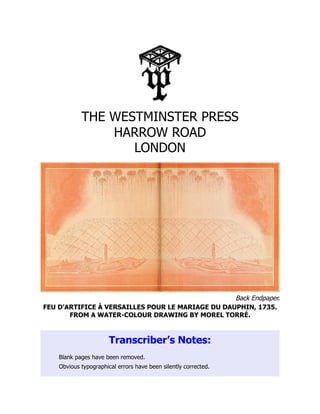
Test Bank for Math and Dosage Calculations for Healthcare
Professionals 5th Edition by Booth
http://testbankbell.com/product/test-bank-for-math-and-dosage-
calculations-for-healthcare-professionals-5th-edition-by-booth/
Algebra and Trigonometry 4th Edition Stewart Solutions
Manual
http://testbankbell.com/product/algebra-and-trigonometry-4th-edition-
stewart-solutions-manual/
Test Bank for Case Studies in Abnormal Psychology, 10th
Edition by Oltmanns, Martin, Neale, Davison
http://testbankbell.com/product/test-bank-for-case-studies-in-
abnormal-psychology-10th-edition-by-oltmanns-martin-neale-davison/
Test Bank for Adult Development and Aging, 6th Edition:
Cavanaugh
http://testbankbell.com/product/test-bank-for-adult-development-and-
aging-6th-edition-cavanaugh/
College Algebra in Context 5th Edition Harshbarger Test
Bank
http://testbankbell.com/product/college-algebra-in-context-5th-
edition-harshbarger-test-bank/
Test Bank for Organizational Behavior A Practical Problem
Solving Approach 2nd Edition By Kinicki
http://testbankbell.com/product/test-bank-for-organizational-behavior-
a-practical-problem-solving-approach-2nd-edition-by-kinicki/
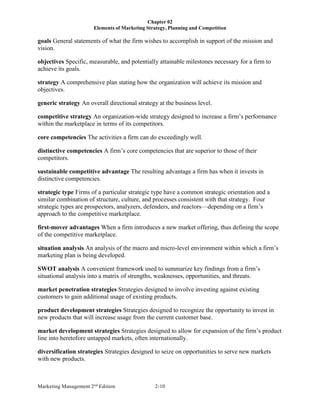
Chapter 02
Elements of Marketing Strategy, Planning and Competition
Marketing Management 2nd
Edition 2-1
Marketing Management 2nd Edition
Marshall Solutions Manual
Full download chapter at: https://testbankbell.com/product/solution-manual-for-
macroeconomics-for-today-9th-edition/
LEARNING OBJECTIVES
LO 2-1 Examine the concept of value and the elements and role of the value chain.
LO 2-2 Understand the conditions required for successful marketing planning, that marketing
planning is focused on the value proposition, and that marketing planning is a dynamic
process.
LO 2-3 Identify various types of organizational strategies.
LO 2-4 Conduct a situation analysis.
LO 2-5 Use the framework provided for marketing planning, along with the content in future
chapters, to build a marketing plan.
CHAPTER OUTLINE
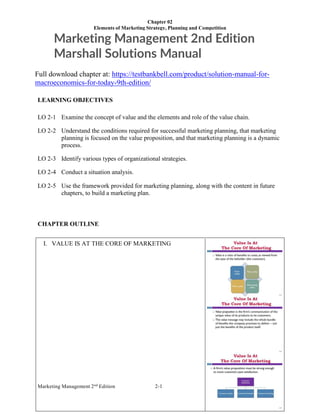
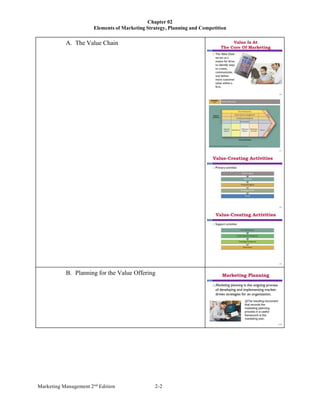
I. VALUE IS AT THE CORE OF MARKETING
Chapter 02
Elements of Marketing Strategy, Planning and Competition
Marketing Management 2nd
Edition 2-2
A. The Value Chain
B. Planning for the Value Offering
Chapter 02
Elements of Marketing Strategy, Planning and Competition
Marketing Management 2nd
Edition 2-3
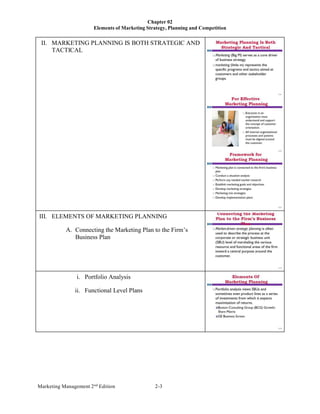
II. MARKETING PLANNING IS BOTH STRATEGIC AND
TACTICAL
III. ELEMENTS OF MARKETING PLANNING
A. Connecting the Marketing Plan to the Firm’s
Business Plan
i. Portfolio Analysis
ii. Functional Level Plans
Chapter 02
Elements of Marketing Strategy, Planning and Competition
Marketing Management 2nd
Edition 2-4
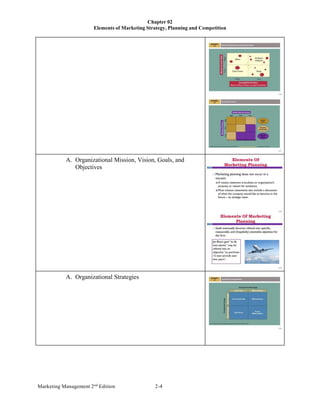
A. Organizational Mission, Vision, Goals, and
Objectives
A. Organizational Strategies
Chapter 02
Elements of Marketing Strategy, Planning and Competition
Marketing Management 2nd
Edition 2-5
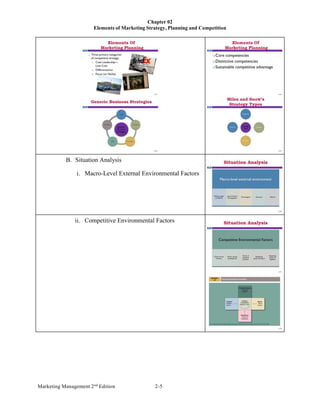
B. Situation Analysis
i. Macro-Level External Environmental Factors
ii. Competitive Environmental Factors
Chapter 02
Elements of Marketing Strategy, Planning and Competition
Marketing Management 2nd
Edition 2-6
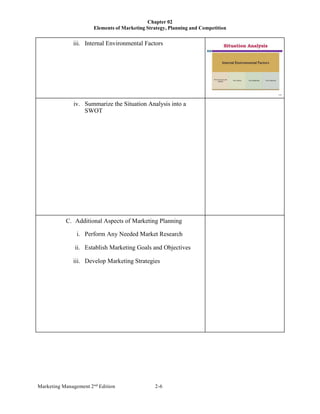
iii. Internal Environmental Factors
iv. Summarize the Situation Analysis into a
SWOT
C. Additional Aspects of Marketing Planning
i. Perform Any Needed Market Research
ii. Establish Marketing Goals and Objectives
iii. Develop Marketing Strategies
Chapter 02
Elements of Marketing Strategy, Planning and Competition
Marketing Management 2nd
Edition 2-7
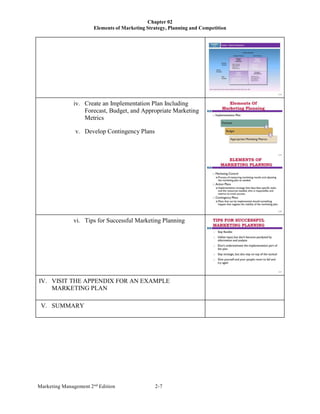
iv. Create an Implementation Plan Including
Forecast, Budget, and Appropriate Marketing
Metrics
v. Develop Contingency Plans
vi. Tips for Successful Marketing Planning
IV. VISIT THE APPENDIX FOR AN EXAMPLE
MARKETING PLAN
V. SUMMARY
Chapter 02
Elements of Marketing Strategy, Planning and Competition
Marketing Management 2nd
Edition 2-8
ETHICAL DIMENSION 2
Ethical Perspective
1. Senior Management: How should senior management incorporate ethical standards at all
stages of the marketing planning process?
Ethical standards should be included into the formality of the marketing planning process.
This means that firms must develop an acceptable ethical code of conduct that is pervasive
throughout the organization.
2. Marketing Managers: A company’s brands can be quickly impacted by negative publicity
surrounding ethical scandals. How might they be impacted and what might a marketing
manager do to reestablish a brand damaged in this way?
Firms can benefit from the following: take responsibility, fire or punish those responsible,
admit your errors, address policy and business practice changes, and promote the changes
about the firm to the marketplace.
3. The Public: Company image and trust can be regained by a CEO’s quick public
acknowledgment of an ethics problem accompanied by plans for changes in practice. What
could HP’s CEO have done better?
One of the things that could have help with the scandal would have been a faster response by
the CEO in the intervention, once the story became a headline in the media.
KEY TERMS
benefits The advantageous outcome from the advantage found in a product feature.
utility The want-satisfying power of a good or service. There are four types of utility: form
utility, time utility, place utility, and ownership utility.
value proposition The whole bundle of benefits a company promises to deliver to the customer,
not just the benefits of the product itself.
customer satisfaction The level of liking an individual harbors for an offering.
customer loyalty A customer’s commitment to a company and its products and brands for the
long run.
Chapter 02
Elements of Marketing Strategy, Planning and Competition
Marketing Management 2nd
Edition 2-9
customer retention Low propensity among a firm’s customer base to consider switching to
other providers.
value chain The synthesis of activities within a firm involved in designing, producing,
marketing, delivering, and supporting its products or services.
value-creating activities Activities within a firm’s value chain that act to increase the value of
its products and services for its customers. These can take the form of either primary activities
or support activities.
marketing planning The ongoing process of developing and implementing market-driven
strategies for an organization.
marketing plan The resulting document that records the marketing planning process in a useful
framework.
market-driven strategic planning The process at the corporate or strategic business unit (SBU)
level of a firm that acts to marshal the various resource and functional areas toward a central
purpose around the customer.
corporate-level strategic plan An umbrella plan for the overall direction of the corporation
developed above the strategic business unit (SBU) level.
SBU-level strategic plan Planning that occurs within each of the firm’s strategic business units
(SBUs) designed to meet individual performance requirements and contribute satisfactorily to
the overall corporate plan.
portfolio analysis A tool used in strategic planning for multibusiness corporations that views
SBUs, and sometimes even product lines, as a series of investments from which it expects
maximization of returns.
Boston Consulting Group (BCG) Growth-Share Matrix A popular approach for in-firm
portfolio analysis that categorizes business units’ level of contribution to the overall firm based
on two factors: market growth rate and competitive position.
GE business screen A popular approach for in-firm portfolio analysis that categorizes business
units’ level of contribution to the overall firm based on two factors: business position and market
attractiveness.
functional-level plans Plans for each business function that makes up one of the firm’s strategic
business units (SBUs). These include core business functions within each SBU such as
operations, marketing, finance, as well as other pertinent operational areas.
mission statement The verbal articulation of an organization’s purpose, or reason for existence.
strategic vision Often included within a firm’s mission statement, it is a discussion of what the
company would like to become in the future.
Chapter 02
Elements of Marketing Strategy, Planning and Competition
Marketing Management 2nd
Edition 2-10
goals General statements of what the firm wishes to accomplish in support of the mission and
vision.
objectives Specific, measurable, and potentially attainable milestones necessary for a firm to
achieve its goals.
strategy A comprehensive plan stating how the organization will achieve its mission and
objectives.
generic strategy An overall directional strategy at the business level.
competitive strategy An organization-wide strategy designed to increase a firm’s performance
within the marketplace in terms of its competitors.
core competencies The activities a firm can do exceedingly well.
distinctive competencies A firm’s core competencies that are superior to those of their
competitors.
sustainable competitive advantage The resulting advantage a firm has when it invests in
distinctive competencies.
strategic type Firms of a particular strategic type have a common strategic orientation and a
similar combination of structure, culture, and processes consistent with that strategy. Four
strategic types are prospectors, analyzers, defenders, and reactors—depending on a firm’s
approach to the competitive marketplace.
first-mover advantages When a firm introduces a new market offering, thus defining the scope
of the competitive marketplace.
situation analysis An analysis of the macro and micro-level environment within which a firm’s
marketing plan is being developed.
SWOT analysis A convenient framework used to summarize key findings from a firm’s
situational analysis into a matrix of strengths, weaknesses, opportunities, and threats.
market penetration strategies Strategies designed to involve investing against existing
customers to gain additional usage of existing products.
product development strategies Strategies designed to recognize the opportunity to invest in
new products that will increase usage from the current customer base.
market development strategies Strategies designed to allow for expansion of the firm’s product
line into heretofore untapped markets, often internationally.
diversification strategies Strategies designed to seize on opportunities to serve new markets
with new products.
Chapter 02
Elements of Marketing Strategy, Planning and Competition
Marketing Management 2nd
Edition 2-11
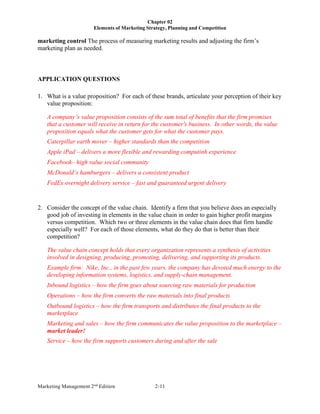
marketing control The process of measuring marketing results and adjusting the firm’s
marketing plan as needed.
APPLICATION QUESTIONS
1. What is a value proposition? For each of these brands, articulate your perception of their key
value proposition:
A company’s value proposition consists of the sum total of benefits that the firm promises
that a customer will receive in return for the customer's business. In other words, the value
proposition equals what the customer gets for what the customer pays.
Caterpillar earth mover – higher standards than the competition
Apple iPad – delivers a more flexible and rewarding computinh experience
Facebook– high value social community
McDonald’s hamburgers – delivers a consistent product
FedEx overnight delivery service – fast and guaranteed urgent delivery
2. Consider the concept of the value chain. Identify a firm that you believe does an especially
good job of investing in elements in the value chain in order to gain higher profit margins
versus competition. Which two or three elements in the value chain does that firm handle
especially well? For each of those elements, what do they do that is better than their
competition?
The value chain concept holds that every organization represents a synthesis of activities
involved in designing, producing, promoting, delivering, and supporting its products.
Example firm: Nike, Inc., in the past few years, the company has devoted much energy to the
developing information systems, logistics, and supply-chain management.
Inbound logistics – how the firm goes about sourcing raw materials for production
Operations – how the firm converts the raw materials into final products
Outbound logistics – how the firm transports and distributes the final products to the
marketplace
Marketing and sales – how the firm communicates the value proposition to the marketplace –
market leader!
Service – how the firm supports customers during and after the sale
Chapter 02
Elements of Marketing Strategy, Planning and Competition
Marketing Management 2nd
Edition 2-12
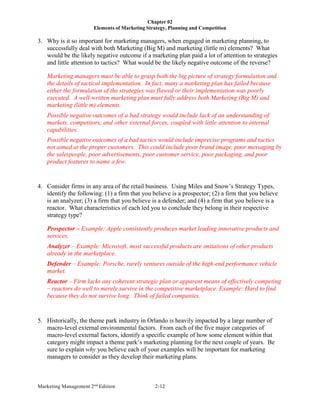
3. Why is it so important for marketing managers, when engaged in marketing planning, to
successfully deal with both Marketing (Big M) and marketing (little m) elements? What
would be the likely negative outcome if a marketing plan paid a lot of attention to strategies
and little attention to tactics? What would be the likely negative outcome of the reverse?
Marketing managers must be able to grasp both the big picture of strategy formulation and
the details of tactical implementation. In fact, many a marketing plan has failed because
either the formulation of the strategies was flawed or their implementation was poorly
executed. A well-written marketing plan must fully address both Marketing (Big M) and
marketing (little m) elements.
Possible negative outcomes of a bad strategy would include lack of an understanding of
markets, competitors, and other external forces, coupled with little attention to internal
capabilities.
Possible negative outcomes of a bad tactics would include imprecise programs and tactics
not aimed at the proper customers. This could include poor brand image, poor messaging by
the salespeople, poor advertisements, poor customer service, poor packaging, and poor
product features to name a few.
4. Consider firms in any area of the retail business. Using Miles and Snow’s Strategy Types,
identify the following: (1) a firm that you believe is a prospector; (2) a firm that you believe
is an analyzer; (3) a firm that you believe is a defender; and (4) a firm that you believe is a
reactor. What characteristics of each led you to conclude they belong in their respective
strategy type?
Prospector – Example: Apple consistently produces market leading innovative products and
services.
Analyzer – Example: Microsoft, most successful products are imitations of other products
already in the marketplace.
Defender – Example: Porsche, rarely ventures outside of the high-end performance vehicle
market.
Reactor – Firm lacks any coherent strategic plan or apparent means of effectively competing
– reactors do well to merely survive in the competitive marketplace. Example: Hard to find
because they do not survive long. Think of failed companies.
5. Historically, the theme park industry in Orlando is heavily impacted by a large number of
macro-level external environmental factors. From each of the five major categories of
macro-level external factors, identify a specific example of how some element within that
category might impact a theme park’s marketing planning for the next couple of years. Be
sure to explain why you believe each of your examples will be important for marketing
managers to consider as they develop their marketing plans.
Chapter 02
Elements of Marketing Strategy, Planning and Competition
Marketing Management 2nd
Edition 2-13
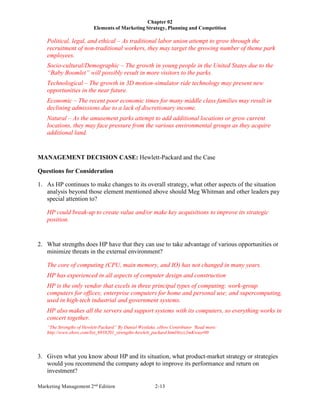
Political, legal, and ethical – As traditional labor union attempt to grow through the
recruitment of non-traditional workers, they may target the growing number of theme park
employees.
Socio-cultural/Demographic – The growth in young people in the United States due to the
“Baby Boomlet” will possibly result in more visitors to the parks.
Technological – The growth in 3D motion-simulator ride technology may present new
opportunities in the near future.
Economic – The recent poor economic times for many middle class families may result in
declining admissions due to a lack of discretionary income.
Natural – As the amusement parks attempt to add additional locations or grow current
locations, they may face pressure from the various environmental groups as they acquire
additional land.
MANAGEMENT DECISION CASE: Hewlett-Packard and the Case
Questions for Consideration
1. As HP continues to make changes to its overall strategy, what other aspects of the situation
analysis beyond those element mentioned above should Meg Whitman and other leaders pay
special attention to?
HP could break-up to create value and/or make key acquisitions to improve its strategic
position.
2. What strengths does HP have that they can use to take advantage of various opportunities or
minimize threats in the external environment?
The core of computing (CPU, main memory, and IO) has not changed in many years.
HP has experienced in all aspects of computer design and construction
HP is the only vendor that excels in three principal types of computing: work-group
computers for offices; enterprise computers for home and personal use; and supercomputing,
used in high-tech industrial and government systems.
HP also makes all the servers and support systems with its computers, so everything works in
concert together.
“The Strengths of Hewlett-Packard” By Daniel Westlake, eHow Contributor ‘Read more:
http://www.ehow.com/list_6938201_strengths-hewlett_packard.html#ixzz2mKwuyr00
3. Given what you know about HP and its situation, what product-market strategy or strategies
would you recommend the company adopt to improve its performance and return on
investment?
Chapter 02
Elements of Marketing Strategy, Planning and Competition
Marketing Management 2nd
Edition 2-14
Student answers will vary.
SUGGESTED VIDEO
BP: Transforming its Strategy "Beyond Petroleum" (7:52 minutes)
Description: Senior Vice President of BP Global Brand and Marketing & Innovation speaks on
one of their Brand Values "going green" and having a lower impact on the environment by
designing an innovative gas station and apply to their other 25,000 sites.
1. Are people more likely to purchase gas from BP because of its commitment to the
environment?
Notwithstanding tis environmental efforts, BP is still under pressure to create value for its
customers. Some customers will welcome the "going green" commitment and reward BP.
However, some customers while applauding the company will still not buy if the things they
value more are not there.
2. In light of the recent crisis in the Gulf of Mexico, how does BP convince the public that they
are sincere about caring about the environment?
BP has an uphill battle in this matter. BP needs not only to perform the activities to
demonstrate its sincerity, the company will also need to have the patience to give the market
time to adjust.
Random documents with unrelated
content Scribd suggests to you:
Turning cases, 97, 126
Tyrrel, 43
Ufano, Diego, 20
United States, 175
“Universal Magazine, The,” 99
Vanochio, 18
Vauxhall, 33
Vengagvedi, 10
Versailles, 20, 21, 24, 43, 132
Vert de gris, 129
Vertical wheels, 121, 131
Very signal lights, 164, 171, 172
Vesuvius, 50
Victoria Park, 43
„ Queen, Coronation of, 41
„ „ Portrait of, 51
„ „ Visit to Paris Exhibition, 43
Vienna, 23
“Village Blacksmith, The,” 52
Volcano, 9
Wadd, 103
Walcheren Expedition, 160
Wallis, Admiral Sir Provo, 49
Walpole, 29, 30
War inventions, 165
„ rockets, 158, 159
Warman, 34
Warsaw, 162
Warwick, Earl of, 18
Water fireworks, 24, 28, 39, 101
Waterloo, 160
“Weekly Journal, Read’s,” 157
Weinerisch-Neustadt, 161
Wheel, block, 118
„ brilliant, 30
„ catherine, 118, 119
„ double triangle, 131
„ hundred-feet, 55
„ pin, 118
„ rocket, 122
„ saxon, 131
Wheels, 41, 121, 131
„ fire, 122
„ horizontal, 26, 121, 133
„ revolving, 44
„ triangle, 131
„ vertical, 26, 121, 131
Whistler, 96
White Conduit House, 37
White Star Line, 174
Whitehall, 27, 28
Wicks, Major, 172
Wild fire, 16
William IV, Coronation of, 41
Windmills, 131
Woolwich Arsenal, 43
„ Royal Laboratory, 159
Worcester Cathedral, 50
Wordsworth, 40
Yalu, Battle of the, 49
Yellow orpiment smoke, 172
Yorkshire Stingo Gardens, 37
Ypres display, 21
Yron scales, 96
Zinc, 142, 146
Zud-Amerika Lyn, 173
Back Endpaper.
THE WESTMINSTER PRESS
HARROW ROAD
LONDON
FEU D’ARTIFICE À VERSAILLES POUR LE MARIAGE DU DAUPHIN, 1735.
FROM A WATER-COLOUR DRAWING BY MOREL TORRÉ.
Transcriber’s Notes:
Blank pages have been removed.
Obvious typographical errors have been silently corrected.
All errata have been applied.
*** END OF THE PROJECT GUTENBERG EBOOK PYROTECHNICS:
THE HISTORY AND ART OF FIREWORK MAKING ***
Updated editions will replace the previous one—the old editions
will be renamed.
Creating the works from print editions not protected by U.S.
copyright law means that no one owns a United States
copyright in these works, so the Foundation (and you!) can copy
and distribute it in the United States without permission and
without paying copyright royalties. Special rules, set forth in the
General Terms of Use part of this license, apply to copying and
distributing Project Gutenberg™ electronic works to protect the
PROJECT GUTENBERG™ concept and trademark. Project
Gutenberg is a registered trademark, and may not be used if
you charge for an eBook, except by following the terms of the
trademark license, including paying royalties for use of the
Project Gutenberg trademark. If you do not charge anything for
copies of this eBook, complying with the trademark license is
very easy. You may use this eBook for nearly any purpose such
as creation of derivative works, reports, performances and
research. Project Gutenberg eBooks may be modified and
printed and given away—you may do practically ANYTHING in
the United States with eBooks not protected by U.S. copyright
law. Redistribution is subject to the trademark license, especially
commercial redistribution.
START: FULL LICENSE
THE FULL PROJECT GUTENBERG LICENSE
PLEASE READ THIS BEFORE YOU DISTRIBUTE OR USE THIS WORK
To protect the Project Gutenberg™ mission of promoting the
free distribution of electronic works, by using or distributing this
work (or any other work associated in any way with the phrase
“Project Gutenberg”), you agree to comply with all the terms of
the Full Project Gutenberg™ License available with this file or
online at www.gutenberg.org/license.
Section 1. General Terms of Use and
Redistributing Project Gutenberg™
electronic works
1.A. By reading or using any part of this Project Gutenberg™
electronic work, you indicate that you have read, understand,
agree to and accept all the terms of this license and intellectual
property (trademark/copyright) agreement. If you do not agree
to abide by all the terms of this agreement, you must cease
using and return or destroy all copies of Project Gutenberg™
electronic works in your possession. If you paid a fee for
obtaining a copy of or access to a Project Gutenberg™
electronic work and you do not agree to be bound by the terms
of this agreement, you may obtain a refund from the person or
entity to whom you paid the fee as set forth in paragraph 1.E.8.
1.B. “Project Gutenberg” is a registered trademark. It may only
be used on or associated in any way with an electronic work by
people who agree to be bound by the terms of this agreement.
There are a few things that you can do with most Project
Gutenberg™ electronic works even without complying with the
full terms of this agreement. See paragraph 1.C below. There
are a lot of things you can do with Project Gutenberg™
electronic works if you follow the terms of this agreement and
help preserve free future access to Project Gutenberg™
electronic works. See paragraph 1.E below.
1.C. The Project Gutenberg Literary Archive Foundation (“the
Foundation” or PGLAF), owns a compilation copyright in the
collection of Project Gutenberg™ electronic works. Nearly all the
individual works in the collection are in the public domain in the
United States. If an individual work is unprotected by copyright
law in the United States and you are located in the United
States, we do not claim a right to prevent you from copying,
distributing, performing, displaying or creating derivative works
based on the work as long as all references to Project
Gutenberg are removed. Of course, we hope that you will
support the Project Gutenberg™ mission of promoting free
access to electronic works by freely sharing Project Gutenberg™
works in compliance with the terms of this agreement for
keeping the Project Gutenberg™ name associated with the
work. You can easily comply with the terms of this agreement
by keeping this work in the same format with its attached full
Project Gutenberg™ License when you share it without charge
with others.
1.D. The copyright laws of the place where you are located also
govern what you can do with this work. Copyright laws in most
countries are in a constant state of change. If you are outside
the United States, check the laws of your country in addition to
the terms of this agreement before downloading, copying,
displaying, performing, distributing or creating derivative works
based on this work or any other Project Gutenberg™ work. The
Foundation makes no representations concerning the copyright
status of any work in any country other than the United States.
1.E. Unless you have removed all references to Project
Gutenberg:
1.E.1. The following sentence, with active links to, or other
immediate access to, the full Project Gutenberg™ License must
appear prominently whenever any copy of a Project
Gutenberg™ work (any work on which the phrase “Project
Gutenberg” appears, or with which the phrase “Project
Gutenberg” is associated) is accessed, displayed, performed,
viewed, copied or distributed:
This eBook is for the use of anyone anywhere in the United
States and most other parts of the world at no cost and
with almost no restrictions whatsoever. You may copy it,
give it away or re-use it under the terms of the Project
Gutenberg License included with this eBook or online at
www.gutenberg.org. If you are not located in the United
States, you will have to check the laws of the country
where you are located before using this eBook.
1.E.2. If an individual Project Gutenberg™ electronic work is
derived from texts not protected by U.S. copyright law (does not
contain a notice indicating that it is posted with permission of
the copyright holder), the work can be copied and distributed to
anyone in the United States without paying any fees or charges.
If you are redistributing or providing access to a work with the
phrase “Project Gutenberg” associated with or appearing on the
work, you must comply either with the requirements of
paragraphs 1.E.1 through 1.E.7 or obtain permission for the use
of the work and the Project Gutenberg™ trademark as set forth
in paragraphs 1.E.8 or 1.E.9.
1.E.3. If an individual Project Gutenberg™ electronic work is
posted with the permission of the copyright holder, your use and
distribution must comply with both paragraphs 1.E.1 through
1.E.7 and any additional terms imposed by the copyright holder.
Additional terms will be linked to the Project Gutenberg™
License for all works posted with the permission of the copyright
holder found at the beginning of this work.
1.E.4. Do not unlink or detach or remove the full Project
Gutenberg™ License terms from this work, or any files
containing a part of this work or any other work associated with
Project Gutenberg™.
1.E.5. Do not copy, display, perform, distribute or redistribute
this electronic work, or any part of this electronic work, without
prominently displaying the sentence set forth in paragraph 1.E.1
with active links or immediate access to the full terms of the
Project Gutenberg™ License.
1.E.6. You may convert to and distribute this work in any binary,
compressed, marked up, nonproprietary or proprietary form,
including any word processing or hypertext form. However, if
you provide access to or distribute copies of a Project
Gutenberg™ work in a format other than “Plain Vanilla ASCII” or
other format used in the official version posted on the official
Project Gutenberg™ website (www.gutenberg.org), you must,
at no additional cost, fee or expense to the user, provide a copy,
a means of exporting a copy, or a means of obtaining a copy
upon request, of the work in its original “Plain Vanilla ASCII” or
other form. Any alternate format must include the full Project
Gutenberg™ License as specified in paragraph 1.E.1.
1.E.7. Do not charge a fee for access to, viewing, displaying,
performing, copying or distributing any Project Gutenberg™
works unless you comply with paragraph 1.E.8 or 1.E.9.
1.E.8. You may charge a reasonable fee for copies of or
providing access to or distributing Project Gutenberg™
electronic works provided that:
• You pay a royalty fee of 20% of the gross profits you derive
from the use of Project Gutenberg™ works calculated using the
method you already use to calculate your applicable taxes. The
fee is owed to the owner of the Project Gutenberg™ trademark,
but he has agreed to donate royalties under this paragraph to
the Project Gutenberg Literary Archive Foundation. Royalty
payments must be paid within 60 days following each date on
which you prepare (or are legally required to prepare) your
periodic tax returns. Royalty payments should be clearly marked
as such and sent to the Project Gutenberg Literary Archive
Foundation at the address specified in Section 4, “Information
about donations to the Project Gutenberg Literary Archive
Foundation.”
• You provide a full refund of any money paid by a user who
notifies you in writing (or by e-mail) within 30 days of receipt
that s/he does not agree to the terms of the full Project
Gutenberg™ License. You must require such a user to return or
destroy all copies of the works possessed in a physical medium
and discontinue all use of and all access to other copies of
Project Gutenberg™ works.
• You provide, in accordance with paragraph 1.F.3, a full refund of
any money paid for a work or a replacement copy, if a defect in
the electronic work is discovered and reported to you within 90
days of receipt of the work.
• You comply with all other terms of this agreement for free
distribution of Project Gutenberg™ works.
1.E.9. If you wish to charge a fee or distribute a Project
Gutenberg™ electronic work or group of works on different
terms than are set forth in this agreement, you must obtain
permission in writing from the Project Gutenberg Literary
Archive Foundation, the manager of the Project Gutenberg™
trademark. Contact the Foundation as set forth in Section 3
below.
1.F.
1.F.1. Project Gutenberg volunteers and employees expend
considerable effort to identify, do copyright research on,
transcribe and proofread works not protected by U.S. copyright
law in creating the Project Gutenberg™ collection. Despite these
efforts, Project Gutenberg™ electronic works, and the medium
on which they may be stored, may contain “Defects,” such as,
but not limited to, incomplete, inaccurate or corrupt data,
transcription errors, a copyright or other intellectual property
infringement, a defective or damaged disk or other medium, a
computer virus, or computer codes that damage or cannot be
read by your equipment.
1.F.2. LIMITED WARRANTY, DISCLAIMER OF DAMAGES - Except
for the “Right of Replacement or Refund” described in
paragraph 1.F.3, the Project Gutenberg Literary Archive
Foundation, the owner of the Project Gutenberg™ trademark,
and any other party distributing a Project Gutenberg™ electronic
work under this agreement, disclaim all liability to you for
damages, costs and expenses, including legal fees. YOU AGREE
THAT YOU HAVE NO REMEDIES FOR NEGLIGENCE, STRICT
LIABILITY, BREACH OF WARRANTY OR BREACH OF CONTRACT
EXCEPT THOSE PROVIDED IN PARAGRAPH 1.F.3. YOU AGREE
THAT THE FOUNDATION, THE TRADEMARK OWNER, AND ANY
DISTRIBUTOR UNDER THIS AGREEMENT WILL NOT BE LIABLE
TO YOU FOR ACTUAL, DIRECT, INDIRECT, CONSEQUENTIAL,
PUNITIVE OR INCIDENTAL DAMAGES EVEN IF YOU GIVE
NOTICE OF THE POSSIBILITY OF SUCH DAMAGE.
1.F.3. LIMITED RIGHT OF REPLACEMENT OR REFUND - If you
discover a defect in this electronic work within 90 days of
receiving it, you can receive a refund of the money (if any) you
paid for it by sending a written explanation to the person you
received the work from. If you received the work on a physical
medium, you must return the medium with your written
explanation. The person or entity that provided you with the
defective work may elect to provide a replacement copy in lieu
of a refund. If you received the work electronically, the person
or entity providing it to you may choose to give you a second
opportunity to receive the work electronically in lieu of a refund.
If the second copy is also defective, you may demand a refund
in writing without further opportunities to fix the problem.
1.F.4. Except for the limited right of replacement or refund set
forth in paragraph 1.F.3, this work is provided to you ‘AS-IS’,
WITH NO OTHER WARRANTIES OF ANY KIND, EXPRESS OR
IMPLIED, INCLUDING BUT NOT LIMITED TO WARRANTIES OF
MERCHANTABILITY OR FITNESS FOR ANY PURPOSE.
1.F.5. Some states do not allow disclaimers of certain implied
warranties or the exclusion or limitation of certain types of
damages. If any disclaimer or limitation set forth in this
agreement violates the law of the state applicable to this
agreement, the agreement shall be interpreted to make the
maximum disclaimer or limitation permitted by the applicable
state law. The invalidity or unenforceability of any provision of
this agreement shall not void the remaining provisions.
1.F.6. INDEMNITY - You agree to indemnify and hold the
Foundation, the trademark owner, any agent or employee of the
Foundation, anyone providing copies of Project Gutenberg™
electronic works in accordance with this agreement, and any
volunteers associated with the production, promotion and
distribution of Project Gutenberg™ electronic works, harmless
from all liability, costs and expenses, including legal fees, that
arise directly or indirectly from any of the following which you
do or cause to occur: (a) distribution of this or any Project
Gutenberg™ work, (b) alteration, modification, or additions or
deletions to any Project Gutenberg™ work, and (c) any Defect
you cause.
Section 2. Information about the Mission
of Project Gutenberg™
Project Gutenberg™ is synonymous with the free distribution of
electronic works in formats readable by the widest variety of
computers including obsolete, old, middle-aged and new
computers. It exists because of the efforts of hundreds of
volunteers and donations from people in all walks of life.
Volunteers and financial support to provide volunteers with the
assistance they need are critical to reaching Project
Gutenberg™’s goals and ensuring that the Project Gutenberg™
collection will remain freely available for generations to come. In
2001, the Project Gutenberg Literary Archive Foundation was
created to provide a secure and permanent future for Project
Gutenberg™ and future generations. To learn more about the
Project Gutenberg Literary Archive Foundation and how your
efforts and donations can help, see Sections 3 and 4 and the
Foundation information page at www.gutenberg.org.
Section 3. Information about the Project
Gutenberg Literary Archive Foundation
The Project Gutenberg Literary Archive Foundation is a non-
profit 501(c)(3) educational corporation organized under the
laws of the state of Mississippi and granted tax exempt status
by the Internal Revenue Service. The Foundation’s EIN or
federal tax identification number is 64-6221541. Contributions
to the Project Gutenberg Literary Archive Foundation are tax
deductible to the full extent permitted by U.S. federal laws and
your state’s laws.
The Foundation’s business office is located at 809 North 1500
West, Salt Lake City, UT 84116, (801) 596-1887. Email contact
links and up to date contact information can be found at the
Foundation’s website and official page at
www.gutenberg.org/contact
Section 4. Information about Donations to
the Project Gutenberg Literary Archive
Foundation
Project Gutenberg™ depends upon and cannot survive without
widespread public support and donations to carry out its mission
of increasing the number of public domain and licensed works
that can be freely distributed in machine-readable form
accessible by the widest array of equipment including outdated
equipment. Many small donations ($1 to $5,000) are particularly
important to maintaining tax exempt status with the IRS.
The Foundation is committed to complying with the laws
regulating charities and charitable donations in all 50 states of
the United States. Compliance requirements are not uniform
and it takes a considerable effort, much paperwork and many
fees to meet and keep up with these requirements. We do not
solicit donations in locations where we have not received written
confirmation of compliance. To SEND DONATIONS or determine
the status of compliance for any particular state visit
www.gutenberg.org/donate.
While we cannot and do not solicit contributions from states
where we have not met the solicitation requirements, we know
of no prohibition against accepting unsolicited donations from
donors in such states who approach us with offers to donate.
International donations are gratefully accepted, but we cannot
make any statements concerning tax treatment of donations
received from outside the United States. U.S. laws alone swamp
our small staff.
Please check the Project Gutenberg web pages for current
donation methods and addresses. Donations are accepted in a
number of other ways including checks, online payments and
credit card donations. To donate, please visit:
www.gutenberg.org/donate.
Section 5. General Information About
Project Gutenberg™ electronic works
Professor Michael S. Hart was the originator of the Project
Gutenberg™ concept of a library of electronic works that could
be freely shared with anyone. For forty years, he produced and
distributed Project Gutenberg™ eBooks with only a loose
network of volunteer support.
Project Gutenberg™ eBooks are often created from several
printed editions, all of which are confirmed as not protected by
copyright in the U.S. unless a copyright notice is included. Thus,
we do not necessarily keep eBooks in compliance with any
particular paper edition.
Most people start at our website which has the main PG search
facility: www.gutenberg.org.
This website includes information about Project Gutenberg™,
including how to make donations to the Project Gutenberg
Literary Archive Foundation, how to help produce our new
eBooks, and how to subscribe to our email newsletter to hear
about new eBooks.
Welcome to our website – the perfect destination for book lovers and
knowledge seekers. We believe that every book holds a new world,
offering opportunities for learning, discovery, and personal growth.
That’s why we are dedicated to bringing you a diverse collection of
books, ranging from classic literature and specialized publications to
self-development guides and children's books.
More than just a book-buying platform, we strive to be a bridge
connecting you with timeless cultural and intellectual values. With an
elegant, user-friendly interface and a smart search system, you can
quickly find the books that best suit your interests. Additionally,
our special promotions and home delivery services help you save time
and fully enjoy the joy of reading.
Join us on a journey of knowledge exploration, passion nurturing, and
personal growth every day!
testbankbell.com

Solution Manual for Macroeconomics for Today, 9th Edition

  • 1.
    Solution Manual forMacroeconomics for Today, 9th Edition download pdf http://testbankbell.com/product/solution-manual-for-macroeconomics-for- today-9th-edition/ Visit testbankbell.com today to download the complete set of test banks or solution manuals!
  • 2.
    We have selectedsome products that you may be interested in Click the link to download now or visit testbankbell.com for more options!. Solution Manual for Macroeconomics for Today, 9th Edition Irvin B. Tucker http://testbankbell.com/product/solution-manual-for-macroeconomics- for-today-9th-edition-irvin-b-tucker/ Test Bank for Macroeconomics for Today, 9th Edition http://testbankbell.com/product/test-bank-for-macroeconomics-for- today-9th-edition/ Solution Manual for Macroeconomics for Today, 10th Edition, Irvin B. Tucker http://testbankbell.com/product/solution-manual-for-macroeconomics- for-today-10th-edition-irvin-b-tucker/ Solution Manual for Oracle 12c: SQL 3rd Edition Casteel http://testbankbell.com/product/solution-manual-for- oracle-12c-sql-3rd-edition-casteel/
  • 3.
    Test Bank forMath and Dosage Calculations for Healthcare Professionals 5th Edition by Booth http://testbankbell.com/product/test-bank-for-math-and-dosage- calculations-for-healthcare-professionals-5th-edition-by-booth/ Algebra and Trigonometry 4th Edition Stewart Solutions Manual http://testbankbell.com/product/algebra-and-trigonometry-4th-edition- stewart-solutions-manual/ Test Bank for Case Studies in Abnormal Psychology, 10th Edition by Oltmanns, Martin, Neale, Davison http://testbankbell.com/product/test-bank-for-case-studies-in- abnormal-psychology-10th-edition-by-oltmanns-martin-neale-davison/ Test Bank for Adult Development and Aging, 6th Edition: Cavanaugh http://testbankbell.com/product/test-bank-for-adult-development-and- aging-6th-edition-cavanaugh/ College Algebra in Context 5th Edition Harshbarger Test Bank http://testbankbell.com/product/college-algebra-in-context-5th- edition-harshbarger-test-bank/
  • 4.
    Test Bank forOrganizational Behavior A Practical Problem Solving Approach 2nd Edition By Kinicki http://testbankbell.com/product/test-bank-for-organizational-behavior- a-practical-problem-solving-approach-2nd-edition-by-kinicki/
  • 5.
    Chapter 02 Elements ofMarketing Strategy, Planning and Competition Marketing Management 2nd Edition 2-1 Marketing Management 2nd Edition Marshall Solutions Manual Full download chapter at: https://testbankbell.com/product/solution-manual-for- macroeconomics-for-today-9th-edition/ LEARNING OBJECTIVES LO 2-1 Examine the concept of value and the elements and role of the value chain. LO 2-2 Understand the conditions required for successful marketing planning, that marketing planning is focused on the value proposition, and that marketing planning is a dynamic process. LO 2-3 Identify various types of organizational strategies. LO 2-4 Conduct a situation analysis. LO 2-5 Use the framework provided for marketing planning, along with the content in future chapters, to build a marketing plan. CHAPTER OUTLINE I. VALUE IS AT THE CORE OF MARKETING
  • 6.
    Chapter 02 Elements ofMarketing Strategy, Planning and Competition Marketing Management 2nd Edition 2-2 A. The Value Chain B. Planning for the Value Offering
  • 7.
    Chapter 02 Elements ofMarketing Strategy, Planning and Competition Marketing Management 2nd Edition 2-3 II. MARKETING PLANNING IS BOTH STRATEGIC AND TACTICAL III. ELEMENTS OF MARKETING PLANNING A. Connecting the Marketing Plan to the Firm’s Business Plan i. Portfolio Analysis ii. Functional Level Plans
  • 8.
    Chapter 02 Elements ofMarketing Strategy, Planning and Competition Marketing Management 2nd Edition 2-4 A. Organizational Mission, Vision, Goals, and Objectives A. Organizational Strategies
  • 9.
    Chapter 02 Elements ofMarketing Strategy, Planning and Competition Marketing Management 2nd Edition 2-5 B. Situation Analysis i. Macro-Level External Environmental Factors ii. Competitive Environmental Factors
  • 10.
    Chapter 02 Elements ofMarketing Strategy, Planning and Competition Marketing Management 2nd Edition 2-6 iii. Internal Environmental Factors iv. Summarize the Situation Analysis into a SWOT C. Additional Aspects of Marketing Planning i. Perform Any Needed Market Research ii. Establish Marketing Goals and Objectives iii. Develop Marketing Strategies
  • 11.
    Chapter 02 Elements ofMarketing Strategy, Planning and Competition Marketing Management 2nd Edition 2-7 iv. Create an Implementation Plan Including Forecast, Budget, and Appropriate Marketing Metrics v. Develop Contingency Plans vi. Tips for Successful Marketing Planning IV. VISIT THE APPENDIX FOR AN EXAMPLE MARKETING PLAN V. SUMMARY
  • 12.
    Chapter 02 Elements ofMarketing Strategy, Planning and Competition Marketing Management 2nd Edition 2-8 ETHICAL DIMENSION 2 Ethical Perspective 1. Senior Management: How should senior management incorporate ethical standards at all stages of the marketing planning process? Ethical standards should be included into the formality of the marketing planning process. This means that firms must develop an acceptable ethical code of conduct that is pervasive throughout the organization. 2. Marketing Managers: A company’s brands can be quickly impacted by negative publicity surrounding ethical scandals. How might they be impacted and what might a marketing manager do to reestablish a brand damaged in this way? Firms can benefit from the following: take responsibility, fire or punish those responsible, admit your errors, address policy and business practice changes, and promote the changes about the firm to the marketplace. 3. The Public: Company image and trust can be regained by a CEO’s quick public acknowledgment of an ethics problem accompanied by plans for changes in practice. What could HP’s CEO have done better? One of the things that could have help with the scandal would have been a faster response by the CEO in the intervention, once the story became a headline in the media. KEY TERMS benefits The advantageous outcome from the advantage found in a product feature. utility The want-satisfying power of a good or service. There are four types of utility: form utility, time utility, place utility, and ownership utility. value proposition The whole bundle of benefits a company promises to deliver to the customer, not just the benefits of the product itself. customer satisfaction The level of liking an individual harbors for an offering. customer loyalty A customer’s commitment to a company and its products and brands for the long run.
  • 13.
    Chapter 02 Elements ofMarketing Strategy, Planning and Competition Marketing Management 2nd Edition 2-9 customer retention Low propensity among a firm’s customer base to consider switching to other providers. value chain The synthesis of activities within a firm involved in designing, producing, marketing, delivering, and supporting its products or services. value-creating activities Activities within a firm’s value chain that act to increase the value of its products and services for its customers. These can take the form of either primary activities or support activities. marketing planning The ongoing process of developing and implementing market-driven strategies for an organization. marketing plan The resulting document that records the marketing planning process in a useful framework. market-driven strategic planning The process at the corporate or strategic business unit (SBU) level of a firm that acts to marshal the various resource and functional areas toward a central purpose around the customer. corporate-level strategic plan An umbrella plan for the overall direction of the corporation developed above the strategic business unit (SBU) level. SBU-level strategic plan Planning that occurs within each of the firm’s strategic business units (SBUs) designed to meet individual performance requirements and contribute satisfactorily to the overall corporate plan. portfolio analysis A tool used in strategic planning for multibusiness corporations that views SBUs, and sometimes even product lines, as a series of investments from which it expects maximization of returns. Boston Consulting Group (BCG) Growth-Share Matrix A popular approach for in-firm portfolio analysis that categorizes business units’ level of contribution to the overall firm based on two factors: market growth rate and competitive position. GE business screen A popular approach for in-firm portfolio analysis that categorizes business units’ level of contribution to the overall firm based on two factors: business position and market attractiveness. functional-level plans Plans for each business function that makes up one of the firm’s strategic business units (SBUs). These include core business functions within each SBU such as operations, marketing, finance, as well as other pertinent operational areas. mission statement The verbal articulation of an organization’s purpose, or reason for existence. strategic vision Often included within a firm’s mission statement, it is a discussion of what the company would like to become in the future.
  • 14.
    Chapter 02 Elements ofMarketing Strategy, Planning and Competition Marketing Management 2nd Edition 2-10 goals General statements of what the firm wishes to accomplish in support of the mission and vision. objectives Specific, measurable, and potentially attainable milestones necessary for a firm to achieve its goals. strategy A comprehensive plan stating how the organization will achieve its mission and objectives. generic strategy An overall directional strategy at the business level. competitive strategy An organization-wide strategy designed to increase a firm’s performance within the marketplace in terms of its competitors. core competencies The activities a firm can do exceedingly well. distinctive competencies A firm’s core competencies that are superior to those of their competitors. sustainable competitive advantage The resulting advantage a firm has when it invests in distinctive competencies. strategic type Firms of a particular strategic type have a common strategic orientation and a similar combination of structure, culture, and processes consistent with that strategy. Four strategic types are prospectors, analyzers, defenders, and reactors—depending on a firm’s approach to the competitive marketplace. first-mover advantages When a firm introduces a new market offering, thus defining the scope of the competitive marketplace. situation analysis An analysis of the macro and micro-level environment within which a firm’s marketing plan is being developed. SWOT analysis A convenient framework used to summarize key findings from a firm’s situational analysis into a matrix of strengths, weaknesses, opportunities, and threats. market penetration strategies Strategies designed to involve investing against existing customers to gain additional usage of existing products. product development strategies Strategies designed to recognize the opportunity to invest in new products that will increase usage from the current customer base. market development strategies Strategies designed to allow for expansion of the firm’s product line into heretofore untapped markets, often internationally. diversification strategies Strategies designed to seize on opportunities to serve new markets with new products.
  • 15.
    Chapter 02 Elements ofMarketing Strategy, Planning and Competition Marketing Management 2nd Edition 2-11 marketing control The process of measuring marketing results and adjusting the firm’s marketing plan as needed. APPLICATION QUESTIONS 1. What is a value proposition? For each of these brands, articulate your perception of their key value proposition: A company’s value proposition consists of the sum total of benefits that the firm promises that a customer will receive in return for the customer's business. In other words, the value proposition equals what the customer gets for what the customer pays. Caterpillar earth mover – higher standards than the competition Apple iPad – delivers a more flexible and rewarding computinh experience Facebook– high value social community McDonald’s hamburgers – delivers a consistent product FedEx overnight delivery service – fast and guaranteed urgent delivery 2. Consider the concept of the value chain. Identify a firm that you believe does an especially good job of investing in elements in the value chain in order to gain higher profit margins versus competition. Which two or three elements in the value chain does that firm handle especially well? For each of those elements, what do they do that is better than their competition? The value chain concept holds that every organization represents a synthesis of activities involved in designing, producing, promoting, delivering, and supporting its products. Example firm: Nike, Inc., in the past few years, the company has devoted much energy to the developing information systems, logistics, and supply-chain management. Inbound logistics – how the firm goes about sourcing raw materials for production Operations – how the firm converts the raw materials into final products Outbound logistics – how the firm transports and distributes the final products to the marketplace Marketing and sales – how the firm communicates the value proposition to the marketplace – market leader! Service – how the firm supports customers during and after the sale
  • 16.
    Chapter 02 Elements ofMarketing Strategy, Planning and Competition Marketing Management 2nd Edition 2-12 3. Why is it so important for marketing managers, when engaged in marketing planning, to successfully deal with both Marketing (Big M) and marketing (little m) elements? What would be the likely negative outcome if a marketing plan paid a lot of attention to strategies and little attention to tactics? What would be the likely negative outcome of the reverse? Marketing managers must be able to grasp both the big picture of strategy formulation and the details of tactical implementation. In fact, many a marketing plan has failed because either the formulation of the strategies was flawed or their implementation was poorly executed. A well-written marketing plan must fully address both Marketing (Big M) and marketing (little m) elements. Possible negative outcomes of a bad strategy would include lack of an understanding of markets, competitors, and other external forces, coupled with little attention to internal capabilities. Possible negative outcomes of a bad tactics would include imprecise programs and tactics not aimed at the proper customers. This could include poor brand image, poor messaging by the salespeople, poor advertisements, poor customer service, poor packaging, and poor product features to name a few. 4. Consider firms in any area of the retail business. Using Miles and Snow’s Strategy Types, identify the following: (1) a firm that you believe is a prospector; (2) a firm that you believe is an analyzer; (3) a firm that you believe is a defender; and (4) a firm that you believe is a reactor. What characteristics of each led you to conclude they belong in their respective strategy type? Prospector – Example: Apple consistently produces market leading innovative products and services. Analyzer – Example: Microsoft, most successful products are imitations of other products already in the marketplace. Defender – Example: Porsche, rarely ventures outside of the high-end performance vehicle market. Reactor – Firm lacks any coherent strategic plan or apparent means of effectively competing – reactors do well to merely survive in the competitive marketplace. Example: Hard to find because they do not survive long. Think of failed companies. 5. Historically, the theme park industry in Orlando is heavily impacted by a large number of macro-level external environmental factors. From each of the five major categories of macro-level external factors, identify a specific example of how some element within that category might impact a theme park’s marketing planning for the next couple of years. Be sure to explain why you believe each of your examples will be important for marketing managers to consider as they develop their marketing plans.
  • 17.
    Chapter 02 Elements ofMarketing Strategy, Planning and Competition Marketing Management 2nd Edition 2-13 Political, legal, and ethical – As traditional labor union attempt to grow through the recruitment of non-traditional workers, they may target the growing number of theme park employees. Socio-cultural/Demographic – The growth in young people in the United States due to the “Baby Boomlet” will possibly result in more visitors to the parks. Technological – The growth in 3D motion-simulator ride technology may present new opportunities in the near future. Economic – The recent poor economic times for many middle class families may result in declining admissions due to a lack of discretionary income. Natural – As the amusement parks attempt to add additional locations or grow current locations, they may face pressure from the various environmental groups as they acquire additional land. MANAGEMENT DECISION CASE: Hewlett-Packard and the Case Questions for Consideration 1. As HP continues to make changes to its overall strategy, what other aspects of the situation analysis beyond those element mentioned above should Meg Whitman and other leaders pay special attention to? HP could break-up to create value and/or make key acquisitions to improve its strategic position. 2. What strengths does HP have that they can use to take advantage of various opportunities or minimize threats in the external environment? The core of computing (CPU, main memory, and IO) has not changed in many years. HP has experienced in all aspects of computer design and construction HP is the only vendor that excels in three principal types of computing: work-group computers for offices; enterprise computers for home and personal use; and supercomputing, used in high-tech industrial and government systems. HP also makes all the servers and support systems with its computers, so everything works in concert together. “The Strengths of Hewlett-Packard” By Daniel Westlake, eHow Contributor ‘Read more: http://www.ehow.com/list_6938201_strengths-hewlett_packard.html#ixzz2mKwuyr00 3. Given what you know about HP and its situation, what product-market strategy or strategies would you recommend the company adopt to improve its performance and return on investment?
  • 18.
    Chapter 02 Elements ofMarketing Strategy, Planning and Competition Marketing Management 2nd Edition 2-14 Student answers will vary. SUGGESTED VIDEO BP: Transforming its Strategy "Beyond Petroleum" (7:52 minutes) Description: Senior Vice President of BP Global Brand and Marketing & Innovation speaks on one of their Brand Values "going green" and having a lower impact on the environment by designing an innovative gas station and apply to their other 25,000 sites. 1. Are people more likely to purchase gas from BP because of its commitment to the environment? Notwithstanding tis environmental efforts, BP is still under pressure to create value for its customers. Some customers will welcome the "going green" commitment and reward BP. However, some customers while applauding the company will still not buy if the things they value more are not there. 2. In light of the recent crisis in the Gulf of Mexico, how does BP convince the public that they are sincere about caring about the environment? BP has an uphill battle in this matter. BP needs not only to perform the activities to demonstrate its sincerity, the company will also need to have the patience to give the market time to adjust.
  • 19.
    Random documents withunrelated content Scribd suggests to you:
  • 20.
    Turning cases, 97,126 Tyrrel, 43 Ufano, Diego, 20 United States, 175 “Universal Magazine, The,” 99 Vanochio, 18 Vauxhall, 33 Vengagvedi, 10 Versailles, 20, 21, 24, 43, 132 Vert de gris, 129 Vertical wheels, 121, 131 Very signal lights, 164, 171, 172 Vesuvius, 50 Victoria Park, 43 „ Queen, Coronation of, 41 „ „ Portrait of, 51 „ „ Visit to Paris Exhibition, 43 Vienna, 23 “Village Blacksmith, The,” 52 Volcano, 9 Wadd, 103 Walcheren Expedition, 160 Wallis, Admiral Sir Provo, 49 Walpole, 29, 30 War inventions, 165
  • 21.
    „ rockets, 158,159 Warman, 34 Warsaw, 162 Warwick, Earl of, 18 Water fireworks, 24, 28, 39, 101 Waterloo, 160 “Weekly Journal, Read’s,” 157 Weinerisch-Neustadt, 161 Wheel, block, 118 „ brilliant, 30 „ catherine, 118, 119 „ double triangle, 131 „ hundred-feet, 55 „ pin, 118 „ rocket, 122 „ saxon, 131 Wheels, 41, 121, 131 „ fire, 122 „ horizontal, 26, 121, 133 „ revolving, 44 „ triangle, 131 „ vertical, 26, 121, 131 Whistler, 96 White Conduit House, 37 White Star Line, 174 Whitehall, 27, 28 Wicks, Major, 172
  • 22.
    Wild fire, 16 WilliamIV, Coronation of, 41 Windmills, 131 Woolwich Arsenal, 43 „ Royal Laboratory, 159 Worcester Cathedral, 50 Wordsworth, 40 Yalu, Battle of the, 49 Yellow orpiment smoke, 172 Yorkshire Stingo Gardens, 37 Ypres display, 21 Yron scales, 96 Zinc, 142, 146 Zud-Amerika Lyn, 173
  • 23.
    Back Endpaper. THE WESTMINSTERPRESS HARROW ROAD LONDON FEU D’ARTIFICE À VERSAILLES POUR LE MARIAGE DU DAUPHIN, 1735. FROM A WATER-COLOUR DRAWING BY MOREL TORRÉ. Transcriber’s Notes: Blank pages have been removed. Obvious typographical errors have been silently corrected.
  • 24.
    All errata havebeen applied.
  • 25.
    *** END OFTHE PROJECT GUTENBERG EBOOK PYROTECHNICS: THE HISTORY AND ART OF FIREWORK MAKING *** Updated editions will replace the previous one—the old editions will be renamed. Creating the works from print editions not protected by U.S. copyright law means that no one owns a United States copyright in these works, so the Foundation (and you!) can copy and distribute it in the United States without permission and without paying copyright royalties. Special rules, set forth in the General Terms of Use part of this license, apply to copying and distributing Project Gutenberg™ electronic works to protect the PROJECT GUTENBERG™ concept and trademark. Project Gutenberg is a registered trademark, and may not be used if you charge for an eBook, except by following the terms of the trademark license, including paying royalties for use of the Project Gutenberg trademark. If you do not charge anything for copies of this eBook, complying with the trademark license is very easy. You may use this eBook for nearly any purpose such as creation of derivative works, reports, performances and research. Project Gutenberg eBooks may be modified and printed and given away—you may do practically ANYTHING in the United States with eBooks not protected by U.S. copyright law. Redistribution is subject to the trademark license, especially commercial redistribution. START: FULL LICENSE
  • 26.
    THE FULL PROJECTGUTENBERG LICENSE
  • 27.
    PLEASE READ THISBEFORE YOU DISTRIBUTE OR USE THIS WORK To protect the Project Gutenberg™ mission of promoting the free distribution of electronic works, by using or distributing this work (or any other work associated in any way with the phrase “Project Gutenberg”), you agree to comply with all the terms of the Full Project Gutenberg™ License available with this file or online at www.gutenberg.org/license. Section 1. General Terms of Use and Redistributing Project Gutenberg™ electronic works 1.A. By reading or using any part of this Project Gutenberg™ electronic work, you indicate that you have read, understand, agree to and accept all the terms of this license and intellectual property (trademark/copyright) agreement. If you do not agree to abide by all the terms of this agreement, you must cease using and return or destroy all copies of Project Gutenberg™ electronic works in your possession. If you paid a fee for obtaining a copy of or access to a Project Gutenberg™ electronic work and you do not agree to be bound by the terms of this agreement, you may obtain a refund from the person or entity to whom you paid the fee as set forth in paragraph 1.E.8. 1.B. “Project Gutenberg” is a registered trademark. It may only be used on or associated in any way with an electronic work by people who agree to be bound by the terms of this agreement. There are a few things that you can do with most Project Gutenberg™ electronic works even without complying with the full terms of this agreement. See paragraph 1.C below. There are a lot of things you can do with Project Gutenberg™ electronic works if you follow the terms of this agreement and help preserve free future access to Project Gutenberg™ electronic works. See paragraph 1.E below.
  • 28.
    1.C. The ProjectGutenberg Literary Archive Foundation (“the Foundation” or PGLAF), owns a compilation copyright in the collection of Project Gutenberg™ electronic works. Nearly all the individual works in the collection are in the public domain in the United States. If an individual work is unprotected by copyright law in the United States and you are located in the United States, we do not claim a right to prevent you from copying, distributing, performing, displaying or creating derivative works based on the work as long as all references to Project Gutenberg are removed. Of course, we hope that you will support the Project Gutenberg™ mission of promoting free access to electronic works by freely sharing Project Gutenberg™ works in compliance with the terms of this agreement for keeping the Project Gutenberg™ name associated with the work. You can easily comply with the terms of this agreement by keeping this work in the same format with its attached full Project Gutenberg™ License when you share it without charge with others. 1.D. The copyright laws of the place where you are located also govern what you can do with this work. Copyright laws in most countries are in a constant state of change. If you are outside the United States, check the laws of your country in addition to the terms of this agreement before downloading, copying, displaying, performing, distributing or creating derivative works based on this work or any other Project Gutenberg™ work. The Foundation makes no representations concerning the copyright status of any work in any country other than the United States. 1.E. Unless you have removed all references to Project Gutenberg: 1.E.1. The following sentence, with active links to, or other immediate access to, the full Project Gutenberg™ License must appear prominently whenever any copy of a Project Gutenberg™ work (any work on which the phrase “Project
  • 29.
    Gutenberg” appears, orwith which the phrase “Project Gutenberg” is associated) is accessed, displayed, performed, viewed, copied or distributed: This eBook is for the use of anyone anywhere in the United States and most other parts of the world at no cost and with almost no restrictions whatsoever. You may copy it, give it away or re-use it under the terms of the Project Gutenberg License included with this eBook or online at www.gutenberg.org. If you are not located in the United States, you will have to check the laws of the country where you are located before using this eBook. 1.E.2. If an individual Project Gutenberg™ electronic work is derived from texts not protected by U.S. copyright law (does not contain a notice indicating that it is posted with permission of the copyright holder), the work can be copied and distributed to anyone in the United States without paying any fees or charges. If you are redistributing or providing access to a work with the phrase “Project Gutenberg” associated with or appearing on the work, you must comply either with the requirements of paragraphs 1.E.1 through 1.E.7 or obtain permission for the use of the work and the Project Gutenberg™ trademark as set forth in paragraphs 1.E.8 or 1.E.9. 1.E.3. If an individual Project Gutenberg™ electronic work is posted with the permission of the copyright holder, your use and distribution must comply with both paragraphs 1.E.1 through 1.E.7 and any additional terms imposed by the copyright holder. Additional terms will be linked to the Project Gutenberg™ License for all works posted with the permission of the copyright holder found at the beginning of this work. 1.E.4. Do not unlink or detach or remove the full Project Gutenberg™ License terms from this work, or any files
  • 30.
    containing a partof this work or any other work associated with Project Gutenberg™. 1.E.5. Do not copy, display, perform, distribute or redistribute this electronic work, or any part of this electronic work, without prominently displaying the sentence set forth in paragraph 1.E.1 with active links or immediate access to the full terms of the Project Gutenberg™ License. 1.E.6. You may convert to and distribute this work in any binary, compressed, marked up, nonproprietary or proprietary form, including any word processing or hypertext form. However, if you provide access to or distribute copies of a Project Gutenberg™ work in a format other than “Plain Vanilla ASCII” or other format used in the official version posted on the official Project Gutenberg™ website (www.gutenberg.org), you must, at no additional cost, fee or expense to the user, provide a copy, a means of exporting a copy, or a means of obtaining a copy upon request, of the work in its original “Plain Vanilla ASCII” or other form. Any alternate format must include the full Project Gutenberg™ License as specified in paragraph 1.E.1. 1.E.7. Do not charge a fee for access to, viewing, displaying, performing, copying or distributing any Project Gutenberg™ works unless you comply with paragraph 1.E.8 or 1.E.9. 1.E.8. You may charge a reasonable fee for copies of or providing access to or distributing Project Gutenberg™ electronic works provided that: • You pay a royalty fee of 20% of the gross profits you derive from the use of Project Gutenberg™ works calculated using the method you already use to calculate your applicable taxes. The fee is owed to the owner of the Project Gutenberg™ trademark, but he has agreed to donate royalties under this paragraph to the Project Gutenberg Literary Archive Foundation. Royalty
  • 31.
    payments must bepaid within 60 days following each date on which you prepare (or are legally required to prepare) your periodic tax returns. Royalty payments should be clearly marked as such and sent to the Project Gutenberg Literary Archive Foundation at the address specified in Section 4, “Information about donations to the Project Gutenberg Literary Archive Foundation.” • You provide a full refund of any money paid by a user who notifies you in writing (or by e-mail) within 30 days of receipt that s/he does not agree to the terms of the full Project Gutenberg™ License. You must require such a user to return or destroy all copies of the works possessed in a physical medium and discontinue all use of and all access to other copies of Project Gutenberg™ works. • You provide, in accordance with paragraph 1.F.3, a full refund of any money paid for a work or a replacement copy, if a defect in the electronic work is discovered and reported to you within 90 days of receipt of the work. • You comply with all other terms of this agreement for free distribution of Project Gutenberg™ works. 1.E.9. If you wish to charge a fee or distribute a Project Gutenberg™ electronic work or group of works on different terms than are set forth in this agreement, you must obtain permission in writing from the Project Gutenberg Literary Archive Foundation, the manager of the Project Gutenberg™ trademark. Contact the Foundation as set forth in Section 3 below. 1.F. 1.F.1. Project Gutenberg volunteers and employees expend considerable effort to identify, do copyright research on, transcribe and proofread works not protected by U.S. copyright
  • 32.
    law in creatingthe Project Gutenberg™ collection. Despite these efforts, Project Gutenberg™ electronic works, and the medium on which they may be stored, may contain “Defects,” such as, but not limited to, incomplete, inaccurate or corrupt data, transcription errors, a copyright or other intellectual property infringement, a defective or damaged disk or other medium, a computer virus, or computer codes that damage or cannot be read by your equipment. 1.F.2. LIMITED WARRANTY, DISCLAIMER OF DAMAGES - Except for the “Right of Replacement or Refund” described in paragraph 1.F.3, the Project Gutenberg Literary Archive Foundation, the owner of the Project Gutenberg™ trademark, and any other party distributing a Project Gutenberg™ electronic work under this agreement, disclaim all liability to you for damages, costs and expenses, including legal fees. YOU AGREE THAT YOU HAVE NO REMEDIES FOR NEGLIGENCE, STRICT LIABILITY, BREACH OF WARRANTY OR BREACH OF CONTRACT EXCEPT THOSE PROVIDED IN PARAGRAPH 1.F.3. YOU AGREE THAT THE FOUNDATION, THE TRADEMARK OWNER, AND ANY DISTRIBUTOR UNDER THIS AGREEMENT WILL NOT BE LIABLE TO YOU FOR ACTUAL, DIRECT, INDIRECT, CONSEQUENTIAL, PUNITIVE OR INCIDENTAL DAMAGES EVEN IF YOU GIVE NOTICE OF THE POSSIBILITY OF SUCH DAMAGE. 1.F.3. LIMITED RIGHT OF REPLACEMENT OR REFUND - If you discover a defect in this electronic work within 90 days of receiving it, you can receive a refund of the money (if any) you paid for it by sending a written explanation to the person you received the work from. If you received the work on a physical medium, you must return the medium with your written explanation. The person or entity that provided you with the defective work may elect to provide a replacement copy in lieu of a refund. If you received the work electronically, the person or entity providing it to you may choose to give you a second opportunity to receive the work electronically in lieu of a refund.
  • 33.
    If the secondcopy is also defective, you may demand a refund in writing without further opportunities to fix the problem. 1.F.4. Except for the limited right of replacement or refund set forth in paragraph 1.F.3, this work is provided to you ‘AS-IS’, WITH NO OTHER WARRANTIES OF ANY KIND, EXPRESS OR IMPLIED, INCLUDING BUT NOT LIMITED TO WARRANTIES OF MERCHANTABILITY OR FITNESS FOR ANY PURPOSE. 1.F.5. Some states do not allow disclaimers of certain implied warranties or the exclusion or limitation of certain types of damages. If any disclaimer or limitation set forth in this agreement violates the law of the state applicable to this agreement, the agreement shall be interpreted to make the maximum disclaimer or limitation permitted by the applicable state law. The invalidity or unenforceability of any provision of this agreement shall not void the remaining provisions. 1.F.6. INDEMNITY - You agree to indemnify and hold the Foundation, the trademark owner, any agent or employee of the Foundation, anyone providing copies of Project Gutenberg™ electronic works in accordance with this agreement, and any volunteers associated with the production, promotion and distribution of Project Gutenberg™ electronic works, harmless from all liability, costs and expenses, including legal fees, that arise directly or indirectly from any of the following which you do or cause to occur: (a) distribution of this or any Project Gutenberg™ work, (b) alteration, modification, or additions or deletions to any Project Gutenberg™ work, and (c) any Defect you cause. Section 2. Information about the Mission of Project Gutenberg™
  • 34.
    Project Gutenberg™ issynonymous with the free distribution of electronic works in formats readable by the widest variety of computers including obsolete, old, middle-aged and new computers. It exists because of the efforts of hundreds of volunteers and donations from people in all walks of life. Volunteers and financial support to provide volunteers with the assistance they need are critical to reaching Project Gutenberg™’s goals and ensuring that the Project Gutenberg™ collection will remain freely available for generations to come. In 2001, the Project Gutenberg Literary Archive Foundation was created to provide a secure and permanent future for Project Gutenberg™ and future generations. To learn more about the Project Gutenberg Literary Archive Foundation and how your efforts and donations can help, see Sections 3 and 4 and the Foundation information page at www.gutenberg.org. Section 3. Information about the Project Gutenberg Literary Archive Foundation The Project Gutenberg Literary Archive Foundation is a non- profit 501(c)(3) educational corporation organized under the laws of the state of Mississippi and granted tax exempt status by the Internal Revenue Service. The Foundation’s EIN or federal tax identification number is 64-6221541. Contributions to the Project Gutenberg Literary Archive Foundation are tax deductible to the full extent permitted by U.S. federal laws and your state’s laws. The Foundation’s business office is located at 809 North 1500 West, Salt Lake City, UT 84116, (801) 596-1887. Email contact links and up to date contact information can be found at the Foundation’s website and official page at www.gutenberg.org/contact
  • 35.
    Section 4. Informationabout Donations to the Project Gutenberg Literary Archive Foundation Project Gutenberg™ depends upon and cannot survive without widespread public support and donations to carry out its mission of increasing the number of public domain and licensed works that can be freely distributed in machine-readable form accessible by the widest array of equipment including outdated equipment. Many small donations ($1 to $5,000) are particularly important to maintaining tax exempt status with the IRS. The Foundation is committed to complying with the laws regulating charities and charitable donations in all 50 states of the United States. Compliance requirements are not uniform and it takes a considerable effort, much paperwork and many fees to meet and keep up with these requirements. We do not solicit donations in locations where we have not received written confirmation of compliance. To SEND DONATIONS or determine the status of compliance for any particular state visit www.gutenberg.org/donate. While we cannot and do not solicit contributions from states where we have not met the solicitation requirements, we know of no prohibition against accepting unsolicited donations from donors in such states who approach us with offers to donate. International donations are gratefully accepted, but we cannot make any statements concerning tax treatment of donations received from outside the United States. U.S. laws alone swamp our small staff. Please check the Project Gutenberg web pages for current donation methods and addresses. Donations are accepted in a number of other ways including checks, online payments and
  • 36.
    credit card donations.To donate, please visit: www.gutenberg.org/donate. Section 5. General Information About Project Gutenberg™ electronic works Professor Michael S. Hart was the originator of the Project Gutenberg™ concept of a library of electronic works that could be freely shared with anyone. For forty years, he produced and distributed Project Gutenberg™ eBooks with only a loose network of volunteer support. Project Gutenberg™ eBooks are often created from several printed editions, all of which are confirmed as not protected by copyright in the U.S. unless a copyright notice is included. Thus, we do not necessarily keep eBooks in compliance with any particular paper edition. Most people start at our website which has the main PG search facility: www.gutenberg.org. This website includes information about Project Gutenberg™, including how to make donations to the Project Gutenberg Literary Archive Foundation, how to help produce our new eBooks, and how to subscribe to our email newsletter to hear about new eBooks.
  • 37.
    Welcome to ourwebsite – the perfect destination for book lovers and knowledge seekers. We believe that every book holds a new world, offering opportunities for learning, discovery, and personal growth. That’s why we are dedicated to bringing you a diverse collection of books, ranging from classic literature and specialized publications to self-development guides and children's books. More than just a book-buying platform, we strive to be a bridge connecting you with timeless cultural and intellectual values. With an elegant, user-friendly interface and a smart search system, you can quickly find the books that best suit your interests. Additionally, our special promotions and home delivery services help you save time and fully enjoy the joy of reading. Join us on a journey of knowledge exploration, passion nurturing, and personal growth every day! testbankbell.com