Solution Manual for Contemporary Logistics, 10th
Edition by Murphy install download
https://testbankmall.com/product/solution-manual-for-
contemporary-logistics-10th-edition-by-murphy/
Download more testbank from https://testbankmall.com
Instant digital products (PDF, ePub, MOBI) available
Download now and explore formats that suit you...
Solution Manual for Contemporary Strategy Analysis 10th by
Grant
https://testbankmall.com/product/solution-manual-for-contemporary-
strategy-analysis-10th-by-grant/
testbankmall.com
Solution Manual for Supply Chain Logistics Management 5th
by Bowersox
https://testbankmall.com/product/solution-manual-for-supply-chain-
logistics-management-5th-by-bowersox/
testbankmall.com
Test bank for Contemporary Logistics, 11/E 11th Edition :
0132953463
https://testbankmall.com/product/test-bank-for-contemporary-
logistics-11-e-11th-edition-0132953463/
testbankmall.com
Test Bank for M: Finance, 3rd Edition, Marcia Cornett,
Troy Adair John Nofsinger
https://testbankmall.com/product/test-bank-for-m-finance-3rd-edition-
marcia-cornett-troy-adair-john-nofsinger/
testbankmall.com
Solution Manual for Operations Management: Sustainability
and Supply Chain Management, 13th Edition, Jay Heizer,
Barry Render Chuck Munson
https://testbankmall.com/product/solution-manual-for-operations-
management-sustainability-and-supply-chain-management-13th-edition-
jay-heizer-barry-render-chuck-munson-3/
testbankmall.com
Test Bank for Language in Mind: An Introduction to
Psycholinguistics, 2nd Edition, Julie Sedivy
https://testbankmall.com/product/test-bank-for-language-in-mind-an-
introduction-to-psycholinguistics-2nd-edition-julie-sedivy-2/
testbankmall.com
Test Bank for Basic Geriatric Nursing, 7th Edition,
Patricia A. Williams,
https://testbankmall.com/product/test-bank-for-basic-geriatric-
nursing-7th-edition-patricia-a-williams/
testbankmall.com
Test Bank for Pathology for the Physical Therapist
Assistant 1st Edition by Goodman
https://testbankmall.com/product/test-bank-for-pathology-for-the-
physical-therapist-assistant-1st-edition-by-goodman/
testbankmall.com
Test Bank For A History of Western Art 5th Edition
https://testbankmall.com/product/test-bank-for-a-history-of-western-
art-5th-edition/
testbankmall.com
Test Bank for Cell and Molecular Biology: Concepts and
Experiments, 7th Edition Gerald Karp
https://testbankmall.com/product/test-bank-for-cell-and-molecular-
biology-concepts-and-experiments-7th-edition-gerald-karp/
testbankmall.com
©2011 Pearson Education, Inc. publishing as Prentice Hall 2
system. For example, some companies routinely use premium and/or expedited
transportation—which increase transportation costs—to meet customer delivery
requirements. As such, the company could be considered effective (meeting
delivery deadlines) but perhaps not efficient (increased transportation costs).
5. Explain the significance of the fact that the purpose of logistics is to meet customer
requirements.
One reason for this significance is that meeting customer requirements means that
companies must know—rather than assume—customer needs and wants. This
knowledge is facilitated by communication between companies and their
customers. Even today some companies are hesitant to communicate with
customers. In addition, meeting customer requirements means that a “one size fits
all” approach to logistics will result in some customers being overserved and
others being underserved. As a result, companies should consider a “tailored
logistics” approach, where groups of customers with similar logistical needs and
wants are provided with the appropriate logistical services.
6. Explain how an understanding of logistics management could be relevant to your
favorite charitable organization.
There are any number of examples that can be used. The textbook mentions the
Food Bank of New York City; from a logistical perspective, the Food Bank of
New York City is responsible for collecting, sorting, repacking, and distributing
food from its 90,000 square-foot warehouse. (The instructor could also look at
the logistical aspects associated with responses to natural disasters, such as
earthquakes and tsunamis.)
7. How has a reduction in economic regulation contributed to the increased importance
of logistics?
Reductions in economic regulation in the United States allowed individual
carriers flexibility in pricing and service, and this flexibility was important to
logistics for several reasons. First, it provided companies with the ability to
implement the tailored logistics approach in the sense that companies could
specify different logistics service levels and prices could be adjusted accordingly.
Second, the increased pricing flexibility allowed large buyers of transportation
services to reduce their transportation costs by leveraging large amounts of freight
with a limited number of carriers.
©2011 Pearson Education, Inc. publishing as Prentice Hall 3
8. Discuss the logistical implications associated with the increased emphasis on the
convenience associated with a family’s shopping experience.
This convenience is manifested in various ways to include extended store hours,
home delivery of purchased items, and ready-to-eat-ready-to-cook foods. From a
logistics perspective, extended store hours force retailers to address issues such as
the optimal delivery times for replenishment trucks and when to replenish
merchandise. A logistical challenge with home delivery is the coordination of
delivery times with the purchaser’s ability to receive the item(s). Finally, ready-
to-eat-ready-to-cook foods have different packaging requirements, such as
reusable bags.
9. Explain how power retailers are logistical trendsetters.
The logistics practices of power retailers are often viewed as barometers for
emerging logistics trends. In the 1990s, for example, Wal-Mart and Warner-
Lambert were the first two companies to explore collaborative planning,
forecasting, and replenishment (CPFR). Power retailers have also been logistical
trendsetters with respect to focusing on inventory turnover (the number of times
inventory sells in one year); suppliers are forced to be more efficient in the sense
that they should focus on providing the products that will be bought by
consumers.
10. What is the systems approach to problem solving? How is this concept applicable to
logistics management?
The systems approach to problem solving suggests that a company’s objectives
can be realized by recognizing the mutual interdependence of the major functional
areas such as marketing, production, finance, and logistics. As such, decisions
made by one functional area can have important implications for the other
functional areas. With respect to logistics, the systems approach suggests that one
should recognize the mutual interdependence of the various activities that
constitute the logistics function. Thus, a transportation decision may impact
inventory, warehousing, and packaging, among others.
11. Distinguish between materials management and physical distribution.
Materials management refers to the movement and storage of materials into a firm
while physical distribution refers to the storage of finished product and movement
to the customer.
12. Explain what is meant by the total cost approach to logistics.
The total cost approach to logistics is built on the premise that all relevant
activities in moving and storing products should be considered as a whole (i.e.,
their total cost) and not individually. Use of the total cost approach requires an
©2011 Pearson Education, Inc. publishing as Prentice Hall 4
understanding of cost tradeoffs. In other words, changes to one logistics activity
cause some costs to increase and others to decrease. The key to the total cost
approach is that all relevant cost items are considered simultaneously when
making a decision. The objective is to find the approach with the lowest total cost
that supports the organization’s customer service requirements.
13. Define what is meant by a cost trade-off. Do you believe that this concept is
workable? Why or why not?
A cost trade-off acknowledges that changing patterns or activities of distribution
will result in some costs increasing and other costs decreasing. The net effect,
however, should be an overall cost decrease for providing a given level of
customer service.
The remainder of the question asks the student for her/his opinion about the
workability of this concept. Although nearly any answer is acceptable, those
students who believe that cost trade-offs are unworkable might have difficulty
with many of the concepts presented throughout the text.
14. What are several areas in which finance and logistics might interface?
The finance department is often in charge of capital budgeting decisions that
would affect logistics, such as materials handling and packaging equipment.
Another potential area of finance/logistics interface is with respect to inventory;
finance tends to view inventory from a dollar perspective while logistics tends to
be more concerned with the number of units of inventory. This dichotomy is
highlighted by the concept of depreciation which reduces the monetary value of
inventory by a certain amount per period of time—even though the actual quantity
of inventory may be unchanged.
15. Discuss the postponement concept as it relates to the production and logistics
interface.
Postponement refers to the delay of value-added activities such as assembly,
production, and packaging until the latest possible time. Some value-added
activities, such as case packing and case labeling, that were traditionally
performed at a production plant are now performed in warehousing facilities. As
a result, warehousing facilities are adding new types of equipment and being
configured differently to allow specific value-added activities to take place.
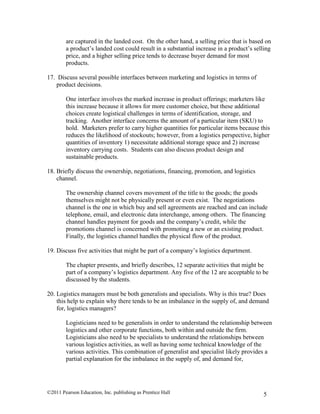
16. Define what is meant by a landed cost and explain its relevance for pricing decisions.
Landed cost refers to the price of a product at its source plus transportation costs
to its destination. On the one hand, a selling price that is based on a product’s
landed cost allows the seller to offer “free” delivery of the product to product to
prospective customers, because the transportation costs associated with delivery
©2011 Pearson Education, Inc. publishing as Prentice Hall 5
are captured in the landed cost. On the other hand, a selling price that is based on
a product’s landed cost could result in a substantial increase in a product’s selling
price, and a higher selling price tends to decrease buyer demand for most
products.
17. Discuss several possible interfaces between marketing and logistics in terms of
product decisions.
One interface involves the marked increase in product offerings; marketers like
this increase because it allows for more customer choice, but these additional
choices create logistical challenges in terms of identification, storage, and
tracking. Another interface concerns the amount of a particular item (SKU) to
hold. Marketers prefer to carry higher quantities for particular items because this
reduces the likelihood of stockouts; however, from a logistics perspective, higher
quantities of inventory 1) necessitate additional storage space and 2) increase
inventory carrying costs. Students can also discuss product design and
sustainable products.
18. Briefly discuss the ownership, negotiations, financing, promotion, and logistics
channel.
The ownership channel covers movement of the title to the goods; the goods
themselves might not be physically present or even exist. The negotiations
channel is the one in which buy and sell agreements are reached and can include
telephone, email, and electronic data interchange, among others. The financing
channel handles payment for goods and the company’s credit, while the
promotions channel is concerned with promoting a new or an existing product.
Finally, the logistics channel handles the physical flow of the product.
19. Discuss five activities that might be part of a company’s logistics department.
The chapter presents, and briefly describes, 12 separate activities that might be
part of a company’s logistics department. Any five of the 12 are acceptable to be
discussed by the students.
20. Logistics managers must be both generalists and specialists. Why is this true? Does
this help to explain why there tends to be an imbalance in the supply of, and demand
for, logistics managers?
Logisticians need to be generalists in order to understand the relationship between
logistics and other corporate functions, both within and outside the firm.
Logisticians also need to be specialists to understand the relationships between
various logistics activities, as well as having some technical knowledge of the
various activities. This combination of generalist and specialist likely provides a
partial explanation for the imbalance in the supply of, and demand for,
©2011 Pearson Education, Inc. publishing as Prentice Hall 6
logisticians in the sense that not everyone is capable of balancing generalist and
specialist requirements.
©2011 Pearson Education, Inc. publishing as Prentice Hall 7
PART III
EXAMINATION QUESTIONS
CHAPTER 1: AN OVERVIEW OF LOGISTICS
Multiple Choice Questions
1. Logistics clearly contributes to ___________ and ___________ utility.
a. time; place
b. form; time
c. place; form
d. possession; time
e. none of the above
(a; p. 3)
2. ___________ utility refers to the value or usefulness that comes from a customer
being able to take possession of a product.
a. Time
b. Place
c. Form
d. Possession
(d; p. 3)
3. ___________ utility refers to having products available where they are needed by
customers.
a. Possession
b. Time
c. Place
d. Form
(c; p. 3)
4. All of the following are types of economic utility, except:
a. Time
b. Production
c. Place
d. Possession
e. All of the above are types of economic utility
(b; p. 3)
5. All of the following terms have been used to refer to business logistics except:
a. business logistics
©2011 Pearson Education, Inc. publishing as Prentice Hall 8
b. industrial distribution
c. logistics management
d. physical distribution
e. all of the above are correct
(e; p. 4)
6. “How well a company does what it says it’s going to do” represents ___________.
a. efficiency
b. productivity
c. leading edge logistics
d. effectiveness
(d; p. 5)
7. What concept refers to “how well company resources are used to achieve what a
company promises it can do?”
a. Efficiency
b. Productivity
c. Reengineering
d. Effectiveness
(a; p. 5)
8. Every customer getting the same type and levels of logistics service refers to
___________.
a. tailored logistics
b. mass logistics
c. effectiveness
d. efficiency
(b; p. 6)
9. Which of the following is not a reason for the increased importance of logistics?
a. growing power of manufacturers
b. reduction in economic regulation
c. globalization of trade
d. technological advances
e. all of the above are reasons
(a; pp. 6–9)
10. The ___________ concept suggests that there are an ever-increasing number of
market segments with distinct preferences.
a. rhochrematics
b. relationship marketing
©2011 Pearson Education, Inc. publishing as Prentice Hall 9
c. market demassification
d. niche marketing
(c; p. 7)
11. What two logistics activities make the heaviest use of the Internet?
a. Warehousing and inventory management
b. Purchasing and transportation
c. Inventory management and purchasing
d. Transportation and warehousing
(b; p. 8)
12. ___________ refers to the removal of intermediaries between producer and
consumer.
a. Direct channels
b. Market demassification
c. Consolidation
d. Disintermediation
(d; p. 8)
13. ___________ are characterized by large market share and low prices.
a. Category killers
b. Mass merchandisers
c. Power retailers
d. Do-it-yourself (DIY) retailers
(c; p. 8)
14. World trade grew at an average annual rate of approximately ___________ percent
between 1997 and 2007.
a. 10
b. 8
c. 6
d. 4
(c; p. 9)
15. The ___________ approach indicates that a company’s objectives can be realized by
recognizing the mutual interdependence of major functional areas.
a. supply chain
b. systems
c. interfunctionality
d. total cost
(b; p. 9)
©2011 Pearson Education, Inc. publishing as Prentice Hall 10
16. The movement and storage of materials into a firm refers to:
a. physical distribution
b. materials management
c. materials handling
d. supply chain management
(b; p. 10)
17. What concept refers to the storage of finished product and movement to the
customer?
a. Inbound logistics
b. Supply chain management
c. Physical distribution
d. Materials management
(c; p. 10)
18. Logistics managers use the ___________ approach to coordinate inbound logistics,
materials management, and physical distribution in a cost efficient manner.
a. total cost
b. supply chain
c. mass logistics
d. interfunctional
(a; p. 12)
19. A cost trade-off is a situation where:
a. all costs react according to their individual degrees of inflation in the economy
b. all costs are reflected as a percentage variation from standard costs
c. some costs increase and some costs decrease
d. some costs are eliminated by efficient management controls
(c; p. 12)
20. The ___________ department often measures inventory in terms of its cost or value
in dollars, whereas ___________ tends to measure inventory in terms of units.
a. Marketing; logistics
b. Finance; production
c. Marketing; production
d. Finance; logistics
(d; p. 12)
21. A common interface between production and logistics involves:
©2011 Pearson Education, Inc. publishing as Prentice Hall 11
a. the use of plastic versus wood pallets
b. the mode of transportation
c. shipment pricing
d. the length of production runs
(d; p. 13)
22. ___________ refers to the delay of value-added activities such as assembly,
production, and packaging to the latest possible time.
a. Building blocks
b. Deferral
c. Demurrage
d. Postponement
(d; p. 13)
23. The four basic components of the marketing mix include all of the following except:
a. price
b. production
c. product
d. place
(b; p. 14)
24. Branding alliances allow customers to purchase products from two or more name-
brand retailers at one store location. Which of the following statements about
branding alliances is false?
a. They offer potential customers convenience by satisfying multiple needs at
one place
b. They boost brand awareness
c. They don’t create any logistical challenges
d. They increase customer spending per transaction
e. All of the above are true
(c; p. 14)
25. Landed costs refer to:
a. a product that is shipped via surface transport
b. a product that is quoted cash on delivery (COD)
c. a prepaid shipment
d. a price that includes both the cost of the product plus transportation to the
buyer
(d; p. 15)
26. ____________ refers to being out of an item at the same time there is demand for it.
©2011 Pearson Education, Inc. publishing as Prentice Hall 12
a. Intensive distribution
b. Stockout
c. Rhochrematics
d. Supplier indifference
(b; pp. 14-15)
27. Which of the following is not part of the marketing channel?
a. the logistics channel
b. the negotiations channel
c. the promotion channel
d. the finance channel
e. all are part of the marketing channel
(e; p. 15)
28. The ownership channel consists of all parties except:
a. customers
b. manufacturers
c. wholesalers
d. retailers
(a; p. 16)
29. Which channel covers the movement of title to the goods?
a. promotions
b. logistics
c. finance
d. ownership
(d; p. 16)
30. ____________ is bringing together similar stocks from different sources.
a. Accumulating
b. Assorting
c. Auditing
d. Allocating
(a; p. 16)
31. ____________ refers to breaking a homogenous supply into smaller lots.
a. Sorting out
b. Allocating
c. Accumulating
d. Assorting
©2011 Pearson Education, Inc. publishing as Prentice Hall 13
(b; p. 17)
32. Channel intermediaries:
a. assume temporary ownership of the goods
b. fill niches
c. disappear as the market becomes organized
d. tend to lack focus
(b; p. 17)
33. Which of the following is not a logistics-related activity?
a. Customer service
b. International logistics
c. Materials handling
d. Procurement
e. All of the above are logistics-related activities
(e; pp. 18-19)
34. The most costly logistics activity in many firms is ____________.
a. industrial packaging
b. warehousing management
c. order management
d. transportation management
(d; p. 19)
35. U.S. News & World Report suggests that logistics employment should increase by
____________ percent through 2018.
a. 10
b. 15
c. 20
d. 25
(c; p. 20)
True-False Questions
1. Absolute and relative logistics costs in relation to Gross Domestic Product vary from
country to country. (True; p. 2)
2. The four general types of economic utility are production, possession, time, and
place. (False; p. 3)
©2011 Pearson Education, Inc. publishing as Prentice Hall 14
3. Logistics clearly contributes to time and form utility. (False; p. 3)
4. The current definition of logistics, as promulgated by the Council of Supply Chain
Management Professionals, suggests that logistics is part of the supply chain process.
(True; p. 4)
5. Logistics is only concerned with forward flows, that is, those directed towards the
point of consumption. (False; p. 5)
6. The purpose of logistics is to maximize customer service. (False; p. 7)
7. In mass logistics, groups of customers with similar logistical needs and wants are
provided with logistics services appropriate to those wants and needs. (False; p. 6)
8. Logistical principles apply only to for-profit organizations. (False; p. 6)
9. Reductions in economic regulation allowed individual transportation companies
flexibility in pricing and service. (True; p. 6)
10. Market demassification suggests that an ever-increasing number of market segments
have distinct preferences. (True; p. 7)
11. The Internet has done little to improve logistical effectiveness and efficiency. (False;
p. 8)
12. Disintermediation refers the removal of intermediaries between producer and
consumer. (True; p. 8)
13. Superior logistics is an essential component of corporate strategies for many power
retailers. (True; p. 9)
14. Logistics has played a minor role in the growth of global trade. (False; p. 9)
15. The systems approach indicates that a company’s objectives can be realized by
recognizing the mutual interdependence of the major functional areas of a firm.
(True; p. 10)
16. Physical distribution is synonymous with materials management. (False; p. 10)
17. Interfunctional logistics attempts to coordinate inbound logistics, materials manage-
ment, and physical distribution in a cost efficient manner that supports an
organization’s customer service objectives. (False; p. 10)
18. The key to the total cost approach is that all relevant cost items are considered
simultaneously when making a decision. (True; p. 12)
©2011 Pearson Education, Inc. publishing as Prentice Hall 15
19. The finance department tends to measure inventory in terms of units while logistics
tends to measure inventory in terms of its cost / value. (False; p. 12)
20. Long production runs sometimes result in excessive inventory of products with
limited demand for them. (True; p. 13)
21. Postponement is the delay of value-added activities such as assembly, production, and
packaging to the latest possible time. (True; p. 13)
22. Logistics offers many companies an important route for creating marketing
superiority. (True; p.14)
23. Landed costs refer to the price of a product at the source. (False; p. 14)
24. Stockouts refer to a situation where a company is out of an item at the same time that
there is demand for that item. (True; p. 14)
25. Logistical decisions tend not to be impacted by marketers’ growing emphasis on
offering sustainable products. (False; p. 15)
26. Many promotional decisions, such as pricing campaigns that lower the price of
certain items, require close coordination between marketing and logistics. (True; p.
15)
27. The negotiations channel is the one where buy and sell agreements are reached.
(True; p. 16)
28. The financing channel handles a company’s credit and payment for goods. (True; p.
16 )
29. There is no linkage between the promotions and logistics channel. (False; p. 16)
30. The most significant contribution that the logistics channel makes to the overall
channel process is the sorting function. (True; p. 16)
31. The sorting function has four steps. (True; p. 16)
32. The sorting function takes place between retailers and the consumer. (False; p. 17)
33. Intermediaries assume ownership of goods while they’re in the marketing channel.
(False; p. 17)
34. A broker is a type of intermediary often associated with the negotiations channel.
(True; p. 17)
©2011 Pearson Education, Inc. publishing as Prentice Hall 16
35. Advertising agencies are a channel intermediary that might be found in the
promotions channel. (True; p. 17)
36. A commonly used logistics intermediary is the freight forwarder. (True; p. 17)
37. Demand forecasting is not considered to be a logistics-related activity. (False; p. 18)
38. Transportation represents the most costly logistics activity in many organizations.
(True; p. 18)
39. It is better for a logistics manager to be a generalist rather than a specialist. (False; p.
19)
40. There are relatively few opportunities for employment in the logistics sector. (False;
p. 20)
©2011 Pearson Education, Inc. publishing as Prentice Hall 17
PART IV
CASE SOLUTIONS
CASE 1-1 KIDDIELAND AND THE SUPER GYM
Question 1: List and discuss the advantages and disadvantages of purchasing a two-
wheeled trailer for each store to use for delivering Super Gyms.
Because the stores are in a number of states, one would have to check the motor
vehicle and insurance requirements of each state. An advantage is that deliveries
would be under the control of each store. A disadvantage may be labor costs,
especially if two workers are needed to make the delivery. Also, once at the site,
the store’s employees might be asked to assist in the assembly of the gym.
Question 2: List and discuss the advantages and disadvantages of having local trucking
companies deliver the Super Gym from the retail stores to the customers.
There are probably no disadvantages to using a local trucking company to make
the delivery. A decision would have to be made how to handle the trucking firm’s
charges.
Question 3: List and discuss the advantages and disadvantages of stocking Super Gyms
at the distribution centers and then having the truck that make deliveries from the
distribution center to the retail stores and also make deliveries of Super Gyms to
individual customers.
The problem here focuses on the size of equipment; the large tractor-trailer
combinations are not suited to making home deliveries. The actual costs to
KiddieLand of using trucks this way might be very high. There might be some
savings in inventory costs by stocking the gyms at the distribution center rather
than at each retail store.
Question 4: List and discuss the advantages and disadvantages of charging the customer
for home delivery if they are unable to carry the Super Gym home.
Perhaps the one advantage to charging for home delivery is that KiddieLand
recoups the associated costs. However, because charged home delivery will add to
the customer’s total purchase price, there could be a reduction in demand or this
could generate customer dissatisfaction.
Question 5: Which alternative would you prefer? Why?
The student can choose any alternative. However, the text of the case seems to
prefer the use of a local trucking company and charging the customer for home
delivery.
©2011 Pearson Education, Inc. publishing as Prentice Hall 18
Question 6: Draft a brief statement (catalog copy) to be inserted in the firm’s
spring/summer brochure that clearly explains to the potential customers the policy that is
recommended in question 5.
The brochure is intended for use in all stores, so whatever copy is prepared must
be widely applicable. A sentence might read: “The Super Gym comes
unassembled and is packed in three boxes: one weighing ____ pounds, is ____
inches by ____ inches by ____ inches; the second weighs ____ pounds, is ____
inches by ____ inches by ____ inches; and the third weighs ____ pounds, and is
____ inches by ____ inches by ____ inches. Assembly requires the following
tools: ____; ____; ____; and ____.”
Question 7: In the first meeting Toth asked about SUVs but there was no further mention
of them. How would you follow up on his query?
Anyone in the group could answer that sport utility vehicles have more carrying
capacity than autos and many also have trailer-hitches. SUVs are sufficiently
popular—particularly in the United States—that almost every buyer of the Super
Gym equipment would either have a SUV, or be able to borrow one.
Other documents randomly have
different content
78
“A detective,” explained Sprague, simply.
Dot became impatient; she wanted to get to the point
of their visit.
“We should like to meet the aviatrix who calls herself
Linda Carlton,” she announced, in a business-like tone.
“Has she come in yet?”
“She is on the set now,” replied Sprague. “Going
through her stunts. She has only a small part in the
picture, so it can all be done at once.”
“Will you kindly take us out where she is?” asked Linda.
“In a minute, sister,” returned the man,
condescendingly. “But we have some business with you
first.”
Linda’s expression became freezing. She could not bear
this insolent young man. He smiled in an irritating
manner.
“We have examined your licenses, Miss Slocum,” he
said. “And we believe the signatures have been forged.
The real Miss Carlton brought hers today, and we
compared the two. There is no doubt that hers is
genuine.”
“What?” demanded Linda, in horror.
“Let us see them!” demanded Dot, entirely unconvinced.
Mr. Sprague nodded.
“Our friend, Mr. Chase, has them now. He will let you
look at them.”
79
The young man, who could not have been a day over
twenty-five, looked extremely embarrassed. Not like a
hard-boiled detective at all, Linda thought. Indeed, he
flashed her a look of sympathy, as if he did not share in
Sprague’s accusation. Still, it was his business, and he
had to go through with it.
He fumbled in his pockets and produced two cards,
identical at a glance. The same numbers, the same
printing—and what looked like the same signatures.
“Don’t let them out of your hands, Chase,” warned
Sprague, evidently determined to be as nasty as
possible.
“You see, ladies,” Chase said, almost apologetically.
“This signature is forged.” He held up one of the cards.
“Look at the capital ‘L’. It hasn’t been copied quite
right.”
“Of course it hasn’t!” cried Dot. “But the other one is
yours, Linda.”
“Yes,” agreed Linda, trembling in spite of her innocence,
“I remember that mud-spot on mine. I got it on that
treasure-hunt that Mr. Clavering planned, from Green
Falls last summer.”
“Odd,” remarked Sprague, sarcastically. “That is the very
mud-spot the real Miss Carlton identified her card by!”
“What do you propose to do?” demanded Dot, now
thoroughly exasperated.
“Hold Miss Slocum under bail,” replied Sprague. “For
forgery.”
80
Dot burst into a peal of laughter.
“It’s too absurd!” she exclaimed.
The young detective looked exceedingly uncomfortable.
“Shall we go out on the lot?” he suggested. “And see
the stunts?”
“O. K. by me,” agreed Sprague.
“Are we to wear hand-cuffs?” inquired Dot, flippantly.
Sprague gave her a withering look.
“You are not being held at all, Miss Manton,” he said.
“We’re not concerned under what names you care to
travel.”
The young detective fell back and walked across the lots
with the girls.
“I believe you are innocent, Miss—Carlton,” he said, his
brown eyes already showing devotion to Linda. “Of
course I have to take your money for bail, but I’m sure
it will be all cleared up soon. I think that the other girl is
the impostor.”
“Oh, thank you, Mr. Chase!” cried Linda, the tears
dangerously near to her eyes at this expression of
sympathy.
The group reached the lot, where the picture was being
rehearsed. It looked so interesting, so thrilling,—had it
been under any other circumstances, the girls would
have only been too delighted at the opportunity. But
now they could think only of the horrible fix they were
81
82
in, with not a friend in this strange city to vindicate
them.
Mr. Von Goss, who was buzzing busily about the lot,
paid no attention at all to Dot and Linda—not even a
formal nod of greeting as he passed them by. He had
evidently decided that they were impostors, who had
cleverly deceived him, thereby securing for themselves
an evening’s unusual entertainment at his expense.
Therefore, he preferred not to recognize them at all.
The deliberate cut hurt Linda, for she had liked and
admired the older man, and had found him exceedingly
interesting.
The moving-picture aviatrix, however, was going
through all sorts of stunts in a silver Moth, which had
been brightly painted and decorated. Linda stood still,
gazing at her enviously. Not that she wanted to be in
the picture, but she would always rather be in the air
than on the ground. And it looked now as if she were to
be chained to the earth for several days to come, unless
she or Dot could think of a way out of their difficulties.
“The girl’s too low!” cried Chase suddenly, in horror.
Linda watched her; she certainly was dangerously near
to the ground. The roar of her motor was deafening.
But, by a stroke of luck, she regained control, and
abruptly pointed her plane upward, climbing without
disaster.
“She’s good,” admitted Linda, in all fairness.
“Not so good as she looks,” remarked Chase. “I happen
to know that plane and it will take a lot of punishment.
But she’ll do that little stunt once too often.”
83
“You’re a flier too, Mr. Chase?” inquired Linda.
“Yes,” he replied. “I’m a secret-service man, on the air
force of the police.”
He looked right into Linda’s eyes, as if to tell her that his
love of flying was another bond of sympathy between
them.
“How did you happen to be called in—on an
unimportant case like ours?”
“I’m here on something else. Connected with another
case. And I know Mr. Von Goss personally, so he asked
me to help him out.”
“I see.... I suppose I shouldn’t ask you for advice, Mr.
Chase—but—I feel as if you would help me, if possible.
What would you do if you were in my place?”
“Wire to somebody well known in aviation circles, who
can come and identify you as the girl who flew the
Atlantic alone. Because that is the important thing.
That’s why Von Goss is paying the aviatrix thirty
thousand dollars for a small part in one picture. Just
because of that one fact!”
“Then friends wouldn’t help—in establishing my
identity?”
“No. They ought to be people in aviation.”
Dot interrupted this conversation, by suddenly grasping
Linda’s arm. “Look at Sprague!” she cried. “Look at the
way he’s waving that hat of his to his girl-friend! Now
what do you suppose the idea of that is?”
84
At the mention of his own name, the secretary turned to
the girls.
“Miss Carlton is supposed to fly away—be lost to sight
now,” he informed them, calmly. “It isn’t likely she’ll
come back and land here, for that finishes her part.”
“You mean we’re not to see her?” demanded Dot. “That
looks suspicious to me!”
“Oh, yeah?” returned Sprague. “Well, don’t flatter
yourselves that Miss Linda Carlton has time to waste on
a couple of upstarts from Toonerville, or wherever it was
you came from. She’s a busy girl!”
Linda sighed deeply as she watched the plane disappear
entirely from view. There was nothing to do now;
Sprague and Von Goss were both against her. She might
as well go back to the hotel.
“Come to the hotel this afternoon for that check for
bail,” she said to Chase. “I’ll have it ready.”
Then, with a nod of farewell, she and Dot left the lot
and went into a restaurant at Culver City for their lunch.
But this time they were not interested in seeing the
stars. Their own problems were too pressing.
“If I could only get in touch with Daddy,” said Linda, as
she nibbled at her salad. “But I don’t know where he is,
and I should hate to alarm Aunt Emily by telling her that
I am being held under bail. No ... I guess the best idea
is to wire Mr. Eckert.”
“That’s the stuff!” approved Dot. “Why not go over to
that telephone and do it now, while I order something
for dessert?”
85
86
Linda took the suggestion, and fifteen minutes later the
girls started back for their hotel in Los Angeles. They
felt like prisoners, unable to come and go at will. As a
matter of fact, Dot was still as free as air, but she had
no thought of deserting Linda.
They bought the afternoon paper on their way back to
the hotel, and when they reached their room, Dot
spread it out on her bed to read. But the first item that
met her eye made her stare in horror. It was Linda’s
picture, right on the front page, with the caption “Miss
Sallie Slocum, impersonating Linda Carlton,” and
underneath it, the whole dishonest story.
She read it in rising anger, determined to destroy it
before Linda should see it. But her companion, noticing
the look on her chum’s face, crossed the room and saw
it for herself.
“Not a soul will believe it is really I!” she exclaimed.
“Because it doesn’t look a whole lot like me.”
“No, it certainly doesn’t. It must be that same picture
the reporter took of us both at the airport, the day we
landed here in Los Angeles. Only I’m cut off. I’m not
news any more.”
“No, you’re free, Dot.”
“Yet it’s all my fault!” She wound her arms around
Linda. “Darling, I just can’t tell you how sorry I am for
that silly prank!”
Linda patted her hand.
“Don’t think of it as your fault, Dot. That name business
is only a side-issue. That girl would have gotten away
87
with it, no matter what we did. She’d have thought up
something else if she hadn’t had that to play on.”
“But I played right into her hands.”
“Perhaps. Only, any girl who would go to all this trouble
to invent such a dishonest scheme would have
succeeded somehow. Why, the licenses were really the
most important thing. But how she ever managed to get
them exchanged without that smart Sprague noticing, is
more than I can account for.”
“Well, you must remember he wasn’t prejudiced against
her as he was against you. He trusted her, so he
probably wasn’t watching her closely.”
“I detest that man,” said Linda.
“So do I,” agreed Dot.
“Well, this isn’t getting us anywhere,” remarked Linda,
with a yawn. “I think a nap would do us good.”
So, wisely acting upon the suggestion, the girls slept
until Mr. Chase called at five o’clock for Linda’s check for
one thousand dollars for bail.
“Which I hate to have to take,” he said, apologetically.
“But I expect to give it back to you soon!”
88
CHAPTER VII
STOLEN!
Linda and Dot both felt terribly depressed, in spite of
their luxurious surroundings. Indeed, both girls had
showed more spirit on that deserted island in the
Atlantic Ocean, where they had been stranded without
any plane during the early summer. When both their
food and their water supply were limited, and the
chances of survival were small. But now there was
nothing to do but wait—wait in this strange, lonely city,
where their only friends—Mr. Von Goss and Mr. Chase—
had turned out to be enemies. And now Mr. Chase was
going away, flying south on important business, so that
even he would be lost to them.
“But you will soon be free,” he had said, after he had
heard that Linda had wired for Mr. Eckert.
“In time to stop that picture’s being shown, do you
think?” inquired Linda. “I understand that the rest of it
was completed, and that all that had to be filmed was
my double’s part.”
“Yes, I believe that’s what Von Goss said. But surely it
won’t be released for a month or so. I shouldn’t worry.
89
You do hate publicity, don’t you?” he asked,
sympathetically.
“I have always tried to shun it,” answered Linda. “But it
seems that I am being punished now.”
But the young man had gone, and the girls were feeling
very blue.
“We’ve got to pull ourselves together!” announced Dot,
after a few minutes of somber silence. “Let’s step out
and go to a show tonight! After all, you paid that
thousand dollars bail, and we might as well get some
fun out of it.”
“True,” admitted Linda.
“Not a picture this time. A theatre. I’m sick of movies.”
“So am I.”
“And let’s make a rule, with a forfeit of five dollars, if
either of us mentions that aviatrix, or Sprague, or any
other vermin we have met around the studio, we have
to pay the other! Is it a go?”
“Does that include Mr. Chase?” asked Linda, slyly.
Dot poked her companion under the chin.
“I suppose not,” she agreed. “You couldn’t exactly
describe him as ‘vermin’.... And besides, I can see that
you were rather smitten. And did he fall for you?
Whew!”
Linda blushed.
“He is a nice young man, don’t you think so, Dot?”
90
“Of course I do. But poor Ralph! How jealous he’d be, if
he only knew!”
“Ralph will be furious because I didn’t wire to him to
help us out. But after all, he’s only a personal friend,
and of course his assertions about my innocence
wouldn’t carry much weight.”
“We’re agreed, then,” said Dot, as she began to dress
for dinner, “that the tabu subjects are Von Goss, movies,
Sprague, and your double. At five dollars apiece!”
Linda laughed, but she felt much better. Trust Dot to
find some fun in every situation, no matter how
unpleasant or dangerous it seemed. They were able to
get seats at a very good play, and in the excitement of
the mystery involved, they forgot all about their own
troubles, and had no need to worry about the forfeit.
It was lucky indeed that they were able to enjoy their
evening, for the next morning held a most unpleasant
surprise for them. They had gone for a walk after
breakfast and returned to the hotel about eleven
o’clock, hoping for some word from Mr. Eckert.
The telephone rang and Linda picked it up gaily,
expecting it to be the message. But it proved to be a
message of a very different sort a summons from a
police-court in Los Angeles!
“The officer wants you to come downstairs immediately,
Miss Carlton,” the operator told her.
“I’m going too,” announced Dot, following her
companion into the elevator.
91
A uniformed policeman was waiting for Linda in the
lobby. He was a rough, uneducated person of the lower
class, evidently accustomed to bullying his suspects into
submission. He did not return Linda’s feeble “Good
morning,” but merely extended a piece of paper with his
right hand.
“Your bum check!” he snarled. “For bail. You had no
right to sign the name of ‘Linda Carlton’ anyhow, but
besides that, there ain’t no funds to cover it—even if
you say you are the real ‘Linda’.”
“No funds!” gasped Linda, staring incredulously at the
man. “Why, I keep five thousand dollars in my check
account—just to be ready for any kind of emergencies
that may come up when I’m flying about the country!”
“That’s just the amount that was took out yesterday. By
the real Linda Carlton.” His tone was jeering, as if he
were enjoying the situation as he would a play.
“Oh!” cried Linda. “This is terrible!”
“I’ll say it is,” agreed the policeman. “Now get your hat,
and come along with me. You’re goin’ to jail.”
The girls looked at each other in speechless
amazement. This was too dreadful for words.
“Let me wire for the money,” suggested Dot, suddenly.
“I can get it from my father.”
“Do as you like. But this here forger goes to jail—even if
she is a pretty girl. That ain’t a gonna help her none
now!”
“Oh!”
92
93
The tears came to Linda’s eyes, in spite of her effort to
hold them back. She felt dizzy and weak. It was all like
a hideous nightmare, from which, try as she might, she
could not awaken. She opened her mouth to speak, but
only a stifled sob came. Then, with a hopeless gesture
of powerlessness, she decided to do as she was told.
She turned about desperately and walked towards the
elevator like a criminal going to the electric chair. Dot,
still trying to think of some way to save the situation,
waited, hesitating, breathing hard. It was a tense and
horrible moment—until Linda walked right into the arms
of her dear old friend, Mr. Eckert!
“Linda, I’m here!” he said, putting out his arms to catch
her, for he could see that she was blinded by tears.
“Dear child, you’re not going to faint?”
Linda looked up in a daze, too astonished to believe that
he was true. Had her imagination conjured up his kindly
presence? But no; Mr. Eckert’s hands were on her
shoulders, supporting her, keeping her from falling. And
beside him was a large, fine-looking man in a blue
uniform.
“Oh!” she gasped, in joy and relief, clinging desperately
to the elderly man’s hand.
“What are you doing to Miss Carlton?” demanded the
stranger in uniform, of the policeman. “Hounding her
with abuse?”
“This here young lady forged a name and passed a bum
check,” he whimpered.
“What name?” asked the other man.
94
“Claims she’s Linda Carlton, with five thousand bucks in
a bank, where she’s already overdrew her account.”
“She is Linda Carlton!” announced Mr. Eckert. “I can
testify to that—your superior officer, James A. Brenan,
can testify to my knowledge, for he knows me well. He
is Chief of Police in St. Louis.”
“How did you get here so soon, Mr. Eckert?” asked Dot.
“We only wired yesterday.”
“We started immediately, sensing your trouble. And flew
day and night. But I see that we got here just in time.”
“Ten minutes later I’d have been wearing prison
stripes!” returned Linda, now almost herself again. “Oh,
Mr. Eckert, I can never thank you enough.”
“I was only too thankful to be of use, my dear child,”
said the kind-hearted man.
“What shall we do first?” inquired Dot, as the policeman
made a move to slip away.
“Catch the thief,” announced Chief Brenan. “If she has
forged a check for five thousand dollars already, she
must have gone away as fast as she could.” He turned
to the Los Angeles policeman. “Go and inform your
station of this as fast as you can.... And meanwhile,
we’ll go straight to the studio of the Apex Film
Corporation and find out what we can about her from
the director.”
The policeman departed, and Linda asked Mr. Eckert
whether he weren’t terribly hungry and tired.
95
96
“Hungry, yes, but I haven’t had time to think about
being tired yet. I want to get things all straightened out
for you first, before I consider sleeping. We will arrange
for a couple of rooms and order a meal before we go to
Hollywood.”
In an incredibly short time the men reappeared from
their rooms and ate a hasty meal that was both
breakfast and lunch. Then the whole party, the two
girls, and the two older men chartered a car for Culver
City.
“Won’t it be fun to stick out our tongues at that Sprague
insect?” laughed Dot, now enjoying herself hugely. “He
was so condescending—so sure that the other girl was
the real thing!”
“And I’m going to insist that they don’t show the picture
under my name!” added Linda.
“It’ll serve Mr. Von Goss right. I’m glad he’s losing
money. Remember how snippy he was to us yesterday,
on the lot?”
“He certainly was. Wouldn’t even speak to us!”
“He may get his money back when we catch the
impostor,” remarked Chief Brenan. “She can’t have had
a chance to spend much of it.”
“I’ll wager she bought that plane that she was doing
stunts with,” observed Linda. “It certainly was speedy.
And she’d want to get out of the country as soon as
possible.”
The short distance to Culver City was covered quickly in
the high-powered car. Dot was the first to run into the
97
studio when they arrived. She wanted to have the fun of
saying, “I told you so,” to that “fresh Sprig,” as she liked
to call him.
The same “publicity girl” took their cards. But, though
Mr. Von Goss was in, she informed them that Mr.
Sprague was no longer with the Apex.
“Fired?” asked Dot, hopefully.
“No, I believe not. He left yesterday—to be married to
Miss Linda Carlton.”
“No, he didn’t!” contradicted Dot. “This is Miss Linda
Carlton right here, and she’d rather be dead than
married to that shrimp. Your actress wasn’t Linda
Carlton at all—as we’re just about to prove.”
“Really?” remarked the girl, only slightly interested. It
was a practice of hers never to frown or show emotion,
lest she encourage wrinkles.
They passed on in to the director’s office, and Linda
introduced the two men and told her story. When she
had finished, Mr. Von Goss looked extremely worried,
crestfallen, even defeated. For now Linda’s identity was
established beyond a doubt.
“How then do you account for this license?” he asked,
extending the one with the forged signature to Linda.
“Sprague’s doing, of course!” cried Dot, before Linda
had a chance to answer. “He was in league with that
girl. We just heard that they were married.”
“But how could he manage these licenses?” demanded
Von Goss.
98
“He got hold of a blank somehow, and forged the name.
Then when he had the chance to get hold of the real
Miss Carlton’s, of course he exchanged them.”
The Chief of Police was listening to Dot’s logic with
admiration.
“You’re a bright girl,” he said. “And you’ve figured it out
just about right.” He turned to Linda. “You should never
have let your own licenses get out of your hands.”
“I had no idea Mr. Sprague was dishonest,” she said.
“But the worst part of it is, that now I have to fly with a
false license.”
“We’ll get yours back when we catch that couple!”
promised Von Goss. “Because we’ve got to catch them.
Why, I paid her thirty thousand dollars for her part in
the picture—and if my picture is not shown, I’ll lose
thousands more....”
He looked terribly discouraged.
The Chief of Police rose.
“We must go back now and get to work. Have you any
idea, Von Goss, where this couple went, or what kind of
plane they flew in?”
“I heard Sprague say something about South America
for a honeymoon,” the man replied. “He told us to keep
his mail for him, till he came back, as he wouldn’t have
any definite address. But I haven’t any idea whether
they expected to fly, or what kind of plane they used if
they did.”
99
“The girl didn’t buy your plane—or steal it?” asked
Linda.
“No. It’s still out there. We needed it today for some
stills.”
“What kind of plane did she own when she came to the
studio?”
“She didn’t own any. She told me that she had left her
autogiro at Spring City, and had flown west with a
friend.”
“And you believed every word of it!” was Dot’s taunt.
“And never even asked to see her license, until we
showed up and made it necessary.”
“It’s all true,” agreed the director. “I’ve been a fool.”
“If we only knew what kind of plane, it would be so
much easier to follow and catch her,” remarked Linda,
sadly.
Mr. Von Goss rose from his desk, and followed the group
to the door, lingering beside Linda, as if he were trying
to get up courage to say something to her. For such a
self-possessed man, he seemed unusually nervous.
“Miss Carlton,” he said, in a humble tone, “won’t you
please do that part of the picture for me?” It seemed
strange that a man who could tell stars what to do,
should speak so deferentially to Linda.
“Oh, no, Mr. Von Goss,” she replied immediately. “I
couldn’t possibly. I’m all keyed up for a chase. I want to
catch this girl, if it’s the last thing I ever do!”
100
101
“Then let me pay you, say fifty thousand dollars for the
use of your name, and let me show the picture as it is.
Nobody would ever guess that it isn’t you. For she does
look astonishingly like you.”
“Wouldn’t I love to see that girl!” said Dot.
Again Linda shook her head. “I don’t want my name in
moving-pictures, Mr. Von Goss,” she said with quiet
determination. “Besides, I shouldn’t like people to think
I flew in the dangerous, spectacular way that girl did. It
is harmful to the whole cause of aviation. No; you
cannot use my name in connection with your picture.”
Von Goss knew that she meant what she said, and there
was no use of any further argument. But he was in a
terrible fix, and he didn’t know how to get out of it
without losing a great deal of money. Certainly he
couldn’t use the name of the girl—whatever it was—for
when she was caught, the whole world would know that
she was a criminal.
A solution of his problem, however, suddenly suggested
itself to Linda.
“I have it, Mr. Von Goss!” she cried, turning about. “Use
Ann Harding! She’s a flier, and a popular actress
besides. She can do the stunts, and probably will prove
more of a drawing card to the public than I could hope
to be.”
“Ann Harding!” repeated the man. “But she belongs to
another studio.”
“Borrow her! Pay her! You’ll save your picture.”
102
“I believe you’re right, Miss Carlton,” he admitted, with a
sigh of relief. “That ought to save the situation.”
The four visitors left the studio and hurried in their car
back to the hotel. But no news of the couple had been
received by any of the Los Angeles police. Linda
therefore determined to pack a box of supplies and to
set out, that very afternoon, on the search, inquiring at
the airports they passed as they flew towards Mexico.
Just before sitting down to her late lunch with Dot, she
wired the news to her aunt, informing her of her plans,
and asking that additional funds be put into her
checking account. Then she called the airport on the
telephone.
“This is Linda Carlton,” she said. “I want you to have my
autogiro in readiness for a long trip. Plenty of gas and
oil. I will call for it inside of an hour.”
“Linda Carlton?” repeated the voice at the other end of
the wire. “Autogiro?... Must be some mistake.... Miss
Carlton flew away in her autogiro last night, about eight
o’clock. She paid the bill, and said she wouldn’t be
back!”
103
CHAPTER VIII
IN HOT PURSUIT
Linda replaced the telephone receiver and sat
motionless, staring at the wall of the hotel bedroom.
The worst had happened. The autogiro was stolen. The
Ladybug! Her dearest possession.
“What’s the matter?” asked Dot, realizing that her chum
must have heard bad news.
In a few words Linda explained the situation.
“And the worst of it is, that girl evidently didn’t have any
difficulty at all about doing it. Just walked into the
airport at night and demanded the plane. They handed
it over to her without so much as a question.”
For once in her life, Dot remained speechless. There
was not a single word of comfort she could think of to
offer to her companion.
“She’s had almost a whole day’s start,” Linda added
dismally. “Here it is three o’clock, and she must have
pulled out at dark last night. She’s probably out of the
United States by this time. And nobody even on her trail
yet!”
104
“Our police always catch the wrong person, anyway,”
remarked Dot, grimly.
“Don’t be too hard on them, Dot. They’re not all like
that dreadful specimen that came for me this morning.
And in a case like this, they would probably put the air-
force on duty. Men of a much higher type.”
“Like Mr. Chase, for instance.”
“Yes.”
“What are you going to do, Linda?”
“Call the police headquarters first. Tell them to get in
touch with all the airports possible, so that any
autogiros can be reported. But I’d like to go after that
girl myself, too!”
“In what?”
“‘In what?’ is right! Oh, if I only had a plane! If Ted
Mackay were only here—or even Ralph, with his
autogiro! But do you realize, Dot, that I’m bankrupt? I
can’t buy a plane, or even hire one, now that that girl
took everything I had in the bank.”
Her companion nodded. “If somebody would only lend
you one,” she said. “Maybe Mr. Eckert—”
“I’ve thought of him. But he has to get back to the
school immediately. Why, Dot, this is the twenty-ninth of
September! We’ve wasted a whole week, just to
establish the fact that I am Linda Carlton! Isn’t it just
too absurd!”
105
“It’s the craziest thing I ever heard of. And now you’ll
lose your chance at that teaching position, unless you
give up trying to get your Ladybug back.”
“I can’t do that. I couldn’t give up now. No, I’ll call the
police headquarters, and then I’ll wait around until Mr.
Eckert wakes up from his nap. We’ll surprise the men by
having dinner with them.”
It was indeed a surprise, as Linda expected, when she
and Dot met Mr. Eckert and Chief Brenan in the lobby of
the hotel that evening at seven o’clock. Naturally, both
men thought that the girls had flown away early in the
afternoon.
“I’m tied to the earth again,” Linda announced
immediately. “But not by the law this time.... That girl
flew off in my autogiro!”
“No!” cried Mr. Eckert, incredulously. “Why, there isn’t
anything she won’t steal!” He smiled grimly. “Did she
leave you your own clothing, Linda?”
“Yes,” replied the girl. “But that’s about all.”
“You should have had me wakened the minute you
heard the news. If you had done that, you might have
been on your way by this time.”
“You mean—?” gasped Linda.
“In my plane, of course. Take it and welcome, my dear
child!”
Linda seized his hand and tried to stammer out her
thanks. But she was too much moved by his generosity
to say anything.
106
“How will you get back to St. Louis in time for the
opening of your school?” inquired Dot.
“By the commercial air-line,” replied Mr. Eckert. “Now
come in and eat some dinner, and after that, you can
make your plans.”
It seemed to Linda almost too good to be true. To have
the privilege of flying that new, fast biplane, which she
had admired so much that morning. It had a cruising
speed of a hundred and fifty miles an hour! Surely, in it,
she could catch her own Ladybug.
“You’ll start early tomorrow morning, I suppose?” asked
Mr. Eckert, as they seated themselves in the dining-
room.
“Yes,” answered Linda. “The police are already on the
job, in communication with all the airports, which are to
keep a watch out for all autogiros that pass overhead or
land for gas. We’ll find out what reports have been
turned in, before we take off in the morning.”
“And will you go along, Miss Crowley?”
“Certainly,” replied Dot. “I’m just as anxious to recover
the Ladybug as Linda is.”
“It may mean dangerous business.”
“It’s bound to be exciting!”
After dinner Chief Brenan telephoned to the police
headquarters to find out what information had been
gained. Three autogiros, he learned, had been spotted,
but only two of them had been stopped. Neither of
these was the Ladybug. The third, it seemed, had been
107
108
seen early in the day, flying southeast across California
toward Arizona. Two secret-service planes had already
been sent out in that direction.
With Mr. Eckert’s help, Linda sketched out a course to
follow. She would head straight for the city of Yuma, in
the extreme southwest of Arizona, stopping there for
the first night. Then she would go over the border into
Mexico.
Dot, in the meanwhile, took charge of the practical
preparations for the trip. She arranged to leave their
box of clothing at the hotel, and packed all the supplies
for the trip. Water in gallon jugs and thermos bottles,
canned food, blankets in case they were forced to camp
out at night, field glasses and first-aid kit—and finally,
upon Mr. Eckert’s suggestion—a revolver.
The whole party breakfasted at dawn the following
morning, and Mr. Eckert accompanied the girls to the
airport, to sign the necessary papers for the release of
his plane, the Sky Rocket. It was a beautiful new
biplane, of the latest model. Painted yellow, with a
companion cockpit, it stood in readiness on the runway,
as if inviting Linda to climb in and fly.
Her eyes were shining in happy anticipation as she
skipped forward and climbed into the cockpit to peer at
the instruments. Everything for convenience and
comfort seemed to be provided. Altimeter, clocks,
compass, parachutes—even a wireless, with transmitting
radio wires placed inside the wings, so that messages
could be sent and received.
“It’s marvellous, Mr. Eckert!” she exclaimed, as she
seated herself at the controls, her hand fingering the
109
joy-stick.
“Aren’t you even going to give her a trial flight, Miss
Carlton?” inquired the mechanic, skeptically.
“Miss Carlton can pilot any plane that’s made!” replied
Mr. Eckert, proudly. “She never needs any instruction.
But,” he added, coming closer to Linda, “don’t forget
that this isn’t an autogiro. Don’t try to land her on top of
a building!”
Linda smiled.
“I only wish I had my own license,” she said.
“I shouldn’t worry about that,” returned Mr. Eckert. “The
police aren’t going to make any more mistakes about
arresting you.”
“I should hope not!” exclaimed Dot.
A minute later the mechanic started the motor, and
Linda taxied along the runway, waving good-bye to Mr.
Eckert. A few hundred feet further, and the Sky Rocket
rose into the air like a bird, soaring up to the skies. The
usual fog common to the early morning climate of
California had lifted, and the sun shone brightly as Linda
directed her course towards the mountains. She let out
the throttle to its maximum as soon as she reached a
good safe height; a hundred and fifty miles an hour did
not seem an abnormal speed, but it was a thrilling
experience. Linda loved her own Ladybug, but after all,
this was an exciting change.
Over the orange groves of southern California they
passed again, then, even higher up in the air to clear
the San Jacinto Mountains, over the city of Imperial—on
110
towards Yuma. The flight was nearly four hundred
miles, but Linda covered it in less than four hours. At
noon she landed the Sky Rocket at the airport of Yuma,
Arizona.
Being a large airport, the men had already been
informed by radio of the stolen autogiro, and the
attendant who came out to greet the Sky Rocket was
prepared to answer Linda’s questions.
“A giro stopped here yesterday for gas and oil,” he said.
“And we filled her up. Put a patch on one wing, but the
couple wouldn’t wait long enough to have it done right.
That must have been about three o’clock in the
afternoon. We got the radio soon after that, to take the
licenses of all the giros we got a look at.”
“What did the people look like? Were they a man and a
girl?” demanded Dot, excitedly.
“Yeah. A married couple, I believe.”
“On their honeymoon?”
“Can’t tell you that. They didn’t act mushy.”
Linda smiled.
“Did they give you their names?” she inquired.
“And did the girl look like—Miss Carlton?” put in Dot,
before the man could answer Linda’s question.
“Couldn’t say she did, except that all you girl fliers look
something alike. But her face was pretty dirty, and her
helmet was pulled down low.... Yeah, they gave their
names. A Mr. and Mrs. Bower, of Texas.”
111
“Oh!” gasped Linda, in disappointment. “We’re looking
for people named Sprague.”
“They wouldn’t be likely to give their right names,
Linda,” Dot reminded her. “Why, that girl thinks nothing
of swiping a new name to fit her fancy!”
“True,” admitted Linda.
“And another thing,” added the attendant. “There was a
secret-service flier here this morning already. After
them. A nice-looking chap, in a gray monoplane.”
“Could it have been Mr. Chase?” demanded Dot.
“Yeah. I think that was the name.... Well, he crossed
the border, hot on their trail. Shouldn’t be surprised if he
had ’em by now, for he flew a fast plane!”
The news was encouraging, so after a bite of lunch and
a hasty inspection, the girls flew away again, heading
south now, avoiding the Gulf of California, and crossing
over into Mexico.
They passed over the California river and continued an
easterly course, avoiding the mountains near the coast,
and pointing inland before they turned southeast again.
From their height in the air they could not see the
ground without glasses, but as Linda dipped lower, they
could distinguish how barren and desolate it was. There
were no trees; only short, stumpy underbrush scattered
about, with big patches of bare, hard earth between. A
most unattractive part of the country.
112
113
The engine of the plane continued to throb evenly; it
was in perfect condition. At least, Linda thought, her
plane was giving her no worry. But then, planes were
more like automobiles now; the accidents were oftener
due to the pilots themselves than to faulty motors....
But thus far, she had accomplished nothing. There had
been no sign of an autogiro, or indeed of any kind of
plane, since they left Arizona.
“We may be flying too high,” she remarked, as the
hours passed without any success. “I’m afraid to dip too
low with this plane.”
“Yes, that must be the trouble,” responded her
companion. “They could come down amongst those
bushes and camp for the night, and we’d never see
them. It seems like a wild-goose chase to me.”
“You don’t want to give up?”
“No, not as long as we can get any news at all. And
they can’t go on forever without gas. They’ll have to
stop at airports every once in a while to refuel, and then
they’ll be caught.”
“Some of these little Mexican places may not have been
informed,” observed Linda. “If they didn’t speak English
—or didn’t have a radio.”
On and on they flew, over this hot, deserted land, so
uncultivated and barren. The sun sank and twilight
came on—and still no sign of a town or an airport where
the girls might land.
“I’m afraid I’m lost,” Linda admitted to Dot, when it
became too dim to distinguish the ground even with the
114
aid of glasses. “I’ll have to fly lower, and look for a
landing. I think remember a place a couple of miles
back.”
She circled about and began flying in the opposite
direction, cautiously gliding a little nearer to the ground.
“Do you mind sleeping out tonight, Dot?” she inquired.
Her companion made a face. She had read enough
about Mexican bandits not to relish the prospect.
“I suppose we’ll have to,” she said. “Anyway, we have
plenty of food.”
Darkness was coming on fast; there was nothing to do
but take a chance at landing. Beyond them stretched
great black mountains, deep and forbidding, inhabited,
they felt sure, by all sorts of wild animals. These must
be avoided at any cost; so Linda went back to the spot
she had selected and prepared to make a dangerous
landing. How thankful she was that she had had plenty
of experience in spot landings!
Keeping the plane still high enough to maintain the glide
to the spot, she combined maneuvers to accomplish her
purpose. From a glide, she went into a side-slip until
she lost altitude, then, as she approached the landing-
mark, she gradually reduced speed with the forward
slip, straightening out just as she reached the ground.
And landed on the exact spot she had selected!
“Good work, Linda!” cried Dot, admiringly.
Linda grinned.

Solution Manual for Contemporary Logistics, 10th Edition by Murphy

  • 1.
    Solution Manual forContemporary Logistics, 10th Edition by Murphy install download https://testbankmall.com/product/solution-manual-for- contemporary-logistics-10th-edition-by-murphy/ Download more testbank from https://testbankmall.com
  • 2.
    Instant digital products(PDF, ePub, MOBI) available Download now and explore formats that suit you... Solution Manual for Contemporary Strategy Analysis 10th by Grant https://testbankmall.com/product/solution-manual-for-contemporary- strategy-analysis-10th-by-grant/ testbankmall.com Solution Manual for Supply Chain Logistics Management 5th by Bowersox https://testbankmall.com/product/solution-manual-for-supply-chain- logistics-management-5th-by-bowersox/ testbankmall.com Test bank for Contemporary Logistics, 11/E 11th Edition : 0132953463 https://testbankmall.com/product/test-bank-for-contemporary- logistics-11-e-11th-edition-0132953463/ testbankmall.com Test Bank for M: Finance, 3rd Edition, Marcia Cornett, Troy Adair John Nofsinger https://testbankmall.com/product/test-bank-for-m-finance-3rd-edition- marcia-cornett-troy-adair-john-nofsinger/ testbankmall.com
  • 3.
    Solution Manual forOperations Management: Sustainability and Supply Chain Management, 13th Edition, Jay Heizer, Barry Render Chuck Munson https://testbankmall.com/product/solution-manual-for-operations- management-sustainability-and-supply-chain-management-13th-edition- jay-heizer-barry-render-chuck-munson-3/ testbankmall.com Test Bank for Language in Mind: An Introduction to Psycholinguistics, 2nd Edition, Julie Sedivy https://testbankmall.com/product/test-bank-for-language-in-mind-an- introduction-to-psycholinguistics-2nd-edition-julie-sedivy-2/ testbankmall.com Test Bank for Basic Geriatric Nursing, 7th Edition, Patricia A. Williams, https://testbankmall.com/product/test-bank-for-basic-geriatric- nursing-7th-edition-patricia-a-williams/ testbankmall.com Test Bank for Pathology for the Physical Therapist Assistant 1st Edition by Goodman https://testbankmall.com/product/test-bank-for-pathology-for-the- physical-therapist-assistant-1st-edition-by-goodman/ testbankmall.com Test Bank For A History of Western Art 5th Edition https://testbankmall.com/product/test-bank-for-a-history-of-western- art-5th-edition/ testbankmall.com
  • 4.
    Test Bank forCell and Molecular Biology: Concepts and Experiments, 7th Edition Gerald Karp https://testbankmall.com/product/test-bank-for-cell-and-molecular- biology-concepts-and-experiments-7th-edition-gerald-karp/ testbankmall.com
  • 5.
    ©2011 Pearson Education,Inc. publishing as Prentice Hall 2 system. For example, some companies routinely use premium and/or expedited transportation—which increase transportation costs—to meet customer delivery requirements. As such, the company could be considered effective (meeting delivery deadlines) but perhaps not efficient (increased transportation costs). 5. Explain the significance of the fact that the purpose of logistics is to meet customer requirements. One reason for this significance is that meeting customer requirements means that companies must know—rather than assume—customer needs and wants. This knowledge is facilitated by communication between companies and their customers. Even today some companies are hesitant to communicate with customers. In addition, meeting customer requirements means that a “one size fits all” approach to logistics will result in some customers being overserved and others being underserved. As a result, companies should consider a “tailored logistics” approach, where groups of customers with similar logistical needs and wants are provided with the appropriate logistical services. 6. Explain how an understanding of logistics management could be relevant to your favorite charitable organization. There are any number of examples that can be used. The textbook mentions the Food Bank of New York City; from a logistical perspective, the Food Bank of New York City is responsible for collecting, sorting, repacking, and distributing food from its 90,000 square-foot warehouse. (The instructor could also look at the logistical aspects associated with responses to natural disasters, such as earthquakes and tsunamis.) 7. How has a reduction in economic regulation contributed to the increased importance of logistics? Reductions in economic regulation in the United States allowed individual carriers flexibility in pricing and service, and this flexibility was important to logistics for several reasons. First, it provided companies with the ability to implement the tailored logistics approach in the sense that companies could specify different logistics service levels and prices could be adjusted accordingly. Second, the increased pricing flexibility allowed large buyers of transportation services to reduce their transportation costs by leveraging large amounts of freight with a limited number of carriers.
  • 6.
    ©2011 Pearson Education,Inc. publishing as Prentice Hall 3 8. Discuss the logistical implications associated with the increased emphasis on the convenience associated with a family’s shopping experience. This convenience is manifested in various ways to include extended store hours, home delivery of purchased items, and ready-to-eat-ready-to-cook foods. From a logistics perspective, extended store hours force retailers to address issues such as the optimal delivery times for replenishment trucks and when to replenish merchandise. A logistical challenge with home delivery is the coordination of delivery times with the purchaser’s ability to receive the item(s). Finally, ready- to-eat-ready-to-cook foods have different packaging requirements, such as reusable bags. 9. Explain how power retailers are logistical trendsetters. The logistics practices of power retailers are often viewed as barometers for emerging logistics trends. In the 1990s, for example, Wal-Mart and Warner- Lambert were the first two companies to explore collaborative planning, forecasting, and replenishment (CPFR). Power retailers have also been logistical trendsetters with respect to focusing on inventory turnover (the number of times inventory sells in one year); suppliers are forced to be more efficient in the sense that they should focus on providing the products that will be bought by consumers. 10. What is the systems approach to problem solving? How is this concept applicable to logistics management? The systems approach to problem solving suggests that a company’s objectives can be realized by recognizing the mutual interdependence of the major functional areas such as marketing, production, finance, and logistics. As such, decisions made by one functional area can have important implications for the other functional areas. With respect to logistics, the systems approach suggests that one should recognize the mutual interdependence of the various activities that constitute the logistics function. Thus, a transportation decision may impact inventory, warehousing, and packaging, among others. 11. Distinguish between materials management and physical distribution. Materials management refers to the movement and storage of materials into a firm while physical distribution refers to the storage of finished product and movement to the customer. 12. Explain what is meant by the total cost approach to logistics. The total cost approach to logistics is built on the premise that all relevant activities in moving and storing products should be considered as a whole (i.e., their total cost) and not individually. Use of the total cost approach requires an
  • 7.
    ©2011 Pearson Education,Inc. publishing as Prentice Hall 4 understanding of cost tradeoffs. In other words, changes to one logistics activity cause some costs to increase and others to decrease. The key to the total cost approach is that all relevant cost items are considered simultaneously when making a decision. The objective is to find the approach with the lowest total cost that supports the organization’s customer service requirements. 13. Define what is meant by a cost trade-off. Do you believe that this concept is workable? Why or why not? A cost trade-off acknowledges that changing patterns or activities of distribution will result in some costs increasing and other costs decreasing. The net effect, however, should be an overall cost decrease for providing a given level of customer service. The remainder of the question asks the student for her/his opinion about the workability of this concept. Although nearly any answer is acceptable, those students who believe that cost trade-offs are unworkable might have difficulty with many of the concepts presented throughout the text. 14. What are several areas in which finance and logistics might interface? The finance department is often in charge of capital budgeting decisions that would affect logistics, such as materials handling and packaging equipment. Another potential area of finance/logistics interface is with respect to inventory; finance tends to view inventory from a dollar perspective while logistics tends to be more concerned with the number of units of inventory. This dichotomy is highlighted by the concept of depreciation which reduces the monetary value of inventory by a certain amount per period of time—even though the actual quantity of inventory may be unchanged. 15. Discuss the postponement concept as it relates to the production and logistics interface. Postponement refers to the delay of value-added activities such as assembly, production, and packaging until the latest possible time. Some value-added activities, such as case packing and case labeling, that were traditionally performed at a production plant are now performed in warehousing facilities. As a result, warehousing facilities are adding new types of equipment and being configured differently to allow specific value-added activities to take place. 16. Define what is meant by a landed cost and explain its relevance for pricing decisions. Landed cost refers to the price of a product at its source plus transportation costs to its destination. On the one hand, a selling price that is based on a product’s landed cost allows the seller to offer “free” delivery of the product to product to prospective customers, because the transportation costs associated with delivery
  • 8.
    ©2011 Pearson Education,Inc. publishing as Prentice Hall 5 are captured in the landed cost. On the other hand, a selling price that is based on a product’s landed cost could result in a substantial increase in a product’s selling price, and a higher selling price tends to decrease buyer demand for most products. 17. Discuss several possible interfaces between marketing and logistics in terms of product decisions. One interface involves the marked increase in product offerings; marketers like this increase because it allows for more customer choice, but these additional choices create logistical challenges in terms of identification, storage, and tracking. Another interface concerns the amount of a particular item (SKU) to hold. Marketers prefer to carry higher quantities for particular items because this reduces the likelihood of stockouts; however, from a logistics perspective, higher quantities of inventory 1) necessitate additional storage space and 2) increase inventory carrying costs. Students can also discuss product design and sustainable products. 18. Briefly discuss the ownership, negotiations, financing, promotion, and logistics channel. The ownership channel covers movement of the title to the goods; the goods themselves might not be physically present or even exist. The negotiations channel is the one in which buy and sell agreements are reached and can include telephone, email, and electronic data interchange, among others. The financing channel handles payment for goods and the company’s credit, while the promotions channel is concerned with promoting a new or an existing product. Finally, the logistics channel handles the physical flow of the product. 19. Discuss five activities that might be part of a company’s logistics department. The chapter presents, and briefly describes, 12 separate activities that might be part of a company’s logistics department. Any five of the 12 are acceptable to be discussed by the students. 20. Logistics managers must be both generalists and specialists. Why is this true? Does this help to explain why there tends to be an imbalance in the supply of, and demand for, logistics managers? Logisticians need to be generalists in order to understand the relationship between logistics and other corporate functions, both within and outside the firm. Logisticians also need to be specialists to understand the relationships between various logistics activities, as well as having some technical knowledge of the various activities. This combination of generalist and specialist likely provides a partial explanation for the imbalance in the supply of, and demand for,
  • 9.
    ©2011 Pearson Education,Inc. publishing as Prentice Hall 6 logisticians in the sense that not everyone is capable of balancing generalist and specialist requirements.
  • 10.
    ©2011 Pearson Education,Inc. publishing as Prentice Hall 7 PART III EXAMINATION QUESTIONS CHAPTER 1: AN OVERVIEW OF LOGISTICS Multiple Choice Questions 1. Logistics clearly contributes to ___________ and ___________ utility. a. time; place b. form; time c. place; form d. possession; time e. none of the above (a; p. 3) 2. ___________ utility refers to the value or usefulness that comes from a customer being able to take possession of a product. a. Time b. Place c. Form d. Possession (d; p. 3) 3. ___________ utility refers to having products available where they are needed by customers. a. Possession b. Time c. Place d. Form (c; p. 3) 4. All of the following are types of economic utility, except: a. Time b. Production c. Place d. Possession e. All of the above are types of economic utility (b; p. 3) 5. All of the following terms have been used to refer to business logistics except: a. business logistics
  • 11.
    ©2011 Pearson Education,Inc. publishing as Prentice Hall 8 b. industrial distribution c. logistics management d. physical distribution e. all of the above are correct (e; p. 4) 6. “How well a company does what it says it’s going to do” represents ___________. a. efficiency b. productivity c. leading edge logistics d. effectiveness (d; p. 5) 7. What concept refers to “how well company resources are used to achieve what a company promises it can do?” a. Efficiency b. Productivity c. Reengineering d. Effectiveness (a; p. 5) 8. Every customer getting the same type and levels of logistics service refers to ___________. a. tailored logistics b. mass logistics c. effectiveness d. efficiency (b; p. 6) 9. Which of the following is not a reason for the increased importance of logistics? a. growing power of manufacturers b. reduction in economic regulation c. globalization of trade d. technological advances e. all of the above are reasons (a; pp. 6–9) 10. The ___________ concept suggests that there are an ever-increasing number of market segments with distinct preferences. a. rhochrematics b. relationship marketing
  • 12.
    ©2011 Pearson Education,Inc. publishing as Prentice Hall 9 c. market demassification d. niche marketing (c; p. 7) 11. What two logistics activities make the heaviest use of the Internet? a. Warehousing and inventory management b. Purchasing and transportation c. Inventory management and purchasing d. Transportation and warehousing (b; p. 8) 12. ___________ refers to the removal of intermediaries between producer and consumer. a. Direct channels b. Market demassification c. Consolidation d. Disintermediation (d; p. 8) 13. ___________ are characterized by large market share and low prices. a. Category killers b. Mass merchandisers c. Power retailers d. Do-it-yourself (DIY) retailers (c; p. 8) 14. World trade grew at an average annual rate of approximately ___________ percent between 1997 and 2007. a. 10 b. 8 c. 6 d. 4 (c; p. 9) 15. The ___________ approach indicates that a company’s objectives can be realized by recognizing the mutual interdependence of major functional areas. a. supply chain b. systems c. interfunctionality d. total cost (b; p. 9)
  • 13.
    ©2011 Pearson Education,Inc. publishing as Prentice Hall 10 16. The movement and storage of materials into a firm refers to: a. physical distribution b. materials management c. materials handling d. supply chain management (b; p. 10) 17. What concept refers to the storage of finished product and movement to the customer? a. Inbound logistics b. Supply chain management c. Physical distribution d. Materials management (c; p. 10) 18. Logistics managers use the ___________ approach to coordinate inbound logistics, materials management, and physical distribution in a cost efficient manner. a. total cost b. supply chain c. mass logistics d. interfunctional (a; p. 12) 19. A cost trade-off is a situation where: a. all costs react according to their individual degrees of inflation in the economy b. all costs are reflected as a percentage variation from standard costs c. some costs increase and some costs decrease d. some costs are eliminated by efficient management controls (c; p. 12) 20. The ___________ department often measures inventory in terms of its cost or value in dollars, whereas ___________ tends to measure inventory in terms of units. a. Marketing; logistics b. Finance; production c. Marketing; production d. Finance; logistics (d; p. 12) 21. A common interface between production and logistics involves:
  • 14.
    ©2011 Pearson Education,Inc. publishing as Prentice Hall 11 a. the use of plastic versus wood pallets b. the mode of transportation c. shipment pricing d. the length of production runs (d; p. 13) 22. ___________ refers to the delay of value-added activities such as assembly, production, and packaging to the latest possible time. a. Building blocks b. Deferral c. Demurrage d. Postponement (d; p. 13) 23. The four basic components of the marketing mix include all of the following except: a. price b. production c. product d. place (b; p. 14) 24. Branding alliances allow customers to purchase products from two or more name- brand retailers at one store location. Which of the following statements about branding alliances is false? a. They offer potential customers convenience by satisfying multiple needs at one place b. They boost brand awareness c. They don’t create any logistical challenges d. They increase customer spending per transaction e. All of the above are true (c; p. 14) 25. Landed costs refer to: a. a product that is shipped via surface transport b. a product that is quoted cash on delivery (COD) c. a prepaid shipment d. a price that includes both the cost of the product plus transportation to the buyer (d; p. 15) 26. ____________ refers to being out of an item at the same time there is demand for it.
  • 15.
    ©2011 Pearson Education,Inc. publishing as Prentice Hall 12 a. Intensive distribution b. Stockout c. Rhochrematics d. Supplier indifference (b; pp. 14-15) 27. Which of the following is not part of the marketing channel? a. the logistics channel b. the negotiations channel c. the promotion channel d. the finance channel e. all are part of the marketing channel (e; p. 15) 28. The ownership channel consists of all parties except: a. customers b. manufacturers c. wholesalers d. retailers (a; p. 16) 29. Which channel covers the movement of title to the goods? a. promotions b. logistics c. finance d. ownership (d; p. 16) 30. ____________ is bringing together similar stocks from different sources. a. Accumulating b. Assorting c. Auditing d. Allocating (a; p. 16) 31. ____________ refers to breaking a homogenous supply into smaller lots. a. Sorting out b. Allocating c. Accumulating d. Assorting
  • 16.
    ©2011 Pearson Education,Inc. publishing as Prentice Hall 13 (b; p. 17) 32. Channel intermediaries: a. assume temporary ownership of the goods b. fill niches c. disappear as the market becomes organized d. tend to lack focus (b; p. 17) 33. Which of the following is not a logistics-related activity? a. Customer service b. International logistics c. Materials handling d. Procurement e. All of the above are logistics-related activities (e; pp. 18-19) 34. The most costly logistics activity in many firms is ____________. a. industrial packaging b. warehousing management c. order management d. transportation management (d; p. 19) 35. U.S. News & World Report suggests that logistics employment should increase by ____________ percent through 2018. a. 10 b. 15 c. 20 d. 25 (c; p. 20) True-False Questions 1. Absolute and relative logistics costs in relation to Gross Domestic Product vary from country to country. (True; p. 2) 2. The four general types of economic utility are production, possession, time, and place. (False; p. 3)
  • 17.
    ©2011 Pearson Education,Inc. publishing as Prentice Hall 14 3. Logistics clearly contributes to time and form utility. (False; p. 3) 4. The current definition of logistics, as promulgated by the Council of Supply Chain Management Professionals, suggests that logistics is part of the supply chain process. (True; p. 4) 5. Logistics is only concerned with forward flows, that is, those directed towards the point of consumption. (False; p. 5) 6. The purpose of logistics is to maximize customer service. (False; p. 7) 7. In mass logistics, groups of customers with similar logistical needs and wants are provided with logistics services appropriate to those wants and needs. (False; p. 6) 8. Logistical principles apply only to for-profit organizations. (False; p. 6) 9. Reductions in economic regulation allowed individual transportation companies flexibility in pricing and service. (True; p. 6) 10. Market demassification suggests that an ever-increasing number of market segments have distinct preferences. (True; p. 7) 11. The Internet has done little to improve logistical effectiveness and efficiency. (False; p. 8) 12. Disintermediation refers the removal of intermediaries between producer and consumer. (True; p. 8) 13. Superior logistics is an essential component of corporate strategies for many power retailers. (True; p. 9) 14. Logistics has played a minor role in the growth of global trade. (False; p. 9) 15. The systems approach indicates that a company’s objectives can be realized by recognizing the mutual interdependence of the major functional areas of a firm. (True; p. 10) 16. Physical distribution is synonymous with materials management. (False; p. 10) 17. Interfunctional logistics attempts to coordinate inbound logistics, materials manage- ment, and physical distribution in a cost efficient manner that supports an organization’s customer service objectives. (False; p. 10) 18. The key to the total cost approach is that all relevant cost items are considered simultaneously when making a decision. (True; p. 12)
  • 18.
    ©2011 Pearson Education,Inc. publishing as Prentice Hall 15 19. The finance department tends to measure inventory in terms of units while logistics tends to measure inventory in terms of its cost / value. (False; p. 12) 20. Long production runs sometimes result in excessive inventory of products with limited demand for them. (True; p. 13) 21. Postponement is the delay of value-added activities such as assembly, production, and packaging to the latest possible time. (True; p. 13) 22. Logistics offers many companies an important route for creating marketing superiority. (True; p.14) 23. Landed costs refer to the price of a product at the source. (False; p. 14) 24. Stockouts refer to a situation where a company is out of an item at the same time that there is demand for that item. (True; p. 14) 25. Logistical decisions tend not to be impacted by marketers’ growing emphasis on offering sustainable products. (False; p. 15) 26. Many promotional decisions, such as pricing campaigns that lower the price of certain items, require close coordination between marketing and logistics. (True; p. 15) 27. The negotiations channel is the one where buy and sell agreements are reached. (True; p. 16) 28. The financing channel handles a company’s credit and payment for goods. (True; p. 16 ) 29. There is no linkage between the promotions and logistics channel. (False; p. 16) 30. The most significant contribution that the logistics channel makes to the overall channel process is the sorting function. (True; p. 16) 31. The sorting function has four steps. (True; p. 16) 32. The sorting function takes place between retailers and the consumer. (False; p. 17) 33. Intermediaries assume ownership of goods while they’re in the marketing channel. (False; p. 17) 34. A broker is a type of intermediary often associated with the negotiations channel. (True; p. 17)
  • 19.
    ©2011 Pearson Education,Inc. publishing as Prentice Hall 16 35. Advertising agencies are a channel intermediary that might be found in the promotions channel. (True; p. 17) 36. A commonly used logistics intermediary is the freight forwarder. (True; p. 17) 37. Demand forecasting is not considered to be a logistics-related activity. (False; p. 18) 38. Transportation represents the most costly logistics activity in many organizations. (True; p. 18) 39. It is better for a logistics manager to be a generalist rather than a specialist. (False; p. 19) 40. There are relatively few opportunities for employment in the logistics sector. (False; p. 20)
  • 20.
    ©2011 Pearson Education,Inc. publishing as Prentice Hall 17 PART IV CASE SOLUTIONS CASE 1-1 KIDDIELAND AND THE SUPER GYM Question 1: List and discuss the advantages and disadvantages of purchasing a two- wheeled trailer for each store to use for delivering Super Gyms. Because the stores are in a number of states, one would have to check the motor vehicle and insurance requirements of each state. An advantage is that deliveries would be under the control of each store. A disadvantage may be labor costs, especially if two workers are needed to make the delivery. Also, once at the site, the store’s employees might be asked to assist in the assembly of the gym. Question 2: List and discuss the advantages and disadvantages of having local trucking companies deliver the Super Gym from the retail stores to the customers. There are probably no disadvantages to using a local trucking company to make the delivery. A decision would have to be made how to handle the trucking firm’s charges. Question 3: List and discuss the advantages and disadvantages of stocking Super Gyms at the distribution centers and then having the truck that make deliveries from the distribution center to the retail stores and also make deliveries of Super Gyms to individual customers. The problem here focuses on the size of equipment; the large tractor-trailer combinations are not suited to making home deliveries. The actual costs to KiddieLand of using trucks this way might be very high. There might be some savings in inventory costs by stocking the gyms at the distribution center rather than at each retail store. Question 4: List and discuss the advantages and disadvantages of charging the customer for home delivery if they are unable to carry the Super Gym home. Perhaps the one advantage to charging for home delivery is that KiddieLand recoups the associated costs. However, because charged home delivery will add to the customer’s total purchase price, there could be a reduction in demand or this could generate customer dissatisfaction. Question 5: Which alternative would you prefer? Why? The student can choose any alternative. However, the text of the case seems to prefer the use of a local trucking company and charging the customer for home delivery.
  • 21.
    ©2011 Pearson Education,Inc. publishing as Prentice Hall 18 Question 6: Draft a brief statement (catalog copy) to be inserted in the firm’s spring/summer brochure that clearly explains to the potential customers the policy that is recommended in question 5. The brochure is intended for use in all stores, so whatever copy is prepared must be widely applicable. A sentence might read: “The Super Gym comes unassembled and is packed in three boxes: one weighing ____ pounds, is ____ inches by ____ inches by ____ inches; the second weighs ____ pounds, is ____ inches by ____ inches by ____ inches; and the third weighs ____ pounds, and is ____ inches by ____ inches by ____ inches. Assembly requires the following tools: ____; ____; ____; and ____.” Question 7: In the first meeting Toth asked about SUVs but there was no further mention of them. How would you follow up on his query? Anyone in the group could answer that sport utility vehicles have more carrying capacity than autos and many also have trailer-hitches. SUVs are sufficiently popular—particularly in the United States—that almost every buyer of the Super Gym equipment would either have a SUV, or be able to borrow one.
  • 22.
    Other documents randomlyhave different content
  • 23.
    78 “A detective,” explainedSprague, simply. Dot became impatient; she wanted to get to the point of their visit. “We should like to meet the aviatrix who calls herself Linda Carlton,” she announced, in a business-like tone. “Has she come in yet?” “She is on the set now,” replied Sprague. “Going through her stunts. She has only a small part in the picture, so it can all be done at once.” “Will you kindly take us out where she is?” asked Linda. “In a minute, sister,” returned the man, condescendingly. “But we have some business with you first.” Linda’s expression became freezing. She could not bear this insolent young man. He smiled in an irritating manner. “We have examined your licenses, Miss Slocum,” he said. “And we believe the signatures have been forged. The real Miss Carlton brought hers today, and we compared the two. There is no doubt that hers is genuine.” “What?” demanded Linda, in horror. “Let us see them!” demanded Dot, entirely unconvinced. Mr. Sprague nodded. “Our friend, Mr. Chase, has them now. He will let you look at them.”
  • 24.
    79 The young man,who could not have been a day over twenty-five, looked extremely embarrassed. Not like a hard-boiled detective at all, Linda thought. Indeed, he flashed her a look of sympathy, as if he did not share in Sprague’s accusation. Still, it was his business, and he had to go through with it. He fumbled in his pockets and produced two cards, identical at a glance. The same numbers, the same printing—and what looked like the same signatures. “Don’t let them out of your hands, Chase,” warned Sprague, evidently determined to be as nasty as possible. “You see, ladies,” Chase said, almost apologetically. “This signature is forged.” He held up one of the cards. “Look at the capital ‘L’. It hasn’t been copied quite right.” “Of course it hasn’t!” cried Dot. “But the other one is yours, Linda.” “Yes,” agreed Linda, trembling in spite of her innocence, “I remember that mud-spot on mine. I got it on that treasure-hunt that Mr. Clavering planned, from Green Falls last summer.” “Odd,” remarked Sprague, sarcastically. “That is the very mud-spot the real Miss Carlton identified her card by!” “What do you propose to do?” demanded Dot, now thoroughly exasperated. “Hold Miss Slocum under bail,” replied Sprague. “For forgery.”
  • 25.
    80 Dot burst intoa peal of laughter. “It’s too absurd!” she exclaimed. The young detective looked exceedingly uncomfortable. “Shall we go out on the lot?” he suggested. “And see the stunts?” “O. K. by me,” agreed Sprague. “Are we to wear hand-cuffs?” inquired Dot, flippantly. Sprague gave her a withering look. “You are not being held at all, Miss Manton,” he said. “We’re not concerned under what names you care to travel.” The young detective fell back and walked across the lots with the girls. “I believe you are innocent, Miss—Carlton,” he said, his brown eyes already showing devotion to Linda. “Of course I have to take your money for bail, but I’m sure it will be all cleared up soon. I think that the other girl is the impostor.” “Oh, thank you, Mr. Chase!” cried Linda, the tears dangerously near to her eyes at this expression of sympathy. The group reached the lot, where the picture was being rehearsed. It looked so interesting, so thrilling,—had it been under any other circumstances, the girls would have only been too delighted at the opportunity. But now they could think only of the horrible fix they were
  • 26.
    81 82 in, with nota friend in this strange city to vindicate them. Mr. Von Goss, who was buzzing busily about the lot, paid no attention at all to Dot and Linda—not even a formal nod of greeting as he passed them by. He had evidently decided that they were impostors, who had cleverly deceived him, thereby securing for themselves an evening’s unusual entertainment at his expense. Therefore, he preferred not to recognize them at all. The deliberate cut hurt Linda, for she had liked and admired the older man, and had found him exceedingly interesting. The moving-picture aviatrix, however, was going through all sorts of stunts in a silver Moth, which had been brightly painted and decorated. Linda stood still, gazing at her enviously. Not that she wanted to be in the picture, but she would always rather be in the air than on the ground. And it looked now as if she were to be chained to the earth for several days to come, unless she or Dot could think of a way out of their difficulties. “The girl’s too low!” cried Chase suddenly, in horror. Linda watched her; she certainly was dangerously near to the ground. The roar of her motor was deafening. But, by a stroke of luck, she regained control, and abruptly pointed her plane upward, climbing without disaster. “She’s good,” admitted Linda, in all fairness. “Not so good as she looks,” remarked Chase. “I happen to know that plane and it will take a lot of punishment. But she’ll do that little stunt once too often.”
  • 27.
    83 “You’re a fliertoo, Mr. Chase?” inquired Linda. “Yes,” he replied. “I’m a secret-service man, on the air force of the police.” He looked right into Linda’s eyes, as if to tell her that his love of flying was another bond of sympathy between them. “How did you happen to be called in—on an unimportant case like ours?” “I’m here on something else. Connected with another case. And I know Mr. Von Goss personally, so he asked me to help him out.” “I see.... I suppose I shouldn’t ask you for advice, Mr. Chase—but—I feel as if you would help me, if possible. What would you do if you were in my place?” “Wire to somebody well known in aviation circles, who can come and identify you as the girl who flew the Atlantic alone. Because that is the important thing. That’s why Von Goss is paying the aviatrix thirty thousand dollars for a small part in one picture. Just because of that one fact!” “Then friends wouldn’t help—in establishing my identity?” “No. They ought to be people in aviation.” Dot interrupted this conversation, by suddenly grasping Linda’s arm. “Look at Sprague!” she cried. “Look at the way he’s waving that hat of his to his girl-friend! Now what do you suppose the idea of that is?”
  • 28.
    84 At the mentionof his own name, the secretary turned to the girls. “Miss Carlton is supposed to fly away—be lost to sight now,” he informed them, calmly. “It isn’t likely she’ll come back and land here, for that finishes her part.” “You mean we’re not to see her?” demanded Dot. “That looks suspicious to me!” “Oh, yeah?” returned Sprague. “Well, don’t flatter yourselves that Miss Linda Carlton has time to waste on a couple of upstarts from Toonerville, or wherever it was you came from. She’s a busy girl!” Linda sighed deeply as she watched the plane disappear entirely from view. There was nothing to do now; Sprague and Von Goss were both against her. She might as well go back to the hotel. “Come to the hotel this afternoon for that check for bail,” she said to Chase. “I’ll have it ready.” Then, with a nod of farewell, she and Dot left the lot and went into a restaurant at Culver City for their lunch. But this time they were not interested in seeing the stars. Their own problems were too pressing. “If I could only get in touch with Daddy,” said Linda, as she nibbled at her salad. “But I don’t know where he is, and I should hate to alarm Aunt Emily by telling her that I am being held under bail. No ... I guess the best idea is to wire Mr. Eckert.” “That’s the stuff!” approved Dot. “Why not go over to that telephone and do it now, while I order something for dessert?”
  • 29.
    85 86 Linda took thesuggestion, and fifteen minutes later the girls started back for their hotel in Los Angeles. They felt like prisoners, unable to come and go at will. As a matter of fact, Dot was still as free as air, but she had no thought of deserting Linda. They bought the afternoon paper on their way back to the hotel, and when they reached their room, Dot spread it out on her bed to read. But the first item that met her eye made her stare in horror. It was Linda’s picture, right on the front page, with the caption “Miss Sallie Slocum, impersonating Linda Carlton,” and underneath it, the whole dishonest story. She read it in rising anger, determined to destroy it before Linda should see it. But her companion, noticing the look on her chum’s face, crossed the room and saw it for herself. “Not a soul will believe it is really I!” she exclaimed. “Because it doesn’t look a whole lot like me.” “No, it certainly doesn’t. It must be that same picture the reporter took of us both at the airport, the day we landed here in Los Angeles. Only I’m cut off. I’m not news any more.” “No, you’re free, Dot.” “Yet it’s all my fault!” She wound her arms around Linda. “Darling, I just can’t tell you how sorry I am for that silly prank!” Linda patted her hand. “Don’t think of it as your fault, Dot. That name business is only a side-issue. That girl would have gotten away
  • 30.
    87 with it, nomatter what we did. She’d have thought up something else if she hadn’t had that to play on.” “But I played right into her hands.” “Perhaps. Only, any girl who would go to all this trouble to invent such a dishonest scheme would have succeeded somehow. Why, the licenses were really the most important thing. But how she ever managed to get them exchanged without that smart Sprague noticing, is more than I can account for.” “Well, you must remember he wasn’t prejudiced against her as he was against you. He trusted her, so he probably wasn’t watching her closely.” “I detest that man,” said Linda. “So do I,” agreed Dot. “Well, this isn’t getting us anywhere,” remarked Linda, with a yawn. “I think a nap would do us good.” So, wisely acting upon the suggestion, the girls slept until Mr. Chase called at five o’clock for Linda’s check for one thousand dollars for bail. “Which I hate to have to take,” he said, apologetically. “But I expect to give it back to you soon!”
  • 31.
    88 CHAPTER VII STOLEN! Linda andDot both felt terribly depressed, in spite of their luxurious surroundings. Indeed, both girls had showed more spirit on that deserted island in the Atlantic Ocean, where they had been stranded without any plane during the early summer. When both their food and their water supply were limited, and the chances of survival were small. But now there was nothing to do but wait—wait in this strange, lonely city, where their only friends—Mr. Von Goss and Mr. Chase— had turned out to be enemies. And now Mr. Chase was going away, flying south on important business, so that even he would be lost to them. “But you will soon be free,” he had said, after he had heard that Linda had wired for Mr. Eckert. “In time to stop that picture’s being shown, do you think?” inquired Linda. “I understand that the rest of it was completed, and that all that had to be filmed was my double’s part.” “Yes, I believe that’s what Von Goss said. But surely it won’t be released for a month or so. I shouldn’t worry.
  • 32.
    89 You do hatepublicity, don’t you?” he asked, sympathetically. “I have always tried to shun it,” answered Linda. “But it seems that I am being punished now.” But the young man had gone, and the girls were feeling very blue. “We’ve got to pull ourselves together!” announced Dot, after a few minutes of somber silence. “Let’s step out and go to a show tonight! After all, you paid that thousand dollars bail, and we might as well get some fun out of it.” “True,” admitted Linda. “Not a picture this time. A theatre. I’m sick of movies.” “So am I.” “And let’s make a rule, with a forfeit of five dollars, if either of us mentions that aviatrix, or Sprague, or any other vermin we have met around the studio, we have to pay the other! Is it a go?” “Does that include Mr. Chase?” asked Linda, slyly. Dot poked her companion under the chin. “I suppose not,” she agreed. “You couldn’t exactly describe him as ‘vermin’.... And besides, I can see that you were rather smitten. And did he fall for you? Whew!” Linda blushed. “He is a nice young man, don’t you think so, Dot?”
  • 33.
    90 “Of course Ido. But poor Ralph! How jealous he’d be, if he only knew!” “Ralph will be furious because I didn’t wire to him to help us out. But after all, he’s only a personal friend, and of course his assertions about my innocence wouldn’t carry much weight.” “We’re agreed, then,” said Dot, as she began to dress for dinner, “that the tabu subjects are Von Goss, movies, Sprague, and your double. At five dollars apiece!” Linda laughed, but she felt much better. Trust Dot to find some fun in every situation, no matter how unpleasant or dangerous it seemed. They were able to get seats at a very good play, and in the excitement of the mystery involved, they forgot all about their own troubles, and had no need to worry about the forfeit. It was lucky indeed that they were able to enjoy their evening, for the next morning held a most unpleasant surprise for them. They had gone for a walk after breakfast and returned to the hotel about eleven o’clock, hoping for some word from Mr. Eckert. The telephone rang and Linda picked it up gaily, expecting it to be the message. But it proved to be a message of a very different sort a summons from a police-court in Los Angeles! “The officer wants you to come downstairs immediately, Miss Carlton,” the operator told her. “I’m going too,” announced Dot, following her companion into the elevator.
  • 34.
    91 A uniformed policemanwas waiting for Linda in the lobby. He was a rough, uneducated person of the lower class, evidently accustomed to bullying his suspects into submission. He did not return Linda’s feeble “Good morning,” but merely extended a piece of paper with his right hand. “Your bum check!” he snarled. “For bail. You had no right to sign the name of ‘Linda Carlton’ anyhow, but besides that, there ain’t no funds to cover it—even if you say you are the real ‘Linda’.” “No funds!” gasped Linda, staring incredulously at the man. “Why, I keep five thousand dollars in my check account—just to be ready for any kind of emergencies that may come up when I’m flying about the country!” “That’s just the amount that was took out yesterday. By the real Linda Carlton.” His tone was jeering, as if he were enjoying the situation as he would a play. “Oh!” cried Linda. “This is terrible!” “I’ll say it is,” agreed the policeman. “Now get your hat, and come along with me. You’re goin’ to jail.” The girls looked at each other in speechless amazement. This was too dreadful for words. “Let me wire for the money,” suggested Dot, suddenly. “I can get it from my father.” “Do as you like. But this here forger goes to jail—even if she is a pretty girl. That ain’t a gonna help her none now!” “Oh!”
  • 35.
    92 93 The tears cameto Linda’s eyes, in spite of her effort to hold them back. She felt dizzy and weak. It was all like a hideous nightmare, from which, try as she might, she could not awaken. She opened her mouth to speak, but only a stifled sob came. Then, with a hopeless gesture of powerlessness, she decided to do as she was told. She turned about desperately and walked towards the elevator like a criminal going to the electric chair. Dot, still trying to think of some way to save the situation, waited, hesitating, breathing hard. It was a tense and horrible moment—until Linda walked right into the arms of her dear old friend, Mr. Eckert! “Linda, I’m here!” he said, putting out his arms to catch her, for he could see that she was blinded by tears. “Dear child, you’re not going to faint?” Linda looked up in a daze, too astonished to believe that he was true. Had her imagination conjured up his kindly presence? But no; Mr. Eckert’s hands were on her shoulders, supporting her, keeping her from falling. And beside him was a large, fine-looking man in a blue uniform. “Oh!” she gasped, in joy and relief, clinging desperately to the elderly man’s hand. “What are you doing to Miss Carlton?” demanded the stranger in uniform, of the policeman. “Hounding her with abuse?” “This here young lady forged a name and passed a bum check,” he whimpered. “What name?” asked the other man.
  • 36.
    94 “Claims she’s LindaCarlton, with five thousand bucks in a bank, where she’s already overdrew her account.” “She is Linda Carlton!” announced Mr. Eckert. “I can testify to that—your superior officer, James A. Brenan, can testify to my knowledge, for he knows me well. He is Chief of Police in St. Louis.” “How did you get here so soon, Mr. Eckert?” asked Dot. “We only wired yesterday.” “We started immediately, sensing your trouble. And flew day and night. But I see that we got here just in time.” “Ten minutes later I’d have been wearing prison stripes!” returned Linda, now almost herself again. “Oh, Mr. Eckert, I can never thank you enough.” “I was only too thankful to be of use, my dear child,” said the kind-hearted man. “What shall we do first?” inquired Dot, as the policeman made a move to slip away. “Catch the thief,” announced Chief Brenan. “If she has forged a check for five thousand dollars already, she must have gone away as fast as she could.” He turned to the Los Angeles policeman. “Go and inform your station of this as fast as you can.... And meanwhile, we’ll go straight to the studio of the Apex Film Corporation and find out what we can about her from the director.” The policeman departed, and Linda asked Mr. Eckert whether he weren’t terribly hungry and tired.
  • 37.
    95 96 “Hungry, yes, butI haven’t had time to think about being tired yet. I want to get things all straightened out for you first, before I consider sleeping. We will arrange for a couple of rooms and order a meal before we go to Hollywood.” In an incredibly short time the men reappeared from their rooms and ate a hasty meal that was both breakfast and lunch. Then the whole party, the two girls, and the two older men chartered a car for Culver City. “Won’t it be fun to stick out our tongues at that Sprague insect?” laughed Dot, now enjoying herself hugely. “He was so condescending—so sure that the other girl was the real thing!” “And I’m going to insist that they don’t show the picture under my name!” added Linda. “It’ll serve Mr. Von Goss right. I’m glad he’s losing money. Remember how snippy he was to us yesterday, on the lot?” “He certainly was. Wouldn’t even speak to us!” “He may get his money back when we catch the impostor,” remarked Chief Brenan. “She can’t have had a chance to spend much of it.” “I’ll wager she bought that plane that she was doing stunts with,” observed Linda. “It certainly was speedy. And she’d want to get out of the country as soon as possible.” The short distance to Culver City was covered quickly in the high-powered car. Dot was the first to run into the
  • 38.
    97 studio when theyarrived. She wanted to have the fun of saying, “I told you so,” to that “fresh Sprig,” as she liked to call him. The same “publicity girl” took their cards. But, though Mr. Von Goss was in, she informed them that Mr. Sprague was no longer with the Apex. “Fired?” asked Dot, hopefully. “No, I believe not. He left yesterday—to be married to Miss Linda Carlton.” “No, he didn’t!” contradicted Dot. “This is Miss Linda Carlton right here, and she’d rather be dead than married to that shrimp. Your actress wasn’t Linda Carlton at all—as we’re just about to prove.” “Really?” remarked the girl, only slightly interested. It was a practice of hers never to frown or show emotion, lest she encourage wrinkles. They passed on in to the director’s office, and Linda introduced the two men and told her story. When she had finished, Mr. Von Goss looked extremely worried, crestfallen, even defeated. For now Linda’s identity was established beyond a doubt. “How then do you account for this license?” he asked, extending the one with the forged signature to Linda. “Sprague’s doing, of course!” cried Dot, before Linda had a chance to answer. “He was in league with that girl. We just heard that they were married.” “But how could he manage these licenses?” demanded Von Goss.
  • 39.
    98 “He got holdof a blank somehow, and forged the name. Then when he had the chance to get hold of the real Miss Carlton’s, of course he exchanged them.” The Chief of Police was listening to Dot’s logic with admiration. “You’re a bright girl,” he said. “And you’ve figured it out just about right.” He turned to Linda. “You should never have let your own licenses get out of your hands.” “I had no idea Mr. Sprague was dishonest,” she said. “But the worst part of it is, that now I have to fly with a false license.” “We’ll get yours back when we catch that couple!” promised Von Goss. “Because we’ve got to catch them. Why, I paid her thirty thousand dollars for her part in the picture—and if my picture is not shown, I’ll lose thousands more....” He looked terribly discouraged. The Chief of Police rose. “We must go back now and get to work. Have you any idea, Von Goss, where this couple went, or what kind of plane they flew in?” “I heard Sprague say something about South America for a honeymoon,” the man replied. “He told us to keep his mail for him, till he came back, as he wouldn’t have any definite address. But I haven’t any idea whether they expected to fly, or what kind of plane they used if they did.”
  • 40.
    99 “The girl didn’tbuy your plane—or steal it?” asked Linda. “No. It’s still out there. We needed it today for some stills.” “What kind of plane did she own when she came to the studio?” “She didn’t own any. She told me that she had left her autogiro at Spring City, and had flown west with a friend.” “And you believed every word of it!” was Dot’s taunt. “And never even asked to see her license, until we showed up and made it necessary.” “It’s all true,” agreed the director. “I’ve been a fool.” “If we only knew what kind of plane, it would be so much easier to follow and catch her,” remarked Linda, sadly. Mr. Von Goss rose from his desk, and followed the group to the door, lingering beside Linda, as if he were trying to get up courage to say something to her. For such a self-possessed man, he seemed unusually nervous. “Miss Carlton,” he said, in a humble tone, “won’t you please do that part of the picture for me?” It seemed strange that a man who could tell stars what to do, should speak so deferentially to Linda. “Oh, no, Mr. Von Goss,” she replied immediately. “I couldn’t possibly. I’m all keyed up for a chase. I want to catch this girl, if it’s the last thing I ever do!”
  • 41.
    100 101 “Then let mepay you, say fifty thousand dollars for the use of your name, and let me show the picture as it is. Nobody would ever guess that it isn’t you. For she does look astonishingly like you.” “Wouldn’t I love to see that girl!” said Dot. Again Linda shook her head. “I don’t want my name in moving-pictures, Mr. Von Goss,” she said with quiet determination. “Besides, I shouldn’t like people to think I flew in the dangerous, spectacular way that girl did. It is harmful to the whole cause of aviation. No; you cannot use my name in connection with your picture.” Von Goss knew that she meant what she said, and there was no use of any further argument. But he was in a terrible fix, and he didn’t know how to get out of it without losing a great deal of money. Certainly he couldn’t use the name of the girl—whatever it was—for when she was caught, the whole world would know that she was a criminal. A solution of his problem, however, suddenly suggested itself to Linda. “I have it, Mr. Von Goss!” she cried, turning about. “Use Ann Harding! She’s a flier, and a popular actress besides. She can do the stunts, and probably will prove more of a drawing card to the public than I could hope to be.” “Ann Harding!” repeated the man. “But she belongs to another studio.” “Borrow her! Pay her! You’ll save your picture.”
  • 42.
    102 “I believe you’reright, Miss Carlton,” he admitted, with a sigh of relief. “That ought to save the situation.” The four visitors left the studio and hurried in their car back to the hotel. But no news of the couple had been received by any of the Los Angeles police. Linda therefore determined to pack a box of supplies and to set out, that very afternoon, on the search, inquiring at the airports they passed as they flew towards Mexico. Just before sitting down to her late lunch with Dot, she wired the news to her aunt, informing her of her plans, and asking that additional funds be put into her checking account. Then she called the airport on the telephone. “This is Linda Carlton,” she said. “I want you to have my autogiro in readiness for a long trip. Plenty of gas and oil. I will call for it inside of an hour.” “Linda Carlton?” repeated the voice at the other end of the wire. “Autogiro?... Must be some mistake.... Miss Carlton flew away in her autogiro last night, about eight o’clock. She paid the bill, and said she wouldn’t be back!”
  • 43.
    103 CHAPTER VIII IN HOTPURSUIT Linda replaced the telephone receiver and sat motionless, staring at the wall of the hotel bedroom. The worst had happened. The autogiro was stolen. The Ladybug! Her dearest possession. “What’s the matter?” asked Dot, realizing that her chum must have heard bad news. In a few words Linda explained the situation. “And the worst of it is, that girl evidently didn’t have any difficulty at all about doing it. Just walked into the airport at night and demanded the plane. They handed it over to her without so much as a question.” For once in her life, Dot remained speechless. There was not a single word of comfort she could think of to offer to her companion. “She’s had almost a whole day’s start,” Linda added dismally. “Here it is three o’clock, and she must have pulled out at dark last night. She’s probably out of the United States by this time. And nobody even on her trail yet!”
  • 44.
    104 “Our police alwayscatch the wrong person, anyway,” remarked Dot, grimly. “Don’t be too hard on them, Dot. They’re not all like that dreadful specimen that came for me this morning. And in a case like this, they would probably put the air- force on duty. Men of a much higher type.” “Like Mr. Chase, for instance.” “Yes.” “What are you going to do, Linda?” “Call the police headquarters first. Tell them to get in touch with all the airports possible, so that any autogiros can be reported. But I’d like to go after that girl myself, too!” “In what?” “‘In what?’ is right! Oh, if I only had a plane! If Ted Mackay were only here—or even Ralph, with his autogiro! But do you realize, Dot, that I’m bankrupt? I can’t buy a plane, or even hire one, now that that girl took everything I had in the bank.” Her companion nodded. “If somebody would only lend you one,” she said. “Maybe Mr. Eckert—” “I’ve thought of him. But he has to get back to the school immediately. Why, Dot, this is the twenty-ninth of September! We’ve wasted a whole week, just to establish the fact that I am Linda Carlton! Isn’t it just too absurd!”
  • 45.
    105 “It’s the craziestthing I ever heard of. And now you’ll lose your chance at that teaching position, unless you give up trying to get your Ladybug back.” “I can’t do that. I couldn’t give up now. No, I’ll call the police headquarters, and then I’ll wait around until Mr. Eckert wakes up from his nap. We’ll surprise the men by having dinner with them.” It was indeed a surprise, as Linda expected, when she and Dot met Mr. Eckert and Chief Brenan in the lobby of the hotel that evening at seven o’clock. Naturally, both men thought that the girls had flown away early in the afternoon. “I’m tied to the earth again,” Linda announced immediately. “But not by the law this time.... That girl flew off in my autogiro!” “No!” cried Mr. Eckert, incredulously. “Why, there isn’t anything she won’t steal!” He smiled grimly. “Did she leave you your own clothing, Linda?” “Yes,” replied the girl. “But that’s about all.” “You should have had me wakened the minute you heard the news. If you had done that, you might have been on your way by this time.” “You mean—?” gasped Linda. “In my plane, of course. Take it and welcome, my dear child!” Linda seized his hand and tried to stammer out her thanks. But she was too much moved by his generosity to say anything.
  • 46.
    106 “How will youget back to St. Louis in time for the opening of your school?” inquired Dot. “By the commercial air-line,” replied Mr. Eckert. “Now come in and eat some dinner, and after that, you can make your plans.” It seemed to Linda almost too good to be true. To have the privilege of flying that new, fast biplane, which she had admired so much that morning. It had a cruising speed of a hundred and fifty miles an hour! Surely, in it, she could catch her own Ladybug. “You’ll start early tomorrow morning, I suppose?” asked Mr. Eckert, as they seated themselves in the dining- room. “Yes,” answered Linda. “The police are already on the job, in communication with all the airports, which are to keep a watch out for all autogiros that pass overhead or land for gas. We’ll find out what reports have been turned in, before we take off in the morning.” “And will you go along, Miss Crowley?” “Certainly,” replied Dot. “I’m just as anxious to recover the Ladybug as Linda is.” “It may mean dangerous business.” “It’s bound to be exciting!” After dinner Chief Brenan telephoned to the police headquarters to find out what information had been gained. Three autogiros, he learned, had been spotted, but only two of them had been stopped. Neither of these was the Ladybug. The third, it seemed, had been
  • 47.
    107 108 seen early inthe day, flying southeast across California toward Arizona. Two secret-service planes had already been sent out in that direction. With Mr. Eckert’s help, Linda sketched out a course to follow. She would head straight for the city of Yuma, in the extreme southwest of Arizona, stopping there for the first night. Then she would go over the border into Mexico. Dot, in the meanwhile, took charge of the practical preparations for the trip. She arranged to leave their box of clothing at the hotel, and packed all the supplies for the trip. Water in gallon jugs and thermos bottles, canned food, blankets in case they were forced to camp out at night, field glasses and first-aid kit—and finally, upon Mr. Eckert’s suggestion—a revolver. The whole party breakfasted at dawn the following morning, and Mr. Eckert accompanied the girls to the airport, to sign the necessary papers for the release of his plane, the Sky Rocket. It was a beautiful new biplane, of the latest model. Painted yellow, with a companion cockpit, it stood in readiness on the runway, as if inviting Linda to climb in and fly. Her eyes were shining in happy anticipation as she skipped forward and climbed into the cockpit to peer at the instruments. Everything for convenience and comfort seemed to be provided. Altimeter, clocks, compass, parachutes—even a wireless, with transmitting radio wires placed inside the wings, so that messages could be sent and received. “It’s marvellous, Mr. Eckert!” she exclaimed, as she seated herself at the controls, her hand fingering the
  • 48.
    109 joy-stick. “Aren’t you evengoing to give her a trial flight, Miss Carlton?” inquired the mechanic, skeptically. “Miss Carlton can pilot any plane that’s made!” replied Mr. Eckert, proudly. “She never needs any instruction. But,” he added, coming closer to Linda, “don’t forget that this isn’t an autogiro. Don’t try to land her on top of a building!” Linda smiled. “I only wish I had my own license,” she said. “I shouldn’t worry about that,” returned Mr. Eckert. “The police aren’t going to make any more mistakes about arresting you.” “I should hope not!” exclaimed Dot. A minute later the mechanic started the motor, and Linda taxied along the runway, waving good-bye to Mr. Eckert. A few hundred feet further, and the Sky Rocket rose into the air like a bird, soaring up to the skies. The usual fog common to the early morning climate of California had lifted, and the sun shone brightly as Linda directed her course towards the mountains. She let out the throttle to its maximum as soon as she reached a good safe height; a hundred and fifty miles an hour did not seem an abnormal speed, but it was a thrilling experience. Linda loved her own Ladybug, but after all, this was an exciting change. Over the orange groves of southern California they passed again, then, even higher up in the air to clear the San Jacinto Mountains, over the city of Imperial—on
  • 49.
    110 towards Yuma. Theflight was nearly four hundred miles, but Linda covered it in less than four hours. At noon she landed the Sky Rocket at the airport of Yuma, Arizona. Being a large airport, the men had already been informed by radio of the stolen autogiro, and the attendant who came out to greet the Sky Rocket was prepared to answer Linda’s questions. “A giro stopped here yesterday for gas and oil,” he said. “And we filled her up. Put a patch on one wing, but the couple wouldn’t wait long enough to have it done right. That must have been about three o’clock in the afternoon. We got the radio soon after that, to take the licenses of all the giros we got a look at.” “What did the people look like? Were they a man and a girl?” demanded Dot, excitedly. “Yeah. A married couple, I believe.” “On their honeymoon?” “Can’t tell you that. They didn’t act mushy.” Linda smiled. “Did they give you their names?” she inquired. “And did the girl look like—Miss Carlton?” put in Dot, before the man could answer Linda’s question. “Couldn’t say she did, except that all you girl fliers look something alike. But her face was pretty dirty, and her helmet was pulled down low.... Yeah, they gave their names. A Mr. and Mrs. Bower, of Texas.”
  • 50.
    111 “Oh!” gasped Linda,in disappointment. “We’re looking for people named Sprague.” “They wouldn’t be likely to give their right names, Linda,” Dot reminded her. “Why, that girl thinks nothing of swiping a new name to fit her fancy!” “True,” admitted Linda. “And another thing,” added the attendant. “There was a secret-service flier here this morning already. After them. A nice-looking chap, in a gray monoplane.” “Could it have been Mr. Chase?” demanded Dot. “Yeah. I think that was the name.... Well, he crossed the border, hot on their trail. Shouldn’t be surprised if he had ’em by now, for he flew a fast plane!” The news was encouraging, so after a bite of lunch and a hasty inspection, the girls flew away again, heading south now, avoiding the Gulf of California, and crossing over into Mexico. They passed over the California river and continued an easterly course, avoiding the mountains near the coast, and pointing inland before they turned southeast again. From their height in the air they could not see the ground without glasses, but as Linda dipped lower, they could distinguish how barren and desolate it was. There were no trees; only short, stumpy underbrush scattered about, with big patches of bare, hard earth between. A most unattractive part of the country.
  • 51.
    112 113 The engine ofthe plane continued to throb evenly; it was in perfect condition. At least, Linda thought, her plane was giving her no worry. But then, planes were more like automobiles now; the accidents were oftener due to the pilots themselves than to faulty motors.... But thus far, she had accomplished nothing. There had been no sign of an autogiro, or indeed of any kind of plane, since they left Arizona. “We may be flying too high,” she remarked, as the hours passed without any success. “I’m afraid to dip too low with this plane.” “Yes, that must be the trouble,” responded her companion. “They could come down amongst those bushes and camp for the night, and we’d never see them. It seems like a wild-goose chase to me.” “You don’t want to give up?” “No, not as long as we can get any news at all. And they can’t go on forever without gas. They’ll have to stop at airports every once in a while to refuel, and then they’ll be caught.” “Some of these little Mexican places may not have been informed,” observed Linda. “If they didn’t speak English —or didn’t have a radio.” On and on they flew, over this hot, deserted land, so uncultivated and barren. The sun sank and twilight came on—and still no sign of a town or an airport where the girls might land. “I’m afraid I’m lost,” Linda admitted to Dot, when it became too dim to distinguish the ground even with the
  • 52.
    114 aid of glasses.“I’ll have to fly lower, and look for a landing. I think remember a place a couple of miles back.” She circled about and began flying in the opposite direction, cautiously gliding a little nearer to the ground. “Do you mind sleeping out tonight, Dot?” she inquired. Her companion made a face. She had read enough about Mexican bandits not to relish the prospect. “I suppose we’ll have to,” she said. “Anyway, we have plenty of food.” Darkness was coming on fast; there was nothing to do but take a chance at landing. Beyond them stretched great black mountains, deep and forbidding, inhabited, they felt sure, by all sorts of wild animals. These must be avoided at any cost; so Linda went back to the spot she had selected and prepared to make a dangerous landing. How thankful she was that she had had plenty of experience in spot landings! Keeping the plane still high enough to maintain the glide to the spot, she combined maneuvers to accomplish her purpose. From a glide, she went into a side-slip until she lost altitude, then, as she approached the landing- mark, she gradually reduced speed with the forward slip, straightening out just as she reached the ground. And landed on the exact spot she had selected! “Good work, Linda!” cried Dot, admiringly. Linda grinned.