1/11
February 28, 2025
AI Deployment Company
solulab.com/ai-deployment-services-company
Let’s Discuss!
2/11
Read More
3/11
Read More
Read More
4/11
5/11
6/11
7/11
8/11
Get Started Today!
9/11
10/11
Talk to Our AI Experts!
Talk to Our AI Experts
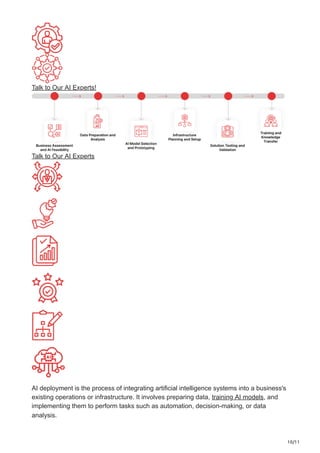
AI deployment is the process of integrating artificial intelligence systems into a business's
existing operations or infrastructure. It involves preparing data, training AI models, and
implementing them to perform tasks such as automation, decision-making, or data
analysis.
11/11
AI deployment helps businesses streamline operations, improve efficiency, reduce costs,
and make data-driven decisions. It also enhances scalability, automates repetitive tasks,
and enables real-time insights into business performance.
AI solutions can be deployed through several options, including cloud deployment, on-
premises deployment, hybrid deployment, multi-cloud deployment, and serverless
deployment. Each option caters to different needs, such as scalability, security, and cost-
efficiency.
Industries such as healthcare, finance, retail, logistics, manufacturing, real estate,
education, energy, and agriculture benefit significantly from AI deployment by automating
processes, improving decision-making, and enhancing overall productivity.
While large datasets are beneficial for training complex AI models, many AI solutions can
be implemented with smaller datasets using techniques like transfer learning. The data
requirements depend on the specific use case and desired outcomes.
The timeline for AI deployment varies based on the complexity of the project, the type of
solution, and the business’s infrastructure. It can range from a few weeks for simple
applications to several months for large-scale or highly customized solutions.
AI deployment services use encryption, secure data storage, access controls, and
adherence to regulations like GDPR or HIPAA to ensure that sensitive data remains
protected and that systems comply with industry standards.
Yes, AI solutions can be seamlessly integrated with existing business systems such as
ERP, CRM, or supply chain platforms. Proper planning and testing ensure smooth
integration without disrupting current workflows.
After deployment, AI solutions require monitoring, maintenance, and optimization to
ensure consistent performance. This may include periodic updates, retraining models with
new data, and scaling the system to meet evolving business needs.

solulab.com-AI Deployment Company (1).pdf

  • 1.
    1/11 February 28, 2025 AIDeployment Company solulab.com/ai-deployment-services-company Let’s Discuss!
  • 2.
  • 3.
  • 4.
  • 5.
  • 6.
  • 7.
  • 8.
  • 9.
  • 10.
    10/11 Talk to OurAI Experts! Talk to Our AI Experts AI deployment is the process of integrating artificial intelligence systems into a business's existing operations or infrastructure. It involves preparing data, training AI models, and implementing them to perform tasks such as automation, decision-making, or data analysis.
  • 11.
    11/11 AI deployment helpsbusinesses streamline operations, improve efficiency, reduce costs, and make data-driven decisions. It also enhances scalability, automates repetitive tasks, and enables real-time insights into business performance. AI solutions can be deployed through several options, including cloud deployment, on- premises deployment, hybrid deployment, multi-cloud deployment, and serverless deployment. Each option caters to different needs, such as scalability, security, and cost- efficiency. Industries such as healthcare, finance, retail, logistics, manufacturing, real estate, education, energy, and agriculture benefit significantly from AI deployment by automating processes, improving decision-making, and enhancing overall productivity. While large datasets are beneficial for training complex AI models, many AI solutions can be implemented with smaller datasets using techniques like transfer learning. The data requirements depend on the specific use case and desired outcomes. The timeline for AI deployment varies based on the complexity of the project, the type of solution, and the business’s infrastructure. It can range from a few weeks for simple applications to several months for large-scale or highly customized solutions. AI deployment services use encryption, secure data storage, access controls, and adherence to regulations like GDPR or HIPAA to ensure that sensitive data remains protected and that systems comply with industry standards. Yes, AI solutions can be seamlessly integrated with existing business systems such as ERP, CRM, or supply chain platforms. Proper planning and testing ensure smooth integration without disrupting current workflows. After deployment, AI solutions require monitoring, maintenance, and optimization to ensure consistent performance. This may include periodic updates, retraining models with new data, and scaling the system to meet evolving business needs.