SECTION 3:SOIL


  Chapter 14 Weathering and Erosion





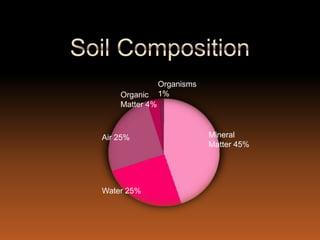
Organisms
    Organic     1%
    Matter 4%


Air 25%                     Mineral
                            Matter 45%


Water 25%










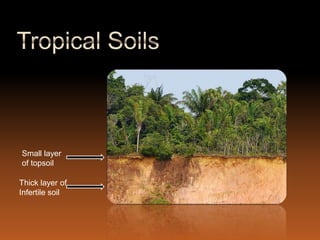
Small layer
of topsoil

Thick layer of
Infertile soil
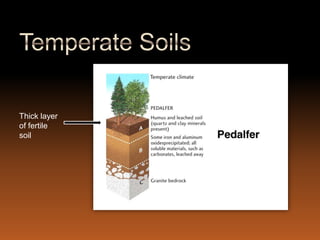
Thick layer
of fertile
soil
Soil
Soil

Soil

Editor's Notes

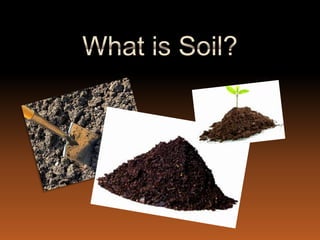
  • #3 Soil is a complex mixture of minerals, water, gases, and the remains of dead organisms. Soil is extremely vital for the existence of many life forms on Earth. Without soil, plants would not be able to grow and thrive, which would cut down all of the consumer organisms that rely on plants to survive.
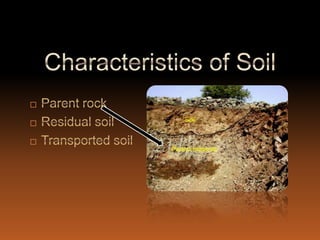
  • #4 The parent rock is the rock from which the soil was originally weathered. The characteristics of soil are determined by the type of parent rock it came from. Residual soil is usually formed from chemical or physical weathering, and it eventually covers the parent rock. Transported soil is soil that has been carried away from the parent rock by water, wind, or glaciers. This type of soil, because it is not found near its parent rock, usually has different characteristics than the bedrock it rests on.
  • #5 Typical soil consists of 4% organic matter, 25% air, 25% water, 45% mineral matter, and 1% organisms. What soil is made of greatly affects how soil feels or what its color is. Rocks that contain large amounts of quartz weather to become sandy soils. Soils that contain lots of aluminum later on weather to form clay. Soil that contains a lot of copper would appear a reddish tint, and black soils are rich in organic material. The color of soil also determines the amount of moisture it contains. A darker soil would have more moisture, whereas a lighter soil would contain less moisture.
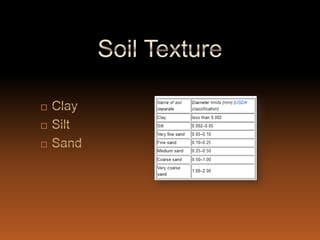
  • #6 Rock material in soil consists of three main types: Clay, silt, and sand. Silt particles are hard to see, but make soil feel gritty. Clay is made of the finest particles and feels sticky when moist. Sand has a gritty texture as well.
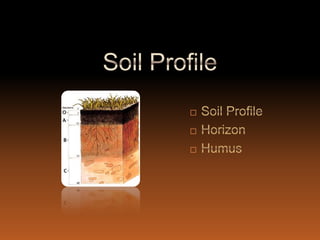
  • #7 Soil profile is a vertical section of soil that shows the layers of horizons. Scientists study a soil profile to determine the soil’s composition. The different layers of soil are called horizons, and there are typically 3 layers of horizons. Horizon A is the uppermost layer, otherwise known as topsoil. Horizon A is where most organisms that survive in soil live. Humus is an organic material that organisms produce when they decay. Horizon B is the zone of leaching, where dissolved or suspended materials move downward. Horizon C mainly consists of rock particles that have gone through slight weathering.
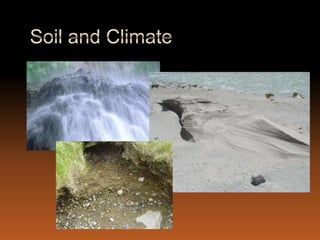
  • #8 Climate is a key factor in that influences soil information. Because different places have climates and weather, the weathering process for each area is different. In some areas, the main process of weathering is wind weathering. In others, it is rain erosion. Understanding the climate of a region is a big step towards determining the composition of soil.
  • #9 In tropical climates, heavy rainfall often produces a thick, infertile layer of soil through chemical weathering. There is usually a thin layer or fertile layer on top, while the rest of the soil is a thick layer of infertile soil called “laterite”.
  • #10 In temperate climates, though rainfall is not excessive, both mechanical and chemical weathering occur. Two main soil types that form are “pedalfer” and “pedocal”. Pedalfer soil form in areas that receive more than 65 centimeters of rain per year, and usually contains clay, quartz, and iron compounds. Pedocal soil is very fertile and less acidic than pedalfer soil. This type of soil forms in regions that receive less than 65 centimeters of rain per year, and contains large amounts of calcium carbonate.
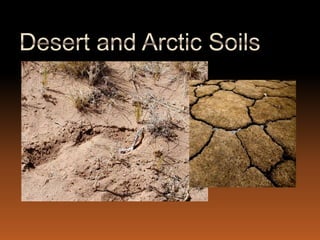
  • #11 Since there is rarely any rainfall in desert and arctic climates, chemical weathering occurs very slowly. Because of this, the soil has very little moisture, and consists mainly of regolith, or loose, heterogeneousmaterial covering solid rock. Because there aren’t many organisms that can survive in parched desert or arctic soil, there is very little humus in the soils.
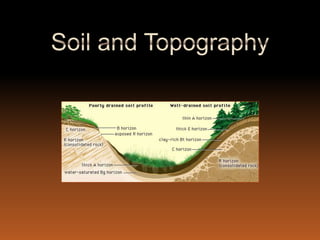
  • #12 Topography is another element that affects soil formation. Topography often determines the way water and other substances run, causing weathering. A steep slope would obviously have a thinner layer of topsoil at the top of the slope because of constant water flow moving down the slope during rainfall. The bottom of the slope would be thicker, since much of the soil from the top of the slope is washed down to the bottom.