SOFTWARE PROJECT MANAGEMENT
GROUP
04
CONTENT
01 What is software project management
02 The Role of Software Project Manager
03 Risk Management
04 People Management
 A project is well-defined task, which is a collection of
several operations done in order to achieve a goal (for
example, software development and delivery).
 It’s a essential part of software engineering.
 Projects needs to be managed because professional
software engineering is always subject to organizational
budget and schedule constraints.
 So we want Project management to ensure that
software meets and overcome these constraints as well
as delivering high quality software.
What is Software
Project Management?
A Project can be characterized as:
01
03
• Every project may has a unique and distinct goal.
• Project is not routine activity or day-to-day operations.
• Project comes with a start time and end time.
• Project ends when its goal is achieved hence it is a temporary phase in the lifetime of an organization.
• Project needs adequate resources in terms of time, manpower, finance, material and knowledge-bank.
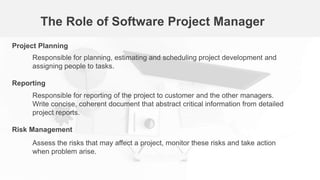
Project Planning
Responsible for planning, estimating and scheduling project development and
assigning people to tasks.
Reporting
Responsible for reporting of the project to customer and the other managers.
Write concise, coherent document that abstract critical information from detailed
project reports.
Risk Management
Assess the risks that may affect a project, monitor these risks and take action
when problem arise.
The Role of Software Project Manager
People Management
Responsible for managing a team of people.
Choose people for their team and establish ways of working
that lead to effective team performance.
Proposal Writing
The first stage in a software project may involve writing a proposal to win a
contract.
It includes cost and schedule estimate and justifies why the project should be
awarded to them.
The Role of Software Project Manager Continue..
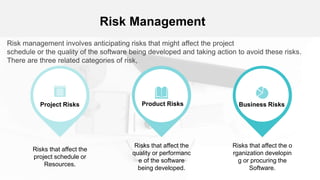
Project Risks Product Risks Business Risks
Risks that affect the
project schedule or
Resources.
Risks that affect the
quality or performanc
e of the software
being developed.
Risks that affect the o
rganization developin
g or procuring the
Software.
Risk Management
Risk management involves anticipating risks that might affect the project
schedule or the quality of the software being developed and taking action to avoid these risks.
There are three related categories of risk,
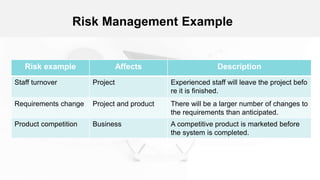
Risk example Affects Description
Staff turnover Project Experienced staff will leave the project befo
re it is finished.
Requirements change Project and product There will be a larger number of changes to
the requirements than anticipated.
Product competition Business A competitive product is marketed before
the system is completed.
Risk Management Example
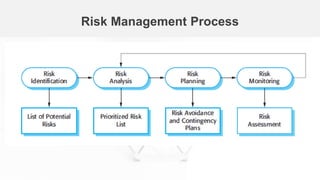
Risk Management Process
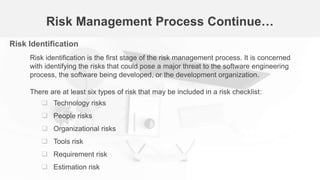
Risk Management Process Continue…
Risk Identification
Risk identification is the first stage of the risk management process. It is concerned
with identifying the risks that could pose a major threat to the software engineering
process, the software being developed, or the development organization.
There are at least six types of risk that may be included in a risk checklist:
 Technology risks
 People risks
 Organizational risks
 Tools risk
 Requirement risk
 Estimation risk
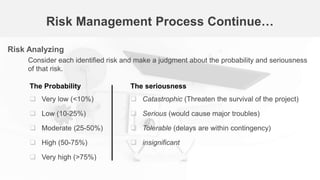
Risk Management Process Continue…
Risk Analyzing
Consider each identified risk and make a judgment about the probability and seriousness
of that risk.
The Probability
 Very low (<10%)
 Low (10-25%)
 Moderate (25-50%)
 High (50-75%)
 Very high (>75%)
The seriousness
 Catastrophic (Threaten the survival of the project)
 Serious (would cause major troubles)
 Tolerable (delays are within contingency)
 insignificant
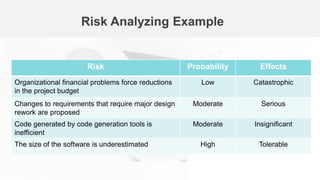
Risk Probability Effects
Organizational financial problems force reductions
in the project budget
Low Catastrophic
Changes to requirements that require major design
rework are proposed
Moderate Serious
Code generated by code generation tools is
inefficient
Moderate Insignificant
The size of the software is underestimated High Tolerable
Risk Analyzing Example
Risk Management Process Continue…
Risk Planning
Considers each of the key risks that have been identified, and develop strategies to
manage these risks.
Avoidance strategies
Probability that the risk will arise will be reduced
Minimization strategies
Impact of the risk will be reduced
Contingency plans
Prepare for the worst and have a strategy in place to deal with it
Risk Management Process Continue…
Risk monitoring
Process of checking that your assumptions about the product, process, and business
risks have not changed.
People Management
 Consistency – People in a project team should all be treated in a comparable way.
 Respect – Different people have different skills and managers should respect these
differences.
 Inclusion – people contribute effectively when they feel that other listen to them and
take account of their proposals considered the all views.
 Honesty – As a manager you should always be honest about what is going well and
what is going badly in the team.
It costs a lot to recruit and retain good people and it is up to software managers to ensure that
the organization gets the best possible return on its investment
Motivating People
Motivation means organizing the work and the working environment to encourage people to w
ork as effectively as possible
Task Oriented People
Who are motivated by the work they do.
In software engineering these people motivated by the intellectual challenge of software development
Self-oriented People
Who are motivated by personal success and recognition.
They are interesting in software development as a means of achieving their own goals.
Interaction-oriented People
Who are motivated by the presence and actions of co-workers
Team Work
Putting together a group that has right balance of technical skills, experience and
personalities is a critical project management task.
 Selecting Group Members
 Group Organization
 Group Communication
Reference
 Software Engineering (ninth edition) –Ian Sommerville
 Tutorialspoint
 Youtube
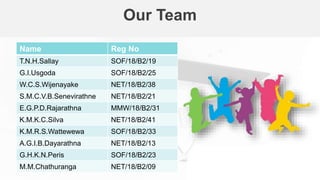
Our Team
Name Reg No
T.N.H.Sallay SOF/18/B2/19
G.I.Usgoda SOF/18/B2/25
W.C.S.Wijenayake NET/18/B2/38
S.M.C.V.B.Senevirathne NET/18/B2/21
E.G.P.D.Rajarathna MMW/18/B2/31
K.M.K.C.Silva NET/18/B2/41
K.M.R.S.Wattewewa SOF/18/B2/33
A.G.I.B.Dayarathna NET/18/B2/13
G.H.K.N.Peris SOF/18/B2/23
M.M.Chathuranga NET/18/B2/09
Software Project Management

Software Project Management

  • 1.
  • 2.
    CONTENT 01 What issoftware project management 02 The Role of Software Project Manager 03 Risk Management 04 People Management
  • 3.
     A projectis well-defined task, which is a collection of several operations done in order to achieve a goal (for example, software development and delivery).  It’s a essential part of software engineering.  Projects needs to be managed because professional software engineering is always subject to organizational budget and schedule constraints.  So we want Project management to ensure that software meets and overcome these constraints as well as delivering high quality software. What is Software Project Management?
  • 4.
    A Project canbe characterized as: 01 03 • Every project may has a unique and distinct goal. • Project is not routine activity or day-to-day operations. • Project comes with a start time and end time. • Project ends when its goal is achieved hence it is a temporary phase in the lifetime of an organization. • Project needs adequate resources in terms of time, manpower, finance, material and knowledge-bank.
  • 5.
    Project Planning Responsible forplanning, estimating and scheduling project development and assigning people to tasks. Reporting Responsible for reporting of the project to customer and the other managers. Write concise, coherent document that abstract critical information from detailed project reports. Risk Management Assess the risks that may affect a project, monitor these risks and take action when problem arise. The Role of Software Project Manager
  • 6.
    People Management Responsible formanaging a team of people. Choose people for their team and establish ways of working that lead to effective team performance. Proposal Writing The first stage in a software project may involve writing a proposal to win a contract. It includes cost and schedule estimate and justifies why the project should be awarded to them. The Role of Software Project Manager Continue..
  • 7.
    Project Risks ProductRisks Business Risks Risks that affect the project schedule or Resources. Risks that affect the quality or performanc e of the software being developed. Risks that affect the o rganization developin g or procuring the Software. Risk Management Risk management involves anticipating risks that might affect the project schedule or the quality of the software being developed and taking action to avoid these risks. There are three related categories of risk,
  • 8.
    Risk example AffectsDescription Staff turnover Project Experienced staff will leave the project befo re it is finished. Requirements change Project and product There will be a larger number of changes to the requirements than anticipated. Product competition Business A competitive product is marketed before the system is completed. Risk Management Example
  • 9.
  • 10.
    Risk Management ProcessContinue… Risk Identification Risk identification is the first stage of the risk management process. It is concerned with identifying the risks that could pose a major threat to the software engineering process, the software being developed, or the development organization. There are at least six types of risk that may be included in a risk checklist:  Technology risks  People risks  Organizational risks  Tools risk  Requirement risk  Estimation risk
  • 11.
    Risk Management ProcessContinue… Risk Analyzing Consider each identified risk and make a judgment about the probability and seriousness of that risk. The Probability  Very low (<10%)  Low (10-25%)  Moderate (25-50%)  High (50-75%)  Very high (>75%) The seriousness  Catastrophic (Threaten the survival of the project)  Serious (would cause major troubles)  Tolerable (delays are within contingency)  insignificant
  • 12.
    Risk Probability Effects Organizationalfinancial problems force reductions in the project budget Low Catastrophic Changes to requirements that require major design rework are proposed Moderate Serious Code generated by code generation tools is inefficient Moderate Insignificant The size of the software is underestimated High Tolerable Risk Analyzing Example
  • 13.
    Risk Management ProcessContinue… Risk Planning Considers each of the key risks that have been identified, and develop strategies to manage these risks. Avoidance strategies Probability that the risk will arise will be reduced Minimization strategies Impact of the risk will be reduced Contingency plans Prepare for the worst and have a strategy in place to deal with it
  • 14.
    Risk Management ProcessContinue… Risk monitoring Process of checking that your assumptions about the product, process, and business risks have not changed.
  • 15.
    People Management  Consistency– People in a project team should all be treated in a comparable way.  Respect – Different people have different skills and managers should respect these differences.  Inclusion – people contribute effectively when they feel that other listen to them and take account of their proposals considered the all views.  Honesty – As a manager you should always be honest about what is going well and what is going badly in the team. It costs a lot to recruit and retain good people and it is up to software managers to ensure that the organization gets the best possible return on its investment
  • 16.
    Motivating People Motivation meansorganizing the work and the working environment to encourage people to w ork as effectively as possible Task Oriented People Who are motivated by the work they do. In software engineering these people motivated by the intellectual challenge of software development Self-oriented People Who are motivated by personal success and recognition. They are interesting in software development as a means of achieving their own goals. Interaction-oriented People Who are motivated by the presence and actions of co-workers
  • 17.
    Team Work Putting togethera group that has right balance of technical skills, experience and personalities is a critical project management task.  Selecting Group Members  Group Organization  Group Communication
  • 18.
    Reference  Software Engineering(ninth edition) –Ian Sommerville  Tutorialspoint  Youtube
  • 19.
    Our Team Name RegNo T.N.H.Sallay SOF/18/B2/19 G.I.Usgoda SOF/18/B2/25 W.C.S.Wijenayake NET/18/B2/38 S.M.C.V.B.Senevirathne NET/18/B2/21 E.G.P.D.Rajarathna MMW/18/B2/31 K.M.K.C.Silva NET/18/B2/41 K.M.R.S.Wattewewa SOF/18/B2/33 A.G.I.B.Dayarathna NET/18/B2/13 G.H.K.N.Peris SOF/18/B2/23 M.M.Chathuranga NET/18/B2/09