Visit https://ebookultra.com todownload the full version and
explore more ebooks
Software Engineering 8ed. Edition Sommerville I.
_____ Click the link below to download _____
https://ebookultra.com/download/software-
engineering-8ed-edition-sommerville-i/
Explore and download more ebooks at ebookultra.com
2.
Here are somesuggested products you might be interested in.
Click the link to download
Software Engineering Handbook 1st Edition Jessica Keyes
https://ebookultra.com/download/software-engineering-handbook-1st-
edition-jessica-keyes/
Human Centered Software Engineering Integrating Usability
in the Software Development Lifecycle Ahmed Seffah
https://ebookultra.com/download/human-centered-software-engineering-
integrating-usability-in-the-software-development-lifecycle-ahmed-
seffah/
Essentials of software engineering Fourth Edition Barbara
Bernal
https://ebookultra.com/download/essentials-of-software-engineering-
fourth-edition-barbara-bernal/
Essentials Of Software Engineering 3rd Edition Frank Tsui
https://ebookultra.com/download/essentials-of-software-
engineering-3rd-edition-frank-tsui/
3.
Software Engineering andComputer Games 1st Edition Rucker
https://ebookultra.com/download/software-engineering-and-computer-
games-1st-edition-rucker/
Object Oriented Software Engineering 7th Edition Stephen
Schach
https://ebookultra.com/download/object-oriented-software-
engineering-7th-edition-stephen-schach/
Software Reliability Engineering More Reliable Software
Faster and Cheaper 2nd Edition John D. Musa
https://ebookultra.com/download/software-reliability-engineering-more-
reliable-software-faster-and-cheaper-2nd-edition-john-d-musa/
Fundamentals of software engineering 4th ed. Edition Rajib
Mall
https://ebookultra.com/download/fundamentals-of-software-
engineering-4th-ed-edition-rajib-mall/
Software engineering quality practices 1st Edition Ronald
Kirk Kandt
https://ebookultra.com/download/software-engineering-quality-
practices-1st-edition-ronald-kirk-kandt/
5.
Software Engineering 8ed.Edition Sommerville I. Digital
Instant Download
Author(s): Sommerville I.
ISBN(s): 9780321313799, 0321313798
Edition: 8ed.
File Details: PDF, 9.61 MB
Year: 2006
Language: english
6.
Log on toaw-bc.com/computing
for a full list of Computing titles.
The 8th edition of the best-selling
introduction to software engineering is
now updated with three new chapters on
state-of-the-art topics.
NEW CHAPTERS IN THE 8TH EDITION
• Security engineering, showing you how
you can design software to resist attacks
and recover from damage;
• Service-oriented software engineering,
explaining how reusable web services
can be used to develop new
applications;
• Aspect-oriented software development,
introducing new techniques based on
the separation of concerns.
Software
Engineering
Software
Engineering
KEY FEATURES
• Includes the latest developments in software
engineering theory and practice, integrated
with relevant aspects of systems engineering.
• Extensive coverage of agile methods and
reuse.
• Integrated coverage of system safety,
security and reliability – illustrating best
practice in developing critical systems.
• Two running case studies (an information
system and a control system) illuminate
different stages of the software lifecycle.
ONLINE RESOURCES
Visit www.pearsoned.co.uk/sommerville to
access a full range of resources for students
and instructors.
In addition, a rich collection of resources
including links to other websites, teaching
material on related courses and additional
chapters is available at
http://www.software-engin.com.
IAN SOMMERVILLE is Professor of Software
Engineering at the University of St. Andrews
in Scotland
8
8
8
SOMMERVILLE
SOMMERVILLE
SOMMERVILLE
Software
Engineering
Software Engineering
ISBN 0-321-31379-8
9 780321 313799
www.pearson-books.com
an imprint of
0321313798_cover.qxd 26/4/06 17:48 Page 1
7.
••
Software Engineering EighthEdition
Visit the Software Engineering, eighth edition Companion
Website at www.pearsoned.co.uk/sommerville to find
valuable student learning material including:
• Lecture presentations (in PowerPoint and PDF) for all
chapters in the book
• Class quiz questions for each chapter
• Case studies
• Project suggestions
• Suggestions for further reading and links to web
resources for each chapter
This 8th edition has enhanced the 7th edition with
new material on security engineering, service-oriented
software engineering and aspect-oriented software
development. For educational purposes, it is completely
compatible with the 7th edition.
SE8_A01.qxd 4/4/06 8:53 Page i
8.
••
Operating Systems
J Baconand T Harris
Programming Language Essentials
H E Bal and D Grune
Programming in Ada 95, 2nd ed
J G P Barnes
Java Gently, 3rd ed
J Bishop
Software Design, 2nd ed
D Budgen
Concurrent Programming
A Burns and G Davies
Real-Time Systems and Programming Languages, 3rd ed
A Burns and A Wellings
Database Systems, 4th ed
T Connolly and C Begg
Distributed Systems, 4th ed
G Coulouris, J Dollimore and T Kindberg
Fortran 90 Programming, 2nd ed
T M R Ellis, I R Phillips and T M Lahey
Program Verification
N Francez
Introduction to Programming using SML
M Hansen and H Rischel
Functional C
P Hartel and H Muller
Algorithms and Data Structures, 2nd ed
J Kingston
Introductory Logic and Sets for Computer Scientists
N Nissanke
Human-Computer Interaction
J Preece et al
Algorithms
F Rabhi and G Lapalme
Ada 95 From the Beginning, 3rd ed
J Skansholm
C++ From the Beginning, 2nd ed
J Skansholm
Java From the Beginning, 2nd ed
J Skansholm
Object-Oriented Programming in Eiffel, 2nd ed
P Thomas and R Weedon
Miranda
S Thompson
Haskell, 2nd ed
S Thompson
Discrete Mathematics for Computer Scientists, 2nd ed
J K Truss
Compiler Design
R Wilhem and D Maurer
Discover Delphi
S Williams and S Walmsley
Comparative Programming Languages, 3rd ed
R G Clark
International Computer Science Series
Selected titles in the series
SE8_A01.qxd 4/4/06 8:53 Page ii
••
Preface
The first editionof this textbook on software engineering was published more than
twenty years ago. That edition was written using a dumb terminal attached to an early
minicomputer (a PDP-11) that probably cost about $50,000. I wrote this edition on
a wireless laptop that cost less than $2,000 and is many times more powerful than
that PDP-11. Software then was mostly mainframe software, but personal computers
were just becoming available. None of us then realised how pervasive these would
become and how much they would change the world.
Changes in hardware over the past twenty or so years have been absolutely remark-
able, and it may appear that changes in software have been equally significant.
Certainly, our ability to build large and complex systems has improved dramatically.
Our national utilities and infrastructure—energy, communications and transport—
rely on very complex and, largely, very reliable computer systems. For building
business systems, there is an alphabet soup of technologies—J2EE, .NET, EJB, SAP,
BPEL4WS, SOAP, CBSE—that allow large web-based applications to be deployed
much more quickly than was possible in the past.
However, although much appears to have changed in the last two decades, when
we look beyond the specific technologies to the fundamental processes of soft-
ware engineering, much has stayed the same. We recognised twenty years ago that
the waterfall model of the software process had serious problems, yet a survey
published in December 2003 in IEEE Software showed that more than 40% of
companies are still using this approach. Testing is still the dominant program
validation technique, although other techniques such as inspections have been used
more effectively since the mid-1970s. CASE tools, although now based around the
UML, are still essentially diagram editors with some checking and code-generation
functionality.
SE8_A01.qxd 4/4/06 8:53 Page v
12.
vi Preface
Our currentsoftware engineering methods and techniques have made us much
better at building large and complex systems than we were. However, there are still
too many projects that are late, are over budget and do not deliver the software
that meets the customer’s needs. While I was writing the 7th edition, a government
enquiry in the UK reported on the project to provide a national system to be used
in courts that try relatively minor offenders. The cost of this system was estimated
at £156 million and it was scheduled for delivery in 2001. In 2004, costs had
escalated to £390 million and it was still not fully operational. There is, therefore,
still a pressing need for software engineering education.
Over the past few years, the most significant developments in software engineer-
ing have been the emergence of the UML as a standard for object-oriented system
description and the development of agile methods such as extreme programming.
Agile methods are geared to rapid system development, explicitly involve the user
in the development team, and reduce paperwork and bureaucracy in the software
process. In spite of what some critics claim, I think these approaches embody good
software engineering practice. They have a well-defined process, pay attention to
system specification and user requirements, and have high quality standards.
However, this revision has not become a text on agile methods. Rather, I focus
on the basic software engineering processes—specification, design, development,
verification, and validation and management. You need to understand these processes
and associated techniques to decide whether agile methods are the most appropriate
development strategy for you and how to adapt and change methods to suit your
particular situation. A pervasive theme of the book is critical systems—systems whose
failure has severe consequences and where system dependability is critical. In
each part of the book, I discuss specific software engineering techniques that are
relevant to critical systems engineering.
Books inevitably reflect the opinions and prejudices of their authors. Some
readers will disagree with my opinions and with my choice of material. Such dis-
agreement is a healthy reflection of the diversity of the discipline and is essential
for its evolution. Nevertheless, I hope that all software engineers and software
engineering students can find something of interest here.
The structure of the book
The structure of the book is based around the fundamental software engineering
processes. It is organised into seven parts. The first six focus on software processes
and the final part discusses some important new software engineering technologies.
Part 1: Introduces software engineering, places it in a broader systems context
and presents the notions of software engineering processes and management.
••
••
SE8_A01.qxd 4/4/06 8:53 Page vi
13.
Preface vii
Part 2:Covers the processes, techniques and deliverables that are associated with
requirements engineering. It includes a discussion of software requirements,
system modelling, formal specification and techniques for specifying dependability.
Part 3: This part is devoted to software design and design processes. Three out of
the six chapters focus on the important topic of software architectures. Other topics
include object-oriented design, real-time systems design and user interface design.
Part 4: Describes a number of approaches to development, including agile methods,
software reuse, CBSE and critical systems development. Because change is now
such a large part of development, I have integrated material on software evolution
and maintenance into this part.
Part 5: Focuses on techniques for software verification and validation. It includes
chapters on static V & V, testing and critical systems validation.
Part 6: This part covers a range of management topics: managing people,
cost estimation, quality management, process improvement and configuration
management.
Part 7: The final part includes three chapters that are devoted to important
new technologies that are already starting to be used. The chapters cover security
engineering, service-oriented software engineering and aspect-oriented software
development.
In the introduction to each part, I discuss the structure and organisation in more
detail.
Changes from the 7th edition
This new edition of my textbook can be thought of as a mid-life upgrade than a
radical new revision of the book. I have designed it to be completely compatible
with the 7th edition but have included a new section on Emerging Technologies.
This discusses recent developments which I believe are significant for the future of
software engineering. This section includes three additional chapters:
30. Security engineering where I discuss issues of how to ensure that your soft-
ware is secure and can resist external attacks.
31. Service-oriented software engineering where I describe new approaches to
application development using reusable web services.
32. Aspect-oriented software development where I introduce a new technique of
software development based around the separation of concerns.
As the other chapters in the book are still current and relevant, I have not mod-
ified these, apart from very small changes to link to the new material in Chapters
30–32. More information on changes and the differences between the 6th and 7th
editions is available from the book website.
••
••
SE8_A01.qxd 4/4/06 8:53 Page vii
14.
viii Preface
Readership
The bookis aimed at students taking undergraduate and graduate courses and at
software engineers in commerce and industry. It may be used in general software
engineering courses or in courses such as advanced programming, software specifica-
tion, and software design or management. Software engineers in industry may find
the book useful as general reading and as a means of updating their knowledge on
particular topics such as requirements engineering, architectural design, dependable
systems development and process improvement. Wherever practicable, the examples
in the text have been given a practical bias to reflect the type of applications that
software engineers must develop.
Using the book for teaching
The book is widely used in a range of software engineering courses and, if you already
use the 7th edition, then you will find this edition to be completely compatible with
it. I have deliberately left Chapters 1 to 29 of the 7th edition unchanged. If you
use these in your teaching, there is no need to change any of your supplementary
material or associated coursework. The new chapters are stand-alone chapters and
you may wish to introduce one or more of them to give students an understanding
of new developments in the subject.
I have designed the book so that it can be used in three types of software
engineering course:
1. General introductory courses in software engineering For students who have
no previous software engineering experience, you can start with the introductory
section, then pick and choose chapters from the other sections of the book.
This will give students a general overview of the subject with the opportunity
of more detailed study for those students who are interested. If the course’s
approach is project-based, the early chapters provide enough material to allow
students to get started on projects, consulting later chapters for reference and
further information as their work progresses.
2. Introductory or intermediate courses on specific software engineering topics
The book supports courses in software requirements specification, software design,
software engineering management, dependable systems development and soft-
ware evolution. Each part can serve as a text in its own right for an introductory
or intermediate course on that topic. As well as further reading associated with
each chapter, I have also included information on other relevant papers and books
on the web site.
••
••
SE8_A01.qxd 4/4/06 8:53 Page viii
15.
Preface ix
3. Moreadvanced courses in specific software engineering topics The chapters
can form a foundation for a specific software course, but they must be sup-
plemented with further reading that explores the topic in greater detail. For
example, I teach an MSc module in systems engineering that relies on material
here. I have included details of this course and a course on critical systems
engineering on the web site.
The benefit of a general text like this is that it can be used in several related
courses. The text can be used in an introductory software engineering course and
in courses on specification, design and critical systems. Courses on component-based
software engineering and systems engineering use the book along with additional
papers that are distributed to students. Having a single text presents students with
a consistent view of the subject—and they don’t have to buy several books.
To reinforce the student’s learning experience, I have included a glossary of key
terms, with additional definitions on the web site. Furthermore, each chapter has:
• a clearly defined set of objectives set out on the first page;
• a list of key points covered in the chapter;
• suggested further reading—either books that are currently in print or easily
available papers (lists of other suggested readings and links can be found on
my web site);
• exercises, including design exercises.
The Software Engineering Body of Knowledge project (http://www.swebok.org)
was established to define the key technical knowledge areas that are relevant to pro-
fessional software engineers. These are organised under 10 headings: requirements,
design, construction, testing, maintenance, configuration management, management,
process, tools and methods, and quality. While it would be impossible to cover all
of the knowledge areas proposed by the SWEBOK project in a single textbook, all
of the top-level areas are discussed in this book.
Web pages
The publishers web site that is associated with the book is:
http://www.pearsoned.co.uk/sommerville
To support the use of this book in software engineering courses, I have included
a wide range of supplementary material on the web site. If you follow the Material
for Instructors links, you can find:
••
••
SE8_A01.qxd 4/4/06 8:53 Page ix
16.
x Preface
• lecturepresentations (PowerPoint and PDF) for all chapters in the book;
• class quiz questions for each chapter;
• case studies;
• project suggestions;
• course structure descriptions;
• suggestions for further reading and links to web resources for each chapter;
• solutions for a selection of the exercises associated with each chapter and for
the quiz questions (available to instructor’s only).
My own web site, includes all of the material on the publishers web site plus
extensive supplementary material on software engineering such as links to other sites,
invited lectures that I have presented, teaching material that I have developed for
related courses such as Systems Engineering and the web sites of previous editions
of Software Engineering. The URL of this site is:
http://www.software-engin.com
It has been my policy, both in the previous edition and in this edition, to keep
the number of web links in the book to an absolute minimum. The reason for this
is that these links are subject to change and, once printed, it is impossible to update
them. Consequently, the book’s web page includes a large number of links to resources
and related material on software engineering. If you use these and find problems,
please let me know and I will update the links.
I welcome your constructive comments and suggestions about the book and the web
site. You can contact me at ian@software-engin.com. I recommend that you include
[SE8] in the subject of the e-mail message to ensure that my spam filters do not
accidentally reject your mail. I regret that I do not have time to help students with their
homework, so please do not ask me how to solve any of the problems in the book.
Acknowledgements
A large number of people have contributed over the years to the evolution of this book
and I’d like to thank everyone (reviewers, students and book users who have e-mailed
me) who has commented on previous editions and made constructive suggestions
for change. The editorial and production staff at Pearson Education in England and
the US were supportive and helpful, and produced the book in record time. So thanks
to Simon Plumtree, Mary Lince, Ros Woodward, Keith Mansfield, Patty Mahtani,
Daniel Rausch, Carol Noble and Sharon Burkhardt for their help and support.
••
••
SE8_A01.qxd 4/4/06 8:54 Page x
17.
Preface xi
As Iwrite, I am about to leave Lancaster University for new challenges at
St Andrews University in Scotland. I’d like to thank all of my current and pre-
vious colleagues at Lancaster for their support and encouragement over the years
as software engineering has evolved.
Finally, I’d like to thank my family, who tolerated my absence when the book
was being written and my frustration when the words were not flowing. A big thank-
you to my wife Anne and daughters Ali and Jane for their help and support.
Ian Sommerville,
February 2006
••
••
SE8_A01.qxd 4/4/06 8:54 Page xi
18.
••
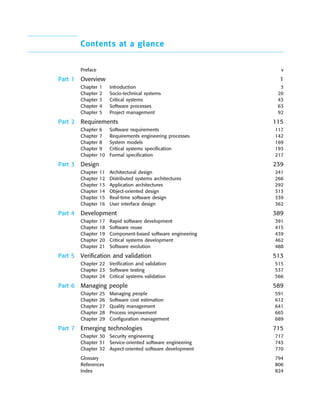
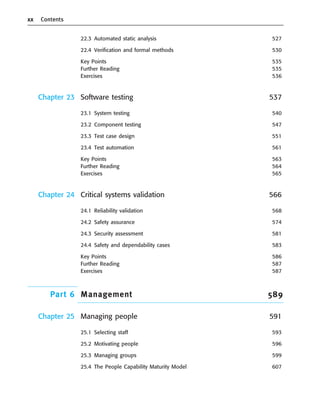
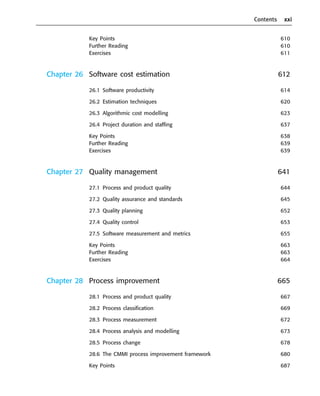
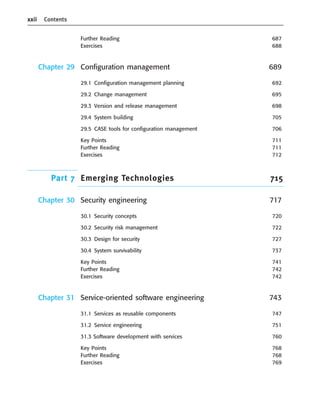
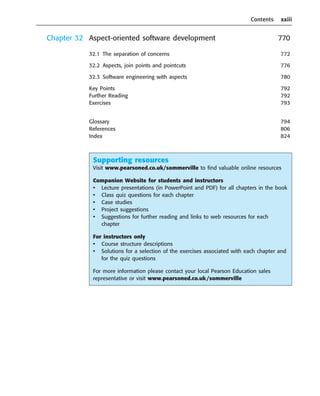
Contents at aglance
Preface v
Part 1 Overview 1
Chapter 1 Introduction 3
Chapter 2 Socio-technical systems 20
Chapter 3 Critical systems 43
Chapter 4 Software processes 63
Chapter 5 Project management 92
Part 2 Requirements 115
Chapter 6 Software requirements 117
Chapter 7 Requirements engineering processes 142
Chapter 8 System models 169
Chapter 9 Critical systems specification 193
Chapter 10 Formal specification 217
Part 3 Design 239
Chapter 11 Architectural design 241
Chapter 12 Distributed systems architectures 266
Chapter 13 Application architectures 292
Chapter 14 Object-oriented design 313
Chapter 15 Real-time software design 339
Chapter 16 User interface design 362
Part 4 Development 389
Chapter 17 Rapid software development 391
Chapter 18 Software reuse 415
Chapter 19 Component-based software engineering 439
Chapter 20 Critical systems development 462
Chapter 21 Software evolution 488
Part 5 Verification and validation 513
Chapter 22 Verification and validation 515
Chapter 23 Software testing 537
Chapter 24 Critical systems validation 566
Part 6 Managing people 589
Chapter 25 Managing people 591
Chapter 26 Software cost estimation 612
Chapter 27 Quality management 641
Chapter 28 Process improvement 665
Chapter 29 Configuration management 689
Part 7 Emerging technologies 715
Chapter 30 Security engineering 717
Chapter 31 Service-oriented software engineering 743
Chapter 32 Aspect-oriented software development 770
Glossary 794
References 806
Index 824
SE8_A01.qxd 4/4/06 8:54 Page xii
19.
••
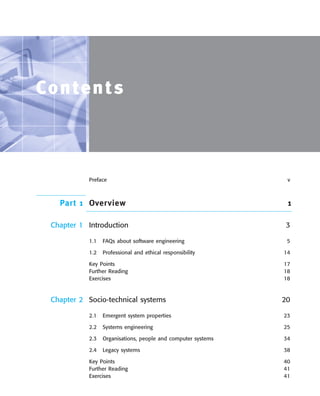
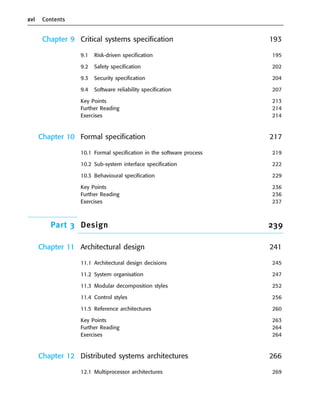
Contents
Preface v
Part 1Overview 1
Chapter 1 Introduction 3
1.1 FAQs about software engineering 5
1.2 Professional and ethical responsibility 14
Key Points 17
Further Reading 18
Exercises 18
Chapter 2 Socio-technical systems 20
2.1 Emergent system properties 23
2.2 Systems engineering 25
2.3 Organisations, people and computer systems 34
2.4 Legacy systems 38
Key Points 40
Further Reading 41
Exercises 41
SE8_A01.qxd 4/4/06 8:54 Page xiii
20.
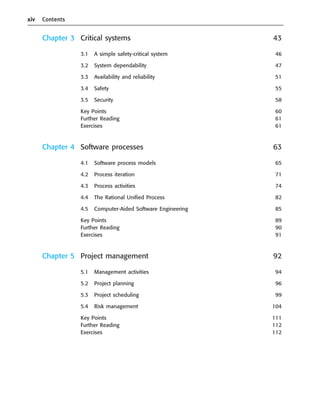
xiv Contents
Chapter 3Critical systems 43
3.1 A simple safety-critical system 46
3.2 System dependability 47
3.3 Availability and reliability 51
3.4 Safety 55
3.5 Security 58
Key Points 60
Further Reading 61
Exercises 61
Chapter 4 Software processes 63
4.1 Software process models 65
4.2 Process iteration 71
4.3 Process activities 74
4.4 The Rational Unified Process 82
4.5 Computer-Aided Software Engineering 85
Key Points 89
Further Reading 90
Exercises 91
Chapter 5 Project management 92
5.1 Management activities 94
5.2 Project planning 96
5.3 Project scheduling 99
5.4 Risk management 104
Key Points 111
Further Reading 112
Exercises 112
••
••
SE8_A01.qxd 4/4/06 8:54 Page xiv
21.
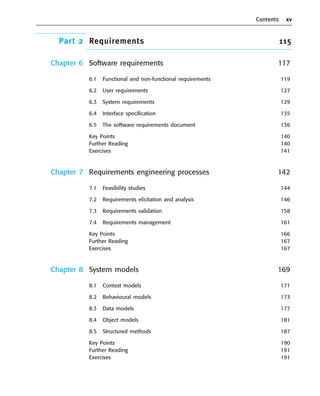
Contents xv
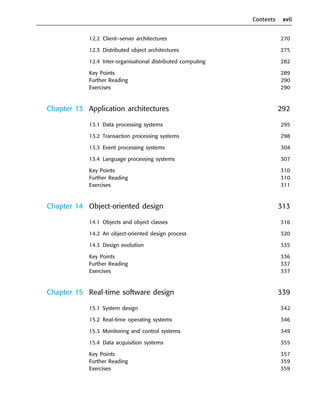
Part 2Requirements 115
Chapter 6 Software requirements 117
6.1 Functional and non-functional requirements 119
6.2 User requirements 127
6.3 System requirements 129
6.4 Interface specification 135
6.5 The software requirements document 136
Key Points 140
Further Reading 140
Exercises 141
Chapter 7 Requirements engineering processes 142
7.1 Feasibility studies 144
7.2 Requirements elicitation and analysis 146
7.3 Requirements validation 158
7.4 Requirements management 161
Key Points 166
Further Reading 167
Exercises 167
Chapter 8 System models 169
8.1 Context models 171
8.2 Behavioural models 173
8.3 Data models 177
8.4 Object models 181
8.5 Structured methods 187
Key Points 190
Further Reading 191
Exercises 191
••
••
SE8_A01.qxd 4/4/06 8:54 Page xv
22.
xvi Contents
Chapter 9Critical systems specification 193
9.1 Risk-driven specification 195
9.2 Safety specification 202
9.3 Security specification 204
9.4 Software reliability specification 207
Key Points 213
Further Reading 214
Exercises 214
Chapter 10 Formal specification 217
10.1 Formal specification in the software process 219
10.2 Sub-system interface specification 222
10.3 Behavioural specification 229
Key Points 236
Further Reading 236
Exercises 237
Part 3 Design 239
Chapter 11 Architectural design 241
11.1 Architectural design decisions 245
11.2 System organisation 247
11.3 Modular decomposition styles 252
11.4 Control styles 256
11.5 Reference architectures 260
Key Points 263
Further Reading 264
Exercises 264
Chapter 12 Distributed systems architectures 266
12.1 Multiprocessor architectures 269
••
••
SE8_A01.qxd 4/4/06 8:54 Page xvi
23.
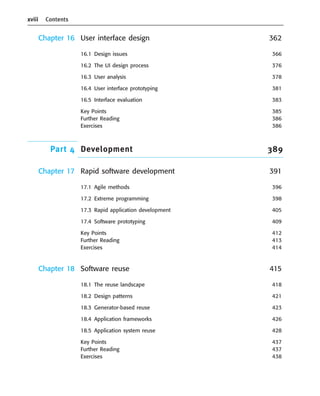
Contents xvii
12.2 Client–serverarchitectures 270
12.3 Distributed object architectures 275
12.4 Inter-organisational distributed computing 282
Key Points 289
Further Reading 290
Exercises 290
Chapter 13 Application architectures 292
13.1 Data processing systems 295
13.2 Transaction processing systems 298
13.3 Event processing systems 304
13.4 Language processing systems 307
Key Points 310
Further Reading 310
Exercises 311
Chapter 14 Object-oriented design 313
14.1 Objects and object classes 316
14.2 An object-oriented design process 320
14.3 Design evolution 335
Key Points 336
Further Reading 337
Exercises 337
Chapter 15 Real-time software design 339
15.1 System design 342
15.2 Real-time operating systems 346
15.3 Monitoring and control systems 349
15.4 Data acquisition systems 355
Key Points 357
Further Reading 359
Exercises 359
••
••
SE8_A01.qxd 4/4/06 8:54 Page xvii
24.
xviii Contents
Chapter 16User interface design 362
16.1 Design issues 366
16.2 The UI design process 376
16.3 User analysis 378
16.4 User interface prototyping 381
16.5 Interface evaluation 383
Key Points 385
Further Reading 386
Exercises 386
Part 4 Development 389
Chapter 17 Rapid software development 391
17.1 Agile methods 396
17.2 Extreme programming 398
17.3 Rapid application development 405
17.4 Software prototyping 409
Key Points 412
Further Reading 413
Exercises 414
Chapter 18 Software reuse 415
18.1 The reuse landscape 418
18.2 Design patterns 421
18.3 Generator-based reuse 423
18.4 Application frameworks 426
18.5 Application system reuse 428
Key Points 437
Further Reading 437
Exercises 438
••
••
SE8_A01.qxd 4/4/06 8:54 Page xviii
25.
Contents xix
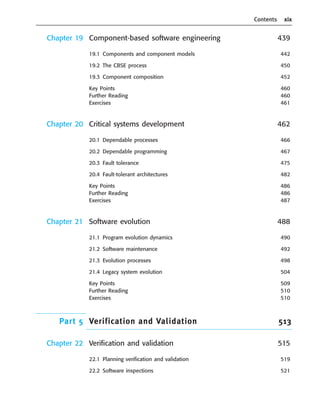
Chapter 19Component-based software engineering 439
19.1 Components and component models 442
19.2 The CBSE process 450
19.3 Component composition 452
Key Points 460
Further Reading 460
Exercises 461
Chapter 20 Critical systems development 462
20.1 Dependable processes 466
20.2 Dependable programming 467
20.3 Fault tolerance 475
20.4 Fault-tolerant architectures 482
Key Points 486
Further Reading 486
Exercises 487
Chapter 21 Software evolution 488
21.1 Program evolution dynamics 490
21.2 Software maintenance 492
21.3 Evolution processes 498
21.4 Legacy system evolution 504
Key Points 509
Further Reading 510
Exercises 510
Part 5 Verification and Validation 513
Chapter 22 Verification and validation 515
22.1 Planning verification and validation 519
22.2 Software inspections 521
••
••
SE8_A01.qxd 4/4/06 8:54 Page xix
26.
xx Contents
22.3 Automatedstatic analysis 527
22.4 Verification and formal methods 530
Key Points 535
Further Reading 535
Exercises 536
Chapter 23 Software testing 537
23.1 System testing 540
23.2 Component testing 547
23.3 Test case design 551
23.4 Test automation 561
Key Points 563
Further Reading 564
Exercises 565
Chapter 24 Critical systems validation 566
24.1 Reliability validation 568
24.2 Safety assurance 574
24.3 Security assessment 581
24.4 Safety and dependability cases 583
Key Points 586
Further Reading 587
Exercises 587
Part 6 Management 589
Chapter 25 Managing people 591
25.1 Selecting staff 593
25.2 Motivating people 596
25.3 Managing groups 599
25.4 The People Capability Maturity Model 607
••
••
SE8_A01.qxd 4/4/06 8:54 Page xx
27.
Contents xxi
Key Points610
Further Reading 610
Exercises 611
Chapter 26 Software cost estimation 612
26.1 Software productivity 614
26.2 Estimation techniques 620
26.3 Algorithmic cost modelling 623
26.4 Project duration and staffing 637
Key Points 638
Further Reading 639
Exercises 639
Chapter 27 Quality management 641
27.1 Process and product quality 644
27.2 Quality assurance and standards 645
27.3 Quality planning 652
27.4 Quality control 653
27.5 Software measurement and metrics 655
Key Points 663
Further Reading 663
Exercises 664
Chapter 28 Process improvement 665
28.1 Process and product quality 667
28.2 Process classification 669
28.3 Process measurement 672
28.4 Process analysis and modelling 673
28.5 Process change 678
28.6 The CMMI process improvement framework 680
Key Points 687
••
••
SE8_A01.qxd 4/4/06 8:54 Page xxi
28.
xxii Contents
Further Reading687
Exercises 688
Chapter 29 Configuration management 689
29.1 Configuration management planning 692
29.2 Change management 695
29.3 Version and release management 698
29.4 System building 705
29.5 CASE tools for configuration management 706
Key Points 711
Further Reading 711
Exercises 712
Part 7 Emerging Technologies 715
Chapter 30 Security engineering 717
30.1 Security concepts 720
30.2 Security risk management 722
30.3 Design for security 727
30.4 System survivability 737
Key Points 741
Further Reading 742
Exercises 742
Chapter 31 Service-oriented software engineering 743
31.1 Services as reusable components 747
31.2 Service engineering 751
31.3 Software development with services 760
Key Points 768
Further Reading 768
Exercises 769
••
••
SE8_A01.qxd 4/4/06 8:54 Page xxii
29.
Contents xxiii
Chapter 32Aspect-oriented software development 770
32.1 The separation of concerns 772
32.2 Aspects, join points and pointcuts 776
32.3 Software engineering with aspects 780
Key Points 792
Further Reading 792
Exercises 793
Glossary 794
References 806
Index 824
••
••
Supporting resources
Visit www.pearsoned.co.uk/sommerville to find valuable online resources
Companion Website for students and instructors
• Lecture presentations (in PowerPoint and PDF) for all chapters in the book
• Class quiz questions for each chapter
• Case studies
• Project suggestions
• Suggestions for further reading and links to web resources for each
chapter
For instructors only
• Course structure descriptions
• Solutions for a selection of the exercises associated with each chapter and
for the quiz questions
For more information please contact your local Pearson Education sales
representative or visit www.pearsoned.co.uk/sommerville
SE8_A01.qxd 4/4/06 8:54 Page xxiii
The basic structureof this book follows the essential software processes of specifica-
tion, design, development, verification and validation, and management. However,
rather than plunge immediately into these topics, I have included this overview section
so that you can get a broad picture of the discipline. The chapters in this part are:
Chapter 1 is a general introduction to software engineering. To make this accessi-
ble and easy to understand, I have organised it using a question/answer structure
where I pose and answer questions such as ‘what is software engineering’. I also
introduce professionalism and ethics in this chapter.
Chapter 2 introduces socio-technical systems, a topic that I believe is absolutely essen-
tial for software engineers. Software is never used on its own but always as part of
some broader system including hardware, people and, often, organisations. These
profoundly affect the software requirements and operation. In this chapter I cover
the emergent system properties, systems engineering processes and some of the
ways in which organisational and human concerns affect software systems.
Chapter 3 discusses ‘critical systems’. Critical systems are systems where failure has
severe technical, economic or human consequences, and where system safety, secu-
rity and availability are key requirements. Chapters on aspects of critical systems are
included in each part of the book. In this chapter, I also introduce the first of the
running case studies in the book—the software for an insulin pump used in the treat-
ment of diabetic patients.
The first three chapters set the scene for software engineering and Chapter 4 con-
tinues this by introducing software process and software process models. I intro-
duce basic software engineering processes, the subject of the book, in this chapter.
I also briefly discuss the Rational Unified Process, which is geared to object-oriented
system development. The final section of the chapter discusses how software pro-
cesses can be supported with automated software tools.
Chapter 5 introduces project management. Project management is part of all pro-
fessional development projects and I describe basic project planning, scheduling and
risk estimation here. Students in a software engineering course involved in a stu-
dent project should find the information they need here to draw up bar charts for
a project schedule and resource allocation.
••
••
SE8_C01.qxd 4/4/06 10:53 Page 2
33.
Introduction
1
Objectives
The objectives ofthis chapter are to introduce software engineering and
to provide a framework for understanding the rest of the book. When
you have read this chapter, you will:
■ understand what software engineering is and why it is important;
■ know the answers to key questions that provide an introduction to
software engineering;
■ understand some ethical and professional issues that are important
for software engineers.
Contents
1.1 FAQs about software engineering
1.2 Professional and ethical responsibility
••
••
SE8_C01.qxd 4/4/06 10:53 Page 3
34.
4 Chapter 1■ Introduction
Virtually all countries now depend on complex computer-based systems. National
infrastructures and utilities rely on computer-based systems and most electrical prod-
ucts include a computer and controlling software. Industrial manufacturing and dis-
tribution is completely computerised, as is the financial system. Therefore,
producing and maintaining software cost-effectively is essential for the functioning
of national and international economies.
Software engineering is an engineering discipline whose focus is the cost-
effective development of high-quality software systems. Software is abstract and
intangible. It is not constrained by materials, or governed by physical laws or by
manufacturing processes. In some ways, this simplifies software engineering as there
are no physical limitations on the potential of software. However, this lack of nat-
ural constraints means that software can easily become extremely complex and hence
very difficult to understand.
The notion of software engineering was first proposed in 1968 at a conference
held to discuss what was then called the ‘software crisis’. This software crisis resulted
directly from the introduction of new computer hardware based on integrated cir-
cuits. Their power made hitherto unrealisable computer applications a feasible
proposition. The resulting software was orders of magnitude larger and more com-
plex than previous software systems.
Early experience in building these systems showed that informal software devel-
opment was not good enough. Major projects were sometimes years late. The soft-
ware cost much more than predicted, was unreliable, was difficult to maintain and
performed poorly. Software development was in crisis. Hardware costs were tum-
bling whilst software costs were rising rapidly. New techniques and methods were
needed to control the complexity inherent in large software systems.
These techniques have become part of software engineering and are now widely
used. However, as our ability to produce software has increased, so too has the com-
plexity of the software systems that we need. New technologies resulting from the
convergence of computers and communication systems and complex graphical user
interfaces place new demands on software engineers. As many companies still do
not apply software engineering techniques effectively, too many projects still pro-
duce software that is unreliable, delivered late and over budget.
I think that we have made tremendous progress since 1968 and that the devel-
opment of software engineering has markedly improved our software. We have a
much better understanding of the activities involved in software development. We
have developed effective methods of software specification, design and implemen-
tation. New notations and tools reduce the effort required to produce large and com-
plex systems.
We know now that there is no single ‘ideal’ approach to software engineering.
The wide diversity of different types of systems and organisations that use these
systems means that we need a diversity of approaches to software development.
However, fundamental notions of process and system organisation underlie all of
these techniques, and these are the essence of software engineering.
••
••
SE8_C01.qxd 4/4/06 10:53 Page 4
35.
1.1 ■ FAQsabout software engineering 5
Software engineers can be rightly proud of their achievements. Without com-
plex software we would not have explored space, would not have the Internet and
modern telecommunications, and all forms of travel would be more dangerous and
expensive. Software engineering has contributed a great deal, and I am convinced
that, as the discipline matures, its contributions in the 21st century will be even greater.
1.1 FAQs about software engineering
This section is designed to answer some fundamental questions about software engi-
neering and to give you some impression of my views of the discipline. The for-
mat that I have used here is the ‘FAQ (Frequently Asked Questions) list’. This approach
is commonly used in Internet newsgroups to provide newcomers with answers to
frequently asked questions. I think that it is a very effective way to give a succinct
introduction to the subject of software engineering.
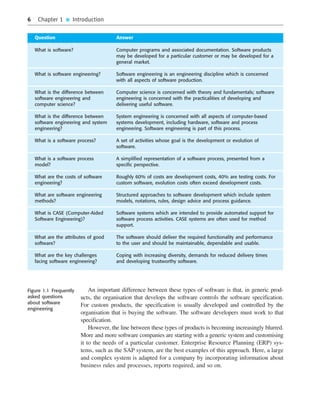
Figure 1.1 summarises the answers to the questions in this section.
1.1.1 What is software?
Many people equate the term software with computer programs. However, I prefer a
broader definition where software is not just the programs but also all associated doc-
umentation and configuration data that is needed to make these programs operate cor-
rectly. A software system usually consists of a number of separate programs,
configuration files, which are used to set up these programs, system documentation,
which describes the structure of the system, and user documentation, which explains
how to use the system and web sites for users to download recent product information.
Software engineers are concerned with developing software products, i.e., soft-
ware which can be sold to a customer. There are two fundamental types of software
product:
1. Generic products These are stand-alone systems that are produced by a devel-
opment organisation and sold on the open market to any customer who is able
to buy them. Examples of this type of product include software for PCs such as
databases, word processors, drawing packages and project management tools.
2. Customised (or bespoke) products These are systems which are commissioned
by a particular customer. A software contractor develops the software especially
for that customer. Examples of this type of software include control systems
for electronic devices, systems written to support a particular business process
and air traffic control systems.
••
••
SE8_C01.qxd 4/4/06 10:53 Page 5
36.
6 Chapter 1■ Introduction
An important difference between these types of software is that, in generic prod-
ucts, the organisation that develops the software controls the software specification.
For custom products, the specification is usually developed and controlled by the
organisation that is buying the software. The software developers must work to that
specification.
However, the line between these types of products is becoming increasingly blurred.
More and more software companies are starting with a generic system and customising
it to the needs of a particular customer. Enterprise Resource Planning (ERP) sys-
tems, such as the SAP system, are the best examples of this approach. Here, a large
and complex system is adapted for a company by incorporating information about
business rules and processes, reports required, and so on.
••
••
Question Answer
What is software?
What is software engineering?
What is the difference between
software engineering and
computer science?
What is the difference between
software engineering and system
engineering?
What is a software process?
What is a software process
model?
What are the costs of software
engineering?
What are software engineering
methods?
What is CASE (Computer-Aided
Software Engineering)?
What are the attributes of good
software?
What are the key challenges
facing software engineering?
Figure 1.1 Frequently
asked questions
about software
engineering
Computer programs and associated documentation. Software products
may be developed for a particular customer or may be developed for a
general market.
Software engineering is an engineering discipline which is concerned
with all aspects of software production.
Computer science is concerned with theory and fundamentals; software
engineering is concerned with the practicalities of developing and
delivering useful software.
System engineering is concerned with all aspects of computer-based
systems development, including hardware, software and process
engineering. Software engineering is part of this process.
A set of activities whose goal is the development or evolution of
software.
A simplified representation of a software process, presented from a
specific perspective.
Roughly 60% of costs are development costs, 40% are testing costs. For
custom software, evolution costs often exceed development costs.
Structured approaches to software development which include system
models, notations, rules, design advice and process guidance.
Software systems which are intended to provide automated support for
software process activities. CASE systems are often used for method
support.
The software should deliver the required functionality and performance
to the user and should be maintainable, dependable and usable.
Coping with increasing diversity, demands for reduced delivery times
and developing trustworthy software.
SE8_C01.qxd 4/4/06 10:53 Page 6
37.
1.1 ■ FAQsabout software engineering 7
1.1.2 What is software engineering?
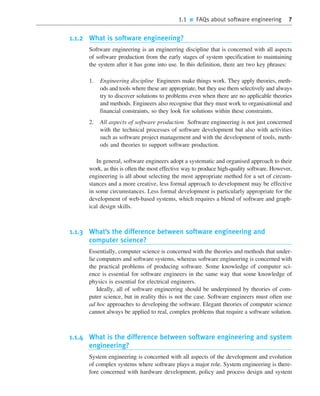
Software engineering is an engineering discipline that is concerned with all aspects
of software production from the early stages of system specification to maintaining
the system after it has gone into use. In this definition, there are two key phrases:
1. Engineering discipline Engineers make things work. They apply theories, meth-
ods and tools where these are appropriate, but they use them selectively and always
try to discover solutions to problems even when there are no applicable theories
and methods. Engineers also recognise that they must work to organisational and
financial constraints, so they look for solutions within these constraints.
2. All aspects of software production Software engineering is not just concerned
with the technical processes of software development but also with activities
such as software project management and with the development of tools, meth-
ods and theories to support software production.
In general, software engineers adopt a systematic and organised approach to their
work, as this is often the most effective way to produce high-quality software. However,
engineering is all about selecting the most appropriate method for a set of circum-
stances and a more creative, less formal approach to development may be effective
in some circumstances. Less formal development is particularly appropriate for the
development of web-based systems, which requires a blend of software and graph-
ical design skills.
1.1.3 What’s the difference between software engineering and
computer science?
Essentially, computer science is concerned with the theories and methods that under-
lie computers and software systems, whereas software engineering is concerned with
the practical problems of producing software. Some knowledge of computer sci-
ence is essential for software engineers in the same way that some knowledge of
physics is essential for electrical engineers.
Ideally, all of software engineering should be underpinned by theories of com-
puter science, but in reality this is not the case. Software engineers must often use
ad hoc approaches to developing the software. Elegant theories of computer science
cannot always be applied to real, complex problems that require a software solution.
1.1.4 What is the difference between software engineering and system
engineering?
System engineering is concerned with all aspects of the development and evolution
of complex systems where software plays a major role. System engineering is there-
fore concerned with hardware development, policy and process design and system
••
••
SE8_C01.qxd 4/4/06 10:53 Page 7
38.
8 Chapter 1■ Introduction
deployment as well as software engineering. System engineers are involved in spec-
ifying the system, defining its overall architecture and then integrating the different
parts to create the finished system. They are less concerned with the engineering of
the system components (hardware, software, etc.).
System engineering is an older discipline than software engineering. People have
been specifying and assembling complex industrial systems such as aircraft and chem-
ical plants for more than a hundred years. However, as the percentage of software
in systems has increased, software engineering techniques such as use-case mod-
elling and configuration management are being used in the systems engineering pro-
cess. I discuss system engineering in Chapter 2.
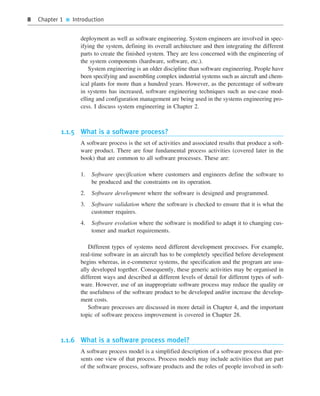
1.1.5 What is a software process?
A software process is the set of activities and associated results that produce a soft-
ware product. There are four fundamental process activities (covered later in the
book) that are common to all software processes. These are:
1. Software specification where customers and engineers define the software to
be produced and the constraints on its operation.
2. Software development where the software is designed and programmed.
3. Software validation where the software is checked to ensure that it is what the
customer requires.
4. Software evolution where the software is modified to adapt it to changing cus-
tomer and market requirements.
Different types of systems need different development processes. For example,
real-time software in an aircraft has to be completely specified before development
begins whereas, in e-commerce systems, the specification and the program are usu-
ally developed together. Consequently, these generic activities may be organised in
different ways and described at different levels of detail for different types of soft-
ware. However, use of an inappropriate software process may reduce the quality or
the usefulness of the software product to be developed and/or increase the develop-
ment costs.
Software processes are discussed in more detail in Chapter 4, and the important
topic of software process improvement is covered in Chapter 28.
1.1.6 What is a software process model?
A software process model is a simplified description of a software process that pre-
sents one view of that process. Process models may include activities that are part
of the software process, software products and the roles of people involved in soft-
••
••
SE8_C01.qxd 4/4/06 10:53 Page 8
39.
1.1 ■ FAQsabout software engineering 9
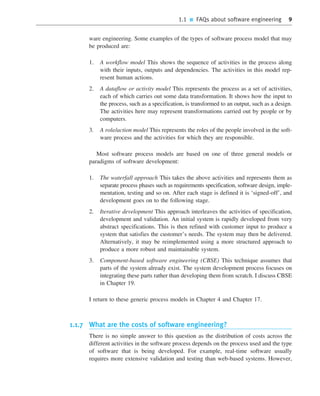
ware engineering. Some examples of the types of software process model that may
be produced are:
1. A workflow model This shows the sequence of activities in the process along
with their inputs, outputs and dependencies. The activities in this model rep-
resent human actions.
2. A dataflow or activity model This represents the process as a set of activities,
each of which carries out some data transformation. It shows how the input to
the process, such as a specification, is transformed to an output, such as a design.
The activities here may represent transformations carried out by people or by
computers.
3. A role/action model This represents the roles of the people involved in the soft-
ware process and the activities for which they are responsible.
Most software process models are based on one of three general models or
paradigms of software development:
1. The waterfall approach This takes the above activities and represents them as
separate process phases such as requirements specification, software design, imple-
mentation, testing and so on. After each stage is defined it is ‘signed-off’, and
development goes on to the following stage.
2. Iterative development This approach interleaves the activities of specification,
development and validation. An initial system is rapidly developed from very
abstract specifications. This is then refined with customer input to produce a
system that satisfies the customer’s needs. The system may then be delivered.
Alternatively, it may be reimplemented using a more structured approach to
produce a more robust and maintainable system.
3. Component-based software engineering (CBSE) This technique assumes that
parts of the system already exist. The system development process focuses on
integrating these parts rather than developing them from scratch. I discuss CBSE
in Chapter 19.
I return to these generic process models in Chapter 4 and Chapter 17.
1.1.7 What are the costs of software engineering?
There is no simple answer to this question as the distribution of costs across the
different activities in the software process depends on the process used and the type
of software that is being developed. For example, real-time software usually
requires more extensive validation and testing than web-based systems. However,
••
••
SE8_C01.qxd 4/4/06 10:53 Page 9
40.
10 Chapter 1■ Introduction
each of the different generic approaches to software development has a different
profile of cost distribution across the software process activities. If you assume that
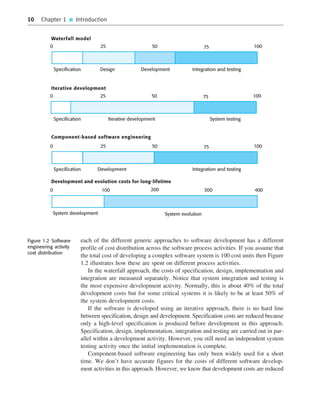
the total cost of developing a complex software system is 100 cost units then Figure
1.2 illustrates how these are spent on different process activities.
In the waterfall approach, the costs of specification, design, implementation and
integration are measured separately. Notice that system integration and testing is
the most expensive development activity. Normally, this is about 40% of the total
development costs but for some critical systems it is likely to be at least 50% of
the system development costs.
If the software is developed using an iterative approach, there is no hard line
between specification, design and development. Specification costs are reduced because
only a high-level specification is produced before development in this approach.
Specification, design, implementation, integration and testing are carried out in par-
allel within a development activity. However, you still need an independent system
testing activity once the initial implementation is complete.
Component-based software engineering has only been widely used for a short
time. We don’t have accurate figures for the costs of different software develop-
ment activities in this approach. However, we know that development costs are reduced
••
••
Figure 1.2 Software
engineering activity
cost distribution
SE8_C01.qxd 4/4/06 10:53 Page 10
41.
1.1 ■ FAQsabout software engineering 11
relative to integration and testing costs. Integration and testing costs are increased
because you have to ensure that the components that you use actually meet their
specification and work as expected with other components.
On top of development costs, costs are also incurred in changing the software
after it has gone into use. The costs of evolution vary dramatically depending on
the type of system. For long-lifetime software systems, such as command and con-
trol systems that may be used for 10 years or more, these costs are likely to exceed
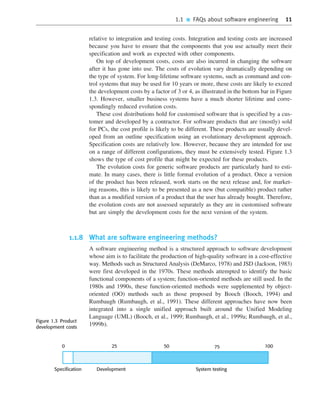
the development costs by a factor of 3 or 4, as illustrated in the bottom bar in Figure
1.3. However, smaller business systems have a much shorter lifetime and corre-
spondingly reduced evolution costs.
These cost distributions hold for customised software that is specified by a cus-
tomer and developed by a contractor. For software products that are (mostly) sold
for PCs, the cost profile is likely to be different. These products are usually devel-
oped from an outline specification using an evolutionary development approach.
Specification costs are relatively low. However, because they are intended for use
on a range of different configurations, they must be extensively tested. Figure 1.3
shows the type of cost profile that might be expected for these products.
The evolution costs for generic software products are particularly hard to esti-
mate. In many cases, there is little formal evolution of a product. Once a version
of the product has been released, work starts on the next release and, for market-
ing reasons, this is likely to be presented as a new (but compatible) product rather
than as a modified version of a product that the user has already bought. Therefore,
the evolution costs are not assessed separately as they are in customised software
but are simply the development costs for the next version of the system.
1.1.8 What are software engineering methods?
A software engineering method is a structured approach to software development
whose aim is to facilitate the production of high-quality software in a cost-effective
way. Methods such as Structured Analysis (DeMarco, 1978) and JSD (Jackson, 1983)
were first developed in the 1970s. These methods attempted to identify the basic
functional components of a system; function-oriented methods are still used. In the
1980s and 1990s, these function-oriented methods were supplemented by object-
oriented (OO) methods such as those proposed by Booch (Booch, 1994) and
Rumbaugh (Rumbaugh, et al., 1991). These different approaches have now been
integrated into a single unified approach built around the Unified Modeling
Language (UML) (Booch, et al., 1999; Rumbaugh, et al., 1999a; Rumbaugh, et al.,
1999b).
••
••
Specification Development System testing
25 50 75 100
0
Figure 1.3 Product
development costs
SE8_C01.qxd 4/4/06 10:53 Page 11
42.
12 Chapter 1■ Introduction
There is no ideal method, and different methods have different areas where they
are applicable. For example, object-oriented methods are often appropriate for
interactive systems but not for systems with stringent real-time requirements.
All methods are based on the idea of developing models of a system that may
be represented graphically and using these models as a system specification or design.
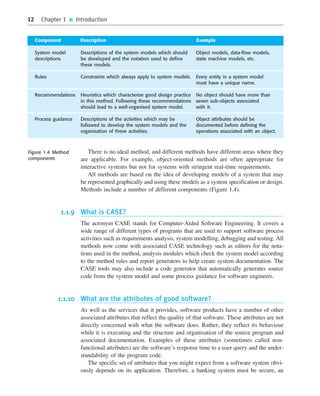
Methods include a number of different components (Figure 1.4).
1.1.9 What is CASE?
The acronym CASE stands for Computer-Aided Software Engineering. It covers a
wide range of different types of programs that are used to support software process
activities such as requirements analysis, system modelling, debugging and testing. All
methods now come with associated CASE technology such as editors for the nota-
tions used in the method, analysis modules which check the system model according
to the method rules and report generators to help create system documentation. The
CASE tools may also include a code generator that automatically generates source
code from the system model and some process guidance for software engineers.
1.1.10 What are the attributes of good software?
As well as the services that it provides, software products have a number of other
associated attributes that reflect the quality of that software. These attributes are not
directly concerned with what the software does. Rather, they reflect its behaviour
while it is executing and the structure and organisation of the source program and
associated documentation. Examples of these attributes (sometimes called non-
functional attributes) are the software’s response time to a user query and the under-
standability of the program code.
The specific set of attributes that you might expect from a software system obvi-
ously depends on its application. Therefore, a banking system must be secure, an
••
••
Figure 1.4 Method
components
Component Description Example
System model
descriptions
Rules
Recommendations
Process guidance
Object models, data-flow models,
state machine models, etc.
Every entity in a system model
must have a unique name.
No object should have more than
seven sub-objects associated
with it.
Object attributes should be
documented before defining the
operations associated with an object.
Descriptions of the system models which should
be developed and the notation used to define
these models.
Constraints which always apply to system models.
Heuristics which characterise good design practice
in this method. Following these recommendations
should lead to a well-organised system model.
Descriptions of the activities which may be
followed to develop the system models and the
organisation of these activities.
SE8_C01.qxd 4/4/06 10:53 Page 12
43.
1.1 ■ FAQsabout software engineering 13
interactive game must be responsive, a telephone switching system must be reliable,
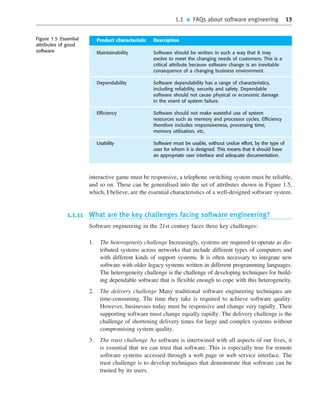
and so on. These can be generalised into the set of attributes shown in Figure 1.5,
which, I believe, are the essential characteristics of a well-designed software system.
1.1.11 What are the key challenges facing software engineering?
Software engineering in the 21st century faces three key challenges:
1. The heterogeneity challenge Increasingly, systems are required to operate as dis-
tributed systems across networks that include different types of computers and
with different kinds of support systems. It is often necessary to integrate new
software with older legacy systems written in different programming languages.
The heterogeneity challenge is the challenge of developing techniques for build-
ing dependable software that is flexible enough to cope with this heterogeneity.
2. The delivery challenge Many traditional software engineering techniques are
time-consuming. The time they take is required to achieve software quality.
However, businesses today must be responsive and change very rapidly. Their
supporting software must change equally rapidly. The delivery challenge is the
challenge of shortening delivery times for large and complex systems without
compromising system quality.
3. The trust challenge As software is intertwined with all aspects of our lives, it
is essential that we can trust that software. This is especially true for remote
software systems accessed through a web page or web service interface. The
trust challenge is to develop techniques that demonstrate that software can be
trusted by its users.
••
••
Product characteristic Description
Maintainability Software should be written in such a way that it may
evolve to meet the changing needs of customers. This is a
critical attribute because software change is an inevitable
consequence of a changing business environment.
Dependability Software dependability has a range of characteristics,
including reliability, security and safety. Dependable
software should not cause physical or economic damage
in the event of system failure.
Efficiency Software should not make wasteful use of system
resources such as memory and processor cycles. Efficiency
therefore includes responsiveness, processing time,
memory utilisation, etc.
Usability Software must be usable, without undue effort, by the type of
user for whom it is designed. This means that it should have
an appropriate user interface and adequate documentation.
Figure 1.5 Essential
attributes of good
software
SE8_C01.qxd 4/4/06 10:53 Page 13
44.
14 Chapter 1■ Introduction
Of course, these are not independent. For example, it may be necessary to make
rapid changes to a legacy system to provide it with a web service interface. To address
these challenges, we will need new tools and techniques as well as innovative ways
of combining and using existing software engineering methods.
1.2 Professional and ethical responsibility
Like other engineering disciplines, software engineering is carried out within a legal
and social framework that limits the freedom of engineers. Software engineers must
accept that their job involves wider responsibilities than simply the application of
technical skills. They must also behave in an ethical and morally responsible way
if they are to be respected as professionals.
It goes without saying that you should always uphold normal standards of honesty
and integrity. You should not use your skills and abilities to behave in a dishonest
way or in a way that will bring disrepute to the software engineering profession. However,
there are areas where standards of acceptable behaviour are not bounded by laws but
by the more tenuous notion of professional responsibility. Some of these are:
1. Confidentiality You should normally respect the confidentiality of your
employers or clients irrespective of whether a formal confidentiality agreement
has been signed.
2. Competence You should not misrepresent your level of competence. You
should not knowingly accept work that is outside your competence.
3. Intellectual property rights You should be aware of local laws governing the
use of intellectual property such as patents and copyright. You should be care-
ful to ensure that the intellectual property of employers and clients is protected.
4. Computer misuse You should not use your technical skills to misuse other peo-
ple’s computers. Computer misuse ranges from relatively trivial (game play-
ing on an employer’s machine, say) to extremely serious (dissemination of viruses).
Professional societies and institutions have an important role to play in setting
ethical standards. Organisations such as the ACM, the IEEE (Institute of Electrical
and Electronic Engineers) and the British Computer Society publish a code of pro-
fessional conduct or code of ethics. Members of these organisations undertake to
follow that code when they sign up for membership. These codes of conduct are
generally concerned with fundamental ethical behaviour.
The ACM and the IEEE have cooperated to produce a joint code of ethics and
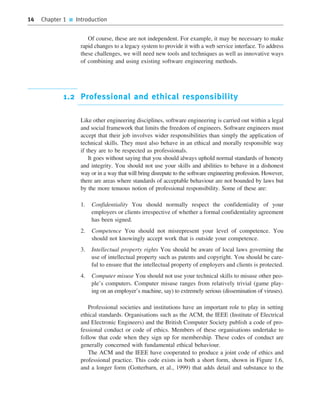
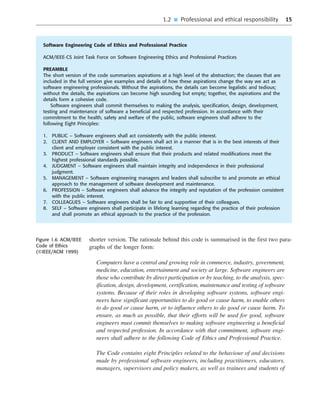
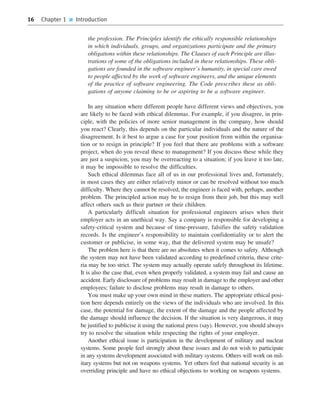
professional practice. This code exists in both a short form, shown in Figure 1.6,
and a longer form (Gotterbarn, et al., 1999) that adds detail and substance to the
••
••
SE8_C01.qxd 4/4/06 10:53 Page 14
16 Chapter 1■ Introduction
the profession. The Principles identify the ethically responsible relationships
in which individuals, groups, and organizations participate and the primary
obligations within these relationships. The Clauses of each Principle are illus-
trations of some of the obligations included in these relationships. These obli-
gations are founded in the software engineer’s humanity, in special care owed
to people affected by the work of software engineers, and the unique elements
of the practice of software engineering. The Code prescribes these as obli-
gations of anyone claiming to be or aspiring to be a software engineer.
In any situation where different people have different views and objectives, you
are likely to be faced with ethical dilemmas. For example, if you disagree, in prin-
ciple, with the policies of more senior management in the company, how should
you react? Clearly, this depends on the particular individuals and the nature of the
disagreement. Is it best to argue a case for your position from within the organisa-
tion or to resign in principle? If you feel that there are problems with a software
project, when do you reveal these to management? If you discuss these while they
are just a suspicion, you may be overreacting to a situation; if you leave it too late,
it may be impossible to resolve the difficulties.
Such ethical dilemmas face all of us in our professional lives and, fortunately,
in most cases they are either relatively minor or can be resolved without too much
difficulty. Where they cannot be resolved, the engineer is faced with, perhaps, another
problem. The principled action may be to resign from their job, but this may well
affect others such as their partner or their children.
A particularly difficult situation for professional engineers arises when their
employer acts in an unethical way. Say a company is responsible for developing a
safety-critical system and because of time-pressure, falsifies the safety validation
records. Is the engineer’s responsibility to maintain confidentiality or to alert the
customer or publicise, in some way, that the delivered system may be unsafe?
The problem here is that there are no absolutes when it comes to safety. Although
the system may not have been validated according to predefined criteria, these crite-
ria may be too strict. The system may actually operate safely throughout its lifetime.
It is also the case that, even when properly validated, a system may fail and cause an
accident. Early disclosure of problems may result in damage to the employer and other
employees; failure to disclose problems may result in damage to others.
You must make up your own mind in these matters. The appropriate ethical posi-
tion here depends entirely on the views of the individuals who are involved. In this
case, the potential for damage, the extent of the damage and the people affected by
the damage should influence the decision. If the situation is very dangerous, it may
be justified to publicise it using the national press (say). However, you should always
try to resolve the situation while respecting the rights of your employer.
Another ethical issue is participation in the development of military and nuclear
systems. Some people feel strongly about these issues and do not wish to participate
in any systems development associated with military systems. Others will work on mil-
itary systems but not on weapons systems. Yet others feel that national security is an
overriding principle and have no ethical objections to working on weapons systems.
••
••
SE8_C01.qxd 4/4/06 10:53 Page 16
47.
Chapter 1 ■Key points 17
In this situation it is important that both employers and employees should make
their views known to each other in advance. Where an organisation is involved in
military or nuclear work, it should be able to specify that employees must be will-
ing to accept any work assignment. Equally, if an employee is taken on and makes
clear that he does not wish to work on such systems, employers should not put pres-
sure on him to do so at some later date.
The general area of ethics and professional responsibility is one that has
received increasing attention over the past few years. It can be considered from a
philosophical standpoint where the basic principles of ethics are considered, and
software engineering ethics are discussed with reference to these basic principles.
This is the approach taken by Laudon (Laudon, 1995) and to a lesser extent by Huff
and Martin (Huff and Martin, 1995).
However, I find their approach is too abstract and difficult to relate to everyday
experience. I prefer the more concrete approach embodied in codes of conduct and
practice. I think that ethics are best discussed in a software engineering context and
not as a subject in their own right. In this book, therefore, I do not include abstract
ethical discussions but, where appropriate, include examples in the exercises that
can be the starting point for a group discussion on ethical issues.
••
••
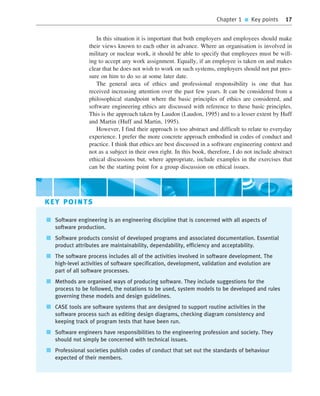
■ Software engineering is an engineering discipline that is concerned with all aspects of
software production.
■ Software products consist of developed programs and associated documentation. Essential
product attributes are maintainability, dependability, efficiency and acceptability.
■ The software process includes all of the activities involved in software development. The
high-level activities of software specification, development, validation and evolution are
part of all software processes.
■ Methods are organised ways of producing software. They include suggestions for the
process to be followed, the notations to be used, system models to be developed and rules
governing these models and design guidelines.
■ CASE tools are software systems that are designed to support routine activities in the
software process such as editing design diagrams, checking diagram consistency and
keeping track of program tests that have been run.
■ Software engineers have responsibilities to the engineering profession and society. They
should not simply be concerned with technical issues.
■ Professional societies publish codes of conduct that set out the standards of behaviour
expected of their members.
KEY POINTS
SE8_C01.qxd 4/4/06 10:53 Page 17
48.
18 Chapter 1■ Introduction
FURTHER READING
Fundamentals of Software Engineering. A general software engineering text that takes a rather
different perspective on the subject than this book. (C. Ghezi, et. al., Prentice Hall, 2003.)
‘Software engineering: The state of the practice’. A special issue of IEEE Software that includes
several articles discussing current practice in software engineering, how this has changed and the
extent to which new software technologies are used. (IEEE Software, 20 (6), November 2003.)
Software Engineering: An Engineering Approach. A general text that takes a rather different
approach to my book but which includes a number of useful case studies. (J. F. Peters and W.
Pedrycz, 2000, John Wiley & Sons.)
Professional Issues in Software Engineering. This is an excellent book discussing legal and
professional issues as well as ethics. I prefer its practical approach to more theoretical texts on
ethics. (F. Bott, et al., 3rd edition, 2000, Taylor & Francis.)
‘Software engineering code of ethics is approved’. An article that discusses the background to the
development of the ACM/IEEE Code of Ethics and includes both the short and long form of the
code. (Comm. ACM, D. Gotterbarn, et al., October 1999.)
‘No silver bullet: Essence and accidents of software engineering’. In spite of its age, this paper is a
good general introduction to the problems of software engineering. The essential message of the
paper, that there is no simple answer to the problems of software engineering, hasn’t changed. (F.
P. Brooks, IEEE Computer, 20 (4), April 1987.)
EXERCISES
1.1 By making reference to the distribution of software costs discussed in Section 1.1.6, explain
why it is appropriate to consider software to be more than the programs that can be
executed by end-users of a system.
1.2 What are the differences between generic software product development and custom
software development?
1.3 What are the four important attributes which all software products should have? Suggest four
other attributes that may sometimes be significant.
1.4 What is the difference between a software process model and a software process? Suggest
two ways in which a software process model might be helpful in identifying possible process
improvements.
1.5 Explain why system testing costs are particularly high for generic software products that are
sold to a very wide market.
1.6 Software engineering methods became widely used only when CASE technology became
••
••
SE8_C01.qxd 4/4/06 10:53 Page 18
49.
Chapter 1 ■Exercises 19
available to support them. Suggest five types of method support that can be provided by
CASE tools.
1.7 Apart from the challenges of heterogeneity, rapid delivery and trust, identify other problems
and challenges that software engineering is likely to face in the 21st century.
1.8 Discuss whether professional engineers should be certified in the same way as doctors or
lawyers.
1.9 For each of the clauses in the ACM/IEEE Code of Ethics shown in Figure 1.6, suggest an
appropriate example that illustrates that clause.
1.10 To help counter terrorism, many countries are planning the development of computer
systems that track large numbers of their citizens and their actions. Clearly this has privacy
implications. Discuss the ethics of developing this type of system.
••
••
SE8_C01.qxd 4/4/06 10:53 Page 19
50.
••
Socio-technical systems
2
Objectives
The objectivesof this chapter are to introduce the concept of a
socio-technical system—a system that includes people, software
and hardware—and to discuss the systems engineering process.
When you have read this chapter, you will:
■ know what is meant by a socio-technical system and understand
the difference between a technical computer-based system and a
socio-technical system;
■ have been introduced to the concept of emergent system
properties such as reliability, performance, safety and security;
■ understand the activities that are involved in the systems
engineering process;
■ understand why the organisational context of a system affects its
design and use;
■ know what is meant by a ‘legacy system’, and why these systems
are often critical to the operation of many businesses.
Contents
2.1 Emergent system properties
2.2 Systems engineering
2.3 Organisations, people and computer systems
2.4 Legacy systems
SE8_C02.qxd 4/4/06 8:56 Page 20
This eBook isfor the use of anyone anywhere in the United
States and most other parts of the world at no cost and with
almost no restrictions whatsoever. You may copy it, give it away
or re-use it under the terms of the Project Gutenberg License
included with this eBook or online at www.gutenberg.org. If you
are not located in the United States, you will have to check the
laws of the country where you are located before using this
eBook.
1.E.2. If an individual Project Gutenberg™ electronic work is derived
from texts not protected by U.S. copyright law (does not contain a
notice indicating that it is posted with permission of the copyright
holder), the work can be copied and distributed to anyone in the
United States without paying any fees or charges. If you are
redistributing or providing access to a work with the phrase “Project
Gutenberg” associated with or appearing on the work, you must
comply either with the requirements of paragraphs 1.E.1 through
1.E.7 or obtain permission for the use of the work and the Project
Gutenberg™ trademark as set forth in paragraphs 1.E.8 or 1.E.9.
1.E.3. If an individual Project Gutenberg™ electronic work is posted
with the permission of the copyright holder, your use and distribution
must comply with both paragraphs 1.E.1 through 1.E.7 and any
additional terms imposed by the copyright holder. Additional terms
will be linked to the Project Gutenberg™ License for all works posted
with the permission of the copyright holder found at the beginning
of this work.
1.E.4. Do not unlink or detach or remove the full Project
Gutenberg™ License terms from this work, or any files containing a
part of this work or any other work associated with Project
Gutenberg™.
1.E.5. Do not copy, display, perform, distribute or redistribute this
electronic work, or any part of this electronic work, without
prominently displaying the sentence set forth in paragraph 1.E.1
53.
with active linksor immediate access to the full terms of the Project
Gutenberg™ License.
1.E.6. You may convert to and distribute this work in any binary,
compressed, marked up, nonproprietary or proprietary form,
including any word processing or hypertext form. However, if you
provide access to or distribute copies of a Project Gutenberg™ work
in a format other than “Plain Vanilla ASCII” or other format used in
the official version posted on the official Project Gutenberg™ website
(www.gutenberg.org), you must, at no additional cost, fee or
expense to the user, provide a copy, a means of exporting a copy, or
a means of obtaining a copy upon request, of the work in its original
“Plain Vanilla ASCII” or other form. Any alternate format must
include the full Project Gutenberg™ License as specified in
paragraph 1.E.1.
1.E.7. Do not charge a fee for access to, viewing, displaying,
performing, copying or distributing any Project Gutenberg™ works
unless you comply with paragraph 1.E.8 or 1.E.9.
1.E.8. You may charge a reasonable fee for copies of or providing
access to or distributing Project Gutenberg™ electronic works
provided that:
• You pay a royalty fee of 20% of the gross profits you derive
from the use of Project Gutenberg™ works calculated using the
method you already use to calculate your applicable taxes. The
fee is owed to the owner of the Project Gutenberg™ trademark,
but he has agreed to donate royalties under this paragraph to
the Project Gutenberg Literary Archive Foundation. Royalty
payments must be paid within 60 days following each date on
which you prepare (or are legally required to prepare) your
periodic tax returns. Royalty payments should be clearly marked
as such and sent to the Project Gutenberg Literary Archive
Foundation at the address specified in Section 4, “Information
54.
about donations tothe Project Gutenberg Literary Archive
Foundation.”
• You provide a full refund of any money paid by a user who
notifies you in writing (or by e-mail) within 30 days of receipt
that s/he does not agree to the terms of the full Project
Gutenberg™ License. You must require such a user to return or
destroy all copies of the works possessed in a physical medium
and discontinue all use of and all access to other copies of
Project Gutenberg™ works.
• You provide, in accordance with paragraph 1.F.3, a full refund of
any money paid for a work or a replacement copy, if a defect in
the electronic work is discovered and reported to you within 90
days of receipt of the work.
• You comply with all other terms of this agreement for free
distribution of Project Gutenberg™ works.
1.E.9. If you wish to charge a fee or distribute a Project Gutenberg™
electronic work or group of works on different terms than are set
forth in this agreement, you must obtain permission in writing from
the Project Gutenberg Literary Archive Foundation, the manager of
the Project Gutenberg™ trademark. Contact the Foundation as set
forth in Section 3 below.
1.F.
1.F.1. Project Gutenberg volunteers and employees expend
considerable effort to identify, do copyright research on, transcribe
and proofread works not protected by U.S. copyright law in creating
the Project Gutenberg™ collection. Despite these efforts, Project
Gutenberg™ electronic works, and the medium on which they may
be stored, may contain “Defects,” such as, but not limited to,
incomplete, inaccurate or corrupt data, transcription errors, a
copyright or other intellectual property infringement, a defective or
55.
damaged disk orother medium, a computer virus, or computer
codes that damage or cannot be read by your equipment.
1.F.2. LIMITED WARRANTY, DISCLAIMER OF DAMAGES - Except for
the “Right of Replacement or Refund” described in paragraph 1.F.3,
the Project Gutenberg Literary Archive Foundation, the owner of the
Project Gutenberg™ trademark, and any other party distributing a
Project Gutenberg™ electronic work under this agreement, disclaim
all liability to you for damages, costs and expenses, including legal
fees. YOU AGREE THAT YOU HAVE NO REMEDIES FOR
NEGLIGENCE, STRICT LIABILITY, BREACH OF WARRANTY OR
BREACH OF CONTRACT EXCEPT THOSE PROVIDED IN PARAGRAPH
1.F.3. YOU AGREE THAT THE FOUNDATION, THE TRADEMARK
OWNER, AND ANY DISTRIBUTOR UNDER THIS AGREEMENT WILL
NOT BE LIABLE TO YOU FOR ACTUAL, DIRECT, INDIRECT,
CONSEQUENTIAL, PUNITIVE OR INCIDENTAL DAMAGES EVEN IF
YOU GIVE NOTICE OF THE POSSIBILITY OF SUCH DAMAGE.
1.F.3. LIMITED RIGHT OF REPLACEMENT OR REFUND - If you
discover a defect in this electronic work within 90 days of receiving
it, you can receive a refund of the money (if any) you paid for it by
sending a written explanation to the person you received the work
from. If you received the work on a physical medium, you must
return the medium with your written explanation. The person or
entity that provided you with the defective work may elect to provide
a replacement copy in lieu of a refund. If you received the work
electronically, the person or entity providing it to you may choose to
give you a second opportunity to receive the work electronically in
lieu of a refund. If the second copy is also defective, you may
demand a refund in writing without further opportunities to fix the
problem.
1.F.4. Except for the limited right of replacement or refund set forth
in paragraph 1.F.3, this work is provided to you ‘AS-IS’, WITH NO
OTHER WARRANTIES OF ANY KIND, EXPRESS OR IMPLIED,
56.
INCLUDING BUT NOTLIMITED TO WARRANTIES OF
MERCHANTABILITY OR FITNESS FOR ANY PURPOSE.
1.F.5. Some states do not allow disclaimers of certain implied
warranties or the exclusion or limitation of certain types of damages.
If any disclaimer or limitation set forth in this agreement violates the
law of the state applicable to this agreement, the agreement shall be
interpreted to make the maximum disclaimer or limitation permitted
by the applicable state law. The invalidity or unenforceability of any
provision of this agreement shall not void the remaining provisions.
1.F.6. INDEMNITY - You agree to indemnify and hold the Foundation,
the trademark owner, any agent or employee of the Foundation,
anyone providing copies of Project Gutenberg™ electronic works in
accordance with this agreement, and any volunteers associated with
the production, promotion and distribution of Project Gutenberg™
electronic works, harmless from all liability, costs and expenses,
including legal fees, that arise directly or indirectly from any of the
following which you do or cause to occur: (a) distribution of this or
any Project Gutenberg™ work, (b) alteration, modification, or
additions or deletions to any Project Gutenberg™ work, and (c) any
Defect you cause.
Section 2. Information about the Mission
of Project Gutenberg™
Project Gutenberg™ is synonymous with the free distribution of
electronic works in formats readable by the widest variety of
computers including obsolete, old, middle-aged and new computers.
It exists because of the efforts of hundreds of volunteers and
donations from people in all walks of life.
Volunteers and financial support to provide volunteers with the
assistance they need are critical to reaching Project Gutenberg™’s
goals and ensuring that the Project Gutenberg™ collection will
57.
remain freely availablefor generations to come. In 2001, the Project
Gutenberg Literary Archive Foundation was created to provide a
secure and permanent future for Project Gutenberg™ and future
generations. To learn more about the Project Gutenberg Literary
Archive Foundation and how your efforts and donations can help,
see Sections 3 and 4 and the Foundation information page at
www.gutenberg.org.
Section 3. Information about the Project
Gutenberg Literary Archive Foundation
The Project Gutenberg Literary Archive Foundation is a non-profit
501(c)(3) educational corporation organized under the laws of the
state of Mississippi and granted tax exempt status by the Internal
Revenue Service. The Foundation’s EIN or federal tax identification
number is 64-6221541. Contributions to the Project Gutenberg
Literary Archive Foundation are tax deductible to the full extent
permitted by U.S. federal laws and your state’s laws.
The Foundation’s business office is located at 809 North 1500 West,
Salt Lake City, UT 84116, (801) 596-1887. Email contact links and up
to date contact information can be found at the Foundation’s website
and official page at www.gutenberg.org/contact
Section 4. Information about Donations to
the Project Gutenberg Literary Archive
Foundation
Project Gutenberg™ depends upon and cannot survive without
widespread public support and donations to carry out its mission of
increasing the number of public domain and licensed works that can
be freely distributed in machine-readable form accessible by the
widest array of equipment including outdated equipment. Many
58.
small donations ($1to $5,000) are particularly important to
maintaining tax exempt status with the IRS.
The Foundation is committed to complying with the laws regulating
charities and charitable donations in all 50 states of the United
States. Compliance requirements are not uniform and it takes a
considerable effort, much paperwork and many fees to meet and
keep up with these requirements. We do not solicit donations in
locations where we have not received written confirmation of
compliance. To SEND DONATIONS or determine the status of
compliance for any particular state visit www.gutenberg.org/donate.
While we cannot and do not solicit contributions from states where
we have not met the solicitation requirements, we know of no
prohibition against accepting unsolicited donations from donors in
such states who approach us with offers to donate.
International donations are gratefully accepted, but we cannot make
any statements concerning tax treatment of donations received from
outside the United States. U.S. laws alone swamp our small staff.
Please check the Project Gutenberg web pages for current donation
methods and addresses. Donations are accepted in a number of
other ways including checks, online payments and credit card
donations. To donate, please visit: www.gutenberg.org/donate.
Section 5. General Information About
Project Gutenberg™ electronic works
Professor Michael S. Hart was the originator of the Project
Gutenberg™ concept of a library of electronic works that could be
freely shared with anyone. For forty years, he produced and
distributed Project Gutenberg™ eBooks with only a loose network of
volunteer support.
59.
Project Gutenberg™ eBooksare often created from several printed
editions, all of which are confirmed as not protected by copyright in
the U.S. unless a copyright notice is included. Thus, we do not
necessarily keep eBooks in compliance with any particular paper
edition.
Most people start at our website which has the main PG search
facility: www.gutenberg.org.
This website includes information about Project Gutenberg™,
including how to make donations to the Project Gutenberg Literary
Archive Foundation, how to help produce our new eBooks, and how
to subscribe to our email newsletter to hear about new eBooks.
60.
Welcome to ourwebsite – the ideal destination for book lovers and
knowledge seekers. With a mission to inspire endlessly, we offer a
vast collection of books, ranging from classic literary works to
specialized publications, self-development books, and children's
literature. Each book is a new journey of discovery, expanding
knowledge and enriching the soul of the reade
Our website is not just a platform for buying books, but a bridge
connecting readers to the timeless values of culture and wisdom. With
an elegant, user-friendly interface and an intelligent search system,
we are committed to providing a quick and convenient shopping
experience. Additionally, our special promotions and home delivery
services ensure that you save time and fully enjoy the joy of reading.
Let us accompany you on the journey of exploring knowledge and
personal growth!
ebookultra.com

![x Preface
• lecture presentations (PowerPoint and PDF) for all chapters in the book;
• class quiz questions for each chapter;
• case studies;
• project suggestions;
• course structure descriptions;
• suggestions for further reading and links to web resources for each chapter;
• solutions for a selection of the exercises associated with each chapter and for
the quiz questions (available to instructor’s only).
My own web site, includes all of the material on the publishers web site plus
extensive supplementary material on software engineering such as links to other sites,
invited lectures that I have presented, teaching material that I have developed for
related courses such as Systems Engineering and the web sites of previous editions
of Software Engineering. The URL of this site is:
http://www.software-engin.com
It has been my policy, both in the previous edition and in this edition, to keep
the number of web links in the book to an absolute minimum. The reason for this
is that these links are subject to change and, once printed, it is impossible to update
them. Consequently, the book’s web page includes a large number of links to resources
and related material on software engineering. If you use these and find problems,
please let me know and I will update the links.
I welcome your constructive comments and suggestions about the book and the web
site. You can contact me at ian@software-engin.com. I recommend that you include
[SE8] in the subject of the e-mail message to ensure that my spam filters do not
accidentally reject your mail. I regret that I do not have time to help students with their
homework, so please do not ask me how to solve any of the problems in the book.
Acknowledgements
A large number of people have contributed over the years to the evolution of this book
and I’d like to thank everyone (reviewers, students and book users who have e-mailed
me) who has commented on previous editions and made constructive suggestions
for change. The editorial and production staff at Pearson Education in England and
the US were supportive and helpful, and produced the book in record time. So thanks
to Simon Plumtree, Mary Lince, Ros Woodward, Keith Mansfield, Patty Mahtani,
Daniel Rausch, Carol Noble and Sharon Burkhardt for their help and support.
••
••
SE8_A01.qxd 4/4/06 8:54 Page x](https://image.slidesharecdn.com/78168-250301225526-e967e183/85/Software-Engineering-8ed-Edition-Sommerville-I-16-320.jpg)