Software Engineering 101
22/10/2013
Pedro Melo Pereira
2
Software Engineering
 SE is the application of a systematic, disciplined, quantifiable approach to the design,
development, operation, and maintenance of software, and the study of these
approaches; that is, the application of engineering to software.
Wikipedia
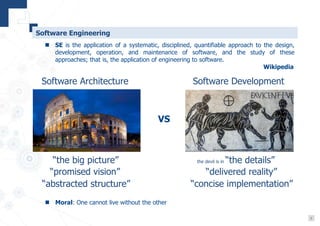
Software Architecture Software Development
VS
“the big picture” the devil is in “the details”
“promised vision” “delivered reality”
 Moral: One cannot live without the other
“abstracted structure” “concise implementation”
3
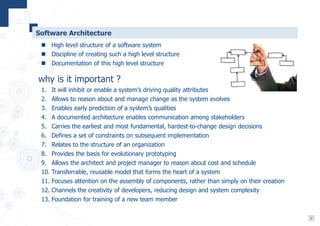
Software Architecture
 High level structure of a software system
 Discipline of creating such a high level structure
 Documentation of this high level structure
why is it important ?
1. It will inhibit or enable a system’s driving quality attributes
2. Allows to reason about and manage change as the system evolves
3. Enables early prediction of a system’s qualities
4. A documented architecture enables communication among stakeholders
5. Carries the earliest and most fundamental, hardest-to-change design decisions
6. Defines a set of constraints on subsequent implementation
7. Relates to the structure of an organization
8. Provides the basis for evolutionary prototyping
9. Allows the architect and project manager to reason about cost and schedule
10. Transferrable, reusable model that forms the heart of a system
11. Focuses attention on the assembly of components, rather than simply on their creation
12. Channels the creativity of developers, reducing design and system complexity
13. Foundation for training of a new team member
4
Software Architecture – Distributed Systems – Design Patterns
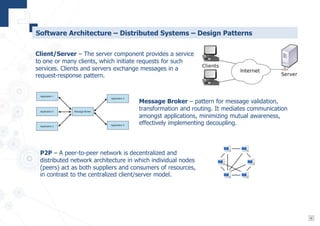
Client/Server – The server component provides a service
to one or many clients, which initiate requests for such
services. Clients and servers exchange messages in a
request-response pattern.
Message Broker – pattern for message validation,
transformation and routing. It mediates communication
amongst applications, minimizing mutual awareness,
effectively implementing decoupling.
P2P – A peer-to-peer network is decentralized and
distributed network architecture in which individual nodes
(peers) act as both suppliers and consumers of resources,
in contrast to the centralized client/server model.
5
Software Architecture – Distributed Systems – Design Patterns
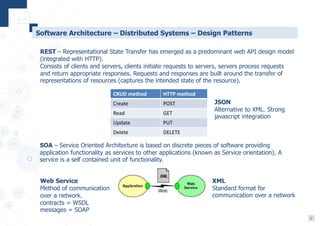
REST – Representational State Transfer has emerged as a predominant web API design model
(integrated with HTTP).
Consists of clients and servers, clients initiate requests to servers, servers process requests
and return appropriate responses. Requests and responses are built around the transfer of
representations of resources (captures the intended state of the resource).
SOA – Service Oriented Architecture is based on discrete pieces of software providing
application functionality as services to other applications (known as Service orientation). A
service is a self contained unit of functionality.
CRUD method HTTP method
Create POST
Read GET
Update PUT
Delete DELETE
Web Service
Method of communication
over a network.
contracts = WSDL
messages = SOAP
XML
Standard format for
communication over a network
JSON
Alternative to XML. Strong
javascript integration
6
Software Architecture – Distributed Systems – Design Patterns
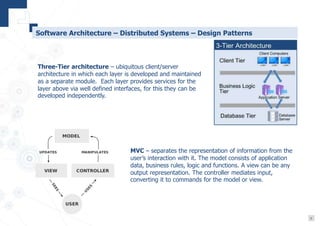
Three-Tier architecture – ubiquitous client/server
architecture in which each layer is developed and maintained
as a separate module. Each layer provides services for the
layer above via well defined interfaces, for this they can be
developed independently.
MVC – separates the representation of information from the
user’s interaction with it. The model consists of application
data, business rules, logic and functions. A view can be any
output representation. The controller mediates input,
converting it to commands for the model or view.
7
Software Architecture – Distributed Systems – Cloud Computing
 IaaS – Infrastructure as a service
 PaaS – Platform as a service
 SaaS – Software as a service
 NaaS – Network as a service
concept
service models
characteristics
 Agility – improves re-provision of infrastructure resources
 Cost – converts capital expenses to operational ones
 Virtualization – sharing of servers with increases utilization
 Reliability – multiple redundant sites, suitable for BC or DR
 Scalability/elasticity – dynamic provisioning response for PL
 Performance – continuous monitoring and alerts
 Security – security patches are provided automatically
 Maintenance – job of off-site operators
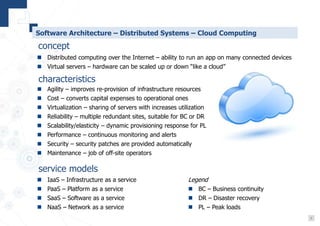
 Distributed computing over the Internet – ability to run an app on many connected devices
 Virtual servers – hardware can be scaled up or down “like a cloud”
Legend
 BC – Business continuity
 DR – Disaster recovery
 PL – Peak loads
8
Software Development
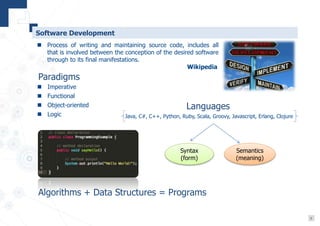
 Process of writing and maintaining source code, includes all
that is involved between the conception of the desired software
through to its final manifestations.
Wikipedia
Algorithms + Data Structures = Programs
Paradigms
 Imperative
 Functional
 Object-oriented
 Logic
Languages
Java, C#, C++, Python, Ruby, Scala, Groovy, Javascript, Erlang, Clojure
Syntax
(form)
Semantics
(meaning)
9
Software Development - Methodologies
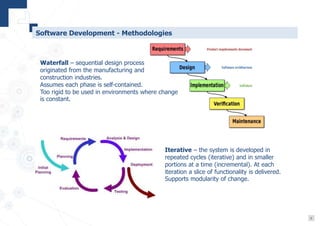
Waterfall – sequential design process
originated from the manufacturing and
construction industries.
Assumes each phase is self-contained.
Too rigid to be used in environments where change
is constant.
Iterative – the system is developed in
repeated cycles (iterative) and in smaller
portions at a time (incremental). At each
iteration a slice of functionality is delivered.
Supports modularity of change.
10
Software Development - Methodologies
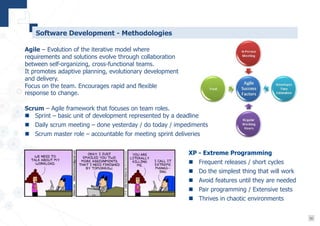
Agile – Evolution of the iterative model where
requirements and solutions evolve through collaboration
between self-organizing, cross-functional teams.
It promotes adaptive planning, evolutionary development
and delivery.
Focus on the team. Encourages rapid and flexible
response to change.
XP - Extreme Programming
 Frequent releases / short cycles
 Do the simplest thing that will work
 Avoid features until they are needed
 Pair programming / Extensive tests
 Thrives in chaotic environments
Scrum – Agile framework that focuses on team roles.
 Sprint – basic unit of development represented by a deadline
 Daily scrum meeting – done yesterday / do today / impediments
 Scrum master role – accountable for meeting sprint deliveries
11
Software Development – Design
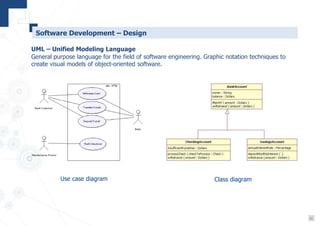
Use case diagram
UML – Unified Modeling Language
General purpose language for the field of software engineering. Graphic notation techniques to
create visual models of object-oriented software.
Class diagram
12
Software Development – Design
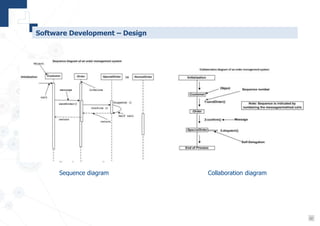
Sequence diagram Collaboration diagram
13
Software Development – Object Oriented Programming
Features
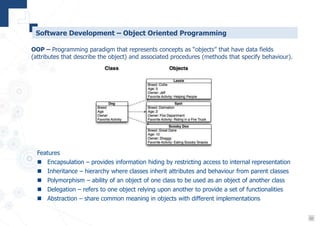
 Encapsulation – provides information hiding by restricting access to internal representation
 Inheritance – hierarchy where classes inherit attributes and behaviour from parent classes
 Polymorphism – ability of an object of one class to be used as an object of another class
 Delegation – refers to one object relying upon another to provide a set of functionalities
 Abstraction – share common meaning in objects with different implementations
OOP – Programming paradigm that represents concepts as “objects” that have data fields
(attributes that describe the object) and associated procedures (methods that specify behaviour).
14
Software Development – Design Patterns
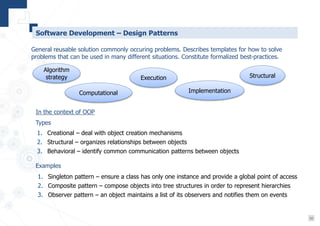
1. Creational – deal with object creation mechanisms
2. Structural – organizes relationships between objects
3. Behavioral – identify common communication patterns between objects
1. Singleton pattern – ensure a class has only one instance and provide a global point of access
2. Composite pattern – compose objects into tree structures in order to represent hierarchies
3. Observer pattern – an object maintains a list of its observers and notifies them on events
General reusable solution commonly occuring problems. Describes templates for how to solve
problems that can be used in many different situations. Constitute formalized best-practices.
In the context of OOP
Types
Examples
Algorithm
strategy
Computational
Execution
Implementation
Structural
15
Software Development – Databases
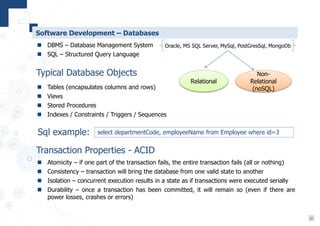
 DBMS – Database Management System
 SQL – Structured Query Language
Oracle, MS SQL Server, MySql, PostGresSql, MongoDb
Relational
Non-
Relational
(noSQL)
Transaction Properties - ACID
 Atomicity – if one part of the transaction fails, the entire transaction fails (all or nothing)
 Consistency – transaction will bring the database from one valid state to another
 Isolation – concurrent execution results in a state as if transactions were executed serially
 Durability – once a transaction has been committed, it will remain so (even if there are
power losses, crashes or errors)
 Tables (encapsulates columns and rows)
 Views
 Stored Procedures
 Indexes / Constraints / Triggers / Sequences
Typical Database Objects
select departmentCode, employeeName from Employee where id=3Sql example:
16
Software Development – Tests
 Unit Tests – smallest testable part of an application (units of source code)
 Integration Tests – individual software models are combined and tested as a group
 Acceptance Tests – used to determine the outcome of a complete functionality or system
 Test-driven development – process in which tests are done before the rest of the code
Provides information about the quality of the system under test.
Allows the business to understand and manage the risks of software
implementation.
 Meets the requirements that guided its design and development
 Works as expected
 Can be implemented according to the specified interfaces
 Satisfies the needs of stakeholders (non functional requirements)
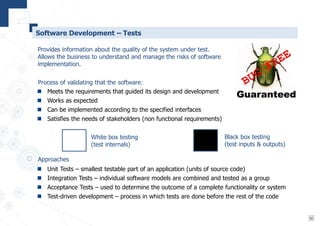
Process of validating that the software:
Approaches
White box testing
(test internals)
Black box testing
(test inputs & outputs)
17
Software Development – Release Management
 Automated Builds – build versions by scripting repetitive tasks in order to be more productive
 Automated Testing – integrate running tests into the build process. Avoids bugs early on.
 Continuous Integration – automation of building frequent and up to date releases
Process of managing software releases from development stage to final version.
 Software defects
 Issues
 Risks
 Software change requests
 New development requests and associated tasks
 Deployment and packaging
Provides support for managing:
Tools

Software Engineering 101

  • 1.
  • 2.
    2 Software Engineering  SEis the application of a systematic, disciplined, quantifiable approach to the design, development, operation, and maintenance of software, and the study of these approaches; that is, the application of engineering to software. Wikipedia Software Architecture Software Development VS “the big picture” the devil is in “the details” “promised vision” “delivered reality”  Moral: One cannot live without the other “abstracted structure” “concise implementation”
  • 3.
    3 Software Architecture  Highlevel structure of a software system  Discipline of creating such a high level structure  Documentation of this high level structure why is it important ? 1. It will inhibit or enable a system’s driving quality attributes 2. Allows to reason about and manage change as the system evolves 3. Enables early prediction of a system’s qualities 4. A documented architecture enables communication among stakeholders 5. Carries the earliest and most fundamental, hardest-to-change design decisions 6. Defines a set of constraints on subsequent implementation 7. Relates to the structure of an organization 8. Provides the basis for evolutionary prototyping 9. Allows the architect and project manager to reason about cost and schedule 10. Transferrable, reusable model that forms the heart of a system 11. Focuses attention on the assembly of components, rather than simply on their creation 12. Channels the creativity of developers, reducing design and system complexity 13. Foundation for training of a new team member
  • 4.
    4 Software Architecture –Distributed Systems – Design Patterns Client/Server – The server component provides a service to one or many clients, which initiate requests for such services. Clients and servers exchange messages in a request-response pattern. Message Broker – pattern for message validation, transformation and routing. It mediates communication amongst applications, minimizing mutual awareness, effectively implementing decoupling. P2P – A peer-to-peer network is decentralized and distributed network architecture in which individual nodes (peers) act as both suppliers and consumers of resources, in contrast to the centralized client/server model.
  • 5.
    5 Software Architecture –Distributed Systems – Design Patterns REST – Representational State Transfer has emerged as a predominant web API design model (integrated with HTTP). Consists of clients and servers, clients initiate requests to servers, servers process requests and return appropriate responses. Requests and responses are built around the transfer of representations of resources (captures the intended state of the resource). SOA – Service Oriented Architecture is based on discrete pieces of software providing application functionality as services to other applications (known as Service orientation). A service is a self contained unit of functionality. CRUD method HTTP method Create POST Read GET Update PUT Delete DELETE Web Service Method of communication over a network. contracts = WSDL messages = SOAP XML Standard format for communication over a network JSON Alternative to XML. Strong javascript integration
  • 6.
    6 Software Architecture –Distributed Systems – Design Patterns Three-Tier architecture – ubiquitous client/server architecture in which each layer is developed and maintained as a separate module. Each layer provides services for the layer above via well defined interfaces, for this they can be developed independently. MVC – separates the representation of information from the user’s interaction with it. The model consists of application data, business rules, logic and functions. A view can be any output representation. The controller mediates input, converting it to commands for the model or view.
  • 7.
    7 Software Architecture –Distributed Systems – Cloud Computing  IaaS – Infrastructure as a service  PaaS – Platform as a service  SaaS – Software as a service  NaaS – Network as a service concept service models characteristics  Agility – improves re-provision of infrastructure resources  Cost – converts capital expenses to operational ones  Virtualization – sharing of servers with increases utilization  Reliability – multiple redundant sites, suitable for BC or DR  Scalability/elasticity – dynamic provisioning response for PL  Performance – continuous monitoring and alerts  Security – security patches are provided automatically  Maintenance – job of off-site operators  Distributed computing over the Internet – ability to run an app on many connected devices  Virtual servers – hardware can be scaled up or down “like a cloud” Legend  BC – Business continuity  DR – Disaster recovery  PL – Peak loads
  • 8.
    8 Software Development  Processof writing and maintaining source code, includes all that is involved between the conception of the desired software through to its final manifestations. Wikipedia Algorithms + Data Structures = Programs Paradigms  Imperative  Functional  Object-oriented  Logic Languages Java, C#, C++, Python, Ruby, Scala, Groovy, Javascript, Erlang, Clojure Syntax (form) Semantics (meaning)
  • 9.
    9 Software Development -Methodologies Waterfall – sequential design process originated from the manufacturing and construction industries. Assumes each phase is self-contained. Too rigid to be used in environments where change is constant. Iterative – the system is developed in repeated cycles (iterative) and in smaller portions at a time (incremental). At each iteration a slice of functionality is delivered. Supports modularity of change.
  • 10.
    10 Software Development -Methodologies Agile – Evolution of the iterative model where requirements and solutions evolve through collaboration between self-organizing, cross-functional teams. It promotes adaptive planning, evolutionary development and delivery. Focus on the team. Encourages rapid and flexible response to change. XP - Extreme Programming  Frequent releases / short cycles  Do the simplest thing that will work  Avoid features until they are needed  Pair programming / Extensive tests  Thrives in chaotic environments Scrum – Agile framework that focuses on team roles.  Sprint – basic unit of development represented by a deadline  Daily scrum meeting – done yesterday / do today / impediments  Scrum master role – accountable for meeting sprint deliveries
  • 11.
    11 Software Development –Design Use case diagram UML – Unified Modeling Language General purpose language for the field of software engineering. Graphic notation techniques to create visual models of object-oriented software. Class diagram
  • 12.
    12 Software Development –Design Sequence diagram Collaboration diagram
  • 13.
    13 Software Development –Object Oriented Programming Features  Encapsulation – provides information hiding by restricting access to internal representation  Inheritance – hierarchy where classes inherit attributes and behaviour from parent classes  Polymorphism – ability of an object of one class to be used as an object of another class  Delegation – refers to one object relying upon another to provide a set of functionalities  Abstraction – share common meaning in objects with different implementations OOP – Programming paradigm that represents concepts as “objects” that have data fields (attributes that describe the object) and associated procedures (methods that specify behaviour).
  • 14.
    14 Software Development –Design Patterns 1. Creational – deal with object creation mechanisms 2. Structural – organizes relationships between objects 3. Behavioral – identify common communication patterns between objects 1. Singleton pattern – ensure a class has only one instance and provide a global point of access 2. Composite pattern – compose objects into tree structures in order to represent hierarchies 3. Observer pattern – an object maintains a list of its observers and notifies them on events General reusable solution commonly occuring problems. Describes templates for how to solve problems that can be used in many different situations. Constitute formalized best-practices. In the context of OOP Types Examples Algorithm strategy Computational Execution Implementation Structural
  • 15.
    15 Software Development –Databases  DBMS – Database Management System  SQL – Structured Query Language Oracle, MS SQL Server, MySql, PostGresSql, MongoDb Relational Non- Relational (noSQL) Transaction Properties - ACID  Atomicity – if one part of the transaction fails, the entire transaction fails (all or nothing)  Consistency – transaction will bring the database from one valid state to another  Isolation – concurrent execution results in a state as if transactions were executed serially  Durability – once a transaction has been committed, it will remain so (even if there are power losses, crashes or errors)  Tables (encapsulates columns and rows)  Views  Stored Procedures  Indexes / Constraints / Triggers / Sequences Typical Database Objects select departmentCode, employeeName from Employee where id=3Sql example:
  • 16.
    16 Software Development –Tests  Unit Tests – smallest testable part of an application (units of source code)  Integration Tests – individual software models are combined and tested as a group  Acceptance Tests – used to determine the outcome of a complete functionality or system  Test-driven development – process in which tests are done before the rest of the code Provides information about the quality of the system under test. Allows the business to understand and manage the risks of software implementation.  Meets the requirements that guided its design and development  Works as expected  Can be implemented according to the specified interfaces  Satisfies the needs of stakeholders (non functional requirements) Process of validating that the software: Approaches White box testing (test internals) Black box testing (test inputs & outputs)
  • 17.
    17 Software Development –Release Management  Automated Builds – build versions by scripting repetitive tasks in order to be more productive  Automated Testing – integrate running tests into the build process. Avoids bugs early on.  Continuous Integration – automation of building frequent and up to date releases Process of managing software releases from development stage to final version.  Software defects  Issues  Risks  Software change requests  New development requests and associated tasks  Deployment and packaging Provides support for managing: Tools