Analysis of Current Trends in Software Development
Trend Description Why is it Happening? Expected Impact
DevOps The trend is DevOps integrates development and
operations, emphasizing continuous delivery and
automation.
Because the need for rapid development and deployment
cycles, combined with increasing security threats, has
made DevOps critical for modern software.
Experts predict faster, more secure software
development, with reduced vulnerability to cyberattacks.
Blockchain
Technology
The trend is Blockchain provides a decentralized,
immutable record of transactions, and is used in
various fields like finance, supply chain etc.
Because Blockchain’s ability to provide secure,
transparent, and decentralized systems is driving its
adoption across industries.
Increased transparency and security in industries like
finance, logistics, and healthcare.
Artificial Intelligence
and Machine Learning
The trend is AI and ML technologies are used to create
systems that can learn from data and make decisions
autonomously, improving automation and
personalizing software interactions.
Because growing volumes of data and advancements in
computational power have accelerated the development
of AI and ML, making it feasible to use these technologies
for complex problem solving.
AI will increase automation, improve efficiency, and
enhance decision-making processes in various fields,
from healthcare to autonomous vehicles
Big Data Analytics The trend is Big data involves analyzing vast amounts
of data to extract insights that improve decision-
making and uncover patterns.
Because the rise of IoT, social media, and enterprise
systems generates massive datasets
Better predictive analytics, more personalized services,
and enhanced operational efficiency across industries
like healthcare, retail, and finance​
Information Security The trend is Information security focuses on protecting
data and systems from cyberattacks, emphasizing
secure coding, encryption, and continuous monitoring.
As digital transformation accelerates, the frequency and
sophistication of cyberattacks are increasing,.
Stronger defenses against data breaches and
cyberattacks, with security embedded throughout the
software development lifecycle.
Cloud-Native
Development
The trend is cloud-native development uses
microservices, containers, and cloud platforms to build
scalable, resilient applications.
Organizations need flexible, scalable infrastructure to keep
up with demand.
Greater agility in software development, reduced
operational costs, and enhanced scalability for enterprise
applications.
Low-Code and No-
Code Development
The trend is these platforms allow users to create
applications with minimal coding.
The demand for faster application development and the
shortage of skilled developers.
Faster software delivery, broader accessibility of app
development.
Quantum Computing The trend is Quantum computing leverages quantum
mechanics to solve problems far more efficiently than
traditional computers.
Advances in quantum theory and computing hardware
have made it possible to explore practical applications for
quantum computing.
Breakthroughs in computational fields such as material
science, cryptography etc.
Human-Centered
Design and Inclusivity
The trend is this approach prioritizes the needs of
users by designing software that is accessible, intuitive,
and inclusive.
Because as digital tools become integral to daily life,
there's a growing need for accessible design to ensure
inclusivity for all users.
Improved user experiences, increased digital inclusivity,
and more equitable software products
Green Software
Engineering
The trend is Green software engineering aims to
minimize the environmental impact of software
through energy-efficient coding
As climate change becomes a global concern, industries
are adopting greener practices, and software development
is no exception.
Reduced carbon footprint of software operations, cost
savings through optimized resource use.
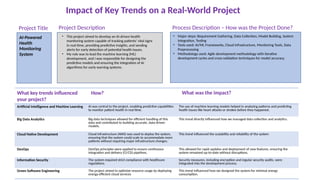
Impact of Key Trends on a Real-World Project
Process Description – How was the Project Done?
Project Description
• This project aimed to develop an AI-driven health
monitoring system capable of tracking patients' vital signs
in real-time, providing predictive insights, and sending
alerts for early detection of potential health issues.
• My role was to lead the machine learning (ML)
development, and I was responsible for designing the
predictive models and ensuring the integration of AI
algorithms for early warning systems.
• Major steps: Requirement Gathering, Data Collection, Model Building, System
Integration, Testing
• Tools used: AI/ML Frameworks, Cloud Infrastructure, Monitoring Tools, Data
Preprocessing
• Methodology used: Agile development methodology with iterative
development cycles and cross-validation techniques for model accuracy.
What key trends influenced
your project?
How? What was the impact?
Artificial Intelligence and Machine Learning AI was central to the project, enabling predictive capabilities
to monitor patient health in real time.
The use of machine learning models helped in analyzing patterns and predicting
health issues like heart attacks or strokes before they happened​
.
Big Data Analytics Big data techniques allowed for efficient handling of this
data and contributed to building accurate, data-driven
models.
This trend directly influenced how we managed data collection and analytics​
.
Cloud Native Development Cloud infrastructure (AWS) was used to deploy the system,
ensuring that the system could scale to accommodate more
patients without requiring major infrastructure changes.
This trend influenced the scalability and reliability of the system
DevOps DevOps principles were applied to ensure continuous
integration and delivery (CI/CD) pipelines.
This allowed for rapid updates and deployment of new features, ensuring the
system remained up-to-date without disruptions.
Information Security The system required strict compliance with healthcare
regulations.
Security measures, including encryption and regular security audits, were
integrated into the development process​
.
Green Software Engineering The project aimed to optimize resource usage by deploying
energy-efficient cloud services
This trend influenced how we designed the system for minimal energy
consumption.
AI-Powered
Health
Monitoring
System
Project Title

Software Development Trends Analysis Template v2.pptx

  • 1.
    Analysis of CurrentTrends in Software Development Trend Description Why is it Happening? Expected Impact DevOps The trend is DevOps integrates development and operations, emphasizing continuous delivery and automation. Because the need for rapid development and deployment cycles, combined with increasing security threats, has made DevOps critical for modern software. Experts predict faster, more secure software development, with reduced vulnerability to cyberattacks. Blockchain Technology The trend is Blockchain provides a decentralized, immutable record of transactions, and is used in various fields like finance, supply chain etc. Because Blockchain’s ability to provide secure, transparent, and decentralized systems is driving its adoption across industries. Increased transparency and security in industries like finance, logistics, and healthcare. Artificial Intelligence and Machine Learning The trend is AI and ML technologies are used to create systems that can learn from data and make decisions autonomously, improving automation and personalizing software interactions. Because growing volumes of data and advancements in computational power have accelerated the development of AI and ML, making it feasible to use these technologies for complex problem solving. AI will increase automation, improve efficiency, and enhance decision-making processes in various fields, from healthcare to autonomous vehicles Big Data Analytics The trend is Big data involves analyzing vast amounts of data to extract insights that improve decision- making and uncover patterns. Because the rise of IoT, social media, and enterprise systems generates massive datasets Better predictive analytics, more personalized services, and enhanced operational efficiency across industries like healthcare, retail, and finance​ Information Security The trend is Information security focuses on protecting data and systems from cyberattacks, emphasizing secure coding, encryption, and continuous monitoring. As digital transformation accelerates, the frequency and sophistication of cyberattacks are increasing,. Stronger defenses against data breaches and cyberattacks, with security embedded throughout the software development lifecycle. Cloud-Native Development The trend is cloud-native development uses microservices, containers, and cloud platforms to build scalable, resilient applications. Organizations need flexible, scalable infrastructure to keep up with demand. Greater agility in software development, reduced operational costs, and enhanced scalability for enterprise applications. Low-Code and No- Code Development The trend is these platforms allow users to create applications with minimal coding. The demand for faster application development and the shortage of skilled developers. Faster software delivery, broader accessibility of app development. Quantum Computing The trend is Quantum computing leverages quantum mechanics to solve problems far more efficiently than traditional computers. Advances in quantum theory and computing hardware have made it possible to explore practical applications for quantum computing. Breakthroughs in computational fields such as material science, cryptography etc. Human-Centered Design and Inclusivity The trend is this approach prioritizes the needs of users by designing software that is accessible, intuitive, and inclusive. Because as digital tools become integral to daily life, there's a growing need for accessible design to ensure inclusivity for all users. Improved user experiences, increased digital inclusivity, and more equitable software products Green Software Engineering The trend is Green software engineering aims to minimize the environmental impact of software through energy-efficient coding As climate change becomes a global concern, industries are adopting greener practices, and software development is no exception. Reduced carbon footprint of software operations, cost savings through optimized resource use.
  • 2.
    Impact of KeyTrends on a Real-World Project Process Description – How was the Project Done? Project Description • This project aimed to develop an AI-driven health monitoring system capable of tracking patients' vital signs in real-time, providing predictive insights, and sending alerts for early detection of potential health issues. • My role was to lead the machine learning (ML) development, and I was responsible for designing the predictive models and ensuring the integration of AI algorithms for early warning systems. • Major steps: Requirement Gathering, Data Collection, Model Building, System Integration, Testing • Tools used: AI/ML Frameworks, Cloud Infrastructure, Monitoring Tools, Data Preprocessing • Methodology used: Agile development methodology with iterative development cycles and cross-validation techniques for model accuracy. What key trends influenced your project? How? What was the impact? Artificial Intelligence and Machine Learning AI was central to the project, enabling predictive capabilities to monitor patient health in real time. The use of machine learning models helped in analyzing patterns and predicting health issues like heart attacks or strokes before they happened​ . Big Data Analytics Big data techniques allowed for efficient handling of this data and contributed to building accurate, data-driven models. This trend directly influenced how we managed data collection and analytics​ . Cloud Native Development Cloud infrastructure (AWS) was used to deploy the system, ensuring that the system could scale to accommodate more patients without requiring major infrastructure changes. This trend influenced the scalability and reliability of the system DevOps DevOps principles were applied to ensure continuous integration and delivery (CI/CD) pipelines. This allowed for rapid updates and deployment of new features, ensuring the system remained up-to-date without disruptions. Information Security The system required strict compliance with healthcare regulations. Security measures, including encryption and regular security audits, were integrated into the development process​ . Green Software Engineering The project aimed to optimize resource usage by deploying energy-efficient cloud services This trend influenced how we designed the system for minimal energy consumption. AI-Powered Health Monitoring System Project Title