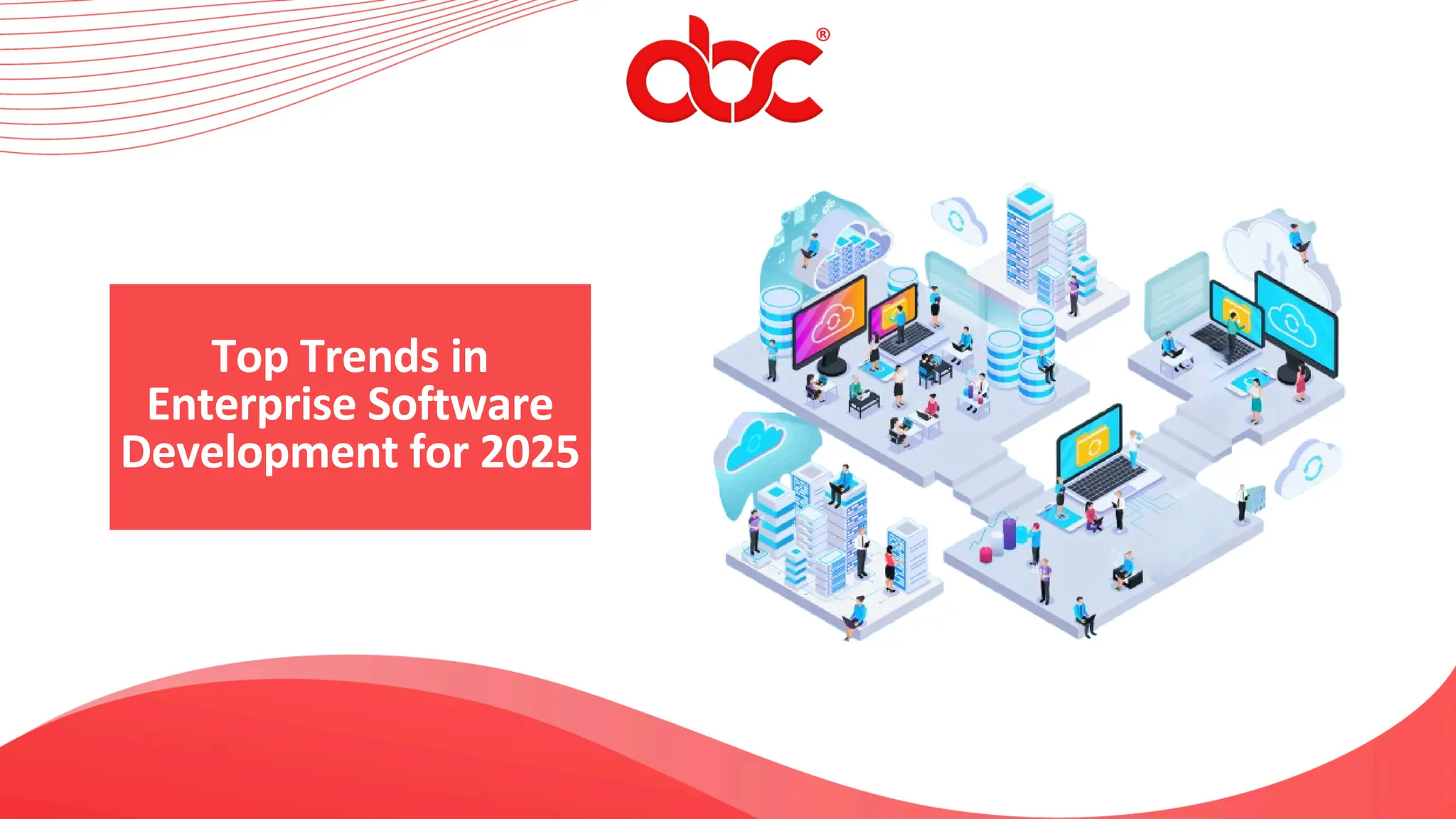
Top Trends in
Enterprise Software
Development for 2025
As enterprises strive to stay competitive in an increasingly digital landscape,
software development continues to evolve, reflecting new technological
advancements and shifting business needs. From the integration of AI and
machine learning to the rise of low-code platforms, emerging trends in enterprise
software development for 2025 will shape how businesses operate, innovate,
and engage with their customers. This blog outlines the key trends anticipated to
define the future of enterprise software and how decision-makers can leverage
these developments to stay ahead of the curve.
Artificial Intelligence (AI) and Machine Learning
applications (ML) are transforming enterprise applications
in the areas of modeling, automation, and real time decision
management. The integration of AI/ML technology
facilitates companies to leverage data more effectively,
improve their operations, and optimize process
management.
1. AI and Machine Learning Integration
For instance, algorithms can immediately determine the fraudulent actions performed
in finance, which is made possible through AI. Other than that, machine learning
approaches can assist in diagnostics of patients through patient data analysis, in
healthcare settings, hence making many predictions to be sooner and more accurate.
Booming industries employ AI tools for recommendation engines and improvement in
stock control. AI and ML assisted tools deployed in software ecosystems embed the
ability for organizations to become more responsive and more innovative within the
business environment, making such technologies crucial for the businesses that intend
to evolve by 2025.
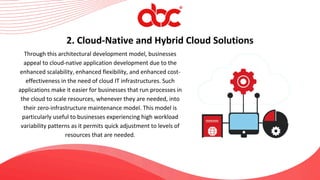
Through this architectural development model, businesses
appeal to cloud-native application development due to the
enhanced scalability, enhanced flexibility, and enhanced cost-
effectiveness in the need of cloud IT infrastructures. Such
applications make it easier for businesses that run processes in
the cloud to scale resources, whenever they are needed, into
their zero-infrastructure maintenance model. This model is
particularly useful to businesses experiencing high workload
variability patterns as it permits quick adjustment to levels of
resources that are needed.
2. Cloud-Native and Hybrid Cloud Solutions
In addition, it is clear that the hybrid cloud systems, which encapsulate the on-premises
systems and the public as well as private cloud services, these solutions have increased
the level of popularity owing to their favourable and useful approach of data
management. By combining on premise private clouds and public clouds for non-
sensitive workloads, enterprises are able to keep legally sensitive information private
yet still use the public cloud for operational optimization and minimal threat
workloads. This blend of cloud and hybrid solutions allows companies to transition
their IT strategies as they need to, further allowing channelling cloud solutions as an
integral component in enterprise software development strategy for 2025.
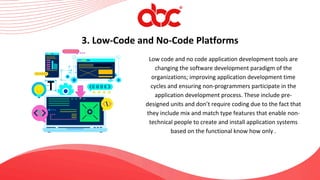
Low code and no code application development tools are
changing the software development paradigm of the
organizations; improving application development time
cycles and ensuring non-programmers participate in the
application development process. These include pre-
designed units and don’t require coding due to the fact that
they include mix and match type features that enable non-
technical people to create and install application systems
based on the functional know how only .
3. Low-Code and No-Code Platforms
This democratizing philosophy to software development encourages innovation
especially in organizations where staff that are not in the IT department can develop
what they require themselves. Furthermore, the usage of low-code/no-code tools
empowers enterprises’ agility by enhancing movement away from long led time
software development, thus enabling companies to be agile and responsive to the ever
changing market conditions. This means that for organizations that want to gain an
edge by 2025, deployment of low-code and no-code tools may be fundamental in
decreasing the time to market and also creating a conducive environment for more
ideas to be proposed and implemented.
With the increasing level of sophistication in cyber-attacks these
days, IT managers are taking the necessary precautions to ensure
that security becomes a first-class citizen in the software
development lifecycle. It is important to note that even cyber
security is no longer seen as simply an after-thought feature that
is added after the product’s completion but is an integral part of
each phase of the software development life cycle. Secure
coding, encryption, two factor authentication are now standard
features of enterprise software development, and not just any
‘add-ons’ to make applications fire-proof.
4. Increased Focus on Cybersecurity
Various companies from different industries verticals regard consumer safety and data
protection as their paramount priority. This is especially true yes in the case of finance or
healthcare industries who are relatively quick to adopt new cyber security remediation
frameworks. New security testing techniques are integrated as part of the development
pipeline which incorporates implementing new security controls to detect and address
data vulnerabilities and weaknesses as early in the process as possible. Organizations
who have an ingrained culture of cyber security will remain the best suited to protect
their data from evolving forms of cyber threats. This is particularly important as
consumer trust is forecasted to be a key factor when evaluating businesses in 2025.
Organizations are embedding compliance into the software
architecture and development process more often than
ever as more data privacy laws come into existence such as
the general data protection regulation or CPCA. Compliance
is no longer something that is addressed after a compliant
app is developed, it is done from the app design phase and
removing the need to implement controls after-the-fact.
Self-protection of data is prioritized while other compliance
features are considered indirectly.
5. Data Privacy and Compliance
If organizations are to be trusted with user information, they must ensure specific
measures are able to be enforced such as limiting what data is stored, why it is
stored, and providing controls over how user information is accessed. These
measures include the user’s consent protocols and data anonymization
techniques. Taking proactive measures to ensure compliance will help minimize
regulatory exposure for companies while enhancing consumer confidence which
is essential in this current age.
As enterprises prepare for 2025, these trends offer a roadmap for staying competitive
and responsive to market needs. From leveraging AI/ML for enhanced intelligence and
automation to adopting hybrid cloud solutions for greater operational flexibility, the
future of enterprise software development is both dynamic and promising.
Organizations that prioritize these trends—embracing low-code platforms for agility,
strengthening cybersecurity measures, and embedding compliance—will be well-
positioned to navigate the complexities of a digital-first world and deliver innovative,
secure, and compliant solutions that meet the demands of tomorrow’s marketplace.
Contact Us for your Custom Enterprise Software Development needs.
Conclusion
Contact Us
+ 91 98 980 105 89
info@ansibytecode.com
+91 97 243 145 89
10685-B Hazelhurst Dr. #22591 Houston, TX 77043, USA

Top Trends in Enterprise Software Development for 2025

  • 1.
    Top Trends in EnterpriseSoftware Development for 2025
  • 2.
    As enterprises striveto stay competitive in an increasingly digital landscape, software development continues to evolve, reflecting new technological advancements and shifting business needs. From the integration of AI and machine learning to the rise of low-code platforms, emerging trends in enterprise software development for 2025 will shape how businesses operate, innovate, and engage with their customers. This blog outlines the key trends anticipated to define the future of enterprise software and how decision-makers can leverage these developments to stay ahead of the curve.
  • 3.
    Artificial Intelligence (AI)and Machine Learning applications (ML) are transforming enterprise applications in the areas of modeling, automation, and real time decision management. The integration of AI/ML technology facilitates companies to leverage data more effectively, improve their operations, and optimize process management. 1. AI and Machine Learning Integration
  • 4.
    For instance, algorithmscan immediately determine the fraudulent actions performed in finance, which is made possible through AI. Other than that, machine learning approaches can assist in diagnostics of patients through patient data analysis, in healthcare settings, hence making many predictions to be sooner and more accurate. Booming industries employ AI tools for recommendation engines and improvement in stock control. AI and ML assisted tools deployed in software ecosystems embed the ability for organizations to become more responsive and more innovative within the business environment, making such technologies crucial for the businesses that intend to evolve by 2025.
  • 5.
    Through this architecturaldevelopment model, businesses appeal to cloud-native application development due to the enhanced scalability, enhanced flexibility, and enhanced cost- effectiveness in the need of cloud IT infrastructures. Such applications make it easier for businesses that run processes in the cloud to scale resources, whenever they are needed, into their zero-infrastructure maintenance model. This model is particularly useful to businesses experiencing high workload variability patterns as it permits quick adjustment to levels of resources that are needed. 2. Cloud-Native and Hybrid Cloud Solutions
  • 6.
    In addition, itis clear that the hybrid cloud systems, which encapsulate the on-premises systems and the public as well as private cloud services, these solutions have increased the level of popularity owing to their favourable and useful approach of data management. By combining on premise private clouds and public clouds for non- sensitive workloads, enterprises are able to keep legally sensitive information private yet still use the public cloud for operational optimization and minimal threat workloads. This blend of cloud and hybrid solutions allows companies to transition their IT strategies as they need to, further allowing channelling cloud solutions as an integral component in enterprise software development strategy for 2025.
  • 7.
    Low code andno code application development tools are changing the software development paradigm of the organizations; improving application development time cycles and ensuring non-programmers participate in the application development process. These include pre- designed units and don’t require coding due to the fact that they include mix and match type features that enable non- technical people to create and install application systems based on the functional know how only . 3. Low-Code and No-Code Platforms
  • 8.
    This democratizing philosophyto software development encourages innovation especially in organizations where staff that are not in the IT department can develop what they require themselves. Furthermore, the usage of low-code/no-code tools empowers enterprises’ agility by enhancing movement away from long led time software development, thus enabling companies to be agile and responsive to the ever changing market conditions. This means that for organizations that want to gain an edge by 2025, deployment of low-code and no-code tools may be fundamental in decreasing the time to market and also creating a conducive environment for more ideas to be proposed and implemented.
  • 9.
    With the increasinglevel of sophistication in cyber-attacks these days, IT managers are taking the necessary precautions to ensure that security becomes a first-class citizen in the software development lifecycle. It is important to note that even cyber security is no longer seen as simply an after-thought feature that is added after the product’s completion but is an integral part of each phase of the software development life cycle. Secure coding, encryption, two factor authentication are now standard features of enterprise software development, and not just any ‘add-ons’ to make applications fire-proof. 4. Increased Focus on Cybersecurity
  • 10.
    Various companies fromdifferent industries verticals regard consumer safety and data protection as their paramount priority. This is especially true yes in the case of finance or healthcare industries who are relatively quick to adopt new cyber security remediation frameworks. New security testing techniques are integrated as part of the development pipeline which incorporates implementing new security controls to detect and address data vulnerabilities and weaknesses as early in the process as possible. Organizations who have an ingrained culture of cyber security will remain the best suited to protect their data from evolving forms of cyber threats. This is particularly important as consumer trust is forecasted to be a key factor when evaluating businesses in 2025.
  • 11.
    Organizations are embeddingcompliance into the software architecture and development process more often than ever as more data privacy laws come into existence such as the general data protection regulation or CPCA. Compliance is no longer something that is addressed after a compliant app is developed, it is done from the app design phase and removing the need to implement controls after-the-fact. Self-protection of data is prioritized while other compliance features are considered indirectly. 5. Data Privacy and Compliance
  • 12.
    If organizations areto be trusted with user information, they must ensure specific measures are able to be enforced such as limiting what data is stored, why it is stored, and providing controls over how user information is accessed. These measures include the user’s consent protocols and data anonymization techniques. Taking proactive measures to ensure compliance will help minimize regulatory exposure for companies while enhancing consumer confidence which is essential in this current age.
  • 13.
    As enterprises preparefor 2025, these trends offer a roadmap for staying competitive and responsive to market needs. From leveraging AI/ML for enhanced intelligence and automation to adopting hybrid cloud solutions for greater operational flexibility, the future of enterprise software development is both dynamic and promising. Organizations that prioritize these trends—embracing low-code platforms for agility, strengthening cybersecurity measures, and embedding compliance—will be well- positioned to navigate the complexities of a digital-first world and deliver innovative, secure, and compliant solutions that meet the demands of tomorrow’s marketplace. Contact Us for your Custom Enterprise Software Development needs. Conclusion
  • 14.
    Contact Us + 9198 980 105 89 info@ansibytecode.com +91 97 243 145 89 10685-B Hazelhurst Dr. #22591 Houston, TX 77043, USA