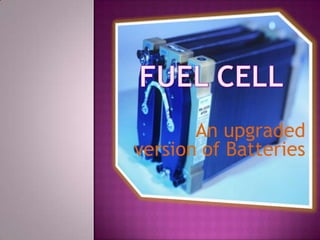
An upgraded
version of Batteries
 A fuel cell is an electrochemical energy
conversion device that converts hydrogen
and oxygen into electricity, heat, and water
as a result of a chemical reaction.
1. CATHODE- the positive electrode
2. ANODE- the negative electrode
3. ELECTROLYTE- in which the reactions take
place
4. AN INTERCONNECT(in case of a stack)- for
electron transfer
5. SEALS- To act as barrier between
components
 Highly efficient electric power generation
system (can be as high as 70-80%)
 Effective utilization high temperature waste
heat
 Environmental friendly power generation
 A single fuel cell generates a tiny amount of
direct current (DC) electricity. In practice,
many fuel cells are usually assembled into a
stack. Cell or stack, the principles are the
same.
 Ionically conductive -oxygen ion transport
 Chemically stable (at high temperatures as
well as in reducing and oxidizing
environments)
 Gas tight/free of porosity
 Uniformly thin layer (to minimize ohmic
losses)
Most widely used electrolyte is Yttrium doped
zirconium oxide (YSZ)
 Advantages of YSZ
i. ionic conductivity
ii. chemical stability
iii. mechanical strength
 Disadvantages of YSZ
i. low ionic conductivity
 Solution
I. Decrease the thickness of the YSZ
electrolyte
II. Find other materials to replace the
yttrium like Scandium-doped zirconium
oxide has higher conductivity than YSZ but
high cost of scandium is a disadvantage
 High electronic conductivity
 Chemically compatible with neighboring cell
component (usually the electrolyte)
 Should be porous
 Stable in an oxidizing environment
 Large triple phase boundary
 Catalyze the dissociation of oxygen
 Adhesion to electrolyte surface
Lanthanum strontium manganite(LSM)
is the cathode
Advantages of LSM
I. Compatibility with doped
zirconia electrolytes
II. Similar coefficient of
expansion to YSZ and thus
limits stresses
 Disadvantages of LSM
I. LSM is a poor ionic conductor, and so the
electrochemically active reaction is
limited to the triple phase boundary (TPB)
where the electrolyte, air and electrode
meet.
II. LSM works well as a cathode at high
temperatures, but its performance quickly
falls as the operating temperature is
lowered below 800 °C.
 Electrically conductive
 High electro-catalytic activity
 Large triple phase boundary
 Stable in a reducing environment
 Can be made thin enough to avoid mass transfer
losses, but thick enough to provide area and
distribute current
 Thermal expansion coefficient similar neighboring
cell component
 Chemically compatible with neighboring cell
component
 Fine particle size
 Ceramic anode layer must be very porous to
allow the fuel to flow towards the
electrolyte
 The most common material used is a cermet
made up of nickel mixed with the ceramic
material that is used for the electrolyte
 The anode is commonly the thickest and
strongest layer
 The anode’s job is to use the oxygen ions
that diffuse through the electrolyte to
oxidize the hydrogen fuel
ADDITIONAL USES:
 Function of the anode is to act as a catalyst
for steam reforming the fuel into hydrogen.
 This provides another operational benefit to
the fuel cell stack because the reforming
reaction is endothermic, which cools the
stack internally.
 Stable under high temperature oxidizing and
reducing environments
 Very high electrical conductivity
 High density with “no open porosity”
 Strong and high creep resistances for planar
configurations
 Good thermal conductivity
 Phase stability under temperature range
 Resistant to sulfur poisoning, oxidation and
carburization
 Low materials and fabrication cost
 The interconnect can be either a metallic or
ceramic layer that sits between each individual
cell.
 It connects each cell in series, so that the
electricity each cell generates can be combined.
 a metallic 95Cr-5 Fe alloy is the most commonly
used interconnect
 Ceramic materials are also under considerations
DRAWBACKS:
these ceramic interconnect materials are very
expensive as compared to metals.
 Electrically insulating
 Thermal expansion compatibility with other
cell components
 Chemically and physically stable at high
temperatures
 Gastight
 Chemically compatible with other
components
 Provide high mechanical bonding strength
 Low cost
 PURPOSE
produce an electrical current that can be
directed outside the cell to do work
 GENERAL WORKING OF FUEL CELLS
1. Hydrogen atoms enter a fuel cell at the
anode
2. Hydrogen atoms are now ionized, and
carry a positive electrical charge.
3. Negatively charged electrons provide the
current through wires to do work.
 In some cells, Oxygen enters the fuel cell at
the cathode and combines with the electrons
and hydrogen.
 In other cell types the oxygen picks up
electrons and then combines with hydrogen
 Electrolyte must permit only the appropriate
ions to pass between the anode and cathode
 Fuel cells create electricity chemically.
Therefore, fuel cells are more efficient in
extracting energy from a fuel
 Alkali fuel cells
 Molten Carbonate fuel cells (MCFC)
 Phosphoric Acid fuel cells (PAFC)
 Proton Exchange Membrane (PEM) fuel cells
 Solid Oxide fuel cells (SOFC)
 Fuel cells can continuously make electricity
if they have a constant fuel supply.
 SOFCs that operate at higher temperatures --
between about 1100 and 1800 degrees
Fahrenheit
 Can run on a wide variety of fuels, including
natural gas, biogas, hydrogen and liquid fuels
such as diesel and gasoline
 Each SOFC is made of ceramic materials,
which form three layers: the anode, the
cathode and the electrolyte
 The big advantage to fuel cells is that they're
more efficient than traditional power
generation
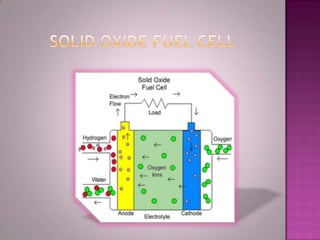
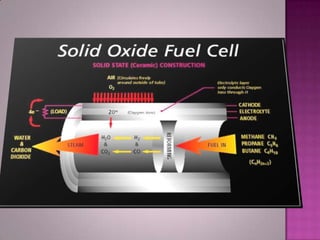
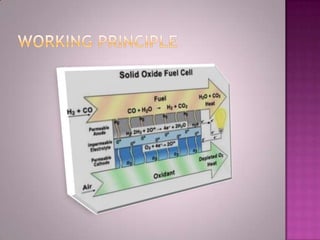
 SOFC essentially consists of two
porous electrodes separated by a
dense, oxide ion conducting electrolyte.
 Oxygen supplied at the cathode (air
electrode) reacts with
incoming electrons from the external circuit
to form oxide ions
 These ions migrate to the anode (fuel
electrode) through the oxide ion conducting
electrolyte.
 At the anode, oxide ions combine with
hydrogen (and/or carbon monoxide) in the
fuel to form water (and/or carbon dioxide),
liberating electrons.
 Electrons (electricity) flow from the anode
through the external circuit to the cathode.
ADVANTAGES
 high efficiency,
 long-term stability,
 fuel flexibility,
 low emissions, and
 relatively low cost.
DISADVANTAGES
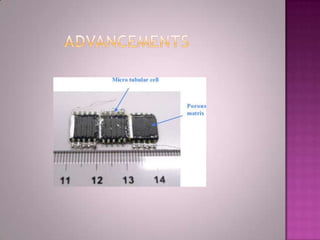
 high operating temperature which results in
longer start-up times and mechanical and
chemical compatibility issues.
 SOFC are being targeted for use in power and
heat generation for homes and businesses as well
as auxiliary power units for electrical systems in
vehicles.
 SOFC also can be linked with a gas turbine, in
which
the hot, high pressure exhaust of the fuel cell
can be
used to spin the turbine, generating a second
source of
electricity.
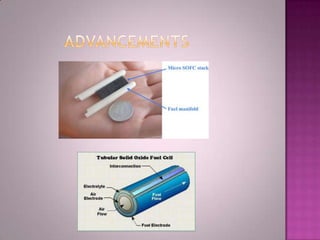
 Using planar SOFCs, stationary power generation
systems of from 1-kW to 25-kW size have been
fabricated and tested by several organizations
 Rolls-Royce Fuel Cell Systems Ltd is developing a
SOFC gas turbine hybrid system fueled by natural
gas for power generation applications on the
order of a megawatt (e.g. Futuregen).
 Ceres Power Ltd. has developed a low cost and
low temperature (500–600 degrees) SOFC stack
using cerium gadolinium oxide (CGO) in place of
current industry standard ceramic, yttria
stabilized zirconia (YSZ), which allows the use of
stainless steel to support the ceramic.
 Solid Cell Inc. has developed a unique, low cost
cell architecture that combines properties of
planar and tubular designs, along with a Cr-free
cermet interconnect.
 The high temperature electrochemistry center
(HITEC) at the University of Florida, Gainesville
is focused on studying ionic transport, electro
catalytic phenomena and micro structural
characterization of ion conducting materials.
 SiEnergy Systems, a Harvard spin-off company,
has demonstrated the first macro-scale thin-film
solid-oxide fuel cell that can operate at 500
degrees.
 Delphi Automotive Systems are developing
an SOFC that will power auxiliary units in
automobiles and tractor-trailers
 Research is also going on in reducing start-up
time to be able to implement SOFCs in
mobile applications
SOLID OXIDE FUEL CELLS

SOLID OXIDE FUEL CELLS

  • 2.
  • 3.
     A fuelcell is an electrochemical energy conversion device that converts hydrogen and oxygen into electricity, heat, and water as a result of a chemical reaction.
  • 4.
    1. CATHODE- thepositive electrode 2. ANODE- the negative electrode 3. ELECTROLYTE- in which the reactions take place 4. AN INTERCONNECT(in case of a stack)- for electron transfer 5. SEALS- To act as barrier between components
  • 5.
     Highly efficientelectric power generation system (can be as high as 70-80%)  Effective utilization high temperature waste heat  Environmental friendly power generation
  • 6.
     A singlefuel cell generates a tiny amount of direct current (DC) electricity. In practice, many fuel cells are usually assembled into a stack. Cell or stack, the principles are the same.
  • 7.
     Ionically conductive-oxygen ion transport  Chemically stable (at high temperatures as well as in reducing and oxidizing environments)  Gas tight/free of porosity  Uniformly thin layer (to minimize ohmic losses)
  • 8.
    Most widely usedelectrolyte is Yttrium doped zirconium oxide (YSZ)  Advantages of YSZ i. ionic conductivity ii. chemical stability iii. mechanical strength  Disadvantages of YSZ i. low ionic conductivity
  • 9.
     Solution I. Decreasethe thickness of the YSZ electrolyte II. Find other materials to replace the yttrium like Scandium-doped zirconium oxide has higher conductivity than YSZ but high cost of scandium is a disadvantage
  • 10.
     High electronicconductivity  Chemically compatible with neighboring cell component (usually the electrolyte)  Should be porous  Stable in an oxidizing environment  Large triple phase boundary  Catalyze the dissociation of oxygen  Adhesion to electrolyte surface
  • 11.
    Lanthanum strontium manganite(LSM) isthe cathode Advantages of LSM I. Compatibility with doped zirconia electrolytes II. Similar coefficient of expansion to YSZ and thus limits stresses
  • 12.
     Disadvantages ofLSM I. LSM is a poor ionic conductor, and so the electrochemically active reaction is limited to the triple phase boundary (TPB) where the electrolyte, air and electrode meet. II. LSM works well as a cathode at high temperatures, but its performance quickly falls as the operating temperature is lowered below 800 °C.
  • 13.
     Electrically conductive High electro-catalytic activity  Large triple phase boundary  Stable in a reducing environment  Can be made thin enough to avoid mass transfer losses, but thick enough to provide area and distribute current  Thermal expansion coefficient similar neighboring cell component  Chemically compatible with neighboring cell component  Fine particle size
  • 14.
     Ceramic anodelayer must be very porous to allow the fuel to flow towards the electrolyte  The most common material used is a cermet made up of nickel mixed with the ceramic material that is used for the electrolyte  The anode is commonly the thickest and strongest layer  The anode’s job is to use the oxygen ions that diffuse through the electrolyte to oxidize the hydrogen fuel
  • 15.
    ADDITIONAL USES:  Functionof the anode is to act as a catalyst for steam reforming the fuel into hydrogen.  This provides another operational benefit to the fuel cell stack because the reforming reaction is endothermic, which cools the stack internally.
  • 16.
     Stable underhigh temperature oxidizing and reducing environments  Very high electrical conductivity  High density with “no open porosity”  Strong and high creep resistances for planar configurations  Good thermal conductivity  Phase stability under temperature range  Resistant to sulfur poisoning, oxidation and carburization  Low materials and fabrication cost
  • 17.
     The interconnectcan be either a metallic or ceramic layer that sits between each individual cell.  It connects each cell in series, so that the electricity each cell generates can be combined.  a metallic 95Cr-5 Fe alloy is the most commonly used interconnect  Ceramic materials are also under considerations DRAWBACKS: these ceramic interconnect materials are very expensive as compared to metals.
  • 18.
     Electrically insulating Thermal expansion compatibility with other cell components  Chemically and physically stable at high temperatures  Gastight  Chemically compatible with other components  Provide high mechanical bonding strength  Low cost
  • 19.
     PURPOSE produce anelectrical current that can be directed outside the cell to do work  GENERAL WORKING OF FUEL CELLS 1. Hydrogen atoms enter a fuel cell at the anode 2. Hydrogen atoms are now ionized, and carry a positive electrical charge. 3. Negatively charged electrons provide the current through wires to do work.
  • 20.
     In somecells, Oxygen enters the fuel cell at the cathode and combines with the electrons and hydrogen.  In other cell types the oxygen picks up electrons and then combines with hydrogen  Electrolyte must permit only the appropriate ions to pass between the anode and cathode  Fuel cells create electricity chemically. Therefore, fuel cells are more efficient in extracting energy from a fuel
  • 21.
     Alkali fuelcells  Molten Carbonate fuel cells (MCFC)  Phosphoric Acid fuel cells (PAFC)  Proton Exchange Membrane (PEM) fuel cells  Solid Oxide fuel cells (SOFC)
  • 22.
     Fuel cellscan continuously make electricity if they have a constant fuel supply.  SOFCs that operate at higher temperatures -- between about 1100 and 1800 degrees Fahrenheit  Can run on a wide variety of fuels, including natural gas, biogas, hydrogen and liquid fuels such as diesel and gasoline
  • 23.
     Each SOFCis made of ceramic materials, which form three layers: the anode, the cathode and the electrolyte  The big advantage to fuel cells is that they're more efficient than traditional power generation
  • 28.
     SOFC essentiallyconsists of two porous electrodes separated by a dense, oxide ion conducting electrolyte.  Oxygen supplied at the cathode (air electrode) reacts with incoming electrons from the external circuit to form oxide ions  These ions migrate to the anode (fuel electrode) through the oxide ion conducting electrolyte.
  • 29.
     At theanode, oxide ions combine with hydrogen (and/or carbon monoxide) in the fuel to form water (and/or carbon dioxide), liberating electrons.  Electrons (electricity) flow from the anode through the external circuit to the cathode.
  • 30.
    ADVANTAGES  high efficiency, long-term stability,  fuel flexibility,  low emissions, and  relatively low cost. DISADVANTAGES  high operating temperature which results in longer start-up times and mechanical and chemical compatibility issues.
  • 31.
     SOFC arebeing targeted for use in power and heat generation for homes and businesses as well as auxiliary power units for electrical systems in vehicles.  SOFC also can be linked with a gas turbine, in which the hot, high pressure exhaust of the fuel cell can be used to spin the turbine, generating a second source of electricity.  Using planar SOFCs, stationary power generation systems of from 1-kW to 25-kW size have been fabricated and tested by several organizations

  • 32.
     Rolls-Royce FuelCell Systems Ltd is developing a SOFC gas turbine hybrid system fueled by natural gas for power generation applications on the order of a megawatt (e.g. Futuregen).  Ceres Power Ltd. has developed a low cost and low temperature (500–600 degrees) SOFC stack using cerium gadolinium oxide (CGO) in place of current industry standard ceramic, yttria stabilized zirconia (YSZ), which allows the use of stainless steel to support the ceramic.
  • 33.
     Solid CellInc. has developed a unique, low cost cell architecture that combines properties of planar and tubular designs, along with a Cr-free cermet interconnect.  The high temperature electrochemistry center (HITEC) at the University of Florida, Gainesville is focused on studying ionic transport, electro catalytic phenomena and micro structural characterization of ion conducting materials.  SiEnergy Systems, a Harvard spin-off company, has demonstrated the first macro-scale thin-film solid-oxide fuel cell that can operate at 500 degrees.
  • 34.
     Delphi AutomotiveSystems are developing an SOFC that will power auxiliary units in automobiles and tractor-trailers  Research is also going on in reducing start-up time to be able to implement SOFCs in mobile applications