Social Problems 13th Edition Eitzen Baca Zinn Smith Test Bank
Social Problems 13th Edition Eitzen Baca Zinn Smith Test Bank
Social Problems 13th Edition Eitzen Baca Zinn Smith Test Bank
Social Problems 13th Edition Eitzen Baca Zinn Smith Test Bank
Social Problems 13th Edition Eitzen Baca Zinn Smith Test Bank
1.
Social Problems 13thEdition Eitzen Baca Zinn
Smith Test Bank download pdf
https://testbankmall.com/product/social-problems-13th-edition-eitzen-
baca-zinn-smith-test-bank/
Visit testbankmall.com to explore and download the complete
collection of test banks or solution manuals!
2.
We have selectedsome products that you may be interested in
Click the link to download now or visit testbankmall.com
for more options!.
Diversity in Families 10th Edition Baca Zinn Eitzen Wells
Test Bank
https://testbankmall.com/product/diversity-in-families-10th-edition-
baca-zinn-eitzen-wells-test-bank/
Test Bank for Social Problems, 14th Edition, D. Stanley
Eitzen
https://testbankmall.com/product/test-bank-for-social-problems-14th-
edition-d-stanley-eitzen/
Test Bank for Diversity in Families 9th Edition Maxine
Baca Zinn
https://testbankmall.com/product/test-bank-for-diversity-in-
families-9th-edition-maxine-baca-zinn/
Solution Manual for Work Systems: The Methods, Measurement
& Management of Work Mikell P. Groover
https://testbankmall.com/product/solution-manual-for-work-systems-the-
methods-measurement-management-of-work-mikell-p-groover/
3.
Introduction to LeadershipConcepts and Practice 4th
Edition Northouse Test Bank
https://testbankmall.com/product/introduction-to-leadership-concepts-
and-practice-4th-edition-northouse-test-bank/
Test Bank for Management, 15th Edition, Stephen P. Robbins
Mary A. Coulter
https://testbankmall.com/product/test-bank-for-management-15th-
edition-stephen-p-robbins-mary-a-coulter/
Precalculus Graphs and Models A Right Triangle Approach
6th Edition Bittinger Solutions Manual
https://testbankmall.com/product/precalculus-graphs-and-models-a-
right-triangle-approach-6th-edition-bittinger-solutions-manual/
Solution Manual for General Chemistry: Principles and
Modern Applications, 11th Edition Petrucci
https://testbankmall.com/product/solution-manual-for-general-
chemistry-principles-and-modern-applications-11th-edition-petrucci/
Test Bank for Psychology in Modules, 10th Edition: David
G. Myers
https://testbankmall.com/product/test-bank-for-psychology-in-
modules-10th-edition-david-g-myers/
978-0205881888
Chapter 1 TheSociological Approach to Social Problems
A. Multiple-Choice
1. As the percentage of the U.S. residents who are over 65 years old increases, the
divide between workers who support the old with payroll taxes will have a racial
dimension because the elderly will be overwhelmingly __________.
A) African American
B) Asian
C) Latin American
D) White
Answer: D
Page Reference: 3
Learning Objective:
Topic/A-head: Introduction
Skill Level: Remember the Facts
2. Emergency food requests and people seeking emergency shelter are
__________.
A) increasing
B) decreasing
C) staying the same
D) not currently studied
Answer: A
Page Reference: 4
Learning Objective:
Topic/A-head: Introduction
Skill Level: Remember the Facts
3. The United States, with about 4.5 percent of the world’s population, consumes
__________ of the world’s energy.
A) one-third
B) one-fourth
C) one-half
D) three-fourths
6.
Answer: B
Page Reference:4
Learning Objective:
Topic/A-head: Introduction
Skill Level: Remember the Facts
4. Based on the measures used in the text, which of the following is the most
accurate?
A) A greater proportion of the government is run by women in the United States
than in Scandinavian countries.
B) The United States was among the worst countries in the rate of deaths for
children under age five.
C) Japan is the best country in the world in which to be a mother.
D) Women have it better in the United States than in any other country in the
world.
Answer: B
Page Reference: 5
Learning Objective:
Topic/A-head: Introduction
Skill Level: Remember the Facts
5. Almost all the growth in the world’s population by 2050 will take place in the
__________.
A) poorest nations
B) wealthiest nations
C) United States
D) European Union
Answer: A
Page Reference: 5
Learning Objective:
Topic/A-head: Introduction
Skill Level: Remember the Facts
6. Half of the people in the world live on less than __________.
A) $0.25 a day
B) $0.50 a day
C) $1 a day
D) $2 a day
7.
Answer: D
Page Reference:5
Learning Objective:
Topic/A-head: Introduction
Skill Level: Remember the Facts
7. The __________ nature of social problems illustrates that social problems vary
by time, place, and definition.
A) economic
B) objective
C) political
D) subjective
Answer: D
Page Reference: 7
Learning Objective: 1.1
Topic/A-head: History of Social Problems Theory
Skill Level: Understand the Concepts
8. In the most recent direction of the study of deviance, __________.
A) labeling people as abnormal has helped to clarify that they are the source of
most social problems
B) it is understood that social structures contribute to the perpetuation of deviance
C) it is understood that deviants bring their problems on themselves
D) labeling is seen as irrelevant in creating and sustaining deviance
Answer: B
Page Reference: 7
Learning Objective: 1.1
Topic/A-head: History of Social Problems Theory
Skill Level: Understand the Concepts
9. The __________ nature of social problems describes societal conditions that
harm certain segments of the population.
A) economic
B) objective
C) political
D) subjective
8.
Answer: B
Page Reference:8
Learning Objective: 1.2
Topic/A-head: Toward a Definition of Social Problems
Skill Level: Understand the Concepts
10. According to the text, __________ often escape criticism and identification as
social problems.
A) institutions
B) criminals
C) the mentally ill
D) school dropouts
Answer: A
Page Reference: 9
Learning Objective: 1.2
Topic/A-head: Toward a Definition of Social Problems
Skill Level: Apply What You Know
11. Which of the following is a danger associated with relying on public opinion to
define social phenomena as social problems?
A) It may increase focus on intuitions as the source of social problems.
B) It may divert attention from problems within the existing social order.
C) It may overlook conditions that are detrimental to the rich.
D) It may overlook individual responsibility.
Answer: B
Page Reference: 8-9
Learning Objective: 1.2
Topic/A-head: Toward a Definition of Social Problems
Skill Level: Analyze It
12. The nations of Western Europe, Scandinavia, and Canada are able to provide
generous social welfare policies for their citizens because they __________.
A) are monarchies
B) tax their citizens at a higher rate than the United States
C) restrict the freedoms of their citizens
D) are communist nations
9.
Answer: B
Page Reference:11
Learning Objective: 1.3
Topic/A-head: Types of Social Problems
Skill Level: Remember the Facts
13. As a result of extensive and universal social services, the social welfare states
have __________ than the United States.
A) higher infant mortality rates
B) lower literacy rates
C) lower rates of violent crime
D) higher rates of violent crime
Answer: C
Page Reference: 11
Learning Objective: 1.3
Topic/A-head: Types of Social Problems
Skill Level: Remember the Facts
14. Social welfare states have a(n) ________ life expectancy when compared to the
United States.
A) shorter
B) longer
C) identical
D) nonexistent
Answer: B
Page Reference: 11
Learning Objective: 1.3
Topic/A-head: Types of Social Problems
Skill Level: Remember the Facts
15. Citizens in social welfare states likely have better health outcomes than those
in the United States because __________.
A) they provide more tax-funded social services for their people
B) they have no unemployment
C) they have a more competitive system for social services
D) they access social services through private enterprise, which ensures higher
quality
10.
Answer: A
Page Reference:11
Learning Objective: 1.3
Topic/A-head: Types of Social Problems
Skill Level: Remember the Facts
16. According to the sociological perspective, norm violators are __________.
A) solely responsible for their actions
B) universally criticized
C) the symptoms of social problems, not the cause
D) guiltless for their actions
Answer: C
Page Reference: 9
Learning Objective: 1.3
Topic/A-head: Types of Social Problems
Skill Level: Understand the Concepts
17. Society-induced conditions that harm any segment of the population, and acts
and conditions that violate the norms and values found in society, define
__________.
A) social problems
B) self-actualization
C) cultural deprivation
D) the sociological imagination
Answer: A
Page Reference: 10
Learning Objective: 1.3
Topic/A-head: Types of Social Problems
Skill Level: Understand the Concepts
18. According to the text, the key to understanding social problems is
understanding the __________.
A) opinions of the public
B) personal experiences of those who violate society’s norms
C) needs of victims of deviant behavior
D) distribution of power in society
11.
Answer: D
Page Reference:10
Learning Objective: 1.3
Topic/A-head: Types of Social Problems
Skill Level: Understand the Concepts
19. Institutionalized deviance results in a society in which __________.
A) all law enforcement is corrupt
B) there is an extremely high rate of crime
C) some members are disadvantaged
D) all members are economically equal
Answer: C
Page Reference: 10
Learning Objective: 1.3
Topic/A-head: Types of Social Problems
Skill Level: Understand the Concepts
20. Sociology is distinct from other disciplines in its approach to understanding
norm violations as __________.
A) defined by the least powerful members of society
B) culturally defined and socially labeled
C) an inherent property of deviant individuals
D) universally agreed upon
Answer: B
Page Reference: 9
Learning Objective: 1.3
Topic/A-head: Types of Social Problems
Skill Level: Apply What You Know
21. Which of the following is an example of institutionalized deviance?
A) The equal distribution of health care among all members of society
B) The equal distribution of income among all members of society
C) The bias against the poor and people of color by police officers
D) Tax laws that permit a large business to write off purchases
Answer: D
Page Reference: 10
Learning Objective: 1.3
12.
Topic/A-head: Types ofSocial Problems
Skill Level: Analyze It
22. The idea of the “sociological imagination” was developed by which
sociologist?
A) C. Wright Mills
B) William Graham Sumner
C) Karl Marx
D) Emile Durkheim
Answer: A
Page Reference: 11
Learning Objective: 1.4
Topic/A-head: The Sociological Imagination
Skill Level: Remember the Facts
23. The sociological imagination involves which of the following components?
A) A focus on your individual point of view
B) A focus on genetic determinants
C) A focus on social, economic, and historical circumstances
D) A focus on individual decision making
Answer: C
Page Reference: 11-12
Learning Objective: 1.4
Topic/A-head: The Sociological Imagination
Skill Level: Understand the Concepts
24. The system-blame approach assumes that social problems results from
__________.
A) psychological conditions
B) social conditions
C) religious tradition
D) institutionalized deviance
Answer: B
Page Reference: 12
Learning Objective: 1.5
Topic/A-head: Social Structure as the Basic Unit of Analysis
Skill Level: Understand the Concepts
13.
25. The assumptionby the members of a group that the culture of some other
group is not only inferior, but also deficient, is called __________.
A) system-blame
B) person-blame
C) cultural deprivation
D) sociological imagination
Answer: C
Page Reference: 12-13
Learning Objective: 1.5
Topic/A-head: Social Structure as the Basic Unit of Analysis
Skill Level: Understand the Concepts
26. Recidivism is the __________ crime.
A) reinvolvement in
B) retribution for
C) institutionalized deviance of
D) cultural deprivation of
Answer: A
Page Reference: 13
Learning Objective: 1.5
Topic/A-head: Social Structure as the Basic Unit of Analysis
Skill Level: Understand the Concepts
27. The belief that the place of people in the stratification system is a function of
their ability and effort refers to __________.
A) self-actualization
B) social Darwinism
C) the subjective nature of social problems
D) the objective nature of social problems
Answer: B
Page Reference: 14
Learning Objective: 1.5
Topic/A-head: Social Structure as the Basic Unit of Analysis
Skill Level: Understand the Concepts
28. Relying too heavily on a person-blame approach to social problems is a
problem because __________.
14.
A) it legitimizesthe right to initiate system-change rather than person-change
B) societal conditions (such as norms that are racist, sexist, or homophobic) go
unchallenged
C) it directs blame at the system and away from the individuals
D) it absolves individuals from responsibility for their actions
Answer: B
Page Reference: 14-15
Learning Objective: 1.5
Topic/A-head: Social Structure as the Basic Unit of Analysis
Skill Level: Understand the Concepts
29. According to social Darwinism, disadvantaged members of society
__________.
A) do not have any control over their circumstances
B) are valuable parts of the community
C) deserve government welfare
D) deserve their fate
Answer: D
Page Reference: 14
Learning Objective: 1.5
Topic/A-head: Social Structure as the Basic Unit of Analysis
Skill Level: Understand the Concepts
30. The person-blame approach assumes that social problems results from
__________.
A) psychological conditions
B) social conditions
C) religious tradition
D) institutionalized deviance
Answer: A
Page Reference: 12
Learning Objective: 1.5
Topic/A-head: Social Structure as the Basic Unit of Analysis
Skill Level: Apply What You Know
31. Which of the following is a reason for using the system-blame approach in
studying social problems?
15.
A) Individual actorsare the source of many social problems.
B) A balance is needed since most people in our society tend to blame institutions.
C) It is a necessary first step in restructuring society along more humane lines.
D) Citizens are eager for societal change.
Answer: C
Page Reference: 14-15
Learning Objective: 1.5
Topic/A-head: Social Structure as the Basic Unit of Analysis
Skill Level: Apply What You Know
32. Relying too heavily on a system-blame approach is a problem because
__________.
A) societal conditions are taken for granted and go unchallenged
B) it focuses on person-change rather than system-change
C) it directs blame at individuals and away from the system
D) it absolves individuals from responsibility for their actions
Answer: D
Page Reference: 14-15
Learning Objective: 1.5
Topic/A-head: Social Structure as the Basic Unit of Analysis
Skill Level: Apply What You Know
33. A person-blame approach advocates social programs that __________.
A) seek to control individual behavior
B) produce sweeping social change
C) reorganize social institutions
D) change long-held societal norms
Answer: A
Page Reference: 13-14
Learning Objective: 1.5
Topic/A-head: Social Structure as the Basic Unit of Analysis
Skill Level: Apply What You Know
34. Deviant people are treated as the cause of their own problems by which of the
following approaches to studying social problems?
A) self-actualization
B) person-blame
16.
C) system-blame
D) institutionalizeddeviance
Answer: B
Page Reference: 13-14
Learning Objective: 1.5
Topic/A-head: Social Structure as the Basic Unit of Analysis
Skill Level: Apply What You Know
35. Asserting that “the poor are poor because they are not bright enough to
succeed” might be said by a __________.
A) social Darwinist
B) sociologist
C) person who focuses on institutionalized deviance
D) system blamer
Answer: A
Page Reference: 15
Learning Objective: 1.5
Topic/A-head: Social Structure as the Basic Unit of Analysis
Skill Level: Apply What You Know
36. Asserting that “the poor are poor because the institutions around them set them
up to fail” might be said by a __________.
A) social Darwinist
B) system blamer
C) person who focuses on norm violators
D) victim blamer
Answer: B
Page Reference: 15
Learning Objective: 1.5
Topic/A-head: Social Structure as the Basic Unit of Analysis
Skill Level: Apply What You Know
37. According to William Graham Sumner, the rich are successful because
__________.
A) they are superior
B) they have worked the hardest
17.
C) there isa conspiracy by the powerful who keep the poor down
D) they have helped the poor
Answer: A
Page Reference: 15
Learning Objective: 1.5
Topic/A-head: Social Structure as the Basic Unit of Analysis
Skill Level: Analyze It
38. The system-blame orientation would attribute students’ failure in schools to
__________.
A) being born with limited intellectual capacities
B) the failure of the students to work hard to succeed
C) the failure of the educational system to meet their needs
D) the failure of their parents to provide proper guidance
Answer: C
Page Reference: 12-13
Learning Objective: 1.5
Topic/A-head: Social Structure as the Basic Unit of Analysis
Skill Level: Analyze It
39. Which of the following would be a reason for a recently released criminal
committing another crime according to the system-blame approach?
A) The person did not reform in prison.
B) The person is surrounded by ex-criminals.
C) The person is inherently criminal.
D) Many employers do not hire ex-convicts.
Answer: D
Page Reference: 13-14
Learning Objective: 1.5
Topic/A-head: Social Structure as the Basic Unit of Analysis
Skill Level: Analyze It
40. According to the system-blame approach, many ex-convicts can be seen as
victims in that __________.
A) they were born deviant
B) they have to spend time in prison for their crimes
18.
C) they donot have the skills and resources to survive without resorting to crime
D) they are required to spend a year in school after getting released from prison
Answer: C
Page Reference: 13
Learning Objective: 1.5
Topic/A-head: Social Structure as the Basic Unit of Analysis
Skill Level: Analyze It
41. According to the sociological perspective, which of the following best explains
social problems?
A) Norm violators
B) People who seek self-actualization
C) Problems caused by societal conditions
D) Biology
Answer: C
Page Reference: 14-15
Learning Objective: 1.5
Topic/A-head: Social Structure as the Basic Unit of Analysis
Skill Level: Analyze It
42. Our social system is rarely seen as causing social problems because
__________.
A) it is the poor who define what are considered social problems
B) we tend to focus on the elite who commit “deviant” acts
C) institutions cannot be changed
D) we have a hard time questioning our cherished traditions
Answer: D
Page Reference: 14-15
Learning Objective: 1.5
Topic/A-head: Social Structure as the Basic Unit of Analysis
Skill Level: Analyze It
43. Social Darwinists would oppose social reforms like social welfare because
__________.
A) they are too expensive to produce viable results
B) they allow people to get money for doing nothing
19.
C) they perpetuatethe existence of unfit groups in society
D) it is more effective to provide technical training for the poor
rude age; thelittle society that existed was demoralized by war, and there was no one to restrain,
perhaps no one even to advise, this young orphan boy. He followed his friends to Charleston, “riding his
horse, a fine and valuable animal which he had contrived to possess.” His career in that city was wild
and reckless. He ran up a long bill with his landlord, which he paid by a lucky throw at dice; the wager
being his horse against two hundred dollars. All at once his conscience seems to have smitten him. He
resolved to return home and reform. Never again through all his life did he throw dice for a wager. His
scheme of reformation did not, however, include the abandonment of horse-racing and chicken-fighting,
for during the next two years his biographers continue to record many achievements and adventures in
this line. His other pursuits, if he had any, are not known. Some say he taught school. If he did,
teachers must have been few and far between at that time in North Carolina. When he was seventeen
or eighteen years of age, he went to Salisbury to study law. Unable to find an opening, he went to
Morgantown, in Burke County, where he was equally unsuccessful. At length he succeeded in
persuading Mr. Spruce McCoy, of Salisbury, a lawyer of eminence, and subsequently a distinguished
judge, to undertake his instruction. The story of his career in Salisbury is a sad one, if certain traditions
be true. He was, according to some of his biographers, “the most roaring, rollicking, game-cocking,
horse-racing, card-playing mischievous fellow that ever lived in Salisbury.” The portrait is probably from
the easel of a political enemy, or a well-meaning admirer, who deemed these the highest qualifications a
young man could possess. In the first place, a life of this description involved the expenditure of
considerable money even in a small North Carolina town a century ago, and Jackson had none. To
suppose that he lived by gambling and horse-racing is absurd. It is certain, however, that on one
occasion he ran a foot-race there under somewhat ludicrous conditions. The champion runner of the
town was one Hugh Montgomery. A match was made between him and Jackson on these terms:
Montgomery to carry a man on his back and get a start of half the distance. Jackson won by one or two
feet, “amid the laughter of the town.”
He received his license to practice law before he reached his twentieth year. This he could not have
accomplished if his life had been the wild and reckless one which some writers would have us believe.
He left Salisbury immediately and went to live at Martinsville in Guilford County. Two of his friends kept
a store there, and he probably assisted them, although, it is said, he earned a livelihood by serving as a
constable. The following year a friend of his was appointed judge of the Superior Court in Tennessee.
He appointed Jackson public prosecutor. The position was not one for which there were many
applicants. In the first place, it led into the wilderness where the red man was yet very successfully
disputing the advance of the pale-faces, and, in the next, the whites whom Jackson was coming to
prosecute were not much higher in the scale of civilization than the native savages. Jackson induced
some friends to accompany him in quest of fortune and fame, and a start was made for Jonesboro’,
then the principal settlement in Eastern Tennessee. Thence they proceeded to Nashville, where they
arrived in October, 1788. The journey was full of peril, and were it not for the watchfulness of Jackson
one night the whole party would probably have been massacred. Having a presentiment of danger, he
determined to sit up on guard. Toward midnight the hooting of an owl fell on his ear. This was followed
by another and another, until in a short time all the owls in Tennessee appeared to have collected
overhead of them. Jackson suspected that these owls carried scalping-knives and tomahawks, and
awoke his companions. They were troubled no more by owls that night. At Nashville he found as much
law business as he could attend to, and he set to work with his usual energy and vigor. In his capacity
of public prosecutor he was obliged to attend court at Jonesboro’, which compelled him to make
frequent journeys through the Indian-infested wilderness. This was hard and perilous work. No one
dared attempt the trip alone, and travelers were in the habit of making up parties in order to be the
better prepared for attack. Jackson one time was delayed, and his friends started without him. He
followed and soon came upon their track, and, at the same time, the unmistakable trail of Indians
immediately behind them. This was a situation which would have caused ninety-nine in a hundred men
to turn back, but not so Jackson. Although his servant declined to go with him he determined to push
ahead, and divided his provisions with his attendant, who turned homeward. Jackson came to a point
where the Indians had branched off with the intention of surprising and attacking the whites with a
certainty of success. At length he overtook his friends and warned them of their danger. It was snowing
heavily at the time, and the entire party were turned away from the camp of some hunters from whom
22.
they had askedshelter. When returning home they again stopped at the camp, but every one of the
hunters had been scalped.
Jackson now began to accumulate property, and he married Mrs. Robards, establishing his home,
the first he really ever had, in Nashville. This was almost the first halt thus far in “the march and the
battle” of his life. It was not, however, the famous home called the Hermitage, for that did not come
until many years later. If money was scarce in Tennessee at that time, there was an abundance of land,
and six hundred and forty acres, or a square mile of real estate, was the ordinary fee for trying a case
at court. Jackson was in fact a land speculator, as well as a lawyer, and he was a purchaser whenever
he could command the money. So large were his possessions that he sold six thousand dollars worth of
land in one block to a gentleman in Philadelphia, and after that large transaction for that time, had still
several thousand acres left. Some years later he engaged in business on his place at Hunters Hill,
thirteen miles from Nashville. This plantation embraced several thousand acres, and he erected on it a
house which was one of the finest in that part of the country. In a smaller building near it he opened a
store and sold goods to the Indians through a small window. His prosperity, however, received a sudden
check. The Philadelphia gentleman, whose notes he had taken for his land, failed, and the protection of
the notes devolved on Jackson, who had discounted them. This he did at an enormous sacrifice.
He determined to retrieve his fortune, and to that end enlarged his operations in every direction. His
slaves numbered one hundred and fifty, and in their management he was greatly assisted by Mrs.
Jackson. He raised corn and cotton, which he shipped on his own boats. At his large store he took
produce of all kinds in exchange for goods. He had on his plantation a cotton-gin, which was so recently
invented that it had scarcely ceased to be a curiosity. With it he cleaned his own cotton and that of his
neighbors, which was another source of income. He was an excellent farmer and very proud of his
crops, which were nearly always good. But this was not all. In his youth he had been exceedingly fond
of horses, and his equine tastes grew stronger as he advanced in years. He brought the famous
“Truxton” from Virginia to Tennessee and won fame and money as a turfman. Few races came off in the
country around in which his name was not among the entries, and, as he ran his animals with care and
judgment, he was a frequent winner. His stable was in fact the best bred in all that section, and proved
a large source of income to him. Down even to the present day there is a “Truxton” strain in Tennessee
which is highly prized. In addition he amused himself with an occasional cockfight. On at least one
occasion the ownership of six hundred and forty acres of land depended upon the issue of the battle
between the game birds. During these years, while he was pursuing the avocation of a planter, of a
dealer in the goods of every description needed in a new country, of a horse-breeder and of a
speculator in land, he also found time to hold various public positions. He was a delegate to the
convention that framed the constitution of the State; a member of the legislature; then a congressman
and a judge. His service in Congress was very brief, and he resigned his position on the bench in order
to recover the fortune he had lost. Jackson was a good public officer. He was not a great lawyer or
jurist, but he fearlessly prosecuted every lawbreaker, and his decisions were always honest. Every
scoundrel in the territory was his enemy, but he never quailed before one of them.
While he was on the bench the sheriff one day told him that a ruffian, who had been guilty of
cutting off his child’s ear in a drunken passion, was in the court-house yard, armed with dirk and pistols,
and defied arrest. Jackson directed him to summon a posse of citizens. The sheriff reported back that
the citizens were too terrified to act. “He must be taken,” said Jackson; “summon me!” With a pistol in
either hand, Jackson walked into the yard and strode up to the outlaw, who at once surrendered to him.
Jackson possessed undaunted courage and nerve. A mob assembled one time with the intention of
tarring and feathering him. He was ill in bed when a committee waited on him to communicate the
cheerful intelligence. “Give my compliments,” said he, “to Colonel —— [the leader of the party], and tell
him my door is open to receive him and his regiment whenever they choose to call upon me, and that I
hope he will have the chivalry to lead his men and not to follow them.” His brave defiance cowed the
mob. It dispersed, and its leader apologized to Jackson.
Long years after, while Jackson was President, he told a story of one of his experiences during these
frontier days, which we shall insert here.
23.
“Now, Mr. B——,”said Jackson, “if any one attacks you I know you will fight with that big black stick
of yours. You will aim right for his head. Well, sir, ten chances to one he will ward it off, and if you do hit
him, you won’t bring him down. Now, sir [taking the stick into his own hands], you hold the stick so and
punch him in the stomach, and you’ll drop him. I will tell you how I found that out. When I was a young
man, practising law in Tennessee, there was a big bullying fellow that wanted to pick a quarrel with me,
and so trod on my toes. Supposing it accidental, I said nothing. Soon after he did it again, and I began
to suspect his object. In a few moments he came by a third time, pushing against me violently and
evidently meaning fight. He was a man of immense size, one of the very biggest men I ever saw. As
quick as a flash I snatched a small rail from the top of the fence and gave him the point of it full in the
stomach. Sir, it doubled him up. He fell at my feet, and I stamped on him. Soon he got up, savage, and
was about to fly at me like a tiger. The bystanders made as though they would interfere. Said I, ‘Don’t;
stand back; give me room; that is all I ask, and I will manage him.’ With that I stood ready with the rail
pointed. He gave me one look and turned away a bewitted man, sir, and feeling like one. So, sir, I say to
you, if any fellow assaults you, give him the point in his belly.”
Jackson fought several duels, killing his antagonist in one of them; but these episodes in his life do
not fall within the limits of this paper. His military career may be said to begin with his appointment, in
1802, to the command of the militia of Tennessee, although he was not called into active service until
the following year. Jefferson had then completed the Louisiana purchase, and it was thought the
Spaniards would not be willing to acknowledge the authority of the United States, and, possibly, might
resist it. Troops were ordered to the frontier, and if necessary were to be marched to New Orleans.
Tennessee promptly responded, and Major General Jackson discharged so well the duty assigned him
that he was thanked by the Federal Government.
The ambitious, restless, brilliant Burr was at this time revolving in his fertile brain the erection of an
empire in Mexico, and looking around for lieutenants to aid him in the realization of his dream, his eye
fell upon Jackson, whom he had doubtless met in Philadelphia while he was Vice-President. In the
summer of 1805 Jackson rode from his plantation into Nashville. The little town was gayly decked with
flags and banners, and the streets were thronged with people from the surrounding country. Aaron Burr
was expected, and the demonstration was in his honor. After an entertainment by the people of
Nashville he rode home with Jackson as his guest. Burr’s project appealed to the imagination of Jackson
and he offered his services. Next day Burr went away. A year later he was again in Kentucky and
Tennessee, and Jackson again offered to join his expedition. The enterprise was then discussed
everywhere, but no one had suspected, or at least given expression to, the suspicion that Burr’s plans
were hostile to the interests of the United States. Rumors of this nature, however, were soon afloat, and
Jackson laid the matter before Governor Claiborne. He at the same time wrote Burr, declaring that if his
designs were inimical to the government, he desired to have no further relations with him. Burr was
tried shortly afterwards for treason. He was always one of Jackson’s friends and entertained the highest
opinion of his military capacity. When Congress declared war against England in 1812, Burr said that
Jackson was the most capable general in the country. During the next five or six years Jackson was in
private life.
The outbreak of hostilities with England called him again into the field. The Mississippi Valley was
loyal to the core and promptly furnished a larger number of men than had been called for. Jackson, at
the head of 2,500 volunteers, descended the Ohio and Mississippi to Natchez, where he received word
from Wilkinson, at New Orleans, to await further orders. Wilkinson was jealous of Jackson and did not
desire his co-operation if he could do without it. Jackson, angry at the delay, went into camp. Later on
he was enraged when, instead of receiving an order to advance, he was instructed to disband his forces
500 miles from Nashville. It was a cruel order to give; cruel treatment of men who had so promptly
rushed to the defense of their country. Jackson resolved to disobey it. He would not abandon his men
so far from their homes. His quarter-master refused to furnish proper supplies. Jackson solved that
problem by borrowing $5,000 on his own responsibility. The journey back was severe, and many of the
men fell sick. Jackson placed one of the sufferers on his own horse and walked 400 miles on foot. His
officers and mounted men who were strong enough followed his example and gave their horses to their
companions who had succumbed to the hardships of the march. One soldier became so dangerously ill
24.
that it wasproposed to abandon him. “Not a man shall be left as long as life is in him,” said Jackson. He
watched over the sufferer as if he had been his own child, and saved his life.
In the summer of 1813 the terrible massacre of Fort Mimms occurred. The legislature of Tennessee
authorized the raising of 3,500 men, and Jackson began operations against the Creeks in the following
October. So great was his popularity that in a short time he had over five thousand men under his
command. His name soon became a terror to the Indians, whom he mercilessly followed and fought
whenever they dared to oppose him. But there was a tender heart in the breast of Jackson. After a
fierce encounter at Tallahassee, an Indian woman was found killed on the field. An infant boy lay on her
bosom vainly striving to satisfy his hunger. The child was brought within the lines and adopted by
Jackson. Mrs. Jackson, who had no children of her own, became as attached to the little war-waif as her
husband, and he grew to be a fine youth. When he died Jackson was deeply grieved, and the remains
are buried at the Hermitage. The timely assistance rendered by Jackson to the besieged at Fort
Talladega prevented a repetition of the Fort Mimms horror, for it was on the point of surrender when he
appeared and put the savages to flight. His own supplies now fell short, and his men were threatened
with famine. The volunteers in his command attempted to leave for their homes, but were prevented by
the militia. The militia shortly after threatened revolt, and they were held in check by the volunteers.
Both parties next united and resolved to abandon the field. Jackson rode to the head of the column and
presenting his pistol declared he would kill the first man who advanced. So dire was the distress that he
lived on acorns picked up in the woods. At the Great Horseshoe Bend of the Tallapoosa River, Jackson
struck the Creek Indians a blow from which they never recovered. More than one thousand warriors
took their final stand at that point in a strongly fortified camp. The battle was one of the fiercest in all
our Indian annals. Six hundred braves were killed, for they had resolved to die rather than yield. Finally,
the remnant of the band, their brethren nearly all slain, laid down their arms on the now historic
Hickory Ground, at the fork of the Coosa and Tallapoosa rivers. Among those who surrendered was the
famous Weatherford, the most valiant of all their leaders.
The Waxhaw lad, who thirty-three years before had been struck down by one of Tarleton’s officers
for refusing to clean his boots, was now Major-General in the Regular Army of the United States and in
full command of the division of the South. The war with England had been in progress two years with
varying success on either side. Florida was a province of Spain, and its governor, while openly
professing friendship for the United States, had allowed British vessels to land supplies in the harbor of
Pensacola, where they were forwarded by officers on shore to the Indians in arms against us. He
resolved to attack the place, and let Mr. Madison at Washington settle the difficulty which was certain to
follow with Spain as best he could. An appeal for volunteers was promptly answered, and early in
November Jackson was drawn up in front of the place with a demand for an immediate surrender. This
was refused, and an attack was ordered next day. In a short time he was in possession of Pensacola,
and the British ships were weighing anchor to escape the fire of his artillery. Fort Barancas blew up as
he was making preparations to assault it. He had no further business in Pensacola, and resolved to
leave, sending this note to the governor: “The enemy has retired; the hostile Creeks have fled to the
forest, and I now retire from your town, leaving you to occupy your forts and protect the rights of your
citizens.” Then came New Orleans, where the trained veterans of the Peninsula War were driven to their
ships by the raw levies of the Mississippi Valley. The story is known to every school-boy. It did not end
the war with England—for the treaty of peace had been signed at Ghent before the battle was fought—
but it more than compensated for all our reverses during the long struggle, and added an imperishable
laurel to our military fame. Praise of Jackson fell from every tongue, and the fighting back-woodsman of
Tennessee became the idol of the country. While the whole Republic was resounding with laudation of
his deeds and thanking him in set addresses and formal resolutions from Congress down to the smallest
town council, his wife was awaiting him in a small log-hut in the forest. Before the war the bankruptcy
of a relative for whom he was security had forced Jackson to sell everything in order to meet his
liabilities. To this humble home he returned from the city he had saved. His next military service was in
the Seminole War. Spain still held the Floridas, and her officers were again secretly assisting the savages
against the United States. Without instructions, he entered the Spanish possessions, seized St. Marks,
and sent its officials to Pensacola. The trial and execution of Arbuthnot and Ambrister followed, after
which he captured Pensacola and Fort Barancas. Negotiations for the cession of Florida were pending at
25.
the time, andJackson’s action became the subject of official investigation. He was sustained by public
opinion and Congress. In a trip through the Middle and Eastern States he was everywhere received with
the greatest enthusiasm. When Florida was annexed, Jackson became the first governor of the new
Territory. His civil career was as vigorous and energetic as his military one had been, but he resigned at
the end of a few months, and returned home to the Hermitage, which had in the meantime been built.
He was next elected to the United States Senate, and declined the mission to Mexico offered him by Mr.
Monroe. His defeat for the Presidency in 1824 was a severe blow, and the next four years were spent at
his home near Nashville. In 1828 he swept the country, but his joy was turned to sorrow by the death
of his wife a short time after his election.
Jackson was the first President inaugurated with what may be called military honors. He was
surrounded by a body-guard of Revolutionary veterans, militia and military companies from all quarters
of the Union. Martial music filled the air; the city was gayly decorated with flags and banners, and when
the ceremonies were over artillery thundered out all over the capital. “I never saw such a crowd,” Daniel
Webster wrote. “Persons have come 500 miles to see General Jackson, and they really seem to think
that the country is rescued from some dreadful danger.” Jackson rode a magnificent charger to the
Capitol, cheered by thousands of admirers who lined the sidewalks and filled every window and point of
vantage. The reception at the White House which followed presented some extraordinary scenes. Indian
fighters from distant Tennessee, hunters from Kentucky, trappers from the Northwest, and a mob of
office-seekers from all sections of the Union, mingling with the refined society of the capital and visitors
from other cities, surged through the great East Room. They clamored for refreshments, and in a short
time emptied the barrels of punch that had been provided for their entertainment. Large quantities of
glass and china were broken in the scramble, and the rush to see “Old Hickory” and shake his hand was
so great that his friends found it necessary to surround and save him from injury.
His favorite exercise was driving and horseback riding. He retired about ten o’clock and rose early.
He frequently took a short canter before beginning the labors of the day, but his usual hour for
relaxation was in the afternoon. He was always accompanied by a servant. Mr. Van Buren sometimes
rode with him, but more generally his nephew and Secretary, Mr. Donelson, who, with his family, lived at
the White House. The summers he spent at Old Point Comfort in Virginia. There were occasional
pilgrimages to the Hermitage, and trips North and East which were ovations at every point where he
stopped. He narrowly escaped assassination, in 1834, while he was descending the steps of the Capitol
in a funeral procession. A crazy painter out of employment fired twice at him without exploding the
powder. On another occasion he was assaulted while in the cabin of a small steamer, at the wharf in
Alexandria, by a Lieutenant Randolph who had been dismissed from the Navy. He was seventy years old
lacking eleven days when his second administration closed. Like Jefferson, Madison and Monroe, he
placed the reins of government in the hands of his Secretary of State, and immediately retired to the
Hermitage, now as famous and as sacred to his followers as Mount Vernon, Monticello or Montpelier.
There, in June, 1845, he died, surrounded by his grandchildren and favorite slaves; his last words being
an expression of the hope that he would meet them all, black and white, in heaven. The march and the
battle were at last ended.
26.
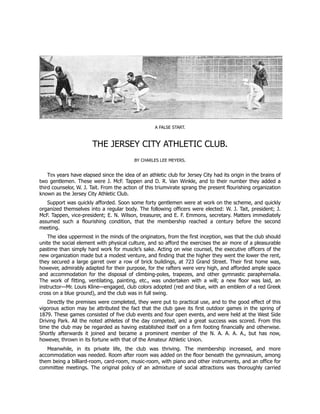
A FALSE START.
THEJERSEY CITY ATHLETIC CLUB.
BY CHARLES LEE MEYERS.
TEN years have elapsed since the idea of an athletic club for Jersey City had its origin in the brains of
two gentlemen. These were J. McF. Tappen and D. R. Van Winkle, and to their number they added a
third counselor, W. J. Tait. From the action of this triumvirate sprang the present flourishing organization
known as the Jersey City Athletic Club.
Support was quickly afforded. Soon some forty gentlemen were at work on the scheme, and quickly
organized themselves into a regular body. The following officers were elected: W. J. Tait, president; J.
McF. Tappen, vice-president; E. N. Wilson, treasurer, and E. F. Emmons, secretary. Matters immediately
assumed such a flourishing condition, that the membership reached a century before the second
meeting.
The idea uppermost in the minds of the originators, from the first inception, was that the club should
unite the social element with physical culture, and so afford the exercises the air more of a pleasurable
pastime than simply hard work for muscle’s sake. Acting on wise counsel, the executive officers of the
new organization made but a modest venture, and finding that the higher they went the lower the rent,
they secured a large garret over a row of brick buildings, at 723 Grand Street. Their first home was,
however, admirably adapted for their purpose, for the rafters were very high, and afforded ample space
and accommodation for the disposal of climbing-poles, trapezes, and other gymnastic paraphernalia.
The work of fitting, ventilating, painting, etc., was undertaken with a will; a new floor was laid, an
instructor—Mr. Louis Kline—engaged, club colors adopted (red and blue, with an emblem of a red Greek
cross on a blue ground), and the club was in full swing.
Directly the premises were completed, they were put to practical use, and to the good effect of this
vigorous action may be attributed the fact that the club gave its first outdoor games in the spring of
1879. These games consisted of five club events and four open events, and were held at the West Side
Driving Park. All the noted athletes of the day competed, and a great success was scored. From this
time the club may be regarded as having established itself on a firm footing financially and otherwise.
Shortly afterwards it joined and became a prominent member of the N. A. A. A. A., but has now,
however, thrown in its fortune with that of the Amateur Athletic Union.
Meanwhile, in its private life, the club was thriving. The membership increased, and more
accommodation was needed. Room after room was added on the floor beneath the gymnasium, among
them being a billiard-room, card-room, music-room, with piano and other instruments, and an office for
committee meetings. The original policy of an admixture of social attractions was thoroughly carried
27.
out, and receptions,skating parties, and a varied round of amusements followed each other in quick
succession, all serving to maintain the interest.
So matters moved smoothly and pleasantly until the roller-skating craze infected the city, and as the
seductive influences of the slippery floor, and the novelty of the fashion made themselves felt, gradually
the attendance at the club fell off, and it seemed as if a period of darkness were in store for it. And
indeed to the determined spirits who, by their devotion, tided matters over, a deep and lasting debt is
owed. This danger, although at the time it looked really great, soon disappeared. One by one the rinks
closed, members of the club returned to their proper allegiance, and affairs resumed their former
prosperity.
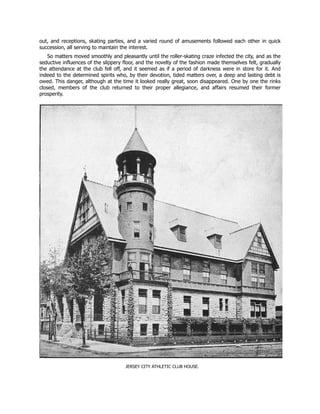
JERSEY CITY ATHLETIC CLUB HOUSE.
28.
In the latterpart of 1885 an epidemic struck Jersey City—it was a “club fever.” All the men in the city
were either organizing or joining clubs. Clubs were formed for almost every purpose, social, intellectual,
literary, athletic, bowling, etc. The social element so strongly developed by the ten or a dozen rinks, had
to find an outlet, and the movement flowed clubward. Among the first to recognize and direct this
curious fever was the Jersey City Athletic Club, and as a consequence its membership filled up so rapidly
that in November, 1885, its rooms were entirely inadequate for the uses of its members, and it was
decided to build a club-house.
The scheme for the enlargement of the premises had a very modest beginning, for in the spring of
1885 a demand for further accommodation in the matter of bowling alleys had been put forward. To
meet this the proposition was made that two alleys should be built on some land adjoining the Alpha
Rink. This by no means met with general approbation, and it became evident that the membership was
falling off, and that the club was being deserted for its more enterprising rivals, notable among which
was the Palma Club, which had just completed a new building. When, therefore, the “club fever” broke
out, a club meeting was held, and a proposition made that a committee be appointed whose duty it
should be to raise the large sum of $25,000 for building purposes. Though the scheme was much
derided, the committee was formed, and comprised the following gentlemen: Messrs. J. C. Appleby, C.
H. Dickson, H. Hartshorne, and E. R. Grant. When this prompt and timely action became known, it
enlisted so many desirable recruits that in six months from the inception of the building scheme the
membership had trebled, in spite of the fact that in the city four other large and well-appointed clubs
offered their attractions.
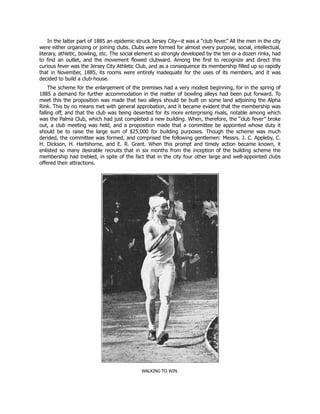
WALKING TO WIN.
29.
The plans werefinally passed, and ground purchased for a sum of $5,000, while the building to be
erected was to cost $20,000. On the first night the amount subscribed was $6,000, and thus assured of
the success of the venture the various committees perfected their work, and on Thanksgiving Day,
1886, the building was finished. Then the question arose how the completed building was to be
furnished. The solution of the problem proved easier than might have been expected. The ladies came
graciously to the rescue. A fair was organized to raise the necessary funds, and the good work which
had been done during the months of preparation was apparent when, after the close of the fair, which
was open for ten days, the sum of $8,000 in cash remained as a monument to its success.
The new club-house stands at the corner of Crescent and Clinton Avenues—almost the highest
portion of “The Heights”—upon the brow of the hill. The site is superb, commanding from the eastern
windows and tower a magnificent view of New York harbor and the surrounding country. The style of
architecture is modern Queen Anne. The basement and first and second stories are of undressed
brown-stone, and the upper stories wood, with a slate roof. The tower forms a notable feature; a roomy
piazza on one side of the house and a large porch are popular parts of the house in summer. The
entrance is very spacious, and opens into a large vestibule, and this again leads to a wide hall running
through to the billiard-room.
In the basement are the bowling-alleys, six in number, fitted with all the latest improvements, and
built by the best makers in the costliest style. In fact, so well is their construction carried out, that the
claim that they are among the best of their kind in America is fully justified. The active use to which
they are put every night vouches for the interest displayed in the pastime by the members. On the left
of the bowling-alleys is the wheelroom, which affords storage for a large number of wheels, and gives
easy egress to the street through the side-doors.
30.
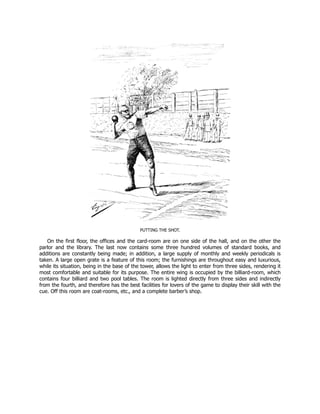
PUTTING THE SHOT.
Onthe first floor, the offices and the card-room are on one side of the hall, and on the other the
parlor and the library. The last now contains some three hundred volumes of standard books, and
additions are constantly being made; in addition, a large supply of monthly and weekly periodicals is
taken. A large open grate is a feature of this room; the furnishings are throughout easy and luxurious,
while its situation, being in the base of the tower, allows the light to enter from three sides, rendering it
most comfortable and suitable for its purpose. The entire wing is occupied by the billiard-room, which
contains four billiard and two pool tables. The room is lighted directly from three sides and indirectly
from the fourth, and therefore has the best facilities for lovers of the game to display their skill with the
cue. Off this room are coat-rooms, etc., and a complete barber’s shop.
31.
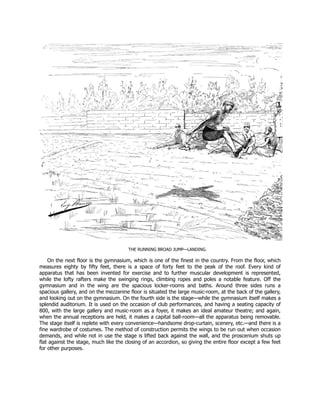
THE RUNNING BROADJUMP—LANDING.
On the next floor is the gymnasium, which is one of the finest in the country. From the floor, which
measures eighty by fifty feet, there is a space of forty feet to the peak of the roof. Every kind of
apparatus that has been invented for exercise and to further muscular development is represented,
while the lofty rafters make the swinging rings, climbing ropes and poles a notable feature. Off the
gymnasium and in the wing are the spacious locker-rooms and baths. Around three sides runs a
spacious gallery, and on the mezzanine floor is situated the large music-room, at the back of the gallery,
and looking out on the gymnasium. On the fourth side is the stage—while the gymnasium itself makes a
splendid auditorium. It is used on the occasion of club performances, and having a seating capacity of
800, with the large gallery and music-room as a foyer, it makes an ideal amateur theatre; and again,
when the annual receptions are held, it makes a capital ball-room—all the apparatus being removable.
The stage itself is replete with every convenience—handsome drop-curtain, scenery, etc.—and there is a
fine wardrobe of costumes. The method of construction permits the wings to be run out when occasion
demands, and while not in use the stage is lifted back against the wall, and the proscenium shuts up
flat against the stage, much like the closing of an accordion, so giving the entire floor except a few feet
for other purposes.
32.
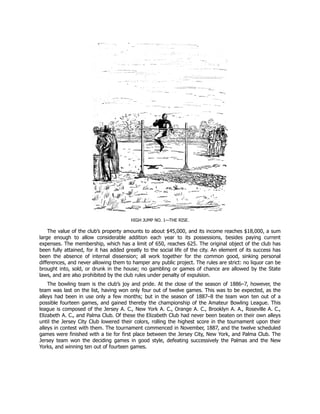
HIGH JUMP NO.1—THE RISE.
The value of the club’s property amounts to about $45,000, and its income reaches $18,000, a sum
large enough to allow considerable addition each year to its possessions, besides paying current
expenses. The membership, which has a limit of 650, reaches 625. The original object of the club has
been fully attained, for it has added greatly to the social life of the city. An element of its success has
been the absence of internal dissension; all work together for the common good, sinking personal
differences, and never allowing them to hamper any public project. The rules are strict: no liquor can be
brought into, sold, or drunk in the house; no gambling or games of chance are allowed by the State
laws, and are also prohibited by the club rules under penalty of expulsion.
The bowling team is the club’s joy and pride. At the close of the season of 1886–7, however, the
team was last on the list, having won only four out of twelve games. This was to be expected, as the
alleys had been in use only a few months; but in the season of 1887–8 the team won ten out of a
possible fourteen games, and gained thereby the championship of the Amateur Bowling League. This
league is composed of the Jersey A. C., New York A. C., Orange A. C., Brooklyn A. A., Roseville A. C.,
Elizabeth A. C., and Palma Club. Of these the Elizabeth Club had never been beaten on their own alleys
until the Jersey City Club lowered their colors, rolling the highest score in the tournament upon their
alleys in contest with them. The tournament commenced in November, 1887, and the twelve scheduled
games were finished with a tie for first place between the Jersey City, New York, and Palma Club. The
Jersey team won the deciding games in good style, defeating successively the Palmas and the New
Yorks, and winning ten out of fourteen games.
33.
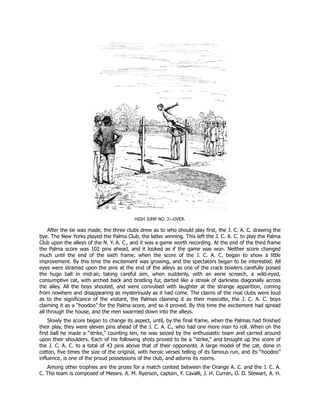
HIGH JUMP NO.2—OVER.
After the tie was made, the three clubs drew as to who should play first, the J. C. A. C. drawing the
bye. The New Yorks played the Palma Club, the latter winning. This left the J. C. A. C. to play the Palma
Club upon the alleys of the N. Y. A. C., and it was a game worth recording. At the end of the third frame
the Palma score was 102 pins ahead, and it looked as if the game was won. Neither score changed
much until the end of the sixth frame, when the score of the J. C. A. C. began to show a little
improvement. By this time the excitement was growing, and the spectators began to be interested. All
eyes were strained upon the pins at the end of the alleys as one of the crack bowlers carefully poised
the huge ball in mid-air, taking careful aim, when suddenly, with an eerie screech, a wild-eyed,
consumptive cat, with arched back and bristling fur, darted like a streak of darkness diagonally across
the alley. All the boys shouted, and were convulsed with laughter at the strange apparition, coming
from nowhere and disappearing as mysteriously as it had come. The claims of the rival clubs were loud
as to the significance of the visitant, the Palmas claiming it as their mascotte, the J. C. A. C. boys
claiming it as a “hoodoo” for the Palma score, and so it proved. By this time the excitement had spread
all through the house, and the men swarmed down into the alleys.
Slowly the score began to change its aspect, until, by the final frame, when the Palmas had finished
their play, they were eleven pins ahead of the J. C. A. C., who had one more man to roll. When on the
first ball he made a “strike,” counting ten, he was seized by the enthusiastic team and carried around
upon their shoulders. Each of his following shots proved to be a “strike,” and brought up the score of
the J. C. A. C. to a total of 43 pins above that of their opponents. A large model of the cat, done in
cotton, five times the size of the original, with heroic verses telling of its famous run, and its “hoodoo”
influence, is one of the proud possessions of the club, and adorns its rooms.
Among other trophies are the prizes for a match contest between the Orange A. C. and the J. C. A.
C. The team is composed of Messrs. A. M. Ryerson, captain, F. Cavalli, J. H. Curran, O. D. Stewart, A. H.
34.
Brown, E. R.Grant, G. E. Hogg, J. A. Davis, E. Klein and H. W. McLellan. Bowling tournaments between
the members of the club for prizes help to promote good play and develop champions.
The baseball team has won a number of local victories, and interests a large number of members.
Having, however, no regular grounds to practice on, the team contents itself with playing against local
club nines.
The club is extremely strong in wheelmen, having among its members 75 per cent. of the Hudson
County Wheelmen, who form the largest and strongest cycling organization in New Jersey, and one
which is hand in hand with the J. C. A. C. It was proposed at one time to amalgamate, but the H. C. W.,
not wishing to lose their identity, compromised by nearly all becoming members of the J. C. A. C.
Among their wheelmen, Charles E. Kluge possesses a world-wide fame. His records on the “Star” and
tricycle, and latterly upon the crank machine, are well known, while his world record for twenty-five
miles stands unrivaled. Others who have carried the club’s name to the front upon the racing-track are
E. P. Baggot, E. M. Smith, W. P. Smith, and C. A. Stenken. On the whole, however, the members are
more devoted to rolling up mileage on the road than rolling down Father Time on the track.
The achievements of the athletes of the J. C. A. C. belong rather to its past history than to its
present. For the first years of its existence the club gave spring and fall games and their success was
unquestioned. The novelty, however, wore off and the great difficulty in reaching the trotting track,
which was the only available ground, prohibited an attendance sufficient to make them a financial
success. So, after money had been lost steadily for the sake of the sport for some years, the games
were abandoned, although the club athletes continued to score successes in the field and on the track.
Among these were Hugh McMahon, whose best on record at the hurdles stood for a number of years, A.
D. Stone, G. Y. Gilbert, and Charles Lee Meyers. A feature of the club athletics consists of runs from the
house across country and return, and a series of races in its gymnasium, such as obstacle and potato
races.
In the spring of 1885 it gave an entertainment which brought together all the noted athletes of the
day as performers, among them being L. E. Myers, F. P. Murray, Robt. Stall on the rings, G. Y. Gilbert,
and many others of the same class.
In 1887 the Boxing and Wrestling Championships of America were given under the auspices of the
club and in its gymnasium.
The original idea, which has been mentioned before as existing in the minds of the originators of the
club, has been well carried out. In order to obliterate from the minds of the ladies the inherent
prejudice against all men’s clubs, the rooms were at first thrown open to them every Thursday evening,
a dance was given every month, and a ladies’ class formed in the gymnasium. The result of this
diplomacy was made apparent when the furnishing of the new club-house had to be accomplished.
After their noble efforts in this cause, the question arose how to recompense them for their devotion,
and how to place them in possession of all the club privileges without cost (for the club’s gratitude could
do no less), and yet not make them members.
This difficult problem was solved by giving up to the ladies the afternoons of Tuesday and Thursday
of each week and also Thursday evening, and having an informal dance once each month. At these
times all privileges are free to ladies, and numerous groups enjoy themselves bowling, playing billiards,
pool, cards, and often getting up an impromptu dance in the gymnasium. This feature is naturally one
of the most attractive to the members, and among the ladies themselves the club is a very popular
place. It has not so far interfered in the smallest degree with the exercise of the members’ privileges, as
they can use all the club’s advantages on these occasions, courtesy of course giving preference to the
fair sex, and indeed it has been of unexpected benefit to the club. Ladies, by telling their friends of the
beauty of the club-house and the enjoyment to be obtained on its ladies’ days, have induced their male
friends to join the club. A grand ball is given annually to the ladies, the first one in the new club-house
being in honor of the ladies’ services during the fair. In January, 1888, Governor Green and all his staff
of State officials honored the Club Ball by their presence.
35.
Another prominent characteristicof the club is musical ability. Almost the first action of the club after
its organization was to give an entertainment which took the form of a minstrel show, with only the
members as performers. These shows grew better year by year, until in the fall of 1885 the club
produced “The Mikado,” which had a run of two nights and splendid success. These plays were given in
a local theatre and were “in black,” with most of the dialogue localized. In the fall of 1887, having its
own theatre, the club took a step forward and produced “Erminie,” in black, with a remarkably
successful run of four nights. Shortly after this the club orchestra was organized, and is now one of the
notable features of every entertainment. In April of last year, “Patience” was produced for three nights,
but this time with the assistance of the wives, sisters and sweethearts of the members, and exactly as
written, with every detail. Such a splendid success was scored that its repetition was almost a necessity,
so it was again given the month following, making four performances. The entire performance was
marked throughout by the most careful attention to artistic effect, and in this it was quite a triumph.
In such ways the club has retained the sympathy and co-operation of the ladies. For instance, when
“Patience” was produced, they contributed a major part of the attraction by splendid singing and acting.
The club is in the height of its prosperity. While the substantial reasons for its existence continue,
there seems no doubt of its standing and permanency.
36.
MY BOAT.
THE frolicwaves are dancing bright
Across the moon’s broad path of light:
My lovely boat—
A swan afloat,
Holds o’er the waves her long white throat:
From either side
The waters glide
In silver flashes of laughing foam,
And she skims the sea
In an ecstasy
Of joy, returned again to home.
Arthur Cleveland Hall.
37.
ON A CANADIANFARM IN MIDWINTER.
BY W. BLACKBURN HARTE.
BY decree of the inexorable res angusta domi, I left my native
England in the last days of the year of grace 1886, for Canada, with
the determination of becoming a farmer. I was a cockney to my
backbone, and had not the slightest idea of farming, but still I was
young and hopeful, and I imagined that this happy consummation
would take but a very short time to accomplish. Many a night, while
lying in my bunk during the passage across the Atlantic, I built
châteaux en Espagne innumerable, and galloped over limitless acres
of which I held the freehold. Alas! my castles have since been
irretrievably mortgaged to Doubt and Despair, and if the reader will
give me his kind attention while I relate my experiences, we will
together watch these castles of cards topple to the ground.
Upon my arrival at Montreal I at once advertised for a situation
on a farm, for I had more ambition than capital or collateral security,
and consequently was unable to immediately blossom forth into a
landed proprietor. To my great delight I received three or four
answers from farmers in different parts of the country, each of
whom represented that his farm was situated in the very heart of
the garden of Canada, and desired me to come on without delay.
Subsequent experience led me to the conclusion that Canada was
one immense garden—of snow, and remarkably well ventilated. After
a little thought, I decided to place myself and accompanying
transcendent abilities at the disposal of a gentleman—evidently a
public philanthropist—who, judging from the friendly warmth of his
38.
communication, appeared tohave been anxiously looking forward to
my arrival on this continent.
The next day I boarded a train going east, and after a two hours’
journey arrived at my destination, which was only fifty miles from
the metropolis. I had reason later to thank my stars that I had not
decided to begin my career as a farm-hand in the neighborhood of
the “Rockies,” because in that case my return to civilization would
have been well-nigh impossible, considering the state of my
exchequer. The name of the village was Knowlton, in the province of
Quebec. Some of my readers are doubtless acquainted with the
locality.
A negro conductor passed through the car and announced in
stentorian tones, first in French-Canadian patois, and then in
English, the name of the station, and looking out of the window I
saw a noble edifice which appeared to have been blown together,
“promiscuous-like,” on a very windy day, and then tarred over. This
was the waiting-room and station-master’s sanctum combined; in
fact, it was the station. There was not the ghost of a platform, but a
low fence surrounded the rear of the shanty. The station-master, as I
afterwards found out, was a man of exceedingly portly dimensions,
and was greatly impressed with a sense of his own importance, so
there was little room in the shanty for aught else beside himself and
the stove.
The whole population of the place, about twenty-five or thirty
persons all told, counting one or two of the canine genus, were
assembled in the yard to witness the train come in. This appeared to
be the only dissipation of which the villagers were at any time
capable. They looked like so many badly packed bundles of cloth,
and spoke a villainous gibberish, which would confound the natives
of La Belle France. I fancy I was looked upon as a sort of natural
curiosity. Certainly I was the “observed of all observers” upon that
occasion, and caused no little diversion. I stood and watched the
departing train until it was out of sight, and then sat down upon my
chest. To confess the truth, I did not feel in the best of spirits. The
39.
prospect seemed lessinviting now that I was, as it were, plumped
down, out of all civilization, upon the scene of my new labors.
My benefactor, the farmer, now approached me, and introduced
himself by suddenly bawling in my ear, “Now then, young feller, get
up, and take hold of t’ other end of this box. Great Scott! what a
terror, anyway. What ’ev you got in it, anyhow?”
Mr. Wiman, for that was the gentleman’s name, had never seen
me before in his life, but he jumped to the conclusion that I was “his
man,” because, as he afterwards explained to me, I looked “so
English, you know.” I guessed, too, that a stranger in those parts
was rather a rara avis.
We carried the box to his sledge, which he had kindly brought
down to drive me up to the farm. Taking a seat beside him, I
inquired what distance his place was from the village.
“Well, I guess it’s something over five miles—more or less,” was
his reply.
We drove on for a long time in silence, and I began to think that
there was a considerable difference between a five-mile drive in the
“old country” and a similar distance in Canada. I ventured to hint as
much to Mr. Wiman. He burst into a hearty laugh.
“Bless yer! I should jist reckon there is a difference. That’s all!
We keep up with the times on this side ’ev the water. This ’ere is a
live country, sir—a live country!”
I did not quite understand how the advanced state of the country
should so materially alter the mileage, but kept my own counsel. I
could not help, however, reflecting that despite the fact that I was
now in a land of enlightenment and progress, I had never seen such
a dismal, dreary landscape in my life. Nature in her sterner aspects
cannot so quell the soul of man as when she presents herself in
merely bleak desolation. There was nothing but snow, which almost
blinded me with its dazzling whiteness, and certainly added to the
depression of my spirits.
40.
At last Mr.Wiman drew rein at a wayside auberge and told me to
wait a few minutes until he returned. This was comforting. The
atmosphere was not 90° in the shade—it was 20° below zero! I
jammed my hard felt hat down over my face, under the impression
that by getting my head into it as far as possible I should keep my
ears from dropping off. Foolishly enough, I had neglected to
purchase a fur cap when in Montreal, and now bitterly repented my
want of forethought.
The first quarter of an hour did not seem so very long, as my
mind was occupied with hundreds of conflicting thoughts, and those
inevitable “first impressions” which chill one’s cherished hopes. But
when a “few minutes” slowly dragged itself into a good half-hour, it
struck me that the Canadian method of reckoning the flight of time
must be conducted on the broad basis which characterized the
mileage. I rubbed my hands with snow to keep them warm and
prevent them from freezing, and jumping off the sledge I paced
rapidly up and down, under the veranda in front of the hostelry, to
induce circulation. I had read something and heard more about the
climate in this part of the world, and was afraid that unless I was
extremely careful I should coagulate into one complete block of ice.
At last my patience was exhausted, and I determined to go in quest
of my employer. I found him, the centre of a small circle of convives
assembled around the stove, discussing in broken French and
English, thick with authority and liquor, the question of commercial
union.
I nervously asked him when he intended to resume his journey.
He replied by pointing to a vacant seat, and asking me to take
“something hot.” I was half frozen, and readily accepted the offer.
“Sorry—hic—sorry I forgot you,” he said, with a cheerful smile.
“Don’t mention it,” I replied politely. “I’m still alive.”
In another hour or so the party broke up, leaving Mr. Wiman
decidedly none the better for his potations. In fact, he was wholly
unfit to have charge of the horse.
41.
He took myarm, and staggering out into the cold again, we
found the horse lying down in the snow, almost stiff, and the sledge
overturned. It was dark. In Canada there is no twilight. It is a
sudden transition from day into night, and I began to wish myself
back in Montreal. However, after many kicks and objurgatory
coaxings, the poor beast was induced to stand up, and righting the
sledge and replacing my belongings, we again took our seats. Mr.
Wiman then handed the reins to me with instructions to drive
“home,” and fell fast asleep on my shoulder. I did not, of course,
know the road in the least, but the horse did. He had been left for a
“few minutes” on many occasions before. I could not refrain from
inwardly making comparisons between the brute and his master, not
altogether favorable to the intelligence of the latter. I also did not
forget to thank God for the brute’s endowment, as otherwise we
should in all probability have been buried beneath the snow, which,
in some places, was over ten feet in depth. As it was, the ride was
not unattended with danger, as it was hard to see the track in the
dark, and every now and again the poor animal slid up to his neck in
the snow, and only extricated himself after severe struggles. The
farmer awoke at intervals, when the sledge was almost overturned,
but he kept his seat wonderfully. This, of course, was the force of
long habit. I have heard of tipsy sailors preserving their equilibrium
in the same marvelous fashion. Wiman would then encourage the
horse with a few sanguinary expressions, and again relapse into the
land of Nod. As this may be getting wearisome to the reader, I will
only mention one other incident of that memorable drive.
Just in front of the homestead we encountered a very large drift,
and as the horse endeavored to scramble through it, the sledge
upset and deposited both of us at least a couple of feet under the
snow. I was the first to get my head above the surface, and began
to search for my companion and my box. I found the son of Bacchus
coiled up quite content. After sundry kicks he realized his position,
and clutching the sledge with both hands, instructed me to let go
the traces and free the horse. This I did, and, after many attempts,
the unfortunate beast regained his feet.
42.
Welcome to ourwebsite – the perfect destination for book lovers and
knowledge seekers. We believe that every book holds a new world,
offering opportunities for learning, discovery, and personal growth.
That’s why we are dedicated to bringing you a diverse collection of
books, ranging from classic literature and specialized publications to
self-development guides and children's books.
More than just a book-buying platform, we strive to be a bridge
connecting you with timeless cultural and intellectual values. With an
elegant, user-friendly interface and a smart search system, you can
quickly find the books that best suit your interests. Additionally,
our special promotions and home delivery services help you save time
and fully enjoy the joy of reading.
Join us on a journey of knowledge exploration, passion nurturing, and
personal growth every day!
testbankmall.com

















![they had asked shelter. When returning home they again stopped at the camp, but every one of the
hunters had been scalped.
Jackson now began to accumulate property, and he married Mrs. Robards, establishing his home,
the first he really ever had, in Nashville. This was almost the first halt thus far in “the march and the
battle” of his life. It was not, however, the famous home called the Hermitage, for that did not come
until many years later. If money was scarce in Tennessee at that time, there was an abundance of land,
and six hundred and forty acres, or a square mile of real estate, was the ordinary fee for trying a case
at court. Jackson was in fact a land speculator, as well as a lawyer, and he was a purchaser whenever
he could command the money. So large were his possessions that he sold six thousand dollars worth of
land in one block to a gentleman in Philadelphia, and after that large transaction for that time, had still
several thousand acres left. Some years later he engaged in business on his place at Hunters Hill,
thirteen miles from Nashville. This plantation embraced several thousand acres, and he erected on it a
house which was one of the finest in that part of the country. In a smaller building near it he opened a
store and sold goods to the Indians through a small window. His prosperity, however, received a sudden
check. The Philadelphia gentleman, whose notes he had taken for his land, failed, and the protection of
the notes devolved on Jackson, who had discounted them. This he did at an enormous sacrifice.
He determined to retrieve his fortune, and to that end enlarged his operations in every direction. His
slaves numbered one hundred and fifty, and in their management he was greatly assisted by Mrs.
Jackson. He raised corn and cotton, which he shipped on his own boats. At his large store he took
produce of all kinds in exchange for goods. He had on his plantation a cotton-gin, which was so recently
invented that it had scarcely ceased to be a curiosity. With it he cleaned his own cotton and that of his
neighbors, which was another source of income. He was an excellent farmer and very proud of his
crops, which were nearly always good. But this was not all. In his youth he had been exceedingly fond
of horses, and his equine tastes grew stronger as he advanced in years. He brought the famous
“Truxton” from Virginia to Tennessee and won fame and money as a turfman. Few races came off in the
country around in which his name was not among the entries, and, as he ran his animals with care and
judgment, he was a frequent winner. His stable was in fact the best bred in all that section, and proved
a large source of income to him. Down even to the present day there is a “Truxton” strain in Tennessee
which is highly prized. In addition he amused himself with an occasional cockfight. On at least one
occasion the ownership of six hundred and forty acres of land depended upon the issue of the battle
between the game birds. During these years, while he was pursuing the avocation of a planter, of a
dealer in the goods of every description needed in a new country, of a horse-breeder and of a
speculator in land, he also found time to hold various public positions. He was a delegate to the
convention that framed the constitution of the State; a member of the legislature; then a congressman
and a judge. His service in Congress was very brief, and he resigned his position on the bench in order
to recover the fortune he had lost. Jackson was a good public officer. He was not a great lawyer or
jurist, but he fearlessly prosecuted every lawbreaker, and his decisions were always honest. Every
scoundrel in the territory was his enemy, but he never quailed before one of them.
While he was on the bench the sheriff one day told him that a ruffian, who had been guilty of
cutting off his child’s ear in a drunken passion, was in the court-house yard, armed with dirk and pistols,
and defied arrest. Jackson directed him to summon a posse of citizens. The sheriff reported back that
the citizens were too terrified to act. “He must be taken,” said Jackson; “summon me!” With a pistol in
either hand, Jackson walked into the yard and strode up to the outlaw, who at once surrendered to him.
Jackson possessed undaunted courage and nerve. A mob assembled one time with the intention of
tarring and feathering him. He was ill in bed when a committee waited on him to communicate the
cheerful intelligence. “Give my compliments,” said he, “to Colonel —— [the leader of the party], and tell
him my door is open to receive him and his regiment whenever they choose to call upon me, and that I
hope he will have the chivalry to lead his men and not to follow them.” His brave defiance cowed the
mob. It dispersed, and its leader apologized to Jackson.
Long years after, while Jackson was President, he told a story of one of his experiences during these
frontier days, which we shall insert here.](https://image.slidesharecdn.com/11647-250605152949-70ee39d3/85/Social-Problems-13th-Edition-Eitzen-Baca-Zinn-Smith-Test-Bank-22-320.jpg)
![“Now, Mr. B——,” said Jackson, “if any one attacks you I know you will fight with that big black stick
of yours. You will aim right for his head. Well, sir, ten chances to one he will ward it off, and if you do hit
him, you won’t bring him down. Now, sir [taking the stick into his own hands], you hold the stick so and
punch him in the stomach, and you’ll drop him. I will tell you how I found that out. When I was a young
man, practising law in Tennessee, there was a big bullying fellow that wanted to pick a quarrel with me,
and so trod on my toes. Supposing it accidental, I said nothing. Soon after he did it again, and I began
to suspect his object. In a few moments he came by a third time, pushing against me violently and
evidently meaning fight. He was a man of immense size, one of the very biggest men I ever saw. As
quick as a flash I snatched a small rail from the top of the fence and gave him the point of it full in the
stomach. Sir, it doubled him up. He fell at my feet, and I stamped on him. Soon he got up, savage, and
was about to fly at me like a tiger. The bystanders made as though they would interfere. Said I, ‘Don’t;
stand back; give me room; that is all I ask, and I will manage him.’ With that I stood ready with the rail
pointed. He gave me one look and turned away a bewitted man, sir, and feeling like one. So, sir, I say to
you, if any fellow assaults you, give him the point in his belly.”
Jackson fought several duels, killing his antagonist in one of them; but these episodes in his life do
not fall within the limits of this paper. His military career may be said to begin with his appointment, in
1802, to the command of the militia of Tennessee, although he was not called into active service until
the following year. Jefferson had then completed the Louisiana purchase, and it was thought the
Spaniards would not be willing to acknowledge the authority of the United States, and, possibly, might
resist it. Troops were ordered to the frontier, and if necessary were to be marched to New Orleans.
Tennessee promptly responded, and Major General Jackson discharged so well the duty assigned him
that he was thanked by the Federal Government.
The ambitious, restless, brilliant Burr was at this time revolving in his fertile brain the erection of an
empire in Mexico, and looking around for lieutenants to aid him in the realization of his dream, his eye
fell upon Jackson, whom he had doubtless met in Philadelphia while he was Vice-President. In the
summer of 1805 Jackson rode from his plantation into Nashville. The little town was gayly decked with
flags and banners, and the streets were thronged with people from the surrounding country. Aaron Burr
was expected, and the demonstration was in his honor. After an entertainment by the people of
Nashville he rode home with Jackson as his guest. Burr’s project appealed to the imagination of Jackson
and he offered his services. Next day Burr went away. A year later he was again in Kentucky and
Tennessee, and Jackson again offered to join his expedition. The enterprise was then discussed
everywhere, but no one had suspected, or at least given expression to, the suspicion that Burr’s plans
were hostile to the interests of the United States. Rumors of this nature, however, were soon afloat, and
Jackson laid the matter before Governor Claiborne. He at the same time wrote Burr, declaring that if his
designs were inimical to the government, he desired to have no further relations with him. Burr was
tried shortly afterwards for treason. He was always one of Jackson’s friends and entertained the highest
opinion of his military capacity. When Congress declared war against England in 1812, Burr said that
Jackson was the most capable general in the country. During the next five or six years Jackson was in
private life.
The outbreak of hostilities with England called him again into the field. The Mississippi Valley was
loyal to the core and promptly furnished a larger number of men than had been called for. Jackson, at
the head of 2,500 volunteers, descended the Ohio and Mississippi to Natchez, where he received word
from Wilkinson, at New Orleans, to await further orders. Wilkinson was jealous of Jackson and did not
desire his co-operation if he could do without it. Jackson, angry at the delay, went into camp. Later on
he was enraged when, instead of receiving an order to advance, he was instructed to disband his forces
500 miles from Nashville. It was a cruel order to give; cruel treatment of men who had so promptly
rushed to the defense of their country. Jackson resolved to disobey it. He would not abandon his men
so far from their homes. His quarter-master refused to furnish proper supplies. Jackson solved that
problem by borrowing $5,000 on his own responsibility. The journey back was severe, and many of the
men fell sick. Jackson placed one of the sufferers on his own horse and walked 400 miles on foot. His
officers and mounted men who were strong enough followed his example and gave their horses to their
companions who had succumbed to the hardships of the march. One soldier became so dangerously ill](https://image.slidesharecdn.com/11647-250605152949-70ee39d3/85/Social-Problems-13th-Edition-Eitzen-Baca-Zinn-Smith-Test-Bank-23-320.jpg)