Dec 7, 2007


Can you read this? If not, please sit closer. Thank you.
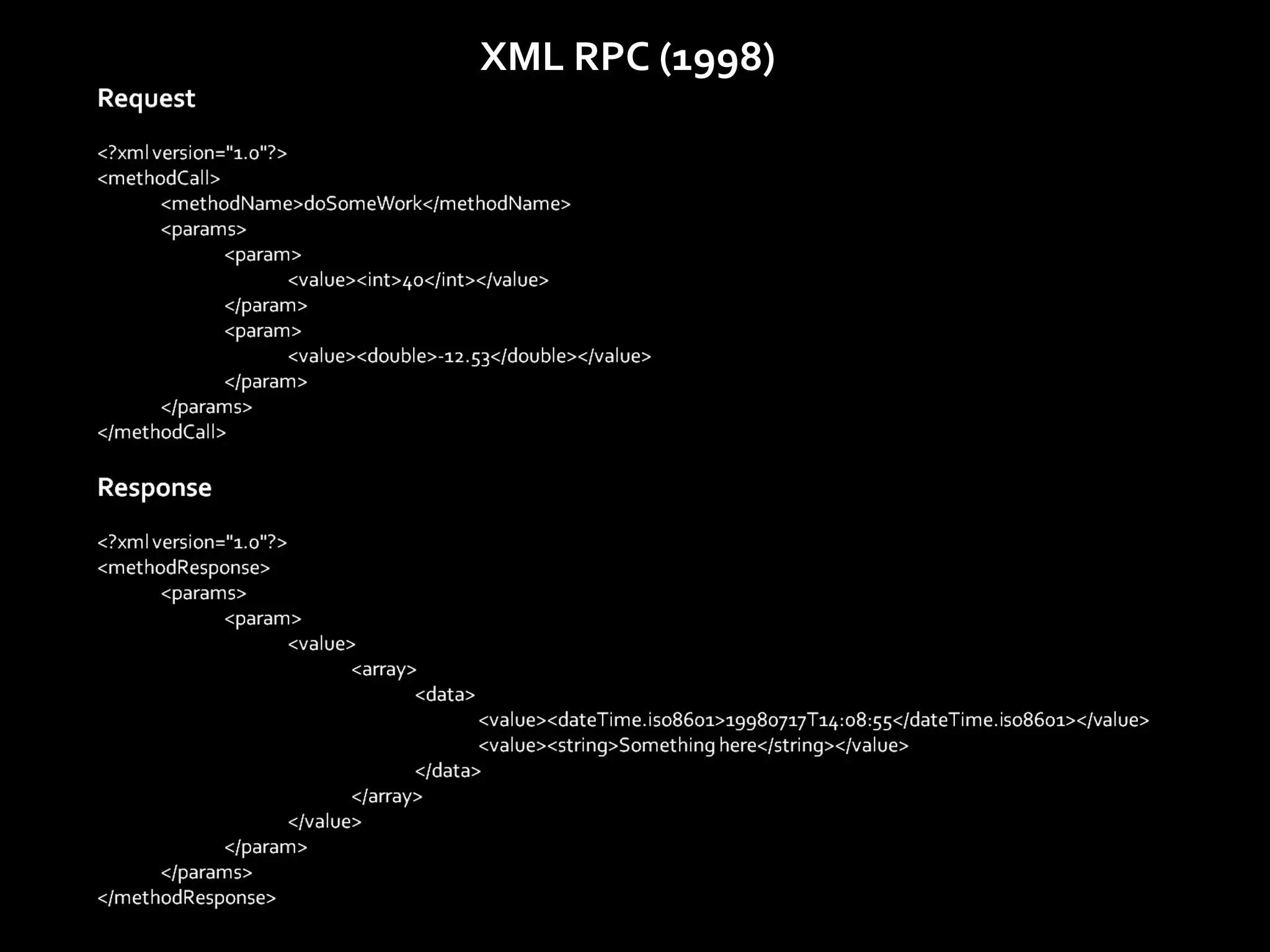
XML RPC (1998)
Early SOAP (2000) “section 5 encoding”
<?xml version="1.0"?>
<soap-env:envelope
    soap-env:encodingStyle="http://schemas.xmlsoap.org/soap/encoding/"
    xmlns:soap-env="http://schemas.xmlsoap.org/soap/envelope/"
    xmlns:soap-enc="http://schemas.xmlsoap.org/soap/encoding/"
    xmlns:xsd="http://www.w3.org/1999/XMLSchema"
    xmlns:xsi="http://www.w3.org/1999/XMLSchema-instance">
        <soap-env:header>
                ...
        </soap-env:header>
        <soap-env:body>
                <m:doSomeWork xmlns:m="http://www.lab49.com/">
                       <foo xsi:type="xsd:int">40</foo>
                       <bar>-12.53</bar>
                </m:doSomeWork>
        </soap-env:body>
</soap-env:envelope>


<?xml version="1.0"?>
<soap-env:Envelope
    soap-env:encodingStyle="http://schemas.xmlsoap.org/soap/encoding/"
    xmlns:soap-env="http://schemas.xmlsoap.org/soap/envelope/"
    xmlns:soap-enc="http://schemas.xmlsoap.org/soap/encoding/"
    xmlns:xsd="http://www.w3.org/1999/XMLSchema"
    xmlns:xsi="http://www.w3.org/1999/XMLSchema-instance">
        <soap-env:body>
                <m:doSomeWorkResponse xmlns:m="http://www.lab49.com/">
                       <soap-enc:array soap-enc:arrayType="xsd:ur-type[2]">
                              <baz xsi:type="xsd:int">12345</baz>
                              <quux xsi:type="xsd:string">Something here</quux>
                       </soap-enc:array>
                </m:doSomeWorkResponse>
        </soap-env:Body>
</soap-env:Envelope>
SOAP fancy encoding rules
References:
       <e:Book>
             <title>My Life and Work</title>
             <author href="#Person-1"/>
       </e:Book>

       <e:Person id="Person-1">
             <name>Henry Ford</name>
             <address href="#Address-2"/>
       </e:Person>

       <e:Address id="Address-2">
             <email>mailto:henryford@hotmail.com</email>
            <web>http://www.henryford.com</web>
       </e:Address>


Sparse arrays:
      <SOAP-ENC:Array SOAP-ENC:arrayType="xsd:string[,][4]">
           <SOAP-ENC:Array href="#array-1" SOAP-ENC:position="[2]"/>
      </SOAP-ENC:Array>

      <SOAP-ENC:Array id="array-1" SOAP-ENC:arrayType="xsd:string[10,10]">
           <item SOAP-ENC:position="[2,2]">Third row, third col</item>
           <item SOAP-ENC:position="[7,2]">Eighth row, third col</item>
      </SOAP-ENC:Array>
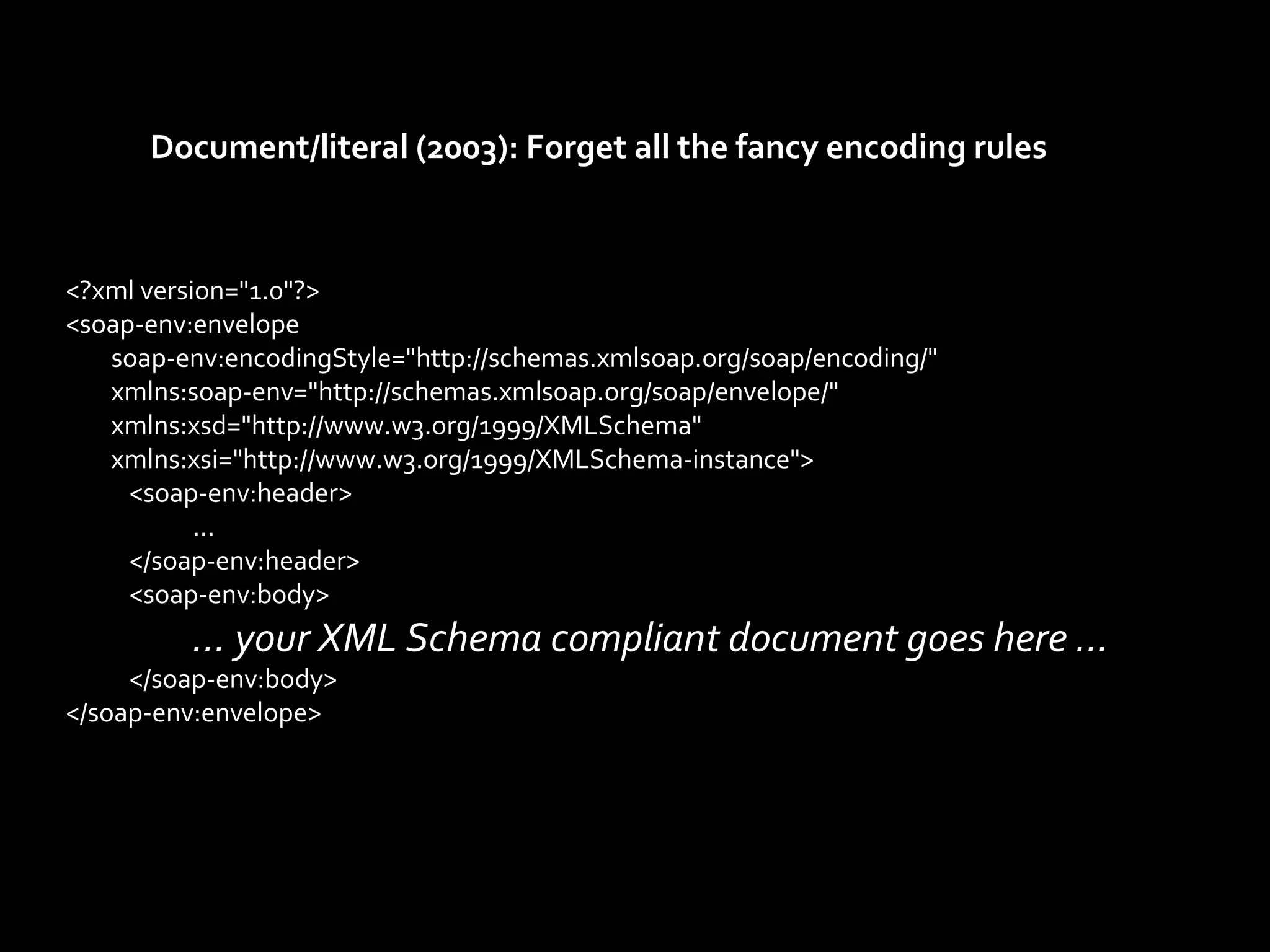
Document/literal (2003): Forget all the fancy encoding rules


<?xml version="1.0"?>
<soap-env:envelope
   soap-env:encodingStyle="http://schemas.xmlsoap.org/soap/encoding/"
   xmlns:soap-env="http://schemas.xmlsoap.org/soap/envelope/"
   xmlns:xsd="http://www.w3.org/1999/XMLSchema"
   xmlns:xsi="http://www.w3.org/1999/XMLSchema-instance">
     <soap-env:header>
           ...
     </soap-env:header>
     <soap-env:body>
          … your XML Schema compliant document goes here …
     </soap-env:body>
</soap-env:envelope>
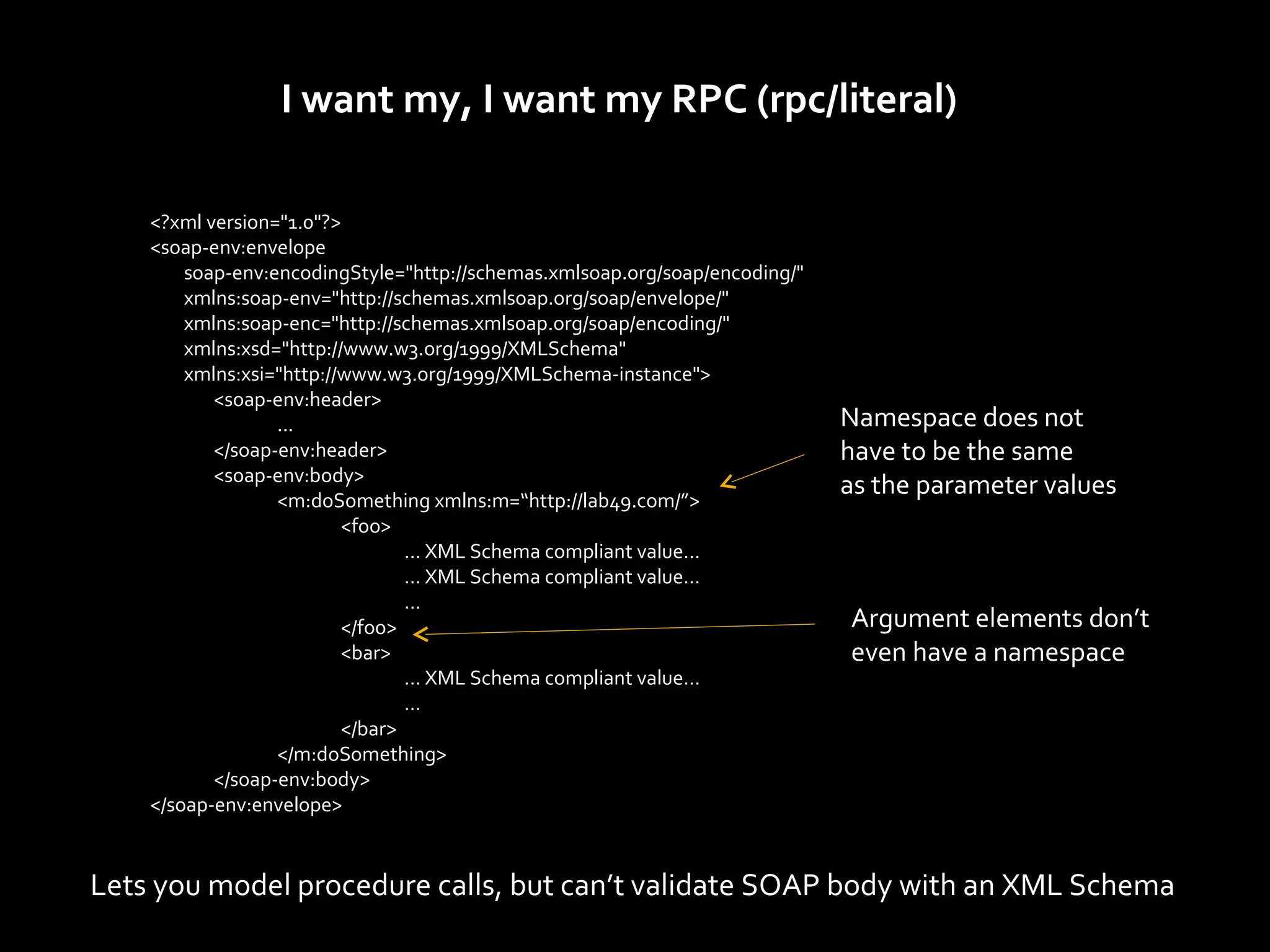
I want my, I want my RPC (rpc/literal)

    <?xml version="1.0"?>
    <soap-env:envelope
        soap-env:encodingStyle="http://schemas.xmlsoap.org/soap/encoding/"
        xmlns:soap-env="http://schemas.xmlsoap.org/soap/envelope/"
        xmlns:soap-enc="http://schemas.xmlsoap.org/soap/encoding/"
        xmlns:xsd="http://www.w3.org/1999/XMLSchema"
        xmlns:xsi="http://www.w3.org/1999/XMLSchema-instance">
           <soap-env:header>
                  ...                                                        Namespace does not
           </soap-env:header>                                                have to be the same
           <soap-env:body>
                  <m:doSomething xmlns:m=“http://lab49.com/”>
                                                                             as the parameter values
                          <foo>
                                 … XML Schema compliant value…
                                 … XML Schema compliant value…
                                 …
                          </foo>                                             Argument elements don’t
                          <bar>                                              even have a namespace
                                 … XML Schema compliant value…
                                 …
                          </bar>
                  </m:doSomething>
           </soap-env:body>
    </soap-env:envelope>


Lets you model procedure calls, but can’t validate SOAP body with an XML Schema
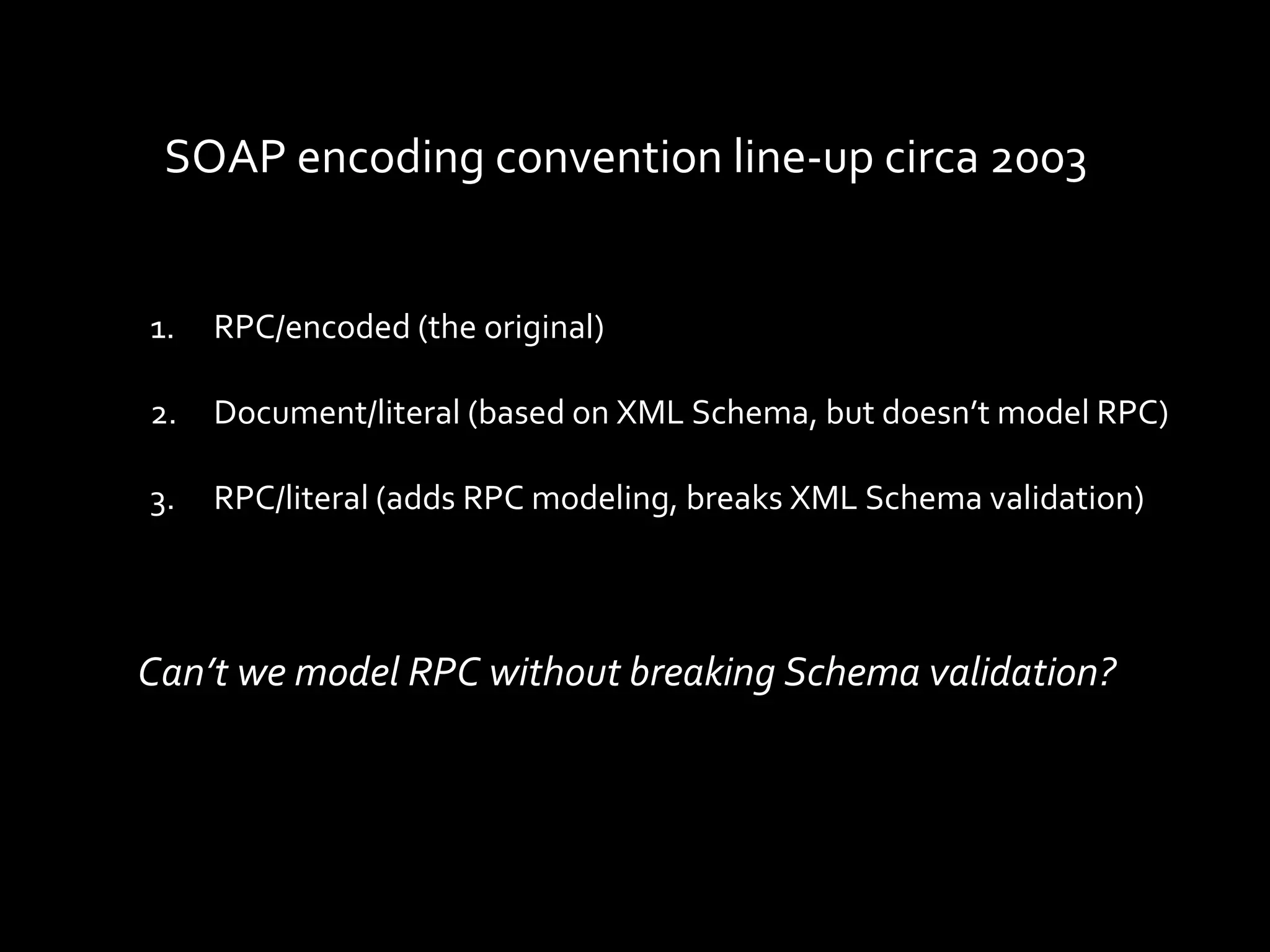
SOAP encoding convention line-up circa 2003


1.   RPC/encoded (the original)

2.   Document/literal (based on XML Schema, but doesn’t model RPC)

3.   RPC/literal (adds RPC modeling, breaks XML Schema validation)


Can’t we model RPC without breaking Schema validation?
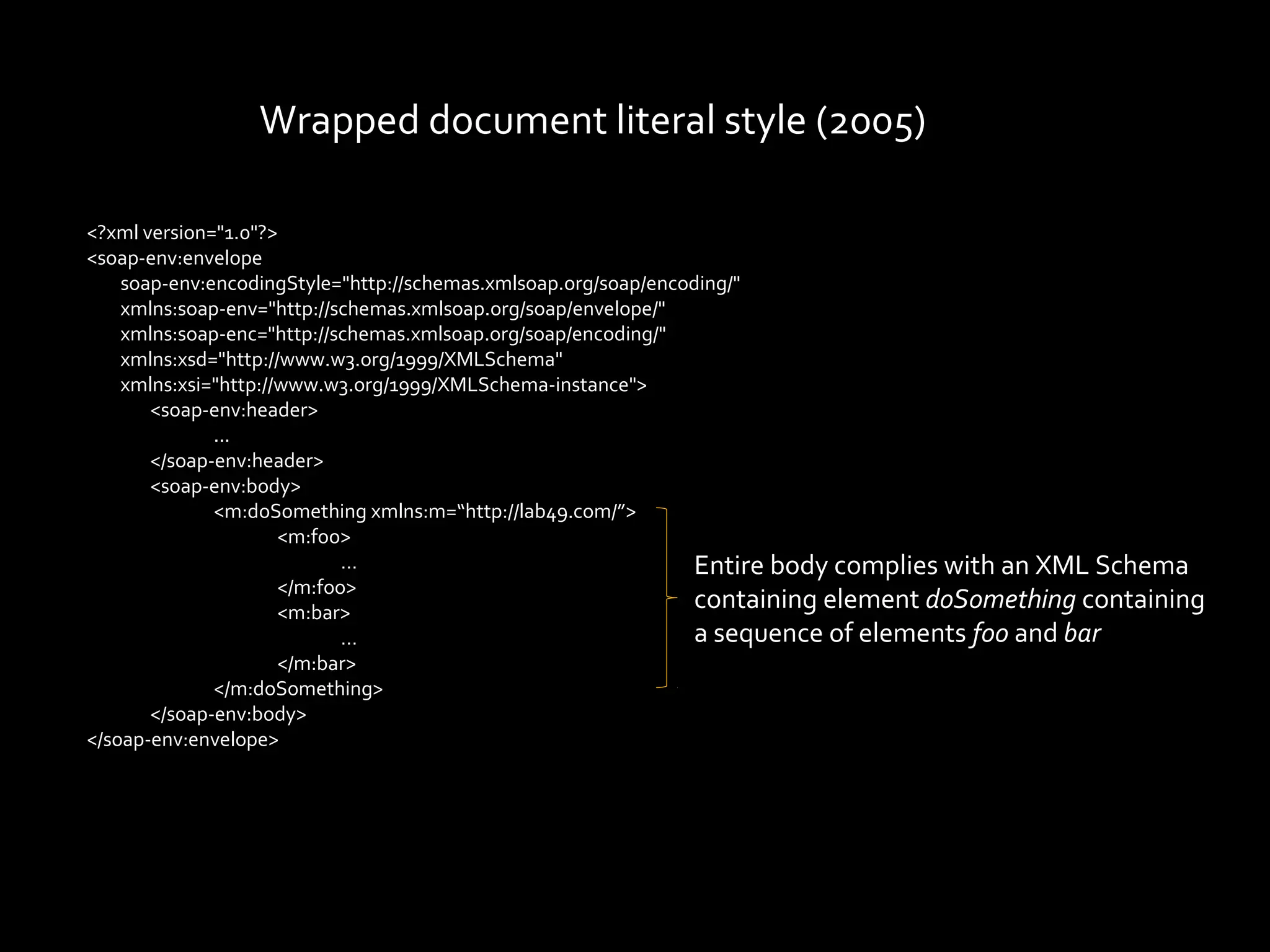
Wrapped document literal style (2005)

<?xml version="1.0"?>
<soap-env:envelope
    soap-env:encodingStyle="http://schemas.xmlsoap.org/soap/encoding/"
    xmlns:soap-env="http://schemas.xmlsoap.org/soap/envelope/"
    xmlns:soap-enc="http://schemas.xmlsoap.org/soap/encoding/"
    xmlns:xsd="http://www.w3.org/1999/XMLSchema"
    xmlns:xsi="http://www.w3.org/1999/XMLSchema-instance">
       <soap-env:header>
              ...
       </soap-env:header>
       <soap-env:body>
              <m:doSomething xmlns:m=“http://lab49.com/”>
                      <m:foo>
                             …                                  Entire body complies with an XML Schema
                      </m:foo>
                      <m:bar>
                                                                containing element doSomething containing
                             …                                  a sequence of elements foo and bar
                      </m:bar>
              </m:doSomething>
       </soap-env:body>
</soap-env:envelope>
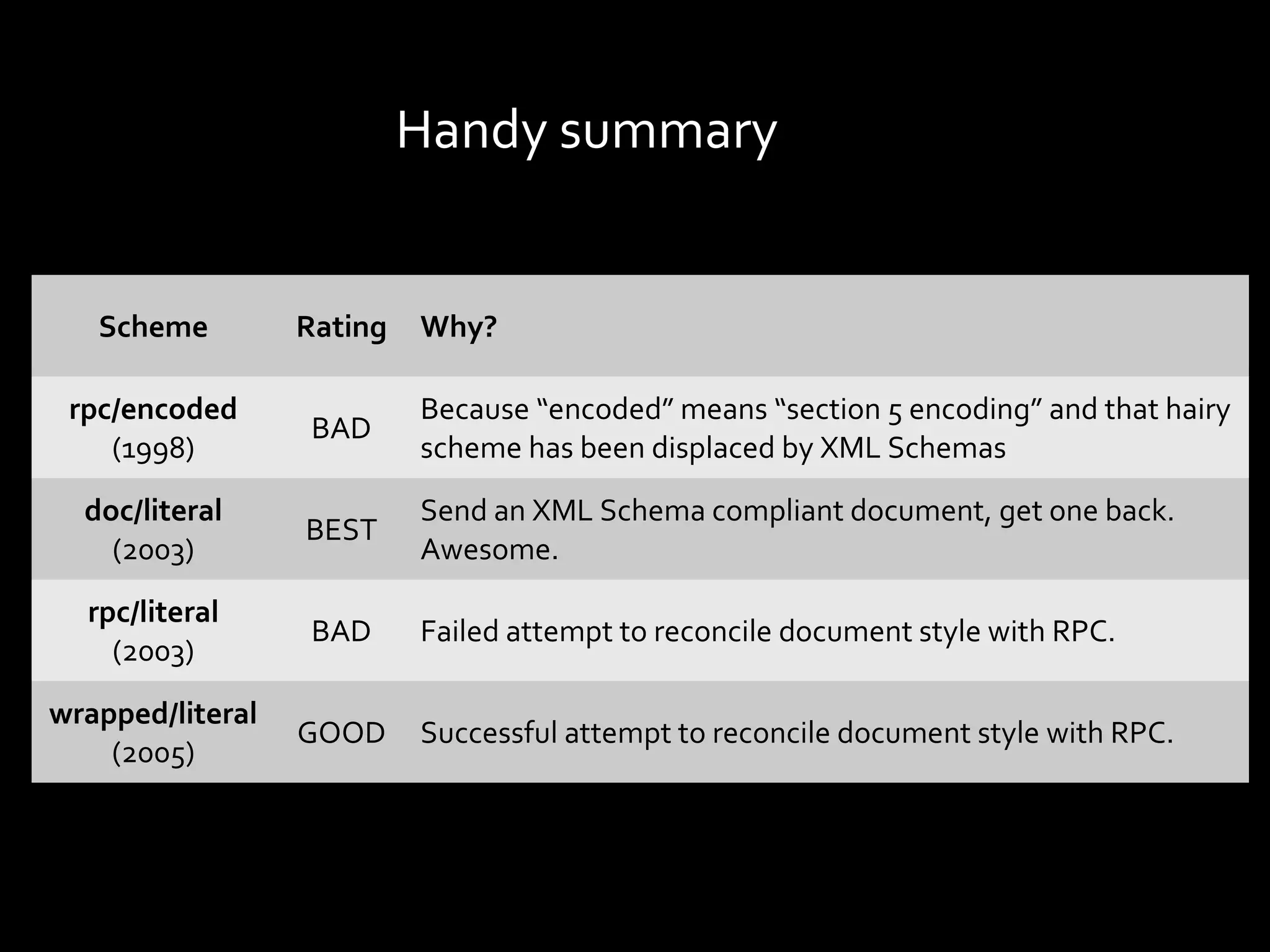
Handy summary


   Scheme         Rating   Why?

 rpc/encoded               Because “encoded” means “section 5 encoding” and that hairy
                   BAD
    (1998)                 scheme has been displaced by XML Schemas
  doc/literal              Send an XML Schema compliant document, get one back.
                  BEST
    (2003)                 Awesome.
  rpc/literal
                   BAD     Failed attempt to reconcile document style with RPC.
    (2003)
wrapped/literal
                  GOOD     Successful attempt to reconcile document style with RPC.
    (2005)
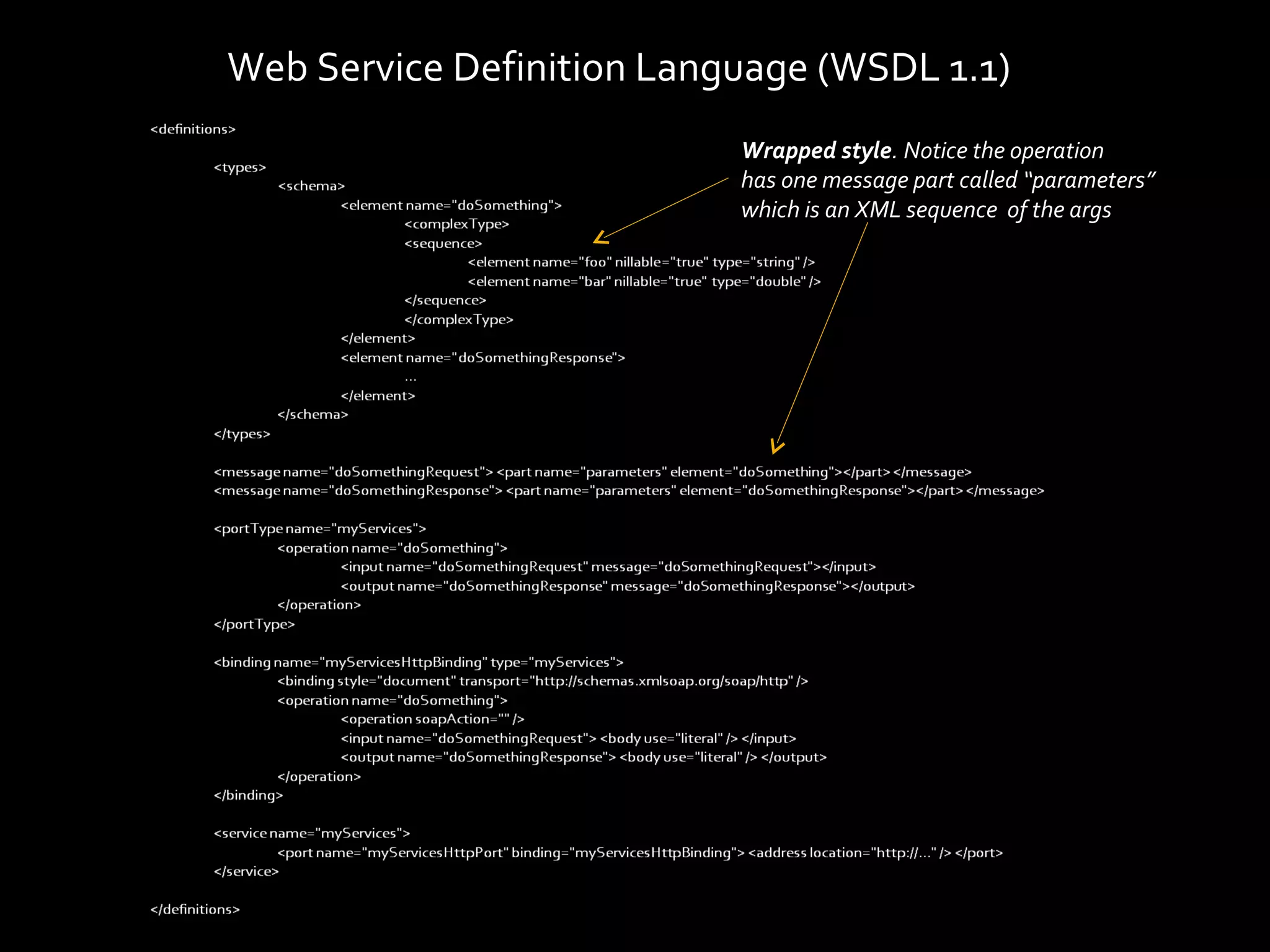
Web Service Definition Language (WSDL 1.1)
                           Wrapped style. Notice the operation
                           has one message part called “parameters”
                           which is an XML sequence of the args
WSDL IS IMPORTANT
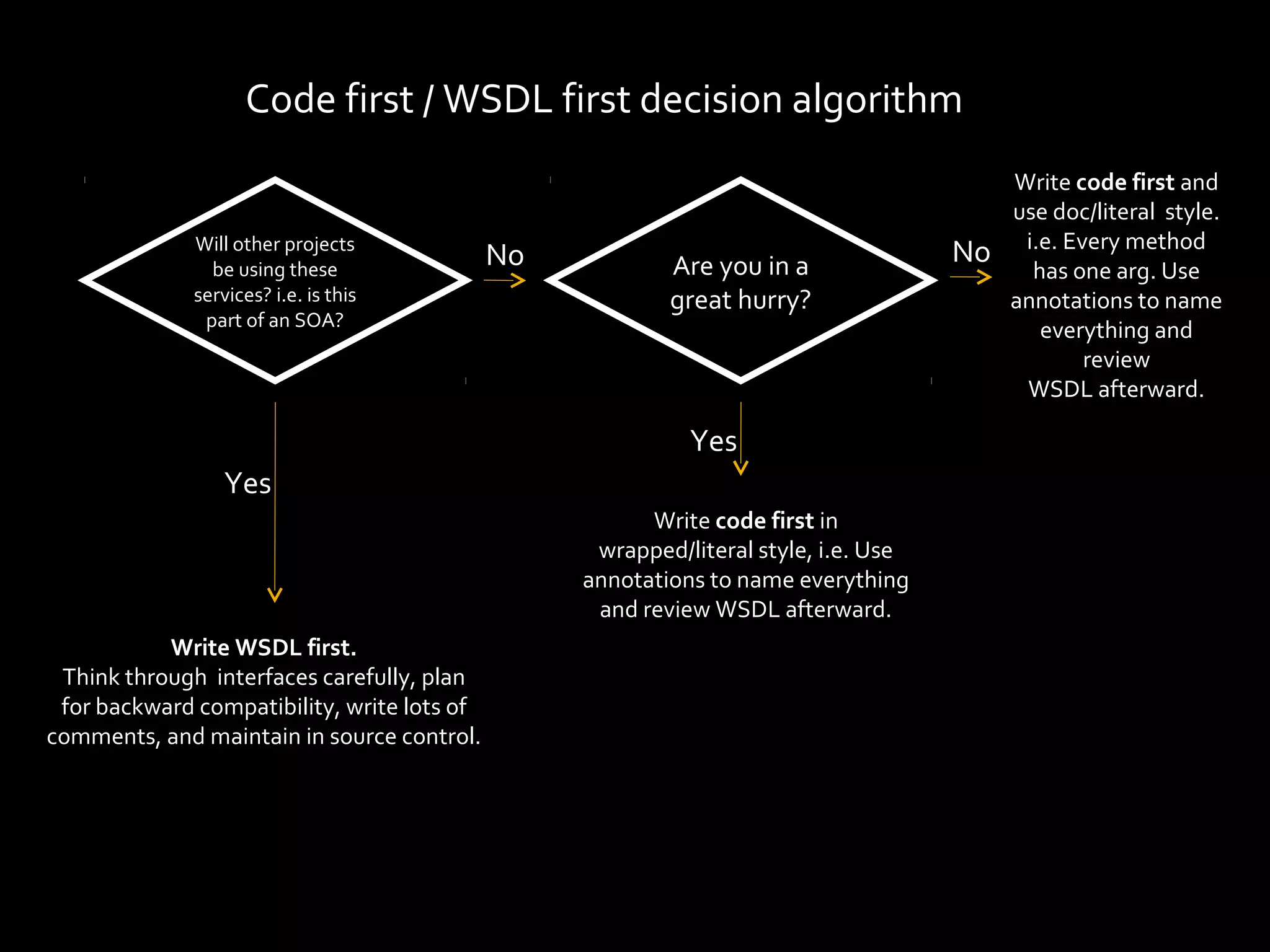
Code first / WSDL first decision algorithm
                                                                                          Write code first and
                                                                                          use doc/literal style.
              Will other projects                                                          i.e. Every method
                                             No           Are you in a               No
                be using these                                                              has one arg. Use
              services? i.e. is this                      great hurry?                    annotations to name
               part of an SOA?                                                               everything and
                                                                                                  review
                                                                                           WSDL afterward.

                                                            Yes
                  Yes
                                                        Write code first in
                                                   wrapped/literal style, i.e. Use
                                                  annotations to name everything
                                                   and review WSDL afterward.
           Write WSDL first.
 Think through interfaces carefully, plan
 for backward compatibility, write lots of
comments, and maintain in source control.
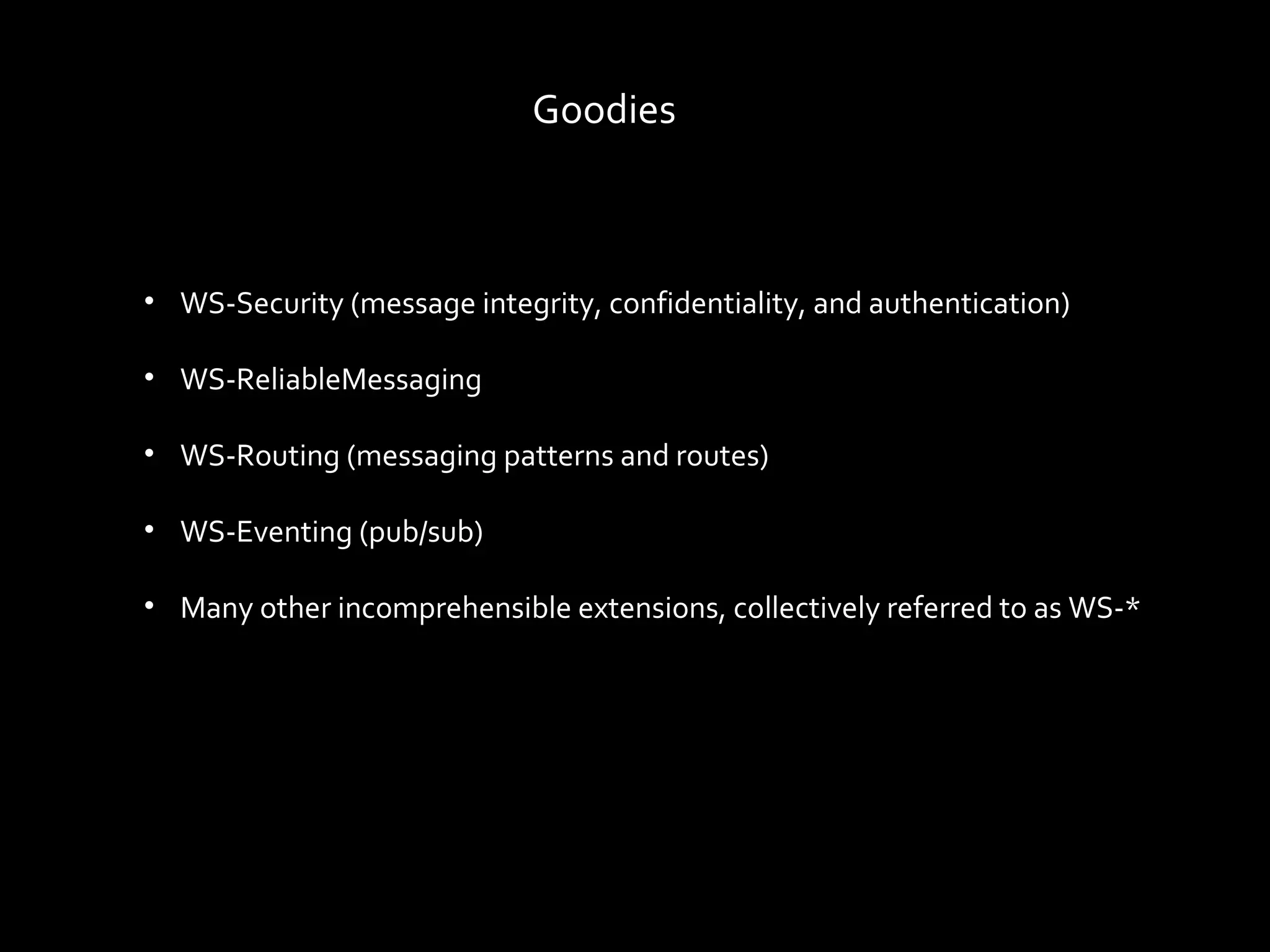
Goodies


• WS-Security (message integrity, confidentiality, and authentication)

• WS-ReliableMessaging

• WS-Routing (messaging patterns and routes)

• WS-Eventing (pub/sub)

• Many other incomprehensible extensions, collectively referred to as WS-*
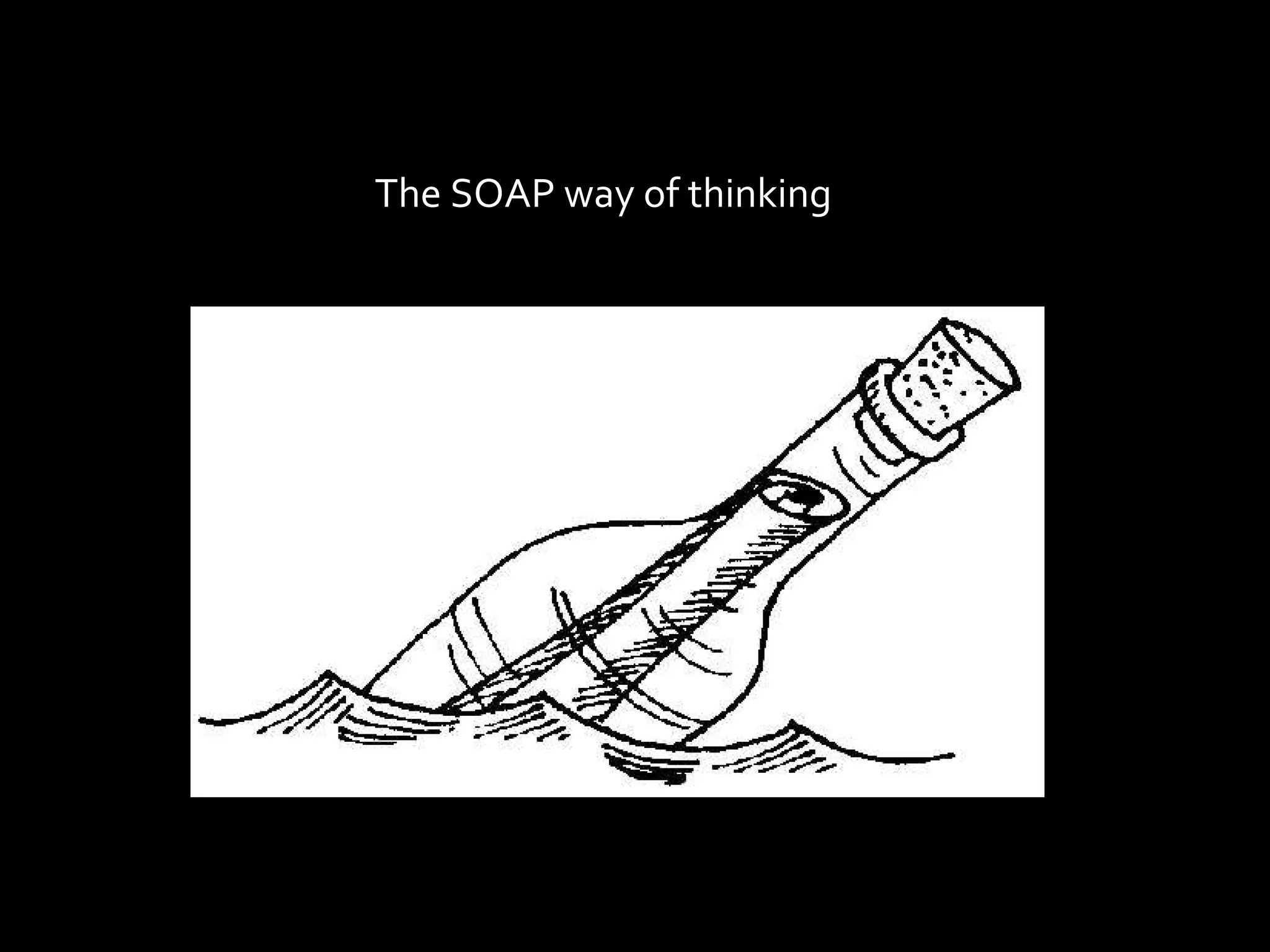
The SOAP way of thinking
In the meantime…
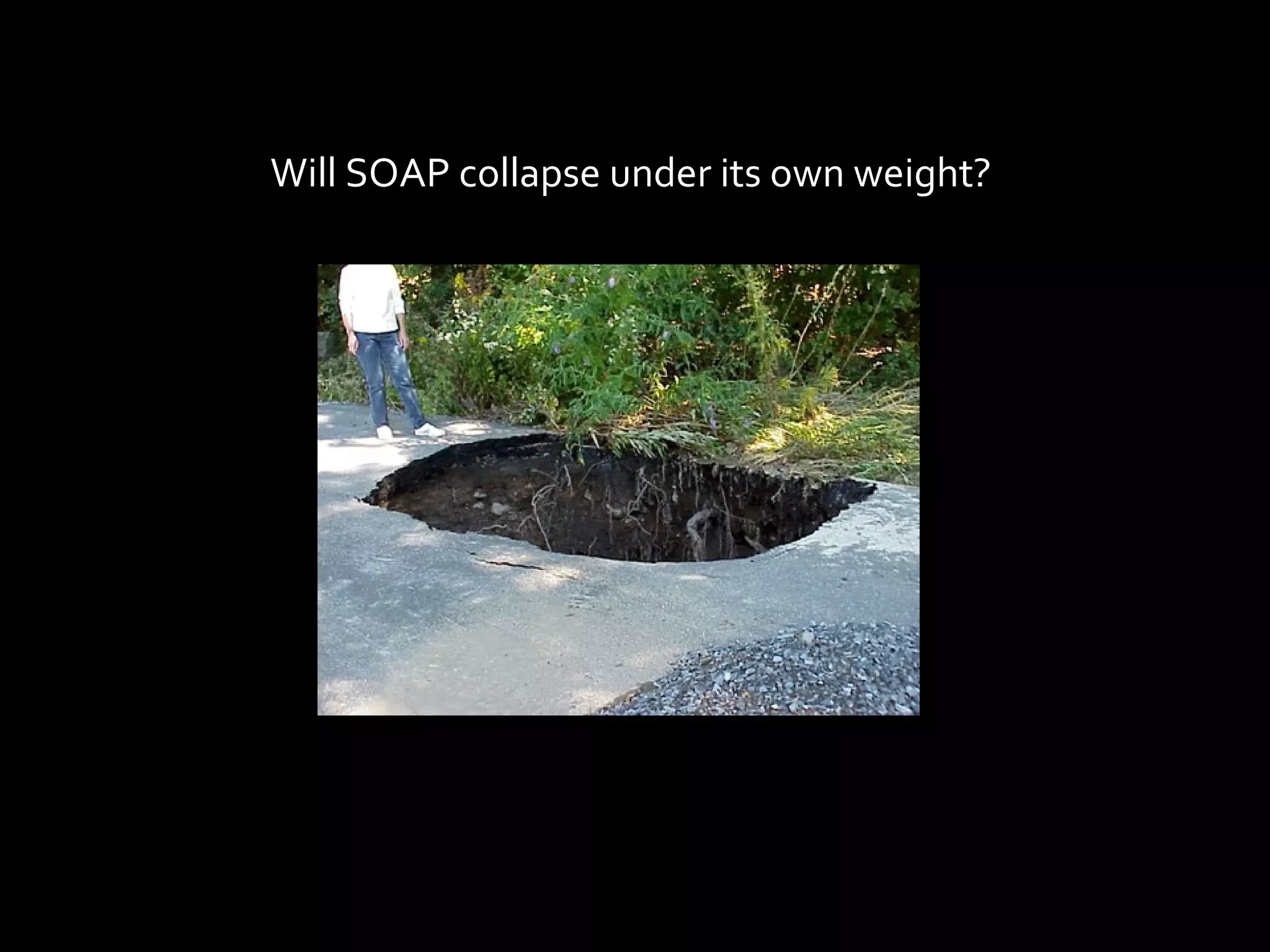
Will SOAP collapse under its own weight?
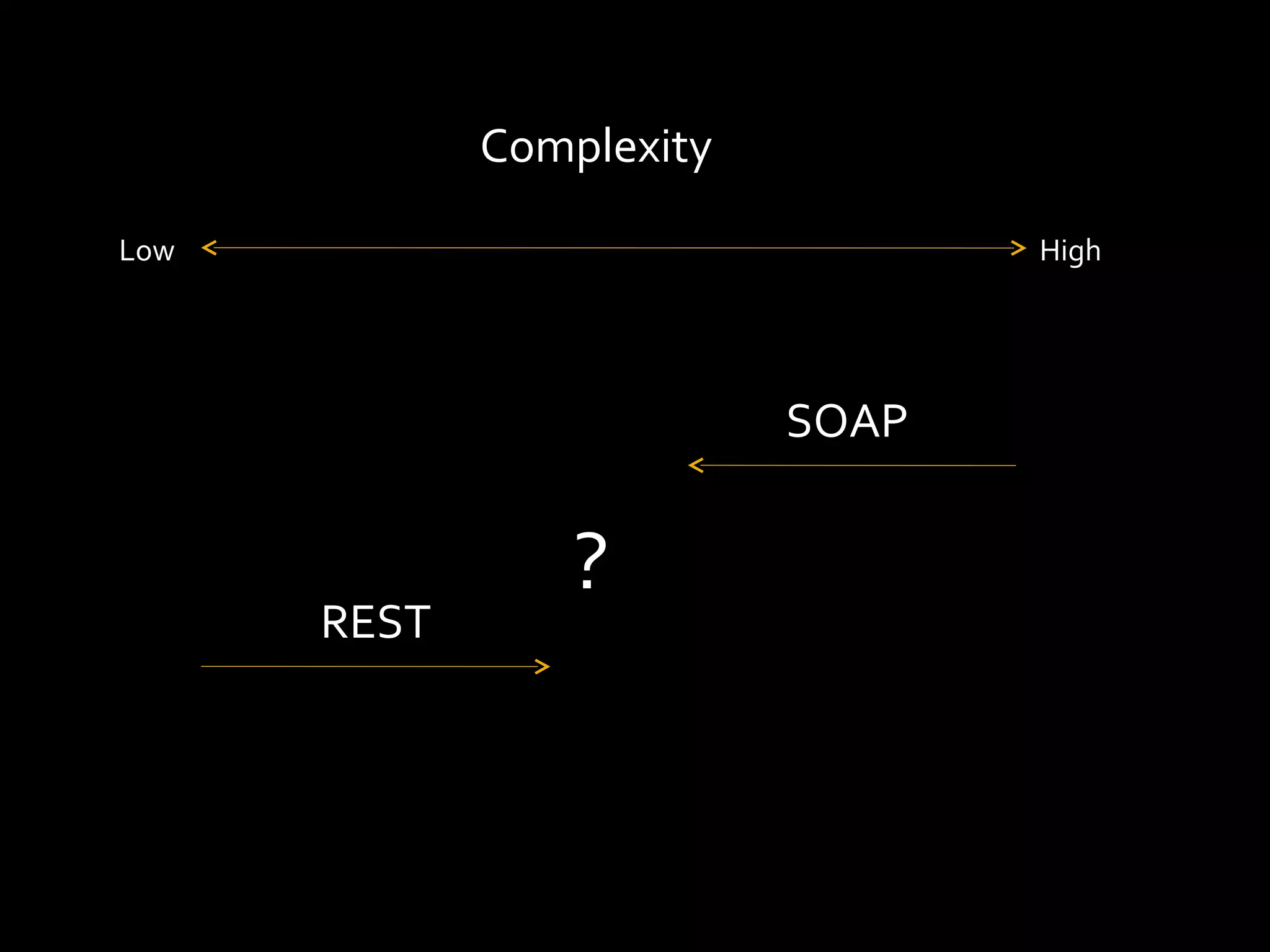
Complexity

Low                              High


                          SOAP


                 ?
      REST
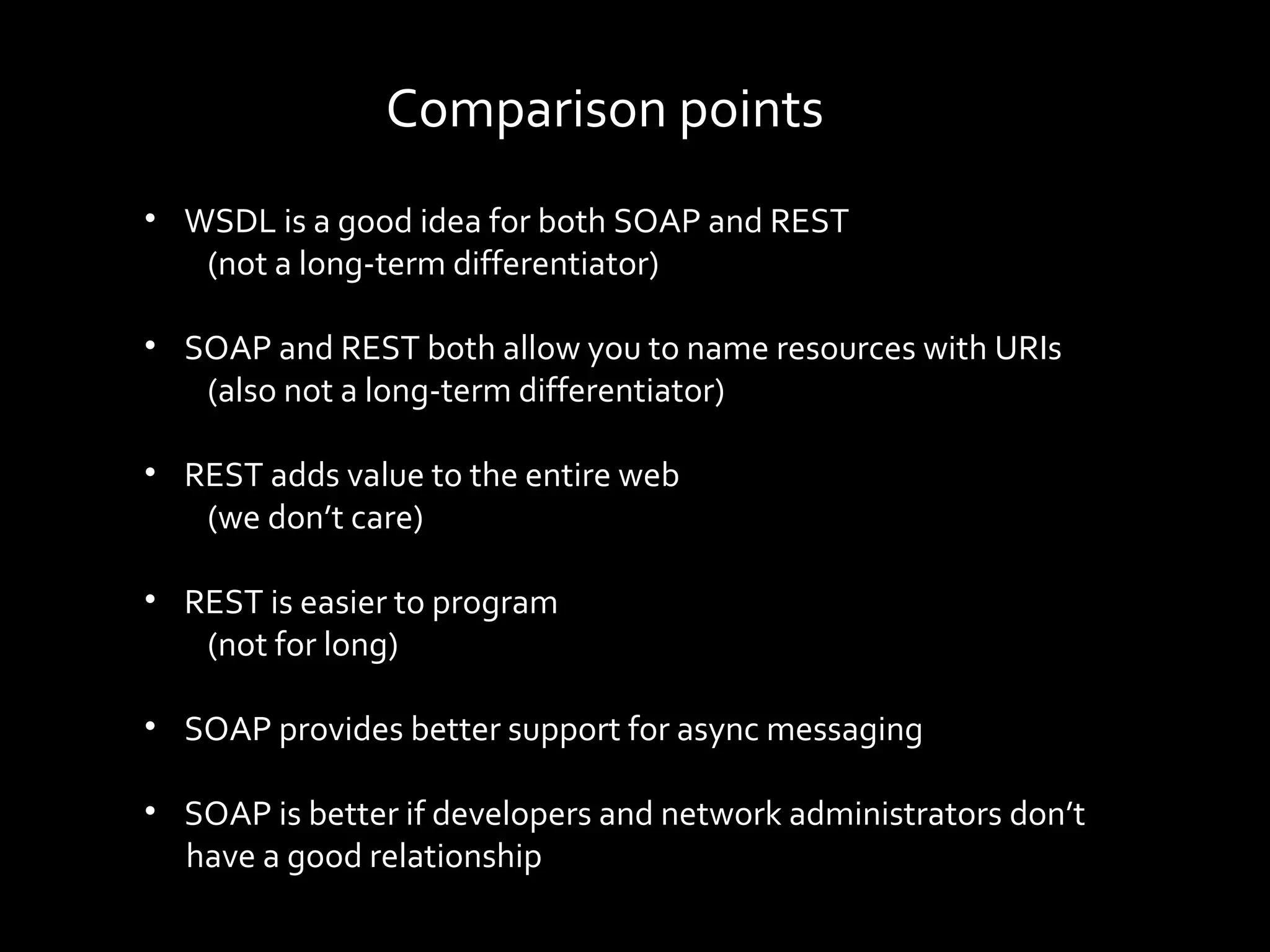
Comparison points
• WSDL is a good idea for both SOAP and REST
   (not a long-term differentiator)

• SOAP and REST both allow you to name resources with URIs
   (also not a long-term differentiator)

• REST adds value to the entire web
   (we don’t care)

• REST is easier to program
   (not for long)

• SOAP provides better support for async messaging

• SOAP is better if developers and network administrators don’t
  have a good relationship
In conclusion

For enterprise apps, default to SOAP.

But if (like Amazon.com) you
•are catering to people who are not making a large
         investment in connecting to your service
•have control over your network
•are trying to reach a broad audience

… then go with REST.

Expires: Mon, 31 Mar 2008 20:00:00 GMT
Questions?

Soap vs-rest

  • 1.
    Dec 7, 2007 Canyou read this? If not, please sit closer. Thank you.
  • 2.
  • 3.
    Early SOAP (2000)“section 5 encoding” <?xml version="1.0"?> <soap-env:envelope soap-env:encodingStyle="http://schemas.xmlsoap.org/soap/encoding/" xmlns:soap-env="http://schemas.xmlsoap.org/soap/envelope/" xmlns:soap-enc="http://schemas.xmlsoap.org/soap/encoding/" xmlns:xsd="http://www.w3.org/1999/XMLSchema" xmlns:xsi="http://www.w3.org/1999/XMLSchema-instance"> <soap-env:header> ... </soap-env:header> <soap-env:body> <m:doSomeWork xmlns:m="http://www.lab49.com/"> <foo xsi:type="xsd:int">40</foo> <bar>-12.53</bar> </m:doSomeWork> </soap-env:body> </soap-env:envelope> <?xml version="1.0"?> <soap-env:Envelope soap-env:encodingStyle="http://schemas.xmlsoap.org/soap/encoding/" xmlns:soap-env="http://schemas.xmlsoap.org/soap/envelope/" xmlns:soap-enc="http://schemas.xmlsoap.org/soap/encoding/" xmlns:xsd="http://www.w3.org/1999/XMLSchema" xmlns:xsi="http://www.w3.org/1999/XMLSchema-instance"> <soap-env:body> <m:doSomeWorkResponse xmlns:m="http://www.lab49.com/"> <soap-enc:array soap-enc:arrayType="xsd:ur-type[2]"> <baz xsi:type="xsd:int">12345</baz> <quux xsi:type="xsd:string">Something here</quux> </soap-enc:array> </m:doSomeWorkResponse> </soap-env:Body> </soap-env:Envelope>
  • 4.
    SOAP fancy encodingrules References: <e:Book> <title>My Life and Work</title> <author href="#Person-1"/> </e:Book> <e:Person id="Person-1"> <name>Henry Ford</name> <address href="#Address-2"/> </e:Person> <e:Address id="Address-2"> <email>mailto:henryford@hotmail.com</email> <web>http://www.henryford.com</web> </e:Address> Sparse arrays: <SOAP-ENC:Array SOAP-ENC:arrayType="xsd:string[,][4]"> <SOAP-ENC:Array href="#array-1" SOAP-ENC:position="[2]"/> </SOAP-ENC:Array> <SOAP-ENC:Array id="array-1" SOAP-ENC:arrayType="xsd:string[10,10]"> <item SOAP-ENC:position="[2,2]">Third row, third col</item> <item SOAP-ENC:position="[7,2]">Eighth row, third col</item> </SOAP-ENC:Array>
  • 5.
    Document/literal (2003): Forgetall the fancy encoding rules <?xml version="1.0"?> <soap-env:envelope soap-env:encodingStyle="http://schemas.xmlsoap.org/soap/encoding/" xmlns:soap-env="http://schemas.xmlsoap.org/soap/envelope/" xmlns:xsd="http://www.w3.org/1999/XMLSchema" xmlns:xsi="http://www.w3.org/1999/XMLSchema-instance"> <soap-env:header> ... </soap-env:header> <soap-env:body> … your XML Schema compliant document goes here … </soap-env:body> </soap-env:envelope>
  • 6.
    I want my,I want my RPC (rpc/literal) <?xml version="1.0"?> <soap-env:envelope soap-env:encodingStyle="http://schemas.xmlsoap.org/soap/encoding/" xmlns:soap-env="http://schemas.xmlsoap.org/soap/envelope/" xmlns:soap-enc="http://schemas.xmlsoap.org/soap/encoding/" xmlns:xsd="http://www.w3.org/1999/XMLSchema" xmlns:xsi="http://www.w3.org/1999/XMLSchema-instance"> <soap-env:header> ... Namespace does not </soap-env:header> have to be the same <soap-env:body> <m:doSomething xmlns:m=“http://lab49.com/”> as the parameter values <foo> … XML Schema compliant value… … XML Schema compliant value… … </foo> Argument elements don’t <bar> even have a namespace … XML Schema compliant value… … </bar> </m:doSomething> </soap-env:body> </soap-env:envelope> Lets you model procedure calls, but can’t validate SOAP body with an XML Schema
  • 7.
    SOAP encoding conventionline-up circa 2003 1. RPC/encoded (the original) 2. Document/literal (based on XML Schema, but doesn’t model RPC) 3. RPC/literal (adds RPC modeling, breaks XML Schema validation) Can’t we model RPC without breaking Schema validation?
  • 8.
    Wrapped document literalstyle (2005) <?xml version="1.0"?> <soap-env:envelope soap-env:encodingStyle="http://schemas.xmlsoap.org/soap/encoding/" xmlns:soap-env="http://schemas.xmlsoap.org/soap/envelope/" xmlns:soap-enc="http://schemas.xmlsoap.org/soap/encoding/" xmlns:xsd="http://www.w3.org/1999/XMLSchema" xmlns:xsi="http://www.w3.org/1999/XMLSchema-instance"> <soap-env:header> ... </soap-env:header> <soap-env:body> <m:doSomething xmlns:m=“http://lab49.com/”> <m:foo> … Entire body complies with an XML Schema </m:foo> <m:bar> containing element doSomething containing … a sequence of elements foo and bar </m:bar> </m:doSomething> </soap-env:body> </soap-env:envelope>
  • 9.
    Handy summary Scheme Rating Why? rpc/encoded Because “encoded” means “section 5 encoding” and that hairy BAD (1998) scheme has been displaced by XML Schemas doc/literal Send an XML Schema compliant document, get one back. BEST (2003) Awesome. rpc/literal BAD Failed attempt to reconcile document style with RPC. (2003) wrapped/literal GOOD Successful attempt to reconcile document style with RPC. (2005)
  • 10.
    Web Service DefinitionLanguage (WSDL 1.1) Wrapped style. Notice the operation has one message part called “parameters” which is an XML sequence of the args
  • 11.
  • 12.
    Code first /WSDL first decision algorithm Write code first and use doc/literal style. Will other projects i.e. Every method No Are you in a No be using these has one arg. Use services? i.e. is this great hurry? annotations to name part of an SOA? everything and review WSDL afterward. Yes Yes Write code first in wrapped/literal style, i.e. Use annotations to name everything and review WSDL afterward. Write WSDL first. Think through interfaces carefully, plan for backward compatibility, write lots of comments, and maintain in source control.
  • 13.
    Goodies • WS-Security (messageintegrity, confidentiality, and authentication) • WS-ReliableMessaging • WS-Routing (messaging patterns and routes) • WS-Eventing (pub/sub) • Many other incomprehensible extensions, collectively referred to as WS-*
  • 14.
    The SOAP wayof thinking
  • 15.
  • 16.
    Will SOAP collapseunder its own weight?
  • 17.
    Complexity Low High SOAP ? REST
  • 18.
    Comparison points • WSDLis a good idea for both SOAP and REST (not a long-term differentiator) • SOAP and REST both allow you to name resources with URIs (also not a long-term differentiator) • REST adds value to the entire web (we don’t care) • REST is easier to program (not for long) • SOAP provides better support for async messaging • SOAP is better if developers and network administrators don’t have a good relationship
  • 19.
    In conclusion For enterpriseapps, default to SOAP. But if (like Amazon.com) you •are catering to people who are not making a large investment in connecting to your service •have control over your network •are trying to reach a broad audience … then go with REST. Expires: Mon, 31 Mar 2008 20:00:00 GMT
  • 20.