Henrik Frystyk Nielsen, <frystyk@microsoft.com>
Introduction to SOAP
A Walkthrough of Core Technical Concepts
2
What is SOAP?
• SOAP is a simple, lightweight XML protocol for
exchanging structured and typed information on the
Web
• Overall design goal: KISS
• Can be implemented in a weekend
• Stick to absolutely minimum of functionality
• Make it Modular and Extensible
• No application semantics and no transport
semantics
• Think “XML datagram”
3
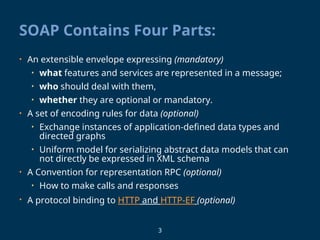
SOAP Contains Four Parts:
• An extensible envelope expressing (mandatory)
• what features and services are represented in a message;
• who should deal with them,
• whether they are optional or mandatory.
• A set of encoding rules for data (optional)
• Exchange instances of application-defined data types and
directed graphs
• Uniform model for serializing abstract data models that can
not directly be expressed in XML schema
• A Convention for representation RPC (optional)
• How to make calls and responses
• A protocol binding to HTTP and HTTP-EF (optional)
4
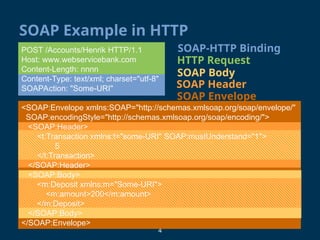
SOAP Envelope
SOAP Example in HTTP
HTTP Request
SOAP-HTTP Binding
SOAP Header
SOAP Body
POST /Accounts/Henrik HTTP/1.1
Host: www.webservicebank.com
Content-Length: nnnn
Content-Type: text/xml; charset="utf-8"
SOAPAction: "Some-URI"
<SOAP:Envelope xmlns:SOAP="http://schemas.xmlsoap.org/soap/envelope/"
SOAP:encodingStyle="http://schemas.xmlsoap.org/soap/encoding/">
<SOAP:Header>
<t:Transaction xmlns:t="some-URI" SOAP:mustUnderstand="1">
5
</t:Transaction>
</SOAP:Header>
<SOAP:Body>
<m:Deposit xmlns:m="Some-URI">
<m:amount>200</m:amount>
</m:Deposit>
</SOAP:Body>
</SOAP:Envelope>
5
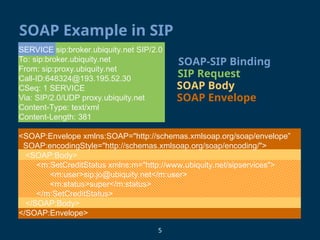
SOAP Example in SIP
SOAP Envelope
SIP Request
SOAP-SIP Binding
SOAP Body
SERVICE sip:broker.ubiquity.net SIP/2.0
To: sip:broker.ubiquity.net
From: sip:proxy.ubiquity.net
Call-ID:648324@193.195.52.30
CSeq: 1 SERVICE
Via: SIP/2.0/UDP proxy.ubiquity.net
Content-Type: text/xml
Content-Length: 381
<SOAP:Envelope xmlns:SOAP="http://schemas.xmlsoap.org/soap/envelope”
SOAP:encodingStyle="http://schemas.xmlsoap.org/soap/encoding/">
<SOAP:Body>
<m:SetCreditStatus xmlns:m="http://www.ubiquity.net/sipservices">
<m:user>sip:jo@ubiquity.net</m:user>
<m:status>super</m:status>
</m:SetCreditStatus>
</SOAP:Body>
</SOAP:Envelope>
6
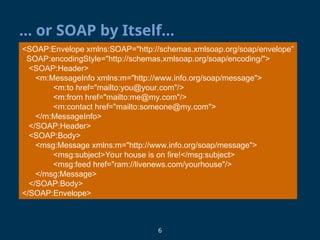
… or SOAP by Itself…
<SOAP:Envelope xmlns:SOAP="http://schemas.xmlsoap.org/soap/envelope”
SOAP:encodingStyle="http://schemas.xmlsoap.org/soap/encoding/">
<SOAP:Header>
<m:MessageInfo xmlns:m="http://www.info.org/soap/message">
<m:to href="mailto:you@your.com"/>
<m:from href="mailto:me@my.com"/>
<m:contact href="mailto:someone@my.com">
</m:MessageInfo>
</SOAP:Header>
<SOAP:Body>
<msg:Message xmlns:m="http://www.info.org/soap/message">
<msg:subject>Your house is on fire!</msg:subject>
<msg:feed href="ram://livenews.com/yourhouse"/>
</msg:Message>
</SOAP:Body>
</SOAP:Envelope>
7
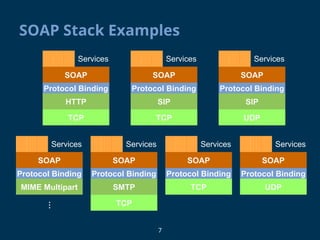
SOAP Stack Examples
SOAP
HTTP
TCP
Protocol Binding
SOAP
SIP
TCP
Protocol Binding
SOAP
SIP
UDP
Protocol Binding
SOAP
MIME Multipart
Protocol Binding
…
SOAP
SMTP
TCP
Protocol Binding
SOAP
TCP
Protocol Binding
SOAP
UDP
Protocol Binding
Services
Services Services Services
8
Note Again: SOAP is a Protocol!
• What does this mean?
• It is not a distributed object system
• It is not an RPC system
• It is not even a Web application
• Your application decides what your application is!
• You can build a tightly coupled system
…or…
• You can build a loosely coupled system
• Tunneling is a property of the application, not the
protocol
9
SOAP is Designed for Evolvability
• How are features and services deployed in the Web?
• Often by extending existing applications
• Spreading from in the small to the large over time
• This means that:
• Applications have different capabilities at all times
• We have to support this
• This requires that:
• Applications supporting a particular feature or service
should be able to employ this with no prior agreement;
• Applications can require that the other party either
understand and abide by the new feature or service or
abort the operation
10
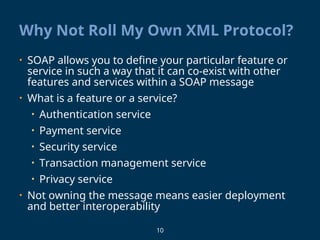
Why Not Roll My Own XML Protocol?
• SOAP allows you to define your particular feature or
service in such a way that it can co-exist with other
features and services within a SOAP message
• What is a feature or a service?
• Authentication service
• Payment service
• Security service
• Transaction management service
• Privacy service
• Not owning the message means easier deployment
and better interoperability
11
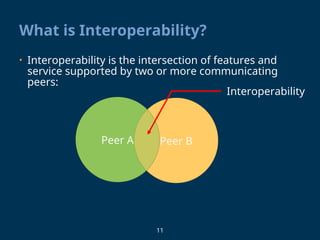
What is Interoperability?
• Interoperability is the intersection of features and
service supported by two or more communicating
peers:
Peer B
Peer A
Interoperability
12
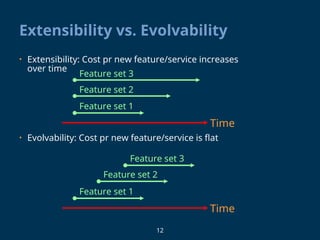
Extensibility vs. Evolvability
• Extensibility: Cost pr new feature/service increases
over time
• Evolvability: Cost pr new feature/service is flat
Time
Time
Feature set 3
Feature set 3
Feature set 2
Feature set 2
Feature set 1
Feature set 1
13
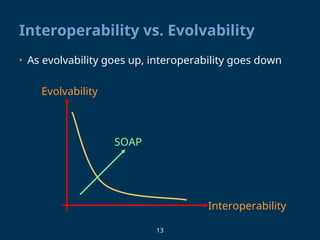
Interoperability vs. Evolvability
• As evolvability goes up, interoperability goes down
Interoperability
Evolvability
SOAP
14
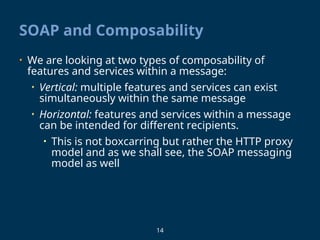
SOAP and Composability
• We are looking at two types of composability of
features and services within a message:
• Vertical: multiple features and services can exist
simultaneously within the same message
• Horizontal: features and services within a message
can be intended for different recipients.
• This is not boxcarring but rather the HTTP proxy
model and as we shall see, the SOAP messaging
model as well
15
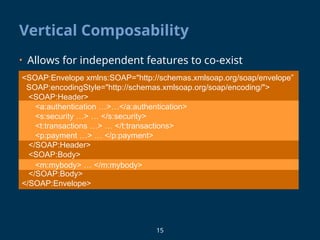
Vertical Composability
• Allows for independent features to co-exist
<SOAP:Envelope xmlns:SOAP="http://schemas.xmlsoap.org/soap/envelope”
SOAP:encodingStyle="http://schemas.xmlsoap.org/soap/encoding/">
<SOAP:Header>
<a:authentication …>…</a:authentication>
<s:security …> … </s:security>
<t:transactions …> … </t:transactions>
<p:payment …> … </p:payment>
</SOAP:Header>
<SOAP:Body>
<m:mybody> … </m:mybody>
</SOAP:Body>
</SOAP:Envelope>
<a:authentication …>…</a:authentication>
<s:security …> … </s:security>
<t:transactions …> … </t:transactions>
<p:payment …> … </p:payment>
<m:mybody> … </m:mybody>
16
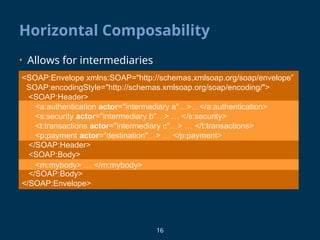
Horizontal Composability
• Allows for intermediaries
<SOAP:Envelope xmlns:SOAP="http://schemas.xmlsoap.org/soap/envelope”
SOAP:encodingStyle="http://schemas.xmlsoap.org/soap/encoding/">
<SOAP:Header>
<a:authentication actor="intermediary a"…>…</a:authentication>
<s:security actor="intermediary b"…> … </s:security>
<t:transactions actor="intermediary c"…> … </t:transactions>
<p:payment actor="destination"…> … </p:payment>
</SOAP:Header>
<SOAP:Body>
<m:mybody> … </m:mybody>
</SOAP:Body>
</SOAP:Envelope>
<a:authentication actor="intermediary a"…>…</a:authentication>
<s:security actor="intermediary b"…> … </s:security>
<t:transactions actor="intermediary c"…> … </t:transactions>
<p:payment actor="destination"…> … </p:payment>
<m:mybody> … </m:mybody>
17
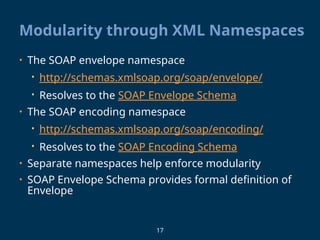
Modularity through XML Namespaces
• The SOAP envelope namespace
• http://schemas.xmlsoap.org/soap/envelope/
• Resolves to the SOAP Envelope Schema
• The SOAP encoding namespace
• http://schemas.xmlsoap.org/soap/encoding/
• Resolves to the SOAP Encoding Schema
• Separate namespaces help enforce modularity
• SOAP Envelope Schema provides formal definition of
Envelope
18
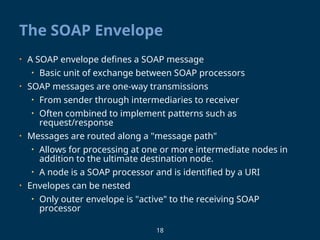
The SOAP Envelope
• A SOAP envelope defines a SOAP message
• Basic unit of exchange between SOAP processors
• SOAP messages are one-way transmissions
• From sender through intermediaries to receiver
• Often combined to implement patterns such as
request/response
• Messages are routed along a "message path"
• Allows for processing at one or more intermediate nodes in
addition to the ultimate destination node.
• A node is a SOAP processor and is identified by a URI
• Envelopes can be nested
• Only outer envelope is "active" to the receiving SOAP
processor
19
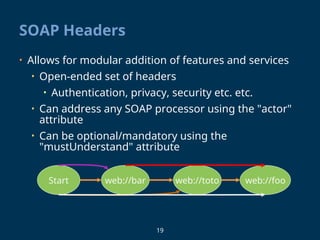
SOAP Headers
• Allows for modular addition of features and services
• Open-ended set of headers
• Authentication, privacy, security etc. etc.
• Can address any SOAP processor using the "actor"
attribute
• Can be optional/mandatory using the
"mustUnderstand" attribute
Start web://bar web://toto web://foo
20
Semantics of SOAP Headers
• Contract between sender and recipient
• Recipient is described by "actor" attribute
• Allows for different types of negotiation:
• Take it or leave it directly supported
• Let's talk about it can be built on top
• And for different settings:
• Server dictated
• Peer-to-peer
• Dictated by third party
21
The SOAP actor Attribute
• The "Actor" attribute is a generalization of the HTTP
Connection header field
• Instead of hop-by-hop vs. end-to-end, the actor
attribute can address any SOAP processor because
it is a URI
• Special cases:
• "next hop" has a special URI assigned to it
• "end" is the default destination for a header
• "end" is the destination for the body
22
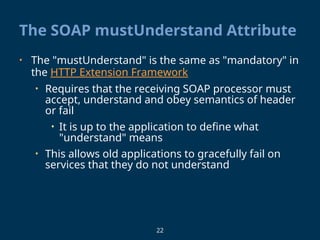
The SOAP mustUnderstand Attribute
• The "mustUnderstand" is the same as "mandatory" in
the HTTP Extension Framework
• Requires that the receiving SOAP processor must
accept, understand and obey semantics of header
or fail
• It is up to the application to define what
"understand" means
• This allows old applications to gracefully fail on
services that they do not understand
23
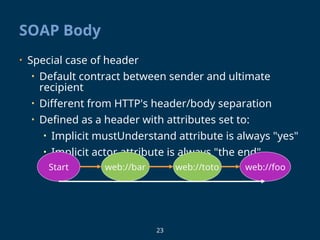
SOAP Body
• Special case of header
• Default contract between sender and ultimate
recipient
• Different from HTTP's header/body separation
• Defined as a header with attributes set to:
• Implicit mustUnderstand attribute is always "yes"
• Implicit actor attribute is always "the end"
Start web://bar web://toto web://foo
24
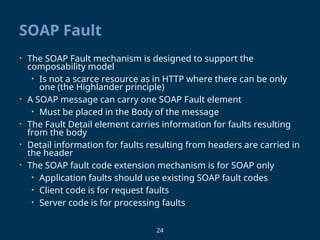
SOAP Fault
• The SOAP Fault mechanism is designed to support the
composability model
• Is not a scarce resource as in HTTP where there can be only
one (the Highlander principle)
• A SOAP message can carry one SOAP Fault element
• Must be placed in the Body of the message
• The Fault Detail element carries information for faults resulting
from the body
• Detail information for faults resulting from headers are carried in
the header
• The SOAP fault code extension mechanism is for SOAP only
• Application faults should use existing SOAP fault codes
• Client code is for request faults
• Server code is for processing faults
25
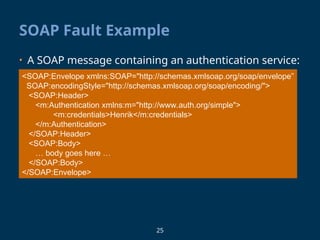
SOAP Fault Example
• A SOAP message containing an authentication service:
<SOAP:Envelope xmlns:SOAP="http://schemas.xmlsoap.org/soap/envelope”
SOAP:encodingStyle="http://schemas.xmlsoap.org/soap/encoding/">
<SOAP:Header>
<m:Authentication xmlns:m="http://www.auth.org/simple">
<m:credentials>Henrik</m:credentials>
</m:Authentication>
</SOAP:Header>
<SOAP:Body>
… body goes here …
</SOAP:Body>
</SOAP:Envelope>
26
SOAP Fault Example… 2
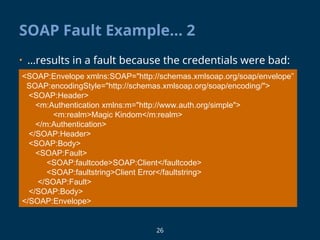
• …results in a fault because the credentials were bad:
<SOAP:Envelope xmlns:SOAP="http://schemas.xmlsoap.org/soap/envelope”
SOAP:encodingStyle="http://schemas.xmlsoap.org/soap/encoding/">
<SOAP:Header>
<m:Authentication xmlns:m="http://www.auth.org/simple">
<m:realm>Magic Kindom</m:realm>
</m:Authentication>
</SOAP:Header>
<SOAP:Body>
<SOAP:Fault>
<SOAP:faultcode>SOAP:Client</faultcode>
<SOAP:faultstring>Client Error</faultstring>
</SOAP:Fault>
</SOAP:Body>
</SOAP:Envelope>
27
SOAP Versioning Model
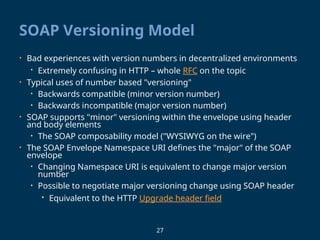
• Bad experiences with version numbers in decentralized environments
• Extremely confusing in HTTP – whole RFC on the topic
• Typical uses of number based "versioning"
• Backwards compatible (minor version number)
• Backwards incompatible (major version number)
• SOAP supports "minor" versioning within the envelope using header
and body elements
• The SOAP composability model ("WYSIWYG on the wire")
• The SOAP Envelope Namespace URI defines the "major" of the SOAP
envelope
• Changing Namespace URI is equivalent to change major version
number
• Possible to negotiate major versioning change using SOAP header
• Equivalent to the HTTP Upgrade header field
28
SOAP and "Binary" Data
• "Binary" can in fact mean any data that is to be
tunneled through SOAP
• Encrypted data, images, XML documents, SOAP
envelopes as data
• Can be carried in two ways
• Within the envelope as binary blob
• Referenced from within the SOAP envelope
• References can point to anything including
• MIME multipart, HTTP accessible resources etc.
• Integrity can be obtained through manifest
29
Binding to HTTP
• The purpose of the HTTP protocol binding is two-fold
• To ensure that SOAP is carried in a way that is
consistent with HTTP’s message model
• Intent is not to break HTTP
• To indicate to HTTP servers that this is a SOAP
message
• Allows HTTP servers to act on a SOAP message
without knowing SOAP
• Binding only works for HTTP POST requests
• SOAP intermediary is not the same as HTTP intermediary
• Only HTTP origin server can be SOAP intermediary
30
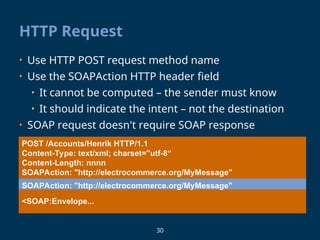
HTTP Request
POST /Accounts/Henrik HTTP/1.1
Content-Type: text/xml; charset="utf-8“
Content-Length: nnnn
SOAPAction: "http://electrocommerce.org/MyMessage"
<SOAP:Envelope...
• Use HTTP POST request method name
• Use the SOAPAction HTTP header field
• It cannot be computed – the sender must know
• It should indicate the intent – not the destination
• SOAP request doesn't require SOAP response
SOAPAction: "http://electrocommerce.org/MyMessage"
31
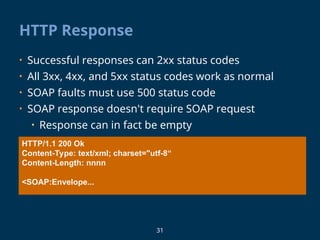
HTTP Response
• Successful responses can 2xx status codes
• All 3xx, 4xx, and 5xx status codes work as normal
• SOAP faults must use 500 status code
• SOAP response doesn't require SOAP request
• Response can in fact be empty
HTTP/1.1 200 Ok
Content-Type: text/xml; charset="utf-8“
Content-Length: nnnn
<SOAP:Envelope...
32
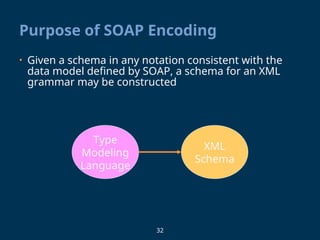
Purpose of SOAP Encoding
• Given a schema in any notation consistent with the
data model defined by SOAP, a schema for an XML
grammar may be constructed
Type
Modeling
Language
XML
Schema
33
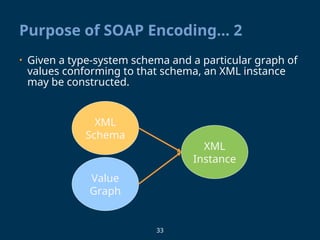
Purpose of SOAP Encoding… 2
• Given a type-system schema and a particular graph of
values conforming to that schema, an XML instance
may be constructed.
XML
Schema
XML
Instance
Value
Graph
34
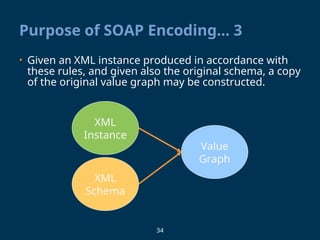
Purpose of SOAP Encoding… 3
• Given an XML instance produced in accordance with
these rules, and given also the original schema, a copy
of the original value graph may be constructed.
XML
Instance
Value
Graph
XML
Schema
35
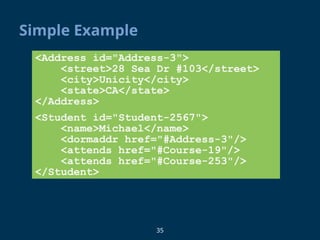
Simple Example
<Address id="Address-3">
<street>28 Sea Dr #103</street>
<city>Unicity</city>
<state>CA</state>
</Address>
<Student id="Student-2567">
<name>Michael</name>
<dormaddr href="#Address-3"/>
<attends href="#Course-19"/>
<attends href="#Course-253"/>
</Student>
36
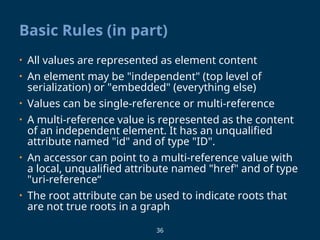
Basic Rules (in part)
• All values are represented as element content
• An element may be "independent" (top level of
serialization) or "embedded" (everything else)
• Values can be single-reference or multi-reference
• A multi-reference value is represented as the content
of an independent element. It has an unqualified
attribute named "id" and of type "ID".
• An accessor can point to a multi-reference value with
a local, unqualified attribute named "href" and of type
"uri-reference“
• The root attribute can be used to indicate roots that
are not true roots in a graph
37
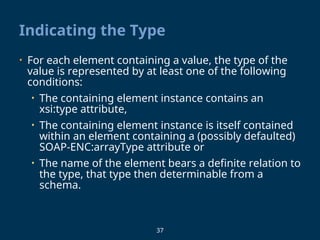
Indicating the Type
• For each element containing a value, the type of the
value is represented by at least one of the following
conditions:
• The containing element instance contains an
xsi:type attribute,
• The containing element instance is itself contained
within an element containing a (possibly defaulted)
SOAP-ENC:arrayType attribute or
• The name of the element bears a definite relation to
the type, that type then determinable from a
schema.
38
Simple Types
• A "simple type" is a class of simple values
• SOAP uses all the types found in the section "Built-in
data types" of "XML Schema Part 2: Datatypes"
• A simple value is represented as character data, that
is, without any sub-elements
39
Simple Type Examples
<element name="age" type="int"/>
<element name="height" type="float"/>
<element name="displacement"
type="negativeInteger"/>
<element name="color">
<simpleType base="xsd:string">
<enumeration value="Green"/>
<enumeration value="Blue"/>
</simpleType>
</element>
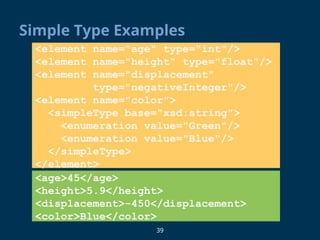
<age>45</age>
<height>5.9</height>
<displacement>-450</displacement>
<color>Blue</color>
40
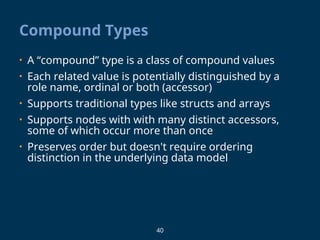
Compound Types
• A “compound” type is a class of compound values
• Each related value is potentially distinguished by a
role name, ordinal or both (accessor)
• Supports traditional types like structs and arrays
• Supports nodes with with many distinct accessors,
some of which occur more than once
• Preserves order but doesn't require ordering
distinction in the underlying data model
41
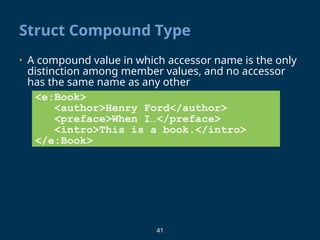
Struct Compound Type
• A compound value in which accessor name is the only
distinction among member values, and no accessor
has the same name as any other
<e:Book>
<author>Henry Ford</author>
<preface>When I…</preface>
<intro>This is a book.</intro>
</e:Book>
42
Array Compound Type
• A compound value in which ordinal position serves as
the only distinction among member values
<SOAP-ENC:Array
SOAP-ENC:arrayType="xyz:Order[2]">
<Order>
<Product>Apple</Product>
<Price>1.56</Price>
</Order>
<Order>
<Product>Peach</Product>
<Price>1.48</Price>
</Order>
</SOAP-ENC:Array>
43
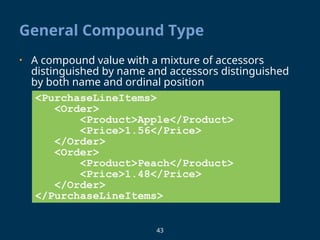
General Compound Type
• A compound value with a mixture of accessors
distinguished by name and accessors distinguished
by both name and ordinal position
<PurchaseLineItems>
<Order>
<Product>Apple</Product>
<Price>1.56</Price>
</Order>
<Order>
<Product>Peach</Product>
<Price>1.48</Price>
</Order>
</PurchaseLineItems>
44
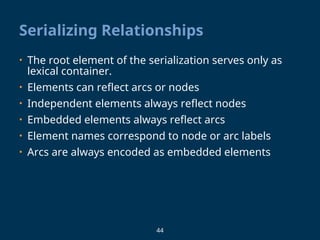
Serializing Relationships
• The root element of the serialization serves only as
lexical container.
• Elements can reflect arcs or nodes
• Independent elements always reflect nodes
• Embedded elements always reflect arcs
• Element names correspond to node or arc labels
• Arcs are always encoded as embedded elements
45
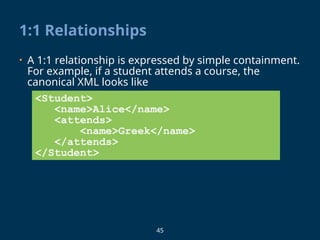
1:1 Relationships
• A 1:1 relationship is expressed by simple containment.
For example, if a student attends a course, the
canonical XML looks like
<Student>
<name>Alice</name>
<attends>
<name>Greek</name>
</attends>
</Student>
46
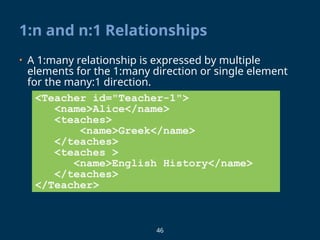
1:n and n:1 Relationships
• A 1:many relationship is expressed by multiple
elements for the 1:many direction or single element
for the many:1 direction.
<Teacher id="Teacher-1">
<name>Alice</name>
<teaches>
<name>Greek</name>
</teaches>
<teaches >
<name>English History</name>
</teaches>
</Teacher>
47
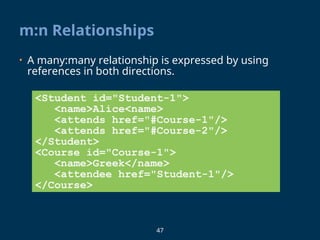
m:n Relationships
• A many:many relationship is expressed by using
references in both directions.
<Student id="Student-1">
<name>Alice<name>
<attends href="#Course-1"/>
<attends href="#Course-2"/>
</Student>
<Course id="Course-1">
<name>Greek</name>
<attendee href="Student-1"/>
</Course>
48
SOAP and RPC
• A method invocation is modeled as a struct
• A method response is modeled as a struct
• Struct contains an accessor for each [in] or [in/out] or
[out] parameter.
• The request struct is both named and typed identically
to the method name.
• The response struct name is not important
• The first accessor is the return value followed by the
parameters in the same order as in the method
signature
49
Summary
• SOAP envelope provides
• Composability in the vertical (Shopping basket)
• Composability in the horizontal (Amtrak)
• SOAP can be used with many protocols
• Easy to deploy with existing infrastructure
• SOAP is fundamentally a one-way message
• Supports request/response, RPC etc.
• Your application decides what it is!

soap protocol presentation protocol explanation

  • 1.
    Henrik Frystyk Nielsen,<frystyk@microsoft.com> Introduction to SOAP A Walkthrough of Core Technical Concepts
  • 2.
    2 What is SOAP? •SOAP is a simple, lightweight XML protocol for exchanging structured and typed information on the Web • Overall design goal: KISS • Can be implemented in a weekend • Stick to absolutely minimum of functionality • Make it Modular and Extensible • No application semantics and no transport semantics • Think “XML datagram”
  • 3.
    3 SOAP Contains FourParts: • An extensible envelope expressing (mandatory) • what features and services are represented in a message; • who should deal with them, • whether they are optional or mandatory. • A set of encoding rules for data (optional) • Exchange instances of application-defined data types and directed graphs • Uniform model for serializing abstract data models that can not directly be expressed in XML schema • A Convention for representation RPC (optional) • How to make calls and responses • A protocol binding to HTTP and HTTP-EF (optional)
  • 4.
    4 SOAP Envelope SOAP Examplein HTTP HTTP Request SOAP-HTTP Binding SOAP Header SOAP Body POST /Accounts/Henrik HTTP/1.1 Host: www.webservicebank.com Content-Length: nnnn Content-Type: text/xml; charset="utf-8" SOAPAction: "Some-URI" <SOAP:Envelope xmlns:SOAP="http://schemas.xmlsoap.org/soap/envelope/" SOAP:encodingStyle="http://schemas.xmlsoap.org/soap/encoding/"> <SOAP:Header> <t:Transaction xmlns:t="some-URI" SOAP:mustUnderstand="1"> 5 </t:Transaction> </SOAP:Header> <SOAP:Body> <m:Deposit xmlns:m="Some-URI"> <m:amount>200</m:amount> </m:Deposit> </SOAP:Body> </SOAP:Envelope>
  • 5.
    5 SOAP Example inSIP SOAP Envelope SIP Request SOAP-SIP Binding SOAP Body SERVICE sip:broker.ubiquity.net SIP/2.0 To: sip:broker.ubiquity.net From: sip:proxy.ubiquity.net Call-ID:648324@193.195.52.30 CSeq: 1 SERVICE Via: SIP/2.0/UDP proxy.ubiquity.net Content-Type: text/xml Content-Length: 381 <SOAP:Envelope xmlns:SOAP="http://schemas.xmlsoap.org/soap/envelope” SOAP:encodingStyle="http://schemas.xmlsoap.org/soap/encoding/"> <SOAP:Body> <m:SetCreditStatus xmlns:m="http://www.ubiquity.net/sipservices"> <m:user>sip:jo@ubiquity.net</m:user> <m:status>super</m:status> </m:SetCreditStatus> </SOAP:Body> </SOAP:Envelope>
  • 6.
    6 … or SOAPby Itself… <SOAP:Envelope xmlns:SOAP="http://schemas.xmlsoap.org/soap/envelope” SOAP:encodingStyle="http://schemas.xmlsoap.org/soap/encoding/"> <SOAP:Header> <m:MessageInfo xmlns:m="http://www.info.org/soap/message"> <m:to href="mailto:you@your.com"/> <m:from href="mailto:me@my.com"/> <m:contact href="mailto:someone@my.com"> </m:MessageInfo> </SOAP:Header> <SOAP:Body> <msg:Message xmlns:m="http://www.info.org/soap/message"> <msg:subject>Your house is on fire!</msg:subject> <msg:feed href="ram://livenews.com/yourhouse"/> </msg:Message> </SOAP:Body> </SOAP:Envelope>
  • 7.
    7 SOAP Stack Examples SOAP HTTP TCP ProtocolBinding SOAP SIP TCP Protocol Binding SOAP SIP UDP Protocol Binding SOAP MIME Multipart Protocol Binding … SOAP SMTP TCP Protocol Binding SOAP TCP Protocol Binding SOAP UDP Protocol Binding Services Services Services Services Services Services Services
  • 8.
    8 Note Again: SOAPis a Protocol! • What does this mean? • It is not a distributed object system • It is not an RPC system • It is not even a Web application • Your application decides what your application is! • You can build a tightly coupled system …or… • You can build a loosely coupled system • Tunneling is a property of the application, not the protocol
  • 9.
    9 SOAP is Designedfor Evolvability • How are features and services deployed in the Web? • Often by extending existing applications • Spreading from in the small to the large over time • This means that: • Applications have different capabilities at all times • We have to support this • This requires that: • Applications supporting a particular feature or service should be able to employ this with no prior agreement; • Applications can require that the other party either understand and abide by the new feature or service or abort the operation
  • 10.
    10 Why Not RollMy Own XML Protocol? • SOAP allows you to define your particular feature or service in such a way that it can co-exist with other features and services within a SOAP message • What is a feature or a service? • Authentication service • Payment service • Security service • Transaction management service • Privacy service • Not owning the message means easier deployment and better interoperability
  • 11.
    11 What is Interoperability? •Interoperability is the intersection of features and service supported by two or more communicating peers: Peer B Peer A Interoperability
  • 12.
    12 Extensibility vs. Evolvability •Extensibility: Cost pr new feature/service increases over time • Evolvability: Cost pr new feature/service is flat Time Time Feature set 3 Feature set 3 Feature set 2 Feature set 2 Feature set 1 Feature set 1
  • 13.
    13 Interoperability vs. Evolvability •As evolvability goes up, interoperability goes down Interoperability Evolvability SOAP
  • 14.
    14 SOAP and Composability •We are looking at two types of composability of features and services within a message: • Vertical: multiple features and services can exist simultaneously within the same message • Horizontal: features and services within a message can be intended for different recipients. • This is not boxcarring but rather the HTTP proxy model and as we shall see, the SOAP messaging model as well
  • 15.
    15 Vertical Composability • Allowsfor independent features to co-exist <SOAP:Envelope xmlns:SOAP="http://schemas.xmlsoap.org/soap/envelope” SOAP:encodingStyle="http://schemas.xmlsoap.org/soap/encoding/"> <SOAP:Header> <a:authentication …>…</a:authentication> <s:security …> … </s:security> <t:transactions …> … </t:transactions> <p:payment …> … </p:payment> </SOAP:Header> <SOAP:Body> <m:mybody> … </m:mybody> </SOAP:Body> </SOAP:Envelope> <a:authentication …>…</a:authentication> <s:security …> … </s:security> <t:transactions …> … </t:transactions> <p:payment …> … </p:payment> <m:mybody> … </m:mybody>
  • 16.
    16 Horizontal Composability • Allowsfor intermediaries <SOAP:Envelope xmlns:SOAP="http://schemas.xmlsoap.org/soap/envelope” SOAP:encodingStyle="http://schemas.xmlsoap.org/soap/encoding/"> <SOAP:Header> <a:authentication actor="intermediary a"…>…</a:authentication> <s:security actor="intermediary b"…> … </s:security> <t:transactions actor="intermediary c"…> … </t:transactions> <p:payment actor="destination"…> … </p:payment> </SOAP:Header> <SOAP:Body> <m:mybody> … </m:mybody> </SOAP:Body> </SOAP:Envelope> <a:authentication actor="intermediary a"…>…</a:authentication> <s:security actor="intermediary b"…> … </s:security> <t:transactions actor="intermediary c"…> … </t:transactions> <p:payment actor="destination"…> … </p:payment> <m:mybody> … </m:mybody>
  • 17.
    17 Modularity through XMLNamespaces • The SOAP envelope namespace • http://schemas.xmlsoap.org/soap/envelope/ • Resolves to the SOAP Envelope Schema • The SOAP encoding namespace • http://schemas.xmlsoap.org/soap/encoding/ • Resolves to the SOAP Encoding Schema • Separate namespaces help enforce modularity • SOAP Envelope Schema provides formal definition of Envelope
  • 18.
    18 The SOAP Envelope •A SOAP envelope defines a SOAP message • Basic unit of exchange between SOAP processors • SOAP messages are one-way transmissions • From sender through intermediaries to receiver • Often combined to implement patterns such as request/response • Messages are routed along a "message path" • Allows for processing at one or more intermediate nodes in addition to the ultimate destination node. • A node is a SOAP processor and is identified by a URI • Envelopes can be nested • Only outer envelope is "active" to the receiving SOAP processor
  • 19.
    19 SOAP Headers • Allowsfor modular addition of features and services • Open-ended set of headers • Authentication, privacy, security etc. etc. • Can address any SOAP processor using the "actor" attribute • Can be optional/mandatory using the "mustUnderstand" attribute Start web://bar web://toto web://foo
  • 20.
    20 Semantics of SOAPHeaders • Contract between sender and recipient • Recipient is described by "actor" attribute • Allows for different types of negotiation: • Take it or leave it directly supported • Let's talk about it can be built on top • And for different settings: • Server dictated • Peer-to-peer • Dictated by third party
  • 21.
    21 The SOAP actorAttribute • The "Actor" attribute is a generalization of the HTTP Connection header field • Instead of hop-by-hop vs. end-to-end, the actor attribute can address any SOAP processor because it is a URI • Special cases: • "next hop" has a special URI assigned to it • "end" is the default destination for a header • "end" is the destination for the body
  • 22.
    22 The SOAP mustUnderstandAttribute • The "mustUnderstand" is the same as "mandatory" in the HTTP Extension Framework • Requires that the receiving SOAP processor must accept, understand and obey semantics of header or fail • It is up to the application to define what "understand" means • This allows old applications to gracefully fail on services that they do not understand
  • 23.
    23 SOAP Body • Specialcase of header • Default contract between sender and ultimate recipient • Different from HTTP's header/body separation • Defined as a header with attributes set to: • Implicit mustUnderstand attribute is always "yes" • Implicit actor attribute is always "the end" Start web://bar web://toto web://foo
  • 24.
    24 SOAP Fault • TheSOAP Fault mechanism is designed to support the composability model • Is not a scarce resource as in HTTP where there can be only one (the Highlander principle) • A SOAP message can carry one SOAP Fault element • Must be placed in the Body of the message • The Fault Detail element carries information for faults resulting from the body • Detail information for faults resulting from headers are carried in the header • The SOAP fault code extension mechanism is for SOAP only • Application faults should use existing SOAP fault codes • Client code is for request faults • Server code is for processing faults
  • 25.
    25 SOAP Fault Example •A SOAP message containing an authentication service: <SOAP:Envelope xmlns:SOAP="http://schemas.xmlsoap.org/soap/envelope” SOAP:encodingStyle="http://schemas.xmlsoap.org/soap/encoding/"> <SOAP:Header> <m:Authentication xmlns:m="http://www.auth.org/simple"> <m:credentials>Henrik</m:credentials> </m:Authentication> </SOAP:Header> <SOAP:Body> … body goes here … </SOAP:Body> </SOAP:Envelope>
  • 26.
    26 SOAP Fault Example…2 • …results in a fault because the credentials were bad: <SOAP:Envelope xmlns:SOAP="http://schemas.xmlsoap.org/soap/envelope” SOAP:encodingStyle="http://schemas.xmlsoap.org/soap/encoding/"> <SOAP:Header> <m:Authentication xmlns:m="http://www.auth.org/simple"> <m:realm>Magic Kindom</m:realm> </m:Authentication> </SOAP:Header> <SOAP:Body> <SOAP:Fault> <SOAP:faultcode>SOAP:Client</faultcode> <SOAP:faultstring>Client Error</faultstring> </SOAP:Fault> </SOAP:Body> </SOAP:Envelope>
  • 27.
    27 SOAP Versioning Model •Bad experiences with version numbers in decentralized environments • Extremely confusing in HTTP – whole RFC on the topic • Typical uses of number based "versioning" • Backwards compatible (minor version number) • Backwards incompatible (major version number) • SOAP supports "minor" versioning within the envelope using header and body elements • The SOAP composability model ("WYSIWYG on the wire") • The SOAP Envelope Namespace URI defines the "major" of the SOAP envelope • Changing Namespace URI is equivalent to change major version number • Possible to negotiate major versioning change using SOAP header • Equivalent to the HTTP Upgrade header field
  • 28.
    28 SOAP and "Binary"Data • "Binary" can in fact mean any data that is to be tunneled through SOAP • Encrypted data, images, XML documents, SOAP envelopes as data • Can be carried in two ways • Within the envelope as binary blob • Referenced from within the SOAP envelope • References can point to anything including • MIME multipart, HTTP accessible resources etc. • Integrity can be obtained through manifest
  • 29.
    29 Binding to HTTP •The purpose of the HTTP protocol binding is two-fold • To ensure that SOAP is carried in a way that is consistent with HTTP’s message model • Intent is not to break HTTP • To indicate to HTTP servers that this is a SOAP message • Allows HTTP servers to act on a SOAP message without knowing SOAP • Binding only works for HTTP POST requests • SOAP intermediary is not the same as HTTP intermediary • Only HTTP origin server can be SOAP intermediary
  • 30.
    30 HTTP Request POST /Accounts/HenrikHTTP/1.1 Content-Type: text/xml; charset="utf-8“ Content-Length: nnnn SOAPAction: "http://electrocommerce.org/MyMessage" <SOAP:Envelope... • Use HTTP POST request method name • Use the SOAPAction HTTP header field • It cannot be computed – the sender must know • It should indicate the intent – not the destination • SOAP request doesn't require SOAP response SOAPAction: "http://electrocommerce.org/MyMessage"
  • 31.
    31 HTTP Response • Successfulresponses can 2xx status codes • All 3xx, 4xx, and 5xx status codes work as normal • SOAP faults must use 500 status code • SOAP response doesn't require SOAP request • Response can in fact be empty HTTP/1.1 200 Ok Content-Type: text/xml; charset="utf-8“ Content-Length: nnnn <SOAP:Envelope...
  • 32.
    32 Purpose of SOAPEncoding • Given a schema in any notation consistent with the data model defined by SOAP, a schema for an XML grammar may be constructed Type Modeling Language XML Schema
  • 33.
    33 Purpose of SOAPEncoding… 2 • Given a type-system schema and a particular graph of values conforming to that schema, an XML instance may be constructed. XML Schema XML Instance Value Graph
  • 34.
    34 Purpose of SOAPEncoding… 3 • Given an XML instance produced in accordance with these rules, and given also the original schema, a copy of the original value graph may be constructed. XML Instance Value Graph XML Schema
  • 35.
    35 Simple Example <Address id="Address-3"> <street>28Sea Dr #103</street> <city>Unicity</city> <state>CA</state> </Address> <Student id="Student-2567"> <name>Michael</name> <dormaddr href="#Address-3"/> <attends href="#Course-19"/> <attends href="#Course-253"/> </Student>
  • 36.
    36 Basic Rules (inpart) • All values are represented as element content • An element may be "independent" (top level of serialization) or "embedded" (everything else) • Values can be single-reference or multi-reference • A multi-reference value is represented as the content of an independent element. It has an unqualified attribute named "id" and of type "ID". • An accessor can point to a multi-reference value with a local, unqualified attribute named "href" and of type "uri-reference“ • The root attribute can be used to indicate roots that are not true roots in a graph
  • 37.
    37 Indicating the Type •For each element containing a value, the type of the value is represented by at least one of the following conditions: • The containing element instance contains an xsi:type attribute, • The containing element instance is itself contained within an element containing a (possibly defaulted) SOAP-ENC:arrayType attribute or • The name of the element bears a definite relation to the type, that type then determinable from a schema.
  • 38.
    38 Simple Types • A"simple type" is a class of simple values • SOAP uses all the types found in the section "Built-in data types" of "XML Schema Part 2: Datatypes" • A simple value is represented as character data, that is, without any sub-elements
  • 39.
    39 Simple Type Examples <elementname="age" type="int"/> <element name="height" type="float"/> <element name="displacement" type="negativeInteger"/> <element name="color"> <simpleType base="xsd:string"> <enumeration value="Green"/> <enumeration value="Blue"/> </simpleType> </element> <age>45</age> <height>5.9</height> <displacement>-450</displacement> <color>Blue</color>
  • 40.
    40 Compound Types • A“compound” type is a class of compound values • Each related value is potentially distinguished by a role name, ordinal or both (accessor) • Supports traditional types like structs and arrays • Supports nodes with with many distinct accessors, some of which occur more than once • Preserves order but doesn't require ordering distinction in the underlying data model
  • 41.
    41 Struct Compound Type •A compound value in which accessor name is the only distinction among member values, and no accessor has the same name as any other <e:Book> <author>Henry Ford</author> <preface>When I…</preface> <intro>This is a book.</intro> </e:Book>
  • 42.
    42 Array Compound Type •A compound value in which ordinal position serves as the only distinction among member values <SOAP-ENC:Array SOAP-ENC:arrayType="xyz:Order[2]"> <Order> <Product>Apple</Product> <Price>1.56</Price> </Order> <Order> <Product>Peach</Product> <Price>1.48</Price> </Order> </SOAP-ENC:Array>
  • 43.
    43 General Compound Type •A compound value with a mixture of accessors distinguished by name and accessors distinguished by both name and ordinal position <PurchaseLineItems> <Order> <Product>Apple</Product> <Price>1.56</Price> </Order> <Order> <Product>Peach</Product> <Price>1.48</Price> </Order> </PurchaseLineItems>
  • 44.
    44 Serializing Relationships • Theroot element of the serialization serves only as lexical container. • Elements can reflect arcs or nodes • Independent elements always reflect nodes • Embedded elements always reflect arcs • Element names correspond to node or arc labels • Arcs are always encoded as embedded elements
  • 45.
    45 1:1 Relationships • A1:1 relationship is expressed by simple containment. For example, if a student attends a course, the canonical XML looks like <Student> <name>Alice</name> <attends> <name>Greek</name> </attends> </Student>
  • 46.
    46 1:n and n:1Relationships • A 1:many relationship is expressed by multiple elements for the 1:many direction or single element for the many:1 direction. <Teacher id="Teacher-1"> <name>Alice</name> <teaches> <name>Greek</name> </teaches> <teaches > <name>English History</name> </teaches> </Teacher>
  • 47.
    47 m:n Relationships • Amany:many relationship is expressed by using references in both directions. <Student id="Student-1"> <name>Alice<name> <attends href="#Course-1"/> <attends href="#Course-2"/> </Student> <Course id="Course-1"> <name>Greek</name> <attendee href="Student-1"/> </Course>
  • 48.
    48 SOAP and RPC •A method invocation is modeled as a struct • A method response is modeled as a struct • Struct contains an accessor for each [in] or [in/out] or [out] parameter. • The request struct is both named and typed identically to the method name. • The response struct name is not important • The first accessor is the return value followed by the parameters in the same order as in the method signature
  • 49.
    49 Summary • SOAP envelopeprovides • Composability in the vertical (Shopping basket) • Composability in the horizontal (Amtrak) • SOAP can be used with many protocols • Easy to deploy with existing infrastructure • SOAP is fundamentally a one-way message • Supports request/response, RPC etc. • Your application decides what it is!