EUR 23452 EN - 2008
SOAP HTTP Binding Status
Matteo Villa
TXT e-solutions
Roberto Lucchi, Michel Millot, Ioannis Kanellopoulos (Editors)
European Commission
Joint Research Centre
Institute for Environment and Sustainability
Survey on OGC and ORCHESTRA specifications
relevant for the INSPIRE Network Services
The mission of the Institute for Environment and Sustainability is to provide scientific-technical
support to the European Union’s Policies for the protection and sustainable development of the
European and global environment.
European Commission
Joint Research Centre
Institute for Environment and Sustainability
Contact information
Matteo Villa
TXT e-Solutions S.p.A.
Via Frigia, 27
20126 Milano (MI)
ITALY
E-mail: matteo.villa@txt.it
Tel.: +39 02 25771
Fax: +39 02 25771828
Roberto Lucchi (Editor)
European Commission Joint Research Centre
Institute for Environment and Sustainability
Spatial Data Infrastructures Unit
TP262, via Fermi 2749
I-21027 Ispra (VA)
ITALY
E-mail: Roberto.Lucchi@jrc.it
Tel.: +39 0332 78 5325
Fax: +39 0332 78 6325
Michel Millot (Editor)
European Commission Joint Research Centre
Institute for Environment and Sustainability
Spatial Data Infrastructures Unit
TP262, via Fermi 2749
I-21027 Ispra (VA)
ITALY
E-mail: Michel.Millot@jrc.it
Tel.: +39 0332 78 6146
Fax: +39 0332 78 6325
Ioannis Kanellopoulos (Editor)
European Commission Joint Research Centre
Institute for Environment and Sustainability
Spatial Data Infrastructures Unit
TP262, via Fermi 2749
I-21027 Ispra (VA)
ITALY
E-mail: Ioannis.Kanellopoulos@jrc.it
Tel.: +39 0332 78 5115
Fax: +39 0332 78 6325
http://ies.jrc.ec.europa.eu/
http://www.jrc.ec.europa.eu/
Legal Notice
Neither the European Commission nor any person acting on behalf of the Commission is
responsible for the use which might be made of this publication.
Europe Direct is a service to help you find answers
to your questions about the European Union
Freephone number (*):
00 800 6 7 8 9 10 11
(*) Certain mobile telephone operators do not allow access to 00 800 numbers or these calls may be billed.
A great deal of additional information on the European Union is available on the Internet.
It can be accessed through the Europa server http://europa.eu/
JRC 46663
EUR 23452 EN
ISBN 978-92-79-09147-6
ISSN 1018-5593
DOI 10.2788/88099
Luxembourg: Office for Official Publications of the European Communities
© European Communities, 2008
Reproduction is authorised provided the source is acknowledged
Printed in Italy
Page 4 of 75
Table of Contents
1. Introduction....................................................................................................................................6
2. Purpose and Scope of the Document .............................................................................................8
3. Normative References....................................................................................................................9
4. State of Play .................................................................................................................................10
4.1 Inspire Discovery Service......................................................................................................10
4.1.1 OGC Catalogue Service (OGC CSW) .........................................................................11
4.1.2 Orchestra Catalogue Service........................................................................................21
4.1.3 Inspire proposed Implementation ................................................................................22
4.2 Inspire View Service..............................................................................................................24
4.2.1 OGC WMS - WebMapping Service ............................................................................24
4.2.2 Orchestra Map&Diagram Service................................................................................29
4.2.3 Inspire proposed Implementation ................................................................................30
4.3 Inspire Transformation Services............................................................................................32
4.3.1 OGC WCTS - Web Coordinates Transforming Services ............................................32
4.3.2 Orchestra Schema Mapping Service............................................................................32
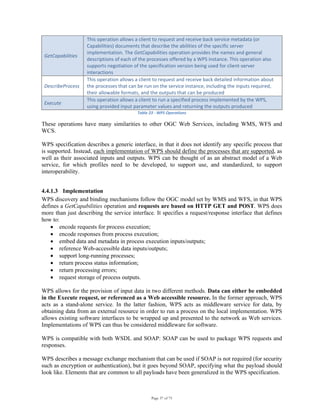
4.3.3 Other Relevant OGC Services .....................................................................................35
4.4 Inspire Invoke Services..........................................................................................................36
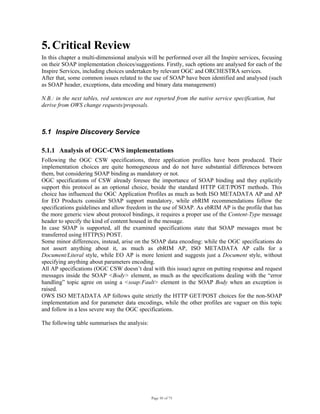
4.4.1 OGC WPS - Web Processing Service..........................................................................36
4.4.2 Orchestra Processing Service.......................................................................................39
4.5 Inspire Download Service......................................................................................................40
4.5.1 OGC WCS - Web Coverage Service ...........................................................................40
4.5.2 OGC WFS - Web Feature Service...............................................................................44
4.5.3 Orchestra Feature Access Service................................................................................48
5. Critical Review ............................................................................................................................50
5.1 Inspire Discovery Service......................................................................................................50
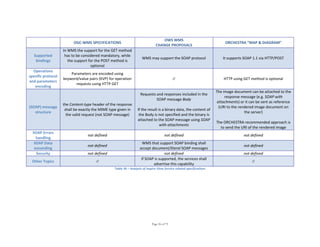
5.1.1 Analysis of OGC-CWS implementations....................................................................50
5.1.2 ORCHESTRA Catalogue Service................................................................................53
5.1.3 INSPIRE Proposed Implementation ............................................................................53
5.2 Inspire View Service..............................................................................................................54
5.3 Inspire Transformation Services............................................................................................57
5.4 Inspire Invoke Service ...........................................................................................................59
5.5 Inspire Download Service......................................................................................................60
5.6 Common Issues......................................................................................................................61
5.6.1 SOAP Header...............................................................................................................62
5.6.2 Exception report SOAP encoding................................................................................62
5.6.3 Protocol Binding..........................................................................................................62
5.6.4 Data Encoding..............................................................................................................63
5.6.5 Binary Data ..................................................................................................................66
6. Conclusions..................................................................................................................................68
Annex A – Terms, Definitions and Abbreviations ............................................................................69
7. Annex B – Inspire IR Reference..................................................................................................70
8. Annex C – Bibliography ..............................................................................................................71
Page 5 of 75
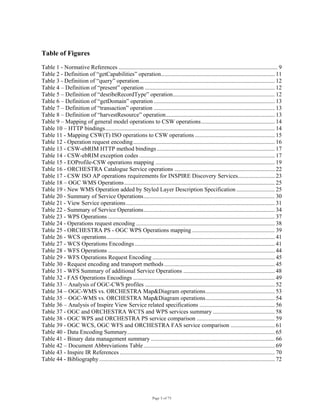
Table of Figures
Table 1 - Normative References ............................................................................................................ 9
Table 2 - Definition of “getCapabilities” operation............................................................................. 11
Table 3 - Definition of “query” operation............................................................................................ 12
Table 4 – Definition of “present” operation ........................................................................................ 12
Table 5 – Definition of “desribeRecordType” operation..................................................................... 12
Table 6 – Definition of “getDomain” operation .................................................................................. 13
Table 7 – Definition of “transaction” operation .................................................................................. 13
Table 8 – Definition of “harvestResource” operation.......................................................................... 13
Table 9 – Mapping of general model operations to CSW operations.................................................. 14
Table 10 – HTTP bindings................................................................................................................... 14
Table 11 - Mapping CSW(T) ISO operations to CSW operations ...................................................... 15
Table 12 - Operation request encoding................................................................................................ 16
Table 13 - CSW-ebRIM HTTP method bindings................................................................................ 17
Table 14 - CSW-ebRIM exception codes ............................................................................................ 17
Table 15 - EOProfile-CSW operations mapping ................................................................................. 19
Table 16 - ORCHESTRA Catalogue Service operations .................................................................... 22
Table 17 - CSW ISO AP operations requirements for INSPIRE Discovery Services......................... 23
Table 18 – OGC WMS Operations...................................................................................................... 25
Table 19 - New WMS Operation added by Styled Layer Description Specification .......................... 25
Table 20 - Summary of Service Operations......................................................................................... 30
Table 21 - View Service operations..................................................................................................... 31
Table 22 - Summary of Service Operations......................................................................................... 34
Table 23 - WPS Operations ................................................................................................................. 37
Table 24 - Operations request encoding .............................................................................................. 38
Table 25 - ORCHESTRA PS - OGC WPS Operations mapping ........................................................ 39
Table 26 - WCS operations.................................................................................................................. 41
Table 27 - WCS Operations Encodings............................................................................................... 41
Table 28 - WFS Operations ................................................................................................................. 44
Table 29 - WFS Operations Request Encoding ................................................................................... 45
Table 30 - Request encoding and transport methods........................................................................... 45
Table 31 - WFS Summary of additional Service Operations .............................................................. 48
Table 32 - FAS Operations Encodings ................................................................................................ 49
Table 33 – Analysis of OGC-CWS profiles ........................................................................................ 52
Table 34 – OGC-WMS vs. ORCHESTRA Map&Diagram operations............................................... 53
Table 35 – OGC-WMS vs. ORCHESTRA Map&Diagram operations............................................... 54
Table 36 – Analysis of Inspire View Service related specifications ................................................... 56
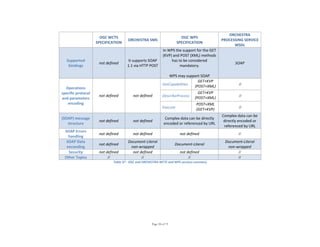
Table 37 - OGC and ORCHESTRA WCTS and WPS services summary .......................................... 58
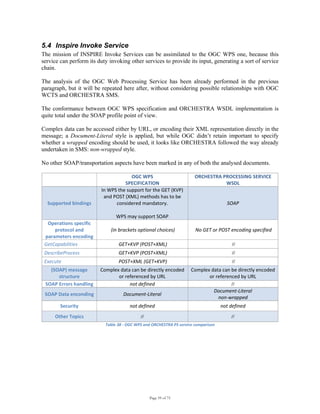
Table 38 - OGC WPS and ORCHESTRA PS service comparison ..................................................... 59
Table 39 - OGC WCS, OGC WFS and ORCHESTRA FAS service comparison .............................. 61
Table 40 - Data Encoding Summary.................................................................................................... 65
Table 41 - Binary data management summary .................................................................................... 66
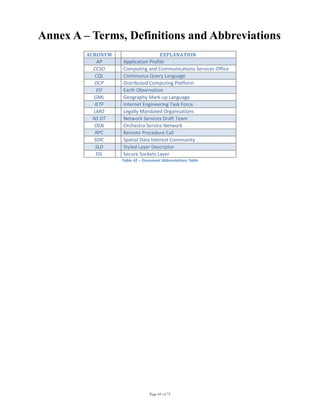
Table 42 – Document Abbreviations Table......................................................................................... 69
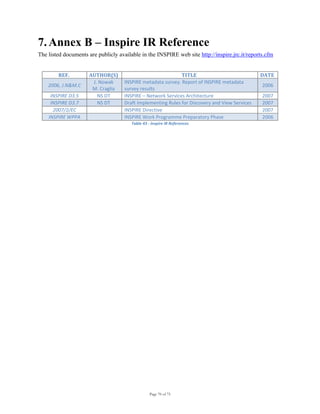
Table 43 - Inspire IR References ......................................................................................................... 70
Table 44 - Bibliography....................................................................................................................... 72
Page 6 of 75
1. Introduction
The general situation on spatial information in Europe is of fragmentation of datasets and sources,
gaps in availability, lack of harmonization between datasets at different geographical scales and
duplication of information collection. These problems make it difficult to identify, access and use
data that are available.
Fortunately, awareness is growing at both national and EU level about the need for quality geo-
referenced information to support understanding of the complexity and interactions between human
activities and environmental pressures and impacts. The INSPIRE directive proposal [2007/2/EC] is
therefore timely and relevant, but also a major challenge, given the general situation outlined above
and the many stakeholder interests to be addressed.
INSPIRE is complementary to related policy initiatives, such as the Commission proposal for a
Directive on the re-use and commercial exploitation of Public Sector Information. [2003/98/EC]
INSPIRE is ambitious: the initiative intends to trigger the creation of a European spatial information
infrastructure that delivers to the users integrated spatial information services. These services should
allow the users to identify and access spatial or geographical information from a wide range of
sources, from the local level to the global level, in an interoperable way for a variety of uses. The
target users of INSPIRE include policy-makers, planners and managers at European, national and
local level and the citizens and their organizations.
INSPIRE will require the Member States to implement various measures. Some of these measures
will be directly transposed by the Member States, while others require more details which will be
formulated in so called ‘Implementing Rules’. Hence, in parallel to the Co-Decision process [Co-
Dec], the Commission has initiated actions to prepare draft Implementing Rules with the set-up of
Drafting Teams mainly composed of European Union experts nominated by Spatial Data Interest
Communities and Legally Mandated organizations. [INSPIRE WPPP]
Interoperability will be reached progressively as metadata, data and services compliant with the
INSPIRE Implementing Rules are becoming available and will require the active involvement of all
actors identified in INSPIRE, namely European Union Member States relevant Institutions and the
Commission.
According to W3C Web Services definition (http://www.w3c.org/TR/ws‐arch/), a Web service is a
software system designed to support interoperable machine-to-machine interaction over a network. It
has an interface described in a machine-processable format (specifically WSDL). Other systems
interact with the Web service in a manner prescribed by its description using SOAP messages,
typically conveyed using HTTP with an XML serialization in conjunction with other Web-related
standards.
As the INSPIRE directive advises to utilize existing standards, OGC service bindings are taken as a
guidance. Existing OGC Web Services (OWS) support a mix of protocols and technology bindings.
These are Key-Value-Pairs send via HTTP GET, XML send via HTTP POST, SOAP via HTTP
POST and combinations. In addition, the World Wide Web Consortium suggests the usage of SOAP
as a messaging protocol for web services. INSPIRE services should utilize one standard technology
binding for all service types. In order to streamline integration and implementation as well as getting
a maximum benefit from the offered services, a mix of technologies is to be avoided. Taking all
requirements, opportunities and risks into account, the default communication-protocol and binding
technology for INSPIRE services should be SOAP (using document/literal encoding style).
Page 7 of 75
According to the “SOAP Experiment report” [OGC 03-014], Web services offer a new platform for
building loosely coupled, distributed systems. OGC has produced a set of discussion papers to
discover the feasibility and usefulness of enabling SOAP communication in OGC services.
The premise of the SOAP experiment is the belief that porting OWS services to Web Services will
offer several key benefits, including:
• distribution: it will be easier to distribute geospatial data and applications across platforms,
operating systems, computer languages, etc;
• integration: it will be easier for application developers to integrate geospatial functionality
and data into their custom applications;
• infrastructure: the GIS industry could take advantage of the huge amount of infrastructure
that is being built to enable the Web Services architecture – including development tools,
application servers, messaging protocols, security infrastructure, workflow definitions, etc.
 
On the other hand, “INSPIRE – Network Services Architecture” [INSPIRE D3.5], reports that
existing OGC Web Services (OWS) typically support HTTP GET and/or HTTP POST as messaging
protocol and they publish the GetCapabilities operation to provide service Metadata. The World
Wide Consortium suggests the usage of SOAP (currently version 1.2) as a messaging framework and
WSDL (currently version 2.0) to describe service metadata.
A number of arguments can be listed in favour of SOAP/WSDL approach for the INSPIRE network
services:
a) SOAP Web services are becoming the standard information technology and thus support
more sustainable implementing rules;
b) SOAP Web service ensure smooth and complete integration in development environments;
c) SOAP Web services yield a direct and full integration with other web service environments;
d) SOAP Web services have the possibility to support geo rights management services by using
SOAP envelope data.
However, since the OGC interface specifications support HTTP GET or HTTP POST, there are only
a few attempts to use SOAP/WSDL for geo-information services. Recent experiments (e.g. within
OGC, but also within EU funded Projects as ORCHESTRA) provided interface specification for
SOAP/WSDL based geo-information services but also indicated some issues in realising operational
services based on SOAP/WSDL, e.g. a lack of support by current development tools.
Page 8 of 75
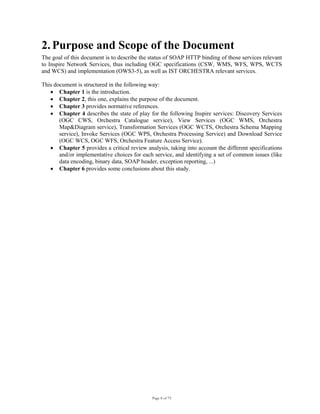
2. Purpose and Scope of the Document
The goal of this document is to describe the status of SOAP HTTP binding of those services relevant
to Inspire Network Services, thus including OGC specifications (CSW, WMS, WFS, WPS, WCTS
and WCS) and implementation (OWS3-5), as well as IST ORCHESTRA relevant services.
This document is structured in the following way:
• Chapter 1 is the introduction.
• Chapter 2, this one, explains the purpose of the document.
• Chapter 3 provides normative references.
• Chapter 4 describes the state of play for the following Inspire services: Discovery Services
(OGC CWS, Orchestra Catalogue service), View Services (OGC WMS, Orchestra
Map&Diagram service), Transformation Services (OGC WCTS, Orchestra Schema Mapping
service), Invoke Services (OGC WPS, Orchestra Processing Service) and Download Service
(OGC WCS, OGC WFS, Orchestra Feature Access Service).
• Chapter 5 provides a critical review analysis, taking into account the different specifications
and/or implementative choices for each service, and identifying a set of common issues (like
data encoding, binary data, SOAP header, exception reporting, ...)
• Chapter 6 provides some conclusions about this study.
Page 9 of 75
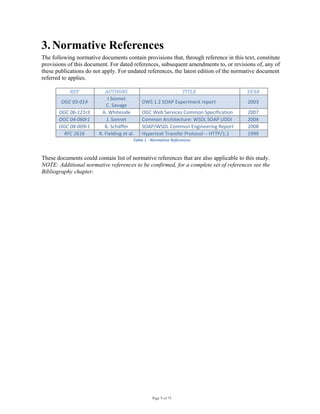
3. Normative References
The following normative documents contain provisions that, through reference in this text, constitute
provisions of this document. For dated references, subsequent amendments to, or revisions of, any of
these publications do not apply. For undated references, the latest edition of the normative document
referred to applies.
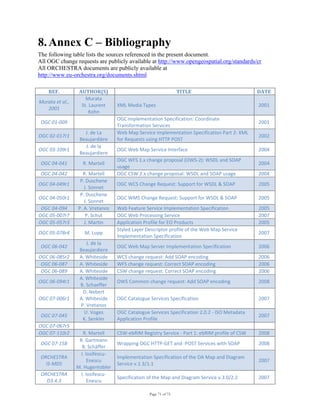
REF  AUTHORS  TITLE  YEAR 
OGC 03‐014 
J Sonnet 
C. Savage 
OWS 1.2 SOAP Experiment report  2003 
OGC 06‐121r3  A. Whiteside  OGC Web Services Common Specification  2007 
OGC 04‐060r1  J. Sonnet  Common Architecture: WSDL SOAP UDDI  2004 
OGC 08‐009r1  B. Schäffer  SOAP/WSDL Common Engineering Report  2008 
RFC 2616  R. Fielding et al.  Hypertext Transfer Protocol ‐‐ HTTP/1.1  1999 
Table 1 ‐ Normative References 
These documents could contain list of normative references that are also applicable to this study.
NOTE: Additional normative references to be confirmed, for a complete set of references see the
Bibliography chapter.
Page 10 of 75
4. State of Play
4.1 Inspire Discovery Service
The INSPIRE Directive [2007/2/EC] asks Member States to “establish and operate a network of
services” for the discovery of spatial data sets and services “for which metadata have been created”.
Discovery services should “make it possible to search for spatial data sets and services on the basis of
the content of the corresponding metadata and to display the content of the metadata. […] Those
services shall take into account relevant user requirements and shall be easy to use, available to the
public and accessible via the Internet or any other appropriate means of telecommunication.”
In INSPIRE these services are referred to as Discovery Services.
Summarizing, the goal of discovery service is to support discovery, evaluation and use of spatial
data and services through their metadata properties.
Metadata is the information and documentation, which makes these resources understandable and
sharable for users over time.
The network of services should also include the technical possibility to enable public authorities to
make their spatial datasets and services available. The INSPIRE Directive specifies that Member
States shall “ensure that public authorities are given the technical possibility to link their spatial
datasets and services to the network”. This ‘linking’ service is also offered in the context of a
discovery service.
For the purpose of the search services, as a minimum, the following combination of search criteria
shall be implemented:
• “keywords;
• classification of spatial data and services;
• spatial data quality and accuracy;
• degree of conformity with the implementing rules provided […];
• geographical location;
• conditions applying to the access to and use of spatial datasets and services;
• the public authorities responsible for the establishment, management, maintenance (and)
• distribution of spatial datasets and services.”
The INSPIRE survey of Novak and Craglia [2006, J.N&M.C] shows the deployment of Catalogue
Service standards by the INSPIRE SDICs and LMOs. OGC standards are applied to 39% of all
metadata holdings.
The OGC Catalogue Service for the Web specification is the most widely adopted standard for the
INSPIRE SDICs and LMOs: it offers the functionality needed to fulfil the INSPIRE use cases for
discovery.
Within the context of the OGC-CSW specifications, three relevant proposed implementations of
the Catalogue Service for the Web are taken into account:
1. Metadata Application Profile (OWS)
2. ebRIM Application Profile (OWS)
3. a draft of Application Profile for Earth Observation (OGC in collaboration with ESA).
Page 11 of 75
Another relevant approach related to a Discovery Service (specifications and implementation) is
represented by the Orchestra Catalogue Service.
Finally, it is necessary to take into account the INSPIRE draft proposed implementation.
4.1.1 OGC Catalogue Service (OGC CSW)
4.1.1.1 Overview
Catalogue Services support the ability to publish, access and search digital catalogues of metadata for
geospatial data, services, and related information resources. Metadata in catalogues represent resource
characteristics that can be queried and presented for evaluation and further processing, by both humans
and software. [OGC 07-006r1]
Catalogue services are required to support the discovery and binding to registered information
resources within an information community.
4.1.1.2 Specification
Current “OGC Catalogue Service for the Web” specification version is 2.0.2 and can be found at:
http://portal.opengeospatial.org/files/?artifact_id=20555.
OGC defines a General Catalogue Interface Model [OGC 07-006r1, section 7] providing a set of
abstract service interfaces that support the discovery, access, maintenance and organization of catalogues
of geospatial information and related resources. The interfaces specified are intended to allow users or
application software to find information that exists in multiple distributed computing environments,
including the World Wide Web (WWW) environment.
Amongst all the defined operations, seven are used as basis for further specifications of the CSW:
1) “getCapabilities” operation:
Definition   It allows clients to retrieve service metadata describing Catalogue Service instance  
Receives  
Optional identifier(s) of requested parts of the complete service metadata 
document  
Returns  
Service metadata document for Catalogue Service instance. Some document 
contents depend on the set of classes that are associated with the Catalogue 
Service class, as defined by the specific protocol binding, and on other details of 
that protocol binding. Other document contents depend on the types of data 
defined by the specific application profile, and on other details of that profile.  
Exceptions   Invalid Parameter Value, Missing Parameter Value  
Pre‐conditions   None  
Post‐conditions  
Service metadata document returned to requesting client, either complete or 
including selected parts  
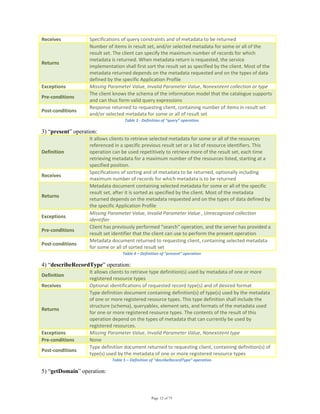
Table 2 ‐ Definition of “getCapabilities” operation 
2) “query” operation
Definition  
It allows clients to ask a catalogue to execute a query that searches the catalogued 
metadata and produces a result set containing (zero or more) references to all the 
registered resources that satisfy the query. The server may maintain the result set 
for subsequent retrieval requests 
Page 12 of 75
Receives   Specifications of query constraints and of metadata to be returned  
Returns  
Number of items in result set, and/or selected metadata for some or all of the 
result set. The client can specify the maximum number of records for which 
metadata is returned. When metadata return is requested, the service 
implementation shall first sort the result set as specified by the client. Most of the 
metadata returned depends on the metadata requested and on the types of data 
defined by the specific Application Profile 
Exceptions   Missing Parameter Value, Invalid Parameter Value, Nonexistent collection or type 
Pre‐conditions  
The client knows the schema of the information model that the catalogue supports 
and can thus form valid query expressions  
Post‐conditions  
Response returned to requesting client, containing number of items in result set 
and/or selected metadata for some or all of result set 
Table 3 ‐ Definition of “query” operation 
3) “present” operation:
Definition  
It allows clients to retrieve selected metadata for some or all of the resources 
referenced in a specific previous result set or a list of resource identifiers. This 
operation can be used repetitively to retrieve more of the result set, each time 
retrieving metadata for a maximum number of the resources listed, starting at a 
specified position. 
Receives  
Specifications of sorting and of metadata to be returned, optionally including 
maximum number of records for which metadata is to be returned 
Returns  
Metadata document containing selected metadata for some or all of the specific 
result set, after it is sorted as specified by the client. Most of the metadata 
returned depends on the metadata requested and on the types of data defined by 
the specific Application Profile 
Exceptions  
Missing Parameter Value, Invalid Parameter Value , Unrecognized collection 
identifier 
Pre‐conditions  
Client has previously performed “search” operation, and the server has provided a 
result set identifier that the client can use to perform the present operation 
Post‐conditions  
Metadata document returned to requesting client, containing selected metadata 
for some or all of sorted result set 
Table 4 – Definition of “present” operation 
4) “describeRecordType” operation:
Definition  
It allows clients to retrieve type definition(s) used by metadata of one or more 
registered resource types 
Receives   Optional identifications of requested record type(s) and of desired format 
Returns  
Type definition document containing definition(s) of type(s) used by the metadata 
of one or more registered resource types. This type definition shall include the 
structure (schema), queryables, element sets, and formats of the metadata used 
for one or more registered resource types. The contents of the result of this 
operation depend on the types of metadata that can currently be used by 
registered resources. 
Exceptions   Missing Parameter Value, Invalid Parameter Value, Nonexistent type 
Pre‐conditions   None 
Post‐conditions  
Type definition document returned to requesting client, containing definition(s) of 
type(s) used by the metadata of one or more registered resource types 
Table 5 – Definition of “desribeRecordType” operation 
5) “getDomain” operation:
Page 13 of 75
Definition  
It allows clients to retrieve the domain (allowed values) of a metadata property or 
request parameter at the time the request is invoked. The returned information 
may be static domain information, but may also be dynamic in that the allowed 
values are determined at runtime. The operation does a best attempt at returning 
information about a metadata property or request parameter 
Receives   Names of one or more requested metadata properties or request parameters. 
Returns  
Descriptions of domains of one or more requested metadata properties or request 
parameters 
Exceptions   Missing Parameter Value, Invalid Parameter Name 
Pre‐conditions   None 
Post‐conditions  
Descriptions of domains returned to requesting client, containing the domain 
descriptions for all the identified metadata properties or request parameters 
Table 6 – Definition of “getDomain” operation 
6) ”transaction” operation
Definition  
It allows clients to request a specified set of “insert”, “update”, and “delete” 
actions on the content managed by a Catalogue Service instance. 
Receives  
Specification of set of “insert”, “update”, and “delete” actions, plus an optional 
identifier. At least one action shall be included 
Returns  
A summary of the transaction results that identifies newly created entries when 
applicable. Most contents of the result depend on the types of data defined by the 
specific protocol binding and Application Profile. 
Exceptions   Missing Parameter Value, Invalid Parameter Value, Transaction Failed 
Pre‐conditions   User is authorized to modify catalogue contents 
Post‐conditions  
Catalogue entries are inserted, updated, and/or deleted as requested, and the 
integrity and consistency of catalogue contents are preserved 
Table 7 – Definition of “transaction” operation 
7) “harvestResource” operation
Definition  
It allows a user to request that a catalogue service attempt to retrieve a resource 
from a specified location, and to optionally create one or more entries for that 
resource. A harvest attempt may occur periodically if an interval is specified 
Receives   A request message containing the source of the resource to be harvested 
Returns  
An acknowledgement that a harvestRequest has been received and validated (if a 
responseHandler is specified) or a summary of the harvest results that identifies 
newly harvested records (if a responseHandler is not specified). Most contents of 
the result depend on the types of data defined by the specific protocol binding and 
Application Profile. 
Exceptions   InvalidRequest, ResourceNotFound 
Pre‐conditions  
The user is permitted to modify catalogue contents, unless the scope of the harvest 
does not include an insert or update transaction 
Post‐conditions  
One or more records are harvested from a remote system and optionally new 
catalogue entries are created or existing entries are updated, and the integrity and 
consistency of the catalogue contents are preserved 
Table 8 – Definition of “harvestResource” operation 
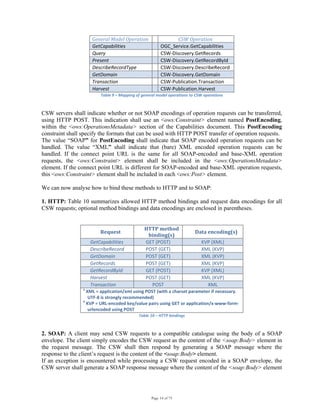
Such operations are then mapped to the Catalogue Service for the Web (CSW) operations [OGC 07-
006r1, section 10.4], as shown in Table 9 (the table does not list the general model operations that are
not mapped to CSW operations)
Page 14 of 75
General Model Operation    CSW Operation 
GetCapabilities     OGC_Service.GetCapabilities  
Query    CSW‐Discovery.GetRecords  
Present    CSW‐Discovery.GetRecordById  
DescribeRecordType    CSW‐Discovery.DescribeRecord  
GetDomain    CSW‐Discovery.GetDomain  
Transaction    CSW‐Publication.Transaction  
Harvest    CSW‐Publication.Harvest  
Table 9 – Mapping of general model operations to CSW operations 
CSW servers shall indicate whether or not SOAP encodings of operation requests can be transferred,
using HTTP POST. This indication shall use an <ows:Constraint> element named PostEncoding,
within the <ows:OperationsMetadata> section of the Capabilities document. This PostEncoding
constraint shall specify the formats that can be used with HTTP POST transfer of operation requests.
The value “SOAP” for PostEncoding shall indicate that SOAP encoded operation requests can be
handled. The value “XML” shall indicate that (bare) XML encoded operation requests can be
handled. If the connect point URL is the same for all SOAP-encoded and base-XML operation
requests, the <ows:Constraint> element shall be included in the <ows:OperationsMetadata>
element. If the connect point URL is different for SOAP-encoded and base-XML operation requests,
this <ows:Constraint> element shall be included in each <ows:Post> element.
We can now analyse how to bind these methods to HTTP and to SOAP:
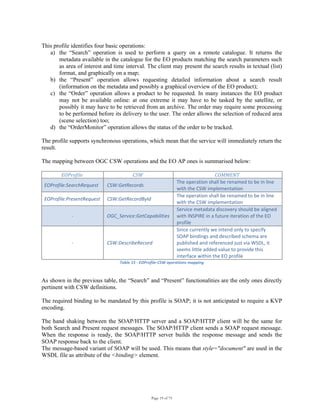
1. HTTP: Table 10 summarizes allowed HTTP method bindings and request data encodings for all
CSW requests; optional method bindings and data encodings are enclosed in parentheses.
Request 
HTTP method 
binding(s) 
Data encoding(s) 
GetCapabilities   GET (POST)  KVP (XML) 
DescribeRecord  POST (GET)  XML (KVP) 
GetDomain  POST (GET)  XML (KVP) 
GetRecords  POST (GET)  XML (KVP) 
GetRecordById  GET (POST)  KVP (XML) 
Harvest  POST (GET)  XML (KVP) 
Transaction  POST  XML 
a
 XML = application/xml using POST (with a charset parameter if necessary. 
UTF‐8 is strongly recommended)  
b
 KVP = URL‐encoded key/value pairs using GET or application/x‐www‐form‐
urlencoded using POST 
Table 10 – HTTP bindings 
2. SOAP: A client may send CSW requests to a compatible catalogue using the body of a SOAP
envelope. The client simply encodes the CSW request as the content of the <soap:Body> element in
the request message. The CSW shall then respond by generating a SOAP message where the
response to the client’s request is the content of the <soap:Body> element.
If an exception is encountered while processing a CSW request encoded in a SOAP envelope, the
CSW server shall generate a SOAP response message where the content of the <soap:Body> element
Page 15 of 75
is a <soap:Fault> element. The following skeleton XML fragment shall be used when generating the
<soap:Body> element in the event that the CSW server encounters an exception:
<soap:Body> 
    <soap:Fault> 
        <soap:Code> 
            <soap:Value>soap:Server</soap:Value> 
        </soap:Code> 
        <soap:Reason> 
            <soap:Text>A server exception was encountered.</soap:Text> 
        </soap:Reason> 
        <soap:Detail> 
            <ows:ExceptionReport>…</ows:ExceptionReport> 
        </soap:Detail> 
    </soap:Fault> 
</soap:Body>  
The <soap:Value> element in the <soap:Code> element shall have the content “soap:Server”
indicating that this is a server exception. The <soap:Text> element in the <soap:Reason> element
shall have the content “Server exception was encountered.”. This fixed string is used since the details
of the exception will be specified in the <soap:Detail> element using an <ows:ExceptionReport>
element as defined in document [OGC 06-121r3].
The <soap:Detail> element shall contain an <ows:ExceptionReport> element detailing the specific
exception that the server encountered.
4.1.1.3 OWS ISO Metadata Application Profile
Referring to [OGC 07-045], we analyse the ISO Metadata Application Profile.
Table 11 shows how the operations of this profile (CSW(T) ISO) are mapped to the operations
specified by the CSW 2.0.2 specification. This is a full mapping in that all of the CSW(T) ISO
operations have a corresponding CSW operation.
CSW OPERATION  CSW(T) ISO OPERATION 
OGC_Service.GetCapabilities   OGC_Service.GetCapabilities 
CSW Discovery.DescribeRecord  CSW Discovery.DescribeRecord 
CSW Discovery.GetDomain  CSW Discovery.GetDomain 
CSW Discovery.GetRecords  CSW Discovery.GetRecords 
CSW Discovery.GetRecordById  CSW Discovery.GetRecordById 
CSW Publication.Harvest  CSWT Manager.Harvest 
CSW Publication.Transaction  CSWT Manager.Transaction 
Table 11 ‐ Mapping CSW(T) ISO operations to CSW operations
Apart from the GetCapabilities operation, all the other ones must support the embedding of requests
and responses in SOAP messages. In this case only SOAP messaging (via HTTP/POST) with
document/literal style has to be used. Messages must conform to SOAP 1.2
(http://www.w3.org/TR/SOAP/). The message payload will be in the body of the SOAP envelope.
Most operations support the encoding of the request messages as Keyword-Value Pairs (KVP) within
Page 16 of 75
a request URI; all operations support the usage of a XML entity-body and responses are XML-
encoded.
The HTTP encoding of catalogue operation requests shall use HTTP GET with Keyword-Value Pairs
(KVP) encoding and HTTP POST with XML encoding as specified in Section 11 of [OGC 06-121r3].
Note that the parameter names in all KVP encodings must be handled in a case insensitive manner
while parameter values shall be handled in a case sensitive manner.
Table 12 summarizes the CSW(T) ISO operations and their encoding methods that are applied in this
profile. The mandatory method bindings and data encodings are printed in bold.
CSW(T) ISO 
OPERATION 
REQUEST ENCODING 
GetCapabilities  XML(POST+SOAP) and KVP (GET) 
DescribeRecord  XML (POST+SOAP) and KVP (GET) 
GetDomain  XML (POST+SOAP) and KVP(GET) 
GetRecords  XML (POST+SOAP) and KVP(GET) 
GetRecordById  XML (POST+SOAP) and KVP(GET) 
Harvest  XML (POST+SOAP) and KVP(POST) 
Transaction  XML (POST+SOAP) 
Table 12 ‐ Operation request encoding 
There is no KVP encoding for transaction operation request, because there is no convenient way of
encoding the transaction payloads using keyword-value pairs.
Technical issues:
• HTTP: The base communication protocol is HTTP 1.1 as specified by IETF RFC 2616
(http://www.ietf.org/rfc/rfc2616). All bindings of operations (see Table 5) MUST be
consistent with HTTP/1.1 semantics. Alternative bindings may be specified for a specific
service instance. Any HTTP/1.1 response message containing an entity-body must include a
Content-Type header field defining the media type of that body ([RFC 2616], 7.2.1). This
includes the charset parameter (“application/xml; charset=utf-8”).
• SOAP: Only SOAP messaging (via HTTP/POST) with document/literal style has to be used.
Messages must be compliant with SOAP 1.2 (http://www.w3.org/TR/SOAP/). The message
payload will be in the body of the SOAP envelope.
Security considerations:
• Security issues are part of the implementation specification of a catalogue service. It is
recommended that HTTP Basic Authentication is used to prevent access to the URLs of the
transaction interface, unless the requestor can provide user/password credentials. This basic
authentication should be used in conjunction with HTTPS as part of a security solution.
4.1.1.4 OWS ebRIM Application profile of CSW
OWS followed also another way to implement CSW, trying to join the CSW interfaces with the OASIS
ebXML registry information model (ebRIM 3.0), to provide a general and flexible Web-based registry
service that enables users, human or software agents to locate, access and make use of resources in an
open distributed system. [OGC 07-110r2]
Use of HTTP methods: the HTTP/1.1 specification [RFC 2616] defines eight methods for
manipulating and retrieving representations of resources. Only the GET and POST methods are
Page 17 of 75
supported in this application profile. Service requests are bound to HTTP methods as indicated in
Table 13:
CSW­ebRIM 
OPERATION 
HTTP METHOD 
BINDING(S) 
GetCapabilities   GET and POST 
GetRecords   POST and GET 
GetRecordById   GET and POST 
DescribeRecord   GET and POST 
GetDomain   GET and POST 
GetRepositoryItem   GET 
Transaction   POST 
Harvest  POST 
Table 13 ‐ CSW‐ebRIM HTTP method bindings 
Proper use of the Content-Type header is required by this profile; all request and response messages
shall correctly indicate the content type of the message (if not empty). The following message
content types shall be recognized by all conforming implementations:
a) application/xml – the body contains an XML request or response entity;
b) application/x-www-form-urlencoded – the body contains a KVP-style encoding of request
parameters;
c) application/soap+xml – the body contains a SOAP 1.2 envelope;
d) multipart/related – the message is a compound object containing related parts structured in
accord with RFC 2387 [RFC 2378].
Exception codes: The OWS Common specification defines a number of general exception codes that
shall be supported by all implementations (OGC 05-008, cl. 8.3). This profile defines additional
exception codes and also requires the proper use of HTTP status codes, as shown in the following
table:
CODE  REASON  STATUS CODE 
Wrs:InvalidRequest  
The  request  message  is  invalid  for 
some reason.  
400 
Wrs:NotImplemented  
The request is not supported by the 
service.  
500 
Wrs:NotFound  
The  requested  resource  does  not 
exist or could not be found.  
404 
Wrs:NotSupported  
A  service  option  or  media  type  is 
unsupported.  
415 
Wrs:TransactionFailed  
The requested transaction could not 
be completed.  
500 
Table 14 ‐ CSW‐ebRIM exception codes 
Use of the SOAP messaging framework - HTTP binding: this implementation may support the
W3C SOAP 1.2 messaging framework. If so, this shall be advertised in the capabilities document by
including the value application/soap+xml for the operation-specific Content-Type constraint. A
service that supports SOAP shall conform to the SOAP 1.2 HTTP binding (SOAP Part 2); such a
binding shall also be declared in a WSDL service description if one is available.
The HTTP binding employs two message exchange patterns: “Request-Response” and “SOAP
Response”. In general, a request bound to the GET method is restricted to the “SOAP response”
Page 18 of 75
pattern; POST requests are restricted to the “Request-Response” pattern. A conforming
implementation shall support both patterns. If a request message does not contain a SOAP envelope,
as in the GET method, but a SOAP response is desired, the Accept request header shall be used to
indicate this preference. A normal response is produced if the service cannot function as a SOAP
node.
EXAMPLE Accept: application/soap+xml; application/xml;
Request and response that contain a SOAP message construct shall satisfy all requirements in section
5 in the W3C SOAP 1.2 specification. The SOAP body element shall contain the appropriate XML
request or response entity. This specification imposes no constraints on the content of the optional
SOAP header element; it may be ignored if present. The action parameter in the Content-Type
request header field value, if present, may be used to optimize message dispatching and routing [RFC
3902]. The value should include the following service type identifier:
urn:ogc:serviceType:WebRegistryService:1.0.
Fault handling: In the event that an exception report is produced for any reason, a single SOAP
Fault element information item shall be included as the only child element information item of the
SOAP body element (see SOAP1.2, sec. 5.4). The elements of the SOAP Fault are constructed as
follows:
a) env:Code/env:Value = “env:Sender” or “env:Receiver”, depending on the source of the error
and the HTTP status code (i.e., 4xx, 5xx);
b) env:Code/env:Subcode/env:Value = value of ows:Exception/@exceptionCode (an OWS
exception code value shall be set above with “ows:”);
c) env:Reason/env:Text = ows:Exception/ows:ExceptionText, where @xml:lang =
ows:ExceptionReport/@language;
d) env:Detail contains the original ows:ExceptionReport element
Security considerations - authentication:
Authentication is the process of verifying the identity of a user. It is strongly recommended that
implementations employ an authentication mechanism to verify the identity of a user that seeks to
modify registry content. The standard HTTP authentication schemes documented in RFC 2617 [RFC
2617] are widely employed and are suitable for most applications:
a) basic with TLS (or SSL v3) to establish a secure communication channel;
b) digest.
In the event that a request requires valid authentication credentials and these are either missing or invalid,
the response status code shall be 401 (Unauthorized).
4.1.1.5 OGC Application Profile for EO Products
Amongst the possible implementations of the Catalogue Service for the Web, OGC proposed a
solution to find and order data products from catalogues of Earth Observation (EO) products. The
work, consultable at [OGC 05-057r3], describes a first set of SOAP/HTTP protocol binding that have
been inspired from on the catalogue abstract model.
Message-based SOAP (Simple Object Access Protocol) over HTTP or HTTPS for secure
communication is used as protocol between the client application and the catalogue service. SOAP is
firewall-friendly and platform independent; it is thus well suited to integrate services in a
heterogeneous environment.
Page 19 of 75
This profile identifies four basic operations:
a) the “Search” operation is used to perform a query on a remote catalogue. It returns the
metadata available in the catalogue for the EO products matching the search parameters such
as area of interest and time interval. The client may present the search results in textual (list)
format, and graphically on a map;
b) the “Present” operation allows requesting detailed information about a search result
(information on the metadata and possibly a graphical overview of the EO product);
c) the “Order” operation allows a product to be requested. In many instances the EO product
may not be available online: at one extreme it may have to be tasked by the satellite, or
possibly it may have to be retrieved from an archive. The order may require some processing
to be performed before its delivery to the user. The order allows the selection of reduced area
(scene selection) too;
d) the “OrderMonitor” operation allows the status of the order to be tracked.
The profile supports synchronous operations, which mean that the service will immediately return the
result.
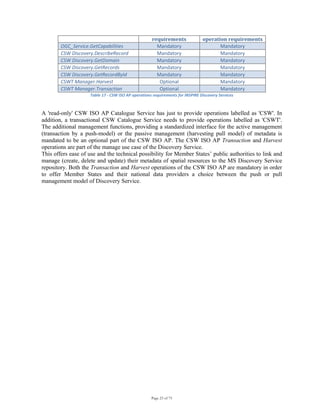
The mapping between OGC CSW operations and the EO AP ones is summarised below:
EOProfile  CSW  COMMENT 
EOProfile:SearchRequest  CSW:GetRecords 
The operation shall be renamed to be in line 
with the CSW implementation 
EOProfile:PresentRequest  CSW:GetRecordById 
The operation shall be renamed to be in line 
with the CSW implementation 
‐  OGC_Service:GetCapabilities 
Service metadata discovery should be aligned 
with INSPIRE in a future iteration of the EO 
profile 
‐  CSW:DescribeRecord 
Since currently we intend only to specify 
SOAP bindings and described schema are 
published and referenced just via WSDL, it 
seems little added value to provide this 
interface within the EO profile 
Table 15 ‐ EOProfile‐CSW operations mapping 
As shown in the previous table, the “Search” and “Present” functionalities are the only ones directly
pertinent with CSW definitions.
The required binding to be mandated by this profile is SOAP; it is not anticipated to require a KVP
encoding.
The hand shaking between the SOAP/HTTP server and a SOAP/HTTP client will be the same for
both Search and Present request messages. The SOAP/HTTP client sends a SOAP request message.
When the response is ready, the SOAP/HTTP server builds the response message and sends the
SOAP response back to the client.
The message-based variant of SOAP will be used. This means that style="document" are used in the
WSDL file as attribute of the <binding> element.
Page 20 of 75
4.1.1.6 Change proposals/requests
A change request about SOAP and HTTP binding in CSW has been submitted providing the
following guidelines [OGC 06-089]:
a) a client may send CSW requests to a compatible catalogue using the body of a SOAP
envelope. The client simply encodes the CSW request as the content of the <soap:Body>
element in the request message. The CSW may then respond by generating a SOAP message
where the response to the client’s request is the content of the <soap:Body> element.
b) In case an exception is encountered while processing a CSW operation request, encoded in a
SOAP envelope, the CSW server must generate a SOAP response message where the content
of the <soap:Body> element is a <soap:Fault> element. The following skeleton XML
fragment must be used when generating the <soap:Body> element in the event that the CSW
server encounters an exception:
<soap:Body> 
    <soap:Fault> 
        <soap:Code> 
            <soap:Value>soap:Server</soap:Value> 
        </soap:Code> 
        <soap:Reason> 
            <soap:Text>A server exception was encountered.</soap:Text> 
        </soap:Reason> 
        <soap:Detail> 
            <ows:ExceptionReport> 
                ... 
            </ows:ExceptionReport> 
        </soap:Detail>xds 
    </soap:Fault> 
</soap:Body> 
The <soap:Value> element in the <soap:Code> element shall have the content soap:Server
indicating that this is a server exception. The <soap:Text> element in the <soap:Reason>
element shall have the content “Server exception was encountered.”. This fixed string is used
since the details of the exception are specified in the <soap:Detail> element using an
<ows:ExceptionReport>.
The <soap:Detail> element shall contain an <ows:ExceptionReport> element detailing the
specific exception that the server encountered.
c) CSW servers shall indicate whether or not SOAP encodings of operation requests can be
transferred using HTTP POST. This indication shall use an <ows:Constraint> element named
PostEncoding, within the <ows:OperationsMetadata> section of the Capabilities document.
d) This PostEncoding constraint shall specify the formats that can be used with HTTP POST
transfer or operation requests. The value “SOAP” for PostEncoding shall indicate that SOAP
encoded operation requests can be handled. The value “XML” shall indicate that (bare) XML
encoded operation requests can be handled. If the connect point URL is the same for all
SOAP-encoded and base-XML operation requests, the <ows:Constraint> element shall be
included in the <ows:OperationsMetadata> element. If the connect point URL is different for
Page 21 of 75
SOAP-encoded and base-XML operation requests, this <ows:Constraint> element shall be
included in each <ows:Post> element.
e) This profile imports the HTTP protocol binding from [OGC 07-006r1].
f) Compliance with the WS-I Basic Profile v1.0 [WSI-Basic] requires that only document-literal
or rpc-literal bindings can be employed. The former style entails little more than wrapping a
WFS message with a SOAP envelope. In the latter style, the child element of the
<soap:Body> element consists of a wrapper element bearing either the name of the operation
or the name of the operation suffixed with "Response"; the corresponding message parts
appear in the guise of child accessor elements. In most cases a SOAP binding does little more
than provide a simple envelope that wraps existing messages (for the document-literal
encoding style). For the rpc-literal encoding style, the schema alone is not sufficient to
validate the message body: the RPC rules must be known. Given the state of current SOAP
tools, interoperability issues may arise.
g) Message encodings: many CSW messages admit two encoding styles: an XML
representation (application/xml) based on an XML Schema type definition, or a key-value
pair (KVP) representation that can be readily incorporated within a Request-URI
(application/x-www-form-urlencoded). Unfortunately these usually have inconsistent content
models so they must be defined separately (e.g. GetCapabilities KVP representation uses
different names and adds the REQUEST parameter). Retrieval operations that are commonly
bound to the GET method may also require alternative message definitions.
4.1.2 Orchestra Catalogue Service
4.1.2.1 Overview
The Catalogue Service supports the ability to publish, query and retrieve descriptive information
(meta information) for resources (i.e. data and services), meta information about Orchestra Source
Systems just like meta information for other Orchestra services and instances of feature types that are
referred to by extensions of the OMM_FeatureType, such as documents, schemas, dictionaries,
equations and models.
4.1.2.2 Specification
Current “Catalogue Service” specification version by ORCHESTRA is 1.1/2.2.1 and can be found at
the following URL:
http://www.eu‐orchestra.org/download.php?file=docs/OA‐Specs/Catalogue_Service_Specification_v1.1‐
BRGM‐IITB.pdf. [ORCHESTRA D3.4.4]
The abstract specification outlines the following operations:
OPERATION  DESCRIPTION 
GetCapabilities  This operation returns the service capabilities 
Search 
Given a request in a given language, the catalogue returns a list of 
identifiers for corresponding features 
getMetaInformation 
Given some identifiers of features managed by the catalogue, as 
returned by a previous query, this method returns the associated meta 
information instances 
Page 22 of 75
getQueryDomain 
This operation is used by catalogue clients in order to get the domain 
of values that are applicable to a query parameter. getQuery‐Domain 
delivers allowed values of a property of a meta information type 
getMetaInformationType 
Given a list of catalogue entry types managed by the catalogue, this 
operation returns the associated meta information type. The meta 
information type can include meta information defined in an OAS_MI 
or could include other meta information used in well known standards 
createMetaInformation 
This operation creates meta information in catalogue entries managed 
by the catalogue 
setMetaInformation  This operation updates meta information in existing catalogue entries 
deleteMetaInformation  This operation deletes meta information from the catalogue 
collectMetaInformation 
This operation given one reference to a source of meta information, 
collects meta information for the discovery purpose using the means 
from other services. This operation can be called directly in a 
synchronous way or asynchronously using the interface for 
asynchronous operation support 
collectMetaInformationPeriodic 
This operation gives the possibility for periodic collection of meta 
information from the given source. It should only be called 
asynchronously 
getNavigationRoots 
This operation returns the features that can be used to start navigation 
inside the catalogue. If none is returned, no navigation will be possible 
getNavigationEdges 
This operation, given an existing node in the catalogue, returns all 
relationships that start from this node to other ones. Each relationship 
is qualified by the kind of relationship 
improveQuery 
This operation returns semantically connected keywords related to a 
given search request 
Table 16 ‐ ORCHESTRA Catalogue Service operations 
4.1.2.3 Implementation
ORCHESTRA defined an implementation specification of the Catalogue Service for the Web
Services Platform, providing a formal description of the implemented interfaces according to the
rules defined in the specification of the “ORCHESTRA Web Services Platform”. The proposed
implementation can be found at [ORCHESTRA IS-CAT].
The Web service specifications presented in “Specification of the Catalogue Service” [ORCHESTRA
D3.4.4] are compliant to WSDL Version 1.1 with SOAP Version 1.1 HTTP binding.
4.1.3 Inspire proposed Implementation
The Network Services Drafting Team has made a proposal for the technical content of the INSPIRE
Implementing Rules for Discovery Service; such proposal is available and described in “Draft
Implementing Rules for Discovery and View Services (IR1)” [INSPIRE D3.7].
The CSW ISO AP conforms to the ISO 19115 and IS0 19119 standards for metadata of spatial data
(sets) and services. ISO 19115 has a broad adoption in geo-community in Europe and CSW ISO AP
offers all the functionalities needed for the Discovery Services use cases: describe, discover, publish,
manage and harvest.
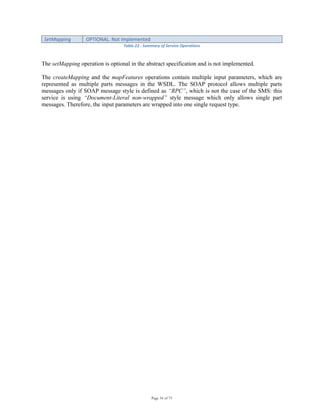
CSW ISO AP operations  CSW ISO AP operation  INSPIRE CSW ISO AP 
Page 23 of 75
requirements  operation requirements 
OGC_Service.GetCapabilities   Mandatory  Mandatory 
CSW Discovery.DescribeRecord  Mandatory  Mandatory 
CSW Discovery.GetDomain  Mandatory  Mandatory 
CSW Discovery.GetRecords  Mandatory  Mandatory 
CSW Discovery.GetRecordById  Mandatory  Mandatory 
CSWT Manager.Harvest  Optional  Mandatory 
CSWT Manager.Transaction  Optional  Mandatory 
Table 17 ‐ CSW ISO AP operations requirements for INSPIRE Discovery Services
A 'read-only' CSW ISO AP Catalogue Service has just to provide operations labelled as 'CSW'. In
addition, a transactional CSW Catalogue Service needs to provide operations labelled as 'CSWT'.
The additional management functions, providing a standardized interface for the active management
(transaction by a push-model) or the passive management (harvesting pull model) of metadata is
mandated to be an optional part of the CSW ISO AP. The CSW ISO AP Transaction and Harvest
operations are part of the manage use case of the Discovery Service.
This offers ease of use and the technical possibility for Member States’ public authorities to link and
manage (create, delete and update) their metadata of spatial resources to the MS Discovery Service
repository. Both the Transaction and Harvest operations of the CSW ISO AP are mandatory in order
to offer Member States and their national data providers a choice between the push or pull
management model of Discovery Service.
Page 24 of 75
4.2 Inspire View Service
The INSPIRE Directive [2007/2/EC] asks Member States to create “view services making it possible,
as a minimum, to display, navigate, zoom in/out, pan, or overlay viewable spatial datasets and to
display legend information and any relevant content of metadata; […] Member States may allow a
public authority supplying a service […] to apply charges where such charges secure the maintenance
of spatial datasets and corresponding data services, especially in cases involving very large volumes
of frequently updated data. Data made available through the view services referred […] may be in a
form preventing their reuse for commercial purposes”.
In INSPIRE these services are referred to as View Services.
Summarizing, the goal of view service is to allow requests over geo-referenced data belonging to
the themes covered by the INSPIRE Directive Annexes, over a spatiotemporal extension, and
provide a visual representation of these data.
The following aspects of a view service should be considered:
• nature of the Metadata;
• availability of the Metadata;
• multiple datasets View Geometry (supported spatial reference systems);
• multiple datasets View Output Format (supported formats and their possible integration);
• temporal data dimension;
• legend availability and handling;
• restriction of access and e-commerce;
• multilingualism;
• relationship with client applications.
A relevant approach related to the View Service (specifications and implementation) is represented
by the Orchestra Map & Diagram Service.
Also for the View Service, INSPIRE is providing a draft implementation.
4.2.1 OGC WMS - WebMapping Service
4.2.1.1 Overview
A Web Map Service (WMS) produces maps of spatially referenced data dynamically from
geographic information. This International Standard defines a "map" to be a portrayal of geographic
information as a digital image file suitable for display on a computer screen. A map is not the data
itself. WMS-produced maps are generally rendered in a pictorial format such as PNG, GIF or JPEG,
or occasionally as vector-based graphical elements in Scalable Vector Graphics (SVG) or Web
Computer Graphics Metafile (WebCGM) formats. [OGC 03-109r1]
4.2.1.2 Specification
Current “OGC Web Map Service” interface recommendation paper version is 1.3.0 and can be found at:
http://portal.opengeospatial.org/files/?artifact_id=4756.
Page 25 of 75
This International Standard defines three operations:
a) one returns service-level metadata;
b) another one returns a map whose geographic and dimensional parameters are well-defined;
c) and an optional third operation returns information about particular features shown on a map.
HTTP supports two request methods: GET and POST. One or both of these methods may be offered
by a server. In WMS the support for the GET method has to be considered mandatory, while the
support for the POST method is optional.
The response to a Web Map Service request is always supposed to be a computer file that is
transferred over the Internet from the server to the client. The file may contain text, or it may
represent a map image. The type of the returned file shall be indicated by a MIME type string.
The return value of a valid Service request shall correspond to the type requested in the FORMAT
parameter and in the HTTP environment, the Content-type header of the response shall be exactly the
MIME type given in the valid request.
As showed in the following table, three operations are defined for a Web Map Service:
OPERATION 
OPERATION 
REQUIREMENT 
GOAL 
GetCapabilities  Mandatory 
The goal of this operation is to obtain service metadata, which is 
a machine‐readable (and human‐readable) description of the 
server's information content and acceptable request parameter 
values 
GetMap  Mandatory  This operation returns a map 
GetFeatureInfo  Optional 
This operation is designed to provide clients of a WMS with more 
information about features in the pictures of maps that were 
returned by previous Map requests 
Table 18 – OGC WMS Operations 
OGC studied an International Standard to define the implementation of the WMS on a distributed
computing platform (DCP) comprising Internet hosts that support the Hypertext Transfer Protocol
(HTTP) [OGC 06-042].
Styled Layer Descriptor Specification [OGC 05-078r4] added a new optional operation to the three
described in the OGC WMS specifications: DescribeLayer, that returns the feature types of the layer,
or layers, specified in a request and the attributes can be discovered with the DescribeFeatureType
operation of a WFS interface.
OPERATION 
OPERATION 
REQUIREMENT 
GOAL 
DescribeLayer  Optional 
This operation returns the feature types of the layer, or layers, 
specified in the request 
Table 19 ‐ New WMS Operation added by Styled Layer Description Specification 
Page 26 of 75
4.2.1.3 OWS Experiments Reports
The WMS specification [OGC 03-109r1] defines a number of parameters that should be used when
calling a WMS service. These parameters are encoded using keyword/value pairs (KVP) for
operation requests using HTTP Get.
As stated in “SOAP Experiment Report” [OWS 03-014], the main advantage of HTTP Get
vocabulary is that a request is fully represented in single URL. However, the HTTP GET model has
various shortcomings, including:
a) it does not provide an easy way of passing structured parameter values to a server;
b) Styled Layer Descriptor (SLD) WMS requests, which include an XML description of the
styling, are difficult to encode directly and require that the request URL make reference to a
separate SLD URL;
c) proposals to add a Filter parameter have been made more complex by the need to associate
specific Filter expressions with specific Layers;
d) length limitations on HTTP URLs may preclude all of the desired parameters from being
included in the request.
To overcome the limitations of the HTTP GET binding a HTTP POST binding was developed. This
binding and its associated schemas are described in [OGC 02-017r1].
The binding specifies that an HTTP POST message to a WMS server should consist of an XML
message.
Using XML messages solves the issues discussed above because:
a) it allows additional structure in the request message, thereby by allowing additional
functionality;
b) it removes size restrictions;
c) the comma-separated list of Layer names can be replaced by a sequence of XML elements,
each of which is either a named or a user-defined Layer, and directly associating Style and
Filter information within each Layer. The GetFeatureInfo operation, which includes most of a
GetMap request, benefits in a similar way.
Unfortunately, testing during experiments revealed that the XML Schemas developed for the WMS
HTTP POST bindings do not work correctly with existing Web Service toolkits. Issues that were
encountered included:
a) version and service are defined as attributes on the top-level element (GetMap,
GetFeatureInfo, GetCapabilities). This is a problem because some Web Service toolkits, such
as Axis, do not support the use of attributes. Note that .NET does support such attributes, but
only through the use of its metadata functionality.
b) The exceptions simple type defines an enumeration that includes two values,
application/vnd.ogc.se+inimage and application/vnd.ogc.se+xml. Both Axis and .NET map
these to constants defined on particular classes. However, these strings are not valid names in
Java or C#. In the case of Axis, this will cause a compilation error while .NET mangles the
name to make it valid. In either case, this is a critical issue.
It is deemed crucial to support the HTTP GET binding in any future WMS specifications that will be
developed. The reasoning for this recommendation is that the HTTP GET binding:
a) provides backwards compatibility with previous versions of WMS;
Page 27 of 75
b) provides a mechanism for clients that do not support SOAP, such as older Web Browsers, to
call a WMS server.
 
4.2.1.4 Change proposals
Following the new W3C standards, OGC has proposed a change request to the proposed WMS
specifications, focusing on SOAP [OGC 04-050r1].
The main underlined point is that a Web Map Service may support the “SOAP” protocol.
There are two steps in supporting SOAP:
• to add a definition of the SOAP binding to the WSDL description of the service
• to add a support for SOAP document/literal envelope
This should be the WSDL description of the SOAP binding:
<?xml version="1.0" encoding="UTF‐8"?> 
<wsdl:definitions targetNamespace="http://www.opengis.net/wms/soap" 
   xmlns:wms‐soap="http://www.opengis.net/wms/soap" 
   xmlns:wms‐req="http://www.opengis.net/wms/requests" 
   xmlns:wsdl="http://schemas.xmlsoap.org/wsdl/" 
   xmlns:mime="http://schemas.xmlsoap.org/wsdl/mime/" 
   xmlns:soap="http://schemas.xmlsoap.org/wsdl/soap/"> 
    <wsdl:documentation> 
    </wsdl:documentation> 
    <!‐‐ import WMS interface definitions ‐‐> 
    <wsdl:import namespace="http://www.opengis.net/wms/requests" location="./wms‐xml‐interfaces.wsdl"/> 
    <!‐‐ **************************************** 
             Bindings 
    **************************************** ‐‐> 
    <wsdl:binding name="WMS_SOAP_Binding" type="wms‐req:WMS_XML_Port"> 
        <soap:binding style="document" transport="http://schemas.xmlsoap.org/soap/http"/> 
            <wsdl:operation name="GetCapabilities"> 
                <soap:operation/> 
                <wsdl:input> 
                    <soap:body use="literal"/> 
                </wsdl:input> 
                <wsdl:output> 
                    <soap:body use="literal"/> 
                </wsdl:output> 
                <wsdl:fault name="exception"> 
                    <soap:fault name="exception" use="literal"/> 
                </wsdl:fault> 
            </wsdl:operation> 
            <wsdl:operation name="GetMap"> 
                <soap:operation/> 
                <wsdl:input> 
Page 28 of 75
                    <soap:body use="literal"/> 
                </wsdl:input> 
                <wsdl:output> 
                    <mime:content type="image/*"/> 
                </wsdl:output> 
                <wsdl:fault name="exception"> 
                    <soap:fault name="exception" use="literal"/> 
                </wsdl:fault> 
            </wsdl:operation> 
        </wsdl:binding> 
</wsdl:definitions> 
SOAP support shall be declared between the Capabilities of the services; this will allow the usage of
SOAP independently of WSDL.
If SOAP is supported, the services shall advertise this capability.
SOAP document/literal envelope: a Web Map Service that support SOAP binding shall accept
document/literal SOAP messages which contain a message as defined in the XML encoding for Web
Map Service. It is not required for the Web Map Service to support any other feature or extension of
the SOAP protocol:
<?xml version="1.0" encoding="UTF‐8"?> 
    <env:Envelope xmlns:env=”http://schemas.xmlsoap.org/soap/envelope/”> 
        <env:Body> 
            <Operation> 
                … 
            </Operation> 
        </env:Body> 
    </env:Envelope> 
If the result of the operation is an XML document, it shall be included in a SOAP envelope as well:
<?xml version="1.0" encoding="UTF‐8"?> 
    <env:Envelope xmlns:env=”http://schemas.xmlsoap.org/soap/envelope/”> 
        <env:Body> 
            <Result> 
                … 
            </Result> 
        </env:Body> 
    </env:Envelope> 
If the result is a binary data, the content of the Body is not specified and the binary is attached to the
SOAP message using SOAP with attachments [SOAP-Attachments].
Adding support for SOAP document/literal binding is very important for the future of OGC WMS:
the W3C and industry standard for Web services is WSDL/SOAP/UDDI. Adding SOAP support will
Page 29 of 75
increase the potential user base of this specification, while leaving the WMS without support for
these standards is a thread for its mid-term adoption.
4.2.2 Orchestra Map&Diagram Service
4.2.2.1 Overview
“The Map and Diagram Service is a service that dynamically portrays geographic and statistical data
using style definitions and symbolisation rules. Its main task is to produce maps and diagrams from
geographic data (vector or raster) and/or statistical data (e.g. census data, result of a statistical
analysis) as digital image files suitable for display on a computer screen. This service is able to create
maps and diagrams based not only on data hosted on the server, but also on data provided by external
services (e. g provided by Feature Access Services) or directly included in the request message as
GML (sent as an optional part of the Styled Layer Definition)”. [ORCHESTRA D3.4.3]
The main output of this service is an image document.
Maps and diagrams represent a visualisation of the data; they are not the data itself, thus they are
generally rendered in a pictorial format such as PNG (recommended as default format), GIF or JPEG.
Portrayal in vector-based graphical elements as Scalable Vector Graphics (SVG) or Web Computer
Graphics Metafile (WebCGM) is also allowed if it is acceptable for the service provider.
4.2.2.2 Specification
Current “Map&Diagram Service” specification version by ORCHESTRA is 3.0/2.2 and can be found
at the following URL:
http://www.eu‐orchestra.org/download.php?file=docs/OA‐
Specs/Map_and_Diagram_Service_Specification_v3.0‐ETHZ.pdf. [ORCHESTRA D3.4.3]
The interface specifies the following operations:
• getCapabilities
• getMap
• getDiagram
• getFeatureInfo
• getLegendGraphic
• getLayerDescription
• getStyle
It may be possible that the mapping of this interface to SOAP may differ from the future SOAP
mappings defined for OGC Web Services.
However, as the SOAP mapping defined in the above mentioned document leaves several things
unspecified, the SOAP interface of the Map and Diagram Service goes further and specifies the input
and output types for each operation messages as UML and XML Schema types.
Another issue linked with the SOAP platform mapping of the interface lies in the return of the image
document. The image document can be attached to the response message (e.g. SOAP with
attachments) or it can be sent as reference (URI to the rendered image document on the server). Our
recommended approach is to send the URI of the rendered image to overcome the problems and
limitations of the SOAP attachments.
Page 30 of 75
4.2.2.3 Implementation
The Map and Diagram Service has been designed as an evolution of (and keeping backward
compatibility with) the OGC WMS standard [OGC 03-109r1].
The document “Implementation Specification of the OA Map and Diagram Service” [ORCHESTRA
IS-MDS] defines an implementation specification of the Map and Diagram Service for the
“ORCHESTRA Web Services Platform”.
The Web service specifications presented in this document are compliant to WSDL Version 1.1 with
SOAP Version 1.1 HTTP binding.
The accepted binding are:
• SOAP Version 1.1 (with attachments) HTTP binding (mandatory)
• HTTP using GET method (optional – for backward compatibility with OGC WMS standard)
NAME  DESCRIPTION 
getCapabilities  It returns a Capabilities document 
getMap 
It returns a map of spatially referenced geographic and thematic information as 
an image document 
getDiagram  It returns a diagram representation of tabular data as an image document 
getLayerLegend  It returns a legend symbol (corresponding to a layer) as an image document 
getFeatureInfo 
It returns information about the features rendered in a certain point of a map or 
diagram layer 
setLayer  It stores a new data layer on the server 
deleteLayer  It removes an existing data layer from the server 
setStyle  It stores a new style on the server 
deleteStyle  It removes an existing style from the server 
getLayerDescription 
It returns a layer description document containing schema information for a 
layer 
Table 20 ‐ Summary of Service Operations 
4.2.3 Inspire proposed Implementation
Many factors encourage the adoption of a standards-based approach for the View Services
Implementing Rules. First of all, the INSPIRE Directive requires a standards-based approach when
possible.
Furthermore, the standards-based approach is particularly applicable to the INSPIRE context
considering the following:
a) the standardization activity in the area of viewing maps has reached a very good level of
maturity;
b) in Europe the INSPIRE reference materials provided by the INSPIRE community for the
establishment of the Implementing Rules show a general endorsement of this international
standard by the different European actors of the geographic information domain. Many
INSPIRE LMOs and SDICs have already adopted the OGC standard.
A standards-based approach is certainly the best answer to the high-level requirements of INSPIRE
as it ensures the conformance to the European and International Standards.
Page 31 of 75
The Network Services Drafting Team has made a proposal for the technical content of the INSPIRE
Implementing Rules for View Services; such proposal is available and described in “Draft
Implementing Rules for Discovery and View Services (IR1)” [INSPIRE D3.7].
In accordance with this document, the INSPIRE View Service operations shall follow those of the
EN ISO 19128 international standard [OGC 03-109r1].
The View Service shall provide the following functions:
ISO WMS 
operations 
ISO WMS operation 
requirements 
INSPIRE WMS 
operation 
requirements 
GetCapabilities  mandatory  mandatory 
GetMap  mandatory  mandatory 
GetFeatureInfo  optional  optional 
Table 21 ‐ View Service operations 
These three operations shall use parameters defined in the ISO 19128 WMS standard.
Page 32 of 75
4.3 Inspire Transformation Services
The INSPIRE Directive asks “Member States to establish and operate a network of … transformation
services, enabling spatial data sets to be transformed with a view to achieving interoperability”.
Generalisation services could be classified as transformation services too.
Following [INSPIRE D3.5], the transformation services shall be combined with the other services
such in a way to enable all those services to operate in conformity with the Implementing Rules
laying down the following:
a) harmonised spatial data specifications;
b) arrangements for the exchange of spatial data.
This set of services is the one with the widest range of potential interpretation, as it can go from the
change of coordinate systems, to schema mapping, encoding or generalisation.
Proposed Assumptions
The allowed transformations would be from a set of National SRS to the harmonised spatial data
theme “coordinate reference systems” and from the harmonised spatial data theme “coordinate
reference systems” to the same set of National SRS. An example for the latter is to help an end user
to use a specific tool, working directly on the original data set, using the original SRS.
Up to now the meaning of INSPIRE Transformation Services is not completely clear and under
discussion. The actual understanding addresses Web services that can be service-chained for
schema transformation and coordinate transformation. These services are offered as “translating
download service”, where the translation is configured in the service and the client has (nearly) no
control over the translation.
In this chapter, four services will be analyzed, that can fit in the Inspire Transformation Services
domain: OGC Web Coordinates Transforming Services, OGC Web Processing Service,
ORCHESTRA Schema Mapping Service and ORCHESTRA Processing Service.
Each of these services focuses or covers one of the neuralgic aspects of the Inspire Transformation
Services.
4.3.1 OGC WCTS - Web Coordinates Transforming Services
The OGC WCTS Implementation Specification [OGC 01-009] provides interfaces for general
positioning, coordinates systems and coordinates transformations that can handle 2D and 3D
coordinates, as well as 4D, 5D, etc.
The interfaces for Coordinate Transformation Services are split into three packages:
a) Positioning (PT);
b) Coordinate Systems (CS);
c) Coordinate Transformations (CT).
OGC specification refers to packages that have been profiled for COM, CORBA and Java and then
focuses on common data structures and typical mathematical transformations. There are no
specifications for a possible service-based implementation. In this sense this OGC service differs
from the ones described in the previous chapters.
4.3.2 Orchestra Schema Mapping Service
Page 33 of 75
4.3.2.1 Overview
As stated in [ORCHESTRA SMS SPEC], the ORCHESTRA Schema Mapping Service (SMS)
provides functionalities that are related to the mapping of features from a source into a target
schema.
The main (and hence mandatory) functionality of this interface is to execute a schema mapping. We
consider a schema mapping to be “the definition of an automated transformation of each instance of a
data structure A into an instance of a data structure B that preserves the intended meaning of the
original information” (Doerr, 2004). This is the main difference with the Processing Service, which
also transforms data from one schema to another one, but usually changes the semantics of the
information.
A schema mapping is described by
• an identifier that is unique to the Schema Mapping Service instance;
• descriptions of the source and target feature types;
• the schema mapping language used to describe the mapping;
• a reference to the actual mapping.
The Schema Mapping Service can be used to
a) directly map from one application schema to another one;
b) map from an application schema to a common (or community) schema (or vice versa).This
situation can be used to perform an indirect mapping between two application schemas
through the community schema.
The features mapping might also require that several feature collections are combined. In order to
support this possibility, an (optional) concatenation operation is also included in the service interface.
The description of the schema mapping is required as an input, because it is outside the scope of the
Schema Mapping Service to automatically derive a mapping between two application schemas.
4.3.2.2 Specification and implementation
The Web service specifications presented in [ORCHESTRA IS SMS] are compliant to WSDL
Version 1.1 with SOAP Version 1.1 HTTP binding; WSDL used version is 1.1.
The message style that shall be used is Document-Literal non-wrapped; this choice has the
consequence that each operation can take only one single input parameter (an XML element).
NAME  DESCRIPTION 
getCapabilites 
This mandatory operation informs the client of the capabilities of an ORCHESTRA 
Service Instance (OSI) 
mapFeatures 
This operation maps a feature collection from a local to a target schema using a 
predefined mapping rule 
concatFeatures  Not implemented 
createMapping 
This operation registers in the repository a mapping between a source feature 
descriptor and a target feature descriptor, for a specific schema mapping language 
deleteMapping 
This operation removes permanently zero or more mappings identified by the 
specified query 
getMapping 
This operation returns a collection of mapping descriptors identified by the specified 
query. If no query is specified all registered mappings are returned 
Page 34 of 75
SetMapping  OPTIONAL. Not implemented 
Table 22 ‐ Summary of Service Operations 
The setMapping operation is optional in the abstract specification and is not implemented.
The createMapping and the mapFeatures operations contain multiple input parameters, which are
represented as multiple parts messages in the WSDL. The SOAP protocol allows multiple parts
messages only if SOAP message style is defined as “RPC”, which is not the case of the SMS: this
service is using “Document-Literal non-wrapped” style message which only allows single part
messages. Therefore, the input parameters are wrapped into one single request type.
Page 35 of 75
4.3.3 Other Relevant OGC Services
OGC Web Processing Service (and Orchestra Processing Service) should also be considered as
relevant for the Inspire Transformation Services, as the Network Services Draft Team is currently
proposing to use it for both schema and coordinate transformation.
Anyway, due to the current state of play and to the nature of the WPS, these services are reported in
this document in the Inspire Invoke Services section.
Page 36 of 75
4.4 Inspire Invoke Services
The INSPIRE Directive asks “Member States to establish and operate a network of […] services
allowing spatial data services to be invoked”.
The Invoke Spatial Data Services service supports invoking individual (spatial) services, as well as
combinations of individual (spatial) services, both synchronous and asynchronous, in service chains
through a (Web) service orchestration engine a.k.a. “workflow engine”. The service chains are
expressed in a standard (e.g. XML-based) notation that can be consumed by commercial, as well as
open-source, orchestration engines from multiple sources.
The Invoke Spatial Data Services service allows also the definition of both the data inputs and data
outputs expected by the spatial services and the external Web service interface of the service chain.
For spatial data services available on the Internet, the Invoke Spatial Data Services service will
enable a user or a client application to run them without requiring the availability of a GIS. This
requires that a client application can discover the service, bind to it and invoke it. The
orchestration/combination of Spatial Data Services with other services will require to precisely
defining the interactions between them.
OGC Web Processing Service has the same goal of Inspire Invoke Services, so it will be analysed in
the following of this chapter, together with its ORCHESTRA implementation.
4.4.1 OGC WPS - Web Processing Service
4.4.1.1 Overview
A WPS provides client access across a network to pre-programmed calculations and/or
computation models that operate on spatially referenced data. The calculation can be extremely
simple (as subtracting one set of spatially referenced numbers from another), or highly complex (as a
global climate change model), with any number of data inputs and outputs.
The data required by the service can be delivered across a network, or available at the server. This
data can use image data formats or data exchange standards such as Geography Mark-up Language
(GML).
4.4.1.2 Specification
[OGC 05-007r7] specifies that the platform-neutral data needed as input or output for the services
could be encoded in many alternative ways: each appropriate to one or more specific DCPs. Possible
choices are HTTP GET transfer of operations requests (using KVP encoding) and HTTP POST
transfer of operations requests (using XML or KVP encoding), but the same operation requests and
responses (and other data) could be encoded for other specific computing platforms, including
SOAP/WSDL.
The WPS interface specifies three operations that can be requested by a client and performed by a
WPS server; all of them should be mandatorily implemented by all WPS servers:
OPERATION  DESCRIPTION 
Page 37 of 75
GetCapabilities 
This operation allows a client to request and receive back service metadata (or 
Capabilities) documents that describe the abilities of the specific server 
implementation. The GetCapabilities operation provides the names and general 
descriptions of each of the processes offered by a WPS instance. This operation also 
supports negotiation of the specification version being used for client‐server 
interactions 
DescribeProcess 
This operation allows a client to request and receive back detailed information about 
the processes that can be run on the service instance, including the inputs required, 
their allowable formats, and the outputs that can be produced 
Execute 
This operation allows a client to run a specified process implemented by the WPS, 
using provided input parameter values and returning the outputs produced 
Table 23 ‐ WPS Operations 
These operations have many similarities to other OGC Web Services, including WMS, WFS and
WCS.
WPS specification describes a generic interface, in that it does not identify any specific process that
is supported. Instead, each implementation of WPS should define the processes that are supported, as
well as their associated inputs and outputs. WPS can be thought of as an abstract model of a Web
service, for which profiles need to be developed, to support use, and standardized, to support
interoperability.
4.4.1.3 Implementation
WPS discovery and binding mechanisms follow the OGC model set by WMS and WFS, in that WPS
defines a GetCapabilities operation and requests are based on HTTP GET and POST. WPS does
more than just describing the service interface. It specifies a request/response interface that defines
how to:
• encode requests for process execution;
• encode responses from process execution;
• embed data and metadata in process execution inputs/outputs;
• reference Web-accessible data inputs/outputs;
• support long-running processes;
• return process status information;
• return processing errors;
• request storage of process outputs.
WPS allows for the provision of input data in two different methods. Data can either be embedded
in the Execute request, or referenced as a Web accessible resource. In the former approach, WPS
acts as a stand-alone service. In the latter fashion, WPS acts as middleware service for data, by
obtaining data from an external resource in order to run a process on the local implementation. WPS
allows existing software interfaces to be wrapped up and presented to the network as Web services.
Implementations of WPS can thus be considered middleware for software.
WPS is compatible with both WSDL and SOAP: SOAP can be used to package WPS requests and
responses.
WPS describes a message exchange mechanism that can be used if SOAP is not required (for security
such as encryption or authentication), but it goes beyond SOAP, specifying what the payload should
look like. Elements that are common to all payloads have been generalized in the WPS specification.
Page 38 of 75
The use of SOAP to wrap WPS requests offers the ability to add security certificates, as well as
encryption to Web-based geo-processing transactions.
The encoding of operation requests shall use HTTP GET with KVP encoding and HTTP POST
with XML encoding as specified in Clause 11 of [OGC 06-121r3]. Table 24 summarizes the three
Service operations and their encoding methods defined in the specification (encodings reported in
bold are mandatory).
OPERATION  REQUESTED ENCODING 
GetCapabilities  GET‐KVP and POST‐XML 
DescribeProcess  GET‐KVP and POST‐XML 
Execute  POST‐XML and GET‐KVP 
Table 24 ‐ Operations request encoding 
The outputs can be returned in the form of an XML response document, either embedded within the
response document, or stored as Web accessible resources.
WPS requests and responses encoded in SOAP shall use SOAP Document-style encoding (also
called message-style or Document-Literal encoding), as described in [OGC 06-094], for the
following operations:
• GetCapabilities request
• GetCapabilities response
• DescribeProcess request
• DescribeProcess response
• Execute response, when status=true
An example for a DescribeProcess request follows:
<soap:Envelope xmlns:soap=http://schemas.xmlsoap.org/soap/envelope/ 
  xmlns:xsi=http://www.w3.org/2001/XMLSchema‐instance 
  xmlns:xsd="http://www.w3.org/2001/XMLSchema"> 
     <soap:Body> 
        <DescribeProcess service="WPS" version="1.0.0" xmlns=http://www.opengeospatial.net/wps 
        xmlns:ows="http://www.opengeospatial.net/ows" xmlns:xlink=http://www.w3.org/1999/xlink 
        xmlns:xsi=http://www.w3.org/2001/XMLSchema‐instance 
        xsi:schemaLocation="http://www.opengeospatial.net/wps ..wpsDescribeProcess.xsd"> 
            <ows:Identifier>intersection</ows:Identifier>  
            <ows:Identifier>union</ows:Identifier> 
         </DescribeProcess>  
    </soap:Body> 
</soap:Envelope> 
WPS execute requests encoded in SOAP shall be encoded as follows:
• the process name shall be turned into an element in the SOAP body by pre-pending the text
"ExecuteProcess_";
Page 39 of 75
• each input and output shall be encoded as an element in the SOAP body by using the
Identifier as the name of the element.
SOAP requests to execute a process when RawDataOutput is requested shall generate a SOAP error.
4.4.1.4 Change requests/proposals
No change requests/proposals have been submitted.
4.4.2 Orchestra Processing Service
ORCHESTRA has followed all the OGC specification for the Web Processing Service, producing a
WSDL implementing the pre-defined operations, using SOAP as transportation protocol.
All the three operations have been implemented:
ORCHESTRA 
PROCESSING 
SERVICE 
OGC WPS 
execute Execute 
getProcessDescription DescribeProcess 
getCapabilities  GetCapabilities 
Table 25 ‐ ORCHESTRA PS ‐ OGC WPS Operations mapping 
The used encoding is Document-Literal for each operation, as specified in [OGC 05-007r7].
Complex data for services input or output can be included in the SOAP messages or can be
referenced by URLs.
Page 40 of 75
4.5 Inspire Download Service
The INSPIRE Directive asks Member States “to establish and operate a network” of “download
services, enabling copies of spatial data sets, or parts of such sets, to be downloaded and, where
practicable, accessed directly”.
A download service supports:
• download of a complete dataset or datasets;
• download of a part of a dataset or datasets;
• where practicable, provide direct access to complete datasets or parts of datasets;
• gazetteer-like services are also covered by a type of download service.
It is worth to note that either the conceptual, or application, or logical schema of the local or national
spatial data set may and will often differ from the INSPIRE harmonised specification of the spatial
object types in the data specification. In this case a download service will transform queries and data
between the conceptual or application schema of the spatial dataset and the harmonized schema on-
the-fly. Search criteria need to support searching based on spatial and temporal extents.
OGC provides a couple of services that allow having access to two different kinds of geospatial
information: the Web Coverage Service and the Web Feature Service. These services and their
possible correlated ORCHESTRA implementation will be analyzed in the following sections.
4.5.1 OGC WCS - Web Coverage Service
4.5.1.1 Overview
The Web Coverage Service (WCS) supports electronic retrieval of geospatial data as "coverages" –
that is, digital geospatial information representing space-varying phenomena.
A WCS provides access to potentially detailed and rich sets of geospatial information, in forms
that are useful for client-side rendering, multi-valued coverages and input into scientific models and
other clients.
The WCS may be compared to the OGC Web Map Service (WMS) and the OGC Web Feature
Service (WFS): like them it allows clients to choose portions of a server's information holdings based
on spatial constraints and other criteria.
However, unlike the WMS [OGC 06-042], which portrays spatial data to return static maps (rendered
as pictures by the server), the Web Coverage Service provides available data together with their
detailed descriptions, defines a rich syntax for requests against these data and returns data with their
original semantics (instead of pictures), which may be interpreted, extrapolated, etc. – and not just
portrayed.
Unlike WFS [OGC 04-094], which returns discrete geospatial features, the Web Coverage Service
returns coverages representing space-varying phenomena that relate a space-temporal domain to a
(possibly multidimensional) range of properties.
4.5.1.2 Specification
As specified by [OGC 07-067r5], The Web Coverage Service provides three operations:
OPERATION  DESCRIPTION 
GetCapabilities 
This operation returns an XML document describing the service and brief descriptions 
of the coverages that clients may request 
Page 41 of 75
DescribeCoverage 
This operation lets clients request a full description of one or more coverages served 
by a particular WCS server. The server then responds with an XML document that 
fully describes the identified coverages 
GetCoverage 
This operation returns a coverage (that is, values or properties of a set of geographic 
locations), encoded in a well‐known coverage format 
Table 26 ‐ WCS operations 
4.5.1.3 Implementation
All WCS operation requests may use HTTP GET with KVP encoding, or use HTTP POST with
XML, as specified in Clause 11 of [OGC 06-121r3].
OPERATION  HTTP BINDING 
GetCapabilities  GET‐KVP or POST‐XML 
DescribeCoverage GET‐KVP or POST‐XML 
GetCoverage  GET‐KVP or POST‐XML 
Table 27 ‐ WCS Operations Encodings 
GetCapabilities
The mandatory GetCapabilities operation allows WCS clients to retrieve service metadata from a
WCS server. The response to a GetCapabilities request shall be an XML document containing
service metadata about the server, usually including summary information about the data collections
from which coverages may be requested.
All WCS servers shall implement HTTP GET transfer of the GetCapabilities operation request, using
KVP encoding. Servers may also implement HTTP POST transfer of the GetCapabilities operation
request, using XML encoding only.
When the HTTP POST connect point URL is different for different encodings of the operation
requests, this <ows:Constraint> element shall be included in each <Post> element. When the
connect point URL is the same for all encodings of all operation requests, this <ows:Constraint>
element should be included in the <OperationsMetadata> element.
When a WCS server encounters an error while performing a GetCapabilities operation, it shall return
an exception report message as specified in Clause 8 of [OGC 06-121r3].
KVP encoding
The KVP encoding of a WCS GetCapabilities operation request shall be as specified in Table 5 in
Subclause 7.2.2 of [OGC 06-121r3].
XML encoding
The XML Schema fragment for encoding a WCS GetCapabilities operation request extends
<ows:GetCapabilitiesType> from [OGC 06-121r3]:
<element name="GetCapabilities"> 
    <annotation> 
        <documentation> 
Page 42 of 75
            Request to a WCS to perform the GetCapabilities operation. This operation allows a client to retrieve a 
Capabilities XML document providing metadata for the specific WCS server. In this XML encoding, no 
"request" parameter is included, since the element name specifies the specific operation. 
        </documentation> 
    </annotation> 
    <complexType> 
        <complexContent> 
            <extension base="ows:GetCapabilitiesType"> 
                <sequence/> 
                <attribute name="service" type="ows:ServiceType" use="required" fixed="WCS"/> 
            </extension> 
        </complexContent> 
    </complexType> 
</element> 
DescribeCoverage / GetCoverage
WCS servers may implement either KVP encoding for HTTP GET transfer, or HTTP POST using
XML transfer of DescribeCoverage and GetCoverage operations requests.
When a WCS server encounters an error while performing a DescribeCoverage operation, it shall
return an exception report message as specified in Subclause 7.4 of [OGC 06-121r3].
4.5.1.4 Change requests/proposals
The following indications were added to the OGC WCS specification [OGC 07-067r5], after that a
change proposal [OGC 06-085r2] had been submitted by OWS.
All compliant WCS servers may implement SOAP 1.2 transfer of all WCS operation requests and
responses. When SOAP is implemented, the SOAP Request-Response message exchange pattern
shall be used with the HTTP POST binding.
If a WCS server implements SOAP version 1.2 transfer of an operation request, it shall also
implement SOAP transfer of the corresponding operation response.
For SOAP transfer, each XML-encoded operation request or response shall be encapsulated in the
body of a SOAP envelope, which shall contain only one body and only this request or response in
that body.
A WCS server shall return operation responses and error messages using only SOAP transfer when
the operation request is sent using SOAP; the proposed implementation of the SOAP protocol
uses document/literal encoding.
All compliant WCS servers shall specify the URLs to which SOAP operation requests may be sent,
within the OperationsMetadata section of a service metadata (Capabilities) XML document.
When an error is detected while processing an operation request encoded in a SOAP envelope, the
WCS server shall generate a SOAP response message where the content of the <Body> element is a
<Fault> element containing an <ExceptionReport> element.
This shall be done using the following XML fragment:
<soap:Envelope xmlns:soap="http://www.w3.org/2003/05/soap‐envelope"> 
Page 43 of 75
    <soap:Body> 
        <soap:Fault> 
            <soap:Code> 
                <soap:Value>soap:Server</soap:Value> 
            </soap:Code> 
            <soap:Reason> 
                <soap:Text>A server exception was encountered.<soap:Text> 
            </soap:Reason> 
            <soap:Detail> 
                <ows:ExceptionReport> ... </ows:ExceptionReport> 
            </soap:Detail> 
        </soap:Fault> 
    </soap:Body> 
</soap:Envelope> 
The <Code> element shall have the Value “soap:server” indicating that this is a server exception.
The <Reason> element shall have the Text “Server exception was encountered.” This fixed string is
used since the details of the exception shall be specified in the <Detail> element using an
<ows:ExceptionReport> element as specified in OWS Common [OGC 06-121r3].
All WCS servers shall specify the encodings that may be sent using HTTP POST transfer of
operation requests. Specifically, an <ows:Constraint> element shall be included, with PostEncoding
as the value of the name attribute and specifying different allowed values for each allowed encoding:
a) the value “SOAP” shall indicate that SOAP encoding is allowed;
b) the value “XML” shall indicate that XML encoding is allowed (without SOAP message
encapsulation).
The value “KVP” is not used, since this WCS standard does not allow KVP encodings of operation
requests to be transferred using HTTP POST.
In the GetCoverage operation, when the store parameter is absent or has the value “false”, the server
shall transfer the complete GetCoverage response to the client, either as a MIME multipart message
(for KVP or XML requests), or as a SOAP message with attachments (for SOAP requests). The
Coverages shall reference the other parts of the MIME multi-part message (or SOAP attachments).
When the store parameter has the value “true”, the body of the SOAP envelope response shall
contain one XML encoded Coverages element with one or more references to URLs of files
containing coverage content and metadata.
When the store parameter is absent or has the value “false”, responses to GetCoverage SOAP
requests shall be encoded as SOAP with Attachments as defined in [W3C Note] (but using SOAP 1.2
rather than SOAP 1.1). These responses shall consist of MIME multipart messages, with the
Coverages element contained within a SOAP 1.2 envelope.
Another change request was posted by OWS, specifying the morphology of the possible SOAP
binding for WCS in a better way [04-049r1].
WCS may support the “SOAP” protocol and the implementation of the SOAP protocol shall use
Document-Literal encoding.
Page 44 of 75
4.5.2 OGC WFS - Web Feature Service
4.5.2.1 Overview
As [OGC 04-094] declares, the OGC Web Map Service allows a client to overlay map images for
display, served from multiple Web Map Services on the Internet. In a similar fashion, the OGC Web
Feature Service allows a client to retrieve and update geospatial data encoded in Geography
Mark-up Language (GML) from multiple Web Feature Services.
The requirements for a Web Feature Service are:
• the interfaces must be defined in XML;
• GML must be used to express features within the interface;
• at a minimum a WFS must be able to present features using GML;
• the predicate or filter language will be defined in XML and be derived from CQL, as defined
in the OpenGIS Catalogue Interface Implementation Specification;
• the data-store used to store geographic features should be opaque to client applications and
their only view of the data should be through the WFS interface;
• the use of a subset of XPath expressions for referencing properties.
The WFS operations support INSERT, UPDATE, DELETE, LOCK, QUERY and DISCOVERY
operations on geographic features using HTTP as the distributed computing platform.
4.5.2.2 Specification
To support transaction and query processing, the following operations are defined:
OPERATION  DESCRIPTION 
GetCapabilities 
A Web feature service must be able to describe its capabilities. Specifically, it must 
indicate which feature types it can service and what operations are supported on 
each feature type 
DescribeFeatureType 
A Web feature service must be able, upon request, to describe the structure of 
any feature type it can service. 
GetFeature 
A Web feature service must be able to service a request to retrieve feature 
instances. In addition, the client should be able to specify which feature 
properties to fetch and should be able to constrain the query spatially and non‐
spatially 
GetGmlObject 
A Web feature service may be able to service a request to retrieve element 
instances by traversing XLinks that refer to their XML IDs. In addition, the client 
should be able to specify whether nested XLinks embedded in returned element 
data should also be retrieved 
Transaction 
A Web feature service may be able to service transaction requests. A transaction 
request is composed of operations that modify features; that is create, update, 
and delete operations on geographic features 
LockFeature 
A Web feature service may be able to process a lock request on one or more 
instances of a feature type for the duration of a transaction. This ensures that 
serializable transactions are supported 
Table 28 ‐ WFS Operations 
Page 45 of 75
HTTP supports two request methods: GET and POST. One or both of these methods may be defined
for a particular Web Feature Service and offered by a service instance.
In addition to, or instead of offering Web feature services using the HTTP protocol, a service
provider may offer Web feature services using HTTPS.
4.5.2.3 Implementation
There are two methods of encoding WFS requests: the first one uses XML as the encoding language
and is intended to be used with HTTP POST method. The second encoding uses keyword-value pairs
(KVP) to encode the various parameters of a request and is intended to be used with HTTP GET.
Table 29 correlates WFS operations and their encoding semantics as defined in OGC specification
[OGC 04-094].
 
OPERATION  REQUEST ENCODING 
GetCapabilities  XML & KVP 
DescribeFeatureType XML & KVP 
GetGmlObject  XML & KVP 
LockFeature  XML & KVP 
Transaction  XML & limited KVP 
Table 29 ‐ WFS Operations Request Encoding 
[OGC 04-094] mandates the use of GML for the XML encoding of the state of geographic features.
The following matrix correlated WFS request encodings with each of the supported HTTP methods
(GET and POST). The value in each cell defines the expected MIME type for the encoding/request
method combination. The value “Not Applicable” means that the encoding/request method
combination is supported but a MIME type is not applicable. An empty cell indicates that the
combination is not supported.
  HTTP GET  HTTP POST 
XML encoded requests    text/xml 
KVP encoded requests  Not applicable  application/x‐www‐form‐urlencoded 
Table 30 ‐ Request encoding and transport methods 
When using the HTTP POST method, the content type for XML encoded WFS requests must be set
to text/xml. When using the HTTP POST method, the content type for KVP encoded WFS requests
must be set to application/x-www-form-urlencoded and the content of the document must be
equivalent to the query string of an HTTP GET request.
When using the HTTP GET method and KVP encoded WFS requests, a MIME type is not applicable
as the entire request is encoded in the URL as keyword-value pairs that follow the ‘?’ character.
The combination of XML encoded requests and the HTTP GET method is not supported.
getCapabilities
Every Web Feature Service must support the KVP encoded form of the GetCapabilities request over
HTTP GET so that a client can always know how to obtain a capabilities document.
Page 46 of 75
The following section defines the XML encoding for a GetCapabilities request and defines the service
metadata generated in response as an XML document that a Web Feature Service must generate to
describe its capabilities.
Request
The GetCapabilities element is used to request a capabilities document from a Web Feature Service.
It is defined by the following XML Schema fragment:
<xsd:element name="GetCapabilities" type="wfs:GetCapabilitiesType"/>  
<xsd:complexType name="GetCapabilitiesType">  
    <xsd:complexContent>  
        <xsd:extension base="ows:GetCapabilitiesType">  
            <xsd:attribute name="service" type="ows:ServiceType" use="optional" default="WFS"/>  
        </xsd:extension>  
    </xsd:complexContent>  
</xsd:complexType>  
The base type, ows:GetCapabilitiesType, is defined in the OWS Common Implementation Specification
[Murata et al., 2001].
Response
The root element of the response to a GetCapabilities request is the <WFS_Capabilities> element.
It is partially defined be the following XML Schema fragment:
<xsd:element name="WFS_Capabilites" type="wfs:WFS_CapabilitiesType" substitutionGroup="ows:Capabilites"/>  
<xsd:complexType name="WFS_CapabilitiesType">  
    <xsd:complexContent>  
        <xsd:extension base="ows:CapabilitiesBaseType">  
            <xsd:sequence>  
                <xsd:element ref="wfs:FeatureTypeList" minOccurs="0"/>  
                <xsd:element ref="wfs:ServesGMLObjectTypeList" minOccurs="0"/> 
                <xsd:element ref="ows:Filter_Capabilities"/> 
            </xsd:sequence> 
        </xsd:extension> 
    </xsd:complexContent> 
</xsd:complexType> 
The base type, ows:CapabilitiesBaseType, is defined in the OWS Common Implementation
Specification [Murata et al., 2001].
4.5.2.4 Change Proposals/Requests
OWS has posted a couple of change requests about SOAP usage in WFS.
In [OGC 04-041] it’s underlined that the compliance with the WS-I Basic Profile v1.0 [WSI-Basic]
requires that only “Document-Literal” or “RPC-Literal” bindings are employed. The former style
Page 47 of 75
entails little more than wrapping a WFS message with a SOAP envelope. In the latter style, the child
element of the <soap:Body> element consists of a wrapper element bearing either the name of the
operation or the name of the operation suffixed with "Response"; the corresponding message parts
appear in the guise of child accessory elements.
When specifying a binding for an interface, the WS-I Basic profile doesn't allow any operation to be
omitted, even though the WSDL content model does. Compliance with the Basic profile would rule
out the use of piecemeal bindings; that is, all operations within the interface must be bound to that
protocol (e.g. HTTP GET).
One consequence of this is that it may be desirable to place operations that are commonly bound to
the HTTP GET method within a separate interface.
Message encodings: KVP vs. XML
Most WFS messages admit two encoding styles: an XML representation (application/xml) based on
an XML Schema type definition, or a key-value pair (KVP) representation that can be readily
incorporated within a Request-URI (application/x-www-form-urlencoded). Unfortunately these
usually have inconsistent content models so they must be defined separately (e.g. GetCapabilities
KVP representation uses different names and adds the REQUEST parameter).
In light of this aspect, retrieval operations that are commonly bound to the GET method may also
require alternative message definitions (e.g., GetCapabilitiesRequest-KVP).
[OGC 04-094] specification has included the following guidelines, after that OWS proposed them in
[OGC 06-087]: a client may send WFS requests to a compatible server using the body of a SOAP
envelope. The client simply encodes the WFS request as the content of the <soap:Body> element in
the request message.
The WFS may then response by generating a SOAP message where the response to the client’s
request is the content of the <soap:Body> element.
In the event that an exception is encountered while processing a WFS request encoded in a SOAP
envelope, the Web Feature Service must generate a SOAP response message where the content of the
<soap:Body> element is a <soap:Fault> element. The following skeleton XML fragment must be
used when generating the <soap:Body> element in the event that a WFS encounters an exception:
<soap:Body> 
    <soap:Fault> 
        <soap:faultcode>soap:Server</soap:faultode> 
        <soap:faultstring>A server exception was encountered.</soap:faultstring> 
        <soap:faultactor>http://www.url_of_WFS_server.com/</soap:faultactor> 
        <soap:detail> 
            <ows:ExceptionReport> 
                … 
            </ows:ExpetionReport> 
        </soap:detail> 
    </soap:Fault> 
</soap:Body> 
The <soap:faultcode> element must have the content “soap:Server” indicating that this is a server
exception. The <soap:faultstring> element must have the content “Server exception was
encountered.”. This fixed string is used since the details of the exception will be specified in the
Page 48 of 75
<soap:detail> element, using an <ows:ExceptionRecport> element as defined in document [Murata
et al., 2001].
The <soap:detail> element must contain an <ows:ExceptionReport> element detailing the specific
exception that the server encountered.
The use of the soap:Header element has not been discussed in the change requests.
4.5.3 Orchestra Feature Access Service
4.5.3.1 Overview
The Feature Access Service (FAS) allows interoperable read and write access on feature instances
available in an OSN. [ORCHESTRA FAS SPEC]
The FAS offers information about:
• the feature types it is capable to provide or support;
• the supported encoding(s) to transfer requested or submitted feature data;
• the query language and mechanism that is supported for filtered feature access.
The Feature Access Service allows queries to select certain features based on their type, certain
attribute values and their spatial and temporal extent.
More on, any Feature Access Service may support the update of existing feature instances, the
creation of new feature and the deletion of existing features and hence, in this case, it should also be
transactional. It can also allow creation, updates and deletions of feature types.
4.5.3.2 Specification
The functionality of the Feature Access Service (FAS) is based on the WFS and WCS OGC
implementation specifications. These specifications allow the retrieval of features and coverages
respectively. At the abstract level, coverages and features are considered as ORCHESTRA features
and thus an interface has been developed to access to both types.
The write functionalities of the WFS specification (which basically consist of a transactional
operation) have been transferred into three operations setFeatures, createFeatures and
deleteFeatures, as to follow the ORCHESTRA convention of operation functionality. Additionally,
the objective was to put the “write behavior” of the WFS at the operation level in the interface.
Currently, in the OGC WFS specification, the write type of a given operation (i.e. insert, update, or
delete) is specified as a parameter to a more generic operation (transaction operation).
OPERATION   NAME DESCRIPTION 
getFeatureTypes 
This operation gets a description (the schema) of given feature types serviced by a 
Feature Access Service instance 
setFeatureTypes  This operation updates existing Feature Types 
createFeatureTypes  This operation creates new Feature Types 
deleteFeatureTypes  This operation deletes existing Feature Types 
getFeatures  This operation retrieves features and their attributes 
setFeatures  This operation updates existing features 
createFeatures  This operation creates new features 
deleteFeatures  This operation deletes existing features 
Table 31 ‐ WFS Summary of additional Service Operations 
Page 49 of 75
4.5.3.3 Implementation
As specified in [ORCHESTRA FAS IS], the implementation of the Feature Access Service is
compliant to WSDL Version 1.1 with SOAP Version 1.1 HTTP binding.
The possible bindings are:
• SOAP Version 1.1 HTTP binding (mandatory)
• HTTP using POST method and XML encoding (optional)
• HTTP using GET method with KVP encoding (optional)
OPERATION   REQUIRED ENCODING 
getFeatureTypes  SOAP 1.1 (POST+XML or GET+KVP) 
setFeatureTypes  SOAP 1.1 (POST+XML or GET+KVP) 
createFeatureTypes  SOAP 1.1 (POST+XML or GET+KVP) 
deleteFeatureTypes  SOAP 1.1 (POST+XML or GET+KVP) 
getFeatures  SOAP 1.1 (POST+XML or GET+KVP) 
setFeatures  SOAP 1.1 (POST+XML or GET+KVP) 
createFeatures  SOAP 1.1 (POST+XML or GET+KVP) 
deleteFeatures  SOAP 1.1 (POST+XML or GET+KVP) 
Table 32 ‐ FAS Operations Encodings 
All the operations described in the specification document [ORCHESTRA FAS SPEC] have been
implemented.
Page 50 of 75
5. Critical Review
In this chapter a multi-dimensional analysis will be performed over all the Inspire services, focusing
on their SOAP implementation choices/suggestions. Firstly, such options are analysed for each of the
Inspire Services, including choices undertaken by relevant OGC and ORCHESTRA services.
After that, some common issues related to the use of SOAP have been identified and analysed (such
as SOAP header, exceptions, data encoding and binary data management)
N.B.: in the next tables, red sentences are not reported from the native service specification, but
derive from OWS change requests/proposals.
5.1 Inspire Discovery Service
5.1.1 Analysis of OGC-CWS implementations
Following the OGC CSW specifications, three application profiles have been produced. Their
implementation choices are quite homogeneous and do not have substantial differences between
them, but considering SOAP binding as mandatory or not.
OGC specifications of CSW already foresee the importance of SOAP binding and they explicitly
support this protocol as an optional choice, beside the standard HTTP GET/POST methods. This
choice has influenced the OGC Application Profiles as much as both ISO METADATA AP and AP
for EO Products consider SOAP support mandatory, while ebRIM recommendations follow the
specifications guidelines and allow freedom in the use of SOAP. As ebRIM AP is the profile that has
the more generic view about protocol bindings, it requires a proper use of the Content-Type message
header to specify the kind of content housed in the message.
In case SOAP is supported, all the examined specifications state that SOAP messages must be
transferred using HTTP(S) POST.
Some minor differences, instead, arise on the SOAP data encoding: while the OGC specifications do
not assert anything about it, as much as ebRIM AP, ISO METADATA AP calls for a
Document/Literal style, while EO AP is more lenient and suggests just a Document style, without
specifying anything about parameters encoding.
All AP specifications (OGC CSW doesn’t deal with this issue) agree on putting response and request
messages inside the SOAP <Body> element, as much as the specifications dealing with the “error
handling” topic agree on using a <soap:Fault> element in the SOAP Body when an exception is
raised.
OWS ISO METADATA AP follows quite strictly the HTTP GET/POST choices for the non-SOAP
implementation and for parameter data encodings, while the other profiles are vaguer on this topic
and follow in a less severe way the OGC specifications.
The following table summarises the analysis:
Page 51 of 75
  OGC IMPL SPECIFICATIONS  OWS ISO METADATA AP  OWS ebRIM AP  AP for EO Products 
Supported 
bindings 
Both HTTP GET/POST and SOAP 
are supported. 
 
SOAP encoding of operation 
requests are eventually 
transferred using HTTP POST 
All operations must support 
embedding of requests and 
responses in SOAP 1.2 messages 
via HTTP/POST 
(except getCapabilities based on 
GET+KVP) 
SOAP 1.2 messaging framework 
may be supported 
SOAP over HTTP or HTTPS 
is used and mandatory 
Operations 
specific protocol 
and parameters 
encoding 
(in brackets optional choices)  (in brackets optional choices)
(in brackets optional choices, no 
specifications for parameters data 
encoding)
(only two CSW operations 
have been mapped; 
it is not anticipated to 
require a KVP encoding) 
GetCapabilities:  GET + KVP (POST + XML) GET + KVP (POST + XML)  GET (POST)  n/a 
DescribeRecord:  POST + XML (GET + KVP) POST + XML (GET + KVP) POST (GET)  n/a 
GetDomain:  POST + XML (GET + KVP) POST + XML (GET + KVP) GET (POST)  n/a 
GetRecords:  POST + XML (GET + KVP) POST + XML (GET + KVP) GET (POST) 
POST + XML 
(“SearchRequest”) 
GetRecordById:  GET + KVP (POST + XML) GET + KVP and POST + XML  GET (POST) 
POST + XML 
(“PresentRequest”) 
Harvest:  POST + XML (GET + KVP) POST + XML (POST + KVP) GET  n/a 
Transaction POST + XML POST + XML POST  n/a 
SOAP message 
structure 
Messages are stored in the Body 
of SOAP envelope 
(spec added as consequence of 
change proposed by [OGC 06‐
089]) 
Messages are stored in the Body 
of SOAP envelope 
 
Responses are XML‐encoded 
Proper use of the Content‐Type 
header is required by this profile: 
in case of SOAP binding,  the 
Content‐Type should be set to 
"application/soap+xml" 
 
XML response or request should be 
contained in the Body of SOAP 
envelope 
 
No constraints on SOAP Header 
not defined 
SOAP Errors 
handling 
In SOAP, exceptions are stored 
in the SOAP envelope Body as 
soap:Fault element 
no remarks 
In SOAP, exceptions are stored in 
the SOAP envelope Body as 
soap:Fault element. 
not defined 
Page 52 of 75
(spec added as consequence of 
change proposed by [OGC 06‐
089]) 
SOAP Data 
enconding 
not defined  Document/Literal style  not defined 
SOAP style should be 
"Document" 
Security  not defined  Use of HTTPS recommended 
Basic with TLS (or SSL v3) to 
establish a secure communication 
channel 
Use of HTTPS 
recommended 
Table 33 – Analysis of OGC‐CWS profiles
Page 53 of 75
5.1.1.1 Summary of OWS CSW CHANGE PROPOSALS/REQUESTS
Some change proposals have been requested [OWS 06-089], to align the OGC CSW specifications
with some choices taken by the examined Application Profiles.
Some of changes are related to the use of the SOAP Body as storage of CSW requests, and SOAP
Fault for error handling: these have already been incorporated in the OGC-CWS specifications [07-
006r1].
Other changes are linked with the necessity of making available a functionality by which the server
can indicate if SOAP requests can be managed using HTTP POST or not.
Finally, another request is about SOAP data encoding, a topic that was not treated in 2.0.2
specifications. The change proposal leaves the choice open between Document-Literal and RPC-
Literal encoding. [04-042]
It should be noticed that the EO AP draft implementation rules define only Document
encoding style.
5.1.2 ORCHESTRA Catalogue Service
This implementation specification is based on SOAP 1.1 HTTP binding and Document-Literal
SOAP encoding.
The most relevant remark is that the version proposed for SOAP is still 1.1, while current
standard is 1.2.
Another difference is due to the fact that ORCHESTRA Catalogue service is defining more
operations than OGC-CSW, as shown:
OGC­CSW OPERATION 
ORCHESTRA 
CATALOGUE OPERATION 
GetCapabilities  GetCapabilities 
GetRecords search 
GetRecordById getMetaInformation 
GetDomain  getQueryDomain 
DescribeRecord getMetaInformationType 
Transaction (insert) createMetaInformation 
Transaction (update) setMetaInformation 
Transaction (delete) deleteMetaInformation 
Harvest collectMetaInformation 
- collectMetaInformationPeriodic
- getNavigationRoots 
- getNavigationEdges 
- improveQuery 
Table 34 – OGC‐WMS vs. ORCHESTRA Map&Diagram operations 
5.1.3 INSPIRE Proposed Implementation
Page 54 of 75
INSPIRE implementation rules have asserted that the INSPIRE Catalogue Service should follow
CSW ISO AP specifications, considered as a good standard. This implies:
• use of SOAP 1.2 binding on HTTP POST;
• encoding style as Document/Literal (considered the most fitting one for geo-information
context in most of OGC deliverables and discussion papers).
Beside SOAP, previous HTTP GET and POST bindings with KVP or XML parameters are anyway
maintained for coherence with servers that do not support SOAP.
5.2 Inspire View Service
OGC WMS specification is less detailed regarding the use of SOAP than the OGC CSW one;
moreover there are no Application Profiles or further specification refinements for such service
type. The analysis is thus performed amongst OGC WMS specification, OWS change proposals (as
consequence of OWS experimentation [OWS 03-014]) and the ORCHESTRA “Map & Diagram”
service.
ORCHESTRA specifications of Map&Diagram Service already consider the use of SOAP binding,
even if it does not provide many details on SOAP conformity choices or recommendations. OGC
WMS Specifications, instead, do not consider the possibility of using SOAP, while they just support
HTTP GET as compulsory binding (KVP parameter encoding) and POST as optional. That’s why a
change proposal has been redacted to fix this lack.
Also for this service ORCHESTRA refers to SOAP 1.1 (while latest one is 1.2).
It should also be noticed that ORCHESTRA is defining more operations than OGC, as shown
below:
OGC­WMS 
OPERATION 
ORCHESTRA 
MAP & DIAGRAM 
OPERATION 
GetCapabilities getCapabilities 
GetMap getMap 
‐ getDiagram 
‐ getLayerLegend 
GetFeatureInfo getFeatureInfo 
‐ setLayer 
‐ deleteLayer 
‐ setStyle 
‐ deleteStyle 
DescribeLayer getLayerDescription 
Table 35 – OGC‐WMS vs. ORCHESTRA Map&Diagram operations 
Regarding message structure, the only recommendation OGC specifications provide is that the
Content-type header of the response shall be exactly the MIME type given in the valid request.
Taking into consideration the change request and ORCHESTRA approaches, we can find a
substantial difference: both of them analyse the possible problem bound to the binary nature of the
service response. OWS change proposal does not give options: if the result is a binary data, the
content of the Body is not specified and the binary is attached to the SOAP message using SOAP
Page 55 of 75
with attachments. On the other hand, ORCHESTRA leaves the choice to the implementer between
SOAP with attachments or to send the file as a reference, but recommends this latter option.
OWS change request is the only one to face the SOAP data encoding theme, stating that
Document/Literal encoding shall be accepted.
The following table summarises the analysis:
Page 56 of 75
  OGC‐WMS SPECIFICATIONS 
OWS WMS 
CHANGE PROPOSALS 
ORCHESTRA “MAP & DIAGRAM” 
Supported 
bindings 
In WMS the support for the GET method 
has to be considered mandatory, while 
the support for the POST method is 
optional 
WMS may support the SOAP protocol  It supports SOAP 1.1 via HTTP/POST 
Operations 
specific protocol 
and parameters 
encoding 
Parameters are encoded using 
keyword/value pairs (KVP) for operation 
requests using HTTP GET 
//  HTTP using GET method is optional 
(SOAP) message 
structure 
the Content‐type header of the response 
shall be exactly the MIME type given in 
the valid request (not SOAP message) 
Requests and responses included in the 
SOAP message Body 
 
If the result is a binary data, the content of 
the Body is not specified and the binary is 
attached to the SOAP message using SOAP 
with attachments 
The image document can be attached to the 
response message (e.g. SOAP with 
attachments) or it can be sent as reference 
(URI to the rendered image document on 
the server) 
 
The ORCHESTRA recommended approach is 
to send the URI of the rendered image 
SOAP Errors 
handling 
not defined  not defined  not defined 
SOAP Data 
enconding 
not defined 
WMS that support SOAP binding shall 
accept document/literal SOAP messages 
not defined 
Security  not defined  not defined  not defined 
Other Topics  // 
If SOAP is supported, the services shall 
advertise this capability 
// 
Table 36 – Analysis of Inspire View Service related specifications 
Page 57 of 75
5.3 Inspire Transformation Services
Following the goals described in the Inspire directive, the Transformation Services should base on
two different kinds of OGC services and on one service implemented by ORCHESTRA: OGC Web
Coordinate Transformation Services, OGC Web Processing Service and ORCHESTRA Schema
Mapping Service.
The goals of these three kinds of services are very different, but combined together they should
cover the whole needs of Inspire Transform Service:
• OGC WCTS offers the interfaces to transform geo-spatial data to perform transformations
under a geo-spatial point of view, for example to convert them from a 3D coordinate system
to a 2D one.
• OGC WPS allows invoking one or more generic manipulation algorithms on geo-spatial
data, offering the possibility to invoke service chains too. These algorithms can be of
different kinds like a simple subtraction of one set of spatially referenced numbers from
another, or highly complex, as a global climate change model.
• ORCHESTRA SMS, instead, is very different compared with the OGC Processing Service,
which also transforms data from one schema to another one, but usually changes the
semantics of the information. The Schema Mapping Services, rather, change the
representation of the data, perhaps modifying the data structure by which they are
represented, but preserve the data semantic.
OGC WCTS implementation specification document [OGC 01-009] does not provide an in depth
description of the transport mechanism related to this service, but just focuses on the operations
interfaces and their parameters: no approach with SOAP is specified and no possible issues or
suggestions are proposed.
On the ORCHESTRA side, instead, the SOAP HTTP binding is as usual explicitly recommended
even in SMS, but as usual proposing the 1.1 SOAP version and providing Web service
specifications compliant to WSDL Version 1.1.
OGC WPS specification [OGC 05-007r7] states that the platform-neutral data needed as input or
output for the services could be encoded in many alternative ways: it foresees the possibility of
using SOAP as well, but constraints the use of GET with KVP and POST with XML pairs, as
specified in Clause 11 of [OGC 06-121r3].
ORCHESTRA provided a WSDL of a faithful implementation of WPS services, where a SOAP
binding with Document-Literal non-wrapped style has been used.
ORCHESTRA SMS documentation is very unambiguous about the message style that shall be
used for SOAP data: Document-Literal non-wrapped, even if this choice has the consequence that
each operation takes only one single input parameter (an XML element).
Conversely, WPS requests and responses encoded in SOAP shall use SOAP Document-Literal
encoding, as described in [OGC 06-094], without taking into consideration the problem of wrapped
or non-wrapped style.
For both OGC WPS specification and ORCHESTRA Processing Service WSDL, the values of
complex data structures can be (either) directly encoded in the operation requests, or made available
through a Web accessible URL.
The outputs can be returned in the form of an XML response document, either embedded within the
response document, or stored as Web accessible resources.
Page 58 of 75
 
OGC WCTS 
SPECIFICATION 
ORCHESTRA SMS 
OGC WPS 
SPECIFICATION 
ORCHESTRA 
PROCESSING SERVICE 
WSDL 
Supported 
bindings 
not defined 
It supports SOAP 
1.1 via HTTP POST 
In WPS the support for the GET 
(KVP) and POST (XML) methods 
has to be considered 
mandatory. 
 
WPS may support SOAP 
SOAP 
GetCapabilities 
GET+KVP 
(POST+XML) 
// 
DescribeProcess 
GET+KVP 
(POST+XML) 
// 
Operations 
specific protocol 
and parameters 
encoding 
not defined  not defined 
Execute 
POST+XML 
(GET+KVP) 
// 
(SOAP) message 
structure 
not defined  not defined 
Complex data can be directly 
encoded or referenced by URL 
Complex data can be 
directly encoded or 
referenced by URL 
SOAP Errors 
handling 
not defined  not defined  not defined  // 
SOAP Data 
enconding 
not defined 
Document‐Literal 
non‐wrapped 
Document‐Literal 
Document‐Literal 
non‐wrapped 
Security  not defined  not defined  not defined  // 
Other Topics  //  //  //  // 
Table 37 ‐ OGC and ORCHESTRA WCTS and WPS services summary
Page 59 of 75
5.4 Inspire Invoke Service
The mission of INSPIRE Invoke Services can be assimilated to the OGC WPS one, because this
service can perform its duty invoking other services to provide its input, generating a sort of service
chain.
The analysis of the OGC Web Processing Service has been already performed in the previous
paragraph, but it will be repeated here after, without considering possible relationships with OGC
WCTS and ORCHESTRA SMS.
The conformance between OGC WPS specification and ORCHESTRA WSDL implementation is
quite total under the SOAP profile point of view.
Complex data can be accessed either by URL, or encoding their XML representation directly in the
message; a Document-Literal style is applied, but while OGC didn’t retain important to specify
whether a wrapped encoding should be used, it looks like ORCHESTRA followed the way already
undertaken in SMS: non-wrapped style.
No other SOAP/transportation aspects have been marked in any of both the analysed documents.
 
OGC WPS 
SPECIFICATION 
ORCHESTRA PROCESSING SERVICE 
WSDL 
Supported bindings 
In WPS the support for the GET (KVP) 
and POST (XML) methods has to be 
considered mandatory. 
 
WPS may support SOAP 
SOAP 
Operations specific 
protocol and 
parameters encoding 
(in brackets optional choices)  No GET or POST encoding specified 
GetCapabilities  GET+KVP (POST+XML)  // 
DescribeProcess  GET+KVP (POST+XML)  // 
Execute  POST+XML (GET+KVP)  // 
(SOAP) message 
structure 
Complex data can be directly encoded 
or referenced by URL 
Complex data can be directly encoded 
or referenced by URL 
SOAP Errors handling  not defined  // 
SOAP Data enconding  Document‐Literal 
Document‐Literal 
non‐wrapped 
Security  not defined  not defined 
Other Topics  //  // 
Table 38 ‐ OGC WPS and ORCHESTRA PS service comparison 
Page 60 of 75
5.5 Inspire Download Service
INSPIRE Download Service allows the user to download and have access to a set of geospatial data or
to a part of them.
Two OGC services and one ORCHESTRA service are taken into consideration for this goal: OGC
Web Coverage Service, OGC Web Feature Service and ORCHESTRA Feature Access Service.
OGC WCS specification [OGC 07-067r5] approached only the use of HTTP GET with KVP encoding,
or HTTP POST with XML encoding, as specified in Clause 11 of [OGC 06-121r3], but a change
report [OGC 06-085r2] added the possibility for all compliant WCS servers to implement SOAP 1.2
transfer of all WCS operation requests and responses, over HTTP POST. Anyway all WCS servers
shall implement HTTP GET transfer of the GetCapabilities operation request, using KVP encoding.
Also in OGC WFS specification [OGC 04-094] both HTTP GET and POST methods are allowed to be
offered by a Web Feature Service instance and after that OWS proposed in [OGC 06-087] the
possibility to send WFS requests to a compatible server using the body of a SOAP envelope, the two
OGC services specifications have been lined up.
Both the services specifies that for SOAP transfer, each XML-encoded operation request or response
shall be encapsulated in the body of a SOAP envelope, which shall contain only one body and this
body should contain only that request or response.
In the [OGC 04-041] WFS change proposal, it’s underlined that the compliance with the WS-I Basic
Profile v1.0 [WSI-Basic] requires that only Document-Literal or RPC-Literal bindings are employed,
while WCS specifies the opportunity to use the Document-Literal encoding.
All compliant WCS servers shall specify the URLs to which SOAP operation requests may be sent,
within the OperationsMetadata section of a service metadata (Capabilities) XML document.
Another aspect on which both the specifications agree is that when an error is detected, during the
processing an operation request encoded in a SOAP envelope, the servers shall generate a SOAP
response message where the content of the <Body> element is a <Fault> element. WCS specification
adds that this <Fault> element must contain an <ExceptionReport> element.
WFS focuses also on the possibility of using SOAP on HTTPS to improve security for its messages
and mandates the use of GML for the XML encoding of the state of geographic features.
ORCHESTRA provided an implementation of OGC WFS and WCS based on SOAP 1.1, with optional
HTTP GET and POST bindings, but that does not enter in the details of peculiar aspects like data
encoding or SOAP message structure.
  OGC WCS SPEC  OGC WFS  ORCHESTRA FAS 
Supported bindings 
Both HTTP GET and POST 
(and SOAP) are supported 
Both HTTP GET and POST 
(and SOAP) are supported 
SOAP 1.1 is mandatory 
HTTP POST and GET are 
optional 
Operations specific 
protocol and 
parameters encoding 
(in brackets optional 
choices) 
(in brackets optional 
choices)
SOAP 1.1 
(POST + XML or GET + 
KVP)
GetCapabilities: 
GET + KVP (POST + XML) 
(POST + SOAP)
GET + KVP (POST + XML) 
(POST + SOAP) 
//
DescribeCoverage: 
(GET + KVP or POST + XML)
(POST + SOAP)
//  //
Page 61 of 75
GetCoverage: 
(GET + KVP or POST + XML)
(POST + SOAP)
//  //
DescribeFeatureType:  // 
(GET + KVP or POST + XML) 
(POST + SOAP) 
//
GetGmlObject:  // 
(GET + KVP or POST + XML) 
(POST + SOAP) 
//
LockFeature:  // 
(GET + KVP or POST + XML) 
(POST + SOAP) 
//
Transaction:  // 
(GET + KVP or POST + XML) 
(POST + SOAP) 
//
SOAP message 
structure 
Messages are stored in the 
Body of SOAP envelope 
 
Binary data can be 
encoded as URL reference 
or with SOAP with 
Attachment in function of 
the parameter “store” of 
GetCoverage 
It’s mandatory the use of 
GML for the XML encoding 
of the state of geographic 
features 
 
Messages are stored in the 
Body of SOAP envelope 
 
soap:Header use is not 
discussed 
not defined
SOAP Errors handling 
In SOAP, exceptions are 
stored in the SOAP 
envelope Body as 
soap:Fault element 
In SOAP, exceptions are 
stored in the SOAP 
envelope Body as 
soap:Fault element 
not defined
SOAP Data 
enconding 
Document‐Literal 
“Document‐Literal” or 
“RPC‐Literal” 
not defined
Security  not defined 
WFS may be offered using 
HTTPS 
not defined
Table 39 ‐ OGC WCS, OGC WFS and ORCHESTRA FAS service comparison 
5.6 Common Issues
As stated in “OWS common change request: add SOAP encoding” [OWS 06-094r1], OWS understood
that SOAP encoding is critical for the survival of OGC services, so SOAP encoding needs to be
foreseen and implemented.
OWS specifications shall indicate that servers may optionally implement SOAP 1.2 transfer of all
operation requests and responses, using the same XML encodings as specified for use with HTTP
POST. When SOAP encoding is implemented, the SOAP Request-Response message exchange pattern
shall be used with the HTTP POST binding.
The following common rules should be followed by all the OGC Web services.
For SOAP transfer, each XML-encoded operation request shall be encapsulated in the <Body> element
of a SOAP envelope; in other words, the SOAP-Body shall be used only for transmitting the actual
OWS service request.
When the operation request is sent using SOAP, an implementing server shall return operation
responses and error messages using only SOAP transfer.
All compliant OWS servers shall specify the URLs to which SOAP-encoded operation requests may
be sent, within the OperationsMetadata section of a service metadata (Capabilities) XML document.
Page 62 of 75
5.6.1 SOAP Header
The optional SOAP-Header shall be used for elective elements (NOT parameters), in order to invoke
the service and could be targeted at any SOAP receiver in the SOAP message path and the same
behaviour can be though even for the response messages.
Actually no OGC service specification document or change proposal examines the SOAP Header
theme, an aspect that instead should be analysed to provide a common use inside the Inspire domain.
SOAP headers could be used for security, like data encryption, for documentation, providing
descriptive comments on the content of the message, for policies, affecting behaviour of the targeted
receiver, not tightly bound to message semantics, for adding message meta-data, or for
“piggybacking”, providing information (potentially) unrelated to the message body.
5.6.2 Exception report SOAP encoding
If an error is detected while processing an operation request encoded in a SOAP envelope, the OWS
server shall generate a SOAP response message where the content of the <Body> element is a
<Fault> element containing an <ExceptionReport> element.
This shall be done using the following XML fragment:
<soap:Envelope xmlns:soap=http://www.w3.org/2003/05/soap‐envelope 
xmlns:ows=http://www.opengis.net/ows/1.2> 
    <soap:Body> 
        <soap:Fault> 
            <soap:Code> 
                <soap:Value>soap:Server</soap:Value> 
            </soap:Code> 
            <soap:Reason> 
                <soap:Text>A server exception was encountered.<soap:Text> 
            </soap:Reason> 
            <soap:Detail> 
                <ows:ExceptionReport> 
                    ... 
                </ows:ExceptionReport> 
            </soap:Detail> 
        </soap:Fault>
    </soap:Body> 
</soap:Envelope> 
The <Code> element shall have the Value “soap:server” indicating that this is a server exception. The
Reason element shall have the Text “Server exception was encountered”. This fixed string is used
since the details of the exception shall be specified in the Detail element using an
ows:ExceptionReport element.
5.6.3 Protocol Binding
OWS provides a report [OGC 04-060r1] on the use of SOAP in various OGC services, focussing
mainly on WMS, WFS and WCS.
The conclusions is that XML bindings (e.g. SOAP) seem to be the way to go to; they should be
used where possible and taken into account when defining new services; they offer all the flexibility
Page 63 of 75
needed in terms of message complexity and permit to leverage the XML schema definitions of the
existing services.
However, KVP bindings cannot be overlooked, as many existing services support only such
bindings, and we cannot expect all those services to be upgraded to SOAP.
Since a unique abstract part cannot be defined for both KVP and XML bindings, specific message
types will have to be defined.
This leads to a situation where HTTP GET/POST and SOAP bindings will probably co-exist in
parallel for a long time.
There is a common consensus within OGC to integrate existing Web service standards as much as
possible, but incorporating those standards can on one hand certainly provide solutions for SOAP-
based OGC services, but, on the other hand, it would disregard all HTTP GET and POST-based
services, which currently are in the majority.
Another way to support HTTP GET and POST-based services would be to define an easy and
generic approach to provide these services with a SOAP binding, which would enable a
transformation of any HTTP GET and POST services to a SOAP service. Such a generic approach
would even allow building generic wrapper components, which could be applied to any existing
HTTP GET and POST service and to the according clients, so that the transformation to SOAP
could be completely transparent to the client application.
The way to perform such a mapping is exhaustively described in [OGC 07-158] and [OGC 08-
009r1].
In [OGC 08-009r1] there’s an important aspect to be remarked about the Capabilities documents. A
Capabilities document contains for each operation a ‘DCPType’ node which defines the binding for
this operation. The sub node ‘HTTP’ still remains, since also the SOAP binding will be available
via HTTP, but the sub node under the HTTP node has to be changed from ‘Get’ or ‘Post’ to
‘SOAP’. The sub node under ‘Get’ or ‘Post’ contains the URL to the described operation. This URL
has to be changed to the current SOAP wrapper URL.
5.6.3.1 getCapabilities
All OWS servers shall specify the encodings that may be sent using HTTP POST transfer of operation
requests. Specifically, an <ows:Constraint> element shall be included, with “PostEncoding” as the
value of the “name” attribute and specifying different allowed values for each allowed encoding:
a) the value “SOAP” shall indicate that SOAP encoding is allowed;
b) the value “XML” shall indicate that XML encoding is allowed (without SOAP message
encapsulation);
c) the value “KVP” shall indicate that KVP encoding is allowed.
 
If the HTTP POST connect point URL is different for different encodings of the operation requests, a
<ows:Constraint> element shall be included in each <Post> element; while if the connect point URL
is the same for all encodings of all operation requests, the <ows:Constraint> element shall be included
in the <OperationsMetadata> element.
5.6.4 Data Encoding
Data encoding is one of the aspects undertaken in all the OGC/ORCHESTRA services.
Page 64 of 75
SOAP 1.2 specifications allow different styles and encodings: the “OWS common change request: add
SOAP encoding” [OWS 06-094r1] suggests for the use of SOAP with OGC Web Services only the
Document Literal-Wrapped style.
The compliance with the WS-I Basic Profile v1.0 [WSI-Basic] requires that only Document-Literal or
RPC-Literal bindings are employed in the Web services implementation and this advice has been
respected by all the specification and implementation documents analysed.
The most wide-spread choice is Document-Literal, as probably it’s along the whole Internet, while
RPC-Literal is considered a possible option just by CSW change request and by WFS specification.
Figure 1 ‐ Document‐RPC‐Literal‐Encoded space choices disposition 
The main point to be addressed appears to be the choice between Document-Literal Wrapped or non-
Wrapped encoding. The largest part of the examined documents do not enter in this depth of detail, but
ORCHESTRA appears to be more incline to a non-Wrapped choice, while the only time OGC
expresses its opinion on this topic in a common discussion paper [06-094r1], it proposes a Wrapped
style.
  OGC SPEC  ORCH. 
INSPIRE 
DRAFTS 
CHANGE 
REQ/PROP 
Other0  Other1 
Common  ‐  ‐ 
Document‐
Literal 
Document‐Literal‐
Wrapped 
[06‐094r1] 
Document‐
Literal 
[04‐060r1] 
Document‐
Literal 
[08‐009r1] 
CSW  //  //  // 
Document‐Literal 
/ 
RPC‐Literal 
[04‐042] 
Document‐
Literal 
[OGC 07‐045] 
Document 
[05‐057r3] 
WMS  //  //  // 
Document‐Literal 
[04‐050r1] 
‐  ‐ 
WCTS  // 
Document‐
Literal 
non‐
Wrapped 
[IS SMS] 
//  //  ‐  ‐ 
WPS 
Document‐
Literal 
[05‐007r7] 
Document‐
Literal 
wrapped 
[PRO WSDL] 
//  //  ‐  ‐ 
Page 65 of 75
WCS 
Document‐
Literal 
[04‐049r1] 
‐      ‐  ‐ 
WFS 
Document‐
Literal 
/ 
RPC‐Literal 
[04‐041] 
//  //  //  ‐  ‐ 
Table 40 ‐ Data Encoding Summary 
Specific documents report:
Common
• “A WSDL SOAP binding can be either an RPC style binding or a document style binding.
Furthermore, A SOAP binding can have an encoded use or a literal use. Of the four resulting
combinations, document/literal binding was chosen for OGC messages, because it is the one
that matches best the way transport layers are designed in current OGC services (XML
messages validated by OGC schemas) and because it allows for direct use of OGC schemas in
the SOAP messaging scheme” [04-060r1].
• “OWS-2 pointed out document literal as the OGC binding of choice since it matches best the
OGC Web Service world. This document follows this argumentation and recommends
Document/Literal style for SOAP bindings” [08-009r1].
• “For the use of SOAP with OGC Web Services only the Document Literal-Wrapped style
shall be used” [06-094r1].
• “Only SOAP messaging (via HTTP/POST) with document/literal style shall be used”
[INSPIRE D3.7].
CSW
• “Compliance with the WS-I Basic Profile v1.0 [WSI-Basic] requires that only “document-
literal” or “rpc-literal” bindings be employed (R2705). For the rpc-literal encoding style, the
schema alone is not sufficient to validate the message body—the RPC rules must be known.
Given the state of current SOAP tools, interoperability issues may arise” [04-042].
• “Apart from the GetCapabilities operation, all operations must support the embedding of
requests and responses in SOAP messages. In this case only SOAP messaging (via
HTTP/POST) with document/literal style has to be used” [05-057r3].
• “The message-based variant of SOAP will be used. This means that style="document" are
used in the WSDL file as attribute of the <binding> element” [OGC 07-045].
WMS
• “This change aims to add support for SOAP document/literal binding” [04-050r1].
WCTS
• “The message style that shall be used is document/literal non-wrapped. This has the
consequence that each operation takes only one single input parameter (an XML element)” [IS
SMS].
WPS
• “WPS requests and responses encoded in SOAP shall use SOAP document-style encoding (also
called message-style or document-literal encoding)” [05-007r7].
• “The used encoding is Document-Literal for each operation” [PRO WSDL].
WCS
Page 66 of 75
• “The proposed implementation of the SOAP protocol uses document/literal encoding” [OGC
04-049r1]
WFS
• “Compliance with the WS-I Basic Profile v1.0 [WSI-Basic] requires that only “Document-
Literal” or “RPC-Literal” bindings are employed” [OGC 04-041].
5.6.5 Binary Data
Another relevant topic to be analyzed is the way to transmit big binary data in SOAP messages.
Many different solutions have been proposed, from MTOM and XOP to SOAP with Attachments,
passing from uploading the file on a server and sending the reference by URL.
The topic has not been discussed in those services where large amount of binary data are not foreseen
to be exchanged.
Anyway, according to the “OWS common change request: add SOAP encoding” [OWS 06-094r1], for
binary data sent via a SOAP message, the Message Transportation Optimization Mechanism (MTOM)
shall be used, in conjunction with XML-binary Optimized Packaging (XOP).
  OGC SPEC  ORCHESTRA 
INSPIRE 
DRAFTS 
CHANGE 
REQ/PROP 
Var0  Var1 
Common  ‐  ‐  ‐ 
MTOM 
+ 
XOP 
[06‐094r1] 
SwA 
[04‐060r1] 
MTOM 
+ 
XOP 
(+Fast Infoset) 
[08‐009r1] 
CSW  //  //  //  //  //  // 
WMS  // 
SwA 
/ 
URL reference 
// 
SwA 
[04‐050r1] 
‐  ‐ 
WCTS  //  //  //  //  ‐  ‐ 
WPS 
SwA 
/ 
URL 
reference 
 [05‐007r7] 
//  //  //  ‐  ‐ 
WCS 
SwA 
/ 
URL 
reference 
[06‐085r2] 
//  //  //  ‐  ‐ 
WFS  //  //  //  //  ‐  ‐ 
Table 41 ‐ Binary data management summary 
Common
• “Using SOAP with attachments (SwA) seems the way to go, and WSDL documents created in
the scope of OWS-2 were designed with that approach in mind. However, support for MIME
messages in existing XML tools (e.g. BPEL) should be investigated” [04-060r1];
• “This document recommends OGC specifications to use the XOP specification as the basis for
defining attachments as binary content when defining HTTP binding for their interfaces” [08-
009r1];
Page 67 of 75
• “this IPR recommends the use of MTOP (see section 6.3) and XOP (see section 6.4) to
efficiently transfer (large) binary data with SOAP” [08-009r1];
• “To reduce the actual on-the-wire payload, Fast Infoset (see section 6.5) should be
considered as a potential solution for future Web Services” [08-009r1];
• “For binary data send via a SOAP message, the Message Transportation Optimization
Mechanism (MTOM) shall be used in conjunction with XML-binary Optimized Packaging
(XOP)” [06-094r1].
WMS
• “If the result is a Binary, the content of the Body is not specified and the binary is attached to
the SOAP message using SOAP with attachment” [04-050r1];
• “The image document can be attached to the response message (e.g. SOAP with
attachments) or it can be sent as reference (URI to the rendered image document on the
server). Our recommended approach is to send the URI of the rendered image to overcome
the problems and limitations of the SOAP attachments” [ORCHESTRA D3.4.3].
WPS
• “The values of complex data structures can be (either) directly encoded in the operation
requests, or made available through a Web accessible URL” [05-007r7];
• “The outputs can be returned in the form of an XML response document, either embedded
within the response document, or stored as Web accessible resources” [05-007r7];
• “Data can either be embedded in the Execute request, or referenced as a web accessible
resource” [05-007r7].
WCS
• “When the store parameter has the value “true”, the body of the SOAP envelope shall contain
one XML encoded Coverages element with one or more references to URLs of files
containing coverage content and metadata” [OGC 06-085r2].
• “When the store parameter is absent or has the value “false”, responses to GetCoverage SOAP
requests shall be encoded as SOAP with Attachments as defined in [W3C Note] (but using
SOAP 1.2 rather than SOAP 1.1). These responses shall consist of MIME multipart messages,
with the Coverages element contained within a SOAP 1.2 envelope” [OGC 06-085r2].
Page 68 of 75
6. Conclusions
Usually other systems interact with a Web service in a manner prescribed by its description using
SOAP messages, typically conveyed using HTTP with an XML serialization in conjunction with other
Web-related standards.
Despite of these guidelines, the analysis performed in this document revealed that:
1. OGC services have been designed and proposed when SOAP was not a standard yet, so their
specifications are not compliant with this protocol, so obviously a possible SOAP-based
implementation is not taken into account
2. Several change requests and common discussion papers have been proposed by OWS to propose a
SOAP-based implementation of OGC services: version 1.2 has been considered the way to follow,
but not all SOAP related issues have been analysed (i.e. data encoding, binary data transport, etc...)
3. The quantity and quality of SOAP-based experimentation and proposals is quite different when
addressing the various OGC services. Indeed, OGC CSW (related to Inspire Discovery Service)
has the richest set of documentation: this is due to the several Application Profiles already
implemented or studied (by OWS and ORCHESTRA), that have already analysed most of the
issues connected to the use of SOAP
4. Other OGC reports ([OGC 03-014], [OGC 04-060r1] and [OGC 08-009r1]) are related to a general
use of SOAP amongst OGC services. Anyway they do not cover in detail all the SOAP
problematics, like the common use of the SOAP Header, or the choice between wrapped or non-
wrapped data encoding style.
As a preliminary conclusion of the analysis, what could constitute the basis for the definition of a
common framework for future Inspire services based on SOAP binding is as follows:
• SOAP v1.2 and WSDL v2.0
• Document-Literal wrapped data-encoding
• MTOM + XOP + Fast Infoset for binary data transport and XML compression
• HTTPS could be used as lower level protocol to improve security
• use of a common SOAP Header
• faults messages should be managed inside SOAP bodies
A consolidated and detailed definition of a proposal for an INSPIRE SOAP framework will be the
object of a separate document.
Page 69 of 75
Annex A – Terms, Definitions and Abbreviations
ACRONYM    EXPLANATION 
AP    Application Profile 
CCSO    Computing and Communications Services Office 
CQL    Continuous Query Language 
DCP    Distributed Computing Platform 
EO    Earth Observation 
GML    Geography Mark‐up Language 
IETF    Internet Engineering Task Force 
LMO    Legally Mandated Organisations 
NS DT    Network Services Draft Team 
OSN    Orchestra Service Network 
RPC    Remote Procedure Call 
SDIC    Spatial Data Interest Community 
SLD    Styled Layer Descriptor 
SSL    Secure Sockets Layer 
Table 42 – Document Abbreviations Table 
Page 70 of 75
7. Annex B – Inspire IR Reference
The listed documents are publicly available in the INSPIRE web site http://inspire.jrc.it/reports.cfm
REF.  AUTHOR(S)  TITLE  DATE 
2006, J.N&M.C 
J. Nowak 
M. Craglia 
INSPIRE metadata survey. Report of INSPIRE metadata 
survey results 
2006 
INSPIRE D3.5  NS DT  INSPIRE – Network Services Architecture  2007 
INSPIRE D3.7  NS DT  Draft Implementing Rules for Discovery and View Services  2007 
2007/2/EC    INSPIRE Directive  2007 
INSPIRE WPPA    INSPIRE Work Programme Preparatory Phase  2006 
Table 43 ‐ Inspire IR References 
Page 71 of 75
8. Annex C – Bibliography
The following table lists the sources referenced in the present document.
All OGC change requests are publicly available at http://www.opengeospatial.org/standards/cr
All ORCHESTRA documents are publicly available at
http://www.eu-orchestra.org/documents.shtml
REF.  AUTHOR(S)  TITLE  DATE 
Murata et al., 
2001 
Murata 
St. Laurent 
Kohn 
XML Media Types  2001 
OGC 01‐009   
OGC 
Implementation Specification: Coordinate 
Transformation Services 
2001 
OGC 02‐017r1 
J. de La 
Beaujardière 
Web Map Service Implementation Specification Part 2: XML 
for Requests using HTTP POST 
2002 
OGC 03‐109r1 
J. de la 
Beaujardiere 
OGC Web Map Service Interface  2004 
OGC 04‐041  R. Martell 
OGC WFS 1.x change proposal (OWS‐2): WSDL and SOAP 
usage 
2004 
OGC 04‐042  R. Martell  OGC CSW 2.x change proposal: WSDL and SOAP usage  2004 
OGC 04‐049r1 
P. Duschene 
J. Sonnet 
OGC WCS Change Request: Support for WSDL & SOAP  2005 
OGC 04‐050r1 
P. Duschene 
J. Sonnet 
OGC WMS Change Request: Support for WSDL & SOAP  2005 
OGC 04‐094  P. A. Vretanos  Web Feature Service Implementation Specification  2005 
OGC 05‐007r7  P. Schut  OGC Web Processing Service  2007 
OGC 05‐057r3  J. Martin  Application Profile for EO Products  2005 
OGC 05‐078r4  M. Lupp 
Styled Layer Descriptor profile of the Web Map Service 
Implementation Specification 
2007 
OGC 06‐042 
J. de la 
Beaujardiere 
OGC Web Map Server Implementation Specification  2006 
OGC 06‐085r2  A. Whiteside  WCS change request: Add SOAP encoding  2006 
OGC 06‐087  A. Whiteside  WFS change request: Correct SOAP encoding  2006 
OGC 06‐089  A. Whiteside  CSW change request: Correct SOAP encoding  2006 
OGC 06‐094r1 
A. Whiteside 
B. Schaeffer 
OWS Common change request: Add SOAP encoding  2008 
OGC 07‐006r1 
D. Nebert 
A. Whiteside 
P. Vretanos 
OGC Catalogue Services Specification  2007 
OGC 07‐045 
U. Voges 
K. Senkler 
OGC Catalogue Services Specification 2.0.2 ‐ ISO Metadata 
Application Profile 
2007 
OGC 07‐067r5       
OGC 07‐110r2  R. Martell  CSW‐ebRIM Registry Service ‐ Part 1: ebRIM profile of CSW  2008 
OGC 07‐158 
R. Gartmann 
B. Schäffer 
Wrapping OGC HTTP‐GET and ‐POST Services with SOAP  2008 
ORCHESTRA 
IS‐MDS 
I. Iosifescu‐
Enescu 
M. Hugentobler 
Implementation Specification of the OA Map and Diagram 
Service v.1.3/1.1 
2007 
ORCHESTRA 
D3.4.3 
I. Iosifescu‐
Enescu 
Specification of the Map and Diagram Service v.3.0/2.2  2007 
Page 72 of 75
M. Hugentobler 
ORCHESTRA 
D3.4.4 
D. Hilbring 
D. Coraboeuf 
Specification of the Catalogue Service  2007 
ORCH IS‐CAT  D. Hilbring 
Implementation Specification of the Catalogue Service for 
Pilots Phase 2 
2007 
ORCH IS‐SMS 
A. Friis‐
Christensen 
et al. 
Implementation Specification of the Schema Mapping 
Service 
2007 
ORCH IS‐MDS 
Iosifescu‐
Enescu 
M. Hugentobler 
Implementation Specification of the OA Map and Diagram 
Service 
2007 
ORCH FAS IS 
E. Severin 
T. Strasser 
Implementation Specification of the Feature Access Service  2006 
ORCH SMS 
SPEC 
M. Lutz 
et al. 
Specification of the Schema Mapping Service  2007 
ORCH FAS 
SPEC 
A. Friis‐
Christensen 
M. Lutz 
Specification of the Feature Access Service  2006 
PRO WSDL  //  Processing Service WSDL   
RFC 2378 
R. Hedberg 
P. Pomes 
The CCSO Nameserver (Ph) Architecture  1998 
RFC 2617 
J. Franks 
et al. 
HTTP Authentication: Basic and Digest Access 
Authentication 
1999 
RFC 3902 
M. Baker 
M. Nottingham 
The "application/soap+xml" media type  2004 
SOAP‐
Attachments 
H. F. Nielsen 
H. Ruellan 
SOAP 1.2 Attachment Feature  2004 
WSI‐Basic 
M. McIntosh 
et al. 
Basic Security Profile Version 1.0  2007 
2003/98/EC   
Directive 2003/98/EC of the European Parliament and of the 
Council on the re‐use of public sector information 
2003 
Co‐Dec   
http://ec.europa.eu/comm/codecision/index_en.htm 
 
Table 44 ‐ Bibliography 
Page 73 of 75
European Commission
EUR 23452 EN – Joint Research Centre – Institute for Environment and Sustainability
Title: SOAP HTTP Binding Status - Survey on OGC and ORCHESTRA Specifications Relevant for the INSPIRE
Network Services
Author: Matteo Villa
Editors: Roberto Lucchi, Michel Millot, Ioannis Kanellopoulos
Luxembourg: Office for Official Publications of the European Communities
2008 – 75 pp. - 21 x 29.7 cm
EUR – Scientific and Technical Research series – ISSN 1018-5593
ISBN 978-92-79-09147-6
DOI 10.2788/88099
Abstract
The goal of this document is to describe the status of SOAP HTTP binding of those services relevant
for the Inspire Network Services, thus including OGC specifications (CSW, WMS, WFS, WPS,
WCTS and WCS) and implementation (OWS3-5), as well as IST ORCHESTRA relevant services.
Page 74 of 75
How to obtain EU publications
Our priced publications are available from EU Bookshop (http://bookshop.europa.eu), where you can place
an order with the sales agent of your choice.
The Publications Office has a worldwide network of sales agents. You can obtain their contact details by
sending a fax to (352) 29 29-42758.
Page 75 of 75
The mission of the JRC is to provide customer-driven scientific and technical support
for the conception, development, implementation and monitoring of EU policies. As a
service of the European Commission, the JRC functions as a reference centre of
science and technology for the Union. Close to the policy-making process, it serves
the common interest of the Member States, while being independent of special
interests, whether private or national.
LB-NA-23452-EN-C

Soap binding survey

  • 1.
    EUR 23452 EN- 2008 SOAP HTTP Binding Status Matteo Villa TXT e-solutions Roberto Lucchi, Michel Millot, Ioannis Kanellopoulos (Editors) European Commission Joint Research Centre Institute for Environment and Sustainability Survey on OGC and ORCHESTRA specifications relevant for the INSPIRE Network Services
  • 2.
    The mission ofthe Institute for Environment and Sustainability is to provide scientific-technical support to the European Union’s Policies for the protection and sustainable development of the European and global environment. European Commission Joint Research Centre Institute for Environment and Sustainability Contact information Matteo Villa TXT e-Solutions S.p.A. Via Frigia, 27 20126 Milano (MI) ITALY E-mail: matteo.villa@txt.it Tel.: +39 02 25771 Fax: +39 02 25771828 Roberto Lucchi (Editor) European Commission Joint Research Centre Institute for Environment and Sustainability Spatial Data Infrastructures Unit TP262, via Fermi 2749 I-21027 Ispra (VA) ITALY E-mail: Roberto.Lucchi@jrc.it Tel.: +39 0332 78 5325 Fax: +39 0332 78 6325 Michel Millot (Editor) European Commission Joint Research Centre Institute for Environment and Sustainability Spatial Data Infrastructures Unit TP262, via Fermi 2749 I-21027 Ispra (VA) ITALY E-mail: Michel.Millot@jrc.it Tel.: +39 0332 78 6146 Fax: +39 0332 78 6325 Ioannis Kanellopoulos (Editor) European Commission Joint Research Centre Institute for Environment and Sustainability Spatial Data Infrastructures Unit TP262, via Fermi 2749 I-21027 Ispra (VA) ITALY E-mail: Ioannis.Kanellopoulos@jrc.it Tel.: +39 0332 78 5115 Fax: +39 0332 78 6325
  • 3.
    http://ies.jrc.ec.europa.eu/ http://www.jrc.ec.europa.eu/ Legal Notice Neither theEuropean Commission nor any person acting on behalf of the Commission is responsible for the use which might be made of this publication. Europe Direct is a service to help you find answers to your questions about the European Union Freephone number (*): 00 800 6 7 8 9 10 11 (*) Certain mobile telephone operators do not allow access to 00 800 numbers or these calls may be billed. A great deal of additional information on the European Union is available on the Internet. It can be accessed through the Europa server http://europa.eu/ JRC 46663 EUR 23452 EN ISBN 978-92-79-09147-6 ISSN 1018-5593 DOI 10.2788/88099 Luxembourg: Office for Official Publications of the European Communities © European Communities, 2008 Reproduction is authorised provided the source is acknowledged Printed in Italy
  • 4.
    Page 4 of75 Table of Contents 1. Introduction....................................................................................................................................6 2. Purpose and Scope of the Document .............................................................................................8 3. Normative References....................................................................................................................9 4. State of Play .................................................................................................................................10 4.1 Inspire Discovery Service......................................................................................................10 4.1.1 OGC Catalogue Service (OGC CSW) .........................................................................11 4.1.2 Orchestra Catalogue Service........................................................................................21 4.1.3 Inspire proposed Implementation ................................................................................22 4.2 Inspire View Service..............................................................................................................24 4.2.1 OGC WMS - WebMapping Service ............................................................................24 4.2.2 Orchestra Map&Diagram Service................................................................................29 4.2.3 Inspire proposed Implementation ................................................................................30 4.3 Inspire Transformation Services............................................................................................32 4.3.1 OGC WCTS - Web Coordinates Transforming Services ............................................32 4.3.2 Orchestra Schema Mapping Service............................................................................32 4.3.3 Other Relevant OGC Services .....................................................................................35 4.4 Inspire Invoke Services..........................................................................................................36 4.4.1 OGC WPS - Web Processing Service..........................................................................36 4.4.2 Orchestra Processing Service.......................................................................................39 4.5 Inspire Download Service......................................................................................................40 4.5.1 OGC WCS - Web Coverage Service ...........................................................................40 4.5.2 OGC WFS - Web Feature Service...............................................................................44 4.5.3 Orchestra Feature Access Service................................................................................48 5. Critical Review ............................................................................................................................50 5.1 Inspire Discovery Service......................................................................................................50 5.1.1 Analysis of OGC-CWS implementations....................................................................50 5.1.2 ORCHESTRA Catalogue Service................................................................................53 5.1.3 INSPIRE Proposed Implementation ............................................................................53 5.2 Inspire View Service..............................................................................................................54 5.3 Inspire Transformation Services............................................................................................57 5.4 Inspire Invoke Service ...........................................................................................................59 5.5 Inspire Download Service......................................................................................................60 5.6 Common Issues......................................................................................................................61 5.6.1 SOAP Header...............................................................................................................62 5.6.2 Exception report SOAP encoding................................................................................62 5.6.3 Protocol Binding..........................................................................................................62 5.6.4 Data Encoding..............................................................................................................63 5.6.5 Binary Data ..................................................................................................................66 6. Conclusions..................................................................................................................................68 Annex A – Terms, Definitions and Abbreviations ............................................................................69 7. Annex B – Inspire IR Reference..................................................................................................70 8. Annex C – Bibliography ..............................................................................................................71
  • 5.
    Page 5 of75 Table of Figures Table 1 - Normative References ............................................................................................................ 9 Table 2 - Definition of “getCapabilities” operation............................................................................. 11 Table 3 - Definition of “query” operation............................................................................................ 12 Table 4 – Definition of “present” operation ........................................................................................ 12 Table 5 – Definition of “desribeRecordType” operation..................................................................... 12 Table 6 – Definition of “getDomain” operation .................................................................................. 13 Table 7 – Definition of “transaction” operation .................................................................................. 13 Table 8 – Definition of “harvestResource” operation.......................................................................... 13 Table 9 – Mapping of general model operations to CSW operations.................................................. 14 Table 10 – HTTP bindings................................................................................................................... 14 Table 11 - Mapping CSW(T) ISO operations to CSW operations ...................................................... 15 Table 12 - Operation request encoding................................................................................................ 16 Table 13 - CSW-ebRIM HTTP method bindings................................................................................ 17 Table 14 - CSW-ebRIM exception codes ............................................................................................ 17 Table 15 - EOProfile-CSW operations mapping ................................................................................. 19 Table 16 - ORCHESTRA Catalogue Service operations .................................................................... 22 Table 17 - CSW ISO AP operations requirements for INSPIRE Discovery Services......................... 23 Table 18 – OGC WMS Operations...................................................................................................... 25 Table 19 - New WMS Operation added by Styled Layer Description Specification .......................... 25 Table 20 - Summary of Service Operations......................................................................................... 30 Table 21 - View Service operations..................................................................................................... 31 Table 22 - Summary of Service Operations......................................................................................... 34 Table 23 - WPS Operations ................................................................................................................. 37 Table 24 - Operations request encoding .............................................................................................. 38 Table 25 - ORCHESTRA PS - OGC WPS Operations mapping ........................................................ 39 Table 26 - WCS operations.................................................................................................................. 41 Table 27 - WCS Operations Encodings............................................................................................... 41 Table 28 - WFS Operations ................................................................................................................. 44 Table 29 - WFS Operations Request Encoding ................................................................................... 45 Table 30 - Request encoding and transport methods........................................................................... 45 Table 31 - WFS Summary of additional Service Operations .............................................................. 48 Table 32 - FAS Operations Encodings ................................................................................................ 49 Table 33 – Analysis of OGC-CWS profiles ........................................................................................ 52 Table 34 – OGC-WMS vs. ORCHESTRA Map&Diagram operations............................................... 53 Table 35 – OGC-WMS vs. ORCHESTRA Map&Diagram operations............................................... 54 Table 36 – Analysis of Inspire View Service related specifications ................................................... 56 Table 37 - OGC and ORCHESTRA WCTS and WPS services summary .......................................... 58 Table 38 - OGC WPS and ORCHESTRA PS service comparison ..................................................... 59 Table 39 - OGC WCS, OGC WFS and ORCHESTRA FAS service comparison .............................. 61 Table 40 - Data Encoding Summary.................................................................................................... 65 Table 41 - Binary data management summary .................................................................................... 66 Table 42 – Document Abbreviations Table......................................................................................... 69 Table 43 - Inspire IR References ......................................................................................................... 70 Table 44 - Bibliography....................................................................................................................... 72
  • 6.
    Page 6 of75 1. Introduction The general situation on spatial information in Europe is of fragmentation of datasets and sources, gaps in availability, lack of harmonization between datasets at different geographical scales and duplication of information collection. These problems make it difficult to identify, access and use data that are available. Fortunately, awareness is growing at both national and EU level about the need for quality geo- referenced information to support understanding of the complexity and interactions between human activities and environmental pressures and impacts. The INSPIRE directive proposal [2007/2/EC] is therefore timely and relevant, but also a major challenge, given the general situation outlined above and the many stakeholder interests to be addressed. INSPIRE is complementary to related policy initiatives, such as the Commission proposal for a Directive on the re-use and commercial exploitation of Public Sector Information. [2003/98/EC] INSPIRE is ambitious: the initiative intends to trigger the creation of a European spatial information infrastructure that delivers to the users integrated spatial information services. These services should allow the users to identify and access spatial or geographical information from a wide range of sources, from the local level to the global level, in an interoperable way for a variety of uses. The target users of INSPIRE include policy-makers, planners and managers at European, national and local level and the citizens and their organizations. INSPIRE will require the Member States to implement various measures. Some of these measures will be directly transposed by the Member States, while others require more details which will be formulated in so called ‘Implementing Rules’. Hence, in parallel to the Co-Decision process [Co- Dec], the Commission has initiated actions to prepare draft Implementing Rules with the set-up of Drafting Teams mainly composed of European Union experts nominated by Spatial Data Interest Communities and Legally Mandated organizations. [INSPIRE WPPP] Interoperability will be reached progressively as metadata, data and services compliant with the INSPIRE Implementing Rules are becoming available and will require the active involvement of all actors identified in INSPIRE, namely European Union Member States relevant Institutions and the Commission. According to W3C Web Services definition (http://www.w3c.org/TR/ws‐arch/), a Web service is a software system designed to support interoperable machine-to-machine interaction over a network. It has an interface described in a machine-processable format (specifically WSDL). Other systems interact with the Web service in a manner prescribed by its description using SOAP messages, typically conveyed using HTTP with an XML serialization in conjunction with other Web-related standards. As the INSPIRE directive advises to utilize existing standards, OGC service bindings are taken as a guidance. Existing OGC Web Services (OWS) support a mix of protocols and technology bindings. These are Key-Value-Pairs send via HTTP GET, XML send via HTTP POST, SOAP via HTTP POST and combinations. In addition, the World Wide Web Consortium suggests the usage of SOAP as a messaging protocol for web services. INSPIRE services should utilize one standard technology binding for all service types. In order to streamline integration and implementation as well as getting a maximum benefit from the offered services, a mix of technologies is to be avoided. Taking all requirements, opportunities and risks into account, the default communication-protocol and binding technology for INSPIRE services should be SOAP (using document/literal encoding style).
  • 7.
    Page 7 of75 According to the “SOAP Experiment report” [OGC 03-014], Web services offer a new platform for building loosely coupled, distributed systems. OGC has produced a set of discussion papers to discover the feasibility and usefulness of enabling SOAP communication in OGC services. The premise of the SOAP experiment is the belief that porting OWS services to Web Services will offer several key benefits, including: • distribution: it will be easier to distribute geospatial data and applications across platforms, operating systems, computer languages, etc; • integration: it will be easier for application developers to integrate geospatial functionality and data into their custom applications; • infrastructure: the GIS industry could take advantage of the huge amount of infrastructure that is being built to enable the Web Services architecture – including development tools, application servers, messaging protocols, security infrastructure, workflow definitions, etc.   On the other hand, “INSPIRE – Network Services Architecture” [INSPIRE D3.5], reports that existing OGC Web Services (OWS) typically support HTTP GET and/or HTTP POST as messaging protocol and they publish the GetCapabilities operation to provide service Metadata. The World Wide Consortium suggests the usage of SOAP (currently version 1.2) as a messaging framework and WSDL (currently version 2.0) to describe service metadata. A number of arguments can be listed in favour of SOAP/WSDL approach for the INSPIRE network services: a) SOAP Web services are becoming the standard information technology and thus support more sustainable implementing rules; b) SOAP Web service ensure smooth and complete integration in development environments; c) SOAP Web services yield a direct and full integration with other web service environments; d) SOAP Web services have the possibility to support geo rights management services by using SOAP envelope data. However, since the OGC interface specifications support HTTP GET or HTTP POST, there are only a few attempts to use SOAP/WSDL for geo-information services. Recent experiments (e.g. within OGC, but also within EU funded Projects as ORCHESTRA) provided interface specification for SOAP/WSDL based geo-information services but also indicated some issues in realising operational services based on SOAP/WSDL, e.g. a lack of support by current development tools.
  • 8.
    Page 8 of75 2. Purpose and Scope of the Document The goal of this document is to describe the status of SOAP HTTP binding of those services relevant to Inspire Network Services, thus including OGC specifications (CSW, WMS, WFS, WPS, WCTS and WCS) and implementation (OWS3-5), as well as IST ORCHESTRA relevant services. This document is structured in the following way: • Chapter 1 is the introduction. • Chapter 2, this one, explains the purpose of the document. • Chapter 3 provides normative references. • Chapter 4 describes the state of play for the following Inspire services: Discovery Services (OGC CWS, Orchestra Catalogue service), View Services (OGC WMS, Orchestra Map&Diagram service), Transformation Services (OGC WCTS, Orchestra Schema Mapping service), Invoke Services (OGC WPS, Orchestra Processing Service) and Download Service (OGC WCS, OGC WFS, Orchestra Feature Access Service). • Chapter 5 provides a critical review analysis, taking into account the different specifications and/or implementative choices for each service, and identifying a set of common issues (like data encoding, binary data, SOAP header, exception reporting, ...) • Chapter 6 provides some conclusions about this study.
  • 9.
    Page 9 of75 3. Normative References The following normative documents contain provisions that, through reference in this text, constitute provisions of this document. For dated references, subsequent amendments to, or revisions of, any of these publications do not apply. For undated references, the latest edition of the normative document referred to applies. REF  AUTHORS  TITLE  YEAR  OGC 03‐014  J Sonnet  C. Savage  OWS 1.2 SOAP Experiment report  2003  OGC 06‐121r3  A. Whiteside  OGC Web Services Common Specification  2007  OGC 04‐060r1  J. Sonnet  Common Architecture: WSDL SOAP UDDI  2004  OGC 08‐009r1  B. Schäffer  SOAP/WSDL Common Engineering Report  2008  RFC 2616  R. Fielding et al.  Hypertext Transfer Protocol ‐‐ HTTP/1.1  1999  Table 1 ‐ Normative References  These documents could contain list of normative references that are also applicable to this study. NOTE: Additional normative references to be confirmed, for a complete set of references see the Bibliography chapter.
  • 10.
    Page 10 of75 4. State of Play 4.1 Inspire Discovery Service The INSPIRE Directive [2007/2/EC] asks Member States to “establish and operate a network of services” for the discovery of spatial data sets and services “for which metadata have been created”. Discovery services should “make it possible to search for spatial data sets and services on the basis of the content of the corresponding metadata and to display the content of the metadata. […] Those services shall take into account relevant user requirements and shall be easy to use, available to the public and accessible via the Internet or any other appropriate means of telecommunication.” In INSPIRE these services are referred to as Discovery Services. Summarizing, the goal of discovery service is to support discovery, evaluation and use of spatial data and services through their metadata properties. Metadata is the information and documentation, which makes these resources understandable and sharable for users over time. The network of services should also include the technical possibility to enable public authorities to make their spatial datasets and services available. The INSPIRE Directive specifies that Member States shall “ensure that public authorities are given the technical possibility to link their spatial datasets and services to the network”. This ‘linking’ service is also offered in the context of a discovery service. For the purpose of the search services, as a minimum, the following combination of search criteria shall be implemented: • “keywords; • classification of spatial data and services; • spatial data quality and accuracy; • degree of conformity with the implementing rules provided […]; • geographical location; • conditions applying to the access to and use of spatial datasets and services; • the public authorities responsible for the establishment, management, maintenance (and) • distribution of spatial datasets and services.” The INSPIRE survey of Novak and Craglia [2006, J.N&M.C] shows the deployment of Catalogue Service standards by the INSPIRE SDICs and LMOs. OGC standards are applied to 39% of all metadata holdings. The OGC Catalogue Service for the Web specification is the most widely adopted standard for the INSPIRE SDICs and LMOs: it offers the functionality needed to fulfil the INSPIRE use cases for discovery. Within the context of the OGC-CSW specifications, three relevant proposed implementations of the Catalogue Service for the Web are taken into account: 1. Metadata Application Profile (OWS) 2. ebRIM Application Profile (OWS) 3. a draft of Application Profile for Earth Observation (OGC in collaboration with ESA).
  • 11.
    Page 11 of75 Another relevant approach related to a Discovery Service (specifications and implementation) is represented by the Orchestra Catalogue Service. Finally, it is necessary to take into account the INSPIRE draft proposed implementation. 4.1.1 OGC Catalogue Service (OGC CSW) 4.1.1.1 Overview Catalogue Services support the ability to publish, access and search digital catalogues of metadata for geospatial data, services, and related information resources. Metadata in catalogues represent resource characteristics that can be queried and presented for evaluation and further processing, by both humans and software. [OGC 07-006r1] Catalogue services are required to support the discovery and binding to registered information resources within an information community. 4.1.1.2 Specification Current “OGC Catalogue Service for the Web” specification version is 2.0.2 and can be found at: http://portal.opengeospatial.org/files/?artifact_id=20555. OGC defines a General Catalogue Interface Model [OGC 07-006r1, section 7] providing a set of abstract service interfaces that support the discovery, access, maintenance and organization of catalogues of geospatial information and related resources. The interfaces specified are intended to allow users or application software to find information that exists in multiple distributed computing environments, including the World Wide Web (WWW) environment. Amongst all the defined operations, seven are used as basis for further specifications of the CSW: 1) “getCapabilities” operation: Definition   It allows clients to retrieve service metadata describing Catalogue Service instance   Receives   Optional identifier(s) of requested parts of the complete service metadata  document   Returns   Service metadata document for Catalogue Service instance. Some document  contents depend on the set of classes that are associated with the Catalogue  Service class, as defined by the specific protocol binding, and on other details of  that protocol binding. Other document contents depend on the types of data  defined by the specific application profile, and on other details of that profile.   Exceptions   Invalid Parameter Value, Missing Parameter Value   Pre‐conditions   None   Post‐conditions   Service metadata document returned to requesting client, either complete or  including selected parts   Table 2 ‐ Definition of “getCapabilities” operation  2) “query” operation Definition   It allows clients to ask a catalogue to execute a query that searches the catalogued  metadata and produces a result set containing (zero or more) references to all the  registered resources that satisfy the query. The server may maintain the result set  for subsequent retrieval requests 
  • 12.
    Page 12 of75 Receives   Specifications of query constraints and of metadata to be returned   Returns   Number of items in result set, and/or selected metadata for some or all of the  result set. The client can specify the maximum number of records for which  metadata is returned. When metadata return is requested, the service  implementation shall first sort the result set as specified by the client. Most of the  metadata returned depends on the metadata requested and on the types of data  defined by the specific Application Profile  Exceptions   Missing Parameter Value, Invalid Parameter Value, Nonexistent collection or type  Pre‐conditions   The client knows the schema of the information model that the catalogue supports  and can thus form valid query expressions   Post‐conditions   Response returned to requesting client, containing number of items in result set  and/or selected metadata for some or all of result set  Table 3 ‐ Definition of “query” operation  3) “present” operation: Definition   It allows clients to retrieve selected metadata for some or all of the resources  referenced in a specific previous result set or a list of resource identifiers. This  operation can be used repetitively to retrieve more of the result set, each time  retrieving metadata for a maximum number of the resources listed, starting at a  specified position.  Receives   Specifications of sorting and of metadata to be returned, optionally including  maximum number of records for which metadata is to be returned  Returns   Metadata document containing selected metadata for some or all of the specific  result set, after it is sorted as specified by the client. Most of the metadata  returned depends on the metadata requested and on the types of data defined by  the specific Application Profile  Exceptions   Missing Parameter Value, Invalid Parameter Value , Unrecognized collection  identifier  Pre‐conditions   Client has previously performed “search” operation, and the server has provided a  result set identifier that the client can use to perform the present operation  Post‐conditions   Metadata document returned to requesting client, containing selected metadata  for some or all of sorted result set  Table 4 – Definition of “present” operation  4) “describeRecordType” operation: Definition   It allows clients to retrieve type definition(s) used by metadata of one or more  registered resource types  Receives   Optional identifications of requested record type(s) and of desired format  Returns   Type definition document containing definition(s) of type(s) used by the metadata  of one or more registered resource types. This type definition shall include the  structure (schema), queryables, element sets, and formats of the metadata used  for one or more registered resource types. The contents of the result of this  operation depend on the types of metadata that can currently be used by  registered resources.  Exceptions   Missing Parameter Value, Invalid Parameter Value, Nonexistent type  Pre‐conditions   None  Post‐conditions   Type definition document returned to requesting client, containing definition(s) of  type(s) used by the metadata of one or more registered resource types  Table 5 – Definition of “desribeRecordType” operation  5) “getDomain” operation:
  • 13.
    Page 13 of75 Definition   It allows clients to retrieve the domain (allowed values) of a metadata property or  request parameter at the time the request is invoked. The returned information  may be static domain information, but may also be dynamic in that the allowed  values are determined at runtime. The operation does a best attempt at returning  information about a metadata property or request parameter  Receives   Names of one or more requested metadata properties or request parameters.  Returns   Descriptions of domains of one or more requested metadata properties or request  parameters  Exceptions   Missing Parameter Value, Invalid Parameter Name  Pre‐conditions   None  Post‐conditions   Descriptions of domains returned to requesting client, containing the domain  descriptions for all the identified metadata properties or request parameters  Table 6 – Definition of “getDomain” operation  6) ”transaction” operation Definition   It allows clients to request a specified set of “insert”, “update”, and “delete”  actions on the content managed by a Catalogue Service instance.  Receives   Specification of set of “insert”, “update”, and “delete” actions, plus an optional  identifier. At least one action shall be included  Returns   A summary of the transaction results that identifies newly created entries when  applicable. Most contents of the result depend on the types of data defined by the  specific protocol binding and Application Profile.  Exceptions   Missing Parameter Value, Invalid Parameter Value, Transaction Failed  Pre‐conditions   User is authorized to modify catalogue contents  Post‐conditions   Catalogue entries are inserted, updated, and/or deleted as requested, and the  integrity and consistency of catalogue contents are preserved  Table 7 – Definition of “transaction” operation  7) “harvestResource” operation Definition   It allows a user to request that a catalogue service attempt to retrieve a resource  from a specified location, and to optionally create one or more entries for that  resource. A harvest attempt may occur periodically if an interval is specified  Receives   A request message containing the source of the resource to be harvested  Returns   An acknowledgement that a harvestRequest has been received and validated (if a  responseHandler is specified) or a summary of the harvest results that identifies  newly harvested records (if a responseHandler is not specified). Most contents of  the result depend on the types of data defined by the specific protocol binding and  Application Profile.  Exceptions   InvalidRequest, ResourceNotFound  Pre‐conditions   The user is permitted to modify catalogue contents, unless the scope of the harvest  does not include an insert or update transaction  Post‐conditions   One or more records are harvested from a remote system and optionally new  catalogue entries are created or existing entries are updated, and the integrity and  consistency of the catalogue contents are preserved  Table 8 – Definition of “harvestResource” operation  Such operations are then mapped to the Catalogue Service for the Web (CSW) operations [OGC 07- 006r1, section 10.4], as shown in Table 9 (the table does not list the general model operations that are not mapped to CSW operations)
  • 14.
    Page 14 of75 General Model Operation    CSW Operation  GetCapabilities     OGC_Service.GetCapabilities   Query    CSW‐Discovery.GetRecords   Present    CSW‐Discovery.GetRecordById   DescribeRecordType    CSW‐Discovery.DescribeRecord   GetDomain    CSW‐Discovery.GetDomain   Transaction    CSW‐Publication.Transaction   Harvest    CSW‐Publication.Harvest   Table 9 – Mapping of general model operations to CSW operations  CSW servers shall indicate whether or not SOAP encodings of operation requests can be transferred, using HTTP POST. This indication shall use an <ows:Constraint> element named PostEncoding, within the <ows:OperationsMetadata> section of the Capabilities document. This PostEncoding constraint shall specify the formats that can be used with HTTP POST transfer of operation requests. The value “SOAP” for PostEncoding shall indicate that SOAP encoded operation requests can be handled. The value “XML” shall indicate that (bare) XML encoded operation requests can be handled. If the connect point URL is the same for all SOAP-encoded and base-XML operation requests, the <ows:Constraint> element shall be included in the <ows:OperationsMetadata> element. If the connect point URL is different for SOAP-encoded and base-XML operation requests, this <ows:Constraint> element shall be included in each <ows:Post> element. We can now analyse how to bind these methods to HTTP and to SOAP: 1. HTTP: Table 10 summarizes allowed HTTP method bindings and request data encodings for all CSW requests; optional method bindings and data encodings are enclosed in parentheses. Request  HTTP method  binding(s)  Data encoding(s)  GetCapabilities   GET (POST)  KVP (XML)  DescribeRecord  POST (GET)  XML (KVP)  GetDomain  POST (GET)  XML (KVP)  GetRecords  POST (GET)  XML (KVP)  GetRecordById  GET (POST)  KVP (XML)  Harvest  POST (GET)  XML (KVP)  Transaction  POST  XML  a  XML = application/xml using POST (with a charset parameter if necessary.  UTF‐8 is strongly recommended)   b  KVP = URL‐encoded key/value pairs using GET or application/x‐www‐form‐ urlencoded using POST  Table 10 – HTTP bindings  2. SOAP: A client may send CSW requests to a compatible catalogue using the body of a SOAP envelope. The client simply encodes the CSW request as the content of the <soap:Body> element in the request message. The CSW shall then respond by generating a SOAP message where the response to the client’s request is the content of the <soap:Body> element. If an exception is encountered while processing a CSW request encoded in a SOAP envelope, the CSW server shall generate a SOAP response message where the content of the <soap:Body> element
  • 15.
    Page 15 of75 is a <soap:Fault> element. The following skeleton XML fragment shall be used when generating the <soap:Body> element in the event that the CSW server encounters an exception: <soap:Body>      <soap:Fault>          <soap:Code>              <soap:Value>soap:Server</soap:Value>          </soap:Code>          <soap:Reason>              <soap:Text>A server exception was encountered.</soap:Text>          </soap:Reason>          <soap:Detail>              <ows:ExceptionReport>…</ows:ExceptionReport>          </soap:Detail>      </soap:Fault>  </soap:Body>   The <soap:Value> element in the <soap:Code> element shall have the content “soap:Server” indicating that this is a server exception. The <soap:Text> element in the <soap:Reason> element shall have the content “Server exception was encountered.”. This fixed string is used since the details of the exception will be specified in the <soap:Detail> element using an <ows:ExceptionReport> element as defined in document [OGC 06-121r3]. The <soap:Detail> element shall contain an <ows:ExceptionReport> element detailing the specific exception that the server encountered. 4.1.1.3 OWS ISO Metadata Application Profile Referring to [OGC 07-045], we analyse the ISO Metadata Application Profile. Table 11 shows how the operations of this profile (CSW(T) ISO) are mapped to the operations specified by the CSW 2.0.2 specification. This is a full mapping in that all of the CSW(T) ISO operations have a corresponding CSW operation. CSW OPERATION  CSW(T) ISO OPERATION  OGC_Service.GetCapabilities   OGC_Service.GetCapabilities  CSW Discovery.DescribeRecord  CSW Discovery.DescribeRecord  CSW Discovery.GetDomain  CSW Discovery.GetDomain  CSW Discovery.GetRecords  CSW Discovery.GetRecords  CSW Discovery.GetRecordById  CSW Discovery.GetRecordById  CSW Publication.Harvest  CSWT Manager.Harvest  CSW Publication.Transaction  CSWT Manager.Transaction  Table 11 ‐ Mapping CSW(T) ISO operations to CSW operations Apart from the GetCapabilities operation, all the other ones must support the embedding of requests and responses in SOAP messages. In this case only SOAP messaging (via HTTP/POST) with document/literal style has to be used. Messages must conform to SOAP 1.2 (http://www.w3.org/TR/SOAP/). The message payload will be in the body of the SOAP envelope. Most operations support the encoding of the request messages as Keyword-Value Pairs (KVP) within
  • 16.
    Page 16 of75 a request URI; all operations support the usage of a XML entity-body and responses are XML- encoded. The HTTP encoding of catalogue operation requests shall use HTTP GET with Keyword-Value Pairs (KVP) encoding and HTTP POST with XML encoding as specified in Section 11 of [OGC 06-121r3]. Note that the parameter names in all KVP encodings must be handled in a case insensitive manner while parameter values shall be handled in a case sensitive manner. Table 12 summarizes the CSW(T) ISO operations and their encoding methods that are applied in this profile. The mandatory method bindings and data encodings are printed in bold. CSW(T) ISO  OPERATION  REQUEST ENCODING  GetCapabilities  XML(POST+SOAP) and KVP (GET)  DescribeRecord  XML (POST+SOAP) and KVP (GET)  GetDomain  XML (POST+SOAP) and KVP(GET)  GetRecords  XML (POST+SOAP) and KVP(GET)  GetRecordById  XML (POST+SOAP) and KVP(GET)  Harvest  XML (POST+SOAP) and KVP(POST)  Transaction  XML (POST+SOAP)  Table 12 ‐ Operation request encoding  There is no KVP encoding for transaction operation request, because there is no convenient way of encoding the transaction payloads using keyword-value pairs. Technical issues: • HTTP: The base communication protocol is HTTP 1.1 as specified by IETF RFC 2616 (http://www.ietf.org/rfc/rfc2616). All bindings of operations (see Table 5) MUST be consistent with HTTP/1.1 semantics. Alternative bindings may be specified for a specific service instance. Any HTTP/1.1 response message containing an entity-body must include a Content-Type header field defining the media type of that body ([RFC 2616], 7.2.1). This includes the charset parameter (“application/xml; charset=utf-8”). • SOAP: Only SOAP messaging (via HTTP/POST) with document/literal style has to be used. Messages must be compliant with SOAP 1.2 (http://www.w3.org/TR/SOAP/). The message payload will be in the body of the SOAP envelope. Security considerations: • Security issues are part of the implementation specification of a catalogue service. It is recommended that HTTP Basic Authentication is used to prevent access to the URLs of the transaction interface, unless the requestor can provide user/password credentials. This basic authentication should be used in conjunction with HTTPS as part of a security solution. 4.1.1.4 OWS ebRIM Application profile of CSW OWS followed also another way to implement CSW, trying to join the CSW interfaces with the OASIS ebXML registry information model (ebRIM 3.0), to provide a general and flexible Web-based registry service that enables users, human or software agents to locate, access and make use of resources in an open distributed system. [OGC 07-110r2] Use of HTTP methods: the HTTP/1.1 specification [RFC 2616] defines eight methods for manipulating and retrieving representations of resources. Only the GET and POST methods are
  • 17.
    Page 17 of75 supported in this application profile. Service requests are bound to HTTP methods as indicated in Table 13: CSW­ebRIM  OPERATION  HTTP METHOD  BINDING(S)  GetCapabilities   GET and POST  GetRecords   POST and GET  GetRecordById   GET and POST  DescribeRecord   GET and POST  GetDomain   GET and POST  GetRepositoryItem   GET  Transaction   POST  Harvest  POST  Table 13 ‐ CSW‐ebRIM HTTP method bindings  Proper use of the Content-Type header is required by this profile; all request and response messages shall correctly indicate the content type of the message (if not empty). The following message content types shall be recognized by all conforming implementations: a) application/xml – the body contains an XML request or response entity; b) application/x-www-form-urlencoded – the body contains a KVP-style encoding of request parameters; c) application/soap+xml – the body contains a SOAP 1.2 envelope; d) multipart/related – the message is a compound object containing related parts structured in accord with RFC 2387 [RFC 2378]. Exception codes: The OWS Common specification defines a number of general exception codes that shall be supported by all implementations (OGC 05-008, cl. 8.3). This profile defines additional exception codes and also requires the proper use of HTTP status codes, as shown in the following table: CODE  REASON  STATUS CODE  Wrs:InvalidRequest   The  request  message  is  invalid  for  some reason.   400  Wrs:NotImplemented   The request is not supported by the  service.   500  Wrs:NotFound   The  requested  resource  does  not  exist or could not be found.   404  Wrs:NotSupported   A  service  option  or  media  type  is  unsupported.   415  Wrs:TransactionFailed   The requested transaction could not  be completed.   500  Table 14 ‐ CSW‐ebRIM exception codes  Use of the SOAP messaging framework - HTTP binding: this implementation may support the W3C SOAP 1.2 messaging framework. If so, this shall be advertised in the capabilities document by including the value application/soap+xml for the operation-specific Content-Type constraint. A service that supports SOAP shall conform to the SOAP 1.2 HTTP binding (SOAP Part 2); such a binding shall also be declared in a WSDL service description if one is available. The HTTP binding employs two message exchange patterns: “Request-Response” and “SOAP Response”. In general, a request bound to the GET method is restricted to the “SOAP response”
  • 18.
    Page 18 of75 pattern; POST requests are restricted to the “Request-Response” pattern. A conforming implementation shall support both patterns. If a request message does not contain a SOAP envelope, as in the GET method, but a SOAP response is desired, the Accept request header shall be used to indicate this preference. A normal response is produced if the service cannot function as a SOAP node. EXAMPLE Accept: application/soap+xml; application/xml; Request and response that contain a SOAP message construct shall satisfy all requirements in section 5 in the W3C SOAP 1.2 specification. The SOAP body element shall contain the appropriate XML request or response entity. This specification imposes no constraints on the content of the optional SOAP header element; it may be ignored if present. The action parameter in the Content-Type request header field value, if present, may be used to optimize message dispatching and routing [RFC 3902]. The value should include the following service type identifier: urn:ogc:serviceType:WebRegistryService:1.0. Fault handling: In the event that an exception report is produced for any reason, a single SOAP Fault element information item shall be included as the only child element information item of the SOAP body element (see SOAP1.2, sec. 5.4). The elements of the SOAP Fault are constructed as follows: a) env:Code/env:Value = “env:Sender” or “env:Receiver”, depending on the source of the error and the HTTP status code (i.e., 4xx, 5xx); b) env:Code/env:Subcode/env:Value = value of ows:Exception/@exceptionCode (an OWS exception code value shall be set above with “ows:”); c) env:Reason/env:Text = ows:Exception/ows:ExceptionText, where @xml:lang = ows:ExceptionReport/@language; d) env:Detail contains the original ows:ExceptionReport element Security considerations - authentication: Authentication is the process of verifying the identity of a user. It is strongly recommended that implementations employ an authentication mechanism to verify the identity of a user that seeks to modify registry content. The standard HTTP authentication schemes documented in RFC 2617 [RFC 2617] are widely employed and are suitable for most applications: a) basic with TLS (or SSL v3) to establish a secure communication channel; b) digest. In the event that a request requires valid authentication credentials and these are either missing or invalid, the response status code shall be 401 (Unauthorized). 4.1.1.5 OGC Application Profile for EO Products Amongst the possible implementations of the Catalogue Service for the Web, OGC proposed a solution to find and order data products from catalogues of Earth Observation (EO) products. The work, consultable at [OGC 05-057r3], describes a first set of SOAP/HTTP protocol binding that have been inspired from on the catalogue abstract model. Message-based SOAP (Simple Object Access Protocol) over HTTP or HTTPS for secure communication is used as protocol between the client application and the catalogue service. SOAP is firewall-friendly and platform independent; it is thus well suited to integrate services in a heterogeneous environment.
  • 19.
    Page 19 of75 This profile identifies four basic operations: a) the “Search” operation is used to perform a query on a remote catalogue. It returns the metadata available in the catalogue for the EO products matching the search parameters such as area of interest and time interval. The client may present the search results in textual (list) format, and graphically on a map; b) the “Present” operation allows requesting detailed information about a search result (information on the metadata and possibly a graphical overview of the EO product); c) the “Order” operation allows a product to be requested. In many instances the EO product may not be available online: at one extreme it may have to be tasked by the satellite, or possibly it may have to be retrieved from an archive. The order may require some processing to be performed before its delivery to the user. The order allows the selection of reduced area (scene selection) too; d) the “OrderMonitor” operation allows the status of the order to be tracked. The profile supports synchronous operations, which mean that the service will immediately return the result. The mapping between OGC CSW operations and the EO AP ones is summarised below: EOProfile  CSW  COMMENT  EOProfile:SearchRequest  CSW:GetRecords  The operation shall be renamed to be in line  with the CSW implementation  EOProfile:PresentRequest  CSW:GetRecordById  The operation shall be renamed to be in line  with the CSW implementation  ‐  OGC_Service:GetCapabilities  Service metadata discovery should be aligned  with INSPIRE in a future iteration of the EO  profile  ‐  CSW:DescribeRecord  Since currently we intend only to specify  SOAP bindings and described schema are  published and referenced just via WSDL, it  seems little added value to provide this  interface within the EO profile  Table 15 ‐ EOProfile‐CSW operations mapping  As shown in the previous table, the “Search” and “Present” functionalities are the only ones directly pertinent with CSW definitions. The required binding to be mandated by this profile is SOAP; it is not anticipated to require a KVP encoding. The hand shaking between the SOAP/HTTP server and a SOAP/HTTP client will be the same for both Search and Present request messages. The SOAP/HTTP client sends a SOAP request message. When the response is ready, the SOAP/HTTP server builds the response message and sends the SOAP response back to the client. The message-based variant of SOAP will be used. This means that style="document" are used in the WSDL file as attribute of the <binding> element.
  • 20.
    Page 20 of75 4.1.1.6 Change proposals/requests A change request about SOAP and HTTP binding in CSW has been submitted providing the following guidelines [OGC 06-089]: a) a client may send CSW requests to a compatible catalogue using the body of a SOAP envelope. The client simply encodes the CSW request as the content of the <soap:Body> element in the request message. The CSW may then respond by generating a SOAP message where the response to the client’s request is the content of the <soap:Body> element. b) In case an exception is encountered while processing a CSW operation request, encoded in a SOAP envelope, the CSW server must generate a SOAP response message where the content of the <soap:Body> element is a <soap:Fault> element. The following skeleton XML fragment must be used when generating the <soap:Body> element in the event that the CSW server encounters an exception: <soap:Body>      <soap:Fault>          <soap:Code>              <soap:Value>soap:Server</soap:Value>          </soap:Code>          <soap:Reason>              <soap:Text>A server exception was encountered.</soap:Text>          </soap:Reason>          <soap:Detail>              <ows:ExceptionReport>                  ...              </ows:ExceptionReport>          </soap:Detail>xds      </soap:Fault>  </soap:Body>  The <soap:Value> element in the <soap:Code> element shall have the content soap:Server indicating that this is a server exception. The <soap:Text> element in the <soap:Reason> element shall have the content “Server exception was encountered.”. This fixed string is used since the details of the exception are specified in the <soap:Detail> element using an <ows:ExceptionReport>. The <soap:Detail> element shall contain an <ows:ExceptionReport> element detailing the specific exception that the server encountered. c) CSW servers shall indicate whether or not SOAP encodings of operation requests can be transferred using HTTP POST. This indication shall use an <ows:Constraint> element named PostEncoding, within the <ows:OperationsMetadata> section of the Capabilities document. d) This PostEncoding constraint shall specify the formats that can be used with HTTP POST transfer or operation requests. The value “SOAP” for PostEncoding shall indicate that SOAP encoded operation requests can be handled. The value “XML” shall indicate that (bare) XML encoded operation requests can be handled. If the connect point URL is the same for all SOAP-encoded and base-XML operation requests, the <ows:Constraint> element shall be included in the <ows:OperationsMetadata> element. If the connect point URL is different for
  • 21.
    Page 21 of75 SOAP-encoded and base-XML operation requests, this <ows:Constraint> element shall be included in each <ows:Post> element. e) This profile imports the HTTP protocol binding from [OGC 07-006r1]. f) Compliance with the WS-I Basic Profile v1.0 [WSI-Basic] requires that only document-literal or rpc-literal bindings can be employed. The former style entails little more than wrapping a WFS message with a SOAP envelope. In the latter style, the child element of the <soap:Body> element consists of a wrapper element bearing either the name of the operation or the name of the operation suffixed with "Response"; the corresponding message parts appear in the guise of child accessor elements. In most cases a SOAP binding does little more than provide a simple envelope that wraps existing messages (for the document-literal encoding style). For the rpc-literal encoding style, the schema alone is not sufficient to validate the message body: the RPC rules must be known. Given the state of current SOAP tools, interoperability issues may arise. g) Message encodings: many CSW messages admit two encoding styles: an XML representation (application/xml) based on an XML Schema type definition, or a key-value pair (KVP) representation that can be readily incorporated within a Request-URI (application/x-www-form-urlencoded). Unfortunately these usually have inconsistent content models so they must be defined separately (e.g. GetCapabilities KVP representation uses different names and adds the REQUEST parameter). Retrieval operations that are commonly bound to the GET method may also require alternative message definitions. 4.1.2 Orchestra Catalogue Service 4.1.2.1 Overview The Catalogue Service supports the ability to publish, query and retrieve descriptive information (meta information) for resources (i.e. data and services), meta information about Orchestra Source Systems just like meta information for other Orchestra services and instances of feature types that are referred to by extensions of the OMM_FeatureType, such as documents, schemas, dictionaries, equations and models. 4.1.2.2 Specification Current “Catalogue Service” specification version by ORCHESTRA is 1.1/2.2.1 and can be found at the following URL: http://www.eu‐orchestra.org/download.php?file=docs/OA‐Specs/Catalogue_Service_Specification_v1.1‐ BRGM‐IITB.pdf. [ORCHESTRA D3.4.4] The abstract specification outlines the following operations: OPERATION  DESCRIPTION  GetCapabilities  This operation returns the service capabilities  Search  Given a request in a given language, the catalogue returns a list of  identifiers for corresponding features  getMetaInformation  Given some identifiers of features managed by the catalogue, as  returned by a previous query, this method returns the associated meta  information instances 
  • 22.
    Page 22 of75 getQueryDomain  This operation is used by catalogue clients in order to get the domain  of values that are applicable to a query parameter. getQuery‐Domain  delivers allowed values of a property of a meta information type  getMetaInformationType  Given a list of catalogue entry types managed by the catalogue, this  operation returns the associated meta information type. The meta  information type can include meta information defined in an OAS_MI  or could include other meta information used in well known standards  createMetaInformation  This operation creates meta information in catalogue entries managed  by the catalogue  setMetaInformation  This operation updates meta information in existing catalogue entries  deleteMetaInformation  This operation deletes meta information from the catalogue  collectMetaInformation  This operation given one reference to a source of meta information,  collects meta information for the discovery purpose using the means  from other services. This operation can be called directly in a  synchronous way or asynchronously using the interface for  asynchronous operation support  collectMetaInformationPeriodic  This operation gives the possibility for periodic collection of meta  information from the given source. It should only be called  asynchronously  getNavigationRoots  This operation returns the features that can be used to start navigation  inside the catalogue. If none is returned, no navigation will be possible  getNavigationEdges  This operation, given an existing node in the catalogue, returns all  relationships that start from this node to other ones. Each relationship  is qualified by the kind of relationship  improveQuery  This operation returns semantically connected keywords related to a  given search request  Table 16 ‐ ORCHESTRA Catalogue Service operations  4.1.2.3 Implementation ORCHESTRA defined an implementation specification of the Catalogue Service for the Web Services Platform, providing a formal description of the implemented interfaces according to the rules defined in the specification of the “ORCHESTRA Web Services Platform”. The proposed implementation can be found at [ORCHESTRA IS-CAT]. The Web service specifications presented in “Specification of the Catalogue Service” [ORCHESTRA D3.4.4] are compliant to WSDL Version 1.1 with SOAP Version 1.1 HTTP binding. 4.1.3 Inspire proposed Implementation The Network Services Drafting Team has made a proposal for the technical content of the INSPIRE Implementing Rules for Discovery Service; such proposal is available and described in “Draft Implementing Rules for Discovery and View Services (IR1)” [INSPIRE D3.7]. The CSW ISO AP conforms to the ISO 19115 and IS0 19119 standards for metadata of spatial data (sets) and services. ISO 19115 has a broad adoption in geo-community in Europe and CSW ISO AP offers all the functionalities needed for the Discovery Services use cases: describe, discover, publish, manage and harvest. CSW ISO AP operations  CSW ISO AP operation  INSPIRE CSW ISO AP 
  • 23.
    Page 23 of75 requirements  operation requirements  OGC_Service.GetCapabilities   Mandatory  Mandatory  CSW Discovery.DescribeRecord  Mandatory  Mandatory  CSW Discovery.GetDomain  Mandatory  Mandatory  CSW Discovery.GetRecords  Mandatory  Mandatory  CSW Discovery.GetRecordById  Mandatory  Mandatory  CSWT Manager.Harvest  Optional  Mandatory  CSWT Manager.Transaction  Optional  Mandatory  Table 17 ‐ CSW ISO AP operations requirements for INSPIRE Discovery Services A 'read-only' CSW ISO AP Catalogue Service has just to provide operations labelled as 'CSW'. In addition, a transactional CSW Catalogue Service needs to provide operations labelled as 'CSWT'. The additional management functions, providing a standardized interface for the active management (transaction by a push-model) or the passive management (harvesting pull model) of metadata is mandated to be an optional part of the CSW ISO AP. The CSW ISO AP Transaction and Harvest operations are part of the manage use case of the Discovery Service. This offers ease of use and the technical possibility for Member States’ public authorities to link and manage (create, delete and update) their metadata of spatial resources to the MS Discovery Service repository. Both the Transaction and Harvest operations of the CSW ISO AP are mandatory in order to offer Member States and their national data providers a choice between the push or pull management model of Discovery Service.
  • 24.
    Page 24 of75 4.2 Inspire View Service The INSPIRE Directive [2007/2/EC] asks Member States to create “view services making it possible, as a minimum, to display, navigate, zoom in/out, pan, or overlay viewable spatial datasets and to display legend information and any relevant content of metadata; […] Member States may allow a public authority supplying a service […] to apply charges where such charges secure the maintenance of spatial datasets and corresponding data services, especially in cases involving very large volumes of frequently updated data. Data made available through the view services referred […] may be in a form preventing their reuse for commercial purposes”. In INSPIRE these services are referred to as View Services. Summarizing, the goal of view service is to allow requests over geo-referenced data belonging to the themes covered by the INSPIRE Directive Annexes, over a spatiotemporal extension, and provide a visual representation of these data. The following aspects of a view service should be considered: • nature of the Metadata; • availability of the Metadata; • multiple datasets View Geometry (supported spatial reference systems); • multiple datasets View Output Format (supported formats and their possible integration); • temporal data dimension; • legend availability and handling; • restriction of access and e-commerce; • multilingualism; • relationship with client applications. A relevant approach related to the View Service (specifications and implementation) is represented by the Orchestra Map & Diagram Service. Also for the View Service, INSPIRE is providing a draft implementation. 4.2.1 OGC WMS - WebMapping Service 4.2.1.1 Overview A Web Map Service (WMS) produces maps of spatially referenced data dynamically from geographic information. This International Standard defines a "map" to be a portrayal of geographic information as a digital image file suitable for display on a computer screen. A map is not the data itself. WMS-produced maps are generally rendered in a pictorial format such as PNG, GIF or JPEG, or occasionally as vector-based graphical elements in Scalable Vector Graphics (SVG) or Web Computer Graphics Metafile (WebCGM) formats. [OGC 03-109r1] 4.2.1.2 Specification Current “OGC Web Map Service” interface recommendation paper version is 1.3.0 and can be found at: http://portal.opengeospatial.org/files/?artifact_id=4756.
  • 25.
    Page 25 of75 This International Standard defines three operations: a) one returns service-level metadata; b) another one returns a map whose geographic and dimensional parameters are well-defined; c) and an optional third operation returns information about particular features shown on a map. HTTP supports two request methods: GET and POST. One or both of these methods may be offered by a server. In WMS the support for the GET method has to be considered mandatory, while the support for the POST method is optional. The response to a Web Map Service request is always supposed to be a computer file that is transferred over the Internet from the server to the client. The file may contain text, or it may represent a map image. The type of the returned file shall be indicated by a MIME type string. The return value of a valid Service request shall correspond to the type requested in the FORMAT parameter and in the HTTP environment, the Content-type header of the response shall be exactly the MIME type given in the valid request. As showed in the following table, three operations are defined for a Web Map Service: OPERATION  OPERATION  REQUIREMENT  GOAL  GetCapabilities  Mandatory  The goal of this operation is to obtain service metadata, which is  a machine‐readable (and human‐readable) description of the  server's information content and acceptable request parameter  values  GetMap  Mandatory  This operation returns a map  GetFeatureInfo  Optional  This operation is designed to provide clients of a WMS with more  information about features in the pictures of maps that were  returned by previous Map requests  Table 18 – OGC WMS Operations  OGC studied an International Standard to define the implementation of the WMS on a distributed computing platform (DCP) comprising Internet hosts that support the Hypertext Transfer Protocol (HTTP) [OGC 06-042]. Styled Layer Descriptor Specification [OGC 05-078r4] added a new optional operation to the three described in the OGC WMS specifications: DescribeLayer, that returns the feature types of the layer, or layers, specified in a request and the attributes can be discovered with the DescribeFeatureType operation of a WFS interface. OPERATION  OPERATION  REQUIREMENT  GOAL  DescribeLayer  Optional  This operation returns the feature types of the layer, or layers,  specified in the request  Table 19 ‐ New WMS Operation added by Styled Layer Description Specification 
  • 26.
    Page 26 of75 4.2.1.3 OWS Experiments Reports The WMS specification [OGC 03-109r1] defines a number of parameters that should be used when calling a WMS service. These parameters are encoded using keyword/value pairs (KVP) for operation requests using HTTP Get. As stated in “SOAP Experiment Report” [OWS 03-014], the main advantage of HTTP Get vocabulary is that a request is fully represented in single URL. However, the HTTP GET model has various shortcomings, including: a) it does not provide an easy way of passing structured parameter values to a server; b) Styled Layer Descriptor (SLD) WMS requests, which include an XML description of the styling, are difficult to encode directly and require that the request URL make reference to a separate SLD URL; c) proposals to add a Filter parameter have been made more complex by the need to associate specific Filter expressions with specific Layers; d) length limitations on HTTP URLs may preclude all of the desired parameters from being included in the request. To overcome the limitations of the HTTP GET binding a HTTP POST binding was developed. This binding and its associated schemas are described in [OGC 02-017r1]. The binding specifies that an HTTP POST message to a WMS server should consist of an XML message. Using XML messages solves the issues discussed above because: a) it allows additional structure in the request message, thereby by allowing additional functionality; b) it removes size restrictions; c) the comma-separated list of Layer names can be replaced by a sequence of XML elements, each of which is either a named or a user-defined Layer, and directly associating Style and Filter information within each Layer. The GetFeatureInfo operation, which includes most of a GetMap request, benefits in a similar way. Unfortunately, testing during experiments revealed that the XML Schemas developed for the WMS HTTP POST bindings do not work correctly with existing Web Service toolkits. Issues that were encountered included: a) version and service are defined as attributes on the top-level element (GetMap, GetFeatureInfo, GetCapabilities). This is a problem because some Web Service toolkits, such as Axis, do not support the use of attributes. Note that .NET does support such attributes, but only through the use of its metadata functionality. b) The exceptions simple type defines an enumeration that includes two values, application/vnd.ogc.se+inimage and application/vnd.ogc.se+xml. Both Axis and .NET map these to constants defined on particular classes. However, these strings are not valid names in Java or C#. In the case of Axis, this will cause a compilation error while .NET mangles the name to make it valid. In either case, this is a critical issue. It is deemed crucial to support the HTTP GET binding in any future WMS specifications that will be developed. The reasoning for this recommendation is that the HTTP GET binding: a) provides backwards compatibility with previous versions of WMS;
  • 27.
    Page 27 of75 b) provides a mechanism for clients that do not support SOAP, such as older Web Browsers, to call a WMS server.   4.2.1.4 Change proposals Following the new W3C standards, OGC has proposed a change request to the proposed WMS specifications, focusing on SOAP [OGC 04-050r1]. The main underlined point is that a Web Map Service may support the “SOAP” protocol. There are two steps in supporting SOAP: • to add a definition of the SOAP binding to the WSDL description of the service • to add a support for SOAP document/literal envelope This should be the WSDL description of the SOAP binding: <?xml version="1.0" encoding="UTF‐8"?>  <wsdl:definitions targetNamespace="http://www.opengis.net/wms/soap"     xmlns:wms‐soap="http://www.opengis.net/wms/soap"     xmlns:wms‐req="http://www.opengis.net/wms/requests"     xmlns:wsdl="http://schemas.xmlsoap.org/wsdl/"     xmlns:mime="http://schemas.xmlsoap.org/wsdl/mime/"     xmlns:soap="http://schemas.xmlsoap.org/wsdl/soap/">      <wsdl:documentation>      </wsdl:documentation>      <!‐‐ import WMS interface definitions ‐‐>      <wsdl:import namespace="http://www.opengis.net/wms/requests" location="./wms‐xml‐interfaces.wsdl"/>      <!‐‐ ****************************************               Bindings      **************************************** ‐‐>      <wsdl:binding name="WMS_SOAP_Binding" type="wms‐req:WMS_XML_Port">          <soap:binding style="document" transport="http://schemas.xmlsoap.org/soap/http"/>              <wsdl:operation name="GetCapabilities">                  <soap:operation/>                  <wsdl:input>                      <soap:body use="literal"/>                  </wsdl:input>                  <wsdl:output>                      <soap:body use="literal"/>                  </wsdl:output>                  <wsdl:fault name="exception">                      <soap:fault name="exception" use="literal"/>                  </wsdl:fault>              </wsdl:operation>              <wsdl:operation name="GetMap">                  <soap:operation/>                  <wsdl:input> 
  • 28.
    Page 28 of75                     <soap:body use="literal"/>                  </wsdl:input>                  <wsdl:output>                      <mime:content type="image/*"/>                  </wsdl:output>                  <wsdl:fault name="exception">                      <soap:fault name="exception" use="literal"/>                  </wsdl:fault>              </wsdl:operation>          </wsdl:binding>  </wsdl:definitions>  SOAP support shall be declared between the Capabilities of the services; this will allow the usage of SOAP independently of WSDL. If SOAP is supported, the services shall advertise this capability. SOAP document/literal envelope: a Web Map Service that support SOAP binding shall accept document/literal SOAP messages which contain a message as defined in the XML encoding for Web Map Service. It is not required for the Web Map Service to support any other feature or extension of the SOAP protocol: <?xml version="1.0" encoding="UTF‐8"?>      <env:Envelope xmlns:env=”http://schemas.xmlsoap.org/soap/envelope/”>          <env:Body>              <Operation>                  …              </Operation>          </env:Body>      </env:Envelope>  If the result of the operation is an XML document, it shall be included in a SOAP envelope as well: <?xml version="1.0" encoding="UTF‐8"?>      <env:Envelope xmlns:env=”http://schemas.xmlsoap.org/soap/envelope/”>          <env:Body>              <Result>                  …              </Result>          </env:Body>      </env:Envelope>  If the result is a binary data, the content of the Body is not specified and the binary is attached to the SOAP message using SOAP with attachments [SOAP-Attachments]. Adding support for SOAP document/literal binding is very important for the future of OGC WMS: the W3C and industry standard for Web services is WSDL/SOAP/UDDI. Adding SOAP support will
  • 29.
    Page 29 of75 increase the potential user base of this specification, while leaving the WMS without support for these standards is a thread for its mid-term adoption. 4.2.2 Orchestra Map&Diagram Service 4.2.2.1 Overview “The Map and Diagram Service is a service that dynamically portrays geographic and statistical data using style definitions and symbolisation rules. Its main task is to produce maps and diagrams from geographic data (vector or raster) and/or statistical data (e.g. census data, result of a statistical analysis) as digital image files suitable for display on a computer screen. This service is able to create maps and diagrams based not only on data hosted on the server, but also on data provided by external services (e. g provided by Feature Access Services) or directly included in the request message as GML (sent as an optional part of the Styled Layer Definition)”. [ORCHESTRA D3.4.3] The main output of this service is an image document. Maps and diagrams represent a visualisation of the data; they are not the data itself, thus they are generally rendered in a pictorial format such as PNG (recommended as default format), GIF or JPEG. Portrayal in vector-based graphical elements as Scalable Vector Graphics (SVG) or Web Computer Graphics Metafile (WebCGM) is also allowed if it is acceptable for the service provider. 4.2.2.2 Specification Current “Map&Diagram Service” specification version by ORCHESTRA is 3.0/2.2 and can be found at the following URL: http://www.eu‐orchestra.org/download.php?file=docs/OA‐ Specs/Map_and_Diagram_Service_Specification_v3.0‐ETHZ.pdf. [ORCHESTRA D3.4.3] The interface specifies the following operations: • getCapabilities • getMap • getDiagram • getFeatureInfo • getLegendGraphic • getLayerDescription • getStyle It may be possible that the mapping of this interface to SOAP may differ from the future SOAP mappings defined for OGC Web Services. However, as the SOAP mapping defined in the above mentioned document leaves several things unspecified, the SOAP interface of the Map and Diagram Service goes further and specifies the input and output types for each operation messages as UML and XML Schema types. Another issue linked with the SOAP platform mapping of the interface lies in the return of the image document. The image document can be attached to the response message (e.g. SOAP with attachments) or it can be sent as reference (URI to the rendered image document on the server). Our recommended approach is to send the URI of the rendered image to overcome the problems and limitations of the SOAP attachments.
  • 30.
    Page 30 of75 4.2.2.3 Implementation The Map and Diagram Service has been designed as an evolution of (and keeping backward compatibility with) the OGC WMS standard [OGC 03-109r1]. The document “Implementation Specification of the OA Map and Diagram Service” [ORCHESTRA IS-MDS] defines an implementation specification of the Map and Diagram Service for the “ORCHESTRA Web Services Platform”. The Web service specifications presented in this document are compliant to WSDL Version 1.1 with SOAP Version 1.1 HTTP binding. The accepted binding are: • SOAP Version 1.1 (with attachments) HTTP binding (mandatory) • HTTP using GET method (optional – for backward compatibility with OGC WMS standard) NAME  DESCRIPTION  getCapabilities  It returns a Capabilities document  getMap  It returns a map of spatially referenced geographic and thematic information as  an image document  getDiagram  It returns a diagram representation of tabular data as an image document  getLayerLegend  It returns a legend symbol (corresponding to a layer) as an image document  getFeatureInfo  It returns information about the features rendered in a certain point of a map or  diagram layer  setLayer  It stores a new data layer on the server  deleteLayer  It removes an existing data layer from the server  setStyle  It stores a new style on the server  deleteStyle  It removes an existing style from the server  getLayerDescription  It returns a layer description document containing schema information for a  layer  Table 20 ‐ Summary of Service Operations  4.2.3 Inspire proposed Implementation Many factors encourage the adoption of a standards-based approach for the View Services Implementing Rules. First of all, the INSPIRE Directive requires a standards-based approach when possible. Furthermore, the standards-based approach is particularly applicable to the INSPIRE context considering the following: a) the standardization activity in the area of viewing maps has reached a very good level of maturity; b) in Europe the INSPIRE reference materials provided by the INSPIRE community for the establishment of the Implementing Rules show a general endorsement of this international standard by the different European actors of the geographic information domain. Many INSPIRE LMOs and SDICs have already adopted the OGC standard. A standards-based approach is certainly the best answer to the high-level requirements of INSPIRE as it ensures the conformance to the European and International Standards.
  • 31.
    Page 31 of75 The Network Services Drafting Team has made a proposal for the technical content of the INSPIRE Implementing Rules for View Services; such proposal is available and described in “Draft Implementing Rules for Discovery and View Services (IR1)” [INSPIRE D3.7]. In accordance with this document, the INSPIRE View Service operations shall follow those of the EN ISO 19128 international standard [OGC 03-109r1]. The View Service shall provide the following functions: ISO WMS  operations  ISO WMS operation  requirements  INSPIRE WMS  operation  requirements  GetCapabilities  mandatory  mandatory  GetMap  mandatory  mandatory  GetFeatureInfo  optional  optional  Table 21 ‐ View Service operations  These three operations shall use parameters defined in the ISO 19128 WMS standard.
  • 32.
    Page 32 of75 4.3 Inspire Transformation Services The INSPIRE Directive asks “Member States to establish and operate a network of … transformation services, enabling spatial data sets to be transformed with a view to achieving interoperability”. Generalisation services could be classified as transformation services too. Following [INSPIRE D3.5], the transformation services shall be combined with the other services such in a way to enable all those services to operate in conformity with the Implementing Rules laying down the following: a) harmonised spatial data specifications; b) arrangements for the exchange of spatial data. This set of services is the one with the widest range of potential interpretation, as it can go from the change of coordinate systems, to schema mapping, encoding or generalisation. Proposed Assumptions The allowed transformations would be from a set of National SRS to the harmonised spatial data theme “coordinate reference systems” and from the harmonised spatial data theme “coordinate reference systems” to the same set of National SRS. An example for the latter is to help an end user to use a specific tool, working directly on the original data set, using the original SRS. Up to now the meaning of INSPIRE Transformation Services is not completely clear and under discussion. The actual understanding addresses Web services that can be service-chained for schema transformation and coordinate transformation. These services are offered as “translating download service”, where the translation is configured in the service and the client has (nearly) no control over the translation. In this chapter, four services will be analyzed, that can fit in the Inspire Transformation Services domain: OGC Web Coordinates Transforming Services, OGC Web Processing Service, ORCHESTRA Schema Mapping Service and ORCHESTRA Processing Service. Each of these services focuses or covers one of the neuralgic aspects of the Inspire Transformation Services. 4.3.1 OGC WCTS - Web Coordinates Transforming Services The OGC WCTS Implementation Specification [OGC 01-009] provides interfaces for general positioning, coordinates systems and coordinates transformations that can handle 2D and 3D coordinates, as well as 4D, 5D, etc. The interfaces for Coordinate Transformation Services are split into three packages: a) Positioning (PT); b) Coordinate Systems (CS); c) Coordinate Transformations (CT). OGC specification refers to packages that have been profiled for COM, CORBA and Java and then focuses on common data structures and typical mathematical transformations. There are no specifications for a possible service-based implementation. In this sense this OGC service differs from the ones described in the previous chapters. 4.3.2 Orchestra Schema Mapping Service
  • 33.
    Page 33 of75 4.3.2.1 Overview As stated in [ORCHESTRA SMS SPEC], the ORCHESTRA Schema Mapping Service (SMS) provides functionalities that are related to the mapping of features from a source into a target schema. The main (and hence mandatory) functionality of this interface is to execute a schema mapping. We consider a schema mapping to be “the definition of an automated transformation of each instance of a data structure A into an instance of a data structure B that preserves the intended meaning of the original information” (Doerr, 2004). This is the main difference with the Processing Service, which also transforms data from one schema to another one, but usually changes the semantics of the information. A schema mapping is described by • an identifier that is unique to the Schema Mapping Service instance; • descriptions of the source and target feature types; • the schema mapping language used to describe the mapping; • a reference to the actual mapping. The Schema Mapping Service can be used to a) directly map from one application schema to another one; b) map from an application schema to a common (or community) schema (or vice versa).This situation can be used to perform an indirect mapping between two application schemas through the community schema. The features mapping might also require that several feature collections are combined. In order to support this possibility, an (optional) concatenation operation is also included in the service interface. The description of the schema mapping is required as an input, because it is outside the scope of the Schema Mapping Service to automatically derive a mapping between two application schemas. 4.3.2.2 Specification and implementation The Web service specifications presented in [ORCHESTRA IS SMS] are compliant to WSDL Version 1.1 with SOAP Version 1.1 HTTP binding; WSDL used version is 1.1. The message style that shall be used is Document-Literal non-wrapped; this choice has the consequence that each operation can take only one single input parameter (an XML element). NAME  DESCRIPTION  getCapabilites  This mandatory operation informs the client of the capabilities of an ORCHESTRA  Service Instance (OSI)  mapFeatures  This operation maps a feature collection from a local to a target schema using a  predefined mapping rule  concatFeatures  Not implemented  createMapping  This operation registers in the repository a mapping between a source feature  descriptor and a target feature descriptor, for a specific schema mapping language  deleteMapping  This operation removes permanently zero or more mappings identified by the  specified query  getMapping  This operation returns a collection of mapping descriptors identified by the specified  query. If no query is specified all registered mappings are returned 
  • 34.
    Page 34 of75 SetMapping  OPTIONAL. Not implemented  Table 22 ‐ Summary of Service Operations  The setMapping operation is optional in the abstract specification and is not implemented. The createMapping and the mapFeatures operations contain multiple input parameters, which are represented as multiple parts messages in the WSDL. The SOAP protocol allows multiple parts messages only if SOAP message style is defined as “RPC”, which is not the case of the SMS: this service is using “Document-Literal non-wrapped” style message which only allows single part messages. Therefore, the input parameters are wrapped into one single request type.
  • 35.
    Page 35 of75 4.3.3 Other Relevant OGC Services OGC Web Processing Service (and Orchestra Processing Service) should also be considered as relevant for the Inspire Transformation Services, as the Network Services Draft Team is currently proposing to use it for both schema and coordinate transformation. Anyway, due to the current state of play and to the nature of the WPS, these services are reported in this document in the Inspire Invoke Services section.
  • 36.
    Page 36 of75 4.4 Inspire Invoke Services The INSPIRE Directive asks “Member States to establish and operate a network of […] services allowing spatial data services to be invoked”. The Invoke Spatial Data Services service supports invoking individual (spatial) services, as well as combinations of individual (spatial) services, both synchronous and asynchronous, in service chains through a (Web) service orchestration engine a.k.a. “workflow engine”. The service chains are expressed in a standard (e.g. XML-based) notation that can be consumed by commercial, as well as open-source, orchestration engines from multiple sources. The Invoke Spatial Data Services service allows also the definition of both the data inputs and data outputs expected by the spatial services and the external Web service interface of the service chain. For spatial data services available on the Internet, the Invoke Spatial Data Services service will enable a user or a client application to run them without requiring the availability of a GIS. This requires that a client application can discover the service, bind to it and invoke it. The orchestration/combination of Spatial Data Services with other services will require to precisely defining the interactions between them. OGC Web Processing Service has the same goal of Inspire Invoke Services, so it will be analysed in the following of this chapter, together with its ORCHESTRA implementation. 4.4.1 OGC WPS - Web Processing Service 4.4.1.1 Overview A WPS provides client access across a network to pre-programmed calculations and/or computation models that operate on spatially referenced data. The calculation can be extremely simple (as subtracting one set of spatially referenced numbers from another), or highly complex (as a global climate change model), with any number of data inputs and outputs. The data required by the service can be delivered across a network, or available at the server. This data can use image data formats or data exchange standards such as Geography Mark-up Language (GML). 4.4.1.2 Specification [OGC 05-007r7] specifies that the platform-neutral data needed as input or output for the services could be encoded in many alternative ways: each appropriate to one or more specific DCPs. Possible choices are HTTP GET transfer of operations requests (using KVP encoding) and HTTP POST transfer of operations requests (using XML or KVP encoding), but the same operation requests and responses (and other data) could be encoded for other specific computing platforms, including SOAP/WSDL. The WPS interface specifies three operations that can be requested by a client and performed by a WPS server; all of them should be mandatorily implemented by all WPS servers: OPERATION  DESCRIPTION 
  • 37.
    Page 37 of75 GetCapabilities  This operation allows a client to request and receive back service metadata (or  Capabilities) documents that describe the abilities of the specific server  implementation. The GetCapabilities operation provides the names and general  descriptions of each of the processes offered by a WPS instance. This operation also  supports negotiation of the specification version being used for client‐server  interactions  DescribeProcess  This operation allows a client to request and receive back detailed information about  the processes that can be run on the service instance, including the inputs required,  their allowable formats, and the outputs that can be produced  Execute  This operation allows a client to run a specified process implemented by the WPS,  using provided input parameter values and returning the outputs produced  Table 23 ‐ WPS Operations  These operations have many similarities to other OGC Web Services, including WMS, WFS and WCS. WPS specification describes a generic interface, in that it does not identify any specific process that is supported. Instead, each implementation of WPS should define the processes that are supported, as well as their associated inputs and outputs. WPS can be thought of as an abstract model of a Web service, for which profiles need to be developed, to support use, and standardized, to support interoperability. 4.4.1.3 Implementation WPS discovery and binding mechanisms follow the OGC model set by WMS and WFS, in that WPS defines a GetCapabilities operation and requests are based on HTTP GET and POST. WPS does more than just describing the service interface. It specifies a request/response interface that defines how to: • encode requests for process execution; • encode responses from process execution; • embed data and metadata in process execution inputs/outputs; • reference Web-accessible data inputs/outputs; • support long-running processes; • return process status information; • return processing errors; • request storage of process outputs. WPS allows for the provision of input data in two different methods. Data can either be embedded in the Execute request, or referenced as a Web accessible resource. In the former approach, WPS acts as a stand-alone service. In the latter fashion, WPS acts as middleware service for data, by obtaining data from an external resource in order to run a process on the local implementation. WPS allows existing software interfaces to be wrapped up and presented to the network as Web services. Implementations of WPS can thus be considered middleware for software. WPS is compatible with both WSDL and SOAP: SOAP can be used to package WPS requests and responses. WPS describes a message exchange mechanism that can be used if SOAP is not required (for security such as encryption or authentication), but it goes beyond SOAP, specifying what the payload should look like. Elements that are common to all payloads have been generalized in the WPS specification.
  • 38.
    Page 38 of75 The use of SOAP to wrap WPS requests offers the ability to add security certificates, as well as encryption to Web-based geo-processing transactions. The encoding of operation requests shall use HTTP GET with KVP encoding and HTTP POST with XML encoding as specified in Clause 11 of [OGC 06-121r3]. Table 24 summarizes the three Service operations and their encoding methods defined in the specification (encodings reported in bold are mandatory). OPERATION  REQUESTED ENCODING  GetCapabilities  GET‐KVP and POST‐XML  DescribeProcess  GET‐KVP and POST‐XML  Execute  POST‐XML and GET‐KVP  Table 24 ‐ Operations request encoding  The outputs can be returned in the form of an XML response document, either embedded within the response document, or stored as Web accessible resources. WPS requests and responses encoded in SOAP shall use SOAP Document-style encoding (also called message-style or Document-Literal encoding), as described in [OGC 06-094], for the following operations: • GetCapabilities request • GetCapabilities response • DescribeProcess request • DescribeProcess response • Execute response, when status=true An example for a DescribeProcess request follows: <soap:Envelope xmlns:soap=http://schemas.xmlsoap.org/soap/envelope/    xmlns:xsi=http://www.w3.org/2001/XMLSchema‐instance    xmlns:xsd="http://www.w3.org/2001/XMLSchema">       <soap:Body>          <DescribeProcess service="WPS" version="1.0.0" xmlns=http://www.opengeospatial.net/wps          xmlns:ows="http://www.opengeospatial.net/ows" xmlns:xlink=http://www.w3.org/1999/xlink          xmlns:xsi=http://www.w3.org/2001/XMLSchema‐instance          xsi:schemaLocation="http://www.opengeospatial.net/wps ..wpsDescribeProcess.xsd">              <ows:Identifier>intersection</ows:Identifier>               <ows:Identifier>union</ows:Identifier>           </DescribeProcess>       </soap:Body>  </soap:Envelope>  WPS execute requests encoded in SOAP shall be encoded as follows: • the process name shall be turned into an element in the SOAP body by pre-pending the text "ExecuteProcess_";
  • 39.
    Page 39 of75 • each input and output shall be encoded as an element in the SOAP body by using the Identifier as the name of the element. SOAP requests to execute a process when RawDataOutput is requested shall generate a SOAP error. 4.4.1.4 Change requests/proposals No change requests/proposals have been submitted. 4.4.2 Orchestra Processing Service ORCHESTRA has followed all the OGC specification for the Web Processing Service, producing a WSDL implementing the pre-defined operations, using SOAP as transportation protocol. All the three operations have been implemented: ORCHESTRA  PROCESSING  SERVICE  OGC WPS  execute Execute  getProcessDescription DescribeProcess  getCapabilities  GetCapabilities  Table 25 ‐ ORCHESTRA PS ‐ OGC WPS Operations mapping  The used encoding is Document-Literal for each operation, as specified in [OGC 05-007r7]. Complex data for services input or output can be included in the SOAP messages or can be referenced by URLs.
  • 40.
    Page 40 of75 4.5 Inspire Download Service The INSPIRE Directive asks Member States “to establish and operate a network” of “download services, enabling copies of spatial data sets, or parts of such sets, to be downloaded and, where practicable, accessed directly”. A download service supports: • download of a complete dataset or datasets; • download of a part of a dataset or datasets; • where practicable, provide direct access to complete datasets or parts of datasets; • gazetteer-like services are also covered by a type of download service. It is worth to note that either the conceptual, or application, or logical schema of the local or national spatial data set may and will often differ from the INSPIRE harmonised specification of the spatial object types in the data specification. In this case a download service will transform queries and data between the conceptual or application schema of the spatial dataset and the harmonized schema on- the-fly. Search criteria need to support searching based on spatial and temporal extents. OGC provides a couple of services that allow having access to two different kinds of geospatial information: the Web Coverage Service and the Web Feature Service. These services and their possible correlated ORCHESTRA implementation will be analyzed in the following sections. 4.5.1 OGC WCS - Web Coverage Service 4.5.1.1 Overview The Web Coverage Service (WCS) supports electronic retrieval of geospatial data as "coverages" – that is, digital geospatial information representing space-varying phenomena. A WCS provides access to potentially detailed and rich sets of geospatial information, in forms that are useful for client-side rendering, multi-valued coverages and input into scientific models and other clients. The WCS may be compared to the OGC Web Map Service (WMS) and the OGC Web Feature Service (WFS): like them it allows clients to choose portions of a server's information holdings based on spatial constraints and other criteria. However, unlike the WMS [OGC 06-042], which portrays spatial data to return static maps (rendered as pictures by the server), the Web Coverage Service provides available data together with their detailed descriptions, defines a rich syntax for requests against these data and returns data with their original semantics (instead of pictures), which may be interpreted, extrapolated, etc. – and not just portrayed. Unlike WFS [OGC 04-094], which returns discrete geospatial features, the Web Coverage Service returns coverages representing space-varying phenomena that relate a space-temporal domain to a (possibly multidimensional) range of properties. 4.5.1.2 Specification As specified by [OGC 07-067r5], The Web Coverage Service provides three operations: OPERATION  DESCRIPTION  GetCapabilities  This operation returns an XML document describing the service and brief descriptions  of the coverages that clients may request 
  • 41.
    Page 41 of75 DescribeCoverage  This operation lets clients request a full description of one or more coverages served  by a particular WCS server. The server then responds with an XML document that  fully describes the identified coverages  GetCoverage  This operation returns a coverage (that is, values or properties of a set of geographic  locations), encoded in a well‐known coverage format  Table 26 ‐ WCS operations  4.5.1.3 Implementation All WCS operation requests may use HTTP GET with KVP encoding, or use HTTP POST with XML, as specified in Clause 11 of [OGC 06-121r3]. OPERATION  HTTP BINDING  GetCapabilities  GET‐KVP or POST‐XML  DescribeCoverage GET‐KVP or POST‐XML  GetCoverage  GET‐KVP or POST‐XML  Table 27 ‐ WCS Operations Encodings  GetCapabilities The mandatory GetCapabilities operation allows WCS clients to retrieve service metadata from a WCS server. The response to a GetCapabilities request shall be an XML document containing service metadata about the server, usually including summary information about the data collections from which coverages may be requested. All WCS servers shall implement HTTP GET transfer of the GetCapabilities operation request, using KVP encoding. Servers may also implement HTTP POST transfer of the GetCapabilities operation request, using XML encoding only. When the HTTP POST connect point URL is different for different encodings of the operation requests, this <ows:Constraint> element shall be included in each <Post> element. When the connect point URL is the same for all encodings of all operation requests, this <ows:Constraint> element should be included in the <OperationsMetadata> element. When a WCS server encounters an error while performing a GetCapabilities operation, it shall return an exception report message as specified in Clause 8 of [OGC 06-121r3]. KVP encoding The KVP encoding of a WCS GetCapabilities operation request shall be as specified in Table 5 in Subclause 7.2.2 of [OGC 06-121r3]. XML encoding The XML Schema fragment for encoding a WCS GetCapabilities operation request extends <ows:GetCapabilitiesType> from [OGC 06-121r3]: <element name="GetCapabilities">      <annotation>          <documentation> 
  • 42.
    Page 42 of75             Request to a WCS to perform the GetCapabilities operation. This operation allows a client to retrieve a  Capabilities XML document providing metadata for the specific WCS server. In this XML encoding, no  "request" parameter is included, since the element name specifies the specific operation.          </documentation>      </annotation>      <complexType>          <complexContent>              <extension base="ows:GetCapabilitiesType">                  <sequence/>                  <attribute name="service" type="ows:ServiceType" use="required" fixed="WCS"/>              </extension>          </complexContent>      </complexType>  </element>  DescribeCoverage / GetCoverage WCS servers may implement either KVP encoding for HTTP GET transfer, or HTTP POST using XML transfer of DescribeCoverage and GetCoverage operations requests. When a WCS server encounters an error while performing a DescribeCoverage operation, it shall return an exception report message as specified in Subclause 7.4 of [OGC 06-121r3]. 4.5.1.4 Change requests/proposals The following indications were added to the OGC WCS specification [OGC 07-067r5], after that a change proposal [OGC 06-085r2] had been submitted by OWS. All compliant WCS servers may implement SOAP 1.2 transfer of all WCS operation requests and responses. When SOAP is implemented, the SOAP Request-Response message exchange pattern shall be used with the HTTP POST binding. If a WCS server implements SOAP version 1.2 transfer of an operation request, it shall also implement SOAP transfer of the corresponding operation response. For SOAP transfer, each XML-encoded operation request or response shall be encapsulated in the body of a SOAP envelope, which shall contain only one body and only this request or response in that body. A WCS server shall return operation responses and error messages using only SOAP transfer when the operation request is sent using SOAP; the proposed implementation of the SOAP protocol uses document/literal encoding. All compliant WCS servers shall specify the URLs to which SOAP operation requests may be sent, within the OperationsMetadata section of a service metadata (Capabilities) XML document. When an error is detected while processing an operation request encoded in a SOAP envelope, the WCS server shall generate a SOAP response message where the content of the <Body> element is a <Fault> element containing an <ExceptionReport> element. This shall be done using the following XML fragment: <soap:Envelope xmlns:soap="http://www.w3.org/2003/05/soap‐envelope"> 
  • 43.
    Page 43 of75     <soap:Body>          <soap:Fault>              <soap:Code>                  <soap:Value>soap:Server</soap:Value>              </soap:Code>              <soap:Reason>                  <soap:Text>A server exception was encountered.<soap:Text>              </soap:Reason>              <soap:Detail>                  <ows:ExceptionReport> ... </ows:ExceptionReport>              </soap:Detail>          </soap:Fault>      </soap:Body>  </soap:Envelope>  The <Code> element shall have the Value “soap:server” indicating that this is a server exception. The <Reason> element shall have the Text “Server exception was encountered.” This fixed string is used since the details of the exception shall be specified in the <Detail> element using an <ows:ExceptionReport> element as specified in OWS Common [OGC 06-121r3]. All WCS servers shall specify the encodings that may be sent using HTTP POST transfer of operation requests. Specifically, an <ows:Constraint> element shall be included, with PostEncoding as the value of the name attribute and specifying different allowed values for each allowed encoding: a) the value “SOAP” shall indicate that SOAP encoding is allowed; b) the value “XML” shall indicate that XML encoding is allowed (without SOAP message encapsulation). The value “KVP” is not used, since this WCS standard does not allow KVP encodings of operation requests to be transferred using HTTP POST. In the GetCoverage operation, when the store parameter is absent or has the value “false”, the server shall transfer the complete GetCoverage response to the client, either as a MIME multipart message (for KVP or XML requests), or as a SOAP message with attachments (for SOAP requests). The Coverages shall reference the other parts of the MIME multi-part message (or SOAP attachments). When the store parameter has the value “true”, the body of the SOAP envelope response shall contain one XML encoded Coverages element with one or more references to URLs of files containing coverage content and metadata. When the store parameter is absent or has the value “false”, responses to GetCoverage SOAP requests shall be encoded as SOAP with Attachments as defined in [W3C Note] (but using SOAP 1.2 rather than SOAP 1.1). These responses shall consist of MIME multipart messages, with the Coverages element contained within a SOAP 1.2 envelope. Another change request was posted by OWS, specifying the morphology of the possible SOAP binding for WCS in a better way [04-049r1]. WCS may support the “SOAP” protocol and the implementation of the SOAP protocol shall use Document-Literal encoding.
  • 44.
    Page 44 of75 4.5.2 OGC WFS - Web Feature Service 4.5.2.1 Overview As [OGC 04-094] declares, the OGC Web Map Service allows a client to overlay map images for display, served from multiple Web Map Services on the Internet. In a similar fashion, the OGC Web Feature Service allows a client to retrieve and update geospatial data encoded in Geography Mark-up Language (GML) from multiple Web Feature Services. The requirements for a Web Feature Service are: • the interfaces must be defined in XML; • GML must be used to express features within the interface; • at a minimum a WFS must be able to present features using GML; • the predicate or filter language will be defined in XML and be derived from CQL, as defined in the OpenGIS Catalogue Interface Implementation Specification; • the data-store used to store geographic features should be opaque to client applications and their only view of the data should be through the WFS interface; • the use of a subset of XPath expressions for referencing properties. The WFS operations support INSERT, UPDATE, DELETE, LOCK, QUERY and DISCOVERY operations on geographic features using HTTP as the distributed computing platform. 4.5.2.2 Specification To support transaction and query processing, the following operations are defined: OPERATION  DESCRIPTION  GetCapabilities  A Web feature service must be able to describe its capabilities. Specifically, it must  indicate which feature types it can service and what operations are supported on  each feature type  DescribeFeatureType  A Web feature service must be able, upon request, to describe the structure of  any feature type it can service.  GetFeature  A Web feature service must be able to service a request to retrieve feature  instances. In addition, the client should be able to specify which feature  properties to fetch and should be able to constrain the query spatially and non‐ spatially  GetGmlObject  A Web feature service may be able to service a request to retrieve element  instances by traversing XLinks that refer to their XML IDs. In addition, the client  should be able to specify whether nested XLinks embedded in returned element  data should also be retrieved  Transaction  A Web feature service may be able to service transaction requests. A transaction  request is composed of operations that modify features; that is create, update,  and delete operations on geographic features  LockFeature  A Web feature service may be able to process a lock request on one or more  instances of a feature type for the duration of a transaction. This ensures that  serializable transactions are supported  Table 28 ‐ WFS Operations 
  • 45.
    Page 45 of75 HTTP supports two request methods: GET and POST. One or both of these methods may be defined for a particular Web Feature Service and offered by a service instance. In addition to, or instead of offering Web feature services using the HTTP protocol, a service provider may offer Web feature services using HTTPS. 4.5.2.3 Implementation There are two methods of encoding WFS requests: the first one uses XML as the encoding language and is intended to be used with HTTP POST method. The second encoding uses keyword-value pairs (KVP) to encode the various parameters of a request and is intended to be used with HTTP GET. Table 29 correlates WFS operations and their encoding semantics as defined in OGC specification [OGC 04-094].   OPERATION  REQUEST ENCODING  GetCapabilities  XML & KVP  DescribeFeatureType XML & KVP  GetGmlObject  XML & KVP  LockFeature  XML & KVP  Transaction  XML & limited KVP  Table 29 ‐ WFS Operations Request Encoding  [OGC 04-094] mandates the use of GML for the XML encoding of the state of geographic features. The following matrix correlated WFS request encodings with each of the supported HTTP methods (GET and POST). The value in each cell defines the expected MIME type for the encoding/request method combination. The value “Not Applicable” means that the encoding/request method combination is supported but a MIME type is not applicable. An empty cell indicates that the combination is not supported.   HTTP GET  HTTP POST  XML encoded requests    text/xml  KVP encoded requests  Not applicable  application/x‐www‐form‐urlencoded  Table 30 ‐ Request encoding and transport methods  When using the HTTP POST method, the content type for XML encoded WFS requests must be set to text/xml. When using the HTTP POST method, the content type for KVP encoded WFS requests must be set to application/x-www-form-urlencoded and the content of the document must be equivalent to the query string of an HTTP GET request. When using the HTTP GET method and KVP encoded WFS requests, a MIME type is not applicable as the entire request is encoded in the URL as keyword-value pairs that follow the ‘?’ character. The combination of XML encoded requests and the HTTP GET method is not supported. getCapabilities Every Web Feature Service must support the KVP encoded form of the GetCapabilities request over HTTP GET so that a client can always know how to obtain a capabilities document.
  • 46.
    Page 46 of75 The following section defines the XML encoding for a GetCapabilities request and defines the service metadata generated in response as an XML document that a Web Feature Service must generate to describe its capabilities. Request The GetCapabilities element is used to request a capabilities document from a Web Feature Service. It is defined by the following XML Schema fragment: <xsd:element name="GetCapabilities" type="wfs:GetCapabilitiesType"/>   <xsd:complexType name="GetCapabilitiesType">       <xsd:complexContent>           <xsd:extension base="ows:GetCapabilitiesType">               <xsd:attribute name="service" type="ows:ServiceType" use="optional" default="WFS"/>           </xsd:extension>       </xsd:complexContent>   </xsd:complexType>   The base type, ows:GetCapabilitiesType, is defined in the OWS Common Implementation Specification [Murata et al., 2001]. Response The root element of the response to a GetCapabilities request is the <WFS_Capabilities> element. It is partially defined be the following XML Schema fragment: <xsd:element name="WFS_Capabilites" type="wfs:WFS_CapabilitiesType" substitutionGroup="ows:Capabilites"/>   <xsd:complexType name="WFS_CapabilitiesType">       <xsd:complexContent>           <xsd:extension base="ows:CapabilitiesBaseType">               <xsd:sequence>                   <xsd:element ref="wfs:FeatureTypeList" minOccurs="0"/>                   <xsd:element ref="wfs:ServesGMLObjectTypeList" minOccurs="0"/>                  <xsd:element ref="ows:Filter_Capabilities"/>              </xsd:sequence>          </xsd:extension>      </xsd:complexContent>  </xsd:complexType>  The base type, ows:CapabilitiesBaseType, is defined in the OWS Common Implementation Specification [Murata et al., 2001]. 4.5.2.4 Change Proposals/Requests OWS has posted a couple of change requests about SOAP usage in WFS. In [OGC 04-041] it’s underlined that the compliance with the WS-I Basic Profile v1.0 [WSI-Basic] requires that only “Document-Literal” or “RPC-Literal” bindings are employed. The former style
  • 47.
    Page 47 of75 entails little more than wrapping a WFS message with a SOAP envelope. In the latter style, the child element of the <soap:Body> element consists of a wrapper element bearing either the name of the operation or the name of the operation suffixed with "Response"; the corresponding message parts appear in the guise of child accessory elements. When specifying a binding for an interface, the WS-I Basic profile doesn't allow any operation to be omitted, even though the WSDL content model does. Compliance with the Basic profile would rule out the use of piecemeal bindings; that is, all operations within the interface must be bound to that protocol (e.g. HTTP GET). One consequence of this is that it may be desirable to place operations that are commonly bound to the HTTP GET method within a separate interface. Message encodings: KVP vs. XML Most WFS messages admit two encoding styles: an XML representation (application/xml) based on an XML Schema type definition, or a key-value pair (KVP) representation that can be readily incorporated within a Request-URI (application/x-www-form-urlencoded). Unfortunately these usually have inconsistent content models so they must be defined separately (e.g. GetCapabilities KVP representation uses different names and adds the REQUEST parameter). In light of this aspect, retrieval operations that are commonly bound to the GET method may also require alternative message definitions (e.g., GetCapabilitiesRequest-KVP). [OGC 04-094] specification has included the following guidelines, after that OWS proposed them in [OGC 06-087]: a client may send WFS requests to a compatible server using the body of a SOAP envelope. The client simply encodes the WFS request as the content of the <soap:Body> element in the request message. The WFS may then response by generating a SOAP message where the response to the client’s request is the content of the <soap:Body> element. In the event that an exception is encountered while processing a WFS request encoded in a SOAP envelope, the Web Feature Service must generate a SOAP response message where the content of the <soap:Body> element is a <soap:Fault> element. The following skeleton XML fragment must be used when generating the <soap:Body> element in the event that a WFS encounters an exception: <soap:Body>      <soap:Fault>          <soap:faultcode>soap:Server</soap:faultode>          <soap:faultstring>A server exception was encountered.</soap:faultstring>          <soap:faultactor>http://www.url_of_WFS_server.com/</soap:faultactor>          <soap:detail>              <ows:ExceptionReport>                  …              </ows:ExpetionReport>          </soap:detail>      </soap:Fault>  </soap:Body>  The <soap:faultcode> element must have the content “soap:Server” indicating that this is a server exception. The <soap:faultstring> element must have the content “Server exception was encountered.”. This fixed string is used since the details of the exception will be specified in the
  • 48.
    Page 48 of75 <soap:detail> element, using an <ows:ExceptionRecport> element as defined in document [Murata et al., 2001]. The <soap:detail> element must contain an <ows:ExceptionReport> element detailing the specific exception that the server encountered. The use of the soap:Header element has not been discussed in the change requests. 4.5.3 Orchestra Feature Access Service 4.5.3.1 Overview The Feature Access Service (FAS) allows interoperable read and write access on feature instances available in an OSN. [ORCHESTRA FAS SPEC] The FAS offers information about: • the feature types it is capable to provide or support; • the supported encoding(s) to transfer requested or submitted feature data; • the query language and mechanism that is supported for filtered feature access. The Feature Access Service allows queries to select certain features based on their type, certain attribute values and their spatial and temporal extent. More on, any Feature Access Service may support the update of existing feature instances, the creation of new feature and the deletion of existing features and hence, in this case, it should also be transactional. It can also allow creation, updates and deletions of feature types. 4.5.3.2 Specification The functionality of the Feature Access Service (FAS) is based on the WFS and WCS OGC implementation specifications. These specifications allow the retrieval of features and coverages respectively. At the abstract level, coverages and features are considered as ORCHESTRA features and thus an interface has been developed to access to both types. The write functionalities of the WFS specification (which basically consist of a transactional operation) have been transferred into three operations setFeatures, createFeatures and deleteFeatures, as to follow the ORCHESTRA convention of operation functionality. Additionally, the objective was to put the “write behavior” of the WFS at the operation level in the interface. Currently, in the OGC WFS specification, the write type of a given operation (i.e. insert, update, or delete) is specified as a parameter to a more generic operation (transaction operation). OPERATION   NAME DESCRIPTION  getFeatureTypes  This operation gets a description (the schema) of given feature types serviced by a  Feature Access Service instance  setFeatureTypes  This operation updates existing Feature Types  createFeatureTypes  This operation creates new Feature Types  deleteFeatureTypes  This operation deletes existing Feature Types  getFeatures  This operation retrieves features and their attributes  setFeatures  This operation updates existing features  createFeatures  This operation creates new features  deleteFeatures  This operation deletes existing features  Table 31 ‐ WFS Summary of additional Service Operations 
  • 49.
    Page 49 of75 4.5.3.3 Implementation As specified in [ORCHESTRA FAS IS], the implementation of the Feature Access Service is compliant to WSDL Version 1.1 with SOAP Version 1.1 HTTP binding. The possible bindings are: • SOAP Version 1.1 HTTP binding (mandatory) • HTTP using POST method and XML encoding (optional) • HTTP using GET method with KVP encoding (optional) OPERATION   REQUIRED ENCODING  getFeatureTypes  SOAP 1.1 (POST+XML or GET+KVP)  setFeatureTypes  SOAP 1.1 (POST+XML or GET+KVP)  createFeatureTypes  SOAP 1.1 (POST+XML or GET+KVP)  deleteFeatureTypes  SOAP 1.1 (POST+XML or GET+KVP)  getFeatures  SOAP 1.1 (POST+XML or GET+KVP)  setFeatures  SOAP 1.1 (POST+XML or GET+KVP)  createFeatures  SOAP 1.1 (POST+XML or GET+KVP)  deleteFeatures  SOAP 1.1 (POST+XML or GET+KVP)  Table 32 ‐ FAS Operations Encodings  All the operations described in the specification document [ORCHESTRA FAS SPEC] have been implemented.
  • 50.
    Page 50 of75 5. Critical Review In this chapter a multi-dimensional analysis will be performed over all the Inspire services, focusing on their SOAP implementation choices/suggestions. Firstly, such options are analysed for each of the Inspire Services, including choices undertaken by relevant OGC and ORCHESTRA services. After that, some common issues related to the use of SOAP have been identified and analysed (such as SOAP header, exceptions, data encoding and binary data management) N.B.: in the next tables, red sentences are not reported from the native service specification, but derive from OWS change requests/proposals. 5.1 Inspire Discovery Service 5.1.1 Analysis of OGC-CWS implementations Following the OGC CSW specifications, three application profiles have been produced. Their implementation choices are quite homogeneous and do not have substantial differences between them, but considering SOAP binding as mandatory or not. OGC specifications of CSW already foresee the importance of SOAP binding and they explicitly support this protocol as an optional choice, beside the standard HTTP GET/POST methods. This choice has influenced the OGC Application Profiles as much as both ISO METADATA AP and AP for EO Products consider SOAP support mandatory, while ebRIM recommendations follow the specifications guidelines and allow freedom in the use of SOAP. As ebRIM AP is the profile that has the more generic view about protocol bindings, it requires a proper use of the Content-Type message header to specify the kind of content housed in the message. In case SOAP is supported, all the examined specifications state that SOAP messages must be transferred using HTTP(S) POST. Some minor differences, instead, arise on the SOAP data encoding: while the OGC specifications do not assert anything about it, as much as ebRIM AP, ISO METADATA AP calls for a Document/Literal style, while EO AP is more lenient and suggests just a Document style, without specifying anything about parameters encoding. All AP specifications (OGC CSW doesn’t deal with this issue) agree on putting response and request messages inside the SOAP <Body> element, as much as the specifications dealing with the “error handling” topic agree on using a <soap:Fault> element in the SOAP Body when an exception is raised. OWS ISO METADATA AP follows quite strictly the HTTP GET/POST choices for the non-SOAP implementation and for parameter data encodings, while the other profiles are vaguer on this topic and follow in a less severe way the OGC specifications. The following table summarises the analysis:
  • 51.
    Page 51 of75   OGC IMPL SPECIFICATIONS  OWS ISO METADATA AP  OWS ebRIM AP  AP for EO Products  Supported  bindings  Both HTTP GET/POST and SOAP  are supported.    SOAP encoding of operation  requests are eventually  transferred using HTTP POST  All operations must support  embedding of requests and  responses in SOAP 1.2 messages  via HTTP/POST  (except getCapabilities based on  GET+KVP)  SOAP 1.2 messaging framework  may be supported  SOAP over HTTP or HTTPS  is used and mandatory  Operations  specific protocol  and parameters  encoding  (in brackets optional choices)  (in brackets optional choices) (in brackets optional choices, no  specifications for parameters data  encoding) (only two CSW operations  have been mapped;  it is not anticipated to  require a KVP encoding)  GetCapabilities:  GET + KVP (POST + XML) GET + KVP (POST + XML)  GET (POST)  n/a  DescribeRecord:  POST + XML (GET + KVP) POST + XML (GET + KVP) POST (GET)  n/a  GetDomain:  POST + XML (GET + KVP) POST + XML (GET + KVP) GET (POST)  n/a  GetRecords:  POST + XML (GET + KVP) POST + XML (GET + KVP) GET (POST)  POST + XML  (“SearchRequest”)  GetRecordById:  GET + KVP (POST + XML) GET + KVP and POST + XML  GET (POST)  POST + XML  (“PresentRequest”)  Harvest:  POST + XML (GET + KVP) POST + XML (POST + KVP) GET  n/a  Transaction POST + XML POST + XML POST  n/a  SOAP message  structure  Messages are stored in the Body  of SOAP envelope  (spec added as consequence of  change proposed by [OGC 06‐ 089])  Messages are stored in the Body  of SOAP envelope    Responses are XML‐encoded  Proper use of the Content‐Type  header is required by this profile:  in case of SOAP binding,  the  Content‐Type should be set to  "application/soap+xml"    XML response or request should be  contained in the Body of SOAP  envelope    No constraints on SOAP Header  not defined  SOAP Errors  handling  In SOAP, exceptions are stored  in the SOAP envelope Body as  soap:Fault element  no remarks  In SOAP, exceptions are stored in  the SOAP envelope Body as  soap:Fault element.  not defined 
  • 52.
    Page 52 of75 (spec added as consequence of  change proposed by [OGC 06‐ 089])  SOAP Data  enconding  not defined  Document/Literal style  not defined  SOAP style should be  "Document"  Security  not defined  Use of HTTPS recommended  Basic with TLS (or SSL v3) to  establish a secure communication  channel  Use of HTTPS  recommended  Table 33 – Analysis of OGC‐CWS profiles
  • 53.
    Page 53 of75 5.1.1.1 Summary of OWS CSW CHANGE PROPOSALS/REQUESTS Some change proposals have been requested [OWS 06-089], to align the OGC CSW specifications with some choices taken by the examined Application Profiles. Some of changes are related to the use of the SOAP Body as storage of CSW requests, and SOAP Fault for error handling: these have already been incorporated in the OGC-CWS specifications [07- 006r1]. Other changes are linked with the necessity of making available a functionality by which the server can indicate if SOAP requests can be managed using HTTP POST or not. Finally, another request is about SOAP data encoding, a topic that was not treated in 2.0.2 specifications. The change proposal leaves the choice open between Document-Literal and RPC- Literal encoding. [04-042] It should be noticed that the EO AP draft implementation rules define only Document encoding style. 5.1.2 ORCHESTRA Catalogue Service This implementation specification is based on SOAP 1.1 HTTP binding and Document-Literal SOAP encoding. The most relevant remark is that the version proposed for SOAP is still 1.1, while current standard is 1.2. Another difference is due to the fact that ORCHESTRA Catalogue service is defining more operations than OGC-CSW, as shown: OGC­CSW OPERATION  ORCHESTRA  CATALOGUE OPERATION  GetCapabilities  GetCapabilities  GetRecords search  GetRecordById getMetaInformation  GetDomain  getQueryDomain  DescribeRecord getMetaInformationType  Transaction (insert) createMetaInformation  Transaction (update) setMetaInformation  Transaction (delete) deleteMetaInformation  Harvest collectMetaInformation  - collectMetaInformationPeriodic - getNavigationRoots  - getNavigationEdges  - improveQuery  Table 34 – OGC‐WMS vs. ORCHESTRA Map&Diagram operations  5.1.3 INSPIRE Proposed Implementation
  • 54.
    Page 54 of75 INSPIRE implementation rules have asserted that the INSPIRE Catalogue Service should follow CSW ISO AP specifications, considered as a good standard. This implies: • use of SOAP 1.2 binding on HTTP POST; • encoding style as Document/Literal (considered the most fitting one for geo-information context in most of OGC deliverables and discussion papers). Beside SOAP, previous HTTP GET and POST bindings with KVP or XML parameters are anyway maintained for coherence with servers that do not support SOAP. 5.2 Inspire View Service OGC WMS specification is less detailed regarding the use of SOAP than the OGC CSW one; moreover there are no Application Profiles or further specification refinements for such service type. The analysis is thus performed amongst OGC WMS specification, OWS change proposals (as consequence of OWS experimentation [OWS 03-014]) and the ORCHESTRA “Map & Diagram” service. ORCHESTRA specifications of Map&Diagram Service already consider the use of SOAP binding, even if it does not provide many details on SOAP conformity choices or recommendations. OGC WMS Specifications, instead, do not consider the possibility of using SOAP, while they just support HTTP GET as compulsory binding (KVP parameter encoding) and POST as optional. That’s why a change proposal has been redacted to fix this lack. Also for this service ORCHESTRA refers to SOAP 1.1 (while latest one is 1.2). It should also be noticed that ORCHESTRA is defining more operations than OGC, as shown below: OGC­WMS  OPERATION  ORCHESTRA  MAP & DIAGRAM  OPERATION  GetCapabilities getCapabilities  GetMap getMap  ‐ getDiagram  ‐ getLayerLegend  GetFeatureInfo getFeatureInfo  ‐ setLayer  ‐ deleteLayer  ‐ setStyle  ‐ deleteStyle  DescribeLayer getLayerDescription  Table 35 – OGC‐WMS vs. ORCHESTRA Map&Diagram operations  Regarding message structure, the only recommendation OGC specifications provide is that the Content-type header of the response shall be exactly the MIME type given in the valid request. Taking into consideration the change request and ORCHESTRA approaches, we can find a substantial difference: both of them analyse the possible problem bound to the binary nature of the service response. OWS change proposal does not give options: if the result is a binary data, the content of the Body is not specified and the binary is attached to the SOAP message using SOAP
  • 55.
    Page 55 of75 with attachments. On the other hand, ORCHESTRA leaves the choice to the implementer between SOAP with attachments or to send the file as a reference, but recommends this latter option. OWS change request is the only one to face the SOAP data encoding theme, stating that Document/Literal encoding shall be accepted. The following table summarises the analysis:
  • 56.
    Page 56 of75   OGC‐WMS SPECIFICATIONS  OWS WMS  CHANGE PROPOSALS  ORCHESTRA “MAP & DIAGRAM”  Supported  bindings  In WMS the support for the GET method  has to be considered mandatory, while  the support for the POST method is  optional  WMS may support the SOAP protocol  It supports SOAP 1.1 via HTTP/POST  Operations  specific protocol  and parameters  encoding  Parameters are encoded using  keyword/value pairs (KVP) for operation  requests using HTTP GET  //  HTTP using GET method is optional  (SOAP) message  structure  the Content‐type header of the response  shall be exactly the MIME type given in  the valid request (not SOAP message)  Requests and responses included in the  SOAP message Body    If the result is a binary data, the content of  the Body is not specified and the binary is  attached to the SOAP message using SOAP  with attachments  The image document can be attached to the  response message (e.g. SOAP with  attachments) or it can be sent as reference  (URI to the rendered image document on  the server)    The ORCHESTRA recommended approach is  to send the URI of the rendered image  SOAP Errors  handling  not defined  not defined  not defined  SOAP Data  enconding  not defined  WMS that support SOAP binding shall  accept document/literal SOAP messages  not defined  Security  not defined  not defined  not defined  Other Topics  //  If SOAP is supported, the services shall  advertise this capability  //  Table 36 – Analysis of Inspire View Service related specifications 
  • 57.
    Page 57 of75 5.3 Inspire Transformation Services Following the goals described in the Inspire directive, the Transformation Services should base on two different kinds of OGC services and on one service implemented by ORCHESTRA: OGC Web Coordinate Transformation Services, OGC Web Processing Service and ORCHESTRA Schema Mapping Service. The goals of these three kinds of services are very different, but combined together they should cover the whole needs of Inspire Transform Service: • OGC WCTS offers the interfaces to transform geo-spatial data to perform transformations under a geo-spatial point of view, for example to convert them from a 3D coordinate system to a 2D one. • OGC WPS allows invoking one or more generic manipulation algorithms on geo-spatial data, offering the possibility to invoke service chains too. These algorithms can be of different kinds like a simple subtraction of one set of spatially referenced numbers from another, or highly complex, as a global climate change model. • ORCHESTRA SMS, instead, is very different compared with the OGC Processing Service, which also transforms data from one schema to another one, but usually changes the semantics of the information. The Schema Mapping Services, rather, change the representation of the data, perhaps modifying the data structure by which they are represented, but preserve the data semantic. OGC WCTS implementation specification document [OGC 01-009] does not provide an in depth description of the transport mechanism related to this service, but just focuses on the operations interfaces and their parameters: no approach with SOAP is specified and no possible issues or suggestions are proposed. On the ORCHESTRA side, instead, the SOAP HTTP binding is as usual explicitly recommended even in SMS, but as usual proposing the 1.1 SOAP version and providing Web service specifications compliant to WSDL Version 1.1. OGC WPS specification [OGC 05-007r7] states that the platform-neutral data needed as input or output for the services could be encoded in many alternative ways: it foresees the possibility of using SOAP as well, but constraints the use of GET with KVP and POST with XML pairs, as specified in Clause 11 of [OGC 06-121r3]. ORCHESTRA provided a WSDL of a faithful implementation of WPS services, where a SOAP binding with Document-Literal non-wrapped style has been used. ORCHESTRA SMS documentation is very unambiguous about the message style that shall be used for SOAP data: Document-Literal non-wrapped, even if this choice has the consequence that each operation takes only one single input parameter (an XML element). Conversely, WPS requests and responses encoded in SOAP shall use SOAP Document-Literal encoding, as described in [OGC 06-094], without taking into consideration the problem of wrapped or non-wrapped style. For both OGC WPS specification and ORCHESTRA Processing Service WSDL, the values of complex data structures can be (either) directly encoded in the operation requests, or made available through a Web accessible URL. The outputs can be returned in the form of an XML response document, either embedded within the response document, or stored as Web accessible resources.
  • 58.
    Page 58 of75   OGC WCTS  SPECIFICATION  ORCHESTRA SMS  OGC WPS  SPECIFICATION  ORCHESTRA  PROCESSING SERVICE  WSDL  Supported  bindings  not defined  It supports SOAP  1.1 via HTTP POST  In WPS the support for the GET  (KVP) and POST (XML) methods  has to be considered  mandatory.    WPS may support SOAP  SOAP  GetCapabilities  GET+KVP  (POST+XML)  //  DescribeProcess  GET+KVP  (POST+XML)  //  Operations  specific protocol  and parameters  encoding  not defined  not defined  Execute  POST+XML  (GET+KVP)  //  (SOAP) message  structure  not defined  not defined  Complex data can be directly  encoded or referenced by URL  Complex data can be  directly encoded or  referenced by URL  SOAP Errors  handling  not defined  not defined  not defined  //  SOAP Data  enconding  not defined  Document‐Literal  non‐wrapped  Document‐Literal  Document‐Literal  non‐wrapped  Security  not defined  not defined  not defined  //  Other Topics  //  //  //  //  Table 37 ‐ OGC and ORCHESTRA WCTS and WPS services summary
  • 59.
    Page 59 of75 5.4 Inspire Invoke Service The mission of INSPIRE Invoke Services can be assimilated to the OGC WPS one, because this service can perform its duty invoking other services to provide its input, generating a sort of service chain. The analysis of the OGC Web Processing Service has been already performed in the previous paragraph, but it will be repeated here after, without considering possible relationships with OGC WCTS and ORCHESTRA SMS. The conformance between OGC WPS specification and ORCHESTRA WSDL implementation is quite total under the SOAP profile point of view. Complex data can be accessed either by URL, or encoding their XML representation directly in the message; a Document-Literal style is applied, but while OGC didn’t retain important to specify whether a wrapped encoding should be used, it looks like ORCHESTRA followed the way already undertaken in SMS: non-wrapped style. No other SOAP/transportation aspects have been marked in any of both the analysed documents.   OGC WPS  SPECIFICATION  ORCHESTRA PROCESSING SERVICE  WSDL  Supported bindings  In WPS the support for the GET (KVP)  and POST (XML) methods has to be  considered mandatory.    WPS may support SOAP  SOAP  Operations specific  protocol and  parameters encoding  (in brackets optional choices)  No GET or POST encoding specified  GetCapabilities  GET+KVP (POST+XML)  //  DescribeProcess  GET+KVP (POST+XML)  //  Execute  POST+XML (GET+KVP)  //  (SOAP) message  structure  Complex data can be directly encoded  or referenced by URL  Complex data can be directly encoded  or referenced by URL  SOAP Errors handling  not defined  //  SOAP Data enconding  Document‐Literal  Document‐Literal  non‐wrapped  Security  not defined  not defined  Other Topics  //  //  Table 38 ‐ OGC WPS and ORCHESTRA PS service comparison 
  • 60.
    Page 60 of75 5.5 Inspire Download Service INSPIRE Download Service allows the user to download and have access to a set of geospatial data or to a part of them. Two OGC services and one ORCHESTRA service are taken into consideration for this goal: OGC Web Coverage Service, OGC Web Feature Service and ORCHESTRA Feature Access Service. OGC WCS specification [OGC 07-067r5] approached only the use of HTTP GET with KVP encoding, or HTTP POST with XML encoding, as specified in Clause 11 of [OGC 06-121r3], but a change report [OGC 06-085r2] added the possibility for all compliant WCS servers to implement SOAP 1.2 transfer of all WCS operation requests and responses, over HTTP POST. Anyway all WCS servers shall implement HTTP GET transfer of the GetCapabilities operation request, using KVP encoding. Also in OGC WFS specification [OGC 04-094] both HTTP GET and POST methods are allowed to be offered by a Web Feature Service instance and after that OWS proposed in [OGC 06-087] the possibility to send WFS requests to a compatible server using the body of a SOAP envelope, the two OGC services specifications have been lined up. Both the services specifies that for SOAP transfer, each XML-encoded operation request or response shall be encapsulated in the body of a SOAP envelope, which shall contain only one body and this body should contain only that request or response. In the [OGC 04-041] WFS change proposal, it’s underlined that the compliance with the WS-I Basic Profile v1.0 [WSI-Basic] requires that only Document-Literal or RPC-Literal bindings are employed, while WCS specifies the opportunity to use the Document-Literal encoding. All compliant WCS servers shall specify the URLs to which SOAP operation requests may be sent, within the OperationsMetadata section of a service metadata (Capabilities) XML document. Another aspect on which both the specifications agree is that when an error is detected, during the processing an operation request encoded in a SOAP envelope, the servers shall generate a SOAP response message where the content of the <Body> element is a <Fault> element. WCS specification adds that this <Fault> element must contain an <ExceptionReport> element. WFS focuses also on the possibility of using SOAP on HTTPS to improve security for its messages and mandates the use of GML for the XML encoding of the state of geographic features. ORCHESTRA provided an implementation of OGC WFS and WCS based on SOAP 1.1, with optional HTTP GET and POST bindings, but that does not enter in the details of peculiar aspects like data encoding or SOAP message structure.   OGC WCS SPEC  OGC WFS  ORCHESTRA FAS  Supported bindings  Both HTTP GET and POST  (and SOAP) are supported  Both HTTP GET and POST  (and SOAP) are supported  SOAP 1.1 is mandatory  HTTP POST and GET are  optional  Operations specific  protocol and  parameters encoding  (in brackets optional  choices)  (in brackets optional  choices) SOAP 1.1  (POST + XML or GET +  KVP) GetCapabilities:  GET + KVP (POST + XML)  (POST + SOAP) GET + KVP (POST + XML)  (POST + SOAP)  // DescribeCoverage:  (GET + KVP or POST + XML) (POST + SOAP) //  //
  • 61.
    Page 61 of75 GetCoverage:  (GET + KVP or POST + XML) (POST + SOAP) //  // DescribeFeatureType:  //  (GET + KVP or POST + XML)  (POST + SOAP)  // GetGmlObject:  //  (GET + KVP or POST + XML)  (POST + SOAP)  // LockFeature:  //  (GET + KVP or POST + XML)  (POST + SOAP)  // Transaction:  //  (GET + KVP or POST + XML)  (POST + SOAP)  // SOAP message  structure  Messages are stored in the  Body of SOAP envelope    Binary data can be  encoded as URL reference  or with SOAP with  Attachment in function of  the parameter “store” of  GetCoverage  It’s mandatory the use of  GML for the XML encoding  of the state of geographic  features    Messages are stored in the  Body of SOAP envelope    soap:Header use is not  discussed  not defined SOAP Errors handling  In SOAP, exceptions are  stored in the SOAP  envelope Body as  soap:Fault element  In SOAP, exceptions are  stored in the SOAP  envelope Body as  soap:Fault element  not defined SOAP Data  enconding  Document‐Literal  “Document‐Literal” or  “RPC‐Literal”  not defined Security  not defined  WFS may be offered using  HTTPS  not defined Table 39 ‐ OGC WCS, OGC WFS and ORCHESTRA FAS service comparison  5.6 Common Issues As stated in “OWS common change request: add SOAP encoding” [OWS 06-094r1], OWS understood that SOAP encoding is critical for the survival of OGC services, so SOAP encoding needs to be foreseen and implemented. OWS specifications shall indicate that servers may optionally implement SOAP 1.2 transfer of all operation requests and responses, using the same XML encodings as specified for use with HTTP POST. When SOAP encoding is implemented, the SOAP Request-Response message exchange pattern shall be used with the HTTP POST binding. The following common rules should be followed by all the OGC Web services. For SOAP transfer, each XML-encoded operation request shall be encapsulated in the <Body> element of a SOAP envelope; in other words, the SOAP-Body shall be used only for transmitting the actual OWS service request. When the operation request is sent using SOAP, an implementing server shall return operation responses and error messages using only SOAP transfer. All compliant OWS servers shall specify the URLs to which SOAP-encoded operation requests may be sent, within the OperationsMetadata section of a service metadata (Capabilities) XML document.
  • 62.
    Page 62 of75 5.6.1 SOAP Header The optional SOAP-Header shall be used for elective elements (NOT parameters), in order to invoke the service and could be targeted at any SOAP receiver in the SOAP message path and the same behaviour can be though even for the response messages. Actually no OGC service specification document or change proposal examines the SOAP Header theme, an aspect that instead should be analysed to provide a common use inside the Inspire domain. SOAP headers could be used for security, like data encryption, for documentation, providing descriptive comments on the content of the message, for policies, affecting behaviour of the targeted receiver, not tightly bound to message semantics, for adding message meta-data, or for “piggybacking”, providing information (potentially) unrelated to the message body. 5.6.2 Exception report SOAP encoding If an error is detected while processing an operation request encoded in a SOAP envelope, the OWS server shall generate a SOAP response message where the content of the <Body> element is a <Fault> element containing an <ExceptionReport> element. This shall be done using the following XML fragment: <soap:Envelope xmlns:soap=http://www.w3.org/2003/05/soap‐envelope  xmlns:ows=http://www.opengis.net/ows/1.2>      <soap:Body>          <soap:Fault>              <soap:Code>                  <soap:Value>soap:Server</soap:Value>              </soap:Code>              <soap:Reason>                  <soap:Text>A server exception was encountered.<soap:Text>              </soap:Reason>              <soap:Detail>                  <ows:ExceptionReport>                      ...                  </ows:ExceptionReport>              </soap:Detail>          </soap:Fault>     </soap:Body>  </soap:Envelope>  The <Code> element shall have the Value “soap:server” indicating that this is a server exception. The Reason element shall have the Text “Server exception was encountered”. This fixed string is used since the details of the exception shall be specified in the Detail element using an ows:ExceptionReport element. 5.6.3 Protocol Binding OWS provides a report [OGC 04-060r1] on the use of SOAP in various OGC services, focussing mainly on WMS, WFS and WCS. The conclusions is that XML bindings (e.g. SOAP) seem to be the way to go to; they should be used where possible and taken into account when defining new services; they offer all the flexibility
  • 63.
    Page 63 of75 needed in terms of message complexity and permit to leverage the XML schema definitions of the existing services. However, KVP bindings cannot be overlooked, as many existing services support only such bindings, and we cannot expect all those services to be upgraded to SOAP. Since a unique abstract part cannot be defined for both KVP and XML bindings, specific message types will have to be defined. This leads to a situation where HTTP GET/POST and SOAP bindings will probably co-exist in parallel for a long time. There is a common consensus within OGC to integrate existing Web service standards as much as possible, but incorporating those standards can on one hand certainly provide solutions for SOAP- based OGC services, but, on the other hand, it would disregard all HTTP GET and POST-based services, which currently are in the majority. Another way to support HTTP GET and POST-based services would be to define an easy and generic approach to provide these services with a SOAP binding, which would enable a transformation of any HTTP GET and POST services to a SOAP service. Such a generic approach would even allow building generic wrapper components, which could be applied to any existing HTTP GET and POST service and to the according clients, so that the transformation to SOAP could be completely transparent to the client application. The way to perform such a mapping is exhaustively described in [OGC 07-158] and [OGC 08- 009r1]. In [OGC 08-009r1] there’s an important aspect to be remarked about the Capabilities documents. A Capabilities document contains for each operation a ‘DCPType’ node which defines the binding for this operation. The sub node ‘HTTP’ still remains, since also the SOAP binding will be available via HTTP, but the sub node under the HTTP node has to be changed from ‘Get’ or ‘Post’ to ‘SOAP’. The sub node under ‘Get’ or ‘Post’ contains the URL to the described operation. This URL has to be changed to the current SOAP wrapper URL. 5.6.3.1 getCapabilities All OWS servers shall specify the encodings that may be sent using HTTP POST transfer of operation requests. Specifically, an <ows:Constraint> element shall be included, with “PostEncoding” as the value of the “name” attribute and specifying different allowed values for each allowed encoding: a) the value “SOAP” shall indicate that SOAP encoding is allowed; b) the value “XML” shall indicate that XML encoding is allowed (without SOAP message encapsulation); c) the value “KVP” shall indicate that KVP encoding is allowed.   If the HTTP POST connect point URL is different for different encodings of the operation requests, a <ows:Constraint> element shall be included in each <Post> element; while if the connect point URL is the same for all encodings of all operation requests, the <ows:Constraint> element shall be included in the <OperationsMetadata> element. 5.6.4 Data Encoding Data encoding is one of the aspects undertaken in all the OGC/ORCHESTRA services.
  • 64.
    Page 64 of75 SOAP 1.2 specifications allow different styles and encodings: the “OWS common change request: add SOAP encoding” [OWS 06-094r1] suggests for the use of SOAP with OGC Web Services only the Document Literal-Wrapped style. The compliance with the WS-I Basic Profile v1.0 [WSI-Basic] requires that only Document-Literal or RPC-Literal bindings are employed in the Web services implementation and this advice has been respected by all the specification and implementation documents analysed. The most wide-spread choice is Document-Literal, as probably it’s along the whole Internet, while RPC-Literal is considered a possible option just by CSW change request and by WFS specification. Figure 1 ‐ Document‐RPC‐Literal‐Encoded space choices disposition  The main point to be addressed appears to be the choice between Document-Literal Wrapped or non- Wrapped encoding. The largest part of the examined documents do not enter in this depth of detail, but ORCHESTRA appears to be more incline to a non-Wrapped choice, while the only time OGC expresses its opinion on this topic in a common discussion paper [06-094r1], it proposes a Wrapped style.   OGC SPEC  ORCH.  INSPIRE  DRAFTS  CHANGE  REQ/PROP  Other0  Other1  Common  ‐  ‐  Document‐ Literal  Document‐Literal‐ Wrapped  [06‐094r1]  Document‐ Literal  [04‐060r1]  Document‐ Literal  [08‐009r1]  CSW  //  //  //  Document‐Literal  /  RPC‐Literal  [04‐042]  Document‐ Literal  [OGC 07‐045]  Document  [05‐057r3]  WMS  //  //  //  Document‐Literal  [04‐050r1]  ‐  ‐  WCTS  //  Document‐ Literal  non‐ Wrapped  [IS SMS]  //  //  ‐  ‐  WPS  Document‐ Literal  [05‐007r7]  Document‐ Literal  wrapped  [PRO WSDL]  //  //  ‐  ‐ 
  • 65.
    Page 65 of75 WCS  Document‐ Literal  [04‐049r1]  ‐      ‐  ‐  WFS  Document‐ Literal  /  RPC‐Literal  [04‐041]  //  //  //  ‐  ‐  Table 40 ‐ Data Encoding Summary  Specific documents report: Common • “A WSDL SOAP binding can be either an RPC style binding or a document style binding. Furthermore, A SOAP binding can have an encoded use or a literal use. Of the four resulting combinations, document/literal binding was chosen for OGC messages, because it is the one that matches best the way transport layers are designed in current OGC services (XML messages validated by OGC schemas) and because it allows for direct use of OGC schemas in the SOAP messaging scheme” [04-060r1]. • “OWS-2 pointed out document literal as the OGC binding of choice since it matches best the OGC Web Service world. This document follows this argumentation and recommends Document/Literal style for SOAP bindings” [08-009r1]. • “For the use of SOAP with OGC Web Services only the Document Literal-Wrapped style shall be used” [06-094r1]. • “Only SOAP messaging (via HTTP/POST) with document/literal style shall be used” [INSPIRE D3.7]. CSW • “Compliance with the WS-I Basic Profile v1.0 [WSI-Basic] requires that only “document- literal” or “rpc-literal” bindings be employed (R2705). For the rpc-literal encoding style, the schema alone is not sufficient to validate the message body—the RPC rules must be known. Given the state of current SOAP tools, interoperability issues may arise” [04-042]. • “Apart from the GetCapabilities operation, all operations must support the embedding of requests and responses in SOAP messages. In this case only SOAP messaging (via HTTP/POST) with document/literal style has to be used” [05-057r3]. • “The message-based variant of SOAP will be used. This means that style="document" are used in the WSDL file as attribute of the <binding> element” [OGC 07-045]. WMS • “This change aims to add support for SOAP document/literal binding” [04-050r1]. WCTS • “The message style that shall be used is document/literal non-wrapped. This has the consequence that each operation takes only one single input parameter (an XML element)” [IS SMS]. WPS • “WPS requests and responses encoded in SOAP shall use SOAP document-style encoding (also called message-style or document-literal encoding)” [05-007r7]. • “The used encoding is Document-Literal for each operation” [PRO WSDL]. WCS
  • 66.
    Page 66 of75 • “The proposed implementation of the SOAP protocol uses document/literal encoding” [OGC 04-049r1] WFS • “Compliance with the WS-I Basic Profile v1.0 [WSI-Basic] requires that only “Document- Literal” or “RPC-Literal” bindings are employed” [OGC 04-041]. 5.6.5 Binary Data Another relevant topic to be analyzed is the way to transmit big binary data in SOAP messages. Many different solutions have been proposed, from MTOM and XOP to SOAP with Attachments, passing from uploading the file on a server and sending the reference by URL. The topic has not been discussed in those services where large amount of binary data are not foreseen to be exchanged. Anyway, according to the “OWS common change request: add SOAP encoding” [OWS 06-094r1], for binary data sent via a SOAP message, the Message Transportation Optimization Mechanism (MTOM) shall be used, in conjunction with XML-binary Optimized Packaging (XOP).   OGC SPEC  ORCHESTRA  INSPIRE  DRAFTS  CHANGE  REQ/PROP  Var0  Var1  Common  ‐  ‐  ‐  MTOM  +  XOP  [06‐094r1]  SwA  [04‐060r1]  MTOM  +  XOP  (+Fast Infoset)  [08‐009r1]  CSW  //  //  //  //  //  //  WMS  //  SwA  /  URL reference  //  SwA  [04‐050r1]  ‐  ‐  WCTS  //  //  //  //  ‐  ‐  WPS  SwA  /  URL  reference   [05‐007r7]  //  //  //  ‐  ‐  WCS  SwA  /  URL  reference  [06‐085r2]  //  //  //  ‐  ‐  WFS  //  //  //  //  ‐  ‐  Table 41 ‐ Binary data management summary  Common • “Using SOAP with attachments (SwA) seems the way to go, and WSDL documents created in the scope of OWS-2 were designed with that approach in mind. However, support for MIME messages in existing XML tools (e.g. BPEL) should be investigated” [04-060r1]; • “This document recommends OGC specifications to use the XOP specification as the basis for defining attachments as binary content when defining HTTP binding for their interfaces” [08- 009r1];
  • 67.
    Page 67 of75 • “this IPR recommends the use of MTOP (see section 6.3) and XOP (see section 6.4) to efficiently transfer (large) binary data with SOAP” [08-009r1]; • “To reduce the actual on-the-wire payload, Fast Infoset (see section 6.5) should be considered as a potential solution for future Web Services” [08-009r1]; • “For binary data send via a SOAP message, the Message Transportation Optimization Mechanism (MTOM) shall be used in conjunction with XML-binary Optimized Packaging (XOP)” [06-094r1]. WMS • “If the result is a Binary, the content of the Body is not specified and the binary is attached to the SOAP message using SOAP with attachment” [04-050r1]; • “The image document can be attached to the response message (e.g. SOAP with attachments) or it can be sent as reference (URI to the rendered image document on the server). Our recommended approach is to send the URI of the rendered image to overcome the problems and limitations of the SOAP attachments” [ORCHESTRA D3.4.3]. WPS • “The values of complex data structures can be (either) directly encoded in the operation requests, or made available through a Web accessible URL” [05-007r7]; • “The outputs can be returned in the form of an XML response document, either embedded within the response document, or stored as Web accessible resources” [05-007r7]; • “Data can either be embedded in the Execute request, or referenced as a web accessible resource” [05-007r7]. WCS • “When the store parameter has the value “true”, the body of the SOAP envelope shall contain one XML encoded Coverages element with one or more references to URLs of files containing coverage content and metadata” [OGC 06-085r2]. • “When the store parameter is absent or has the value “false”, responses to GetCoverage SOAP requests shall be encoded as SOAP with Attachments as defined in [W3C Note] (but using SOAP 1.2 rather than SOAP 1.1). These responses shall consist of MIME multipart messages, with the Coverages element contained within a SOAP 1.2 envelope” [OGC 06-085r2].
  • 68.
    Page 68 of75 6. Conclusions Usually other systems interact with a Web service in a manner prescribed by its description using SOAP messages, typically conveyed using HTTP with an XML serialization in conjunction with other Web-related standards. Despite of these guidelines, the analysis performed in this document revealed that: 1. OGC services have been designed and proposed when SOAP was not a standard yet, so their specifications are not compliant with this protocol, so obviously a possible SOAP-based implementation is not taken into account 2. Several change requests and common discussion papers have been proposed by OWS to propose a SOAP-based implementation of OGC services: version 1.2 has been considered the way to follow, but not all SOAP related issues have been analysed (i.e. data encoding, binary data transport, etc...) 3. The quantity and quality of SOAP-based experimentation and proposals is quite different when addressing the various OGC services. Indeed, OGC CSW (related to Inspire Discovery Service) has the richest set of documentation: this is due to the several Application Profiles already implemented or studied (by OWS and ORCHESTRA), that have already analysed most of the issues connected to the use of SOAP 4. Other OGC reports ([OGC 03-014], [OGC 04-060r1] and [OGC 08-009r1]) are related to a general use of SOAP amongst OGC services. Anyway they do not cover in detail all the SOAP problematics, like the common use of the SOAP Header, or the choice between wrapped or non- wrapped data encoding style. As a preliminary conclusion of the analysis, what could constitute the basis for the definition of a common framework for future Inspire services based on SOAP binding is as follows: • SOAP v1.2 and WSDL v2.0 • Document-Literal wrapped data-encoding • MTOM + XOP + Fast Infoset for binary data transport and XML compression • HTTPS could be used as lower level protocol to improve security • use of a common SOAP Header • faults messages should be managed inside SOAP bodies A consolidated and detailed definition of a proposal for an INSPIRE SOAP framework will be the object of a separate document.
  • 69.
    Page 69 of75 Annex A – Terms, Definitions and Abbreviations ACRONYM    EXPLANATION  AP    Application Profile  CCSO    Computing and Communications Services Office  CQL    Continuous Query Language  DCP    Distributed Computing Platform  EO    Earth Observation  GML    Geography Mark‐up Language  IETF    Internet Engineering Task Force  LMO    Legally Mandated Organisations  NS DT    Network Services Draft Team  OSN    Orchestra Service Network  RPC    Remote Procedure Call  SDIC    Spatial Data Interest Community  SLD    Styled Layer Descriptor  SSL    Secure Sockets Layer  Table 42 – Document Abbreviations Table 
  • 70.
    Page 70 of75 7. Annex B – Inspire IR Reference The listed documents are publicly available in the INSPIRE web site http://inspire.jrc.it/reports.cfm REF.  AUTHOR(S)  TITLE  DATE  2006, J.N&M.C  J. Nowak  M. Craglia  INSPIRE metadata survey. Report of INSPIRE metadata  survey results  2006  INSPIRE D3.5  NS DT  INSPIRE – Network Services Architecture  2007  INSPIRE D3.7  NS DT  Draft Implementing Rules for Discovery and View Services  2007  2007/2/EC    INSPIRE Directive  2007  INSPIRE WPPA    INSPIRE Work Programme Preparatory Phase  2006  Table 43 ‐ Inspire IR References 
  • 71.
    Page 71 of75 8. Annex C – Bibliography The following table lists the sources referenced in the present document. All OGC change requests are publicly available at http://www.opengeospatial.org/standards/cr All ORCHESTRA documents are publicly available at http://www.eu-orchestra.org/documents.shtml REF.  AUTHOR(S)  TITLE  DATE  Murata et al.,  2001  Murata  St. Laurent  Kohn  XML Media Types  2001  OGC 01‐009    OGC  Implementation Specification: Coordinate  Transformation Services  2001  OGC 02‐017r1  J. de La  Beaujardière  Web Map Service Implementation Specification Part 2: XML  for Requests using HTTP POST  2002  OGC 03‐109r1  J. de la  Beaujardiere  OGC Web Map Service Interface  2004  OGC 04‐041  R. Martell  OGC WFS 1.x change proposal (OWS‐2): WSDL and SOAP  usage  2004  OGC 04‐042  R. Martell  OGC CSW 2.x change proposal: WSDL and SOAP usage  2004  OGC 04‐049r1  P. Duschene  J. Sonnet  OGC WCS Change Request: Support for WSDL & SOAP  2005  OGC 04‐050r1  P. Duschene  J. Sonnet  OGC WMS Change Request: Support for WSDL & SOAP  2005  OGC 04‐094  P. A. Vretanos  Web Feature Service Implementation Specification  2005  OGC 05‐007r7  P. Schut  OGC Web Processing Service  2007  OGC 05‐057r3  J. Martin  Application Profile for EO Products  2005  OGC 05‐078r4  M. Lupp  Styled Layer Descriptor profile of the Web Map Service  Implementation Specification  2007  OGC 06‐042  J. de la  Beaujardiere  OGC Web Map Server Implementation Specification  2006  OGC 06‐085r2  A. Whiteside  WCS change request: Add SOAP encoding  2006  OGC 06‐087  A. Whiteside  WFS change request: Correct SOAP encoding  2006  OGC 06‐089  A. Whiteside  CSW change request: Correct SOAP encoding  2006  OGC 06‐094r1  A. Whiteside  B. Schaeffer  OWS Common change request: Add SOAP encoding  2008  OGC 07‐006r1  D. Nebert  A. Whiteside  P. Vretanos  OGC Catalogue Services Specification  2007  OGC 07‐045  U. Voges  K. Senkler  OGC Catalogue Services Specification 2.0.2 ‐ ISO Metadata  Application Profile  2007  OGC 07‐067r5        OGC 07‐110r2  R. Martell  CSW‐ebRIM Registry Service ‐ Part 1: ebRIM profile of CSW  2008  OGC 07‐158  R. Gartmann  B. Schäffer  Wrapping OGC HTTP‐GET and ‐POST Services with SOAP  2008  ORCHESTRA  IS‐MDS  I. Iosifescu‐ Enescu  M. Hugentobler  Implementation Specification of the OA Map and Diagram  Service v.1.3/1.1  2007  ORCHESTRA  D3.4.3  I. Iosifescu‐ Enescu  Specification of the Map and Diagram Service v.3.0/2.2  2007 
  • 72.
    Page 72 of75 M. Hugentobler  ORCHESTRA  D3.4.4  D. Hilbring  D. Coraboeuf  Specification of the Catalogue Service  2007  ORCH IS‐CAT  D. Hilbring  Implementation Specification of the Catalogue Service for  Pilots Phase 2  2007  ORCH IS‐SMS  A. Friis‐ Christensen  et al.  Implementation Specification of the Schema Mapping  Service  2007  ORCH IS‐MDS  Iosifescu‐ Enescu  M. Hugentobler  Implementation Specification of the OA Map and Diagram  Service  2007  ORCH FAS IS  E. Severin  T. Strasser  Implementation Specification of the Feature Access Service  2006  ORCH SMS  SPEC  M. Lutz  et al.  Specification of the Schema Mapping Service  2007  ORCH FAS  SPEC  A. Friis‐ Christensen  M. Lutz  Specification of the Feature Access Service  2006  PRO WSDL  //  Processing Service WSDL    RFC 2378  R. Hedberg  P. Pomes  The CCSO Nameserver (Ph) Architecture  1998  RFC 2617  J. Franks  et al.  HTTP Authentication: Basic and Digest Access  Authentication  1999  RFC 3902  M. Baker  M. Nottingham  The "application/soap+xml" media type  2004  SOAP‐ Attachments  H. F. Nielsen  H. Ruellan  SOAP 1.2 Attachment Feature  2004  WSI‐Basic  M. McIntosh  et al.  Basic Security Profile Version 1.0  2007  2003/98/EC    Directive 2003/98/EC of the European Parliament and of the  Council on the re‐use of public sector information  2003  Co‐Dec    http://ec.europa.eu/comm/codecision/index_en.htm    Table 44 ‐ Bibliography 
  • 73.
    Page 73 of75 European Commission EUR 23452 EN – Joint Research Centre – Institute for Environment and Sustainability Title: SOAP HTTP Binding Status - Survey on OGC and ORCHESTRA Specifications Relevant for the INSPIRE Network Services Author: Matteo Villa Editors: Roberto Lucchi, Michel Millot, Ioannis Kanellopoulos Luxembourg: Office for Official Publications of the European Communities 2008 – 75 pp. - 21 x 29.7 cm EUR – Scientific and Technical Research series – ISSN 1018-5593 ISBN 978-92-79-09147-6 DOI 10.2788/88099 Abstract The goal of this document is to describe the status of SOAP HTTP binding of those services relevant for the Inspire Network Services, thus including OGC specifications (CSW, WMS, WFS, WPS, WCTS and WCS) and implementation (OWS3-5), as well as IST ORCHESTRA relevant services.
  • 74.
    Page 74 of75 How to obtain EU publications Our priced publications are available from EU Bookshop (http://bookshop.europa.eu), where you can place an order with the sales agent of your choice. The Publications Office has a worldwide network of sales agents. You can obtain their contact details by sending a fax to (352) 29 29-42758.
  • 75.
    Page 75 of75 The mission of the JRC is to provide customer-driven scientific and technical support for the conception, development, implementation and monitoring of EU policies. As a service of the European Commission, the JRC functions as a reference centre of science and technology for the Union. Close to the policy-making process, it serves the common interest of the Member States, while being independent of special interests, whether private or national. LB-NA-23452-EN-C